0022-538X/09/$12.00 doi:10.1128/JVI.01236-09
Copyright © 2009, American Society for Microbiology. All Rights Reserved.
Clade-Specific Evolution Mediated by HLA-B*57/5801 in Human
Immunodeficiency Virus Type 1 Clade A1 p24
䌤
Lyle R. McKinnon,
1,2* Rupert Capina,
3Harold Peters,
3Mark Mendoza,
3Joshua Kimani,
1,2Charles Wachihi,
2Anthony Kariri,
2Makobu Kimani,
2Meika Richmond,
1Sandy Koesters Kiazyk,
4Keith R. Fowke,
1,2Walter Jaoko,
2Ma Luo,
3T. Blake Ball,
1,2,4,5and Francis A. Plummer
1,2,3,4Departments of Medical Microbiology1and Immunolgy,5University of Manitoba, Winnipeg, Canada; Department of
Medical Microbiology, University of Nairobi, Nairobi, Kenya2; National Microbiology Lab, Public Health Agency of
Canada, Winnipeg, Canada3; and National Laboratory for HIV Immunology,
Public Health Agency of Canada, Winnipeg, Canada4
Received 15 June 2009/Accepted 8 September 2009
HLA-B*57-mediated selection pressure leads to a typical escape pathway in human immunodeficiency virus type 1 (HIV-1) CD8 epitopes such as TW10. Whether this T242N pathway is shared by all clades remains unknown. We therefore assessed the nature of HLA-B*57 selection in a large, observational Kenyan cohort where clades A1 and D predominate. While T242N was ubiquitous in clade D HLA-B*57ⴙ subjects, this mutation was rare (15%) in clade A1. Instead, P243T and I247L were selected by clade A1-infected HLA-B*57 subjects but not by HLA-B*5801ⴙsubjects. Our data suggest that clade A1 consensus proline at Gag residue 243 might represent an inherent block to T242N escape in clade A1. We confirmed immunologically that P243T and I247L likely represent escape mutations. HLA-B*57 evolution also differed between clades in the KF11 and IW9 epitopes. A better understanding of clade-specific evolution is important for the development of HIV vaccines in regions with multiple clades.
Human immunodeficiency virus type 1 (HIV-1) displays ex-treme genetic diversity, with nine clades (subtypes) described in group M, and frequent genomic recombination among and within the clades (7, 44). HIV is also capable of rapid evolu-tion, which can lead to mutational escape from immune con-trol (43). Escape from CD8⫹ T-cell responses occurs fre-quently in HIV-1 infection through mutations that affect epitope processing, HLA class I binding, and/or T-cell receptor recognition (23). In early HIV-1 infection, the majority of amino acid substitutions are associated HLA class I alleles (1). The timing and consequences of mutational escape from CD8⫹T-cell responses vary considerably (8, 22).
HLA-B*57, and to a lesser extent HLA-B*5801, has been associated with slower progression to AIDS in several studies (18, 27, 39), and HLA-B*5701 was associated with a lower viremia set point in a genome-wide association study (16). Several attributes of HLA-B*57-restricted CD8⫹ T-cell re-sponses may contribute to their protectiveness, including dom-inant responses in acute infection (2), recognition of protective epitopes in HIV-1 p24 (33), better recognition of epitope vari-ation (45), and retention of proliferative capability in chronic infection (24).
HLA-B*57/5801 also exert powerful selection pressure on HIV to avoid CD8⫹T-cell recognition. This was first demon-strated in the HLA-B*57-restricted TW10 epitope (TSTLQE QIGW [Gag240-249]), which accounts for ⬎30% of overall
HIV-specific CD8⫹T-cell responses in acutely infected HLA-B*57⫹subjects (3). Escape in this epitope usually occurs early in infection, which coincidently is when HLA-B*57 is most protective (18). In clade B and C infections,⬎75 to 100% of HLA-B*57/5801⫹ subjects develop the T242N escape muta-tion, while HLA-B*57/5701-negative subjects rarely display polymorphism at this residue (5, 9, 10, 15, 32, 35, 38, 41). When T242N is transmitted to HLA-B*57/5801-negative subjects, it rapidly reverts to the consensus, suggesting that T242N is as-sociated with a fitness defect (32, 35).
While CD8⫹T-cell cross-clade recognition has been tested extensively (6, 11, 19, 36, 48), few studies have addressed the possibility of clade-specific escape from CD8⫹T-cell re-sponses. This may be especially relevant where clade consensus sequences differ in immunologically relevant epitopes. Here we demonstrate in a large Kenyan cohort substantial differ-ences in HLA-B*57/B*5801-mediated selection among HIV clades.
Participants were enrolled from a Nairobi, Kenya-based co-hort, and the relevant ethical review boards approved the study. HLA typing was performed as described previously (34). CD4 counts were measured longitudinally at biannual visits. Multiple and other clade infections were excluded. The HIV-1 p24 gene was amplified from proviral HIV DNA or RNA using a nested PCR approach and sequenced, and viral subtyping was carried out as described previously (42). Previously de-scribed HLA-B*57 epitopes IW9 (ISPRTLNAW), KF11 (K AFSPEVIPMF), and TW10 (TSTLQEQIGW) and selected variants were tested in immunological assays and described where relevant. Gamma interferon enzyme-linked immuno-spot (ELISPOT) assays were performed as described previ-ously (37) using blood samples from HLA-B*57⫹and -B*5801⫹
* Corresponding author. Mailing address: Department of Medi-cal Microbiology, University of Nairobi, P.O. Box 19676-00202, Nairobi, Kenya. Phone: 254-723-430009. Fax: 254-20-272-8860. E-mail: [email protected].
䌤Published ahead of print on 16 September 2009.
12636
on November 8, 2019 by guest
http://jvi.asm.org/
subjects. All peptides were tested at concentrations of 10g, 1
g, 0.1g, and 0.01g/ml. Responses were considered posi-tive if they were more than two times higher than that of the negative control and were measured at ⱖ100 spot-forming units ml⫺1. Fisher’s exact test and chi-square analyses were
used to determine differences among groups in categorical analyses. Mann-Whitney U tests were used to compare re-sponse magnitudes and disease progression between groups.
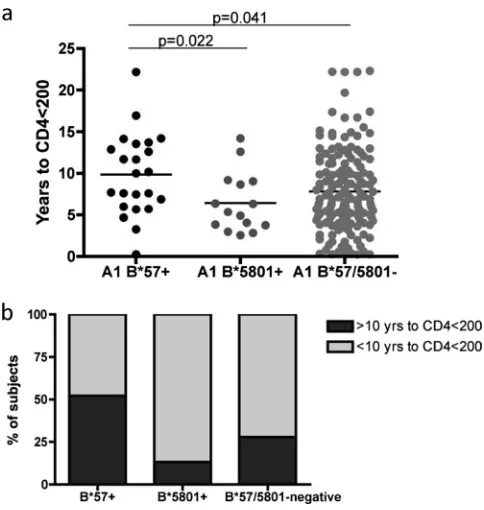
We confirmed the protective effects of HLA-B*57 in clade A1 infection (mean of 9.9 years versus 7.8 years until CD4 counts were⬍200,P⫽0.041) (Fig. 1). Slow progressors were overrepresented in HLA-B*57⫹ clade A1⫹subjects (52.2%) compared to both HLA-B*5801⫹clade A1⫹(13.3%,P⫽0.02) and HLA-B*57/5801-negative clade A1⫹(27.8%,P⫽0.028) subjects (Fig. 1b). In contrast to what has been shown for other clades (2, 27), protection was not observed for clade A1-in-fected HLA-B*5801⫹ subjects (mean of 6.5 years versus 7.8 years until CD4 counts were⬍200,P⬎0.3) (Fig. 1).
Stratification of TW10 (Gag240-249) proviral sequences on
the basis of HLA allele and clade revealed several differences in selection between clades A1 and D (Fig. 2a). We observed the expected T242N substitution in 100% of HLA-B*57⫹clade D-infected subjects (7/7), compared to only 14.7% variability at Gag residue 242 in HLA-B*57/5801-negative subjects (13/ 88,P⫽3.26⫻10⫺9) (Fig. 2b). In contrast, T242N was found
infrequently in clade A1-infected HLA-B*57⫹subjects (15%, 5/33,P⫽0.0004). Instead, variants containing the mutations P243T and I247L were more frequently observed (both ob-served in 11/33 subjects). Overall, variation at residues 243 and
247 was more common in HLA-B*57⫹subjects (51% and 15%, respectively;P⫽2.92⫻10⫺6) than in
HLA-B*57/5801-nega-tive clade A1⫹ subjects (33% and 9%, respectively; P ⫽
0.0008). Selection at both residues 243 and 247 was observed only in 2/33 HLA-B*57⫹subjects, suggesting that these muta-tions are independent. Selection at residue 248, observed in clade B infection (32), was not evident in either clade A1 or D. While I247X selection has been described in other clades at low frequencies and in elite controllers (21, 40), HLA-B*57-mediated selection at Gag residue 243 has not yet been de-scribed. In summary, the T242N mutation, which is typical of other clades, does not appear to be the primary escape mutant in clade A1.
Previous studies have suggested that HLA-B*5801 places selection pressure on TW10, similar to that of HLA-B*57 (35). Similar to clades B and C, selection of T242N was evident in HLA-B*5801⫹clade D-infected subjects (TW10 variation in 8/11 HLA-B*5801⫹ subjects versus 13/88 HLA-B*57/5801-negative subjects;P⫽0.0069) (Fig. 2c). Limited T242N selection was observed in clade A1-infected HLA-B*5801⫹subjects, and in contrast to HLA-B*57, there were no HLA-B*5801-associated substitutions at residues 243 and 247 in clade A1 (Pvalues of 0.75 and 0.29, respectively) (Fig. 2c). In summary, these data suggest that in addition to HLA-B*5801 not being associated with protection in clade A1 (Fig. 1), HLA-B*5801 does not select the HLA-B*57-associated clade A1 TW10 escape muta-tions.
Inclusion of all clade A1 sequences with T242X substitutions (regardless of the HLA allele) reveals that in every case (10/ 10), there is an accompanying residue 243 mutation. Polymor-phisms at these sites correlate very strongly (P⫽3.71⫻10⫺8)
(Fig. 2d). Together, these data suggest that residue 242 poly-morphism in clade A1 is incompatible with proline at residue 243, which is the clade A1 consensus.
We next assessed the immunological implications of novel clade A1 variants in HLA-B*57⫹(n⫽12) and -B*5801⫹(n⫽
6) subjects infected primarily by clade A1. Clade A1-infected subjects commonly made anamnestic, low-avidity responses to TW10. The majority of HLA-B*57⫹subjects who recognized clade A1 TW10 did not respond to P243T or I247L in ELISPOT assays (Fig. 3), supporting the hypothesis that these represent escape mutations. Those who did recognize P243T and I247L had lower magnitude responses than those who recognized clade A1 TW10 at the 10-g/ml peptide concen-tration (Pof 0.0005 for both) (Fig. 3a). Similarly, these variants were not well recognized by CD8⫹T cells from HLA-B*5801⫹ subjects (Fig. 3b). For two HLA-B*57⫹subjects, P243T and I247L responses had lower avidity than clade A1 TW10 re-sponses (Fig. 3c). These data support the hypothesis that P243T and I247L likely represent escape mutations.
[image:2.585.42.284.66.321.2]Recognition of the clade B/D consensus (TSTLQEQIGW) was diminished compared to that of clade A1 TW10. However, despite the presumed absence of this variant in these subjects’ autologous sequences, the clade B/D escape variant (TSNLQ EQIGW [T242N]) was recognized at a magnitude similar to that of the consensus clade A1 TW10 (r⫽0.71,P⫽0.0099) (Fig. 3d). No responses to T242N/G248A were observed (not shown), as described previously (32). These data suggest that clade A1 and B TW10, and their escape variants, are immu-nologically distinct from one another.
FIG. 1. HLA-B*57, but not HLA-B*5801, is associated with a lower rate of disease progression in clade A1-infected subjects than that of the overall cohort. (a) Number of years from cohort entry until sequential CD4 counts fell below 200/l. (b) Slow progressors (⬎10 years with CD4 counts of⬎200) were also more common in HLA-B*57⫹ clade A1-infected subjects than in those expressing HLA-B*5801 or neither.
on November 8, 2019 by guest
http://jvi.asm.org/
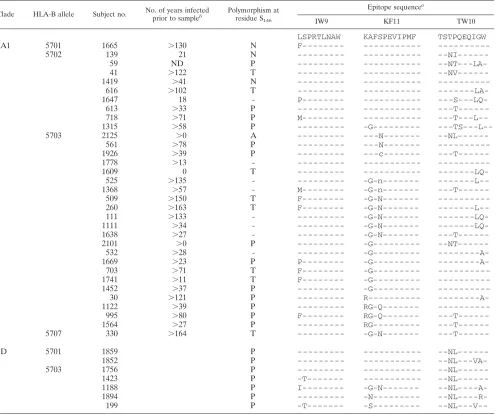
We next assessed whether clade-specific selection was evi-dent in other immunodominant HLA-B*57 p24 epitopes that are commonly targeted in chronic clade B infection (2). In clade D IW9 (ISPRTLNAW [Gag147-155]), variants containing the escape variant I147L (14) were more common in HLA-B*57⫹ subjects than in HLA-B*57/5801-negative subjects (86% and 30%, respectively;P⫽0.0055) (Table 1). However, this variant was not selected in clade A1 (variation in 30% versus 21% subjects;Pvalue was not significant), where leucine is the consensus. Interestingly, ELISPOT data indicated sub-stantial cross-reactivity between 147L and 147I in clade A1-infected subjects (10g/ml,r⫽0.987,P⬍0.0001) (data not shown), suggesting that infection with an escape variant from one clade (clade D) does not necessarily preclude recognition of this epitope in another one (clade A1). Other amino acids (F, M, and P) were common in HLA-B*57⫹subjects at residue 147 (⬎30% versus 3% in HLA-B*57/5801-negative subjects,
P⫽3.85⫻10⫺6). Although the immunological consequences
are unknown, these HLA-associated substitutions could repre-sent novel escape variants.
In addition, a substitution at Gag residue 146 (A146P)
rep-resents an IW9 processing escape mutation in clades B and C (14), and this mutation was also selected by HLA-B*57 in both clades A1 and D (Table 1). In clade A1, substitutions at Gag residue 146 (primarily P and T) were more frequent in HLA-B*57⫹ subjects than in HLA-B*57/5801-negative subjects (13/33 and 10/221, respectively;P⫽ 1.42⫻ 10⫺7) (Table 1).
Therefore, although the consensus at residue 146 differs among clades, here escape at residue 146 occurs in HLA-B*57⫹subjects infected by clades A1, B, C, and D.
For KF11 (KAFSPEVIPMF [Gag162-172]), HLA-B*57-associ-ated variation from the consensus was more common in clade A1 (67% versus 21%,P⫽2.44⫻10⫺7) than in clade D (43% versus
17%,P⫽0.012). Previously described A163G and A163G/S165N variants (13, 20) were most common in clade A1 (Table 1). In addition, the novel K162X substitution was present in clade A1. HLA-B*5703 and -B*5701 have previously been shown to display differences in KF11 selection (20, 47), and our data indicate that HLA-B*5702 also differs from HLA-B*5703 in terms of KF11 selection. While the KF11 consensus is present in the majority of HLA-B*5702⫹ subjects, it is rare in HLA-B*5703⫹ clade A1 infection (8/9 versus 2/22,P⫽4.74⫻10⫺5).
FIG. 2. HLA-B*57-mediated selection in TW10 differs between clade A1 and clade D. (a) TW10 sequences were stratified by HLA-B*57, HLA-B*5801, or other alleles (HLA-B*57/5801⫺) and compared between clades A1 and D, based on the clade B consensus TW10 sequence. Each subject is represented by one sequence, and the numbers of subjects with a given sequence are shown in parentheses. A summary of variation from the TW10 consensus at Gag residues 242, 243, 247, and 248 is shown for HLA-B*57⫹(b) and -B*5801⫹(c) subjects. (b and c) Clade D is shown at the top, and clade A1 is shown at the bottom. Variation is shown in dark gray, and consensus is shown in light gray. (d) The proportions of clade A1-infected subjects with selection at Gag residue 242 only, and those with selection at residues 242 and 243 in combination, are shown.ⴱ,P⬍
0.05;ⴱⴱ,P⬍0.005;ⴱⴱⴱ,P⬍0.0005.
on November 8, 2019 by guest
http://jvi.asm.org/
Mounting evidence suggests that HLA alleles are a major force in viral evolution (26). We show that in clade A1 p24, HLA-B*57 selection in three epitopes differs from earlier clade B and C data in several important aspects, while clade D selection resembles what has previously been shown. This in-cluded a low frequency of T242N in clade A1 TW10, with selection being more common at Gag residues 243 and 247, more extensive KF11 escape, and selection of different amino acids in IW9. Overall, selection was evident in the majority of HLA-B*57⫹subjects (⬎90% of clade A1-infected subjects had selection in more than one epitope, and⬎75% of them had selection in more than two) (Table 1). Parallel escape in mul-tiple epitopes demonstrates the need to avoid the pressure of CD8⫹T-cell responses.
One possible mechanism underlying the differences in TW10
selection is that TSNPQEQIGW (never observed) (Fig. 2d) is not feasible virologically, such that T242N is possible only in conjunction with a preexisting residue 243 mutation (TSNXQ EQIGW, observed in 15% of HLA-B*57⫹subjects) (underlin-ing shows mutation). One would expect to observe T242N at a higher frequency, given its dominance in HLA-B*57⫹subjects infected by other clades. Therefore, while T242N has been implicated in HLA-B*57-mediated protection, this mutation is rare in clade A1. Because HLA-B*57 remains protective in clade A1, that protection may be mediated by novel mecha-nisms.
Because TW10 is commonly recognized by 86% of clade A1 subjects, it is evident that clade A1 TW10 can bind HLA-B*57. We therefore hypothesize that TSTPQEQIGW may affect the interaction between epitope and cognate T-cell receptors,
FIG. 3. Peptides with novel TW10 clade A1-selected mutations are poorly recognized in ex vivo gamma interferon ELISPOT avidity assays, suggestive of escape mutations. ELISPOT responses to TW10 and variants at 10g/ml peptide by HLA-B*57⫹(a) and HLA-B*5801⫹(b) subjects are shown. (c) The functional avidity of TW10 and variants for two HLA-B*57⫹subjects is shown, suggesting that P243T and I247L are less recognized than TW10, particularly at lower peptide concentrations. Sequence names are described in the text. (d) Elispot responses to A1 TW10 and T242N correlated at 10g/ml. SFU/m, spot-forming units/million PBMCs.
on November 8, 2019 by guest
http://jvi.asm.org/
which in turn influences which escape mutations are optimal. This hypothesis is supported by our immunological data show-ing cross-reactivity between clade A1 TW10 and TSNLQE QIGW (underlining shows mutation), which imply that muta-tion at residue 242 may not lead to effective escape in clade A1 (Fig. 3d).
In contrast to other clades (including clade D), HLA-B*5801 does not appear to place selection pressure on clade A1 TW10. A previous study in Rwanda similarly showed that in clade A1, HLA-B*5703 but not HLA-B*5801 was associated with lower HIV viral loads (30). Therefore, HLA-B*5801 was associated with neither protection nor selection in clade A1 TW10. Our data also show that HLA-B*5702- and -B*5703-mediated KF11 selection differs, despite these alleles differing at only one codon. Similar findings have been published for HLA-B7 supertype alleles (31). These data highlight the differences in immunological pressure within HLA supertype alleles, even
though these alleles often present the same epitopes to the immune system.
Previous reports have suggested that HIV evolution can differ among clades for a variety of reasons. HLA-B*1503 differed in its protectiveness in clade B- and clade C-infected cohorts, and the apparent mechanism is broader recognition of subdominant epitopes, which remain intact due to limited se-lection where HLA-B*1503 is less common (17). Similarly, Yu et al. showed that differences in KF11 evolution between clades B and C were largely the result of differences in immu-nological features of HLA-B*5701- and -B*5703-restricted re-sponses, with the latter allele being more frequent in clade C-infected populations (47). The temporality of selection can also differ between clades; while TW10 and IW9 selection is similar between clade B and C, the order in which they are selected is opposite (12). Our data show that virological factors (i.e., sequence differences) can also lead to clade-specific
es-TABLE 1. p24 sequences in HLA-B*57⫹subjects infected by clades A1 and D
Clade HLA-B allele Subject no. No. of years infected
prior to sampleb Polymorphism at residue S146
Epitope sequencea
IW9 KF11 TW10
LSPRTLNAW KAFSPEVIPMF TSTPQEQIGW
A1 5701 1665 ⬎130 N F--- ---
---5702 139 21 N --- ---
--NI---59 ND P --- ---
--NT---LA-41 ⬎122 T --- ---
--NV---1419 ⬎41 N --- ---
---616 ⬎102 T --- ---
---LA-1647 18 - P--- ---
---S---LQ-613 ⬎33 P --- ---
---T---718 ⬎71 P M--- ---
---T---L--1315 ⬎58 P --- -G---
---TS---L--5703 2125 ⬎0 A --- ---N---
--NL---561 ⬎78 P --- ---N---
---1926 ⬎39 P --- ---c---
---T---1778 ⬎13 - --- ---
---1609 0 T --- ---
---LQ-525 ⬎135 - --- -G-n---
---L--1368 ⬎57 - M--- -G-n---
---T---509 ⬎150 T F--- -G-N---
---260 ⬎163 T F--- -G-N---
---L--111 ⬎133 - --- -G-N---
---LQ-1111 ⬎34 - --- -G-N---
---LQ-1638 ⬎27 - --- -G-N---
---T---2101 ⬎0 P --- -G---
--NT---532 ⬎28 - --- -G---
---A-1669 ⬎23 P P--- -G---
---A-703 ⬎71 T F--- -G---
---1741 ⬎11 T F--- -G---
---1452 ⬎37 P --- -G---
---30 ⬎121 P --- R---
---A-1122 ⬎39 P --- RG-Q---
---995 ⬎80 P F--- RG-Q---
---T---1564 ⬎27 P --- RG---
---T---5707 330 ⬎164 T --- -G-N---
---T---D 5701 1859 P --- ---
--NL---1852 P --- ---
--NL---VA-5703 1756 P --- ---
--NL---1423 P -T--- ---
--NL---1188 P I--- -G-N---
--NL----A-1894 P --- -N---
--NL----R-199 P -T--- -S---
--NL---V--a
The first row of epitope sequences shows the consensus sequences. b
ND, not done.
on November 8, 2019 by guest
http://jvi.asm.org/
[image:5.585.47.543.81.497.2]cape. Other reports have found few differences in evolution among clades, including no differences in HLA-A2 Gag SL9 escape among clades A, B, and D (25), so the presence of clade-specific evolution will depend on the epitope and allele under study.
Recent reports have suggested that Gag-specific CD8⫹ T-cell responses are protective in HIV infection (28), possibly because escape in Gag comes at a fitness cost. In support of this, infection by strains containing multiple Gag escape mu-tations was associated with lower set point viremia indepen-dent of HLA alleles in the recipients (21). One of the first demonstrations of Gag escape with fitness cost was T242N selection and reversion (32), and this substitution dominates in clade B- and clade C-infected HLA-B*57⫹subjects in numer-ous cohorts (5, 9, 10, 15, 32, 35, 38, 41). Our data show that while clade D follows clades B and C, HLA-B*57-mediated evolution in clade A1 differs not only in TW10 but also in other p24 epitopes. Knowledge of clade-specific escape pathways will be important for vaccines that aim to cover multiple clades, particularly where clades differ in immunologically critical epitopes.
We thank the study participants and staff at Majengo clinic (1985 to present) for their dedication and perseverance. Thanks to Melissa Herman for reviewing the manuscript and to many staff members at the University of Nairobi and University of Manitoba for their assis-tance and support.
This research was supported by grants from the National Institutes of Health (grant R01 AI56980 A1), the Canadian Institutes of Health Research (grant HOP-43135), the Bill and Melinda Gates Foundation, and the CIHR through the Grand Challenges in Global Health Initia-tive to F.A.P. F.A.P. is a Tier I Canada Research Chair in Suscepti-bility and Resistance to Infection. K.R.F. is supported by a National Salary Award from CIHR. L.R.M. is supported by the CIHR and CIHR/ICID National Training Program.
REFERENCES
1.Allen, T. M., M. Altfeld, S. C. Geer, E. T. Kalife, C. Moore, K. M. O’Sullivan, I. DeSouza, M. E. Feeney, R. L. Eldridge, E. L. Maier, D. E. Kaufmann, M. P. Lahaie, L. Reyor, G. Tanzi, M. N. Johnston, C. Brander, R. Draenert, J. K. Rockstroh, H. Jessen, E. S. Rosenberg, S. A. Mallal, and B. D. Walker.
2005. Selective escape from CD8⫹T-cell responses represents a major driv-ing force of human immunodeficiency virus type 1 (HIV-1) sequence diver-sity and reveals constraints on HIV-1 evolution. J. Virol.79:13239–13249. 2.Altfeld, M., M. M. Addo, E. S. Rosenberg, F. M. Hecht, P. K. Lee, M. Vogel,
X. G. Yu, R. Draenert, M. N. Johnston, D. Strick, T. M. Allen, M. E. Feeney, J. O. Kahn, R. P. Sekaly, J. A. Levy, J. K. Rockstroh, P. J. Goulder, and B. D. Walker.2003. Influence of HLA-B57 on clinical presentation and viral con-trol during acute HIV-1 infection. AIDS17:2581–2591.
3.Altfeld, M., E. T. Kalife, Y. Qi, H. Streeck, M. Lichterfeld, M. N. Johnston, N. Burgett, M. E. Swartz, A. Yang, G. Alter, X. G. Yu, A. Meier, J. K. Rockstroh, T. M. Allen, H. Jessen, E. S. Rosenberg, M. Carrington, and B. D. Walker. 2006. HLA alleles associated with delayed progression to AIDS contribute strongly to the initial CD8(⫹) T cell response against HIV-1. PLoS Med.3:e403.
4. Reference deleted.
5.Bailey, J. R., T. M. Williams, R. F. Siliciano, and J. N. Blankson.2006. Maintenance of viral suppression in HIV-1-infected HLA-B*57⫹elite sup-pressors despite CTL escape mutations. J. Exp. Med.203:1357–1369. 6.Barugahare, B., C. Baker, O. K’Aluoch, R. Donovan, M. Elrefaei, M. Eggena,
N. Jones, S. Mutalya, C. Kityo, P. Mugyenyi, and H. Cao.2005. Human immunodeficiency virus-specific responses in adult Ugandans: patterns of cross-clade recognition. J. Virol.79:4132–4139.
7.Bhattacharya, T., M. Daniels, D. Heckerman, B. Foley, N. Frahm, C. Kadie, J. Carlson, K. Yusim, B. McMahon, B. Gaschen, S. Mallal, J. I. Mullins, D. C. Nickle, J. Herbeck, C. Rousseau, G. H. Learn, T. Miura, C. Brander, B. Walker, and B. Korber.2007. Founder effects in the assessment of HIV polymorphisms and HLA allele associations. Science315:1583–1586. 8.Borrow, P., H. Lewicki, X. Wei, M. S. Horwitz, N. Peffer, H. Meyers, J. A.
Nelson, J. E. Gairin, B. H. Hahn, M. B. Oldstone, and G. M. Shaw.1997. Antiviral pressure exerted by HIV-1-specific cytotoxic T lymphocytes (CTLs)
during primary infection demonstrated by rapid selection of CTL escape virus. Nat. Med.3:205–211.
9.Brockman, M. A., A. Schneidewind, M. Lahaie, A. Schmidt, T. Miura, I. Desouza, F. Ryvkin, C. A. Derdeyn, S. Allen, E. Hunter, J. Mulenga, P. A. Goepfert, B. D. Walker, and T. M. Allen.2007. Escape and compensation from early HLA-B57-mediated cytotoxic T-lymphocyte pressure on human immunodeficiency virus type 1 Gag alter capsid interactions with cyclophilin A. J. Virol.81:12608–12618.
10.Chopera, D. R., Z. Woodman, K. Mlisana, M. Mlotshwa, D. P. Martin, C. Seoighe, F. Treurnicht, D. A. de Rosa, W. Hide, S. A. Karim, C. M. Gray, and C. Williamson.2008. Transmission of HIV-1 CTL escape variants provides HLA-mismatched recipients with a survival advantage. PLoS Pathog.
4:e1000033.
11.Coplan, P. M., S. B. Gupta, S. A. Dubey, P. Pitisuttithum, A. Nikas, B. Mbewe, E. Vardas, M. Schechter, E. G. Kallas, D. C. Freed, T. M. Fu, C. T. Mast, P. Puthavathana, J. Kublin, K. Brown Collins, J. Chisi, R. Pendame, S. J. Thaler, G. Gray, J. McIntyre, W. L. Straus, J. H. Condra, D. V. Mehrotra, H. A. Guess, E. A. Emini, and J. W. Shiver.2005. Cross-reactivity of anti-HIV-1 T cell immune responses among the major HIV-1 clades in HIV-1-positive individuals from 4 continents. J. Infect. Dis.191:1427–1434. 12.Crawford, H., W. Lumm, A. Leslie, M. Schaefer, D. Boeras, J. G. Prado, J. Tang, P. Farmer, T. Ndung’u, S. Lakhi, J. Gilmour, P. Goepfert, B. D. Walker, R. Kaslow, J. Mulenga, S. Allen, P. J. Goulder, and E. Hunter.2009. Evolution of HLA-B*5703 HIV-1 escape mutations in HLA-B*5703-positive individuals and their transmission recipients. J. Exp. Med.206:909–921. 13.Crawford, H., J. G. Prado, A. Leslie, S. Hue, I. Honeyborne, S. Reddy, M. van
der Stok, Z. Mncube, C. Brander, C. Rousseau, J. I. Mullins, R. Kaslow, P. Goepfert, S. Allen, E. Hunter, J. Mulenga, P. Kiepiela, B. D. Walker, and P. J. Goulder.2007. Compensatory mutation partially restores fitness and delays reversion of escape mutation within the immunodominant HLA-B*5703-restricted Gag epitope in chronic human immunodeficiency virus type 1 infection. J. Virol.81:8346–8351.
14.Draenert, R., S. Le Gall, K. J. Pfafferott, A. J. Leslie, P. Chetty, C. Brander, E. C. Holmes, S. C. Chang, M. E. Feeney, M. M. Addo, L. Ruiz, D. Ramduth, P. Jeena, M. Altfeld, S. Thomas, Y. Tang, C. L. Verrill, C. Dixon, J. G. Prado, P. Kiepiela, J. Martinez-Picado, B. D. Walker, and P. J. Goulder.2004. Immune selection for altered antigen processing leads to cytotoxic T lym-phocyte escape in chronic HIV-1 infection. J. Exp. Med.199:905–915. 15.Feeney, M. E., Y. Tang, K. Pfafferott, K. A. Roosevelt, R. Draenert, A.
Trocha, X. G. Yu, C. Verrill, T. Allen, C. Moore, S. Mallal, S. Burchett, K. McIntosh, S. I. Pelton, M. A. St John, R. Hazra, P. Klenerman, M. Altfeld, B. D. Walker, and P. J. Goulder.2005. HIV-1 viral escape in infancy followed by emergence of a variant-specific CTL response. J. Immunol.174:7524– 7530.
16.Fellay, J., K. V. Shianna, D. Ge, S. Colombo, B. Ledergerber, M. Weale, K. Zhang, C. Gumbs, A. Castagna, A. Cossarizza, A. Cozzi-Lepri, A. De Luca, P. Easterbrook, P. Francioli, S. Mallal, J. Martinez-Picado, J. M. Miro, N. Obel, J. P. Smith, J. Wyniger, P. Descombes, S. E. Antonarakis, N. L. Letvin, A. J. McMichael, B. F. Haynes, A. Telenti, and D. B. Goldstein.2007. A whole-genome association study of major determinants for host control of HIV-1. Science317:944–947.
17.Frahm, N., P. Kiepiela, S. Adams, C. H. Linde, H. S. Hewitt, K. Sango, M. E. Feeney, M. M. Addo, M. Lichterfeld, M. P. Lahaie, E. Pae, A. G. Wurcel, T. Roach, M. A. St John, M. Altfeld, F. M. Marincola, C. Moore, S. Mallal, M. Carrington, D. Heckerman, T. M. Allen, J. I. Mullins, B. T. Korber, P. J. Goulder, B. D. Walker, and C. Brander.2006. Control of human immuno-deficiency virus replication by cytotoxic T lymphocytes targeting subdomi-nant epitopes. Nat. Immunol.7:173–178.
18.Gao, X., A. Bashirova, A. K. Iversen, J. Phair, J. J. Goedert, S. Buchbinder, K. Hoots, D. Vlahov, M. Altfeld, S. J. O’Brien, and M. Carrington.2005. AIDS restriction HLA allotypes target distinct intervals of HIV-1 pathogen-esis. Nat. Med.11:1290–1292.
19.Geels, M. J., S. A. Dubey, K. Anderson, E. Baan, M. Bakker, G. Pollakis, W. A. Paxton, J. W. Shiver, and J. Goudsmit.2005. Broad cross-clade T-cell responses to Gag in individuals infected with human immunodeficiency virus type 1 non-B clades (A to G): importance of HLA anchor residue conser-vation. J. Virol.79:11247–11258.
20.Gillespie, G. M., G. Stewart-Jones, J. Rengasamy, T. Beattie, J. J. Bwayo, F. A. Plummer, R. Kaul, A. J. McMichael, P. Easterbrook, T. Dong, E. Y. Jones, and S. L. Rowland-Jones.2006. Strong TCR conservation and altered T cell cross-reactivity characterize a B*57-restricted immune response in HIV-1 infection. J. Immunol.177:3893–3902.
21.Goepfert, P. A., W. Lumm, P. Farmer, P. Matthews, A. Prendergast, J. M. Carlson, C. A. Derdeyn, J. Tang, R. A. Kaslow, A. Bansal, K. Yusim, D. Heckerman, J. Mulenga, S. Allen, P. J. Goulder, and E. Hunter.2008. Transmission of HIV-1 Gag immune escape mutations is associated with reduced viral load in linked recipients. J. Exp. Med.205:1009–1017. 22.Goulder, P. J., R. E. Phillips, R. A. Colbert, S. McAdam, G. Ogg, M. A.
Nowak, P. Giangrande, G. Luzzi, B. Morgan, A. Edwards, A. J. McMichael, and S. Rowland-Jones.1997. Late escape from an immunodominant cyto-toxic T-lymphocyte response associated with progression to AIDS. Nat. Med.
3:212–217.
on November 8, 2019 by guest
http://jvi.asm.org/
23.Goulder, P. J., and D. I. Watkins.2004. HIV and SIV CTL escape: impli-cations for vaccine design. Nat. Rev. Immunol.4:630–640.
24.Horton, H., I. Frank, R. Baydo, E. Jalbert, J. Penn, S. Wilson, J. P. McNevin, M. D. McSweyn, D. Lee, Y. Huang, S. C. De Rosa, and M. J. McElrath.2006. Preservation of T cell proliferation restricted by protective HLA alleles is critical for immune control of HIV-1 infection. J. Immunol.177:7406–7415. 25.Iversen, A. K., G. Stewart-Jones, G. H. Learn, N. Christie, C. Sylvester-Hviid, A. E. Armitage, R. Kaul, T. Beattie, J. K. Lee, Y. Li, P. Chotiyarnwong, T. Dong, X. Xu, M. A. Luscher, K. MacDonald, H. Ullum, B. Klarlund-Pedersen, P. Skinhoj, L. Fugger, S. Buus, J. I. Mullins, E. Y. Jones, P. A. van der Merwe, and A. J. McMichael.2006. Conflicting selective forces affect T cell receptor contacts in an immunodominant human immunodeficiency virus epitope. Nat. Immunol.7:179–189.
26.Kawashima, Y., K. Pfafferott, J. Frater, P. Matthews, R. Payne, M. Addo, H. Gatanaga, M. Fujiwara, A. Hachiya, H. Koizumi, N. Kuse, S. Oka, A. Duda, A. Prendergast, H. Crawford, A. Leslie, Z. Brumme, C. Brumme, T. Allen, C. Brander, R. Kaslow, J. Tang, E. Hunter, S. Allen, J. Mulenga, S. Branch, T. Roach, M. John, S. Mallal, A. Ogwu, R. Shapiro, J. G. Prado, S. Fidler, J. Weber, O. G. Pybus, P. Klenerman, T. Ndung’u, R. Phillips, D. Heckerman, P. R. Harrigan, B. D. Walker, M. Takiguchi, and P. Goulder.2009. Adap-tation of HIV-1 to human leukocyte antigen class I. Nature458:641–645. 27.Kiepiela, P., A. J. Leslie, I. Honeyborne, D. Ramduth, C. Thobakgale, S.
Chetty, P. Rathnavalu, C. Moore, K. J. Pfafferott, L. Hilton, P. Zimbwa, S. Moore, T. Allen, C. Brander, M. M. Addo, M. Altfeld, I. James, S. Mallal, M. Bunce, L. D. Barber, J. Szinger, C. Day, P. Klenerman, J. Mullins, B. Korber, H. M. Coovadia, B. D. Walker, and P. J. Goulder.2004. Dominant influence of HLA-B in mediating the potential co-evolution of HIV and HLA. Nature432:769–775.
28.Kiepiela, P., K. Ngumbela, C. Thobakgale, D. Ramduth, I. Honeyborne, E. Moodley, S. Reddy, C. de Pierres, Z. Mncube, N. Mkhwanazi, K. Bishop, M. van der Stok, K. Nair, N. Khan, H. Crawford, R. Payne, A. Leslie, J. Prado, A. Prendergast, J. Frater, N. McCarthy, C. Brander, G. H. Learn, D. Nickle, C. Rousseau, H. Coovadia, J. I. Mullins, D. Heckerman, B. D. Walker, and P. Goulder.2007. CD8⫹T-cell responses to different HIV proteins have discordant associations with viral load. Nat. Med.13:46–53.
29. Reference deleted.
30.Lazaryan, A., E. Lobashevsky, J. Mulenga, E. Karita, S. Allen, J. Tang, and R. A. Kaslow.2006. Human leukocyte antigen B58 supertype and human immunodeficiency virus type 1 infection in native Africans. J. Virol.80:6056– 6060.
31.Leslie, A., D. A. Price, P. Mkhize, K. Bishop, A. Rathod, C. Day, H. Craw-ford, I. Honeyborne, T. E. Asher, G. Luzzi, A. Edwards, C. M. Rousseau, J. I. Mullins, G. Tudor-Williams, V. Novelli, C. Brander, D. C. Douek, P. Kiepiela, B. D. Walker, and P. J. Goulder.2006. Differential selection pres-sure exerted on HIV by CTL targeting identical epitopes but restricted by distinct HLA alleles from the same HLA supertype. J. Immunol.177:4699– 4708.
32.Leslie, A. J., K. J. Pfafferott, P. Chetty, R. Draenert, M. M. Addo, M. Feeney, Y. Tang, E. C. Holmes, T. Allen, J. G. Prado, M. Altfeld, C. Brander, C. Dixon, D. Ramduth, P. Jeena, S. A. Thomas, A. St John, T. A. Roach, B. Kupfer, G. Luzzi, A. Edwards, G. Taylor, H. Lyall, G. Tudor-Williams, V. Novelli, J. Martinez-Picado, P. Kiepiela, B. D. Walker, and P. J. Goulder.
2004. HIV evolution: CTL escape mutation and reversion after transmission. Nat. Med.10:282–289.
33.Lewis, J. J., C. Ronsmans, A. Ezeh, and S. Gregson.2004. The population impact of HIV on fertility in sub-Saharan Africa. AIDS18(Suppl. 2):S35–S43. 34.Luo, M., C. R. Cohen, M. J. Narayansingh, S. Pan, L. McKinnon, R. C. Brunham, and F. A. Plummer.2004. Identification of a novel HLA-DQA1 null allele, DQA1*0403N, from an East African woman. Tissue Antigens
63:609–611.
35.Martinez-Picado, J., J. G. Prado, E. E. Fry, K. Pfafferott, A. Leslie, S. Chetty, C. Thobakgale, I. Honeyborne, H. Crawford, P. Matthews, T. Pillay, C. Rousseau, J. I. Mullins, C. Brander, B. D. Walker, D. I. Stuart, P. Kiepiela, and P. Goulder. 2006. Fitness cost of escape mutations in p24 Gag in
association with control of human immunodeficiency virus type 1. J. Virol.
80:3617–3623.
36.McKinnon, L. R., T. B. Ball, J. Kimani, C. Wachihi, L. Matu, M. Luo, J. Embree, K. R. Fowke, and F. A. Plummer.2005. Cross-clade CD8(⫹) T-cell responses with a preference for the predominant circulating clade. J. Acquir. Immune Defic. Syndr.40:245–249.
37.McKinnon, L. R., T. B. Ball, C. Wachihi, P. J. McLaren, J. L. Waruk, X. Mao, S. Ramdahin, A. O. Anzala, J. Kamene, M. Luo, K. R. Fowke, and F. A. Plummer.2007. Epitope cross-reactivity frequently differs between central and effector memory HIV-specific CD8⫹T cells. J. Immunol.178:3750– 3756.
38.Migueles, S. A., A. C. Laborico, H. Imamichi, W. L. Shupert, C. Royce, M. McLaughlin, L. Ehler, J. Metcalf, S. Liu, C. W. Hallahan, and M. Connors.
2003. The differential ability of HLA B*5701⫹long-term nonprogressors and progressors to restrict human immunodeficiency virus replication is not caused by loss of recognition of autologous viralgagsequences. J. Virol.
77:6889–6898.
39.Migueles, S. A., M. S. Sabbaghian, W. L. Shupert, M. P. Bettinotti, F. M. Marincola, L. Martino, C. W. Hallahan, S. M. Selig, D. Schwartz, J. Sulli-van, and M. Connors.2000. HLA B*5701 is highly associated with restriction of virus replication in a subgroup of HIV-infected long term nonprogressors. Proc. Natl. Acad. Sci. USA97:2709–2714.
40.Miura, T., M. A. Brockman, A. Schneidewind, M. Lobritz, F. Pereyra, A. Rathod, B. L. Block, Z. L. Brumme, C. J. Brumme, B. Baker, A. C. Rothchild, B. Li, A. Trocha, E. Cutrell, N. Frahm, C. Brander, I. Toth, E. J. Arts, T. M. Allen, and B. D. Walker.2009. HLA-B57/B*5801 human immunodeficiency virus type 1 elite controllers select for rare Gag variants associated with reduced viral replication capacity and strong cytotoxic T-lymphocyte recog-nition. J. Virol.83:2743–2755.
41.Navis, M., I. Schellens, D. van Baarle, J. Borghans, P. van Swieten, F. Miedema, N. Kootstra, and H. Schuitemaker.2007. Viral replication capac-ity as a correlate of HLA B57/B5801-associated nonprogressive HIV-1 in-fection. J. Immunol.179:3133–3143.
42.Peters, H. O., M. G. Mendoza, R. E. Capina, M. Luo, X. Mao, M. Gubbins, N. J. Nagelkerke, I. Macarthur, B. B. Sheardown, J. Kimani, C. Wachihi, S. Thavaneswaran, and F. A. Plummer.2008. An integrative bioinformatic approach for studying escape mutations in human immunodeficiency virus type 1gagin the Pumwani sex worker cohort. J. Virol.82:1980–1992. 43.Rambaut, A., D. Posada, K. A. Crandall, and E. C. Holmes.2004. The causes
and consequences of HIV evolution. Nat. Rev. Genet.5:52–61.
44.Rousseau, C. M., G. H. Learn, T. Bhattacharya, D. C. Nickle, D. Heckerman, S. Chetty, C. Brander, P. J. Goulder, B. D. Walker, P. Kiepiela, B. T. Korber, and J. I. Mullins. 2007. Extensive intrasubtype recombination in South African human immunodeficiency virus type 1 subtype C infections. J. Virol.
81:4492–4500.
45.Turnbull, E. L., A. R. Lopes, N. A. Jones, D. Cornforth, P. Newton, D. Aldam, P. Pellegrino, J. Turner, I. Williams, C. M. Wilson, P. A. Goepfert, M. K. Maini, and P. Borrow.2006. HIV-1 epitope-specific CD8⫹T cell responses strongly associated with delayed disease progression cross-recognize epitope variants efficiently. J. Immunol.176:6130–6146.
46. Reference deleted.
47.Yu, X. G., M. Lichterfeld, S. Chetty, K. L. Williams, S. K. Mui, T. Miura, N. Frahm, M. E. Feeney, Y. Tang, F. Pereyra, M. X. Labute, K. Pfafferott, A. Leslie, H. Crawford, R. Allgaier, W. Hildebrand, R. Kaslow, C. Brander, T. M. Allen, E. S. Rosenberg, P. Kiepiela, M. Vajpayee, P. A. Goepfert, M. Altfeld, P. J. Goulder, and B. D. Walker.2007. Mutually exclusive T-cell receptor induction and differential susceptibility to human immunodefi-ciency virus type 1 mutational escape associated with a two-amino-acid difference between HLA class I subtypes. J. Virol.81:1619–1631. 48.Yu, X. G., M. Lichterfeld, B. Perkins, E. Kalife, S. Mui, J. Chen, M. Cheng,
W. Kang, G. Alter, C. Brander, B. D. Walker, and M. Altfeld.2005. High degree of interclade cross-reactivity of HIV-1-specific T cell responses at the single peptide level. AIDS19:1449–1456.