Original article
Increasing temperature causes
fl
owering onset time changes of alpine
ginger
Roscoea
in the Central Himalayas
Dharmalingam Mohandass
a, Jian-Li Zhao
a, Yong-Mei Xia
a, Mason J. Campbell
b,
Qing-Jun Li
a,*aKey Laboratory of Tropical Forest Ecology, Xishuangbanna Tropical Botanical Garden, Chinese Academy of Sciences, Menglun Town, Mengla County,
Yunnan, PR China
bCenter for Tropical Environmental and Sustainability Science, School of Marine and Tropical Biology, James Cook University, Cairns, Queensland, Australia
a r t i c l e i n f o
Article history: Received 29 April 2015 Received in revised form 1 August 2015 Accepted 1 August 2015 Available online 18 August 2015
Keywords: climate change flowering phenology global warming
herbarium-based phenology Zingiberaceae
a b s t r a c t
Recent herbarium-based phenology assessments of many plant species have found significant responses to global climate change over the previous century. In this study, we investigate how the flowering phenology of three alpine gingerRoscoeaspecies responses to climate change over the century from 1913 to 2011, by comparing between herbarium-based phenology records and directflowering observations. According to the observations,flowering onset of the three alpine ginger species occurred either 22 days earlier or was delayed by 8e30 days when comparing the mean peak flowering date between herbarium-based phenology records and directflowering observations. It is likely that this significant change inflowering onset is due to increased annual minimum and maximum temperatures and mean annual temperature by about 0.053C per year. Our results also show thatflowering time changes occurred due to an increasing winterespring minimum temperature and monsoon minimum temper-ature, suggesting that theseRoscoeaspecies respond greatly to climate warming resulting in changes on
flowering times.
CopyrightÓ2015, National Science Museum of Korea (NSMK) and Korea National Arboretum (KNA). Production and hosting by Elsevier. This is an open access article under the CC BY-NC-ND license (http:// creativecommons.org/licenses/by-nc-nd/4.0/).
Introduction
Historical herbarium records of plant phenology data have been used as a tool to determine climatic changes in tropical and temperate regions over the past century (Calinger et al 2013; Gaira et al 2011; Hart et al 2014; Holle et al 2010; Primack et al 2004; Robbirt et al 2011; Schwartz 1999). However, comparing direct flowering observation of current individual species with historic herbarium phenology records has rarely been used in either trop-ical or temperate regions (Hart et al 2014; Rawal et al 2014; Robbirt et al 2011). It has been suggested (Miller-Rushing et al 2006) that assessing long-term datasets of a single speciesflowering dates may be an unreliable way of assessingflowering time changes by climate change (Amano et al 2010; Bock et al 2014; Robbirt et al 2011). Conversely, using long-term herbarium records of the change inflowering times of multiple species has been suggested as
an appropriate predictor for the analysis offlowering time changes in response to climate change (Gaira et al 2011; Miller-Rushing et al 2006; Primack et al 2004). Additionally, phenological changes have recently been shown to impact interspecific interactions and evolutionary processes (Bradshaw and Holzapfel 2001; Harrington et al 1999; Inouye et al 2000; Primack et al 2004; Visser and Holleman 2001), withflowering time considered the most sensi-tive indicator of these in herbaceous species (Tilman and El Haddi 1992; Walker et al 1999). Here we focus on Himalayan alpine ginger species, comparing herbarium-based historic data and direct flowering observations. An earlier study of Himalayan alpine gin-gers in the Trans Himalayas has occurred on individual species; however, they only compared historic herbarium records and did not focus on directflowering observation due to the lack of such data sets (Gaira et al 2011).
In highland forests, significantly increased temperatures due to climate change are known to affect herbaceous forest species (Bertrand et al 2011). Therefore, some highland mountainous forest species may be more sensitive to climate change than their lowland forest species equivalents. Moreover, a trend of significantly increased warming has been found in higher elevations when *Corresponding author. Tel.:þ86-871-68125332.
E-mail address:[email protected](Q.-J. Li).
Peer review under responsibility of National Science Museum of Korea (NSMK) and Korea National Arboretum (KNA).
H O S T E D BY Contents lists available atScienceDirect
Journal of Asia-Paci
fi
c Biodiversity
j o u rn a l h o m e p a g e : h t t p : / / w w w . e l s e v i e r . c o m / l o c a t e / j a p b
http://dx.doi.org/10.1016/j.japb.2015.08.003
compared with lower elevations in the Himalayas and Tibet Plateau (Liu and Chen 2000). According to the Intergovernmental Panel on Climate Change, the global temperature will rise to 1e3.5C by 2100 (IPCC 1996). Additionally, temperature trends in Nepal have shown a general warming over the period 1977e1994 (Shrestha et al 1999); however, the significant temperature differences were found during the winter season with less difference in the monsoon season. Furthermore, recent studies have found average tempera-ture increases at higher elevations of the Himalayas (Sharma et al 2009; Shrestha et al 2012).
In the Central Himalayas, alpine plant communities are found in high elevation temperate regions, which are dominated by alpine pine andQuercus. Within these alpine plant communities,Roscoea
is the only alpine ginger genus and is distributed from Kashmir through the Himalayas to Vietnam, extending northwards into China (Cowley 1982; Cowley 2007; Wu et al 1994), with some species found in north-eastern India (Cowley 2007). There are about 23 recognized species ofRoscoea, eight of which are endemic to China (Wu et al 1994), three endemic to Nepal, and one each to Bhutan and India (Cowley 2007; Mao and Bhaumik 2007).Roscoea
likely dispersed from northern India to Kashmir and then to the Eastern Himalayas and Sikkim, Bhutan and then on to Tibet, Yunnan, and Sichuan Province. Surprisingly, there are no records of populations in-between Bhutan and China. This disjunction in distribution is likely a dearth of favorable climatic conditions in this region due to the uplift taking place as a result of the collision between the Indian and Asian tectonic plates (Ngamriabsakul et al 2000; Zhao et al 2015).
A number of studies have detailed the taxonomy, history, evo-lution and phylogeny, and reproductive biology ofRoscoeain the Himalayas and China (Cowley 1982; Fan and Li 2012; Ngamriabsakul et al 2000; Wu et al 1994; Zhang and Li 2008; Zhang et al 2011). This genus is highly specialized in its micro-habitat requirements and therefore threatened due to human disturbance factors such as clearing the forest for road formation and habitat destruction for mine production. These disturbances are major threats to the population and may lead to the extinction of some species.
Roscoea generally occur in the alpine montane belt within a colder climatic regime with the genera likely originating from the current Himalayan and Chinese Clade (Ngamriabsakul et al 2000). Thus, it has been suggested that Roscoeaflowering is adapted to occur under low temperatures and high humidity in the higher elevation regions of the alpine zone. Another reason for this sug-gestion is that, they occur inQuercus, pine and Rhododendron-oak forest and display plant growth, phenology, and shade tolerance conditions adapted to these environments. Therefore, we predict thatRoscoea might be highly sensitive to changes in the annual minimum temperature and seasonal minimum temperature. Pre-vious studies in recent years have indicated changes in minimum temperature may cause a delay in the onset offlowering time (Holle et al 2010). In Nepal, temperature has displayed an increasing trend, with air temperature increasing by 1.5C over 25 years and the mean annual temperature increasing 0.06C per year (Shrestha et al 2012). It is therefore important to understand howRoscoeafl ow-ering responds to climate warming through long-term herbarium phenology records (HPR) and through direct flowering observa-tions (DFO).
As mentioned, in recent times, studies using HPR have shown significant changes in plantflowering times due to climatic change (Gaira et al 2011; Holle et al 2010; Lavoie and Lachance 2006; Miller-Rushing et al 2006; Primack et al 2004). Some of these studies have demonstratedflowering events are occurring earlier, whilst others have shown a delayed onset due to climate change over the past century (Gaira et al 2011; Holle et al 2010; Primack
et al 2004). Additionally, one of these studies inferred that decreasing spring temperature and precipitation caused delayed flowering times (Crimmins et al 2010). As such, in this study we investigate whetherflowering times in threeRoscoeaspecies of the Central Himalayas have changed due to increasing maximum, minimum temperature, and seasonal temperature (Bradshaw and Holzapfel 2001; Fitter and Fitter 2002; Gaira et al 2011; Holle et al 2010; Menzel and Fabian 1999). For this study, we examined flowering data from HPR dated 1913 to 2007 and compared them with direct observations of flowering times in 2009 and 2011. However, this study only focused on the phenology of the herbar-ium specimens by examining mean flowering dates across the herbarium specimens. We tested the following predictions and questions: (1) does theRoscoeaflowering time change in response to increasing temperature, including minimum, maximum, average temperature, and seasonal temperatures?; and (2) how does the relationship betweenRoscoea flowering dates, months, and year vary based on a comparison between the HPR and DFO records?
Materials and methods
Study areas and species
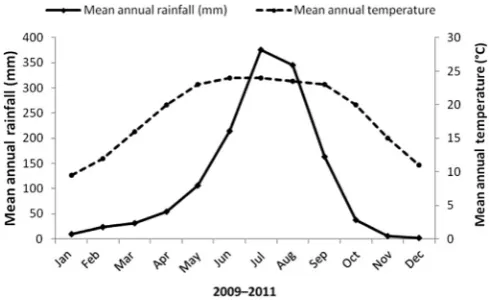
The Central Himalayas are located in the central part of north and south-western Nepal and cover the area from 2659’N and 8452’E in the south to 2818’N and 8533’E in the north (Figure 1). The mean annual temperature of the study area is 19.840.08C and the mean maximum temperature is 27.520.30C and the mean minimum annual temperature is 12.90.19C. The average winter and spring temperatures are 11.580.15C over 40 years, from 1970 to 2011. The mean annual rainfall of the area is 1572 mm with 80% of the total rainfall occurring in the period JuneeSeptember (Figure 2). In the central Himalayas, different seasons such as spring (FebruaryeApril), summer (Mayemid-June), rainy (mid-Junee mid-September), autumn (mid-SeptembereNovember), winter (DecembereJanuary), and monsoon types were classified as pre-monsoon, pre-monsoon, and postmonsoon according to Nepal tem-perature reconstruction data in Kathmandu, Nepal (Cook et al 2003; Shrestha et al 1999). Two vegetation types are common in the study area; oak forest and pine forest and both exist in sandy, silty, and clay loam soil types. The soils found under both vegetation types are slightly acidic in nature, but oak forests are found on areas with higher nutrients compare to those of pine forests (Sheikh and Kumar 2010).
[image:2.595.304.550.580.714.2]The study focused on three Roscoea species:Roscoea alpinia Royle, Roscoea capitata Sm, and Roscoea purpurea Sm. belongs to family Zingiberaceae.
Roscoea alpinia: Perennial, rhizomatous, and tuberous rooted herb from 6e12 cm to 20e30 cm tall. Leaves atflowering time usually one to two and underdeveloped. Distributions: India, Kashmir, 2440 m, Nepal 2400e3960 m. General flowering period in Nepal: MayeJune (Cowley 1982, 2007).
Roscoea capitata:Perennial, rhizomatous, and tuberous rooted herb to 45 cm tall. Distributions; India and Nepal, 1220e2600 m. Flowering period from June to September (Cowley 1982, 2007).
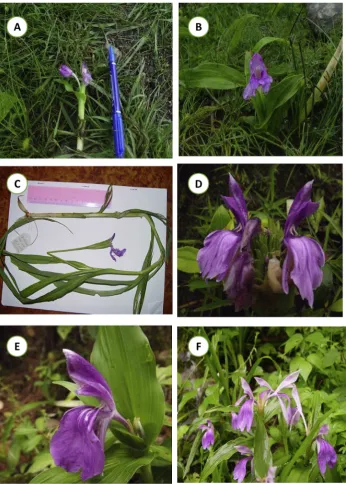
Roscoea purpurea: Perennial, 25e38 cm tall,flowers light purple, mauve, lilac, pink, red, white, or white with purple markings, usually flower opens in the morning. Distribution: India and Nepal, 1700e2700 m. Flowering period from end of June to September (Cowley 1982, 2007). All threeRoscoeaspecies were photographed (Figure 3) through DFO.
Many of the sites sampled for flowering observation were disturbed by various human activities such as construction and extension of roads, agricultural land establishment, land use changes, and ecotourism development. PreferentialRoscoeahabitat is mostly south-north facing slopes of Rhododendron-oak forest where they are often found near forest edges due to shade toler-ance; however, they do also occur nearby roadsides in grasslands at higher elevations (2600 m).
Data collection
Field surveys of DFO periods were carried out from July 2009 to August 2009 and from June to July 2011 at 13 sites in the Central Himalayas. From these sites, differentflowering populations were observed, and altitude, latitude, and longitude were recorded using a Geographical Positioning System (seeAppendix 1). Prior tofield observations, we collected the herbarium records information of
Roscoeadistributions from the National Herbarium and Plant Lab-oratories, Godavari, near Kathmandu, whose collections date back to 1913. For example, some of the oldest specimens of Roscoea
species were deposited by R.E. Cooper, A.K. Bulley Esq. Cheshire, on July 30, 1913. We gathered information on the long-term history of herbarium phenological records through qualitative assessments of theRoscoeaherbarium collections over the period dated 1913e 2007. However, we did not collect herbarium specimens during this study. We utilized as a tool the HPR, which is a well-known com-parison tool for climate change and has previously be used in several recent studies (Holle et al 2010; Gaira et al 2011; Miller-Rushing et al 2006; Primack et al 2004). Using HPR, we recorded: the distribution of altitude ranges, date of flowering, place of specimen collection, accession number, and the locality ofRoscoea
species from the herbarium records. As mentioned, our DFOfield survey occurred during two periods in the years 2009 and 2011, and was performed at many different locations across the central Himalayas.
A total of 134 herbarium records were analyzed, covering 54 sites, and a time period of 1913e2007. Roscoeaflowering dates, place of collection, accession number, and altitude were recorded from these herbarium records. Twenty-oneflowering populations were observed (DFO) over 13 sites during 2009 and 2011, whilst an additional 24 populations were observed in a vegetative state (not flowering) during June and July infive sites and samples were collected and photographed withflowering condition noted. Three
Roscoeaspecies were identified and confirmed throughfloral key characters using the National Herbarium and Plant Laboratories, Kathmandu and the reviewdThe genusRoscoea(Cowley 2007).
The number of HPR from 1913e2007 and the number of DFO from 2009 and 2011 were used for further analysis. We calculated the frequency of HPR and DFO records in order to show the dis-tribution offlowering records over a century. We gathered mean annual maximum and minimum temperature from the period 1970 to 2011 and rainfall data from 1975 to 2011 using the online climate data provided at http://www.ncdc.noaa.gov/cdo-weband http:// www.geodata.us/weather.
Data analysis
The mean annual temperature, mean maximum annual tem-perature, and mean minimum annual temperature were regressed with year from 1970 to 2011 (total 41 years) to see whether a warming signal occurred in the Central Himalayas. The relationship between flowering season of blooming dates and mean spring temperature were tested using simple linear regression. Flowering months and dates based on HPR and DFO were regressed with
Roscoeaflowering year over a century from 1913 to 2011. Flowering dates based on HPR and DFO was regressed withRoscoeaflowering year over a century. We also regressed betweenflowering dates and months based on HPR and DFO, in order tofind out current initial flowering time. Mean annual precipitation and seasonal precipi-tation were regressed for 37 years to examine whether the pre-cipitation had changed over that time period. The maximum and minimum temperature (C) of various seasons such as winter and spring, premonsoon, monsoon, and postmonsoon was tested using a Spearman’s Correlation Coefficient. In order to examine variation in the number of blooming days this variable was compared with HPR and DFO using meanflowering dates over a century from 1913 to 2011. The normal flowering dates (Gregorian calendar) were converted into Julian date (Holle et al 2010) to test for statistical differences in the mean value (t test) and standard deviation (f
statistic) for each of the threeRoscoeaspecies. Julian dates were used to prevent differences that may occur in the herbarium re-cords due to the calendars used (as occurs for computer program-ming (Ohms 1986). One-way analysis of variance was used to test for significant differences betweenRoscoeaflowering distributions at different sites, years, and flowering dates. This statistical tests were performed using the software SPSS version 17.0 (SPSS Inc., Chicago, IL, USA).
Results
Flowering records of HPR and DFO
[image:3.595.45.290.65.215.2]ThreeRoscoeaspecies were analyzed using both HPR and DFO records from 176 collections over a century. Of these records, 134 were HPR and 45 DFO (as observed from various sites;Figure 4; Appendix 1). Herbarium-based records showed that the frequency
Figure 2.Mean annual rainfall and temperature over the period 2009e2011 for the
of collection at the different sites changed across the period 1913e 2007 and that DFO occurred at 15 sites in 2009 and 30 sites in 2011. The maximum herbarium collection occurred over the period 1964e1993 during which almost 66% (89 records) of the herbarium collections were made. Most of the specimen collection occurred across an elevational ranges from 1500 m to 4000 m above sea level. Additionally, there was no significant change in the eleva-tional distribution of theRoscoeacollections (R2¼0.001, df¼144, nonsignificant) over a century, with collections consistently occurring at medium and higher elevations.
Effect of temperature and rainfall
[image:4.595.120.467.64.549.2]Mean annual temperature increased significantly over the period 1970e2011 (R2¼0.30, df¼40, p¼0.0002; Figure 5), the
Figure 3.Photographs of early and delayfloweringRoscoeataken during thefield surveys during years 2009 and 2011. A, B,Roscoea alpiniaplant; B,R. alpiniaflower; C. herbarium collection ofRoscoea capitata; D,R. capitatawithflowers; E, earlyflowering date ofRoscoea purpurea; and F, peakflowering date ofR. purpurea.
Figure 4.Frequency offlowering records for the three examinedRoscoeaspecies over the years 1913e2011 based on herbarium phenology records and directflowering
[image:4.595.36.281.591.710.2]warming trend showed average temperature increases of 0.053C per year from 1970e2011. Moreover, minimum temperature increased significantly over the study period byw0.8C (R2¼0.20,
df¼40,p¼0.001;Figure 6). Analogously, maximum temperature displayed a significant warming signal over the study period, increasing by 0.7C (R2¼0.12,df¼40,p¼0.02,Figure 7).
Daily temperature, as analyzed by seasons, showed a significant mean monthly minimum temperature increase over the study period for the seasons of winter and spring (r¼0.44,p<0.005) as it did for the monsoon minimum temperature (r¼0.44,p<0.004; Table 1). Thisfinding indicates a significant increase in the mini-mum temperature during the winter and spring seasons; which could delay theflowering. However,Roscoeausuallyflowers during the monsoon period, but the increased minimum temperature during the monsoon could delay the onset offlowering.
There was a significant increase in the mean spring temperature along with the initialRoscoeaflowering date (from May to October;
R2¼0.08, df¼90, p¼0.004; Figure 8), indicating that Roscoea
exhibited a delayedflowering onset across the examined century.
Mean annual rainfall significantly increased over the examined 37 years (R2¼0.17,df¼36,p¼0.01); however, this appears to be driven by the significant increase in monsoonal precipitation (from June to September) over the years from 1975e2011 (regressionfit with adjustedR2¼0.11,df¼36,p¼0.04). The percentage of annual rainfall received during the monsoon ranged from 68% to 86% over the examined 37 years.
Flowering onset time changes based on HPR and DFO
According to our observation, the mean peakflowering date of
Roscoeaspecies differed between the HPR and DFO analyses across the three species. Among these, theflowering onset ofR. alpinia
differed by a delay of 30 days between HPR and DFO, whereas
R. capitata blooming time had a difference of an 8-day delay (Table 2). The peak flowering period of R. purpurea was not observed during DFO; however, thefirst day offlowering for this species in Daman was observed to occur on June 2, 2011 (although only 2 individuals were observedflowering from the 7 populations) and peakflowering occurred in July 2011. Therefore, two species,
[image:5.595.55.286.66.239.2]R. alpiniaandR. capitata, showed a delayedflowering onset trend ranging from 8 days to 30 days across an examined century. However, R. purpurea was found to exhibit an earlier flowering onset of 22 days across the examined century. Additionally, the Julian date offlowering for each species showed significant varia-tion when comparing HPR and DFO records (Table 3). Therefore, the flowering date of each species significantly varied over the exam-ined century.
Figure 5.Relationship between mean annual temperature and year over the period 1970e2011 in the Central Himalayas. A significant positive trends shows temperature
[image:5.595.321.554.69.240.2]occurring over the examined time period (R2¼0.30, df¼40,p<0.0002).
Figure 6.Relationship between mean minimum annual temperature and year for the studied period 1970e2011 in the Central Himalayas. A significant positive trends
shows minimum annual temperature increased over the examined time period (R2¼0.20, df¼40,p<0.001).
Figure 7.Relationship between mean maximum annual temperature and year over the period 1970e2011 in the Central Himalayas. A significant positive trends shows
temperature increasing over the examined time periods (R2¼0.12, df¼40,p<0.02).
Table 1. Spearman’s correlation coefficient between seasonal temperatures (maximum and minimum) at high elevations (>1500 m above sea level) over the years 1975e2011. Significant correlations are associated with early and delay onset
offlowering inRoscoea.
Season Temperature (C)
Maximum N¼37
Minimum N¼37
Winter & spring 0.20 0.44*
Premonsoon 0.39y 0.11
Monsoon 0.31z 0.44*
Postmonsoon 0.001 0.41*
[image:5.595.47.286.527.702.2]Variation offlowering sequence among sites
According to HPR and DFO records, the observation of the initial flowering time for the examinedRoscoeaspecies differed signifi -cantly between the examined sites(F¼9.04,df¼5,p<0.05) and their year of collection (F¼12.57, df¼5, p<0.01). Moreover, flowering time (Julian date offlowering) varied significantly over the examined century(F¼7.92,df¼5,p<0.05;Table 4).
Flowering time changes on Roscoea species
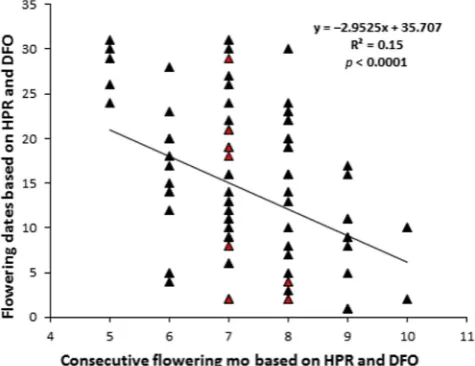
The initial flowering months and dates did not significantly changes over the period 1913e2011, however delayed blooming did occur over the last decade (Figure 9). Theflowering dates of HPR and DFO records significantly changed with number of years from 1913 to 2011(R2¼0.05,df¼106,p<0.03;Figure 10), indicating a delay inflowering dates across the examined century. The initial flowering dates of HPR and DFO records significantly declined along with consecutive months of flowering over the examined
time period (R2¼0.15, df¼106, p<0.0001; Figure 11), thus, showing a delay inflowering onset time period.
Discussion
Flowering time changes due to increasing temperature
[image:6.595.34.280.66.252.2]Recent studies using herbarium-based flowering assessments have shown thatflowering time in a variety of plant species have changed significantly due to climate change (Gaira et al 2011; Holle et al 2010; Miller-Rushing et al 2006; Primack et al 2004). In particular, increasing temperature has created rapid changes in different types of weather events over the past 50 years at the global level (Jump et al 2009). Holle et al (2010)suggested that increased temperature changed the timing offlowering frequency, characterized either by earlier or delayedflowering.Primack et al (2004)used 372 herbarium species and found earlier flowering responses to climate change, with similar results from other studies suggesting that this early-flowering is due to increasing tempera-ture over time (Gaira et al 2011; Gallagher et al 2009;Lavoie and Lachance 2006; Robbirt et al 2011). Recent studies have found a mean warming trend increases in the Himalayas 1.5C and at an average rate of 0.06C per year; however, the highest temperature increases were recorded in the winter season 1.7C and lowest in the summer 0.75C (Shrestha et al 2012). Thefindings of this study
Figure 8.Relationship between initialflowering date offlowering season and mean spring temperature 1970e2011 in the Central Himalayas. A significant positive trends
[image:6.595.301.553.95.163.2]shows delayedflowering occurring as mean spring temperature increased (R2¼0.084, df¼91,p<0.004).
Table 2.Mean peakflowering date of herbarium phenology records (1913e2007)
and directflowering observation (2009e2011) of the three examinedRoscoea
spe-cies in the Central Himalayas.
Species names Mean peakflowering date Mean number of flowering d earlier (þ) and delayed () Herbarium
phenology records
Directflowering observation
Roscoea alpinia 6thJuly 4thAugust 30
Roscoea capitata 15thJuly 22ndJuly 8
Roscoea purpurea 12thAugust 20thJuly þ22
Table 3.Comparison of mean and standard deviation of Julian date difference be-tween herbarium phenology records (1913e2007) and directflowering observation
(2009e2011) indicating significant differences inflowering time over the examined
time period for the threeRoscoeaspecies in the Central Himalayas.
Species names Julian date difference ttest N p Fstatistic p
[image:6.595.309.545.492.676.2]Roscoea alpinia 12797.14 4.17 36 0.0002 438.590 0.001 Roscoea capitata 14584.92 6.41 20 0.0001 345.618 0.001 Roscoea purpurea 13453.41 7.70 62 0.0001 181.484 0.001
Table 4.Analysis of variance was used to compare the different sources of variation between the herbarium phenology records and directflowering observation in three Roscoeaspecies from Central Himalayas.
Source of variation df SS F p*
Site 5 1819.5 9.04 0.040
Year 5 764.83 12.57 0.024
Flowering time (Jd) 5 2169.5 7.92 0.048
Sitey 8 2057.56 5.31 0.047
Siteflowering time (Jd) 8 2350.22 5.61 0.042
Yflowering time (Jd) 8 1954.89 5.81 0.039
Df¼degree of freedom; Jd¼Julian date offlowering between 1913e2011; SS¼sum
of squares.
* Allp-values are significant level at an alpha level of<0.05.
[image:6.595.32.283.566.641.2] [image:6.595.32.284.698.742.2]indicate that Roscoea flowering times have changed due to increasing seasonal temperature. Our results also suggest that winter and spring temperature increases are the major causes of flowering time changes (earlier or delayed).
Shrestha et al (2012)demonstrated that when the timing of the “start of the seasons” exhibited a negative trend, flowering occurred earlier and when they exhibited a positive trendsfl ow-ering was delayed. According to our results, flowering seasons showed a significant positive trend, with mean spring temperature, resulting in a delayed pattern ofRoscoeaflowering season when examining the period mid-July in 2009 and 2011 compared with herbarium records from 1913 to 1999, of whenflowering starts from mid-May to June.
Flowering time changes based on HPR and DFO
The present study utilized 134 herbarium specimens from 36 years (1913e2007) across a century, and DFO from 2 years (2009 and 2011) and found thatflowering time varied significantly, with an earlier and delayed flowering signal due to increasing mini-mum temperature and spring temperature. Notably,Roscoea spe-cies significantly responded to increased minimum temperature and mean spring temperature rather than maximum temperature under the local environmental conditions. Recent studies indicate that increased spring temperatures either advance or delay the date offirstflowering (Crimmins et al 2010; Dunnell and Travers 2011). Additionally,Holle et al (2010)noted thatflowering time was strongly delayed by variable minimum temperature across 345 species and also found that Julian date offlowering signifi -cantly increased in response to a rise in average temperature. In the Trans-Himalayas, Aconitum heterophyllum flowered earlier (19e27 days) with increased overall temperature ofw1oC (Gaira et al 2011), whereas we found that Roscoea’s flowering time occurred earlier (22 days) and delayed (8e30 days) with increasing average temperature 0.053C per year (1970e2011). However, it must be noted that higher elevationsflowering may also be delayed due to local environmental disturbance and severe drought (Gaira et al 2011). Therefore, ongoing increasing tem-perature linked to current climatic changes may also increase drought stress which may cause a negative impact on Roscoea
species distributions, with elevated mortality and declining plant reproduction.
Furthermore, Körner (2003) has suggested that some alpine plant groups such asPrimulaceae,Ranunculaceae, andCyperaceae
species areflowering earlier, and species ofAsteraceaeand Cam-panulaceae are experiencing a flowering delay in response to climate change. Previous studies have suggested that a delay in flowering may result in plants producing high seed output but the seeds have a reduced rate of maturing because of time constraints; therefore those plants experience higher levels of selfing and apomixis (Körner 2003). Similarly, recent Roscoea reproductive biology studies indicates several species breeds through self-pollination under natural conditions (Zhang and Li 2008, Zhang et al 2011), whilst a recent new discovery found a delayed polli-nation mechanism onRoscoea debilisthrough self-pollination (Fan and Li 2012). However, long-term studies are necessary to under-stand whetherRoscoeadelayflowering affects reproductive success through seed germination and reproductive success.
Alpine gingers in the generaRoscoeaare highly specialized, as are the alpine plant communities within which they exist.Roscoea
flowering time has changed due to climate warming, in particular, increasing minimum annual temperatures and increasing spring temperatures. As a consequence their reproductive success and population size may vary over the next few decades, due to po-tential reproductive declines caused by alterations of plant-pollinator interactions. However, the long term observation of
Roscoeaphenology, along with local and global climatic variables would enable a deeper understanding of the likely response of the herbaceous alpine floral community of the central Himalayas to future climatic conditions.
Acknowledgments
[image:7.595.46.289.66.252.2]This study was partially funded and supported by the knowl-edge Innovation Program of the Chinese Academy of Sciences (Grant No. KSCX2-YW-Z-0903) and National Basic Research Pro-gram of China (973 ProPro-gram, Grant. No. 2007CB411600). This publication was also supported by the National Natural Science Foundation of China (NSFC) through Young Scientist Grant No.
Figure 10.The relationship between initialflowering dates and year examined based on herbarium phenology records and directflowering observation in the Central Himalayas. Overall, the initialflowering time is significantly delayed over the exam-ined time period for the three examexam-inedRoscoeaspecies. The black triangle shapes denotes herbarium phenology records and red triangle shapes denotes direct flower-ing observation records. DFO¼direct flowering observation; HPR¼herbarium phenology records.
[image:7.595.49.287.482.665.2]31200173, P.R. China. We are grateful to the Director and Dr Ganga Datt Bhatt, Assistant Research Officer, National Herbarium and Plant Laboratories, Godavari, Kathmandu Valley, for kindly allowing us to refer theRoscoeaHerbarium specimen. We thank Mr Babu Ram Paudel, Mr Shankar Panthi, and Mr Ganesh forfield support. Our sincere thanks to Prof Chitra Baniya, Prof Krishna Kumar Shrestha, and Prof Choudary from Tribhuvan University, Nepal for sharing discussion which gave us valuable suggestions for ourfield survey.
Appendix A. Supplementary data
Supplementary data related to this article can be found athttp:// dx.doi.org/10.1016/j.japb.2015.08.003.
References
Amano T, Smithers RJ, Sparks TH, et al. 2010. A 250-year index offirstflowering dates and its response to temperature changes.Proceedings of the Royal Society B 277:2451e2457.
Bertrand R, Lenoir J, Piedallu C, et al. 2011. Changes in plant community composi-tion lag behind climate warming in lowland forests.Nature479:517e520. Bock A, Sparks TH, Estrella N, et al. 2014. Changes infirstflowering dates and
flowering duration of 232 plant species on the island of Guernsey. Global Change Biology20:3508e3519.
Bradshaw WE, Holzapfel CM. 2001. Genetic shift in photoperiodic response corre-lated with global warming.Proceedings National Academy of Sciences USA98: 14509e14511.
Calinger KM, Queenborough S, Curtis PS. 2013. Herbarium specimens reveal the footprint of climate change onflowering trends across north-central North America.Ecology Letters16:1037e1044.
Cook ER, Krusic PJ, Jones PD. 2003. Dendroclimatic signals in long tree-ring chro-nologies from the Himalayas of Nepal.International Journal of Climatology23: 707e732.
Cowley EJ. 1982. A Revision ofRoscoea(Zingiberaceae).Kew Bulletin36:747e777. Cowley EJ. 2007.The genus Roscoea. Richmond (UK): Royal Botanic Gardens, Kew. Crimmins TM, Crimmins MA, Bertelsen CD. 2010. Complex responses to climate
drivers in onset of spring flowering across a semi-arid elevation gradient. Journal of Ecology98:1042e1051.
Dunnell KM, Travers S. 2011. Shifts in theflowering phenology of the northern Great Plains: patterns over 100 years.American Journal of Botany98:945e955. Fan YL, Li QJ. 2012. Stigmaticfluid aids self-pollination inRoscoea debilis (Zingi-beraceae): a new delayed selfing mechanism.Annals of Botany110:969e975. Fitter AH, Fitter RSR. 2002. Rapid changes inflowering time in British plants.Science
296:1689e1691.
Gaira KS, Dhar U, Belwal OK. 2011. Potential of herbarium records to sequence phenological pattern: a case study ofAconitum heterophyllumin the Himalaya. Biodiversity Conservation20:2201e2210.
Gallagher RV, Hughes L, Leishman MR. 2009. Phenological trends among Australian alpine species: using herbarium records to identify climate-change indicators. Australian Journal of Botany57:1e9.
Harrington R, Woiwod I, Sparks T. 1999. Climate change and trophic interactions. Trends in Ecology and Evolution14:146e150.
Hart R, Salick J, Ranjitkar S, et al. 2014. Herbarium specimens show contrasting phenological responses to Himalayan climate.Proceedings of National Academy of Sciences111:10615e10619.
Holle BV, Wei Y, Nickerson D. 2010. Climatic variability leads to laterflowering of Floridian plants.PLoS ONE5:1e9.
Inouye DW, Barr B, Armitage KB, et al. 2000. Climate change is affecting altitudinal migrants and hibernating species.Proceedings National Academy of Sciences USA 97:1630e1633.
IPCC. 1996.Climate changee1995. The Science of Climate Change. Cambridge (UK): Cambridge University Press.
Jump AS, Matyas C, Penuelas J. 2009. The altitude-for-latitude disparity in the range retractions of woody species.Trends in Ecology and Evolution24:694e701. Körner C. 2003.Alpine plant Life. Functional plant ecology of high mountain
ecosys-tems. New York: Springer-Verlag Berlin Heidelberg.
Lavoie C, Lachance D. 2006. A new herbarium-based method for reconstructing the phenology of plant species across large areas.American Journal of Botany93: 512e516.
Liu X, Chen B. 2000. Climatic warming in the Tibetan Plateau during recent decades. International Journal of Climatology20:1729e1742.
Mao AA, Bhaumik M. 2007.Roscoea ngainoi(Zingiberaceae) sp. nov. from Manipur, India.Nordic Journal of Botany25:299e302.
Menzel A, Fabian P. 1999. Growing Season extended in Europe.Nature397. 659e 659.
Miller-Rushing AJ, Primack RB, Primack D, et al. 2006. Photographs and herbarium specimens as tools to document phenological changes in response to global warming.American Journal of Botany93:1667e1674.
Ngamriabsakul C, Newman MF, Cronk CB. 2000. Phylogeny and disjunction in Roscoea(Zingiberaceae).Edinburg Journal of Botany57:39e61.
Ohms BG. 1986. Computer processing of dates outside the twentieth century.IBM Systematics Journal25:244e251.
Primack D, Imbres C, Primack RB, et al. 2004. Herbarium specimens demonstrate earlierflowering times in response to warming in Boston.American Journal of Botany91:1260e1264.
Rawal DS, Kasel S, Keatley MR, et al. 2014. Herbarium records identify sensitivity of flowering phenology of eucalypts to climate: implications for species response to climate change.Austral Ecology40:117e125.
Robbirt KM, Davy AJ, Hutchings MJ, et al. 2011. Validation of biological collections as a source of phenological data for use in climate change studies: a case study with the orchid Ophrys sphegodes.Journal of Ecology99:235e241.
Schwartz MD. 1999. Advancing to full bloom: planning phenological research for the 21st century.International Journal of Biometeorology42:113e118. Sharma E, Chettri N, Tsering K, et al. 2009.Climate change impacts and vulnerability
in the Eastern Himalayas. Kathmandu (Nepal): ICIMOD.
Sheikh MA, Kumar M. 2010. Nutrient status and economic analysis of soils in oak and pine Forests in Garhwal Himalaya.Journal of American Science6:117e122. Shrestha AB, Wake CP, Mayewski PA, et al. 1999. Maximum temperature trends in
the Himalaya and its vicinity: an analysis based on temperature records from Nepal for the period 1971e94.Journal of Climatology12:2775e2786. Shrestha UB, Gautam S, Bawa KS. 2012. Widespread climate change in the
Hima-layas and associated changes in local ecosystems.PLoS ONE7:e36741. Tilman D, El Haddi A. 1992. Drought and biodiversity in grasslands.Oecologia89:
257e264.
Visser ME, Holleman LJM. 2001. Warmer springs disrupt the synchrony of oak and winter moth phenology.Proceedings Royal Society London Series BdBiological
Sciences268:289e294.
Walker MD, Walker DA, Welker JM, et al. 1999. Long-term experimental manipu-lation of winter snow regime and summer temperature in arctic and alpine tundra.Hydrological Process13:2315e2330.
Wu Z, Raven PH, Hong D. 1994.Flora of China, Beijing. St. Louis (MO): Science Press. Zhang ZQ, Li QJ. 2008. Autonomous selfing provides reproductive assurance in an alpine gingerRoscoea schneideriana(Zingiberaceae).Annals of Botany102:531e 538.
Zhang ZQ, Kress WJ, Xie WJ, et al. 2011. Reproductive biology of two Himalayan alpine gingers (Roscoea spp., Zingiberaceae) in China: pollination syndrome and compensatoryfloral mechanisms.Plant Biology13:582e589.
Zhao J-L, Xia Y-M, Cannon CH, Kress WJ, Li Q-J. 2015. Evolutionary diversification of alpine ginger reflects the early uplift of the HimalayaneTibetan Plateau and