Making meaning in mathematics
problem-solving using the
Reciprocal Teaching approach
K/lie Meyer | U niversity o f S outhern Q ueensland and Q ueensland U niversity o f Technology, Q ueensland
Literacy Learning:
the Middle Years
V o lu m e 2 2 N u m b e r 2 June 2 0 14
ABSTRACT
This paper examines the application o f the Reciprocal Teaching instructional approach to
m athem atical word problems in the middle years. The Reciprocal Teaching process is extended fro m
the fo u r traditional strategies o f predicting, clarifying, questioning and summarising, to include
fu rth e r cognitive reading comprehension strategies applied to the context o f solving mathem atical
word problems.
Introduction
Reciprocal Teaching (RT) is an evidence-based, dialogic instructional approach that has been proven
to improve reading comprehension in literacy (Palincsar, 1986; Palincsar & Brown, 1983, 1984).
The four comprehension strategies that traditionally constitute RT include predicting, clarifying,
questioning and summarising. These four cognitive reading comprehension strategies, through the
RT approach, have also been applied to support students to comprehend and solve mathematical
word problems (Collen, 2011; Wessman Huber, 2011; Lamb, 2004; Quirk, 2010; Reilly, Parsons 8t
Bortolot, 2009; Rudy, 1990; van Garderen, 2004).
Reilly et al. (2009) conducted an action research project applying RT in mathematics with two Year
7 classes in Victoria, which were streamed for ability, gender and behaviour. One class used the RT
approach and the other used any problem-solving strategy of their choice. The authors had previously
found that students at the same school in Victoria had experienced significant improvement in their
reading ages when using the RT approach in literacy. The researchers in n o v a te d on the RT approach
for problem-solving in mathematics by including predicting, clarifying, solving and summarising as
their key strategies or stages.
Students were encouraged to predict the type of mathematical questions being asked, the
mathematical operations required and what the answer might look like, using their prior knowledge,
the structure of the text, including headings, illustrations/diagrams and problem content. During the
clarifying stage, students listed words they were unfamiliar with, facts that they knew and information
they had yet to determine to successfully solve the problem. In the solving phase, students used a range
of problem-solving strategies and demonstrated their working using pictures, diagrams, numbers or
words. Finally, during the summarising stage, students engaged in self-reflection, including justifying
their answer, reflecting on how they might refine their approach if presented with a similar problem,
and evaluating how they contributed to the group problem-solving task.
Students also recorded their thinking under each of the four headings: predicting, clarifying,
solving and summarising. The outcomes included the observation that the RT group completed fewer
problems in the allocated time period, compared to the non-RT group; however, fewer than one-third
of the students in the non-RT group solved the problems correctly, whereas three-quarters of the RT
group had correct solutions. The non-RT group also displayed minimal working out or checking of
Literacy Learning:
the Middle Years
Volum e 22
N u m b e r 2
June 2014
The RT group was encouraged to visualise the problem using concrete materials or manipulatives
and these appeared to lead to better comprehension, higher student engagement and more successful
outcomes. Another factor that the authors note may have led to the successful outcomes of the RT
group was the fact that they had multiple engagements with the text, having to re-read the problem
several times before attempting a solution.
A study of Year 5 students in New Zealand, using the RT approach to solve mathematical word
problems, found that the students gained confidence when solving word problems and that both
the teacher and the students found the approach useful when using a five-stage process applied to
word problems focused on statistics (Quirk, 2010). The five stages in the process included: make
connections, read it, plan it, solve it and check it, and aligned with Polya’s (1957) four problem
solving stages (see, plan, do, check). The difference was an added emphasis on making connections.
One of the challenges that the teacher in the study identified was teaching the students to eliminate
unnecessary information when identifying the most important information in the problem.
In a study of fourth grade students from two elementary schools, students were exposed over
a six-week period to a modified version of RT for mathematics problem-solving. Wessman Huber
(2011) found that the students using the RT approach made significantly greater changes in the pre
test to post-test results when compared to the control group. This included an increased degree of
metacognition resulting from the students’ abilities to describe the strategies and thinking used to
solve mathematical word problems. Of note is the finding that students who received instruction in
RT strategies in mathematics had ‘statistically higher performance scores when compared to students
in the comparison class’ (p. 70).
In contrast to these positive findings, Cohen’s (2011) study of the application of RT to the
mathematical word problem-solving skills of fifth grade students in two elementary schools in upstate
New York found non-significant differences for overall post-test outcomes. To further investigate the
use of Reciprocal Teaching in mathematics, this paper examines an innovation of the RT approach
in mathematics. It extends the RT process to include additional cognitive reading comprehension
strategies for comprehending and solving mathematical word problems.
8
Reading comprehension and problem-solving in mathematics
The language of mathematics can often be a formidable barrier to understanding mathematical
concepts, comprehension and problem-solving (Department of Education, Employment and
Workplace Relations, 2008). The challenges of comprehending the language of mathematics are
further compounded for students with learning difficulties, learning support needs or those learning
English as an additional language. Schell (1982) asserts that mathematics is often the most difficult
content area material to read and some of the challenges of comprehending in mathematics can be
attributed to its vocabulary (Chinn, 2004), as mathematics uses the standard 26 alphabet symbols,
plus many non-alphabetic symbols, has differences in sentence structure to standard English prose;
there is not always a one-to-one correspondence between the mathematical symbols and the spoken
language required to verbalise meaning when reading mathematics, and different reading paths or
directionality of text are evident (Schell, 1982). In addition to this, the order of the operations as they
are written or read in mathematics is not necessarily the order in which they are carried out (Adams,
2003), and readers must comprehend the problem to determine the appropriate action to be carried
out in order to solve the problem (van Garderen, 2004).
Other challenges in comprehending mathematical word problems include the need to identify
sufficient, insufficient and extraneous information (Schell, 1982) and the highly technical vocabulary
and multiple meanings of some everyday words in a mathematical context (Schleppegrell, 2007).
Mathematical vocabulary includes technical, sub-technical, general and symbolic terms (Monroe &
placed on learners within mathematical contexts. Highlighting key words may not be an effective
strategy in mathematical problem-solving because of the multiple meanings of words within a
mathematical context (Chinn, 2004). Each strand of the mathematics curriculum has its own
specialised vocabulary and, within each strand, there is also vocabulary specific to that context. It is
therefore crucial that teachers apprentice students into the technical language of mathematics and the
grammatical patterning that results from this technical vocabulary (Schleppegrell, 2007).
In their examination of mathematics dispositions, Gresalfi and Cobb (2006) argue for classroom
instructional approaches that distribute authority and develop discipline-specific literacies that enable
students to exercise agency and participate substantially and legitimately in mathematical practices.
The RT approach, when applied to comprehending and solving mathematical word problems, may
provide one way for this distributed authority, student agency and the development of mathematically-
specific language to be afforded.
Literacy Learning:
the Middle Years
Volum e 22
N u m b e r 2
June 2014
Innovating on the Reciprocal Teaching approach in mathematics
In the innovation reported in this paper, the RT approach was extended from the traditional four
reading strategies used in literacy contexts (predicting, clarifying, questioning and summarising),
to include other cognitive strategies, also referred as high yield strategies, specifically applied
to comprehending and solving mathematical word problems. This is an innovation on a previous
approach reported in this journal, which extended RT to incorporate high yield reading comprehension
strategies in literacy (Meyer, 2010). A series of role cards including cues or prompts was developed
in this latest innovation, to support students to engage in RT mathematics problem-solving groups.
Several iterations of this approach to RT in mathematics have been developed by the author and
trialled in classrooms internationally.
The approach reported is a dialogic approach to reading comprehension in mathematics, which
supports learners to progress within their zones of proximal development (Vygotsky, 1978) through
the use of scaffolds from the teacher, the support of peers, and prompt cards. This uses the gradual
release of responsibility (Pearson & Gallagher, 1983) approach to support student independence. The
premise is that teachers will:
• explicitly model each of the stages or reading strategies within a mathematical word problem-solving context;
• guide the students to apply each strategy through small group work;
• gradually release responsibility as groups work towards independence through each of the
stages in the process.
This approach encourages the development of accountable talk and close reading within a
mathematical problem-solving context.
The author’s original iteration of the application of RT to mathematics word problem-solving and
comprehension included the following stages or strategies:
• predicting;
• clarifying;
• questioning;
• visualising;
• connecting;
• calculating;
• summarising.
Literacy Learning:
the Middle Years
V o lu m e 2 2 N u m b e r 2 Ju n e 2 0 14
• the ‘giving feedback’ stage o f the process; • mini graphic organisers for each stage; • interactive notebook scaffolds.
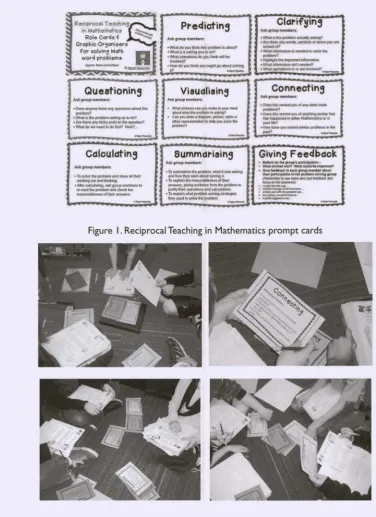
Figure 1 shows an overview o f each o f the stages and the prompts used to support students by scaffolding their learning within the process of comprehending and solving mathematical word problems. The role cards are usually printed in colour and laminated for durability for use during small group problem-solving sessions as indicated in Figure 2.
R e c ip ro c a l T e a c h i n g ^ ^ ^ in M a th e m a tics |
R o le C a rd s < G ra ph ic O rg a n ise rs"
f o r so lvin g Math B8S5H w o rd p ro b le m s
fppror. Ivors /ondoOovr K l I M 1
Predicting
Ask group members:
• What do you think this problem is about?
• What is it asking you to do?
• What operations do you think will be involved?
•How do you think you might go about solvng
Clarifying Ask group members: ! • What is the problem actuary asking?
I • Are there any words, symbols or terms you aie 1 unsure of?
i • What information is needed to solve the i problem?
1 • Highlight the important information 1 • What information isn't needed?
i • What operatxxVs is or are involved?
Questioning Ask group members:
• Does anyone have any questions about this problem?
• What Is Ore problem asking us to do?
• Are there any tncky parts lo the question? •What do we need to do first? Next?
Visualising Ask group members:
• What pictures can you make in your mind about what the problem is asking?
• Can you draw a diagram, picture, table or other representation to help you solve the problem?
Connecting i Ask group members:
( • Does this rettund you of any other math
i problems?
i • Does this remind you of anything similar that i has happened in either Mathematics or in I your fife? > l • How have you solved similar problems in the <
1 past? « , « .. « * , '
Calculating
Ask group members:
• To solve the problem and show a# their workng out and thinking
• Alter calculating, ask group members to re-read the problem and check the reasonableness of their answers.
Summarising Ask group members:
• To summarise the problem, what it was asking and how they went about solving it
• To explain the reasonableness of their answers, givmg evidence from the problem to justify their operabons and calculations
• To explain what problem solving strategies they used lo solve the problem
Giving Feedback
• Reflect on the group's participation
-• What worked well? What could be Improved?
• Give feedback to each group member about their participation in the problem solving group (Remember to use warm and cool feedback and focus on me positives)
- AeMWagMUaMT” ** _ __
Figure I. Reciprocal Teaching in Mathematics p ro m p t cards
10
Figure 2. Reciprocal Teaching in Mathematics in action
[image:4.576.140.517.181.699.2]organisers and interactive notebook pages can be found at h ttp ://rip p e rre so u rc e s.b lo g sp o t.c o m . a u /2 0 1 4 /0 1 /re c ip ro c a l-te a c h in g .h tm l
Figure 3. Reciprocal Teaching in Mathematics graphic organisers
Figure 4. Reciprocal Teaching in Mathematics interactive n otebo o k scaffolds
The innovation on the RT approach to mathematics reported here was developed prior to the review of the other studies cited earlier in this paper. Commonalities with other approaches to RT in mathematics can be identified, however, including the focus on making connections (Quirk, 2010), visualising the problem, the solving phase in the process, the summarising stage, which includes justifying answers and solutions and students evaluating their participation in group problem-solving sessions (Reilly et al., 2009), and the students’ multiple engagements and re-readings of the text (Wessman Huber, 2011), which result in close reading of the mathematical word problem. The point o f difference, however, is the explicit inclusion of the cognitive strategies o f visualising, connecting, calculating and summarising (including explaining the reasonableness of solutions and restating the problem in the students’ own words). In relation to higher order thinking, Brown and Campione (1986) state that:
Understanding is more likely to occur when a student is required to explain, elaborate, or defend his or her position to others; the burden of explanation is often the push needed to make him or her evaluate, integrate, and elaborate knowledge in new ways. (p. 1066)
Literacy Learning:
the Middle Years
Volum e 22
N u m b e r 2
June 2014
[image:5.576.85.472.71.575.2]Literacy Learning:
the Middle Years
V o lu m e 2 2 N u m b e r 2 June 2 0 1 4
The approach to RT reported in this paper is therefore a heuristic that supports students as they learn to perform higher-level operations. It uses scaffolds for teaching higher-level cognitive strategies and provides feedback to students as an im portant part o f the teaching and learning o f these cognitive strategies (Rosenshine & Meister, 1992).
Findings: Reporting on anecdotal feedback
Several teachers have trialled the approach to RT reported in this paper, using the scaffolds provided (the role cards, graphic organisers and interactive notebook scaffolds). A Year 5 teacher in the United States reported that in comparison to other students in the same year level at her school:
On every single Science and Math test this year my class has scored higher than the other two 5th grade classes; sometimes quite significantly ... I think we consistently score higher on the weekly and monthly classroom tests because my students know that there is the expectation of looking below the surface and applying problem-solving skills.
The teacher attributes this outcome to the use of Reciprocal Teaching within her classroom, including the scaffolds shared in this paper. However, further research would need to be conducted to confirm or disprove whether this is empirically the case. O ther feedback has been in relation to the approach supporting students’ accountability and ownership of their learning, their independent thinking - that it supported students to have an ‘equal voice’ in group work - and further that the approach ‘empowers students’ and helps develop their vocabulary and reading comprehension strategies.
Conclusion
This paper has reported on one innovation that applied the Reciprocal Teaching approach to small group mathematical problem-solving groups, in order to support students to comprehend and solve mathematics word problems. Previous studies that have incorporated innovations on RT in mathematics were discussed and the author’s own innovation on RT in mathematics was described. Further research is required to ascertain empirically if the approach reported in this paper does have an effect on improving reading comprehension o f mathematical word problems an d /o r problem-solving in mathematics. However, at this early stage, the anecdotal feedback is promising and the findings from previous published studies are encouraging.
Acknowledgements
Many thanks to Joy Hollander, a fifth grade teacher from Las Vegas, Nevada, USA, and another fifth grade teacher, who wishes to remain anonymous, from Utah, USA. They provided photographs taken in their classrooms while they were using the RT resources reported in this paper.
Clip art and fonts for the RT resources developed by the author and reported in this paper were provided by:
- C olleen A laniz (h ttp ://w w w .te a c h e rsp a y te a c h e rs.c o m /P ro d u c t/C lip -A rt- C uties-757701);
- G raphics by Sarah B eth (h ttp ://w w w .te a c h e rsp a y te a c h e rs.c o m /P ro d u c t/C a llo u ts- C ollection-C lipart-G raphics-S peech-T hought-B ubbles-727451);
- G raphics from th e P o n d (h ttp ://w w w .te a c h e rsp a y te a c h e rs.c o m /P ro d u c t/F u z z y - F u n -S callo p ed -B o rd ers-F R E E -G rap h ics-F ro m -th e-P o n d -6 4 1 4 7 4 (h ttp ://w w w . teachersp ay teach ers.co m /P ro d u ct/F lip -F lap -T em p late-S et-D eco rativ e-G reat-fo r- Interactiv e-N o teb o o k s-9 9 7 5 1 0 );
- Jen Jones H ello F o n ts (h ttp ://w w w .te a c h e rsp a y te a c h e rs.c o m /P ro d u c t/H e llo -F o n ts- L icense-for-C om m ercial-U se-S ingle-L icense-S ingle-D esigner-395172);
- Julie O’Connor (http://www.teacherspayteachers.com/Product/Speech-Bubbles-clip- art-and-instructional-tool-805414);
- nahhan73 (http://www.etsy.com/au/shop/nahhan73?section_id=10804022) - Zip-a-Dee-Doo-Dah Designs (http://www.teacherspayteachers.com/Product/
Rainbow-Links- Chains- Clip -art- Over- 3 0 - Graphics- 690697).
Literacy Learning:
the Middle Years
Volum e 22
N u m b e r 2
June 2014
References
Adams, T.L. (2003). Reading mathematics: More than words can say. The Reading Teacher, 56(8), 786-795. Brown, A.L. & Campione, J.C. (1986). Psychological theory and the study of learning disabilities. American
Psychologist, 41(10), 1059-1068.
Chinn, S. (2004). The language of maths. In S. Chinn (Ed.), The trouble with maths: A practical guide to helping
learners with numeracy difficulties (pp. 93-104). London: Roudedge Falmer.
Collen, M.H. (2011). Fifth grade children’s use of reciprocal teaching to solve word problems in mathematics
(Doctoral thesis, State University of New York at Albany). Retrieved from ProQuest Dissertations & Theses A&I database.
Department of Education, Employment and Workplace Relations. (2008, May). National numeracy review
report. Retrieved 14.2.14, from http://www.coag.gov.au/sites/default/files/national_numeracy_review.pdf
Gresalfi, M.S. & Cobb, P. (2006). Cultivadng students’ discipline-specific dispositions as a critical goal for pedagogy and equity. Pedagogies: A n International Journal, 1(1), 49-57. doi:10.1207/sl5544818ped0101_8 Lamb, J. (2004). Reciprocal Teaching in the mathematics classroom: Improving student achievement through
reading (Master of Arts in Education thesis, Pacific Lutheran University, Tacoma, WA). Retrieved from
ProQuest Dissertations & Theses A&I database.
Meyer, K. (2010). ‘Diving into reading’: Revisiting reciprocal teaching in die middle years. Literacy Learning: the Middle Tears, 15(1), 41-52.
Monroe, E.E. & Panchyshyn, R. (1995). Vocabulary considerations for teaching mathematics. Childhood
Education, 72(2), 80-83.
Palincsar, A.S. (1986). Metacognidve strategy instruction. Exceptional Children, 53(2), 118-124.
Palincsar, A.S. & Brown, A.L. (1983). Reciprocal teaching of comprehension-monitoring activities (Technical report No. 269). Retrieved from http://gateway.library.qut.edu.aU/loginlurLhttp://search.ebscohost. com/login.aspx?direct=true&db=eric&AN=ED225135&site=ehost-live
Palincsar, A.S. & Brown, A.L. (1984). Reciprocal teaching of comprehension-fostering and comprehension monitoring activities. Cognition and Instruction, 1(2), 117-175.
Pearson, P.D. & Gallagher, M.C. (1983, October 1). The instruction o f reading comprehension (Technical Report No. 297). Retrieved from http://gateway.library.qut.edu.aU/loginlurLhttp://search.ebscohost.com/login. aspx?direct=true&db=eric&AN=ED236565&site=ehost-live
Polya, G. (1957). How to solve it: A new aspect of mathematical method (2nd ed.). Garden City, NY: Doubleday. Quirk, PJ. (2010). Using reciprocal teaching and learning methods to enhance comprehension in mathematics word
problems) Master of Education thesis, Massey University, Palmerston North, New Zealand). Retrieved from
http://mro.massey.ac.nz/handle/10179/2247
Reilly, Y., Parsons, J. & Bortolot, E. (2009). Reciprocal Teaching in mathematics. Proceedings of the Mathematics
of Prime Importance Conference, the 46th Conference of the Mathematical Association of Victoria (pp. 182—
189). Retrieved from http://www.mav.vic.edu.au/files/conferences/2009/13Reilly.pdf
Rosenshine, B. & Meister, C. (1992). The use of scaffolds for teaching higher-level cognitive strategies.
Educational Leadership, 49(7), 26-33.
Rudy, D.W. (1990). The effects of metacognitive strategies and social interaction upon mathematics learning: A reciprocal teaching study (Doctoral thesis, Loyola University of Chicago, Chicago, IL). Retrieved from ProQuest Dissertations & Theses A&I database.
Schell, V.J. (1982). Learning partners: Reading and mathematics. The Reading Teacher, 35(5), 544-548. Schleppegrell, M.J. (2007). The linguistic challenges of mathematics teaching and learning: A research review.
Reading and Writing Quarterly, 23(2), 139-159.
van Garderen, D. (2004). Reciprocal teaching as a comprehension strategy for understanding mathematical word problems. Reading and Writing Quarterly, 20(2), 225-229.
Vygotsky, L.S. (1978). Mind in society: The development ofhigher psychological processes (M. Cole, V. John-Steiner, S. Scribner & E. Soubermann, Trans.). Cambridge, MA.: Harvard University Press.
Literacy Learning:
the Middle Years
Volum e 22
Wessman Huber, C. (2011). The impact o f Reciprocal Teaching on mathematics problem solving fo r Grade 4
students (Doctoral thesis, Central Connecticut State University, New Britain, CT). Retrieved from ProQuest
Dissertations & Theses A&I database.
N u m b e r 2
June 2014
Kylie Meyer is a l e c t u r e r a t t h e U n iv e r s ity o f S o u th e r n Q u e e n s la n d , S p rin g fie ld C a m p u s , Q u e e n s la n d . S h e is c u r r e n t ly c o m p le tin g h e r P h D s tu d y a r o u n d c o n c e p tio n s o f in te lle c tu a l d e m a n d in t h e te a c h in g o f r e a d in g a c ro s s t h e c u r r ic u lu m . S h e is p a s s io n a te a b o u t lit e r a c y e d u c a tio n in t h e m id d le y e a rs .
r
A U S T R A L I A N L I T E R A C Y E D U C A T O R S ' A S S O C I A T I O N
A n n o u n c i n g :
o
W a k e fie ld
P r e s s
A
SPECIAL OFFER
for all
Literacy Learning
and
ALEA
members.
Wakefield Press, South Australia's leading independent publisher, is partnering with ALEA to offer an A L E A member’s discount of 20% off all Wakefield Press titles
ordered online. This offer applies not only to Wakefield's titles suitable for younger readers, but for all Wakefield titles. Teachers - broaden your reading and knowledge! Books on history, biography, art, as well as poetry and fiction.
Books for younger readers: poetry and fiction suitable for in-class reading or home reading.
See W a k e f i e l d ' s f u l l c a t a l o g u e o n l i n e a t
www.wakefieldpress.com.au
To obtain your discount, simply enter the code word LI BER in your shopping cart as you check out.
Wakefield Press
We love good stories and publish beautiful books.
M1W
WAKlIFltP »1§§
Tadpoles in th e Torrens
Poems fo r young readers
Featuring
Jude Aquilina, Max Fatchen, Peter Combe, Juan Garrido Salgado Christobel Mattingley, Rory Harris, janeen Brian
& many others
O rd e r online w ith y o u r ALEA code and save 20%