UNIVERSITY OF SOUTHERN QUEENSLAND
Consumer Perceptions of the Barriers to Adoption of
Internet Banking: A Case Study in Libya
A thesis submitted in fulfilment of the
Requirement for the award of
Doctor of Philosophy
By
Ghaled K. Elsaber Hossen
Student ID: 0050100884
School of Information Systems
Faculty of Business, Education, Law & Arts
I
ABSTRACT
Banking services have been impacted by developments in information technology and considerable funds have been invested in the development of communications technology in the banking sector. E-banking is the major platform for adopting and using highly-developed IT systems in banking services. Evaluating an individual's acceptance of using e-banking technology, and Internet banking in particular, is a key issue facing the banking sector. Arguments remain about the most important factors that impact upon customers’ willingness to adopt Internet banking, despite considerable attention being paid to issues of assessment of the adoption of e-banking services in general, and Internet e-banking in particular. This study reviewed relevant IT literature which informed the development of an extension of the Technology Acceptance Model (TAM) by adding external factors with the aim of being more relevant for developing countries such as Libya. This study proposes an assessment methodology model to foster the adoption of Internet banking in Libya.
The study model included six constructs: Trust, Security, Customer Support, Internet Network Quality, Perceived Ease of Use and Perceived Usefulness. The study model considered perceptions of bank customers about these constructs relating to the adoption of Internet banking services. The instrument was designed to measure the attitudes of bank customers towards the adoption of online banking. A quantitative study was conducted with survey responses received from 536 Libyan bank customers. The findings confirmed that the study model is valid and reliable to measure the adoption of Internet banking from the point of view of customers’ perceptions; and the study model supported the relationships among the seven constructs.
The findings of the study indicate that Libyan bank customers perceive Internet banking to be risky but essential to development and growth of the economy. Bank customers are planning to adopt banking services through the Internet despite their concerns relating to factors such as security, trust, support and Internet quality that relate to Perceived Ease of Use (PEOU), and Perceived Usefulness (PU) of the new technology. The adoption of Internet banking technology may expand extensively in the Libyan banking sector in the near future. The use of Internet banking still presents number of challenging issues. Assessing the acceptance of Internet banking usage is seen as an important issue encountered by the banking sector. The key reasons behind the reluctance by users towards use online banking services include the persistence of factors that impact upon the adoption of e-banking services. The quantitative analysis of results from the survey questionnaire confirmed all the relationships in the traditional TAM, as well as the importance of trust and security in the new technology and issues relating to Internet network quality and support. Factors such as PU were confirmed in terms of their impact upon user or non-users’ intentions towards using new technology. PEOU was another major determinant factor influencing customers’ intention towards the use of Internet banking technology.
II
CERTIFICATION OF DISSERTATION
I certify that the ideas, results, analyses and conclusions reported in this dissertation are entirely my own effort, except where otherwise acknowledged. I also certify that the work is original and has not been previously submitted for any other award, except where otherwise acknowledged.
Candidate signature
______________________________ ______________________________
Ghaled K Elsaber Hossen Date
ENDORSEMENT
Principal Supervisor
______________________________ ______________________________
Professor Jeffrey Soar Date
Co-Supervisor
______________________________ ______________________________
III
ACKNOWLEDGEMENT
Firstly, I would like to present my gratefulness to ALLAH (God) for assisting me in the completion of this dissertation.
All my deepest gratitude and thanks to Professor Jeffrey Soar, the principal supervisor of this study. He has great knowledge and experience in the information systems field and he guided and motivated me immensely to accomplish the research objectives effectively. He gave me a lot of time and he always was available for me. I do not have sufficient words that could describe the efforts that Prof Jeffrey Soar put in towards my research.
I would like to thank my co-supervisor Dr Mustafa Ally, who provided me with guidance, support and encouragement during all the stages and especially at the beginning of my study. His advice and suggestions helped me in selecting the study topic.
Also my thanks to my all Family, friends and banks staffs for their support and help to gather the data. My great thanks to banks customers who participated in my study. Without your assistance this study would not have been completed. Thanks are due to the Ministry of Higher Education and Scientific Research of Libya for giving me the opportunity to complete my PhD study.
I would like to acknowledge the people who assisted me during my study: Ahmed Moftah and his family, Imad Alhouny, Raf-Allah Algoabily, Mohamed Bonowara and Monsef Mousa. I would like to appreciate the efforts of Farj Alshwihidy and Hafz Alsedig for their worthy help and suggestions about the statistical methods. Thanks for Libyan PhD students (colleagues) at USQ.
I am particularly grateful and my special thanks go to the editor Chris O’Reilly, I am greatly indebted to her. I also acknowledge the work put in by the editor Libby Collett to edit and improve the English usage within the thesis.
IV
Table of Contents
1. CHAPTER ONE: INTRODUCTION ... 2
1.1. Introduction ... 2
1.2. Online banking services ... 2
1.3. Background to Libya ... 5
1.3.1. Geographical location and population ... 5
1.3.2. The history of Libya ... 6
1.3.3. Italian colonial period ... 6
1.3.4. Libya's political history ... 6
1.3.5. The Revolution of 17th of February ... 7
1.3.6. Religions ... 8
1.3.7. Libya’s judicial system and legislation ... 9
1.4. Libyan economy ... 9
1.5. Libyan banking sector ... 12
1.5.1. Islamic banks ... 12
1.5.2. Libyan commercial banks ... 13
1.5.3. Information technology in commercial banks... 14
1.6. Research approach ... 15
1.7. Research Motivation and Contribution ... 15
1.8. Research objectives ... 16
1.9. Statement of the problem ... 16
1.9.1. Research Questions ... 17
1.10. Significance of the study... 17
1.11. Chapter summary ... 18
2. CHAPTER TWO: LIBYAN BANKING SECTOR ... 20
2.1. Introduction ... 20
2.2. About the banking sector in Libya ... 20
2.3. Development of Libyan banking sector ... 22
2.4. Organising the Libyan banking sector ... 24
2.5. Technology in Libyan banking sector ... 26
2.5.1. The national payments system ... 26
2.6. Banking sector reform ... 29
2.6.1. Privatisation of commercial banks ... 30
2.6.2. Standards of conduct for companies in the banking business ... 31
2.6.3. Abolition of bank interest ... 32
2.7. Banking Supervision ... 32
V
2.8.1. Central Bank of Libya (CBL) ... 34
2.8.2. Commercial banks:... 36
2.8.3. Libyan Foreign Bank... 40
2.8.4. Specialised banks ... 41
2.9. Chapter Summary ... 42
3. CHAPTER THREE: LITERATURE REVIEW ... 44
3.1. Introduction ... 44
3.2. Background ... 44
3.3. Electronic banking ... 46
3.3.1. History ... 46
3.3.2. Features of electronic banks ... 47
3.4. Importance of information technology in banks ... 47
3.5. Arab electronic banking services: ... 48
3.6. Obstacles facing e-banking services in the Arab countries ... 52
3.7. Mechanisation difficulties in Libyan banks ... 55
3.7.1. Economic constraints (financial): ... 56
3.7.2. Technical limitations: ... 56
3.7.3. Administrative and social obstacles ... 56
3.8. The need for online banking services in Libya ... 57
3.9. Chapter summary ... 60
4. CHAPTER FOUR: RESEARCH METHODOLOGY ... 62
4.1. Introduction ... 62
4.2. Research Methodology ... 62
4.2.1. Quantitative Approach ... 63
4.3. The research problem ... 64
4.3.1. Research Questions ... 66
4.4. The research framework ... 66
4.4.1. Technology Acceptance Model (TAM) ... 67
4.4.2. The extension of TAM ... 68
4.4.3. TAM framework for use in developing countries ... 68
4.5. Research model and hypotheses ... 69
4.5.1. Research Model ... 69
4.5.2. Research Hypothesis ... 70
4.5.3. Hypotheses and definition of key factors ... 71
4.6. The research community and the study sample ... 74
4.7. Data collection ... 75
VI
4.7.2. Research Ethics ... 79
4.8. Data analysis ... 80
4.8.1. The Components of SEM technique ... 81
4.8.2. Absolute Fit Indices ... 82
4.8.3. Validity and Reliability ... 83
4.8.4. Squared Multiple Correlation (SMC)... 84
4.8.5. Cronbach's alpha ... 84
4.8.6. T-test ... 84
4.9. Chapter summary ... 85
5. CHAPTER FIVE: RESULTS ... 87
5.1 Introduction ... 87
5.1.1. Overview ... 87
5.2. Descriptive statistics ... 87
5.2.1. Sample Characteristics ... 87
5.3. Measurement model and testing study model and hypotheses ... 91
5.3.1. One-factor congeneric measurement model for constructs ... 91
5.3.2 Exogenous and endogenous factors first-order CFA ... 97
5.3.3 Measurement Model... 100
5.3.4 Validity and reliability ... 101
5.3.5 Testing the study model and the hypotheses ... 103
5.4 Content Analysis of Bank Customers’ Comments ... 106
5.4.1 Communications infrastructure ... 107
5.4.2 Online banking products and services... 107
5.4.3 Safety and Security ... 108
5.4.4 Trust factor ... 109
5.4.5 Culture and Media ... 109
5.4.6 The technology used in commercial banks ... 109
5.4.7 Privacy... 110
5.4.8 Other issues ... 110
5.5 Chapter summary ... 110
6. CHAPTER SIX: DISCUSSION ... 112
6.3 Introduction ... 112
6.4 The findings of demographic data ... 113
6.5 Discussion of the measurement model ... 116
6.5.1 Perceived Ease of Use ... 116
6.5.2 Perceived Usefulness ... 116
VII
6.5.4 Support ... 117
6.5.5 Security ... 118
6.5.6 Trust ... 118
6.6 Discussion on the structural model and hypotheses ... 118
6.6.1 Discussion on the results of the endogenous factors ... 119
6.6.2 Discussion the results of the exogenous factors ... 121
6.7 Discussion of content analysis of bank customers’ comments ... 124
6.8 Chapter summary ... 126
7. CHAPTER SEVEN: CONCLUSION AND RECOMMENDATIONS ... 128
7.1 Introduction ... 128
7.2 Research objectives ... 129
7.3 Research problem ... 130
7.3.1 Research questions ... 130
7.4 Research contributions ... 131
7.4.1 Contribution to knowledge ... 131
7.4.2 Contribution to practice... 132
7.5 Recommendations ... 133
7.6 Research Limitations ... 134
7.7 Future research ... 135
8. REFERENCES LIST: ... 136
9. APPENDICES ... 153
9.3 Appendix A: Ethics Approval of USQ ... 153
VIII
LIST OF FIGURES
Figure 1 Structure of Libyan Banking System ... 34
Figure 2 the Research Model ... 69
Figure 3 Gender... 88
Figure 4 Ages ... 89
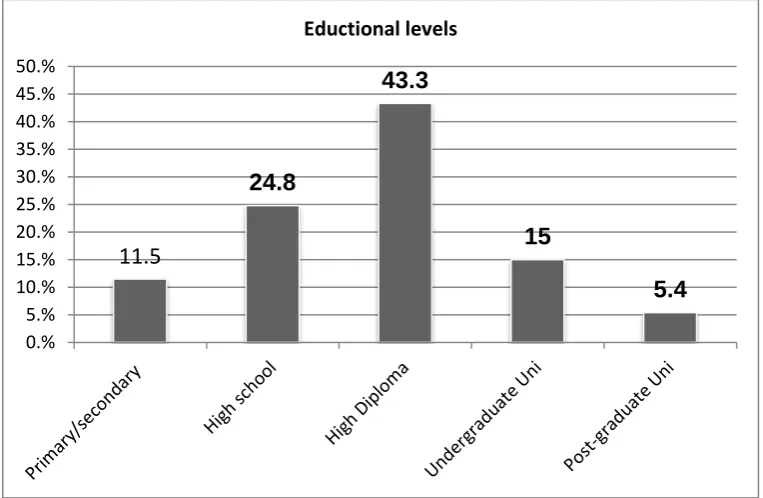
Figure 5 Educational levels ... 89
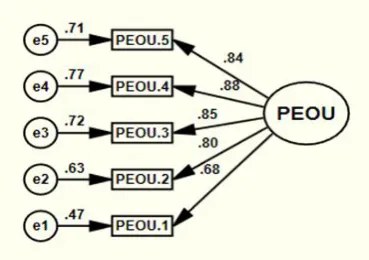
Figure 6 One-factor congeneric measurement model of Perceived ... 92
Figure 7 One-factor congeneric measurement model of Perceived ... 92
Figure 8 One-factor congeneric measurement model of Perceived usefulness (First iteration) ... 93
Figure 9 One-factor congeneric measurement model of Perceived usefulness (Final iteration) ... 93
Figure 10 One-factor congeneric measurement model of Internet quality (First iteration) ... 94
Figure 11 One-factor congeneric measurement model of Internet quality (Final iteration) ... 94
Figure 12 One-factor congeneric measurement model of Support ... 95
Figure 13 One-factor congeneric measurement model of Support (Final iteration) .. 95
Figure 14 One-factor congeneric measurement model of Security ... 96
Figure 15 One-factor congeneric measurement model of Security ... 96
Figure 16 One-factor congeneric measurement model of Trust ... 97
Figure 17 One-factor congeneric measurement model of Trust ... 97
Figure 18 One-factor congeneric measurement model of Intention ... 97
Figure 19 One-factor congeneric model exogenous constructs ... 98
Figure 20 One-factor congeneric model endogenous constructs ... 99
Figure 21 Seven first-order correlated factors for measured model ... 101
IX
LIST OF TABLES
Table 1-1 GDP of Libya (1980-2010) ... 11
Table 2-1 Assets & Liabilities of Central Bank of Libya ... 21
Table 2-2 Companies Listed in Libyan Stock Market 2013(Million L.D.) ... 30
Table 2-3 Percentage of banks owned ... 31
Table 2-4 Deposits in Central Bank of Libya (Million L.D.) ... 36
Table 2-5 Liabilities of commercial banks (Million L.D.)... 37
Table 2-6 Loans of specialised banks (Million L.D) ... 41
Table 3-1 Internet user in Arab world ... 51
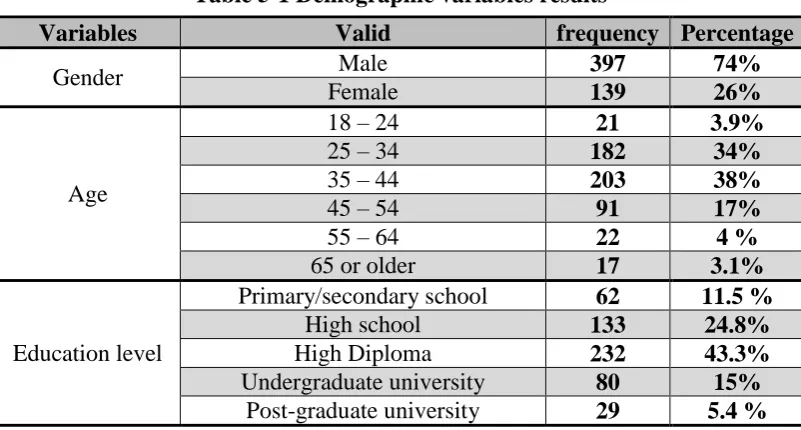
Table 5-1 Demographic variables results ... 88
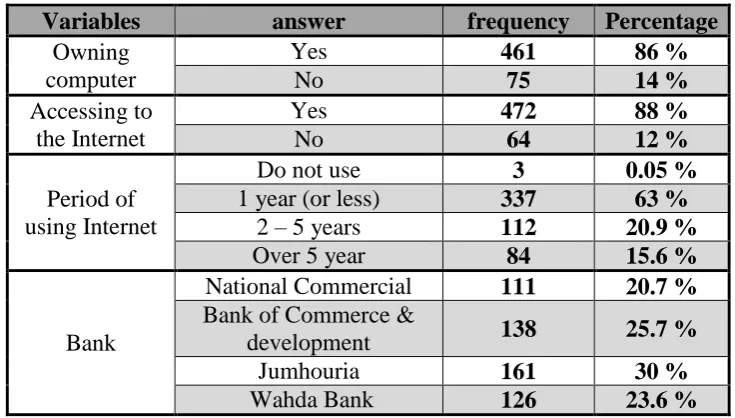
Table 5-2 Population's sample results answer ... 90
Table 5-3 Customers methods of using banking services ... 90
Table 5-4 CFA goodness of fit for Perceived Ease of Use ... 92
Table 5-5 CFA goodness of fit for Perceived Usefulness ... 93
Table 5-6 CFA goodness of fit for Internet quality ... 94
Table 5-7 CFA goodness of fit for support ... 95
Table 5-8 CFA goodness-of-fit for security ... 96
Table 5-9 CFA goodness-of-fit for Trust ... 96
Table 5-10 CFA goodness of fit for intention to use online banking ... 97
Table 5-11 CFA goodness of fit for exogenous constructs ... 98
Table 5-12 CFA goodness of fit for endogenous constructs ... 99
Table 5-13 CFA goodness of fit for full model ... 100
Table 5-14 Reliability and validity indicators ... 102
Table 5-15 Discriminant validity analyses ... 103
Table 5-16 Regression weights of the model ... 105
Table 5-17 Themes and sub-themes of customers’ comments ... 108
Table 6-1 Summary of the sample gender ... 114
Table 6-2 Summary of the sample education level ... 114
Table 6-3 Summary of the sample Internet experience ... 114
Table 6-4 Summary of the survey participants of each bank ... 115
Table 6-5 Summary of face to face banking ... 115
Table 6-6 Summary of Internet banking users ... 115
Table 6-7 Results of the hypotheses of the endogenous factors ... 121
X
LIST OF ABBREVIATIONS
α Cronbach's alpha
AGFI Adjusted Goodness-of-Fit Index
AVE Average Variance Extracted
β Results of regression
BCD The Bank of Commerce & Development
BJ Bank Journal
BN Bank of the Nation
CBL Central Bank of Libya
CFA Confirmatory Factor Analysis
CR Composite Reliability
DCB Development and Commerce Bank
GDP Gross Domestic Product
GFI Goodness-of-Fit Index
GNC General National Congress
GPC General Planning Council
GPCCM General People's Committee for Culture and
Media
IDT Innovation Diffusion Theory
IMF International Monetary Fund
Int Intention to use
IQ Internet Quality
IS Information system
IT Information Technology
JB Jumhouria Bank
L.D Libyan Dinars
LFB Libyan Foreign Bank
LIG Libyan Interim Government
LNC Libyan National Congress
LSM Libyan Stock Market
NAB National Agricultural Bank
NCB National Commercial Bank
NPS National Payments System
PEOU Perceived Ease of Use
PCI Perceived Characteristics of the Innovation
PU Perceived Usefulness
RMR Root Mean-square Residual
RMSEA Root Mean Square Error of Approximation
S Security
SB Sahara Bank
SEM Structural Equation Modelling
SMC Squared Multiple Correlation
Sp Support
SPA Service Provider Applications
SRMR Standardised Root Mean-square Residual
T Trust
TAM Technology Acceptance Model
TL Transparency-Libya
XI
TRA Theory of Reasoned Action
UTAUT Unified Theory of Acceptance and Use of
Technology
WB Wahda Bank
1
CHAPTER ONE
2
1. CHAPTER ONE: INTRODUCTION 1.1. Introduction
The contemporary world is witnessing significant development in the field of Internet Banking—a major electronic activity which is now prevalent worldwide. The widespread use of the Internet for commercial transactions is one of the most significant phenomena in commercial and banking activities; and, in particular, information and communications technology has had a clear and significant impact on the banking industry.
This Chapter provides a general introduction into online banking adoption in Libya, and is divided into two main parts. The first section (1.1, 1.2, 1.3, and 1.4) outlines the use of banking services via the Internet, followed by a brief overview of Libya, including information on its geographical location, population and history (ancient and modern). The second section provides an introduction to the Libyan economy, describing Libya’s economic resources and it’s most important economic sectors. It also includes an overview of the Libyan banking sector (Islamic banks and commercial banks). Chapter Two provides a more in-depth analysis and discussion of the use of information technology in the Libyan banking sector.
The second part of this Chapter focuses on the presentation of the research methodology, including sections 1.5 1.9. It shows the motivation and contributions of the research, research objectives and an explanation of the research problem and questions of the study, in addition to defining the importance of the study. Chapter Five describes in detail the research methodology adopted for this study.
1.2. Online banking services
Internet banking is a global phenomenon which has contributed to the creation of a global market in the most advanced countries (Akinci, Aksoy & Atilgan 2004; Black et al. 2001; Chong et al. 2010; Freeman & Elgahwash 2011; Riffai, Grant & Edgar 2012). Developing countries or developing economies are clearly late or slow in the adoption of modern technology usage (Abukhzam & Lee 2010; Emzio 2010; Gikandi & Bloor 2010; Nasri & Charfeddine 2012; Tingari & Abdelrahman 2012). Issues of awareness, education, infrastructure and culture undoubtedly play an important role in adopting technology for economic growth. Arab countries are made up of many developing countries in terms of culture; and religion has a strong influence on individuals’ business and social behaviour. This thesis examines the adoption of online banking in Libya, a country located in North Africa. The research proposes a framework consisting of a set of factors that are likely to assist in identifying the behaviour of Libyan banking customers towards the adoption of banking services via the Internet.
3
The internal and external forces impacting the banking sector via the Internet contribute to a better understanding of the competitive banking environment and the rapidly increasing impact of online banking. Subsequently, there are five external forces at play, namely: the environment, technological, political, economic, and social conditions (Jayawardhena & Foley 2000; Nellis 1998). Online banking has contributed to economic and political changes, and has influenced the rights and behaviour of customers. Legislation has also contributed to increased competition in the financial services industry and the banking sector. The social environment includes changing the nature of the banks’ mature clients. Mature customers are the most important new challenge for financial services providers. Social changes have also occurred in cultural values, beliefs and attitudes toward technology and society. According to a study by Jayawardhena and Foley (2000), the internal forces in the banking environment have the greatest impact on the financial sector. Jayawardhena and Foley (2000) classified the internal forces into three categories, namely, the threat of new entrants, increase in number of customers, and the volatility of supply. One of the biggest drawbacks for commercial banks that offer their services online is the threat of new entrants (Jayawardhena & Foley 2000). An important question in a competitive future market is how banks can increase the number of customers who are loyal to their bank. The answer to this probably lies in providing superior online services via the Internet.
The increase in customer loyalty power means that the power has switched from the banks to their customers. Customers are able to control virtually all of their financial transactions and loans through the Internet. Volatile forces of supply have had a profound impact on the banks’ services: reductions in the number of bank branches and bank deposits of individuals have changed the banking sector. As a result, customers are able in a restricted sense to use Internet service delivery channels instead of having a traditional network of widespread branches with appropriate staff levels. It can be expected with the implementation of these delivery mechanisms that more Internet changes will ensue. Banks are investing heavily in online customer service channels in order to provide fast delivery of Internet services to save time, effort and a personalised service. The emergence of new banking technology creates a highly competitive market and has an important influence on consumer behaviour. Actual providers of online banking services need to better understand the behaviour of their customers and their attitudes towards technology in general. If banks succeed in this, they will be able to influence, and even determine, consumer behaviour and desires. This will become one of the most important key issues in creating a competitive advantage in the future (Gikandi & Bloor 2010).
4
National Congress as emergency budgets (3-7 billion dinars, 2011 2013), it includes the budgets of compensation for the damage of the war in Libya in 2011.
Additionally, the reserves of Libyan assets inside and abroad are estimated to be more than 170 billion USD in 2012 (LIG 2013b). The head of the Central Bank of Libya notes that Libya is in dire need of a modern banking system (CBL 2013a). He also refers to the magnitude of the future work required in Libya and the large investment projects needed to finance this huge change. This requires having high quality financial systems, and making sure banking is safe and sufficiently sophisticated for the anticipated growth of Libya (CBL 2013b)
The increase and expansion in the scope of the provision of banking services has resulted in high competition between banks, as well as changes in global market conditions. Banks in the Arab countries—and developing countries in general, and Libya in particular—are at risk because these developing countries are late adopters of new technology compared to developed countries. A report shows that in Arab countries the use of the Internet has been effective to a large extent, and perhaps also in many of the world's least developed countries (Aladwani 2003; Loch, Straub & Kamel 2003; PC-Magazine 2008). However, there is a distinct delay or hesitation in the adoption of e commerce technologies. E-commerce is considered one of the most important issues in economic development, especially in financial and banking sectors. Developing countries need to introduce advanced technologies that are routinely used in the developed world to promote and improve the quality of basic services for individuals and institutions and, subsequently, encourage consumers to increase their use of online banking. This has become a necessity for all countries that want to be successful in the advancement and development of their economies. In this current study, the researcher will focus on the dissemination and adoption of banking technology in Libya.
5
1.3. Background to Libya
1.3.1. Geographical location and population
Libya is located in North Africa on the southern coast of the Mediterranean Sea. It is bordered to the east by Egypt and Sudan in the south-east; in the south are Chad and Niger, Algeria in the west and Tunisia in the north-west. Libya is a member of a number of international and regional organisations/groupings including the United Nations, the African Union, the Arab Maghreb Union, the Arab League, Non-Aligned Movement, the Organisation of Islamic Cooperation, the Organisation of Petroleum Exporting Countries, and Common Market for Eastern and Southern Africa (COMESA).
Tripoli is the capital and the largest city in the country in terms of population density, followed by the city of Benghazi. The third largest city in the country is Misrata and the fourth-largest city is the city of Al-Bayda. In addition to other major cities such as Alzawa which restricts the capital Tripoli from the west and Tobruk in the far-east of the country, Sabha is the largest city in the south.
In terms of Libya’s population—which was 6,154,623 in the year 2012—the Libyan population is small compared to the area of the country (which is in the range of 1,774,440 km²) (GPCCM 2008). Libya is seventeenth in the world in terms of area, and the fourth largest country in Africa. Libya has the longest coastline between the countries bordering the sea with an average length of about 1,955 km. Historically, Libya consisted of three regions: Tripoli (west), Cyrenaica (East) and Fezzan (North). Most people (more than 70%) live in the narrow coastal strip next to the Mediterranean Sea. More than half the population (approximately 65%) lives in the two major cities of the country, Tripoli in the west and Benghazi in the east.
Based on its geographical location, Libya is an important bridge linking Africa and Europe. Libya is on the southern coast of the Mediterranean, which has had an impact on its fortunes since ancient times. Libya has been directly influenced by important historical events that have defined the Mediterranean region. Ports suitable for the reception of ships are the ports of Benghazi and Tripoli. These outlets provide valuable trade with the outside world between African countries such as Niger, Chad and Mali. This puts Libya in a strategic location and provides an important link between the eastern and western Arab world and demonstrates the meeting and mixing of currents of Arab-Islamic culture and civilisations.
6
the desert climate in the south, which makes it an attractive and important ingredient for elements of the tourism industry.
1.3.2. The history of Libya
Historically, Libya was named as the territory in North Africa between Egypt and Tunisia. Its name comes from and is related to the Libo tribe that inhabited this region for thousands of years. The Greeks emigrated from the island of Crete around the eighth century BC to establish the five Greek cities and Cyrenaica. These cities were the most prosperous cities in North Africa in that era. Existing historical records indicate that Libya was inhabited by ancient Berber tribes and on the west coast by Phoenicians Qatanna—who migrated from the western Mediterranean coast at the beginning of the tenth century BC. In the fifth century AD Libya came into the hands of the Vandals and was then under the control of the Byzantines in the sixth century AD. In the seventh century, Muslim Arabs joined the succession of Al Rashidiya Caliphate, the Umayyad Caliphate, and then the Abbasid Caliphate. The most important dynasties that ruled and became prosperous included the Aghlabids in the ninth century AD, and Ziriun at the start of 972 AD. They are of Berber origin, belonging to the Fatimids (WFE 2013b).
1.3.3. Italian colonial period
Libya at the end of the nineteenth century was the only part of the Arab world in North Africa that was unable to repel European colonisation. Because of Libya’s proximity to Italy it experienced the major goal of Italy’s colonial policy. It was not difficult for Italy to fabricate flimsy pretexts to occupy Libya and they declared war against Turkish colonialism in Libya on 29 September 1911. The war began between the Ottomans (Turkish) and the Italians—with the latter seizing Tripoli on 3rd October in the same year.
The banner of the resistance against the Italians arose in the Nafusa Mountains in the west and Green Mountain in the east in 1911. The resistance by Libyan forces and the Ottomans against the Italians was for a short period only. Subsequently, Turkey ceded Libya to Italy under the Treaty of O'Shea concluded between the two countries on 18thof October 1912. Libyans realised that they now needed to organise their ranks and repel Italian colonialism. The Libyan resistance intensified against Italian forces, and prevented the control of coastal cities. But when Italy entered World War I in 1915, Ahmed Sharif led the resistance against the Italian invasion in Cyrenaica (east) along with Turkey against the allies, but after the defeat of his forces ceded leadership to Idris al-Sanusi (king of Libya from 1949 to 1969) who led the resistance in the Green Mountain area with Omar Mukhtar and a number of Arab tribal elders. In the central region and the western region, the war against Italian colonisation was led by a group of leaders and tribal elders. In 1949 Cyrenaica declared its independence to be the eighth of an independent Arab state. In 1951 three states (Tripoli, Cyrenaica and Fezzan) united under the banner of the United Libyan Kingdom and under the Constitution of 1951 to be Libya unified (Borders) and independent after the decision of the United Nations in 1951.
1.3.4. Libya's political history
7
in a quasi-democratic regime. After a military coup in September 1969, Libya was controlled by Colonel Gaddafi, who was coup leader unilaterally, until the revolution of February 17 2011 saw the eventual overthrow of al Gaddafi and his regime. During the period between January 1972 and November 1977, Libya was in a union with Egypt and Syria that was not actually implemented (WFE 2013b)
Libya's foreign policies have been regarded—since the 1970s—as ‘hostile’ to a number of Western countries. During the 1980s Libya was involved in several conflicts with the United States (Imperial). The policy of Libya has been ‘hostile’ toward some European countries, particularly Britain, France and even Italy (as recently as the mid-nineties). Libya was punished via an economic blockade and air embargo throughout the period 1992 - 2003; and the United States bombed targets in Tripoli and Benghazi in 1986 during the reign of the late U.S. President Ronald Reagan. Libya restored international relations after the lifting of the air embargo and the end of the Lockerbie problem. Libya also voluntarily abandoned in 2003 its secret program to develop weapons of mass destruction (WFE 2013b).
1.3.5. The Revolution of 17th of February
On 1 September 1969, a group of low-ranking officers led by Lieutenant Gaddafi's military coup proclaimed the Libyan Arab Republic. In 1977, Gaddafi transformed the political system of ‘republican system’ to ‘public order’ which, as he was said, was implemented and built on the theory of popular decision-making conferences, and popular committees. On 17 February 2011, a revolution occurred in the form of protests and demonstrations against the regime of Gaddafi—which was seen as an oppressive regime. Demonstrations were launched in the city of Benghazi on February 15 over the arrest of a lawyer of victims in Abu-Salim prison (1269 persons “victims” have been killed in Abu-Salim prison as of 29/06/1996). He supported the victims' families and the public could see no reason for his detention. On 16th of February 2011 the demonstrators began to demand the overthrow of the regime in eastern Libya (especially after the first young man was killed in the demonstrations on 17 of February in the city of al-Bayda), then demonstrations spread to many parts of Libya, including Zentan, Alzawa, Tripoli and Misrata cities in the west. On 27 February 2011 Libya witnessed the establishment of the National Transitional Council (NTC), which became the revolutionary government. The rebels succeeded in controlling many of the coastal cities in the east and some areas in the south-east. The Libyan people in the eastern area (Tobruk and Al-Mareg cities) raised Libya's flag of independence in 1951. The previous flag of the United Kingdom of Libya, 1951-1969 had been cancelled when Gaddafi gained power in 1969.
After the liberation of eastern Libya in a short time period, the rebels took control of cities such as Zentan, Misrata, and Alzawa in the west of the country, and others in many parts of the Nafusa Mountains. Most areas of the country were liberated after the liberation of the capital city (Tripoli) on 20 August 2011. On 16 of September 2011 the United Nations recognised, through the majority of the members of the General Assembly, the National Transitional Council (NTC) as the only government in Libya. The Council subsequently assumed the seat of Libya in the international organisation. On 23 October 2011, the liberation of Libya was complete with the official announcement that Gaddafi had been killed on 20 October 2011.
8
establishment of a constitution and a new system of government. The handover of power (a peaceful transition for the first time in Libya’s political history) of the NCT to the General National Congress (GNC) took place on August 2012. The election of members of the GNC (200 members) on July 2012 was a first in the history of the country; and the GNC maintained the management of the affairs of the country for a year and a half. The GNC worked in the first session—by Constitutional Declaration—to elect a GNC president and vice president via a secret ballot and— within thirty days—the GNC choose the head of government (Dr Abdu-Al Rahim Al-Keap). The second stage prepared for the election of members of the Constitution Drafting Committee (GNC 2013a).
The General National Congress (GNC) announced the issuance of the Law on Election of the constituent body to draft a permanent constitution for the country (known as the 60 Commission) in the city of Al-Bayda. Accordingly, the constituent body consists of 60 members. This method was chosen based on the body that drafted the first constitution of the country in 1951, which was a sixty-member body. The Commission will be composed of 20 members from the three regions (Cyrenaica, Tripoli and Fezzan) and the GNC will begin formulating general national laws and lead Libya to full parliamentary elections after a new constitution in 2014 (GNC 2013b).
1.3.6. Religions
Libya is religiously homogeneous, where the majority of the population are Islamic Muslims (97%), and 3% belong to other religions—mostly foreigners and non-permanent residents (WFE 2013e). Most Christians who are in Libya are part of foreign communities of African refugees, Copts or Europeans working in Libya. There is also a small community of Anglican faith, and refugee workers from Africa and India in Tripoli belonging to the Egyptian Episcopal religion. There are monotheistic churches in Tripoli, Benghazi and in several cities in Libya, but older churches are mostly closed. Catholic monks and nuns work in most of the coastal cities and mountainous regions. There is one priest in the city of Sabha, and most of the others work in hospitals, shelters or assisting the disabled and the elderly. The monks and nuns dress in religious clothes and the researcher is not aware of any recorded cases of religious discrimination or harassment.
Libyan Jews left the country either individually or and in groups after 1967. There may be a small number of Jews in Libya, mostly in the old city of Tripoli. In 1974, the World Council of Jews indicated that there are no longer Jews in Libya (other than about twenty). The Jewish minority numbered 36,000 after the end of World War II. The Jewish population left to settle in Italy, Israel and other countries over various stages between 1948 and 1967 (WFE 2013e).
9
1.3.7. Libya’s judicial system and legislation
Libya's legal system is based on a combination of civil law and Islamic legal principles. Judges apply the principles of Islamic law on issues relating to personal status. Libya is the first Arab state to regulate the issuance of the first historic legislative database in the Arab countries. It consists of forty volumes covering the stages of the Italian occupation and contemporary events; and issues supplements on a regular basis. This is a historical encyclopaedia proactive in supporting regimes in some Arab countries; and has been used as a case in the federal system applied in the United Arab Emirates (UAE), based on the federal experience in Libya (1951-1963).
1.4. Libyan economy
The most important natural resources in Libya are oil and natural gas. Oil and gas are the main sources of income for the country. The total certain oil reserves in Libya is 41.5 billion barrels, placing Libya among the top African countries in this field. Oil accounts for about 94% of the proceeds of Libya's foreign exchange, 60% of government revenue and 30% of GDP (WFE 2013b). Libya produces 2 million barrels of oil per day and plans to increase production to three million barrels per day in the near future. The rate of gas production is 399 billion cubic feet; with certain gas reserves of 52.7 trillion cubic feet. The most important products and industries are iron and steel, cement and building materials, caustic soda, urea fertilisers and other petrochemical industries. The main agricultural products are barley, wheat, tomatoes, potatoes, olive, vegetables, fruit and meat. Libya uses the policy of support for the prices of basic food commodities, and also supports prices of fuel and electricity. Education and health services are provided free of charge. The government plans to alter its program during 2013 to cancel the policy support of basic commodities and fuel and, instead, offer Libyan citizens direct cash support from the beginning of 2014 (LIG 2013a).
The Libyan Dinar (LD) is the basic unit of currency in Libya. It consists of 1000 Dirhams. The LD is covered by gold and a basket of foreign currencies and is convertible into foreign currencies. There are no restrictions on cash transfers to and from Libya. The U.S. dollar is equivalent to approximately 1.28 dinars. Categories of paper currency in Libya are 1 LD, 5 LD, 10 LD, 20 LD and 50 LD (there is a note that the decision was made to cancel paper 50 dinars from 26 February 2012). The coin categories in Libya are 50 Dirhams, 100 Dirhams, 250 Dirhams and 500 Dirhams (CBL 2013c).
10
1. Libya is the largest state with Roman ruins outside Italy.
2. Libya has the longest coastline on the Mediterranean Sea—which benefits tourism investment.
3. The country possesses one of the largest and amazing deserts in the world, which attracts tourists to activities such as desert safaris.
4. Libya has numerous charming picturesque and natural areas—particularly in the Green Mountain area, which exceeds the size of Lebanon.
5. Libya has a history of Grecian, Roman, Turkish, and Italian times in cities including Lepda, Sabratha, Cyrene, Toulmeatha and Sousse.
6. Libya attracts a large number of tourists from Italy, Britain, France and Australia specifically to visit attractions such as cemeteries and military sites from World War II.
7. During 2013, historians on a mission from Britain announced the discovery of relics from three civilisations in Libya. This establishes Libya as a desired tourism destination because of its historical background, archaeological discoveries, and the various hunting trips and safaris offered to enthusiasts. 8. Libya has a pleasing climate with its moderate ‘Mediterranean Sea climate’. 9. Libya possesses the ability to attract tourists because it is classified as a tourist
destination promising new and exciting destinations and activities.
10. The tourism sector has the ability to attract investments that can create a balance in the state budget—which currently relies entirely on the oil and gas sector (WFE 2013a).
Transportation is lacking in Libya, which has not had an operational railway since 1965 when it was dismantled. Currently, a huge rail project in underway to link Libya to neighbouring countries. This rail line will run for more than 2,000 kilometres and is aimed at connecting the African and European continents. Libyan signed a contract worth $4 billion with a Russian company to create a rail line linking the cities of Sirte and Benghazi, which was due to open in 2012. However, because of the revolution of 17 February, it has stopped planning and is awaiting fresh action by the new authority to implement the project.
Libya's economy depends mainly on revenues from the oil sector. Oil contributes to most of its export revenue and more than half of its GDP. This has led to oil revenues with a small number of the population of Libya’s highest per capita nominal GDP in Africa. Since 2000, Libya held the highest Human Development Index in Africa and the fourth highest GDP in the continent in 2009, after the Seychelles, Equatorial Guinea and Gabon (World Economic Outlook Database 2009). This is due to its vast oil reserves and low population. Libya has the tenth largest proven oil reserves in the world and ranks seventeenth in global oil production. It has recorded favourable growth rates with a growth rate estimated at 10.6% of GDP in 2010. Libya witnessed fantastic growth rate, but this proved unsustainable in the face of the global recession on oil and international sanctions. Thus, GDP per capita shrank by 40% in the 1980s. Successful diversification and integration into the international community helped the current GDP per capita and saw a further deterioration of a mere 3.2% in the 1990s.
11
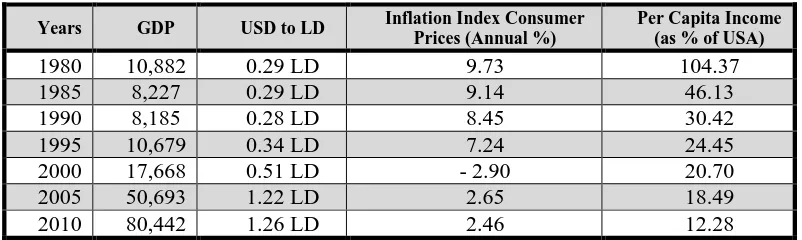
market prices according to estimates by the International Monetary Fund. The figures are displayed in millions of Libyan dinars (LD) during the period from 1980 to 2010.
Table 1-1 GDP of Libya (1980-2010)
Years GDP USD to LD Inflation Index Consumer Prices (Annual %)
Per Capita Income (as % of USA)
1980 10,882 0.29 LD 9.73 104.37
1985 8,227 0.29 LD 9.14 46.13
1990 8,185 0.28 LD 8.45 30.42
1995 10,679 0.34 LD 7.24 24.45
2000 17,668 0.51 LD - 2.90 20.70
2005 50,693 1.22 LD 2.65 18.49
2010 80,442 1.26 LD 2.46 12.28
Source: International Monetary Fund (2012). (http://www.imf.org/external/country/LBY/index.htm)
[image:23.595.119.520.125.245.2]12
1.5. Libyan banking sector
The banking sector is one of the most important elements of modern society because of its key role in the financial industry, which is to mediate between the depositors— who provide the supply of money in the banking system—and borrowers requesting these funds. In addition, the banking system aims to collect and mobilise national savings and convert them into investments in machinery and equipment, buildings and infrastructure, and goods and services that attract foreign investment. However, the banking sector and financial enterprises are struggling to become more efficient, productive and profitable.
The banking system plays an increasingly important role in the areas of economic reform and transformation, including the exact pricing of banking products and the expansion of long-term loans. In addition, the availability of commercial banks is important to the national economy; and the ensuing benefits of many of its services in other areas include:
1. The provision of payment services for the national economy to facilitate the exchange of goods and services.
2. The provision of credit to maintain national spending levels, as well as storing purchasing power in the future in the form of deposits, bonds, shares and other securities.
3. To provide protection against risks to institutions and individuals using the tools of future protection, such as options and futures (Akel 2008).
4. To ensure the banking system cooperates with government policies aimed at promoting economic growth, reducing unemployment, and fighting inflation.
1.5.1. Islamic banks
After the issuance of the decision by the GNC in October 2013 banning interest on financial transactions, the Libyan banking system will be oriented towards Islamic financial instruments (GNC 2013b). Deputy Governor of the Central Bank of Libya has stated that the application of the Islamic system in a number of Libyan banks will commence soon. He said in a press statement that the transition to Islamic banks in Libya will gradually open windows to provide this service. After this process the intention is to evaluate the experience and measure how it contributes to the national economy. Accordingly, Libya will create a new Islamic banking system. Deputy Governor of the Central Bank of Libya stressed that the work on the Islamic banking service will take place before the end of the year 2013 in the traditional (commercial) banks (CBL 2013a).
13
The funding of Islamic instruments is linked to the main financier and based on production processes; so that puts them in the same trench—whether in profit or loss. The idea of issuing instruments of legitimate transactions is by typical leasing and other speculative approaches such as development of financing requirements as an alternative to bonds that deal with banking interest. Once the instruments are established they will spread as a contemporary tool accepted by Muslims and non-Muslims worldwide at a fast rate.
The World Islamic Organisation for Islamic finance and economy has tried to take advantage of the new political climate in Libya. They recently held a workshop in cooperation with the Libyan Islamic finance body. The organisation intends to raise the spirit of the Islamic economy and Islamic banking, and contribute to the organisation by lifting old restrictions through partial adjustments to take into account the present, and meet some of the aspirations of the Libyan people according to the legal and regulatory framework of Islam. The World Islamic Organisation for Islamic Finance and Economy and the Libyan Society of the Islamic Financial and Program of Islamic banks in the Arab Academy has established a number of training programs aimed to contribute to the training of a number of cadres to work in Islamic of Libyan banks (TL 2009).
1.5.2. Libyan commercial banks
During a period of international sanctions during the past few years there have been tremendous changes in the Libyan economy and banking. There has been a strong determination by the Central Bank of Libya (CBL) to build a practical financial sector while diversifying the economy of the country (Banker 2011). There are no 100%-owned commercial banks in the public sector and the government encouraged foreign banks to acquire stakes in private banks. Within a few years the financial culture in Libya changed. Foreign banks obtained new banking licenses, and are expected to continue to expand and enhance the competitiveness of the banking sector. Between the currently listed 16 commercial banks in Libya, there are nine banks owned by the private sector—although none of these banks is a major player in the country (Banker 2011).
The establishment of the Libyan Credit Information Centre (LCIC) in April 2009 is one of the approaches implemented to strengthen the financial infrastructure in Libya. This brought about the Gross Settlement System in real time, automatic exchange of information, and automated check processing—all of which are now operating effectively (Banker 2011). The global economic turmoil is unprecedented and despite the decline in oil prices and production constraints, Libya has succeeded in keeping its non-oil economic growth strong, while its assets have grown to about 170 billion USD. While neighbouring countries such as Greece are experiencing troubles and worries about debt and key macroeconomic factors, Libya is advancing its program of economic reform and its development of the non-oil sector, softened by gas reserves and the second largest oil reserves in Africa and the absence of external debt (WorldBank 2011).
14
about the commercial banks in Libya, see Chapter Two which focuses on the banking sector in Libya.
1.5.3. Information technology in commercial banks
Technological developments, mainly in the field of communications and information technology, are revolutionising the banking industry. The benefits of information technology are especially apparent in the electronic banking industry via the provision of more personalised banking services to consumers; as well as lower processing costs and the creation of new business opportunities. There is an ongoing trend, one that is supported by plans already in place by banks to increase the adoption and acceptance of online banking by customers. There are currently thousands of online banking websites worldwide, but despite the fact that online banking has been fully implemented in many countries, it has not yet been adopted fully in Libya (Abukhzam & Lee 2010; Emzio 2010; Faraj 2011; Freeman & Elgahwash 2011; Hamed 2009; Twati 2008).
Libyan banks continue to grow in this increasingly competitive market. There is considerable interest in the field of e-commerce, which is seen as an enabling tool for greater productivity and efficiency (Twati & Gammack 2006). Given the importance of online banking services, it has become part of the overall e-commerce strategy in Libya (Hamed 2009) as it strives to persuade more banks to adopt this new technology for them to remain competitive and for online banking to be successful in Libya. However, bank customers need to be willing to adopt the new information technology; and the Libyan government is ready to invest in e-commerce infrastructure. The ultimate success of e-commerce, including online banking, is still dependent on consumer perceptions and attitudes and whether they are willing to use online banking (Suh & Han 2003).
15
1.6. Research approach
The research develops and tests an extension of the theory of Technology Acceptance Model (TAM) relating to the acceptance of information technology (Davis & Cosenza 1993; Davis, Bagozzi & Warshaw 1989; Davis 1986). It will identify factors that affect the adoption of information technology usage through the Internet in the Libyan banking sector and, specifically, online banking services provided by commercial banks. It examines the importance of these factors, and raises questions about the factors that contribute to accepting or rejecting the adoption of new information technology via the Internet network by commercial bank customers in Libya.
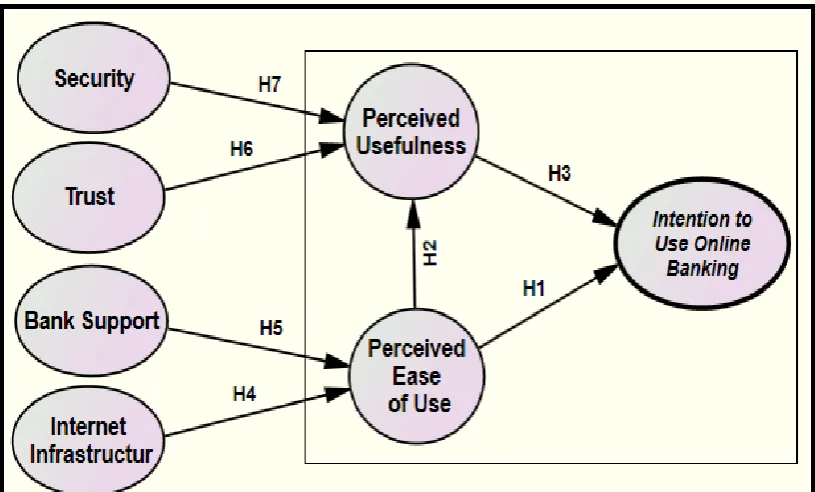
The TAM variables such as Perceived Usefulness (PU) and Perceived Ease of Use (PEOU) are used to explain individual behaviour relating to the adoption of new technology. Both PEOU and PU have an effect on individuals’ behaviour and their attitudes towards acceptance of modern technology. They also have a later effect on behavioural intention to use the technology. In line with the original theory of TAM (Davis, Bagozzi & Warshaw 1989), this research recognises external stimuli in the model such as Trust and Security on the humanitarian side, Support on the part of banks, and the Quality of Telecommunications Infrastructure (Internet Network). This study contributes to enhancing the understanding of acceptance of new information technology in Libya.
TAM theory has demonstrated its status as an effective model to predict the individual’s behaviour and the approval of the direction of the technology usage. TAM developed instruments to measure these original beliefs and were subsequently ratified by Davis (1986; 1989; 1993). These instruments have been widely used by researchers investigating a range of issues in the field of user acceptance of information technology.
This study has selected TAM theory which is the basis of the theory of Reasoned Action (Fishbein 1979) as a research framework. It is possible to look at the study of these phenomena in collaboration with external variables of Trust, Security, Internet Quality and Banks’ Support. Through the theory of TAM and the additional external variables, this research will explain individuals’ perceived attitude towards the adoption of Internet banking services available in Libya.
1.7. Research Motivation and Contribution
16
strategies that can guide e-banking implementation projects in the future in Libya and in its commercial banks.
The research motivation and contribution can be summarised in the following points:
1. Banking products and services online is a worthwhile subject to study, especially in the Arab and developing countries, to draw attention to the quality of services in the Libyan banking sector and how they can be strengthened and developed for the future.
2. Several studies in the literature suggest that there is a problem, reluctance or hesitation in the use of information technology in Arab countries and developing countries; and there is a lack of expertise amongst individuals, companies and most of the potential users and non-qualified staff.
3. Online banking services have been studied extensively in developed countries. While some studies have been conducted in developing countries, online banking services have not been investigated from the viewpoint of individuals in Libya.
4. This study could guide the Libyan government on how it can contribute to the development of the Libyan economy and enhance the lifestyle of Libyans by accepting the use of modern information technology.
1.8. Research objectives
Although consumers in developing economies have shifted to using online banking services because of its benefits, many Libyan bank customers are still not using banking products and services via the Internet. Thus, this requires an assessment of factors that affect customers' perceptions of the adoption and acceptance of online banking in Libya. The main determinants are the subject of research and the study of the Libyan banking sector which exhibit economic and social disparities (political and cultural) compared with other developing countries. There are few studies that have looked at the key factors behind the client's decision to accept online banking services in Libya (Abukhzam & Lee 2010; Emzio 2010; Twati 2008; Twati & Gammack 2006). This study is intended to fill this gap, and focuses on the factors that control the decisions of customers to adopt online banking in the Libyan banking sector. The study seeks to determine the objectives of the research as follows:
1. Identify barriers affecting customers’ decision to adopt online banking in Libya. 2. To determine the most important factors that need to be addressed for the
successful adoption of electronic banking applications and the order of importance of these factors for the Libyan banking sector.
3. Research the effects of the variables on customers’ intention to adopt online banking in Libya.
4. Identify the problems perceived by individuals in Libya in the adoption or use of these new technologies.
5. Suggest a strategy for individuals and organisations to detect hidden problems, thereby improving the use and acceptance of online banking.
1.9. Statement of the problem
17
influence the growth of the banking sector and the ability to attract private investors. In the past, it had been a challenge to adopt online banking business despite the rise of availability and usage of this technology in Libya. To meet the rising need for an efficient banking system, electronic banking enables banks to provide inexpensive services and a direct way of conducting banking business, such as exchanging information, and selling or buying products and services (Chong et al. 2010; Guides 2006). Most customers in Libya do not know whether or not their bank offers an online service. The Bank of Commerce and Development (BCD) was the first privately operated Libyan banking service provider of electronic banking services. The bank actively promoted these services, but some customers were reluctant to adopt them as they feared the risks involved (Guides 2006).
Banks handle sensitive data such as bank accounts. When transmitted over the Internet the IS sensitive data can be exposed to security breaches. It is becoming more widely accepted that it is vital for organisations to encourage and support Information System (IS) innovations as they adopt Internet technologies (Twati 2008). A key concern in banking is trust between customers and their banks (Schafersman 1994), yet customers fail to see the other side of the coin. Further, without an appropriate telecommunications system and quality Internet networks, the innovation of IS/IT would be difficult to launch. The result of this is that, compared to other Arabic nations, the banking sector in Libya has a reputation for having ‘the finest bankers but the worst bank services’ (LibyanInvestment 2009). This research seeks to analyse the barriers to adopting electronic banking in relation to developing banking services in Libya. It is necessary to market electronic banking to increase people’s awareness about e-banking; and people need clear information about the uses and benefits of electronic banking. This will help bank customers do more than just check their balances, transfer funds, and pay bills (Otman & Karlberg 2007).
1.9.1. Research Questions
The following research questions were formulated:
1. What are the barriers to adopting Internet Banking in Libya based on consumers’ perceptions?
2. How important are the barriers to the successful adoption of Internet Banking in Libya?
1.10. Significance of the study
18
1.11. Chapter summary
19
CHAPTER TWO
20
2. CHAPTER TWO: LIBYAN BANKING SECTOR 2.1. Introduction
The banking system plays an important role in the economies of developed and developing countries alike. It has a direct impact on the daily lives of individuals and institutions in the public and private sector. Part of the importance of the banking system is its role as mediator in the compilation of savings from different sources and directed towards investment in different purposes according to the economic and social policies adopted to achieve the goal of growth and prosperity (Abukhzam & Lee 2010).
2.2. About the banking sector in Libya
Despite Libya’s abundant energy resources, the country has one of the least-diversified economies of all the oil-producing countries in the Maghreb region (Otman & Karlberg 2007). In the early seventies, Libya chose to base its economic system exclusively on investment within the limits established by the state. It imposed strict restrictions on foreign trade, Instituted price restrictions and numerous forms of support, and dismissed the private sector almost entirely (St John 2008). The government intervention in the economy from 1969–2003 was seen to have led to a continuous deterioration in the business climate, low economic growth, low living standards, fragility of the macroeconomic conditions, and increased vulnerability of the economy to external shocks (CBL 2011; Libyan Investment 2007). The weak institutions and inefficient governance caused economic conditions to begin to deteriorate in the mid-eighties with the decline in world oil prices, and conditions then worsened in the nineties as a result of international sanctions (Otman & Karlberg 2007).
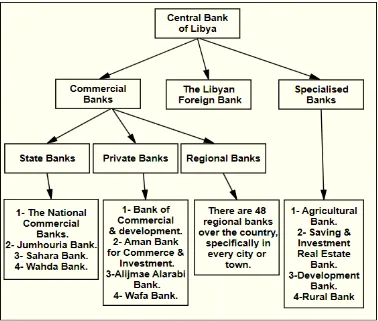
The Libyan banking sector is a group of financial institutions, and is composed mainly of the Central Bank of Libya (CBL), commercial banks, private banks, specialised banks, and representative offices of foreign banks. The most important goal of these financial institutions is to act as a broker at the level of individuals and institutions as well as at the macroeconomic level. Their role is to work as a mediator between available and saved financial resources and draw investment, and thus contribute to increased employment and economic growth, which are measures of the efficiency of the financial system in its ability to achieve these goals. At the micro-level, the primary objective of these institutions should be to maximise the shareholders ‘equity, achieving a big payoff on the capital invested in these institutions while maintaining the strength of their financial position, For example, enabled the Libyan banking sector to survive despite the crisis that gripped the country during the popular movement against the former regime on 17 February 2011. This is due to the solvency enjoyed by commercial banks, and keeps it from private funds and liquidity surpluses and balances with the CBL (CBL 2012c). Although partitions were imposed on the departments of banks in the eastern region, particularly during the revolution and before the complete liberation of all Libyan territories and her operational risks, Libyan commercial banks still managed to restore integrity in banking operations and restore normalcy at the lowest cost and in record time (CBL 2012c).
21
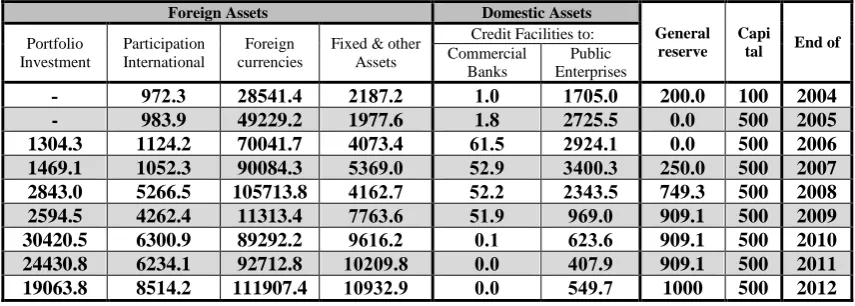
[image:33.595.112.540.317.470.2]vitality of banking activity despite all the difficult operating conditions. The procedures and policies pursued by the central bank to address the liquidity crunch also played an important role in helping the national economy overcome the crisis and achieve financial and monetary stability. For example, the consolidated balance sheet of the banks on12/31/2011 (Year of 17 February Revolution) recorded growth of 8% and a lower rate of growth at the end of 2010.Growth in the consolidated balance sheet of the banks in the year 2011 was due to a 23%increase in private sector deposits. The banking sector also maintained the distribution of its assets ratios, with the CBL accounting for49% of the total assets in the Libyan banking sector. The balance sheets also showed consolidated earnings for the banks at 345.7 Million Libyan Dinars (LD) “before tax”, and a drop of 47% that resulted from the impact of net interest and commission income received, which led to a 9.9% decline in net revenue from 2010 to the end of 2011. The drop was also due to lower-interest income, which increased by 29.6%, and lower interest rates on certificates of deposit issued by the Central Bank of Libya (CBL 2012c).
Table 2-1 Assets & Liabilities of Central Bank of Libya
Source: Central Bank of Libya (2013)
The commitment of the Central Bank of Libya in Benghazi and Tripoli on business continuity in the banking sector and commercial banks’ cohesion is seen to have mitigated the degree of operational risk, especially during the period in which the revolution of 17 February 2011 occurred (GPC 2012). These enabled banks to restore their normal procedures after the restrictions imposed on them were lifted. The CBL was able to eliminate the parallel market activity of foreign currency during the revolution and address the problem of liquidity, which maintained the purchasing power and stability of the value of the Libyan dinar against foreign currencies (St John 2008).
Law No. 5 of 1997 was of the most important pieces of financial legislation in Libya (CBL 2012b). Along with banking laws No. 1 and 2 for the year 2005; it promoted foreign capital investment and worked to create a general economic policy on economic reform, privatisation, and liberalisation of the economy. The decision to nationalise banks and foreign companies in Libya was made in 1970. This decision contributed significantly to the opening of Libya to foreign direct investment, including the massive amounts of investment needed in various sectors, especially to replace obsolete technology in the oil and gas and petrochemical industries, to rebuild roads and communications and railway infrastructure, and to activate the sectors of industry, tourism, and services (CBL 2012c).
End of Capi tal General reserve Domestic Assets Foreign Assets
Credit Facilities to: Fixed & other
22
Some studies have reported (Alfaro et al. 2004; Borensztein, De Gregorio & Lee 1998; Levine & Zervos 1996) that the economy’s ability to take advantage of potential opportunities for foreign direct investment can adversely affect development institutions and local markets. In other words, the country will not be able to meet or absorb any short or long-term capital flows due to the lack of organised and strong financial markets (Borensztein, De Gregorio & Lee 1998). These studies have also shown that “foreign direct investment (FDI) plays an important role in contributing to economic growth. However, the level of development of local financial markets is crucial for these positive effects to be realised (Alfaro et al. 2004).
In analysing the roles of different types of financial institutions, Levine and Zervos (1996) said that in spite of the efficiency of banks and stock markets in providing a variety of different financial services, the stock market, bank liquidity, and development all positively predict economic growth and capital accumulation and improve productivity (Levine & Zervos 1996). Looking at the record of the Libyan government in recent years in its reform of financial institutions, we note that the process had already begun, although there is still a long way to go to ensure investments and foreign investors in Libya. compared to a number of developing countries to choose from in a globalised world, Libya is attractive for individual investors and companies with capital to invest (Otman & Karlberg 2007).
2.3. Development of Libyan banking sector
The financial and banking sectors in Libya are based on the force of law, especially after the nationalisation of banks that occurred after the 1969 revolution (CBL 2012c). Even before then, such laws as law No. 4 of 1963 changed the name of the National Bank to Central Bank of Libya (CBL). The law also contained provisions to create and manage the bank, authorised to be million Libyan pounds, gave the Bank the exclusive right to issue currency, identified the external value of the currency with Libyan responsibility to maintain monetary stability, and included provisions for the regulation of credit. Article 25 of the law No. 4 stated that “the face value of the Libyan pound is equal to 2.48828 grams of pure gold” while in November of 1967 the Libyan currency was linked to the sterling pound until the devaluation of the sterling pound later that year (Libya: Ministry of Planning 2006; Otman & Karlberg 2007).
Article 92 of the law No. 4 dealt with a wide range of topics related to the bank, including the selection of a board, management, buying and selling currencies, import and export, and liquidity management. Article 92 also discussed the issuing of currency and the value of gold, the regulatory role of the bank, the issuance of licenses for banking activities, commercial banking supervision, and reserve ratios, and to some extent included legislation to transparently identify the roles and functions of the CBL and the monetary authority set forth in the law (CBL 2012a).