0022-538X/09/$08.00⫹0 doi:10.1128/JVI.01471-08
Copyright © 2009, American Society for Microbiology. All Rights Reserved.
HLA-Associated Alterations in Replication Capacity of Chimeric
NL4-3 Viruses Carrying
gag-protease
from Elite Controllers of
Human Immunodeficiency Virus Type 1
䌤
Toshiyuki Miura,
1,2,3Mark A. Brockman,
1,2Zabrina L. Brumme,
1,2Chanson J. Brumme,
1Florencia Pereyra,
1,2Alicja Trocha,
1,3Brian L. Block,
1Arne Schneidewind,
1,2Todd M. Allen,
1,2David Heckerman,
4and Bruce D. Walker
1,2,3*
Partners AIDS Research Center, Massachusetts General Hospital, 13th St., BLD149, Charlestown, Massachusetts 021291;
Harvard University Center for AIDS Research, Boston, Massachusetts 021152; Howard Hughes Medical Institute,
Chevy Chase, Maryland 208153; and Microsoft Research, Redmond, Washington 980524
Received 14 July 2008/Accepted 16 October 2008
Human immunodeficiency virus type 1 (HIV-1)-infected persons who maintain plasma viral loads of <50 copies RNA/ml without treatment have been termed elite controllers (EC). Factors contributing to durable control of HIV in EC are unknown, but an HLA-dependent mechanism is suggested by overrepresentation of “protective” class I alleles, such as B*27, B*51, and B*57. Here we investigated the relative replication capacity of viruses (VRC) obtained from EC (nⴝ54) compared to those from chronic progressors (CP;nⴝ41) by constructing chimeric viruses using patient-derivedgag-proteasesequences amplified from plasma HIV RNA and inserted into an NL4-3 backbone. The chimeric viruses generated from EC displayed lower VRC than did viruses from CP (P< 0.0001). HLA-B*57 was associated with lower VRC (Pⴝ0.0002) than were other alleles in both EC and CP groups. Chimeric viruses from B*57ⴙEC (nⴝ18) demonstrated lower VRC than did viruses from B*57ⴙCP (nⴝ8,Pⴝ0.0245). Differences in VRC between EC and CP were also observed for viruses obtained from individuals expressing no described “protective” alleles (Pⴝ0.0065). Intriguingly, two common HLA alleles, A*02 and B*07, were associated with higher VRC (Pⴝ0.0140 and 0.0097, respectively), and there was no difference in VRC between EC and CP sharing these common HLA alleles. These findings indicate that cytotoxic T-lymphocyte (CTL) selection pressure ongag-proteasealters VRC, and HIV-specific CTLs inducing escape mutations with fitness costs in this region may be important for strict viremia control in EC of HIV.
Human immunodeficiency virus type 1 (HIV-1)-infected in-dividuals who control viremia to below the limit of detection (⬍50 RNA copies/ml plasma) without antiviral therapy have been termed elite controllers (EC) (16). Unraveling the mech-anisms associated with this rare and remarkable phenotype, which has been documented in some persons infected for 30 years and counting, should provide important insights regard-ing our understandregard-ing of HIV pathogenesis and could provide important insights for vaccine development.
Host genetics, host innate and adaptive immune responses, and viral sequence variation have all been suggested to influ-ence the rate of disease progression in HIV-1 infection (re-viewed in reference 16). Recently, we reported that viruses sequenced from plasma and peripheral blood mononuclear cells from EC do not share a common ancestor, do not contain shared amino acid changes that are specific to this phenotype, and do not typically harbor gross viral genetic defects (36). However, such studies do not address functional properties of the encoded proteins, such as viral replication capacity (VRC). Reductions in VRC have been observed following exposure to antiretroviral drug selection pressure (17, 25, 31, 34) and there-fore may also occur in response to immune selection pressure.
Focused studies of VRC in long-term nonprogressors/long-term survivors with detectable viremia have suggested that their viruses have reduced VRC compared to those of chronic progressors (CP) (7, 37, 39).
Due to the difficulties in isolating viruses from EC, investi-gating VRC in this rare group has been very challenging. Blankson et al. reported isolation of replication-competent viruses from 4 of 10 EC studied (8). On the other hand, the same group reported a case of a B*27/57 EC whose virus had reduced replication capacity compared to those of laboratory reference strains and the virus in the transmitting donor (4). However, to date, there have been no studies comparing VRC between EC and CP.
Factors that influence VRC are beginning to be defined. Several studies have concluded that the envelope protein is a major determinant for overall fitness of HIV-1 (6, 32, 40, 44). However, little is known about the influence on viral replica-tion of the Gag protein, whose gene sequence is much more conserved than that of envelope. Not only is the Gag protein essential for viral replication, but it is known to be a preferred target for HIV-specific cytotoxic T lymphocytes (CTL) and is subject to mutations driven by CTL selection pressure (9, 21, 28, 35, 38, 45). Although it has been firmly established that in vivo polymorphisms in the conservedpolgene selected under antiretroviral drug therapy can markedly impair viral replica-tion (25, 34), the consequences of immune-driven mutareplica-tions for VRC remain incompletely understood.
Recent studies have indicated that escape mutations in Gag * Corresponding author. Mailing address: Partners AIDS Research
Center, Massachusetts General Hospital, 149 13th St., Room 5212, Charlestown, MA 02129. Phone: (617) 724-8332. Fax: (617) 726-4691. E-mail: [email protected].
䌤Published ahead of print on 29 October 2008.
140
on November 8, 2019 by guest
http://jvi.asm.org/
CTL epitopes restricted by HLA B*27 or B*57, each of which is a known protective HLA class I allele, result in a fitness cost (10, 15, 30, 33, 41, 42). Moreover, CTL targeting epitopes with escape mutations were associated with low plasma viral load (28, 35). Furthermore, relative viremia control was observed in the early phase of infection in persons who acquired viruses from donors with protective HLA alleles that target multiple epitopes within Gag (14, 22), suggesting fitness costs incurred as a result of CTL escape in the donor. These considerations motivated us to examine the influence of thegaggene on VRC. In the present study, we generated gag-protease chimeric viruses on an HIV-1 NL4-3 virus backbone using PCR prod-ucts amplified from plasma of 54 EC and 41 CP and compared VRC by using an infectible cell line with a green fluorescent protein (GFP) reporter to monitor viral replication in vitro. Since there are multiple protease cleavage sites within the Gag protein, the patient-derivedproteasegene was included in the chimeric constructs to preserve Gag processing by the autolo-gous protease. We observed marked differences in VRC when comparing EC and CP and a differential impact on VRC by certain HLA class I alleles. This is the first study to compare VRC between EC and CP and also the first study to investigate associations between HLA alleles and in vitro VRC of HIV-1.
MATERIALS AND METHODS
Study subjects and plasma collection.Fifty-four untreated EC (⬍50 copies/ml plasma) and 41 untreated CP (median viral load, 79,900 [interquartile range, 33,600 to 225,000] copies/ml) were included in the present study. Three of the EC subsequently blipped during clinical follow-up (on average, 813, 183, and 498 RNA copies/ml, respectively) but unless otherwise indicated are grouped with the EC in this analysis. This cohort has been described in detail elsewhere (38). Informed consent was obtained from all participants. Plasma was obtained by
standard procedures and stored at⫺80°C until use.
Viral RNA isolation and nested RT-PCR amplification ofgag-proteasefrom plasma.For the majority of EC, the first-round reverse transcription (RT)-PCR
products from plasma containing the entiregagandproteasegenes were obtained
in the context of a previous study (36), and additionally some EC were added to the current study by using exactly the same methods. The primers used to amplify the first-round products were as follows: forward, AAATCTCTAGCAGTGGC GCCCGAACAG (HXB2 nucleotides 623 to 649), and reverse, TAACCCTGC GGGATGTGGTATTCC (2849 to 2826). For CP, viral RNA was isolated from 0.5 ml of plasma following the same procedures as those used for EC for generation of first-round PCR products. Second-round PCR was performed using 100-mer primers that completely matched the pNL4-3 sequence using
Takara EXTaqDNA polymerase, Hot Start version (catalog no. RR006; Takara
Bio Inc., Shiga, Japan). One hundred microliters of reaction mixture was
com-posed of 10l of 10⫻EXTaqbuffer, 4l of deoxynucleoside triphosphate mix
(2.5 mM each), 6l of 10M forward primer (GAC TCG GCT TGC TGA AGC
GCG CAC GGC AAG AGG CGA GGG GCG GCG ACT GGT GAG TAC GCC AAA AAT TTT GAC TAG CGG AGG CTA GAA GGA GAG AGA TGG G, 695 to 794) and reverse primer (ATG CTT TTA TTT TTT CTT CTG TCA ATG GCC ATT GTT TAA CTT TTG GGC CAT CCA TTC CTG GCT TTA ATT TTA CTG GTA CAG TCT CAA TAG GAC TAA TGG G, 2646 to
2547), 0.5l of enzyme, and 2l of first-round PCR product and water. The
forward primer overlapped thegagcoding sequence by five bases (underlined),
and the reverse primer ended just one base downstream of theproteasegene.
Thermal cycler conditions were as follows: 95°C for 2 min, followed by 40 cycles of 94°C for 30 s, 65°C for 30 s, and 72°C for 2 min and then followed by 7 min of 72°C. PCR products were purified with the Purelink PCR purification kit
(catalog no. K3100-002; Invitrogen, California) and eluted in 50l of
DNase-RNase-free water.
Generation of chimeric viruses.gag-protease-deleted pNL4-3 was developed by
inserting the unique restriction enzyme site BstEII at the 5⬘end of thegaggene
and then 45 bases downstream from the 3⬘end of theproteasegene of pNL4-3 by
site-directed mutagenesis using QuikChange II (Stratagene, La Jolla, CA). The
gag-proteasegene was then deleted by BstEII digestion (New England Biolabs, Ipswich, MA), resulting in self-ligation of the remaining plasmid. A large amount
of vector was prepared using the Hispeed plasmid maxi kit (catalog no.12663;
Qiagen, Maryland), eluted in 1 ml Tris-EDTA buffer, and stored at⫺20°C until
use. This vector was then linearized by BstEII digestion at 60°C for 2 h and purified (Purelink PCR purification kit). Ten micrograms of linearized vector
and 5 to 10g of purified PCR product were cotransfected into 2.5⫻106cells
of the tat-driven GFP reporter T-cell line (GXR cells, CEM origin [11]) in 800
l of R10 Plus medium (RPMI medium with 10% fetal calf serum containing
penicillin and streptomycin) by electroporation (exponential protocol, 300 V, 500
F). Cells were incubated for 45 min at room temperature and transferred to
T25 flasks in 10 ml of R10 Plus medium. GFP expression was monitored by flow cytometry (FACSCalibur; BD Biosciences, San Jose, CA) every 1 to 2 days after day 5. Supernatants were harvested after GFP expression reached 15% among
the viable cells and were stored at⫺80°C as viral stocks for subsequent
replica-tion capacity experiments. Virus titrareplica-tion and VRC assays were performed as described previously (10, 36, 41) at a multiplicity of infection (MOI) of 0.002. Replication capacity assays were performed in duplicate, using gating strategies as previously described (10, 11, 36, 41, 42). The slope of the natural log of percent GFP-expressing cells was calculated between days 2 and 6. The natural log was used for the slope calculation, as appropriate for an exponential growth curve. The MOI of 0.002 was chosen based on initial experiments with this cell line and the chimeric viruses showing that, at this MOI, a robust and clear exponential curve could be plotted before reaching a plateau level of 30 to 40% at 7 to 8 days postinfection, which represents the saturation level in this system. In addition, for
each viral stock, viral RNA was extracted from 30l of stock supernatant using
the ChargeSwitch EasyPlex viral kit (catalog no. CS12281-04m; Invitrogen, Cal-ifornia) following the manufacturer’s instructions, followed by nested RT-PCR, as described above, to provide product for sequencing.
Sequencing and phylogenetic analysis.Plasma and viral stock sequencing was
performed as described previously (36). The origin ofgag-proteasegenes from
chimeric NL4-3 was confirmed by the maximum-likelihood method (DNAml, PHYLIP). Protein amino acid sequence trees were drawn by the maximum-likelihood method as well (Proml, PHYLIP).
Statistical analysis.VRC was compared between the grouped pairs using the Mann-Whitney U test. The association between (i) VRC and the presence or absence of HLA alleles and (ii) VRC and the presence or absence of individual viral amino acid residues was analyzed by Mann-Whitney U test. To account for
multiple tests,qvalues were computed, with cutoffs for significance as indicated
elsewhere (43).
Nucleotide sequence accession numbers.Viral sequences which had not been reported before were submitted to GenBank (accession numbers EU864042-114 and EU873002-005).
RESULTS
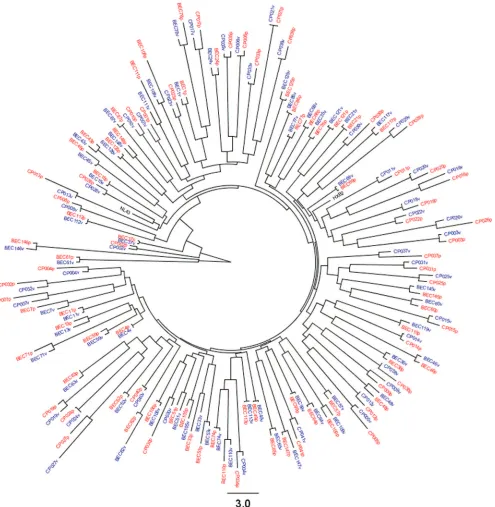
Generation and validation of gag-proteasechimeric NL4-3 viruses. Cotransfection of the amplified patient-derived gag-proteasegenes with the linearized⌬gag-proteaseNL4-3 plasmid into a GFP reporter cell line resulted in production of infec-tious progeny viruses, with expression of GFP in at least 15% of the cells within a median of 14 days (range, 7 to 28 days) in all 54 EC and 41 CP. The entiregag region of the chimeric viruses was then sequenced from the resultant chimeric viral stocks and compared to the original source plasma (Fig. 1). A median of 0.598% (interquartile range, 0.199 to 1.397%) dif-ference at the protein level was observed between plasma HIV RNA and chimeric virus, and there was a significant difference between EC and CP viruses (0.299% [0.150 to 1.199] versus 0.796% [0.399 to 1.796],P⫽0.003). However, the vast majority of the differences were observed at a codon in which we de-tected mixtures in the sequences, and as expected these were more frequent in persons with higher plasma viral loads. If amino acid mixtures were excluded from analysis, there was no difference between EC and CP (0.0% [0.0 to 0.120] versus 0.0% [0.0 to 0.120], P ⫽ 0.887). These data indicated that although there may have been some selection of chimeric vi-ruses during recombination and/or culture, which was partic-ularly evident for CP, probably due to higher intraindividual
on November 8, 2019 by guest
http://jvi.asm.org/
diversity than that for EC, Gag-Protease of chimeric viruses represented the dominant form of plasma viruses in both EC and CP, and selection during culture was unlikely to affect the overall analysis. For subsequent analyses, sequences derived directly from the chimeric viruses were used.
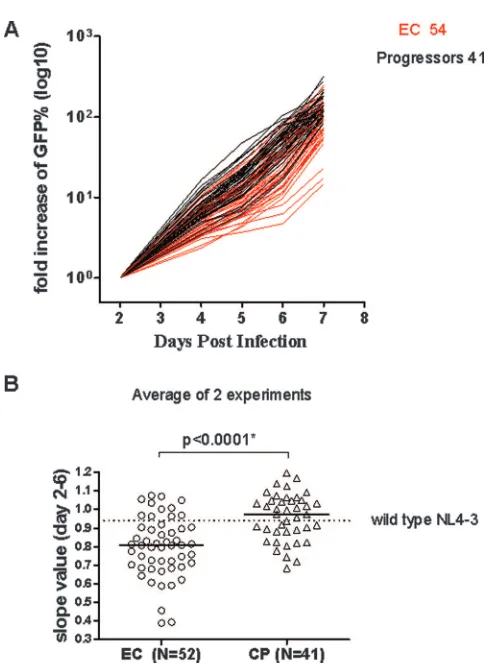
Comparison of VRCs of chimeric NL4-3 between EC and CP.In order to quantitatively compare the in vitro VRCs of chimeric viruses from EC and CP, we infected the GFP re-porter cell line with the chimeric viral stocks at an MOI of
[image:3.585.49.544.68.575.2]0.002 and measured VRC by performing flow cytometric quan-titation of the percentage of cells expressing GFP from days 2 to 6 after infection (Fig. 2A). gag-protease chimeric viruses derived from EC displayed significantly reduced replication capacity compared to those derived from CP. All but two EC were infected with clade B viruses; significant differences re-mained (P⬍0.0001) even after removal of these two non-clade B viruses (Fig. 2B). Three of the EC were subsequently deter-mined to have had blips in viral load at the time at which the FIG. 1. Validation of obtained chimeric NL4-3 sequences by phylogenetic analysis. The tree was drawn by the maximum-likelihood method (Proml, PHYLIP) using entire Gag protein sequences. Blue taxa indicate sequences from chimeric viral stocks. Red taxa indicate the original plasma viral sequence. Note that all viral stocks and plasma viral sequences from the same subjects shared the same branches.
on November 8, 2019 by guest
http://jvi.asm.org/
gag-proteasegene was amplified (viral loads of 812, 183, and 498 RNA copies/ml); removing these from the analysis also did not affect the results (data not shown). We observed a weak positive correlation between VRC and plasma viral loads of CP (Pearsonr⫽0.29,P⫽0.065, data not shown), supporting the finding that chimeric viruses derived from the subjects with lower plasma viral loads had reduced in vitro replication ca-pacity.
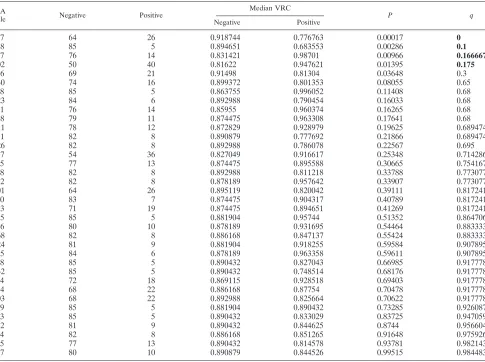
Association between specific HLA alleles and VRC of chi-meric NL4-3 viruses.Having shown that in vitro VRC varies significantly among viruses obtained from HIV-infected per-sons, we next examined whether the particular HLA alleles expressed affected this parameter. In this analysis, we included 90 clade B virus-infected subjects in whom HLA class I types were available and excluded the two subjects with non-B-clade virus infection. Again, using the slope of percent GFP infection between days 2 and 6 as a measure of VRC, we found four class I HLA alleles significantly associated with differences in VRC: B*57, Cw*18, A*02, and B*07 (allP⬍0.05 andq⬍0.2 [Table 1]). B*57 showed the strongest negative impact on VRC (0.777 in B*57⫹versus 0.919 in B*57⫺, q⬍ 0.0001), which supported previous reports of fitness costs by B*57 CTL escape
mutations in Gag (10, 30, 33). Cw*18 also showed a weaker negative impact; however, this is likely due to the strong link-age disequilibrium between B*5703 and Cw*18, rather than a true negative impact of Cw*18 on VRC. In contrast, A*02 and B*07 were associated with higher VRC (0.948 versus 0.816 for A*02 and 0.987 versus 0.831,q⫽0.175, respectively [Table 1]). The fact that these alleles are both common in the U.S. pop-ulation (A*02 frequency, 28.3% for Caucasians and 18.7% for African Americans; B*07 frequency, 11.3% for Caucasians and 9.8% for African Americans) (12) suggests the possibility that these are not actively increasing VRC but rather that the virus may have become most adapted to these populations, render-ing them neutral in comparison to a large group of less-fre-quent HLA alleles, which may still be impacting viral load (1, 20, 29).
Since homozygosity at HLA class I loci has been linked to more-rapid HIV disease progression (13), we also examined the impact of homozygosity for HLA A, B, or C alleles on VRC. However, no association with VRC of the chimeric vi-ruses was observed (data not shown). Also of interest, we did not see a negative impact on gag-protease function by HLA B*27 and B*51, despite these alleles being enriched in EC (38) (Table 1). However, these results could be due to limited statistical power; analysis of larger data sets will be necessary to further evaluate this.
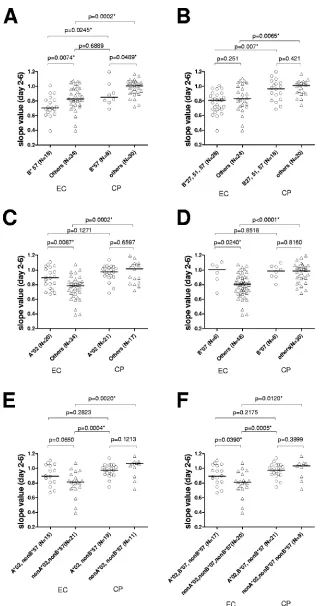
Stratification of VRC by controller status and particular HLA alleles. Given the above results showing that VRC is associated with EC status and with expression of particular HLA alleles, we next compared the relative VRC within the EC group in relation to specific HLA alleles and did the same for the CP group. As shown in Fig. 3A, chimeric viruses from EC expressing HLA-B*57 showed significantly lower VRC than did those from non-B*57 EC (0.707 versus 0.827, P ⫽
0.0074). Likewise, chimeric viruses from B*57 CP displayed significantly reduced VRC compared to those from non-B*57 CP (0.850 versus 1.005, P ⫽ 0.0489). Notably, there was a significant difference in VRC between not only B*57 EC and B*57 CP (P⫽0.0245) but also non-B*57 EC and non-B*57 CP (P⫽0.0002), indicating that the reduced VRC of EC was not due just to biased distribution of B*57 in EC (Fig. 3A). The difference between B*57 EC and B*57 CP is consistent with a previous study in which accumulation of compensatory tions led to recovery of fitness loss induced by escape muta-tions arising within CTL epitopes in B*57 progressors (10). There was still a significant difference between EC and CP when the three alleles most strongly associated with better outcome (B*27, B*51, and B*57) were removed (0.831 versus 1.004, P ⫽ 0.0065 [Fig. 3B]), indicating that the observed differences in VRC were not solely mediated by the most protective HLA alleles.
We next performed a subanalysis of the two alleles, A*02 and B*07, associated with higher VRC. Chimeric viruses from A*02-expressing EC showed significantly higher VRC than did those from non-A*02-expressing EC (0.893 versus 0.786,P⫽
0.0087). In contrast, no difference in VRC was observed be-tween A*02-expressing and non-A*02-expressing CP (0.9733 versus 1.018,P⫽0.6597 [Fig. 3C]). Intriguingly, there were no significant differences in VRC between A*02-expressing EC and A*02-expressing CP, although a trend toward lower VRC in A*02-expressing EC than in A*02-expressing CP was ob-FIG. 2. Comparison of VRCs ofgag-proteasechimeric viruses
be-tween EC and CP. VRCs of chimeric NL4-3 were compared among 54 EC and 41 CP. (A) Kinetics of viral replication; red and black lines indicate EC and CP, respectively. Representative data from duplicate experiments are shown. (B) Comparison of the slope of the natural log between day 2 and day 6. Data shown here are the averages of dupli-cate experiments. Dashed line indidupli-cates VRC of wild-type NL4-3.
on November 8, 2019 by guest
http://jvi.asm.org/
[image:4.585.41.284.60.395.2]served (Fig. 3C). Similar results were obtained for B*07 (Fig. 3D). Since B*57 showed the strongest negative impact on VRC of chimeric viruses and there was biased distribution of B*57 in EC, we repeated this analysis excluding this allele. After B*57-expressing subjects were removed, a trend toward reduced VRC in non-A*02 EC compared to A*02 EC remained (0.815 versus 0.896,P ⫽ 0.0650 [Fig. 3E]). The difference between A*02 EC and A*02 CP was further weakened (P ⫽0.2823) despite the fact that the difference between non-A*02 EC and non-A*02 CP was maintained (P⫽ 0.0020 [Fig. 3E]). Com-bining A*02 and B*07, we obtained a similar result and the difference between A*02/B*07 EC and other EC reached sig-nificance (P⫽0.0390 [Fig. 3F]). These results further support the hypothesis that A*02 and B*07 alleles themselves have little impact on VRC ongag-protease chimeric viruses com-pared to other HLA alleles, but non-A*02/B*07 alleles en-riched in EC have a greater negative impact on VRC, albeit much weaker than that of B*57. In addition, the data suggest that reduced VRC ofgag-proteasechimeric viruses from EC is likely driven by HLA-mediated mutations that include other alleles besides HLA B*57, rather than transmission of viruses with attenuatedgag-proteasegenes.
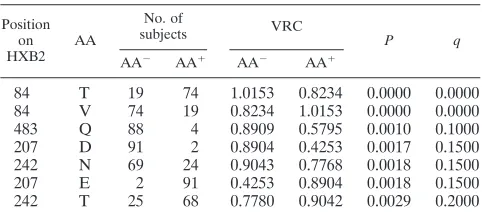
Association between VRC and specific amino acid residues. Having sequenced all of thegag-proteasegenes from the per-sons included in this study, we next examined the association between specific amino acid residues and VRC. Only clade B virus infections (n⫽92) were included in this analysis. Table 2 shows the list of codons in Gag associated with lower VRC based on aqvalue cutoff of⬍0.2 (see Materials and Methods). There was no significant association between codons in pro-tease and VRC (data not shown), but four positions in Gag (84, 207, 242, and 483) were statistically associated with differ-ences. Gag 84T was associated with lower VRC, and interest-ingly T is the current consensus amino acid for clade B at this residue. Of EC, 88.5% had 84T but only 68.3% of CP were carrying T (P⫽0.029). In the Los Alamos National Laboratory database, 87.5% (28/32) of clade B virus sequences sampled before 1995 in the United States included 84T, but after 1995, only 63.6% (14/22) did so (P⫽0.05). These percentages cor-respond well to the differences observed at this residue in EC and CP and are likely explained by older strain infection in EC than in CP, as previously reported (36). T84V was reported as an escape mutation of A*02 (26), which is the most common HLA class I allele in the United States. Therefore, accumula-TABLE 1. VRC ofgag-proteasechimeric NL4-3 by HLA allelesa
HLA
allele Negative Positive
Median VRC
P q
Negative Positive
B57 64 26 0.918744 0.776763 0.00017 0
C18 85 5 0.894651 0.683553 0.00286 0.1
B07 76 14 0.831421 0.98701 0.00966 0.166667
A02 50 40 0.81622 0.947621 0.01395 0.175
C06 69 21 0.91498 0.81304 0.03648 0.3
A30 74 16 0.899372 0.801353 0.08055 0.65
B18 85 5 0.863755 0.996052 0.11408 0.68
A23 84 6 0.892988 0.790454 0.16033 0.68
B51 76 14 0.85955 0.960374 0.16265 0.68
C08 79 11 0.874475 0.963308 0.17641 0.68
A11 78 12 0.872829 0.928979 0.19625 0.689474
C01 82 8 0.890879 0.777692 0.21866 0.689474
A26 82 8 0.892988 0.786078 0.22567 0.695
C07 54 36 0.827049 0.916617 0.25348 0.714286
B35 77 13 0.874475 0.895588 0.30665 0.754167
B08 82 8 0.892988 0.811218 0.33788 0.773077
C02 82 8 0.878189 0.957642 0.33907 0.773077
A01 64 26 0.895119 0.820042 0.39111 0.817241
B40 83 7 0.874475 0.904317 0.40789 0.817241
C03 71 19 0.874475 0.894651 0.41269 0.817241
C15 85 5 0.881904 0.95744 0.51352 0.864706
C16 80 10 0.878189 0.931695 0.54464 0.883333
A68 82 8 0.886168 0.847137 0.55424 0.883333
A24 81 9 0.881904 0.918255 0.59584 0.907895
C05 84 6 0.878189 0.963358 0.59611 0.907895
B58 85 5 0.890432 0.827043 0.66985 0.917778
A32 85 5 0.890432 0.748514 0.68176 0.917778
B44 72 18 0.869115 0.928518 0.69403 0.917778
C04 68 22 0.886168 0.87754 0.70478 0.917778
A03 68 22 0.892988 0.825664 0.70622 0.917778
B49 85 5 0.881904 0.890432 0.73285 0.926087
B13 85 5 0.890432 0.833029 0.83725 0.947059
C12 81 9 0.890432 0.844625 0.8744 0.956604
B14 82 8 0.886168 0.851265 0.91648 0.975926
B15 77 13 0.890432 0.814578 0.93781 0.982143
B27 80 10 0.890879 0.844526 0.99515 0.984483
a
HLA alleles seen in more than four EC are shown.qvalues of⬍0.2 are shown in bold.
on November 8, 2019 by guest
http://jvi.asm.org/
[image:5.585.54.539.80.442.2]FIG. 3. Comparison of VRC between EC and CP by HLA alleles. VRC of chimeric NL4-3 was compared between EC and CP in the context of the designated class I HLA alleles. (A) B*57 versus non-B*57; (B) protective (B*27, B*51, and B*57) alleles versus others; (C) A*02 versus others; (D) B*07 versus others; (E) A*02 versus others after removal of B*57; (F) A*02 or B*07 versus others after removal of B*57.
on November 8, 2019 by guest
http://jvi.asm.org/
tion of T84V in the population over time can be supported by this study. Alternatively, it may be explained that limited viral evolution in EC prevents emergence of the T84V escape mu-tation in A*02⫹EC, since this Gag epitope (SLYNTVATL) is typically first targeted during chronic infection after set point viral loads are achieved (26) and results in a higher frequency of 84T in EC. In any case, the association between 84T and lower VRC is unlikely to reflect a true causal relationship but rather infection by older strains in EC and/or maintenance of the wild-type A*02 epitope in EC.
Another significant association between VRC and specific sequence differences was the Gag T242N mutation, a widely recognized escape mutation from CTL restricted by B*57, which has a negative impact on VRC (10, 33). Therefore, an association between VRC and the T242N mutation would be expected. However, this does not necessarily mean a causal relationship. The other two Gag mutations associated with reduced VRC, 207D and 483Q, were present in only two EC and four EC, respectively. Interestingly, 207D was present in two of the three EC with the lowest VRC of the entire cohort (0.46 and 0.39). The final significant association between se-quence usage and diminished VRC was the 483Q mutation, which was seen in an EC with the lowest VRC recorded, 0.39. Codon 207 did not correspond to any predicted CTL epitopes for the two EC with 207D. Codon 483 corresponded to pre-dicted CTL epitopes in three of the four EC (http://www.hiv .lanl.gov/content/immunology/tables/ctl_summary.html). How-ever, those predicted epitopes were defined for non-clade B virus sequences, and there are substantial mismatches within this region between clade B and non-clade B sequences. Therefore, it is unclear whether this region acts as a CTL epitope for these subjects infected with clade B virus. Larger studies and mutagenesis approaches will be necessary to ex-amine whether these rare mutations are truly associated with EC and affect VRC or not. In summary, except for T242N, a known escape mutation from B*57-restricted TW10-specific CTL, none of the common amino acid changes could be caus-ally linked to reduced VRC ofgag-proteasechimeric NL4-3.
DISCUSSION
In this study, we assessed VRC of chimeric NL4-3 viruses expressing thegag-protease gene derived from a well-charac-terized cohort of EC of HIV infection and compared these to chimeric viruses derived from persons with progressive HIV
infection. This is the first study to directly compare VRC be-tween large numbers of EC and CP. Our results indicate that
gag-proteasegenes from EC are attenuated in replication ca-pacity compared to those from CP. Moreover, our data indi-cate that there are differential impacts on VRC by HLA class I alleles, which contribute to differences observed in VRC between EC and CP. Notably, the allele most associated with a protective effect in HIV-infected persons, HLA-B*57, dis-played the most profound impact on VRC.
Increasing evidence indicates that VRC can impact HIV pathogenesis (10, 15, 22, 33, 41). It has, however, been chal-lenging to amplify target HIV-1 genes and to isolate primary viruses from EC due to the extremely low plasma viral loads. Recently, we and others have successfully amplified HIV-1 genes from plasma viral RNA of EC, which likely represent actively circulating viruses in vivo (3, 5, 36). The availability of these PCR products allowed us to generate chimeric viruses carrying HIV-1 genes from EC plasma. Combining the gener-ation of chimeric NL4-3 with a recently developed GFP re-porter T-cell line (11) enabled us to examine a large number of subjects in the context of diverse HLA alleles and to use flow cytometry to assess viral replication kinetics precisely. Our results provide evidence of a link between HLA class I alleles and VRC, suggesting an important mechanism by which CTL may contribute to viral containment.
Comparison of VRC of primary isolates between progres-sors and long-term nonprogresprogres-sors/long-term survivors has been reported (7, 37, 39), but the current study adds important information to these earlier studies. Most reported studies of VRC have used primary CD4⫹T cells as a source of autolo-gous viruses, which do not necessarily represent actively rep-licating viruses in vivo. Given observed discrepancies between plasma viral and proviral sequences in subjects with extremely low viremia (reference 5 and our unpublished data), namely, that cellular proviruses maintain more wild-type sequences in EC subjects than do circulating plasma viruses in the same subjects, we reasoned it wise to avoid using primary isolates derived from autologous CD4⫹ T cells for comparison be-tween controllers and progressors and instead focused on vi-ruses derived from plasma. Moreover, previous studies have indicated that the envelope gene is the major determinant of overall replication capacity of HIV-1; that intraindividual en-velope diversity positively correlates with in vitro VRC; and that as disease progresses and plasma viral load increases, VRC also increases (2, 39, 44). Since envelope sequences in EC are less evolved than those in CP (3, 36) and contain fewer mixtures than those in CP (our unpublished observations), indicating less envelope sequence diversity in EC, comparison of VRC of primary isolates between EC and CP could merely represent different degrees of diversity of envelope genes, something which has been observed when comparing acute/ early- and late-phase HIV infection in a given subject (44). In other words, the difference in VRC of primary isolates be-tween EC and CP might be just the result of limited envelope sequence diversity in EC due to host factors including immu-nity.
Here we were able to extend studies of VRC beyond theenv
[image:7.585.43.284.88.196.2]gene. Given a growing body of evidence suggesting an impor-tant role for fitness costs by CTL escape mutations within Gag in controlling viremia (10, 28, 33, 35), we focused on this TABLE 2. Association between Gag codons and viral
replication capacitya
Position on HXB2
AA
No. of
subjects VRC P q
AA⫺ AA⫹ AA⫺ AA⫹
84 T 19 74 1.0153 0.8234 0.0000 0.0000 84 V 74 19 0.8234 1.0153 0.0000 0.0000 483 Q 88 4 0.8909 0.5795 0.0010 0.1000 207 D 91 2 0.8904 0.4253 0.0017 0.1500 242 N 69 24 0.9043 0.7768 0.0018 0.1500 207 E 2 91 0.4253 0.8904 0.0018 0.1500 242 T 25 68 0.7780 0.9042 0.0029 0.2000
a
AA, amino acid(s). Onlyqvalues ofⱕ0.2 are shown.
on November 8, 2019 by guest
http://jvi.asm.org/
protein. Since it is not known whether the diversity of the Gag protein sequence correlates with its function, there remains the possibility that the observed differences in VRC between EC and CP might reflect distinct interindividual diversity of the Gag protein. We also note that there is still considerable over-lap in VRC between EC and CP (Fig. 2B). Therefore, the observed reduction of Gag-Protease function in EC is not the sole factor to explain elite control but rather one of the factors contributing to suppression of viremia.
The novelty of the present study is not only in scale or use of EC samples but also in showing a differential impact on viral replication by different HLA class I alleles. Although only B*57 showed a significant negative impact on VRC, indirect evidence that common HLA alleles like A*02 and/or B*07 had little impact on VRC suggests that other HLA class I alleles likely had some negative impact on VRC, albeit to a lesser extent than B*57. This finding and additional observations of significantly reduced VRC in non-A*02/B*07/B*57 EC com-pared to non-A*02/B*07/B*57 CP indicate that reduced VRC in non-A*02/B*07/B*57 EC is likely mediated by HLA class I alleles enriched in EC. These findings further support recent studies suggesting the importance of CTL targeting Gag epitopes and inducing escape mutations with fitness costs (22, 28, 35).
Although this study implies a contribution of altered VRC to viral control in persons with HLA-B*57, it does not link other well-known protective HLA alleles like B*27 and B*51 to altered VRC. Since there are no known B*51 CTL epitopes within the Gag-protease (19), it is perhaps not surprising that we did not see any impact by this allele. On the other hand, B*27 is known to contain an immunodominant CTL epitope within Gag protein, and escape from this CTL response is frequently observed (18, 23, 27) and has been demonstrated to compromise VRC (41, 42). However, these mutations typically do not arise until late-stage infection (24, 41), and it has been demonstrated that the dominant CTL escape form R264K Gag requires an upstream mutation (S173A) which fully compen-sates the fitness cost and is required prior to complete escape (41). Thus, the lack of an effect of B*27 ongag-protease chi-meric virus replication capacity in the present study does not contradict previous findings. These results indicate more het-erogeneous mechanisms of elite control even among HIV-specific CTL responses.
Another important finding of this study is the observation that B*57 EC showed significantly reduced VRC compared to B*57 CP. This might be explained by an additional effect of other protective HLA alleles in B*57 EC that may not be present in B*57 CP. However, as reported before, accumula-tion of compensatory mutaaccumula-tions that recover reduced VRC by B*57 CTL escape mutations also is a feasible explanation (10, 15). However, since we observed rare escape variants in many of the B*57 EC (unpublished data), the mechanism of atten-uation of viruses in B*57 EC seems more complex. Additional studies are required to reveal the role of such rare mutations in VRC in B*57 EC. Likewise, the difference between non-A*02/ B*07/B*57 EC and non-A*02/B*07/B*57 CP might be due to accumulation of compensatory mutations that recover fitness costs by escape mutations, or unique mutations in EC, rather than different HLA allele distribution between EC and CP. Larger data sets may allow this question to be answered.
It has been suggested that EC might acquire viruses with reduced replication capacity at the time of transmission, rather than having these arise in vivo. However, this would not ex-plain the HLA-associated differences in VRC observed in the present study. Therefore, we conclude that the diminished VRC of EC viruses is achieved after transmission rather than transmitted from donors. However, very recently, it was sug-gested that the subjects considered to have obtained viruses from donors with protective HLA alleles could maintain lower levels of viremia, at least temporarily, after infection (22). It is quite possible that controllers who have strong immune re-sponses obtain further benefit when an attenuated virus is transmitted, and this may further contribute to elite control. In order to clarify this point, longitudinal studies of large numbers of persons in acute infection with diverse set point viral loads will be necessary.
Although gag-protease was the focus of the current study, there remains the possibility that there is dysfunction of other HIV-1 genes that may be associated with elite control. Enrich-ment in EC of B*51, which contains no Gag CTL epitopes, is a potential example of an allele that modifies VRC via im-mune-selected mutations in another viral gene. Evaluation of function of other HIV-1 genes is warranted to further under-stand the mechanisms of elite control.
In conclusion, we observed significantly reduced VRC of chimeric NL4-3 viruses carryinggag-proteasegenes from HIV EC and found this to be associated with particular HLA class I allele expression. HLA-B*57 displayed the most profound effect on VRC, whereas the more common HLA alleles A*02 and B*07 had the least impact. Non-A*02/B*07 HLA alleles enriched in EC also appear to be able to attenuate Gag-pro-tease function. This differential impact by HLA alleles on VRC of chimeric viruses also indicates that attenuation of gag-pro-teasegenes is achieved following transmission. It will be im-portant to generate longitudinal data on acute infection and expand these data sets to further define the role of fitness defects in disease outcome and the potential contribution of class I-restricted selection pressure on other coding regions to viral fitness, which has potential important implications for vaccine design.
ACKNOWLEDGMENTS
We gratefully acknowledge the efforts of the clinical staff of The International HIV Controllers Study: Erik Berg, Emily Cutrell, Priscilla Padilla, Almas Rathod, Rachel Rosenberg, Sue Bazner, Chris Birch, and Kristin Moss. Additionally, we recognize and thank the laboratory staff: Brett Baker, Alissa Rothchild, Ildiko Toth, Aisha Darrah, Brooke LaTour, and Agnes Sarkozi. Finally, we acknowledge the hundreds of providers and researchers from around the world who have contributed samples to The International HIV Controllers Study. Success in this research depends on the efforts and support of health-care professionals and researchers who refer subjects from around the world. A complete list of contributors and collaborators can be found at http://www.hivcontrollers.org/index.php?q⫽contributor/alphalist/A. We thank Zixin Hu and Daniel Kuritzkes (Brigham and Women’s Hospital) for advice regarding construction of thegag-protease-deleted NL4-3 vector.
This work was supported by grants AI028568 and AI030914 from the NIAID/NIH, the Howard Hughes Medical Institute, the Harvard Uni-versity Center for AIDS Research (CFAR), and a gift from the Mark and Lisa Schwartz Foundation.
The ideas and opinions expressed in the manuscript are solely the responsibility of the authors and are not necessarily shared by the NIH
on November 8, 2019 by guest
http://jvi.asm.org/
or other funding sources, Massachusetts General Hospital, or its affil-iates. The authors declare no conflicts of interest related to this study.
REFERENCES
1.Altfeld, M., T. M. Allen, E. T. Kalife, N. Frahm, M. M. Addo, B. R. Mothe, A. Rathod, L. L. Reyor, J. Harlow, X. G. Yu, B. Perkins, L. K. Robinson, J. Sidney, G. Alter, M. Lichterfeld, A. Sette, E. S. Rosenberg, P. J. Goulder, C. Brander, and B. D. Walker. 2005. The majority of currently circulating human immunodeficiency virus type 1 clade B viruses fail to prime cytotoxic T-lymphocyte responses against an otherwise immunodominant
HLA-A2-restricted epitope: implications for vaccine design. J. Virol.79:5000–5005.
2.Arien, K. K., G. Vanham, and E. J. Arts.2007. Is HIV-1 evolving to a less
virulent form in humans? Nat. Rev. Microbiol.5:141–151.
3.Bailey, J. R., K. G. Lassen, H. C. Yang, T. C. Quinn, S. C. Ray, J. N. Blankson, and R. F. Siliciano.2006. Neutralizing antibodies do not mediate suppression of human immunodeficiency virus type 1 in elite suppressors or selection of plasma virus variants in patients on highly active antiretroviral
therapy. J. Virol.80:4758–4770.
4.Bailey, J. R., K. O’Connell, H. C. Yang, Y. Han, J. Xu, B. Jilek, T. M. Williams, S. C. Ray, R. F. Siliciano, and J. N. Blankson.2008. Transmission of human immunodeficiency virus type 1 from a patient who developed
AIDS to an elite suppressor. J. Virol.82:7395–7410.
5.Bailey, J. R., T. M. Williams, R. F. Siliciano, and J. N. Blankson.2006.
Maintenance of viral suppression in HIV-1-infected HLA-B*57⫹elite
sup-pressors despite CTL escape mutations. J. Exp. Med.203:1357–1369.
6.Ball, S. C., A. Abraha, K. R. Collins, A. J. Marozsan, H. Baird, M. E. Quinones-Mateu, A. Penn-Nicholson, M. Murray, N. Richard, M. Lobritz, P. A. Zimmerman, T. Kawamura, A. Blauvelt, and E. J. Arts.2003. Com-paring the ex vivo fitness of CCR5-tropic human immunodeficiency virus
type 1 isolates of subtypes B and C. J. Virol.77:1021–1038.
7.Blaak, H., M. Brouwer, L. J. Ran, F. de Wolf, and H. Schuitemaker.1998. In vitro replication kinetics of human immunodeficiency virus type 1 (HIV-1) variants in relation to virus load in long-term survivors of HIV-1 infection.
J. Infect. Dis.177:600–610.
8.Blankson, J. N., J. R. Bailey, S. Thayil, H. C. Yang, K. Lassen, J. Lai, S. K. Gandhi, J. D. Siliciano, T. M. Williams, and R. F. Siliciano.2007. Isolation and characterization of replication-competent human immunodeficiency
vi-rus type 1 from a subset of elite suppressors. J. Virol.81:2508–2518.
9.Borghans, J. A., A. Molgaard, R. J. de Boer, and C. Kesmir.2007. HLA alleles associated with slow progression to AIDS truly prefer to present
HIV-1 p24. PLoS ONE2:e920.
10.Brockman, M. A., A. Schneidewind, M. Lahaie, A. Schmidt, T. Miura, I. Desouza, F. Ryvkin, C. A. Derdeyn, S. Allen, E. Hunter, J. Mulenga, P. A. Goepfert, B. D. Walker, and T. M. Allen.2007. Escape and compensation from early HLA-B57-mediated cytotoxic T-lymphocyte pressure on human immunodeficiency virus type 1 Gag alter capsid interactions with cyclophilin
A. J. Virol.81:12608–12618.
11.Brockman, M. A., G. O. Tanzi, B. D. Walker, and T. M. Allen.2006. Use of a novel GFP reporter cell line to examine replication capacity of
CXCR4-and CCR5-tropic HIV-1 by flow cytometry. J. Virol. Methods131:134–142.
12.Cao, K., J. Hollenbach, X. Shi, W. Shi, M. Chopek, and M. A. Fernandez-Vina.2001. Analysis of the frequencies of HLA-A, B, and C alleles and haplotypes in the five major ethnic groups of the United States reveals high levels of diversity in these loci and contrasting distribution patterns in these
populations. Hum. Immunol.62:1009–1030.
13.Carrington, M., G. W. Nelson, M. P. Martin, T. Kissner, D. Vlahov, J. J. Goedert, R. Kaslow, S. Buchbinder, K. Hoots, and S. J. O’Brien.1999. HLA and HIV-1: heterozygote advantage and B*35-Cw*04 disadvantage. Science
283:1748–1752.
14.Chopera, D. R., Z. Woodman, K. Mlisana, M. Mlotshwa, D. P. Martin, C. Seoighe, F. Treurnicht, D. A. de Rosa, W. Hide, S. A. Karim, C. M. Gray, and C. Williamson.2008. Transmission of HIV-1 CTL escape variants provides HLA-mismatched recipients with a survival advantage. PLoS Pathog.
4:e1000033.
15.Crawford, H., J. G. Prado, A. Leslie, S. Hue, I. Honeyborne, S. Reddy, M. van der Stok, Z. Mncube, C. Brander, C. Rousseau, J. I. Mullins, R. Kaslow, P. Goepfert, S. Allen, E. Hunter, J. Mulenga, P. Kiepiela, B. D. Walker, and P. J. Goulder.2007. Compensatory mutation partially restores fitness and delays reversion of escape mutation within the immunodominant HLA-B*5703-restricted Gag epitope in chronic human immunodeficiency virus
type 1 infection. J. Virol.81:8346–8351.
16.Deeks, S. G., and B. D. Walker.2007. Human immunodeficiency virus con-trollers: mechanisms of durable virus control in the absence of antiretroviral
therapy. Immunity27:406–416.
17.de la Carriere, L. C., S. Paulous, F. Clavel, and F. Mammano.1999. Effects of human immunodeficiency virus type 1 resistance to protease inhibitors on
reverse transcriptase processing, activity, and drug sensitivity. J. Virol.73:
3455–3459.
18.Ferrari, G., W. Neal, A. Jones, N. Olender, J. Ottinger, R. Ha, M. J. Mc-Elrath, P. Goepfert, and K. J. Weinhold.2001. CD8 CTL responses in vaccines: emerging patterns of HLA restriction and epitope recognition.
Immunol. Lett.79:37–45.
19.Frahm, F., C. Linde, and C. Brander.2007. Identification of HIV-derived, HLA class I restricted CTL epitopes: insights into TCR repertoire, CTL
escape and viral fitness, p. 3–28.InB. T. Korber et al. (ed.), HIV molecular
immunology 2006/2007. Theoretical Biology and Biophysics Group, Los Alamos National Laboratory, Los Alamos, NM.
20.Furutsuki, T., N. Hosoya, A. Kawana-Tachikawa, M. Tomizawa, T. Odawara, M. Goto, Y. Kitamura, T. Nakamura, A. D. Kelleher, D. A. Coo-per, and A. Iwamoto.2004. Frequent transmission of cytotoxic-T-lymphocyte escape mutants of human immunodeficiency virus type 1 in the highly
HLA-A24-positive Japanese population. J. Virol.78:8437–8445.
21.Geldmacher, C., J. R. Currier, E. Herrmann, A. Haule, E. Kuta, F. McCutchan, L. Njovu, S. Geis, O. Hoffmann, L. Maboko, C. Williamson, D. Birx, A. Meyerhans, J. Cox, and M. Hoelscher.2007. CD8 T-cell recognition of multiple epitopes within specific Gag regions is associated with mainte-nance of a low steady-state viremia in human immunodeficiency virus type
1-seropositive patients. J. Virol.81:2440–2448.
22.Goepfert, P. A., W. Lumm, P. Farmer, P. Matthews, A. Prendergast, J. M. Carlson, C. A. Derdeyn, J. Tang, R. A. Kaslow, A. Bansal, K. Yusim, D. Heckerman, J. Mulenga, S. Allen, P. J. Goulder, and E. Hunter.2008. Transmission of HIV-1 Gag immune escape mutations is associated with
reduced viral load in linked recipients. J. Exp. Med.205:1009–1017.
23.Goulder, P. J., C. Brander, Y. Tang, C. Tremblay, R. A. Colbert, M. M. Addo, E. S. Rosenberg, T. Nguyen, R. Allen, A. Trocha, M. Altfeld, S. He, M. Bunce, R. Funkhouser, S. I. Pelton, S. K. Burchett, K. McIntosh, B. T. Korber, and B. D. Walker.2001. Evolution and transmission of stable CTL escape
mu-tations in HIV infection. Nature412:334–338.
24.Goulder, P. J., R. E. Phillips, R. A. Colbert, S. McAdam, G. Ogg, M. A. Nowak, P. Giangrande, G. Luzzi, B. Morgan, A. Edwards, A. J. McMichael, and S. Rowland-Jones.1997. Late escape from an immunodominant cyto-toxic T-lymphocyte response associated with progression to AIDS. Nat. Med.
3:212–217.
25.Harrigan, P. R., S. Bloor, and B. A. Larder.1998. Relative replicative fitness of zidovudine-resistant human immunodeficiency virus type 1 isolates in
vitro. J. Virol.72:3773–3778.
26.Iversen, A. K., G. Stewart-Jones, G. H. Learn, N. Christie, C. Sylvester-Hviid, A. E. Armitage, R. Kaul, T. Beattie, J. K. Lee, Y. Li, P. Chotiyarnwong, T. Dong, X. Xu, M. A. Luscher, K. MacDonald, H. Ullum, B. Klarlund-Pedersen, P. Skinhoj, L. Fugger, S. Buus, J. I. Mullins, E. Y. Jones, P. A. van der Merwe, and A. J. McMichael.2006. Conflicting selective forces affect T cell receptor contacts in an immunodominant human immunodeficiency
virus epitope. Nat. Immunol.7:179–189.
27.Kelleher, A. D., C. Long, E. C. Holmes, R. L. Allen, J. Wilson, C. Conlon, C. Workman, S. Shaunak, K. Olson, P. Goulder, C. Brander, G. Ogg, J. S. Sullivan, W. Dyer, I. Jones, A. J. McMichael, S. Rowland-Jones, and R. E. Phillips.2001. Clustered mutations in HIV-1 gag are consistently required for escape from HLA-B27-restricted cytotoxic T lymphocyte responses. J.
Exp. Med.193:375–386.
28.Kiepiela, P., K. Ngumbela, C. Thobakgale, D. Ramduth, I. Honeyborne, E. Moodley, S. Reddy, C. de Pierres, Z. Mncube, N. Mkhwanazi, K. Bishop, M. van der Stok, K. Nair, N. Khan, H. Crawford, R. Payne, A. Leslie, J. Prado, A. Prendergast, J. Frater, N. McCarthy, C. Brander, G. H. Learn, D. Nickle, C. Rousseau, H. Coovadia, J. I. Mullins, D. Heckerman, B. D. Walker, and P. Goulder.2007. CD8⫹T-cell responses to different HIV proteins have
discordant associations with viral load. Nat. Med.13:46–53.
29.Leslie, A., D. Kavanagh, I. Honeyborne, K. Pfafferott, C. Edwards, T. Pillay, L. Hilton, C. Thobakgale, D. Ramduth, R. Draenert, S. Le Gall, G. Luzzi, A. Edwards, C. Brander, A. K. Sewell, S. Moore, J. Mullins, C. Moore, S. Mallal, N. Bhardwaj, K. Yusim, R. Phillips, P. Klenerman, B. Korber, P. Kiepiela, B. Walker, and P. Goulder.2005. Transmission and accumulation of CTL escape variants drive negative associations between HIV
polymor-phisms and HLA. J. Exp. Med.201:891–902.
30.Leslie, A. J., K. J. Pfafferott, P. Chetty, R. Draenert, M. M. Addo, M. Feeney, Y. Tang, E. C. Holmes, T. Allen, J. G. Prado, M. Altfeld, C. Brander, C. Dixon, D. Ramduth, P. Jeena, S. A. Thomas, A. St. John, T. A. Roach, B. Kupfer, G. Luzzi, A. Edwards, G. Taylor, H. Lyall, G. Tudor-Williams, V. Novelli, J. Martinez-Picado, P. Kiepiela, B. D. Walker, and P. J. Goulder.
2004. HIV evolution: CTL escape mutation and reversion after transmission.
Nat. Med.10:282–289.
31.Lucas, G. M.2005. Antiretroviral adherence, drug resistance, viral fitness and HIV disease progression: a tangled web is woven. J. Antimicrob.
Che-mother.55:413–416.
32.Marozsan, A. J., D. M. Moore, M. A. Lobritz, E. Fraundorf, A. Abraha, J. D. Reeves, and E. J. Arts.2005. Differences in the fitness of two diverse wild-type human immunodeficiency virus wild-type 1 isolates are related to the
effi-ciency of cell binding and entry. J. Virol.79:7121–7134.
33.Martinez-Picado, J., J. G. Prado, E. E. Fry, K. Pfafferott, A. Leslie, S. Chetty, C. Thobakgale, I. Honeyborne, H. Crawford, P. Matthews, T. Pillay, C. Rousseau, J. I. Mullins, C. Brander, B. D. Walker, D. I. Stuart, P. Kiepiela, and P. Goulder. 2006. Fitness cost of escape mutations in p24 Gag in association with control of human immunodeficiency virus type 1. J. Virol.
80:3617–3623.
34.Martinez-Picado, J., A. V. Savara, L. Sutton, and R. T. D’Aquila.1999.
on November 8, 2019 by guest
http://jvi.asm.org/
Replicative fitness of protease inhibitor-resistant mutants of human
immu-nodeficiency virus type 1. J. Virol.73:3744–3752.
35.Matthews, P. C., A. Prendergast, A. Leslie, H. Crawford, R. Payne, C. Rousseau, M. Rolland, I. Honeyborne, J. Carlson, C. Kadie, C. Brander, K. Bishop, N. Mlotshwa, J. I. Mullins, H. Coovadia, T. Ndung’u, B. D. Walker, D. Heckerman, and P. J. Goulder.2008. Central role of reverting mutations in HLA associations with human immunodeficiency virus viral set point.
J. Virol.82:8548–8559.
36.Miura, T., M. A. Brockman, C. J. Brumme, Z. L. Brumme, J. M. Carlson, F. Pereyra, A. Trocha, M. M. Addo, B. L. Block, A. C. Rothchild, B. M. Baker, T. Flynn, A. Schneidewind, B. Li, Y. E. Wang, D. Heckerman, T. M. Allen, and B. D. Walker.2008. Genetic characterization of human immunodefi-ciency virus type 1 in elite controllers: lack of gross genetic defects or
common amino acid changes. J. Virol.82:8422–8430.
37.Navis, M., I. Schellens, D. van Baarle, J. Borghans, P. van Swieten, F. Miedema, N. Kootstra, and H. Schuitemaker.2007. Viral replication capac-ity as a correlate of HLA B57/B5801-associated nonprogressive HIV-1
in-fection. J. Immunol.179:3133–3143.
38.Pereyra, F., M. M. Addo, D. E. Kaufmann, Y. Liu, T. Miura, A. Rathod, B. Baker, A. Trocha, R. Rosenberg, E. Mackey, P. Ueda, Z. Lu, D. Cohen, T. Wrin, C. J. Petropoulos, E. S. Rosenberg, and B. D. Walker.2008. Genetic and immunologic heterogeneity among persons who control HIV infection
in the absence of therapy. J. Infect. Dis.197:563–571.
39.Quinones-Mateu, M. E., S. C. Ball, A. J. Marozsan, V. S. Torre, J. L. Albright, G. Vanham, G. van Der Groen, R. L. Colebunders, and E. J. Arts.
2000. A dual infection/competition assay shows a correlation between ex vivo human immunodeficiency virus type 1 fitness and disease progression. J.
Vi-rol.74:9222–9233.
40.Rangel, H. R., J. Weber, B. Chakraborty, A. Gutierrez, M. L. Marotta, M. Mirza, P. Kiser, M. A. Martinez, J. A. Este, and M. E. Quinones-Mateu.
2003. Role of the human immunodeficiency virus type 1 envelope gene in
viral fitness. J. Virol.77:9069–9073.
41.Schneidewind, A., M. A. Brockman, R. Yang, R. I. Adam, B. Li, S. Le Gall, C. R. Rinaldo, S. L. Craggs, R. L. Allgaier, K. A. Power, T. Kuntzen, C. S. Tung, M. X. LaBute, S. M. Mueller, T. Harrer, A. J. McMichael, P. J. Goulder, C. Aiken, C. Brander, A. D. Kelleher, and T. M. Allen.2007. Escape from the dominant HLA-B27-restricted cytotoxic T-lymphocyte response in Gag is associated with a dramatic reduction in human immunodeficiency
virus type 1 replication. J. Virol.81:12382–12393.
42.Schneidewind, A., M. A. Brockman, J. Sidney, Y. E. Wang, H. Chen, T. J. Suscovich, B. Li, R. I. Adam, R. L. Allgaier, B. R. Mothe, T. Kuntzen, C. Oniangue-Ndza, A. Trocha, X. G. Yu, C. Brander, A. Sette, B. D. Walker, and T. M. Allen.2008. Structural and functional constraints limit options for cytotoxic T-lymphocyte escape in the immunodominant HLA-B27-restricted
epitope in human immunodeficiency virus type 1 capsid. J. Virol.82:5594–
5605.
43.Storey, J. D., and R. Tibshirani.2003. Statistical significance for genomewide
studies. Proc. Natl. Acad. Sci. USA100:9440–9445.
44.Troyer, R. M., K. R. Collins, A. Abraha, E. Fraundorf, D. M. Moore, R. W. Krizan, Z. Toossi, R. L. Colebunders, M. A. Jensen, J. I. Mullins, G. Van-ham, and E. J. Arts.2005. Changes in human immunodeficiency virus type 1
fitness and genetic diversity during disease progression. J. Virol.79:9006–
9018.
45.Zuniga, R., A. Lucchetti, P. Galvan, S. Sanchez, C. Sanchez, A. Hernandez, H. Sanchez, N. Frahm, C. H. Linde, H. S. Hewitt, W. Hildebrand, M. Altfeld, T. M. Allen, B. D. Walker, B. T. Korber, T. Leitner, J. Sanchez, and C. Brander.2006. Relative dominance of Gag p24-specific cytotoxic T lympho-cytes is associated with human immunodeficiency virus control. J. Virol.
80:3122–3125.