Educ. Sci. 2014, 4, 172-192; doi:10.3390/educsci4020172
education
sciences
ISSN 2227-7102www.mdpi.com/journal/education Article
“E-tivities from the Front Line”: A Community of Inquiry Case
Study Analysis of Educators’ Blog Posts on the Topic of
Designing and Delivering Online Learning
Phemie Wright
University of Southern Queensland, West St, Toowoomba QLD 4350, Australia; E-Mail: [email protected]; Tel.: +61-0889467554
Received: 5 February 2014 / Accepted: 7 April 2014 / Published: 22 April 2014
Abstract: Designing and implementing successful online learning has been at the forefront
of institutional agendas since digital learning increased in market demand over the last decade. However there is still ongoing debate as to the “how” of this arduous task. The Community of Inquiry (CoI) is one learning design method that has seen potential in the field, but practical implementation of designing for the important components of Social, Cognitive and Teaching Presence have yet to be fully realised. This paper researches an e-learning design strategy called E-tivities as a suggested possible method for designing for CoI components. The research explored recent online blog posts of experienced learning designers’ and educators’ experience in designing successful online learning using E-tivities. Results suggest the E-tivities do have the potential to cater for all Presences of CoI. Specifically when using E-tivities to design online learning Affective Expression was the highest reported Social Presence design factor. All four components of Cognitive Presence appeared to be present in E-tivities design. The most important component for adequate Teaching Presence factors was the initial Design and Organisation of the course. E-tivities and the 5-Stage Model provides a solid framework for this to occur.
Keywords: online learning design; E-tivities; e-Moderation; 5-Stage Model; communities
of inquiry; Social Presence; Teaching Presence; Cognitive Presence
Educ. Sci. 2014, 4 173
1. Introduction
Global institutional implementation of online learning is no longer an area dominated by “early adopters”, and as such all educators now face the common pressure of effectively adapting their current teaching ideologies and practice to converge with rapidly expanding digital tools and expectations for learning and teaching [1]. They must also negate the complexities surrounding the current disruptive and unstable climates of online education and institutional economic security [2]. Administrators of institutions are increasingly aware of trying to find effective strategies for motivating this “next wave” adoption of online learning and teaching [3]. Although research supports the implementation of constructivist and learner-centred pedagogy for online learning success [4], many educators cite difficulties in adapting their current traditional teaching methods to these theoretically complex approaches [5]. The purpose of this research is to seek to analyse a particular learning design methodology known as E-tivities [6], with an interest in exploring these strategies in comparison to the Community of Inquiry (CoI) design framework [7], as a commonly cited and recommended constructivist design theory. This research therefore explores whether E-tivities (and its associated constructs of e-Moderation and the 5-Stage Model) has the potential to provide a clear learning design framework for Social, Teaching and Cognitive Presence factors in the CoI framework. It also seeks to conceptualise the “how”, by drawing on the experience and expertise of practitioners currently using these Salmon design strategies “E-tivities” [6] are based on constructivist and social learning principles, and are cited as a learning design methodology that is neither wholly daunting, or overly arduous [8]. The issue is that although there is some research into the outcomes of applying these particular designing strategies [9–12], very little research or literature is available regarding practical design advice or how-to’s for implementing these strategies. Further, there is no research reviewing the connection between E-tivities and CoI with clear designing insights and strategies. This is relevant because the CoI approach has theoretically being successful for designing online learning to meet student satisfaction and, more importantly, retention in online learning [13,14]. However, the research available on using CoI for e-learning design often does not provide clear designing strategies and examples with first-hand experience from diverse learning designers. This research will focus on recent online blog posts that explore learning designers’ and educators’ experience and recommendations in designing successful online learning using E-tivities. The “bloggers” are not only individuals who have employed E-tivities in their online learning and teaching design for a substantial portion of their educating careers. They are also some of the most successful learning designers and educational experts on the topic of online learning around world today.
1.1. Research Proposal
The objective of this research is explore if the online learning design strategies of E-tivities, and subsequent associations of e-Moderation and the 5-Stage Model, may provide a clear methodology for applying the CoI theoretical framework in designing online learning. From a case study approach, this research will explore the participant blog data for designing themes and exemplars for Social, Cognitive and Teaching presence strategies.
Educ. Sci. 2014, 4 174
How might E-tivities, e-Moderation and the 5-Stage Model be applicable and designed to cater to Social, Cognitive, and Teaching Presence categories of the Community of Inquiry framework?
Therefore the main research questions being investigated are:
1. Are there key principle advice given for designing E-tivities in general that might be useful for future online educators?
2. How might E-tivities, e-Moderation, and the 5-Stage Model be applicable and designed to cater for Social Presence?
3. How might E-tivities, e-Moderation, and the 5-Stage Model, be applicable and designed to cater for Teaching Presence?
4. How might E-tivities, e-Moderation, and the 5-Stage Model, be applicable and designed to cater for Cognitive Presence?
1.2. Definitions of Special Terms
E-tivities are defined as "frameworks for enabling active and participative online learning by individuals and groups” [6](p. 5), and are utilised in online learning in order to create a clear structured opportunity for learners to participate and interact collaboratively with the content, peers and the e-moderator. They are utilised as a means of seeking and acquiring a deeper understanding and connection to the content of the learning. The foundations of E-tivities include constructivism, situated learning and social learning theories [6,15], which are integral components in "well rehearsed, principles and pedagogies for learning" [6] (p. 1). E-tivities are utilised weekly and consistently through course modules, are recommended to be deployed in groups of 25 people maximum [15], and have a very distinct structure in their design. Please see Salmon (2013) page 3 for an overview of the structure of an E-tivity.
E-Moderation [16,17] is a term used to describe a particular strategy of interaction between the online instructor and their students. According to Salmon [16] the role of the e-moderator is described as "promoting human interaction and communication through the modelling, conveying and building of knowledge and skills" (p. 4). E-moderating skills [16,17] include the use of weaving (integrating online student responses and probing, or questioning areas of further discussion—particularly through the use of E-tivities), and summarising—a succinct summary of learners’ responses to the module topic discussions, that explores the deeper context of learners responses and knowledge acquisition. An e-moderator is expected to be sensitive to the online learner’s experience and have high levels of emotional intelligence. An e-moderator should display "self-awareness, interpersonal sensitivity and the ability to influence" [17] (p. 104). Emphasising the constructivist principles of quality, personal and effective interactivity between the learner and teacher. See Salmon [17] (p. 206) and Salmon [6] (p. 184), for an overview of weaving and summarising strategies in e-Moderation.
Educ. Sci. 2014, 4 175
[image:4.595.131.462.156.446.2]Course Structure and Organisation (CSO) factors. Figure 1 displays a direct image replication of the model and the information of the stages involved from Professor Salmon’s (2014) website.
Figure 1. Salmon [17] 5-Stage Model [18].
2. Experimental Section
2.1. Methodology
This study utilised a qualitative method approach, which is an approach that is more interpretive and descriptive analysis of data [19,20] over quantitative and empirical methods (with an emphasis on numerical and statistical data) for defining, measuring and predicting variable outcomes [21,22]. Qualitative methods believe they can make inferences about the “why” or the “how” of the phenomena by being descriptive and exploratory in nature, and have been described as naturalistic or ethnographic [20,23]. They argue that research is “value bound, that it is impossible to differentiate fully causes and effects, that logic flows from specific to general… and that the knower and known cannot be separated because the subjective knower is the only source of reality” [24] (p. 14). As educational research is human specific, with ongoing debate about the ability and appropriateness of defining and measuring output, qualitative analysis provides a fair platform from which to explore the complexities of online educational design, as this research intends to.
2.2. Sampling and Data Collection
Educ. Sci. 2014, 4 176
a series of publically accessible blog posts as data, which were put online mid 2013. This was during a “blog project” over the course of five months on the topic of designing E-tivities (and their ubiquitous associations with e-Moderation and the 5-Stage Model). The blog posts contained experiences, advice and resources of educators who currently utilise E-tivities to design and deliver online learning. The publically accessible and ongoing blog posts involved a diverse range of participants across disciplines, roles, and areas of expertise (see http://www.gillysalmon.com/1/category/guest% 20blogger/1.html). The participants were not formally recruited for this research given the main source of data was publically available online in the form of blog post content. However, consent to utilise these data was made through professional contact networks, and was obtained formally from “blog post authors”, giving them an opportunity as to whether to include their blog posts within the analysis.
It is important to note that the use of blogging content as data for research in the social sciences is a relatively new platform, on which there is much debate. A blog is a “form of internet communication in which the author writes dated entries that appear in reverse order (i.e., earliest first) that can link to other webpages and that usually allow readers to comment” [25] (p. 1). Blog data is being increasingly used in social sciences research for a number of reasons. As Hookway [26] explains:
Blogs offer substantial benefits for social scientific research providing similar, but far more extensive opportunities than their “offline” parallel of qualitative diary research. First, they provide a publicly available, low-cost and instantaneous technique for collecting substantial amounts of data. Further, blogs are naturalistic data in textual form, allowing for the creation of immediate text without the resource intensiveness of tape recorders and transcription (p. 92).
Blog data was used for this particular study for a number of reasons. Firstly, there was an issue of time constraints and participant availability on the topic and pre-available blog data provided a solution to this. Secondly, as there was no research that compared Salmon strategies to the CoI framework, the researcher wanted to focus this investigation as finding preliminary connections, so that a future argument might support funding or research to investigate this phenomenon further. The availability of publically assessable blog data, that specifically discussed how educators designed and used these Salmon strategies, provided a readily available and content relevant platform from which to start research in this field. In addition, given the fact that blogging is reflective in nature, and reflective writing allows for metacognitive processes to prevail [27], it is likely that participants’ responses may well provide richer and more meaningfully content to explore than traditional qualitative data collection methods. As a case study, the participants’ blog post entries were copied and pasted into individual word documents, de-identified and then saved as separate participant content data on a secure password protected USB. This data was subsequently uploaded into NVivo (10.0) software for coding and analysis.
2.3. Participants
Educ. Sci. 2014, 4 177
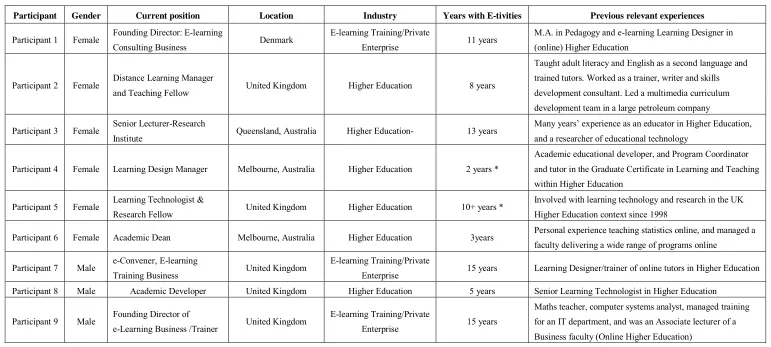
information were addressed differently with each participant, depending on the month’s topic “theme”, and were open to participants to answer in their own way (e.g., “Please list your Background/BIO (as you would like it included on the website) and Please tell us a little bit about yourself and your relationship to E-tivities”). Therefore, the content was not consistent across all participants. Table 1 on the following page gives a randomised order breakdown of the nine participants at a glance.
2.4. Procedure for Data Analysis
[image:6.595.213.383.312.601.2]The content of the blog posts were coded and analysed following Wellington’s [28] adaptation of the constant comparison method with the “continuing refinement of categories” data analysis strategy as outlined in Figure 2 below.
Figure 2. The “Constant Comparison Method” and “Continual Refinement” of categories.
Source Wellington [28] (p. 137).
The coding of the data content was approached from a “middle-range” procedure, whereby categories for coding can “come from both the data and the literature” [29] (p. 39). The data was micro analysed, using line by line coding methodology, in to manageable units and summaries of the participants’ responses, then through continual refinement and constant comparison, content categories began to emerge. Line-by-line coding, as reiterated by Holton [30], has the potential to maximalise missing integral categories that emerge from the data specifically.
Initially three overarching content categories emerged from the data: 1. Reasons for using E-tivities;
Educ. Sci. 2014, 4 178
Table 1. Participants’ demographics and background at a glance.
Participant Gender Current position Location Industry Years with E-tivities Previous relevant experiences
Participant 1 Female Founding Director: E-learning
Consulting Business Denmark
E-learning Training/Private
Enterprise 11 years
M.A. in Pedagogy and e-learning Learning Designer in (online) Higher Education
Participant 2 Female Distance Learning Manager
and Teaching Fellow United Kingdom Higher Education 8 years
Taught adult literacy and English as a second language and trained tutors. Worked as a trainer, writer and skills development consultant. Led a multimedia curriculum development team in a large petroleum company
Participant 3 Female Senior Lecturer-Research
Institute Queensland, Australia Higher Education- 13 years
Many years’ experience as an educator in Higher Education, and a researcher of educational technology
Participant 4 Female Learning Design Manager Melbourne, Australia Higher Education 2 years *
Academic educational developer, and Program Coordinator and tutor in the Graduate Certificate in Learning and Teaching within Higher Education
Participant 5 Female Learning Technologist &
Research Fellow United Kingdom Higher Education 10+ years *
Involved with learning technology and research in the UK Higher Education context since 1998
Participant 6 Female Academic Dean Melbourne, Australia Higher Education 3years Personal experience teaching statistics online, and managed a faculty delivering a wide range of programs online
Participant 7 Male e-Convener, E-learning
Training Business United Kingdom
E-learning Training/Private
Enterprise 15 years Learning Designer/trainer of online tutors in Higher Education Participant 8 Male Academic Developer United Kingdom Higher Education 5 years Senior Learning Technologist in Higher Education
Participant 9 Male Founding Director of
e-Learning Business /Trainer United Kingdom
E-learning Training/Private
Enterprise 15 years
Maths teacher, computer systems analyst, managed training for an IT department, and was an Associate lecturer of a Business faculty (Online Higher Education)
Educ. Sci. 2014, 4 179
Line-by-line content was consequently summated into a simplified sentence or concept to represent the idea being put across, in order to match it with its appropriate category. As an example of the line-by-line coding process can be seen in the following two statements:
“encourages quick focus on learning rather than having to cope with the peculiarities of the software platform”; and
“as they are able to focus on the important issues in the courses and avoid being distracted by the IT aspects.”
These statements were eventually coded as “Focus on learning, not technology”, and were appropriate to the overarching category “Benefits of E-tivities”.
Three further categories that were established from the literature reflected the researcher’s interest in exploring the CoI elements. These further categories were:
1. Social Presence;
2. Cognitive Presence; and 3. Teaching Presence.
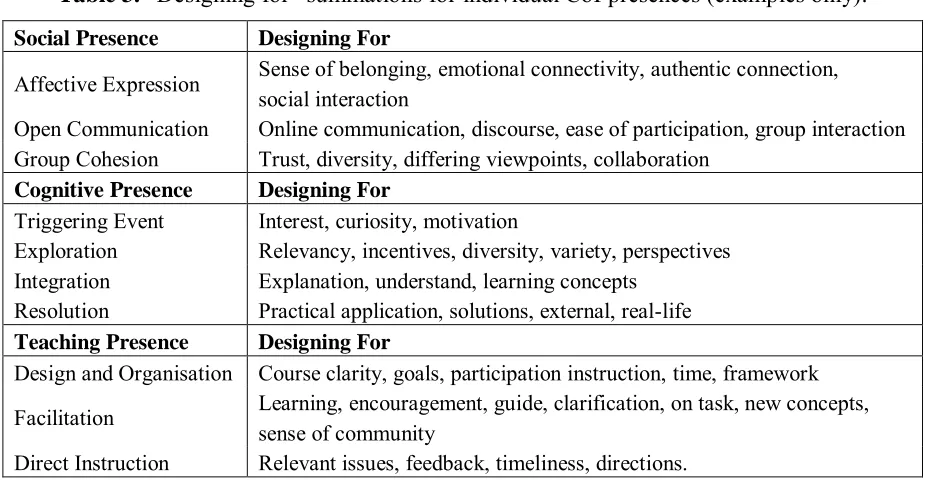
In order to analyse for specific key indicators of the CoI presences without previous similar research, further sub categories with the presences were created, influenced and based on the category refinements within the original literature, and the CoI Survey Instrument (draft v15). This CoI Survey was developed by Ben Arbaugh, Marti Cleveland-Innes, Sebastian Diaz, Randy Garrison, Phil Ice, Jennifer Richardson, Peter Shea, and Karen Swan [13,31]. Refer to Table 2 below for the sub categories of CoI.
Table 2. Sub categories of Community of Inquiry (CoI) presences. Social Presence Cognitive Presence Teaching Presence Affective Expression Triggering Event Design and Organisation
Open Communication Exploration Facilitation
Group Cohesion Integration Direct Instruction
Resolution
Educ. Sci. 2014, 4 180
Table 3. “Designing for” summations for individual CoI presences (examples only). Social Presence Designing For
Affective Expression Sense of belonging, emotional connectivity, authentic connection, social interaction Open Communication Online communication, discourse, ease of participation, group interaction Group Cohesion Trust, diversity, differing viewpoints, collaboration
Cognitive Presence Designing For
Triggering Event Interest, curiosity, motivation
Exploration Relevancy, incentives, diversity, variety, perspectives Integration Explanation, understand, learning concepts
Resolution Practical application, solutions, external, real-life Teaching Presence Designing For
Design and Organisation Course clarity, goals, participation instruction, time, framework Facilitation Learning, encouragement, guide, clarification, on task, new concepts,
sense of community
Direct Instruction Relevant issues, feedback, timeliness, directions.
[image:9.596.104.499.450.537.2]Further analysis included utilising the above keywords in a text search analysis using NVivo, with matches set on synonyms, whereby exact words, stemmed words and synonyms of the words were found, and frequency statistics then reviewed. Figures 3–5 below offer some examples of word text analysis searches
Figure 3. Word text analysis for “Interaction”.
[image:9.596.50.552.652.782.2]Figure 4. Word text analysis for “Collaboration”.
Educ. Sci. 2014, 4 181
Through this exploration, data could be highlighted and mined for further constant comparison exploration, and creation of category summations, as well as supporting previous node classifications. Coding cluster analysis was run in NVivo, and content percentage was analysed and reported.
3. Results
Three sub categories emerged when seeking to answer the research question “Are there key principle advice given for designing e-tivities in general that might be useful for future online educators”. These included “Reasons for using E-tivities”, “Benefits and Outcomes of E-tivities”, and “Challenges of E-tivities”. The following is a breakdown of the results that emerged around these three areas.
3.1. Reasons for Using E-Tivities
[image:10.596.105.494.411.525.2]The participants expressed many reasons that they utilised E-tivities, mostly in relation to their previous success with them. Participants were largely exposed to the use of them during institutional change, and their “initiation” into the online learning environment. Participants reported their motivations for using E-tivities, e-Moderation and the 5-Stage Model was a result of their needs and desires for creating quality online learning design, after experiencing previous failures. Table 4 below gives and outline into the reasons reported for using E-tivities, etc., in their learning design.
Table 4. Participants’ reasons for using E-tivities for online learning. Reasons for using E-tivities etc. Number of participant responses Adaptable across courses and disciplines 3
High quality experience 4
Highly engaging and interactive 3
Reliable and practical based structure 3 Same experience (or better) than face to face 1
Social Constructivist Design 9
3.2. Benefits and Outcomes of Using E-Tivities
Educ. Sci. 2014, 4 182
Table 5. Overarching Categorical Benefits of E-tivities and their corresponding CoI
framework components.
Benefit of E-tivities Descriptors Matching CoI component
Pedagogy Benefit 32% Research based, well rehearsed, helped face-to-face teaching, non transactional in nature Cognitive Presence
Social Benefit 21% Social Collaborative, enables inclusivity, developed student networking Social Presence
Design Benefit 17% Consistent and organised, easy to understand and
apply, usable across multiple online platforms Teaching Presence Student Benefit 16% High Satisfaction, Engaged Students, Quick Adaptability Social Presence Academic Benefit 14% Lower drop out, higher grades, more participation Cognitive Presence
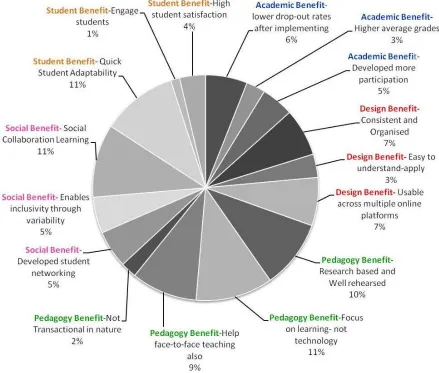
There were 16 sub-set benefits and outcomes reported in using E-tivities for learning design that dwelled within the five overarching categories. Figure 6 below represents the percentage
[image:11.596.49.551.116.275.2]discussed/reported by participants of different benefits and outcomes, grouped by their categories
[image:11.596.78.517.379.752.2]Educ. Sci. 2014, 4 183
The highest benefits discussed by participants included the two Pedagogy Benefits of E-tivities, being based on research and well rehearsed over its years (11%), and that E-tivities enabled the focus to be on the learning and not the technology (11%). Other benefits highly discussed were the Social Benefit of Social Collaboration Learning (11%), however its category of “social” benefit could be debated, given that research into social collaboration learning design shows benefits of relating to all the categories of social, pedagogy, academic and student. However, given the nature of the theory, it was decided that the social category provided the closest match to the underlying principles of the theory for the purposes of this research. The other highly discussed benefit was the student benefit of how quickly and easily students can adapt to the learning design (11%). Specifically, as they become familiar with the structure over time, it allows them to not get caught up in the distractions of design and technology, and focus directly on the task at hand.
It is interpreted that Teaching Presence was not equally represented with regard to “benefits” specifically because the main topic of the blog posts were focused on E-tivities and the 5-Stage Model. Rather than e-Moderation which relates to the “teaching” component of Online Leaning, and would therefore be expected to reflect “Teaching Presence”.
It is noted that the highest reported benefit was in relation to Pedagogy, which is an important consideration for educators in any industry. It also underpins the principle argument that Salmon [6] makes in regards to these methods providing a practical and step-wise solution for designing for pedagogy that reflects a learner-centred approach, from which all other educational outcomes can achieve success.
3.3. Challenges for Designing E-Tivities
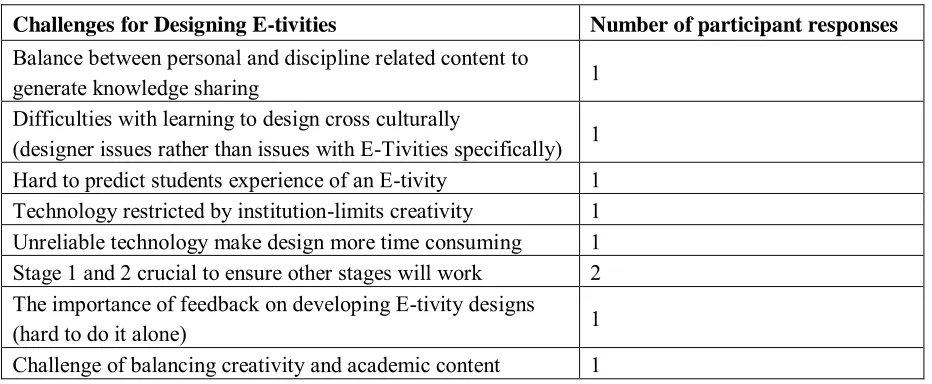
[image:12.596.67.533.593.785.2]All of the participants had their own specific individual and personal challenge in designing E-tivities, with only two participants over-lapping on one particular challenge. Thus, there were eight challenges in total out of nine participants, each challenge reported by a different participant. This could reflect that the constraints and issues relating to online learning design and delivery appear to be situational and content specific, at least in the situation of these participants. Table 6 below outlines the eight key areas that were defined as being the challenges the participants faced in designing E-tivities.
Table 6. Challenges for designing E-tivities as reported by participants.
Challenges for Designing E-tivities Number of participant responses Balance between personal and discipline related content to
generate knowledge sharing 1
Difficulties with learning to design cross culturally
(designer issues rather than issues with E-Tivities specifically) 1 Hard to predict students experience of an E-tivity 1 Technology restricted by institution-limits creativity 1 Unreliable technology make design more time consuming 1 Stage 1 and 2 crucial to ensure other stages will work 2 The importance of feedback on developing E-tivity designs
(hard to do it alone) 1
Educ. Sci. 2014, 4 184
3.4. Social Presence in Design
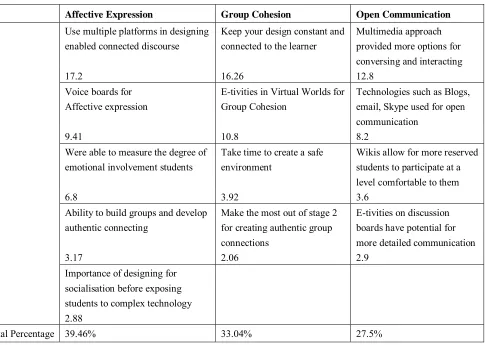
[image:13.596.66.551.341.686.2]In order to answer the research question “How might E-tivities, e-Moderation and the Five- Stage Model, be applicable and designed to cater for Social Presence”, text evaluation, and content comparison analysis for Social Presence indicators were reviewed. A number of ideas emerged and these were summated into overarching concepts that grouped themselves naturally into the three categories within Social Presence (Affective Expression, Group Cohesion and Open Communication). The results are demonstrated below in Table 7, along with the percentage that each of the learning design ideas were discussed in relation to the whole topic/indicators of design that aligned with Social Presence. They have also been ordered from most discussed, to least discussed. This table provides a combination of explanations and suggestions that related to designing for factors of Social Presence, but also for how E-tivities have demonstrated (in the participants’ experience) an element that could be categorised as Social Presence. Interpretation and possible inferences to be made from these results will be presented in the discussion section.
Table 7. Areas of designing and E-tivities that align with Social Presence indicators.
Affective Expression Group Cohesion Open Communication
Use multiple platforms in designing enabled connected discourse
Keep your design constant and connected to the learner
Multimedia approach provided more options for conversing and interacting
17.2 16.26 12.8
Voice boards for Affective expression
E-tivities in Virtual Worlds for Group Cohesion
Technologies such as Blogs, email, Skype used for open communication
9.41 10.8 8.2
Were able to measure the degree of emotional involvement students
Take time to create a safe environment
Wikis allow for more reserved students to participate at a level comfortable to them
6.8 3.92 3.6
Ability to build groups and develop authentic connecting
Make the most out of stage 2 for creating authentic group connections
E-tivities on discussion boards have potential for more detailed communication
3.17 2.06 2.9
Importance of designing for socialisation before exposing students to complex technology 2.88
Total Percentage 39.46% 33.04% 27.5%
3.5. Cognitive Presence in Design
Educ. Sci. 2014, 4 185
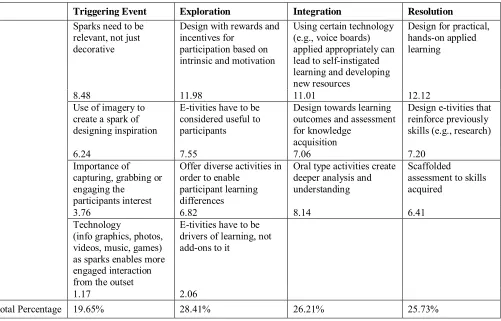
[image:14.596.54.555.212.533.2]relation to the whole topic/indicators of design that aligned with Cognitive Presence. They have also been ordered from most discussed, to least discussed. This table provides a combination of explanations and suggestions that related to designing for factors of Cognitive Presence, but also for how E-tivities have demonstrated (in the participants’ experience) an element that could be categorised as Cognitive Presence. Interpretation and possible inferences to be made from these results will be presented in the discussion section.
Table 8. Areas of designing and E-tivities that align with Cognitive Presence indicators.
Triggering Event Exploration Integration Resolution
Sparks need to be relevant, not just decorative
Design with rewards and incentives for
participation based on intrinsic and motivation
Using certain technology (e.g., voice boards) applied appropriately can lead to self-instigated learning and developing new resources
Design for practical, hands-on applied learning
8.48 11.98 11.01 12.12
Use of imagery to create a spark of designing inspiration
E-tivities have to be considered useful to participants
Design towards learning outcomes and assessment for knowledge
acquisition
Design e-tivities that reinforce previously skills (e.g., research)
6.24 7.55 7.06 7.20
Importance of capturing, grabbing or engaging the
participants interest
Offer diverse activities in order to enable
participant learning differences
Oral type activities create deeper analysis and understanding
Scaffolded
assessment to skills acquired
3.76 6.82 8.14 6.41
Technology
(info graphics, photos, videos, music, games) as sparks enables more engaged interaction from the outset
E-tivities have to be drivers of learning, not add-ons to it
1.17 2.06
Total Percentage 19.65% 28.41% 26.21% 25.73%
3.6. Teaching Presence in Design
Educ. Sci. 2014, 4 186
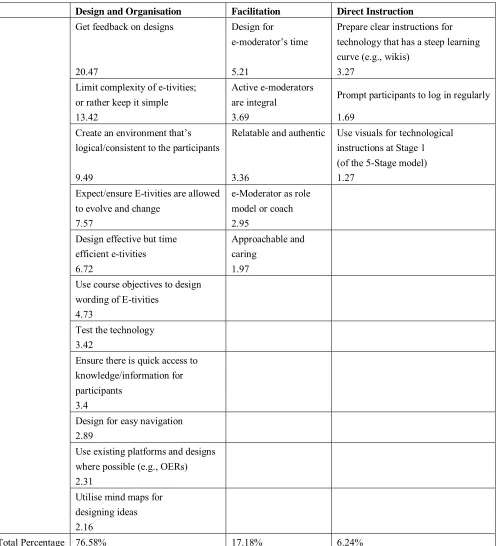
Table 9. Areas of designing and E-tivities for aligning Teaching Presence indicators.
Design and Organisation Facilitation Direct Instruction
Get feedback on designs Design for
e-moderator’s time
Prepare clear instructions for technology that has a steep learning curve (e.g., wikis)
20.47 5.21 3.27
Limit complexity of e-tivities; or rather keep it simple
Active e-moderators
are integral Prompt participants to log in regularly
13.42 3.69 1.69
Create an environment that’s logical/consistent to the participants
Relatable and authentic Use visuals for technological instructions at Stage 1 (of the 5-Stage model)
9.49 3.36 1.27
Expect/ensure E-tivities are allowed to evolve and change
e-Moderator as role model or coach
7.57 2.95
Design effective but time efficient e-tivities
Approachable and caring
6.72 1.97
Use course objectives to design wording of E-tivities
4.73
Test the technology 3.42
Ensure there is quick access to knowledge/information for participants
3.4
Design for easy navigation 2.89
Use existing platforms and designs where possible (e.g., OERs) 2.31
Utilise mind maps for designing ideas 2.16
Total Percentage 76.58% 17.18% 6.24%
4. Discussion
Educ. Sci. 2014, 4 187
commonly mentioned design principle was keeping the design consistent and focused on the learner. E-tivities already have a consistent template for designing which should make this element easier for online educators to cater for. Lastly, the use of multimedia in E-tivity designing was reported by designers to enable more interaction and conversing opportunities amongst learners (Open Communication).
With regards to Cognitive Presence results, interestingly the four indicators of Cognitive Presence categories were relatively evenly distributed. While more examples for designing for Triggering Events and Exploration were given—matching Garrison’s [32] comment that these two areas are easier to design and measure for—quality design strategies were discussed for the other two, with design strategies reflecting the role that technology can play in enabling stronger Integration properties such as reflection, explanation and understanding concepts. In addition, it reflects the focus of strategic practical content and design scaffolding that seem to target Resolution principles of practical application, solutions, external and real-life application.
With regard to Teaching Presence results, it is relevant to note that this presence had the highest instances of designing importance discussed even though it had the lowest reported “benefit” of E-tivities—the latter likely to be a reflection of the focus on E-tivities in the blogging topic, rather than e-Moderation, which is Salmon’s [17] specific strategy for teaching online. Specifically, the importance of the design and organisation of the course were discussed as the most important teaching factors (76.58%). This supports Garrison’s [32] and Garrison et al. [33] assertion, as supported by the research into this presence over the last decade, on how important this factor is on creating sustainable and successful online learning. As well as the importance of laying the correct foundations from which a successful course, and therefore appropriate teaching presence, cognitive presence and social presence can grow.
5. Limitations
Obviously there are limitations of this research from many different avenues, including issues in generalisability outside of this particular case study approach and the small sample size. There are limitations in the qualitative and exploratory research design as being seen as lacking in empirical evidence for a relationship between the variables. Further limitations include issues with the data being pre-existing and not directly written by the participants with any context of CoI applications. However, if you were to consider this in part, an observational approach almost, hearing from designers in the field without influencing their answers or directing their questions towards CoI applications—as would have been likely in a more traditional research design—then there are implications here for findings to have some merit. Specifically given the reflective nature of a blogging platform and potential metacognitive process evolving in the participants’ content.
Educ. Sci. 2014, 4 188
long, that they are also well versed and supportive of the CoI framework, and could be organically designing for these components without the influence of the methodology design at all.
6. Conclusions and Recommendations
It could be concluded by this research that there is some potential support for an alignment between the CoI framework being operationalised through the use of E-tivities [6], e-Moderation [17] and the 5-Stage Model [6]. This study has shown that there is some possible overlap in learning design strategies. There is some support that if online designers were looking specifically at “how” to design for Social, Cognitive, and Teaching Presence, as per the research questions of this report, that utilising these Salmon specific strategies is likely to be an appropriate approach to take. Specific interesting conclusions that emerged from this study included the potential connection of the use of technology and designing through these strategies, in order to cater to the complexities of Integration and Resolution phases of Cognitive Presence. This is important, given the current research into this area has been unable to not only identify the progression of participants through these phases [34], but that according to Garrison et al. [33], correct learning design strategies for these phases is at the bedrock of this issue. This research has highlighted the potential to utilise these Salmon strategies for catering to this designing issue. The research has also supported Garrison et al. [33] assertion for the importance of a solid learning design strategy that centres around the importance of the teacher and their presence. Research into online learning suggests the most reported area for dissatisfaction/satisfaction in the online learning environment was the quality of the encouragement, feedback, counselling, facilitation, respect and instructional quality of the teacher [35–39]. In other words, their “teaching presence”. It is not innovative to suggest the role of the teacher in learning is a pivotal one, and yet online students still continue to be dissatisfied with their experience and their engagement with their teachers. Some research [40,41] suggests that the reason for this is because teachers are often not adequately confident or literate in online teaching skills or pedagogy, and that those with less exposure to online learning have less positive views of its implementation [42]. Further research stressed the importance of continuing exposure to, and education in, online instructing for teachers [38].
With this in mind, it stands to reason that initial recommendations based on this research include training online educators in the strategies E-tivities, e-Moderation, and the 5-Stage Model which would have the potential to not only widen online teachers’ capabilities, but potentially target and identify teaching and design capabilities that cater to these integral CoI components. However, in order to truly support this initial hands-on outcome recommendation, additional research specific recommendations would be suggested. These recommendations include the creation of an empirical based study that directly measures the presence of CoI in these learning and teaching design strategies while they are in action. The best situation of this would be the utilisation of the CoI Survey Instrument (draft v15) [13,31] with participants of courses that are specifically designed with these Salmon methods.
Educ. Sci. 2014, 4 189
Educ. Sci. 2014, 4 190
Acknowledgments
The Author would like to thank those bloggers who were happy to be acknowledged, Anita Monty, David Shepherd, Diane Robbie, Gabi Witthaus, Helen Farley, Ken Giles, Simon Kear, and Terese Bird, for consent to utilise their contributions as data for this project and acknowledge their contribution to the e-learning world. The Author would also like to thank Professor Gilly Salmon for her continued personal and professional support and e-learning opportunities. I am forever, and happily so, in your debt. The Author would lastly like to thank her supervisor of this master’s research project, Petrea Redmond, for being her ongoing professional confidant, an inspirational mentor, and for her never-ending ability enjoy the Author’s sense of humor.
Conflicts of Interest
The author declares no conflict of interest.
References
1. Macdonald, J.; Poniatowska, B. Designing the professional development of staff for teaching online: An OU (UK) case study. Distance Educ. 2011, 32, 119–134.
2. Ernst & Young. University of the Future: A Thousand Year Old Industry on the Cusp of Profound Change; 2012. Available online: http://www.ey.com/Publication/ vwLUAssets/University_of_the_future/$FILE/University_of_the_future_2012.pdf (accessed on 6 August 2013).
3. Hixon, E.; Buckenmeyer, J.; Barczyk, C.; Feldman, L.; Zamojski, H. Beyond the early adopters of online instruction: Motivating the reluctant majority. Internet High. Educ. 2012, 15, 102–107.
4. Ruey, S. A case study of constructivist instructional strategies for adult online learning. Br. J. Educ. Technol. 2010, 41, 706–720.
5. Chan, S. Designing an online class using a constructivist approach. J. Adult Educ. 2010, 39, 26–39.
6. Salmon, G. E-Tivities: The Key to Active Online Learning, 2nd ed.; Routledge: London, UK; New York, NY, USA, 2013.
7. Garrison, D.R.; Anderson, T. E-Learning in the 21st Century: A Framework for Research and Practice; Routledge/Falmer: New York, NY, USA, 2003.
8. Slevin, J. E-Learning and the transformation of social interaction in higher education. Learn. Media Technol. 2008, 33, 115–126.
9. Bermejo, S. Cooperative electronic learning in virtual laboratories through forums. IEEE Trans. Educ.
2005, 48, 140–149, doi:10.1109/TE.2004.837045.
10. Kovacic, A.; Bubas, G.; Zlatovic, M. E-tivities with a Wiki: Innovative Teaching of English as a Foreign Language. In Proceedings of the EUNIS 2008: VISION IT—Visions for use of IT in Higher Education, 14th Congress of the European University Information Systems Organisation, Aarhus, Denmark, 24–27 June 2008.
11. Morley, D. Enhancing networking and proactive learning skills in the first year university experience through the use of wikis. Nurs. Educ. Today 2012, 32, 261–266, doi:10.1016/
Educ. Sci. 2014, 4 191
12. Sidhu, R.; Embi, M. Learner e-tivities: Exploring Malaysian learners’ roles in asynchronous computer-mediated communication. Eur. J. Educ. Stud. 2010, 2, 157–174.
13. Ice, P.; Gibson, A.M.; Boston, W.; Becher, D. An exploration of differences between Community of Inquiry indicators in low and high disenrollment online courses. J. Asynchronous Learn. Netw.
2011, 15, 44–69.
14. Rubin, B.; Fernandes, R.; Avgerinou, M.D. The effects of technology on the Community of Inquiry and satisfaction with online courses. Internet High. Educ. 2013, 17, 48–57.
15. Salmon, G. E-Tivities: The Key to Active Online Learning; Kogan Page: London, UK, 2002. 16. Salmon, G. E-Moderating: The Key to Teaching and Learning Online, 2nd ed.; Routledge:
New York, NY, USA, 2003.
17. Salmon, G. E-Moderating: The Key to Teaching and Learning Online, 3rd ed.; Routledge/Falmer: New York, NY, USA, 2011.
18. Salmon, G. E-Moderating: 5-Stage Model. Available online: http://www.gillysalmon.com/five-stage-model.html (accessed on 30 January 2014).
19. Lodico, M.; Spaulding, D.; Voegtle, K. Methods in Educational Research: From Theory to Practice; John Wiley & Sons: San Francisco, CA, USA, 2010.
20. Somekh, B.; Burman, E.; Dalamont, S.; Payne, M.; Thorp, R. Research in the social sciences. In Research Methods in Social Sciences, 2nd ed.; Somekh, B., Lewin, C., Eds.; Sage Publication: London, UK, 2011; pp. 2–15.
21. Jones, K. The Practice of Quantitative Methods. In Research Methods in Social Sciences, 2nd ed.; Somekh, B., Lewin, C., Eds.; Sage Publication: London, UK, 2011; pp. 201–211.
22. Mustafa, R.F. The P.O.E.Ms of educational research: A beginners’ concise guide. Int. Educ. Stud.
2011, 4, 23–30.
23. Kirk, J.; Miller, M.L. Reliability and Validity in Qualitative Research; Sage Publications: Thousand Oaks, , USA, 1986.
24. Johnson, R.B.; Onweugbuzie, A.J. Mixed-methods research: A research paradigm whose time has come. Educ. Res. 2004, 33, 14–26.
25. Snee, H. Realities toolkit #10: Using blog analysis; 2010. Available online: http://eprints. ncrm.ac.uk/1321/2/10-toolkit-blog-analysis.pdf (accessed on 1 October 2013).
26. Hookway, N. “Entering the blogosphere”: Some strategies for using blogs in social research. J. Qual. Res. 2008, 8, 91–113.
27. Moon, J.A. Learning Journals: A Handbook for Reflective Practice and Professional Development; Routledge: Oxon, UK, 2006.
28. Wellington, J. Educational Research: Contemporary Issues and Practical Approaches; Continuum International Publishing Group: London, UK, 2000.
29. Urquhart, C. Grounded Theory for Qualitative Research: A Practical Guide; Sage Publications: Thousand Oaks, CA, USA, 2013.
30. Holton, J.A. The coding process and its challenges. In The Sage Handbook of Grounded Theory; Bryant, A., Charmaz, K., Eds.; Sage: London, UK, 2007.
Educ. Sci. 2014, 4 192
32. Garrison, D.R. Online community of inquiry review: Social, cognitive, and teaching presence issues. J. Asynchronous Learn. Netw. 2007, 11. Available online: http://sloanconsortium.org/
jaln/v11n1/online-community-inquiry-review-social-cognitive-and-teaching-presence-issues (accessed on 19 September 2013).
33. Garrison, D.; Anderson, T.; Archer, W. The first decade of the Community of Inquiry Framework: A retrospective. Internet High. Educ. 2010, 13, 5–9, doi:10.1016/
j.iheduc.2009.10.003.
34. Garrison, D.; Arbaugh, J.B. Researching the Community of Inquiry Framework: Review, issues, and future directions. Internet High. Educ. 2007, 10, 157–172.
35. Bolliger, D.U.; Martindale, T. Key factors for determining student satisfaction in online courses. Int. J. E-Learn. 2004, 3, 61–67.
36. Gunawardena, C.N.; Linder-VanBerschot, J.A.; LaPointe, D.K.; Rao, L. Predictors of learner satisfaction and transfer of learning in a corporate online education program. Am. J. Distance Educ.
2010, 24, 207–226, doi:10.1080/08923647.2010.522919.
37. Kim, K.; Liu, S.; Bonk, C.J. Online MBA students’ perceptions of online learning: Benefits, challenges, and suggestions. Internet High. Educ. 2005, 8, 335–344.
38. Paechter, M.; Maier, B.; Macher, D. Students’ expectations of, and experiences in e-learning: Their relation to learning achievements and course satisfaction. Comput. Educ. 2010, 54, 222–229.
39. Sher, A. Assessing the relationship of student-instructor and student-student interaction to student learning and satisfaction in web-based online learning environment. J. Interact. Online Learn.
2009, 8, 102–120.
40. Ehrmann, S.C. Why faculty resist. Distance Learn. 2012, 9, 60–64.
41. Schneckenberg, D. Overcoming barriers for eLearning in Universities—Portfolio models for eCompetence development of faculty. Br. J. Educ. Technol. 2010, 41, 979–991.
42. Allen, I.E.; Seaman, J.; Lederman, D.; Jaschik, S. Conflicted: Faculty and online education, 2012.. Available online: http://www.insidehighered.com/sites/default/server_files/ files/IHE-BSRG-Conflict.pdf (accessed on 12 October 2013).
43. Armstrong, D.A. Students’ perceptions of online learning and instructional tools: A qualitative study of undergraduate students’ use of online tools. Turk. Online J. Educ. Technol. 2011, 10, 222–226.
44. Lee, S.; Srinivasan, S.; Trail, T.; Lewis, D.; Lopez, S. Examining the relationship among student perception of support, course satisfaction, and learning outcomes in online learning. Internet High. Educ. 2011, 14, 158–163, doi:10.1016/j.iheduc.2011.04.001.
45. Salmon, G.; Wright, P. Transforming Future Teaching through ‘Carpe Diem’ Learning Design. Educ. Sci. 2014, 4, 52–63, doi:10.3390/educsci4010052.
46. Armellini, A.; Aiyegbayo, O. Learning design and assessment with e-tivities. Br. J. Educ. Technol.
2010, 41, 922–935, doi:10.1111/j.1467-8535.2009.01013.x.
47. Watsona, W.R.; Watsona, S.L.; Reigeluthb, C.M. Education 3.0: Breaking the mold with technology. Interact. Learn. Environ. 2013, 58, doi:10.1080/10494820.2013.764322.
![Figure 1. Salmon [17] 5-Stage Model [18].](https://thumb-us.123doks.com/thumbv2/123dok_us/152365.29509/4.595.131.462.156.446/figure-salmon-stage-model.webp)
![Figure 2. The “Constant Comparison Method” and “Continual Refinement” of categories. Source Wellington [28] (p](https://thumb-us.123doks.com/thumbv2/123dok_us/152365.29509/6.595.213.383.312.601/figure-constant-comparison-method-continual-refinement-categories-wellington.webp)