Page | 1
Further Education and Skills: Statistical First Release
Technical Document
Page | 2
Contents
Introduction ... 3
Scope ... 3
Data Sources ... 4
Issues with Using In-Year Data ... 4
Issues with Comparing Data Across Academic Years ... 5
Data Definitions ... 5
[image:2.595.80.524.151.368.2]Publication Cycle Across the Year ... 6
Table A: Publication Cycle ... 6
Supplementary Tables ... 6
Users of these statistics ... 7
Related Statistical Publications ... 7
Page | 3
Introduction
1. This document provides background information on the Further Education and Skills Statistical First Release (SFR). It explains concepts used in the SFR publication and provides an overview of the data sources and other relevant information.
Scope
2. Should we need to make an unplanned revision to the statistics contained in this release, we will follow the procedures outlined in the Revisions Policy for the Statistical First Release. This includes action to understand the impact that any revisions will have, as well as ensuring that they are clearly communicated to the reader. The Revisions Policy can be found at:
https://www.gov.uk/government/publications/sfr-compliance-with-official-statistics-code-of-practice
3. Information from the different further education learning options have been drawn together to give a coherent and comprehensive picture of the participation and achievement of young people and adults. These include:
Further education organisations
Sixth form colleges
Local Authorities
Independent training organisations
4. These organisations deliver a wide variety of government programmes, including:
Education and Training
Apprenticeships
Workplace Learning
Community Learning
Traineeships
5. The SFR covers adults (19+)1 and does not contain information regarding:
Delivery in School Sixth Forms, including state-funded and independent schools. Provisional figures taken from the Department for Education (DfE)
Participation in Education, Training and Employment by 16–18 Year Olds in England Statistical Release show there were 539,700 16-18 year old students studying in School Sixth Forms, based on a snapshot of participation as recorded on the January 2016 school census.
Higher Education in Higher Education Institutions. The publication referenced in paragraph 31 shows that the total number of HE enrolments at UK Higher Education Institutions stood at 2,266,075 in 2014/15.
Privately-funded training at FE organisations and independent training organisations. There is no single coherent source that provides a measure of privately-funded training. However, in Table 16 of the SFR we do show the
Page | 4 total number of Vocational Qualifications awarded in the UK. This includes both public and privately-funded qualifications and gives some sense of scale of total vocationally-related activity in the sector.
Data Sources
6. The data used to produce the SFR are Individualised Learner Record (ILR) collections that are returned to the Skills Funding Agency by further education colleges and providers and Employer Ownership Pilot data returned by
employers. A Single ILR collection (SILR) was introduced in 2011/12 to replace the multiple ILR collection types that were collected in previous years. There are no longer separate collections for different funding streams and providers return all of their learners in a single file. The following ILR collections have been used to update the release:
Year Data Source 2015/16 SILR (R13)
EOP1 (E13) EOP2 (E13)
7. The data sources for all full academic years are final collections and include information on provision for the full academic year.
8. A statement of the administrative sources used within this SFR is available here:
https://www.gov.uk/government/publications/sfr-compliance-with-official-statistics-code-of-practice
9. Ofqual Vocational Qualification data are used in Table 16 of this release.
10. The Labour Force Survey is the other data source used for the SFR (Tables 14 and 15). The latest LFS data used in this release relate to Quarter 4 (October – December) 2014. Data on the highest level of qualification was revised following a reweighting of the Labour Force Survey (LFS) that affects figures from 2001 onwards.
Issues with Using In-Year Data
11. It is important to provide the earliest picture of further education performance once it becomes available so that users may assess the impact of government-funded provision and hold the system to account. However, in-year data are taken from an operational information system that is designed to support the funding of providers and there are some important limitations users should take into consideration.
12. In-year information is subject to data lag, which is when a provider submits information after the period it related to. This information is subsequently
Page | 5 can vary greatly. They tend to be around 2 to 3 per cent but have been as much as 20 per cent. Revisions are typically upward though it should be noted that on occasions small downward revisions are possible.
13. Data lag from one year to the next is not predictable, as provider behaviour changes over time and there is no source of information that would enable a robust estimate of completeness of data that have been returned. In-year data cannot, therefore, be compared with in-year or final data from earlier academic years. We generally recommend using final data for the last complete academic year for analysis of changes over time.
14. We carry out a quality assessment of the volume of providers that have made their returns. If we consider estimates to be particularly weak, due to data lag or any other factor, we may defer publication of those estimates. In recent years we have encouraged more timely reporting of data ahead of the final return. This is set out in our quality statement, which can be found at:
https://www.gov.uk/government/publications/sfr-compliance-with-official-statistics-code-of-practice
Issues with Comparing Data Across Academic Years
15. In the 2011/12 academic year a Single Individualised Learner Record (ILR) data collection system was introduced. This replaced the multiple separate data collections used in previous years and led to small technical changes in the way learners from more than one funding stream are counted.
16. Overall the new collection system led to a removal of duplicate learners and a reduction in total learner participation of approximately 2 per cent. However, Apprenticeship participation figures were more significantly affected due to a change in the way learners participating on more than one Apprenticeship programme were counted. This has led to a removal of duplicate learners and a reduction in overall Apprenticeship learners of approximately 5 per cent; therefore figures for 2011/12 onwards are not comparable to earlier years. A paper is
available on our website to explain the Single ILR and the small effects it has on the SFR at: Reduction of Duplication in FE and Skills Learner
Volumeshttp://webarchive.nationalarchives.gov.uk/20140107201041/http:/www.thedatas
ervice.org.uk/NR/rdonlyres/C05DCDD5-67EE-4AD0-88B9-BEBC8F7F3300/0/SILR_Effects_SFR_Learners_June12.pdf. Further information on
the Single ILR is available the GOV.UK website at:
https://www.gov.uk/government/publications/ilr-specification-validation-rules-and-appendices-2013-to-2014
Data Definitions
17. High-level definitions of some of the key terms used in this release can be found in the Glossary on page 22 of the main SFR.
Page | 6 estimates provided are the best measure of attainment within the population at Quarter 4 (October – December) each calendar year. Further details of how this information is used to calculate the estimates can be found at: Statistics -
Statistical First Release - SFR Methodology
Publication Cycle Across the Year
19. Further information on future editions of the SFR can be found on the most recent collection website at:
https://www.gov.uk/government/collections/further-education-and-skills-statistical-first-release-sfr
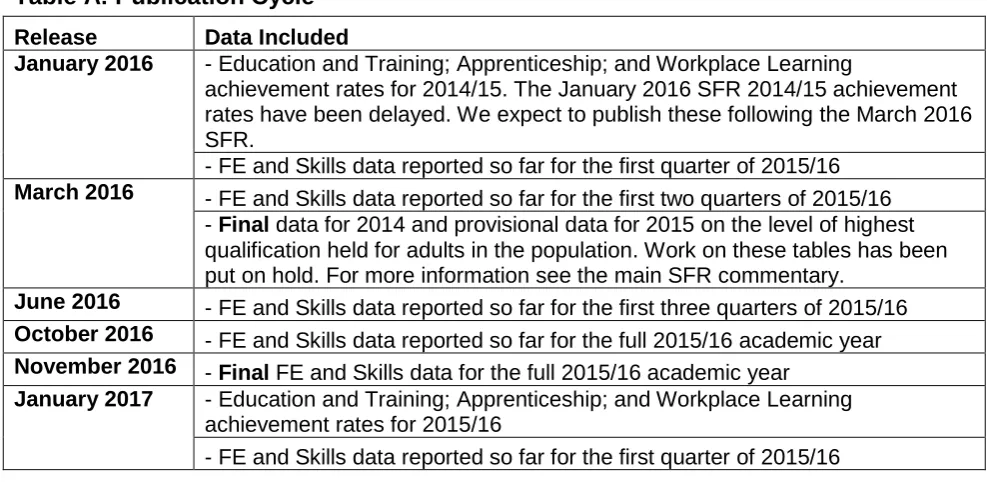
[image:6.595.65.559.272.514.2]20. Table A below shows in-year data and final data included for each release.
Table A: Publication Cycle
Release Data Included
January 2016 - Education and Training; Apprenticeship; and Workplace Learning
achievement rates for 2014/15. The January 2016 SFR 2014/15 achievement rates have been delayed. We expect to publish these following the March 2016 SFR.
- FE and Skills data reported so far for the first quarter of 2015/16
March 2016 - FE and Skills data reported so far for the first two quarters of 2015/16
- Final data for 2014 and provisional data for 2015 on the level of highest qualification held for adults in the population. Work on these tables has been put on hold. For more information see the main SFR commentary.
June 2016 - FE and Skills data reported so far for the first three quarters of 2015/16 October 2016 - FE and Skills data reported so far for the full 2015/16 academic year November 2016 - Final FE and Skills data for the full 2015/16 academic year
January 2017 - Education and Training; Apprenticeship; and Workplace Learning
achievement rates for 2015/16
- FE and Skills data reported so far for the first quarter of 2015/16
21. The Statistical First Release is an evolving product and we welcome feedback. If you have comments or feedback on the SFR, these can be sent to:
22. If you have a statistical question around the content or presentation of National Statistics in the release, please contact: [email protected]
Supplementary Tables
23. A list of supplementary tables relating to this SFR can be found on the GOV.UK website with the most recent SFR collection at
Page | 7 24. Local Authority Reports are published on the GOV.UK website. Local Authority
Districts are shown based on the postcodes of delivery locations and also on the home postcodes of learners. The reports cover 2010/11, 2011/12, 2012/13, 2013/14 and 2014/15: enrolments, participation and provider level. The reports can be found at: https://www.gov.uk/government/statistical-data-sets/fe-data-library-local-authority-tables
Users of these statistics
25. This publication attracts a wide variety of users who use the statistics in various ways including:
Department for Education (DfE) who use the statistics to report on ambitions; develop and monitor policies; and answer parliamentary questions
Education Funding Agency (EFA) who use the SFR to respond to requests for participation, achievement and success rates information from external
partners and organisations
Skills Funding Agency who use the SFR for all statistics shared externally including press releases and for responding to requests from educational bodies
Providers and LEPs
Ofsted (for success rates information) and Ofqual
Researchers
Academics
Media
General public
26. The statistical policy statement on how we meet user needs through engagement for this SFR is available here:
https://www.gov.uk/government/uploads/system/uploads/attachment_data/file/34 8186/User_Engagement_July2014.pdf
Related Statistical Publications
27. There are a number of other statistical publications available that can be used to provide contextual information to this SFR. Some of those most relevant to this release are discussed below:
28. Participation in Education, Training and Employment by 16-18 Year Olds in
England published on 30th June 2016 by the Department for Education. This
shows that the provisional proportion of 16–18 year olds in education and training was 86.6 per cent at end 2015 – the highest rate ever recorded and an increase of 0.7 percentage points from end 2014.
29. Level 2 and 3 attainment in England: Attainment by age 19 in 2015 published on
Page | 8
30. Higher Education Student Enrolments and Qualifications Obtained at Higher
Education Providers in the United Kingdom for the Academic Year published on
14th January 2016 by the Higher Education Statistics Agency (HESA). This shows the total number of HE enrolments at UK Higher Education Institutions stood at 2,266,075 in 2014/15, a decrease of 1 per cent from 2013/14. In 2014/15, there were 745,005 HE qualifications obtained in the UK. Of these, 395,580 were at first degree level.
31. Education and Training Statistics for the United Kingdompublished on 5th
November 2015 by the Department for Education. This release provides statistics relating to education and training in the UK and includes chapters relating to post-compulsory education and training and qualifications. Information includes participation of learners in further education by country of study, participation in job-related training and the highest level of qualification held by adults in the population (UK).
32. FE Choices data provides four performance indicators: Success Rates; Learner Destinations (including Employment Rate and Learning Rate); Learner
Satisfaction; and Employer Satisfaction. Results at National level by type of provider and by individual provider for each performance indicator can be found at: https://www.gov.uk/government/statistical-data-sets/fe-choices-performance-indicators
33. Adult further education: outcome based success measures presents
experimental outcome based measures covering the destinations (into employment and learning) of post-19 learners completing funded further education training from 2010/11 to 2012/13. The measures make use of administrative datasets already held by government to observe learning and employment activity in the year following completion of funded FE learning.
34. Further education for benefit claimants: 2014/15 provides information on Further
Education activity funded by the Skills Funding Agency for adult benefit claimants in England. The statistics are produced using a matched dataset of the
Individualised Learner Record (ILR) from the (former) Department for Business, Innovation and Skills (BIS) and the Work and Pensions Longitudinal Study (WPLS) from the Department for Work and Pensions (DWP). The publication provides statistics on benefit spells with training, learners who were on benefits at the start of training, level of qualification studied (all and highest) and type of learning provision.
Further Education Statistics for Other Countries in the UK
35. The focus of this SFR is on government-funded further education provision in England. Similar information is available for other countries in the UK, and provides useful contextual background to these statistics.
36. Statistics on Further Education and Work-based learning in Wales can be found at:
Page | 9 37. Statistics on Accredited Enrolments in the Northern Ireland Further Education
Sector for 2014/15 can be found at: https://www.delni.gov.uk/topics/del-statistics-and-research-further-education/further-education-statistics
38. Statistics on learners in further education in Scotland can be found through user-defined tables on further education learners and courses: