Levels of Highest Qualification held by Working Age Adults, 2015
This Statistical Release presents key statistics on the highest qualification held by adults of working age in Wales, according to their age at the start of the academic year.
The statistics provided are taken from the Annual Population Survey (APS) for the year ending 31 December 31 2015. Qualifications have been grouped into National Qualification Framework (NQF) levels. Further information can be found in the notes.
Working age adults in this release now refers to males and females aged 18-64, rather than 18-59/64 used previously. Therefore figures are not directly comparable with those from previous releases. See notes for further information.
Key Results
Overall, qualification levels in Wales showed little change compared with 2014.
An estimated 10 per cent of working age adults in Wales reported having no qualifications the same as in 2014.
76 per cent of working age adults in Wales held at least level 2 qualifications compared with 77 per cent in 2014.
57 per cent of working age adults in Wales were qualified to the level 3 threshold, the same as in 2014.
The proportion holding Higher Education or equivalent level qualifications (NQF level 4 or above) was 36 per cent compared with 35 per cent in 2014.
Chart 1. Level of highest qualification held by adults of working age, 2008 to 2015
Statistician: Rachel Lloyd Tel: 029 2082 3357 E-mail: [email protected] Next update: April 2017 (provisional) Twitter: www.twitter.com/statisticswales | www.twitter.com/ystadegaucymru SDR 50/2016 20 April 2016
0% 10% 20% 30% 40% 50% 60% 70% 80% 90% 100%
2008 2009 2010 2011 2012 2013 2014 2015
Level of Highest Qualification held, by characteristic Gender
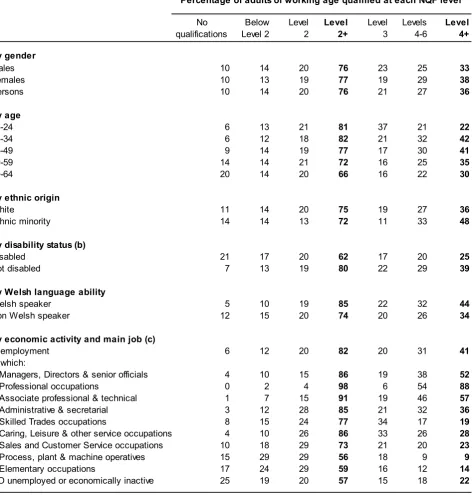
Similar proportions of males and females hold no qualifications, whilst females are more likely to hold qualifications at or above level 4.
Chart 2. Level of highest qualification held by adults of working age, by gender, 2015
Age
The proportion of adults with no qualifications increases with age. 6 per cent of 18-24 year olds were reported as having no qualifications compared with 20 per cent of 60-64 year olds. Disability
Persons with a disability (on basis of Equality Act 2010 legal definition) are more likely to hold no qualifications than non-disabled persons, and less likely to hold qualifications at or above levels 2, 3 and 4.
Ethnicity
Persons from an ethnic minority are more likely to hold Higher education level qualifications than those from a white ethnic origin, but also more likely to have no qualifications.
Welsh language
Higher qualification levels are reported amongst Welsh speakers than their non-Welsh speaking counterparts.
Area
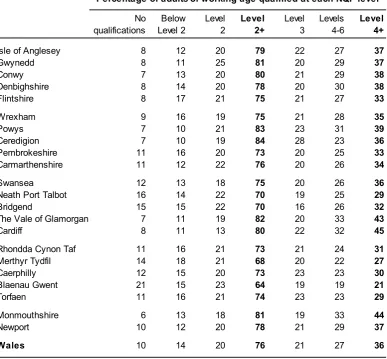
In general, qualification levels were highest in Cardiff, Monmouthshire, and Vale of Glamorgan and lowest in Blaenau Gwent, Merthyr Tydfil and Neath Port Talbot.
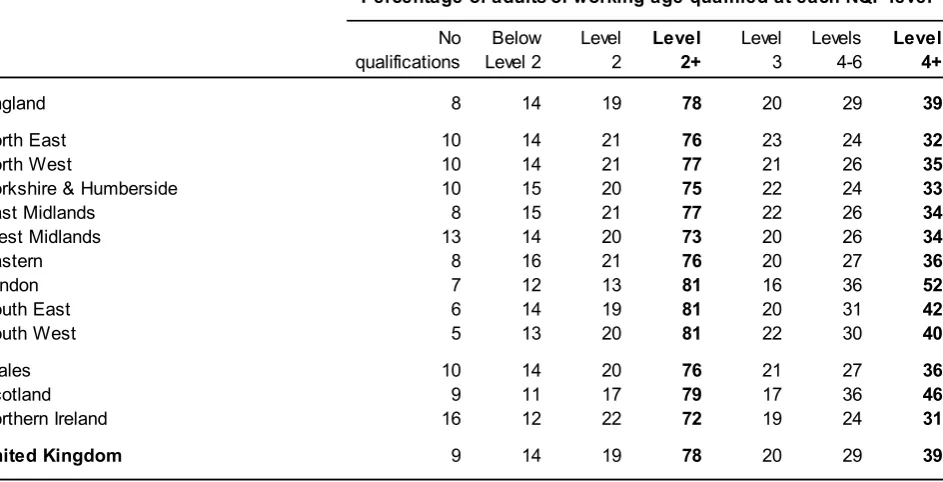
In general, qualification levels in Wales were lower than in England, Scotland and the UK as a whole, but higher than in Northern Ireland and some English regions.
Employment status
25 per cent of those who are either ILO unemployed or economically inactive reported having no qualifications. This compares to 6 per cent for those in employment. (Excluding those who are in full-time education.)
Occupation
Persons employed in professional occupations are more likely to be qualified to at least level 2 than those in other jobs. 98 per cent of persons in professional occupations are qualified at this level.
0% 5% 10% 15% 20% 25% 30% 35%
No quals Below Level 2 Level 2 Level 3 Levels 4-6 Levels 7-8
P
e
r
ce
n
t
Table 1: Level of highest qualification held by adults of working age in Wales, 2015 (a)
No qualifications
Below Level 2
Level 2
Level 2+
Level 3
Levels 4-6
Level 4+
By gender
Males 10 14 20 76 23 25 33
Females 10 13 19 77 19 29 38
Persons 10 14 20 76 21 27 36
By age
18-24 6 13 21 81 37 21 22
25-34 6 12 18 82 21 32 42
35-49 9 14 19 77 17 30 41
50-59 14 14 21 72 16 25 35
60-64 20 14 20 66 16 22 30
By ethnic origin
White 11 14 20 75 19 27 36
Ethnic minority 14 14 13 72 11 33 48
By disability status (b)
Disabled 21 17 20 62 17 20 25
Not disabled 7 13 19 80 22 29 39
By Welsh language ability
Welsh speaker 5 10 19 85 22 32 44
Non Welsh speaker 12 15 20 74 20 26 34
By economic activity and main job (c)
In employment 6 12 20 82 20 31 41
of which:
Managers, Directors & senior officials 4 10 15 86 19 38 52
Professional occupations 0 2 4 98 6 54 88
Associate professional & technical 1 7 15 91 19 46 57
Administrative & secretarial 3 12 28 85 21 32 36
Skilled Trades occupations 8 15 24 77 34 17 19
Caring, Leisure & other service occupations 4 10 26 86 33 26 28
Sales and Customer Service occupations 10 18 29 73 21 20 23
Process, plant & machine operatives 15 29 29 56 18 9 9
Elementary occupations 17 24 29 59 16 12 14
ILO unemployed or economically inactive 25 19 20 57 15 18 22
Source: Annual Population Survey 2015
(a) Adult w orking age is defined as 18-64 for males and females (b) On basis of Equality Act 2010 legal definition of disabled (c) Standard Occupation Classification (SOC) 2010. Excludes persons in full-time education.
Table 2: Level of highest qualification held by adults of working age in Wales, by local authority, 2015 (a)
No qualifications
Below Level 2
Level 2
Level 2+
Level 3
Levels 4-6
Level 4+
Isle of Anglesey 8 12 20 79 22 27 37
Gwynedd 8 11 25 81 20 29 37
Conwy 7 13 20 80 21 29 38
Denbighshire 8 14 20 78 20 30 38
Flintshire 8 17 21 75 21 27 33
Wrexham 9 16 19 75 21 28 35
Powys 7 10 21 83 23 31 39
Ceredigion 7 10 19 84 28 23 36
Pembrokeshire 11 16 20 73 20 25 33
Carmarthenshire 11 12 22 76 20 26 34
Swansea 12 13 18 75 20 26 36
Neath Port Talbot 16 14 22 70 19 25 29
Bridgend 15 15 22 70 16 26 32
The Vale of Glamorgan 7 11 19 82 20 33 43
Cardiff 8 11 13 80 22 32 45
Rhondda Cynon Taf 11 16 21 73 21 24 31
Merthyr Tydfil 14 18 21 68 20 22 27
Caerphilly 12 15 20 73 23 23 30
Blaenau Gwent 21 15 23 64 19 19 21
Torfaen 11 16 21 74 23 23 29
Monmouthshire 6 13 18 81 19 33 44
Newport 10 12 20 78 21 29 37
Wales 10 14 20 76 21 27 36
Source: Annual Population Survey 2015
(a) Adult w orking age is defined as 18-64 for males and females.
Table 3: Level of highest qualification held by adults of working age in the United Kingdom, 2015 (a)
No qualifications
Below Level 2
Level 2
Level 2+
Level 3
Levels 4-6
Level 4+
England 8 14 19 78 20 29 39
North East 10 14 21 76 23 24 32
North West 10 14 21 77 21 26 35
Yorkshire & Humberside 10 15 20 75 22 24 33
East Midlands 8 15 21 77 22 26 34
West Midlands 13 14 20 73 20 26 34
Eastern 8 16 21 76 20 27 36
London 7 12 13 81 16 36 52
South East 6 14 19 81 20 31 42
South West 5 13 20 81 22 30 40
Wales 10 14 20 76 21 27 36
Scotland 9 11 17 79 17 36 46
Northern Ireland 16 12 22 72 19 24 31
United Kingdom 9 14 19 78 20 29 39
Source: Annual Population Survey 2015
(a) Adult w orking age is defined as 18-64 for males and females.
Notes
1. Policy/operational context
This Statistical Release presents the annual snapshot of qualification levels of the working age population in Wales.
The statistics are used within the Welsh Government to monitor trends in qualification levels and specifically
are included within the
Skills Performance measures
and the
Tackling Poverty Action
Plan.
Prior to 2014 publication of this data was through a statistical headline followed by a more detailed statistical bulletin of commentary and charts later in the year. In line with our plans set out in the consultation “Proposals concerning the publication of official statistics” (December 2013) we have developed the headline into a statistical release, and intend to produce the detailed bulletin on an occasional basis rather than annually.
2. Background to the Labour Force Survey/Annual Population Survey
The data presented in this Release are based on the results of the Annual Population Survey for 2015. Data from the Annual Population Survey, a household survey carried out by the Office for National Statistics is available from 2004, and prior to this comparable data are available from the annual Local Labour Force Survey for Wales for 2001-2003.
From 2001, annual Local Labour Force Survey (LLFS) data collected in Wales were based on a
significantly enhanced sample. This larger sample allowed for more detailed and more robust analysis, particularly for sub-Wales geographies.
Developments to the LLFS led to the Annual Population Survey (APS) which now provides annual datasets updated on a rolling quarterly basis from the Labour Force Survey. The data presented here are based on the year ending 31 December 2015.
For years labelled 2001 to 2003, the actual periods covered are the 12 months running from March in the year given to February in the following year (e.g. 2001 = 1 March 2001 to 28 February 2002). Note therefore that there is a two-month overlap between the last period presented on the former March to February basis (2003), and the first period on the new basis (2004).
The annual LLFS/APS datasets are derived from a sample of approximately 23,000 people of working age across Wales, with a minimum of around 800 people of working age in most local authorities in Wales.
Data in this release are presented for working age adults referring to males and females aged 18-64 according to their age at the start of the academic year. Between April 2010 and November 2018 the state pension age for women is gradually increasing from 60 to 65. This release has now been amended to a working age definition of 18-64 for both males and females, rather than its previous definition of 18 to 64 for males and 18 to 59 for females. This change has taken some time to put in place within this release, to allow for a large enough time series, as estimates on this basis are only available from 2008 onwards.
Headline figures on the previous working age definition (18 to 59/64) are:-
An estimated 10 per cent of those aged 18 to 59/64 in Wales reported having no qualifications compared with 9 per cent in 2014
77 per cent of those aged 18 to 59/64 in Wales held at least level 2 qualifications compared with 78 per cent in 2014.
57 per cent of those aged 18 to 59/64 in Wales were qualified to the level 3 threshold compared with 58 per cent in 2014.
The proportion holding higher education level qualifications (NQF level 4 or above) was 36 per cent the same as in 2014.
3. Revisions
There are no revisions to data within this Statistical First Release.
4. Key Quality Information
As the data come from a survey, the results are sample-based estimates and are therefore subject to differing degrees of sampling variability, i.e. the true value for any measure lies in a differing range about the estimated value. This range or sampling variability increases as the detail in the data increases; for example local authority data are subject to higher variability than regional data.
Ethnicity
For the analysis of qualifications by ethnicity, persons in full-time education have been excluded. This change has been made to remove the impact of international students who attend higher education in Wales and thus inflate the proportion with Level 3+qualifications.
Disability
For the analysis of qualifications by disability, this release uses a different definition of disability to that used previously, now being based on the Equality Act 2010 legal definition. Therefore figures within this release are not comparable to those within previous releases which reported those reporting DDA current disability or work-limiting disability.
Proxy response
If the respondent is not available at the time of interview, questions may be answered by proxy through another member of the household. For information on highest qualifications, around two-thirds (68 per cent) of responses have been derived from a respondent's own answers. 21 per cent were obtained from a spouse or partner whilst 11 per cent were obtained from another proxy.
Section 11 of the LFS User Guide Volume 1 presents findings from a follow up study to test the accuracy of results from proxy respondents:
http://www.ons.gov.uk/ons/guide-method/method-quality/specific/labour-market/labour-market-statistics/index.html
Non-response
Information on highest qualification is derived from a number of questions in the survey. Overall, the highest qualification was unknown or unable to be derived for less than 1 per cent of respondents. These respondents have been excluded from the analysis in this release.
Allocation of qualifications with unknown levels
Whilst other questions in the survey are used to allocate qualifications to NQF levels as far as possible1,
for some categories the respondents are distributed into levels using proportions that have been fixed for many years. This is currently true for 'Other' qualifications, Trade Apprenticeships, Scottish CSYS
qualifications and SCE Highers or equivalent. These qualifications account for 10.8 per cent of responses, mainly consisting of Trade Apprenticeships (4.5 per cent) and 'Other' qualifications (6.3 per cent). ‘Other’ qualifications are apportioned across NQF levels Below Level 2, Level 2 and Level 3 in the ratio 55:35:10; Trade apprenticeships are apportioned across Level 2 and Level 3 in the ratio 50:50 and Scottish CSYS qualifications are apportioned across Level 2 and Level 3 in the ratio 33:67. This is a long standing calculation based on detailed analysis of qualifications from the General Household Survey. SCE
Highers are apportioned across Level 2 and Level 3 in the ratio 37:63 based on data from previous years. The aim had been to reconsider these ratios for this analysis of the 2015 data, in line with work taking place across other GSS departments, however this methodology work has not yet been completed and therefore we will incorporate as soon as this is finalised.
Coherence
The figures may differ to those published from statistical publications by other government departments due to a slight difference in source and/or methodologies for deriving levels of qualifications. Also other tables may be based on all persons of working age (16-64) whilst this release is restricted to those aged 18-64 (adults of working age).
The Department for Business, Innovation and Skills have developed an enhanced method of producing qualification estimates from the Labour Force Survey, including the use of administrative records to improve the quality of the attainment data recorded on the LFS and imputation of qualification levels for those with unknown qualifications. Details can be found on the archive Data Service website here
http://webarchive.nationalarchives.gov.uk/20140107201041/http:/www.thedataservice.org.uk/Statisti cs/statisticalfirstrelease/methodogy/
Data is also available from the Census of Population on highest qualification levels. The 2011 census indicated that one in four of the population of Wales aged 16 and over (26 per cent, 651,000) reported having no recognised qualifications and just under one in four of the population of Wales aged 16 and over (24 per cent, 614,000) reported having a qualification at level 4 (degree level) or above. The difference between the level of qualifications reported through the Census and the APS data in this release is in part explained by the wider age range of the Census data. That is both including 16/17 year olds who may not yet have completed their education, and the older age groups. Additional factors to consider are the APS asks more detailed questions about qualifications than the Census. In addition the APS is an interviewer-administered survey whereas the Census is self-completed. Therefore the
interviewer can probe the respondent with further questions to try to establish whether details have been recalled correctly. However, the APS is a sample survey whereas the Census is a more
comprehensive count. Similar issues applied to the 2001 Census.
The biggest benefit of the Census data is to be able to analyse within local authority, down to
community level, and in cross tabulations with small subgroups of the population not possible through the APS.
Changes to LFS qualification questions
5. Qualifications used in the Labour Force Survey and their National Qualification
Framework for England, Wales and Northern Ireland (NQF EWNI) levels
2Below is a list of the qualifications specifically included in the Labour Force Survey questionnaire and provides details of the NQF EWNI level to which they have been assigned for the purposes of statistical analysis.
Data have previously been presented as NVQ equivalencies. The NQF EWNI has nine levels; Entry Level followed by Level 1 to Level 8. In Wales the NQF EWNI forms part of the Credit and
Qualifications Framework for Wales; a meta framework which also includes all Higher Level learning within the University Sector and Quality Assured Lifelong Learning.
Further information about the Credit and Qualifications Framework for Wales can be found here
http://gov.wales/topics/educationandskills/qualificationsinwales/creditqualificationsframework.
NQF Levels 7-8 (previously NVQ level 5 or equivalent) Higher degree
NVQ level 5 Level 8 Diploma 3
Level 8 Certificate 3
Level 7 Diploma 3
Level 7 Certificate 3
Level 8 Award 3
NQF Levels 4-6 (previously NVQ level 4 or equivalent) First degree/Foundation degree
Other degree NVQ level 4 Level 6 Diploma 3
Level 6 Certificate 3
Level 7 Award 3
Diploma in higher education Level 5 Diploma 3
Level 5 Certificate 3
Level 6 Award 3
HNC, HND, BTEC higher etc.
Teaching (further, secondary and primary education, foundation stage¹ and level not stated) Nursing etc.
RSA higher diploma
Other higher education qualification below degree level Level 4 Diploma 3
Level 4 Certificate 3
NQF Level 3 (previously NVQ level 3 or equivalent) Level 5 award 3
NVQ level 3
Advanced/Progression (14-19) Diploma 3
Level 3 Diploma 3
Advanced Welsh Baccalaureate1
2Please note the Scottish Credit and Qualifications Framework has different levels
International Baccalaureate ¹ Scottish Baccalaureate 4
GNVQ/GSVQ Advanced
2+ A levels, 4+ AS levels or equivalent RSA advanced diploma
OND, ONC, BTEC, SCOTVEC national etc. City and Guilds advanced craft/Part 1 Scottish 6 Year Certificate/CSYS (67%) 3 or more SCE higher or equivalent Access to HE qualifications¹
Trade apprenticeship (50%) Other qualifications (10%) Level 3 Certificate 3
NQF Level 2 (previously NVQ level 2 or equivalent) Level 4 Award 3
NVQ level 2
Intermediate Welsh Baccalaureate¹ 1 A level, or 2/3 AS levels, or equivalent Trade apprenticeship (50%)
GNVQ/GSVQ intermediate RSA diploma
City and Guilds craft/Part 2
BTEC, SCOTVEC first or general diploma Higher (14-19) Diploma 3
Level 2 Diploma 3
5+ O levels, GCSE grade A*-C, CSE grade 1 or equivalent Scottish 6 Year Certificate CSYS (33%)
1 or 2 SCE higher or equivalent Other qualifications (35%) Level 2 Certificate 3
Scottish National Level 5 4
Level 3 Award 3
Below NQF Level 2 (previously NVQ level 1 or equivalent) NVQ level 1
Foundation Welsh Baccalaureate2
GNVQ, GSVQ foundation level Foundation (14-19) diploma 3
Level 1 Diploma 3
Scottish National Level 44
Up to 4 O levels, GCSE grade A*-C, CSE grade 1 or equivalent GCSE below grade C, CSE below grade 1
BTEC, SCOTVEC first or general certificate SCOTVEC modules
RSA other
Scottish Nationals Level 34
Scottish Nationals below Level 34
City and Guilds foundation/part 1
2 This qualification was added to the list included on the LFS questionnaire in 2008 3This qualification was added to the list included on the LFS questionnaire in 2011
Level 1 Certificate Level 2 Award YT, YTP certificate Key skills qualification¹ Basic skills qualification¹ Entry level qualification¹ Entry level Diploma 3
Entry level Certificate 3
Level 1 Award 3
Entry level award
Other qualifications (55%)
The percentages in brackets denote that a qualification is split across levels when calculating the number of persons with that qualification. This is done for those qualifications where the LFS does not collect sufficient information to allow a more accurate breakdown of the qualification.
All content is available under the Open Government Licence v3.0 , except where otherwise stated.