in Synthetic Gene Networks
Thesis by
Enoch Yeung
In Partial Fulfillment of the Requirements for the Degree of
Doctor of Philosophy
California Institute of Technology Pasadena, California
2016
c
2016
Acknowledgements
I would like to acknowledge my advisor Richard M. Murray for his invaluable guidance and boundless enthusiasm for doing great research. His professional advice, regular feedback, and broad support over all facets of my graduate studies have made it possible to complete this educational journey. Most importantly, his advisement has helped me to become a more conscientious professional and uncompromising scientist and engineer. I am truly grateful for this precious opportunity to study with him.
Next, I would like to express gratitude to my thesis committee. I thank Jim Beck for guiding me to think deeply about local and global identifiability in nonlinear systems, opening my eyes to the world of stochastic system identification, and being patient with me as I tried to achieve the right balance between experiment and theory. Lea, thank you for regularly providing detailed and enthusiastic feedback, for welcoming me in your group meetings, and guiding my scientific journey. John, many thanks for your profound insights, the sudden paradigm shifts that come from our conversations, and your contagious enthusiasm to be a stellar theoretician.
Prescott, Niles Pierce, Rob Phillips, Erik Winfree, Pan Wei, Vipul Singhal, Eduardo Sontag, Sean Warnick, and Ye Yuan for many insightful conversations. Each of these individuals have played a significant role in shaping the ideas presented in this thesis, though their signature may not be explicit.
Above all, I would like to thank my wonderful wife Amy for her unwavering support and encouragement through my graduate studies. Her faith and confidence in my ability sustained me through countless tough times, including several failed ideas and experiments. Without her, I am certain my research would have been far less fruitful. I also express gratitude to my two little ones, Evelyn and Aaron. Their smiles, giggles, and games added to my motivation even when times were tough. Finally, I am indebted to my parents for the foundation of education that they quietly and consistently laid throughout my life. I cannot begin to enumerate the thousands of teaching moments and educational experiences they have provided I am truly indebted to all my family for this educational experience.
Abstract
In the first part of this thesis, we undertake a quantitative investigation of how composi-tional context, the spatial arrangement and relative orientation of genes, affects individual gene expression in a genetic network. Taking a synthetic biology approach, we construct a series of simple two-reporter biocircuits, each expressing either an mRNA aptamer or a fluorescent protein, and show that by varying the relative orientation of the two genes we obtain a wide range of gene expression profiles, including context-dependent bimodality. We develop a mathematical model to describe the experimental trends observed based on con-cepts from DNA supercoiling theory. We validate the model through a series of in vitro supercoiling experiments and show that by relaxing positive supercoiling in the plasmids, we can significantly reduce the context effects in gene expression. Most importantly, these insights provide a framework for understanding how compositional context and supercoiling can impose feedback on the intended architecture of a synthetic gene network. As a proof of concept, we engineer a genetic toggle switch exploiting compositional context effects to improve its threshold detection and memory capabilities.
illustrate the importance of knowing these loading effects through several example systems, showing that crosstalk imbalance in feedforward loops can lead to performance limitations. However, since biochemical reaction networks are generally large, in practice, only portions of the global network can be reconstructed at a time. We show, with a combination of theory, simulation, modeling and experiments, it is possible to reconstruct the dynamical structure function of a large-scale biochemical network using a series of network reconstruction exper-iments. We then demonstrate how the dynamical structure function can be used to analyze context interference and how these perturbations interfere with performance. We illustrate these ideas with several classes of standard biological networks, e.g. autocatalytic systems, cascade systems, and input-coupled systems.
Contents
Acknowledgements iv
Abstract vi
1 Introduction 1
2 Quantifying Compositional Context Effects in Synthetic Gene Networks 3
2.1 Introduction . . . 3 2.2 Results . . . 6
2.2.1 Compositional Context Significantly Affects Transcription of Synthetic Genes . . . 6 2.2.2 Compositional Context Effects Are Pervasive in Translational Reporters 9 2.2.3 Induction response of genes is affected significantly by compositional
context . . . 12 2.2.4 A Dynamic Model Incorporating Supercoiling States Recapitulates
Observed Compositional Context Effects . . . 14 2.2.5 Relaxing positive supercoiling in plasmids significantly reduces
com-positional context effects . . . 17 2.2.6 Compositional context improves memory and threshold detection in
2.3.1 The Link Between Compositional Context Effects and Growth Phase:
Temporal Aspects of Compositional Context . . . 21
2.3.2 Supercoiling Dynamics Dominate Genetic Context Effects . . . 22
2.3.3 The Role of Compositional Context in Synthetic Biocircuit Design . 24 2.4 Experimental Procedures . . . 26
2.4.1 Plasmid Construction, Assembly, and Strain Curation . . . 26
2.4.2 Single Cell Fluorescence Microscopy . . . 27
2.4.3 Plate Reader Experiments . . . 27
2.5 Experimental Procedures and Data Analysis . . . 28
2.5.1 Plasmid Assembly . . . 28
2.5.2 Analysis of Plate Reader Data . . . 31
2.5.3 Flow Cytometry Experiments and Data Analysis . . . 32
2.5.4 Note on Linear DNA Experiments . . . 33
2.5.5 Note: Fitting Hill Functions for Different Gene Orientations . . . 35
2.6 Note Comparing Toggle Switch Performance of the Original (Divergent) Gardner-Collins Toggle and Convergent Gardner-Collins Toggle . . . 36
3 Reverse-Engineering Context Effects with Dynamical Structure Functions 65 3.1 Introduction . . . 65
3.2 Motivation: Reconstructing Representations of Network Structure . . . 66
3.2.1 The Dynamical Structure Function of an Idealized Incoherent Feedfor-ward Loop . . . 72
3.2.2 The Dynamical Structure Function of an Incoherent Feed Forward Loop with Crosstalk . . . 74
3.3 Quantifying Crosstalk in Biochemical Reaction Networks . . . 77
3.5 Using Network Reconstruction to Prototype and Validate a Novel Event
De-tector From Experimental Data . . . 89
3.6 Conclusion . . . 97
3.7 Experimental Methods . . . 97
4 Analysis of Context Effects with Dynamical Structure Functions 106 4.1 Background . . . 106
4.2 Example: Resource Limitations in a Signal Cascade . . . 108
4.3 Analysis of the Incoherent Feedforward Loop Network Motif with Dynamical Structure Theory . . . 113
4.4 Autocatalyic Systems . . . 120
4.5 Input-Coupled Systems . . . 122
4.6 Clp-XP Loading and Implications on the σ38 (RpoS) Regulated Stress Re-sponse . . . 126
4.7 Conclusion . . . 131
5 Modeling Stochastic Environmental Context Perturbations on Synthetic Gene Networks 132 5.1 Background . . . 132
5.2 Preliminaries: The Chemical Master Equation . . . 135
5.3 Decomposition of the Global Chemical Reaction System . . . 137
5.4 An Additive Decomposition of the Chemical Master Equation . . . 138
5.5 Part I : Leveraging the Partition on Chemical Species . . . 139
5.6 Part II: Leveraging the Partition on the Chemical Reactions . . . 142
5.7 Using the System-Environment Decomposition to Model Environmental Dis-turbances: Examples . . . 145
5.8 Conclusions . . . 155
Chapter 1
Introduction
Synthetic gene networks are inherently dependent on their operating context. These context effects can significantly change the way the network dynamics evolve over time. This poses a challenge when engineering novel synthetic gene networks. The synthetic gene networks have to be engineered in such a a way to account to incorporate context interference to their benefit or to insulate against deleterious context effects.
There are many ways in which the context of a synthetic gene network can affect its performance. As we will detail in this thesis, some are well studied and others have been virtually ignored. Context effects can be generally arise in three forms: 1) compositional context, the way in which genetic elements are composed, 2) host context, the way in which the synthetic gene network interacts with the host chassis or organism and 3) environmental context, the way in which environmental parameters such as oxygen levels, redox potentials, diffusion rates, etc. interact with the synthetic gene network.
Chapter 2
Quantifying Compositional Context
Effects in Synthetic Gene Networks
2.1
Introduction
A fundamental aspect of designing synthetic gene networks is the spatial arrangement and composition of individual genes. With advancements in DNA assembly technology[25, 34, 54, 98], drops in sequencing and prototyping costs [12, 84, 91], and the continual discovery of novel synthetic biological parts [89], synthetic biology is poised to make a leap in the scale and complexity of the networks it builds. So why hasn’t it happened yet?
The challenge is that synthetic biological parts can be highly sensitive to context [9], e.g. the physical composition of elements in synthetic genes, conditions of the host chassis, and environmental parameters. Context effects can often be mitigated by engineering principles such as standardization [16, 69] or high-gain feedback [17, 66]. Frequently, it is critical to have an understanding of physical mechanisms underlying context effects before they can be resolved [16, 69]. The key insight is that context effects in synthetic gene networks can rarely be ignored; the study of context effects leads to principle-based design approaches that mitigate their interference.
func-tion, even if models for individual genetic elements such as promoters and RBSs have limited prediction power [52]. Smanski et al. [87] screened a large combinatorial library for a sixteen gene nitrogen fixation cluster, to explore the effect of genetic permutations in ordering, orien-tation, and operon occupancy. They discovered there were strong differences in nitrogenase activity, depending on the compositional configuration, but no clear architectural trends emerged from monitoring acetylene reduction. Moreover, the number of compositional vari-ants (more thanO(1019) ) of a sixteen gene cluster made it impossible to exhaustively search and screen for the optimal variant.
These results underscore the complementary role that library screening and principle-based design approaches have in synthetic biology. Library screening approaches can be an extremely effective way to optimize performance in individual parts. However, the number of compositional context variants for larger biological networks quickly mushrooms to scales that are intractable for library-based approaches. If we are to build increasingly larger synthetic biocircuits, including synthetic genomesdesignedfrom scratch [33], we need deeper physical understanding of how compositional context affects gene expression.
Moreover, while there have been extensive studies on the effects of intragenic composi-tional context on synthetic gene expression (the spatial arrangement of components within a gene, [16, 52, 69]), there have been far fewer studies on the effect of intergenic composi-tional context on synthetic gene expression (the spatial arrangement of entire genes relative to each other). Recently, Chong and coworkers showed that transient accumulation of lo-calized positive supercoiling leads to reduction in gene expression — they showed through in vitro transcription experiments that supercoiling could be a physical mechanism behind transcriptional bursting [13]. Their results also suggested that the presence of nearby topo-logical barriers such as DNA-bound proteins or transcriptional activity of neighboring genes can affect local gene expression.
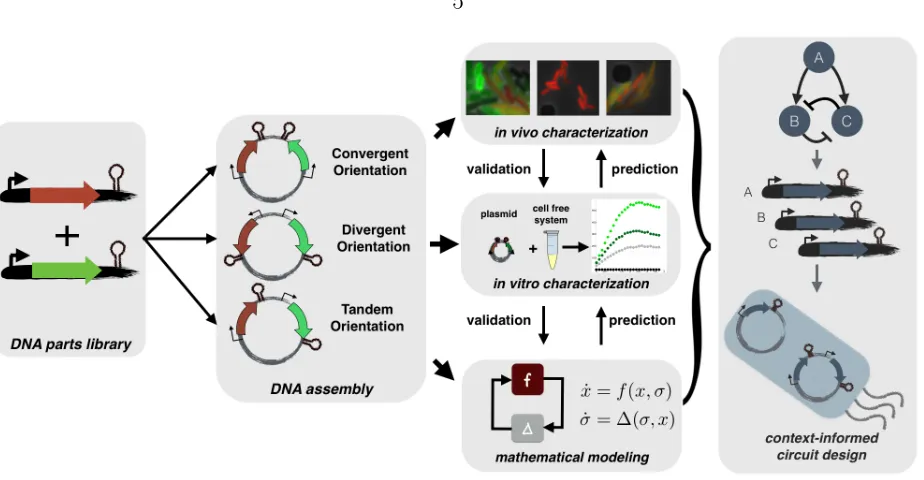
Figure 2.1: Experimental and theoretical approaches for understanding composi-tional context effects: Plasmids are constructed using synthetic biology techniques vary-ing gene orientation, transcript length, codvary-ing sequence, replication origin, and antibiotic marker. Each plasmid is characterized thoroughly in vivo based on what is appropriate for the fluorescent reporter, e.g. single cell fluorescence microscopy, flow cytometry or plate reader. Plasmids are tested in vitro in a cell-free expression system to infer physical hy-potheses driving compositional context effects and compared against models capturing the hypotheses inferred from in vitro and in vivo data. These hypotheses support a conceptual framework for designing synthetic biocircuits that utilize compositional context interactions.
2.2
Results
2.2.1
Compositional Context Significantly Affects Transcription
of Synthetic Genes
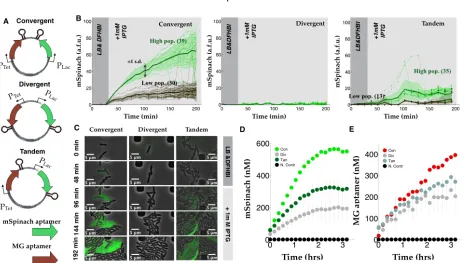
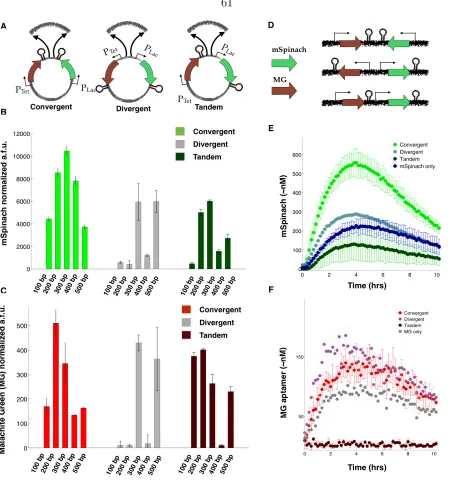
To study the effects of compositional context, we constructed a set of plasmids, varying gene orientation, relative orientation, coding sequence identity, and the length of spacing between genes. There are three relative orientations that two genes can assume: 1) convergent orientation, where transcription of both genes proceeds in opposite directions and towards each other, 2) divergent orientation, where transcription of both genes proceeds in opposite directions, away from each other and towards genetic elements on the plasmid backbone, and 3) tandem orientation, where transcription of both genes proceeds in the same direction [57, 83]. We constructed plasmids of each orientation to examine their effect on gene expression in vivo and in vitro.
Each plasmid incorporated two reporter genes, assembled and inserted in the same locus of a consistent vector backbone. Each gene consisted of an inducible promoter, the Lac or Tet promoter, and a fluorescent reporter. Each plasmid was transformed into MG1655Z1 E. coli, which expresses LacI and TetR constitutively from the genome. We chose LacI and TetR since they provide independently inducible systems[10].
We first used mSpinach RNA aptamer and MG RNA aptamer as reporters downstream of the Lac and Tet promoter, respectively. Since mSpinach RNA aptamer is not cytotoxic, it can be used in live-cell imaging to explore how induction response of the Lac promoter varies with compositional context. After equilibrating background levels of fluorescence in mSpinach, we induced the Lac promoter with 1 mM of ispropyl-β-D-1-thiogalactopyroside (IPTG), thus activating expression of mSpinach RNA aptamer. We observed that the induction response of the Lac promoter varied significantly depending on its relative gene orientation, even though the neighboring gene was never activated by aTc (Figure 2.2).
induc-Figure 2.2: Compositional context alters single cell RNA expression profiles: (A) Convergent-, divergent-, and tandem-oriented mSpinach and MG aptamer reporters on ColE1 backbone. (B) Time-lapse mSpinach expression curves for individual cell traces in response to 1 mM IPTG induction. Solid central lines within a shaded region denote the mean expression across cell lineages within a population, while the shaded area shows one standard deviation from the mean. (C) Single cell microscopy images of convergent-, divergent-convergent-, and tandem- oriented mSpinach expression. (D-E) Convergent-, divergent-, and tandem- oriented mSpinach and MG RNA aptamer expression in an E. coli cell free expression system.
tion, rising gradually over the course of three hours to reach a steady-state level of expression coinciding with saturation in the microfluidic chamber ( Figure 2.2). Convergent oriented mSpinach also gave a strong bimodal response to IPTG induction, with one group of cells achieving high levels of expression (Figure 2.2B) and another with low expression (Figure 2.2B).
[image:17.612.78.543.60.323.2]Interestingly, cells with tandem oriented mSpinach exhibited pulsatile expression, in con-trast to the ramp-like response shown by convergent oriented mSpinach. A few outlier cell traces achieved levels of mSpinach expression comparable to the bright convergent mSpinach population, but only at the peak of their transient pulses. Overall, tandem oriented mSpinach exhibited bursty and weaker gene expression than convergent oriented mSpinach.
Since many intracellular parameters fluctuate stochastically in vivo [22], we ran con-trol experiments of each plasmid in a cell-free E. coli derived expression system [73]. In this system the effects of single-cell variability are eliminated, e.g. variations in LacI and TetR repressor concentration, polymerase, ribosome, tRNA pools. Also, all deoxynucleotide triphosphates are removed during preparation of cell-extract, thus eliminating any confound-ing effects of plasmid replication. We prepared separate cell-free reactions for each orien-tation, assaying mSpinach and MG aptamer expression in a plate reader, using equimolar concentrations for each reaction (Figure 2.2D-E). Because all cell-free reactions were derived from a single batch of well-mixed extract, the variability in LacI repressor concentration was minimal.
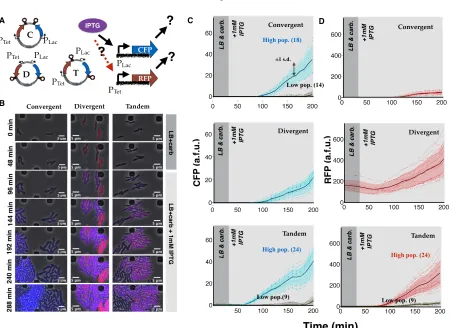
Figure 2.3: Consistent compositional context effects are observed in translated reporters: (A) Plasmid maps for convergent, divergent, and tandem oriented CFP and RFP on the ColE1 plasmid backbone. (B) Single cell microscopy images of convergent-, divergent-convergent-, and tandem- oriented CFP and RFP expression superimposed. (C) Single cell traces of CFP response to IPTG induction in the convergent, divergent, and tandem orientation. Note that both convergent orientation and tandem orientation exhibit bimodal expression phenotypes. High expressing CFP cells also corresponding to high expressing RFP cells, while low expressing CFP cells (gray traces) correspond to low expressing RFP cells.
(D) Single cell traces of RFP response to IPTG induction in the convergent, divergent, and tandem orientation. Note that both divergent orientation and tandem orientation respond to IPTG induction with significant RFP expression, while convergent orientation responds slightly with some leaky RFP expression.
2.2.2
Compositional Context Effects Are Pervasive in
Transla-tional Reporters
components in the network. To explore if these compositional context effects propagated to translational expression, we replaced the transcript of MG aptamer with the coding sequence for red fluorescent protein (Bba E1010 [106]). We also interchanged the spacer between mSpinach and RFP, to see if our results were dependent on the sequence of the spacer. We then ran an identical experiment, as in Figure 2.2, to see how induction of mSpinach affected and correlated with RFP expression in single cells.
As expected, relative gene orientation had the same effect on mSpinach transcription as in Figure 2.2. Even with RFP in place of MG aptamer, mSpinach expression was highest in the convergent orientation and weakest in the divergent orientation.
We also observed that both convergent and tandem oriented mSpinach expressed with a bimodal phenotype (see Figure 2.9B-C). These results confirmed that the identity of the neighboring gene and spacer sequence content was not the source of these gene expression differences.
Interestingly, RFP expression was extremely leaky in the divergent orientation. In con-trast, convergent oriented mSpinach and RFP showed strong XOR logic — any cells that expressed small amounts of RFP did not respond to IPTG induction with mSpinach expres-sion, while cells that did not express any RFP showed strong mSpinach expression. This data suggests compositional context can be exploited to shape co-expression of neighboring genes.
To further show that compositional context effects extend to translated reporters, we replaced mSpinach with cyan fluorescent protein (CFP) [97]. We deliberately used a weak RBS from [69], for CFP and a strong RBS [55] to ensure that any ribosome competition effects would be unidirectional (RFP loading on CFP and not vice-versa) [39]. Thus, if both genes are induced, any differences in RFP expression would elucidate compositional context effects and not competition for translational resources.
strongest in the convergent, (slightly) weaker in the tandem orientation, and weakest in the divergent orientation (Figure 2.3, Figures 2.10C-D (IPTG-only condition).
As a control for plasmid backbone, we cloned and induced CFP as a single gene on the exact same plasmid locus (either in sense or anti-sense orientation relative to the plasmid vector). In both control plasmids, 100 bp flanking upstream and downstream sequences were preserved as in the experimental plasmids, to eliminate any promoter sensitivity to upstream sequence perturbation. We noticed a dramatic 5-fold increase in signal over the weakest ex-pressing orientation (compare Figures 2.10B,F-G and 2.10C). In contrast, comparing sense and anti-sense expression of CFP showed only a small (at most 10% difference in expression). This confirmed that the observed compositional context effects could not be attributed to genetic elements within the plasmid backbone. We also tested the effect of changing the plasmid origin (from ColE1 to p15A) and resistance marker (AmpR to CmR), see Figure 2.11B-C. While the quantitative differences in expression changed by varying plasmid vector (most likely reflecting a change in the copy number of the plasmid), the trends were quali-tatively identical. This confirmed that plasmid backbone composition was not the primary source of the observed context effects.
Once again, to control for single-cell variabilityin vivo, we tested RFP and CFP expres-sion of each context variant in a cell free expresexpres-sion system [84]. CFP and RFP expressed strongest in convergent orientation, weaker in tandem orientation, and weakest in divergent orientation (Figure 2.5B). These results were consistent with results of our prior in vitro tests with mSpinach-MG aptamer plasmids.
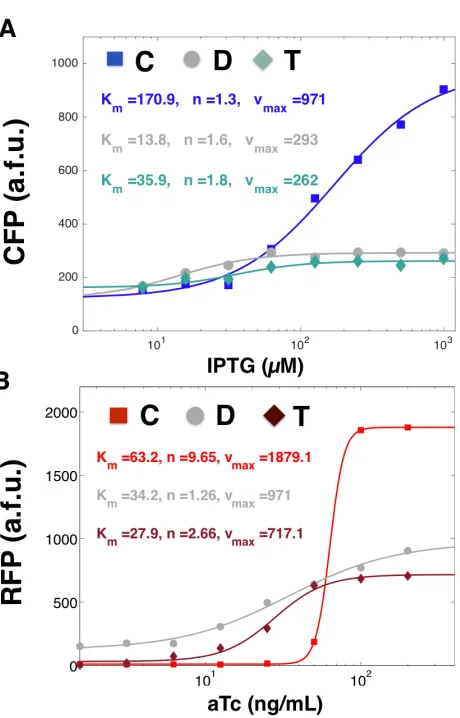
Figure 2.4: Ultrasensitivity, basal expression, and amplitude of gene induction responses are significantly affected by compositional context: (A)Induction curves for convergent-, divergent-, and tandem- oriented CFP fitted to a Hill function at aTc = 200 ng/mL and varying concentrations of IPTG.(B)Induction curves for convergent-, divergent-, and tandem-oriented RFP fitted a Hill function at IPTG = 1000 nM and varying concen-trations of aTc.
expression.
2.2.3
Induction response of genes is affected significantly by
com-positional context
choice of RBSs (using a strong RBS for RFP and a weak RBS for CFP), increases in RFP expression consistently resulted in decreased CFP expression independent of orientation. As expected, increasing CFP expression did not decrease RFP expression. What was most notable was how gene orientation affected the induction response of RFP expression to varying amounts of aTc inducer.
In the convergent orientation, we saw that the transfer curve of RFP expression exhibited strong ultra-sensitivity, increasing by 120-fold in response to only an 8-fold change in aTc. At 100-200 ng/mL of aTc, RFP expression plateaued in an on-state of expression and below 25 ng/mL, RFP expression plateaued in an off-state of expression. Thus, diluting aTc with an 8x dilution factor had the effect of completely switching RFP from an on to an off state. In contrast, the tandem orientation required a 64-fold change in aTc concentration to achieve a comparable (100x) fold-change in RFP expression. At 100-200 ng/mL, we also saw RFP expression plateaued in an on-state of expression (for all concentrations of IPTG tested). However, RFP reached an off-state of expression only when aTc was diluted down to 3 ng/mL or lower. Thus, to achieve the same dynamic range as convergent RFP required an 8x increase in dilution factor.
Divergent oriented RFP exhibited the smallest dynamic range. Varying aTc concentra-tion 200-fold produced at most a 2.7 fold change in RFP expression. Even without aTc, RFP expressed at much higher levels than background. We also saw leaky expression at the single cell level, both in the divergent oriented RFP and CFP MG1655Z1 strain (Figure 2.3) and divergent oriented RFP and mSpinach strain ( Figure 2.10). Since both strains used different spacing sequences of lengths ranging from 150-350 bp, we concluded these leaky effects were a function of RFP gene orientation and not spacer identity nor proximity to the Lac promoter.
half-max induction Km. We noticed that convergent oriented RFP showed significantly increased cooperativity coefficient, nearly four-fold more than tandem orientation and and eight-fold more than divergent orientation. Also, convergent orientation consistently fitted with the highestKmvalue in both RFP and CFP induction curves, suggesting that orienting genes convergently raises the induction threshold.
Our experimental data show that compositional context changes gene expression, in-duction, and repression. Overall, compositional context can dramatically alter canonical properties of synthetic gene expression and thus should not be overlooked when designing synthetic gene networks.
2.2.4
A Dynamic Model Incorporating Supercoiling States
Reca-pitulates Observed Compositional Context Effects
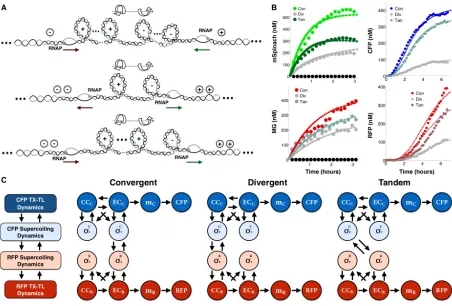
Building on the work of [13, 57, 63] we investigated whether supercoiling can explain the compositional context effects seen in our data. We constructed an ordinary differential equation (ODE) model describing transcription and translation of both genes. To describe the interplay between gene expression and accumulation of supercoiling for each gene, we introduced separate states to keep track of promoter supercoiling and coding sequence su-percoiling. This model structure allowed us to study how supercoiling buildup affected both the processes of transcription initiation and elongation [19]).
The kinetic rates of transcriptional initiation and transcriptional elongation are signifi-cantly affected by supercoiling buildup [19]. Negative supercoiling relaxes or melts the DNA double helix, facilitating transcription initiation and elongation benefits. However, excessive negative supercoiling can lead to the formation of R-loops, structural complexes that involve DNA binding to nascently produced RNA still attached to RNA polymerase. These R-loops complexes have been shown to cause transcriptional stalling [19].
tightly wound DNA that is less likely to be transcribed; positive supercoils downstream of a transcription bubble can also impose torsional resistance against further unwinding of the DNA, thereby stalling transcription. When a gene expresses and produces positive super-coiling downstream of the transcription bubble, the accumulation of positive supersuper-coiling is especially exacerbated by the presence of a topological barrier, e.g. the binding of a DNA binding protein such as a transcription factor, or even the presence of another active gene in negatively supercoiled state. Buildup in positive supercoiling reduces the initial rate of gene transcription [13]. Thus, excessive supercoiling in the DNA double helix in either direction can decrease transcription rates.
In our model we account for the above considerations by encoding a dependency of tran-scription rate parameters on local supercoiling density. We model the buildup in supercoiling density as a consequence of the presence of DNA binding proteins or torsional stress from transcription of nearby genes. We build on the analysis of Meyer and Beslon [63] and con-sider transcription initiation rates to be dynamicallydependent on supercoiling density. We model them as Hill functions of the absolute deviation of the promoter supercoiling state from a natural supercoiling state [79]. In other words, as DNA becomes too twisted in either the positive or negative direction, transcription initiation rates and elongation rates decrease. Similarly, we suppose that the elongation rate of the gene of interest can be modeled as a Hill function of the supercoiling state over the transcript region. Thus, by modeling the dependency of transcription rates on supercoiling, we can model context-specific coupling between neighboring genes (Figure 2.5).
the anti-sense direction, its expression introduces negative-supercoils upstream according to the twin-domain model by Liu & Wang [57]. In moderate amounts, negative supercoiling facilitates the unwinding of DNA and thus enhances the amount of transcriptional initiation and elongation occurring over the Lac promoter and mSpinach transcript. In the diver-gent and tandem orientation, mSpinach is expressed in the sense direction, which results in positive supercoiling build-up downstream of the promoter (Figure 2.5A). The outcome is that divergent and tandem mSpinach expression is reduced (compared to convergent), since the buildup of positive supercoiling in the presence of adjacently positioned DNA binding proteins or an active transcription bubble inhibits initiation and elongation. This effect is more severe in the divergent orientation, since excessive positive and negative supercoiling generated by initiation of the Tet and Lac promoter can interfere with each other’s initiation (Figure 2.5C).
2.2.5
Relaxing positive supercoiling in plasmids significantly
re-duces compositional context effects
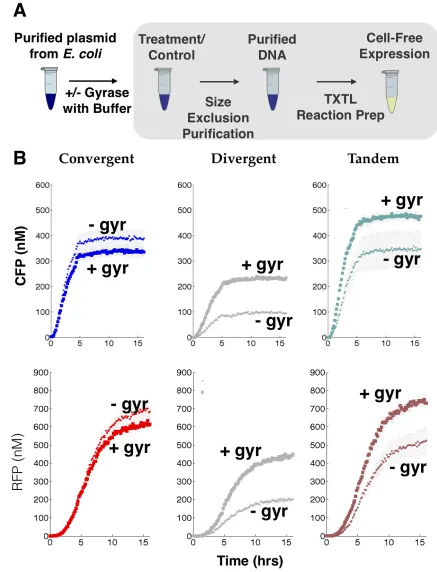
To test the effect of incubating context-variant plasmids with gyrase, we purified plas-mids expressing convergent, divergent, and tandem oriented RFP and CFP from uninduced MG1655Z1 E. coli. We divided each plasmid sample into two aliquots — one aliquot was used as a control for the absence of gyrase treatment and the second aliquot was incubated with gyrase (NEB) at 37◦ C overnight. Once again, we tested the expression levels of each plasmid in the cell-free TX-TL system [84].
In the absence of gyrase, convergent orientation expressed higher than divergent and tandem orientation in both RFP and CFP channels. After gyrase treatment, tandem oriented CFP and RFP expressed brighter than their convergent and divergent counterparts. Treating with gyrase changed the relative ordering of expression levels, as opposed to unilaterally shifting all orientations simultaneously. This suggested that supercoiling as an intrinsic driver of context interference, rather than an extrinsic global factor. Also, the disparity in protein expression between the two orientations farthest apart in expression, convergent and divergent, shrunk from 300 nM to 100 nM (66% for CFP) and from 500 nM to 180 nM (64% for RFP). Since gyrase serves only to relax plasmids of positive supercoiling, this confirmed that supercoiling is the mechanism underlying compositional context effects.
We anticipated that treatment with gyrase would release positively supercoiled domains in the downstream region of tandem oriented CFP and RFP and release positive supercoiling buildup from divergently (leaky) expressed RFP (Figure 2.5A) and thereby reduce torsional stress in the promoters of divergently oriented CFP and RFP. Our experimental results confirmed these hypotheses, with divergent orientated CFP and RFP increasing by more than 2 fold and tandem orientated CFP and RFP increasing by 1.4 fold.
orien-tation); thus the purified plasmid for convergent orientation did not have as much positive supercoiling for gyrase to mitigate. Treatments with gyrase may actually have introduced too much negative supercoiling, leading to the small drop in expression observed.
These experimental outcomes are consistent with our model of supercoiling and its impact on compositional context. Gyrase relaxes positively supercoiled domains downstream of convergent and tandem oriented RFP, while in the divergent orientation, gyrase relaxes any positive supercoiling buildup near the promoter region. Once these positive supercoils are removed, the genes are able to express at much higher levels than prior to treatment.
Our data shows that compositional context can have a strong effect on the dynamics of supercoiling within plasmids. Nearby transcriptionally active genes or protein-bound genes act as topological barriers to stop migration of supercoils or dispersion of localized torsional stress. Protein-bound genes in particular, act to trap supercoiling in neighboring transcriptionally active genes; this may explain why in our IPTG induction experiments, the mere presence of a repressed RFP and MG gene (respectively) could have such a significant effect on CFP and mSpinach expression. In this way, gene orientation and placement can introduce a fundamentally different form of feedback coupling between neighboring genes. When used appropriately, these feedback effects can be beneficial or detrimental to the intended architecture of the biocircuit, as we illustrate in the next section.
2.2.6
Compositional context improves memory and threshold
de-tection in toggle switch
Synthetic gene networks, for the most part, have been designed primarily to avoid one type of compositional context effect: terminator leakage. Terminator leakage can cause positive correlation between a downstream gene with an upstream genes. While this is a noteworthy consideration in designing synthetic gene networks, we can actually utilize compositional context to improve or reinforce the feedback architecture of synthetic gene networks.
of compositional context can improve design. Being one of the first synthetic biocircuits ever made, it was constructed in divergent orientation to avoid terminator leakage effects between two mutually repressing genes, LacI and TetR [31, 50]. From the perspective of protein regulation, two proteins, LacI and TetR, enforce mutual repression by transcriptional repression.
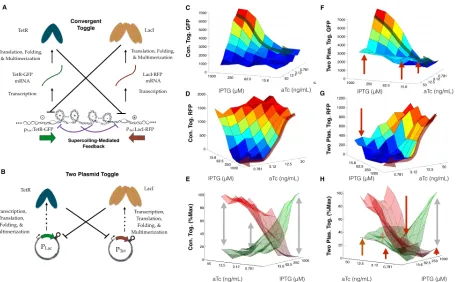
However, we can also build the toggle switch in convergent or tandem orientation. The convergent toggle switch is most appealing, based on several experimental insights: 1) the competing dynamics of positive and negative supercoils between the two genes encodes an additional layer of mutual negative feedback (Figure 2.7A), 2) the coexpression profiles of RFP and CFP in the convergent orientation ( Figure 2.10)E and mSpinach and RFP in the convergent orientation ( Figure 2.9) was strongly anti-correlated. All of these properties of compositional context have the potential to enhance or strengthen the existing mutual negative feedback in the toggle switch.
Since our previous controls of sense and anti-sense encoded single genes showed that changing orientation of a single gene on a backbone did not affect expression more than 15 %, we thus constructed a two plasmid version of the toggle switch, with LacI and TetR expressed on separate plasmids. This “context-free” version of the toggle acted as a reference for how a toggle switch should function independent of genetic context.
In both versions of the toggle switch, each gene cassette in the toggle switch was bi-cistronic, with LacI reported by translation of RFP and TetR reported by GFP. We used stronger ribosome binding sites to express LacI and TetR and weak BCDs to express the downstream reporters.
Information.
We first tested the ability of the toggle switch to act as a threshold detector. In theory, the phase portrait of a toggle switch consists of two locally asymptotically stable equilibrium points and a separatrix which drives state trajectories into the basin of attraction of one of the equilibrium points [31]. As a proxy for varying the amount of actively repressing TetR and LacI, we simultaneously varied the concentration of inducers aTc and IPTG, thereby allowing us to attenuate the activity of LacI and TetR repression independently. Most notably, when the toggle switch was configured in the convergent orientation, it exhibited much sharper XOR logic and separation between high GFP-low RFP states and high RFP-low GFP states compared to its two-plasmid (and divergent) counterpart (Figure 2.7 and Figure 2.11A-B).
The two-plasmid toggle exhibits weaker thresholding in two specific parameter regimes — when IPTG and aTc are both present in high concentrations and when IPTG and aTc are both present in low concentrations. When both inducers are present in high concen-trations, the majority of Lac and Tet promoters are unrepressed because most repressor proteins are sequestered by inducers, leading to weak feedback. The weak feedback makes it difficult to differentiate which inducer is higher, since all promoters are essentially expressing constitutively (Figure 2.7F-H). When both inducers are present in low concentrations, both promoters are strongly repressed making it difficult for one promoter to gain a dominant foothold over the other sufficient to produce fluorescent signal. Thus, in the low inducer concentration regime, even if one inducer is higher in concentration than the other, neither gene is strong enough to repress the other to the point of producing detectable fluorescence (Figure 2.7F-H).
induced than TetR-GFP. The positive supercoiling from TetR-GFP expression propagates downstream to meet the negative supercoils generated from transcription of LacI-mRFP. As more and more LacI-mRFP expresses, it forces the positive supercoils back into the TetR-GFP coding sequence. When this happens, TetR-TetR-GFP is no longer able to express and its transcript region is thus available to LacI-RFP as a downstream region for dissipating its in-ternal torsional stress. Thus, by propagating supercoils into its neighboring gene, LacI-RFP exerts a form of negative feedback independent of transcription factor-mediated repression. This explains why the convergent toggle is able function in regimes where IPTG and aTc are simultaneously high or low. When IPTG and aTc are both present in high concentra-tions, the attenuation of transcription factor repression is compensated by the presence of supercoiling mediated repression. Thus, even though LacI and TetR are not as effective in repressing their respective promoters, the extra layer of feedback allows the convergent tog-gle to decide on a dominant state (LacI-RFP). Similarly, in the low parameter regime, even though both repressors are strong, the additional feedback from supercoiling favors one gene or the other (an enhancement of the winner-takes-all or XOR logic) and evidently improves the ability of the toggle switch to again allow LacI-RFP to dominate over TetR-GFP. Thus, there is a multi-layer feedback effect introduced by supercoiling in the convergent orienta-tion, conformal with the intended feedback architecture of the toggle switch. In this way, we see that compositional context can be a powerful tool for encoding feedback in synthetic gene networks.
2.3
Discussion
2.3.1
The Link Between Compositional Context Effects and Growth
Phase: Temporal Aspects of Compositional Context
com-positional context, the supercoiling state of a gene can be affected by the propagation of supercoiling from nearby coding regions. In this way, supercoiling couples the activity of two neighboring genes. The strength of that coupling and its impact on the temporal dy-namics of gene expression depends on the orientation of the genes and what part of the gene is exposed to torsional stress from the neighboring gene. On the whole, these features of our model are able to recapitulate the in vitro and in vivo trends observed at steady-state, but do not account for aspects of how gyrase and topoisomerase levels are regulated during different growth states.
An interesting facet of these context effects are the temporal dynamics of supercoiled genes, topoisomerase concentrations, and their dependence on cell culture growth phase. Specifically, as E. coli cells transition from exponential to stationary phase, plasmid DNA exhibited significantly less negative supercoiled DNA. Balke & Gralla [3] showed that up to ten negative supercoils could be lost in the pBR322 plasmid in stationary phase cells grown in LB. Thus, gyrase activity (which maintains negative supercoiling) is attenuated as cells approach the end of their exponential growth phase. These findings are corroborated by our data; we also saw that compositional context differences become increasingly dramatic just as cells complete their exponential growth phase (Figure 2.10C-D).
In this work, we have not made a point to model the temporal dynamics of gyrase and topoisomerase as a function of cellular growth phase since doing so would require rigor-ous characterizations of gyrase and topoisomerase concentrations through the entire growth cycle. Another interesting extension would be to examine how gyrase dynamics and the compositional context of genes in core metabolic systems affect or modulate the dynamics of metabolism.
2.3.2
Supercoiling Dynamics Dominate Genetic Context Effects
are the effects of terminator leakage and transcriptional interference from overlapping pro-moter and RBS elements. We claim that supercoiling is the dominant source of compositional context effects observed in our data, justified by the following observations.
First, we see consistent differences in gene expression, even when only one gene is induced and the other remains repressed. If terminator leakage and transcriptional interference were the source of compositional context effects, we would not expect to see any effects in the case of single gene induction.
However, there is more than a 2-fold difference in expression between divergent expressed CFP and its single reporter counterpart (sense or anti-sense, compare Figure 2.10C with Figure 2.3F-G). The physical presence of a neighboring gene has an effect, even if it is not transcriptionally active. Thus, transcriptional interference via terminator leakage does not explain the data.
Second, if transcriptional interference were the primary driver for context effects, we would expect convergent oriented genes to achieve far weaker levels of expression than di-vergent or tandem orientation. In theory, transcribing polymerases that managed to leak through two terminators (Larson et al. [53] characterized the termination efficiency of our terminators at 98%) would collide in the convergent orientation, leading to an increase in abortive transcription events or transcriptional stalling.
Admittedly, we see from our in vivocharacterizations that early-log phase CFP and RFP expression is weaker in the convergent orientation than the divergent and tandem orientation. The fly in the ointment for this argument is thatbothCFP and RFP expression arehigher(see Figure 2.4 and Figure 2.10C-E) in the doubly induced case than in the singly induced case in early log phase, which contradicts the predictions of transcriptional interference theory.
super-coiled, which inhibits their activity. This positive supercoiling originates from the RFP promoter as it transcribes in the anti-sense direction, thus asymmetrically inhibiting CFP expression and favoring RFP expression (see Figure 2.10E).
Thirdly, consider the differences in expression in vitroof convergent, divergent, and tan-dem transcribed RFP and CFP (Figure 2.6). Our experimental characterizations in vitro control for variations for plasmid copy number (as a function of orientation), since plasmid replication does not occur in the transcription-translation (TX-TL) cell-free system [73]. Nonetheless, we see that levels of CFP (and RFP) expression in the convergent and diver-gent orientation differ by nearly 300 nM (and 500 nM) when purified directly from cells in their natural supercoiled state, whereas treating with gyrase to eliminate positive supercoil-ing decreases the difference by nearly 70% in both genes. Relaxsupercoil-ing positive supercoilsupercoil-ing in divergently oriented RFP and CFP with gyrase also allows expression levels comparable to tandem orientation prior to gyrase treatment, while treating tandem oriented RFP and CFP enables expression levels higher than both post-treatment and pre-treatment convergent ori-ented CFP and RFP. Taken in whole, these observations confirm that the dominant physical process driving the effects of compositional context is supercoiling.
2.3.3
The Role of Compositional Context in Synthetic Biocircuit
Design
Our findings show that compositional context significantly alters gene expression in syn-thetic gene networks. When appropriately harnessed, compositional context can be used to strengthen or enhance existing feedback loops in the intended biocircuit design. These find-ings validate prior analysis underscoring the value of accounting for compositional context effects in synthetic biocircuit design [9].
combina-torial promoters [15]. Similarly, Mutalik et al. showed that the compositional context of a ribosome binding site, specifically sequences downstream of the ribosome binding site could have a significant impact on the effective binding strength of the ribosome [69]. Using a bi-cistronic design approach, they showed they were able to better insulate against downstream sequence variability to produce predictable parts. These are examples of the importance of understanding and insulating against intragenic compositional context.
The results of our experimental studies emphasize the importance of understanding in-tergenic compositional context effects, i.e. composition of entire genes. We have seen that compositional context effects can cause variations of 3-4 fold of the same gene (promoter, RBS, coding sequence, etc.) simply by rearranging its orientation and the orientation of other neighboring genes. The significance of these outcomes raise an important issue. As intrageniccontext, e.g. choice of BCD, promoter design, polycistronic design, are optimized to produce a functional gene cassette with model-predicted gene expression levels [52, 70], how do we ensure these predictions are not confounded by intergenic context as genes are composed?
One solution is to separate genes that need to have precise regulated expression levels on to different plasmids. However, the drawback of this approach is that separating genes on different plasmids introduces imbalances in gene copy number, which in turn can lead to additional design-build-test cycles to rebalance circuit dynamics. Also, it is often the case that there are too many genes in a biocircuit to isolate individually on separate plasmids. In such settings, the findings of this work are important to consider, as they can be used to inform how to optimally compose adjacent genes.
orientation, but not in the convergent orientation with 450 bp of spacing between the two genes. It is possible that since the persistence length of DNA is 150 base pairs, 450 base pairs of spacing facilitates formation of plectonomes (with DNA loops consisting of three 150 bp domains) in the spacing region, which induce torsional stress and inhibit formation or movement of the transcription bubble.
In general, genes responded well to induction when induced one by one, though their raw expression levels varied depending on compositional context. This may explain why some circuits in the past have been successfully engineered, with little consideration given to the effects of supercoiling and compositional context. For example, the original toggle switch (oriented divergently) was designed to respond and latch to the presence of a single inducer [31] — it did this well and latched to LacI or TetR dominant states. In contrast, the threshold detection abilities of the toggle were not explored.
Likewise, the fold-change in ’off’ vs ’on’ states of three input and four input AND gates developed by Moon and colleagues [67] was strongest when comparing singly induced expres-sion levels against the corresponding fully induced state. Interestingly, the four layer and three logic gates in these biocircuits were compositionally composed so that no two genes involved in any constituent layer of logic were placed adjacent to each other. Pairs of genes involved in logic gates were always separated by an auxiliary backbone gene or placed on separate plasmids. Overall, the success in this work suggest that genes can be insulated by inserting short ‘junk’ transcriptional units in between each other. Engineering approaches for attenuating compositional context effects are a subject of future research.
2.4
Experimental Procedures
2.4.1
Plasmid Construction, Assembly, and Strain Curation
enzyme. All plasmids were cloned into JM109 E. coli (Zymo Research T3005) or NEB TurboE. coli (NEB C2984H) strains and sequence verified. Sequence verified plasmids were transformed into MG1655Z1 and MG1655∆LacI (also lacking TetR) strains of E. coli. All plasmids with ColE1 replication origin were transformed and cloned at 29 C to maintain low copy number of the ColE1 replication origin. Sequence verified colonies were grown in LB and the appropriate antibiotic and stored as glycerol stocks (17 % glycerol) at -80◦ C.
2.4.2
Single Cell Fluorescence Microscopy
Based on the principles elucidated by Han et al.[40], we ran all our experiments at 29◦ C when imaging mSpinach. Cells were revived from glycerol stock overnight at 29◦ C in LB, diluted to an OD of 0.1 and recovered for 2 hours in log-phase. Cells were then diluted to an density of approximately 5×10⁶ cells/mL of LB and loaded into a CellASIC plate.
Separate solutions for flowing LB with 200 µM DFHBI and LB with 200 µM DFHBI and 1 mM IPTG were prepared and loaded into reagent wells in the CellASIC ONIX B04A plate for imaging.
Fluorescence and bright field images from time-lapse microscopy were cropped using ImageJ and analyzed in MATLAB with Schnitzcell [104]. For characterizing coexpression of mSpinach and MG RNA aptamer, we used single cell agar pad microscopy, with all cells grown shaking at 29◦ C in a 96 well plate from overnight recovery until they reached log-phase (∼4 hours). Induction occurred by transferring 10µL of cultures into another 96 well plate into 350 µL of LB with 1mM IPTG and 200 ng/mL aTc.
2.4.3
Plate Reader Experiments
measurements were taken on Biotek Synergy H1 plate readers, using the internal monochro-momator with excitation (and emission) wavelengths for mSpinach, MG aptamer, CFP, and RFP at 469 nm (and 501 nm) at gain 100, 625 (and 655 nm) at gain 150, CFP at 430 nm (and 470 nm) at gain 61 and 100, RFP at 580 nm (and 610 nm) at gain 61 and 100. For RNA aptamer imaging, all in vitro and in vivo experiments were performed at 29◦ C with 200 µM DFHBI (for mSpinach) and 50 µM of Malachite Green dye.
2.5
Experimental Procedures and Data Analysis
2.5.1
Plasmid Assembly
Initial efforts to characterize orientation effects involved cloning plasmids with no spacing DNA between genes. We used Gibson assembly to build these plasmids and naturally found that in the convergent and divergent orientation, the primers used to amplify overhangs had strong secondary structure, which reduced cloning efficiency. Thus, we inserted a minimum of 150 base pairs of randomly generated DNA. DNA sequences were randomly generated in MATLAB, using a custom script and the function randi() and subsequently screened for secondary structure in Geneious, a gene designer software. All spacer sequences between genes were determined to have no hairpins or any predicted secondary structure at 37◦ C before use in cloning workflows.
Sequenc-ing’s overnight sequencing service (both Standard and Power Read products). All strains were sequence verified both in JM109 and experimental strains of MG1655Z1 and MG1655∆ LacI.
To construct mSpinach and RFP plasmids, we used a similar approach as described above, except that we used an RFP coding sequence derived from BglBrick plasmid (pBbE5k-RFP), amplified as a linear double stranded DNA molecule compatible with Gibson assembly. We used an analogous approach to construct CFP and RFP reporter plasmids on the ColE1 backbone. To switch backbones (p15A with chloremphenicol resistance marker) and con-struct CFP and RFP sense and anti-sense plasmids, we used Golden Gate assembly with BsaI-HF enzyme from New England Biolabs (NEB R3535L). All Golden Gate parts were constructed using an internal protocol with standardized four base pair overhangs. Colonies were screened and sequence verified following the same techniques used for plasmids built by Gibson Assembly. Finally, all plasmids developed for this thesis were sequence verified both from Qiagen purified plasmid and as glycerol stock (using Operon’s DNA prep service). Sequence verified strains were stored in 17 % glycerol stocks at -80 C with LB and either 100 µg/mL of carbencillin or 34 µg/mL of chloremphenicol.
Imaging RNA aptamers: quantitating mSpinach expression using single cell
time-lapse fluorescence microscopy, agar pad microscopy and plate readers
an operating temperature of 29◦ C we used a custom-built microscopy incubation chamber with a World Precision Instruments Heater controller.
Once the microfluidic plate (EMD Millipore Cell ASIC ONIX B04A) was thermally equi-librated, cells were loaded into the imaging chamber and trapped using a loading protocol provided by EMD Millipore to a density of about 3 cells per field of view. Fluorescence mi-croscopy imaging was performed on an Olympus IX81 inverted fluorescence microscope using a Chroma wtGFP filter cube (450/50 BP excitation filter, 480 LP dichroic beamsplitter, and 510/50 BP emission filter), with an XFO-citep 120 PC light source at 100 % intensity and a Hamamatsu ORCA-03G camera. Following the recommendations of [40], we limited imaging frequency and exposure to every 10 minutes and for 200 ms, respectively. All experiments were conducted with an untransformed control strain of MG1655Z1 E. coli in a parallel mi-crofluidic chamber, to quantify background cell fluorescence in DFHBI. For Figures 2.2B, 2.3C-D, and Figure 2.9B we segmented and tracked single cell traces of mSpinach (or RFP and CFP) fluorescence using Schnitzcell [104] and subtracted background fluorescence from each experimental strain. For each point in time, background fluorescence was defined as the maximum of background chamber fluorescence (quantified using ImageJ as mean fluores-cence in a nearby non-occupied area of the microfluidic chamber housing the experimental strain) and background cell fluorescence of the control strain for each frame. The majority of background fluorescence was defined by the background fluorescence in cells, with infrequent fluctuations in background fluorescence due to slight perturbations to the autofocus plane.
as quickly as possible from agar pad to agar pad, and well after the dynamics of induction had reached steady-state.
In contrast, imaging mSpinach in the cell-free expression system developed by Shin and Noireaux [84] required relatively little effort. Fluorescence quantification was performed on a Synergy H1 Biotek plate reader with 469 nm wavelength excitation, 501 nm wavelength emission. Since TX-TL reactions are typically run at 29 C, this further facilitated formation of the mSpinach RNA aptamer in the 32-2 configuration, see the Online Material for Paige et. al. [76]. We did notice that imaging more frequently than 15 minutes had an effect on the dynamics of mSpinach (presumably due to photobleaching), hence we ran all experiments with 15 minute imaging frequencies.
It is important to note that production of mSpinach in 10 µL bulk volume in vitro reactions allows for approximately 109 more copies of mSpinach than produced in a cell, we
speculate this greatly increases the detectability of mSpinach signal overin vivo assays. We found imaging mSpinach in dense cultures (OD ≈1) also produced significant signal above background. Thus, the primary challenges of working with mSpinach is its relatively weak signal per single cell. We anticipate that using the latest version of mSpinach (mSpinach2) or dBroccoli in future tests will greatly improve signal [28].
2.5.2
Analysis of Plate Reader Data
t= 0 to t= 11.7 hours (t = 700 minutes). Each strain was grown in duplicate in MatriPlate (Brooks Life Science Systems MGB096-1-2-LG-L) 96 well square well glass bottom plates at 500 µ L volumes.
Similarly, for toggle switch data analysis we followed the approach outlined above. We note that given our choice of ribosome binding sites for GFP and RFP (BCD1 and BCD9 respectively), expression of GFP and RFP was weaker to avoid ribosomal loading effects. Thus, we did not see significant signal until 8 hours after initial induction. Signal increased monotonically throughout the experiment, varying depending on the balance of IPTG and aTc induction. Data plotted in Figures 2.7 were background subtracted and normalized by OD.
To estimate RNA aptamer and protein expression in the TX-TL system, we used data from prior calibration experiments, titrating purified fluorescent protein or RNA aptamer and quantitating expression in the Biotek. Each Biotek was calibrated independently; the results of the calibration were used to back out fluorescent protein from raw AFUs, after background subtraction.
2.5.3
Flow Cytometry Experiments and Data Analysis
latching period fromt=−5 tot = 0 hours). After latching, cells were diluted with a dilution factor of 1000x, in approximate 8 hour intervals, in selective LB media from t= 0 tot = 48 hours in the experiment. At t= 0,24, and 48 hours, cell cultures were rediluted and grown for two hours to reach exponential growth phase and rediluted 1:10 in 1x phosphate buffer saline solution. As a negative control, we quantified GFP, RFP, and CFP fluorescence of an untransformed strain of MG1655 E. coli as well as cell-free 1x PBS stock to determine forward and side-scatter gating parameters for background particulate matter.
All flow cytometry data was processed using the FlowJo Software. Cells were gated using an ellipsoidal gate of forward and side-scatter values. We utilized live-gating during data acquisition to obtain approximately 20,000 events. All distributions were plotted as modal percentage vs. GFP intensity (in arbitrary fluorescent units). Modal percentage for a given GFP intensity is defined as the ratio of cell count for the given GFP intensity bin normalized by the cell count for the modal GFP intensity bin, multiplied by 100. This method of plotting eliminates the variability of total counts in sub-populations after gating, while still portraying important features of the distribution such as mode, modal variance and modal kurtosis.
2.5.4
Note on Linear DNA Experiments
Since supercoiling buildup is only possible in certain scenarios, e.g. in the presence of chro-mosomal binding proteins, topologically constrained plasmids or linear DNA tethered to a scaffold [13], we used linear DNA to explore how orientation affects gene transcription in the absence of topological barriers. On linear DNA, divergently oriented mSpinach and MG aptamer have relatively little supercoiling buildup since the linear ends of the DNA enable free rotation of the DNA about the helical axis as transcription occurs.
expression can be adversely affected if mSpinach is actively transcribed, since the viscous drag of the open complex on the mSpinach sequence may inhibit free rotation of DNA. Thus, tandem oriented MG aptamer can theoretically experience buildup of positive supercoiling downstream of its gene sequence (and upstream of the Lac promoter), depending on the occupancy of open complexes on the mSpinach gene sequence.
Expression of convergent oriented genes on linear DNA can result in buildup of local torsional stress in between the two genes, with positive supercoiling downstream of the sense cassette and negative supercoiling downstream the anti-sense cassette (see Figure 2.5). In theory, the negative supercoiling could facilitate expression of the anti-sense gene, while the positive supercoiling would interfere with expression of sense gene. To test this, we amplified linear DNA fragments of mSpinach and MG aptamer in convergent, divergent, and tandem orientation and gel purified each sample. We also amplified single gene linear DNA controls containing either mSpinach or MG aptamer. After an additional PCR purification step (to wash out any salt content from gel purification), we expressed convergent, divergent, and tandem mSpinach and MG aptamer from equimolar concentrations of linear DNA (see Figure 2.8D-F).
Remarkably, we observed that convergent oriented mSpinach expressed significantly higher than divergent, tandem oriented, or the single gene control linear DNA. The expression of both divergent and tandem oriented mSpinach was comparable to the mSpinach control and to each other, suggesting that in the absence of topological barriers, differences in expression between tandem and divergently oriented mSpinach were significantly attenuated.
validated supercoiling as the source of compositional context effects.
2.5.5
Note: Fitting Hill Functions for Different Gene
Orienta-tions
We modify the standard Hill Equation to include a term for promoter leakiness that is inde-pendent from the dynamic range due to inducer concentration. The equation for expression due to a promoter with some leakiness and Hill function-type response to an inducer chemical is given as:
f([I]) =l+α [I]
n
Kn
m+ [I]n
,
where [I] is inducer concentration, l is leaky expression, α is the amplitude of expression due to inducer, n is the apparent cooperativity of the response to inducer, and Km is the concentration at which induction is half maximal. Thus, the maximum total expression upon full induction is given by:
Vmax =l+α
2.6
Note Comparing Toggle Switch Performance of
the Original (Divergent) Gardner-Collins Toggle
and Convergent Gardner-Collins Toggle
While our experimental results with de novo toggle switches showed compositional context can reinforce the toggle’s feedback architecture (Figure 2.7), we also wanted to compare performance of the convergent toggle with the canonical toggle switch developed by Gardner et al. [31]. To this end, we modified the original pIKE107 toggle switch, which was assembled with divergent oriented LacI and TetR-GFP genes, to include an RFP coding sequence down-stream of LacI. All RBSs and promoter sequences were left as originally cloned. Next, we used restriction digest DNA assembly to convert the original toggle switch into a convergent toggle switch. All cloning was done using the pIKE107 plasmid backbone. Plasmids were grown up in cloning strains, sequence verified, and transformed into both MG1655∆LacI and MG1655 E. coli.
Our first experimental test was to confirm that the improved thresholding properties in the convergent toggle were preserved, independent of plasmid backbone identity. We imme-diately discovered in preliminary experiments that the RBS for TetR-GFP was significantly stronger than the RBS for LacI-RFP, so to draw a fair comparison with our results in Figure 2.7, we attenuated the concentrations of IPTG by an order of magnitude. We found that convergent oriented Gardner-Collins toggle exhibited strong XOR logic in the high IPTG-high aTC regime and low IPTG-low aTc regime ( Figure 2.11A), consistent with our results in Figure 2.7. In contrast, the divergent Gardner-Collins toggle did not exhibit strong XOR logic in the high IPTG-high aTc regime and the distinction between high GFP-low RFP and high RFP-low GFP states was generally not as clear (see Figure2.11B).
cells transformed with the divergent toggle tended to drift from its high-GFP state into a lower GFP state over time, while the convergent toggle tended to maintain a high-GFP state throughout the course of the entire 53 hour experiment (48 hours post-latching and 5 hours of latching.)
These results can be explained, once again, using our model of supercoiling and its role in strengthening negative feedback in the toggle switch. In the divergent orientation, the supercoiling propagated by proximal promoters generally results in decreased expression of the repressors. This results in weaker repression, since both promoters are affected by the presence of supercoilng (reference the results in Figures 2.2, 2.3, 2.5). This leads to overall reduction in reporter signal, but also leaky repression. As time transpires post-induction (growing in media without inducer), this allows the population of cells to drift from the high-GFP state.
Deriving Supercoiling Dynamics in a ODE Model of mSpinach and
MG Aptamer Expression
Here we explore a detailed model for describing the interplay of supercoiling and gene expres-sion. The motivation to do this arises from 1) experimental results which strongly suggest that supercoiling and not transcriptional interference is the primary cause of differences observed in mSpinach, CFP, RFP, and MG aptamer expression across different gene ori-entations and 2) the need for a mathematical modeling framework that describes how the temporal dynamics of gene expression vary as a function of supercoiling state and neighboring gene activity.
We consider three structural phenomena that arise in supercoiled DNA: positively su-percoiled DNA, negatively susu-percoiled DNA, and R-loop formation [19] of the RNAP-DNA elongation complex in negatively supercoiled DNA. We begin with the basic premises of the twin-domain supercoiling models [57], namely that when a gene is transcribed, negative supercoiling is introduced upstream of the open complex and positive supercoiling is intro-duced downstream of the open complex. We introduce several concepts from the supercoiling literature [19, 51, 57, 74, 78].
Definition 1. We define the constanth0 = 10.5to be the number of DNA base pairs involved
in a single turn of a B-form DNA molecule in its natural state.
Definition 2. We define the linking number αLN of a region of DNA to be the number of supercoiling turns in that region.
Definition 3. We define the supercoiling densityσX of a region of DNA X of N base pairs length as σ =αLN/N.
Thus, we will assume that the plasmid DNA in our experiments is in its natural B-form configuration. Of course, by simply defining h0 = 11 or h0 = 12, it is possible extend our
It is important to note the notions of positive and negative supercoiling correspond to the notions of left-handed twist and right-handed twist, respectively, and are well defined as long as the direction along which gene expression occurs is specified and fixed. For example, a gene expressing in the sense direction (as considered in the model by Wang and Liu [57] and the recent analysis of Chong and Xie [13]) createsright-handed twistor negative supercoiling, conformal with the natural twist or direction of turn in a DNA double helix, downstream of the transcription bubble and left-handed twist, or positive supercoiling, upstream of the transcription bubble. Thus, the convention that negative-supercoiling builds upstream of gene expression and positive supercoiling downstream, is sensible only when considering ’sense’ transcription.
DNA to form the bubble; the end result is the same — negative supercoiling or right-handed twist preceding the bubble and positive supercoiling (or left-handed twist) succeeding the bubble. Thus, the original twist of the DNA, not the direction of bubble propagation, defines what type of supercoiling builds up preceding and succeeding a transcription bubble.
It is important to clarify that we are not declaring the default supercoiling state of DNAin vivo as generally negatively supercoiled. Rather, we are referencing the classical convention that states that the double helix inherently has right-handed curl or twist [19]. Moreover, we make no assertions about the exact amount of additional negative or positive supercoiling introduced surrounding a sense transcription bubble or an anti-sense transcription bubble. Various aspects of the nature of supercoiling build-up and propagation have yet to be char-acterized fully via experiments, such as the rate of propagation of supercoils, the spatial distribution of supercoils succeeding or preceding a transcription bubble, and how DNA promoter and transcript sequence pertain to the rate at which supercoils are introduced. While our model is thus constructed with the capacity for quantitative prediction, until it is supported by robust estimates of physiological parameters, it is meant provide a mechanistic hypothesis for explaining the effects observed in our in vivo and in vitro experiments as opposed to exact predictions.
along the longitudinal axis of DNA until an equilibrium is achieved, i.e. the forces driving left-handed twist through the kink are equally balanced by forces driving right-handed twist through the kink. At equilibrium the net force is zero but this does not implicate in any way that the presence of right-handed or left-handed coils have been annihilated. With each transcriptional event or binding of a gyrase or topoisomerase to modulate the surrounding DNA’s supercoiling state, the equilibrium position of the kink is correspondingly adjusted.
With these observations in order, we now consider the scenario when two non-overlapping genes are adjacent to each other in varying orientations. For the purposes of our model, three regions of DNA for each gene will be of interest, the promoter of a transcriptional unit, the coding sequence of a transcriptional unit, and the intergenic spacing region between adjacent genes in our constructs. Supercoiling has been experimentally demonstrated to affect both the processes of transcription initiation and transcription elongation. Thus, we make a point to distinguish and keep track of the supercoiling states of both the promoter and coding transcript. For simplicity of exposition, we do not explicitly model the supercoiling density of the intergenic spacing region, however, our models will implicitly assume that the spacing region is able to absorb supercoils propagated from upstream or downstream transcription events up to the kink (if present).
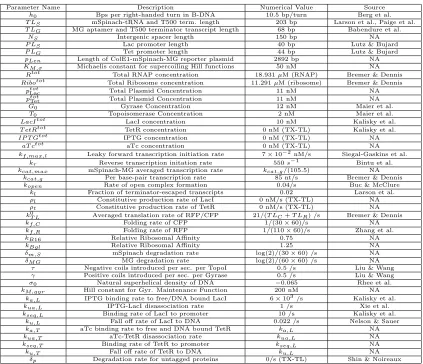
For notation, when modeling the RNA aptamer plasmids, we will use T LX whereX =G or S to denote the length of the MG and mSpinach RNA aptamer transcript respectively,
Convergent Orientation Model
In the convergent orientation, promoters face each other and as both genes express, positive supercoiling propagates from the sense transcription bubble into the intergenic spacing region and negative supercoiling propagates from the anti-sense transcription bubble (see Figure 2.4) to form a kink in between the two genes. Where standard transcription translation models of gene expression assume constant rates of transcription initiation and transcription elongation, we now make explicit the dependencies of these rates on supercoiling state. The chemical reaction network for this orientation is given as:
∅−→ρL LacI ∅−→ρT T etR LacI −δp→ ∅ T etR−δp→ ∅
LacI +IP T G−−−)k−−−a,L*
kua,L
aLacI T etR+aT c−−−)k−−−a,T*
kua,T
aT etR
pLac+LacI
kseq,L
−−−* )−−−
ku,L
pLacC pLac+T etR
kseq,T
−−−* )−−−
ku,T
pT etC
pLacC+IP T G−−→ka,L pLac+aLacI pT etC+aT c−−→ka,T pT et+aT etR R+pLac
kf(σp,S)
−−−−−* )−−−−−
kr
CCS R+pTet
kf(σp,G)
−−−−−* )−−−−− kr CCG CCS kopen
−−−→ECS CCG
kopen
−−−→ECG
ECS
kcat(σt,S)
−−−−−→ mS+R+pLac ECG
kcat(σt,G)
−−−−−→M G+R+pTet
mS −→ ∅δm M G−→ ∅δm
We now derive an expression forσp,S(t) by first considering the effects of transcription on the supercoiling density of the transcript. Consider the collection of plasmids present in the cell or volume of cell-free extract. Consider a small time interval [t, t+] for small > 0. Suppose that ∆LN,t turns are introduced with the production of each mSpinach transcript and thatx∆L