A Note on Dissipative Particle Dynamics (DPD)
Modelling of Simple Fluids
N. Phan-Thien
1, N. Mai-Duy
2,∗and T.Y.N. Nguyen
21
Department of Mechanical Engineering, Faculty of Engineering,
National University of Singapore, 9 Engineering Drive 1, 117575, Singapore,
2
Computational Engineering and Science Research Centre,
School of Mechanical and Electrical Engineering,
University of Southern Queensland, Toowoomba, QLD 4350, Australia.
Submitted to
Computers & Fluids
, June/2018; revised, August/2018
ABSTRACT: In this paper, we show that a Dissipative Particle Dynamics (DPD) model of
a viscous Newtonian fluid may actually produce a linear viscoelastic fluid. We demonstrate
that a single set of DPD particles can be used to model a linear viscoelastic fluid with its
physical parameters, namely the dynamical viscosity and the relaxation time in its memory
kernel, determined from the DPD system at equilibrium. The emphasis of this study is placed
on (i) the estimation of the linear viscoelastic effect from the standard parameter choice;
and (ii) the investigation of the dependence of the DPD transport properties on the length
and time scales, which are introduced from the physical phenomenon under examination.
Transverse-current auto-correlation functions (TCAF) in Fourier space are employed to study
the effects of the length scale, while analytic expressions of the shear stress in a simple small
amplitude oscillatory shear flow are utilised to study the effects of the time scale. A direct
mechanism for imposing the particle diffusion time and fluid viscosity in the hydrodynamic
limit on the DPD system is also proposed.
Keywords: Dissipative particle dynamics (DPD); simple fluids; generalised hydrodynamics;
Newtonian fluids; linear viscoelastic fluids
∗Corresponding author E-mail: [email protected], Telephone 46312748, Fax
1
Introduction
In the dissipative particle dynamics (DPD) (e.g. [1]), the fluid is modelled by a system of
particles undergoing their Newton 2nd law motions
mi¨ri =miv˙i = N
X
j=1,j6=i
(Fij,C +Fij,D+Fij,R), (1)
where N is the number of particles, mi, ri and vi the mass, position vector and velocity
vector of a particle i, respectively, and Fij,C, Fij,D and Fij,R the conservative, dissipative
and random forces, respectively,
Fij,C =aijwCeij, (2)
Fij,D =−γwDeij ·vijeij, (3)
Fij,R=σwRθijeij, wR =√wD, σ=
p
2γkBT , (4)
in which aij, γ and σ are the amplitudes, and wC, wD and wR, the weighting functions,
with eij = rij/rij the unit vector from particle j to particle i (rij = ri −rj, rij = |rij|),
vij =vi−vj the relative velocity vector,kBT the Boltzmann temperature andθij a Gaussian
white noise. It is noted that the characteristics of the random force are defined by the
fluctuation-dissipation theorem. In practice, one usually employs the weighting functions of
the form
wD =
1− r
rc
s
, (5)
wC =
1− r
rc
, (6)
where s is a positive value (s = 2 and s= 1/2: standard and modified values, respectively)
and rc the cut-off radius. The DPD input parameters include s, aij, σ, kBT, m, rc and the
particle density n.
mean - in that sense it is a bottom up approach to solving NS equations. It requires no prior
specification of the constitutive relation for the fluid - the stress-strain rate relation is also
obtained as a part of the solution procedure. It has been shown that, for preceding standard
descriptions of the DPD interaction parameters, the DPD system is actually a Newtonian
fluid on a long-time average [1]. In this work, we explore the generalised hydrodynamic
regime of a DPD fluid that is defined by equations (1)-(6), where typical length scales
include the interaction range rc and the dynamic correlation length l0 defined asl0 =v0t0 in
which v0 and t0 are, respectively, the typical thermal velocity and collision time (or kinetic
time) [1]
v0 = r
kBT
m , (7)
t0 =
1
ω0
, ω0 =
n[wD]γ
3m , [wD] = 4πr
3
c
1 1 +s −
2 2 +s +
1 3 +s
. (8)
The classification of dynamic regimes in DPD can be based on the two length scales, rc and
l0: “particle” regime when rc < l0 and “collective” regime when rc > l0. In this work, the
focus is on a collective regime. Note that if one takes n ={3,4}, rc = 1,m = 1, σ = 3 and
kBT = 1 (commonly used input values), then the above estimates yieldl0 ={0.5305,0.3979}
fors = 2 (standard DPD fluids) andl0 ={0.1161,0.087}fors= 1/2 (modified DPD fluids),
all less than rc = 1.
Let λ be the wavelength (k = 2π/λ is the wave number) of a perturbation in the
hydrody-namics, which can be regarded as the length scale on which the physical phenomena under
examination occur. On the other hand, the correlation length l0 forms a scale on which the
DPD transport coefficients are defined. Ask →0 and the observation time scale is large, the
system behaves like a continuum (the NS equations/hydrodynamics limit). At finite k, the
system can be described by a linearised form of the NS equations, where local deviations of
the macroscopic variables (the number density and momentum density) from their average
values are assumed to be small. As discussed in [2], a standard hydrodynamic regime occurs
on the range l0 < rc < λ while a mesoscopic hydrodynamic regime on l0 < λ < rc. In
addition, there is a smooth transition between these two hydrodynamic regimes, which
mesoscopic hydrodynamics and thus can be probed by considering linearised NS equations
induced by perturbations. The transport coefficients are now functions ofk, and their values
atk = 0 can be estimated through extrapolation. The regime of generalised hydrodynamics
is particularly relevant in the simulation of complex fluids such as colloidal suspensions. In
practice, an effective way to predict the DPD transport coefficients over a wide range of k
is to employ the transverse-current autocorrelation functions (TCAF) in Fourier space [1,2].
Letωbe a characteristic frequency (T = 1/ωis a characteristic time). Assume that our
(non-Newtonian) fluid in question has a characteristic time scale λt. If T ≫ λt, the observation
time scale is large and the material responds like a fluid; otherwise, one may have a solid-like
response. For a linear viscoelastic fluid, the stress at the current time is dependent not only
on the current strain rate but also the past strain rate; in 1D,
σ(t) =
Z γ(t)
γ(−∞)
G(t−t′)dγ(t′) =
Z t
−∞
G(t−t′) ˙γdt′, (9)
where ˙γ is the shear rate (γ is the shear strain) and G is a decreasing function of time, the
relaxation modulus. In the case of a simple shear flow, the stress analysis can be done in an
exact manner. One can utilise its analytic solution to examine the effects of the frequency
on the DPD transport properties.
One particular concern here is how to make a direct link between the fluid physical
parame-ters and the (input) DPD parameparame-ters. We attempt to derive, by means of kinetic theory [1]
and by using generalised forms of the dissipative weighting function, the relation between
the particle diffusion time and the viscosity of the fluid (at the hydrodynamic limit), and the
DPD parameters. The resultant analytic expressions allow one to specify these two physical
parameters as the input parameters.
The remainder of the paper is organised as follows. In Sections 2 and 3, brief reviews of
TCAF and analytic expressions of the shear stress in a simple small amplitude oscillatory
shear flow are respectively given. In Section 4, we investigate the dependence of the DPD
the hydrodynamic limit on the DPD system, and quantify the linear viscoelastic effect from
the standard parameter choice. Numerical experiments are presented in Section 6. Section
7 provides some concluding remarks.
2
Time current autocorrelation functions
The current density is given by
j(r, t) = N
X
j=1
vjδ(r−rj(t)), (10)
where N is the number of particles and subscripts j denote particle number. Since there
is no overall motion, hj(r, t)i = 0 (< · > denoted the average operation). Note that j(r, t)
is the macroscopic (hydrodynamic) variable and v the microscopic variable. The Fourier
transformation of (10) is
J(k, t) = Z
drexp(ik·r)j(r, t) = X j
vj(t) exp(ik·rj(t)). (11)
The spatial correlation function is defined as [3,4]
Cαβ(k, t) = k2
NhJα(−k,0)Jβ(k, t)i, (12)
where α and β denote Cartesian indices.
For an isotropic fluid, the correlation function (12) depends only on the magnitude of kand
one can decompose it into the longitudinal (k) and transverse (⊥) components relative to k
as
Cαβ(k, t) = kαkβ
k2 Ck(k, t) +
δαβ − kαkβ
k2
where δαβ is the Kronecker delta, and
C⊥(k, t) =
k2
NhJ⊥(−k,0)J⊥(k, t)i, (14) Ck(k, t) =
k2
NhJk(−k,0)Jk(k, t)i. (15)
3
Analytic solutions for simple shear flows of linear
viscoelastic fluids
Here we recall some terminologies by considering a small amplitude oscillatory shear flow of
a viscoelastic fluid. The flow is generated between two parallel plates separated by a distance
h. The bottom plate is fixed while the top plate is sinusoidally displaced by δsin(ωt) with
δ ≪h being the small amplitude displacement in the x direction. The top plate velocity is
U(t) =δωcosωt. (16)
The shear rate and the shear strain experienced by the fluid are, respectively,
˙
γ(t) = δ
hωcosωt= ˙γ0cosωt, (17)
γ(t) = δ
hsinωt=γ0sinωt, γ0 = δ
h ≪1, γ˙0 =ωγ0. (18)
For a linear viscoelastic fluid at any arbitrary amplitude δ, or for any viscoelastic fluid at a
small enough amplitude δ, the only non-zero component of the stress is the shear stress
τxy =
Z t
−∞
G(t−t′)∂ux(y, t
′)
∂y dt
′ =
Z t
−∞
G(t−t′) ˙γ0cosωt′dt′,
=
Z ∞
0
˙
γ0G(s) cosω(t−s)ds,
=
Z ∞
0
˙
γ0G(s)[cosωtcosωs+ sinωtsinωs]ds,
=G′(ω)γ0sinωt+η′(ω) ˙γ0cosωt,
where G′(ω) is the storage modulus and η′(ω) is dynamic viscosity; they are related to the
relaxation modulus G(t) by
G′(ω) =
Z ∞
0
ωG(s) sin(ωs)ds, (20)
η′(ω) =
Z ∞
0
G(s) cos(ωs)ds. (21)
By rewriting (19) as
τxy =G′(ω)γ0sinωt+η′(ω) ˙γ0sin(
π
2 +ωt), (22)
the shear stress is shown to have the same phase as the applied strain for the elastic part,
but π/2) out of phase from the applied strain for the viscous part. All of the foregoing are
familiar results in continuum mechanics (e.g. [5]).
4
Generalised DPD transport coefficients
The conservation laws for the mass density ρ(r, t) and momentum density mu(r, t) in the
continuum description read
∂ρ(r, t)
∂t +∇ ·(ρ(r, t)u(r, t)) = 0, (23) ∂
∂tρ(r, t)u(r, t) +u(r, t)· ∇(ρ(r, t)u(r, t)) +∇ ·σ(r, t) =0, (24)
where σ is a stress tensor.
4.1
Newtonian fluids
In this case, the stress tensor is given by
σαβ(r, t) =δαβp(r, t)−η
∂uα(r, t) ∂rβ
+∂uβ(r, t)
∂rα
−δαβ∇ ·u(r, t)
ηB− 2 3η
where p is the local pressure, η the shear viscosity and ηB the bulk viscosity.
Without applied external forces, one has hu(r, t)i= 0. Assume that local deviations of the
hydrodynamic variables from their average values are small, the variables in (23), (24) and
(25) can be expressed as [3,4]
n(r, t) = n+δn(r, t)≈n, (26)
u(r, t) = hu(r, t)i+δu(r, t) =δu(r, t), (27)
ρu(r, t) = m(n+δn(r, t)) (hu(r, t)i+δu(r, t))≈mnδu(r, t) =mnu(r, t) =ρj(r, t), (28)
where high-order terms have been ignored and n is the equilibrium number density of the
system. At equilibrium, the variables < δn(r, t)> and < δu(r, t)> disappear.
Making use of (25) and (26)-(28), the conservation equations (23) and (24) reduce to the
following linear form of the Navier-Stokes equation
∂δρ(r, t)
∂t +∇ ·ρj(r, t) = 0, (29) ∂j(r, t)
∂t +
1
ρ∇p(r, t)− η ρ∇
2j(r, t)
− 1ρ
ηB+ 1 3η
∇∇ ·j(r, t) = 0. (30)
In Fourier space, they become
∂δρ(k, t)
∂t +ik·ρJ(k, t) = 0, (31) ∂J(k, t)
∂t +ic
2ρ(k, t)k+ηkk2
ρ J(k, t) +
1
ρ
4ηk
3 +ηB
kk·J(k, t) =0, (32)
where c is the isothermal sound speed, and the viscosity becomes a function of the wave
number, denoted by ηk.
For the shear viscosity, one only needs to consider the transverse component of the current
density. Equation (32) reduces to
∂J⊥(k, t)
∂t +
ηkk2
Note that equations (29)-(32) and (33) are valid for slow variations of the hydrodynamic
dynamic variables only.
Multiplying both sides of (33) with J⊥(−k, t) and then averaging,
∂
∂tC⊥(k, t) + ηkk2
ρ C⊥(k, t) = 0, (34)
whose solution is
C⊥(k, t)
C⊥(k,0)
= exp
−ηkk
2t
ρ
, (35)
from which the viscosity in the Fourier-transformed space can be estimated from equilibrium
correlation function data. With this approximation, the observation time scale is assumed
to be large. The stress approximations, which involve an additional characteristic time scale,
are discussed in next section.
4.2
Linear viscoelastic fluids
The stress tensor for a linear viscoelastic fluid takes the form
σαβ(r, t) =
Z t
−∞
dt′G(t−t′)
∂uα(r, t′) ∂rβ
+ ∂uβ(r, t
′)
∂rα
, (36)
where G(t) is the relaxation modulus, a decreasing function of time. The stress at the
current time is thus dependent on both the current and past strain rates. It can be seen
that, (i) the contribution of a strain rate at the distant past is weighted by the memory
relaxation modulus and is less than that of a more recent strain rate (i.e. the concept of
fading memory); and (ii) when the memory function is chosen as a Dirac delta function (i.e.
G(t−t′) =ηδ(t−t′)), a Newtonian fluid is recovered.
Here, we consider a simple relaxation modulus (the Maxwell relaxation modulus)
G(t−t′) = η
τ exp
−t−t
′
τ
, (37)
C⊥(k, t) data is now described as a function of not only the viscosity η but also the decay
constant of the memory function, τ. From continuum mechanics, a plane wave given by
u= (u0cosky,0,0) will decay according to
∂ux(y, t)
∂t =
η τ ρ
Z t
0
dt′exp
−t−t
′
τ
∂2u
x(y, t′)
∂y2 , (38)
which can be derived from the NS equations. An exact solution to (38) is
ux(y, t) =u0exp(−
t
2τ)
coshΩt 2τ +
1 Ωsinh
Ωt
2τ
cosky, (39)
where
Ω = s
1−4τ ηk
2
ρ . (40)
On the other hand, from a DPD point of view and without an initial plane wave applied,
thermal fluctuations still occur in a system at a given temperature. Since the response of
the system to internal fluctuations is the same as to external perturbations, one can link the
TCAF to (39), resulting in [6]
C⊥(k, t)
C⊥(k,0)
= exp(− t 2τk
)
coshΩkt 2τk
+ 1 Ωk
sinhΩkt 2τk
, (41)
whereτk =τ(k) and Ωkis defined as in (40) withτ =τkandη=ηk. This model involves two
fitting parameters, namely the decay time τk and the dynamical viscosity ηk. Alternatively,
as discussed in [7], the two fitting parameters can be chosen as the decay times of the memory
function (τk) and TCAF (τk∗), and the fitting model is also shown to be in the form of (41) with Ωk being defined as Ω2k = (1/2τk)2 −(1/τkτk∗)2 and the relation between the viscosity and the decay time of TCAF as ηk =ρ/k2τk∗.
For each value of k, we fit the model (41) to the equilibrium correlation function data. To
examine the dependence of the DPD transport properties on the frequency ω, we now utilise
analytical expressions of the shear stress in a simple oscillatory flow with a small applied
in the strain rate, η′(ω), the dynamic viscosity are computed as
G′(ω) =
Z ∞
0
ωG(s) sin(ωs)ds=
Z ∞
0
ωηk τk
exp
−τs k
sin(ωs)ds= ηkω
2τ
k ω2τ2
k + 1
, (42)
η′(ω) =
Z ∞
0
G(s) cos(ωs)ds=
Z ∞ 0 ηk τk exp − s τk
cos(ωs)ds= ηk
τ2
kω2+ 1
, (43)
where s = t −t′. With the storage modulus and shear viscosity being functions of the
frequency, one now has an effective mechanism for investigating the response of the DPD
system: purely viscous (ω → 0), purely elastic (ω → ∞) and viscoelastic (intermediate
values of ω).
It can be seen from (42) and (43) that
G′(ω)→0 and η′(ω)→ηk asω →0, (44)
G′(ω)→ ηk
τk
and η′(ω)→0 as ω→ ∞. (45)
5
Imposition of fluid properties
One main drawback of the classical DPD formulation is that there is no direct link between
the DPD input parameters and the macroscopic properties of the fluid. Here, we show that
it is possible to directly impose the particle diffusion time and the viscosity of the fluid in
the hydrodynamic limit on the DPD system with the dissipative weighting function of a
generalised form, i.e. wD = (1−r/rc)s.
The viscosity of the fluid,η, can be specified as an input parameter by enforcing the following
constraint [8,9]
η= γn
2[R2w
D]R 30 =
γn2
30
96πr5
c
(s+ 1)(s+ 2)(s+ 3)(s+ 4)(s+ 5), (46)
equation can be solved for the DPD parameter γ,
γ = 5η(s+ 1)(s+ 2)(s+ 3)(s+ 4)(s+ 5) 16πn2r5
c
, (47)
which is equation (44) in [9].
The particle diffusion time can be defined as the time taken by the particle to diffuse a
distance equal to its radius (the time to restore the equilibrium configuration)
τP = R2
D, (48)
where R is the radius and D the self-diffusion coefficient of a particle.
Consider a tagged particle in a sea of other particles. Its radius can be estimated by the
Stokes-Einstein relation
R = kBT
6πDη. (49)
Substitution of (49) into (48) yields
τP =
(kBT)2
36π2D3η2. (50)
By means of kinetic theory, an analytic expression for the diffusivity can be derived as
D= 3mkBT
γmn[wD]R
= 3mkBT
γmn
(s+ 1)(s+ 2)(s+ 3) 8πr3
c
, (51)
(i.e. equation (36) in [9]) and expression (50) becomes
τP =
(kBT)2 36π2η2
8πr3
cγn
3kBT(s+ 1)(s+ 2)(s+ 3)
3
. (52)
Substitution of (47) into (52) yields the following quadratic equation
s2+ 9s+ 20−E = 0, E = 6kBT nr
2
c 5η
3
s
36π2η2τ
P kBT2
which always has two real solutions and we are interested in the positive one
s = −9 + √
1 + 4E
2 , E >20. (54)
The requirement E >20 leads to
τP >
31250 243π2
η kBT n3r6c
for a given η, (55)
η < 243π
2
31250kBT n
3r6
cτP for a given τP. (56)
For given values of τP and η, satisfying the conditions (55) and (56), values of s and γ can
then be computed from (54) and (47), respectively. According to the kinetic theory, the two
physical parameters τP and η will take the specified values for the values ofrc, kBT, n and
m employed.
The DPD without energy conservation describes an isothermal fluid that can be characterised
through the mass density ρ = mn, viscosity η and Schmidt number Sc = η/ρD. It is
convenient to rewrite the particle diffusion time (50) in the form
τP = 1 36π2
ρ3S3
c(kBT)2
η5 . (57)
In investigating the effects of τP, we keep values of ρ, η and Sc constant. In DPD, kBT
is simply a specific kinetic energy; by changing kBT, one can vary the input τP. Here, we
are interested the relation between the particle diffusion time and the relaxation time of the
memory kernel (37) - it will be studied numerically in next section.
6
Numerical results
From the DPD equilibrium state space (time-varying positions and velocities of particles),
the viscosity can be extracted for different wave numbers. For each wave number, several
sets of values of C⊥(k, t)/C⊥(k,0) can be calculated from the DPD simulation data; these
model (35) and (41) for Newtonian and viscoelastic fluids, respectively.
Consider a DPD system defined on a domain of 15×15×15 with periodic boundary
con-ditions, and (aij = 3.5328, n = 4, rc = 1.5, kBT = 1, m = 1, ∆t = 0.001). Its physical
input parameters (fluid properties) chosen to be imposed are η = 30 and Sc = 500, which
correspond to the original input parameters: γ = 6.9710 and s = 0.4244 [9]. It can be seen
that the value ofs used here is close to 0.5 (the modified DPD fluid), and the corresponding
dynamical correlation length (l0 = 0.0149) is less than rc = 1.5. We apply the modified
velocity-Verlet algorithm [10] to solve the DPD equations of motion. Here, the wave number
is chosen in the range of 0.4189 to 7.1209 (i.e. 17 values) and their associated results are
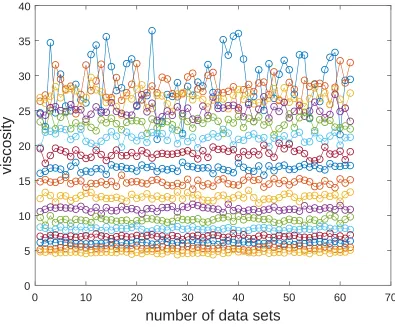
obtained from a single run. A run of 5×10⁵, 1.5×10⁶, 2×10⁶ time steps produces,
respec-tively, 15, 46 and 62 data sets. For each data set, TCAFs are obtained by averaging 500
overlapping samples in which measurements are made every 5 time steps and there are 1025
measurements per sample. It is observed that using a larger number of data sets make the
solution behaviour with respect to the wave number more stable. In the following sections,
the obtained results from 62 data sets are presented. Both Newtonian and viscoelastic fitting
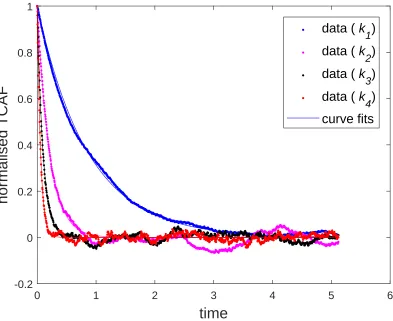
models are applied to the same TCAF data (i.e. C⊥(k, t)/C⊥(k,0)). Their resultant curve
fits are observed to be graphically the same; only those for the Newtonian case are displayed.
For a time step, the elapsed CPU time of computing TCAF is insignificant compared to that
of solving the DPD equations of motion.
6.1
Newtonian fluids
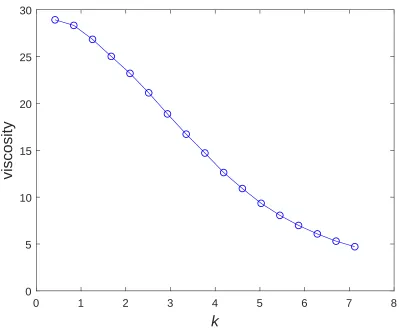
Some typical variations of TCAF are displayed in Figures 1. Since the finite size, defined
through wavelength, is taken into account, the Newtonian viscosity estimated from TCAF
is a function of the wave number. The obtained results are shown in Figures 2 and 3. One
has a wave number-dependent viscosity with the observation time scale being assumed to
be large. To obtain the viscosity at k = 0 (a continuum), some extrapolation is needed. As
whereη0 anda are two fitting parameters. Assuming that values ofk used for the fitting are
sufficiently small, η0 can be regarded as the viscosity at the hydrodynamic limit. Using the
first 4 smallest values ofk(i.e. 0.4189, 0.8378, 1.2566 and 1.6755), this leads toη0 = 29.0214.
On the other hand, from the kinetic theory [1], the viscosity is estimated as η = 30. The
advantage of the TCAF approach is that it can provide information about the size effect
on the transport properties. In addition, one can estimate the transport coefficients at the
hydrodynamic limit through extrapolation.
6.2
Linear viscoelastic fluids
6.2.1 Wavelength- and frequency-dependent transport coefficients
The stress approximations involve two parameters, the viscosity and relaxation time, which
are wavelength- and frequency-dependent.
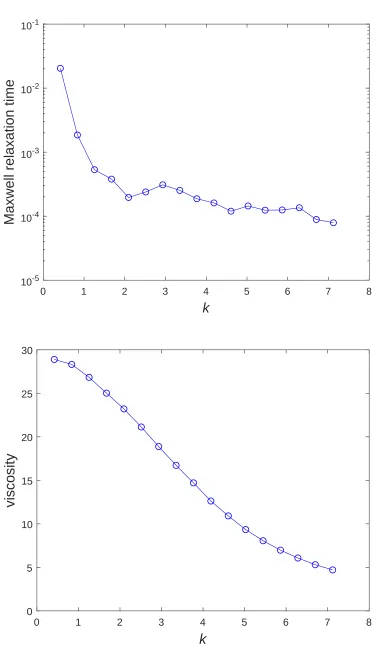
Figure 4 shows plots of the viscosity and the decay constant of the memory function against
the wave numberk. Whenk decreases, the decay constant τk is seen to increase quickly and
is expected to reach its maximum in the hydrodynamic limit. For the shear viscosity ηk, the
change is observed to be slow as k→0. The obtained values of ηk here are similar to those
in the Newtonian case.
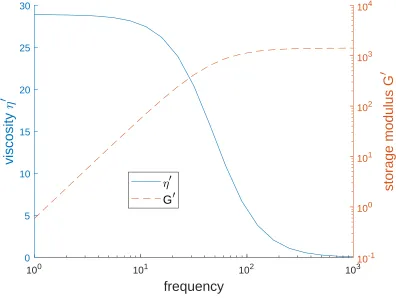
Figure 5 displays the storage modulus and viscosity against the frequency ω, according to
(42) and (43), for the first (smallest) value of k (i.e. k = k1 = 0.4189). At small values of
the frequency (i.e. large observation time scale), the system responses like a fluid and at
large values of the frequency, one has a solid-like response. The storage modulus provides a
convenient means of quantifying the level of elasticity of the fluid.
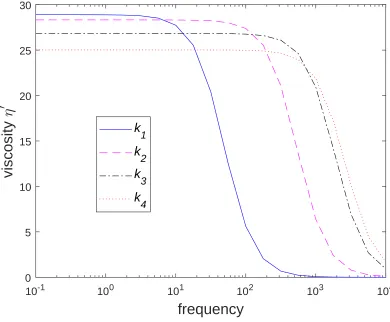
Figure 6 displays the shear viscosity against the frequency ω for the first four values of k
(i.e. 0.4189, 0.8378, 1.2566 and 1.6755). It can be seen that η′ → η
k as ω →0 and η′ → 0 as ω→ ∞.
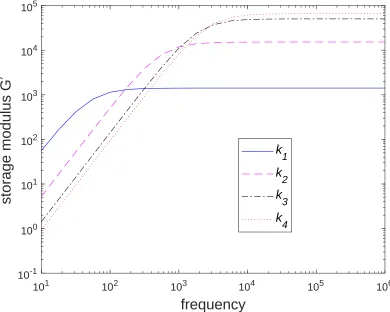
It can be seen that G′ →0 as ω→0 and G′ →η
k/τk as ω→ ∞.
6.2.2 Linear viscoelastic effect
As shown above, a DPD model using a single set of particles can result in a linear viscoelastic
fluid for k≥0. A concern here is how to quantify the linear viscoelastic effect. Some typical
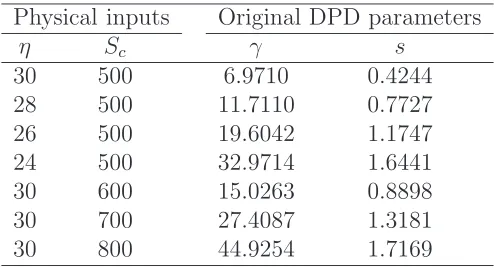
scenarios are studied below and some comments are given at the end of this section. Table
1 displays values of the original DPD parameters γ and s that correspond to the input
viscosities and Schmidt numbers imposed here.
Same fluid at different imposed kBT
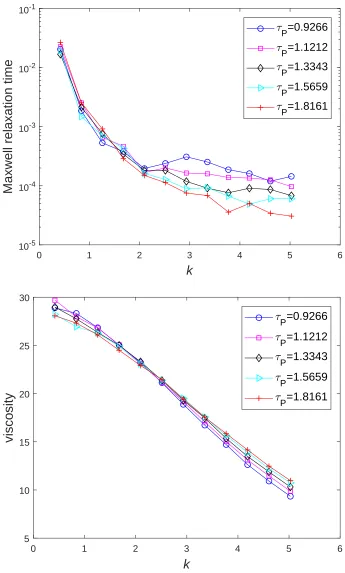
Five values of kBT, (1, 1.1, 1.2, 1.3, 1.4), are employed in conjunction with (ρ= 4, Sc = 500
and η= 30). They lead to τP = (0.93,1.12,1.33,1.57,1.82), respectively, according to (57).
The obtained results concerning the effects of the particle diffusion time τP on the relaxation
time of the memory kernel, τk, over a wide range of k are shown in Figure 8.
Fluids of different viscosities
Four values of η, (30, 28, 26, 24), are employed in conjunction with (ρ = 4, Sc = 500 and
kBT = 1). Figure 9 shows the effects of the imposed viscosity η on the relaxation time τk
over a wide range of k.
Fluids of different Schmidt numbers
Four values of Sc, (500, 600, 700, 800), are employed in conjunction with (ρ = 4, η = 30
and kBT = 1). Figure 10 shows the effects of the imposed limit Schmidt number Sc on the
relaxation time τk over a wide range of k.
From the three figures, it can be seen that the relaxation time, corresponding to different
values of τP, η or Sc, apparently converges as k is reduced, and one would expect that an
the particle diffusion time, viscosity or Schmidt number. An increase in τP, a decrease inη
or an increase in Sc results in a decrease in τk. Differences of τk at small k are thus much
smaller than those at large k. It can also been seen that a change in Sc orτP can affect the
estimated viscosity at the hydrodynamic limit.
7
Concluding remarks
In this work, DPD in its generalised hydrodynamic regime is considered. For a
Newto-nian fluid, the stresses are obtained through a large-time averaging process; they involve
one fitting parameter, namely the viscosity, which is wavelength-dependent. For a linear
viscoelastic fluids, the stresses involve two fitting parameters, namely the viscosity and the
relaxation time, which are wavelength- and frequency-dependent. The wavelength
depen-dency of the transport coefficients is obtained numerically while their frequency dependepen-dency
can be computed analytically, which allow the effects of the length and time scales introduced
by physical phenomena to be determined. The DPD input parameters can be determined
from the viscosity, mass density, Schmidt number and diffusion time. Numerical experiments
indicate that (i) a fluid modelled from a single set of particles may not be Newtonian, but
linear viscoelastic, and any time dependent effects must be carefully looked at, and (ii) the
relaxation time measuring the linear viscoelastic effect can be adjusted by means of the input
diffusion time, viscosity or Schmidt number at finite wave numbers.
References
1. Marsh C. Theoretical Aspects of Dissipative Particle Dynamics (D. Phil. Thesis).
University of Oxford; 1998.
2. Ripoll M, Ernst MH, Espa˜nol P. Large scale and mesoscopic hydrodynamics for
dissi-pative particle dynamics. J Chem Phys 2001;115(15):7271-7284.
4. Hansen JP, McDonald IR. Theory of Simple Liquids. 3rd ed. London: Academic Press;
2006.
5. Phan-Thien N, Mai-Duy N. Understanding Viscoelasticity: An Introduction to
Rheol-ogy. 3rd ed. Cham (Switzerland): Springer International Publishing; 2017.
6. Hess B. Determining the shear viscosity of model liquids from molecular dynamics
simulations. J Chem Phys 2002;116(1):209-217.
7. Vogelsang R, Hoheisel C. Computation and analysis of the transverse current
autocor-relation function, Ct(k,t), for small wave vectors: A molecular-dynamics study for a
Lennard-Jones fluid. Phys Rev A 1987;35(4):1786-1794.
8. Mai-Duy N, Phan-Thien N, Tran-Cong T. An improved dissipative particle dynamics
scheme. Appl Math Model 2017;46:602-617.
9. Mai-Duy N, Phan-Thien N, Tran-Cong T. Imposition of physical parameters in
dissi-pative particle dynamics. Comput Phys Comm 2017;221:290-298.
10. Groot RD, Warren PB, Dissipative particle dynamics: Bridging the gap between
atom-istic and mesoscopic simulation, J Chem Phys 1997;107:4423-4435.
11. Palmer BJ. Transverse-current autocorrelation-function calculations of the shear
Table 1: Values of the input viscosity and Schmidt number, and the corresponding original DPD parameters for (m = 1, n = 4, kBT = 1, rc = 1.5).
Physical inputs Original DPD parameters
η Sc γ s
0 1 2 3 4 5 6
time
-0.2 0 0.2 0.4 0.6 0.8 1
normalised TCAF
data ( k
1
)
data ( k
2
)
data ( k
3
)
data ( k
4
)
[image:20.612.116.509.28.349.2]curve fits
0 10 20 30 40 50 60 70
number of data sets
0 5 10 15 20 25 30 35 40
[image:21.612.113.508.28.355.2]viscosity
0 1 2 3 4 5 6 7 8
k
0 5 10 15 20 25 30
[image:22.612.112.511.24.354.2]viscosity
0 1 2 3 4 5 6 7 8
k
10-5
10-4
10-3
10-2
10-1
Maxwell relaxation time
0 1 2 3 4 5 6 7 8
k
0 5 10 15 20 25 30
[image:23.612.123.500.23.674.2]viscosity
100 101 102 103
frequency
0 5 10 15 20 25 30
viscosity
10-1 100 101 102 103 104
storage modulus G
[image:24.612.113.509.30.328.2]G
Figure 5: Viscoelastic fluids: Storage modulus and viscosity as functions of the frequency for the smallest wave number (i.e. k =k1 = 0.4189). The system responses like a fluid at small
10-1 100 101 102 103 104
frequency
0 5 10 15 20 25 30
viscosity
k
1
k
2
k
3
k
[image:25.612.115.505.29.351.2]4
Figure 6: Viscoelastic fluids: Viscosity as a function of the frequency for the first four values of k (i.e. 0.4189, 0.8378, 1.2566 and 1.6755). It can be seen that η′ → η
101 102 103 104 105 106
frequency
10-1
100
101
102
103
104
105
storage modulus G
k
1
k
2
k
3
k
[image:26.612.116.506.30.342.2]4
Figure 7: Viscoelastic fluids: Storage modulus as a function of the frequency for the first four values of k (i.e. 0.4189, 0.8378, 1.2566 and 1.6755). It can be seen that G′ → 0
as ω → 0 and G′ → η
0 1 2 3 4 5 6
k
10-5 10-4 10-3 10-2 10-1
Maxwell relaxation time
P=0.9266
P=1.1212
P=1.3343
P=1.5659
P=1.8161
0 1 2 3 4 5 6
k
5 10 15 20 25 30
viscosity
P=0.9266
P=1.1212
P=1.3343
P=1.5659
[image:27.612.138.483.61.634.2]P=1.8161
0 1 2 3 4 5 6
k
10-6 10-5 10-4 10-3 10-2 10-1
Maxwell relaxation time
=30 =28 =26 =24
0 1 2 3 4 5 6
k
5 10 15 20 25 30
viscosity
[image:28.612.139.483.69.642.2]=30 =28 =26 =24
0 1 2 3 4 5 6
k
10-6 10-5 10-4 10-3 10-2 10-1
Maxwell relaxation time
S
c=500
S
c=600
S
c=700
S
c=800
0 1 2 3 4 5 6
k
5 10 15 20 25 30
viscosity
S
c=500
S
c=600
S
c=700
S
[image:29.612.139.483.62.633.2]c=800