1
CHAPTER 1: Communication in context: Developing a Professional Identity
Author: Nicholas Ralph
Learning objectives
1. Establish and identify foundations for effective, professional communication; 2. Develop insights into the role of self-awareness and its relationship to developing
a professional identity;
3. Recognise and reflect on the professional requirements inherent to nursing; 4. Identify pathways to professional practice and professional development; 5. Critically explore the change and challenges present in the evolving health care
contexts.
1. Introduction
Communication refers to the act of imparting or exchanging information by speaking, writing, or using some other medium (Arnold & Boggs, 2013). Because it is a routine part of life, it is easy for the importance of effective communication to be forgotten. However, the benefits of effective communication have been demonstrated in every aspect of modern life, such as enhanced safety in aviation (Leonard, Graham & Bonacum, 2004), improved business management practices (Kernbach, Eppler & Bresciani, 2014), and instant, accurate information on developing world events (Veil, Buehner & Palenchar, 2011).
In nursing and healthcare, effective communication is necessary for delivering safe nursing care as it reduces the risk of harm to the patient, enhances clinical outcomes, and encourages reflective practice among clinicians (Haynes et al. 2011; Lin et al. 2013). Poor communication is known to affect the quality and safety of nursing care delivery (Hughes & Mitchell, 2008; Mills, Neily & Dunn, 2008). Throughout this textbook, you will be guided through concepts that are integral to effective
2
professional identity is a useful foundation for effectively communicating throughout your nursing career. Furthermore, scoping the unique characteristics you bring to nursing will help you understand the similarly unique perspectives of others you may study or work with, or care for. You will soon realise that developing your
professional identity and becoming self-aware is necessary to function ethically and professionally in the nursing role. Before long, you will likely face situations that may encroach on your personal values and demand an ethical and professional response, however difficult that may be.
Navigating the complexities of the healthcare environment is always challenging, whether communicating with patients to assess the extent of their condition; or communicating with a grieving family whose loved one is dying. Developing your professional identity through improved self-awareness will enhance your ability to: communicate ethically and professionally;
articulate your motivations in nursing; employ strategies for reflective practice; and
heighten your understanding of the nursing profession.
Understanding the nursing profession will also be useful for establishing insight into how it communicates its defining features, both as a means of identifying its
arrangement and hierarchies, and as a way of highlighting values inherent to the profession of nursing. Throughout the chapter, we will explore concepts and contexts that are relevant to developing your professional identity both as a nursing student and a Registered Nurse.
2. Glossary
Accreditation: A process in which an assessing entity (for example, a professional body) evaluates the credibility, reliability and validity of a program (such as an educational program) presented by another party for the purposes of approving its fitness for purpose.
3
Emotional intelligence: The emotional and social characteristics, skills and enablers that determine how we perceive and express ourselves, understand and relate to others, and cope with daily living.
Professional identity: How an individual perceives and employs the characteristics that define their professional self.
3. Developing a professional identity
In this section, we address concepts relevant to developing a professional identity as a Registered Nurse. The importance of self-awareness is explored as a foundation for effective reflective practice. For each of these domains, the reader is reminded of their importance in establishing effective strategies for communicating as a Registered Nurse.
Self-Awareness
The concept of self-awareness is strongly linked to safe and effective nursing practice, largely because it is strongly associated with effective communication skills. Studies have linked heightened self-awareness in nurses to enhanced cultural competence (Caffrey et al. 2005); effective clinical communication strategies (Sheldon, Barrett & Ellington, 2006); student performance (Halfer & Graf, 2006); reflective practice (Gustafsson, Asp & Fagerberg, 2007); and effective leadership strategies (Horton-Deutsch & Sherwood, 2008). As a means of developing your professional identity, we will address your motivations for becoming a nurse in concert with your defining characteristics as an individual.
Motivations for becoming a nurse
4
part of a metropolitan trauma centre. Alternatively, you may be intrigued by the rigours and demands of rural and remote healthcare. Some students enter nursing with a view to caring for people in developing countries under the sponsorship of aid agencies or the military. However, not all students will enter nursing with such clear goals or ambitions beyond a simple desire to care for people in need.
By understanding your motivations for pursuing a career in nursing, you will begin to develop self-awareness. For instance, a 2008 study on pre-registration student nurses found those with stronger self-efficacy (the strength of one’s own awareness and ability to complete tasks and realise goals) were less likely to withdraw from their studies in nursing and more likely to perform at higher levels in their studies (McLaughlin, Moutray & Muldoon, 2008). Furthermore, emotional intelligence – inclusive of self-awareness and motivation – was identified as having a potential impact on student learning, ethical decision-making, critical thinking and the synthesis and integration of evidence in nursing practice (Bulmer-Smith, Profetto-McGrath & Cummings, 2009). It is therefore very important to identify:
the factors that resulted in your current enrolment in a program of nursing education;
the personal characteristics that will inform your progression in scholarly and clinical environments; and
your awareness of how the context which characterises your present
circumstances will impact on your development as a safe and competent nurse.
Case study
You are your own case study for this exercise. Reflect honestly on what motivated you to become a nursing student, identifying at least 3 reasons.
Thought Bubble: Communicating your self-awareness
5
Not everyone will enter nursing because it ‘called them’. Not everyone will have a story of a sick relative or friend whose illness ignited a caring flame in them that cannot be doused. Not everyone will see the opportunities that a career in nursing can offer individuals. However, everyone – at some point in their lives – will need a nurse.
Stop and think: Does this describe you? Historically, nursing was seen as a calling that arguably implied those who became nurses were automatically predisposed with qualities that would elicit consummate professionalism and profound compassion.
Activity
1. What characteristics do you have that will enhance the benefit you derive from your learning experience?
2. What traits do you have that will make you a great nurse?
As you develop an awareness of yourself through carefully answering these questions, reflect on how your personal attributes will frame your learning experience, colour your nursing practice and shape the progression of your career in healthcare.
Becoming aware of your ‘self’
Each individual possesses unique characteristics that impact positively – and
sometimes negatively – on how they can contribute to nursing. For instance, you may have entered nursing with a deep desire to care for people, yet struggle with blood or needle phobias. You may be attracted to the high-pressure environments of the
intensive care unit, the operating theatre or the emergency room, or you may be drawn to areas where you can build a unique rapport over time with patients and their
6
Having a strong sense of self-awareness is integral to developing ideas about your inherent strengths and weaknesses as a professional, as well as where and how you can best contribute as a Registered Nurse in the healthcare sector. A growing body of research around emotional intelligence in nursing has highlighted the need for nurses to possess emotional intelligence. Emotional intelligence is defined as the emotional and social characteristics, skills and enablers that determine how we perceive and express ourselves, understand others, relate to them, and cope with daily living (Bar-On, 2005). Emotional intelligence is recognised as having an impact on the quality of student learning, ethical decision-making, critical thinking, evidence and knowledge use in practice, and patient outcomes (Bulmer Smith, Profetto-McGrath & Cummings, 2009). Furthermore, emotional intelligence can affect individuals’ work outputs, general well-being, and communication strategies (Salovey & Grewal, 2005). It impacts on a person’s effectiveness in teams, their ability to recognise and respond appropriately to the feelings of self and others, and their ability to encourage self and others (Cadman & Brewer, 2001).
An important early work by Goleman (2001) articulates the attributes or elements of emotional intelligence as follows:
self-awareness (emotional awareness, esteem, insight); self-management (integrity, impulse control, adaptability);
social awareness (developing others, managing conflict, bonding); relationship management (leadership, followership, work).
7
of the patient and to the changing contexts of care. Social awareness in the nurse will be demonstrated by an ability to understand the emotional and social stressors caused by these sudden changes, and to work with the patient and their loved ones to achieve the best available outcome. Finally, relationship management pertains to the nurse’s ability to work through the difficulties of context – such as conflict, upheaval and change – and extract the best from people to instil confidence, trust and acceptance in others. These attributes will facilitate the development of your professional identity and stimulate your learning of emotional intelligence.
Having addressed the individual elements of how you define yourself and your
professional identity, it is now appropriate to explore the broader context in which you will work, as a means of developing professional awareness.
4. Developing Professional Awareness
Developing a strong sense of self-awareness is of equal importance to understanding the nursing profession and how it ‘works’. Modern nursing is situated in rapidly changing higher education and healthcare sectors with established systems designed to define and regulate the nursing profession. While the systematisation of nursing has existed in variety of forms almost as long as the profession itself, in more recent times the roles, responsibilities and scopes of practice inherent to clinicians in the healthcare sector have been intrinsically associated with regulations, policies, practices and evidence. These elements within the system are designed to set forth the expected level of safe and effective practice which the system expects of nursing graduates.
8
your professional role and responsibilities, both as a nursing student and Registered Nurse, will further enable you to understand not only what the system expects of you, but what you should expect of yourself. Exploring both these perspectives during your progression towards nursing practice will help you to form an appropriate response to the requirements of registered nursing practice. In the following section of this chapter we will explore the roles of the nursing student and the Registered Nurse.
The roles of the nursing student and the healthcare professional
Your level of motivation will also play a significant role in how you receive and respond to the communicated expectations articulated by the system. Whether private or public, metropolitan, or rural and remote, healthcare systems are fallible. However, the nursing profession has established frameworks to promote the safety and efficacy of nurses through the use of legislation, professional requirements, codes,
accreditation and competency frameworks (Birks, Chapman & Ralph, 2014).
The structural organisation of both systems (higher education and healthcare) communicate clearly to nursing students and nurses alike that a high standard of professionalism is expected of them. Since the inception of the Australian Health Practitioners Regulation Agency (AHPRA), all students enrolled in an approved program of study in nursing or those who are undertaking clinical training in nursing are mandatorily registered with the Nursing and Midwifery Board of Australia — the NMBA (NMBA, 2014a). For the same reasons health practitioners are registered, nursing students are also listed with the NMBA to protect public safety and allow for appropriate steps to be taken when a serious contravention of the conditions of a student’s registration (such as evidence of an impairment or serious misconduct) has occurred (AHPRA, 2014).
For some of you, such stringent requirements may come as a surprise. However, the intent of this chapter is to highlight the system-wide communications that are geared towards the high standards set forth for nursing students and nurses who operate within the higher education and healthcare sectors.
9
The systems of higher education and healthcare are multifaceted and extraordinarily complex. It is important to remember that the intent of these highly structured systems is to facilitate approaches to education and healthcare delivery that primarily benefit the individual in need of care. Such an approach translates to the concept of patient or person-centredness as a guiding ethos in both the preparation of nursing students for professional practice as well as Registered Nurses working in the clinical setting.
You may ask: ‘So what is person-centreedness and how does it impact on
understanding the profession?’ Person-centreedness was initially articulated as a type of approach — a standard of care that prioritises the patient/client at the centre of care delivery (McCormack, Manley & Titchen, 2013). In order to explain the concept more clearly, we will explore the principle of person-centredness and its influence on
healthcare and education.
Healthcare
As a current or future health professional, you will communicate almost constantly in ways unique to the contexts of healthcare. For instance, communication between health professionals often occurs in an extremely structured way using pre-determined and agreed-upon frameworks. In one moment, you may communicate through
structured handovers using mnemonics such as ISOBAR (Identify, Situation, Observations, Background, Agreed Plan, Read Back), or perhaps frameworks of documented communication such as SOAP (Subjective, Objective, Assessment, Plan). Whatever the case, such structure is simply the manifestation of an expectation that clarity, accuracy and detail is a hallmark of communication between health
professionals.
10
who are responsible for the delivery of care. In the one sense, communicating through the extreme structure of clinical handover and documentation is often simultaneously juxtaposed by the unpredictable and complex contexts brought to bear by persons requiring a nursing presence.
It is arguably the concept of nursing presence that distinguishes nurses from all other health professionals. Nurses are present – more so than other healthcare practitioners – and as a result, are placed in a privileged position to be able to constantly assess, observe and act on changes to the needs of the patient. Therefore, as a profession, the concept of person-centredness is emergent from the fact that the profession of nursing has always valued the privilege of presence in that it enables nurses to provide a person-centred experience throughout the continuum of care. Nurses will adapt to the needs of the person using communication – whether that need is to communicate to colleagues the patient’s condition through clear and accurate documentation or handover, or whether it is to reassure the patient with whom they have built a strong therapeutic relationship by using their expert communication skills.
Education
In the higher education market, much is made of the student experience. The importance of providing each student a rich experience at university is often recognised by the extensive support systems, social clubs, facilities and events that characterise university life. The intent of these initiatives is to provide a supportive environment to students, which facilitates a rich and relevant learning experience for each individual.
In nursing education, the most appropriate way to provide a valuable student experience is to diffuse person-centred approaches through the strategies used to facilitate learning and teaching. As addressed throughout this chapter, the purpose of each system – whether healthcare or higher education – is to ensure each graduate who completes a program of formal education is safe, competent and relevant to the needs of the Australian health consumer.
11
interpret how you can use what you bring to the profession in ways that benefit the entity at the centre of the systems involved – the person in need of healthcare.
Throughout both systems, using person-centredness to guide the delivery of healthcare and to facilitate learning in nursing education is common. In higher education, the focus on curricula is indisputably professed to be person-centred. The preparation of health practitioners is almost exclusively focused on educating students of nursing and other health disciplines towards optimising their capacity to provide safe and
competent care to those in need.
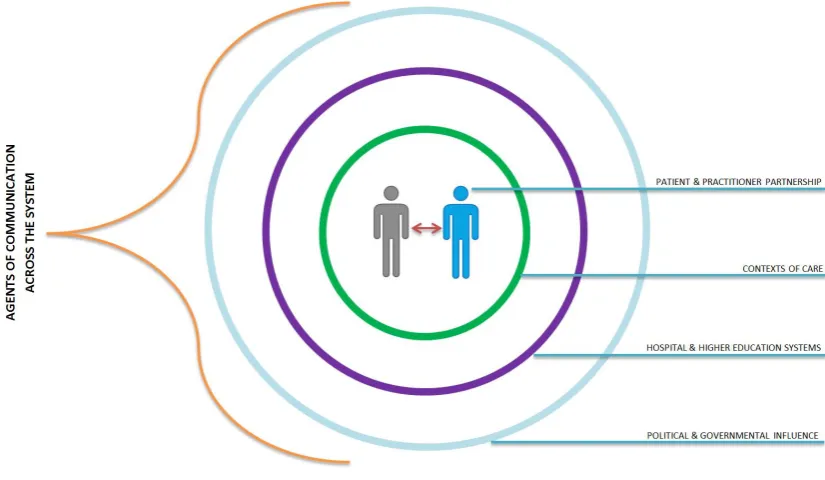
Across the healthcare system, one fact is clearly communicated: that the position of the patient or person is at the very epicentre of all activities. These two systems work in tandem to articulate to the profession, the public and the person that the needs of the individual requiring care must be prioritised. The importance of the partnership
[image:11.595.77.490.457.697.2]between practitioner and person is therefore paramount, and a strong therapeutic person-centred relationship between the care giver and care receiver is fundamental to realising the very existential purpose of each of these systems (see Figure 1).
12
In explaining this partnership, you will no doubt be confronted by one of the nuances of communication – that of the almost mutually interchangeable terms of ‘patient’ and ‘client’. While some traditionalists might argue for the term ‘patient’, its roots are derived from the Latin patiens meaning ‘to suffer’ (Baruch, 2010). More recently, the term ‘client’ has risen in use throughout nursing and healthcare to denote the
transaction that occurs in healthcare between the person and the practitioner. In many respects, the word ‘client’ is arguably a means of communicating that the partnership between the person being cared for and the care-providing practitioner involves mutual expectations that bring certain rights and responsibilities for both parties. The guiding values and responsibilities of the nurse in this partnership are clearly
articulated in the Code of Professional Conduct for Nurses in Australia (NMBA, 2008a) and Code of Ethics for Nurses in Australia (NMBA, 2008b) and provide a pathway to how professional practice must be constantly conducted in all contexts of care.
6. Pathways to Professional Practice
While there may be many different pathways that lead to an individual undertaking studies in nursing or pursuing a career in healthcare, the pathways to professional practice are reflective of a more structured environment due to the need for a system which prepares people to become safe, effective and relevant practitioners who can meet the broader needs of the health-consuming public.
Guiding lights in the nursing profession
The nursing profession in Australia is guided by many documents that provide codes, guidelines or policies for the good of nurses across the country. Two of the most significant documents relating to the essence of nursing are:
the Code of Ethics for Nurses (2008) and
the Code of Professional Conduct for Nurses (2008).
13
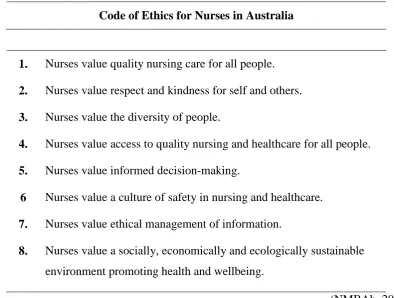
designed to communicate the ethical or moral values nurses are expected to uphold to a broad audience, from nurses to nursing students, employers, organisations,
[image:13.595.78.473.236.534.2]regulatory authorities, the broader community and health consumers (NMBA, 2008). Broadly speaking, there are eight value statements which are outlined in greater detail within the Code of Ethics for Nurses in Australia (see Table 1).
Table 1.1. Summary of Value Statements in the Code of Ethics for Nurses in Australia
Code of Ethics for Nurses in Australia
1.
2.
3.
4.
5.
6
7.
8.
Nurses value quality nursing care for all people. Nurses value respect and kindness for self and others. Nurses value the diversity of people.
Nurses value access to quality nursing and healthcare for all people. Nurses value informed decision-making.
Nurses value a culture of safety in nursing and healthcare. Nurses value ethical management of information.
Nurses value a socially, economically and ecologically sustainable environment promoting health and wellbeing.
(NMBAb, 2008)
Through these statements, the professional commitment of nursing is to respect, promote, protect and uphold the human rights of people receiving care and the nurses providing it to them. The values articulated by the Code of Ethics for Nurses in Australia underpin the Code of Professional Conduct for Nurses in Australia (see
14
Table 1.2. Summary of Value Statements in the Code of Professional Conduct for Nurses in Australia
Code of Professional Conduct for Nurses in Australia
1. Nurses practise in a safe and competent manner. 2. Nurses practise in accordance with the standards of the
profession and broader health system.
3. Nurses practise and conduct themselves in accordance with laws relevant to the profession and practice of nursing. 4. Nurses respect the dignity, culture, ethnicity, values and
beliefs of people receiving care and treatment, and of their colleagues.
5. Nurses treat personal information obtained in a professional capacity as private and confidential.
6. Nurses provide impartial, honest and accurate information in relation to nursing care and healthcare products.
7. Nurses support the health, wellbeing and informed decision-making of people requiring or receiving care.
8. Nurses promote and preserve the trust and privilege inherent in the relationship between nurses and people receiving care. 9. Nurses maintain and build on the community’s trust and
confidence in the nursing profession.
10. Nurses practise nursing reflectively and ethically.
(NMBAa, 2008)
15 Accreditation Standards
In 2010, the National Registration and Accreditation Scheme (NRAS) came into effect, and with it, the birth of the Australian Nursing and Midwifery Accreditation Council (ANMAC). For the first time in Australian history, programs of nursing and midwifery education were accredited according to the same standards across the nation. Previously, state- and territory-based accreditation bodies employed different standards to accredit programs leading to registration as a nurse or a midwife.
Historically, the differences in state and territory approaches to accreditation resulted in significant variations in both the quality and focus of education in the disciplines of nursing and midwifery (Ralph, Birks & Chapman, 2014).
ANMAC play a significant role in ensuring the health and safety of the Australian health consumer by facilitating a high standard of nursing and midwifery education (ANMAC, 2012). Together with the Nursing and Midwifery Board of Australia (NMBA), ANMAC works as a regulatory partner to:
establish, revise and develop standards of accreditation for nursing and midwifery programs;
accredit Australian nursing and midwifery education providers and the programs they deliver leading to a qualification that includes registration or endorsement as a nurse;
Develop, review and provide policy advice and skills assessments of nurses and midwives with international qualifications, who apply to migrate and work in Australia.
As a result of their scope of service, ANMAC provide a vital role in promoting public safety by regulating the education and health sectors to ensure only health
16
programs of education across more than 160 providers of education, ANMAC partners with nursing education at large to embed a standard of quality by enforcing
accreditation standards (Ralph, Birks & Chapman, 2013). Through their role,
ANMAC ensure each program can produce graduates of a standard conducive to the continued quality and safety of both the Australian nursing profession and healthcare sector.
Throughout this system, the messages being sent are clear: Australian health consumers expect graduates to be educated at a high standard, ready to practise at a pre-defined level, and able to function in a safe and competent manner. The system of accreditation is another example of a system hardwired to communicate a standard of educational progression in keeping with the standards set forth by the nursing
profession in Australia. Accreditation standards communicate (to the education provider, the profession, the students and the health consumer) that high standards are expected across the system, to ensure those applying to become registered health practitioners are safe and competent to use their relevant skills and knowledge for the betterment of healthcare delivery across Australia.
Communicating Learning Objectives and Outcomes
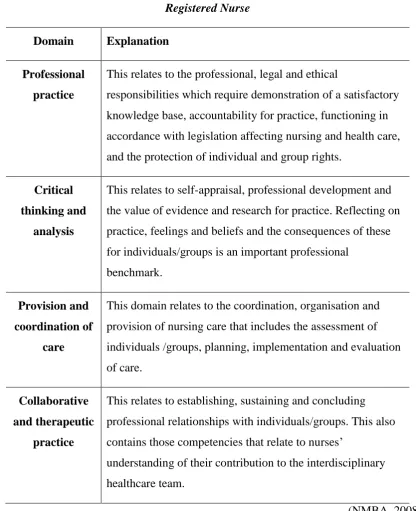
One of the most pivotal issues for anyone enrolled in pre-registration nursing programs is the question of what you are meant to learn and the outcomes of your learning. For students in nursing, the National Competency Standards for the Registered Nurse (NMBA, 2008c) are the key outcomes of your learning on
17
Table 1.3. Summary of Domains in the National Competency Standards for the Registered Nurse
Summary of Domains in the National Competency Standards for the Registered Nurse
Domain Explanation
Professional practice
This relates to the professional, legal and ethical
responsibilities which require demonstration of a satisfactory knowledge base, accountability for practice, functioning in accordance with legislation affecting nursing and health care, and the protection of individual and group rights.
Critical thinking and
analysis
This relates to self-appraisal, professional development and the value of evidence and research for practice. Reflecting on practice, feelings and beliefs and the consequences of these for individuals/groups is an important professional
benchmark. Provision and
coordination of care
This domain relates to the coordination, organisation and provision of nursing care that includes the assessment of individuals /groups, planning, implementation and evaluation of care.
Collaborative and therapeutic
practice
This relates to establishing, sustaining and concluding professional relationships with individuals/groups. This also contains those competencies that relate to nurses’
understanding of their contribution to the interdisciplinary healthcare team.
(NMBA, 2008)
18
Conduct for Nurses in Australia articulate both the values and behaviours to guide
and characterise the nursing profession, the National Competency Standards for Registered Nurses in Australia communicate the expected standards of clinical
performance, irrespective of the specialisations, experiences or qualifications of nurses across the nation. As you progress throughout the degree, be sure to familiarise yourself with the learning objectives of each subject you undertake and the overall program objectives. Use them not only to understand what you need to learn and what is expected of you to learn, but look at them in retrospect and reflect on what you have learned. This exercise will provide you with useful information to identify the
strengths and weakness of your learning experience and to help you articulate to potential employers how you have progressed from a first-year student to a safe, competent and relevant graduate who will bring highly employable skills, knowledge and qualities to the care environment.
Summary
In establishing the contexts of communication, it is important to develop both a sense of professional identity through learned emotional intelligence, and a broad
professional awareness. Having an understanding of both these areas is key to
identifying your roles, responsibilities and potential contributions to the profession of nursing and to patients. By gaining insight into yourself and the profession of which you are now a part, you will be able to approach the information contained in
subsequent chapters of the textbook with a greater appreciation for how to effectively communicate in your role as a care provider.
Discussion and critical thinking questions
1. What strengths and abilities do you possess that will enable you to work professionally in new learning and professional nursing contexts?
2. Provide some examples of your professional approach in your role as a student and on clinical practice.
3. Describe the patient-centred framework.
4. What are professional requirements/pathways to professional nursing practice? 5. What are some of the forces of change operating in the health care context? 6. Give some examples of when you have used the practices outlined in the two
19 Learning extension
20 References
AHPRA, (2014) FAQ for education providers, Page accessed 14 August, 2014, from:
http://www.ahpra.gov.au/Registration/Student-Registrations/FAQ-for-Education-Providers.aspx
Arnold, E. C., & Boggs, K. U. (2013). Interpersonal relationships: Professional communication skills for nurses. Elsevier Health Sciences.
Bar-On, R. (2005). The impact of emotional intelligence on subjective well-being: research article: general. Perspectives in Education: Postmodern (Narrative) Career Counselling and Education: Special Issue, 2, 23, p-41.
Baruch, J. (2010). Gaps in the Safety Net Metaphor. Virtual Mentor, 12(6), 487. Birks, M., Chapman, Y. & Ralph, N. (2014) Assisting the transition: Establishment of
a first year experience coordinator role for nursing students. New Developments in Nursing Education Research, Nova Publications.
Bulmer Smith, K., Profetto-McGrath, J., & Cummings, G. G. (2009). Emotional intelligence and nursing: An integrative literature review. International
Journal of Nursing Studies, 46(12), 1624-1636.
Cadman, C., & Brewer, J. (2001). Emotional intelligence: a vital prerequisite for recruitment in nursing. Journal of Nursing Management, 9(6), 321-324.
Caffrey, R. A., Neander, W., Markle, D., & Stewart, B. (2005). Improving the cultural competence of nursing students: Results of integrating cultural content in the curriculum and an international immersion experience. The Journal of nursing education, 44(5), 234-240.
Clarke, N. (2006). Developing emotional intelligence through workplace learning: findings from a case study in healthcare. Human Resource Development International, 9(4), 447-465.
Goleman, D. (2001). An EI-based theory of performance. The emotionally intelligent workplace: How to select for, measure, and improve emotional intelligence in
individuals, groups, and organizations, Jossey-Bass: New York.
Gustafsson, C., Asp, M., & Fagerberg, I. (2007). Reflective practice in nursing care: Embedded assumptions in qualitative studies. International Journal of Nursing Practice, 13(3), 151-160.
21
implementation of a checklist-based surgical safety intervention. BMJ quality & safety, 20(1), 102-107.
Halfer, D., & Graf, E. (2006). Graduate nurse perceptions of the work experience. Nursing Economics, 24(3), 150.
Horton‐Deutsch, S. & Sherwood, G. (2008). Reflection: an educational strategy to
develop emotionally‐competent nurse leaders. Journal of Nursing
Management, 16(8), 946-954.
Jirwe, M., & Rudman, A. (2012). Why choose a career in nursing?. Journal of
advanced nursing, 68(7), 1615-1623.
Kernbach, S., Eppler, M. J., & Bresciani, S. (2014). The Use of Visualization in the Communication of Business Strategies: An Experimental Evaluation. International Journal of Business Communication, 2329488414525444.
Leonard, M., Graham, S., & Bonacum, D. (2004). The human factor: the critical importance of effective teamwork and communication in providing safe care.Quality and Safety in Health Care, 13(suppl 1), i85-i90.
Lin, E. C. L., Chen, S. L., Chao, S. Y., & Chen, Y. C. (2013). Using standardized patient with immediate feedback and group discussion to teach interpersonal and communication skills to advanced practice nursing students.Nurse education today, 33(6), 677-683.
McCormack, B., Manley, K., & Titchen, A. (Eds.). (2013). Practice development in nursing and healthcare. John Wiley & Sons.
McLaughlin, K., Moutray, M., & Muldoon, O. T. (2008). The role of personality and
self‐efficacy in the selection and retention of successful nursing students: a
longitudinal study. Journal of Advanced Nursing, 61(2), 211-221.
Mills, P., Neily, J., & Dunn, E. (2008). Teamwork and communication in surgical teams: implications for patient safety. Journal of the American College of Surgeons, 206(1), 107-112.
Nursing and Midwifery Board of Australia (2014a). Student Registration. Page accessed 14 August, 2014, from:
22
Nursing and Midwifery Board of Australia (2008a). Code of Professional Conduct for Nurses in Australia. Canberra.
Nursing and Midwifery Board of Australia (2008b). Code of Ethics for Nurses in Australia. Canberra.
Nursing and Midwifery Board of Australia (2008b). National Competency Standards for Registered Nurses. Canberra.
Ralph, N., Birks, M., & Chapman, Y. (2013). The accreditation of nursing education in Australia. Collegian. DOI: 10.1016/j.colegn.2013.10.002
Salovey, P., & Grewal, D. (2005). The science of emotional intelligence. Current directions in psychological science, 14(6), 281-285.
Sheldon, L. K., Barrett, R., & Ellington, L. (2006). Difficult communication in nursing. Journal of Nursing Scholarship, 38(2), 141-147.
Veil, S. R., Buehner, T., & Palenchar, M. J. (2011). A Work‐In‐Process Literature
Review: Incorporating Social Media in Risk and Crisis