i
COOPERATIVE SPACE-TIME BLOCK CODING
AHMAD ZULHELMI BIN AB HAMID
This Report Is Submitted in Partial Fulfillment of the Requirements For The award of Bachelor of Degree Electronic Engineering (Telecommunication Electronic) with
Honours
Faculty of Electronic Engineering & Computer Engineering Universiti Teknikal Malaysia Melaka
ii
UNIVERSTI TEKNIKAL MALAYSIA MELAKA
FAKULTI KEJURUTERAAN ELEKTRONIK DAN KEJURUTERAAN KOMPUTER
BORANG PENGESAHAN STATUS LAPORAN
PROJEK SARJANA MUDA II
Tajuk Projek : COOPERATIVE SPACE-TIME BLOCK CODING
Sesi
Pengajian : 0 9 / 10
Saya AHMAD ZULHELMI BIN AB HAMID
(HURUF BESAR)
mengaku membenarkan Laporan Projek Sarjana Muda ini disimpan di Perpustakaan dengan syarat-syarat kegunaan seperti berikut:
1. Laporan adalah hakmilik Universiti Teknikal Malaysia Melaka.
2. Perpustakaan dibenarkan membuat salinan untuk tujuan pengajian sahaja.
3. Perpustakaan dibenarkan membuat salinan laporan ini sebagai bahan pertukaran antara institusi pengajian tinggi.
4. Sila tandakan ( √ ) :
SULIT* *(Mengandungi maklumat yang berdarjah keselamatan atau kepentingan Malaysia seperti yang termaktub di dalam AKTA RAHSIA RASMI 1972)
TERHAD** **(Mengandungi maklumat terhad yang telah ditentukan oleh organisasi/badan di mana penyelidikan dijalankan)
TIDAK TERHAD
Disahkan oleh:
__________________________ ___________________________________
(TANDATANGAN PENULIS) (COP DAN TANDATANGAN PENYELIA)
NO. 58 TAMAN DESA BINTANG 2,
JALAN LUMUT, 32000, SITIWAN PERAK
iii
APRIL 2010
” I, hereby declare that this report is the result of my own work except for quotes as cited in the references.”
iv
APRIL 2010
“I ;hereby declare that I have read this report and in my opinion this report is sufficient in terms of the scope and quality for the award of bachelor of Electronic Engineering
(Telecommunication Electronic) with Honours”
v
Dedicated, in thankful appreciation for support, encouragement, love and understanding especially to my beloved father, mother, all the family members and to my entire
vi
ACKNOWLEDGMENT
In this part of my Final Year Project I would like to greet and appriciate all the parties that are involved in order to complete this report. First and foremost, Alhamdulillah, I’am thankful to the Almighty God; because of It’s blees. A part from that, I would also like to express my great fullness to my parents; Mr Ab Hamid b Fazal Mohamad & Mrs Zaiton bt Abu Bakar in supporting me with moral and physically. Without their support and courage it is impossible for me to complete this report perfectly.
Other than that, the most helpful and supportive supervisor Mr Mohd Riduan bin Ahmad. He is the one who guided and giving support in physical and mental. This heartily gratitute to my supervisor for guidance and enthusiasm given throughout the progress of this project.
My appreciation also goes to all 4 BENT’s student whom had help and give cooperation with the project. This involves those whom involve directly or indirectly in order to complete this project. There is no word to express the appreciation to whom that involves. Thank You So Much.
vii
ABSTRACT
viii
ABSTRAK
ix
CONTENTS
CHAPTER TOPIC PAGES
TITLE OF PROJECT i
DECLARATION iii-iv
DEDICATION v
ACKNOWLEDGEMENT vi
ABSTRACT vii
ABSTRAK viii
TABLE OF CONTENT ix
LIST OF FIGURE xiii
CHAPTER 1
INTRODUCTION 1
1.1 Overview 1
1.2 Project Summary 3
1.3 Objective 4
1.4 Problem Statement 5
1.5 Scope of Project 6
x
CHAPTER 2 8
LITERATURE REVIEW
2.1 Wireless Sensor Network 9
2.1.1 Physical Architecture 10
2.1.2 Different Between Other Types of Communication 11
2.2 Multiple input multiple output 12
2.2.1 Advantages of MIMO 15
2.2.2 Diversity Techniques 16
2.3 Space-Time Coding 17
2.3.1 Space-Time Block Coding 18
CHAPTER 3
METHODOLOGY 21
3.1 Introduction 22
3.2 Flow Chart 23
3.3 Methodology Procedure 24
3.3.1 Research 25
3.3.2 Constructing 25
3.3.3 Plotting 25
3.3.4 Observe 26
xi
CHAPTER 4
RESULT AND DISCUSSION 28
4.0 Introduction 29
4.1 Mathematical Model 29
4.2 Data Analysis 33
4.2.1 Bit Error Rate (BER) Comparison 33
4.2.1.1 MIMO vs SISO 34
4.2.1.2 STBC vs SM 35
4.2.1.3 STBC vs BF 36
4.2.1.4 Number of Antenna 37
4.2.2 Delay Comparison 39
4.2.2.1 SISO vs MIMO 39
4.2.2.2 STBC vs SM 40
4.2.2.3 STBC vs BF 41
4.2.2.4 Number of Antenna 41
4.2.3 Energy Consumption 43
4.2.3.1 SISO vs MIMO 44
4.2.3.2 STBC vs SM 45
4.2.3.3 STBC vs BF 46
4.2.3.4 Number of Antenna 47
CHAPTER 5 48
xii
REFERENCE 51
APPENDIXES
(a) Appendix A: Bit Error Rate(BER) Comparison 52
(b)Appendix B:Delay Comparison 56
(c) Appendix C: Energy Consumption 59
xiii
LIST OF FIGURE
FIGURE DESCRIPTION PAGE
2.1 Wireless Sensor Nodes physical architecture 10
2.2 Evolution of Communication System 14
2.3 Example of MIMO antenna at each end 14
2.4 STBC matrix form 18
2.5 The Almouti Schemes 19
2.6 Diagram of the Transmitter Part 20
3.1 Wireless Network Family 22
3.2 Flow Chart of Project 23
3.3 MATLAB Software 24
3.4 MATLAB Ability 26
3.5 Main GUI Interphase 27
4.1 SISO vs MIMO (BER) 35
4.2 STBC vs SM (BER) 36
4.3 STBC vs BF (BER) 37
4.4 Number Of Antenna (BER) 38 4.5 SISO vs MIMO (Delay) 40
4.6 STBC vs SM (Delay) 41
4.7 STBC vs BF (Delay) 42
1
CHAPTER 1
INTRODUCTION
1.1 Overview
Wireless communication is the transfer of information over a distance without the usage of electrical conductors or cables [1]. The distances involved may be short (a few meters as in television remote control) or long (thousands of kilometers for radio communications). When the context is clear, the term is often shortened to "wireless". Wireless communication is generally considered to be in the telecommunications family. [1]
2
wireless computer mice, keyboards and headsets, satellite television and cordless telephones.[3]
Wireless operations permits services, such as long range communications, that are impossible or impractical to implement with the use of wires. The term is commonly used in the telecommunications industry to refer to telecommunications systems (e.g. radio transmitters and receivers, remote controls, computer networks, network terminals, etc.) which use some form of energy (e.g. radio frequency (RF), infrared light, laser light, visible light, acoustic energy, etc.) to transfer information without the use of wires. Information is transferred in this manner over both short and long distances.[2]
So, with the existing and development of Wireless system, there is Wireless Sensor Network system in telecommunication. One of the main purpose we used Wireless Sensor Network in telecommunication is because of its reliability, performance and the cost effective factor.[4] This Network system have been research and developed widely in military, industrial and safety purpose. Thus, in telecommunication, it is a need to have higher performance system with compact and high capability system. So, major research, new theories and application of this system have been done.
3
Space Time Block Code is one of the techniques used in Multiple Input Multiple Output (MIMO) technologies. The other techniques are Spatial Multiplexing techniques and Beamforming techniques. Space Time Block Code (STBC) is a very simple yet very effective means of achieving transmit diversity when other form of diversity may be limited or non-existent.
1.2 Project Summary
4
1.3 Objective
In order to ensure the project goes smoothly, the objectives of the project that I have discovered are:
To design and develop the cooperative space-time coding for wireless sensor
network implementation in MATLAB environment. Monitor performance in terms of energy consumption and delay.
To compare the performance of cooperative space-time coding with
5
1.4 Problem Statement
During performing the project, there are some problems that I have faced with. The followings are the problems that occurred and show up during performing the project:
Implement To implementation of coding designed in MATLAB software to
monitor the performance of the system in terms of energy consumption and delay.
To determine the most efficient method in terms of energy consumption and
6
1.5 Scope Of Project
7
1.6 Report Structure
Generally, the report consists of 5 chapters which are;: Introduction, Literature Review, Methodology, Result and: Discussion and Conclusion. Each chapter will be explained briefly on the title that it represent.
The first chapter represented the Introduction part. So, it is related to the introductory of the titles that I have chosen, project background, the objective, problem statement and scope of work that I have planed and discovered.
The second chapter represented the literature review that involves in this project. So here, we will discuss on the information gathered from different types of sources. Then, it will be represented in the form that I have studied and simplified.
The third chapter which is methodology will cover on the theories and method related applied in the project. The software and tools related in order to obtain the result will be discussed briefly in this chapter.
The fourth chapter represents the result of the project. Here, the analysis of the result obtained will be discussed briefly. The graph of Signal to Noise Ratio (SNR) and Energy consumption will be discussed widely in this part.
8
CHAPTER 2
LITERATURE REVIEW
9
2.1 Wireless Sensor Network
As we all know wireless sensor network (WSN) is a wireless network consisting of spatially distributed autonomous devices using sensors. The main purpose of sensors are to cooperatively monitor physical or environmental conditions, such as temperature, sound, vibration, pressure, motion or pollutants, at different locations.[1] The advantages by using the sensor nodes are that, it can be applied to the place that human can not reach e.g.: septic tank, tiny holes, human internal body parts and others. The development of wireless sensor networks was originally motivated by military applications such as battlefield surveillance. However, wireless sensor networks are now used in many industrial and civilian application areas, including industrial process monitoring and control, machine health monitoring, environment and habitat monitoring, healthcare applications, home automation, and traffic control.[3]
10
2.1.1 Physical Architecture
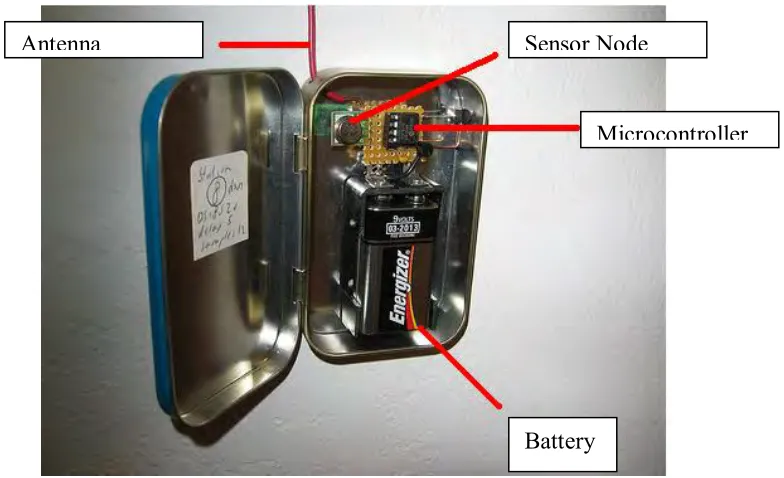
[image:24.612.174.566.380.619.2]As we all know, wireless sensor has its own architecture that enables it to perform the communication. It consists of several elements that permit communication between nodes and source. Basic communication consists of receiving and transmitting part. For wireless sensor network, it has its own antenna and radio transceiver acts as the receiving and transmitting part. [2] The power source is the most important part that enables the system to perform the operation. So, this part represented by battery. The „brain‟ of the sensor is controlled by microcontroller; applied the programmed application. Sensor Node is responsible to monitor record and perform the sensing process. Figure 1.0 illustrates the physical of the listed elements stated before. [5]
Figure 2.1: Wireless Sensor Nodes physical architecture
Microcontroller Sensor Node