Rochester Institute of Technology
RIT Scholar Works
Theses Thesis/Dissertation Collections
5-19-2009
Anecdotes
James Bellucci
Follow this and additional works at:http://scholarworks.rit.edu/theses
This Thesis is brought to you for free and open access by the Thesis/Dissertation Collections at RIT Scholar Works. It has been accepted for inclusion in Theses by an authorized administrator of RIT Scholar Works. For more information, please [email protected].
Recommended Citation
Anecdotes by James Bellucci
THESIS
Submitted in Partial Fulfillment of the Requirements for the Degree of
Master of Fine Arts in Imaging Arts
Rochester Institute of Technology
Professor Elaine O’Neil, Chair
Dr. Jessica Lieberman, Committee Advisor
Professor Alexander Miokovic, Committee Advisor Date Date Date 05-19-2009
05-19-2009
ACKNOWLEDGEMENTS
I would like to thank the hard work, patience and advice of my thesis committee members, Professor Elaine O’Neil, Dr. Jessica Lieberman and Professor Alex Miokovic. Gratitude and thanks go out to the council and work of Dr. Timothy Engström, Professor Elliott Rubenstein and Professor Patricia Russotti. I would also like to thank Dr. Therese Mulligan and the graduate faculty and students for
their insight and advice throughout my studies at R.I.T. Thank you to Christine and my classmates Pavel, Andy, Daniel, Gretchen, Taesung, Ratna, Emily, Sara, Stephanie, Kaitlin and Larissa. Thank you to the students in the School of Print Media’s, Digital Publishing Center for your patience and professionalism. Thank
Anecdotes
by
James Bellucci
B.F.A., Photography, Shepherd University, 2002
M.F.A., Imaging Arts, Rochester Institute of Technology, 2009
Abstract
Anecdotes is a set of illustrations derived from Biblical text, scientific discovery
and self-created stories. This body of work questions these texts through the temporal nature of the anecdotal storytelling convention. The images, created through the manipulation of three-dimensional materials such as paper, cardboard, string, and fabrics in constructed sets and photographically represented as a two-dimensional images, question the authenticity of the grand narrative. The images explore scientific discoveries along with religious beliefs revealing my reservations, perceptions, and sentiments toward both. In considering my changing knowledge and beliefs from childhood into adulthood,
Anecdotes deconstructs these conflicting narratives into a directorial agenda that
Table of Contents
List of Figures ...v
I. Introduction: My Role as Storyteller ...1
II. Narrative and Photography ...7
III. Constructing for the Camera ...18
IV. Action and Internalization of the Text ...30
V. Anecdotes Installed and Concluding Thoughts ...37
List of Figures
Figure 1.1 Beringer’s false fossil machine revealed!... 3
Figure 1.2 Cornell, Joseph, Object-Les Abeilles (Bees attacked by the pale blue sky)... 5
Figure 2.1 Darwin Overboard!... 8
Figure 2.2 Who Were the Players At Sodom and Gomorrah?... 12
Figure 2.3 Ernst, Max, Le Lion de Belfort (The Lion of Belfort)... 13
Figure 2.4 The Expulsion Of Adam And Eve From The Garden Of Eden... 16
Figure 3.1 A Letter From The Primates To Christ... 20
Figure 3.2 Norstein, Yuri, film still from Hedgehog in the Fog... 22
Figure 3.3 Bosch, Hieronymus, The Last Judgment... 25
Figure 3.4 Da Vinci Battles Celestial Fossil Matter... 27
Figure 3.5 Will You Travel Through The Eye Of A Needle?... 28
Figure 4.1 Erik Jarvik and Pope Urban III Compete In The Classroom To Teach Evolution... 32
Figure 5.1 Banksy, Woman’s Portrait With Gas Mask... 40
Chapter I: My Role as Storyteller
Storytelling has existed since the formation of spoken, written and visual languages. From early cave paintings and Greek poetry to television news broadcasts, storytelling is a medium in which information is conveyed to audiences by oration, writing or visual depictions of events in a captivating manner. Poems, novels, parables, drawings and paintings can take form as stories, transmitted by the faithful storyteller, who accounts past events as though he or she were present during these historical moments. The storytelling practice reveals the interpretation of fact to fiction as information is stated
and re-stated throughout generations of writers, visual artists and orators. The storytellers’ artistry in delivering information produces highly crafted
compositions that merge fact and fiction into enticing vessels of teaching material and entertainment used to convey narrative knowledge of the world. The craft of storytelling manifested in visual and written language transmits morals and entertains audiences in forming relationships between storyteller and listener.
The convention of anecdotal storytelling deals with the transmission of information about real persons while entertaining an audience. The work,
Anecdotes is a set of photographic illustrations derived from Biblical, scientific
and self created stories that are visually translated in an anecdotal style,
revealing to viewers a questioning of the translation of information from fact to fiction in the storytelling practice.
However, Biblical passages and other religious ideologies are rarely associated with the ephemeral nature of the anecdotal convention of storytelling. Using the anecdote to illustrate Biblical passages lends itself to a secular notion of the story in contrast to the dogmatic quality of religious texts, and functions to find a sense of levity and play in how I portray these stories. Dealing with the enduring nature of Biblical narratives through the looking-glass of the temporal anecdote, I am able to revive a personal and contemporary reflection on these stories. The specific grouping of Biblical and scientific stories blends into a third type of story: the personal narrative. Growing up with a childhood rich in Catholic catechism, my imagination was filled with Biblical stories that would later be scrutinized as I matured into adulthood. Educated in the public school environment, classes in natural sciences questioned many of the principles of my religious upbringing, thus early on I was perplexed as well as fascinated by the conflicts between science and religion.
For example, the piece, Beringer’s False Fossil Machine Revealed! (fig. 1.1) combines the discovery and fabrication of fossils, divine creation and the validity of scientific discovery into a seemingly nonsensical illustration of a significantly historical event. Eighteenth century natural scientist, Johann Beringer, was credited with finding fossils he claims were directly created by God and placed on earth for him to find. Years after the release of his infamous text, Lithographiae
Wirceburgensis, depicting these claimed divine fossils, it was believed that
of this story shows the interior of Beringer’s study, where he is depicted as an ape chiseling away at a Lügensteine (lying stone) as he is being spied on by a curious lemur through a window. Opposite in the foreground is a completed fossil
tagged with the label YHVH, standing for Yahweh, the anglicized translation of the Hebrew name of God. My selection of this story results from my interest in the verifiability of scientific knowledge merging with divine creation.
My version of this story is derived from the natural science historian, Stephen Jay Gould’s story about Beringer’s false fossils. In my craft as the anecdotal storyteller, Gould’s historical and intellectually comparative storytelling is visually represented as a parody of the story, placing Beringer as a primordial ape, groveling around his laboratory as the divine creator of his uniquely false fossils. Gould’s story projects an unsettled case of a deist
paleontologist trapped between the empirical thought of scientific deduction and an unprovable notion of Godly creation. I have empathized with Beringer, torn between science and creationism, aimlessly questioning both approaches and falling somewhere in-between faith and logic. The ape, Beringer, is a self-reflection in my devolved feeling of being submersed in a society that desires to know all the grand unexplainable answers to human living. The lemur peering in through the window is also me, watching my ape-like self attempt to discover a higher knowledge, as though such an answer is found in the library, laboratory or somewhere in the heavens. The act of creating this work is self-reflexive of my role as storyteller, I am not only commenting on my reading of the original text, but how I imagine I would be placed in each narrative.
The word “Anecdote” is defined as: a short and amusing or interesting story about a real incident or person; an account as regarded as unreliable or
hearsay; the depiction of a minor narrative incident in a painting.1 Anecdotal
stories many times illustrate a story with a sense of humor or seriousness about an incident, however, what is most interesting are how these stories are told and certain elements are omitted, emphasized or altered for effect.
In this work I am interested in how anecdotes and allegories framework particular details of the narrative to emphasize the desires of the storyteller.
For example, parallel to these literary devices, a
cabinet of curiosity (wunderkammer2,
16th century Europe) frameworks eclectic specimens of nature into a spectacle of wonder and inquiry, drawing new connections between otherwise separate natural elements. Similar to this juxtaposition of specimens, the manner in how information is introduced in the storytelling practice enables the storyteller to tailor the story to create new and unique moral, social and
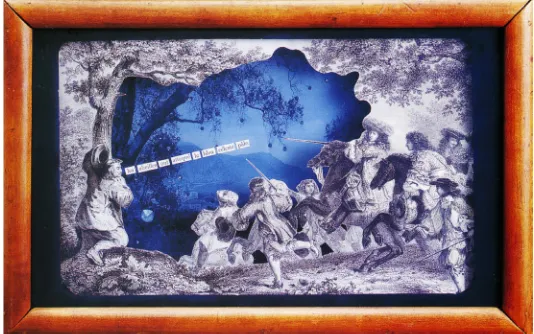
[image:11.612.274.541.73.240.2]cultural underpinnings. In the 20th century, Joseph Cornell’s melding of objects representative of nature and astrological symbols in the miniaturized Victorian box transforms the miniature wunderkammer into a dream-like and sublime representation of the implied story (fig. 1.2). Connections between elements are alluded to, but not overtly created, resulting in an open-ended play of narration. Each image in Anecdotes juxtaposes allegorical symbol with personal story, similar to the narrative mode in which Cornell formulates the dream-like narrative in a miniaturized world of objects bearing significant and cryptic relationships and messages. From the Biblical to scientific variations created in
fig. 1.2 Joseph Cornell; Object-Les Abeilles (Bees
Anecdotes, each depiction is a personal dialogue and visual representation of
my relationship with each story as indicated by use of the paper cutout and the inherent constructed nature of each set.
One important component of the work Anecdotes is my notion of interpretative storytelling. I define the process of translating the text of a story into visual scenes as interpretative storytelling. These are my stories, reflections and comments about other stories based on the visual depictions I imagine while reading texts. The decisions I make include the characters I choose to create or replace as protagonists or antagonists in each story, the environment in which they are placed and how both of these elements interplay with the unfolding of an action occurring before the camera lens. I first remember a story by the events that occurred, such as, a camel passing through the eye of a needle, Johann Beringer’s fabrication of false fossils or Dante Alighieri entering a dark wood. Secondly, I consider my current sentiment toward each of these stories. Based on my standpoint of each story, I then sketch a scene of the set I am looking to create, based on the action of the story I want to emphasize. I then select from a collection of animal illustrations the characters I want to act out each scene. These two-dimensional cutout characters are then placed in each set and photographed.
replacement of characters and environments to prod the notions of each story. This written thesis will explain my motivation and creation of Anecdotes.
Chapter II: Narrative and Photography
Like photography, the grand narrative is potentially accountable for transmitting some sense of truth, yet can rarely be substantiated with evidence. However, in this lack evidence, the grand narrative still contributes to shaping moral and social guidelines in conveying religious knowledge. Grand narratives seek to define the cultural and historical underpinnings of belief systems;
of millennia of random adaptation to environment, otherwise known as natural selection. Intelligent design and natural selection are theories and not proven laws, substantiated by tangible evidence. Darwin Overboard! (fig. 2.1), proposes a humorous question: what if Darwin never made it to the Galapagos islands? Furthermore, what if he never deduced his idea of natural selection? This work probes at the speculative notion that if Darwin never existed, would someone else have thought of natural selection? This image reflects a distrust in even the empirical knowledge of Darwin’s theory of natural selection, wherein the factual writing of the Origin of Species is decontructed into a child-like mode of play.
Darwin Overboard! opens the question of “what if” in detaching the narrative
from its popularized history and connection to a general knowledge of evolution. This work transforms the notion of Darwin as a fictive character in a whimsical
environment lost at sea, divorcing any sensibility of the actual occurrence of historical events connected to human evolution.
Although, modern science has segmented and categorized knowledge
into organized sectors, opposite of the narrative tradition, this in not the way scientific discoveries were first transmitted to audiences. Only since a postmodern discourse of narrative knowledge has science separated its discoveries away from the narrative approach into compartmentalized,
independent areas of study. Therefore, scientific narratives in their earlier form work as companion and counterpoint to grand narratives of religion. Both theological and early scientific texts struggle with substantiating proof in their statements. They are bound to the narrative traditions of history, and in one way or another resort to telling stories. Science, like religion is bound to creating a verification (or falsification) of narrative knowledge via transmission of content through social and historical means. Verifiability or falsification of evidence supporting stories is created by a predetermined set of qualifiers. Science reports its findings in an epic manner to a populous of the scientific community that has established the pre-conditions of this new evidence. The evidence seems valid, but the determining factors were preset to meet the findings of the evidence. Popular science brings to mainstream media the evidence and the rules of what is and is not evidential to new scientific discovery.
of scientific study we can find a correlation in the statement by Jean François Lyotard that:
Narrative knowledge does not give priority to the question of its own legitimation and that it certifies itself in the pragmatics of its own transmission without having recourse to argumentation and proof. This is why its incomprehension of the problems of scientific discourse is accompanied by a certain tolerance: it approaches such discourse primarily as a variant in the family of narrative cultures.3
Lyotard’s mention of “narrative cultures” admits the variation of scientific discovery as part of an epistemology that attempts to divorce itself from the narrative tradition, however is bound to this tradition by its submersion in culture that is dependent on narrative transmission to teach and comprehend knowledge. Amidst a growing number of the populous that does not adhere to religious beliefs, there is an undeniable history and knowledge of the past that uses allegorical devices and the narrative model to explain the unexplainable phenomena scholars and theologians have pondered for centuries. Philosopher of science, Thomas Kuhn, makes the argument in regard to the story that:
There were no facts independent of our theories about them, and that consequently there was, and could be, no one way of viewing, classifying and explaining the world which all rational persons were logically obliged to accept. Such theories, it was suggested, were better seen not in terms of natural law but ‘fictions,’ stories which we constructed to explain events. The stories we use to explain events compartmentalize the randomness and discord of life that otherwise remain unexplainable without being manipulated into a story.4
The model of story formulates a chronological and relative manner in
3. Jean-François Lyotard. The Post-Modern Condition : A Report on Knowledge (Minneapolis: University of Minnesota Press, 1984), 27.
Uni-looking at the world and life in regard to the past, present and future. Stories are how I rationalize the unexplainable, even if the story itself is non-sensible or fantastical, it finds purpose and meaning to me within the realm of the story. Kuhn’s statement rationalizes the model of the story as a vessel for creating a sense of organization of thought when considering the unexplainable and chaotic nature of the human condition. The “once upon a time” tradition of the storytelling practice distills information into a palatable formula of understanding by fusing the rational with the irrational and actuality with fantasy.
Anecdotes explores a personal narrativity of selected texts. This narrativity
is a temporal horizon in constant transition as I remember, experience and re-read the selected texts found in Anecdotes. Paul Ricoeur’s explanation of narrativity, a connection between time and narrative, places the reader wherein “time becomes human to the extent that it is articulated through a narrative mode, and narrative attains its full meaning when it becomes a condition of
temporal existence.”5 Considering Ricoeur’s statement on time and narrative,
Anecdotes is operating through a personal relationship with these selected
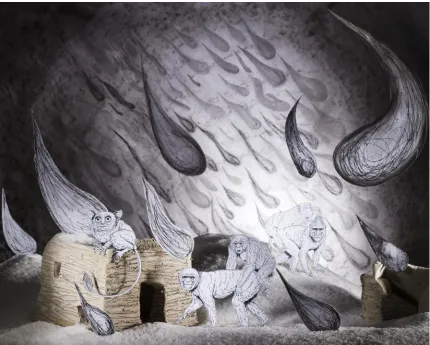
texts over my childhood, adolescence and adulthood in perpetual flux of new, past and present experiences and reflections of each selected text. In merging universally known stories with those that are obscure and personal, my goal is to fuse the universal grand narrative with my narrativity and reflection of each story. For example, Who Were The Players At Sodom And Gomorrah? (fig. 2.2)
illustrates the Biblical story of the destruction of the ancient cities, Sodom and Gomorrah by the wrath of God. The Old Testament illustrates these cities being destroyed by a fire storm as a result of the ungodly sexual acts of the people who inhabited these cities. My rendition of this story depicts chimpanzees engaging in sexual acts while their city is destroyed by a meteor shower of pale sperm-like forms. The desaturated environment is symbolic of the salt and sulfur deposits found at the present day sites of Sodom and Gomorrah. The lack of color and double reading of the meteorite sperm storm emulate the prudent reaction I have when reading this story.
[image:18.612.110.540.71.416.2]The primary question I ask when reading this scripture relates to the
creation of the human body by God and its denial of pleasure of that creation. Sexual acts are human and to be considered a gift of existence. This depiction of Sodom and Gomorrah reveals primates that are posed in their sexuality, looking back at the viewer and not fearful of the destruction of their cities or judgement of their sexuality. Max Ernst’s surrealist novel,
Une Semaine de Bonte (The Seven Deadly
Elements), illustrates characters in
precarious and often violent or sexual situations, comparable to the instinctual acts of animals (fig. 2.3). Similar to my version of Sodom and Gomorrah, Ernst’s imagery anthropomorphizes characters to blend the carnal and instinctual acts of animals with the civilized attire of human conduct. Many images throughout the illustrated novel interchange animal heads or body parts with their human counterparts as indulgent and distressing acts unfold. Ernst’s images correlate to my use of animals in Anecdotes and their imbued presence. The strategy in my work is to de-evolve the narrative and the highly invested notion that narratives transmit some sense of believability or truth.
[image:19.612.329.540.74.365.2]Narratives and photography each deal with a depiction of reality that are made believable by their own innate qualities. Photography records subject
matter in significant detail and narratives use either actual people and events or cleverly inventive fictitious characters and actions to paint a realistic or naturalistic happening of an event. Participation in viewing a photograph or reading or listening to a narrative, engages one to acknowledge the possibility that what is being portrayed is fictive yet still believable or partially based on factual events. Audiences participate in the deceptive nature of photography and narratives in a tension between believability and disbelief. Roland Barthes statement that “myth is not defined by the object of its message, but by the way in which it utters this message: there are formal limits to myth, there are no
substantial ones,”6 evokes an endless approach to the narrative convention by
means of how the story is presented.
The container of the story, otherwise its type, such as parable, allegory or novella, fall within a certain uniform identity in structural elements, but the content is always subject to manipulation and re-contextualization by intent of the storyteller. Barthes’ statement speaks to my childhood and adulthood perceptions of the story through an oscillation between the two. In my adulthood I recollect these childhood stories with scepticism whereas in my youth I was either horrified by the consequences these stories implied or enamoured by the visual references they created. In the present, I manage these adult and
Just as religious narratives can be used by parental figures to establish moral guidelines for the social education of children, science is always fulfilling its own legitimacy for new theories and discoveries. The assignment of characters in Anecdotes, is my deconstruction of this belief/disbelief relationship of the narrative. My rendition of the Expulsion of Adam And Eve From The Garden Of Eden (fig. 2.4), depicts two primates with the human heads of Adam and Eve being driven off by a gorilla pounding its chest. The King James Bible states, “therefore the Lord God sent him (man) forth from the garden of Eden, to till the ground from whence he was taken. So he drove out the man; and he placed at the east of the garden of Eden Cherubims (angelic beings), and a flaming sword which
turned every way, to keep the way of the tree of life.”7 With Adam and Eve’s
new found knowledge of good and evil, by Eve consuming the forbidden apple, they are forced to live outside of the lavish Garden of Eden. My rendition of the story depicts Adam and Eve as monkeys, for I believe this is the devolved level at which the story is geared in revealing any human understanding of knowledge.
of the Bible is to have everything matriculate back to God, but when strict followers of the Bible make this the primary text that forms their knowledge of the world, a societal division occurs based on belief systems, void of any tangible
evidence. The division of belief systems has produced an era of perpetual holy wars, overstated dogmatic principles and feelings of distrust between ideologies based on texts and tradition. My critique is on the system of differences between theological and scientific epistemologies and how these spheres of thought are judgmental in accepting the notion of the other. Within my scope of argument between science and religion, I still adhere to the faith-based ideology of believing in something that I can’t explain. Notions outside rationality are part the human condition, human curiosity and the formation of faith, as a way to cope with everyday life. My questioning arises with the extreme actions this knowledge produces, rather than the knowledge itself.
However, this being stated, an argument comes to play wherein a histo-theological notion of reality vs. symbolism forms the division between actual and ascribed believability. Catholics believe in the physicality of Jesus, the Son of God, as “divine messenger and ‘son of man’ as this individual case is meant
to be entirely real and not symbolic.”8 In my spiritual growth with Catholicism,
the Bible is understood as a document of actual, real, happenings and is not to be considered as fictional stories or be taken in illusionary context. The symbol, moreover, symbolism “is the coincidence, or rather unity, of something specific
and concrete with something that goes beyond specificity and concreteness.”7
that stands before the camera lens. The anecdote makes a similar move by revealing odd and unusual information about actual people and events in a universal conveyance of humor, tragedy or any other humanistically relatable emotion.
Chapter III: Constructing for the Camera
A catalyst for creating the work is my ability to illustrate these human-crafted stories, and also emphasize their fabrication. The hand work of cutting out paper with a razor blade and the occasional burr that remains, allude that these stories are not, or were ever, an account of actual events. In understanding the fictive nature of the narratives I have selected, this work enables me to take authorship in translating the slippage of the narrative into visual form by using materials that reveal this trace.
Many of the images reveal traces of the artist’s hand made by showing cut marks in the materials, brush strokes in painted areas, curling on the edges or wrinkling of paper. Rather than use facile and exact materials, I sought for a tactile construction that straddles the ornate and the rustic. Hand work provides the sense that these sets are individual works created by a person. The showing of handwork is important as it reveals a trace of my unique creation.
thinking about an existing story, all mysticism for me is lost. Two spheres of perception are at play in Anecdotes, my childhood instincts to manipulate characters and my adult knowledge to understand the underlying moral codes of each story and how I might change these codes.
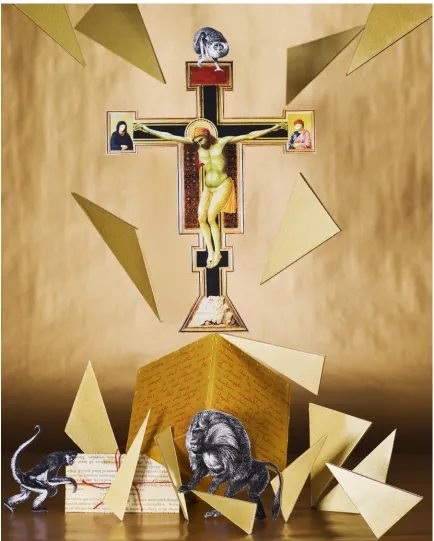
A Letter From The Primates To Christ (fig. 3.1), depicts Christ crucified,
pivoting on a golden cube inscribed with text from Charles Darwin’s Origin
of Species. In the bottom of the frame, standing under the golden cube is an
Primates To Christ represents a lifetime struggle to place the Biblical narrative
within a framework of myself as individual and contributor to society, a society I feel is too wrapped up in the argument of creationism, evolution and existence. I believe these pursuits are self indulgent and a distraction from the more universal problems of the human condition. They are age-old questions with an uncertain relevance to me. The strategy of placing science and religion together in conflict in the work illustrates to me that these majestic stories are just long-lived excuses for tackling the bigger moral and ethical issues challenging humanity. The play of each story and the imagination imbued in making the story come to life are my focus within the obviously fabricated nature of the work.
Camera framing and use of dramatic lighting elevate the action into a directorial state that controls the focus of the viewer. Technical decisions such as depth-of-field and lighting are made based on how they will impact my version of each narrative for the viewer. Through the camera I transformed the constructed nature of the work into a film still environment, mimicking
animation. In Yuri Norstein’s, Hedgehog in the Fog(fig. 3.2), animation merges
[image:28.612.126.523.406.703.2]two-dimensional characters in three-dimensional space, blending the static quality of the characters body with dynamic movements and environments that create vast focal depth. Norstein’s animation works like a moving collage in the illusion of three-dimensional space. The head, body and legs of a character move like separate cutouts attached at multiple pivot points. Movements take on an effect as though someone were in the background with poles attached to
different body parts of the figure making them dance across the screen. My sets are designed to exist in two-dimensional photographic space, where elements become flattened in perspective to compress as much information as possible into the frame.
Although the photographic image has the capacity to deceive, it also creates belief in what it reveals. This revealing nature of photography transforms my sets from three-dimensional space into a two-dimensional allegory prodding back at the viewer. For example, Darwin Overboard (fig. 2.1) is constructed entirely of paper elements, consisting of painted cardboard, tissue paper and printed graphics on paper. The photographic image transcends these sets into theatrical environments. This two-dimensional photographic representation is influenced by allegorical painting. Plato’s Allegory of the Cave10 reveals the allegory to be a representation of what could be and not reality itself. The dialogue between Socrates and Glaucon (Plato’s brother) indicates that the shadowy forms on the cave wall are only illusions of forms and not the object that creates these forms. Furthermore, the language used to communicate these forms can only be comprehended through the understanding of an idea.
The allegorical painting shows what could happen -- an idea as illustrated by painting and not an actual event. These sets as photographs become
the way I think about texts. A text for me is a visual illustration of an idea, object, person, or series of events. In reading these texts, I am actually re-writing them as they become mental images. Best described by Roland Barthes, this would be considered a writerly act of engaging these narratives, in which he explains “the writerly text is a perpetual present, upon which no consequent language can be superimposed; the writerly text is ourselves writing, before the infinite play of the world is traversed, intersected, stopped, plasticized by some singular system (Ideology, Genus, Criticism) which reduces the plurality of entrances, the
opening of networks, the infinity of languages.”11 Barthes statement projects that
the text is simply what we make it. Falling within the play of text, no two readers will comprehend the same passage of text identically. Each will interpret the text different in dialogue with themselves.
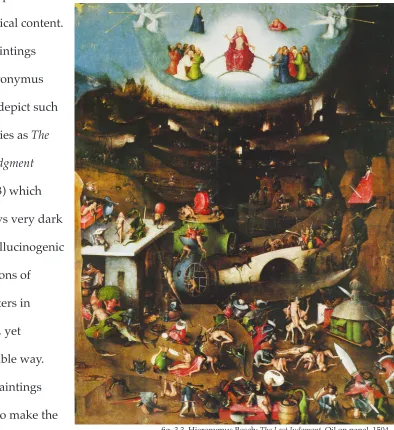
In revealing the handwork of my sets in the finished images, I am working in an opposite manner as many Flemish and Italian Renaissance painters when they depicted
allegorical content. The paintings of Hieronymus Bosch depict such allegories as The
Last Judgment
(fig. 3.3) which portrays very dark and hallucinogenic renditions of characters in a scary, yet believable way. Such paintings strive to make the fictive elements of
[image:31.612.145.539.139.569.2]the allegory come to life. Allegorical painting during this period worked toward symbolizing a deeper meaning behind subject matter by illustrating Biblical content in a naturalistic manner. In revealing traces of handwork in my images the fictive nature of the story is revealed through the openly constructed quality
of the work. I want to reveal the fictive qualities of the story rather than create an illusion that makes them naturalistic.
The image begins as a basic sketch of elements and characters that are derived from the story I am illustrating. Sets are built from fabric, papers, foam-core, cardboard and other found objects. Characters in the sets are carefully selected based upon their personification and alteration of the original character they represent in each story. The levity or seriousness of a character plays a key role in the reading of the final image. Aside from the species of animal selected for each role, facial expression and body posture are primary characteristics that discern which cutout or object are desirable matches for each story and environment. Many of the elements are modular, so that planes of focus can be manipulated to emphasize particular characters or elements for narrative effect. Use of digital capture enabled me to see each solution faster. The ability to quickly review the digital image offered me the option of shooting each set at various angles and to make necessary changes such as repositioning foreground, mid-ground and background elements. Similar to painting, the results of the digital photograph are instantaneous, facilitating a more streamlined and intuitive manner of working. Intuition in creating the work is important as it enables a sense of play with elements and the story.
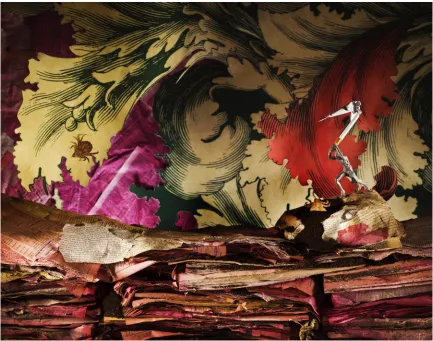
Da Vinci Battles Celestial Fossil Matter (fig. 3.4) incorporates ornate gift
background. This background was then partially cutout and raised away from the back wall of the set to create a three-dimensional sense of wind carrying a single tick on its gale, bringing the background into the foreground strata on which Da Vinci is standing. The foreground is made of phone books soaked in red wine, coffee and clothing dye and stacked in a way that shows the viewer the saturated edges of the paper.
[image:33.612.108.541.71.412.2]Although at first notice a viewer would not recognize the strata as piles of phone books, it was important that the viewer could know that the strata was made of some kind of book, a vessel of knowledge. In this piece the book works as a symbolic foundation (physical and metaphorical) that Da Vinci uses for
support against his enemy of false pseudo-scientifically influenced knowledge handed down by the Catholic church. One section of the foreground book page strata is exposed to the viewer and can be partially read, containing background
information about diseases and their treatments from a Diseases of Cattle12
farmer’s handbook. My overall goal was to portray the institution of religion as a parasite on reason and scientific rigor.
The larger goal throughout the work is to set up opposing spheres of thought against one another in each tableau, either by creating a sense
of seriousness or levity about the actions unfolding before the camera lens.
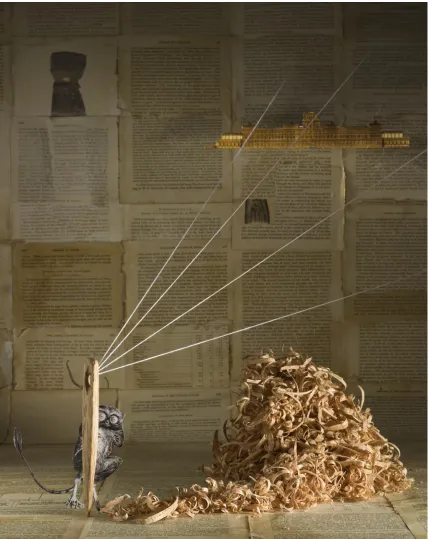
Will You Travel Through The Eye Of A Needle? (fig. 3.5), prods at the story of
“Matthew 19:24” from the New Testament. This passage states “And again I say onto you, It is easier for a camel to go through the eye of a needle, than for a rich
man to enter into the kingdom of God.”13 The following scripture questions this
happening by the prophets, and God’s reply is “For mortals it is impossible, but for God all things are possible.” The message I read from this passage is that anything is possible, but I do not need the Bible to tell me this. Moreover, this allegory is positioned in such a way that imposes an authority that only God can achieve.
The action of the small primate carving the needle alludes to my
questioning as to who created this story. The fearful prophets? A primate from the animal kingdom? Most important, how pertinent is this? A story of this magnitude with such strong visual representation could either drive a child into
fear or toward an unattainable goal of trying to be as powerful as God. For me the implied allegorical message was lost in the translation of biblical text, because of the recollection of my childhood reaction and how I now understand this as an adult. My illustration of this story prods at a reverse evolution in humans that are reduced to investing so much time and effort into a fictional story as though it should be something to teach morals about material wealth. These morals have merit, however, the manner in which they are told in the Bible personally translated to a more fearful depiction of God instead of an admiration. The ongoing question I have asked myself for the past year in making this work is: Why are humans so dependent on religion and/or scientific reason to dictate the manner in which they conduct their lives? This rhetorical question permeates my standpoint on religion and science. These spheres of thought interact in a confusing manner to distract the masses from living simply in concert with others, and produces more philosophical and theological division rather than unity.
Chapter IV: Action and Internalization of the Text
The implication that each tableau is engaged in an action unfolding from a narrative, brings the images out of a dormant stillness and makes the impact
of the work more dynamic. In defining tableau14 in reference to this work, I found
that in creating my versions of these stories it was necessary to make the still-life
construction imply an action in order to transmit my version of the narrative to the viewer. In this work characters look back at the viewer, as though the viewer is interrupting the scene as it unfolds. The characters are breaking the “fourth wall,” or disrupting the suspension of disbelief of the fictive story on stage, as viewers watch them perform. Their posed gestures and eye contact with the viewer, acknowledge their fictive performance. In Will You Travel Through The Eye
Of A Needle? (fig. 3.5) a small lemur stares back at the viewer, standing behind his
creation of a large wooden needle. Evidential of his creation is a large mound of wood trailing off from the base of the needle.
The question I propose to the viewer is: how could a flat paper cutout carve a wooden needle? The hand of the artist or some other intervening force could be the only logical answer. The overt fabrication of the tableau and the act of creation of the needle within the tableau intentionally evoke the action implied tension of the tableau vivant. The static nature of the paper cutouts work against the implication of movement, while other elements connected to the act occurring are revealed to the viewer. The inexact placement of “who did what” in the tableau emulates the uncertainty of who exactly authored the Biblical text.
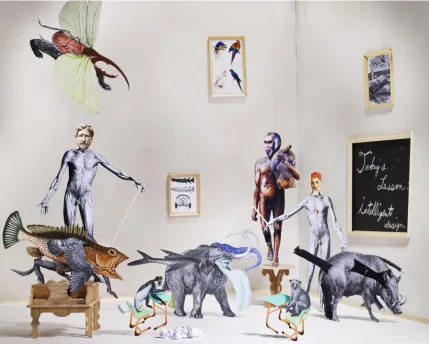
Erik Jarvik and Pope Urban The III Compete In The Classroom To Teach Evolution (fig. 4.1) shows two small primates at the back of a classroom
to myself “who is fooling who” and then with this thought in mind, I seek to invert the topic with a sense of levity.
[image:38.612.110.539.72.416.2]The characters in each set act as instigators in a long standing story gone amiss, with a questionable authenticity to the believability of that story. These interpretations prod the very notion that all stories, even those scientifically based find certain roots in fiction and are the culmination of previous thoughts and texts. Julia Kristeva’s three fold dimension of a text, the writer, addressee and cultural context, manifests intertextuality15 as a basis for a text to supersede a singular viewpoint from either the reader, writer or cultural platform. Texts
are dialogical in nature, the words on the page are recognized as an intersection with other words and their meanings between reader, writer and the cultural backgrounds of each. Intertextuality of a text in this work is the stitching of various renditions of a singular literary story into my singular visual representation. In making this work I am not only being highly selective of each individual story, but the characters by which I choose to emphasize my viewpoint. Their intertextuality is a culmination of my viewpoint of the story colliding with the original text and academic insight from others about the text. In this combining quality of the tableau, characters are posed in each scenario as though they are actors on set. Paper cutouts and their function in collage as the marriage of heterogeneous components form a new relationship within my creation of each tableau. This new relationship is a reflection of my play within the story. The paper cutouts act as a stand in for the original character in the story, stripped from their original connotation and placed into my act of play.
subject matter, explodes the cohesion of logical storytelling. As elements are torn from meaning and re-purposed in the unconscious canvas, the story becomes perverted, rambunctious and nonsensical. This is similar to my replacement of characters and deviation from original texts in my interpretative storytelling process. The influence of surrealist collage to re-purpose existing social codes and symbols to form new meanings parallels my use of cutout material that subverts the original characters of the text to form new renditions of existing stories.
The natural history scholar Stephen Jay Gould writes essays on many topics related to natural history and the myths that have been uncovered throughout the 20th century. His stories, vastly entertaining in rich empirical fact, carry with them supplemental, and many times anecdotal information that carry the reader through an entertaining passage of information. The work is simultaneously fictive and factual, enlightening and opinionated. This writing method translates a construct of historical time into human time through the narrative process.
Gould’s stories are digested through a reader’s building of the events through their own perspective of time, relative to themselves and their
Scientific stories, although founded on empirical thought, upon occasion are passed through generations by storytelling conventions that merge fact with fiction and accounts of the real with myth. Da Vinci Battles Celestial Fossil
Matter (fig. 3.4) came to realization after reading a story by Gould on the topic
of Leonardo da Vinci’s studies about the formation of fossil matter. Renaissance scientists, in an act of self-preservation from Vatican influence conjured up the notion that fossils were mimetic impressions of nature formed by celestial matter descending from the heavens. The power of the Vatican influenced scientists to mix truth with fiction to secure the teachings of Christianity and to promote God’s dominion over all traces of living matter. Da Vinci, in disagreement with this theory, studied the ebb and flow of riverbeds and concluded that fossils are the result of biological remains that become pressurized in sedimentary rock. Of course, this is what scientists conclude today. However, fueled by the pressures of the church, I find it believable to think that scientists actually concluded that fossil matter was the result of celestial intervention.
is illustrated through my own experience that I bring to the story and actively engages my perspective of knowledge.
Da Vinci produced many dogmatic works throughout his life, however firmly held his ground in regard to his scientific theories and inventions. Here we have an individual simultaneously painting renditions of the “Last Supper” while inventing war devices and debunking many pseudo-scientific notions of the time. Thus, Da Vinci Battles Celestial Fossil Matter (fig. 3.4) illustrates Da Vinci standing on a rock formation constructed from pages of a book titled “Diseases of Cattle” from a 1912 handbook for farmers treating diseased livestock. Da Vinci holds above his head a circle compass as he motions to thrust downward onto a tick, my symbol for the celestial matter that according to Gould’s story is the source of all fossil matter. In my work, Gould’s recapitulation of Da Vinci’s rigor in the field of natural sciences is personified by the tick as celestial matter, my symbol for the enduring antagonist falling from the sky and attacking Da Vinci standing upon knowledge of the parasite in which he wards off. Da Vinci Battles
Celestial Fossil Matter (fig. 3.4) is a personification of Gould’s story as I imagined it
while reading his engaging text. My rendition of the story creates a protagonist/ antagonist relationship between Da Vinci and the celestial matter, one that may or may not have actually existed, however one which I have created through my internalization of the narrative.
Anecdotes relate to a narrative anthropology that deconstructs the narrative
fact and measured time become obstructed by memory and recollection of events from the past. A personal narrativity refers in this work to the stories I have constructed about myself as I manage to understand, deconstruct and internalize the stories I have selected to represent in this body of work.
Inevitably, the actions of the narrative are being performed by animals, specifically primates, an evolutionary predecessor to humans. This move is to de-evolve the notion of the weight empowered onto the narrative, prodding at the actions sometimes taken in the guise of being “in the name of religion” or in the “discovery of science.” Working previously with paper cutouts on two-dimensional surfaces, in this work I have explored the manner in which cutouts work in three-dimensional space. These cutouts are purposeful surrogates of any mimetic quality to re-creating a naturalistic rendition of my characters. They allude to their own transient existence. For me the paper cutouts represent the slippage in memory where an impressionable moment is quickly remembered and dismissed.
Chapter V: Anecdotes Installed and Concluding Thoughts
layers of paint. The work reveals unique handwork and a sense of detail in construction that references my presence in the act of creating the photographic image. Furthermore, the detail of cutout elements and overall maximal filling of space with patterns and line work is emulative of ornate Renaissance design. Ortega y Gassert references the frame as a “neutral object” that “limits itself to
concentrating attention and making it spill out onto the picture.”16 The frame
as the “neutral object,” containing the image within, allows the image to meld visually with the surrounding environment. Gassert argues that this four-sided container becomes neutral when it emulates the formal qualities of the image within, striving to erase the separation between the image it displays and the environment of the gallery. The gilded frame draws attention to its contents by finishing the hard, linear and unfinished edges of the image. This quality of the frame allows the image held within to flow outward onto the gallery wall.
Anecdotes presented in gilded, ornate frames, re-contextualizes the tradition of
the painter’s frame. The idea is to deconstruct the naturalistic illusion of the narrative painting itself. Placing my renditions of these narratives into traditional ornate frames simultaneously appropriates the concept of the singular painting as a unique object, while dismissing this notion entirely with the discovery of the reproducible photographic image.
The Polyhedron Carried Away By The Pest Of Logic (fig. 5.2), stems from a
personal dialogue with the creative process and framing this experience into the intellectual structure of academia. In the creative process of making Anecdotes, I approached the building of each work as an allocation of building materials and conceptual parameters which enabled my intuition and pre-production thoughts to merge. I am thinking before and after creating a work, but rarely during the act of making. Before and after completion of the work I am engaged in thought processes with myself. During the act of creating I am in dialogue
with the work. Wu hsin17, the Chinese acknowledgement of “no mindedness”
[image:46.612.131.519.72.336.2]occurs during the creative process. “No mind” translates to me as not over-thinking a work and trusting the forethought and path I have chosen for each
visual representation. Polyhedron Of Creativity Carried Away By The Pest Of Logic is a visual representation of this process wherein the pre-thought and post-thought processes of logic are confronted by the ephemeral creative present in which the excitement of play are manifested into the end-point of a visual work. The five-sided polyhedron head in the foreground represents me engaged in the creative process. Dragged away by the bumble bee of logic, I am in persistent conflict with the intellectual articulation of my creative process.
[image:47.612.110.539.72.376.2]The images presented in Anecdotes are all a direct reflection of this conflict. A conflict with the story and its gravity imbued on the childhood imagination, that conjures up notions of fear and escape from the grim realities of everyday temptation. This work is my most personal and is the genesis of producing more works which will be based upon an inner-narrative that does not necessarily
adhere to the confines of a pre-existing story. I envision the production of new work that is a more lucid representation of my present sentiments about life. I will create new characters that will include friends and family, that are illustrative of conversations about collective fears, ambitions and thoughts on the present and future. The concepts underpinning Anecdotes provides a substrate which held, revealed and expressed my relationship with nostalgia for, and general conflict with, the past. I foresee the continuation of the work presented as a manifestation of present and future ambitions, fears, misconceptions, parodies and dialogues lost in translation between myself and the other.
The notion of Anecdotes was to embody scientific, theological and self-created stories as visual creations of pre-existing texts. What I am most concerned with is transmitting to the audience a sense of play involved in the work.
The response to the work has satisfied these expectations. Viewers perceived the general ideologies behind each story within the image and enjoyed the playfulness of the work. I am elated in my ability to visually communicate texts, however, I also enjoy the fact that audiences can imbue an infinite number of different readings into each work. Visually transmitting the exact narrative, although important, is perhaps secondary to evoking the act of play and sense of wonder as I work and when these images are viewed.
a whimsical speculation of what could be the demise of toys, Toymonger depicts the tableau vivant filled with three-dimensional toy characters in post-apocalyptic environments. Anecdotes, working with pre-existing narratives, and the use of two-dimensional cutouts to reveal the fabrication of the story, shows the interchangeability of characters and subversion of the story to revive a personal connection back to the original text. On exhibit together, Anecdotes and
Toymonger provided the viewer with two different and unique approaches to the
constructed image, making the overall experience of each body of work more playful and exciting.
Selected Bibliography
Adamowicz, Elza. Surrealist Collage in Text and Image: Dissecting the Exquisite
Corpse. New York: Cambridge University Press, 1998.
Atkinson, Vickers T. Special Report on Diseases of Cattle (Washington: Government Printing Office, 1912)
Baas, Jacquelynn and Mary Jane Jacob, ed. Buddha Mind in Contemporary Art. Berkeley: University of California Press, 2004.
Barthes, Roland. Mythologies. New York: Hill & Wang, 1972.
Barthes, Roland. S/Z. New York: Hill & Wang, 1974.
Becker, Carol. Nowhere From Here: Contemporary Art and Buddhism. Los Angeles: University of California Press, 2004.
Davis, Keith F., Naomi Lyons & April Watson. Frederick Sommer: Photography,
Drawing, Collage. Ostfildern, Germany: Yale University Press, 2005.
Ernst, Max. Une Semaine De Bonté. New York: Dover Publications, 1976.
Gould, Stephen Jay. Leonardo’s Mountain of Clams and the Diet of Worms. New York: Harmony Books, 1998.
Gould, Stephen Jay. The Lying Stones of Marrakech. New York: Harmony Books, 2000.
Greaney, Michael. Conrad, Language and Narrative. New York: Cambridge University Press, 2002.
Hartigan, Lynda Roscoe. Joseph Cornell: Navigating The Imagination. New Haven: Smithsonian American Art Museum, Yale University Press, 2007.
Hedgehog in the Fog. Color Animated film. Directed by Yuri Norstein, Written by
Sergei Kozlov. Russia: Soyuzmultfilm, 1975.
Impey, Oliver. The Origin of Museums. Oxford: Clarendon Press, 1984.
Kennedy, Randy. 2005. Need Talent to Exhibit in Museums? Not This Prankster. New York Times Online, http://www.nytimes.com/2005/03/24/arts/ design/24arti.html (accessed Apr. 15th 2009).
Kristeva, Julia. The Kristeva Reader edited by Toril Moi. New York: Columbia Univeristy Press, 1986.
Linfert, Carl. Hieronymus Bosch. New York: Harry N. Abrams Inc, 1972.
Lyotrad, Jean-François. The Postmodern Condition: A Report on Knowledge. Minnesota: University of Minnesota Press, 1991.
McConnell, Frank. The Bible and the Narrative Tradition. New York: Oxford University Press, 1986.
Mcquillan, Martin. The Narrative Reader. New York: Routledge, 2000.
Plato. The Republic, trans Benjamin Jowett. 360 BCE, Book VII
Prickett, Stephen. Narrative, Religion, and Science: Fundamentalism Versus
Irony, 1700-1999. Port Chester: Cambridge University Press, 2002.
Ricoeur, Paul. Time and Narrative Vol. 1. Chicago: University of Chicago Press, 1984.
Rorty, Richard. Contingency, irony and solidarity. New York: Cambridge University Press, 1989.
Schmidt, Victor M., ed. Italian Panel Painting of the Duecento and Trecento. Washington DC: National Gallery of Art, 2002.
Stafford, Barbara M. and Frances Terpak. Devices of Wonder: From the World in a
Box to Images on a Screen. Los Angeles: Getty Publications, 2001.