Open Access
Research
Polymorphism patterns in Duffy-binding protein among Thai
Plasmodium vivax
isolates
Panita Gosi
1,2, Srisin Khusmith*
1, Thareerat Khalambaheti
1, David E Lanar
3,
Kurt E Schaecher
2, Mark M Fukuda
2and Scott R Miller
3Address: 1Department of Microbiology and Immunology, Faculty of Tropical Medicine, Mahidol University, 420/6 Rajvithi Road, Bangkok 10400,
Thailand, 2Department of Immunology and Medicine, Armed Forces Research Institute of Medical Science-United States Army
MilitaryComponent, Bangkok, Thailand and 3Walter Reed Army Institute forResearch, Washington, District of Columbia, USA
Email: Panita Gosi - [email protected]; Srisin Khusmith* - [email protected]; Thareerat Khalambaheti - [email protected]; David E Lanar - [email protected]; Kurt E Schaecher - [email protected]; Mark M Fukuda - [email protected]; Scott R Miller - [email protected]
* Corresponding author
Abstract
Background: The Duffy-binding protein II of Plasmodium vivax (PvDBPII) has been considered as an attractive target for vaccine-mediated immunity despite a possible highly polymorphic nature. Among seven PvDBP domains, domain II has been shown to exhibit a high rate of nonsynonymous polymorphism, which has been suggested to be a potential immune (antibody binding) evasion mechanism. This study aimed to determine the extent of genetic polymorphisms and positive natural selection at domain II of the PvDBP gene among a sampling of Thai P. vivax isolates.
Methods: The PvDBPII gene was PCR amplified and the patterns of polymorphisms were characterized from 30 Thai P. vivax isolates using DNA cloning and sequencing. Phylogenetic analysis of the sequences and positive selection were done using DnaSP ver 4.0 and MEGA ver 4.0 packages.
Results: This study demonstrated a high rate of nonsynonymous polymorphism. Using Sal I as the reference strain, a total of 30 point-mutations were observed in the PvDBPII gene among the set of Thai P. vivax isolates, of which 25 nonsynonymous and five synonymous were found. The highest frequency of polymorphism was found in five variant amino acids (residues D384G, R390H, L424I, W437R, I503K) with the variant L424I having the highest frequency. The difference between the rates of nonsynonymous and synonymous mutations estimated by the Nei and Gojobori's method suggested that PvDBPII antigen appears to be under selective pressure. Phylogenetic analysis of
PvDBPII Thai P. vivax isolates to others found internationally demonstrated six distinct allele groups. Allele groups 4 and 6 were unique to Thailand.
Conclusion: Polymorphisms within PvDBPII indicated that Thai vivax malaria parasites are genetically diverse. Phylogenetic analysis of DNA sequences using the Neighbour-Joining method demonstrated that Thai isolates shared distinct alleles with P. vivax isolates from different geographical areas. The study reported here will be valuable for the development of PvDBPII-based malaria vaccine.
Published: 26 June 2008
Malaria Journal 2008, 7:112 doi:10.1186/1475-2875-7-112
Received: 8 February 2008 Accepted: 26 June 2008
This article is available from: http://www.malariajournal.com/content/7/1/112
© 2008 Gosi et al; licensee BioMed Central Ltd.
Background
Molecular mechanisms of invasion by Plasmodium vivax
merozoites are mediated by the Duffy-binding-like (DBL) family of homologous erythrocyte binding protein (EBPs) located within the micronemes of merozoites that recog-nize specific receptors on red blood cell [1]. PvDBP is a 140-kDa protein belonging to a family of erythrocyte binding proteins characterized by a functionally con-served cysteine-rich region. The similarity among DBL families of EBPs is the greatest within two adjacent rich domains, designated as the amino cysteine-rich domain (N-cys) and carboxyl cysteine-cysteine-rich domain (C-cys) [2]. The amino cysteine-rich domain has been identified as the principle adhesion region binding to erythrocyte receptors, while the function of the carboxyl cysteine-rich domain remains unclear. This amino-cysteine-rich domain is present within the 330 amino acid region II, which has been shown to contain the binding motifs necessary for adherence to the Duffy antigen recep-tor for chemokines (DARC), required for erythrocyte inva-sion [3]. Critical binding motifs in PvDBPII have been mapped to a 170 amino acid spanning region between cysteines 4 and 7 (amino acids 291–460) [4]. Cysteine residues are conserved within the identified binding motif, whereas other amino acids are highly polymorphic, having a high ratio of nonsynonymous to synonymous mutations [5].
The polymorphic nature of the PvDBP, particularly its region II (DBPII) is a major impediment to the develop-ment of a broadly protective vaccine against vivax malaria. A study in Papua New Guinea showed 43 and 18 unique nonsynonymous mutations in 10 Madang [6] and 24 Wosera vivax isolates [7], respectively, whereas 19 unique nonsynonymous mutations were described in 10 Colom-bian vivax isolates [8]. Often the mutations were found in corresponding locations in the protein sequence of iso-lates from different geographical areas. Amino acids sub-stitutions at D384G, K386(N/Q), N417K, L424I, W437R, and I503K were found in both Papua New Guinea isolates and Colombia isolates [5-8]. Such results demonstrate that many similar alleles are widely distributed among P. vivax from different geographical areas. Polymorphic pat-terns in the PvDBP cluster within the critical erythrocyte-binding segment imply the existence of a selection pres-sure on PvDBP [9]. Under the influence of immune pres-sure, the distribution of existing antigenic polymorphisms affects the population structure in which newly selected mutants spread and may provide insight to the evolution and selection of parasite populations over time [10]. Pol-ymorphisms of PvDBPII require further exploration among vivax isolates from different geographic areas, par-ticularly south-east Asia where a large proportion of vivax infections take place. Therefore, the gene polymorphisms
within the region II domain of the P. vivax DBP among Thai P. vivax isolates were investigated.
Methods
P. vivax samples and DNA preparation
Plasmodium vivax isolates were obtained from malaria
patients with informed consent at the outpatient clinic, Hospital for Tropical Diseases, Faculty of Tropical Medi-cine, Mahidol University, Bangkok, from May, 2002 to June, 2003 under a protocol approval by the Ethics Com-mittee, Faculty of Tropical Medicine, Mahidol University. The confirmation of P. vivax infection was done by micro-scopic examination of the parasites in thick and thin blood smears. Approximately 1 ml of venous blood was collected from each individual in 0.5 M ethylene-diamine tetra-acetic acid (EDTA) tubes and kept at -20°C until use. Genomic DNA was extracted from 200 μl of blood using a High Pure PCR Template Preparation Kit (Roche, Man-nhein, Germany) according to the manufacturer's proto-col.
Genotyping of P. vivax isolates at the PvDBPII locus
P. vivax DBPII gene was amplified by PCR using the oligo-nucleotide primers, DBPII-F; 5'-CACCACGATCTCTAGT-GCTATTATA-3' and DBPII-R; 5'-TGTCACAACTTCCTGAG TATT-3' [11]. PCR cycling conditions were 94°C for 3 min, 55°C for 1 min, and 72°C for 1 min for 35 cycles fol-lowed by a 10 min extension at 72°C. PCR products were stained with 0.1 μg/ml ethidium bromide and visualized by digital photography under ultraviolet light. The PCR products were run adjacently to 0.1 μg/lane of a 2-log DNA ladder (NewEngland BioLabs, Inc. MA, USA) as a standard DNA marker.
Purification of PCR products, DNA cloning and DNA sequencing of PvDBPII gene
Analysis of PvDBPII gene sequences
The alignment of complete sequences of 30 PvDBPII genes was analysed by Sequencher ver 4.2 software (Gene Code Corporation, Ann Arbor, MI) [12,13]. Sequences were aligned using CLUSTALX Multiple Sequence Alignment Program developed by the National Center for Biotech-nology Information (NCBI, Bethesda, MD). The percent similarity was assessed using BLASTN (NCBI, Bethesda, MD) and BioEdit ver 7.0 software (Tom Hall Isis Thera-peutics, Isis Pharmaceuticals, CA), DnaSP ver 4.0 [14] and MEGA ver 4.0 Beta program [15].
Analysis of natural selection
Evidence of positive natural selection was determined by comparing the rate of nonsynonymous and synonymous substitutions in region II of the P. vivax DBP gene. The rates of substitutions were estimated using the Nei and Gojobori's method [16] with the Jukes and Cantor correc-tion [17,18] as implemented in the MEGA program. Standard error was determined by 1000 bootstrap replica-tions. Negative selection acting on most coding genes can be identified typically when the rate on nonsynonymous mutations is less than the rate of synonymous mutations (kn <Ks). However, when positive selection is acting on a gene, the rate of nonsynonymous mutations will exceed that of synonymous mutations (kn > Ks). Two other tests of neutrality were performed by Tajima's D test, Fu and Li's D- and F-tests on DnaSP 4 software using P. knowlesi
DBP as an outgroup. Tajima's D test compares the estima-tion of nucleotide diversity calculated in two ways (θ cal-culated from the number of segregating sites and π calculated from average pairwise nucleotide diversity) in order to test for a departure from neutrality. Fu and Li's D
and F test, departures from neutrality are identified as a deviation between estimates of θ (derived from the number of mutations in external branches of the phylog-eny and from the total number of mutations giving the index D or from the average pairwise diversity π giving the index F) [19].
Phylogenetic analysis
Phylogenetic analysis was used to investigate the associa-tions of PvDBPII gene with sequences elucidated from
dif-ferent geographical regions. The gene tree was constructed using regions common to all available PvDBPII
sequences. Forty five PvDBPII genes sequences found in GenBank were compiled and compared to Thai isolates including the sequences from a reference strain, Sal I, one individual sequence from Vietnam, Indonesia, Brazil and India as well as 2, 3, 3 and 31 sequences from Bangladesh, Colombia (COL), South Korea (SK) and Papua New Guinea (PNG), respectively (Table 1). A phylogenetic tree was derived from the aligned nucleotide sequences using the Neighbour-Joining (NJ) method with 1000 bootstrap replicates, the Tamura's three-parameter distance model as implemented in the MEGA ver 4.0 Beta program [20].
Results
PCR products and genetic polymorphisms of PvDBPII
gene among Thai isolates
The PCR amplification of the P. vivax DBPII gene from 30 Thai isolates yielded DNA fragments of approximately 990 base pairs in length (Figure 1). A 900 bp was selected after excluding primer regions and adjacent bases which did not give uniformly reliable sequences. DNA analysis in comparison to the PvDBP gene of Sal I reference strain revealed amino acid polymorphisms across the entire domain II of PvDBP protein (300 amino acids) among Thai isolates. Among the 30 polymorphic sites, 29 showed monomorphic mutation (changed into one amino acid-type) and only a position 386(N/Q) showed dimorphic mutation (changed into two amino acid-types) (Table 2). Among 300 amino acids within PvDBPII, 25 nonsynonymous (representing 83% of all isolates) and five synonymous mutations were identified (Table 2). High frequencies of variant amino acids (>50%) were found and included L424I (86%), D384G (76%), W437R (63%), R390H (56%), and I503K (56%) residue poly-morphisms.
[image:3.612.54.553.615.729.2]Based on the variation of nonsynonymous mutations and in comparison to Sal I the Thai haplotyes were designated as TA (TA1-TA25). TA1, TA5 and TA11 haplotypes were identified in two isolates while TA17 was identified in three isolates. The other 21 haplotypes were identified in single isolates (Table 3). The cluster analysis of PvDBPII
Table 1: PvDBPII sequences deposited in GenBank used in the study
species locality GenBank accession number
P. vivax Papua New Guinea AF289480–289653, AF469522–469602, AY970848–970925, AF291096, AF695565, DQ156519
P. vivax Colombia AY341907, DQ156513, AY341899
P. vivax Korea AF215737, AF215738, DQ156523
P. vivax India DQ156514
P. vivax Brazil DQ153520
P. vivax Vietnam DQ156518
P. vivax Indonesia DQ156521
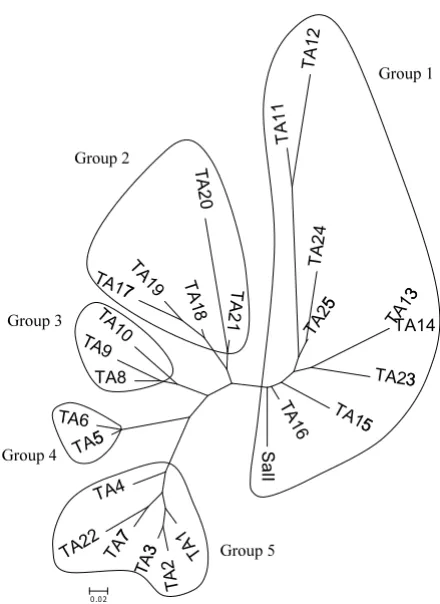
amino acid sequences among 25 haplotypes based on Neighbour-Joining method was organized into five main groups (Figure 2).
Evidence of natural selection
To investigate whether natural selection contributed to generation of this diversity, the ratio of nonsynonymous (Kn) to synonymous substitutions (Ks) was compared between Thai and Sal I isolates. The number of nonsynon-ymous substitutions per nonsynonnonsynon-ymous sites (Kn)
(0.00956) exceeded the number of synonymous substitu-tions per synonymous sites (Ks) (0.00754). The Kn/Ks
ratio was 1.270 predicting that positive selection may be occurring in region II of DBP favouring the fixation of amino acid replacement in certain areas of the protein. The statistic tests detecting departure from neutrality showed evidence that the observed polymorphism might be trending natural selection. Tajima's D value was -0.084549 with P > 0.10. The Fu and Li, D and F values
were -0.92031 with P > 0.10 and -0.7654 with P > 0.10, respectively.
Phylogenetic tree of PvDBPII
Phylogenetic tree analysis of DNA sequences derived from region II of the P. vivax DBP constructs based on the Neighbour-Joining method using Tamura's three-parame-ter distance is shown in Figure 3. Variation of DNA sequence was categorized into nine distinct alleles groups. Thai isolates were widely distributed amongst groups 1, 3, 5 and 7 also containing isolates from different geographi-cal regions. PvDBPII DNA sequence of Thai isolates was related to isolates sets from Papua New Guinea and India (group 1), Korea (group 3), Colombia (group 5) and a second Papua New Guinea set (group 7). The Sal I refer-ence strain used in this study was included in group 2 composed of isolates from Colombia, Korea, Bangladesh, Indonesia, and Vietnam, but bootstrap analysis demon-strated that the Thai isolates were distinct from this group. Most isolates from Papua New Guinea formed a distinc-tive group comprised of 8 and 9.
Discussion
The process invasion into erythrocyte is essential for sur-vival of P. vivax parasite and requires DBP to bind the Duffy blood group antigen that act as erythrocyte recep-tor, Duffy antigen receptor for chemokines (DARC).
Plas-modium vivax utilizes genetic diversity of individual
[image:4.612.51.561.98.293.2]functional proteins to evade the host immune system and resist many anti-malarial drugs [21]. In this study, poly-morphisms and natural selection was assessed and sug-gested positive natural selection in PvDBPII of Thai isolates. Although, non significant could be observed trending positive selection. As this is only a glimpse at the Table 2: Amino acid changes found in PvDBPII gene among 30 Thai isolates, comparing to DBP Sal I sequence.
Position of the amino acid Ќ
268 276 281 306 308 333 351 367 371 375 378 384 385 386 390 SalI CGT AAC GTT TTT AGG CTT AGT ATC AAA AAT CGC GAT GAA AAG CGT Thai AGT AAT GTA TTG AGT TTT TGT ACC GAA GAT CGT GGT AAA AAT/CAG CAT
SalI R N V F R L S I K N R D E K R
Thai S N V L S F C T E D R G K N/Q H
a (1/30) (1/30) (1/30) (2/30) (8/30) (14/30) (1/30) (2/30) (6/30) (7/30) (30/30) (23/30) (14/30) (13/30) (17/30)
b 3 3 3 6 26 46 3 6 20 23 100 76 46 43 56
Position of the amino acid
398 404 417 419 424 433 436 437 447 464 475 486 503 507 513 Sal I TCT ACA AAT ATA TTA CAG AGA TGG TCA ATC CCA CAA ATA AAC ACG Thai ACT AGA AAA ATG ATA AAG ACA CGG TCC ATA GCA GAA AAA CAC AAG
Sal I S T N I L Q R W S I P Q I N T
Thai T R K M I K T R S I A E K H K
a (3/30) (3/30) (11/30) (1/30) (26/30) (1/30) (1/30) (19/30) (1/30) (1/30) (3/30) (2/30) (17/30) (1/30) (1/30)
b 10 10 36 3 86 3 3 63 3 3 10 6 56 3 3
a Showing the detection frequency of each amino acids variant on PvDBPII protein among 30 Thai isolates. b Percentage of detection frequency calculated from value in panel "a".
High prevalence (>50%) of variant amino acids.
Ќ Dimorphic mutation (changed into two amino acid-types)
Schematic diagram of PvDBPII gene showing the location of the primers
Figure 1
Schematic diagram of PvDBPII gene showing the location of the primers.
[image:4.612.70.289.587.676.2]overall population, a wide range study including more subjects from different areas of Thailand would give a more detailed picture.
Analysis of 300 amino acids of PvDBPII protein relative to the Sal I reference strain, resulted in 25 nonsynonymous mutations being found. In addition, 142 nonsynonymous mutations were reported in 76 Papua New Guinea isolates [22]. The nonsynonymous mutations in PvDBPII might have an effect on parasite binding to erythrocyte receptors. Nonsynonymous mutations often times result in amino acid substitutions that alter charge and therefore host immune/antibody recognition [6]. Thus, excessive stable polymorphism generation within the PvDBPII ligand domain from high rate of nonsynonymous polymor-phisms may promote the parasite escape of host immune response [9].
The high frequency (>50%) of L424I (86%), D384G (76%), W437R (63%), R390H (56%), and I503K (56%) residues were found in Thai isolates relative to Sal I PvDBP
[image:5.612.54.553.99.330.2]sequence. The finding is in contrast to previous studies showing R308S (67%), D384G (66%), and S447K (59%) in Papua New Guinea, D384G (59%) in Colombia and D384G (85%) in Brazil isolates [23]. Of the following var-iants N417K, W437R and I503K, all having been shown to be involved in evasion to antibody neutralization, var-iant N417K was found in low frequency (36%) while W437R and I503K were high (63% and 56% respectively) in Thai isolates. These results were different from what has been currently reported in that the low frequencies of var-iants N417K (27.5%) and W437R (27.5%) and the high Table 3: PvDBPII haplotypes observed among 30 Thai isolates.
Haplotype name Amino acid haplotype* No. of isolate observed (%)
TA 1 RFRFSIKDGKNHSTKIIQRRPQKNT 2(6.6)
TA 2 RFSFSIKDGKNHSTKIIQRRPQKNT 1(3.3)
TA3 RFSFSIKDGKKHSTKIIQRRPQKNT 1(3.3)
TA 4 RFRLSIKDGKNHSTKIIQRRPQKNT 1(3.3)
TA 5 RFRFSIENGKNRSTNIIQRRPQINT 2(6.6)
TA6 RFRFSIENGKNRSTKIIQRRPQINT 1(3.3)
TA 7 RFSFSIKDGKNHSTNIIQRRPQINT 1(3.3)
TA 8 RFRLSIENGEKHSTKIIQRRPQKNT 1(3.3)
TA 9 RFRLSIENGEQRSTKIIQRRPQKNT 1(3.3)
TA 10 RFRLSIENGEKRSTKMIQRRPQINT 1(3.3)
TA 11 RLSLLSIKNGKNHTRNIIQRWPQINT 2(6.6)
TA 12 SFSLSIKNGKNHTRNIQRWPEINT 1(3.3)
TA 13 RFRLSTKNGEKHSTNIIQRWPQKHT 1(3.3)
TA 14 RFRLSTKNGEKHSTNIIQRWPQKHT 1(3.3)
TA 15 RFSLSIKNGEKRSTNIIQRWPQKNT 1(3.3)
TA 16 RFRLSIKNGEKRSTNIIQRWPQINT 1(3.3)
TA 17 RFRFSIKNDEKRSTNIIQRRAQKNT 3(10)
TA 18 RFRLSIKNDEKRSTNIIQRRPQKNT 1(3.3)
TA19 RFRFSIKNDKKRSTNIIQRRPQKNT 1(3.3)
TA 20 RFRLSIKNDKKRSTKIIKTRPQINT 1(3.3)
TA 21 RFRLSIKNDKKRSTNIIQRWPQINT 1(3.3)
TA 22 RFSFSIKDGKNHSTNILQRRPQKNT 1(3.3)
TA23 RFRLSIKNGEKHSTNILQRWPQKNK 1(3.3)
TA 24 RFRLCIKNGEKHSTNILQRWPEINT 1(3.3)
TA 25 RFRLSIKNGEKHSTNILQRWPQINT 1(3.3)
* Amino acid residues included in the haplotypes are as follows: 268, 306, 308, 333, 351, 367, 371, 375, 384, 385, 386, 390, 398, 404, 417, 419, 424, 433, 436, 437, 475, 486, 503, 507, 513.
Neighbour-Joining tree of PvDBPII amino acid sequence of 25 variants observed among 30 Thai isolates
Figure 2
Neighbour-Joining tree of PvDBPII amino acid sequence of 25 variants observed among 30 Thai isolates. The PvDBPII haplo-type for each variant could be seen in Table 3.
7$
7$
7$ 7$ 7$
7$ 7$
7$ 7$
7$7$
7$
7$ 7$
7$
7$
7$
7$
7$
7$ 7$
7$
7$
7$ 7$
6D
O,
*URXS
*URXS
*URXS
*URXS
[image:5.612.61.281.365.667.2]Phylogenetic tree of PvDBPII obtaining from Thai P. vivax isolates and other isolates from different geographical malaria endemic areas, i.e. PNG (Papua New Guinea), India, COL (Colombia), Korea, Bangladesh, Brazil, Indonesia, Vietnam, and Sal I
Figure 3
Phylogenetic tree of PvDBPII obtaining from Thai P. vivax isolates and other isolates from different geographical malaria endemic areas, i.e. PNG (Papua New Guinea), India, COL (Colombia), Korea, Bangladesh, Brazil, Indonesia, Vietnam, and Sal I. Numbers at nodes indicate percentage support of 1000 bootstrap replicates (bootstrap support values below 10 are not presented).
! " $ & ' " $ & ' ' ( $ ) *! + ! &! * . / 0 0 + ! &! * . / 0 0 + ) ! 1 & $ * . ! 2 * ! 3 . ! & . 4 ( 5 67 ' 00 ' ( 5 67 ' 00 '
0 ' ' ' " $ &
'' 0 0 0 ' 0' ' ' 0' ' 0 ' 0 ' ' 0 ' ' 0 0 ' 0' ' 0' ' 0 ' ' ' 0 ' 0 ' 0 ' 0 ' 0 ' ' 0 ' 0 0 ' 0 ' ' 0 ' '
*URXS
*URXS
*URXS
*URXS
*URXS
*URXS *URXS
*URXS
*URXS 89
:; <=
>@
< A = ; < =
>: >@
>CC 8= < ; 8< ;= = > = ; =;
:: = > >@
9
=
= > : : : ;
>C
99
:= < 8 = A
A< <@
< =
A@
A = =A >C
>C
>C A< <= >8
>A =9
A< <=
A= A@ ;9 <<
8@
A=
9
C
frequency of variant I503K (55%) found in Brazil and low frequencies of all three variants (N417K, W437R, I503K) found in either Colombia (47%, 18%, 12%, respectively) and/or Papua New Guinea (23%, 26%, 29%, respectively) (Table 4) [23]. N417K, W437R and I503K have recently been shown to not be directly involved in erythrocyte binding, but possibly in inhibition of antibody binding to erythrocyte receptor [24]. Moreover, the variant amino acid T404R was identified in PvDBPII domains of three Thai isolates (Table 2) which is similar to the recent data in Papua New Guinea [22]. Other Thai variants, namely R308S, K371E, D384G, E385K, N386(N/Q), R390H, T404R, N417K, L424I, W437R, S447S and I503K, were also found in isolates of other regions, demonstrating commonality with a progenitor clone (Table 4). The other 18 polymorphic residues of PvDBPII ligand domain were recognized only among Thai isolates, indicative of diver-gence from a progenitor clone.
The study showed that 25 PvDBPII haplotypes clustered into five main groups (dominant haplotypes) (Table 3) on the basis of nonsynonymous mutations is similar, but not entirely the same, with data from Papua New Guinea isolates whose 27 different PvDBPII haplotypes clustering into three dominant PvDBPII haplotypes. Potentially dominant PvDBPII haplotypes observed in these popula-tions could be less immunogenic, thereby may help pro-moting parasite success and escaping the host immune response [22].
Phylogenetic analysis of PvDBPII suggested that Thai iso-lates fell into 6 different alleles groups. Among these, group 1 formed a group with a subset of Papua New Guinea isolates. Groups 4 and 6 were unique among Thai
P. vivax isolates. However, the rest of the allele groups that Thai isolates fell into were more related to the isolates from Korea, India, and Colombia than from Papua New Guinea (Figure 3). The observations derived from the
PvDBPII phylogeny suggested that single Indian isolate found in group 1 appeared to share a common ancestor close to a subset of Thai and Papua New Guinea isolates, demonstrating common ancestoral origins. Thai and Papua New Guinea isolate subsets in group 7 also may have shared common ancestor heritage. Recently, it was
reported that travellers' malaria among foreigners at the Hospital for Tropical Diseases, Bangkok, Thailand includ-ing India and Papua New Guinea patients were though to have acquired their infections in their countries. Malaria importations from country to country can occur by either immigration or travel, and changing malaria attack rates in the countries of exposure are likely to influence the incidence of imported disease [25]. Additionally, these results demonstrated that there is some difference in the nucleotide or amino acid variation in PvDBPII among iso-lates from Thai, Korea, India, Papua New Guinea and Colombia, but most importantly, unique variants from Thailand do exist and should be considered in future vac-cine development of PvDBPII. It should be noted that the present highly diverse phylogenetic tree was constructed relying on polymorphisms within a single gene, demon-strating the high degree of topological variation that can be found using this technique, but also highlighting the problems that can be associated with gene sampling in phylogenetic studies [26]. Use of a combination of several genes with different rates of evolutions has been suggested as an efficient way to overcome this difficulty to prove the existence of a unique tree relating these sequences [27]. Finally, it must also be pointed out that in many situa-tions a single-gene phylogeny may be interesting in itself. Awareness of the problems of orthology (genes in differ-ent species that derive from a common ancestor) assign-ment and tree reconstruction artifacts should be considered.
Conclusion
[image:7.612.50.557.630.703.2]The results indicated that PvDBPII gene among Thai iso-lates is genetically diverse. Nonsynonymous polymor-phism in PvDBPII was the predominant result of which variant L424I showed the highest frequency (86%). Five dominant PvDBPII haplotypes could be clustered among Thai isolates. The high frequency of polymorphisms and the presence of distinct alleles within PvDBPII gene among P. vivax from different geographical areas could provide complication in malaria vaccine development, but should be considered important parts of the develop-ment process.
Table 4: Frequencies of the most common variant amino acids in PvDBPII, comparing to Sal I sequence (accession number M37519)
# R308S D384G K386N K386Q N417K L424I W437R S447K I503K
Thai 26 76 40 3 36 86 63 0 56
COL* 0 59 23 0 47 47 18 0 12
PNG* 67 66 8 11 23 34 26 59 29
Brazil* 12.5 85 12.5 0 27.5 32.5 27.5 0 55
* The frequencies of the common variant amino acid data were referable according to Sousa et al. 2006.
Publish with BioMed Central and every scientist can read your work free of charge "BioMed Central will be the most significant development for disseminating the results of biomedical researc h in our lifetime."
Sir Paul Nurse, Cancer Research UK
Your research papers will be:
available free of charge to the entire biomedical community
peer reviewed and published immediately upon acceptance
cited in PubMed and archived on PubMed Central
yours — you keep the copyright
Submit your manuscript here:
http://www.biomedcentral.com/info/publishing_adv.asp
BioMedcentral
List of abbreviations used
PvDBPII: Domain II of Plasmodium vivax DBP gene; DARC: Duffy antigen receptor for chemokines
Authors' contributions
SRM and SK designed the study, SK, MMF, SRM, KES, DEL and TK, were responsible for the supervision of the work, KES, TK, DEL, and PG were responsible for the sequences and phylogenetic analysis, SK, MMF, SRM, KES, DEL, TK, and PG drafted the manuscript. All authors read and approved the final manuscript.
Acknowledgements
We thank the patients for their kind participation in this study; staff of the Hospital for Tropical Diseases, Faculty of Tropical Medicine, Mahidol Uni-versity for their assistance in blood collection and COL Douglas S. Walsh, US Army Medical Research Unit-Kenya for his valuable guidance and com-ments. This study was supported by the United States Army Medical Research and Materiel Command, Fort Detrick, MD and Faculty of Tropical Medicine, Mahidol University.
Disclaimer
The views of the authors are solely there own, and do not reflect official opinion of the United States Army Medical Research and Materiel Com-mand or the Department of Defense.
References
1. Adams JH, Sim BK, Dolan SA, Fang X, Kaslow DC, Miller : A family of erythrocyte binding proteins of malaria parasites. Proc Natl Acad Sci USA 1992, 89:7085-7089.
2. Fang XD, Kaslow DC, Adams JH, Miller LH: Cloning of the Plasmo-dium vivax duffy receptor. Mol Biochem Parasitol 1991, 44:125-132. 3. Chitnis CE, Chaudhuri A, Horuk R, Pogo AO, Miller LH: The domain on the duffy blood group antigen for binding Plasmo-dium vivax and P. knowlesi malarial parasites to erythrocytes.
J Exp Med 1996, 184:1531-1536.
4. Ranjan A, Chitnis CE: Mapping regions containing binding resi-dues within functional domains of Plasmodium vivax and Plas-modium knowlesi erythrocyte-binding proteins. Proc Natl Acad Sci USA 1999, 96:14067-14072.
5. Tsuboi T, Kappe SH, al-Yaman F, Prickett MD, Alpers M, Adams JH:
Natural variation within the principal adhesion domain of the Plasmodium vivax duffy binding protein. Infect Immun 1994,
62:5581-5586.
6. Cole-Tobian JL, Cortes A, Baisor M, Kastens W, Xainli J, Bockarie M, Adams JH, King CL: Age-acquired immunity to a Plasmodium vivax invasion ligand, the duffy binding protein. J Infect Dis 2002, 186:531-539.
7. Xainli J, Adams JH, King CL: The erythrocyte binding motif of
Plasmodium vivax duffy binding protein is highly polymorphic and functionally conserved in isolates from Papua New Guinea. Mol Biochem Parasitol 2000, 111:253-260.
8. Ampudia E, Patarroyo MA, Patarroyo ME, Murillo LA: Genetic pol-ymorphism of the duffy receptor binding domain of Plasmo-dium vivax in Colombian wild isolates. Mol Biochem Parasitol 1996, 78:269-272.
9. Cole-tobian JL, King CL: Diversity and natural selection in Plas-modium vivax duffy binding protein gene. Mol Biochem Parasitol 2003, 127:121-132.
10. Rich SM, Hudson RR, Ayala FJ: Plasmodium falciparum antigenic diversity: evidence of clonal population structure. Proc Natl Acad Sci USA 1997, 94:13040-13045.
11. Dutta S, Daugherty JR, Ware LA, Lanar DE, Ockenhouse CF:
Expression, purification and characterization of a functional region of the Plasmodium vivax duffy binding protein. Mol Bio-chem Parasitol 2000, 109:179-184.
12. Tamura K: Estimation of the number of nucleotide substitu-tions when there are strong transition-transversion and G+C-content biases. Mol Biol Evol 1992, 9:678-687.
13. Tajima F: Statistical method for testing the neutral mutation hypothesis by DNA polymorphism. Genetics 1989, 123:585-595. 14. Rozas J, Sanchez-DelBarrio JC, Messeguer X, Rozas R: DnaSP, DNA polymorphism analyses by the coalescent and other meth-ods. Bioinformatics 2003, 19:2496-2497.
15. Kumar S, Tamura K, Nei M: MEGA3: Integrated software for molecular evolutionary genetics analysis and sequence align-ment. Brief Bioinform 2004, 5:150-163.
16. Nei M, Gojobori T: Simple methods for estimating the num-bers of synonymous and nonsynonymous nucleotide substi-tutions. Mol Biol Evol 1986, 3:418-426.
17. Jukes TH: The neutral theory of molecular evolution. Genetics 2000, 154:956-958.
18. Cantor CR, Fields CA: Genome sequencing conference. III: Evolution and progress. Genomics 1992, 12:419-420.
19. Fu YX, Li WH: Statistical tests of neutrality of mutations.
Genetics 1993, 133:693-709.
20. Hillis DM: Phylogenetic analysis. Curr Biol 1997, 7:R129-131. 21. VanBuskirk KM, Cole-Tobian JL, Baisor M, Sevova ES, Bockarie M,
King CL, Adams JH: Antigenic drift in the ligand domain of Plas-modium vivax duffy binding protein confers resistance to inhibitory antibodies. J Infect Dis 2004, 190:1556-1562.
22. Cole-Tobian JL, Michon P, Dobod E, Mueller I, King CL: Dynamics of asymptomatic Plasmodium vivax infections and duffy bind-ing protein polymorphisms in relation to parasitemia levels in Papua New Guinean children. Am J Trop Med Hyg 2007,
77:955-962.
23. Sousa TN, Ceravolo IP, Fontes CJF, Couto A, Carvalho LH, Brito CFA: The pattern of major polymorphisms in the duffy bind-ing protein ligand domain among Plasmodium vivax isolates from the Brazilian Amazon area. Mol Biochem Parasitol 2006,
146:251-254.
24. VanBuskirk KM, Sevova E, Adams JH: Conserved residues in the
Plasmodium vivax Duffy-binding protein ligand domain are critical for erythrocyte receptor recognition. Proc Natl Acad Sci USA 2004, 101:15754-15759.
25. Piyaphanee W, Krudsood S, Silachamroon U, Pornpininworakij K, Danwiwatdecha P, Chamnachanan S, Wilairatana P, Looareesuwan S:
Travelers' malaria among foreigners at the Hospital for Tropical Diseases, Bangkok, Thailand – a 6-year review (2000–2005). Korean J Parasitol 2006, 44:229-232.
26. Castresana J: Topological variation in single-gene phylogenetic trees. Genome Biol 2007, 8:216.