R E S E A R C H
Open Access
Agent-based modeling of malaria vectors:
the importance of spatial simulation
Arne Bomblies
Abstract
Background:The modeling of malaria vector mosquito populations yields great insight into drivers of malaria transmission at the village scale. Simulation of individual mosquitoes as“agents”in a distributed, dynamic model domain may be greatly beneficial for simulation of spatial relationships of vectors and hosts.
Methods:In this study, an agent-based model is used to simulate the life cycle and movement of individual malaria vector mosquitoes in a Niger Sahel village, with individual simulated mosquitoes interacting with their physical environment as well as humans. Various processes that are known to be epidemiologically important, such as the dependence of parity on flight distance between developmental habitat and blood meal hosts and therefore spatial relationships of pools and houses, are readily simulated using this modeling paradigm. Impacts of perturbations can be evaluated on the basis of vectorial capacity, because the interactions between individuals that make up the population- scale metric vectorial capacity can be easily tracked for simulated mosquitoes and human blood meal hosts, without the need to estimate vectorial capacity parameters.
Results:As expected, model results show pronounced impacts of pool source reduction from larvicide application and draining, but with varying degrees of impact depending on the spatial relationship between pools and human habitation. Results highlight the importance of spatially-explicit simulation that can model individuals such as in an agent-based model.
Conclusions:The impacts of perturbations on village scale malaria transmission depend on spatial locations of individual mosquitoes, as well as the tracking of relevant life cycle events and characteristics of individual mosquitoes. This study demonstrates advantages of using an agent-based approach for village-scale mosquito simulation to address questions in which spatial relationships are known to be important.
Keywords:Agent-based modeling, Malaria, Topography,Anopheles gambiae
Background
Malaria transmission is highly complex, with transmission dynamics affected by drivers such as climate, weather, hy-drology, social dynamics and the effects of the human im-mune system. All of these can simultaneously influence temporal and spatial patterns of malaria transmission. Consequently, the causal relationship between any one driver of malaria and human disease burden may not be immediately evident in many transmission situations.
Mathematical and numerical models of malaria trans-mission can yield illuminating insight about many as-pects of the vector/host/parasite system by isolating the
impact of certain cause-effect relationships and control-ling for other variables. For example, models have been applied to assess the impacts of interventions such as insecticide-treated bednets e.g. [1,2], the impacts of cli-matic variability and change e.g. [3-5] and the impacts of acquired immunity e.g. [6-8]. Such models often rely on a compartmental structure in which a number of individual humans or mosquitoes transition from one categorization to the next at rates that may be fixed parameters or dependent on some external driver such as climate and internal model variables such as mosquito abundance. Differential equations form the basis of this model for-mulation, and the compartments represent states (for
instance, “susceptible” for human hosts). The model
compartments assume spatial homogeneity and uniform
Correspondence:[email protected]
University of Vermont, School of Engineering, 33 Colchester Ave, Burlington, VT 05405, USA
characteristics of individuals within each compartment. It is not possible to track characteristics of specific indi-viduals; it is only possible to update the status of groups. Many variations of these models exist, and they have yielded many great insights into the transmission
sys-tem. However, a very different model structure—the
agent-based model—may add insight for studying
cer-tain epidemiologically important processes that are often ignored in compartmental models because their structure does not lend itself to simulation of these pro-cesses. For instance, the dependence of malaria trans-mission on spatial heterogeneity of standing water and human habitation is readily explored using spatially ex-plicit, individual-based simulation but would be cumber-some in compartmental models. The known importance of this process in village-scale malaria transmission can be illustrated using an agent-based model by analyzing various scenarios in a well-known transmission environ-ment. Such approaches to studying malaria transmission are rare, however, one notable agent-based modeling study assessed the proximity of source reduction to hu-man habitation [9], in which the spatially-explicit nature of the agent-based model was leveraged to test various environmental management scenarios. Another agent-based model was developed by Bomblieset al. [10], and was coupled to a dynamic hydrology model. This model-ing study builds on the previous applications of agent-based models to further demonstrate their utility in understanding various drivers and controls of malaria transmission.
Agent-based models (also known as individual-based models) simulate individuals as autonomous actors that behave according to a set of prescribed rules and can share information with each other. Individual agents do not behave according to a top-down governing structure. Rather, they are configured to behave autonomously in pursuit of personal goals, and population-scale behavior stems from agents’ collective actions for a bottom-up simulation structure. Simulated mosquitoes are not re-stricted to compartments, and are free to move in a model domain as they alternate between seeking blood meals and oviposition sites while interacting with their immediate environment. The simulated mosquito popu-lation can be visualized much like the actual popupopu-lation: as a cloud of points in the model domain representing individuals at their locations at particular times. The more commonly-applied compartmental models would lump mosquitoes into an aggregated number of individ-uals and lose the spatial information. In the agent-based model, relevant characteristics are tracked for individual mosquitoes, including location, age, infection and blood meal status, parous rate, and size. Each of these attri-butes are updated for each model time step as the mos-quitoes move randomly throughout the model domain
in search of oviposition habitat or blood meals depend-ing on their stage in the life cycle.
Vectorial capacity is the daily rate of potential new in-fectious mosquito bites resulting from a blood meal taken from an infectious human. It is determined by the equation:
VC¼−ma2pn
lnð Þp ð1Þ
wherem= abundance term (mosquitoes per human);a=
number of blood meals per vector per day;p= daily
sur-vival probability of vectors (0–1); n= extrinsic incubation
period of parasite in days. The vectorial capacity is
com-monly calculated by parameterizing equation1using
esti-mates ofaandm, and calculating values ofpandnusing
established functions of temperature. However, in an agent-based model, the number of blood meals and mos-quito movement are tracked in the model for each indi-vidual, and therefore, the population-level transmission variable vectorial capacity can be determined by counting the vector-host interactions occurring in a simulation of human and mosquito agents and aggregating to the population level. In this way, model agent interactions determine vectorial capacity parameters and there is no need for error-prone parameter estimates. This study uses this simple vectorial capacity output to evaluate a variety of hypothetical transmission scenarios by simu-lating changes to the physical environment (such as pool drainage and larvicide application) and implica-tions for malaria control.
Methods
Banizoumbou is a village of about 1000 inhabitants lo-cated in southwestern Niger (13° 31’ N, 2° 39’ E) in a semiarid plateau landscape of tiger bush, shrubland, and millet crops. The village is typical of the Sahel. A pro-nounced rainy season from May through October controls mosquito populations in this water-limited environment, and mosquito abundance is closely tied to rainfall. Several stream channels cross the landscape, but they are geomor-phological relicts of a wetter period and most runoff col-lects in small topographic low points to form pools that are typically several meters to tens of meters in diameter. Stream channels almost never contain flowing water. When persistent enough to allow eggs that have been de-posited in the pools to mature to adult mosquitoes, these pools facilitate expansion of the mosquito population in Banizoumbou. The interplay of rainfall patterns with top-ography can strongly influence pool persistence [10,22] and therefore topography can play a leading role in spatial heterogeneity of mosquito abundance within a village. Areas with more persistently pooled water see more mos-quito activity than areas with short-duration puddles. All scenarios are evaluated using the model HYDREMATS [10], which loosely couples a distributed hydrology model to an agent-based mosquito population model. HYDRE-MATS simulates both human and mosquito agents. From June 2005 through 2008, Bomblieset al.[10] made obser-vations in Banizoumbou to calibrate and validate
HYDRE-MATS for that village. They determined that Anopheles
arabiensisandAn gambiae sensu strictoare the two dom-inant malaria vectors in Banizoumbou and collected weekly samples of mosquitoes at several locations to track temporal trends in abundance, and also measured the hydrological and meteorological characteristics at hourly time steps using automated data logging devices.
The vectorial capacity is modeled by tracking the in-teractions of mosquito and human agents in the model. These can vary spatially depending on local mosquito density and the life stage of the particular mosquito (host-seeking, gravid, resting). When an initial blood meal is taken from a human in the model, the individual
mosqui-to’s status is updated to track which human was the
source of the blood meal. Next, the mosquito responds to simulated CO2gradients to determine flight direction and developmental pool location as it cycles between taking a blood meal, resting, laying eggs, and seeking its next blood meal. These behaviors are well documented in the litera-ture and details of the model are described in [10]. When an individual mosquito takes a blood meal from a human, the human blood meal host’s unique identification be-comes part of the mosquito’s attributes that are tracked during the mosquito’s life. When the mosquito, during her life span, takes a second bite after the required period of sporogony (111 degree-days above 18°C are necessary for
sporogony [23]), the initial host gets“credited”with a po-tential secondary infection, because the initial blood meal host’s identification and the number of bites are known for each individual mosquito. If the secondary bite precedes the requisite duration of sporogony, then the host is not credited with a secondary bite. The number of secondary infections is tracked for each human, and the average for all humans in the simulation is the population-level vectorial capacity at that moment in time. For comparison purposes, the vectorial capacity is then time-integrated. The time-integration of hourly vectorial capacity can be interpreted as a cumulative po-tential transmission impact of the vector population over the rainy season for the village.
Because the development of individual mosquitoes oc-curs in pools, the mosquito abundance is tied to pool per-sistence, which must exceed the temperature-dependent maturation time of subadult mosquitoes. Moreover, mos-quito abundance depends on the proximity of pools to houses, because gravid mosquitoes must find their way back to a pool for oviposition. The mosquito is less likely to encounter the pool if it is far away. Figure 1 shows the location of Banizoumbou, as well as a Quickbird satellite panchromatic image at 60 cm resolution. The location and maximum extent of the four largest, most persistent pools in the village are superimposed on the satellite image of the village (pools 1–4), but many other smaller pools that appear following rainfall are not shown in the figure. From field investigations in 2005, pools 1–4 were found to yield the most pupae (considered a proxy for adult mosquito eclosion), but smaller numbers of mos-quitoes emerged from many less significant, smaller pools as well.
and malaria risk therefore varies throughout the village as in other field studies e.g. [11]. The model is applied for 2005 in the village of Banizoumbou. Many measurements of adult mosquito abundance and hydrological variables were taken during that year in order to validate the model, and these are fully described in Bomblieset al. [10].
Several scenarios are explored using the model. First, the impact of source reduction to control mosquitoes is simulated for discrete individual pools. Two distinct methods are simulated by the model: first, it is assumed that pools are rendered unproductive by larvicide use. In the model, the eclosion of adult mosquitoes is prohibited from pools that have received larvicide applications, but mosquitoes can still use the standing water in the pool for oviposition. It is assumed that mosquitoes still see the pools as suitable breeding habitat, even though their offspring will die in the treated water. This is done se-quentially for pools 1–4 in different simulations. Next,
each pool (1–4) is removed from a new simulation to
evaluate the impact of the draining of the standing water, thus preventing mosquitoes from ovipositing.
HYDREMATS is a deterministic model, but because mosquito behavior is simulated as having random com-ponents, an analysis of impacts must account for vari-ance due to internal model stochasticity arising from the use of random number generators. Individual mosquito decisions are based on uniformly-distributed random numbers that are compared to model parameters to simulate behavior. For each scenario, a total of ten
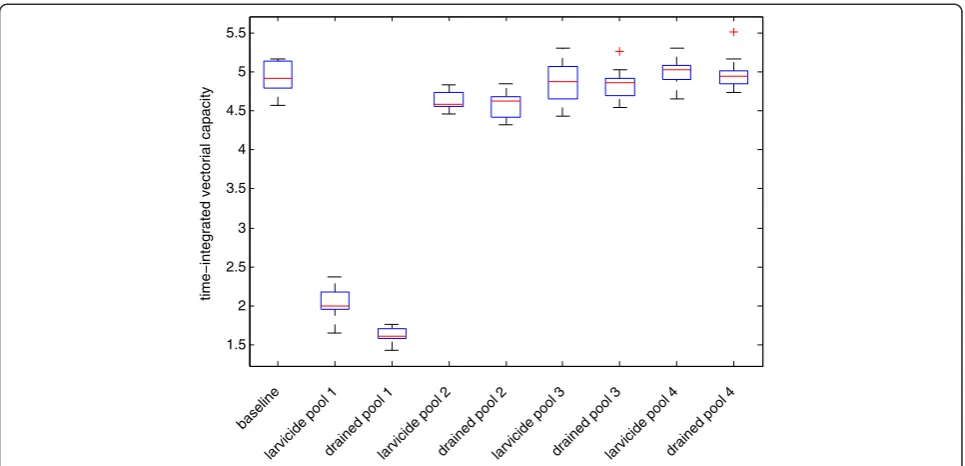
model replicates using different random number seeds were made to analyze the range of deterministic model outcomes. These ten replicates are summarized by the box plots in Figure 2 for each scenario.
[image:4.595.57.539.91.335.2]Results
Figure 3 shows the time series of simulated mosquito abundance for the 2005 baseline scenario (the same simulation as in [10]) and two perturbation scenarios for pool 1, which is located in the middle of the village: the Figure 1Left panel: The location of Banizoumbou.Right panel: a Quickbird satellite panchromatic image of Banizoumbou Village with recurrent, productive pools outlined as polygons. Other, smaller and less persistent pools formed in Banizoumbou and yielded adult mosquitoes, but are not shown on this figure.
0 1 2 3 4 5 6 7 8 9 10
cumulative number of simulated mosquitoes (x10
7)
May−2005 Jul−2005 Sep−2005 Nov−2005 Jan−2006
[image:4.595.305.538.519.703.2]application of larvicide and the draining of the pool. As seen in the figure, both scenarios that inhibit eclosion from pool 1 greatly reduce the total seasonal abundance, and the magnitude of the decreased abundance is approxi-mately the same. In Figure 3, cumulative simulated mos-quitoes are shown in order to smooth out short-term variability in populations, which can make the interpret-ation of a time series of abundance difficult. Approxi-mately 46% of all of the simulated adult mosquitoes, over the entire season, eclose from pools 1–4. This fraction of mosquitoes having originated from pools 1–4 is about 80% during the early days of wetness, but falls back to a low of 35% after predators become established and density-dependent processes keep the numbers of emer-gent adults in check. In total over the season, 54% of all adult mosquitoes eclose from the smaller pools that dot the village. About 52% of the total vectorial capacity is due to mosquitoes from pools 1–4, indicating that this small subset of the large number of pools in the village contrib-utes disproportionately to village malaria transmission. Upon removal of pool 1 in the simulation, the percentage drops to 29% of adults eclosing from pools 2–4. The dif-ference in the apparent 60% reduction in total abundance resulting from the removal of pool 1 (Figure 3) and the 46% percentage of all mosquitoes from pools 1–4 is due to the nonlinear effects of pool 1: the mosquitoes that originated in pool 1 propagate in the model and some of them oviposit in pool 1, and some oviposit in other smaller transient pools. With the removal of pool 1, the offspring of pool 1 mosquitoes are absent from the simu-lation and the overall abundance is reduced, with fewer gravid mosquitoes to oviposit in any water body and with
greater distance from blood meals compared to pool 1, the number of gravid mosquitoes is reduced. Thus, the productivity of other pools depends on the existence of the highly productive pool 1, and pool 1 is particularly im-portant because of the proximity to human habitation. This nonlinear population effect is the reason for the ap-parent discrepancy.
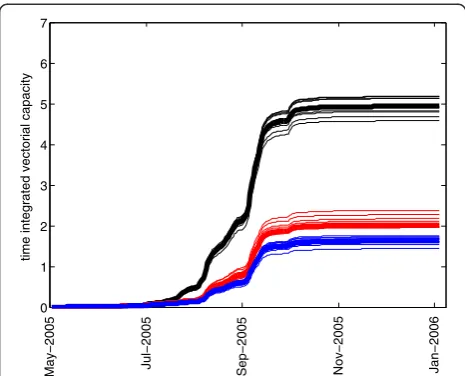
Figure 4 shows the simulated vectorial capacity for the same set of scenarios: baseline, pool 1 drained, and pool 1 with larvicide applied (i.e. the pool is available for ovi-position, but no adult mosquitoes can eclose). Draining the pool, however, reduces the vectorial capacity more than the application of larvicide. As a female mosquito repeatedly cycles through taking a blood meal from a human host, resting, generating eggs (gonotrophy), ovi-position, and again questing for a blood meal, she must fly certain distances between blood meal hosts and ovi-position habitat. This greater flight distance takes time. If pools and blood meal sources are close together (such as in the case of pool 1), then the chance of a flying mosquito encountering the pool is much greater than if the nearest pool’s location is unknown and the mosquito must randomly fly until she encounters water. As a re-sult, in a mosquito’s life span more secondary bites are possible if the time per cycle is shorter. This can be rec-ognized in the agent-based simulation by tracking the average number of gonotrophic cycles per mosquito, for the entire population. For the baseline case, the max-imum value attained by this metric was 0.904, compared to 0.875 for the larvicide scenario and only 0.696 follow-ing drainage of pool 1. Time-integrated values for this metric were 1918 for the baseline case, 2057 for the larvicide application scenario, and 1616 for the removal of the pool. Thus, this mechanism explains how the drainage of standing water from a centrally-located pool such as Pool 1 has a greater impact on reducing vectorial capacity than the application of larvicide. The importance of centrally located pool 1 as a dangerous source of mos-quitoes may be obvious, but by tracking individuals the model is able to simulate mechanistically the population-scale nonlinear effects of spatial relations among individ-uals and features of the physical environment, which goes well beyond simply recognizing that a centrally-located pool is very dangerous.
Similar simulation experiments were conducted for pools 2, 3, and 4. The reductions in the 2005 season cu-mulative vectorial capacity are shown in Figure 2 for the removal of pools 2–4, and for the larvicide application on pools 2–4. Only the final cumulative vectorial cap-acity at the end of the season is shown in the figure in order to show the impacts of each of the perturbations. The results can be interpreted as the potential seasonal total number of secondary cases per initial case caused by the mosquito population. It is a time integration of 0
1 2 3 4 5 6 7
time integrated vectorial capacity
[image:5.595.57.290.88.276.2]May−2005 Jul−2005 Sep−2005 Nov−2005 Jan−2006
the daily vectorial capacity, and is therefore no longer a rate but a seasonal total. Increases in this measure are related to population dynamics (more standing water leads to more mosquitoes), biting patterns arising from the spatial layout of pools and villages, and the age of mosquitoes (which allows more blood meals). Pools 2–4 are all located at the periphery of the village. For this reason, the impacts of pool elimination are not as pro-nounced for pools 2–4 as for pool 1 located in the center of the village. Mosquitoes that emerge from pools 2–4 are less likely to reproduce, because the mosquitoes will only find blood meal hosts in the direction of the village, and none if they fly in any other direction after eclosion. In contrast, mosquitoes eclosing from Pool 1 will find blood meal hosts if they fly in any direction. Livestock was not allowed to be near the village during the summer mon-soon growing season, and therefore it is assumed that no animals exist in the simulation from whichAn gambiae s.l can draw blood meals. Pool 4, although it is the largest and most persistent water body in Banizoumbou, has the least impact on mosquito abundance and vectorial cap-acity because of its distance from the village.
Simulated mosquitoes track and update their charac-teristics as they fly through the model domain. Each in-dividual simulated mosquito retains memory of its site of eclosion. Figure 5 shows the locations of eclosion for all mosquitoes in the baseline scenario. The color gradi-ent of markers shows the number of mosquitoes origin-ating at each location that have parity greater than one at death, and thus contributed to the vectorial capacity.
The most “dangerous” mosquitoes (the greatest number of gonotrophic cycles) emerge from pool 1, as expected.
Discussion
Agent-based models are often applied to situations in which population-level behavior arises from the interac-tions of individuals. As such, they are well-suited for the simulation of vector-borne diseases such as malaria. For vector-borne diseases, vectorial capacity is a population-level metric that describes the collective potential of individual mosquitoes to transmit pathogens in host populations. This study has made use of the tracking of individual mosquitoes through their life cycles to simu-late vectorial capacity for the entire population. Using this formulation, the impacts of changes to the physical environment (such as the removal of breeding habitat at various locations) are shown to be variably modeled, as a result of the spatially explicit structure of the model. This method is distinct from the more common ap-proach of determining vectorial capacity from estimation of parameters, and evaluation of the sensitivity of those parameters to perturbations in the physical environment regardless of location of those changes. In contrast, agent-based models allow the changes to vectorial cap-acity to arise from individuals’collective actions and in-teractions with spatially-distributed environmental features, interactions with humans, and their choice of breeding habitat.
Model results reproduce the known importance of spatial relationships of developmental habitat and human
1.5 2 2.5 3 3.5 4 4.5 5 5.5
time−integrated vectorial capacity
baseline
[image:6.595.57.540.88.321.2]larvicide pool 1drained pool 1larvicide pool 2drained pool 2larvicide pool 3drained pool 3larvicide pool 4drained pool 4
habitation by sequentially simulating the removal of several pools spaced at various distances from houses. Compartmentally-structured models do not have this capability. The danger to humans living near mosquito larval habitats is well known, yet many models assume perfect mixing of the mosquito population without re-gard to individual mosquito locations relative to devel-opmental habitat or human habitation. The removal of pool 1 (located in the middle of the village) resulted in a much more dramatic decrease in both mosquito abun-dance and vectorial capacity than the removal of the
[image:7.595.56.539.89.560.2]study was not perfect. Some pupae were observed in the pool, primarily because the neem powder was driven by wind to certain sections of the pool, leaving other sec-tions of the pool untreated. The model assumes that no mosquitoes emerge from the pool following treatment. Nevertheless, the impact of the inhibition of mosquito eclosion from pool 1 is pronounced, both in observa-tions and in the model results. The same cannot be said for the more peripheral pools studied (2–4). Model re-sults show a significantly lower impact on the village-scale mosquito population as a result of the removal of these pools. The reduced impact is primarily because the mosquitoes that do emerge from these pools have a lower chance of finding suitable blood meal hosts be-cause they are more distant and may not encounter vil-lagers, and recently blood-fed mosquitoes seeking an oviposition site are less likely to encounter the more distant pools than the more proximal pool 1.
Different forms of environmental modifications can be simulated, and their impacts also depend on spatial rela-tions. The impact of pool 1 elimination is noted in the reduction of vectorial capacity. However, the impact of draining the pool is greater than the impact of applying larvicide to the pool. Because the abundance does not differ between the draining and larvicide scenarios, the difference in vectorial capacity can be attributed to the differences in mosquito life cycle following each of the perturbations. In the case of larvicide application, a blood fed mosquito can still utilize the pool for ovipos-ition, thus rendering the mosquito ready for another blood meal (and potential secondary inoculations). This result is in line with other recent studies demonstrating the nonlinear effect of targeted larval source manage-ment [9,21,25-27]. All of these studies demonstrate the same effect resulting from increased time spent foraging for oviposition habitat. In the absence of the pool, the mosquito must fly greater distance to one of the more peripheral pools in order to oviposit before she can re-start her quest for a blood meal. Seeking suitable habitat takes time, and the number of blood meals per mosquito is thus reduced when the pool is drained. This reduction in the number of blood meals per mosquito resulting from spatial factors is reflected in the vectorial capacity for these scenarios. The impacts of treatment and drain-ing of pools 2–4 is not as pronounced, with little or no change in village transmission noted for alterations to pool 4. Pool 4 is the largest, but most distant, pool in the village environment. Some larvae were collected in the field from Pool 4, but the larval abundance was lower than in pools 1 and 2.
A further utility of the agent-based model’s ability to track an individual’s source developmental habitat has been shown in Figure 5. Following the 2005 baseline simulation, the parous rates of all simulated mosquitoes
were analyzed, and these were mapped to their site of eclosion as shown in Figure 5. Figure 5 shows that the most mosquitoes with parity > 1 (i.e. the ones potentially contributing to malaria transmission) eclosed from pools proximal to the human habitation. The figure illustrates the ability of an agent-based simulation to identify“ dan-gerous”pools. For example, an observer in the field may dip for larval samples in pool 3 and find a high abun-dance, as was noted in 2005 in Banizoumbou and shown in the model output. However, the mosquitoes destined to eclose from that pool may not play a significant role in village malaria transmission, even though the larval abundance is nearly as high as in pool 1. Although the fates of emergent mosquitoes from individual pools were not determined in the field, the modeling results suggest that not many high-parity mosquitoes emerged from Pool 3 (Figure 5). Pool 1 would be a better use of resources for environmental management, and targeting that pool would have greater impact for vectorial capacity reduction, even though a larval survey would identify comparable aquatic-stage abundances in both pools.
Several other questions may be readily addressed using the agent-based model structure. For instance, mosquito age is tracked by the agent-based model and the model therefore allows the evaluation of age-dependent mortality formulation. Mosquito senescence is significantly under-appreciated in malaria models, presumably due to the dif-ficulty of simulation of this process in compartmental models. The potential epidemiological importance of senescence is known, yet rarely modeled [28-31]. Fur-ther research will gaFur-ther field observations of location and parous rate in order to adequately simulate senes-cence using this model. Mortality can also depend on temperature and humidity experienced by individual mosquitoes, both of which vary seasonally as well as on small scales in microclimates [32]. The model structure can also be exploited for the simulation of immunity resulting from host-vector interactions. The representa-tion of individual humans and mosquitoes allows ac-quired immunity to result from inoculations allowing simulation of spatial and temporal patterns of host im-munity resulting from environmental variability [33].
well-nourished mosquitoes may be larger and live longer and are thus capable of causing more secondary cases of malaria to warrant exploration of the effect in a model. Other potential model applications include evaluation of the spatial variability of insecticide treated bednet use and indoor residual spraying programs. Because the agent-based model simulates the interactions of individ-ual mosquitoes with humans in the model, when the mosquito is in the host-seeking phase of its life cycle, the mosquito may be killed upon encountering a sleep-ing human to simulate the effects of an insecticide treated bed net. Moreover, the mosquito may be killed from sprayed walls during its resting phase following a blood meal. It may be that spatial patterns of these in-terventions yield variable impacts depending on prox-imity to larval habitat or population density, and such an investigation would also be well suited for an agent-based model such as HYDREMATS. Future research will address these questions.
Conclusions
Several hypothetical modeling scenarios of a previously-studied transmission environment (Banizoumbou, Niger) have been carried out in order to illustrate the utility of agent-based models for village-scale malaria simulation. The impact of source reduction from pools at various distances was evaluated, not for a quantified estimate of actual impact, but to illustrate the importance of spatial patterns of developmental habitat, proximity to human habitation, and the benefits of agent-based simulation for malaria modeling. Significant differences in simulated vectorial capacity are noted as a result of eliminating dif-ferent pools at various distances from human habitation, underscoring the importance of spatially-explicit simula-tion at the village scale. Agent-based modeling can yield significant insight into village-scale malaria transmission that is often neglected in other model paradigms.
Competing interests
The author declares that he has no competing interests.
Authors’contributions
AB conceived of the study, carried out the computer modeling work, analyzed the results, wrote the manuscript and edited the manuscript during the peer review process.
Acknowledgements
The author acknowledges the helpful comments of two anonymous reviewers.
Received: 16 June 2014 Accepted: 25 June 2014 Published: 3 July 2014
References
1. Killeen GF, Smith TA, Ferguson HM, Mshinda H, Abdulla S, Lengeler C, Kachur SP:Preventing childhood malaria in Africa by protecting adults from mosquitoes with insecticide-treated nets.PLoS Med2007,4(7):e229. doi:10.1371/journal.pmed.00402290.
2. Le Menach A, Takala S, McKenzie FE, Perisse A, Harris A, Flahault A, Smith DL:An elaborated feeding cycle model for reductions in vectorial
capacity of night-biting mosquitoes by insecticide-treated nets.
Malar J2007,6:1.
3. Hoshen MB, Morse AP:A weather-driven model of malaria transmission.
Malar J2004,3:32. doi:10.1186/1475-2875-3-32.
4. Bomblies A, Eltahir EAB:Assessment of the impact of climate shifts on malaria transmission in the Sahel.EcoHealth2009,6(3):426–437. 5. Parham PE, Michael E:Modeling the effects of weather and climate
change on malaria transmission.Environ Health Perspect2010, 118(5):620–626.
6. Aron JL:Mathematical modeling of immunity to malaria.Math Biosci
1988,90:385–396.
7. Filipe JAN, Riley EM, Darkeley CJ, Sutherland CJ, Ghani AC:Determination of the processes driving the acquisition of immunity to malaria using a mathematical transmission model.PLoS Comp Biol2007,3:2569–2579. 8. Dietz K, Molineaux L, Thomas A:A malaria model tested in the African
savannah.Bull World Health Organ1974,50:347–357.
9. Gu W, Novak RJ:Agent-based modeling of mosquito foraging behaviour for malaria control.Trans R Soc Trop Med Hyg2009,103(11):1105–1112. 10. Bomblies A, Duchemin JB, Eltahir EAB:Hydrology of malaria: model
development and application to a Sahelian village.Water Resour Res2008, 44(12), W12445. doi:10.1029/2008WR006917.
11. Minakawa N, Mutero CM, Githure JI, Beier JC, Yan G:Spatial distribution and habitat characterization of anopheline mosquito larvae in western Kenya.Am J Trop Med Hyg1999,61(6):1010–1016.
12. Minakawa N, Seda P, Yan G:Influence of host and larval habitat distribution on the abundance of African malaria vectors in western Kenya.Am J Trop Med Hyg2002,67(1):32–38.
13. Cano J, Descalzo MA, Moreno M, Chen Z, Nzambo S, Bobuakasi L, Buatiche JN, Ondo M, Micha F, Benito A:Spatial variability in the density, distribution and vectorial capacity of anopheline species in a high transmission village (Equatorial Guinea).Malar J2006,5:21. doi:10.1186/1475-2875-5-21.
14. Smith T, Charlwood JD, Takken W, Tanner M, Spiegelhalter DJ:Mapping the densities of malaria vectors within a single village.Acta Trop1995, 59:1–18.
15. Gaudart J, Poudiougou B, Dicko A, Ranque S, Toure O, Sagara I, Diallo M, Diawara S, Ouattara A, Diakite M, Doumbo OK:Space-time clustering of childhood malaria at the household level: a dynamic cohort in a Mali village.BMC Public Health2006,6:286.
16. Van der Hoek W, Konradsen F, Dijkstra DS, Amerasinghe PH:Risk factors in malaria: a microepidemiological study in a village in Sri Lanka.Trans R Soc Trop Med Hyg1998,92(3):265–269.
17. Greenwood BM:The microepidemiology of malaria and its importance to malaria control.Trans R Soc Trop Med Hyg1989,83(Suppl):25–29. 18. Bejon P, Williams TN, Liljander A, Noor AM, Wambua J, Ogada E, Olotu A,
Osier FHA, Hay SI, Färnert A, Marsh K:Stable and unstable malaria hotspots in longitudinal cohort studies in Kenya.PLoS Med2010, 7(7):e1000304. doi:10.1371/journal.pmed.1000304.
19. Bousema T, Griffin JT, Sauerwein RW, Smith DL, Churcher TS, Takken W, Ghani A, Drakeley C, Gosling R:Hitting Hotspots: Spatial Targeting of Malaria for Control and Elimination.PLoS Med2012,9(1):e1001165. doi:10.1371/journal.pmed.1001165.
20. Smith DL, Dushoff J, McKenzie FE:The risk of mosquito-borne infection in a heterogeneous environment.PLoS Biol2004,2(11):1957–1964. 21. Le Menach A, McKenzie FE, Flahault A, Smith DL:The unexpected
importance of mosquito oviposition behavior for malaria: non-productive larval habitats can be sources for malaria transmission.Malar J2005, 4:23.
22. Bomblies A:Modeling the role of rainfall patterns in seasonal malaria transmission.Clim Chang2012,112(3–4):673–685.
23. Depinay JMO, Mbogo CM, Killeen G, Knols B, Beier J, Carlson J, Dushoff J, Billingsley P, Mwambi H, Githure J, Toure AM, McKenzie FE:A simulation model of African Anopheles ecology and population dynamics for the analysis of malaria transmission.Malar J2004,3(29).
doi:10.1186/1475-2875-3-29.
24. Gianotti RL, Bomblies A, Dafalla M, Issa-Arzika I, Duchemin JB, Eltahir EAB: Efficacy of local neem extracts for sustainable malaria vector control in an African village.Malar J2008,7(1):301.
Needed.Edited by Breman JG, Alilio MS, Mills A. Am J Trop Med Hyg 2004, 71(2) Supplement. http://www.ncbi.nlm.nih.gov/books/NBK3756/. 26. Smith DL, Perkins TA, Tusting LS, Scott TW, Lindsay SW:Mosquito
Population Regulation and Larval Source Management in Heterogeneous Environments.PLoS One2013,8(8):e71247. doi:10.1371/journal.pone.0071247.
27. Yakob L, Yan G:Modeling the Effects of Integrating Larval Habitat Source Reduction and Insecticide Treated Nets for Malaria Control.PLoS One
2009,4(11):10.1371.
28. Styer LM, Carey JR, Wang JL, Scott TW:Mosquitoes do senesce: departure from the paradigm of constant mortality.Am J Trop Med Hyg2007, 76(1):111–117.
29. Harrington LC, Buonnacorsi JP, Edman JD, Costero A, Kittayapong P, Clark GG, Scott TW:Analysis of survival of young and oldAedes aegypti
(Diptera: Culicidae) from Puerto Rico and Thailand.J Med Entomol2001, 38(4):537–547.
30. Eckhoff PA:A malaria transmission-directed model of mosquito life cycle and ecology.Malar J2011,10:303. doi:10.1186/1475-2875-10-303. 31. Bellan SE:The importance of age-dependent mortality and the intrinsic
incubation period in models of mosquito-borne disease transmission and control.PLoS One2010,5(4). doi:10.1371/journal.pone.0010165. 32. Yamana TK, Eltahir EAB:Incorporating the effects of humidity in a mechanistic model of Anopheles gambiae mosquito population dynamics in the Sahel region of Africa.Parasit Vectors2013,6:235. 33. Yamana TK, Bomblies A, Laminou IM, Duchemin JB, Eltahir EAB:Linking
environmental variability to village-scale malaria transmission using a simple immunity model.Parasit Vectors2013,6:226.
34. Ameneshewa B, Service MW:The relationship between female body size and survival rate of the malaria vectorAnopheles arabiensisin Ethiopia.
Med Vet Entomol1996,10(2):170–172.
35. Ye-ebiyo Y, Pollack RJ, Kiszewski A, Spielman A:Enhancement of development of larvalAnopheles arabiensisby proximity to flowering maize (Zea mays) in turbid water and when crowded.Am J Trop Med Hyg
2003,68(6):748–752.
36. Takken W, Klowden MJ, Chambers GM:Effect of body size on host seeking and blood meal utilization inAnopheles gambiaesensu stricto (Diptera: Culicidae): the disadvantage of being small.J Med Entomol1998, 35:639–645.
doi:10.1186/1756-3305-7-308
Cite this article as:Bomblies:Agent-based modeling of malaria vectors: the importance of spatial simulation.Parasites & Vectors20147:308.
Submit your next manuscript to BioMed Central and take full advantage of:
• Convenient online submission
• Thorough peer review
• No space constraints or color figure charges
• Immediate publication on acceptance
• Inclusion in PubMed, CAS, Scopus and Google Scholar
• Research which is freely available for redistribution