Collaborate, Plan and
Renew: teacher
workload
Reducing workload and increasing
confidence through curriculum planning
March 2018
Contents
Table of figures 4
Research topic 5
Review Group Recommendations 5
Approaches to reducing workload 6
Evidence to support approaches 6
Anticipated difference by using these approaches 7
Investigating the approaches 8
Research Project 9
Timeline and key project milestones 11
Analysis of research data 11
Questionnaire surveys 11
Semi-structured interviews 12
In-depth interviews 13
Pupil voice 13
Findings 14
Teacher confidence and reduced workload 14
The role of the subject leader 19
Effective planning – what has been learned? 20
Limitations in data 21
School culture 23
Cultural barriers 23
Specific issues that may reduce the effectiveness 23
Steps to reduce barriers 24
Recommendations to other schools 25
References 27
Appendix 1 28
Initial reflections on anticipated impact that the research project would make 28
Appendix Two 29
Project Timeline 29
Appendix 3 32
Table of figures
Figure 1: The project’s Theory of Action: Facilitating collaborative change through enquiry 9
Figure 2: The research approach adopted 10
Figure 3: Survey responses to ‘How has the development of specialist-led art plans…’ 14
Figure 4: How would a specialist-led plan for science… 15
Figure 5: How would a specialist-led plan for DT… 15
Figure 6: How would a specialist-led plan for computing... 16
Figure 7: Has the development of specialist–led plans in science…? 16
Figure 8: Has the development of specialist-led plans in DT…? 17
Research topic
The independent report of the DFE online workload challenge consultation in October 2014 reported that there were three key areas that can lead to unnecessary workload; identifying requirements for further considerations in each area.
• Marking: to look at marking practices in schools that are raising standards successfully while reducing marking workload
• Planning and resources: to consider the effect of lesson planning and use of
resources in schools
• Data management: to develop to develop principles for good data management in
schools, including how to monitor pupil progress
Due to current strategic developments within the Academy Trust, it was most appropriate to focus on the area of planning and resources. This focus was rooted in:
• A desire to shape and refine the role of subject leaders as ‘Collaborative Planning Leaders’ across the Trust
• A need to alleviate teachers’ workload but to enhance the learning experience for our children through high quality medium term plans that are easily accessible for staff
Review Group Recommendations
The Mead Teaching School and its partners, River Mead School and Castle Mead School, chose the following three Review Group recommendations because they were considered central to the joint needs we were identifying and the areas of policy and practice that we wished to develop. Teacher workloads and seeking more effective approaches to curriculum planning were important issues for us and so reviewing the
demands made on our teachers was a key priority. Likewise, leaders working
collaboratively on joint planning of schemes of work, within and across our schools, was
an important focus; and in similar vein, teachers engaging in collaborative planning to
develop their skills and knowledge, and to share their expertise was seen as central to
our developmental goals. The following expands on this reasoning further, related to each of these chosen Review Group recommendations.
• SLT should review demands made on teachers in relation to planning to ensure that minimum requirements to be effective are made. Through SLT reviews of staff opinion and evidence from exemplary practice, it became evident that the
additional time to plan. They were also curriculum areas that they felt least confident to deliver
• Senior and middle leaders should ensure that, as a default expectation, a fully resourced, collaboratively produced scheme of work is in place for all teachers for the start of each term. Whilst year group teams already worked collaboratively across all three schools to plan for the long term, teachers were not receiving the benefit of subject specialist knowledge to inform their planning, ensure curriculum coverage and improve teaching and learning. The effective approach to specialist art planning led us to believe that a similar approach to science, DT and
computing would also improve the quality of teaching and learning, increase teacher confidence and reduce workload
• Teachers should engage in collaborative planning to develop their skills and
knowledge, to share their expertise, and to benefit from the expertise of their peers. It was felt that collaborative plans formulated by subject teams from all three schools would ensure that specialist knowledge and skills could be used to support subject specific planning in computing, DT and science. In this way
teachers would benefit from the expertise of their subject specialist peers, develop confidence in their capacity to teach these curriculum areas and reduce time spent on planning for them
Approaches to reducing workload
• Ensuring SLT gain a deeper understanding of the needs and issues underlying the
workload demands made on teachers through carrying out cycles of questionnaire and interviews with teachers
• Subject leaders working collaboratively to produce specialist subject plans, within a clear planning framework, for the use of teachers across the three schools
• SLT and subject leaders working with Science and Technology teams (incorporating science, computing and DT) to pilot the use of this framework across the three schools
• Developing the role of the subject leaders to provide on-going support to ensure that teachers are able to provide effective sequences of teaching and learning. This is complemented through providing a role description document; giving a clear responsibility outline and training in facilitation skills
• Using subject leader knowledge and expertise to create an online tool, the
‘Primary Planning Pod’, for all subject plans across the three subjects
Evidence to support approaches
• Positive feedback for the art specialist approach to curriculum planning
• Teacher feedback that science, computing and DT were areas in which there was
• Evaluation evidence gained from the enquiry cycle that was used and repeated throughout the duration of the project. This involved the setting and re-setting of baselines; trialling strategies and measuring the change and impact of these strategies as they were honed
• Evidence drawn from within our schools was complemented by evidence gained
from literature and from the expertise and practice of other schools.1 An example of literature that helped to inform our approach was Griffith and Burns (2014) Outstanding Teaching: Teaching Backwards. A particularly pertinent influence from the work of other schools was gained through engagement with Foxfields School and Woodhill School in Woolwich, members of the Inspire Partnership. School visits and collaborative practice resulted in changes in the planning of the art curriculum in the Mead schools. This, in turn, formed the basis of this project where equivalent planning approaches for science, DT and computing were being explored
Anticipated difference by using these approaches
During the first of the days when project leaders from across the schools worked with our academic adviser, a research impact model was used to explore the difference that we anticipated making. This generated a wide range of reflections on how new subject specialist planning approaches may be helpful to class teachers. Anticipated impact outcomes that were generated in this way were listed under four headings: Curriculum planning; Continuous development; Teacher confidence; Effective learning. These can be found in Appendix 1.
The initial reflections were later distilled.
• Through the development of specialist plans, class teachers would be enabled to teach improved sequences of subject specific learning whilst increasing subject confidence and lessening workload
• By extending the role of subject leaders and raising their profile and accessibility, teachers would be able to seek support more readily Subject leaders’ level of confidence in their subject specialism would be enhanced as a result
• Access to the online Primary Planning Pod resource would make collaboration and
planning quicker and easier. It would also provide potential access for schools outside the Trust
• Evidence of teacher confidence, skill development and more efficient ways of working would be supported by indicative evidence of improved pupil approaches
1 In establishing our improvement through collaborative enquiry project we consciously drew on the
to learning, where this is available, given the relatively short timescale of the project
Investigating the approaches
The investigation was built upon the discipline of identifying a robust, relevant and
manageable research question that would be used to frame the inquiry and help to keep it on track. As the research progressed, we reviewed and further honed our question in the light of the data and what we were discovering through data analysis. This led to a clear focus on the twin issues of reducing teacher workload and increasing teacher confidence.
The judgement was made that whilst, of course, impact on pupil attainment was
important, and indeed a crucial ultimate goal, there was likely to be limited evidence of this over the course of the short duration of the project. However, it was felt that any pupil gains would have a bearing on teacher confidence and motivation in using the planning strategies being trialled. Therefore, data that was available on pupil attainment, and in particular on pupil attitudes, motivation and behaviours, was used to illuminate
Research Project
The key issue that all schools identified was the amount of time and effort teachers were expending in planning. This was perceived to have insufficient benefits for teaching and learning and led to reduced teacher confidence and self-efficacy. In addressing this issue the original research question outlined in the bid was “How can we shape and refine the role of subject leader as collaborative planning lead to both alleviate teacher workload and enhance the learning experience for children?”
As the project developed, the project team’s discussion and workshops with Professor Graham Handscomb resulted in this question being refined. This honed the focus and created a more manageable project that did not depend on attainment outcomes over such a short period of time. The final research question was:
“How can we develop appropriate planning to increase confidence in teaching and reduce workload?”
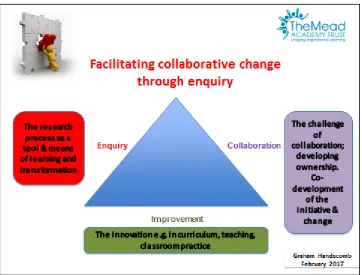
[image:9.595.130.493.453.728.2]Through workshop activity and discussion it was recognised that this project was about facilitating collaborative change through enquiry (see Handscomb, 2013a; 2013b & 2016). This theory of action involved the following three key elements: collaboration – within the team, between schools, between subject teachers and between curriculum areas; improvement – exploring innovative approaches to planning, teaching and classroom practice; enquiry – to ensure that the protocol and planning strategies were formatively evaluated and new understanding captured (see Figure 1).
Figure 1: The project’s Theory of Action: Facilitating collaborative change through enquiry
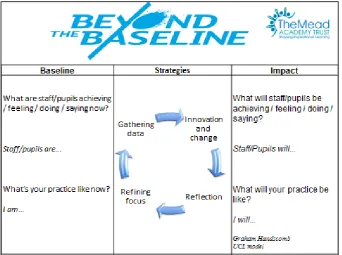
• consider, and state in detail, what the impact would be of using new approaches to curriculum planning
• define the current situation in similar detail, in order to establish a rich baseline picture
[image:10.595.140.483.203.458.2]• trial new planning strategies, using a research evaluation cycle, to bridge the gap between the current situation and the desired outcome. The cycle was repeated a number of times, with a revised baseline being established on each occasion. (See Figure 2)
Figure 2: The research approach adopted
Having established this research approach, we employed a mixed methods research methodology in our inquiry (i.e. using quantitative and qualitative research methods). This involved the use of:
anonymised online questionnaire surveys, inviting all teachers across three schools to participate at specified points throughout the investigation i.e. both before and after the introduction of specialist plans for DT, science and computing
semi-structured interviews with teaching staff across a single year group, within each of the three schools, to gain feedback about the design, content and impact of specialist plans – four teachers in total. The questions were designed to elicit teacher impressions of plans overall, their impact on reducing workload and improved confidence in teaching the three subjects
field research carried out by the project’s field researcher. This involved ongoing notes of meetings and workshops. The field researcher also provided formative reflection and evaluation as the project progressed. The project lead school’s deputy headteacher also kept an ongoing log, which captured and shared summaries of each stage of the project. This person fulfilled the role of helping maintain momentum of the project: setting out agreed actions and next steps; facilitating communications within and between schools; and chasing up on activity and deadlines
pupil voice was also sourced through focus groups, alongside an analysis of evidence from displays and pupils’ written work (pupils were from the same year group as the teachers with whom semi-structured interviews were conducted). Directed questions were also used to gain a picture of pupils’ subject knowledge and understanding and their use of specialist vocabulary for the science, DT and computing topics covered
The bulk of the interviews with staff and pupils were conducted by the field researcher whom the project employed to provide additional research capacity and gain in-depth evidence related to the inquiry question.
Timeline and key project milestones
Since its inception with the initial bid proposal the project gained momentum in the range of scoping activity; implementation of cycles of enquiry including the trialling and
evaluation of new curriculum planning strategies; and of interactions within and between each school. Appendix Two gives an overview of the timeline of key project activity and research process.
Analysis of research data
A mixed methods approach to this project allowed for the generation, progression and triangulation of a range of data. This included quantitative data from questionnaire responses and qualitative findings from interviews. Details of each of these approaches and the analysis undertaken is outlined below.
Questionnaire surveys
From the two online questionnaires circulated to the three schools, data from 35 respondents was received from the first and 29 respondents from the second.
Respondents were asked to give details of their role in school in order to ensure a range of experience and seniority was reflected in the sample. As expected, in both
questionnaires the majority of respondents were class teachers (over 50%), with smaller percentages of senior teachers and deputy headteachers (approx. 30%). Trainee
First questionnaire
Closed questions within the first questionnaire sought teachers’ views on whether time spent on planning was fruitful in terms of learning outcomes for pupils and if the
development of specialist art plans had resulted in increased teaching confidence, reduced workload and positive pupil outcomes. Further questions referred directly to the aims of the project, encapsulated in the project research question, by seeking responses to questions about whether having specialist plans for science, DT and computing would support confidence in leading teaching and learning and reduce workload in relation to curriculum planning.
Most questions asked for a single response along a 5-point Likert scale of impact about how helpful such plans would be, from ‘Not sure’, to ‘Very significantly’. Additional space for further explanation was also offered. The insight gained from this initial set of
responses indicated that the specialist art plans had been extremely well received and were having a significant impact on outcomes for pupils. There was also broad
agreement from respondents that specialist plans for science and technology subjects would have a similar impact.
Second questionnaire
The second questionnaire was undertaken three months later and again asked for closed question feedback from teaching staff about the direct impact of specialist plans for science, DT and computing on teaching confidence and reduced workload. Respondents selected from a 3-point Likert scale ranging from ‘Yes, I feel much more confident/I spend much less time….’ to ‘Not really, I feel as confident as I did before/ I spend about the same amount of time….’ Room for further comments was also available.
Analysis was based on the role of respondents. Responses in each subject area
indicated a positive impact on confidence and workload. However, some comments from both questionnaires highlighted situations that were contributing to a lack of confidence and a limited reduction in workload, which required further investigation. Therefore, as part of the research evaluation cycle illustrated above, semi-structured interviews were undertaken in an effort to gain a more detailed understanding of these situations.
Semi-structured interviews
Teaching staff from one year group (Year 3) across all schools were interviewed. This allowed for deeper insight into teachers’ views of using the specialist science and technology plans and issues raised from questionnaire data. These interviews were undertaken by the independent field researcher in an effort to mediate any ‘halo effect’.
issues from each recording as a result. She also called on a project colleague to help detect any bias in this process.
This interview process offered rich qualitative data about what was/was not helpful about the specialist plans and indicative issues related to confidence and reduced workload. It also pointed to the need for more detailed analysis especially in light of the emerging emphasis around the key role of the subject leader in supporting teachers.
In-depth interviews
The requirement for more in-depth qualitative data came from analysis of questionnaires and semi-structured interviews and further refinement of the research question through project team development workshops. Such a “progressively focused” approach offered an opportunity to unpick the nature of teaching confidence and what constitutes a good use of planning time.
The interviewer used a framework of scaled-response questions to understand
respondents’ perceptions of the specialist plans before and after implementation. The interviewer also ensured that a picture of ‘confident teaching’ and ‘good use of planning time’ (all within the context of science and technology) was discussed in detail.
Three teachers working within Key Stage 2 were interviewed at length. As before, interviews were undertaken by the field researcher, with detailed notes and careful re-listening used to glean key issues for each interview.
Whilst findings were varied, the key role of the subject specialist in supporting delivery of specialist plans re-emerged, alongside helpful insights into aspects of teaching
confidence and time-efficient planning approaches, which could inform revision and further development of specialist plans.
Pupil voice
In addition to the above, interviews were undertaken with small groups of Year 3 children from each of the schools. This data, alongside a focus group analysis of evidence from displays and pupils’ written work, was used to inform understanding about teacher confidence in science and technology subjects. An emerging picture of enthusiastic endeavour, wider use of subject specific vocabulary and a greater emphasis on more practical scientific methods was apparent.
Findings
Our research question sought to determine whether a collaborative focus on curriculum planning, including the development of plans by subject specialists in science, DT and computing helped to increase teacher confidence and reduce teacher workloads. Findings are based on the analysis outlined above and presented within three themed headings that reflect both the key elements of the research focus and the evaluative cycle:
• Teacher confidence and reduced workload • The role of the subject leader
• Effective planning – what has been learned?
Teacher confidence and reduced workload
Baseline data from the initial staff questionnaire survey gave strong indications that specialist plans in art had been well received and that having equivalent plans for
science, DT and computing would impact positively on teachers’ confidence and reduce their planning workload.
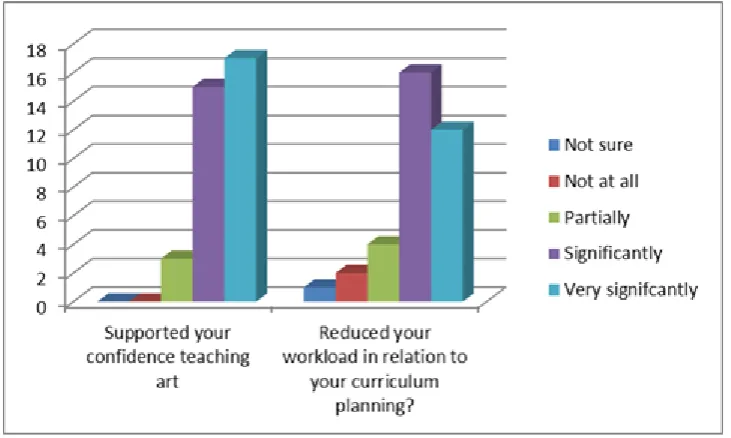
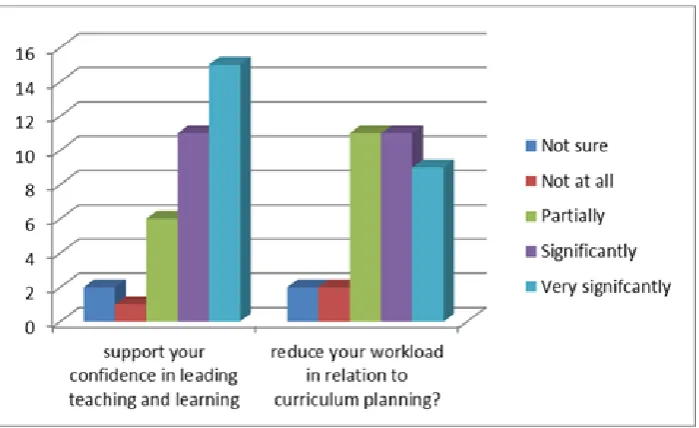
[image:14.595.112.478.459.678.2]92% of survey respondents reported that the development of specialist-led art plans had supported their confidence in teaching art ‘Significantly’ or ‘Very significantly’. 80% reported that specialist-led art plans had reduced their workload in relation to curriculum planning for art (see Figure 3 below).
Figure 3: Survey responses to ‘How has the development of specialist-led art plans…’
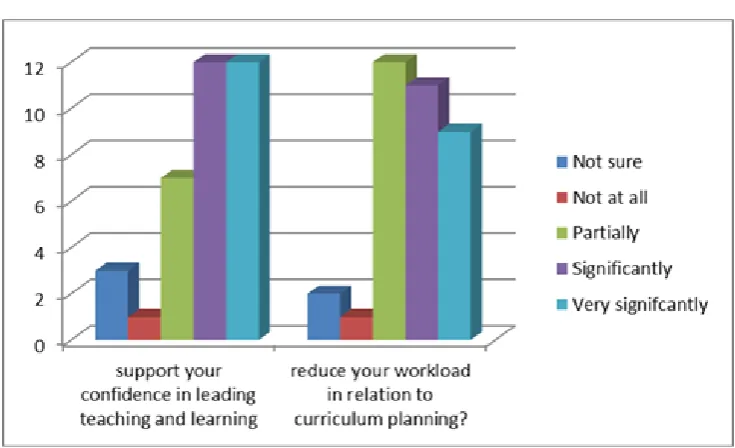
confidence to teach this subject. For all three subject areas, the majority of respondents indicated that having such plans would ‘Significantly’ or ‘Very significantly’ reduce their curriculum planning workload.
A few respondents were ‘Not sure’, or felt that specialist plans would make no impact:
[image:15.595.112.478.236.457.2]“Planning subjects for yourself means that you really know and understand your planning as you have been through the thought process. Even if someone else planned it, you would need to ensure that you fully understand what skills you are teaching.”
Figure 4: How would a specialist-led plan for science…
[image:15.595.113.481.481.705.2]Figure 6: How would a specialist-led plan for computing...
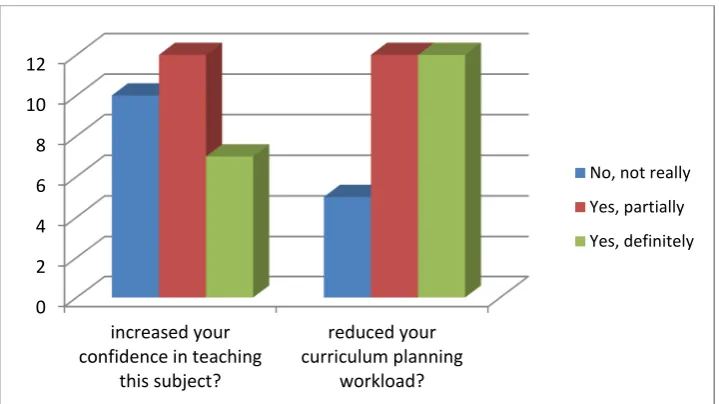
Follow up survey data from the second questionnaire undertaken three months later revealed that specialist-led plans for each subject had a positive impact on teachers’ confidence and levels of workload. 72% of respondents reported a ‘Partial’ or ‘Definite’ increase in their confidence when teaching science and computing (66% in DT). 82% of respondents reported a ‘Partial’ or ‘Definite’ planning workload reduction for computing and DT; 90% reported the same for science. (See Figures 7, 8 and 9.)
‘No, not really’ responses were in the minority and were accounted for by qualifying comments. These revealed that respondents were either outside the project remit
(working in the Foundation Stage for example) or felt that planning for these subjects was not a major contributor to their personal workload.
Figure 7: Has the development of specialist–led plans in science…?
0 2 4 6 8 10 12 14
increased your confidence in teaching
this subject?
reduced your curriculum planning workload?
[image:16.595.111.477.490.685.2]Figure 8: Has the development of specialist-led plans in DT…?
Figure 9: Has the development of specialist-led plans in computing…?
More in-depth and qualitative findings around teacher confidence and workload were drawn from semi-structured interviews with Year 3 teachers from the three schools. These interviews also gave strong indications that specialist plans had raised confidence in teaching science and technology subjects as well as reduced the workload burden of planning considerably.
In particular, comments reflected the importance of subject expertise and the specialists’ capacity to provide the most appropriate and stimulating curriculum content. Comments also reflected the impact this had on staff in developing their confidence and capacity to teach these subjects.
“What this has done for me is that I haven’t had to think about the best way to do computing, DT or science. That thinking has been done and done really well.”
0 2 4 6 8 10 12
increased your confidence in teaching
this subject?
reduced your curriculum planning
workload?
No, not really Yes, partially Yes, definitely
0 2 4 6 8 10 12 14
increased your confidence in teaching
this subject?
reduced your curriculum planning workload?
“Because they (subject specialists) have made sure that we have covered
everything we need to cover and made it relevant and exciting to the topic, I think it has improved my confidence.”
“It’s made a huge difference and helped especially in areas that I am not so
knowledgeable about…for example it wouldn’t have occurred to me to drag the Iron Man’s body – they (subject specialists) are really good at linking it.”
“If I was planning science without this I would find that the subject content takes over and the investigation and investigating skills ‘fall off’.”
“I wouldn’t have had the confidence especially with computing and possibly wouldn’t have come up with the ideas myself.”
“Computing planning helped me to understand the processes which I needed to explain to children, this made me feel a lot more confident. The planning also helped me by giving me questions tailored to each session.”
Respondents also indicated that the time spent on subject research when planning was reduced:
“I would have had to go to Google and search ‘forces activities for KS2 children’ but the Science team have used their passion and knowledge about the subject to do that for us.”
“Specialists have a skill set that reduces massive amounts of research time for us. They are the best people to give us guidance.”
“This has reduced workload but more importantly it has given children a better experience of the subject. I am confident that I have taught much better science over the past two terms.”
Subsequent interviews with Year 3 pupils indicated a level of enthusiasm about the topics that had recently been covered. It also revealed the extent to which many had
understood key concepts and vocabulary linked to each subject. The project team felt the pupils’ understanding was significantly increased compared to their previous accounts of learning.
“Plants need something called photosynthesis…it’s when plants get water and sun and this makes their food.”
“I wrote a program to create a dragon game…when you’ve done this bit you can move onto to level 2! This is called an algorithm. It’s a group of things to make something do something.”
An informal book scrutiny of Year 3 pupils’ work also indicated that more science teaching was being undertaken and the use of subject specific vocabulary was
demonstrated more consistently in pupils’ writing. Whilst pupil attainment was not a direct focus for this project and this constitutes subjective evidence, these findings are arguably a further indication of improved teachers’ confidence.
The role of the subject leader
Interviews with teachers highlighted the key role of the subject leader in producing appropriately detailed plans and supporting teachers by offering guidance, as evidenced in the field researcher’s notes:
“This Year 4 teacher was effusive in her praise for her science lead’s
comprehensive specialist plans for Year 4 and could feel the impact they were having on her teaching confidence. More of the same for the future would allow her to further develop her teaching confidence in this subject.”
For many teachers, the accessibility of the subject lead in supporting the teaching delivery was crucial. For one teacher such targeted support from the science specialist led her to feel her competence as a teacher of science has developed, despite limited scientific knowledge:
“Being able to chat through subject areas with the science lead teacher was very helpful; especially as she knows I am not very confident in science. Also, if I don’t understand anything, she’ll give me 5 to 10 minutes of her time. She has pointed me in all the right directions and, despite not feeling confident, I managed to teach a lesson on electricity thanks to her.”
Such findings have implications for the development of job descriptions for subject leaders, which could include:
• working collaboratively with other subject leads
• devising planning that is accessible to all staff
• being available for face-to-face discussion with individual teachers who may lack confidence
Effective planning – what has been learned?
In-depth interviews also provided helpful insights into aspects of teacher confidence and time efficient planning approaches. The content of specialist plans was crucial. Key aspects identified as particularly helpful in raising teacher confidence and reducing planning workload were:
• the provision of challenging questions, key vocabulary and detailed subject
knowledge
“The science has been broken down…eliciting knowledge, posing questions, gathering knowledge and investigation.”
“I am confident now – all the plans are there so I know the buzz words the children need to use and can teach them.”
“Using the computing questions on the plans helped me feel more confident and able to challenge and question the children.”
“Because there were helpful sheets to read up on the subjects covered, I haven’t had to spend hours researching, and I feel I am more knowledgeable and confident to be a bit more flexible.”
Teachers found it harder to work with plans that were too wordy or had too much subject content and insufficient lesson content or alternatively had not offered sufficient detail where required – a clear balance of these two tensions was important:
“In the plants plan it said talk about the different parts of the plant but I didn’t know how much detail to go into. A signpost for where I could look this up would have helped me or some indication about the level of depth that was needed would have helped.”
• a non-directive style, consistent structure into lesson blocks and direct links to National Curriculum Statements:
“Plans are loose enough for you to adapt but structured enough to know where you are heading. They are a great ‘dummies-guide’ – in a good way!”
“Delivery will be down to the individual teacher but this gives a really good structure. If I was in my previous school I would have welcomed something like this because these subjects are not always in the fore-front of your mind.”
“When this started I had a real worry that people would become de-skilled in planning these subject areas…but I actually think that this approach to planning has done the reverse…I would plan and teach using this structure now.”
• the inclusion of engaging activities and resource ideas with helpful screen shots,
videos and step by step guides:
“We didn’t have this in my previous school and you just played safe and DT just got left to one side because there wasn’t any support there. Having this bank of resources that you can tap into is really useful.”
“The computing planning is exceptional. He has made examples of the game we are making at each stage plus little help sheets, giving that teacher who is not confident about computing real help.”
“I really liked the screen shots that were included on the plans and the questions for teaching computing and ‘help cards’ for the children were really helpful.”
“The deputy headteacher brought round others from another class to watch my computing lesson. He said that I didn’t seem nervous about teaching – that was because of the plans; I could just pick them up and use them. I’d be happy to be observed again. That’s a lot for me to say!”
Where plans had not been deemed helpful, this was due to teachers preferring to use their own plans or a lack of available resources/apparatus needed for lesson delivery.
As specialist subject leaders, the project team reflected on the value of cross-school collaboration and on their personal growth:
“I have enjoyed the opportunity to work collaboratively with subject leader colleagues, to think about my role as a subject leader, help others and increase my interaction with class teachers.”
“This project has enabled me to become a more effective subject leader as I can now support teachers better and check that the children are receiving what has been planned for.”
“I have a sense of ownership and pride in my contribution to a project that can be felt more widely than my classroom, school or Trust.”
Limitations in data
These limitations included limitations regarding sample size – the number of responses from teachers to the anonymous questionnaire was relatively small, but nevertheless was judged to be significantly robust in terms of findings. Similarly, there were a limited
number of semi-structured interviews and in-depth interviews, but these were enhanced by fieldwork of the field researcher.
The team was conscious of a potential ‘Halo Effect’, where respondents give answers that they feel are expected, particularly to senior colleagues. This was mitigated by the use of a field researcher who was an ‘objective outsider’.
There was an absence of ‘control’ data i.e. comparisons between groups who used specialist plans and those that continued a ‘work as usual’ approach. The project team decided not to adopt this approach in their methodology. Instead, baseline data was established in order to evidence change over time.
School culture
Cultural barriers
The project identified a number of cultural barriers that had the potential to impede the planning strategies trialled.
Adopting new approaches, however beneficial, involves change and there was some resistance to such change, particularly among some more long-standing staff.
In addition, because teachers have grown accustomed to heavy workloads and a work-life imbalance, there was a tendency for them to continue in these deleterious work practices, rather than embrace the freeing up of time that new curriculum planning approaches provided.
Associated with this was the cultural tendency for teachers to want to expend time and energy creating their own planning, rather than using and adapting the specialist plans provided. This highlighted the need for the use of facilitation strategies, particularly by subject leaders, to help teachers personalise specialist plans to keep a sense of ownership, without expending unnecessary extra effort in re-inventing them.
Regarding the aim of the research project to gain accurate pictures of teachers’ views and practices, the positive affirming culture of the schools occasionally led teachers to give a positive response to the new planning strategies in order to be supporting to the project team, rather than sharing what they really felt. The use of an independent field researcher helped to mitigate this effect.
Specific issues that may reduce the effectiveness
The project’s approach revealed that there might be initial increased workload, especially for subject leaders, in order to ensure saving of time and reduced workload later, once the approach is embedded. There may also be the cost of significant sustained workload pressures for subject leaders in order to secure workload benefits for teachers.
The role of the subject leader emerged as pivotal from the research findings. This in turn raises the issue of the experience of subject leaders, and in particular the importance of subject leaders developing high level facilitation skills.
A further issue is the need for schools and school collaboratives to strike the right balance in their approach to curriculum planning. This research project revealed, on the one hand, the significant value of relieving teacher workload and increasing their
Steps to reduce barriers
This research project identified a range of practical steps and strategic approaches to help create a culture that fosters implementation of workload reducing measures in relation to curriculum planning. These include:
• accessibility of plans, including an online planning pod, and careful formatting of plans so that teachers can easily include their own nuanced additions
• communications which portray change as doable and incremental rather than as
threatening challenges
• collaboration of schools (e.g. MATs) should make joint curriculum planning a
priority for their use of pooled resources
• SLT commitment to teachers meeting for short and medium term planning, e.g.
through the more flexible use of PPA
• SLT modelling good practice with regards to reasonable workload behaviours and practices
• establishing agreed workload reducing protocols
Conclusion
This project has demonstrated that there is sufficient evidence to indicate that
collaborative working of a team of senior and subject leaders across a group of schools can have dividends for improved approaches to curriculum planning. Taking into account a range of other factors and variables, it is considered that there was sufficient evidence from this collaborative enquiry to suggest that the curriculum
planning strategies trialled did contribute to increased teacher confidence and some reduction in teacher workload. It is anticipated that this effect will be even more evident as these strategies are embedded over time.
This enquiry project raised a number of further issues and questions that were fruitful areas for the participating schools, and indeed others in the wider research and educational community. These include:
• Will this framework of curriculum planning strategies be sustainable when there is
no project funding available?
• How responsive will the framework be to the inevitable further changes and
innovation in curriculum and its development?
• How transferable will the project’s approach to curriculum planning be to other
settings – for example, those that are not part of a trust?
• How can these approaches be used and adapted for planning in other subject areas?
• Will there continue to be the potential tension of reduced workload for teachers at the expense of increased workload for subject leaders?
• How transferable are these plans for teachers working in specialist SEND settings?
Recommendations to other schools
The following recommendations arise from the findings of this improvement through
collaborative inquiry project:
• Invest time and energies into developing within your school, or groups of schools,
an interactive framework of subject specialist plans. This investment will pay dividends in reducing workload and increasing teacher confidence
• Explore the benefits of working collaboratively across partner schools in securing
shared, effective approaches to curriculum planning
• Strike a balance between use of shared specialist plans and fostering ownership and autonomy of individual users of the plans
• Explore the benefits of establishing an online tool to share curriculum planning
• Build into staff deployment and budget planning specific allocation of time for subject leaders to fulfil their facilitation role
References
Brown, C. (2017) How to facilitate Research Learning Communities. Professional Development Today Vol 19, Issue 2.
Griffith, A. and Burns, M (2014)Outstanding teaching: Teaching backwards. Osiris
Handscomb, G. (2017 Creative professional development. Professional Development Today Vol 19, Issue 2.
Handscomb, G. (2016)Harnessing the power of teacher leaders. in School Leadership Today, Volume 7.5 2016.
Handscomb, G. (2013a)Facilitating collaborative change through enquiry. London
Centre for Leadership and Learning. University College London (UCL)
Appendix 1
Initial reflections on anticipated impact that the research
project would make
Curriculum planning
• Use of specialist subject plans by teachers will deliver a curriculum that has
breadth and mastery
• Specialist subject plans and resources will be accessible
• Subject specialist plans will offer guidance for differentiation and provide examples
of good practice
• Subject specialist plans will be talking points and result in more openly shared
practice
• When asked, teachers will be able to give detailed feedback based on secure judgements about pupil attainment
Continuous development
• Teachers will internalise and enhance the framework resources provided by the subject leaders
• As more teachers access and use the resources the planning approach will evolve and improve
Teacher confidence
• Teachers will feel open and positive, sharing ideas, confident in recognising and sharing what they have done and what has worked/not worked
• Annotated planning will show differentiation, enabling teachers to match tasks to
ability levels more effectively
• Teachers will be able to provide quality feedback to other staff and pupils and
provide robust assessment
• The subjects will be consistently taught
Effective learning
• Pupils will talk enthusiastically about what they have learnt using appropriate
technical vocabulary across the curriculum
• Pupils will be able to build on previous knowledge and skills, and generate their own questions
Appendix Two
Project Timeline
Action when Impact
• Subj ec t l ea de rs to con si de r and de vel op pl anni ng st rat egi es for s ci enc e, com put ing an d D T • D ev el opm ent of onl ine Pr im ar y Pl anni ng Pod (onl ine res our ce st or e)
Project Launch Meeting
Launch meeting attended by Head of Teaching School and Head of School December 2016 Clarified aims of project and necessitated need for baseline data to be collected prior to Trust TD day scheduled for 3 January 2017. TD day was to focus on planning and workload. As such, baseline data needed to be collected before this took place in order that responses were not impacted upon by information shared at TD day.
Questionnaire to teachers
Exploring impact of art planning approaches
Exploring teacher confidence in planning and teaching science, DT and computing Explore demands made on teachers in relation to planning
December
2016 Collated baseline information through which understanding gained of issues relating to teacher workload and confidence.
Initial project development meeting, Professor Graham Handscomb and Project Manager and
Head of School January 2017 Clarification of next steps, research focus and question.
Identification of project team members Exploration of project methodologies Agreement of project team meeting dates Project Team established
Project Manager: Head of Teaching School
Project coordinator: Trust Lead for Science and Technology
Academic Advisor: Professor Graham Handscomb
Field Researcher: Dr Sarah Couzens
Subject Leaders from all three schools for science, DT and computing.
January 2017
Planning meeting with website designer for creation of Primary Planning Pod website as a
depository for planning frameworks and resources. February 2017 Set direction and vision for online tool
Project Team Development Day 1
Academic advisor support for Project manager and Head of school Workshop for full project team led by Professor Graham Handscomb
- The nature of enquiry
- Research, collaboration and change - Starting with the end in mind
- Establishing baseline pictures
March
2017 Aims of project clarified. Research question considered and developed. Baseline data considered.
Action when Impact • Subj ec t l ea de rs to con si de r and de vel op pl anni ng st rat egi es for s ci enc e, c om put ing and D T • D ev el opm ent of onl ine Pr im ar y Pl anni ng Pod (onl ine res our ce st or e)
Completion of NCTL Progress report 1 February
2017 Opportunity to clarify and establish progress and share changes to original Research question. Semi-structured interview with teachers
Exploring aspects raised by survey monkey
Exploring confidence in ability to teach effectively for DT, computing and science Exploring impact of planning on workload
March/Early
April 2017 Comparative evidence obtained from Year 3 teachers across the Mead schools. Teacher impressions and implementation of plans, impact on teaching confidence and overall planning workload.
Pupil voice
Children describing experiences of science, DT and computing learning Year 3 pupils across three Mead schools
March/Early
April 2017 Evidence obtained on pupils’ levels of understanding against planned outcomes and use of technological and scientific language from specialist plans for all three subject areas. Questionnaire to teachers
- survey monkey to identify progress since base baseline data collection
- focused questions designed to gauge impact of specialist plans on teaching confidence and planning workload since their introduction in January 2017
March 2017 Clear information of the early impact of specialist plans across all three subject areas on teaching confidence and planning workload. Further comments gave more detail to questionnaire responses.
Project Team Development Day 2
Academic advisor support for Project manager and Head of school Workshop for full project team led by Professor Graham Handscomb
- Reflection on the moral purpose of the project - Clarifying and honing research question(s)
- Feedback on scoping impact & the baseline picture
- Collecting the information we need: exploring some research methods
April 2017 Research question refined further, leading to specific focus on ‘confidence’ and ‘workload’. Considered results of staff and pupil interviews, enabling plan for further in depth interviews with teachers.
Explored definitions around ‘confidence’ and ‘workload’, to support exploration of this in in-depth teacher interviews.
In depth interview with teachers
- Open ended questions on aspects of teaching confidence, teaching enjoyment, use of time when planning in all three subject areas.
May/June
2017 Detailed individual impressions and views on teaching confidence and workload arising from the application of specialist plans across Mead schools.
Project Team Development Day 3
Academic advisor support for Project manager and Head of school Workshop for full project team led by Professor Graham Handscomb
- Continued review & honing of the research question - Reflecting on early findings and emerging messages - Making sense of information gathered
- Knowledge mobilisation – sharingthe research
June 2017 Consideration of impact to date. How increased confidence was being demonstrate by teachers and whether this was demonstrable in children’s learning.
Agreement to create guidance document for subject leaders supporting them in use of planning frameworks and aspects of leadership role.
Action when Impact • Subj ec t l ea de rs to con si de r and de vel op pl anni ng st rat egi es for sc ien ce, c om put ing an d D T • D ev el opm ent of onl ine Pr im ar y Pl anni ng Pod (onl ine res our ce
Completion of NCTL Progress report 2 June 2017
Project Team Development Day 4
Academic advisor support for Project manager and Head of school Workshop for full project team led by Professor Graham Handscomb
- Tentative findings; careful conclusions; and bold recommendations! - Continued review & honing of the research question
- Key ingredients of the research report
- Knowledge mobilisation – sharing the research
July 2017 Clarification regarding use of planning scaffolds and how these should be personalised for each class.
Clarification of knowledge mobilisation approaches. Exploring academic poster templates, agreeing general content.
Completion of all drafts of planning scaffolds for science, DT and computing for all year groups and
all terms. July 2017
Project Team Development Day 5
Academic advisor support for Project manager and Head of school Workshop for full project team led by Professor Graham Handscomb
Measuring Impact – use of Guskey’s evaluation levels to build an impact picture Developing a project poster from range of team perspectives
Workshop activity on Listening Skills – linked to developing subject leader facilitation
September
2017 Academic poster first draft considered. Exploration of leadership skills in terms of active listening.
Relationship of Guskey’s evaluation levels to the project agreed and explored.
Completion of Primary Planning Pod website September
2017 Final Report planning meeting: Project Manager and Field Researcher
- Clarifying report requirements - Analysis of data
- Draft of some sections
September
2017 Information shared with Project coordinator, academic advisor prior to final project reflections and report writing workshop
Final Report Writing workshop: Project manager, project coordinator, academic advisor, head of
school October 2017 Drafted aspects of final report considered. Amendments made and additional workload
Completion of formatting and upload of planning frameworks on to the Primary Planning Pod
website October – December
2017
Appendix 3
Example of formative evaluation exercise carried out by the
project team
During one of the development workshops with the project team, we considered the evaluative question: What difference is our intervention making?
In the ensuing discussion, the team sought to break down the approach to subject specialist planning into its component parts in order to have a data analysis tool to test out the difference the trialled strategies might be making. This tool comprised the following elements:
• What aspects of our specialist planning approach have been effective… have had
a positive effect?
• What effect?
• Which aspect of the planning approach has contributed to which effect? • What evidence is there to support the above link?
• What further evidence is needed to demonstrate a link?
• How could this further evidence be identified (if already in the system) or collected
© Crown copyright 2018
This publication (not including logos) is licensed under the terms of the Open
Government Licence v3.0 except where otherwise stated. Where we have identified any third party copyright information you will need to obtain permission from the copyright holders concerned.
To view this licence:
visit www.nationalarchives.gov.uk/doc/open-government-licence/version/3
email [email protected]
write to Information Policy Team, The National Archives, Kew, London, TW9 4DU About this publication: