
Research Report DFE-RR186
Evaluation of the National
Academy of Parenting
Practitioners’ Training Offer
in evidence based
parenting programmes
Kirsten A. Asmussen, Timothy Matthews,
Katey Weizel, Neda Bebiroglu and
This research report was commissioned before the new UK Government took office on 11 May 2010. As a result the content may not reflect current Government policy and may make reference to the Department for Children, Schools and Families (DCSF) which has now been replaced by the Department
for Education (DFE).
Contents
Executive Summary
1. Introduction 1
2 Ready, steady, go: Local authority readiness and the
implementation of evidence-based parenting interventions 8
3 Service Agency Readiness and the implementation of
evidence-based parenting interventions 20
4 Practitioner and programme characteristics and the
implementation of evidence-based parenting interventions
30
5 Summary, recommendations and conclusion 46
Executive Summary
Background
• The current coalition government recognises the great importance of good parenting for children’s outcomes. It has commissioned several independent reviews that underline this. The Allen Review cogently argues the social and economic benefits that arise from early parenting interventions. The Field Review emphasises the potential for good parenting to overcome the blight of inter-generational poverty. The Munro Review notes that child abuse is an extreme form of poor parenting and that effective parenting programmes are needed to ameliorate matters.
• A growing body of evidence suggests that when evidence-based interventions are implemented at scale with families that need them, significant population-wide benefits can be achieved. These benefits include significant reductions in school failure, youth crime, adolescent drug and alcohol misuse and child maltreatment.
• The National Academy for Parenting Practitioners (NAPP) was established in 2007. Its aim was to transform the size and quality of the parenting workforce in England so that evidence-based parenting programmes could be made available to families who need them. A key objective of this initiative was to provide key training to over 4,000 practitioners in one of ten evidence-based models.
Evaluation aims and methods
• This report describes findings from the evaluation of NAPP’s training offer in evidence-based parenting interventions.
• The evaluation’s key objective was to understand the value and impact of the Academy’s training programme as it was implemented.
• A programme of evaluation was therefore designed to provide ‘real-time’ information on the progress of the training offer so that ongoing changes could be made within an action research framework.
• Data collected through the evaluation included information about the number of practitioners trained, their skill level and whether or not they went on to deliver parenting programmes.
• This data was collected through the training applications, as well as a series of follow-up surveys completed by practitioners immediately following their training and six months thereafter.
Key findings
• The NAPP training offer ran between December 2008 and March 2010. It involved 4,018 training places delivered through 189 separate courses. 3,614 of these places were for primary training in an evidence-based model and 404 places involved booster sessions for practitioners who had attended a primary training session. In the end, 3,162 practitioners from 147 local authorities attended and completed primary training in one of ten evidence-based parenting interventions.
• Practitioners attending NAPP training were overwhelmingly enthusiastic about their experience. Over 95% gave their course highest marks, rating it as ‘good’ or ‘very good’.
• 42% of the NAPP trained practitioners went on to deliver a parenting intervention within 6 months of their training. Although this implementation rate is perhaps less than originally hoped for, it nevertheless resulted in a dramatic increase in the availability of evidence-based parenting interventions across England.
• The majority of practitioners also reported that the NAPP training helped them with their daily work with families whether or not they went on to deliver a parenting intervention. Therefore their training benefitted children and families and was not wasted.
• Practitioners who implemented parenting interventions reported that they found the experience deeply rewarding.
• A very conservative estimate suggests that over 6,000 parents have attended an evidence-based parenting intervention offered as a result of the NAPP training offer. A more realistic estimate suggests that at least 12,0001 families
1 This estimate is based on the calculation of an average of eight parents attending a group delivered by one
have benefitted from support provided by a NAPP-trained practitioner within the past year.
• Practitioners were significantly more likely to implement a parenting intervention if their agency had carefully considered the resources and infrastructures required to deliver it.
• Practitioners were also significantly more likely to implement a parenting intervention within 6 months of their training if they received higher levels of managerial supervision. The extent to which practitioners perceived their managers as supportive and their work as relevant also increased the likelihood of implementation.
• The chief barrier to implementation was a lack of time. Specifically, underestimating the amount of time involved in recruiting parents to the interventions frequently interfered with practitioners’ ability to run an intervention within six months of their training.
Recommendations
• These findings suggest that good quality training is just the starting point for the successful delivery of evidence-based parenting interventions. Once trained, practitioners will continue to require support from their agencies particularly in terms of time, resources and supervision.
• A key recommendation of this report is that those offering evidence-based parenting interventions (including service agencies, programme developers and governments) need to develop evidence-based ways of supporting practitioners in the set up and delivery of their interventions and need the involvement of line managers to ensure their success.
• Further studies are also needed to determine the extent to which increasing the skill of staff in delivering evidence-based programmes leads to improved child outcomes and the cost benefit of this.
1. Introduction
Key points
• Evidence-based parenting interventions can result in community-wide benefits when implemented at scale.
• The UK government established the National Academy for Parenting
Practitioners (NAPP) in 2007 to increase the availability of practitioners able to deliver evidence-based parenting interventions.
• NAPP’s main training offer took place between December 2008 and March 2010, involving 4,000 training places in 10 evidence-based parenting intervention models.
• Training places were provided to service agencies with the understanding that the practitioners attending them would have the resources to implement a parenting intervention within 6 months of NAPP training.
• Reviews of the research literature suggest that training on its own is rarely enough for evidence-based interventions to be implemented. Communities, service agencies and practitioners must also have the capacity and willingness to implement evidence-based programme models with skill and fidelity to the chosen programme.
• The evaluation of the NAPP training offer was designed to investigate the ways in which a variety of key community, service agency and practitioner-level factors contributed to the successful implementation of parenting interventions within 6 months of their NAPP training.
Background
A commitment to families
Over the past two decades, the UK government has demonstrated a strong commitment to improving children’s wellbeing. The previous government initially expressed this commitment through a series of large-scale community initiatives, including Sure Start, On Track and the Children’s Fund, which significantly increased the number of services available to children and parents. The Coalition government is now carrying this commitment forward through policies that encourage the
implementation of ‘evidence-based’ interventions targeting parents and children. In particular, a recent ministerial review published by Graham Allen (2011) has
recommended that UK local authorities expand the use of 19 child and family interventions with strong evidence of improving child outcomes. This
suggests that when properly implemented, these interventions have the potential to improve child and parent outcomes in a way that can reduce the public costs
associated with youth crime and children going into care.
What are evidence-based parenting interventions?
The term ‘evidence-based’ typically refers to interventions with strong evaluation evidence (most typically gained through randomised controlled trials) of improving children’s behavioural and emotional outcomes. While many evidence-based
interventions target children directly through schools, some of the most effective and cost-effective interventions target parents as well. This is because parenting
interventions teach parents skills that promote children’s wellbeing throughout their development. These skills include appropriate child discipline and positive family communication strategies that help children regulate their own behaviour and interact positively with others (Forgatch et al. 2009, Kazdin 2003, Martinez and Forgatch 2002).
A key feature of some of the most effective family interventions is that they include systems for ensuring that they are consistently implemented to a high standard (Sholomskas et al. 2005). These systems include methods for implementing the intervention with fidelity – i.e. in a way that is faithful to its original model. Programme fidelity is vital for ensuring that an intervention achieves its intended outcomes, since it makes certain that the programme’s effective contents are not distorted or lost. Systems for ensuring programme fidelity include minimum practitioner qualification requirements, high-quality pre-service training, a clear programme manual and recommendations for ongoing practitioner supervision. Evidence-based interventions that include well-developed implementation systems are often referred to as
‘dissemination-ready’.
Benefits for children = benefits for communities
A growing body of evidence also suggests that when evidence-based interventions are implemented at scale, significant population-wide benefits can be achieved. These benefits include significant reductions in school failure, youth crime,
adolescent drug and alcohol misuse and child maltreatment. Notable examples of where this has occurred include:
• The US state of Washington, where the costs associated with building a new prison have been offset through the implementation of a ‘portfolio’ of
interventions with evidence of preventing or reducing children’s antisocial behaviour (Aos 2010; Aos et al. 1998: Drake et al. 2009).
• The US state of South Carolina, where the implementation of the full ‘constellation’ of Triple P interventions has resulted in significant reductions in reported cases of child maltreatment (Prinz et al. 2009).
• The country of Norway, where significant improvements in parenting skills and children’s school behaviour have been observed through the
implementation of a ‘suite’ of evidence-based interventions targeting families with high and low needs (Ogden and Hagen 2008; Ogden et al. 2005, 2009).
These promising findings have led central and local governments throughout the world to increase the availability of evidence-based family interventions (Sanders and Murphy-Brennan, 2010). For example, the Obama administration has recently committed over $8 billion to the wide-scale implementation of evidence-based home visiting parenting interventions in every US state over the next twelve years (Haskins et al. 2009). In the UK, Birmingham City Council is investing in home visiting
programmes (including the Family Nurse Partnership) and other evidence-based parenting interventions with the aim of improving child outcomes and reducing the number of children going into care (Birmingham City Council 2007).
Evidence-based practice in the UK
The UK government has a long history of supporting parents and their children. The Respect Action Plan (2006), in particular, identified evidence-based parenting
interventions as a means for reducing the risks associated with youth crime. The Plan therefore introduced a series of measures aimed at increasing parents’ access to evidence-based interventions. These measures included guidance to local authorities encouraging them to develop a parenting strategy that included interventions aimed at improving parent and child-wellbeing. Specifically, local authorities were encouraged to appoint a parenting commissioner who would carefully assess community needs and commission parenting interventions
The Respect Action Plan also introduced the need for a parenting academy that would increase the size and quality of the parenting workforce. In particular, the academy would provide training and supervision to a variety of professionals traditionally involved in parenting work (e.g. social workers, clinical psychologists, youth justice workers, etc.), as well as three new practitioner roles created
specifically to work with parents:
• Respect Parenting Practitioners who would be hired and trained to deliver evidence-based parenting interventions to families with children at-risk for or engaged in anti-social behaviour
• Parenting Experts who were similar to Respect Parenting Practitioners, but instead worked with vulnerable families experiencing difficulties with
substance misuse, mental health and/or domestic violence
• Family Intervention Project (FIP) workers who were to assess the needs of families and coordinate services accordingly for families receiving support through family intervention projects offered to families with a chronic history of offending and antisocial behaviour.
It was anticipated that these parenting professionals, as well as others involved in parenting support (for example, Parent Support Advisors) would particularly benefit from the new parenting academy’s training.
The National Academy for Parenting Practitioners
The National Academy for Parenting Practitioners (NAPP) was launched in April 2007 as a centre of excellence for training and research aimed at increasing the availability of evidence-based parenting support in the UK. One objective of the initiative was to provide 4,000 training places in one of ten evidence-based parenting programme models.
Families and Schools Together (FAST) New Forest
Family Links The Incredible Years Mellow Parenting Parenting Positively The Solihull Approach Triple P
Strengthening Families 10 – 14 Strengthening
Families/Strengthening Communities
See Appendix for more details
NAPP allocated training places to local authorities through an application process involving input from parenting commissioners and the service managers from the agencies hosting the intervention. In order to receive training places, service
practitioners attending training. This was done with the understanding that parenting interventions stood the best chance of being effective if they were implemented immediately after practitioners attended training, when the training information was still fresh. The training application also required the details of the practitioners selected for training. Managers were asked to only put forward practitioners with a bachelor’s qualification (QCSF Level 5) in a helping profession, since many of the programme models assume delivery by a bachelor’s (or master’s – QCF Level 6) qualified helping professionals.
Training places were allocated to local authorities based on their size and need. Priority was also given to practitioners working in a ‘priority’ service (e.g. an extended school, Sure Start children’s centre, youth offending team or FIP) or
‘priority’ role (e.g. Parenting Expert or Parenting Practitioner – see previous section). This was in keeping with the Think Family Grant (replacing the PSSG grant in 2009) which provided ring-fenced funding to local authorities to appoint practitioners who could deliver evidence-based parenting interventions. In order to receive this grant, local authorities had to provide evidence that their practitioners had attended NAPP training. Alongside the training offer, NAPP additionally supported England’s 152 local authorities through a team of Regional Development Managers (RDMs) who worked with Parenting Commissioners to understand how NAPP interventions could support their local parenting strategy.
Evaluating the NAPP Training Offer
Aims and objectives
NAPP’s strategic plan stated the aim of the evaluation of the training offer evaluation was to:
Evaluate the value and impact of the Academy’s training programme as it is implemented, so that we know: the numbers trained; the skill level of those trained; whether or not practitioners go on to deliver programmes; how many parents they see and what the results are; and what the barriers are to
implementing high-quality services and how local managers and practitioners are overcoming these.
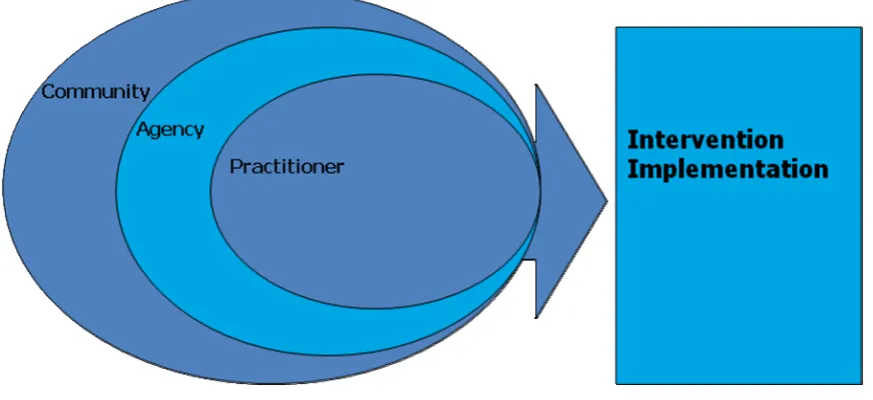
A programme of evaluation was designed to provide ‘real-time’ information on the progress of the training offer so that on-going changes could be made within an action research framework. An evaluation design was agreed that would consider factors that contributed to the take-up and delivery of effective parenting groups. Wandersman et al. (2008) have observed that successful programme
involved in the intervention’s delivery are both willing and able to make the changes necessary to effectively adopt the programme model (see Figure 1.1). The NAPP training evaluation was designed to consider how community, agency and
[image:12.595.72.509.235.435.2]practitioner-level factors either helped or hindered the implementation of NAPP interventions within six months of practitioners attending training.
Figure 1.1: Factors predicting the implementation of evidence-based parenting interventions
Aims and structure of the report
The primary aim of this report is to describe the ways in which community, service agency and practitioner level processes contributed to the implementation of
parenting interventions within six months of practitioners attending NAPP training. As this information was collected through three separate exercises, their evaluation methods and findings will be presented as a series of three ‘mini’ reports that consider, in turn, how community, service and practitioner factors influenced the implementation of NAPP parenting interventions:
• Chapter 2 investigates whether UK local authorities were ‘ready’ for the NAPP training offer through their commissioning arrangements and strategic
planning. This chapter considers the extent to which these factors, as well as local authorities’ previous history with evidence-based models, contributed to the take-up of training places and the implementation of parenting
interventions.
• Chapter 4 considers the extent to which practitioner characteristics
contributed to the implementation of evidence-based parenting interventions, as well as some of the barriers they encountered.
2. Ready, steady, go!
Local authority readiness and the
implementation of evidence-based
parenting interventions
Key points
• Communities only implement new interventions when they are ready to. This means that they must have the capacity and motivation to adopt new
intervention models.
• The evaluation investigated community readiness through local authorities’ commissioning arrangements, their parenting strategies and previous history with evidence-based family interventions.
• Findings suggest that nearly all local authorities had appointed a parenting commissioner and developed a parenting strategy by the time the NAPP training offer was underway. The quality and influence of these activities varied
considerably across local authorities.
• 147 out of 152 local authorities participated in the training offer, taking up 87% of all training places. Local authority take-up of training places was not
associated with any of the local authority readiness factors measured in this study.
• 42% of the practitioners attending NAPP training went on to deliver a parenting intervention within six months of their training.
• Implementation rates were not significantly associated with any of the local readiness factors measured in this study.
• Local readiness, in the form of support for the commissioning process and strategic planning, may be necessary, but not sufficient for the implementation of evidence-based parenting interventions.
Introduction
Ready, willing and able
Communities will only adopt new, evidence-based interventions if they are ready for them. As mentioned in the first Chapter, community readiness is contingent upon local authorities having the capacity and willingness to adopt new programme
models. Factors that increase a community’s capacity to implement evidence-based interventions include:
• The availability of a workforce to deliver evidence-based parenting interventions
• Funding for the staff and resources to implement the intervention
• Good quality interagency relationships
• Strong leadership.
Factors that increase communities’ willingness to adopt a new intervention include the belief that it will provide benefits for the community. Studies suggest that communities with a good understanding of their local needs are likely to be in a better position to appreciate how evidence-based models can support their population (Feinberg et al. 2004). For this reason, successful programme implementation often relies on a ‘local champion’ – i.e. an individual or team of individuals (sometimes referred to as a community coalition) who understand
specifically how new interventions can help their community and are in a position to create tension for change (Wandersman, et al. 2008). A positive history with
evidence-based models also increases the likelihood that new interventions will be implemented (Greenhalgh, et al. 2004).
As described in Chapter 1, the UK government introduced a number of measures to increase local authorities’ capacity and willingness to implement evidence-based parenting interventions. Measures aimed at increasing authorities’ capacity to adopt evidence-based models included funding to employ parenting practitioners and the offer of free training. Measures aimed at increasing local authorities’ motivation to implement NAPP programmes included resources and guidelines for developing a parenting strategy.
Key questions
interventions. For example, some commissioners may not have been fully convinced that the NAPP interventions were needed when other locally-developed programmes were available. For this reason, the evaluation considered the extent to which:
• The influence of the parenting commissioner contributed to the take-up of NAPP training places and the implementation of parenting interventions
• The quality of the parenting strategy predicted the take-up of NAPP training places and the implementation of parenting interventions
• Local authorities’ previous history with evidence-based models influenced their participation in the NAPP training offer.
Methodology
Participants
Local authority information was collected through a ‘local intelligence’ questionnaire completed by NAPP’s eleven Regional Development Managers (RDMs) in March 2010. As explained in the previous chapter, RDMs were employed by NAPP to help local authorities understand the training offer and identify how parenting
interventions could be used within their parenting strategies. Each RDM was
assigned to between five and 13 local authorities, depending on the authority’s size and whether the RDM worked part or full time.
Procedures
The RDMs were asked to complete the local intelligence questionnaire because it was thought that they were in a better position than local authority representatives (including parenting commissioners) to objectively rate each local authority’s readiness. This methodology is similar to one used by Feinberg et al. 2004 to understand how community coalitions influenced the implementation of prevention programmes offered through the ‘Communities that Care’ model.
RDMs rated each local authority’s readiness on a 90-item questionnaire involving yes/no answers and ratings on a five-point Likert scale. Items chosen for the
questionnaire were informed by factors identified through the research literature, as well as the RDMs’ own perspective on local authority readiness. A draft
questionnaire was first piloted in February 2009 and then revised through a series of focus groups with the RDMs. The questionnaire was finalised during two additional consultation sessions, where the RDMs discussed how the Likert scales would be weighted to help ensure consistency between their ratings. Topics covered in the final questionnaire included:
• the influence of the parenting commissioner
• the quality of the parenting strategy
• local authority support for evidence-based parenting interventions
A copy of the final local intelligence questionnaire is provided in Appendix B. The RDMs completed questionnaires for 120 out of a total of 152 local authorities, giving in a response rate of 79%. This means that local intelligence data was missing for just over one-fifth of the population. However, statistical analyses (chi-square) suggest that there were no significant differences between the authorities rated and not rated by the RDMs so the findings we have are reliable and not skewed by the response.
Unfortunately some RDMs did not provide information for all of the questions, resulting in some questionnaire items having high levels of missing data. For this reason, the evaluation only considered data from items with a sufficiently high response rate (85% or more).
Data analysis
Once all of the data was collected, SPSS software was used to conduct descriptive and exploratory analyses with the local intelligence questionnaire data. Confirmatory factor analyses were used to establish independent domain subscales. These
subscales were then used in a series of correlations and regression analyses to explore the extent to which local readiness factors predicted: 1) the take-up of the training offer and 2) the implementation of parenting groups.
Findings: How ready were local authorities for the NAPP
training offer?
The influence of parenting commissioners
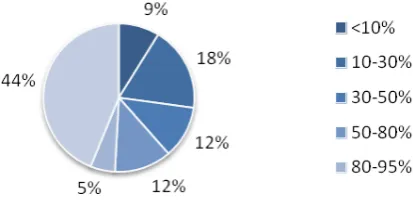
Findings from the local intelligence questionnaire suggest that 96% of all local authorities had either a parenting commissioner or strategic lead in post to develop and carry out their parenting strategy. However, there was a high degree of variation between local authorities in terms of the amount of time the commissioner had dedicated to this role, with less than half of the local authorities having a parenting commissioner in post full-time (see Figure 2.1).
Figure 2.1: Time allocated to the parenting commissioning role (n=114)
The RDMs rated the effectiveness of these commissioners on a variety of
dimensions. As Figure 2.2 suggests, there was a fair degree of variation across local authorities in terms of the parenting commissioners’ influence within the children’s services directorate.
Figure 2.2: Parenting commissioner influence (n=118)
The quality of the parenting strategy
Findings from the local intelligence surveys suggest that 99% of the local authorities had parenting support identified within their children’s and young people’s plan and 97% had developed parenting strategy. The RDMs were asked to rate the quality of these plans on multiple dimensions. Confirmatory factor analyses identified three independent variables:
• the clarity of the parenting strategy
• the extent to which the strategy was linked to local and national targets
Figure 2.3: Clarity of parenting strategies (n=119)
Figure 2.4: Parenting strategies links to local and national targets (n=119)
Figure 2.5: The use of parenting strategies for future planning (n=119)
Strategic planning
three years. Seventy-five percent of the local authorities had done at least two of these activities and 58% had done all three.
Previous history with evidence-based family support
The RDMs provided information about each local authority’s previous history with evidence-based parenting interventions, suggesting that 85% had provided some form of evidence-based parenting support in the past. While all of the local
authorities provided services through Sure Start children’s centres, 37% had been doing so for ten years or more. Ninety-one percent of these authorities had also offered family support services through the Children’s Fund and 32% had participated in On Track.
Findings: Local authority readiness and the take-up of
NAPP training places
Local authority participation
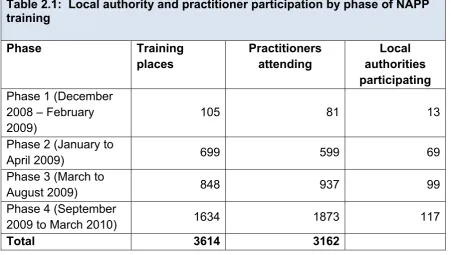
[image:20.595.80.532.424.679.2]The NAPP training offer was rolled out in four phases. A phase-based approach was used to optimise take-up in regional areas and take advantage of training provider availability. Table 3.1 provides an overview of local authority participation and practitioner attendance by phase.
Table 2.1: Local authority and practitioner participation by phase of NAPP training
Phase Training places
Practitioners attending
Local authorities participating
Phase 1 (December 2008 – February 2009)
105 81 13
Phase 2 (January to
April 2009) 699 599 69
Phase 3 (March to
August 2009) 848 937 99
Phase 4 (September
2009 to March 2010) 1634 1873 117
Total 3614 3162
training offer. In the end, 3,162 practitioners attended and completed NAPP training, giving a take-up rate of 87%. 2
By the end of the training offer, 147 out of 152 local authorities had sent practitioners on at least one training course. Four per cent participated in all four phases of the training, 29% participated in three phases, 34% participated in two phases and 33% participated in one.
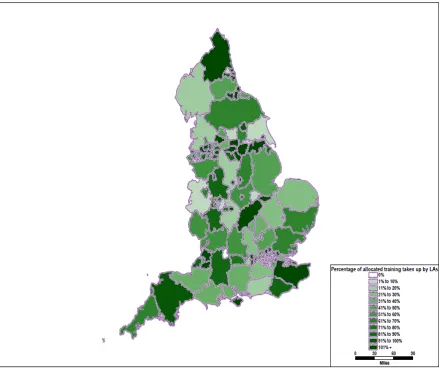
[image:21.595.80.522.283.656.2]Figure 2.6 illustrates the take-up of training places by local authority. The shade of green indicates the amount of training activity in proportion to the training places assigned to each local authority.
Figure 2.6: Take –up of the training offer by Phase 4 of the NAPP training offer
2 It should be noted that 404 additional training places were ‘booster’ sessions offered to practitioners who
Local authority readiness and take-up of NAPP training places
A key aim of the evaluation was to understand the extent to which local authority readiness predicted the take-up of NAPP training places. In order to investigate this question, a series of simple correlations and regressions were conducted. The near universal take-up of training places resulted in none of the local authority readiness factors significantly predicting the take-up of training places by the end of Phase 4. However, previous analyses considering Phases 1 and 2 only (Asmussen et al. 2010) suggested that local authorities that had a Parenting Expert in post were more likely to participate in the earlier phases of the training offer.
Findings: Local authority readiness and the
implementation of NAPP parenting interventions
Implementation rates
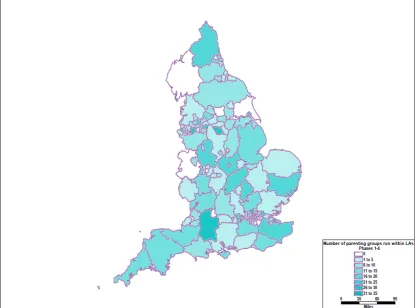
[image:22.595.80.501.443.751.2]Findings from the follow-up questionnaire conducted with practitioners (see Chapter 5 for a description) suggest that 42% of the practitioners participating in the NAPP offer went on to deliver a parenting intervention within six months of their training. Figure 2.7 provides an overview of the implementation rates across the UK.
Figure 2.7: The implementation of parenting interventions by local authority
As Figure 2.7 suggests, implementation rates on account of NAPP training were widespread throughout the country. Authorities represented by darker shades of blue suggest higher implementation rates, with some local authorities implementing as many as thirty parenting interventions within six months of NAPP training.
However, it is important to recognise that these findings only represent the activity of practitioners participating in the follow-up survey. This means that programmes may still have been implemented in areas represented as white on the map, since we do not have follow-up data on a quarter of practitioners attending NAPP training (see Chapter 5 for a complete discussion).
In order to understand the extent to which implementation rates were related to local authority readiness, a series of bivariate correlations and step-wise regressions were conducted. The findings from these analyses are presented in Appendix F,
suggesting that none of the local authority readiness factors significantly predicted their implementation rates.
Summary and implications
High level of take-up
The findings discussed in this chapter suggest that nearly every local authority in England participated in the NAPP evidence-based parenting programme training offer. By the time NAPP training was under way, almost all local authorities had appointed a parenting commissioner, developed a parenting strategy and had some experience delivering evidence-based interventions. Although the RDM ratings indicated that there was a high degree of variation across local authorities on all three of these dimensions, local authority readiness, as conceptualised by this evaluation, did not significantly predict the take-up of NAPP training places or the implementation of parenting interventions. Possible reasons why the evaluation failed to detect a relationship between readiness and participation in the NAPP training offer are discussed in turn below.
Imprecise measurement
When reviewing these findings, it must be recognised that the methodology used for this study may not have been robust enough to detect a relationship between local authority readiness and participation in the NAPP training offer. It should also be recognised that the way in which readiness was conceptualised (i.e. the
commissioner’s influence and strategic planning) may not have been appropriate for understanding community readiness. For example, some might view the support provided by parenting commissioners as ‘technical assistance’ rather than
exists suggests that technical assistance does not generally increase the use of evidence-based interventions, since communities are likely to reject the assistance if they are not ready for it (Chinman et al. 2005, Mitchell et al. 2004).
Complex systems
A second explanation for the findings reported here is that the community-level factors involved in the implementation of parenting interventions are multi-faceted and complex. Indeed, the influence of the parenting commissioner, the quality of the strategic arrangements and the authorities’ previous history with evidence-based interventions are just three aspects of many complex interactions that take place within communities. Schensul (1009) has observed that even when key systems, including strategic planning and strong political support, are in place, interventions may fail to be adopted because the links between these systems are not properly synchronised. Thus, the scope of this study was perhaps too limited to explore the complex interactions between the multiple systems required to facilitate parenting intervention implementation.
Not necessary
A third explanation for the lack of relationship observed between community
readiness and intervention implementation is that community-level factors may not be necessary to successfully implement parenting interventions. Given the fact that many of the NAPP interventions target families, rather than communities (as other school-based and community initiatives do), the need for community support may not be as great.
Not sufficient
A related, but alternative interpretation of these findings is that the local readiness factors investigated in this study may not have been strong enough to over-ride other community-level factors not measured in the evaluation. For example, Wandersman (2009) has observed that while community champions (or coalitions) do increase programme implementation – their influence is frequently modest and inconsistent. Although nearly all of the local authorities had appointed a parenting commissioner and developed a strategy, these activities may not have been fully embedded in local authority functioning. Hence, they may not have been sufficient to influence other community-level factors also related to programme implementation that were not measured in this study.
Necessary, but not sufficient
funding for parenting practitioners, may have over-ridden differences in the quality of the local authorities’ readiness. In other words, government policies may have been successful for getting all of the local authorities to the NAPP ‘table’ – but other factors may have been required to get them to ‘eat’ (i.e. implement parenting interventions). As the following chapters suggest, good training is just the starting point for intervention implementation and it is likely that service-agency and
3. Service agency readiness and the
implementation of evidence-based parenting
interventions
Key points
• Service agencies will only implement new interventions if they are ready for them. This means that they must have the resources and motivation to change their working practices in keeping with the requirements of the new intervention model.
• The evaluation investigated the readiness of the agencies hosting NAPP parenting interventions by examining their funding resources, supervision arrangements, interagency working, referral routes and selection criteria used to nominate practitioners for training.
• The evaluation found that service agencies were significantly more likely to implement a parenting intervention if they had identified all of the resources involved in intervention delivery and provided higher levels of managerial supervision.
• The evaluation findings suggest that greater agency preparation prior to training is likely to increase the likelihood that parenting interventions will be implemented.
• The findings also suggest that intervention implementation benefits from higher levels of managerial support, including supervision.
Introduction
Service agency readiness
In order to provide practitioners with the support required to deliver evidence-based parenting interventions, service agencies must be ready for them much in the same way that communities must be. In other words, service agencies must have both the capacity and willingness to implement evidence-based parenting interventions
(Wandersman et al. 2008). Capacity issues involved in the delivery of evidence-base parenting interventions include:
• Systems for recruiting and selecting staff
• Sufficient resources to deliver the intervention (e.g. training manuals, venue hire, transportation and refreshments)
• Systems for recruiting and referring families into interventions
• Good relationships between agencies involved in the delivery of the intervention
• Arrangements for practitioner supervision.
Ideally, capacity issues should be addressed by service agencies before
practitioners are sent on training (Durlak and DuPre, 2008). Greenhalgh et al. (2004) note, however, that it is often difficult for agencies to anticipate all of arrangements necessary to adopt new intervention models before the implementation process begins. This is because agencies frequently need to substantially change their working practices to ‘install’ the new programme (NIRN, 2008). Clearly, some programme models will take more effort to install than others, depending upon the demands of the programme and the working practices of the agency. If the new programme model requires a substantial effort for an agency to adopt it, high levels of organisational motivation are inevitably required.
Wandersman et al. (2008) note that service agencies, like communities, need to understand why a new intervention is needed in order to be willing to make the changes necessary to install it. Factors that frequently interfere with an agency’s willingness to install a new intervention include a lack of understanding of what the new model can achieve and competing organisational priorities. Durlak and DuPre (2008) also note that an agencies’ willingness to install a new intervention is directly related to the effort involved in the installation process.
Key questions
Methodology
Procedure
Information about service agency readiness was gathered from the NAPP training applications (see Chapter 1 for an overview of the process). All training applications requested information about the practitioners selected for training and verification that funding was available for seven ‘core elements’ associated with the delivery of parenting interventions (see Moran et al 2004 for an overview). For Phases 3 and 4, service managers were also asked to provide information about their agency’s supervision arrangements, their referral pathways and practitioner selection criteria. Although training places were not provided on the basis of this information, the questions were added as a way of making sure that agencies had considered many of the key factors involved in the implementation of parenting interventions. A copy of the Phase 3 and 4 training application is provided in Appendix C.
Participants
Service managers typically requested training places for between one and eight practitioners. A total of 1,133 service managers submitted applications for NAPP training places. Just under a quarter of these were from the London region. The breakdown of training applications by phase is as follows:
Phase 1 (December 2008 to February 2009) 22
Phase 2 (January to April 2009) 204
Phase 3 (March to August 2009) 340
Phase 4 (September 2009 to March 2010) 567
This breakdown suggests that 80% of the training applications were placed in the third and fourth phases of the offer, meaning that detailed information about service agency readiness was available for 80% of the agencies.
Data analysis
Findings: Service agency readiness
Applications by programme model
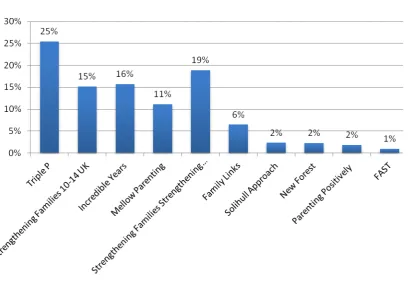
As figure 3.1 suggests, the majority of training applications were for places in one of the Triple P models (25%, n = 288). This was closely followed by training placements in Strengthening Families, Strengthening Communities (19%, n = 214), Incredible Years (16%, n = 178) and Strengthening Families 10-14 (15%, n = 171).
Figure 3.1: Applications per training programme (n=1133)
Funding
The training application also requested verification that agencies had secured
[image:29.595.75.487.237.519.2]Figure 3.2: Secured funding for core elements associated with training (n=1133)
As Figure 3.2 suggests, that majority of the local authorities had identified funding for at least one of the core elements associated with parenting intervention delivery. Further analysis of this information suggested that over three-quarters (77%) of service managers indicated that they had secured funding for five or more of the core elements. However, a substantial few (12%) stated that they had secured very little or no funding for any of the core elements involved in the implementation of NAPP parenting interventions.
The training application also asked service managers to provide information about where their funding was coming from. Twenty per cent did not answer this question and just under half (49%) said that they were funded through the Parenting Support Strategy Grant (PSSG). Fifty-three per cent said that they were funding the
intervention through the PSSG grant along with other funds and 18% said that they were funding the intervention exclusively through funds other than the PSSG grant.
Practitioner supervision
For Phases 3 and 4, the application requested that service managers comment on the arrangements in place for supervising parenting practitioners as they
Figure 3.3: General supervision arrangements
[image:31.595.84.419.440.626.2]As Figure 3.3 suggests, monthly managerial and/or clinical supervision was by far the most frequent form of supervision. Service managers were also asked to report on what kind of supervision would be made available for the practitioners’ specific parenting programme. Figure 3.4 provides an overview of the kinds of supervision that were available.
Figure 3.4: Supervision arrangements for parenting intervention work
Interagency relationships and referral pathways
The application included a series of questions about whether the parenting
interventions would be implemented as part of a multi-agency effort. Seventy-five per cent of the managers said that the intervention would be co-delivered by practitioners from separate services as a form of multi-agency working. Managers were also asked whether there were practitioners working within their agency
already trained to deliver the programme for which they were applying. Fifty-eight per cent said that one or more of the practitioners were already trained and currently delivering the intervention within their service.
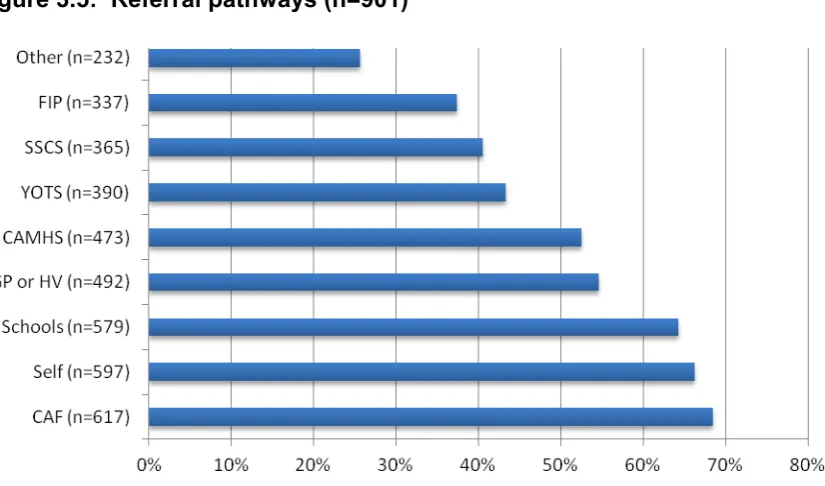
Service managers were also asked to check the kinds of referral pathways used to recruit families into the parenting intervention. As Figure 3.5 suggests, self-referrals and the Common Assessment Framework (CAF)3were the most common method of
[image:32.595.84.497.384.627.2]referral for parenting interventions. A further analyses of the data revealed that 85% of the agencies took referrals from at least one route, 74% took referrals from at least three routes and 6% took referrals from nine routes. Interestingly, 15% of the agencies did not select any referral routes.
Figure 3.5: Referral pathways (n=901)
Practitioner selection criteria
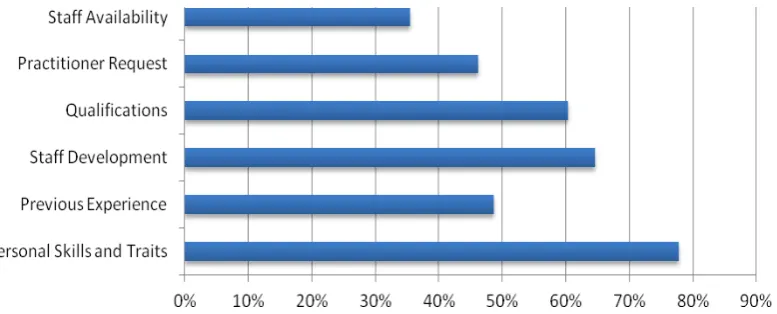
Finally, service manages were asked to report what criteria they used to select the practitioners for training, by ticking one or more boxes involving a variety of criteria. Figure 3.6 provides an overview of their responses.
3 The Common Assessment Framework is a method used by most local authorities to assess the needs
Figure 3.6: Practitioner selection criteria (n=901)
As Figure 3.6 suggests, the practitioner’s personal skills and traits were most frequent criteria used to select practitioners. Service managers were also asked to indicate what the single most important trait used to select practitioners. Over 70% indicated that personal skills and traits were also the most important reason for selecting a practitioner for training.
Service managers additionally provided information about the qualifications and professional background of practitioners nominated for training. Although the NAPP application guidance suggested that practitioners selected for training be ‘qualified helping professionals’, 24% of the managers indicated that they had selected practitioners with Level 3 qualifications and 18% indicated that they had selected practitioners with only a Level 2 qualification. Further details involving the
practitioners’ qualifications will be provided the Chapter 4.
Findings: Service agency readiness and parenting
intervention implementation
parenting interventions six months post practitioner training than managers who had not. In addition, agencies that provided managerial supervision to their practitioners on a weekly basis were also significantly more likely to successfully implement a parenting intervention.
Further linear regressions were conducted to understand the relative contribution of each of these variables to the implementation of parenting interventions, entering all significant variables were entered in one step. Once this was done, only funding for refreshments (β = .32, p < .001) and managerial supervision (β = .91, p < .001), suggesting that both of these activities independently improved the likelihood that parenting group implementation would take place within six months of practitioners attending their NAPP training.
Summary and Implications
Preparation, preparation, preparation
Over 1,100 service agencies sent practitioners on NAPP training. The findings described here demonstrate that the better prepared service agencies were prior to training, the more likely they would be able to implement parenting groups. In particular, attention to the details associated with group delivery (especially funding for refreshments) significantly improved the likelihood that a parenting intervention would be delivered within six months of a practitioner attending training.
These findings should not be interpreted as meaning that refreshments, etc. are the most important factors involved in group delivery. Clearly, the quality of the training and programme materials are also important. The findings do indicate, however, that careful attention to capacity issues prior to training does increase the chances that interventions will be implemented. This higher level of planning could also be interpreted as an indication of service agencies’ willingness to implement the evidence-based parenting. In this respect, it is not surprising that higher levels of managerial supervision also increased the probability of parenting interventions being implemented.
Interestingly, implementation rates were not linked to agencies’ previous history with evidence-based parenting models. While the reasons for this are not clear, it is possible that the offer of free training and government funding to hire practitioners may have overridden any differences between service agencies that may have otherwise predicted differences in implementation rates.
training inevitably increases the burden experienced by the practitioner post-training, which in turn, reduces the chances of the intervention being implemented. Indeed, findings from the follow-up survey (described in the next chapter) suggest that some NAPP practitioners failed to deliver their intervention because they were not able to access vital resources for programme delivery, including funding for the manual, crèche hire, etc.
Supervision, supervision, supervision
The need for high levels of staff supervision is a consistent theme in the research literature. Although good quality training is vital for acquainting practitioners with the content, theories and principles of evidence-based models, pre-service training is limited in its ability to help practitioners apply these concepts in real-life settings (Fixen et al. 2005). Sending practitioners on training without sufficient levels of supervision is what Metz et al. (2007) refer to as the ‘train and hope’ approach, which rarely results in successful outcomes. While host agencies need to make sure that supervision is available to practitioners implementing parenting interventions, developer-led supervision is also likely to improve the efficacy of the intervention as it is implemented.
4. Practitioner and programme characteristics
and the implementation of evidence-based
parenting interventions
Key points
• The evaluation investigated whether practitioner characteristics, including their qualifications and confidence, predicted the implementation of the NAPP evidence-based parenting intervention.
• The evaluation also considered the extent to which the complexity of the programme model predicted the implementation of the NAPP interventions.
• Findings suggest that the practitioners were overwhelmingly enthusiastic about their NAPP training experience. Ninety-five per cent gave the training content top marks and 97% gave top marks to their trainer.
• Forty-two per cent of the practitioners delivered a parenting intervention within six months of their training.
• Practitioners who believed that they learned a great deal through the NAPP training were significantly more likely to deliver a parenting intervention within six months of their training.
• Practitioners who also perceived the intervention as relevant for their agency and reported high levels of agency support were also significantly more likely to implement a NAPP intervention.
• A lack of time and competition with other services were the most common reasons for not being able to implement a parenting intervention within six months of training.
• Difficulty recruiting parents was also frequently reported as a barrier.
• Responses to the follow-up questionnaire additionally suggest that the amount of effort required to deliver these interventions was much higher than originally anticipated.
• Practitioners were significantly less likely to implement more intensive family interventions than they were the group-based models targeting less vulnerable populations.
• Practitioners’ previous qualifications and experience did not improve their ability to implement a parenting intervention. Rather, agency support, in terms of sufficient time and supervision, appeared to be the driving factor.
Introduction
Practitioner characteristics
Findings from the implementation literature consistently suggest that practitioner characteristics influence the use and efficacy of evidence-based interventions. For example, a number of studies have observed that practitioners with a bachelor’s degree or higher in a helping profession are both more open to using evidence-based models and more likely to implement them effectively (Asmussen et al. 2010, Michel and Sneed, 2005; Sanders et al. 2009). It is believed that this is because a higher qualification in the field of nursing, clinical psychology or social work better prepares practitioners for the theories underpinning evidence-based models (Korfmacher et al. 1999). It is also likely that helping professionals will have more experience working with parents and children that will help them understand how to apply key principles. For this reason, four of the interventions offered by NAPP (Incredible Years, New Forest, Parenting Positively and Triple P) recommend that practitioners have a bachelor’s degree or higher in a helping profession attend training(Sanders et al, 2009; Webster-Stratton and Herman, 2010).
Practitioners’ attitudes towards evidence-based models have also been linked to the use and efficacy of evidence-based interventions. Studies suggest that practitioners often resist evidence-based models because they believe that adhering to a manual will reduce their ability to understand and meet the needs of the families they work with (Addis and Krasnow, 2000). Practitioners’ attitudes are also shaped by whether they believe the goals of the model are consistent with their agencies’ priorities. For instance, findings from the evaluation of NAPP’s first training offer (a dress rehearsal for the main offer) observed that practitioners were significantly more likely to
implement parenting intervention if they believed the model was relevant for their agencies’ work (Asmussen et al. 2010).
Recent studies have also linked practitioners’ use of evidence-based models to their sense of self-efficacy – i.e. their confidence in their personal ability to successfully deliver the intervention. Turner et al. (2011) observe that a sense of self-efficacy is particularly important in the delivery of evidence-based models, since their
outcomes-based focus increases the likelihood that practitioners could be blamed for poor outcomes. For this reason, it is assumed practitioners will be reluctant to
implement evidence-based models if they do not think they have the skills to do so successfully. Processes that increase practitioners’ sense of self-efficacy with evidence-based models include their previous experience, high levels of agency support and the ease with which programme models can be learned.
Programme Characteristics
The characteristics of the programme model, including its training format, complexity and flexibility, also influence implementation rates. For example, Beidas and Kendall (2010) have observed that training models that include high levels of active learning are more likely to be implemented and be effective. The authors theorise that this is because active learning methods provide practitioners with opportunities to practice and increase their self-efficacy with the model. These authors additionally note that the kind and quality of post-training support provided by the programme developer improves practitioners’ sense of self-efficacy with the model. In a similar vein, the simplicity and adaptability of the model is also likely to influence practitioners’ confidence in using it (Turner et al. 2011).
Key questions
This chapter considers the extent to which practitioners’ qualifications, attitude and confidence predict the successful implementation of the NAPP parenting
interventions. The chapter also considers the extent to which the complexity of the programme model influences implementation rates. The barriers to implementation are also explored through a qualitative analysis of the experiences of practitioners who did not implement a parenting intervention within six months of their NAPP training.
Methodology
Participants
A total of 3,162 parenting practitioners completed primary training in one of the evidence-based parenting programmes described in Appendix A. Information from these practitioners was gathered through the training application (see previous section and Appendix C) and a user satisfaction survey completed immediately after training (see Appendix D). User satisfaction feedback was available from 90% (2858) of the practitioners.4
2,119 of the practitioners also completed a follow-up questionnaire 6 months after training (see below and Appendix E). This number includes the practitioners attending all of the NAPP interventions except the Families and Schools Together (FAST) programme. This is because FAST training takes place during the actual implementation of a FAST intervention, meaning that training and implementation occur simultaneously. In addition, the practitioners involved in training were recruited
4
through schools who did not always share the practitioners’ contact details with NAPP, making it impossible to follow them up six months after training. This fact, coupled with FAST’s unique implementation model, made it necessary to exclude the FAST trainees from the follow-up sample, bringing the overall sample of trained practitioners down to 2,963. Within this group, 2,119 completed the evaluation follow-up questionnaire, resulting in a response rate of 72%, which is very high for this kind of evaluation. A summary of the characteristics of the practitioners attending NAPP training and the follow-up survey are provided in Appendix H.
Instruments and procedures
Practitioner information was gathered through three separate questionnaires:
• The practitioner section of the training application (Appendix C; see previous section for a description)
• A user satisfaction form handed out directly after training asking practitioners to rate their satisfaction with the training in terms of its content, trainer and organization through a series of Likert-scale questions (see Appendix D).
• A six month follow-up questionnaire asking practitioners whether or not they had delivered a parenting group, the quality of support received from their agency and the barriers to running groups when they were not delivered (see Appendix E).
Parts of the follow-up questionnaire (Sections 10 – 12) were informed by the Family Partnership Model in Practice questionnaire (Day, 2009). This questionnaire included a free text box allowing the practitioners to describe in their own words their
experiences implementing parenting groups, as well as some of the barriers they encountered.
The follow-up questionnaire was sent to practitioners electronically 6 months after they were trained. If a practitioner did not complete the survey within one month of receiving it, they were reminded to complete it and were invited to participate in a telephone interview instead of the electronic questionnaire.
Data analysis
SPSS was used to conduct descriptive and exploratory analyses with the application, satisfaction, and follow-up questionnaire data sets. Factor analyses were also used to reduce the data into composite variables where appropriate. Binary logistic regressions were then conducted to explore the relationship between practitioner characteristics and the implementation of parenting interventions. Qualitative
Findings: Practitioner feedback at the time of training
Training satisfaction
One of the NAPP’s key performance indicators was that 80% of the training participants rate their satisfaction with the training as good (4) or very good (5). Figures 4.1 and 4.2 provide an overview of the practitioners’ satisfaction with their training in the broad categories of content and trainer. These findings suggest that NAPP well exceeded its target in the training content and trainer categories, with 95% of the practitioners rating the training content as good or better and 97% rating the trainer as good or better.
Figure 4.1: Practitioner satisfaction with the quality of the training (n=2858)
Figure 4.2: Practitioner satisfaction with the quality of the trainer (n=2863)
Increases in knowledge and skill
For Phases 3 and 4, the user satisfaction survey also asked practitioners to
Figure 4.3: Practitioner ratings of their increase in knowledge directly following NAPP training (n=2843)
Relevance of the training
At the time of their training, practitioners also commented its relevance for their agency and for themselves as practitioners. As Figure 4.4 suggests, over 90% felt the programme was relevant (4) or highly relevant (5).
Figure 4.4: Practitioner ratings of the relevance of the training for themselves and their organization (n=2853)
Findings: Practitioner characteristics
Practitioner qualifications
their programmes have at least a bachelor’s qualification in psychology, social work or nursing. This is not a requirement for Family Links, Strengthening
Families/Strengthening Communities and the Solihull Approach, however, which do
[image:42.595.81.494.220.473.2]not require any formal qualifications. For this reason, chi-square analyses were conducted to verify the extent to which practitioner qualifications varied by training model. An overview of these findings is provided in Figure 4.5.
Figure 4.5: Practitioner qualifications by training model (n=3162)
As Figure 4.5 suggests, practitioner qualifications varied significantly by training model (x2(16) = 51.344, p<.001), but not necessarily in the expected direction. For example, those attending Mellow Babies and New Forest training were significantly
more likely to have a bachelor’s degree or higher in a helping profession than those attending training in the other intervention models. While a graduate qualification in a helping profession is required for those delivering the New Forest programme, no
such qualifications are required by Mellow Babies – although a background in social
work is strongly recommended. Surprisingly, those attending Parenting Positively
were among the least to have a bachelor’s qualification in a helping profession, despite the fact the programme model specifies a Master’s level qualification (or higher) in psychology or social work. A similar trend was observed with those attending the Triple P trainings, where a third or less of the practitioners had a
bachelor’s qualification in a helping profession, despite the fact that a Master’s
Practitioner role
The follow-up survey asked practitioners to provide more detailed information about their role and service than what was originally asked in the training application. As described in Appendix H, 63% of the practitioners were working out of a priority service (e.g. an extended school, Sure Start children’s centre, or FIPS) and 21% were in a priority role (e.g. Respect Parenting Practitioner, Parenting Expert or FIPS Practitioner). Appendix I provides the details of the roles of the remaining 79% practitioners not working in a priority role, suggesting that a wide variety of
practitioners participated in the NAPP training offer. In short, over 27 different roles were represented, with 23% saying that their role was ‘other’ than the 27 already listed.
Practitioner experience
As the information in Appendix H suggests, the majority of the practitioners attending the NAPP training and participating in the following survey reported that they worked with parents for a substantial length of time, with 40% saying that they had worked with parents for ten years or longer. However, the findings also suggest that these practitioners were relatively new to their specific role, with approximately half of them reporting being in their post for two years or less and 25% saying that they were in their post for less than a year.
The extent to which practitioners had experience running parenting groups was also considered, with just over half (51%) saying that they had run a parenting group before they attended NAPP training. The extent to which these parenting groups were evidence-based is unknown, however.
Findings: The implementation of parenting interventions
Implementation rates
The primary aim of this evaluation was to consider the extent to which NAPP training resulted in the delivery of parenting groups. Overall, 42% of those attending NAPP training implemented a parenting group within six months. Within this sample, 75% delivered one group, 16% delivered two groups and 9% said that they had delivered three or more groups. In total, 1,112 groups were run by practitioners participating in the follow-up survey. Applying these figures to the entire sample of 3,162
practitioners, it is possible that 1,660 groups were run within 6 months of attendance on NAPP training.
The practitioners responding to the follow-up survey reported that the average
eight families can be assumed, these findings suggest that approximately 13,280 families received parenting support from a NAPP trained practitioner within six months of their training (with the assumption of 1,660 groups with eight parents each). However, it is likely that many of these interventions were delivered by two NAPP trained practitioners. Thus, a more conservative estimate of two practitioners per eight parents would suggest that 830 groups were implemented, reaching
approximately 6,640 parents.
Factors contributing to the implementation of parenting groups
A series of logistic regressions were run to consider the factors that may have facilitated the implementation of parenting interventions. The findings from these analyses are presented in Appendix I. The final model suggested that the following factors significantly predict the implementation of parenting intervention:
• Gender: Male practitioners were significantly more likely than female practitioners to implement a parenting intervention within six months of their training. It should be noted that less than 10% of those attending NAPP training were male.
• Service: Practitioners working in children’s centre or a YOT team were
significantly less likely to deliver a parenting intervention than those working in an extended school.
• Time: Practitioners who were provided with sufficient time to run parenting interventions were significantly more likely to run a parenting intervention. The more time they had allocated within their role, the more likely they were to deliver an intervention.
• Agency relevance: Practitioners who perceived the training as highly
relevant to their agency’s priorities were significantly more likely to implement a parenting intervention within six months of their NAPP training.
• Agency support: Practitioners who perceived their managers and
colleagues as highly supportive of their intervention were significantly more likely to implement a parenting intervention within six months of their training.
• Practitioner confidence: Practitioners that were highly confident about their ability to deliver the intervention both at the time of their training and six months following were significantly more likely to implement a parenting intervention.
Figure 4. 7: Implementation rate by parenting intervention model (n=2119)
Factors not associated with the implementation of parenting groups included practitioners’
age and geographical region. Interestingly, practitioner qualifications also did not predict implementation rates, as was originally expected.
Findings: Barriers to the implementation of parenting
interventions
Barriers to implementation
Figure


Related documents