Second headship
Challenge and revitalisation
Professor Brian Fidler, University of Reading, Joint Project
Director; Dr Jeff Jones, CfBT, Joint Project Director
Sarah MacBurnie, Dr Andrew Makori, Reetinder Boparai,
University of Reading, Research Assistants
October 2006
Contents
List of figures and tables 3
Executive summary 4
Acknowledgements and key to quotations 11
1 Introduction 12
2 Background 13
3 Literature review: second headship – issues, challenges and opportunities 16
4 Brief account of how the research was carried out 25
5 Findings from the primary school survey 27
6 Secondary schools second headship 38
7 Comparison of major findings from primary and secondary schools 47
8 Themes 49
9 Policy implications 92
10 Conclusions 95
References 96
Appendix 1: Advisory Committee membership 98
List of figures and tables
Figures
5.1 Current age of respondent primary second heads 5.2 Number of primary headships held
5.3 Length of time in first primary headship
5.4 Ages on taking up first and second primary headships
5.5 Experiences of second headship by 51 current primary second heads 5.6 Range of schools sought for second primary headship
5.7 Performance of the school on taking up post and leaving first primary school 5.8 First and second primary school types
5.9 Location of first and second primary schools 5.10 Denomination of first and second primary schools 5.11 Number of students in first and second primary schools 5.12 Regular teaching load in the smallest primary first headships 5.13 Performance on taking up post in first and second primary schools 5.14 Recommend second primary headship to first heads
6.1 Current age of respondent secondary second heads 6.2 Number of secondary headships held
6.3 Length of time in first secondary headship
6.4 Ages on taking up first and second secondary headships
6.5 Experience of second headship by 65 current secondary second heads 6.6 Range of schools sought for second secondary headship
6.7 GSCE performance on taking up post and leaving first secondary school 6.8 Age range of first and second secondary schools
6.9 Location of first and second secondary schools
6.10 Number of students in first and second secondary schools
6.11 Performance on taking up post in first and second secondary schools 6.12 Recommend second secondary headship to first heads
8.1 Range of schools that interested second heads of primary and secondary heads
8.2 Number of applications for second headships by primary and secondary heads
Tables
3.1 Showing different stage models to the end of first headship 3.2 Showing a model of the gains and losses of job change (GLAD) 4.1 Responses to postal questionnaires
5.1 Personal, school and external reasons for choosing second primary headship 5.2 Areas of work that heads prioritised in their first and second primary schools 6.1 Personal, school and external reasons for choosing second secondary
headship
6.2 Areas of work that heads prioritised in their first and second secondary schools
Executive summary
Introduction
This is a report of a study of second headship in primary and secondary schools in England, funded by the National College for School Leadership (NCSL). By ‘second headship’ we mean those in headships beyond their first. The study examines headteachers’ reasons for seeking a second headship, how they made their choice, and their experiences in their first and second schools. The extent to which their successes are repeated in their second school, and the challenges and rewards of the move, are also studied, along with any development activities that could facilitate moves from first to second headship.
Previous surveys of headteachers indicate that about one third of primary heads are second heads and about one quarter of secondary heads are second heads (Earley et al 2002; Stevens et al 2005).
The literature suggests that such a mid-career transition may have the effect of renewing the motivation of those who make such a transition (Oplatka 2001a). This may be particularly effective when the transition takes place as the person reaches a plateau in their work performance and their work is likely to be less good in the future. Headship involves the processes of organisational and professional socialisation (Parkay et al 1992). The first is concerned with adapting to a new organisation, and the second is concerned with adapting to the role of headteacher. For those who have already been a headteacher and are moving to a new
organisation, the major process is expected to be that of adapting to a new organisation (Fidler and Atton 2004).
The study was conducted using a large questionnaire survey of second heads who had been identified with the aid of a representative sample of local authorities. Eighty-six completed questionnaires were received from primary school second heads – a 74% response rate – and 78 from secondary school second heads – a 70% response rate. Telephone interviews with 20 primary and 20 secondary heads were also conducted. These covered: reasons for seeking second headship and choice of school; similarities and differences in the two schools; and success in the new post. Development activities that heads had found valuable in either or both headships were also studied. The work was conducted in the 2005–06 school year.
Primary survey findings
Findings from the primary questionnaire indicated that:
• 55% of second heads were female and 45% were male;
• 40% of heads are in third and fourth headships and 60% are in second headships (see Figure 5.2);
• they were appointed to their first headship between the ages of 27 and 54 with a mean age of 38 (see Figure 5.4);
• about half intended to go on to second headship when appointed to their first headship;
• they spent an average of nearly six years in their first headship (see Figure 5.3);
• they were appointed to second headship between 30 and 50 years of age with a mean of 44 years (see Figure 5.4);
• two thirds moved to second headship for personal reasons, 27% for school reasons and 6% (n=5) for external reasons;
• two thirds said they were more selective in their choice of second school compared to their first;
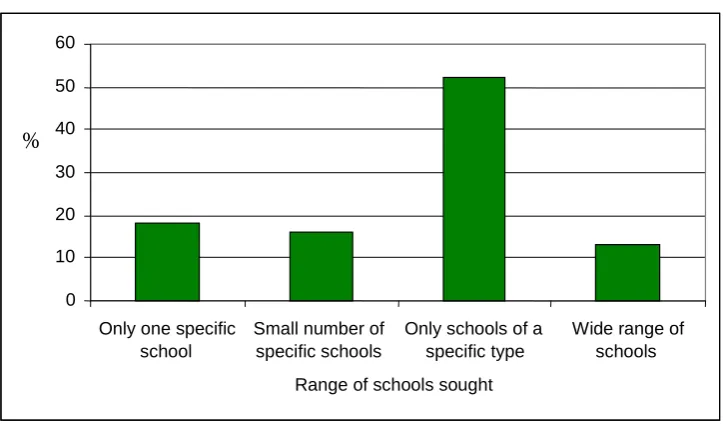
• a third were interested in only one school or a small number and over half were interested only in schools of a specific type (see Figure 5.6);
• these heads had typically made a large improvement in their first school’s SATs scores between taking up post and leaving (see Figure 5.7);
• their first schools tended to be less well performing schools than the national average when they took up post;
• for second headship as a general trend, half those in lower performing schools moved to higher performing schools and half of those in higher performing moved to lower performing (see Figure 5.13 and subsequent discussion);
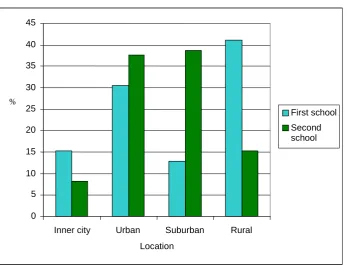
• the overall trend in location was to move from rural to suburban schools (see Figure 5.9 and subsequent discussion);
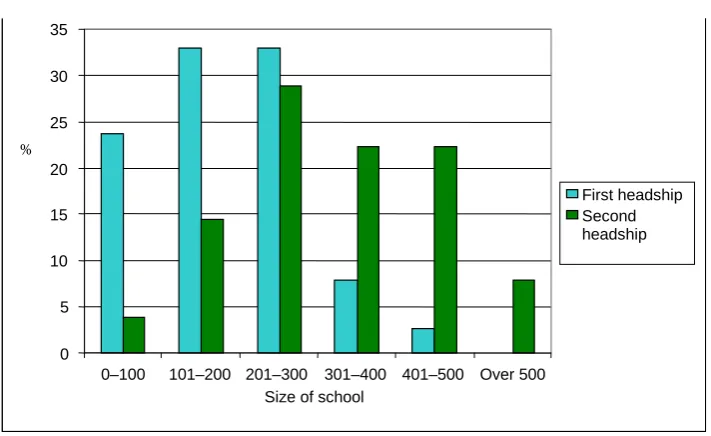
• heads generally moved to larger schools for their second headship (see Figure 5.11);
• in both schools the highest priority for improvement was curriculum, teaching and learning (see Table 5.1);
• two fifths said that they had more surprises on starting work in their second school than their first;
• almost two fifths rated themselves more successful in second headship than their first and only four did not – these had moved on to third or fourth headships;
• about 30% of existing second heads plan a further headship in the future; • over two thirds would definitely recommend second headship to first heads
(see Figure 5.14).
Secondary survey findings
Findings from the secondary school questionnaire indicated that: • 60% of second heads were male and 40% were female;
• 17% of secondary second heads were in a headship beyond their second; • they were appointed to their first headship between the ages of 31 and 52
with a mean age of 41 (see Figure 6.4);
• 44% intended to move on to second headship when appointed to their first headship;
• they spent an average of six years in their first headship (see Figure 6.3); • they were appointed to second headship between 35 and 60 years of age
with a mean age of 47 (see Figure 6.4);
• one third followed another second head in their second headship; • 60% moved to second headship for personal reasons, 30% for school
reasons and 10% (n=8) for external reasons;
• over 70% said they were more selective in their choice of second school compared to their first;
• a third were interested in only one school or a small number and 20% were interested in a wide range of schools (see Figure 6.6);
• these heads had typically made a large improvement in their first school’s test and examination scores between taking up post and leaving (see Figure 6.7); • their first schools tended to be less well performing than the national average
when they took up post;
performing moved to lower performing (see Figure 6.11 and subsequent discussion);
• the overall trend in location was a small move from urban to suburban and rural schools (see Figure 6.9 and subsequent discussion);
• heads generally moved to larger schools for their second headship (see Figure 6.10) and to 11–18 schools (see Figure 6.8);
• in both schools the highest priority for improvement was test and examination results (see Table 6.2);
• over one fifth said that they had more surprises on starting work in their second school than their first;
• almost half rated themselves more successful in their second headship than their first and only five did not;
• almost 30% of existing second heads plan a further headship in the future; • over two thirds would definitely recommend second headship to first heads
(see Figure 6.12).
The research investigated a number of themes in depth using telephone interviews. The findings from these sections are as follows.
Reasons for seeking second headship
The reasons given by primary and secondary school second heads were complex but were analysed under the headings of ‘personal’, ‘school’ (first or second), and ‘external’.
Personal reasons: the most frequent reason given was that the head sought a fresh challenge. A further prompting was provided by a consideration of what they wanted to do with their remaining career. Second heads concluded that they did not wish to spend their whole headship career at only one school and most added that they did not consider this would be good for the school either. Some considered that they personally had completed the improvements that they wished to make in that school. A small number in challenging schools found the workload in their first school was unsustainable in the longer term. Finally, family relocation could intervene even if the head did not wish to move to a second school at that time.
School reasons: almost all were under no pressure to leave their first school where they were very happy, but the most frequent reason given was that their first school needed a fresh impetus and there was a general concern that their school would become complacent if they stayed. Often this was associated with the identification that the school had reached a stage in its development that provided a suitable point for someone else to lead the next stage. Occasionally there was some concern about the school’s future either because of falling rolls or local authority
reorganisation. For a few heads it was the attraction of a particular second school that was the key reason.
External reasons: for a small number of heads it was local authority reorganisation that closed the head’s first school. There were also a very small number of cases where the head was headhunted by consultants or a local authority to take on the headship of a specific second school.
While these were the positive reasons for moving to a second headship, heads spoke of some potentially negative features that they recommended potential second heads should consider before making their decision. A small number spoke of
of their second headship. There was a more general concern that the higher workload required to establish oneself in a new school might be underestimated.
Choice of school
As heads were generally under little pressure to leave their first school, they were able to look for and choose a second school that they wanted. Some sent for details for some time before applying. They had some very general criteria that affected their choice such as wanting a new challenge and wanting a school where they could make a difference, but they also had more specific criteria. These concerned age range, faith, ability range, social and ethnic composition, location, performance and development needed. Second schools were generally larger than first schools and some heads had this as a specific requirement. About 15–20% of primary and secondary heads were interested in only one specific school with a slightly larger group interested in a small number of specific schools. Around a half had schools of a specific type in mind and 15–20% of primary and secondary heads looked at a wide range of schools (see Figure 8.1).
About a half made only one application. There was some comment about their selection by heads who were moving to a somewhat different type of school. Many of these related to heads of very small primary schools moving to larger schools.
Previous experience in a larger school and their development while head of their small school played a part in convincing selectors of their ability to head a larger school. A small number of heads that applied for a prestigious or particularly large secondary school reported that they considered that this was a second headship school – the previous head was a second head and all the shortlisted candidates were second heads.
Some heads noted that despite their efforts to investigate their second school before accepting the job and even after visits before taking up post, there were still some important surprises that they discovered in their early period in post.
Experiences: successes and challenges
There was a great deal of evidence mentioned by heads of their success in their first post but there was less evidence in terms of public indicators of success in their second school. This was largely because the interviewees were chosen from those in the early years of their second headship who were in the process of
re-establishing themselves in their new school. A good deal of effort was being placed on adjusting to a new school, discovering similarities and differences from their first school and reviewing processes that would lead to more conventional measures of success later. A surprisingly common issue was dealing with budget deficits.
They generally attributed their greater success in second headship to their greater maturity and their learning through their first headship experience. Indeed a small number of heads found themselves in schools that they considered needed a second head, so great were the skills required. While there were a number of heads in schools in challenging circumstances, it was heads who found themselves in a very difficult internal situation but not in a challenging external context, often resulting from destabilisation, who found life far tougher than they expected. The other group who for different reasons met an unexpected challenge were those who had moved from a struggling school where staff worked together and were willing to change, to one that was already quite successful but where staff saw no reason to change and improve.
potential second heads would be forewarned of situations that previous second heads had met. But there was also overwhelming evidence of satisfaction from second heads who had moved and had experienced the re-invigoration of a new challenge, and this included those meeting unexpected challenges.
Learning and professional development
Headteachers acknowledged the difficulty of meeting such diverse needs but identified a number of activities, programmes and approaches that had assisted them to meet their professional development and support needs. The NCSL programmes, particularly the Leadership Programme for Serving Headteachers (LPSH), received praise for its rigour and its success in facilitating headteachers’ self-review processes. Other sources of support were also cited, among them being: local authority personnel and structures; coaches, mentors and consultants;
professional associations, higher education establishments; secondment opportunities and visits (some overseas); directed and focused reading; and document consultation.
On the specific issue of preparation for second headship, headteachers were in agreement that their development needs could not be solely met through a new national programme. Moreover, the growing complexity of the role meant that
headteachers would continue to rely on their favoured source of support, namely the support of informal and formal networks made up of colleague headteachers.
Useful additional ways identified by headteachers for preparing for second headship included:
• thorough and timely research of the new school and its context;
• a realistic handover period accompanied by a relevant and robust induction process;
• systematic self-review and self-reflection opportunities, for example, LPSH.
The career of headship
Second headship expands and extends the career of headship and also has
implications for leadership careers before headship. One of the reasons that second heads gave for moving from first headship was the thought of spending their entire headship career in a single school. Thus the possibility of moving to a chosen school for a second headship extends the career of headship and by offering different school possibilities, it also expands the career of headship.
Analysis of the data also point to implications for leadership careers before second headship. Those who take a range of posts in different sizes and types of school are likely to find that more opportunities will be open to them in terms of choice of
headships than those who have taken a narrow path with a limited range of experience. Such effects particularly showed in moving from very small schools to larger ones, moving from single-sex schools and when taking an additional age range for a second headship compared to a first headship.
Seeking opportunities for acting headships at any career stage widens experience of different types of school and so provides a broader base from which to seek
particular choices of school for a second headship.
Heads
• Keeping options open by wide experience before first headship.
• Length of time in first school – think in terms of five to seven years and think of moving when there is a danger of plateauing rather than continuing to improve.
• Choice of school – choose a second school that will provide a personal challenge and where you can make a difference.
• Workload in first year – be prepared for a heavier workload re-establishing yourself in a new school.
• Take care transferring expectations and practice from your first school to the second.
Governors
• Governors as selectors of headteachers need to have a full appreciation of the value of appointing an experienced first head to their vacancy.
• If governors wish to appoint an experienced head they need to ensure that the salary they offer to the successful candidate is attractive.
• Governors need to identify schools that have levels of challenge for which those who are already experienced heads are likely to be best suited.
Local authorities and diocesan authorities
• The possibility of a headship beyond their first needs to be made know to those who are in senior leadership positions in school.
• Authorities need to try to provide acting headship opportunities to existing heads who may plan a second headship in order to increase their knowledge of different schools.
• Authorities should provide induction and make suitable mentoring available to all heads including second heads.
Government
• Government need to make further efforts to make headship an attractive career option.
• The pressure of expectation on headteachers needs to be lessened. • Expectations of headteachers’ careers need to be broadened to include
second headship for individuals and a role identified for them in school improvement.
NCSL
• Information and publicity is needed on second headship and the advantages that it may bring.
• NCSL could incorporate career planning into its training courses before and during headship and specifically draw attention to the implications for earlier posts of preparing for second headship.
Acknowledgements and key to quotations
The authors of the report would like to express their gratitude to all who supported and contributed to this research. In particular they would like to thank the members of the project Advisory Committee and the local authority advisers and officers from the local authorities listed in Appendix 2 who helped us identify second heads. Finally, they would like to thank all the anonymous headteachers who piloted or completed a questionnaire and gave a telephone interview. This research could not have been completed without their cooperation.
In the text where there are quotations from interviews with headteachers:
P = primary S = secondary
M = male F = female
1 Introduction
This is a report of a study of second headship in primary and secondary schools in England, funded by the National College for School Leadership (NCSL). By ‘second headship’ we mean those in headships beyond their first. The study examines headteachers’ reasons for seeking a second headship, how they made their choice, and their experiences in their first and second schools. The extent to which their successes are repeated in their second school, and the challenges and rewards of the move, are also studied, along with any development activities that could facilitate moves from first to second headship.
Previous surveys of headteachers indicate that about one third of primary heads are second heads and about one quarter of secondary heads are second heads (Earley et al 2002; Stevens et al 2005).
The literature suggests that such a mid-career transition may have the effect of renewing the motivation of those who make such a transition (Oplatka 2001a). This may be particularly effective when the transition takes place as the person reaches a plateau in their work performance and their work is likely to be less good in the future. Headship involves the processes of organisational and professional socialisation (Parkay et al 1992). The first is concerned with adapting to a new organisation, and the second is concerned with adapting to the role of headteacher. For those who have already been a headteacher and are moving to a new
organisation, the major process is expected to be that of adapting to a new organisation (Fidler and Atton 2004).
2 Background
Introduction and terminology
Here, we use the term ‘second headship’ to cover any headteacher who is in their second or subsequent permanent headship. We have heard of heads that, through short-term appointments, may have headed as many as seven schools. Where we specifically want to deal with those in third or more headships, we shall refer to them as ‘further’ headships. However, our main focus in this paper is on headteachers in the next headship after their first.
Trends over time
There have been no studies until very recently that have indicated the prevalence of second heads and no previous studies that have focused specifically on second heads. A number of earlier studies of headteachers have mentioned more than one headship but that was noted in passing. Moving on to another post after headship including second headship was not so rare 40–50 years ago. But, only recently have there been any statistics.
The two large-scale national surveys that have been carried out in 2001 and 2004 on the State of School Leadership asked about the previous posts of their sample of headteachers. Thus, in the 2001 survey (Earley et al 2002: 22) “a stratified random sample of headteachers” was conducted in the summer and autumn terms, but some weighting was required as there was an over-representation of urban schools in the summer term survey. A total of 1,050 primary and 450 secondary heads were sent questionnaires with a response rate of 47%. Of the combined group, almost 18% had served between 10–15 years and over 6% had served over 15 years. Twenty-two per cent had been appointed as an internal candidate to their first headship and 27% had been a headteacher previously. This figure was the same for primary and
secondary schools.
This group was also asked about their career aspirations and 30% said they wished to move to another school. Too much reliance should not be placed on stated intentions since there is much evidence that the reality is rather different but, nevertheless, the two figures for moving on to another school in terms of the past and future are not very different. Primary heads were more likely to consider moving to another school than secondary heads.
Copies of the questionnaires are not included in the study and therefore it is not possible to analyse the particular wording used to ascertain how far it was
permanent headships that were being investigated (other than acting headship was given as a separate result category).
Further, unpublished, analysis of the results giving the previous post of the headteacher reveals that 158 of 489 primary heads had been headteacher at another school (32%) and 99 of 421 secondary heads had held the position of headteacher (23.5%)
Thus the proportion of headteachers in headships beyond their first revealed by these two studies is 27% for both primary and secondary second heads (2001) and 32% primary and 23.5% secondary second heads (2004). Our study only looked at second heads and so our findings do not give any further evidence on how many heads are in this group.
Starting points
An important starting point for the work was transcripts of three interviews that had been conducted with secondary second heads in1998. These transcripts formed the first evidence probing why heads had sought a second headship, together with their experiences. From reading through them, it was clear that the decision to move was a complex process, which was influenced by both the individual and their first school.
Personal issues: these centred on looking for a change and a fresh challenge. Sometimes this was specific in terms of a move from a challenging school to one in more favourable circumstances but, generally, the second school was larger.
First school: there was a general feeling that a particular stage of the school’s development had been achieved and either it was not clear what should come next or that the next phase would require different skills.
Learning from the change of school: being head of two schools made them more conscious of differences between schools and the things that they had taken for granted in their first headship. They felt much better prepared for their second headship but things turned out not to be so straightforward as they had anticipated. They had clearer ideas about the kinds of changes they wanted to make but had met some setbacks. They were very aware of the legacy of expectations left by their predecessor. Where they wished to adopt a very different, more involving style they found this change was taking much longer to achieve than they expected. Change was something that generally they were finding unexpectedly tough. A willingness to change that they had experienced in their first school was generally absent in their second more successful school. Aspects of this could come from both governors and staff.
These findings were from three male heads in a particular part of the country at a particular point in time and although we suspected that they were more general, we did not have more up-to-date evidence. We therefore decided to carry out a small number of in-depth pilot interviews with more secondary second heads in different parts of the country.
Pilot interviews
Findings
Career intentions: why go on to second headship?
Only one head had a plan for a second headship when he took up his first headship. The others had not really thought about a further headship until they had been a head for quite some time or there was some event that precipitated a possible move. After a successful Ofsted inspection, it was suggested to one head, by her LA, that this would be an opportunity to move on. For another, it was a period of secondment to NCSL that served as the stimulus, while for another, it was the headship of a particular type of school within the LA that led to an application.
From the accounts of the heads and their applications they expected that age would be a factor if they applied for a further headship.
What came through the accounts from all of the heads was the wish for a fresh personal challenge. They all had in mind particular kinds of school that they would like to move on to. Some moved to a school that had similarities with their first school, while others moved to a different type of school. All moved on to larger schools or schools that paid a higher salary. Salary was mentioned in passing by the heads and only one saw a higher salary as being important to legitimate his choice of second school.
These headteachers had successful first headships and were under no pressure to leave their first school. This partly explains their views and their choice of next school. They were able to be selective. All were looking for particular types of school and were much more discriminating in their choice of school. In some cases, the shortlist for the posts that they applied for consisted entirely of those who were already headteachers. This suggested that some schools may be sufficiently
attractive that they can attract such a field and that governors may have a preference for candidates with experience. As further support for this possibility, in some cases they were following a second head. Thus, there may be a different pool of preferred applicants for some schools.
While they were under no pressure to leave, a number mentioned that they
3 Literature review: second headship – issues, challenges
and opportunities
Introduction
Career transition within and between organisations, including schools, is a common phenomenon due to changing conditions and circumstances. It is increasingly becoming accepted that the phenomenon is inevitable and the trend is bound to continue (Louis 1980). Associated with job mobility are positive and negative consequences (Draper and McMichael 2000). It has been argued that career transition results in a self-renewal process to the transitioners, marked by
innovativeness, reflection and reframing (Oplatka 2001a). This is a positive aspect of transition. Second headship has been identified as an opportunity for personal and professional replenishment, as a means to overcome one’s internal crisis (Oplatka 2001a), and as an opportunity to take up new challenges (Fidler and Jones 2005). Individual headteachers would often like to move to another context, another headship, once they realise that they have reached a plateau in their current post and once they view their job as a chore and no longer a challenge (Earley et al 1995). Plateauing is associated with fatigue and disenchantment, and fatigue impairs performance (Earley et al 1995).
Career transition involves stages and second headship has been located as a mid-career stage transition (Oplatka 2001a). Although literature on second headship is limited in scope (Oplatka 2001a), there is evidence to suggest a growing interest in the subject (Earley and Weindling 2004; Fidler and Jones 2005; Mackenzie 2005).
Definitions and concepts
As a preliminary step in the discussion of second headship, the following terms will be defined: second headship, job mobility, transition, career transition, work role transition, premature departure and involuntary departure.
• Second headship: headteachers who are in their second or subsequent headship (Fidler and Jones 2005: 12).
• Job mobility: a departure from a leading position of whatever nature and for whatever reason (Krüger et al 2001: 400).
• Transition: both a change and a period during which the change is taking place (Louis 1980: 330).
• Career transition: the period during which an individual is either changing roles (taking on a different objective role) or changing orientation in a role already held (altering a subjective state) (Louis 1980: 330).
• Work role transition: any change in employment status and job content. Thus it includes all forms of intra and interorganisational mobility and other
changes in employment (Nicholson 1984: 173).
• Premature departure: job mobility that is not caused by personal factors such as health or the acquisition of a new job, but that is forced by circumstances in the context of the job, in the organisation where the leadership is
performed and/or by personal characteristics of the principal, such as gender, age or leadership style (Krüger et al 2001: 400).
• Involuntary departure: departure that takes place against the will of the person concerned (Krüger et al 2001: 401).
Career transition
Louis (1980) identifies different types of career transitions. In addition to moving jobs she includes changes to the individual within the same job. She distinguishes
between inter-role and intra-role transition. The former involves changing jobs while the latter involves “a new and different orientation to an old role” (p 332). Within the inter-role transitions she identifies five different types, which could involve changing organisations and changing role. Within the intra-role transitions, she identifies four. She observes that some of the intra-roles may not have been embarked on
consciously. She also talks of role and extra-role adjustment. Regarding intra-role adjustment, the formal intra-role is not changed but there is “an internal change in the role holder’s orientation” (p 334). The extra-role adjustment involves a change in one’s life role, which leads to a change in another role, for instance, private and work. She also looks at role/career stage, which she claims to change over time without conscious effort or awareness. Also considered within her discourse is life stage transition, which is about a series of stages in the psychosocial development of the individual, for instance, mid-life crisis.
Nicholson (1984) links the degree to which individuals adapt to their job and their degree of adaptation of the job to their skills and preferences and variables associated with these different orientations.
Vardi (1990) examines career development and mobility within organisations. He notes the major approaches to careers and careers mobility, for instance, economic, administrative, sociological, psychological, and identifies major career concepts. He identifies organisational level characteristics and individual level characteristic constraints and mediating processes. Krüger et al (2001) examine job mobility of principals in the Netherlands and identify a wide range of reasons for job mobility as ‘innocent’ and ‘heavier’ that span the whole spectrum (p 405). The former includes:
• retirement (at age 65); • early retirement (58+);
• resignation (younger than 58 without financial settlement or reduced pay); • health problems or long-term disability;
• death;
• discontinuance of the function in the event of mergers or reorganisations; • acquisition of another position in the principal’s own school, in another school or
outside education; and
• termination of employment contract by the court. (Krüger et al 2001: 405)
The latter involves “rescission of employment contract by the cantonal court; summary dismissal; and dismissal on the basis of incompetence or disability” (p 405). They note that the official reasons for job mobility cited by both men and
women principals are “acquisition of a position in another school” and “resignation” (p 405). They also raise the issues of premature departure and involuntary departure, which are conceived as job mobility. They concluded that job mobility in secondary education was higher for women than men. Draper and McMichael (1998) note that becoming a headteacher involves an occupational transition from a teacher to a manager.
Career phases and stages
Stage implies distinct periods of time that differ qualitatively from both the preceding and succeeding stages whereas a phase may include behaviour across several domains. Phases are recurrent in that individuals can pass through various phases in and between each of many different content domains. (Day and Bakioglu 1996: 207) Following Karmiloff-Smith (1984), Day and Bakioglu (1996: 207) make a distinction between phases and stages: “The phase concept is focused on underlying similarity of process, whereas the stage concept usually refers to similarity of structure”. Day and Bakioglu (1996), in their study of the experience of long-serving headteachers, classified their career experience into four main phases namely, initiation,
development, autonomy and disenchantment.
Others have preferred to use stages without necessarily implying that these are linear. Researchers have identified different numbers of stages. From work on eight new principals in the US, Parkay et al (1992) identified five stages, used later by Benaim and Humphreys (1997) on a case study in Israel – survival, control, stability, educational leadership and professional actualisation. Reeves et al (1997), in a European study, grouped eight career stages into three broad phases, namely, early, middle and mature. Earley and Weindling (2004), following a long-term follow-up of headteachers in England who began work in 1982, identified six stages and their timescale, something that may be very significant in terms of assessing one’s length or duration of career tenure and progression.
Oplatka (2001b: 220) following Weindling (1999) argues that “a person’s experience and attitudes towards work and life vary across the career life cycle and that
developmental change processes were assumed to be differentiated into observable career stages.” And yet others have preferred to use both phases and stages to illustrate the relationship between them (Fidler and Atton 2004). Those who have used both phases and stages have shown that each phase consists of two to three stages. Other writers have given stages with a timescale while others have not. For instance, Earley and Weindling (2004) have given six stages and a timescale,
something that may be very significant in terms of assessing one’s length or duration of career tenure and progression.
A number of models have been developed that are significant in terms of providing a theoretical framework for studying headship career pathways and identifying the stage for support or intervention. Some models have more stages than others (for instance, some have six while others have nine). They also start and end with different stages. Another observation is that while there may be an agreement among different writers that career experience of headteachers can be viewed or considered in terms of stages, consensus is lacking on the content, order or number of stages. Fidler and Atton (2004) produced a consolidated set of stages based on the work of previous researchers showing that the career stages from different authors have much in common. This is shown in Table 3.1. It shows stages to the end of first headship. For those headteachers who go on to a second headship, the fresh start is the beginning of their second headship.
Table 3.1: Showing different stage models to the end of first headship
Overview
Fidler and Atton (2004)
Gronn (1999)
Day and Bakioglu (1996)
Hart and
Weindling (1996)
Parkay et al (1992)
Earley and Weindling (2004)
Reeves et al (1997)
Gabarro (1987) Early life and
career
Formation Formation
Preparation for headship
Preparation Accession Preparation Warm up
Encounter: surprise, adjustment and survival
Incumbency Initiation: idealism, uncertainty and adjustment Encounter and confrontation Survival Shock Sorting it out
Entry and encounter (first months)
Entry (0–6 months) Digging the foundations (6–12)
Taking hold Immersion
Taking hold: getting on top of the situation and setting priorities Development: consolidation and extension Accommodation and integration Control Setting priorities Getting on top of the situation
Taking hold (3–12 months)
Taking action (12– 24)
Reshaping Consolidation
Reshaping (second year)
Stabilisation Getting above floor
level (24–36) Stability
The crunch
Refinement (years
3 and 4) The crunch (24–60)
Educational leadership
At the summit: plateaued/time for a change
Autonomy: single
loop learning Stabilisation Professional actualisation Consolidation (5–7 years)
At the summit (48– 120)
Refinement First headship
Plateaued: disenchantment
Disenchantment Plateau (8+ years) Time for a change
(60–120) Preparing to
finish
Letting go Divestiture
Continuing working life
A fresh start
In that connection Benaim and Humphreys (1997: 86) argue that:
When you are in a job for long time you do not feel the need for change, you are sitting in the same class and sometimes even giving the same exam each year, so teachers do not try so hard to change themselves.
The disenchantment phase has also been linked to individual heads experiencing loss of vision for the future of the school (Day and Bakioglu 1996).
First headship
Draper and McMichael (1998), in a small-scale study of primary heads in Scotland, identified two significant features of those who were likely to apply for first headship. First, they were more often within their thirties than over their forties. Second, they had headship as their long-term strategic view of career development. A large number of those who were likely to move to first headship were deputy heads. Others were those who were in acting heads positions, advisers or secondments (Draper and McMichael 2000). Deputy heads felt that they were familiar with most of the tasks surrounding the headteachers’ role (Draper and McMichael 2000), while those in the position of acting head, adviser or on secondment felt that they had “acquired a wider and more strategic view of the education system and the needs of individual schools” (Draper and McMichael 2000: 462). Interestingly, deputy heads’ aspirations for headship were driven by their own self-determination, perceived competence, wider experience and high expectations (Draper and McMichael 1998).
Moving to headship involved a certain degree of careful preparation, for instance, attending headship and management courses (for example, timetabling, financial management), observing the heads of their previous schools and undertaking many delegated duties (Draper and McMichael 1998). However, despite long preparation and previous experience, the shift of context has been reported to bring challenges and surprises and gains and losses to the newcomers. Evidence suggests that some heads felt decontextualised and therefore deskilled (Benaim and Humphreys 1997; Draper and McMichael 1998, 2000). Some of the challenges that have been identified in the literature include integrating and harnessing the force of high
expectation of the school community on the one hand and that of establishing a new vision with a new authority on the other. There are also issues related to a highly esteemed and successful predecessor whose impact is difficult to follow and dealing with negative criticism (Benaim and Humphreys 1997). Some of the surprises experienced by new heads include: loneliness; some of the procedures that had worked in the previous school failed to work in the new school; inadequate support from the local authority; and the amount of official returns to be made (Benaim and Humphreys 1997; Draper and McMichael 1998, 2000). Others received pleasant surprises, for example, overwhelming respect.
Table 3.2 Showing a model of the gains and losses of job change (GLAD)
Attachment Detachment
Benefits/gains Positive consequences of holding the new job
Positive consequences of leaving the previous job
Losses Negative consequences of holding the new job
Source: Adapted from Draper and McMichael (1998: 200)
Draper and McMichael (1998) examined gains and losses associated with the job change of new headteachers and grouped them into two categories – detachment and attachment, as illustrated in the model (GLAD) above.
In their study they identified the “loss of friendship and support from previous colleagues and association with pupils and parents” and “loss in knowledge of how things worked with respect to parents, the school, the community and the local authority” as a major detachment loss (Draper and McMichael 1998: 200). Such a situation also affects almost anybody who changes jobs. New things to learn and master (personal development) were identified as attachment gains (Draper and McMichael 1998). Frustrations associated with the previous school have been identified as “significant motives for application” for the new job (p 204).
Second headship
From research in Israel, Oplatka (2001a, 2001b) identifies second headship as both an interorganisational and mid-career transition, often occurring between the ages of 40 and 50 (mid-life stages). He also argues that mid-career transition often occurs after 8–14 years in the same career. It is similar to intra-company transition in Louis’ typology (Louis 1980).
Several studies (Oplatka 2001a; Fidler and Jones 2005) link second headship to plateau or peak period and view it as a strategy for personal and professional
development, and therefore as a means to “overcome one’s internal crisis” (Oplatka, 2001a: 73). Having identified career stages in the previous section, it is important to establish the reasons for career transition. Foremost, it is important to point out that career transition may not be a linear process and that stages may occur
concurrently. Reeves et al (1997: 50), in a study that had six headteachers (who had held two headships) in the sample, point out that career stage patterns were often repeated in the second headship, “but the progression through the stages was quicker second time round because they understood better what to expect and how to handle situations”. Also, that career transition may occur at either an early stage, mid-stage or later stage of one’s career. There are several reasons for career transition. For instance, Flintham (2003) identifies the reasons headteachers leave early:
Reasons cited for leaving spanned the full spectrum. This ranged from successful heads with a planned and career-driven exit strategy, who had sought to capitalise on their experience in the wider educational arena to those who felt burnt out and had suffered high levels of psychological stress which had made it impossible to continue in headship or even in gainful employment. (Flintham 2003: 5)
Flintham (2003) grouped headteacher transitioners into three clusters: ‘striders’, ‘strollers’ or ‘stumblers’. Striders were those whose exit was based on a clear plan; strollers were those who wanted to walk away from headship in a controlled manner; and stumblers were those to whom the realisation of that burn-out came suddenly and unexpectedly. He observes that the striders had a clearly defined strategy for moving on.
A review of literature on mid-career reveals some negative and positive aspects associated with career transition (Oplatka 2001b). The negative aspects include:
… high levels of self-fulfilment, enchantment, job satisfaction, new challenges in their role, and experience professional development. (Oplatka 2001b: 220)
Headship is associated with professional socialisation and organisational socialisation (Parkay et al 1992). Van Maanen and Schein (1979: 211) define socialisation, professional socialisation and organisational socialisation as follows:
Socialization refers to the process through which an individual acquires the knowledge, skills, and dispositions needed to perform a social role effectively. Professional socialization refers to the process through which one becomes a member of a professional and over time, develops an identity with that profession. Organizational socialization on the other hand refers to the process by which one is taught and learns ‘the ropes’ of a particular organizational role in a specific setting. Fidler and Jones (2005) define professional socialisation and organisational
socialisation as follows: professional socialisation is “the process of acquiring the skills and attitudes of a headteacher and of understanding what it means to be one” (p 12). Organisational learning “is about discovering how the particular school in which they work operates and how it might respond to efforts to change and improve” (p 13).
Earley and Weindling (2004) see professional socialisation and organisational socialisation as two overlapping phases, arguing that “professional socialisation begins in the pre-appointment phase of a school leader’s career and continues into early post-appointment growth and development” while “organisational socialisation begins upon appointment and is specific to the education context” (p 21).
It is assumed that headteachers in their second headship are likely to experience low to medium levels of professional and organisational socialisation due to their
experience in their first headship (Fidler and Jones 2005). Organisation learning involves knowledge about the school prior to and in the early stages of taking up the post and in our case second headship (Fidler and Jones 2005). In a small-scale study of secondary second headteachers, it was observed that such knowledge assisted second headteachers in terms of making some assessment about the school before accepting the post. In terms of gaining knowledge of their second headship school, one head used financial analysis and comparison techniques, which may have involved visitation and observation as part of their assessment (Fidler and Jones 2005). Two of the heads in the study that had used individual staff interviews in their first headship to get to know the school did not use them in their second headship but recognised afterwards that this may have been a mistake (Fidler and Jones 2005).
Organisational socialisation and learning is facilitated by the social organisation of the school as suggested by Hart (1993) and as cited in Benaim and Humphreys (1997: 83), who argue that:
The ‘principal’s succession’ is not a simple event but a complex interactive process, based not only upon the characteristics of the new leader and the succession process, but also upon the social organisation of the school. There is an inevitable tension between a school’s need for creativity and development and the need for the headteacher to integrate within the social structures that already exist.
Organisational socialisation is about reality testing, adjusting and being accepted in the new environment (Louis 1980). It is also about adapting into the new
identify central office personnel, peers and administrative guidelines as key to the organisational socialisation of a new principal. Other critical areas for new principals include a need to adjust to alienation from the faculty, developing patience and flexibility in regards to other’s opinions, and also developing a broader perspective (Parkay et al 1992). Also the interaction between an individual’s interpersonal orientation and situational factors plays a significant role in terms of an individual’s socialisation into the new role (Parkay et al 1992).
There is a serious danger, however, if the new head fails to integrate, as explained by Benaim and Humphreys (1997: 83): “the succession process is not only a tremendously important event but is also extremely disruptive if the new
headteacher fails to become an integrated and respected member of the social system”. The importance of the notion of integration of new headteachers receives support from Draper and McMichael (1998: 459), who note that:
It can be argued that there is need for new appointees to become integrated into the organisational context in order to access support from colleagues and to gauge the attitudes and skills of those colleagues who plan the most appropriate order and speed of strategic change.
They further observe that the process of integration may require personal change from the new headteacher (Draper and McMichael 1998).
Understanding challenges in the new context
Being successful in the first headship does not necessarily make one immune to second headship challenges. For instance, Fidler and Jones (2005: 13) argue that:
There are cases where successful headteachers in their first headship are less successful in their second. Also, some headteachers who are less than successful in their first post may go on to become highly successful in second headships.
Headteachers who move from one post to another move to new contexts or settings that are different from their previous experiences and expectations (Draper and McMichael 2000). Despite their long experience, the shift of context poses certain challenges, changes, expectations and surprises. The heads in the new setting are faced with the challenge of establishing new aims and goals (Oplatka 2001a). There are also issues relating to the contextual factors. For instance, in Reeves et al’s study (1997: 50) some of the six headteachers who had held two headships “felt that their second headship had been more difficult than their first and that contextual factors meant that transfer of learning from one situation to another was not
necessarily straightforward or helpful”. Benaim and Humphreys (1997) identify three broad categories of problems experienced by new headteachers. They include those internal to the school, those external to the school and those related to staff and staffing issues.
Rieger and Bradley (1995) as noted by Benaim and Humphreys (1997) also identify four challenges that confront new headteachers encapsulated in the text below, which may also be related to change of context. They include:
who may be excited by the new opportunity also expects to set up a new vision and new authority in what Benaim and Humphreys (1997: 81) describe as “part of the new power parcel”. Benaim and Humphreys (1997: 81) note that “the integration and harnessing of these new forces is of great concern not only to the staff of the school, but also to the pupils and their parents”. In connection with new headship
expectations, Benaim and Humphreys (1997) raise the notion of “a fresh pair of eyes and a new sense of perspective” (p 86), and view them as important assets in
relationship to the school’s development programme. In an Australian study, Peters and Cornu (2004) have also identified what they call paradoxical challenge, which they claim is the result of “the contradiction between perception and expectations of the incoming leaders about what their roles should be, and those of some members of their new school communities” (p 12). Reeves et al (1997: 52) emphasise the importance of understanding the school culture in their observation that:
Whilst new school leaders have their own ideas and values, their task is very much to find out what the school culture is and to cooperate with teachers primarily, and with parents to develop the school collaboratively.
Associated with transition to new contexts are surprises. Surprises “are the differences that arise between an individual’s anticipations (tacit and explicit) of future situations and experiences, and the subsequent real-time happenings” (Louis 1980: 332). Surprises often result when there is considerable difference between the jobs as expected and as experienced (Louis 1980). Louis (1980) identifies a variety of surprises that are often experienced during transition. She explains “surprises are subjective appreciations of differences between a personally forecasted experiential world and the individual’s subsequent experience of self in the role and setting” (p 332). Draper and McMichael (2000) have identified some of the surprises that may face headteachers in their new schools. These have to do with their personal reaction to their new position, for instance, their degree of loneliness, or to do with the things they found in the schools they inherited, for instance, the decor, the
arrangement of the head’s room (barricade erected against intruders in some cases), or more seriously, the poor conditions of the buildings, poor discipline, amount of parental pressure and amount of time spent on administrative matters as opposed to teaching and learning (Draper and McMichael 2000: 466). However, as Fidler and Jones (2005: 13) note, their “experiences in the second school will be influenced both by the differences between the contexts of the two schools and also by their learning in the first headship”.
Conclusion
4 Brief account of how the research was carried out
The aims of the project were to investigate:
• the effects on headteachers who went on to a second headship in a state primary or secondary school in England;
• headteachers’ motives for taking on second and, in some cases, third headships;
• the circumstances that led to such a move; • how such choices fitted their career aspirations; • their choice of school;
• the extent to which the successes and failures experienced in first headship were repeated;
• the challenges and rewards of such a move;
• the continuing professional development needs of these headteachers to prepare for and sustain such a transition;
• the nature of any self-renewal and fresh challenge; • successful transfer of skills and learning;
• any preparation and development that may be helpful in the transition.
The study involved a literature review, a questionnaire survey and follow-up telephone interviews. The secondary school survey was carried out in the autumn term 2005 with interviews in the spring term 2006; the primary school study involved a pilot study in the autumn term 2005, a survey in the spring term 2006 and
interviews in the summer term 2006. Full details of the methodology are given in Appendix 2.
A purposive sample of LA advisers were asked for details of headteachers known by them to be in a headship beyond their first. Forty authorities from the nine
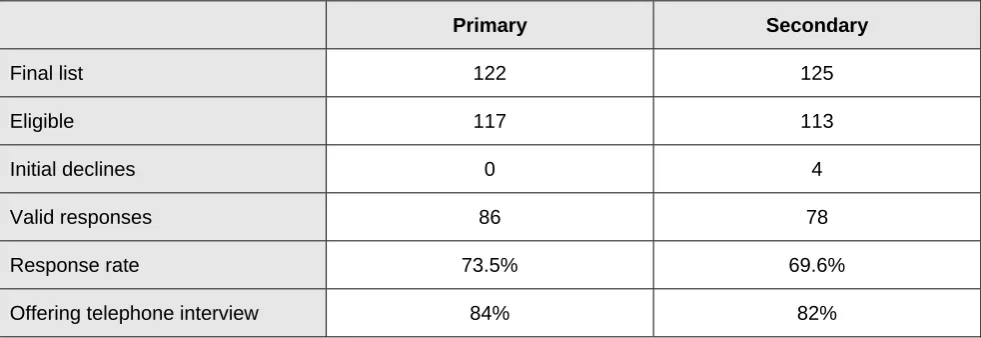
[image:25.595.85.576.531.700.2]Government Regions in England representing county, metropolitan districts, London boroughs and unitary authorities provided details. These LAs are listed in Appendix 2. The larger number of primary school second heads was randomly sampled and postal questionnaires were sent to 122 primary second heads and 125 secondary second heads. The details of the responses are in Table 4.1 below.
Table 4.1: Responses to postal questionnaires
Primary Secondary
Final list 122 125
Eligible 117 113
Initial declines 0 4
Valid responses 86 78
Response rate 73.5% 69.6%
Offering telephone interview 84% 82%
who said that they expected their second schools to be either similar or different to their first school. All interviewees were asked about the forms of training and development that they had undertaken in either first or second headship. The
5 Findings from the primary school survey
These are the findings from 86 completed questionnaires.
Who are second heads?
Gender
Of the primary heads that completed questionnaires, 55% were female and 45% were male. There is an over-representation of males and an under-representation of females compared with the national picture.
Age
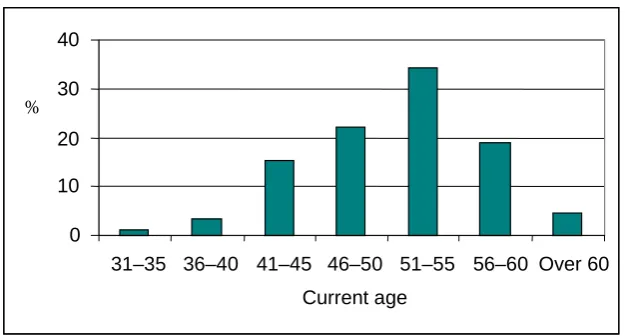
[image:27.595.92.405.284.452.2]Their age when completing the questionnaire is as shown in Figure 5.1.
Figure 5.1: Current age of respondent primary second heads
0 10 20 30 40
31–35 36–40 41–45 46–50 51–55 56–60 Over 60
Current age %
Number of headships
Some respondents had gone on to third and fourth headships, as shown in Figure 5.2.
Figure 5.2: Number of primary headships held
60% 33%
7%
2
3
4
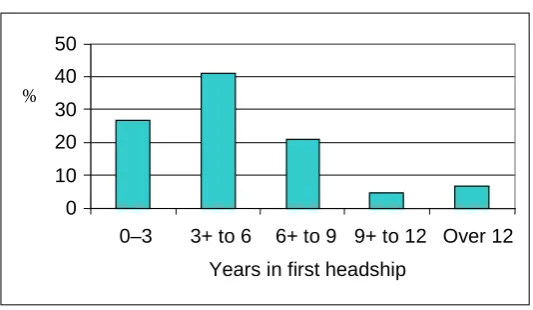
[image:27.595.92.390.553.707.2]heads spent an average of nearly six years in their first headship with a distribution shown in Figure 5.3. The most likely duration was between three to six years. Ninety per cent moved straight from first to second headship. Those who did not move directly mentioned time as acting head, local education authority (LEA)
[image:28.595.93.360.150.305.2]advisor/inspector and school improvement officer between headships.
Figure 5.3: Length of time in first primary headship
0 10 20 30 40 50
0–3 3+ to 6 6+ to 9 9+ to 12 Over 12
Years in first headship %
For those who went directly onto second headship (90% of the sample), the mean age of appointment to second headship was 44 years. The mean length in the second headship was five years with a range of one term to 22 years. Twenty-nine per cent had intentions of becoming a headteacher when they started teaching. Almost half intended going on to a further headship when appointed to their first headship.
Figure 5.4: Ages on taking up first and second primary headships
0 5 10 15 20 25 30 35 40 45
35 or under 35+ to 40 40+ to 45 45+ to 50 50+ to 55
Age in years
%
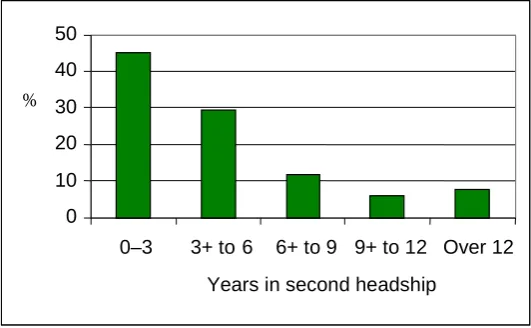
[image:28.595.88.477.425.683.2]Figure 5.5: Experience of second headship by 51 current primary second heads
0 10 20 30 40 50
0–3 3+ to6 6+ to 9 9+ to 12 Over 12
Years in second headship %
The mean length of time in second headship by the 32 who had gone on to third and fourth headships was just over five years, with a range of one to 22 years.
Reasons for moving
The heads were asked to prioritise their reasons for moving to second headship. The percentage indicating their single most important reason was:
• 66% had personal reasons • 27% had school reasons • 6% had external reasons.
Table 5.1: Personal, school and external reasons for choosing second primary headship
Personal School External
The range of personal factors in order of decreasing importance was:
Fresh challenge Timing was right
Use skills in new context Personal circumstances
The range of school factors in order of decreasing importance was:
Timing right for school Achieved aims there School needed fresh
impetus
School needed different skills at this stage of its development
Insufficient leadership time
The range of external factors in order of decreasing importance was:
Particular headship advertised
Headhunted to apply School reorganisation
The possible discouragements to moving from first to second headship that were identified as very or quite important were:
• 46%: more to do at first school
• 43%: recognised possible risks involved.
Choice of school
[image:29.595.86.511.447.632.2]• geographical location • school size
• salary • school type • catchment area.
[image:30.595.93.455.217.429.2]Sixty-seven per cent said they were more selective for their second headship while 28% said they were equally selective. When asked about their selectivity, Figure 5.6 indicates the range of schools that they said that they were interested in.
Figure 5.6: Range of schools sought for second primary headship
0 10 20 30 40 50 60
Only one specific school
Small number of specific schools
Only schools of a specific type
Wide range of schools Range of schools sought
%
When asked about the actual applications that they had made the findings were as follows:
• 54% applied for only one school • 44% attended only one interview
• 20% withdrew an application made to a school • 25% had an internal candidate for their post.
The reasons for withdrawing were: • lack of match
• unprofessional behaviour of the governing body • school too similar to the first school
• few candidates shortlisted
• the school’s close links with the church • poor school facilities
• long commuting distance between school and home • the school’s inability to appoint.
Comparison of schools
Figure 5.7: Performance of the school on taking up post and leaving first primary school
0 5 10 15 20 25 30 35 40
Substantially below comparable
schools
Below comparable
schools
About the same as comparable
schools
Above comparable
schools
Substantially above comparable
schools
No data published at
the time
SATs performance
%
Taking up post Leaving post
For the schools where there was comparable data, it is clear that there was a large improvement in test results over the period of first headship.
[image:31.595.89.389.378.612.2]Type of school
Figure 5.8: First and second primary school types
0 10 20 30 40 50 60 70
Infant Junior Primary First Other School type
%
First school Second school
Most of the first and second headships were concentrated in primary schools. The figure shows that there were only small overall differences in going from first to second headship. However, looking more in depth at the movements that took place from first to second headships shows that only 61% moved between the same types of school.
48 moved to a junior school and the same number went to a first school and just 2 moved to an infant school.
Location of first and second schools
[image:32.595.95.443.174.439.2]The favoured locations for first headship are rural and urban and for second the move is towards suburban and urban locations.
Figure 5.9: Location of first and second primary schools
0 5 10 15 20 25 30 35 40 45
Inner city Urban Suburban Rural Location
%
First school Second school
While there are clear overall trends in movement from rural to suburban schools for second headship, the movements of individuals are more complex than this might imply. Only 45% of heads moved between schools in the same location types.
Three of the 13 heads of inner-city schools for their first headship moved to another inner-city school for their second headship, while the others split between moves to an urban or suburban school. Just over half of the heads in an urban school moved to another urban school and almost a third moved to a suburban location. The remaining split – three moved to an inner-city school and one to a rural school.
School denomination
Figure 5.10: Denomination of first and second primary schools
0 20 40 60 80
C of E Catholic Other None
Denomination of school %
First school
Second school
Most of the first headships were in either a Church of England (C of E) or a non-denominational school but non-non-denominational schools were the favoured type for second headships. Fifty-seven per cent moved between the same types of school. The changes came about mainly as over half those in a C of E school for their first headship moved to a non-denominational school for their second headship. In part this movement reflects the move to larger schools and from rural to suburban areas.
Interestingly, three of the five first heads in a Catholic school moved to the same type for their second headship and one head in a C of E school and one in a
non-denominational school for their first headship moved to a Catholic school for their second headship.
Figure 5.11: Number of students in first and second primary schools
0 5 10 15 20 25 30 35
0–100 101–200 201–300 301–400 401–500 Over 500 Size of school
%
First headship Second headship
Regular teaching load
Comparison of regular teaching loads in the two headships is difficult in part due to the small numbers in the larger schools in first headship and small numbers in smaller schools in second headship. Another factor is that the comparison might have been made some years apart when staffing norms had changed in the meantime. The regular teaching loads in first headship in the three smallest
categories of schools (where there were between 20 and 30 in each group) shows a falling load with increased size in Figure 5.12.
Figure 5.12: Regular teaching load in the smallest primary first headships
0 20 40 60 80
0–100 101–200 201–300
Regular teaching
l
d
%
School performance
Figure 5.13: Performance on taking up post in first and second primary schools
0 5 10 15 20 25 30 35
High performing
Satisfactory Coasting Struggling Failing/serious weakness
School performance
% First school
Second school
The performance of first schools when heads began there is heavily biased towards schools in the lower performance categories compared to schools generally; for example, only around 10% of schools nationally are in the lowest category. While there is a small movement away from the lowest performing schools, this overall trend masks a great deal of movement of individual heads. For example, only about a quarter have a second headship in the same performance category as their first and just over 40% stayed within the two upper, lower or coasting categories.
Table 5.2: Areas of work that heads prioritised in their first and second primary schools
First school Second school
Curriculum, teaching and learning Curriculum, teaching and learning Recruiting and developing staff competence Test results
Test results Recruiting and developing staff competence
Improving premises Improving premises
Parental satisfaction and support Parental satisfaction and support
There is great similarity in the order of these areas even though they took place in different schools and there was a gap of several years in time.
Expectations and experiences
Just over one fifth expected their second headship to be essentially similar to their first headship school while 78% expected it to be quite different. Just over two fifths experienced more surprises in their early stages of second headship than in their first while 29% experienced fewer surprises. The remaining experienced a similar
number of surprises.
Almost two fifths rated themselves more successful in second headship than their first and a further two fifths rated themselves equally successful. Only