Shape optimization of metallic yielding devices for
passive mitigation of seismic energy
Kazem Ghabraiea, Ricky Chanb,∗, Xiaodong Huangb, Yi Min Xieb
aFaculty of Engineering and Surveying, University of Southern Queensland, Toowoomba Qld
4350, Australia
bSchool of Civil, Environmental and Chemical Engineering, RMIT University, GPO Box 2476,
Melbourne VIC 3001, Australia
Abstract
Bi-directional Evolutionary Structural Optimization (BESO) is a well established
topology optimization technique. This method is used in this paper to optimize
the shape of a passive energy dissipater designed for earthquake risk mitigation.
A previously proposed shape design of a steel slit damper (SSD) device is taken
as the initial design and its shape is optimized using a slightly modified BESO
algorithm. Some restrictions are imposed to maintain simplicity and to reduce
fabrication cost. The optimized shape shows increased energy dissipation capacity
and even stress distribution. Experimental verification has been carried out and
proved that the optimized shape is more resistant to low-cycle fatigue.
Keywords: Shape optimization, Energy dissipation, Bi-directional Evolutionary
Structural Optimization, Metallic damper, Cyclic tests, Earthquake resistant
structure
∗Corresponding author
Email addresses:[email protected](Kazem Ghabraie),
1. Introduction
In the last two decades development of energy dissipation devices for
miti-gation of wind and earthquake has flourished. Various types of passive,
semi-active and semi-active devices have been proposed, tested and implemented [1]. With
this technology, a large portion of input energy from wind or earthquake
exci-tations is dissipated by designated devices. As a result, structural responses are
suppressed, and major structural elements can be protected from damage.
Particu-larly in earthquake applications, metallic devices which utilize yield deformation
of metals remain among the most popular types selected by engineers. They are
reliable, inexpensive to fabricate, easy to install and maintain. Metallic devices
can be classified into flexural types, such as hourglass shape ADAS [2],
triangu-lar shape TADAS [3]; shear types such as YSPD [4] and axial types, such as the
Buckling Retrained Brace [5]. Devices are mainly designed to be incorporated
into lateral-load-resisting system in structural frames, but some are developed to
be installed between beam and columns [6].
Design of metallic devices requires several desirable engineering
characteris-tics:
1. possessing sufficient elastic strength and stiffness such that device is not
excited to inelastic region under service loads;
2. having stable and large energy dissipative capability; and
3. having reasonable resistance against low-cycle fatigue.
With respect to low-cycle fatigue, current design standard in the United States
requires devices to undergo five fully reversed cycles at maximum earthquake
de-vice displacement (ASCE/SEI 7-05). Generally, in order to increase the resistance
Along with the revolutionary improvement of digital computers in recent decades,
computational methods and numerical techniques have established their place as
invaluable engineering tools. Among these, numerical optimization methods have
attracted a great number of researchers and have been improved a lot. Particularly,
the state-of-the-art shape and topology optimization techniques have been applied
to a range of physical problems and have been proved to yield much better results
than experimental designs [8, 9]. The Evolutionary Structural Optimization (ESO)
method, introduced by Xie and Steven [10] is a simple and effective topology
op-timization technique which can tackle shape opop-timization problems as well. This
method iteratively improves the design domain by removing its inefficient parts.
A Bi-directional version of the ESO method, called BESO, has been later
pro-posed by Querin et al. [11, 12] and Yang et al. [13]. In BESO, besides removal
of inefficient parts, the efficient parts of the design domain will be improved by
adding more material next to them. Since its introduction, the BESO algorithm
has been improved significantly [14]. The improved BESO algorithm has been
successfully applied to non-linear problems [15, 16]. This method is also capable
of optimizing both shape and topology of the designs [17].
In this paper, the BESO algorithm is modified to optimize the shape of an
ex-isting steel slit damper device design (SSD). The proposed algorithm applies some
shape restrictions to the design to make the final shape easily manufacturable. An
efficient device design should possess a high energy dissipation capability per unit
volume. To gain this, the proposed algorithm maximizes the total plastic
dissipa-tion. It is also demonstrated that the optimum design resulted from the proposed
optimization algorithm, show less stress concentration than the initial design.
numerical models, physical experiments are carried out. It is demonstrated that
experimental outcomes support the numerical results.
2. Optimization
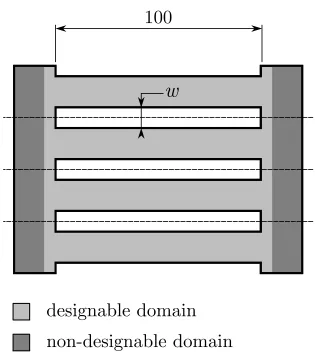
Chan and Albermani [18] have proposed a class of simple designs for SSD
devices supported by a series of experimental test results. Fig. 1 shows the typical
shape of the device. The size of the slits (w) can be controlled by varying land
b. In this paper, a new class of design is proposed by optimizing the shape of
the slits in Fig. 1. To achieve this, a shape optimization algorithm based on the
BESO technique is proposed and utilized here. Some restrictions are imposed to
maintain the simplicity of the shape and hence reduce its fabrication costs. These
[image:4.612.112.501.388.559.2]restrictions are discussed in detail in Section 2.4.
Figure 1: The SSD device design proposed by Chan and Albermani [18].
2.1. Numerical modeling
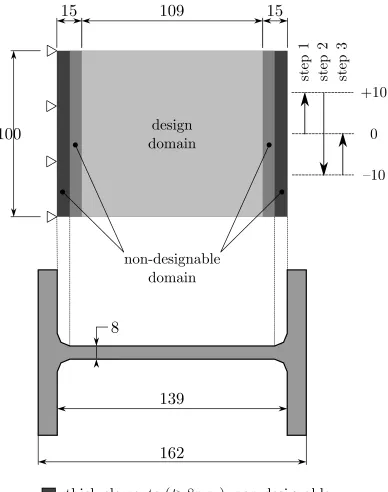
For numerical modeling, the flanges are considered solid and a plane stress
is considered overall the design except for the elements on the far left and right
sides of the domain. These elements which are in the vicinity of the flanges are
modeled using thicker elements to simulate fillets (Fig. 2).
For the sake of fabrication, the holes are prevented from being too wide by
setting the two strips of 15mm width on the left and right sides as non-designable
elements. Fig. 2 illustrates the designable and non-designable domains.
The left side of the model is fixed and a uniform vertical displacement is
ap-plied to the right side of the model. The loading cycle consists of three steps: an
upward displacement of 10mm, followed by a downward displacement of 20mm,
and finally an upward displacement of 10mm up to the original location (Fig. 2).
In this manner the elastic strain energy will be zero after a full cycle and the total
strain energy would be equal to the total plastic dissipation.
2.2. Problem statement
To optimize the shape of the SSD, the total plastic energy dissipation is
con-sidered as the objective function which is to be maximized. In order to prevent the
optimization algorithm from catching the extreme full or empty domain designs,
it is necessary to include an additional constraint to restrict the amount of usable
material [19]. Here we use a volume constraint which forces the algorithm to use
a certain amount of material in the design domain. Alternatively, one can impose
a restriction on the maximum force instead of using a volume constraint [15]. The
optimization problem can be expressed as
max
x1,x2,...,xN
EP
subject to V =V¯
and shape restrictions
whereEPis the total plastic dissipation;Vand ¯Vare the actual and target volumes;
xi-s are the design variables andNis the number of elements in the design domain.
Shape restrictions are fully covered in Section 2.4. In the BESO algorithm, design
variables are binary values with x = 1 indicating the presence of material in the
i-th element andx= 0 representing a void in the location of thei-th element.
2.3. Sensitivity analysis
To evaluate the effect of adding or removing an element during the
optimiza-tion process, one needs to perform a sensitivity analysis.
Because the loading sequence consists of a full cycle, the total plastic
dissipa-tion will be equal to the total strain energy. Hence, for this case, we can write
EP = ET =
I
f·du, (2)
whereET is the total strain energy; andf anduare nodal force and displacement
vectors respectively. Using the trapezoidal method for numerical integration, this
definition can be rewritten as
EP = lim n→∞ 1 2 n X
i=1
uTi −uTi−1(fi+fi−1)
. (3)
The shape sensitivities of the nonlinear systems have been calculated for diff
er-ent types of problems by Huang and Xie [16], Buhl et al. [20], Jung and Gea
[21]. Here we briefly describe the sensitivity analysis of the problem (1) based on
Huang and Xie [16].
To solve the non-linear equilibrium system, an iterative procedure is
com-monly used to eliminate the residual force. The residual force vector,r, is defined
as the difference between the external and internal force vectors. The equilibrium
can thus be expressed as
The internal force vector ˆf is defined as
ˆ
f =
N
X
e=1
Z
Ve
CTeBTσdV =
N
X
e=1
CTepe (5)
with Ce denoting the matrix that transforms the local nodal values of the e-th
element to global nodal values; B being the matrix that transforms a change in
displacement into a change in strain; and σrepresenting the local element stress
vector.
In order to calculate the sensitivities of the objective function,EP, with respect
to a design variable, x, we rewrite the (3) by adding an adjoint vectorλmultiplied
by a zero function
EP = lim n→∞ 1 2 n X
i=1
uTi −uTi−1(fi+fi−1)−λ
T
i (ri+ri−1)
. (6)
Now, differentiating (6) with respect to x, one can obtain
∂Ep
∂x = nlim→∞ "
1 2
n
X
i=1
uTi −uTi−1 ∂fi
∂x +
∂fi−1
∂x ! + 1 2 n X
i=1
∂uT i
∂x −
∂uTi−1
∂x
!
(fi+fi−1)
−λTi ∂ri ∂x +
∂ri−1
∂x
!# . (7)
The system of concern is subject to a gradual change in displacement at certain
nodes. At those degrees of freedom where the displacement is explicitly defined,
∂uj
∂x = 0. Everywhere else, fj = 0. The second term in the above equation, thus,
cancels out. Further, by considering (4), the above equation can be simplified to
∂Ep
∂x = nlim→∞ "
1 2
n
X
i=1
uTi −u T i−1
∂fi
∂x +
∂fi−1
∂x
!
−λTi ∂fi ∂x +
∂fi−1
∂x
!
+λT i
∂ˆfi
∂x +
∂ˆfi−1
∂x
To eliminate the unknown terms in (8), the adjoint equation is defined as
λi = ui−ui−1 (9)
from which the adjoint vector is readily calculable. Now, using (9) in (8), one can
get
∂Ep
∂x = nlim→∞ "
1 2
n
X
i=1
uTi −uTi−1 ∂ˆfi
∂x +
∂ˆfi−1
∂x
!#
. (10)
The validity of this sensitivity analysis is demonstrated through a simple analytical
problem by Huang and Xie [16].
Using a linear approximation, one can write
∂EP
∂x ≈ ∆EP
∆x (11)
and
∂ˆf
∂x ≈ ∆fˆ
∆x. (12)
Now using (12) and (11) in (10), the change in the energy dissipation due to a
change in a design variable can be approximated as
∆Ep ≈ lim n→∞ " 1 2 n X
i=1
uTi −uTi−1 ∆ˆfi+ ∆ˆfi−1
#
. (13)
From (5), the change in the internal force due to removing or adding an element
can be calculated as
∆fˆ= ∆xeCT
epe (14)
which can be substituted into (13) to yield
∆Ep≈ ∆xe lim n→∞ " 1 2 n X
i=1
uTi −uTi−1CTe (pe)i+(pe)i−1
#
Using the trapezoidal numerical integration method and noting the definition of
the dissipated energy in (2), the above equation can be simplified as
∆Ep ≈∆xe lim
n→∞[(Ee)i−(Ee)i−1]= ∆xeEe, (16)
where (Ee)i is the total strain energy of thee-th element after iiteration through
solving the nonlinear equilibrium; and Ee is the final strain energy of the e-th
element upon completion of the loading cycle. Noting the definition of design
variables from Section 2.2, one can observe that for removing an element ∆xe =
−1 and for introducing an element∆xe = +1.
Based on (16) we define the following sensitivity number for an elemente
αe =
∆EP
∆xe
= Ee (17)
which is a measure of efficiency of the e-th element. Note that the sensitivity
numbers defined in (17) are always positive. Remembering that the maximum
value of EP is desirable and noting that ∆EP = αe∆xe, for removing an element
(∆xe = −1), the element with the lowest sensitivity is the most suitable candidate
for removal. On the other hand, introducing a new element strengthens the
adja-cent elements and results in∆xe >0. Hence, in this case, the new element should
be added in the neighborhood of the elements with higher sensitivity numbers.
2.4. Shape restrictions
BESO is naturally a topology optimization method which can introduce new
holes and fill the current holes in the domain. To prevent the algorithm from
changing the topology of the domain and restrict it to shape optimization, it is
slits. In other words, the elements are only allowed to be removed from and added
to the boundary line. The designable domain in each iteration is thus redefined as
D={e|∃i, j∈ B:i, j∈e∧i, j}, (18)
whereBis the set of boundary nodes defined as
B= {j|∃em ∈ M,ev ∈ V: j∈em∩ev} (19)
withMandVrepresenting the sets of solid and void elements.
2.4.1. Periodicity
In order to enhance the manufacturability of the solutions, a periodic cellular
design is considered with four identical cells similar to the initial SSD design.
The BESO method has been previously proved useful in producing optimal
peri-odic structures [22]. To deal with periperi-odic design problems, the design domain
should be divided into a number of identical cells. The sensitivity numbers of
corresponding elements in all of these cells are then averaged and this averaged
value is used as the sensitivity number for all of these elements. This procedure
can be illustrated as
αi =
1
Ncell Ncell X
j=1
αi,j, (20)
whereαi is the averaged sensitivity number of thei-th element in all cells;αi,j is
the (original) sensitivity number of thei-th element in the j-th cell; andNcellis the
number of cells. In this manner, the BESO algorithm treats all the cells identically
and maintains the periodicity of the design.
2.4.2. Mirroring
Because of the non-linear nature of the problem, the loading sequence will
optimal shape. Hence one would get mirrored shape results if once considers a
displacement cycle starting with an upward moving (↑↓↑) and once with an initial
downward moving (↓↑↓). In real case, however, it is uncertain which direction
is more likely to happen. It is thus reasonable to consider both of these loading
cases. To do so, one should consider the mechanical responses of the two load
cases and add them up together to obtain the correct sensitivity number. However,
as the loading sequences are just mirror reflections of each other, we just need to
add the sensitivities of mirrored elements together. This can be mathematically
expressed as
¯
ai = ai +a↔
i (21)
where ¯ai is the corrected (mirrored) sensitivity number of thei-th element; and
↔
i
is the element at the same location as thei-th element in the mirrored structure.
2.5. BESO procedure
As already mentioned in Section 2.3, the elements with the lowest sensitivity
numbers are the least efficient and should be removed while the ones with
high-est sensitivity numbers are the most efficient and should be strengthened. In the
BESO procedure strengthening the elements is via introducing new elements in
their vicinity. In the new BESO algorithm [14], a filtering scheme is used to assign
a sensitivity number to the void elements in the vicinity of solid elements. The
filtering scheme is a wighted averaging which can be expressed as
ˆ
αi =
PN
j=1α¯jwi j
PN j=1wi j
, (22)
where ˆαi is the filtered sensitivity number of the i-th element andwi j is a linear
weighting factor defined as
HereR is a positive scalar value known as filtering radius anddi j is the distance
between the centroids of thei-th and j-th elements.
Using this filtering scheme, the void elements in the neighborhood of the
ele-ments with higher sensitivity number will obtain higher filtered sensitivity
num-bers. Hence, in the BESO procedure, the void elements with the highest filtered
sensitivity numbers can be assumed as the most efficient choices for introduction
to the system. This filtering scheme also smooths the jagged boundary lines and
overcomes some numerical instabilities such as checkerboard formation [23].
2.5.1. Adding and removing elements
In the optimization problem (1), the volume is fixed to a predefined value, ¯V.
Starting from a feasible design withV = V¯, one needs to add and remove a same
amount of material to keep the volume unchanged. Using identical elements to
discretize the designable domain, the number of adding and removing elements
should be equal. If a solid element has a lower sensitivity number than a void
element, the two elements should be switched. However, in order to prevent
sud-den changes, the maximum number of changes should be restricted. The limiting
number of changes is referred to as ‘move limit’ hereafter and is denoted by m.
Comparing with the BESO algorithm proposed by Huang and Xie [14], the move
limit used here is equivalent to the maximum adding ratio, i.e.m=ARmax.
The optimization loop continues until the following condition is met
Pl i=1E
(k−i+1)
P −E
(k−i)
P
Pl i=1E
(k−i+1)
P
< τ, (24)
where E(Pi) denotes the value of the objective function at i-th iteration; k is the current iteration number;τis the convergence tolerance selected as 10−4here; and
2.6. Numerical results
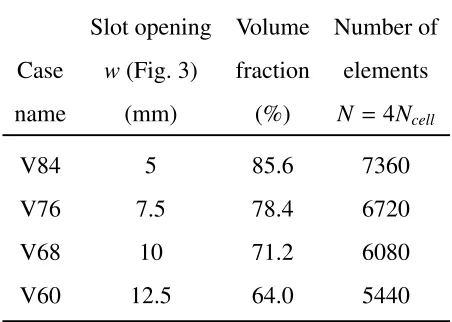
The initial design is depicted in Fig. 3. A series of tests are conducted with
different material volumes. Table 1 summarizes the test cases and their
[image:13.612.192.418.239.400.2]specifica-tions.
Table 1: The specifications of test cases.
Slot opening Volume Number of
Case w(Fig. 3) fraction elements
name (mm) (%) N =4Ncell
V84 5 85.6 7360
V76 7.5 78.4 6720
V68 10 71.2 6080
V60 12.5 64.0 5440
In all cases the volume is kept constant so that the objective function values for
different iterations could be compared. The move limit is chosen asm= 0.005N.
The number of elements, N, for each case is reported in Table 1. This relatively
small value is adopted due to the small number of elements in the design domain
which is limited to the boundaries of the holes. The filtering radius is selected
as 5mm through all the tests. The initial and final cell designs and the evolution
of the objective functions (energy dissipation) for the test cases are illustrated in
Fig. 4 to Fig. 7.
The increasing trend of the energy dissipation through optimization iterations,
which can be observed in all cases, verifies the proposed approach. It can be
seen that in all cases, the energy dissipation increases significantly. In these four
96% compared to the energy dissipation capability of the initial designs. Table 2
summarizes the improvements in the energy absorption capacity of the test cases.
In order to achieve a simple manufacturable shape, some shape restrictions
have been enforced to the shape optimization problem. Restricting the designable
domain to the small setDdefined in (18) to maintain the topology, forcing the
de-sign to be periodic, and mirroring will all impose limitations to the optimization
process by making its feasible space smaller. Furthermore because of the binary
nature of the BESO algorithm, the feasible space in not continuous. This
re-stricted, discrete feasible space causes some oscillations in the objective function
values observable at the end of the optimization procedures, when the solution is
going to converge.
In all cases the optimum cell design is tapered in the middle. As these four
cases had different material volume, it can be concluded that for this sort of
dampers the diamond shaped holes provide the best energy dissipation capacity
irrespective of the material volume.
Table 2: The improvement of the energy dissipation of the test cases after optimization.
EP (J)
Case name Initial Final Improvement (%)
V84 1124. 2203. 96
V76 863. 1440. 67
V68 631. 1000. 58
2.7. Postprocessing
In order to remove the jagged boundaries of the resulted shapes and reduce
the stress concentration it is necessary to smooth the boundaries of the resulted
shapes. A postprocessor is written to automatically smooth the boundaries of the
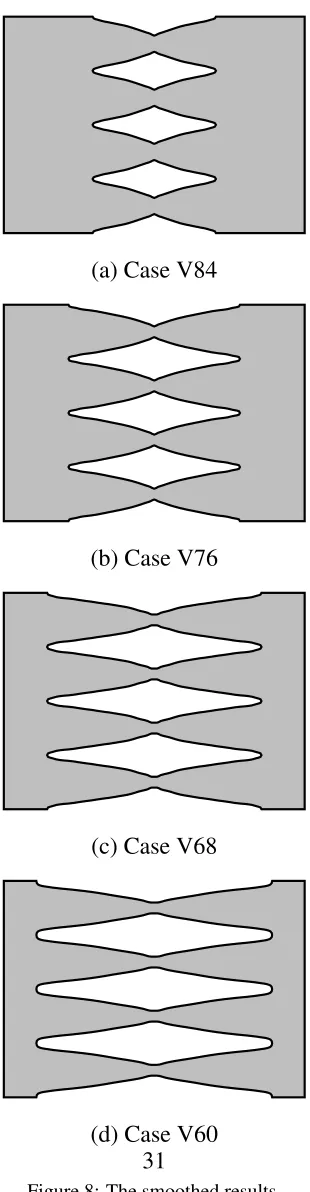
optimal shapes using B´ezier curves. Fig. 8 shows the smoothed results. It can
be seen that irrespective of the volume fraction, all the optimum shapes include
diamond shaped holes.
To check the effect of the shape optimization on stress distribution, the smoothed
optimal shape of the case V60 is tested against its smoothed initial shape. The
force-displacement curve and the stress distribution of the initial and optimal
shapes are depicted in Fig. 9 and Fig. 10 respectively.
It can be seen in Fig. 9 that the optimum shape provides a stiffer design
com-pared to the initial shape. After undergoing 10mm of displacement, the initial
shape produces a reaction of 16.4kN while the reaction generated in the optimal
shape is 24.3kN. Also a comparison between the stress levels in Fig. 10 reveals
that the optimal shape provide a much evener stress distribution. The stress
con-centration zones in the corner of the holes visible in the initial design are
elim-inated in the optimal shape. The stress concentration zones are prone to fatigue
and undesirable brittle failure under cyclic loads. The fatigue failure of the SSD
devices at these zones have been reported in Chan and Albermani [18].
2.8. Optimal design
Based on the shape optimization results and Fig. 8, three specimens with the
shape design depicted in Fig. 11 are fabricated. These specimens are used for
experimental tests as discussed in the following sections. Because of the tapered
3. Experimental verification
The objective of the experiments is to verify the cyclic characteristics of the
optimized shape. Furthermore, strength-degradation and low-cycle fatigue
char-acteristics of the device are not predicted by the current finite element model.
They must be investigated by physical experiment.
3.1. Test setup, instrumentation and loading history
Identical setup with previous tests [18] was used such that comparable results
could be obtained. The test setup is shown in Fig. 12. The specimens were
in-stalled between a ground beam and an L-beam, securely fastened by four M16
bolts (snug tight) on each side. Forced displacement was applied by an MTS
100kN capacity computer-controlled actuator quasi-statically to the specimen via
the L-beam. To ensure the verticality of the applied load, a pantograph system
was welded to the right hand side of the L-beam. The pantograph system also
pre-vented the L-beam from deflecting out-of-plane. The complete test setup rested
on a reaction frame which was significantly stiffer. The centerline of the
actua-tor implied an eccentricity to the specimen, measured 162mm to the centerline
of the specimen. A free-run of the setup (i.e. without the specimen installed)
was performed and the result showed that friction and the effect of gravity were
considered negligible. The setup was robust and repeatable, no visible damage
occurred after all tests were carried out. Fig. 13 shows a photograph of the setup
with specimen installed.
Displacements of the specimens were measured independently by a pair of
LVDTs, marked as 1 and 2 in Fig. 12. While LVDT 1 measures the elastic
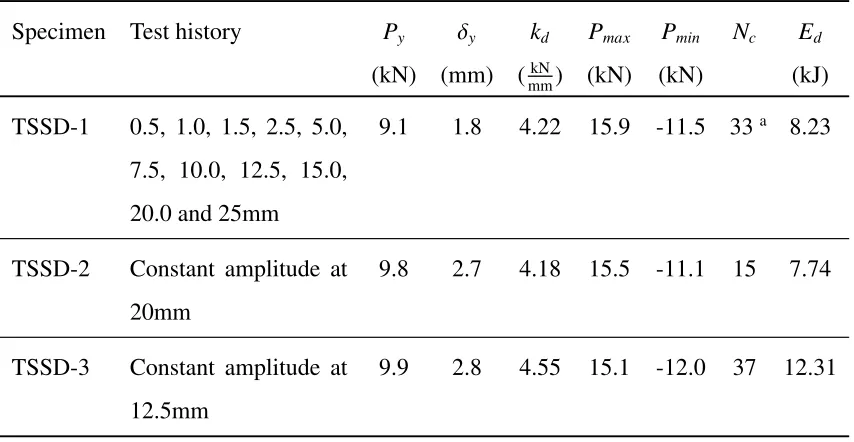
Table 3: Specimens and test results.
Specimen Test history Py δy kd Pmax Pmin Nc Ed
(kN) (mm) (mmkN) (kN) (kN) (kJ)
TSSD-1 0.5, 1.0, 1.5, 2.5, 5.0,
7.5, 10.0, 12.5, 15.0,
20.0 and 25mm
9.1 1.8 4.22 15.9 -11.5 33a 8.23
TSSD-2 Constant amplitude at
20mm
9.8 2.7 4.18 15.5 -11.1 15 7.74
TSSD-3 Constant amplitude at
12.5mm
9.9 2.8 4.55 15.1 -12.0 37 12.31
a Note: TSSD-1 did not break after 33 cycles were completed.
distortion of the test specimen.
Specimen TSSD-1 was tested under identical displacement history with
pre-viously study on SSD [18]. The load history comprised three repeated cycles at
amplitudes of 0.5, 1.0, 1.5, 2.5, 5.0, 7.5, 10.0, 12.5, 15.0, 20.0 and 25mm.
TSSD-2 and TSSD-3 were tested under a constant displacement until complete breakage
of the specimens. Table 3 summarizes the test histories and key results.
3.2. Specimens
Based on the result of optimization, three specimens were fabricated.
Di-mensions are shown in Fig. 11. All specimens (each 100mm long) in this study
were cut from the same structural wide-flange section 152×152×37 Universal
Column to BS4449 (depth × flange width× web thickness× flange thickness is
is identical and material strengths of all specimens may be assumed equal. Four
16mm diameter holes were drilled on each flange for connection to the test rig.
Two standard test coupons were taken from the web of the section. Coupon tests
gave an average tensile yield stress of 316.5N/mm2 and an average Modulus of
Elasticity of 206.1kN/mm2.
3.3. Test results and discussion
All three specimens deformed in a stable manner under the cyclic tests. The
strips deformed in double curvature as expected. Fig. 14(a) to (c) present the
force-displacement hysteresis obtained from the cyclic tests. A positive sign refers
to downward force and displacement. Shear strain γ (i.e. distortion divided by
total width of device) of the specimens are also shown. Positive yield strengthPy,
its corresponding yield displacementδy, elastic stiffnesskd, positive peak strength
Pmax, negative peak strength Pmin, the number of cycles to failureNc and energy
dissipationEd are tabulated in Table 3.
It is clear that all specimens have yielded at small displacement and exhibited
very stable hysteretic behavior with a gradual transition between the elastic and
inelastic regime. The specimen response magnitude was slightly lesser than the
input displacement history due to elastic deformation of the support. Absolute
displacements (difference across LVDT 1 and 2) are used to determine the
me-chanical properties of the specimens. The connection of the specimens by four
structural bolts on each flange performed satisfactory; no significant distortion
was observed after the tests. Fig. 15 shows the damaged specimen TSSD-1 after
3.4. Specimen TSSD-1
TSSD-1 completed all cycles without breakage. At the end of the 25mm
cy-cle, force was released such that the specimen was left deformed. A photograph
of the specimen after all cycles is shown in Fig. 15. Its force-displacement
hys-teresis is shown in Fig. 14(a). Very stable hyshys-teresis without noticeable sign of
strength deterioration was observed. Cracks have developed on the bar surfaces
due to repeated loading, but they did not cause breakage. Initial yield strength and
displacement were recorded at 9.1kN and 1.8mm respectively. Bauschinger effect
was apparent, with negative peak strength only 72% of the positive peak.
TSSD-1 dissipated 8.23kJ at the end of the cycles. Energy dissipation of
TSSD-1 is shown in Fig. 16. Result from specimen SL-1 [18] is plotted on the
same chart for comparison. To account for different volume of steel involved in
specimens, energy is expressed as energy dissipated per unit volume of steel. Here
the volume of steel between fillets is taken into consideration as the flange does
not contribute to energy dissipation. There is a 37% increase in energy
dissipa-tion and it is evident that the optimizadissipa-tion process has resulted in a more efficient
design. From the same diagram it is clear that, after optimization, TSSD-1
sus-tained a much larger cumulative displacement compared to SL-1. The enhanced
resistance against low-cycle fatigue is clear.
3.5. Specimens TSSD-2 and TSSD-3
TSSD-2 and TSSD-3 were fabricated to identical dimensions as TSSD-1, but
these two specimens were tested under constant amplitudes until complete
break-age. They enable us to identify their energy dissipating capacity under different
displacement amplitudes. TSSD-2 was tested at 20mm (µ ≈ 11) while
in Fig. 14(b) and (c). Both specimens exhibited stable behavior without
notice-able degradation during their early cycles. TSSD-2 sustained 15 complete cycles
prior to failure, while TSSD-3 sustained 37 cycles. TSSD-2 dissipated 7.74kJ of
energy, while TSSD-3 dissipated 12.31kJ. It is interesting that at relatively low
displacements, the device dissipated a much larger amount of energy.
4. Conclusion
This paper proposed a new steel slit damper design, TSSD, based on the
nu-merical shape optimization results. A previously proposed steel slit damper, SSD,
with straight uniform slit width has been taken as the initial design. An
optimiza-tion procedure has been proposed based on the well-known BESO method to find
the optimum shape of the slits. Some shape restrictions have been introduced and
imposed in the optimization procedure to maintain the topology of the design and
restrict it to a symmetric periodic cellular shape with 4 cells. The plastic energy
dissipation of the damper after one cycle of displacement loading with 10mm
am-plitude has been taken as the objective function. The optimization problem has
been then stated as maximizing the objective function while the material volume
is kept constant and the shape is restricted. Four initial models with similar shape
to SSD has been considered as the initial designs each having a different material
volume. The resulted evolution of the objective function values for all the cases
has shown a significant increase in the energy dissipation capacity verifying the
proposed optimization procedure. Improvements of 58 to 96% in the energy
ab-sorption capacity of the designs have been recorded. The optimum shapes were
all include bars tapered in the middle forming diamond shaped slits irrespective
A postprocessor has been used to smooth the optimum results using B´ezier
curves. It has been demonstrated that the optimum tapered slit design provides
an even stress distribution and the stress concentration noticeable in the initial
straight slit design has been eliminated in the optimum design. This even stress
distribution can significantly improve the behavior of the damper under fatigue.
The finite element model used in the optimization process was not capable of
predicting failure and fatigue of the design. Therefore, based on the optimization
findings, three TSSD specimens were fabricated and put under cyclic tests.
Un-der identical test setup and load history, the TSSD specimen dissipated 37% more
energy per unit volume compared to the previously tested SSD, and significantly
delayed low-cycle fatigue. It should be noted that this figure is not comparable
with the improvements reported on Table 2 because the volume of the original
SSD and the proposed TSSD are not equal. Experiments confirmed that the
op-timization process is robust and it is suitable for future development of energy
dissipaters.
Acknowledgement
Experimental works described in this paper is carried out during an academic
visit to City University of Hong Kong by the second author, supported by the
Research Grant Council of Hong Kong City University RGC 115208.
References
[1] Soong TT, Spencer Jr BF. Supplemental energy dissipation: state-of-the-art
[2] Bergman DM, Goel SC. Evaluation of cyclic testing of steel-plate devices
for added damping and stiffness. Tech. Rep. UMCE 87-10; Department of
Civil Engineering, University of Michigan; Ann Arbor, Michigan; 1987.
[3] Tsai KC, Chen HW, Hong CP, Su YF. Design of steel triangular
plate energy absorbers for seismic-resistant construction. Earthq Spectra
1993;9(1993):505–28.
[4] Chan RW, Albermani F, Williams MS. Evaluation of yielding shear panel
device for passive energy dissipation. J Constr Steel Res 2009;65(2):260–8.
[5] Black CJ, Makris N, Aiken ID. Component testing, seismic evaluation
and characterization of buckling-restrained braces. ASCE J Struct Eng
2004;130(6):880–94.
[6] Koetaka Y, Chusilp P, Zhang Z, Ando M, Suita K, Inoue K, et al. Mechanical
property of beam-to-column moment connection with hysteretic dampers for
column weak axis. Eng Struct 2005;27(1):109–17.
[7] ASCE/SEI 7-05. Minimum Design Loads for Buildings and Other
Struc-tures. ASCE Publications; 2006.
[8] Bendsøe MP, Sigmund O. Topology Optimization - Theory, Methods, and
Applications. Berlin: Springer; 2003.
[9] Xie YM, Steven GP. Evolutionary structural optimization. London:
Springer; 1997.
[10] Xie YM, Steven GP. A simple evolutionary procedure for structural
[11] Querin OM, Steven GP, Xie YM. Evolutionary structural
optimisa-tion (eso) using a bidirecoptimisa-tional algorithm. Engineering Computations
1998;15(8):1031–48.
[12] Querin OM, Young V, Steven GP, Xie YM. Computational efficiency and
validation of bi-directional evolutionary structural optimisation. Comput
Method Appl Mech Eng 2000;189(2):559–73.
[13] Yang XY, Xie YM, Steven GP, Querin OM. Bidirectional evolutionary
method for stiffness optimization. AIAA J 1999;37(11):1483–8.
[14] Huang X, Xie YM. Convergent and mesh-independent solutions for the
bi-directional evolutionary structural optimization method. Finite Elem Anal
Des 2007;43(14):1039–49.
[15] Huang X, Xie YM, Lu G. Topology optimization of energy-absorbing
struc-tures. Int J Crashworthiness 2007;12(6):663–75.
[16] Huang X, Xie YM. Topology optimization of nonlinear structures under
displacement loading. Eng Struct 2008;30(7):2057–68.
[17] Ghabraie K. Exploring topology and shape optimisation techniques in
un-derground excavations. Phd thesis; RMIT University; Melbourne, Australia;
2009.
[18] Chan RW, Albermani F. Experimental study of steel slit damper for passive
energy dissipation. Eng Struct 2008;30(4):1058–66.
[19] Rozvany GI, Querin OM, Gaspar Z, Pomezanski V. Extended optimality in
[20] Buhl T, Pedersen C, Sigmund O. Stiffness design of geometrically
non-linear structures using topology optimization. Struct Multidiscip Optim
2000;19(2):1615–488.
[21] Jung D, Gea HC. Topology optimization of nonlinear structures. Finite Elem
Anal Des 2004;40(4):1417–27.
[22] Huang X, Xie YM. Optimal design of periodic structures using evolutionary
topology optimization. Struct Multidiscip Optim 2008;36(6):597–606.
[23] Sigmund O, Petersson J. Numerical instabilities in topology optimization:
A survey on procedures dealing with checkerboards, mesh-dependencies and
0 5 10 15 20 25 30 35 40 45 1100.
1200. 1300. 1400. 1500. 1600. 1700. 1800. 1900. 2000. 2100. 2200. 2300.
[image:27.612.146.463.157.605.2]Iteration Obj. Function
0 5 10 15 20 25 30 35 40 45 850.
900. 950. 1000. 1050. 1100. 1150. 1200. 1250. 1300. 1350. 1400. 1450.
[image:28.612.148.459.159.610.2]Iteration Obj. Function
0 2 4 6 8 10 12 14 16 18 20 22 24 26 600.
650. 700. 750. 800. 850. 900. 950. 1000.
[image:29.612.148.461.155.601.2]Iteration Obj. Function
0 2 4 6 8 10 12 14 16 18 20 22 24 26 28 420.
440. 460. 480. 500. 520. 540. 560. 580. 600. 620. 640. 660. 680. 700. 720.
[image:30.612.145.463.152.602.2]Iteration Obj. Function
(a) Case V84
(b) Case V76
(c) Case V68
[image:31.612.228.383.118.714.2]-20 -15 -10 -5 0 5 10 15 20
-12 -10 -8 -6 -4 -2 0 2 4 6 8 10 12
displacement (mm) force (kN)
(a) initial design
-30 -20 -10 0 10 20 30
-12 -10 -8 -6 -4 -2 0 2 4 6 8 10 12 displacement (mm) force (kN)
[image:32.612.154.457.134.625.2](b) optimal design
498.40 436.83 375.25 313.68 252.11 190.54 128.97 67.40 5.83
(a) initial design
486.51 426.83 367.14 307.46 247.78 188.10 128.42 68.73 9.05
[image:33.612.129.477.135.610.2](b) optimal design
Figure 10: Comparing the stress distribution of the initial and optimal designs for case V60. The
(a) TSSD-1
(b) TSSD-2
[image:37.612.169.442.120.705.2]Figure 15: Specimen TSSD-1 after the test.
[image:38.612.113.496.413.638.2]![Figure 1: The SSD device design proposed by Chan and Albermani [18].](https://thumb-us.123doks.com/thumbv2/123dok_us/181281.51676/4.612.112.501.388.559/figure-ssd-device-design-proposed-chan-albermani.webp)