FORMULATION DESIGN, DEVELOPMENT AND INVITRO EVALUATION OF MOUTH DISSOLVING TABLETS OF ZOLMITRIPTAN
A Dissertation submitted to
THE TAMIL NADU DR. M.G.R. MEDICAL UNIVERSITY, CHENNAI - 600 032
In partial fulfilment of the award of the degree of MASTER OF PHARMACY
IN
Branch-I -- PHARMACEUTICS Submitted by
Name: MANIVANNAN.D REG.No.261610254
Under the Guidance of
Dr.V.KAMALAKKANNAN, M.Pharm, Ph.D, DEPARTMENT OF PHARMACEUTICS
J.K.K. NATTRAJA COLLEGE OF PHARMACY KUMARAPALAYAM – 638183
A Dissertation submitted to
THE TAMIL NADU DR. M.G.R. MEDICAL UNIVERSITY, CHENNAI - 600 032
In partial fulfilment of the award of the degree of MASTER OF PHARMACY
IN
Branch-I – PHARMACEUTICS
Submitted by Name: MANIVANNAN.D
REG.No.261610254
Under the Guidance of
Dr.V.KAMALAKKANNAN, M.Pharm, Ph.D,
DEPARTMENT OF PHARMACEUTICS
J.K.K. NATTRAJA COLLEGE OF PHARMACY KUMARAPALAYAM – 638183
This is to certify that the dissertation work entitled “FORMULATION DESIGN, DEVELOPMENT AND INVITRO EVALUATION OF MOUTH DISSOLVING TABLETS OF ZOLMITRIPTAN’’ submitted by student bearing Reg.No-261610254 to “The Tamil Nadu Dr.M.G.R. Medical University, Chennai, for the partial fulfilment
of the Degree of MASTER OF PHARMACY was evaluated by us during the
examination held on…………
This is to certify that the work embodied in this dissertation “FORMULATION DESIGN, DEVELOPMENT AND INVITRO EVALUATION OF MOUTH DISSOLVING TABLETS OF ZOLMITRIPTAN’’ Submitted to “The TamilNadu
Dr.M.G.R.Medical University, Chennai, was carried out by Reg.No-261610254 for the
partial fulfilment of the degree of master of pharmacy in under direct supervision of Dr.V.KAMALAKKANNAN. M.pharm,Ph.D. Associate professor, Department of
Pharmaceutics, J.K.K.Nattraja College of pharmacy, Komarapalayam, during the academic year 2017-2018.
CERTIFICATE
Dr. R.Sambathkumar, M.Pharm, Ph.D., Principal,
J.K.K. Nattraja College of Pharmacy, Kumarapalayam- 638 183,
Tamilnadu. Place : Kumarapalayam.
This is to certify that the work embodied in this dissertation entitled “FORMULATION DESIGN, DEVELOPMENT AND INVITRO EVALUATION
OF MOUTH DISSOLVING TABLETS OF ZOLMITRIPTAN’’ Submitted to “The TamilNadu Dr.M.G.R.Medical University-Chennai, in partial fulfilment and requirement
for the award of degree of MASRT OF PHARMACY is a bonafide work carried out by
Reg.No.-261610254 during the academic year 2017-2018, under the guidance and direct
supervision in the department of pharmaceutics, J.K.K.Nattraja College of Pharmacy, Kumarapalayam.
Place : Kumarapalayam.
Date :
Dr. R. Sambathkumar, M.Pharm, Ph.D.
Principal,
J.K.K.Nattraja College of Pharmacy Kumarapalayam-638 183
Tamilnadu
Dr.V.Kamalakkannan, M.pharm.,Ph.D.
Associate professor,
Department o Pharmaceutics, J.K.K.Nattraja College of pharmacy, Kumarapalayam-638183
Tamilnadu
This is to certify that the entitled “FORMULATION DESIGN,
DEVELOPMENT AND INVITRO EVALUATION OF MOUTH DISSOLVING TABLETS OF ZOLMITRIPTAN’’ is a bonafide work done by Reg.No-261610254 J.K.K.Nattraja College of Pharmacy part and fulfilment university rules and regulation for award of Master of pharmacy under my guidance and supervision during the academic year 2017-2018.
Dr.V.Kamalakkannan, M.pharm,Ph.D.
Associate professor,
Department of Pharmaceutics, J.K.K.Nattraja College of pharmacy, Kumarapalayam-638183
Tamilnadu
Dr.R.Sambathkumar, M.Pharm, Ph.D.
Principal,
J.K.K.Nattraja College of Pharmacy, Kumarapalayam-638 183
Tamilnadu
Dr.S.Bhama, M.pharm, Ph.D,
Head of the Department,
J.K.K.Nattraja College of pharmacy, Kumarapalayam-638183
DECLARATION
The work presented in this dissertation entitled, “FORMULATION DESIGN, DEVELOPMENT AND INVITRO EVALUATION OF MOUTH DISSOLVING TABLETS OF ZOLMITRIPTAN’’ was carried out by me, under the direct supervision
of Dr.V.KAMALAKKANNAN, M.Pharm.,Ph.D. Associate professor , Department of Pharmaceutics, J.K.K.Nattraja College of pharmacy, Kumarapalayam.
I further declare that the work is original and has not been submitted in part or full for the award of any other degree or diploma in any other university.
Place: Kumarapalayam
I am proud to dedicate my deep sense of gratitude to the founder, (Late) Thiru J.K.K. Nattraja Chettiar, providing us the historical institution to study.
My sincere thanks and respectful regards to our reverent Chairperson. Smt N.Sendamaraai. B.Com. Managing Director Mr.S.Omm sharravana, B.Com.,LLB.,
J.K.K.Nattraja Educational Institutions, Komarapalayam for their blessings,
encouragement and support at all times.
It is most pleasant duty to thank our beloved Principal Dr. R.SAMBATHKUMAR, M.Pharm., Ph.D., J.K.K.Nattraja College of Pharmacy, Komarapalayam for ensuring all the facilities were made available to me for the smooth running of this project.
I express my whole hearted thanks to my guide Dr.V.KAMALAKKANNAN M.Pharm.,Ph.D Associate Professor , Department of Pharmaceutics, for suggesting solution to problems faced by me and providing indispensable guidance, tremendous encouragement at each and every step of this dissertation work. Without his critical advice and deep-rooted knowledge, this work would not have been a reality.
My sincere thanks to Dr.R.Shanmugasundaram, M.Pharm, Ph.D., Vice Principal and Professor and Head of the Department, Department of Pharmacology, Dr.Kalaiarasi. M.Pharm, Ph.D Assistant Professor, Department of Pharmacology, for their valuable suggestions during my project work.
My sincere thanks to Dr.M.Vijayabaskaran, M.Pharm., Ph.D., Assistant Professor and head Department of Pharmaceutical chemistry Mrs.S.Gomathi, M.Pharm., Lecturer, Department of Pharmaceutical chemistry and for their valuable suggestions and inspiration.
My sincere thanks to Dr.N.Venkateswaramurthy, M.Pharm.,Ph.D Professor and Head, Department of Pharmacy Practice. Mrs.K.Krishnaveni, M.Pharm. Assistant Professor, Department of Pharmacy Practice, for their help during my project.
My sincere thanks to Dr.V.Sekar, M.Pharm., Ph.D., Professor and Head of The Department of analysis, and Dr.I.Caroline nimila,M.Pharm.,Ph.D., Assistant Professor, Department of Pharmaceutical Analysis for their valuable suggestions.
My sincere thanks to Dr.S.Bhama, M.Pharm.,Ph.D Associate Professor, Mr.R. Kanagasabai, B. Pharm. M.Tech., Assistant Professor, Mr.K.Jaganathan, M.Pharm., Assistant professor, Department of Pharmaceutics, Mr.C.Kannan M.Pharm., Assistant Professor, Department of Pharmaceutics for their valuable help during my project.
I greatly acknowledge the help rendered by Mrs.K.Rani, Office Superintendent, Mrs. V.Gandhimathi, M.A., M.L.I.S., Librarian, and Mrs.S.Jayakala, B.A., B.L.I.S., Asst. Librarian for their co-operation.
My special thanks to all the Technical and Non-Technical Staff Members of the institute for their precious assistance and help.
Last, but nevertheless, I am thankful to my lovable parents and all my friends for their
co-operation, encouragement and help extended to me throughout my project work.
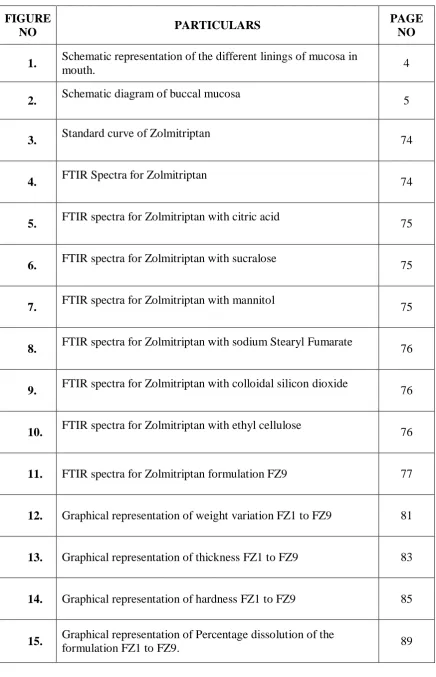
FIGURE
NO PARTICULARS
PAGE NO
1. Schematic representation of the different linings of mucosa in
mouth. 4
2. Schematic diagram of buccal mucosa 5
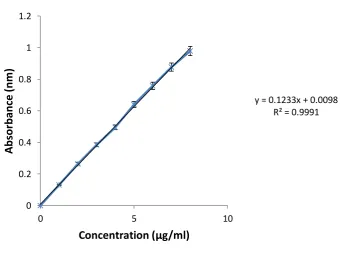
3. Standard curve of Zolmitriptan 74
4. FTIR Spectra for Zolmitriptan 74
5. FTIR spectra for Zolmitriptan with citric acid 75
6. FTIR spectra for Zolmitriptan with sucralose 75
7. FTIR spectra for Zolmitriptan with mannitol 75
8. FTIR spectra for Zolmitriptan with sodium Stearyl Fumarate 76
9. FTIR spectra for Zolmitriptan with colloidal silicon dioxide 76
10. FTIR spectra for Zolmitriptan with ethyl cellulose 76
11. FTIR spectra for Zolmitriptan formulation FZ9 77
12. Graphical representation of weight variation FZ1 to FZ9 81
13. Graphical representation of thickness FZ1 to FZ9 83
14. Graphical representation of hardness FZ1 to FZ9 85
15. Graphical representation of Percentage dissolution of the
17. Percentage drug release of Stability sample(40°C/75% RH- 3 rd
Month) 92
18. Percentage drug release of Stability sample(40°C/75% RH- 6
th
Month) 93
19. Comparison drug release of FZ9 and marketed preparation 94
20. Zero order release kinetic studies 98
21. First order release kinetic studies 98
22. Higuchi release kinetics 99
23. Hixon-crowell cubic root kinetics 99
IST OF TABLES
TABLE
NO.
PARTICULARS
PAGE
NO.
1. Various route of administrations and respective dosage forms 1
2. Uses of Citric acid at various concentrations. 33
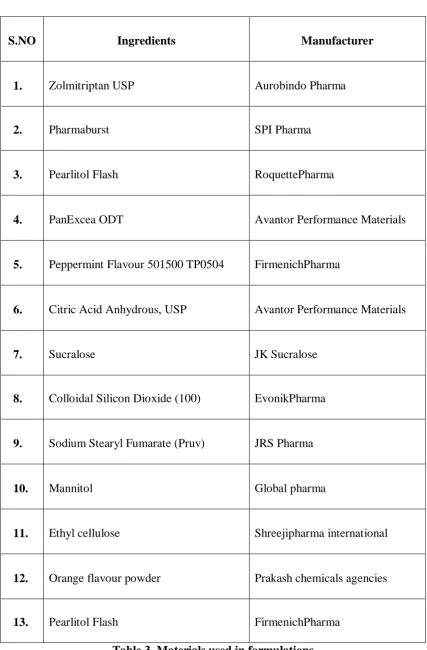
3. Materials used 53
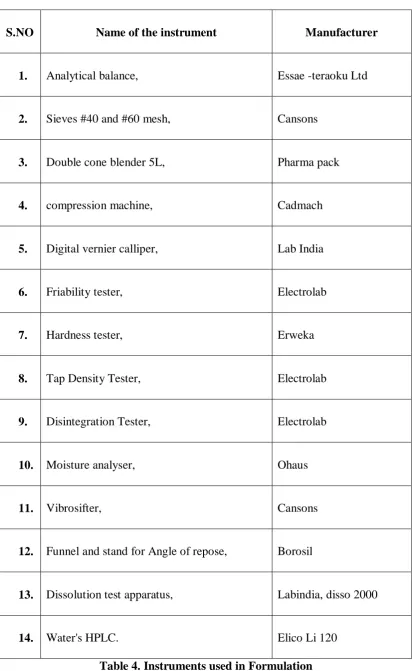
4. Instruments used 54
5. Organoleptic parameters and its observations 56
6. Percentage compressibility and corresponding Flowability. 58
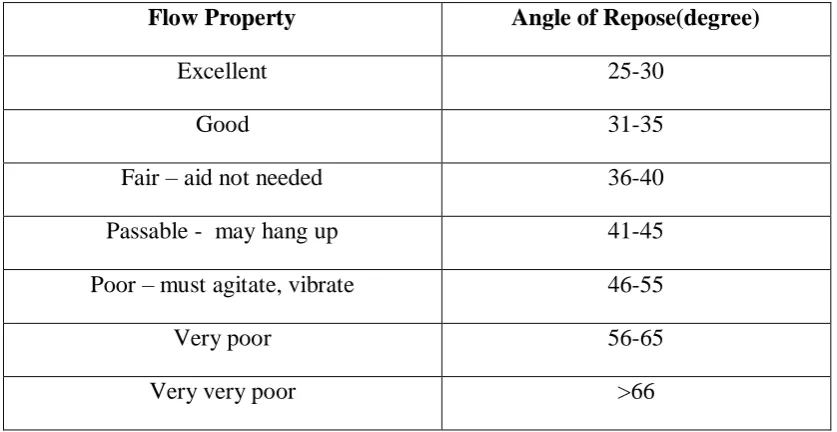
7. Flow Properties and Corresponding Angles of Repose 59
8. Flow property and corresponding Hausner’s ratio. 60
9. Formulation and their composition 64
10. Composition of unit dose of various Formulations Characteristics of
final blend
65 11.
USP Specification for uniformity of weight. 66
12.
Dissolution parameters 71
13.
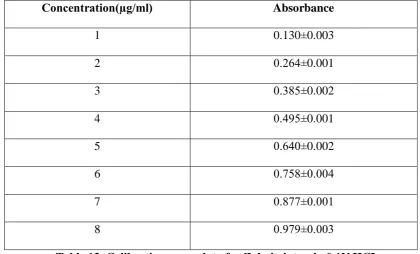
Calibration curve data for Zolmitriptan 73
14.
The principle peaks were observed from IR spectra of Zolmitriptan 77
15. Result for bulk density, tapped density, angle of repose and loss on
drying
78
16. Particle size distribution results for the final blend 78
17. Results of Blend uniformity samples of final blend 79
18. Results for weight variation of the formulation 80
21. Results of percentage content and %RSD of tablets 86
22. Friability and its parameters 87
23. Disintegration time of each formulations 87
24. Assay and water by kf results 88
25. Highest unknown impurity and total impurities results 88
26. Results of dissolution data 89
27. Organoleptic evaluation and its observation 90
28. Percentage drug release of Stability sample(40°C/75% RH- 1
st
Month)
91
29. Percentage drug release of Stability sample(40°C/75% RH- 3
rd
Month)
92
30. Percentage drug release of Stability sample(40°C/75% RH- 6
th
Month)
93
31. Comparison drug release of optimized formulation and marketed
preparation
94
32.
Stability changes in Zolmitriptan on storage in specific condition 95
33.
Compatibility study results with co processed excipients 95
34.
Compatibility study results with diluents with Zolmitriptan 96
35.
Compatibility of glidants and lubricants with Zolmitriptan 96
36.
Compatibility of flavours and sweetening agents with Zolmitriptan 97
37. Comparison of optimized formulation and marketed ODT preparation 97
38. Regression values of in-vitro release kinetic study optimized
Zolmitriptan immediate release Tablet (FZ9)
LIST OF ABBREVATIONS
API : Active Pharmaceutical Ingredient
BP : British Pharmacopeia
DCB : Double cone blender
DSC : Differential scanning calorimetry
DT : Disintegration time
FT-IR : Fourier Transform Infrared
FZ1 TO FZ9 : Formulation of Zolmitriptan 1 to 9.
HLB : Hydrophilic- Lypohilic Balance
HME : Hot Melt EXtrusion
ICH : Interanational Conference on Harmonisation
JP : Japan Pharmacopeia
KT : Ketorolac Tromethamine
LHPC : Low substituted hydroxy propyl cellulose
LOD : Loss on drying
MCC : Microcrystalline cellulose
MOA : Monoamine Oxidase
NMT : Not more than
NSAID : Non Steroidal anti-inflammatory Drugs
ODDF : Orally disintegrating dosage form
ODT : Orally disintegrating tablets
PEG : Poly Ethylene Glycol
PhEur : European Pharmacopeia
RH : Relative Humidity
RPM : Revolutions per minute
RSD : Relative standard deviation
SEM : Scanning Electron Microscopy
TIA : Transient ischemic attack
TMISG : Thermo reversible in-situ mucoadhesive intranasal gel
USFDA : United States food and drug administration
USP : United States Pharmacopeia
WRS : World wide reference system
S.NO TITLE PAGE.NO
1. INTRODUCTION 1
2. LITERATURE REVIEW 15
3. AIM & OBJECTVE 25
4. PLAN OF WORK 27
5. DRUG & EXCIPIENTS PROFILE 28
6. MATERIALS AND METHODS 53
7. RESULTS AND DISCUSSION 73
8. CONCLUSION 103
1. INTRODUCTION
1.1 Oral Drug delivery System
Sastry SV et al, 2000 A drug may be defined as an agent, intended for use in
the diagnosis, mitigation, treatment cure or prevention of disease in man or in animals. Drugs are very rarely administered in the original pure state. They are converted into suitable formulation which is converted into suitable formulation which is called dosage forms. Every dosage form is a combination of the drug and other non drug components. The non drug components are known as additives are used to give a particular shape to the formulation to increase its stability and also to increase its palatability as well as to give more elegance to preparation.
1.2 Various pharmaceutical dosage forms
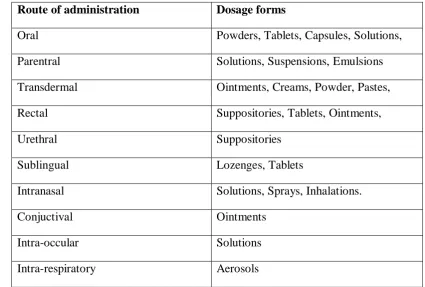
Dosage forms can be classified based on different route of administrations or based on the physical state
Route of administration Dosage forms
Oral Powders, Tablets, Capsules, Solutions,
Emulsions, Syrups, Elixir, Magmas, Gels, Catchets, Pill.
Parentral Solutions, Suspensions, Emulsions
Transdermal Ointments, Creams, Powder, Pastes,
Lotions, Plaster
Rectal Suppositories, Tablets, Ointments,
Creams, Douches, Foams
Urethral Suppositories
Sublingual Lozenges, Tablets
Intranasal Solutions, Sprays, Inhalations.
Conjuctival Ointments
Intra-occular Solutions
[image:17.595.98.524.429.716.2]Intra-respiratory Aerosols
Tablets are solid dosage form each containing a unit dose of one or more medicaments. They are intended for oral administration. A tablet consists of active medicament along with excipients which are in powder form are compressed or pressed into solid dosage form.
1.3 Various types of tablets
1.3.1 Oral Tablets for Ingestion:
1. Compressed tablets
2. Multiple compressed tablets 3. Layered tablets
4. Compression-coated tablets 5. Repeat-action tablets
6. Delayed-action and enteric-coated tablets 7. Sugar and chocolate-coated tablets 8. Film coated tablets
9. Chewable tablets
1.3.2 Tablets Used in the Oral Cavity: 1. Buccal tablets
2. Sublingual tablets 3. Troches and lozenges 4. Dental cones
1.3.3 Tablets Administered by Other Routes:
1. Implantation tablets 2. Vaginal tablets
1.3.4 Tablets Used to Prepare Solutions:
1. Effervescent tablets 2. Dispensing tablets 3. Hypodermic tablets 4. Tablet triturates
1.4 Orally Disintegrating Tablets
importantly, patient compliance. Also, solid oral delivery systems do not require sterile conditions and are, therefore, less expensive to manufacture. A vast variety of pharmaceutical research is directed at developing new dosage forms for oral administration. Most of these efforts have focused on either formulating novel drug delivery systems or increasing the patient compliance. Among the dosage forms developed for facilitating ease of medication, the orally disintegrating systems have been the favourite of product development scientists. In similar fashion the oral cavity is highly acceptable by patients, the mucosa is relatively permeable with rich blood supply and virtual lack of langerhans cells makes oral mucosa tolerant to potential allergens.
1.5 Overview of Oral Mucosa
The oral cavity comprises Journal the lips, cheek, tongue, hard palate, soft palate and floor of the mouth (Fig. 1). The lining of the oral cavity is referred to as the oral mucosa, and includes the buccal, sublingual, gingival, palatal and labial mucosa. The buccal, sublingual and mucosal tissues at the ventral surface of the tongue account for about 60% of the oral mucosal surface area. The top quarter to one-third of the oral mucosa is made up of closely compacted epithelial cells.
of the mouth) and the gingival (gums).
The lining mucosa comprises approximately 60%, the masticatory mucosa approximately 25%, and the specialized mucosa approximately 15% of the total surface area of the oral mucosal lining in an adult human. The masticatory mucosa is located in the regions particularly susceptible to the stress and strains resulting from masticatory activity. The superficial cells of the masticatory mucosa are keratinized, and a thick lamina propia tightly binds the mucosa to the underlying periosteum. Lining mucosa on the other hand is not nearly as subject to masticatory loads and consequently, has a non-keratinized epithelium, which sits on a thin and elastic lamina propia and a sub mucosa.(Fig. 2) The mucosa of the dorsum of the tongue is a specialized gustatory mucosa, which has well papillated surfaces which are both keratinized and some non-keratinized .Depicted the advantages and disadvantages associated with utilizing the oral mucosa as a drug delivery site.
Figure 1: Schematic representation of the different linings of mucosa in mouth.
1.6 ORALLY DISINTEGRATING DOSAGE FORMS
swallowing conventional tablets and capsules. Hence, they do not comply with prescription, which results in high incidence of ineffective therapy
Figure 2: Schematic diagram of buccal mucosa
Advantages of ODTs (Priyanka Nagar et al, 2011)
1. ODT can be administer to the patients who cannot swallow tablets/cap, such as the
elderly, stroke victims, bedridden patients, patients with esophageal problems & patients who refuse to swallow such as paediatric, geriatric & psychiatric patients and thus improves patient compliance.
2. It contain the certain studies which concluded increased bioavailability and proved
rapid absorption of drugs through pregastric absorption of drugs from mouth, pharynx & oesophagus as saliva passes down.
3. ODT is most convenient for disabled, bedridden patients, travellers and busy
people, who do not always have access to water.
4. Good mouth feel property of ODT helps to change the perception of medication.
As bitter pill particularly in paediatric patients.
5. The risk of chocking or suffocation during oral administration of conventional
6. ODT opened new business opportunity like product differentiation, product promotion, patent extension and life cycle management.
7. Suitable during travelling where water may not be available.
8. No specific packaging required can be packaged in push through blisters.
9. Conventional manufacturing equipment.
10.Cost effective.
11.Good chemical stability as conventional oral solid dosage form.
12.New business opportunity like product differentiation, product promotion, patent
extension and life style management.
13.Allow high drug loading.
14.Provides rapid drug delivery from dosage forms.
15.Provide advantage of liquid medication in form of solid preparation.
16.Rapid drug therapy intervention.
17.No chewing needed.
19.Adaptable and amenable to existing processing and packaging machinery.
20.Rapid onset of action.
Disadvantages of ODTs
1. ODT is hygroscopic in nature so must be keep in dry place.
2. Some time it possesses mouth feeling.
3. It is also shows the fragile, effervescence granules property.
4. ODT requires special packaging for properly stabilization & safety of stable product.
Formulation aspect of ODT's (JaysukhHirani J et al, 2009)
pharmacologically active ingredients (drug) and the excipients (additives).
A. Selection of drug candidate: Several factors may be considered while selecting an appropriate drug candidate for development of orally disintegrating tablets. The ultimate characteristics of a drug for dissolution in mouth and pregastric absorption from fast dissolving tablets include
1. Free from bitter taste
2. Dose lower than 20mg
3. Small to moderate molecular weight
4. Good solubility in water and saliva
5. Partially unionized at oral cavity pH
6. Ability to diffuse and partition in to the epithelium of upper GIT(log >1,or preferably>2)
7. Ability to permeate oral mucosal tissue.
There are no particular limitations as long as it is a substance which is used as a pharmaceutical active ingredient. Researchers have formulated ODT for various categories of drugs used for therapy in which rapid peak plasma concentration is required to achieve the desired pharmacological response. These include neuroleptics, cardiovascular agents, analgesics, anti-allergic, anti-epileptics, anxiolytics, sedatives, hypnotics, diuretics, anti-parkinsonism agents, anti-bacterial agents and drugs used for erectile dysfunction
In contrast, the following characteristics may render unsuitable for delivery as an orally disintegrating tablet:-
1. Short half-life and frequent dosing.
2. Very bitter or otherwise unacceptable taste because taste masking cannot be
3. Require controlled or sustained release.
4. Combination with anticholinergics.
Techniques in preparation of orally disintegrating drug delivery system (RakeshPahwa et al., 2010)
The various technologies are developed for the preparation ofOrally DisintegratingDrugDelivery Systemthat are:
• Freeze drying • Spray drying • Molding
• Phase transition process • Melt granulation
• Sublimation • Mass Extrusion
• Cotton Candy Process • Directcompression
Freeze drying
Lyophilization means drying at low temperature under condition that involves the removal of water by sublimation. Drugging water soluble matrix which is then freeze dried to give highly porous structure. The tablets prepared by Lyophilization disintegrate rapidly in less than 5 seconds due to quick penetrate on of saliva in pores when placed in the oral cavity. Lyophilization is useful for heat sensitive drugs i.e., thermo-labile substances.
Ahmed et al., 2006 prepared lyophilized tablet using freeze drying technique.
highly water soluble carrier consisting of gelatin, glycine and sorbitol in blister packs and then subjected to Lyophilization in blister packs. It was found that the increase in solubility of ketoprofen from lyophilized tablet matrix was nearly three times greater than solubility of the plain drug which was duet super saturation generated by amorphous form of drug.
Spray drying
Spray drying can produce highly porous and fine powders that dissolve rapidly. This technique is based on a particulate support matrix, which is prepared by spray drying an aqueous composition containing support matrix and other components to form a highly porous and fine powder. This then mixed with active ingredients and compressed into tablets. The formulations are incorporated by hydrolyzed and non hydrolyzed gelatine as supporting agents, mannitol as bulking agent, sodium starch glycolate or cross carmellose sodium as disintegrating and an acidic material (e.g. citric acid) and / or alkali material (e.g. sodium bicarbonate) to enhance disintegration and dissolution. Tablet compressed from the spray dried powder disintegrated within 20 seconds when immersed in an aqueous medium.
Allen et al., 2011 used as pray drying technique to prepare fast dissolving
Direct compression
This is most popular technique because of its easy implementation and cost-effectiveness. The basic principle involves addition of disintegrants and/or water soluble excipients and/or effervescent agents. Super disintegrates in optimum concentration (about2-5%) are mostly used so as to achieve rapid disintegration along with the good mouth feel. (RakeshPahwa et al, 2011)
Bi et al. 1996 examined the disintegrant property of mixture of microcrystalline cellulose and low substituted hydroxypropyl cellulose (MCC: L-HPC) for orally disintegrating tablet and found that shortest disintegration time was observed in the range of ratio of MCC: L-HPC (8:2 to 9:1).
Gillis et al. prepared a fast-dissolving tablet of Galanth amine hydrobromide which
comprise of diluent which is a spray dried mixture of lactose monohydrate and micro crystalline cellulose in the ratio of 75:25,a cross linked polymeric disintegrant such as cros povidone and a direct compression process was used for preparation of fast dissolving tablets.
Gattanietal. Prepared Ondansetron mouth dissolving tablet using treatedagar as a super disintegrating agent and found that tablets with treatedagar powder had disintegration rate comparable to other super disintegrants.
formulation suffers from the bioavailability problem. Among numerous ways of enhancing drug dissolution, orally disintegrating tablets are one of the promising techniques to overcome the solubility problem of zolmitriptan. The present study is focused on the development of zolmitriptan ODT tablets for improved bioavailability. Patient counseling points for ODT
Reddy L. H et al 2002 as pharmacist are ideal person to become familiar with recent
technology advancement in novel dosage form, thus have opportunity to counsel the patient
for effective treatment. Educating the patients about ODT can avoid any confusion and
misunderstanding of this dosage form.
Counselling points to the patients include:
· Patients may mistake ODT for effervescent tablets, pharmacist need to be clearly told about
the different between them. The cima technologies orosolv and durasolv use slight
effervescence, patients may experience a pleasant tingling effect on the tongue.
· ODT need to be handled carefully because some of ODT developed may not have sufficient
mechanical strength.
· Patients with dryness of mouth or with siogrens syndrome or who taking anticholengic
drugs may not be suitable population for administering ODT.Although no water is needed to
allow the drug to dispense quickly and efficiently but most technologies of ODT utilizes the
body own salivation but decreased volume of saliva may slow down dissolution/
disintegration/ bioavailability of the product.
· Although chewable tablets have been in the market for long time, patients need to be
counseled properly the difference between chewable and ODT tablets.ODT can be used easily
in children who have lost their primary teeth but do not have full use of their permanent teeth
· With the pharmacist counseling, intervention and assistance all of these patients who taking
ODT could be more properly treated with greater convenience.
Industrial Applications
(Kumar et al., 2012, Beri and Sacher, 2013) Industrial applications include the
following:
To develop an orally disintegrating dosage forms and to work with existing
disintegrants
To further improvise upon the existing technology of ODTs
To optimize the blend of disintegrants or excipients to achieve ODTs
To select and develop proper packaging material and system for enhanced
stability of the product and also develop a cost-effective product
To arrive at various taste-masking agents and prepare palatable dosage forms thereby
increasing patient compliance
To develop disintegrants from different polymers which are used as coating materials
by certain modifications and use them for formulating ODTs
Future Prospects
chemical entities with low molecular weights. Challenges and Limitations for ODTs
(Velmurugan S, Vinushitha S et al 2010) Drugs with relatively larger doses are difficult to formulate into ODTs e.g. antibiotics like ciprofloxacin with adult dose tablet containing about 500 mg of the drug. The application for technologies used for ODTs is limited by the amount of drug into each unit dose. The drug dose must be lower than 400mg for insoluble drugs and 60mg for soluble drugs. However Flashdose technology can accommodate larger drug doses and offers improved mechanical strength. Orasolv® technology can accommodate a wide range of active pharmaceutical ingredient from 1 mg to 500 mg
• Mechanical strength - ODTs are made of porous or soft molded matrices in order to allow its disintegration in mouth. This makes tablet friable and handling becomes difficult. Orodispersible tablets with highly porous structure and good mechanical strength have been developed by sublimation method. Also Durasolv® has much higher mechanical strength than Orasolv due to the use of higher compaction pressures during compression.
• Palatability - ODTs are intended to be dissolved in mouth. Most of the drugs have bitter taste. Bitter taste can be masked with enough sweetener and flavors. Specifically, methods of taste masking include lipophilic vehicles, coating with polymers, carbohydrates, lipids or proteins complexation with cyclodextrins or ion-exchange resins, formation of salts, use of salting out layers and solid dispersions [55]. OraQuick utilizes its own patented taste masking technology i.e. MicroMask®. In MicroMask® technology, taste-masking process is done by incorporating drug into matrix microsphere.
from humidity. To overcome humidity problem special working facilities can be designed by simple methods and special air-conditioning systems can be set up. Size of tablet 7 and 8 mm are easy to swallow while tablets of size 8mm are easy to handle. Hence, tablet sizes which are both easy to handle and swallow are difficult to achieve. For the patient compliance, to make the swallowing easier, round shape punches having optimum dimensions can be used.
• Drug candidates should be stable both in water and in saliva, should not ionize at oral cavity pH and should be able to permeate oral mucosal tissue to diffuse and partition in upper GI epithelium (logP > 1, or preferably > 2, not have short half-life). To optimize solubility problem of the active pharmaceutical ingredient some solid buffers and surfactants can also be chosen.
Conclusion
(Aurora J, Pathak V et al 2005) Orally disintegrating tablets have better patient
2. LITERATURE REVIEW
2.1 Orally Disintegrating Tablets
Priyanka Nagar et al., 2011oral delivery which is currently the gold standard in the pharmaceutical industry, where it is regarded as the safest, most convenient and most economical method of drug delivery having the highest patient compliance. Formulation of a convenient dosage form for oral administration, by considering swallowing difficulty especially in case of geriatric and paediatric patient leads to poor patient compliance. To troubleshoot such problems a new dosage form known as orally disintegrating tablet (ODT), has been developed which rapidly disintegrate & dissolve in saliva and then easily swallowed without need of water which is a major benefit over conventional dosage form. In addition, patients suffering from dysphasia, motion sickness, repeated emesis and mental disorders prefer such preparation because they cannot swallow large quantity of water. Further, drugs exhibiting satisfactory absorption from the oral mucosa or intended for immediate pharmacological action can be advantageously formulated in such type of dosage form. The popularity and usefulness of the formulation resulted in development of several ODT technologies for preparation. The current article is focused on ideal characteristics, advantages and disadvantages, formulation aspects, formulation technologies, evaluation of products and future potential. Various marketed preparations along with numerous scientific advancements made so far in this avenue have also been discussed.
2.2 Various Manufacturing technologies for ODT
2.2.1 Spray Drying
Allen L Vetal., 2001 used a spray drying technique to prepare fast dissolving tablets.
The tablets made from this technology are claimed to disintegrate within 20 seconds, which is prepared by spray drying an aqueous composition containing support matrix and other components to form a highly porous and fine powder. This then mixed with active ingredients and compressed into tablets.
2.2.2 Flash Tab Technology
Dinkar Sharma et al., 2012 taste-Masked orally disintegrating tablets of paracetamol
were prepared by Flash Tab Technology. Taste masked granules of paracetamol were prepared by coating the granules of the drug using a pH -sensitive polymer Eudragit EPO in a fluidized bed coater and the coated granules were evaluated. Wet granulation technique was used for the preparation of the tablets using crospovidone and hydroxypropyl cellulose as disintegrants. Disintegration time of the tablets was found to be 27 sec and almost 100% drug released in 30 minutes.
2.2.3 Solid Dispersion Method
Alshehri SM et al, 2015to enhance the solubility as well as to mask the intensely bitter taste of the poorly soluble drug, Mefenamic acid (MA). The taste masking and
solubility of the drug was improved by using Eudragit® EPO in different ratios via hot
FT-IR, SEM and dissolution results for the extrudates, two optimized formulations (20% and 25% drug loads) were selected to formulate the orallydisintegratingtablets (ODTs). ODTs were successfully prepared with excellent friability and rapid disintegration time in addition to having the desired taste-masking effect.
2.2.4 Molding
Tablets prepared by this method are solid dispersions. Moulded tablets offer improved taste due to water- soluble sugars present in dispersion matrix. Different moulding techniques can be used to prepare mouth-dissolving tablets:
a. Compression molding: The manufacturing process involves moistening the
powder blend with a hydro- alcoholic solvent followed by compressing into mould plates to form a wetted mass which is then air dried to remove the solvent. Such tablets are less compact than compressed tablets and possess a porous structure that has tens dissolution.
b.Heatmolding: Amolten matrix in which drug is dissolved or dispersed can be directly moulded in to oro-dispersible tablets. The tablets prepared using heat moulding process involves settling of molten mass that contain a dispersed or dissolved drug. In this process, the suspension or solution of drug, a garland sugar is prepared and then poured into the blister packaging. The agar solution is then solidified at room temperature to form a jelly and dried at 30°C under the vacuum. Developed orally disintegrating tablets was found to improve the mouth feel due to the presence of the water soluble sugars.
c.Novacuum lyophilization: This process involves evaporation of solvent from a drug solution or suspension at a standard pressure.
polyvinyl pyrrolidone can increase mechanical strength. They possess highly porous structure which is supposed to increase their disintegration and dissolution rates. 2.2.5 Phase transition process
The combination of low and high melting point sugar alcohols, as well as a phase transition in the manufacturing process, is important form a king orally disintegrating tablets without any special apparatus. Here, tablet produced by compressing the powder containing two sugar alcohols of high and low melting point and subsequently heating at temperature between their two melting points. Orally disintegrating tablets were produced by compressing powder containing erythritol (melting point: 122°C) and xylitol (melting point: 93-95°C), and then heating at about 93°C for 15 min. After heating, the median pore size of the tablets was increased and tablet hardness was also increased. The increase of tablet hardness with heating and storage did not depend on the crystal state of the lower melting point sugar alcohol.
2.2.6 Melt granulation
Abdelbary et al., 2014 preparedorally disintegrating tablet by incorporating a hydrophilic waxy binder PEG 6- stearate (Superpolystate®) in the formulation. It has melting point of 33-37°C and HLB value of 9. It acts as a binder and increases the physical resistance of tablet. It helps for fast disintegration of tablet when place in mouth and leaving no residue in oral cavity.
those prepared without it. Also, the extra granular addition of a small amount of Crospovidone gave rise to a further increase in disintegration rate and dissolution performances.
2.2.7Sublimation
(Shinde et al., 2010) This technique is based on the use of volatile ingredients (e.g.
camphor, ammonium bicarbonate, naphthalene, urea, urethane, etc.) to other tablet excipients and the mixture is then compressed into tablets. Entrapped volatile material is then removed via sublimation, which leads to formation of a porous structure. These compressed tablets which have high porosity (approximately30%) rapidly dissolved within 15seconds in saliva. Several solvents like cyclohexane, benzene etc. can also be used as pore forming agents. Orodispersible tablets with highly porous structure and good mechanical strength have been developed by this method.
Koizumi et al, 1997 prepared highly porous compressed tablets. They used mannitol
as a tablet matrix material while camphor as subliming agent. Camphor was removed by subliming in vacuum at 80°C for 30 minutes to develop pores in the tablets.
Makino et al., 1998 described a method of producing a fast dissolving tablet using
water as a pore forming material. They used a mixture containing active ingredient and carbohydrates (glucose, mannitol, xylitol etc.) which then moistened with water (1-3%w/w) and compressed into tablets. Then water was removed, yielding highly porous tablet.
2.2.8 Mass Extrusion
The dried cylinder can be used to coat the granules of bitter tasting drugs and thereby masked their bitter taste.
2.2.9 Cotton Candy Process
This process utilizes unique spinning mechanism to produce floss-like crystalline structure. Cotton candy process involves formation of matrix of polysaccharides or saccharides by simultaneous action of flash melting and spinning. The matrix formed is partially recrystallized to improve flow property and compressibility. This candy floss matrix is then milled and blended with active ingredients and excipients and subsequently compressed to orally disintegrating tablet. This process can accommodate larger drug doses and offers improved mechanical strength. However, high- process temperature limits the use ofthis process.
2.2.10 Direct Compression:
(Battu s ket al, 2007) formulation of directly compressible rapidly disintegrating tablets of fenoverine with sufficient mechanical integrity, content uniformity, and acceptable palatability to assist patients of any age group for easy administration was carried out. Effect of varying concentrations of different superdisintegrants such as crospovidone, croscarmellose sodium, and sodium starch glycolate on disintegration time was studied. In which crospovidone shows superior disintegration in the formulation.
than tablets containing soluble diluents and disintegrants. By sublimation method, menthol was found better than camphor in disintegration and drug release
HazeePeera N et al, 2013 orally disintegrating tablets of Zolmitriptan prepared by
direct compression and using Supertab11SD, Avicel PH 102, Crospovidone, Ac-Di-Sol, Sodium starch glycolate, Aspartame, Magnesium stearate were prepared and evaluated for the pre compression parameters such as bulk density, compressibility, angle of repose etc. The prepared batches of tablets were evaluated for hardness, weight variation, friability, disintegration time and in-vitro dissolution profile and found satisfactory. Among the three groups, F9 Formulation as the best formulation and showed maximum dissolution rate with drug release.
El-Setouhy DA et al, 2015 formulation of sublingual tablets of Zolmitriptan using novel surfactant binder with limited permeability poses a great challenge due to their poor absorption. In this study, bioenhanced sublingual tablets (BESTs) of zolmitriptan were prepared using novel surfactant binder (Pluronic® p123/Syloid® mixture) to enhance tablet disintegration and dissolution. Microencapsulated polysorbate 80 (Sepitrap™ 80) were included in the composition of BESTs to enhance the drug transport through the sublingual mucosa. Tablets were evaluated for in vitro/in vivo disintegration, in vitro dissolution and ex vivo permeation. Solubility studies confirmed that phosphate buffer; pH 6.8 could be used as dissolution medium for sublingual tablets of zolmitriptan. BEST-5 containing Pluronic® p123/Syloid® mixture and Sepitrap™ 80 exhibited the shortest in vitro/in vivo disintegration times (<30s), the highest dissolution at early time dissolution points and the highest enhancement of drug transport through mucosal membrane. The in vivo pharmacokinetic study using human volunteers showed a significant increase in the
administration of both BEST-5 and Zomig-ZMT ODT. Our results proposed that Pluronic® p123/Syloid® mixture and Sepitrap™ 80 could be promising for the development of sublingual tablets for rapid onset of action of drugs with limited permeability.
(Ademir Barianni Rodero et al, 2009) in most of the ODT formulation of Zolmitriptan, Asparatame is used as sweetener. Considering the side effects of Asparatame, sucralose can be considered as the sweetener which shows equal potential. Sucralose is a non-nutritive artificial sweetener, 600 times sweeter than sucrose, and is very stable at high temperatures, among other characteristics.
2.3 Various drug delivery systems used in Zolmitriptan formulation
2.3.1 Combinational therapy using Triptans and NSAID.
Subedi RK et al., 2011 the effects of different formulation variables including pressure sensitive adhesive (PSA), thickness of the matrix, solvent system, inclusion of crystallization inhibitor, loading amount of drug and enhancers on the transdermal absorption of zolmitriptan were investigated. Acrylic adhesive with hydroxyl functional group provided good adhesion force and high flux of zolmitriptan. Pseudopolymorphs of zolmitriptan were found to possess different solid-state properties that affected the permeation rate. Polyoxyethylene alkyl ethers significantly increased the permeation of zolmitriptan through hairless mouse skin. However, these enhancers induced crystallization of zolmitriptan. Kollidon(®) 30 delayed the crystallization without altering the permeation profile of zolmitriptan. Stability studies suggested that terpenes did not induce crystallization of zolmitriptan in the patch and stable formulations could be produced by using cineole and limonene, or their combination.
Subedi RK et al., 2011 transdermal patch for Zolmitriptan have determined it’sin
vivo absorption using the rabbit skin. Solvent evaporation technique prepared
zolmitriptan patch was settled in two-chamber diffusion cell combined with excised rabbit abdomen skin for permeation study. A sufficient cumulative penetration
amount of Zolmitriptan (258.5 ± 26.9 μg/cm2 in 24 h) was achieved by the
0.84, and the result indicated that in vitro skin permeation experiments were useful to predict the in vivo performance. In addition, little skin irritation was found in the irritation study. As a conclusion, the optimized zolmitriptan transdermal patches could effectively deliver adequate drug into systemic circulation in short time without producing any irritation phenomenon and worth to be developed.
J.K.K.Nattraja college of pharmacy Page 25 3. AIM &OBJECTIVE
Difficulty in swallowing (dysphagia) is a common problem of all age
groups, especially the elderly and pediatrics, because of physiological changes
associated with those groups. Other categories that experience problems in
using conventional oral dosage forms include the mentally ill, uncooperative
and patients suffering from nausea, motion sickness, sudden episodes of allergic
attack or coughing. Sometimes it may be difficult to swallow conventional
products due to non-availability of water. These problems led to the
development of a novel type of solid oral dosage form called orodispersible
tablet, which disintegrates/dissolves rapidly in saliva without the need of
drinking water.
The benefits in terms of patient compliance, rapid onset of action,
increased bioavailability and good stability make these tablets popular as a
dosage form of choice in the current market. Some drugs are in such cases
bioavailability of drug is significantly greater than those observed from
conventional tablet dosage form.
The basic approach used in the development of the ODTs is the use of
superdisintegrants. Many approaches have been developed to manufacture
ODTs. These include vacuum drying direct compression, lyophilization and
molding. The direct compression method is inexpensive and convenient for
producing tablets of sufficient mechanical strength.
J.K.K.Nattraja college of pharmacy Page 26 In the present study, orodispersible tablets of Zolmitriptan are designed by using polymers namely Pharmabusrst, Pearlitol Flash and Panexcea ODT. Effervescent substances like citric acid and sodium stearyl fumarate.
Accelerated the superdisintegrant action and mask the bitter taste of
zolmitriptan. The designed tablets were evaluated for thickness, hardness,
friability, weight variation, in vitro dispersion time, wetting time, water
absorption ratio, disintegration time, drug content uniformity, in vitro
dissolution rate (in pH 6.8 phosphate buffer), short term stability and drug
excipient interactions (IR spectroscopy).
OBJECTIVES OF THE WORK:
The present work is an attempt:
1. To formulate and evaluate orodispersible tablets.
2. To enhance the bioavailibity.
3. Ease of administration to paediatrics and geriatrics.
4. To evaluate for the pre-formulation characteristics of powder mixture like bulk
density, flow property, angle of repose, compressibility index etc.
5. To evaluate the post-formulation characteristics of the tablet like hardness,
friability, disintegration time, dispersion time, etc.
6. To carry out in vitro dissolution studies of the tablet formulations.
7. To carry out stability studies according to ICH guidelines
4. PLAN OF WORK
Literature survey
Procurement of raw materials and drug (zolmitriptan)
Preformulation studies of zolmitriptan
Characterization of zolmitriptan
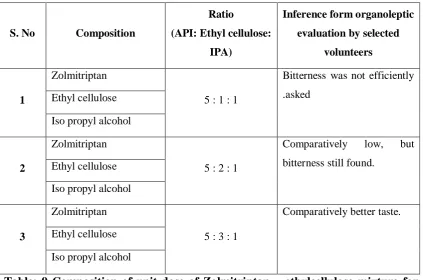
Preparation of zolmitriptan - ethylcellulose mixture (Taste masking)
Pre-compression evaluation
Compression of final blend into tablets
Post-compression evaluation
In-vitro drug release studies
Comparison of optimized formulation and marketed ODT preparation
Stability studies
5. DRUG & EXCIPIENT PROFILE
5.1 ZOLMTIPTAN
Chemical Structure
IUPAC Name :(S)-4-({3-[2-(dimethylamino)ethyl]-1H -indol-5-yl}methyl)-1,3-oxazolidin-2-one
Description : Zolmitriptan is a synthetic tryptamine derivative and appears as a white powder that is partially soluble in water.
Drug class : Antimigraine agents.
Bioavailability : 40% Oral.
Protein binding : 25%.
Absorption : Zolmitriptan is well absorbed after oral administration.
Zolmitriptan displays linear kinetics over the dose range of 2.5 to 50 mg.
Metabolism : Hepatic (CYP1A2-mediated, to active metabolite). Zolmitriptan is converted to an active N-desmethyl metabolite; the metabolite concentrations are about two-thirds that of zolmitriptan. Because the 5HT1B/1D potency of the metabolite is 2 to 6 times that of the parent compound, the metabolite may contribute a substantial portion of the overall effect after zolmitriptan administration.
Excretion: Renal (65%) and faecal (35%). Mean total plasma clearance is 31.5 mL/min/kg, of which one-sixth is renal clearance. The renal clearance is greater than the glomerular filtration rate suggesting renal tubular secretion.
Mechanism of action : Zolmitriptan is a new serotonergic agonist with excellent oral
cranial vessels. On the other, Zolmitriptan exhibits a central nociceptive action in the brainstem nuclei. This dual action of Zolmitriptan on migraine pain is completed with its beneficial effects on nausea and vomiting, due to its binding to the nucleus of the tract us solitaries, the centre for control of vomiting.
Brand names : Zomig, Zomig-ZMT.
Uses : Migraines, Cluster headaches and cyclic vomiting syndrome.
Indications and usage : Zolmitriptan is indicated for the acute treatment of migraine with or without aura in adults.
Limitation of use : Only use Zolmitriptan if a clear diagnosis of migraine
has been established. If a patient has no response to Zolmitriptan treatment for the first migraine attack, reconsider the diagnosis of migraine before Zolmitriptan is administered to treat any subsequent attacks. Zolmitriptan is not indicated for the prevention of migraine attacks. Safety and effectiveness of Zolmitriptan have not been established for cluster headache.
Dosing in Patients with Hepatic Impairment
The recommended dose of Zolmitriptan in patients with moderate to severe hepatic impairment is 1.25 mg because of increased Zolmitriptan blood levels in these patients and elevation of blood pressure in some of these patients. Limit the total daily dose in patients with severe hepatic impairment to not more than 5 mg per day. Contraindications
Ischemic coronary artery disease (angina pectoris, history of myocardial
Wolff-Parkinson-White Syndrome or arrhythmias,
History of stroke, transient ischemic attack (TIA), or history of hemiplegic or
basilar migraine because these patients are at a higher risk of stroke,
Peripheral vascular disease (PVD),
Ischemic bowel disease,
Uncontrolled hypertension.
Medication Overuse Headache
Overuse of acute migraine drugs (e.g. ergotamine, triptans, opioids, or a combination of drugs for 10 or more days per month) may lead to exacerbation of headache (medication overuse headache). Detoxification of patients, including withdrawal of the overused drugs, and treatment of withdrawal symptoms (which often includes a transient worsening of headache) may be necessary.
Adverse Reactions
The following adverse reactions are described elsewhere in other sections of the prescribing information:
Myocardial Ischemia, Myocardial Infarction, and Prinzmetal Angina.
Arrthymias.
Chest and or Throat, Neck and Jaw Pain/Tightness/Pressure.
Cerebrovascular Events.
Other Vasospasm Reactions.
Medication Overuse Headache.
Serotonin Syndrome.
DRUG INTERACTIONS
Zolmitriptan is contraindicated to patients to use along with the following class of drugs
Ergot-containing Drugs,
MAO-A Inhibitors ,
5-HT1B/1D agonists ,
Selective Serotonin Reuptake Inhibitors and Serotonin Norepinephrine
Reuptake Inhibitors and
Cimetidine.
EXCIPIENT PROFILE
5.2 CITRIC ACID
Chemical structure
Non-proprietary names
BP: Citric acid monohydrate
JP: Citric acid
PhEur: Acidumcitricummonohydricum
Synonyms
E330, 2-hydroxypropane-1,2,3-tricarboxylic acid monohydrate.
Functional Category
Acidifying agent, antioxidant, buffering agent, chelating agent and flavour enhancer.
Applications in Pharmaceutical Formulation or technology:
Citric acid is widely used in pharmaceutical formulations and food products, primarily to adjust the pH of solutions. It has also been used experimentally to adjust the pH of tablet matrices in enteric coated formulations for colon-specific drug delivery. Citric acid monohydrate is used in the preparation of effervescent granules, while anhydrous citric acid is widely used in the preparation of effervescent tablets. Citric acid has also been shown to improve the stability of spray dried insulin powder in inhalation formulations.
In food products, citric acid is used as a flavour enhancer for its teat, acidic taste. Citric acid monohydrate is used as a sequestering agent and antioxidant synergist. It is also a component of anti-coagulant citrate solutions. Therapeutically, preparations containing citric acid have been used to dissolve renal calculi.
Use Concentration (%)
Buffer solutions 0.1-2.0
Flavor enhancer for liquid formulations 0.3-2.0
Sequestering agent 0.3-2.0
Description
Citric acid monohydrate occurs as colourless or translucent crystals, or as a white crystalline, efflorescent powder. It is odourless and has a strong acidic taste. The crystal structure is orthorhombic.
Typical Properties
Acidity/alkalinity : pH 2.2 (1% w/v aqueous solution)
Density : 1.542 g/cm3
Hygroscopicity: at relative humidities less than about 65%, citric acid monohydrate effloresces at 25ºC, the anhydrous acid being formed at relative humidities less than about 40%. At relative humidities between about 65% and 75%, citric acid monohydrate absorbs insignificant amounts of citric acid monohydrate absorbs insignificant amounts of moisture, but under more humid conditions substantial amounts of water are absorbed.
Melting point : 100 ºC (soften at 75 ºC)
Solubility: Soluble 1 in 1.5 parts of ethanol (95%) and 1 in less than 1 part of water; sparingly soluble in ether.
Viscosity (dynamic) : 6.5mPa s (6.5 cP) for a 50% w/v aqueous
solution 35 ºC.
Incompatibilities
combination with metal nitrates. On storage, sucrose may crystallize from syrups in the presence of citric acid.
Related Substances
Anhydrous citric acid ; fumaric acid; malic acid ; sodium citrate dihydrate ; tartaric acid.
5.3 COLLOIDAL SILICON DI OXIDE
Chemical structure
Non Proprietary Names
BP: Colloidal anhydrous silica
PhEur: Silica colloidalisanhydrica
USPNF: Colloidal Silicon dioxide
Synonym
Aerosi, Cob-O-Sil M-5P, colloidal silica, fumed silica, light anhydrous silicic acid,
silicic anhydride, silicon dioxide fumed, wacker HDK.
Functional category:
Applications in Pharmaceutical Formulation or Technology:
Colloidal silicon dioxide is widely used in pharmaceuticals, cosmetics, and food products; It’s small particle size and large specific surface area give it desirable flow characteristics that are exploited to improve the flow properties of dry powders in a number of processes such as tableting.
Colloidal Silicon dioxide is also used to stabilize emulsions and as a thixotropic thickening and suspending agent in gets and semisolid preparations. In aerosols, other than those for inhalation, Colloidal Silicon dioxide is used to promote particulate suspension, eliminate hard settling, and minimize the clogging of spray nozzles. Colloidal Silicon dioxide is also used as a tablet disintegrants and as an adsorbent dispersing agent for liquids in powders. Colloidal silica di oxide is used in suppositories for retarding the release profile.
Description
Colloidal silicon dioxide is sub microscopic fumed silica with a particle size of about 15nm. It is a light, loose, bluish-white-coloured, odourless, tasteless, non-gritty amorphous powder.
Typical Properties
Acidity/alkalinity : pH 3.5-4.4 (4% w/v aqueous dispersion)
Density (bulk) : 0.029-0.042g/cm3
Flowability : 35.52%
Incompatibilities:
Incompatible with diethylstilbestrol preparations.
5.4 PANEXCEA ODT
Product Composition
PanExcea MC200G performance excipient contains a polyhydric sugar alcohol (mannitol) and a proprietary silicate salt (Calcium silicate). The novel Particle morphology makes it an excellent building block for orally disintegrating tablet applications.
Description
• Appearance : Odourless, white crystalline powder
• Morphology : Dense spherical particle
• Particle Morphology
• Particle Size Distribution
% Cumulative retained on 60 mesh 1.7%
% Cumulative retained on 200 mesh 77.0%
% Cumulative retained on 270 mesh 86.8%
d50 - 103 microns
• Bulk Density : 0.64 g/cc
• Tapped Density : 0.80 g/cc
• Compressibility(Carr Index) : 19.4
• Hausner’s Ratio : 1.21
Increased Revenues and Shortened Time to Market
PanExcea performance excipients improve supply chain, manufacturing and regulatory efficiencies — speeding your product to market while reducing your ownership costs and increasing your revenues.
• Eliminates Oral Disintegrating Tablet (ODT) technology licensing • Formulation flexibility and scalability allowing:
Manipulation of excipient functionality
Masking of undesirable properties of the individual excipients
Addition of taste masking or other auxiliary excipients
• Simplified tableting processes utilizing conventional direct compression equipment • Delivers tablets of optimal strength and stability, enabling use of conventional packaging.
Application
PanExcea™ performance excipients for orally disintegrating tablet applications act as a building block that enables the rapid disintegration of a tablet, in the oral cavity without water, while providing excellent mouth feel.
• Tablet cost 5 to 10 times lower than conventional ODT technology.
• Rapid and complete disintegration with no residue.
• High Active Pharmaceutical Ingredient (API) loading capacity.
• Potential to reduce tablet size and total volume of excipient.
• Completely disintegrates in less than 30 seconds.
• Smooth, creamy mouth feel.
5.5 PHARMABURST
Pharmaburst is a Quick Dissolving delivery system in which there is addition of active drug in a dry blend with Pharmaburst excipients and compress by tablet machine. Pharmaburst was found to be significantly more compactable, less friable, and more rapidly disintegrating. Pharmaburst is a coprocessed excipient system with specific excipients, which allows rapid disintegration and low adhesion to punches. Pharmaburst is smooth and creamy and helps to mask taste and grittiness of the actives. Main advantages Pharmaburst is highly compatible, rapid disintegration and cost effective
Description
Physical state : Solid
Appearance : White to off-white, free-flowing powder
Color : White
Loss on drying : NMT 3.0%
Bulk Density : 0.31 – 0.51 g/mL
Tapped Density : 0.38 – 0.68 g/mL
Total Polyol Content (db) : 73.8 – 93.8%
% retain on a #20 U.S. sieve : NMT 1
% through a #325 U.S. sieve : NMT 18
Melting point : 330.8°F (164 -169°C)
Boiling point : 563°F (290 -295°C) decomposes
Flash point : > 300.2°F (149°C)
Auto-ignition temperature : 860°F (460°C)
Storage conditions : Store at room temperature. Keep container tightly closed.
Incompatible products : Strong bases, Strong acids, Strong oxidizing
agents.
Incompatible materials : Sources of ignition, direct sunlight.
5.6 PEARLITOL® FLASH
Pearlitol® Flash is a compound dedicated to orodispersible tablets obtained by
Direct Compression.
Description
White, odourless, slightly sweet tasting, crystalline powder
Functional Category
Rapid Release Agent, Disintegrant
Particle Size
200 µm
Advantages
Pleasing taste
A fast melting in the mouth
An easy DC tableting process
A robust DC excipient
5.7 PEPPERMINT FLAVOR
Description: Brown fine powder from leaf of mentha.
Functional Category: Flavouring agent.
Applications in pharmaceutical Formulation or technology:
Peppermint flavour is used in medicine to mask or impart taste to medications. A flavour, as used in the pharmaceutical industry for inactive ingredients, refers to natural or artificial tastes, which may include fragrances and colours of the flavouring. Flavours are used for orally consumed products such as syrups, chewable tablets, suspensions, or gums that impart beneficial therapeutic effect, as well. Peppermint is a common and popular flavour used in medications.
5.8 SODIUM STEARYL FUMARATE
Chemical structure
Nonproprietary Names
BP: Sodium Stearyl Fumarate
PhEur: Natriistearylisfumaras
Synonym
Fumaric acid, octadecyl ester, sodium salt, pruv; sodium monostearyl Fumarate
Functional Category:
Tablet and capsule lubricant
Applications in pharmaceutical Formulation or technology
Sodium Stearyl Fumarate is used as a lubricant in capsule and tablet formulation at 0.5-2.0% ww concentration. It is also used in certain food applications
Description
Sodium Stearyl Fumarate is used as a fine, white powder with agglomerates of flat, circular-shaped particles.
Typical Properties
Acidity/alkalinity : pH 8.3for a 5%w/v aqueous solution at 90ºC.
Density : 1.107g/cm3
Bulk density : 0.2-0.35 g/cm3
Tapped density : 0.3-0.5 g/cm3
Melting point : 224-245ºC(with decomposition)
Incompatibilities
5.9 SUCRALOSE
Chemical structure
Nonproprietary Names
USPNF: Sucralose
Synonym
Splenda; TGS; 1’,4’,6’-trichlorogalactosucrose;
4,1’,6’-tri-chloro-4,1’,6’-trideoxy-galacto-sucrose.
Functional Category:
Sweetening agent
Applications in pharmaceutical Formulation or technology:
Sucralose is used as a sweetening agent in beverages, foods, and pharmaceutical applications. It has a sweetening power approximately300-1000 times that of sucrose and has no aftertaste. It has no nutritional value, is noncarcinogenic, and produces no glycemic response.
Description
Typical Properties
Acidity/alkalinity : pH 5-6 (10% w/v aqueous solution at 20ºC)
Density (bulk) : 0.35 g/cm3
Density (tapped) : 0.62 g/cm3
Density (true) : 1.63g/cm3
Melting point : 130ºC (for anhydrous crystalline form);
36.5ºC (for pentahydrate).
Particle size distribution: 90% <12µm in size.
5.10 MANNITOL
Chemical structure
Nonproprietary Names
BP: Mannitol
JP: D-Mannitol
PhEur: Mannitolum
Synonyms
Cordycepic acid; C*PharmMannidex; E421; manna sugar; D-mannite; mannite; Mannogem; Pearlitol
Chemical Name and CAS Registry Number
D-Mannitol [69-65-8]
Functional Category Diluent;
Diluent for lyophilized preparations; sweetening agent; tablet and capsule diluent; tonicity agent;
Applications in Pharmaceutical Formulation or Technology;
Description
Mannitol is D-Mannitol. It is a hexahydric alcohol related to mannose and is isomeric with sorbitol. Mannitol occurs as a white, odourless, crystalline powder, or free-flowing granules. It has a sweet taste, approximately as sweet as glucose and half as sweet as sucrose, and imparts a cooling sensation in the mouth. Microscopically, it appears as orthorhombic needles when crystallized from alcohol. Mannitol shows polymorphism.
Typical Properties Compressibility:
1. Bulk density : 0.430 g/cm3 for powder; 0.7 g/cm3 for granules.
2. Tapped density : 0.734 g/cm3 for powder; 0.8 g/cm3 for granules.
3. True density : 1.514 g/cm3
4. pKa = 13.5 at 188C Flash point
Stability and Storage Conditions;