Den Europaeiske Investeringsbank Europäische Investitionsbank Ευρωπαϊκή Τράπεζα Επενδύσεων European Investment Bank Banco Europeo de Inversiones Banque européenne d'investissement Banca europea per gli investimenti Europese Investeringsbank
Banco Europeu de Investimento
February 1988 • No 55
ISSN Ò250-3867
βίΟΓΩΊβΤΗ
s
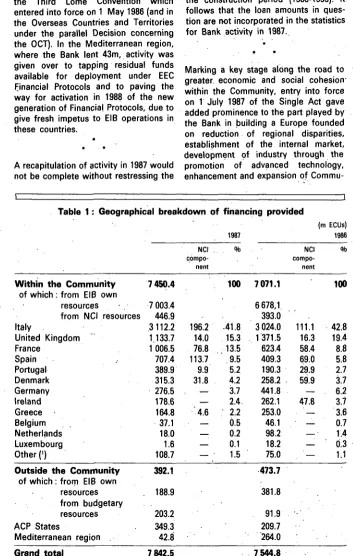
Lending by the European Investment Bank in 1987 totalled 7.84bn ECUs, an increase of some 40/o (2.6o/o in real terms) compared with 1986. Within the EEC, the EIB advanced 7bn in loans from its own resources and almost 450m in loans from New Community Instrument (NCI) resources. Outside the Community, a total of 392.1m was made available, comprising 189m from own resources and 203m from budgetary resources. Salient features of the 1987 financial year were :
Ο signature of the £1bn/Ffrs lObn co-financing agreement (1.4bn in ECU terms) for the Eurotunnel Project : the first series of loans should be disbursed during 1988; of exceptional importance to the Community's transport network, the Channel Tunnel is seen as a project which will provide a significant stimulus to Europe's economy ;
Ο at 1.6bn, the volume of loans centred on projects designed to protect the environment in 1987, the European Year of the Environment, amounted to more than twice as much as the previous year (702m) ;
Ο a surge in financing for capital invest ment fostering regional development which attracted 4.35bn ;
Ο appreciable growth in credit for pro ductive-sector investment, chiefly in industry (2.6bn, compared with 1.9bn in 1986);
0 an upswing in global loans for small and medium-scale projects (more than 2bn made available in all, of which 408m furnished from NCI resources). The number of smaller capital projects in receipt of global loan allocations during the year ran to over 3000, the vast majo rity mounted by SMEs ;
Ο a virtual doubling of financing, opera tions in Spain (707m) and Portugal (390m);
Ο outside the EEC, a boost for lending in the ACP States under the Third Lomé
V) No set country or sector quota is applied to the provi-sion of Bank financing ; the breakdown of EIB lending depends as mucli upon demand as upon the viability of the projects put forward and their conformity with the Bank's economic policy objectives.
(^) ECSC. EIB, NCI and Euratom loans, ERDF and EAGGF (Guidance Section) grants. ' .
Convention (349m, in contrast to 210m in 1986), while further progress was made towards renewing the Financial Proto-cols with the Mediterranean Countries ;
Ο in terms of the Bank's borrowing ope rations, the continued ground gained by Community currencies, including the ECU (5.6bn raised in 1987), as opposed to the slippage of other currencies, par ticularly the US dollar.
Within the Community : the EIB moun ted operations in all of the twelve Mem ber Countries in 1987 ('), particularly vigorous growth being recorded in lending from own resources (+325m). Apart from the high level of lending in Spain and Portugal, there was a sub stantial upturn in financing operations in France and, although not to the same extent, in Denmark. Italy remained the leading recipient of Bank credit. Lending dipped however in Germany, the United Kingdom, Greece, Ireland and in the Benelux countries.
Loans granted by the Bank in 1987 from its own and NCI resources accounted for some 5 1 % of Community structural financing (^) and more than 80% of financial support funded from borrow ings. Accounting for about 1% of gross fixed capital formation within the Com munity in 1987, their relative importance was most pronounced in : Portugal (5.1%) ; Italy (2.4% - 4% however in the case of the Mezzogiorno) ; Ireland (4.2%); Greece . (2.1%); and Spain (1.3%). On the basis of data available at thé time of project appraisal, the EIB puts at some 19.4bn the total fixed asset cost of projects financed in 1987. In terms of employment, these projects are
The 7.84bn ECUs lent by the EIB in 1987 were financed as to 7.19bn from own re-sources (mainly the proceeds of the Bank's borrowings on the capital mar-kets) comprising 7bn provided within and 190m outside the Community to-gether with 650m from resources de-ployed by the Bank acting under manda-te (447m made available in the EEC from the resources of the New Community Instrument (NCI) and 203m outside the Community funded from budgetary re-sources). Loans provided under mandate are, for the most part, granted on be-half, and for the account, of the Euro-pean Economic Community and are acc-ounted for off balance sheet in the Bank's Special Section ; responsibility for these operations is limited to proper performance of the mandate entrusted to the EIB.
expected to have much the same bene-ficial impact as in previous years. Outside the Community : the EIB con-tinued and substantially stepped up (349m) its lending operations in the Afri-can, Caribbean and Pacific States under the Third Lomé Convention which entered into force on 1 May 1986 (and in the Overseas Countries and Territories under the parallel Decision concerning the OCT). In the Mediterranean region, where the Bank lent 43m, activity was given over to tapping residual funds available for deployment under EEC Financial Protocols and to paving the way for activation in 1988 of the new generation of Financial Protocols, due to give fresh impetus to EIB operations in these countries.
A recapitulation of activity in 1987 would not be complete without restressing the
landmark signature of the credit agree-ment providing for £1bn/Ffrs lObn (approx. 1.4bn ECUs) towards construct-ing the Channel Tunnel. The agreement was concluded in September 1987, with disbursements scheduled throughout the construction period (1988-1993). It follows that the loan amounts in ques-tion are not incorporated in the statistics for Bank activity in 1987.
Marking a key stage along the road to greater, economic and social cohesion' within the Community, entry into force on 1 July 1987 of the Single Act gave added prominence to the part played by the Bank in building a Europe founded on reduction of regional disparities, establishment of the internal market, development of industry through the promotion of advanced technology, enhancement and expansion of
[image:2.592.32.385.218.774.2]Commu-1 • - 1
Table 1 : Geographical breakdown of financing provided
Within the Community of which : from EIB own
resources
from NCI resources Italy
United Kingdom France
Spain Portugal Denmark Germany Ireland Greece Belgium Netherlands Luxembourg Other (')
Outside the Community of which : from EIB own
resources from budgetary resources ACP States
Mediterranean region Grand total
7 450.4 7 003.4
446.9 3112.2 1,133.7 1 006.5 707.4 389.9 315.3 276.5 178.6 164.8 37.1 18.0 1.6 108.7 392.1 . 188.9
203.2 349.3 42.8 7 842.5
NCI .
compo-nent
196.2 14.0 76.8 113.7 9.9 31.8 — — 4.6 — — — — '
1987
%
100
-41.8 15.3 13.5 9.5 5.2 4.2 3.7 2.4. 2.2 0.5 0.2 0.1 1.5
7071.1 6678,1 393.0 3024.0 1371.5 623.4 409.3 190.3 258.2 441.8 262.1 253.0 46.1 98.2 18.2 75.0 473.7 381.8 91.9 209.7 264.0 7 544.8
(
NCI
compo-nent
111.1 16.3 58.4 69.0 29.9 59.9 — 47.8 — — — -— . —
m ECUs)
1986
o/b
100
42.8 19.4 8.8 5.8 2.7 3.7 6.2 3.7 3.6 0.7 1.4 Ö.3 1.1
{') Project of direct benefit to the EEC but located outside Member States' European territories.
I 1
nity infrastructure, and dedicated pro-tection of the environment. These various priorities highlighted by the Single Act enshrine the very principles which guide and inform EIB activity.
Breakdown of Bank lending within the EEC by economic policy objec-tive
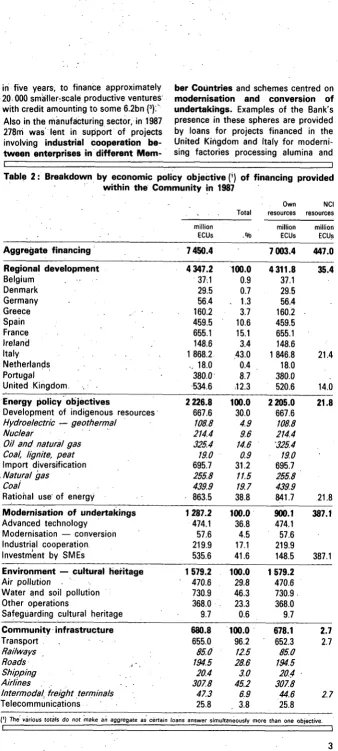
In line with the EIB's principal task, pro-jects fostering iregional development represented the focal point of Bank acti-vity in 1987 : a total of 4.35bn was made available for this purpose, representing a notable upturn compared with the 3.7bn provided the previous year. 70% of lending ih this category was brought to bear on countries or regions with the severest structural problems (Portugal, Greece, Ireland, Northern Ireland, parts of Italy and Spain) and was steered heavily towards regions contending with unemployment rates above, and average income below, the Community average. In the course of what from the spring onwards had been declared the Euro-pean Year of the Environment, the Bank made a significant contribution to the financing of environmental protectiori projects, doubling the volume of its lending in this area for the second year in a row : 1 579m, as against 702m in 1986 and 360m in 1985. Capital invest-ment financed embraced sewerage and sewage disposal schemes, water treat-ment and purification plants in Italy, the United Kingdom, Portugal, France and Germany, as well as equipment and pro-cesses helping to clean up the air we breathe by reducing gaseous emissions from thermal power stations, heating plants and refineries in Greece, Ger-many, Italy and Denmark. The EIB also contributed towards construction of household waste incineration plants in Italy, the United Kingdom and France, the rehabilitation of derelict sites and the fight against soil erosion (Italy). Smaller-scale items of infrastructure and industrial investment offering environ-mental benefits likewise attracted sub-loans from multi-purpose global loan financing, although sometimes entire global loans were devoted specifically to this end.
apprais-ing all loan applications, the Bank sys-tematically examines thé environmental impact of schemes and their compliance with existing legislation. It also makes a point of encouraging promoters to instal equipment limiting the direct and indi-rect environmental effects of each pro-ject to levels even below those called for by law.
Lending to industry registered substan-tial growth (2.6bn) : over 470m of the total made available went in support of capital investment building on or usher-ing in advanced technology. The main thrust of the projects financed was on honing the corhpetitive edge of Euro-pean industry over a broad spectrum of activities.
Again in the productive sector, the EIB continued to channel credit to small and medium-sized enterprises (SMEs) through its global loan facility : aggre-gate global loan credit to smaller busi-nesses in 1987 comprised 1.4bn (') from EIB own resources and 408m from NCI resources (^). A large number of sub-loans are .now in the pipeline for alloca-tion under these global loans in coming months. In 1987, 2 800 small and medi-um-scale industrial veritures attracted sub-loans worth in excess of 900m in all : some 1 800 of these ventures were financed as to more than 610m from the. Bank's own resources, and 980 as to 295m from NCI resources.
In addition, 90 allocations (126m) were channelled to ventures making, more efficient use of energy, 44 (74m) to environmental protection projects, 9 (25m) to ventures deploying advanced technology and 98 (78m) to investment in small and medium-scale infrastruc-ture.
Nearly 80% of productive investment by SMEs financed under global loans in 1987 was undertaken by firms with less than 50 employees..
Taking- all global loan allocations bet-, ween 1983, the European Year of the Small : and Medium-Scale Enterprises, and the end of 1987, the EIB has helped.
(') To which should be added'213m for infrastructure of fairly modest dimensioiis,
(2) NCI IV provides for 760m from Commission NCI borro-wings, in tandem with, which the Bank is supplying a fur-ther 750m .from its own resources. The combined 1,5bn will be used for financing productive investment by SMEs, mainly outside the assisted areas.
(3) Beneficiaries of credit from EIB own resources : over 10 000 SMEs (3bn) ; beneficiaries of NCI credit : 9 200 SMEs • (2,4bn): Key data : rational use of energy — 584 projects (530m) ; advanced technology — 35 projects (114m) ; pro-tection, of the environment — 50 projects (87m); •
in five years, to finance approximately 20 000 smàHertScalé productive ventures with credit amounting to some 6.2bn (^);"
Also in the manufacturing sector, in 1987 278ni was lent in support of projects involving industrial cooperation be-tween enterprises in different
Mem-ber Countries and schemes centred on modernisation and conversion of undertakings. Examples of the Bank's presence in these spheres are provided by loans for projects financed in the United Kingdom and Italy for moderni-sing factories procesmoderni-sing alumina and
[image:3.592.215.554.67.819.2]1 • 1
Table 2 : Breakdown by economic policy objective (') of financing provided within the
Aggregate financing Regional development Belgium
Denmark Germany Greece Spain France Ireland Italy Netherlands Portugal
United Kingdom.
Energy policy objectives
Community in
million ECUs
7450.4 4 347.2 37.1 29.5 56.4 160.2 459.5 655.1 148.6 1 868.2
. 18.0 380.0 534.6 2 226.8
Development of indigenous resources 667.6 Hydroelectric - - geothermal
Nuclear
Oil and natural gas Coal, lignite, peat Import diversification . Natural gas
Coal
Rational use of energy
Modernisation of undertakings Advanced technology
Modernisation — conversion Industrial cooperation. Investment by SMEs
Environment — cultural heritage Air pollution
Water and soil pollution Other operations
Safeguarding cultural heritage Community infrastructure Transport .
Railways
Roads , -S flipp ing
Airlines
Intermodal, freight terminals Telecommunications
(') The various totals do not make an aggregate as
108.8 214.4 325.4 19.0 695.7 255.8 439.9 863.5 1 287.2 474.1 57.6 219.9 535.6 1 579.2 470.6 730.9 368.0 9.7 680.8 655.0 85.0 194.5 20.4 307.8 47.3 25.8
1987
Total
.%
100.0 0.9 0.7 . 1.3
3.7 10.6 15.1 3.4 43.0 0.4 8.7 ;12.3 100.0 30.0 4.9 9.6 14.6 0.9 31.2 11.5 19.7 38.8 100.0 36.8 4.5 17.1 41.6 100.0 29.8 46.3 23.3 0.6 100.0 96.2 12.5 28.6 3.0 45.2 6.9 3.8
Own
resources
million ECUs
7 003.4 4311.8
37.1 29.5 56.4 160.2 459.5 655.1 148.6 1846.8 18.0 380.0 520.6 2 205.0 667.6 108.8 214.4 •325.4 19.0 695.7 255.8 439.9 841.7 900.1 474.1 57.6 219.9 148.5 1 579.2 470.6 730.9. 368.0
9.7 678.1 652.3 85.0 194.5 20.4 307.8 44.6 25.8
NCI
resources
million ECUs
447.0 35.4
21.4
14.0 21.8
21.8 387.1
387.1
2.7 2.7
2.7
::èrtain loans answer simultaneously more than one objective.
aluminium, support for development,of an important copper-mining project in Portugal and finance for Spain's corpo-rate sector aimed at adapting Spanish firms to the new market conditions brought about by entry into the EEC. Projects contributing to Community energy policy objectives attracted 2.2bn in 1987. Loans promoting efficient use of energy accounted for 863m of this (393m for smaller-scale investment and 470m for district heating or for electricity grid interconnections). Import diversification projects and those furthering the use of natural gas (Italy, Denmark, a gasline in Austria benefiting the Community), coal to fuel power stations at Brindisi in Italy and'Kilroot in Northern Ireland, or lignite in Greece were funded with loans total-ling 696m. A further 668m helped. Mem-ber Countries to harness indigenous resources, namely crude oil, natural gas and hydroelectric energy in the United Kingdom, Italy, Spain and France, and to develop nuclear power.
When operational, projects financed in 1987 should reduce the Community's dependence on oil imports by some 13.5m tonnes of oil equivalent (t.o.e.) per annum. The cut-back in oil imports achieved by virtue of projects funded by the EIB since 1983 amounts to some 55m t.o.e., 12m t.o.e. of this realised by dint of more rational use of energy ; the overall saving corresponds to some 14% of projected Community oil imports in 1995.
Schemes aimed at developing Com-munity transport infrastructure clai-med 655m in 1987, notably for air trans-port via loans for airtrans-ports in the United Kingdom, Italy and France and acquisi-tion of aircraft, notably in Italy, to bol-ster existing fleets, especially those operating between Member States. The Bank also financed numerous road and motorway sections in Italy, France, Ireland, Spain, Portugal and the United Kingdom, harbours in Italy and the United Kingdom, a tanker in Luxem-bourg for the conveyance of petro-chemical products and improvements to rail links in Spain and Greece. .
Borrowings
The EIB raised borrowings in 1987 for a total of 5 593 million ECUs, compared with 6 786 million during the previous year. Of this, 3 769 million were tapped
by means of public loan issues, 996 mil-lion through private placings, 456 milmil-lion via interbank operations, 352 million under a US$ medium-term notes pro-gramme and 20 million by allocating to third parties participations in loans, guaranteed by the EIB.
A striking feature of the, financial year was that borrowings were raised mainly iri DM, whereas the US$ had tradition-ally headed the list of currencies tapped in the past. As in previous years, the ECU occupied second place, followed by the US$, the Italian lira and the yen. Again reflecting the trend of recent years, the EIB also raised appreciable amounts in French, Swiss and Belgian francs. Guilders and pounds sterling (see Table). Swap operations totalled 326 million ECUs, bringing in the equiva-lent of 193 million ECUs in floating rate US$ plus 133 million in fixed rate ECUs. A relative fall in demand from its borro-wers for floating rate funds prompted the EIB to slacken the pace of its calls on this market where it raised 393 mil-lion ECUs as against 541 milmil-lion in 1986. The Bank concluded two issues (toge-ther worth 200 million ECUs) in floating rate lire, one being the first of its kind on the Eurolira market. The balance of 193 million ECUs, raised in floating rate US$, has already been mentioned under the heading of swap operations. Principal currencies raised (in million ECUs) - after swap operations
1987 1986 1.
2. 3. 4. 5. 6. 7. 8. 9. 0.
DM ECUs US$ Lit Yen Ffrs Sfrs Fl Bfrs £
1 153 (20.6%) 807 (14.40/0) 722 (12.9%) 639 (11.40/0) 517 ( 9.20/0) 464 ( 8.30/0) 370 ( 6.60/0) ;338 (6.00/0) 302 ( 5.40/0) 142 ( 2.50/0)
879 (13.00/0) 897 (13.20/0) 1 760 (25.90/0) 594 ( 8.70/0) 514 ( 7.60/0) 413 ( 6.10/0) •510 ( 7.50/0) 515 ( 7.6O/0) 263 ( 3.90/0) 304 ( 4.50/0) In 1987, the EIB also raised the equiva-lent of 79 million ECUs in Luxembourg francs, 38 million in Danish kroner and 21 million in Austrian Schillings. The trend towards a fall in the relative importance of the US$ in relation to aggregate borrowings gained considera-ble momentum in 1987, while calls on the DM market showed a steep upturn. Similarly, again in response to demand from borrowers, the ECU continued to occupy second place among currencies
tapped. Hence, the EIB confirmed its prime role on the market for the,Com-munity currency where it is the leading operator on both the borrowing and lending fronts. The main countries in which loans were wholly or partly dis-bursed in ECUs in 1987 were Italy (360 million), Denmark (261 million), Spain (107 million), France (83 million), Ireland (79 million), Portugal (68 mil-lion), Greece (16 million) and Belgium (14 million).
A general facet of the 1987 financial year was the marked rise in issues on national markets and the sharp dip in operations in non-Community currencies which slipped back from 4I.80/0 of the total in 1986 to 31.50/0 last year.
Lending in the Member Countries In Italy, traditionally the largest benefi-ciary of EIB loans. Bank lending reached a new high of 3112m (Lit 4 618bn), of which 196m (Lit 293bn) was provided from NCI resources. The loans break down as to 1209m (Lit 17933n) for industry, 1 081m (Lit 1 609bn) for infras-tructure, and 822m (Lit 1212bn) for energy schemes. Once again, the Bank stepped up its support appreciably for the high-technology sector (363m/ Lit 536bn) and for protection of the environment (692m/Lit 1 033bn). More than 6OO/0 of the loans granted were for projects contributing to reg-ional development, 870/o of them located in the Mezzogiorno, chiefly in Campania - 191m (Lit 282bn),. Sicily - 116m (Lit 170bn), Latium - 123m (Lit 182bn), Abruzzi 57m (Lit 85bn) and Sardinia -130m (Lit 192bn).
These projects, niany accorded priority under the Investment and Job-creation Fund (FIO) consisted, in the main, of a variety of communications infrastructure (588m/Lit 874bn), industrial investment, typically by SMEs (628m/Lit 935bn) and energy schemes (519m/Lit 767bn). The earthquake-stricken regions of Campania and Basilicata also received further reconstruction support virtually exhausting the balance of Community aid left uncommitted.
throughout the country accounted for two thirds of Bank lending in Italy chan-nelled via the instrument ' specifically tailored to their needs, the global loan facility. The proceeds of new global loans concluded in 1987 and of those already on tap from previous years were drawn on to fund 1 518 ventures to the extent of 697m (Lit 985bn), of which 141m (Lit 209bn) from NCI resources was directed towards capital investment in the more developed areas. .
The larger-scale projects attracting finance during the year were in the elec-tronics and electrical-engineering sec-tors (components, printers, magnetic memories, automated production and computerised programming processes) ; substantial credit was also provided for the chemicals industry, more often than not for projects incorporating high tech-nology, e.g. new methods developed for the manufacture of fluorochemicals, detergents, adhesives and medical pro-ducts and in modernising an oil refinery. Cast wide, the net of Bank lending to industry also encompassed backing for : construction of the ATR 42 aircraft, a joint franco-Italian venture ; railway rol-lingstock ; motor vehicle tyre and win-dow manufacturing ; production of paper and foodstuffs ; rationalisation of an alumina plant and a cementworks; and the fitting out of an industrial and medical research centre.
With a view to promoting tourism by safeguarding the Community's cultural heritage, finance was also advanced for restoration of the Doges' Palace in Venice and for protection of the archae-ological sites at Pompeii, Herculaneum and Stabiae.
The list is rounded off with mention of Bank funding for: the establishment of an interregional veterinary analysis and research centre ; development of refuse disposal sites ; construction of waste incineration plant; and, through global loans, tourism infrastructure in Calabria and, fish-farming and agriculture in Sar-dinia.
Infrastructure : in this second key sector, the EIB furnished loans contributing t o : railway reinstatement and twin-track construction schemes ; the first under-ground railway system in Naples ; the final sections of the Tunnels Motorway ("Autostrada dei Trafori") linking Italy (Piedmont) with Switzerland ; the new Al Milan-Rome and A2 Rome-Naples
motorway link by-passing the Rome ring road; widening of the Rome-Naples motorway ; reconstruction of viaducts between Naples and Bari ; development of three intermodal, rail/road freight centres in Turin, Verona and Parma ; container-handling and ro/ro facilities at the ports of Trieste and La Spezia, Brindisi coal harbour, marinas, commer-cial and fishing harbours at Ortona, Bagnari, Cariati and Pescara, and upgra-ding of ferries operating between Sicily and Sardinia (offering increased capa-city and comfort) ; modernisation of Turin-Caselle airport and acquisition of MD 82 and ATR 42 aircraft for domestic and intraCommunity routes ; telecommu-nications in the Mezzogiorno and an emergency satellite system to facilitate preventive action in the event of natural disasters.
Many water supply, sewerage and sewage disposal schemes received Bank funding, particularly in the Po basin, the Rome region arid Venezia, together with watershed management and flow con-trol works on the Arno plus investment designed to combat soil erosion, land-slides and flood risks in The Marches, Molise, Valle d'Aosta, as well as near Perugia (Umbria) and in Oltrepò Pavese (Lombardy). Credit was similarly advanced for reafforestation schemes, urban redevelopment, industrial estates and irrigation.
Energy: the main projects supported in this third priority area included
develop-ment of: hydroelectric resources in northern Italy and Calabria and geother-mal resources in Tuscany; a combined district heating and power plant in Bres-cia ; and Brindisi coal-fired power sta-tion also equipped with desulphurisasta-tion installations in order to reduce environ-mental pollution. The Bank continued to contribute towards : exploitation of oil and natural gas deposits in the Adriatic, the Strait of Sicily and Emilia-Romagna ; the natural gas transmission and distri-bution grid and back-up storage reser-voirs, notably in the Turin and Milan areas; thé electricity grid in the Mezzo-giorno, district heating systems in Calabria and smaller items of capital investment centred on more efficient use of energy.
In the United Kingdom, the EIB lent more than 1.1 bn (£801m), of which 14m (£10m) from NCI resources. The bulk of financing was given'over to
infrastruc-ture (757m ECUs/£536m) and, to a lesser extent, energy (345m ECUs/£243m) sche-mes. A further 32.3m (£22.4m) was directed towards projects in industry and the service sector.
Most of the infrastructure financed was located in the Assisted Areas. The EIB nevertheless provided 320m (£234m) for a range of projects throughout the coun-try contributing towards protection of the environment, chiefly in the form of sewerage and sewage disposal schemes and investment designed to improve the quality of drinking water, notably in Trent, Anglia, Yorkshire, Northumbria, Humberside, the Midlands, Scotland, North-West and South-West England. Further loans served to improve commu-nications between the UK and other Member Countries, principally in terms of the air traffic sector where the Bank supported : construction of a new London City airport in the docklands area of the capital, air safety equipment at London Heathrow, a second passen-ger terminal at Gatwick, extension to the runway at Roborough airport (Plymouth) and additions to and refurbishment of facilities at Manchester. Road schemes in Kent and Essex also attracted credit. Other infrastructure financed included : the rail network in the Glasgow area, roads in Devon and numerous compo-site schemes bringing together finance for roadworks, mains connections and access roads for industrial estates, reha-bilitation of disused docks or shipyards, sewerage and sewage disposal schemes together with a variety of public infras-tructure, for the most part in Scotland, Wales, North-West and North-East
England.
In some of the above cases, provision for environmental protection played a significant part in project design, especi-ally for household waste disposal facili-ties in Manchester, Cheshire and Lanca-shire. In others, the infrastructure served the needs of higher educational institu-tes including technical and vocational training colleges in Dyfed, Manchester, Stafford and Lancashire, involved trans-forming a shipyard into an offshore technology park (Newcastle-upon-Tyne) or underpinned urban renewal schemes in Cardiff and Plymouth.
proven reserves of some 100m barrels of crude. Production from this field as from 1990 is expected to run to 35 000 barrels a day. Conversion of Northern Ireland's 600 MW Kilroot thermal power station from oil- to dual-firing (coal/oil) and transmission equipment designed to upgrade the reliability of the electricity distribution system in Northern Ireland aiso constituted projects supported by the Bank in the energy sector.
Bank lending in the industrial sector included finance for modernisation of aluminium production, casting and rol-ling facilities where sophisticated tech-nology will sharpen competitiveness as a result of greater versatility, higher-quality end products, cost-trimming and energy-saving. Other loans funded development of new data-processing systems and establishment of a new computer centre for the Co-operative Wholesale Society Ltd near Manchester (streamlining order processing, stock management, production planning etc.) as well as facilities for household and industrial waste disposal.
Operations in France in 1987 recorded a distinct upturn with more than Ibn (Ffrs 7bn) lent, of which 76m (Ffrs 530m) from NCI resources. The productive sector absorbed more than two fifths of the total with loans going to both larger-scale projects, notably those deploying advanced technology, and to capital investment by SMEs in the assisted areas in the main. Under the heading of advanced or high technology, the EIB helped to finance a new lay-out for a motor vehicle.paint, shop at Sochaux designed to exploit the most modern technological advances in this area to an extent without precedent in the European motor industry. As well as enabling top-of-the-range models asseriibled at Sochaux to be given a higher-quality and more durable finish, the project will make working conditions in the paint shop far less onerous and will upgrade skill levels among the workforce as well as reducing energy consumption. The Bank also lent its sup-port to expansion of manufacturing and R&D facilities in a factory in the suburbs of Bordeaux specialising in computer-aided design and manufacturing sys-tems (CAD/CAM), principally serving the clothing sector. Finally, still in the high-tech area, the EIB financed modernisa-tion of plant at Firminy (Loire) producing extruders and pumps and furnishing
back-up for a major research and deve-lopment programme.
In conjunction with the SDR de la Bre-tagne, the EIB put up a grouped loan, the proceeds of which were earmarked for two medium-sized agricultural-processing firms, for the production of fertilisers and also for telecommunica-tions equipment manufacturing in Brit-tany.
New global loans concluded in 1987 amounted to 382m (Ffrs 2.6bn) in all, of which 77m (Ffrs 530m) was drawn from NCI resources. Deployment of the sub-loans available under these credit lines was achieved in continued cooperation with Crédit d'Equipement des PME, Caisse Centrale de Crédit Coopératif and the Sociétés de Développement Régional. But links were also forged for the. first time with four Banques Popu-laires active in northern and eastern France, with Fructicomi and Fructibail, property-leasing subsidiaries of the Caisse Centrale des Banques Populaires, with Murabail and Bail-Energie, two holding companies of theBTP-Finances Group, specialising in property leasing, and with the associated Banque de Financeriient des Equipements. Ventures mounted by local authorities and public bodies will qualify for credit, chiefly for infrastructure for energy-saving and environmental protection, channelled via these new intermediaries.
The proceeds of the above and ongoing global loans seryed to fund 767 small and medium-scale ventures with credit totalling 162m (Ffrs l.lbn), the NCI com-ponent accounting for 498 of these ven-tures with finance to the tune of 77m (Ffrs 530m).
Capital investment in infrastructure absorbed 284m ECUs (Ffrs 2bn) in finance for : continued work on the TGV Atlantique (High-Speed Train) line to Le Mans and Angers; construction of the Le Mans-Anger section of the A l l Paris-Nantes motorway, the Toulouse and Lyons by-passes, improvements to the road networks in Brittany and Lor-raine (serving textile-mill country in the Vosges and the Lorraine iron and steel industry), the Mâcon-Châtillon section of the A40 motorway leading to the Mont Blanc tunnel, Switzerland and Italy ; a second passenger terminal at Nice's international airport, and ; a variety of works in and around Nancy ranging from flood protection and the completion of a by-pass to rehabilitation of industrial
wasteland. The Bank also advanced a further loan for the waste water treat-ment plant serving the Marseilles conur-bation where a new physiochemical installation will be constructed under-ground for processing foul water, while plant for treating sludge produced by this installation is to be located incons-picuously in an old quarry. The project includes a 6km marine outfall pipe for disposing of pre-treated effluent.
Four global loans totalling 167m (Ffrs 1.2bn) stepped up the Bank's co-operation with Crédit Local de France (formerly "CAECL") with a view to fund-ing small and medium-scale items of public infrastructure, principally the departmental road and water-supply networks in assisted areas. The pro-ceeds of these credit lines and of others concluded the previous year were drawn on during 1987 to support 80 smaller infrastructural schemes with funds amounting in toto to 58.5m (Ffrs 404.5m).
Lending in the energy sector amounted to 123m (Ffrs 846m) and was directed towards further backing for construction of the first two units (1 280 MW each) of Flamanville nuclear power station in Manche, interconnection of the French and British electricity grids via eight subsea cables (with ^ a combined capa-city of 2 000 MW) laid under the Chan-nel between Calais and Dover. This project is designed to provide a reliable and efficient link between the two grids allowing for pooling of energy resour-ces. The twin promoters. Electricité de France and the Central Electricity Gen-erating Board, have received a total of some Ffrs l.lbn and £120m respectively for this reciprocal supply scheme. Another loan in France's energy sector supported construction of a new house-hold waste incineration plant at Lyon-Gerland which, as Well as significantly reducing atmospheric pollution in the Lyons area, will be equipped with heat recovery facilities to supply power to the grid and to feed the existing district heating system with hot water from steam generated at the plant.
reriewable sources of energy, change-over from oil to coal and other appro-priate fuels, electricity distribution, heat recovery and the construction of mini hydroelectric plants.
With the productive sector and commu-nications infrastructure making a partic-ularly strong showing, lending in Spain in 1988 soared to 707m (Ptas 99bn), of which 114m (Ptas 16bn) was provided from NCI resources.
Productive investment by small and medium-sized firms in industry attracted 417m (Ptas 58bn), with an NCI compo-nent of 92m (Ptas 13bn). The funds were advanced in the form of global loan cre-dit to :
-Banco de Crédito Agricola for onlend-ing to agricultural-processonlend-ing ventures ; -Banco de Crédito Industrial, Banco de Bilbao, Barico de Santander, Banco Commercial Espanol, Banco Hispano Industrial, Banco Hispano Americano, Banco Vizcaya and Banco Popular Espanol : for small and medium-scale ventures and allied service-sector activi-ties (from EIB own and NCI résources) and for tourism (EIB own resources) ; -Liscaya (Leasing Bancaya SA), Uninter Leasing SA (member of the Banco Hispano Americano Group) and Lisban (a Bjanco de Bilbao subsidiary). These establishments will pass sub-loans on to smaller businesses or public bodies as straight investment credit or as finance for leasing plant and equipment, particularly for projects with a high-tech or innovative slant ;
-Caja General de Ahorros de Canarias : for capital projects in the Canary Islands.
Actual credit allocations during the year from these and previous global loans benefited 300 smaller ventures with finance totalling 90m (Ptas 13bn), sub-loans from NCI resources accounting for 63m (Ptas 9bn) of this amount and fun-ding 175 of the said ventures.
Finance for infrastructual schemes ran to 218m (Ptas 30bn) the bulk of which was directed towards improving road and rail links. Noteworthy here are : the project designed to remove bottlenecks and to upgrade safety conditions on the La Corufia-Port Bou section of the railway line between Galicia and Cataluna ; the building of a road bridge on the Guadi-ana between Ayamonte and Portugal ; works on the N4 linking Madrid to Seville, Cordoba and Cadiz ; and
sec-tions of the NI, N2 and N620 between Madrid and Portugal and between the Spanish capital and the South of France. Other loans were focused on improve-ments to main roads in Andalucia, nota-bly the Seville-Grenada-Baza and Jerez-Antequera motorways and the express-way between Guadix and Almeria. Funds were also advanced for sections of the Ugaldebieta motorway designed to connect Bilbao with the Nervion val-ley and with the motorways to Burgos, Barcelona, San Sebastian and France. Still in the transport sector, the Bank granted a loan towards construction of a road haulage centre near Bilbao facilita-ting EEC goods traffic. This project will centralise customs clearance, loading/ unloading, freight storage, parking and safeguarding of heavy goods vehicles conducting cross-frontier trade. More modest infrastructural schemes embra-cing road, water supply, sewerage and sewage disposal, electrification and urban development works undertaken by local authorities in the less-developed regions are being financed through a global loan furnished to Banco de Crédito Local. Finally, the EIB sup-ported construction of five dams on tributaries of the Guadiana under a pro-ject designed to put more, better-quality water on tap to household and industrial consumers, to create scope for irrigation and to offer protection against flooding in western Extremadura.
The energy sector took up 73m (Ptas lObn), the best part of this in the form of a loan for 51m (Ptas 7bn) for an ambitious hydroelectric scheme compri-sing dams and two power stations on the Jucar, 50km south-west of Valencia, with a combined installed capacity of 870. MW. The balance of financing in this sector was accounted for by a glo-bal loan for 22m (Ptas 3bn) to Barico. Atlantico for renovating and moderni-sing boilers in small and medium-sized undertakings with a view to energy-saving and to converting units from oil to natural gas..
Bank lending in Portugal amounted to 390m (Esc. 63.5bn),. comprising 10m (Esc. I.èbn) from NCI resources. The principal recipients were private-sector concerns, both smaller industrial firms and promoters mounting larger-scale manufacturing projects.
Development of the Neves Corvo cop-per mine in Alentejo arid construction of a i.3m t.p.a. ore-processing plant
attracted 180m (Esc. 29bn). Forecast production is put at between 250 000 and 470 000 t.p.a. of concentrates. Reserves are estimated to total 25m ton-nes of ore with an average copper con-tent of 8o/o, making this deposit one of the largest in the world with such a rich copper content.
The EIB provided 21m (Esc. 3.5bn) in all in loans towards construction of a hotel complex in the Algarve and for a factory producing medium-density wood-fibre panels in the Viseu district.
A total of 80m (Esc. 13bn) was made available to SMEs via :
-blanket global loans to the State from which every corrimercial bank and finan-cial institution throughout the length and breadth of thé country is authorised to seek credit for projects selected in agreement with lAPMEl (Instituto dé Apoio às Pequenas e Médias Empresas Industriais) ;
- a custom-made global loan to Banco Pinto e Sotto Mayor for small and medium-scale ventures in the agricultur-al, fisheries and agricultural-processing sectors intended to facilitate the struct-ural adjustment of Portugal's farming sector;
designed, in both cases, to smooth con-nections with a new bridge into Spain ; sections of motorway serving Porto, the Ave and Sousa valleys, key focal points for industry in the north of the country, and a road bridge across the Guadiana linking the Algarve with Andalucia. A scheme to supply the town of Porto with, at the outset, an additional 11m cu.m of water per annum claimed a loan of 6.6m from the Bank (Esc. l.lbn) for offtake, treatment and distribution works. A further two projects on Madeira attracted credit totalling 9m (Esc. 1.5bn) for sewage treatment and disposal facilities in the Funchal area and. for a solid vyaste composting plant serving some 80% of the island's popu-lation and incorporating equipment for the recovery of ferrous material, both projects of clear benefit to the environ-ment.
The Bank advanced 6m (Esc. Ibn) in the energy sector with the aim of expanding the local power grid on Säo Miguel and Terceira islands in the Azores by reinfor-cing two transmission and distribution networks and introducing a systems control component. This project will make for more reliable power on the two islands:
Aggregate Bank financing in Denmark in 198.7 came to 315m (Dkr 2.5bn) com-prising 32m (Dkr 250m) from NCI resour-ces. Virtually all of this credit was taken up by the energy sector for schemes geared to harnessing indigenous natural gas resources and to encouraging rnore rational use of energy. The building of district heating grids, for example, will both lessen Denmark's dependence on outside sources of energy and substant-ially reduce atmospheric pollution. The EIB continued its support for the con-struction of a distribution system to pipe hot water from power stations and solid waste incineration plants in the Copen-hagen conurbation to ten outlying muni-cipalities. It also financed similar works in Ârhus and in numerous municipalities along the Lillebaeit. In addition, loans were made available for the district heating grids in Gentofte, Hornslet and the western suburbs of Copenhagen. It is significant that, since establishment of Denmark's Energy Plan in 1976, the EIB has provided 1 700m (Dkr 14bn) for capital investment in this country's energy sector.
Outside the energy sector, the EIB con-cluded a global loan for 32m (Dkr 250m) with Finansieringsinstituttet for Industri og Handvaerk. Drawn from NCI resour-ces, the proceeds of this credit line will be passed on for productive investment by SMEs. The number of small and medium-scale ventures financed under the heading of this and previous lines of credit already on tap came to 46, accounting between them for 5m ECUs/ Dkr 41m.
In Germany, the EIB lent 276.5m (DM 574m). The best part of this went towards schemes to protect the environ-ment which in some cases contributed at the same time towards attainment of Community energy objectives. Hence, 148.5m (DM 308m) in all was directed towards bringing combined heat-and-power stations into line with national and Community legal standards. Located in Hanover (replacing units operated by Volkswagen, Continental Gummi and Stadtwerke Hannover), also north of Saarbrücken (Weiher 111), as well as in Duisburg and in Saarbrücken itself, the power stations will either be fitted with flue gas treatment installations or equipped with more energy-efficient and less polluting coal-fired steam gen-erators.
A loan for 18m (DM 37m) was provided for constructing a dam to control the flow of the Wupper in the Bergisches Land (North Rhine-Westphalia). The project will permit regulation of the yield of the Wupper, guarantee ade-quate water supplies to firms in the Lower Wupper Valley, improve water quality in the river and prevent flooding over wide areas in winter.
There was continued cooperation with Westdeutsche Landesbank Girozentrale through the medium of global loans totalling 96m (DM 200m) focused on srnall and medium-scale infrastructural projects Intended to reduce pollution and to encourage energy saving. Priority will be accorded to investment centred on the collection, treatment, disposal ór recycling of solid, gaseous and liquid waste, both industrial and domestic, and on the manufacture and installation of equipment, such as measuring and monitoring systems, to safeguard or enhance the environment.
Industry received a loan for 14m (DM 29m) for construction of an electro-nic components factory and installation
of a new micro-electronics production line in Schleswig-Holstein introducing sophisticated EDP infrastructure serving to increase the competitiveness of Euro-pe's entrepreneurial sector. ,
In Greece, the EIB lent 165m (Dr 26bn), comprising 4.6m ECUs (Dr 700m) from NCI resources, for protection of the environment, electricity generation and distribution, and infrastructural sche-mes, notably in the transport sector. Small and medium-scale industrial ven: tures also attracted part of this credit. In response to the need to safeguard the environment, the EIB helped to finance works to modernise and upgrade an oil refinery at Aspropyrgos near Eleusis to the north-west of Athens. These works include
installa-tions to reduce exhaust fumes and pol-lutant effluent. Finance towards con-struction of sewerage systems and wastewater treatment plant at Psyttalia to the south-west of Athens will also serve to clean up the Saronic Gulf as part.of a wider scheme to reduce shore-line pollution.
With lending targeted towards streng-thening the country's electricity supply system, the Bank aided : construction of a hydroelectric power station on the Acheloos near Stratos ; working of an open-cast lignite mine at Amynteon in north-western Greece; erection of a nevv high-voltage transmission line link-ing two sub-stations, one at Kardia (Western Macedonia) and the other at Aghios Stephanos (Athens), and ; estab-lishment of two mini hydroelectric plants in Central Greece.
Infrastructural schemes supported by the EIB included railway rolling stock modernisation and renewal through the purchase of new high-speed passenger train sets, extensions to water supply works in the Thessaloniki conurbation, including investment in purification sys-tems, and upgrading of different sec-tions of the road network in Athens and Attica.
forest fires, set up observation posts and provide coastal defences.
New global loans were made available to : (a) the Agricultural Bank of Greece, the proceeds earmarked for onlending for small and medium-scale on-farm, industrial and agricultural-processing ventures, plus modest irrigation sche-mes ; (b) the Hellenic Industrial. Deve-lopment Bank (ETBA), the credit desig-nated for smaller-scale capital invest-ment in industry, allied services and the tourism sector, and; (c) the Hellenic Organisation of Small and Medium-Sized Industries and Handicrafts (EOM-MEX), recipient, in this case, of a global loan from NCI resources for funding smaller items of capital investment in industry.
Ongoing allocations made during the year from eariier global loans totalled 37m (Dr 6bn) and contributed towards 91 small and medium-scale ventures. Nine ventures attracted 1m ECUs (Dr 150m) from the abovementioned NCI global loan provided in 1987. Bank lending in Ireland in 1987 amoun-ted to. 177m (IR£149m). The funds helped to finance acquisition by Aer Lingus of two Boeing 737-300 aircraft as part of the company's fleet modernisa-tion and renewal programme. Operating with reduced noise levels, better fuel efficiency and improved landing capab-ility in bad weather, the new aircraft will be put onto the busy Dublin-London route and will also be used for charter flights to Greece, Italy, Spain and Portu-
gal-With a view to preserving an important part of Ireland's cultural heritage,' finance was also directed towards resto-ration works at Dublin Castle and the construction of new conference facilities there. Other infrastructure supported included the first phase of a new ring road around the western perimeter of Dublin, various projects to improve and modernise the national primary road network, including construction and upgrading of roads near Dublin, in Waterford, County VVicklow and County Donegal, and the building of a bridge over the River Shannon at Limerick. Fur-ther loans were provided for a reservoir at Belgard to improve water supplies in the Tallaght area and for capital invest-ment designed to increase the capacity of the main Dublin sewage treatment plant às well as for a series of smaller
matching vvater and sewerage works throughout the country.'
The Bank assisted modernisation of Ire-land's telecommunications systems with loans for installation and extension of telephone exchanges (many using digit-al technology), extension of urban, trunk, telex and data transmission net-works, the laying of optical fibre links and improvements to radio transmission systems.
As part of a continuing programme to develop Irish forests, the EIB contribu-ted towards investment in forestry and related activities at various locations throughout Ireland.
Finally, a global loan was made avai-lable to the Bank of Ireland for financing investment by small and medium-sized enterprises in industry and tourism. Sixty-two smaller ventures attracted 7m (IR£5.5m) in all during the year from glo-bal loan credit already activated. In Belgium, the Bank furnished 37m-(Bfrs 1.6bn) in loans for capital invest-ment in industry exploiting advanced technology and contributing to .the con-version of areas hit by closures in the coalmining sector : at Hasselt in Limburg Province,, the Bank financed extension and automation of a factory producing compact disc players, while at Mol in Antwerp Province,· EIB funding aided the installation of new- plant, the first of its kind in the Community, designed for the manufacture of thin and extra-thin glass used for applications in the electronics, medical equipment, optoelectronics and solar energy sectors.
In the Netherlands two loans totalling 18m (Fl 42m) will also serve to diversify economic activity in former coalmining areas of southern Limburg ; the projects relate to : construction of a plant for the production at Geleen of aspartame, an artificial sweetener, using a high-tech enzymatic process representing innova-tive technology for the EEC, and ; instal-lation of a flight simulator at Maastricht airport close to KLM's training school for pilots flying Fokker F-50s over domestic and international routes. The simulator is unique in Europe inasmuch as there is, as yet, only one other of its kind in use in New Zealand.
In the Grand Duchy of Luxembourg, a loan for 1.6m ECUs (Lfrs 68m) was made available for building a tanker to transport petroleum products and
che-micals along the Rhine and the Moselle between Rotterdam, Antwerp, London, Hamburg and Luxembourg.
Under a special authorisation by the EIB's Board of Governors in keeping with Article 18 of the Bank's Statute, a loan for 109rii was provided for a project of direct interest to the EEC as a whole, although situated outside the Member States' European territories : a gasline across Austria conveying Soviet natural gas into the Community and reinforcing the integrated European gas grid. The 378km complete loop line will follow the coursé of the existing Trans-Austria-Gasline financed previously by the Ba'nk and which runs from the Czechoslovakian/Austrian border near Baumgarten to the Austrian/Italian bor-der near Tarvisio. The present project includes extensions and improvements to the Baumgarten compressor station. In addition to helping to diversify the EEC's energy supplies, the new line will bring benefits in terms of reduced Com-munity oil imports.
Sharp increase in financing for thé ACP States under the Third Lomé Convention and for the OCT
The financial year 1987 saw the EIB stepping up considerably its financing operations mounted under the Third Lomé Convention activated the previous year. Similar impetus was accorded to parallel aid .specifically earmarked for the Overseas Countries and Territories. A total of 161.2m was made available from the Bank's own resources (') and 188.2m from risk capital resources, making for. 349.4m in all, in contrast to
209.7m in 1986. Loans were advanced in 33 separate ACP States and two OCTs, while 19 ACP States also benefited from finance for broad-based regional pro-jects in West and East Africa. Angola and Mozambique became beneficiaries of Bank lending for the first time after joining the ranks of. the ACP countries when the Third Lomé Convention came into ; force.
As in previous years, funding by the EIB in 1987 went mainly to industry and.to
the agricultural-processing sector (270/o for fairly large projects and 31o/o for SMEs via national or regional dfcs). Next in line, with the emphasis on making the most of indigenous resources, came the energy sector (22o/o), followed by tele-communications (90/0), water supply (70/0) and port infrastructure (30/o). Some two thirds of Industrial projects financed under individual loans or global loans (115 smaller ventures attracting 32m) were designed first and foremost to exploit domestic resources, to pro-mote local import-substitution activities or to develop exports. The EIB continued its lending for the rehabilitation of industry and infrastructure either by assisting firms faced with economic dif-ficulties to modernise or restructure, or by contributing to bolstering the finan-ces, of companies managing public utili-ties and to ensuring the smooth working of local water and electricity supplies. In addition, assistance was given to improving telecommunications, water supply, and electricity generation and distribution with a view to bettering living conditions, creating a more favou-rable economic climate for business and helping. countries to redress their balance of payments, especially by reducing oil imports.
Aggregate capital investment co-financed totalled 1175m.
List of financing operations mounted in the ACP States and the OCT in 1987
As in previous years, there was a high incidence of co-firiancing operations in vvhich EIB credit was made available in tandem with bilateral aid from the Mem-ber States, multilateral aid from interna-tional institutions and finance provided by the Commission of the European Communities (European Development Fund) and other banks.
Regional projects: - 21m* to the ECOWAS Co-operation, Compensation and Development Fund for the second phase of a programme to extend and interconnect the telecommunications networks of the members of the
Econo-* from risk capital resources
mie Community of West African States (Benin, Burkina Faso, Cape Verde, Ivory Coast, Gambia, Ghana, Guinea, Guinea-Bissau, Liberia, Mali, Mauritania, Niger, Nigeria, Senegal, Sierra Leone and Togo) through the establishment of three microwave links for international
and national communications in Guinea, Guinea-Bissau, Mali and Mauritania, and the installation of exchanges and related equipment.
- 6m to the East African Development Bank (EADB) and three loans of 2m ECUs* each to Tanzania, Uganda and Kenya for the purpose of funding these countries' increased shareholdings in EADB. The proceeds of the operations will help to finance small and medium-scale industrial, agricultural processing and tourism ventures in the three States concerned.
Kenya : 34.5m (including 7.5m from risk capital resources) for : (a) selective rehabilitation and modernisation of berths and oil terminals at Mombasa, the country's principal port which also serves parts of Uganda, Rwanda, Burundi, Zaire and The Sudan ; (b) sup-porting small and medium-scale ventu-res under a global loan to the Develop-ment Finance Corporation of Kenya ; (c) uprating tea-processing capacity with a view to boosting small-holder tea pro-duction ; (d) funding an increase in EADB's share capital (cf "regional pro-jects" above).
Zimbabwe : 32m for : (a) extension of installations for the treatment, pumping and distribution of drinking water in Harare ; (b) supporting small and medium-scale ventures through a global loan to the Zimbabwe Development Bank ; (c) construction of two abattoirs in the south of the country (at Bulawayo and Masvingo) plus a new beef-processing centre at Harare, projects designed to develop and maximise stockfarming.
Nigeria: 30m to the New Nigerian Development Company for the promo-tion of small and medium-scale ventures in the industrial, agricultural-processing, mining and tourism sectors, mainly in the country's ten northern States. Ethiopia: 21m* for development of an open-cast gold mine at Lega Dembi in the south of the country.
Ivory Coast: 16.9m for: (a) modernisa-tion and replacement of installamodernisa-tions at a textile mill in Abidjan (new spinning shop plus adaptation of a weaving shop where projectile looms will replace shut-tle looms) ; (b) renewal and modernisa-tion of three cotton ginning plants (reconstruction of a ginnery at Korhogo and renovation of ginneries at Boundiali and Mèrikono).
Botswana : 16m (including 5m from risk capital resources) for: (a) construction of an abattoir in Francistown (north-eastern Botswana) with a processing capacity of up to 500 head of cattle and 200 head of small ruminants a day and rationalisation of the general processing and marketing of beef, the main source of income and employment for 8OO/0 of the country's population ; (b) support for small and medium-scale projects via a global loan to the Botswana Develop-ment Corporation Limited.
Madagascar: 15^5m,* for rehabilitation of power generation and transmission facilities and installation of additional distribution capacity with a view to upgrading reliability of power produc-tion and supply and to making more efficient use of generating capacity by virtue of an improved distribution net-work.
Mauritania: 15m* for: (a) improving and extending electricity generation arid supply facilities at Nouadhibou, the country's main port and economic cen-tre ; (b) final adjustments to iron ore processing facilities at SNIM's Guelb el Rhein enrichment plant in the Zouerate region with a view to improved productivity of iron ore, the mainstay of Mauritania's economy.
Niger: 14.3m* for construction of a high-voltage transmission line over a distance of 298km between Maradi in Niger and Katsina in Nigeria to the south for the purpose of improving Niger's powei^ supply drawn from hydro and gas-fired steam plants.
Somalia: 13m* for rehabilitation and expansion of electricity generating equipment, transmission and distribution facilities in Mogadishu.
Senegal: 12m* for upgrading and expanding the domestic telecommunica-tions network, chiefly by recourse to digital technology, through installation of close on 40 000 telephone lines, provision of buildings, cables, transmis-sion networks and microwave links and the creation of a national data transmis-sion network.
Zambia: 10.2m* to the Development Bank of Zambia for firiancing small and medium-sized enterprises in industry, agricultural-processing, mining and tourism.
Bahamas: 9.1m towards financing the improvement and expansion of electri-city supply services in the Family Islands by constructing a diesel power station (6 MW) on the island of Abaco, instal-ling three generating units with a total capacity of 4.5 MW on the island of Bimini and four on Eleuthera Island (6 MW in all) together with increases in generating capacity (combined total of some 10 MW) on seven other islands. Ghana : 7m* for the second phase of the programme to rehabilitate the Tema refinery, contributi.ig towards improving environmental protection, making more rational use of energy and enhancing workers' safety.
Tanzania : 7m* : (a) part of this to Tan-ganyika Development Finance Company Limited for financing small and medi-um-sized enterprises in the industrial, agricultural-processing and tourism sectors ; (b) part to the State for funding an increase in EADB's share capital (cf "regional projects" above).
Benin : 6.5m* for improving water sup-plies to Cotonou and Porto Novo, the two largest towns in Benin, by means of drilling new boreholes, constructing and extending water treatment plants and elevated storage reservoirs, rehabilita-ting exisrehabilita-ting reservoirs and laying distri-bution pipes enabling an , additional
' from risk capital resources
500 000 people to be served and appre-ciably improving health conditions in the two towns.
Malawi: 6.5m (including 2.5m from risk capital resources) for extending the water supply SYStem in the capital, Lilongwe, by constructing a new 4.5m cu.m storage dam and the first phase of a new 32 000 cu.m per day treatment plant.
Jamaica : 5.25m for expanding facilities at the port of Montego Bay in order to cater for the increase in cruise ship traf-fic and to offer more space for cargo handling : construction of a quay, dredging of the entrance channel, wide-ning of the inner basin and construction
Angola : 4m* to Banco Nacional de Angola for financing, under the National Investment Fund (FUNIN), feasibility studies or actual implementation of small and medium-scale ventures, espe-cially those intended to help meet the staple needs of the population.
Dominica: 3.8m* for installation of three generating.units with a combined capacity of 4.3 MW on the Clarke's River to enable the island to meet increasing electricity demand without recourse to oil imports.
Belize: 3.5m (including 1m from risk capital resources) for financing small and medium-scale ventures in the industrial, agricultural-processing and tourism sectors through the Develop-ment Finance Corporation of Belize. Swaziland : 3m* to the Swaziland Industrial Development Company Limi-ted for financing small and medium-sized enterprises in industry, agricul-tural-processing, mining and tourism. Mozambique: 3m* for rehabilitating a cotton ginnery at Chokwe and a vegetable-processing plant at Chilembene to help to provide the capi-tal with vegetables throughout the year. Sâo Tome and Principe : 2.1m* for the installation of a palm oil mill at Ribeira Peixe in the south of the island as part of a plantation programme designed to enable .the country to achieve self-sufficiency in edible oil.
Comoros: 2m* to the Comoros Deve-lopment Bank for financing small and medium-sized enterprises in industry, agricultural-processing, tourism and transportation.
Uganda : 2m* to the State for funding an increase in EADB's share capita) (cf "regional projects" above).
Grenada: 1.8m* to the Grenada Deve-lopment Bank for financing small and medium-sized enterprises in the indus-trial, agricultural-processing and tourism sectors, including a nutmeg oil distilla-tion plant (Grenada is the world's second largest producer of nutmegs) with a view to increasing exports. St Kitts-Nevis: 1.5m* to the Develop-ment Bank of St Kitts-Nevis for finan-cing small and medium-sized enterprises in industry, agricultural processing and tourism.
Tonga: 1.5m* to the Tonga Develop-ment Bank for financing small and medi-um-scale ventures in industry, agricultu-ral processing and tourism.
Liberia : (600 000*) and the Republic of Guinea (300 000*) : for a feasibility study on a regional project designed to tap iron ore deposits in the Nimba mountains close to the frontier between these two ACP States.
Solomon Islands : 90 000* for a feasibi-lity study into prospective demand for crude oil and uprating of corresponding storage capacity at Honiara.
O C T
Virgin Islands : 4.4m for construction of a diesel power station at Pockwood Pond with two 2.5 MW generating sets, connection to the network via under-ground cables and the laying of a sub-marine cable between Tortola, the main island, and Virgin Gorda.
French Polynesia: 4m (including 1m from risk capital resources) to Société de Crédit et de Développement de rOcéanie (SOCREDO) for financing small and medium-sized enterprises in the industrial, agricultural-processing, fisheries, tourism and transport sectors.
Lending under the Mediterranean Financial Protocols
With activity tending to be focused on negotiating and concluding the new generation of financial protocols bet-ween the EEC and most of the Mediter-ranean countries (i.e. the Maghreb and Mashreq countries, Israel and Yugo-slavia) and on putting the finishing tou-ches to these new protocols, the Bank continued to deploy the balance of funds still available under earlier proto-cols, while programming and studying projects to be mounted under the new protocols. The latter are scheduled to enter into effect during. 1988 ('). The breakdown of lending during the year is given below, encompassing the entire 42.8m ECUs of residual funds commit-ted, 27.7m ECUs drawn from the EIB's own resources and 15.1m ECUs from Community budgetary resources :
In Algeria, 22m (the balance remaining under the Second EEC-Algeria Financial Protocol) went towards expansion of the thermal power station at Béchar in the south-west of the country through installation of: five new diesel generat-ing sets of 8 MW each, a workshop, sto-rage tanks and associated equipment.
In Turkey, 10.6m from budgetary resources was given over to erection of a 380 kV transmission line connecting a new lignite-fired power station at Yeniköy in the south-west of the country to the national grid. This loan exhausted the last of the funds available under the Supplementary Protocol concluded for an amount of some 30m ECUs in 1973 after the first enlargement of the Com-munity gave rise to additional contribu-tions from the three new Member Sta-tes.
In Jordan, 3.1m (the last of the funds remaining under the Second Financial
(') Protocols are expected to be activated with the follo-wing countries in 1988, the amounts of projected EIB loan and risk capital aid for each of these being : Yugoslavia, 550m ; Israel, 63m ; Algeria, 183m (plus 4m in risk capital) ; Tunisia, 131m (plus 6m in risk capital); Morocco, 151m (plus 11m in^risk capital); Jordan, 63m (plus 2m in risk capital); Lebanon, 53m (plus 1m in risk capital); Egypt, 249rn (plus i l m in risk capital).
' from risk capital resources
Protocol), was lent for construction of five sheep-fattening units intended to increase domestic sheepmeat product-ion and to promote greater agricultural self-sufficiency. The units have an over-all capacity of 36 000 lambs a year and are situated in the country's north-western and central-north-western regions. In Malta, a loan for 3m from budgetary resources (the first loan provided under the Second EEC-Malta Financial Protocol in force until the end of 1988) was advanced for construction, of a solid waste composting plant that will recycle the organic waste of Malta's . entire domestic refuse, thus significantly reducing pollution on the island. The plant is expected to produce initially 50 000 tons of compost, rising to 75 000 tons by 1995, to be used by farmers for soil enrichment and by the government for land reclamation/improvement and forestry.
In Cyprus, a 2.6m credit (including 1.1m from budgetary resources) was directed towards developing the efficiency and reliability of the integrated electricity transmission system through installation of telecontrol/telemetering facilities in six sub-stations linked to interface equipment at the island's new electricity control centre under construction near Nicosia, an increase in transformer capacity at six other sub-stations and provision of an additional sub-station. This loan exhausts the balance of funds available under the Second EEC-Cyprus Financial Protocol.
In Tunisia, a loan for 1.5m (including 400 000 from budgetary resources) was granted for financing small and medium-scale agricultural and agricultural-processing ventures. The funds were advariced to the Banque Nationale de Développement Agricole (BNDA) in the form of a global loan, the proceeds of which were on-lent in support of vent-ures designed to boost agricultural pro-duction for local markets and to increase self-sufficiency. The credit used to fund this operation mounted in 1987 stems from the balance left over from another project financed via BNDA in 1984 which cost less than expected. More than 270 smaller ventures attracted sub-loans from both this latest credit and from a global loan for 20m granted the previous year.
ECU
Belovi/ are the ECU's values in national curren-cies, as at 31 December 1987 ; these rates are applied to the first quarter in preparing finan-cial statements and operational statistics of the Bank: '
DM £ FF Lit Hfl Ptas
2,06034 0,696793 6,98335 1 521,66
2,31762 140,566
FB Flux DKr Dr £irl. Esc US$
43,1539 43,1539 7,94457 164,483 . 0,777888 169,467
1,30335 N.B. : ECU/national currency conversions given in this issue for operations in 1987 are based on different exchange rates, applicable at the time of each contract signature.
J EIB-Information is published periodically by the European Investment Bank In nine different languages (Danish, Dutch, English, French, German, Greek, Italian, Portuguese and Spanish).
Material which appears in EIB-Information may be freely reproduced '; an acknowledge-ment would be appreciated and also a clip-ping of any article published.
100, bd Konrad Adenauer L-2950 Luxembourg tel. 4379-1 — telex 3530 bnkeu lu
telecopier 437704 Department for Italy: Via Sardegna, 38 — 1-00187 Rome tel. 4719-1 — telex 611130 bankeu i
telecopier 474 58 77 Liaison Office for the United Kingdom :
68 Pall Mall London SWIY 5ES
teL. 839 3351 telex 919159 bankeu g
telecopier 9309929 Liaison Office
in Lisbon:
Avenida da Liberdade, 144-156, 8? P-1200 Lisbon
teL 328989 or 328848 telex 15576 bnkeu ρ
telecopier 370487 Representative Office in Athens:
Ypsilantou 13-15 GR-10675 Athens
tel 7249811 telex 222126 bkeu gr
telecopier 7249814 Representative Office in Brussels:
Rue de la Loi 227 B-1040 Brussels
tel· 2309890 — telex 21721 bankeu b telecopier 2305827
Printed in Luxembourg by Imprimerie Centrale, 15, rue du Commerce, Luxembourg