This is a repository copy of Resilience Realities : Resilience and Development Practice in Vanuatu.
White Rose Research Online URL for this paper: http://eprints.whiterose.ac.uk/124325/
Monograph:
Ensor, Jonathan Edward orcid.org/0000-0003-2402-5491 (2016) Resilience Realities : Resilience and Development Practice in Vanuatu. Research Report. Oxfam Australia
[email protected] https://eprints.whiterose.ac.uk/
Reuse
Items deposited in White Rose Research Online are protected by copyright, with all rights reserved unless indicated otherwise. They may be downloaded and/or printed for private study, or other acts as permitted by national copyright laws. The publisher or other rights holders may allow further reproduction and re-use of the full text version. This is indicated by the licence information on the White Rose Research Online record for the item.
Takedown
If you consider content in White Rose Research Online to be in breach of UK law, please notify us by
Resilience
Realities
Resilience
Realities
Resilience and development
practice in Vanuatu
Jonathan Ensor
Stockholm Environment Institute
Environment Department, University of York.
Deeply pernicious forms of resilience are also evident in practices of gender-based
violence and ostracism of women from other islands. These issues must move higher up
the development agenda if resilience programming is to lead to equitable improvements
in wellbeing. At the same time, the fieldwork evidence suggests that interventions can
undermine local resilience and develop dependency on NGOs as sources of resources,
knowledge and skills.
NGOs need to develop strategies that gradually build
effective and supportive relationships between communities and
different levels of government as part of a long term exit strategy.
Finally, the report considers the potential shortcomings of resilience as a framing for
development. In development programming and practice, resilience is associated with other
frameworks in order to address issues of power and equity. This reflects the neutrality of
resilience; it is a concept that has the potential to challenge inequality but is not inherently
anti-poverty. As such, adopting a resilience discourse carries a risk, as resilience can and has
been taken up by policy makers to justify the continued marginalisation of poor communities
from government support. In programming terms, there is cause for significant concern
that the weaknesses of resilience overlap with longstanding weaknesses in development
practice in supporting communities to challenge resource distribution and the unfair effects
of public policy. The report closes by proposing an alternative framing – resourcefulness –
as an important counterpoint to resilience programming.
Resourcefulness aims to
support local people to engage in processes that lead to changes
that are locally conceived and locally felt.
The central concern is with practical support to secure a more equitable share of resources, via a framing that was found toresonate with the interests and priorities expressed by communities during fieldwork.
Executive
summary
This report draws on two weeks of fieldwork undertaken in November 2015. Discussions and
interviews were held in communities with different histories of engagement with development
organisations, exploring their experiences of Tropical Cyclone Pam and the on-going El
Nino event. The findings reflect on themes found in the academic literature to synthesise
recommendations for those responsible for development programming and practice. Analysis
focuses on four topics: the significance of differences between social groups in determining
resilience outcomes; the nature of local resilience among communities with little or no
experience of development interventions; the consequences of development actions for
local resilience; and the potential of an alternative framing – resourcefulness – to support a
transformation in relationships between communities and different government authorities.
Key lessons emerge from this analysis.
The difficulties of addressing the complex manner in which social
difference is produced and reproduced must be a central concern for
development practitioners.
Without explicit attention to the deep roots of social and cultural difference, resilience interventions will reinforce or exacerbate existing patternsof vulnerability and exclusion. This remains the case even when participatory approaches
such as village development or disaster risk committees are adopted as a mechanism to
secure representation of different social groups.
In communities that are isolated
from development assistance, local resilience is underpinned by
intricately woven and diverse livelihood practices and supported
by the ability to capitalise on relationships with other actors.
There are, however, important limitations to local resilience, much of which is wrapped up in theContents
Acknowledgements 4
1.
Introduction
5
1.1 The case study: Three Islands
9
1.1.1 Harald Bay, Futuna 11
1.1.2 Leitokas, Malakula 12
1.1.3 Tomali, Epi 13
1.2
Methods
14
2
Resilience
realities
16
2.1 Social difference and resilience
16
2.1.1 Socially differentiated resilience 18
2.1.2 Resilience, institutions and relations of power 21
2.2 Identifying patterns of local resilience
23
2.2.1 Resilience characteristics 24
2.2.2 Limitations to resilience 27
2.3
Intervening
in
local
resilience
29
2.3.1 Valuing self-reliance 31
3
Beyond resilience
33
3.1
Is
resilience
the
goal?
33
3.2
Resourcefulness
36
3.2.1 Resources 37
3.2.2 Skills and knowledge 38
3.2.3 Indigenous knowledge 40
3.2.4 Recognition 41
3.3 Summary: Resourcefulness in practice
42
4
Conclusion
44
4.1 Social relations and local resilience
45
4.2
Self-reliance
and
support
46
5
Key findings and recommendations
47
6
References
50
M a l a k u l a
E f a t e
S a n t o
T a n n a
M a e w o
P e n t e c o s t
A m b r y m
E P I
B A N K S
I s l a n d s
T o r r e s
I s l a n d s
E r r o m a n g o
F u t u n a
Acknowledgements
This report would not have been produced without the work done by a team of researchers
in Vanuatu. Their hard work and dedication is at the heart of the findings and it would have
been impossible to undertake such comprehensive fieldwork without them. My thanks go
to Amos Kalo, Julia Marango, Jill Wai, Yvette Camille, Donald James and Priscilla Samson, as
well as Wan Smol Bag and Care International for releasing their staff to support this project. I
am grateful to Oxfam for funding this report and to all the staff at Oxfam in Vanuatu for being
so welcoming and supportive throughout the research process. The Stockholm Environment
Institute’s Transforming Development and Disaster Risk also provided funding for this
project. Finally, I am particularly grateful to Daniel Vorbach at Oxfam in Vanuatu and Annette
Salkeld at Oxfam Australia for initiating the research process, ensuring it got off the ground,
and supporting the idea of a second report into the realities of adaptation and resilience
programming in Vanuatu.
1. Introduction
This report is based on research undertaken in Vanuatu between 16-27 November 2015, and
follows on from fieldwork undertaken a year earlier, during November 2014. Findings and
analysis from the first phase were published during 2015 in a joint Oxfam and SEI report, titled
“Adaptation and Resilience in Vanuatu: Interpreting community perceptions of vulnerability,
knowledge and power for community-based adaptation programming”. As with the first
report, the aim of this document is to use themes and critical perspectives from the academic
literature to provide insights and alternative perspectives on resilience programming.
However, the focus of this report is different, and the findings reflect (and reflect on) the
changed circumstances in Vanuatu following Tropical Cyclone Pam (March 2015) and the
subsequent El Nino event which has led to significant water stress for many communities. In
this context, this research has sought to identify key issues related to resilience following
Tropical Cyclone Pam that can contribute to in-country, regional and global community-based
adaptation and resilience discourse and action. In particular, the fieldwork has investigated:
› the ways that development programming and other interventions supported
community resilience in the face of Tropical Cyclone Pam and the subsequent El Nino;
and
› existing community resilience, and how this can be further supported.
The first report introduced a structure for understanding adaptation and resilience in
terms of a spectrum of possible actions: those that aim to support communities to absorb
shocks, in adapting to changing circumstances, and in transforming social, economic and/
or political relations to address significant underlying drivers of vulnerability. As Figure 1
illustrates, this spectrum reflects the changing focus of development actors concerned
with climate change adaptation. Where the focus is on climate change impacts, adaptations
are designed to absorb those impacts in order to secure the stability of existing livelihoods.
However, recognition of the ongoing uncertainty associated with climate change has
prompted increasing attention to be paid to the ability to adapt. This has meant looking for
interventions that enhance flexibility through attention to agency, or the ability of actors to
Figure 1: A spectrum of adaptation actions (see also Béné et al., 2014; Pelling et al., 2014).
This marriage of stability and flexibility is the aim of many examples of community-based
adaptation practice, where the focus of NGOs has been on both impacts and agency in a
bid to support the resilience of communities. The emergence of ‘adaptive capacity’ as a
central aspect of community-based adaptation reflects this, with the ambition being to
enable individuals and communities to access the physical, knowledge and decision making
resources necessary to make adaptations now and in the future. Where community-based
adaptation has been less strong is in relation to recognizing and responding to the structural
constraints that limit individual agency and collective action. Addressing these constraints
means moving beyond resilience and, in a bid to enable profound changes in vulnerability and
human well-being, transforming human and environmental conditions.
Impacts
Agency
Structure
Stability
Flexibility
Change
Absorb
ADAPT
TRANSFORm
Versions of this framing of adaptation, resilience and transformation can be found in the
academic literature (Bene et al. 2014, Pelling et al. 2014) and a similar approach has recently
been embedded into, for example, Oxfam’s Resilience Framework (Oxfam 2016). Yet there
are inherent challenges to the absorb/adapt/transform framework, as practitioners must
focus on understanding the local specificities of complex social relations, while at the same
time attend to the significance of cross-scale (local-national-global) power relations in
defining the local opportunities for development, adaptation and transformation. These twin
challenges – of intra- and inter-community relations – emerged as central issues in exploring
the post-Pam context during fieldwork in Vanuatu, and structure the two main sections of
this report.
At the community level, cultural and social relations, embedded in long-standing practices,
traditions and norms, have created resilience to challenging circumstances. Yet this
resilience is unevenly felt among community members, and actions to enhance adaptive
capacity are likely to replicate and reinforce these patterns of winners and losers in current
and future adaptations if the nature of social relations is not seriously and systematically
considered within development interventions. In the academic literature, these issues
are captured in concern about social difference, and the potential to decontextualize
programming through a focus on the attributes that make up a resilient community rather
than on how local conditions inevitably shape the outcome of programming. “Resilience
for whom” has emerged as a central question, and there is concern that resilience can
lead to undesirable and unintended consequences if it operationalized through a checklist
approach of resilience characteristics (Ensor et al. 2016, Cote and Nightingale 2013). In
practice, resilience is frequently operationalized by development agencies via participatory
approaches, such as community-based adaptation, or with an emphasis on understanding
context, and adopting inclusive processes (Oxfam, 2016). Yet the academic literature
suggests that there is a deep complexity to social relations, in particular in the interaction
of power, agency and institutions – which includes those institutions used to facilitate
participatory approaches. There are, therefore, multiple challenges for development
practitioners working on resilience in communities. Fieldwork responses drew attention
to the significance of social difference to resilience, the nature of existing community
resilience, and the consequences of external interventions for local resilience. These topics
Despite increasing reference to transformation in discussions of resilience, NGOs appear
reluctant to engage with structural relations that cut across scales and constrain a
community’s viable development trajectories and adaptation options. As argued in the first
report, an understanding of context is necessary not only at the community level – it also
needs to identify and address structural issues that underpin patterns of local resilience and
vulnerability. However, case studies suggest that, while techniques and interventions aimed
at absorbing climate change impacts are well represented in programming, activities at the
other end of the spectrum – focusing on transformation through attention to structure and
agency – are significantly less common. The community members that were consulted for this
fieldwork identified numerous structural constraints on their adaptation and development
options. In particular, many made observations that suggested programming should focus
more directly on their vision for their own development, and their access to, understanding
of and relationships with actors and institutions in government at different levels. These
observations chime with an approach to programming proposed in the literature as
‘resourcefulness’, in which support for communities is framed around enabling local people
to engage in processes of transformation. Section 3 of the report introduces the concept of
resourcefulness, considers its relationship to resilience, and analyses the case studies from
this perspective.
Prior to these two substantive sections of the report, there follows a brief overview of the
three case study contexts, and an explanation of the methods used during the fieldwork. The
final section of the report provides an overarching conclusion (section 4), drawing together
ten key findings and making nine recommendations for future resilience programming and
practice (section 5).
1.1 The case study: Three Islands
The fieldwork that underpins the findings in this report was undertaken with communities
in the villages of Leitokas (on the island of Malakula), Harald Bay (Futuna) and Tomali (Epi).
Leitokas lies on the western shore of Malakula and as such was relatively sheltered from the
worst of Tropical Cyclone Pam (see Figure 2). Epi lies the closest of the three islands to the
centre of the cyclone and experienced significant destruction, as did, to a lesser extent,
communities on Futuna (east of Tanna).
A further important distinction between the case study communities is the degree to which
they have prior experience of development interventions. In this regard, Futuna contrasts
sharply with Malakula and Epi. Communities on Futuna have experience of working with
development organisations for several years, and in Harald Bay a program of work that CARE
International started in 2008 was still on-going during November 2015. As noted in the first
report, CARE International’s work in Futuna was part of the Vanuatu NGO Climate Change
Adaptation Program, a consortium of local and international NGOs working across Vanuatu
with Oxfam as the lead agency. Malakula has no prior experience of external development
projects (although the community in Leitokas is integrated into a turtle conservation
program convened by Wan Smol Bag, who Oxfam will be supporting to undertake community
development in Leitokas commencing in 2016), and those in Tomali (Epi) were, at the time of
the fieldwork anticipating working with Oxfam for the first time. These differences allow the
main body of the report to explore post-Tropical Cyclone Pam reflections on programming
(in Futuna) and local responses to environmental stresses and shocks (in Epi and Malakula).
Moreover, these cases allow for comparison between resilience experiences that have been
significantly externally informed, and those that are more local or indigenous in character.
The connection to Oxfam in all three cases was essential to securing the access and support
Figure 2: Track of Tropical Cyclone Pam, approx. 0200hrs 12 March 2015 – 1900hrs 14 March
2015.
There are also important similarities and differences in terms of issues that were identified as
significant during the fieldwork interviews and discussions. This context is set out in brief on
the following pages, providing background to the analysis in the main body of this report.
M a l a k u l a
E f a t e
S a n t o
T a n n a
M a e w o
P e n t e c o s t
A m b r y m
E P I
B A N K S
I s l a n d s
T o r r e s
I s l a n d s
N e w
C a l e d o n i a
E r r o m a n g o
A n a t o m
1.1.1
Harald Bay, Futuna
Tropical Cyclone Pam and its impacts dominated many discussions in Futuna, with particular
attention paid to the role of the Community Disaster and Climate Change Committee (CDCCC).
Tropical Cyclone Pam caused significant damage in the community, in the worst cases
destroying part or all of people’s homes, but also damaging gardens and causing, for many,
an acute food shortage that was only relieved when different agencies brought foodstuffs
to the island. The CDCCC was crucial in organising people prior to the cyclone, checking that
essential activities had been undertaken (such as securing roofs or removing tree branches
that could cause damage to property) and bringing support to vulnerable community
members, including identifying safe houses in which those with weaker homes could shelter.
The CDCCC also provided information in the run up to the cyclone, letting the community
know when they could expect the winds to arrive and what needed to be done at particular
points in time, and undertook assessment activities and distributed tools and supplies in the
aftermath. Overall, the CDCCC were seen by many community members to be crucial in raising
awareness, providing training and giving support immediately prior to and after the cyclone.
Water access was ranked as the most significant current
issue by participants in each of the focus group sessions.
Harald Bay lies on a plain that is accessed by a steep
walk up from the beach, and situated below the equally
steep sides of the mountain that dominates Futuna.
Community members perceive that there is enough water,
but a combination of leakages and small storage tanks
contribute to persistent shortages and low pressure.
This in turn is preventing the community (including the
school) from installing flush toilets, with associated
effects on hygiene. Those judged to be most vulnerable include children and disabled people.
Water access problems are also increasing the workload for those with home gardens, who
would benefit from a secure supply for seedlings and vegetables. Community members also
identified the failure of their crops as a problem, particularly during the current (El Nino)
dry period and with the emergence of new pests following Tropical Cyclone Pam. While
some pointed out that their diet had improved after the cyclone, with vegetable planting
encouraged by NGOs (who supplied seeds) and supplemented by access to rice and local
fish, many expressed concern over whether they would be able to continue to access food if
regular rainfall does not return.
1.1.2
Leitokas, Malakula
While the impacts of Tropical Cyclone Pam were less severe in Leitokas than on Futuna and
Epi, the population still experienced significant disruption and hardship, with community
members expressing shock at how quickly the cyclone arrived. In the absence of a community
disaster committee, individuals heard about the coming cyclone in different ways, with some
being taken completely by surprise. Following Tropical Cyclone Pam, damage to homes and
access to gardens (which they had become cut-off from by a flooded river) were particular
issues. However, for many community members, the current El Nino induced drought has
come to be a much more significant and lasting challenge, with long standing water access
issues further aggravated by a significant reduction in river flow. The community rations
water access for each household, but the drought is killing cattle (a significant household
asset) and dramatically reducing yields of subsistence and cash crops (coconut, peanut and
cocoa). Decreasing food availability has led to many reports of stealing, and is undermining
traditional food sharing practices.
Leitokas, which approximately translates as “mosquito place”, lies in an area of flat
land on the coast, surrounded by hills that are covered in bamboo forest. In a reflection
of the challenges to water access, focus group members described water as “the road
to everything”. Their vision for water access includes toilets and bathrooms, improved
household cleanliness and hygiene, reduced drudgery due to the long distances that they
need to travel with water carriers, and being able to build bungalows to house paying guests.
However, access to hospital and healthcare also ranked highly in community concerns, in
particular due to the lack of local healthcare and
the high cost of boat transport and overnight stays
(Leitokas is highly isolated and walking routes
to the community are extremely challenging).
Vulnerability varies, with the elderly and female
headed households experiencing particular
challenges in food and water access, while those
with larger or more accessible landholdings on the
whole remain able to secure food and cash income.
Interviews also revealed that violence against
women is common and largely unchallenged in the
community.
Vulnerability varies, with
the elderly and female
headed households
experiencing particular
challenges in food and
water access, while
those with larger or more
accessible landholdings
on the whole remain able
to secure food and cash
income.
1.1.3
Tomali, Epi
Tropical Cyclone Pam had a huge effect on the community of Tomali, with both wind and
waves causing serious damage to houses, crops and livestock in this coastal village. At least
one person died while people evacuated their homes during the cyclone, and establishing
whether community members were injured was hampered by fallen trees and debris blocking
access to houses. Water access became a major challenge following the cyclone, as did food
(“children were hungry”), not least due to damage to gardens and the destruction of fences,
without which cattle were able to access cultivated plots and eat the remaining crops and
young plants. Selling kava usually provides a significant income for the community, but many
kava plantations were destroyed. Many individuals were unprepared for the cyclone; those
who had heard via radio or mobile phone did not believe that the cyclone would hit and, as a
consequence, failed to prepare. In the aftermath, focus groups described being overwhelmed
by the number of challenges and being unable to prioritise reconstruction activities (e.g.,
repairs to houses, kitchens, garden crops, livestock fences and access roads).
Significant support was received from both governmental and non-governmental
organisations following the cyclone, but access to cash has been a important barrier to
reconstruction, and many homes remain only partially repaired. These income generation
problems have been exacerbated by the current El Nino drought, which has undermined
peanut and copra production, as well as kava. However, it is water access that is the
dominant issue in the village, rooted in a longstanding dispute with a neighbouring village
who have cut-off the Tomali water supply. While the community has access to hand pumps,
these need repair, cause injury to users and are located at a significant distance from
the village. The resulting drudgery is a significant constraint on community activities, and
1.2 Methods
Focus group discussions (FGDs) and semi-structured interviews (SSIs) were relied on
to gather data in communities, with questions structured to explore the main research
themes (the ways that programming supported community resilience; the nature of existing
community resilience and how this can be further supported). Focus group discussions
were relied on to provide a sense of the shared understanding among participants; while
this approach necessarily offers insights that are relatively broad (rather than deep), it also
provides a setting in which the issues raised can be discussed between participants and
responses debated. In contrast, semi-structured interviews were employed to develop a
deeper understanding of individual perceptions and experiences.
In both cases, a guide was produced setting out the methodological approach and listing
questions that were intended to open discussions around the key themes. These guides were
discussed by the project team during a workshop in Efate, prior to commencing fieldwork, in
order to supplement the questions with insights from local practitioners, generate a shared
understanding of the methods and their aims, and to produce a Bislama translation of the
guides. In addition, the team discussed an alternative approach – life story interviewing – in
which the goal is to encourage the subject to tell “the story of his or her life,” in his or her own
words, prompting only when necessary. Atkinson (1998: 41) suggests that “the less structure
a life story interview has, the more effective it will be in achieving the goal of getting the
person’s own story in the way, form, and style that the individual wants to tell it in”. This
approach was introduced to supplement the individual SSI guides, with a view to encouraging
researchers to pursue a less structured discussion (relying on the question guide as a series
of openings for further conversation) and securing more detailed case histories of resilience
experiences.
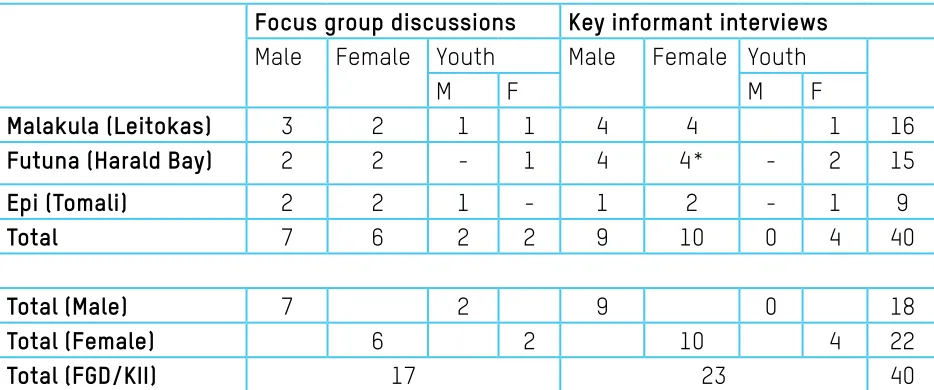
Table 1 provides details of the numbers of interviews and group discussions in each location.
For both KIIs and FGDs, men, women and (when available) youth were interviewed separately,
and sessions were held in places where participants felt comfortable and were afforded
a degree of privacy – in particular, being away from the hearing of others – to support
uninhibited discussion. On each island, SSI participants were identified who had fared well
and less well during and after Tropical Cyclone Pam and/or the on-going El Nino, in order to
explore differing experiences of resilience. An additional FGD (male) was added in Malakula
to follow up on specific questions related to the emerging significance of ‘resourcefulness’.
These additional questions were subsequently integrated into the FGDs or SSIs on Futuna and
Epi where appropriate. The fieldwork on Epi was carried out by the Ni-Vanuatu research team,
led by those team members who had previously worked with report author on the other two
islands.
Some challenges were faced during the data gathering. In Futuna, there was a long process
of negotiation to secure access to KII subjects, working with our local contact to establish
positive and negative stories of resilience in the community. It appeared that there was
reluctance to identify community members who had coped and/or recovered badly during
Tropical Cyclone Pam and its aftermath, perhaps reflecting an underlying desire on the part of
a leading community member to present a positive picture of community resilience. Generally,
there was a mixed response to both FGDs and KIIs, with some groups and individuals willing
to talk expansively, and some displaying considerable reluctance. However, despite these
challenges, the methods revealed a rich picture of experiences of resilience and vulnerability
in each setting.
Focus group discussions Key informant interviews
Male Female Youth Male Female Youth
M F M F
Malakula (Leitokas) 3 2 1 1 4 4 1 16
Futuna (Harald Bay) 2 2 - 1 4 4* - 2 15
Epi (Tomali) 2 2 1 - 1 2 - 1 9
Total 7 6 2 2 9 10 0 4 40
Total (Male) 7 2 9 0 18
Total (Female) 6 2 10 4 22
[image:11.1191.666.1133.436.631.2]Total (FGD/KII) 17 23 40
Table 1: distribution of interviews and focus groups by location and gender.
2 Resilience realities
2.1 Social difference and resilience
This section is concerned with the identifying whether resilience is experienced differently
by those individuals and groups that live within a particular community. In the first report
(Adaptation and Resilience in Vanuatu, November 2015) attention was drawn to how individual
perceptions of risk and vulnerability vary within communities, shaped by differing experiences
of livelihood opportunities and threats. Patterns of vulnerability emerge within communities:
often risks and vulnerability will be unequally distributed, multifaceted, and with drivers that
cut across scales (Dodman and Mitlin, 2011). Furthermore, individuals often differ in their
influence and capacity to create changes to the situations in which they find themselves.
For example, studies highlight how cultural and power relations shape how local risks are
understood, prioritised and managed in adaptation decision making processes (Granderson,
2014, Artur and Hilhorst, 2012; Ayers, 2011; Yates, 2012). Environmental change and social,
cultural and economic factors interact to generate “causal clusters” that act (unevenly) on
communities and their environments (Fook, 2015).
Resilience for whom? Women, particularly widows have a different experience of reslience to others of higher standing in the community. Photo: Arlene Bax/Oxfam
All of this suggests that we need a deep and carefully nuanced understanding of
communities. Communities are in fact characterised by unequal access to knowledge,
resources and decision making (Yates, 2014). Yet the notion of ‘community’ can itself be
a barrier to understanding this context: ‘community’ suggests homogeneity and, perhaps,
a locality characterised by fair decision making. Instead, local decision making frequently
leads to inequitable outcomes. Paradoxically, the real, on-the-ground legitimacy afforded
to inequitable decision making institutions can arise from the maintenance of exclusionary
social relations (Agrawal, 2005). Simply introducing new participatory decision making rules,
via committees or other development-led institutions, overlooks the role played by deep
rooted relationships. As a result, these interventions may, in fact, create new and further
opportunities for exclusion or marginalisation of vulnerable groups.
Delving deeper means not only recognizing the unequal outcomes of different institutional
decision making processes (such as in the home, or in village meetings), but also the “nested
political and social processes that give rise to the production and reproduction” of these
institutions (Cote and Nightingale, 2012: 481).
Development actors must keep in mind that the outcomes of
interventions are socially differentiated, and generated through the
interaction of power, cultural values and institutions – often in ways
that are not readily observable or immediately understandable.
Gendered outcomes of male-dominated village meetings, for example, are the result of
cultural and social relations of power and influence between men and women, played out (i)
over time, (ii) in village meetings, (iii) through village meeting decisions, and (iv) outside of
the arena of the village meeting. The interaction between men and women, men and men, and
women and women at different times and in these different settings ultimately combine to
create unequal outcomes. This, then, is the context that efforts to address inequality must
address.
This understanding of the production and reproduction of risk and vulnerability leads
to questions about the nature and distribution of resilience in communities (Cote and
Nightingale, 2012). How do social differences map onto resilience differences? Does the
2.1.1
Socially differentiated resilience
In Futuna, the headmaster of the school holds a respected position in the community, backed
by a salaried role, his education and his experiences of living on and outside the island. His
social standing was reflected – and consolidated – in the run up to and aftermath of Tropical
Cyclone Pam (TCP). As headmaster, he received notification of TCP from the Department of
Education well in advance of landfall, which he disseminated to parents via the students.
When TCP came closer he received a further update (as did the wider community via the
Community Disaster and Climate Change Committee – CDCCC). At this point his priorities were
to send the children home and organise the preparation of the classrooms, with the twin
aims of providing an emergency shelter and ensuring the protection of the school and its
equipment. His relative affluence within the community is reflected in a new (strong) house
which he had built, and this was the basis for his preparations for his family. He moved his
family, including relations, to his house and told them that they would be safe together.
At the same time, he ensured there was food and water in the house, and beds to shelter
under if the roof were to be destroyed in the cyclone. Subsequently, he also received older
people and widows into his house, as these individuals had been identified by the CDCCC as
particularly vulnerable and/or lacking secure shelter (“those with safer houses feel a sense
of responsibility to look after those who are more vulnerable”). As a back-up to the house, he
and his brothers and nephews also prepared a cave near to the house, which his grandfather
had told him would be safe during a cyclone.
The headmaster’s resilience reflects and relies
on his standing in the community. His access
to information and resources flowed from his
role as a government employee and enabled
him to prepare, while his major asset – a newly built house, securely constructed using
quality materials (brick and strong timbers) – provided him with protection and enabled him to
support others. In the aftermath of TCP he was able to protect himself and his family through
his ability to buy food during the period of scarcity. His situation and standing were further
improved following the influx of resources into the community (for example, he experienced
an increase in visitors from NGOs paying to stay at his house; while the school was able to
access new books and children’s and teacher’s kits from Unicef, provided “for the first time
ever”). His positive attitude – “there are good things coming in [following TCP]; it is a blessing
for the island” – reflects his ability to cope with challenges and thrive during recovery and, as
such, illustrates his resilience.
“there are good things coming in
[following TCP]; it is a blessing
for the island”-School Headmaster
A spectrum of experiences were documented
during the fieldwork. Some contrasted sharply
with that of the headmaster. For example, a
widow with eight children heard about the
cyclone from a neighbour’s radio. She only
found out at the last minute, and does not live
in a strong house, so took bedding, food, water
and firewood into a cave that belongs to her
family. She prepared the cave on her own. After
TCP passed by, she returned to her house but
the kitchen had been badly damaged. While
she was able to raise some income by catering
for development agency staff who came to
assist after the cyclone, she “faced a lot of
hardships”. At the time of interviewing, she was still trying to rebuild her house: “there is no
support in our community for widows… my children can no longer go to school because all
the money that I manage to get [from basket weaving] is for food and soap. All the fruit trees
are down and we have to walk to get water. My family is struggling.” In another case, a man
who occasionally works for the construction company on the island found out about TCP
from family members who contacted him by mobile phone. He and his family sheltered in the
church, but have struggled since then. There are no projects for him to work on with Island
Construction, so he supports his wife’s weaving. However, there is little they can do until the
pandanus grow back following the cyclone. Similarly, he cannot re-thatch his damaged house
until suitable thatching plants grow back. His family received seeds after TCP to help replant
his garden (his crops had been damaged or destroyed), but these have failed to germinate.
The island cabbage he replanted and his taro plants have been destroyed by pests. These
pests represent a new problem, and one that has not been resolved by using the pest control
techniques that they are aware of.
Similar contrasts were found on
Malakula and Epi in relation to water
shortages and the current El Nino. As one male interviewee observed, “some are better off
than others”. In Leitokas, Malakula, for example, one community leader has access to many
ancestral lands, a large extended family and many business interests. This provides him
“some are better off than others”
-Male interviewee“there is no support in our
community for widows… my
children can no longer go to
school because all the money
that I manage to get [from
basket weaving] is for food
and soap. All the fruit trees
are down and we have to walk
to get water. My family is
with relative wealth and influence, and the ability to continue to produce sufficient food
even during times of water stress. Another community leader, this time in Epi, has a house
of sufficient size and strength to shelter 22 people during the cyclone. His kitchen was
destroyed, but has subsequently been rebuilt. Others have very different experiences. A
65 year old female community member in Epi lost her house during the cyclone, and is now
planning to relocate back to the island she grew up in (Tongoa) where her family have a brick
house and she feels she may be safer in future. A female community member in Malakula,
with an abusive husband who frequently abandons the family for days or weeks at a time, is
particularly struggling as they have a 4km walk for water. When her husband is absent she
is unable to access water as it is too far for her to walk with the containers. At the same
time, the family’s income is under threat as the dry weather is destroying coconuts and
cocoa beans before they can be harvested. Another, younger, women in Malakula recognises
that she needs water containers, a radio for early warning and more gardens to provide
food even when some fail. However, she lacks the resources to acquire these assets, and
is now struggling as the El Nino-induced food stress has led to some within the community
stealing from her garden, further reducing her access to food. Thus, in both Malakula and
Epi, the different wealth and social standing maps onto very different outcomes following
the cyclone. While the community leader in Malakula retains access to sufficient food and
regular income, for each of the women interviewed above, increased environmental stress is
exposing underlying vulnerability, indicating lower resilience.
Water containers were noted as an object that could increase a families resilience in the wake of TCPam and the El Nino dry spell. Photo: Arlene Bax/Oxfam
2.1.2
Resilience, institutions and relations of power
The interplay between institutions and social and cultural relations of power was also evident
in the case studies. Violence against women and ostracism of incomer women are examples
of significant expressions of inequality that are embedded in social relations, largely hidden
from view in the ‘private sphere’ of the home. These themes emerged in the first report in this
series, and were further exposed during this study. Women in Malakula in particular reported
domestic violence (in two out of four interviews) and exclusion or marginalisation of incomer
women (one interviewee reporting exclusion, another expressing the need to exclude). It
was made clear to the research team that violence is endemic. One female interviewee
talked about the violence she had suffered and explained that it is simply not discussed in
the community – she had never even told her elder sister who lives with her. As Cote and
Nightingale (2012) identify, social relations can be a limit to adaptation (and thus resilience).
This is the case here, where the influence and decision making power of abused or incomer
women is radically undermined by deep rooted norms of violence and exclusion. However,
the picture is a complicated one. For example, a woman community leader blames incomer
women for undermining institutions that in the past enabled sharing between community
members (“they are bringing their way of living and … changing the generous system”). In
saying this, she further undermines the position of incomer women, while cementing her own
standing and authority within the community (“my husband and I [will] gather the community
together to talk about [this problem]… We must all work together”). Here we see an example
of Agrawal’s (2005) paradox noted above, in which unequal social relations work to secure
the legitimacy of (and thus perpetuate) unequal institutions. In the process, the community
leader secures the power and respect that define her resilience, at the expense of that of
incomer women.
Participatory development actions inevitably work through institutions – either existing, such
as women’s groups or village committees – or new – such as Community Disaster and Climate
Change Committees (CDCCCs). It is imperative that these approaches simultaneously analyse
and address the composition of those institutions, and the underlying social and cultural
relations and norms that (for example) supress and marginalise women. The overarching
point here is that resilience is ‘situated’, deeply embedded in the local context (Cote and
Nightingale, 2012). The aims of resilience in development practice cannot be reduced to
the identification of or support for externally defined characteristics (such as flexibility or
the outcomes of participatory development endeavours at resilience building. With the power
that development practice confers to intervene, comes the responsibility to understand
the ‘social life’ that those interventions are delivered into and will take on in the future.
The relationship between resilience, institutions and social difference is central to this
understanding.
Six months after TCPam many homes remain under temporary repair. Photo: Arlene Bax/Oxfam
2.2 Identifying patterns of
local resilience
This section examines contrasting evidence from the case studies, identifying examples
of resilience (both desirable and undesirable) that can be found in collective actions
and individual practices in communities. While highlighting the inherent strengths of the
communities involved in this study, this section also asks: how can projects distinguish
between and appropriately address the sources of desirable and undesirable community
activities and norms? As Buggy and McNamara (2015) suggest in relation to Vanuatu, the
socio-political context needs to be understood not only to help ensure projects do not
exacerbate existing inequalities, but also to prevent projects from weakening existing
resilience and adaptive capacity.
Case study evidence from the community of Leitokas, Malakula, offers several examples
of resilience strengths and limitations in different forms. All respondents reported access
to water as the main challenged faced in Leitokas. The current water supply system was
established in 1993, drawing water down to the bay from a source in the hills via a system of
pipes attached to a main water tank. The system was funded thanks to money provided by the
president of the provincial government, who at that time was related to community members.
The opportunity of one of his visits was taken to petition him for a water supply system, which
was ultimately built by the government’s Rural Water Supply (RWS) officers five years later.
However, this system required on-going maintenance, which despite repeated efforts by the
community has not been provided by RWS. Over time community numbers have also expanded,
increasing demand on an already stressed system. The result is that pressure is now very
low due to leakage and the high number of junctions in the supply, and each dry season the
available quantity of water reduces dramatically. Community member expressed frustration
as they lack the skills to make effective repairs, and believe that RWS should be responsible
and held to account. The current El Nino has brought this problem into even sharper focus,
with water in the river around which the community is situated – and depends for access to
2.2.1
Resilience characteristics
The community response to these challenges displays many attributes that are associated
with resilience. Monitoring of water levels and availability has led the community water
committee to ration access to a limit of two buckets per household per day, a limit that
appears to be enforced and observed across the community, despite the difficulties that it
generates for households (“Once you have had your share of that amount for the day, you
are not allowed to get more.”) Efforts to maintain the existing system centre on a levy (200Vt
per household per month), supplemented by fundraising efforts such as events where food
is prepared and sold, in order to fund on-going repairs. Community members have invested
in water containers for their households, which they fill by walking to distant water sources.
Individual households have shifted their gardens to damper or shadier areas (near to
stream banks, for example) to compensate for the lack of water for both domestic and food
production uses. The chairman of the water committee reports that he has the responsibility
to ensure water reaches all, and when the supply runs dry he organises well-digging to
provide additional access to water. There have also been experiments with alternative
solutions: an underground well with a spiral pipe system to draw water (which worked for
a month); accessing a digger, which was being used nearby, to provide two new wells (one
rapidly dried, while the other became contaminated with mud); and, using bamboo canes to
pipe alternative water supply sites closer to the village (but still leaving the water access
point at a considerable distance).
These actions demonstrate self-organized community-based monitoring of natural
resources, an acceptance of changing environmental conditions, institutional flexibility and
responsiveness to emerging challenges, collective action, and a willingness to undertake
experiments. In the setting up of the system the community capitalised on their (limited)
cross-scale relationships, drawing on their links to the provincial government. As such, the
community has displayed key resilience characteristics that have been identified within the
society, ecology and social-ecological systems literatures (Bahadur et al. 2013; Ensor et al.
2016), enabling the community to actively respond to the on-going and changing nature of
their water availability and access problems.
Underpinning these responses is further evidence of resilience: a complex pattern of diverse
livelihood and household practices in Leitokas. The community itself is split between three
(or more) locations in order to capitalise on the opportunities available in this remote region
of Malakula: in the village of Les BonBon, where there is a school and access to the river; near
to their gardens and plantations; and in Leitokas, at the coast, to give access to the sea and
associated income generating opportunities. As explained by one respondent: “Most of the
community have houses up there [at Les BonBon] and near the gardens. But they need to be
down here to do business – everything that is sold from their gardens, or comes in from Vila,
goes via this community. We have to keep a presence here in order to protect our control over
the business area.” In Les BonBon, which is almost a day’s walk from Leitokas, the community
has access to a reliable gravity fed water system. Crucially, when asked about the current El
Nino, extreme events and climate change, the respondent replied:
“That’s why we have several homes – so that we can cope with the
changing weather, and move when we need to.”
Another respondent described the local community members as “nomads”: because the land
that they work on covers such a wide area, a family will frequently have more than 2 houses in
the bush. A 37 year old male interviewee described how flexibility and diversity were essential
livelihood strategies. In the recent drought his usual water access points had disappeared
and an entire day could be spent searching for water. In response, he has stopped keeping
cattle, which are highly dependent on water, despite the good potential for cash income.
He now relies on copra, cocoa and peanuts for income. He has moved his gardens closer to
the river, and, having learnt over time which of his other garden plots may dry out, has left
these unplanted. He keeps a second house near the peanut gardens, which he moves into
to allow him to bring in the harvest, as these wetter areas are some distance from his home
village of Leitokas. He has also planted drought tolerant crops this year – wild yams, taro and
navia (a particular drought resistant taro variety) to protect himself against the failure of his
cash crops, and has worked hard to plant a rotation of three crop in previous years when the
conditions were good. In all these strategies, he is relying on knowledge passed down from
his ancestors, and on what he has learnt from his own experiences.
The value of cross-scale relationships, identified above, is also seen in the way the
community has been able to connect into the emergence of national and international
discourses and policies for sustainability and energy independence (for example, see the
Government of Vanuatu’s National Energy Roadmap 2013-2020). These developments have
given rise to a commitment by Unelco, the energy supply company for Efate, Norsup (Malakula)
current levels at around 20% in Efate, to 28% by 2020)1 . Through financial support provided
by the local MP, three Leitokas individuals have started a co-operative to collect copra from
community members’ small plots and sell into the power plant on Efate. A regular contract
provides security to the community members and an outlet for local copra production that is
insulated from the challenges of volatility in global markets (identified as a prominent issue
on other islands in the first report in this series). An appreciation of other geographical scales
was also expressed in several interviewee’s concerns about how logging on the island – at
the landscape scale – could be influencing water availability in the Leitokas community, while
concerns expressed for the future viability of the community and the need to hand down
natural resources to the next generation shows thinking that links the short and long term
consequences of actions.
1 ‘Unelco/Cofely - driving the Vanuatu energy transition’ (2014) www.pecc.org/resources/minerals-a-energy/2161-driving-the-vanuatu-energy-transition/file&usg=AFQjCNGLWrYo0DjW_aYDnTrEj8wUKmTTaw
Communities have planted more drought resistant crops such as wild yams, taro and navia. Photo: Arlene Bax/CARE
2.2.2
Limitations to resilience
All of this evidence combines to offer a positive interpretation of a community that has
evolved practices, norms and institutions that deliver resilience in a difficult environment.
Yet, there are also shortcomings and limitations. Efforts to experiment with and develop
alternative water sources have failed, not least due to a lack of access to knowledge and
resources. The water committee, while instrumental in the key response to shortages
(rationing) is seen by some in the community as ineffective (by women in particular, possibly
as those most reliant on water access in the home to discharge responsibilities for cooking
and washing). Perhaps in part this also explains why the committee cites collecting the
water levy as a central challenge – the committee see this as a failure of the community to
commit to supporting the water supply, while some community members see a need for skills
that have not, to date, been available, and their levy leading to failed projects. Intriguingly,
while there is much evidence of collective action to be found within the tasks that have been
undertaken by the community, a common concern expressed in the focus groups of men and
women was the limited way in which the community help each other: “we need to strengthen
working together – it was strong in the past compared to today”.
Perhaps more worryingly, there is also a profoundly negative interpretation of resilience
to be drawn from the Leitokas evidence. As noted above, the prevalence of gender based
violence is a primary concern. Yet this prevalence itself reflects the degree to which violence
against women has been normalised within communities, and as such represents a highly
resilient practice that has been sustained across generations, between islands, and in the
face on international and national prohibition (e.g. Vanuatu Family Protection Act 2009, which
criminalizes family violence, and the work of organizations such as the Vanuatu Women’s
Centre and Wan Smol Bag whose efforts at awareness raising have significantly raised the
profile of women’s rights). Equally, stories of survival in the face of abuse shared during the
research speak to the extraordinary strength – indeed resilience – of the women. Yet this is
an abhorrent situation, not a desirable outcome.
While some interpretations of resilience hold that a lack of equity is an outcome of “failed
resilience” (Walsh-Dilley et al. 2016), others point out that resilience is a neutral concept
and can equally describe situations which have desirable or undesirable attributes (Bene
et al. 2014). This use of resilience as a descriptive term (‘women are resilient’, ‘violence
resilience practitioners. If resilience is to be prescriptive (we want to ‘build resilience’) we
must recognise that whether or not a situation is desirable will depend on who is being
asked, elevating ‘resilience for whom’ to the central question (Lebel et al. 2006). As noted
in the previous section, however, complexity arises from the difficulty of disentangling ‘for
whom’ resilience is being promoted in any given participatory development setting. These
examples also reinforce the insufficiency of a checklist approach to resilience: the presence
of diversity, flexibility, cross-scale relations, collective action and experiments suggest
many important attributes are present, which may be built upon to secure the long term
sustainability of the community. But on their own they are woefully insufficient to explain the
uneven experiences of vulnerability and risk in Leitokas.
The task, then, for development actors is not only to identify positive resilience attributes
that can be built upon in interventions. It is also to understand whether these attributes are
positive for some and negative (or absent) for others – and whether interventions are likely to
reinforce or address this pattern of winners and losers.
2.3 Intervening in local resilience
This section explores examples of where resilience appears to have diminished or been
supressed through exposure to new influences and, in particular, following experiences of
NGO interventions. While highlighting the significance of NGOs to improving people’s lives,
analysis suggests that development organisations face a complex challenge. How can
projects avoid undermining positive practices and institutions through the provision of new
resources or the displacement of decision making power?
In Futuna, as in Malakula, the most significant issue identified by respondents was access to
water. CARE International have been working in Futuna since 2008 and initially focused on the
water system, providing materials and repairs in interventions that many community members
spontaneously and positively referred to during interviews. However, problems remain with
water access. Focus group participants reported that there are multiple leaks, from the
source to the water tanks, often preventing the tanks – which are themselves too small for
an expanded population – from being filled. During drier periods the available water flows
to the villages further down the hill, reducing access for those higher up. All of this creates
problems for households (in terms of hygiene, cooking and home gardens), and the school
(which is looking to upgrade toilets). The men’s focus group explained that when the system
was first installed (before independence) they sold copra to buy the pipes. Today, they have
no active water committee and the number of taps has multiplied after individuals travelled
to Port Vila and saw “a different way of living” in which water access was much closer to
people’s homes.
At one time, there was a water committee which would undertake repairs. Repairs have now
become the responsibility of a single individual. The research team were told: “He lives close
to the source. Traditional beliefs mean that the only people who can act in this area are
those who live there, so it becomes his job.” Moreover, “The community does not provide any
support to him for the fixing. It’s his responsibility.” However, when the question of a water
committee was raised, it was gradually acknowledged that this might be an advantage. In a
lengthy debate between the focus group members, it was concluded: “we could put together
a water committee; it would allow us to control water – when to allow water to be used within
the community. It’s becoming clear to us [through this conversation] that there would be
benefit to having a committee.” Yet as the conversation progressed, enthusiasm waned: first,
we hadn’t thought about the idea of a water committee.” Worse, people would have no money
to give for repairs as very little income comes from selling fish to Port Vila (the main source
of cash income); moreover, traditional beliefs prevent payments being made: when fees are
charged, the water runs dry. Finally:
“We would like CARE to fix all the problems, from the source to the tanks. The problem will
remain otherwise. CARE should fix it as they’ve been coming often. CARE should finish all the
jobs including water.”
In contrast with Malakula, at no point did focus group or individual interviewees refer to Rural
Water Supply as the appropriate body to facilitate repairs or training. This failure to organise,
take action or imagine potential solutions was in evidence elsewhere in Futuna. For example,
in interviews a number of individuals identified the presence of new pests as a problem, but
no one reported having discussed potential remedies with neighbours. Only during a focus
group discussion, when pressed about how the community could help each other, was the
idea of exchanging experiences of successes and failures in efforts to address the problem
proposed – as something new, that could be tried.
Intervening in local resilience has the potential to create reliance on extrenal forces for such things as water supply maintenance.
Photo: Arlene Bax/Oxfam
2.3.1
Valuing self-reliance
The evidence suggests that NGOs – and CARE International in particular – are held in high
esteem on Futuna. The development and training of the CDCCC by CARE International was seen
as the CARE International’s key intervention. As one respondent observed:
“it [the CDCCC] help us to be better prepared in times of a Cyclone
– who should do what …. I remember in the past we were just
running around like crazy in the last minute when the cyclone is
already here, trying to get things done. And people just walking
around outside wanting to see how the wind is blowing and what
damage is occurring.”
The large majority of respondents referred to the CDCCC in extremely positive terms,
recognising and appreciating the value of organised and informed collective action before,
during and after the Cyclone. Credit for this is given to the work of CARE’s staff in supporting
local self-reliance.
Yet outside of NGO led actions, the community has arrived at a place where their potential for
self-organisation, collective action and problem solving is low. The evidence is suggestive
of dependence on the main implementing NGO having emerged (“CARE should fix it”). This
idea is strengthened by evidence from Epi, where (as in Malakula) there has been limited
exposure to development NGOs. Here, initial individual responses to cyclone Pam gave way
to collective action when immediate priorities had been addressed, while responses to
water stress also show a degree of organisation and initiative. In this case, the community
had had its supply cut off by a nearby village. The community responded by making several
requests to the government, resulting in the provision of hand pumps by the Department of
Geology, Mines and Rural Water Supplies. In focus group discussions, community members
concluded “all we want is to get support – funding or a generator” to enable better water
extraction; the community would provide labour, transport, access to land where there is a
reliable water source, and arrange a maintenance fee to enable on-going management. This
contrast with Futuna should not, however, be overstated. First, the absence of similar data
prior to NGOs starting to work in Futuna means that it is not possible to track a change in
contrasting responses to water scarcity, many in Malakula also suggest that (in common with
respondents in Futuna) there is a tendency to individualism and a lack of collective action,
narrowing the gap between the two communities.
Resilience thinking brings with it a deeply problematic assumption that it is inherently
desirable for communities to be self-reliant. In some interpretations, this justifies the retreat
of the state and the devolution of responsibility to those least able to deliver (Mackinnon
and Derickson, 2013). As noted in the introduction, this emphasis on self-reliance is one
that resonates with many NGO approaches to community-based development, which stop
short of attending to the challenges of transformation in power relations necessary to
overcome structural barriers to adaptation. In Futuna, CARE International’s focus on
self-reliance has yielded an enormously effective response to a disaster, while simultaneously
community capacity to address a wider set of problems has been complicated the NGO’s
visible presence and positive actions. It is not surprising that when communities uncover a
source of resources, knowledge and skills that they value, that they then look to that source
as the obvious solution to their most pressing needs. The issue is whether an NGO is always
the most appropriate body to be meeting those wider needs. Self-reliance needs marrying
with the tools, skills and opportunities for independent organisation and engaging with
institutions and organisations beyond the community, if they are to have sustainable access
to those with the resources and responsibility to support local problem solving.
Resilience thinking has little to offer development practice on how to support communities
to tackle these questions. Can, then, resilience be enhanced by considering alternative
framings that better capture the ambitions of communities to overcome structural
constraints, and shift the focus of programming more directly onto the problem of
transformation? This question is explored in the next section.
3 Beyond resilience
A key challenge for resilience in development programming lies in balancing the opportunities
(to build on existing local practices that support resilience) and the risks (undermining local
resilience and/or generating dependencies on development programs). In this section, it
is argued that striking this balance can be aided by stepping back and looking harder at
the intentions and limitations of resilience in development practice. An alternative framing
– resourcefulness – is explored for its potential to provide insights that contrast with, yet
can complement, those derived from a resilience perspective. The aim is to identify how the
strengths of resilience can be more systematically exploited in practice.
3.1 Is resilience the goal?
In introducing resourcefulness, MacKinnon and Derickson (2013) offer three critiques of
resilience, the first two of which have already been touched on. First, resilience is ‘externally’
defined, for example by checklists of characteristics (flexibility, diversity and so on) that
have been compiled, refined and reproduced by development scholars and practitioners. The
effect of this is that resilience can too easily be treated as a prescription that needs to be
applied to communities, reproducing existing patterns of power and inequality rather than
‘situating’ resilience within the social context. Second, MacKinnon and Derickson suggest
that resilience is principally concerned with particular spaces (“resilient communities”),
encouraging a devolution of “responsibility without power” to self-reliant communities, in
which resilience means taking “knock after knock”, coping with and recovering from shocks
(2013: 255). What this overlooks is that it is frequently actors and institutions at other
scales (national governments, global markets) that have the most profound influence on
opportunities for and limits to the resilience of local people.
The third critique can be read as the culmination of these concerns. For many scholars,
resilience is open to being interpreted and applied in deeply conservative ways, as it has a
built-in bias towards maintaining existing social relations (Hayward 2013; Fainstein 2015).
Desirable but profound changes in power relationships, within communities or between
communities and actors at other scales (such as government or private sector operators),