ISSN 0252-8266
%
eurostat
EUROSTATISTIK
Daten zur Konjunkturanalyse
EUROSTATISTICS
Data for short-term economic analysis
EUROSTATISTIQUES
Données pour l'analyse de la conjoncture
Monatlich D Monthly D Mensuel
10 D 1993
Theme / Thème
m
eurostat
OFICINA ESTADÍSTICA DE LAS COMUNIDADES EUROPEAS
DE EUROPÆISKE FÆLLESSKABERS STATISTISKE KONTOR
STATISTISCHES AMT DER EUROPÄISCHEN GEMEINSCHAFTEN
ΣΤΑΤΙΣΤΙΚΗ ΥΠΗΡΕΣΙΑ ΤΩΝ
ΕΥΡΩΠΑΪΚΩΝ ΚΟΙΝΟΤΗΤΩΝ
STATISTICAL OFFICE OF THE EUROPEAN COMMUNITIES
OFFICE STATISTIQUE DES
COMMUNAUTÉS EUROPÉENNES
ISTITUTO STATISTICO DELLE COMUNITÀ EUROPEE
BUREAU VOOR DE STATISTIEK DER EUROPESE GEMEENSCHAPPEN
SERVIÇO DE ESTATÍSTICA DAS COMUNIDADES EUROPEIAS
L2920 Luxembourg Tél. 43 011 Télex COMEUR LU 3423
B1049 Bruxelles, rue de la Loi 200 Tél. 299 11 11
Las publicaciones de Eurostat están clasificadas por temas y por series. La clasificación se encuentra al final de
la obra. Para mayor información sobre las publicaciones, rogamos se pongan en contacto con Eurostat.
Para los, pedidos, diríjanse a las oficinas de venta cuyas direcciones figuran en la página interior de la
contracubierta.
Eurostats publikationer er klassificeret efter emne og serie. En oversigt herover findes bag i hæftet. Yderligere
oplysninger om publikationerne kan fås ved henvendelse til Eurostat.
Bestilling kan afgives til de salgssteder, der er anført på omslagets side 3.
Die Veröffentlichungen von Eurostat sind nach Themenkreisen und Reihen gegliedert. Die Gliederung ist hinten in
jedem Band aufgeführt. Genauere Auskünfte über die Veröffentlichungen erteilt Eurostat.
Ihre Bestellungen richten Sie bitte an die Verkaufsbüros, deren Anschriften jeweils auf der dritten Umschlagseite
der Veröffentlichungen zu finden sind.
Οι
εκδόσεις της Eurostat ταξινομούνται κατά θέμα και κατά σειρά. Η ακριβής ταξινόμηση αναφέρεται στο
τέλος κάθε έκδοσης. Για λεπτομερέστερες πληροφορίες σχετικά με τις εκδόσεις, μπορείτε να
απευθύ-νεσθε στην Eurostat.
Για τις παραγγελίες μπορείτε να απευθύνεσθε στα γραφεία πώλησης, των οποίων οι διευθύνσεις
αναγράφονται στη σελίδα 3 του εξωφύλλου.
Eurostat's publications are classified according to themes and series. This classification is indicated at the end of
the publication. For more detailed information on publications, contact Eurostat.
Orders are obtainable from the sales offices mentioned on the inside back cover.
Les publications d'Eurostat sont
classées par thème et par série. Cette classification est précisée à la fin
de l'ouvrage. Pour des informations plus détaillées sur les publications, contactez Eurostat.
Pour les commandes, adressez-vous aux bureaux de vente dont les adresses sont indiquées à la page 3
de la couverture.
Le pubblicazioni dell'Eurostat sono classificate per tema e per serie. Tale classificazione è precisata alla fine
dell'opera. Per informazioni più dettagliate sulle pubblicazioni rivolgersi all'Eurostat.
Per eventuali ordinazioni rivolgersi a uno degli uffici di vendita i cui indirizzi figurano nella 3
apagina della
copertina.
De publikaties van Eurostat zijn ingedeeld naar onderwerp en serie. Deze indeling is achter in het boek
opgenomen. Voor nadere informatie over de publikaties kunt u sich wenden tot Eurostat.
Gelieve bestellingen op te geven bij de verkoopbureaus, waarvan de adressen op bladzijde 3 van de omslag zijn
vermeld.
As publicações do Eurostat estão classificadas por tema e por série. Esta classificação está indicada no firn da
obra. Para mais informações sobre as publicações é favor contactar Eurostat.
EUROSTATISTIK
Daten zur Konjunkturanalyse
EUROSTATISTICS
Data for short-term economic analysis
EUROSTATISTIQUES
Données pour l'analyse de la conjoncture
Luxembourg: Office des publications officielles des Communautés européennes, 1993
© EGKS-EWG-EAG, Brüssel — Luxemburg, 1993
Nachdruck — ausgenommen zu kommerziellen Zwecken — mit Quellenangabe gestattet.
© ECSC-EEC-EAEC, Brussels — Luxembourg, 1993
Reproduction is authorized, except for commercial purposes, provided the source is acknowledged.
© CECA-CEE-CEEA, Bruxelles — Luxembourg, 1993
Reproduction autorisée, sauf à des fins commerciales, moyennant mention de la source.
Vorwort
Mit der monatlich erscheinenden Veröffentlichung
Eurostatistik - Daten zur
Konjunkturanalyse
werden innerhalb kürzester Frist die neuesten statistischen Daten
über die Europäische Gemeinschaft als Ganzes (EUR 12), über jedes Mitgliedsland
sowie über die Vereinigten Staaten und Japan bekanntgegeben.
Eurostatistik
enthält nicht die Gesamtheit des bei Eurostat verfügbaren statistischen
Materials, sondern eine Auswahl der relevantesten Reihen über die konjunkturelle
Entwicklung.
Schnelligkeit und Pünktlichkeit sind die wichtigsten Vorzüge dieser Veröffentlichung.
Aus diesem Grunde wurde sie im Umfang bewußt klein gehalten und enthält keine
Anmerkungen zur Methodik, die im übrigen in den spezialisierten Veröffentlichungen
von Eurostat zu finden sind.
Die in
Eurostatistik
veröffentlichten Daten stammen aus dem ICG -Bereich der
On-line-Datenbank Cronos von Eurostat.
Wer Zugang zu Cronos besitzt, kann jederzeit die Tabellen dieser Veröffentlichung
abfragen, wobei die Daten täglich auf den neuesten Stand gebracht werden (Hinweise
zur On-line -Benutzung finden sich auf der letzten Seite). Darüber hinaus sind die
Daten in der Datenbank Eurocron verfügbar, die vom Host Eurobases der
Kommission angeboten wird.
Weitere Informationen über
Eurostatistik
können bei folgender Stelle angefordert
werden:
Eurostat - Informationsbüro Data Shop
L-2920 LUXEMBURG 121, rue Joseph II
Telephon: (352) 4301 34567 Büro 3/235
Telefax: (352) 43 64 04 B-1049 Bruxelles
Inhaltsverzeichnis
Zeichen und Abkürzungen
KURZ NOTIERT
5
KONJUNKTURDATEN
1. Volkswirtschaftliche Gesamtrechnungen . .35
2. Beschäftigung
39
3. Arbeitslosigkeit
44
4. Industrielle Produktion
49
5. Meinungsumfrage in der Industrie
59
6. Industrieerzeugnisse
65
7. Einzelhandel
70
8. Landwirtschaftliche Erzeugnisse
72
9. Außenhandel
75
10. Verbraucherpreise
106
11. Landwirtschaftliche Erzeugerpreise . . . .
111
12. Löhne und Gehälter
113
13. Finanzstatistiken
114
14. Zahlungsbilanz
121
Anmerkung betreffend Grafiken und Tabellen:
O Die Daten beziehen sich auf das Gebiet der
Bundesrepublik Deutschland vor dem
3.10.1990 einschließlich WestBerlin.
%
ΤΓΓ-1 %
T/T4%
T/T12%
BALANCE%
1985=100
EUR12=100
1000
MIO
MRD
Τ
TJ(GCV)
GWH
USD
ECU
SZR
ESVG
NACE
SITC
EUR
UEBL
ACP
Weniger als die Hälfte der verwendeten
Einheit
Prozent
Prozentualer Zuwachs eines
Vierteljahres gegenüber dem vorher
gehenden Vergleichszeitraum
(Monat, Vierteljahr.Jahr)
Prozentualer Zuwachs eines
Vierteljahres gegenüber dem
entsprechenden Vierteljahr des
Vorjahres
Prozentualer Zuwachs eines Monats
gegenüber dem entsprechenden Monat
des Vorjahres
Saldo zwischen den positiven
Antworten (Zunahme,Verbesserung der
Situation)und den negativen Antworten
(Abnahme,Verschlechterung der
Situation)der Konjunkturumfrage bei
den Unternehmern in der Gemeinschaft
Basisjahr
Gemeinschaft der 10 oder 12 (=100)
in 1000
Million
Milliarde
Metrische Tonne
Terajoule = 109KJ
Gigawattstunde = 106kWh
USDollar
Europäische Währungseinheit
Sonderziehungsrechte
Europäisches System
Volkwirtschaftlicher Gesamtrechnungen
Allgemeine Systematik der
Wirtschaftszweige in den Europäischen
Gemeinschaften
Standard International Trade
Classification
Mitgliedstaaten insgesamt
BelgischLuxemburgische
Wirt schaftsunion
KURZ NOTIERT
Soweit nicht anders angegeben, beziehen sich die Angaben auf den Gebietsstand der Bundesrepublik Deutschland vor dem 03.10.1990; sie schließen Berlin (West) ein.
WECHSELKURSE: Beruhigung an den Devisenmärkten
In der Zeit nach der Einführung der erweiterten Bandbreiten Ende Juli gab es relativ wenig Bewegung im Verhältnis der europäischen Währungen zueinander. Der durchschnittliche Wertverlust der früher den sogenannten .harten Kern" bildenden Währungen (französischer und belgischer/luxemburgischer Franc, dänische Krone und holländischer Gulden) gegenü-ber der D-Mark belief sich von Ende Juli bis zum 24. Septemgegenü-ber auf rund 2,3 %. Dabei ist jedoch der holländische Gulden nicht berücksichtigt, der während dieses Zeitraums gegenüber der D-Mark so gut wie unverändert blieb.
Der relativ geringe Kursrückgang ist dadurch zu erklären, daß die EG-Mitgliedstaaten ihre Zinssätze nicht so rasch zurücknahmen, wie dies von den Finanzmärkten erwartet worden war. Die belgische Zentralbank erhöhte sogar Mitte August und ein weiteres Mal Anfang September ihre kurzfristigen Zinssätze, um den Franc vor weiteren Kursverlusten zu schützen; der von der belgischen Nationalbank für Ausleihungen oberhalb des Plafonds erhobene Zinssatz wurde während der Wechselkursspannungen Ende Juli auf 13 % und danach am 2. September nochmals auf 14 % angehoben.
Die am 6. September 1993 bekanntgegebene Entscheidung der Bundesbank, sowohl den Diskontsatz als auch den Lombardsatz um 0 % auf 6,25 % bzw. 7,25 % zu senken, machte den Weg frei für eine wettere Zinssenkungsrunde in anderen europäischen Ländern: In den darauffolgenden Tagen wurden In Belgien, Frankreich, Italien, Dänemark, den Niederlanden und Österreich die Zinssätze zurückgenommen. In Belgien und In Dänemark ist das Zinssatzniveau trotzdem noch immer höher als vor der Erweiterung der EWS-Band-breiten, und in Frankreich ist der Zinssatz der Banque de France für Wertpapierpensions-geschäfte im Wege des Tenderverfahrens, der die Untergrenze für die Geldmarktsätze angibt, seit dem 2. Juli unverändert geblieben.
Ein Grund für die Ruhe an den europäischen Devisenmärkten war die vom US-Dollar in der letzten Zelt nach den politischen Umwälzungen In Rußland an den Tag gelegte Stärke: Der Dollar wird weiterhin als .Fluchtwährung" in Zeiten der Unsicherheit betrachtet. Nachdem er im August und in den ersten beiden Septemberwochen gegenüber der D-Mark beständig an Wert verloren hatte, legte er zwischen dem 15. und dem 24. September nahezu 6 Pfennig (rund 4 %) zu. Als sich abzeichnete, daß die russischen Probleme im internatio-nalen Kontext weniger schwerwiegend waren als zunächst angenommen, gab der Dollar erneut nach, wobei Ängste angesichts der Schwäche der US-Wirtschaft und die Möglichkeit eines weiteren Nachgebens der US-Zinssätze diese Negativentwicklung beeinflußten. Gegenüber dem Yen jedoch konnte der Dollar seine Wertsteigerung, die nach der massiven Intervention der amerikanischen Notenbank Mitte August eingetreten war, erhalten. Am 29. September stand der Yen gegenüber dem Dollar bei knapp über 105 und somit In einiger Entfernung von der Marke von 100 Yen für 1 Dollar, die an einem bestimmten Punkt bedroht gewesen war. Dies kann als Beispiel einer erfolgreichen Devisenmarktintervention angesehen werden, im Gegensatz zu zahlreichen Gelegenheiten, wenn derartige Interven-tionen aufgrund des enormen Umfangs der Weltdevisenmärkte im Vergleich zu den »begrenzten verfügbaren Ressourcen der Zentralbanken fehlschlagen.
Der ungarische Forint, der an einen aus gleichen Teilen aus Ecu und US-Dollar zusammen-gesetzten Währungskorb geknüpft ist, wurde, nachdem er bereits am 8. Juli um 3 % abgewertet worden war, am 29. September erneut um 4,5 % abgewertet. Der Forint Hegt nun um rund 15 % unter seinem Vorjahreswert. Die ungarische Zentralbank hat ihren wichtigsten Zinssatz in der vergangenen Woche bereits um 3 % erhöht, er beträgt nunmehr 22 %.
RENDITEN VON STAATSANLEIHEN: In allen Ländern rückläufige oder
gleichblei-bende Renditen
Die Renditen von Staatsanleihen waren in allen hier betrachteten Ländern, aus denen Daten für den August vorliegen, entweder rückläufig oder unverändert. Die stärksten Rückgänge waren in Spanien (um 0,8 %) und Im Vereinigten Königreich (um 0,6 %) zu verzeichnen. In sechs der elf EG-Länder, für die Daten über die Renditen von Staatsanleihen verfügbar sind, liegen die Renditen derzeit unter 7 %.
Die Renditenrückgänge waren in den ersten acht Monaten des Jahres 1993 recht dramatisch: Im EG-Durchschnitt ist die Rendite von Staatsanleihen von 9,2 % im Dezember 1992 auf 7,2 % im August 1993 gesunken. In absoluten Werten gingen die Renditen erwartungsgemäß am stärksten in denjenigen Ländern zurück, in denen sie am höchsten gewesen waren, nämlich in Italien und Spanien.
In zahlreichen Ländern liegen die Renditen von Staatsanleihen gegenwärtig auf oder nahe bei einem historischen Tiefststand.
Der jüngste Rückgang der amerikanischen Renditen von Staatsanleihen, die in den ersten acht Monaten des Jahres 1993 um 1,1 % nachgegeben haben, setzte sich auch Anfang September fort, als die US-Schatzanweisung mit 30jähriger Laufzeit, die als Referenzwert für US-Renditen von Staatsanleihen gilt, erstmals seh dem 16jährigen Bestehen dieser Obligation mit Renditen knapp unter 6 % gehandelt wurde. Der rückläufigen Entwicklung der US-Renditen von Staatsanleihen ging ein schwaches Wirtschaftswachstum und Infol-gedessen eine Korrektur der Inflationsprognosen nach unten voraus.
GELDVOLUMEN: M3-Zuwachsrate in Frankreich unterhalb des Zielkorridors Die Zuwachsrate von M3 In Frankreich betrug im Juni, auf Jahresbasis umgerechnet, 3,3 % und blieb somit etwas unter dem für 1993 angestrebten Zielkorridor von 4 %-6,5 %. Die Tatsache, daß nunmehr bereits im dritten aufeinanderfolgenden Monat eine Verlangsamung des Geldmengenwachstums festzustellen ist, kann als Hinweis auf die wirtschaftliche Depression in Frankreich angesehen werden. Die Zielvorgabe für das Geldmengenwachstum war allerdings zu einem Zeitpunkt gesetzt worden, als die Voraus-schätzungen für das französische Wirtschaftswachstum noch besser waren als die derzeitigen Prognosen.
Auch in Portugal und in Griechenland ist das Geldmengenwachstum weiterhin langsam. In Portugal hat sich L- in den letzten drei Monaten, auf das Jahr umgerechnet, um weniger als 10 % erhöht, und in Griechenland liegt die Zuwachsrate von M3 noch immer erheblich unter den angestrebten 9 %-12 %: Im Juli betrug sie, auf Jahresbasis umgerechnet, nur knapp 4 %.
In den Niederlanden und in Italien hingegen hat sich das Geldmengenwachstum in den vergangenen Monaten beschleunigt, In Italien näherte sich die M2-Zuwachsrate sogar der Obergrenze Ihres Zielkorridors von 5 %-7 %.
Außerhalb der EG verzeichnete Japan in acht der neun Monate bis Mai 1993 negative Zuwachsraten für M2; in den Vereinigten Staaten verläuft das M2-Wachstum zwar weiterhin langsam, lag jedoch im Mal erstmals seit Januar dieses Jahres oberhalb 1 %.
AMTLICHE WÄHRUNGSRESERVEN: Anstieg der Währungsreserven
In allen hier betrachteten Ländern, aus denen Daten für Juli vorliegen, war in diesem Monat ein Anstieg der Währungsreserven zu verzeichnen. Am höchsten war die Zunahme in Dänemark, das sich durch die Begebung mehrerer Euroanleihen Devisen verschaffte. Auch in Griechenland, Irland und den Niederlanden waren Anstiege der Währungsreserven zu beobachten.
Diese Zunahme der Reserven mag überraschen in Anbetracht der Tatsache, daß während des Betrachtungszeitraums die Währungen mehrerer Länder an den Devisenmärkten erheblich unter Druck standen. Im Falle Dänemarks wurden die dadurch verursachten Reservenabflüsse jedoch durch die Zuflüsse infolge der Emissionen von Euroanleihen mehr als aufgewogen. Aus Frankreich liegen zwar noch keine aktuellen Daten für Juli vor, den vorläufigen Daten ist jedoch zu entnehmen, daß die Nettoreserveposition Frankreichs Ende Juli negativ war, nachdem die Banque de France interveniert hatte, um den Abfluß französischer Francs einzudämmen.
VIERTELJÄHRLICHE GESAMTRECHNUNGEN: Im ersten Quartal 1993:
Rückläu-figes Wirtschaftswachstum (BIP - 0 , 9
%),
Wiederanstieg der Inflation
( + 0,8
%).
Im ersten Quartal 1993 war für die Wirtschaft in der Gemeinschaft insgesamt ein weiterer Wachstumsrückgang zu verzeichnen (BIP - 0 , 9 %). Dieses Ergebnis, das weitgehend mit den makroökonomischen Vorausschätzungen für das Jahr 1993 übereinstimmt, läßt vermuten, daß sich die wirtschaftliche Lage im Laufe des Jahres noch ungünstiger als 1992 entwickeln wird. Den meisten Wirtschaftswissenschaftlern zufolge sind nur schwer Anzeichen für eine kurzfristige Erholung der Wirtschaft in der Gemeinschaft festzustellen. Dagegen läßt die amerikanische Wirtschaft gewisse - zwar relativ schwache und zuweilen widersprüchliche - Anzeichen für einen Aufschwung erkennen. Völlig offen bleibt jedoch zur Zeit die Frage, inwieweit die Volkswirtschaften der Gemeinschaft angesichts ihrer internen Probleme von diesem neuen Aufwärtstrend in den Vereinigten Staaten profitieren können. Auf der letzten Konferenz der G-7 wurde betont, daß der Aufschwung der Weltwirtschaft von drei Hauptfaktoren abhängt: dem Wiederaufschwung des Außenhandels, der eng verbunden ¡st mit der positiven Entwicklung der GATT-Verhandlungen; der Wiederbelebung der Inlandsnachfrage, vor allen nach Gütern des letzten Verbrauchs; dem Abbau der staatlichen Defizite in allen Ländern. Für die Gemeinschaft ist außerdem ein Abbau der monetären Spannungen zu nennen, die sich auf die Stabilität des monetären Systems sehr ungünstig ausgewirkt haben. Im ersten Quartal des laufenden Jahres sind die Zinssätze dank der nachlassenden Spannung auf dem Devisenmarkt und des geringeren Inflationsdrucks langsam gesenkt worden, was vor allem dem Zweck diente, die Inlands-nachfrage zu fördern.
Was die anhand des impliziten BIP-Deflators gemessene Preisentwicklung betrifft, so ist ein leichtes Wiederanziehen der vierteljährlichen Inflationsrate (+0,8 %) festzustellen, wäh-rend die jährliche Rate weiterhin rückläufig ist ( + 3,0 %). Diese günstige Preisentwicklung ist zweifellos durch die schwache Inlandsnachfrage beeinflußt worden, die selbst in den Ländern, in denen Abwertungen vorgenommen wurden, dazu geführt hat, daß die Inflationsrate weiter gesunken ist.
Bei den Bestandteilen des BIP muß auf den vierten aufeinanderfolgenden und bisher stärksten Rückgang der Investitionstätigkeit ( - 2 , 4 %) hingewiesen werden. Die Entwick-lung des privaten ebenso wie des öffentlichen Verbrauchs ist ebenfalls negativ ( - 0 , 8 % bzw. 0,6 %).
Was die Situation in den einzelnen Mitgliedstaaten angeht, ist eine Verschärfung der negativen Phase in den Niederlanden (BIP - 0 , 5 %), in Frankreich (BIP - 0 , 7 %), in Dänemark (BIP - 1 , 6 %) und vor allem in Deutschland (BIP - 2 , 3 %) zu beobachten. In Italien scneint sich die Rezessionstendenz, die in den letzten drei Quartalen festzustellen war, zu verlangsamen (BIP - 0 , 1 %). Nur in einem Land, im Vereinigten Königreich, ist eine positive Entwicklung mit mäßiger Steigerungsrate zu verzeichnen (BIP +0,4 %). Was die Inflation betrifft, wird ein deutlicher Rückgang aus Italien (+0,7 %) und vor allem aus Deutschland (+0,2 %) gemeldet. Dagegen hat sich In Frankreich der Inflationsdruck verschärft ( + 1,1 % ) , ebenso wie im Vereinigten Königreich und in Dänemark ( + 1,2 % bzw. +1,3 %), vor allem, wenn man berücksichtigt, daß in diesen beiden Staaten im vierten Quartal 1992 eine relativ starke Deflation zu beobachten war. Für Frankreich und die Niederlande weisen die vorläufigen Daten für das zweite Quartal 1993 auf eine Stagnation der Produktion hin (BIP - 0 , 0 % bzw. + 0,0 %).
Für die Vereinigten Staaten liegen bereits die Zahlen für das zweite Quartal 1993 vor; Dort ist ein leichter Anstieg des Wirtschaftswachstums (BIP +0,4 %) bei einem gleichzeitigen leichten Rückgang der vierteljährlichen wie jährlichen Inflationsrate (+0,6 % bzw. + 2,5 %) zu beobachten. Bei den Komponenten des BIP ¡st die anhaltende positive Entwicklung der Investitionstätigkeit ( + 1,7%) sowie der Wiederanstieg des privaten Verbrauchs ( + 0,9 %) zu nennen.
In Japan deuten die Zahlen für das zweite Quartal 1993 auf ein Anhalten der Phase der Unsicherheit hin: Die Produktion ist erneut zurückgegangen (BIP - 0 , 5 %) und die vierteljährliche Inflationsrate ist erheblich gestiegen, wohingegen die jährliche Inflationsrate rückläufig ¡st ( + 0 , 7 %). Bei den Komponenten des BIP ¡st ein Rückgang des privaten Verbrauchs ( - 0 , 6 %) und der Investitionstätigkeit ( - 0 , 3 %) festzustellen.
PREISE : Die Jahresinflationsrate der EG unverändert bei 3,5 % im August
Die Jahresinflationsrate der EG insgesamt gemessen mit dem Verbraucherpreisindex für EUR-12 blieb unverändert bei 3,5 % von Juni auf August. Vor Jahresfrist lag diese Zahl bei 4,0 %.
Die Zahl für den Monat August zeigt erneut die Stabilität der Inflationsrate für die EG insgesamt; z.B. zwischen November 1992 und August 1993 blieb diese Rate Immer zwischen 3,7 % und 3,4 %.
Zur Zeit liegen die jährlichen Inflationsraten in 4 der 12 EG-Länder über denen des Vorjahres: Belgien (3,2 % gegenüber 2,1 % ) , Deutschland (4,2 % gegenüber 3,5 %), Frankreich (2,2 % gegenüber 2,0 %) und Luxemburg (3,7 % gegenüber 3,1 %), während sie in den übrigen Mltglledstaaten unter dem Niveau des Vorjahres liegen und zwar in einigen dieser Länder bedeutend unter diesem Niveau. Niederlande ( 1 , 9 % gegenüber 3,6 %), Vereinigtes Königreich (1,7 % gegenüber 3,6 %) und Portugal (5,6 % gegenüber 9,3 %).
(0,1 %), Dänemark (0,2 %) und Luxemburg (0,3 %), ebenso in Belgien, Griechenland, In den Niederlanden, im Vereinigten Königreich und in Portugal (0,4 % ) , nur Spanien verzeichnete eine stärkere Preissteigerung im Augusut (0,6 %).
Der Vierteljahresindex Irlands für Mitte August lag bei Redaktionsschluß noch nicht vor und wird deshalb erst in der nächsten Ausgabe dieses Bulletins erscheinen.
In ansteigender Reihenfolge nach der derzeitigen Inflation sind die Inflationsraten und die entsprechenden Zahlen des Vorjahres für die einzelnen Mitgliedstaaten wie folgt:
Irland** Dänemark Ver.Königreich Niederlande Frankreich Belgien
AUG. '93 AUG. '92 0,9 % 1,2 % 1,7% 1,9% 2,2 %P 3,2 %
AUG AUG
3,6 % 2,1 % 3,6 % 3,6 % 2.0 % 2.1 % 92
Luxemburg Deutschland* Spanien Italien Portugal Griechenland
AUG. '93 AUG. '92 3,7 % 4,2 % 4,6 % 4,9 % P
5,6 % 14,6 %
AUG. '92 AUG. '91 3,1 % 3,5 % 5,7 % 5,1 % 9,3 % 15,3 % * Der Verbraucherpreisindex der Bundesrepublik Deutschland bezieht sich weiterhin auf den Gebietsstand
vordem 3. Oktober 1990 ** Mai 1993/Mai 1992 ρ = vorläufig
Die entsprechenden Daten für die Beitrittskandidatenebenfalls in aufsteigender Reihenfolge sind wie folgt: Finnland 2,1 % (2,3 %), Norwegen 2,2 % (2,0 %), Österreich 3 4 % (3,8 %) und Schweden 5,2 % (2,0 % ) .
Die Jahresinflationsraten für die Vereinigten Staaten und Japan lagen im Auqust bei 2 8 % (3,1 %) bzw. 2,1 % ( 1 , 7 % ) .
INDUSTRIEPRODUKTION: Erholung noch nicht in Sicht
Im Industriesektor Europas fällt die Produktion weiterhin, eine Stabilisierung ¡st nicht in Sicht. Besonders die Investitionsgüterproduktion, die eigentlich der Motor des nächsten Aufschwungs sein sollte, sinkt spürbar.
Für die Europäische Gemeinschaft (EUR12) betrug die Veränderungsrate des arbeitstäglich bereinigten Produktionsindex gegenüber dem Wert des gleichen Monats ein Jahr zuvor Im Juni 1993 4 , 1 %, im Mai waren es 4 , 2 %. Für Westdeutschland betragen die entsprechenden Veränderungsraten 8 , 0 % (Juni) bzw. 9 , 4 % (Mai).
Betrachtet man die letzten drei verfügbaren Monate April bis Juni 1993, so beläuft sich für EUR12 die Veränderungsrate des saisonbereinigten Produktionsindex gegenüber den drei davor liegenden Monaten Januar bis März auf 0 , 7 %.
Für die grossen Güterkategorien ergibt sich folgendes Bild (Änderung der letzten drei Monate gegenüber den drei Vormonaten):
Grundstoffindustrie: EUR 12 1 , 3 % , USA + 0 6 % Investitionsgüterindustrie: EUR 12 1 , 6 % , USA + 1 1 % Konsumgüterindustrie: EUR 12 0 , 6 %, USA 0 , 4 %.
Im Baubegewerbe (NACE 5) der Europäischen Gemeinschaft könnte eine leichte Erholung einsetzen: während Im ersten Quartal 1993 noch eine Veränderungsrate von 2 % gegenüber dem letzten Quartal des Vorjahres zu verzeichnen war, beträgt die (geschätzte) Veränderungsrate im zweiten Quartal gegenüber Januar bis März +0,5 %.
Für die einzelnen Mitgliedstaaten der EG ergibt sich für die saisonbereinigte Industriepro duktion folgende Veränderungsraten der letzten drei Monate gegenüber den Vormonaten: Griechenland +3,1 %, Luxemburg +2,1 % [geschätzt], Belgien + 1 , 4 % [geschätzt], Irland +1,3 % [geschätzt], Vereinigtes Königreich +0,8 %, Italien 0 , 5 %, Deutschland (West) 0 , 9 % , Spanien 0 , 9 % [geschätzt], Frankreich 1 , 1 % , Niederlande 1 , 2 %, Portugal 2 , 2 % [geschätzt], Dänemark 3 , 0 %. Demnach sank auch in den Sommermonaten in vielen Mitgliedstaaten die Produktion oder sie stagnierte bei geringen positiven Anderungsraten. Von den grossen EG Mitgliedsstaaten zeigt nur das Vereinigte Königreich Zeichen eines tragenden Aufschwungs.
In den einzelnen Wirtschaftszweigen der EGIndustrie sank die Produktion in der Herstel lung von Metallwaren (NACE 31), der Nahrungsmittelindustrie (NACE 41/42), der Textilindustrie (NACE 43) und der Schuh und Bekleidungsindustrie (NACE 45). Eine leichte Erholung ist zu verzeichnen in der Erzeugung von Metallen (NACE 22), der Industrie Steine Erden (NACE 24) und der chemischen Industrie (NACE 25). Auch die Automobilindustrie (NACE 35) zeigt zumindest keine sinkende Produktion mehr.
Luxemburg, den 14.9.1993
ZAHLUNGSBILANZ Gesamttendenzen vorläufige Zahlen für das erste Quartal 1993:
Bedingt durch die Einführung von INTRASTAT, dem neuen System für die Erhebung von Daten über den innergemeinschaftlichen Handel, ¡st es zu erheblichen Verzögerungen bei der Datensammlung gekommen. Infolgedessen konnten die Zahlungsbilanzdaten für das erste Quartal 1993 nicht aktualisiert werden.
Die Angaben stimmen daher bis auf einige von den Mitgliedstaaten selbst vorgenommene Änderungen mit den in der vorhergehenden Nummer veröffentlichten Zahlen überein. Bis heute (29. September 1993) liegen uns die Zahlen für die Vereinigten Staaten, Japan, Dänemark, Deutschland, das Vereingte Königreich und teilweise für die Niederlande und Griechenland vor, die zur Information veröffentlicht werden. Schätzungen für die gesamte Gemeinschaft für das erste Quartal 1993 sind jedoch nicht möglich.
AUSSENHANDEL: Ergebnisse für März 1993
Im ersten Quartal 1993 belief sich das Außenhandelsdefizit der Gemeinschaft auf 12,6 Mrd. ECU, das entspricht einer Verbesserung um 7,3 Mrd. ECU gegenüber dem entsprechenden Vorjahreszeitraum. Die außergemeinschaftüchen Einfuhren gingen um 4.8 % zurück, während die Ausfuhren nur wenig stiegen (1,3 % ) . Die Differenz der Entwicklungsraten von Ausfuhren und Einfuhren stieg von 2 Prozentpunkten im ersten Quartal 1992 auf 6 Prozentpunkte im selben Zeltraum des Jahres 1993.
Das Handelsbilanzdefizit der USA belief sich im ersten Quartal 1993 auf 22,1 Mrd. ECU, entsprechend einer Verschlechterung um 8 Mrd. ECU gegenüber dem selben Zeitraum des Vorjahres. Die Einfuhren der USA stiegen in Ecu um 16,4 % und in Dollar um 10 %. Die Ausfuhren der USA sind weniger stark gestiegen: um 8,5 % in Ecu und um 2,4 % in Dollar.
Der Handelsbilanzüberschuß Japans erreichte Im ersten Quartal 1993 fast 25 Mrd. ECU, gegenüber 20 Mrd. ECU im ersten Quartal 1992. Die Ausfuhren Japans stiegen um 10,4 % in Ecu und um 4 % in Dollar, stagnierten aber in Yen. Die Einfuhren Japans stiegen Im ersten Quartal 1993 um 5,7 % gegenüber dem entsprechenden Zeitraum des Vorjahres; sie stagnierten in Dollar und gingen in Yen um 3,4 % zurück.
Foreword
Eurostatistics - data for short-term economic analysis
is a monthly publication aimed
at providing, as rapidly as possible, the latest statistical data on the European
Community as a whole (EUR 12), each Member State, the United States and Japan.
Eurostatistics
does not present all the statistics held by Eurostat, but a selection of the
most relevant series on the economic situation.
Speed of publication and punctuality are the main features of this publication; that is
why it is deliberately streamlined and does not contain any methodological notes,
which are given in Eurostat's specialized publications.
The data published in
Eurostatistics
are taken from the ICG domain of Eurostat's
on-line database, Cronos (the notes regarding on-on-line consultation may be found at the
end of this publication). They are also available via the Commission host Eurobases in
the Eurocron database.
Further information on
Eurostatistics
can be obtained from the following addresses:
Eurostat - Information Office Data Shop
L-2920 Luxembourg 121, Rue Joseph II
Tel.: (352) 4301 -34567 Office 3/235
Fax: (352) 43 64 04 B-1049 Bruxelles
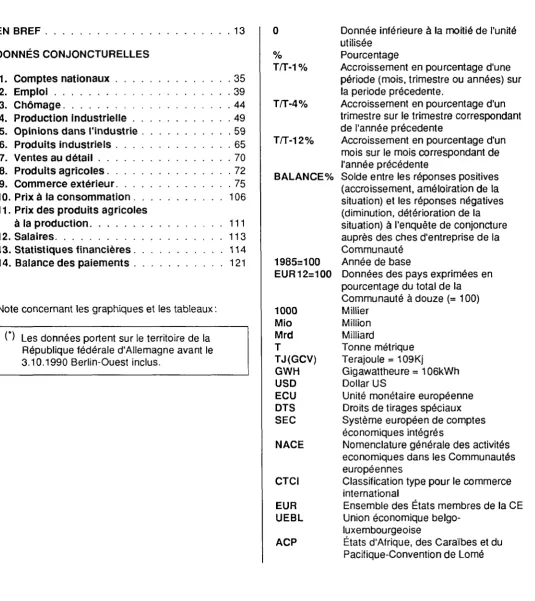
Contents
Symbols and abbreviations
IH
IN BRIEF
9
SHORT-TERM TRENDS
1. National accounts
35
2. Employment
39
3. Umeployment
44
4. Industrial production
49
5. Opinions in industry
59
6. Industrial products
65
7. Retail sales
70
8. Agricultural products
72
9. External trade
75
10. Consumer prices
106
11. Producer prices of agricultural products. .111
12. Wagesand salaries
113
13. Financial statistics
114
14. Balance of payments
121
Note concerning graphs and tables:
O Data for the Federal Republic of Germany,
including West-Berlin, as constituted prior to
3 October 1990.
0
%
T/T-1 %
T/T-4%
T/T-12%
BALANCE%
1985=100
EUR12=100
1000
MIO
MRD
Τ
TJ(GCV)
GWH
USD
ECU
ESA
SDR
NACE
S ITC
EUR
UEBL
ACP
Data less than the unit used
Per cent
Percentage increase of one period
(month, quarter, year) on the
corresponding previous period
Percentage increase on the
corresponding quarter of the previous
year
Percentage increase on the
corresponding month of the previous
year
Balance between positive replies
(increase, improvement in the situation)
and negative replies (reduction,
worsening of the situation) in the
short-term-trends enquiry conducted among
heads of enterprises in the Community
Reference year
Data for countries expressed as a
percentage of the Community of 12
(=100)
Thousand
Million
Thousand million
Tonne
Terajoule=109kj
Gigawatt hour (= l06kWh)
US dollar
European currency unit
European system of integrated
economic accounts
Special drawing right
General industrial classification of
economic activities within the European
Communities
Standard international trade
classification
IN BRIEF
Unless otherwise stated, data for the Federal Republic of Germany, including West Berlin, as constituted prior to 3 October 1990.
EXCHANGE RATES: calmer period In foreign exchange markets
There was a relatively small amount of movement in European currencies visàvis one another in the period after the introduction of wide currency bands at the end of July: the average depreciation against the Deutschemark of the former socalled 'hard core' currencies (French and Belgian/Luxembourg francs, Danish krone and Dutch guilder) was around 2.3% between the end of July and September 24. However, this figure excludes the Dutch guilder which was more or less unchanged against the mark in this period. This relatively small depreciation can be explained by the fact that EC Member States did not reduce interest rates as quickly as had been expected by the financial markets. The Belgian central bank even increased its shortterm interest rates in midAugust and again in early September in order to protect the franc from further depreciation; the rate charged by the National Bank of Belgium on banks' advances above ceiling was increased to 13% during the period of exchange rate pressure at the end of July and was again increased to 14% on September 2.
However, the Bundesbank's decision on September 9 to reduce both its discount and lombard rates by Vi% to 6.25 and 7.25% respectively allowed a further round of interest rate cuts in other European countries: in the following days rates were reduced in Belgium, France, Italy, Denmark, the Netherlands and Austria. In Belgium and Denmark however, rates remain at levels higher than before the widening of the ERM bands, and in France the Banque de France's auction rate, which marks the floor for money market rates, has remained unchanged since July 2.
One reason tor the calm in the European foreign exchange markets has been the recent strength of the US dollar following the political upheavals in Russia: the dollar continues to be perceived as a 'safe haven' in times of uncertainty. Having depreciated steadily against the DM in August and the first two weeks of September, the dollar gained almost 6 pfennigs (around 4%) between September 15 and 24. When it became clear that the Russian problems were less serious in international terms than had previously been thought, the dollar depreciated once more, with fears of the weakness of the US economy and the possibility of a further reduction in US interest rates both negatively influencing the dollar.
Against the yen however the dollar maintained the appreciation which occurred following the bout of Federal Reserve intervention in midAugust. On September 29 it stood at just over 105 against the dollar, some way from the 100 point which had been threatened at one point. This is an example of foreign exchange intervention which was successful, in contrast to many occasions when it fails as a result of the huge size of the global foreign currency markets compared to the limited resources available to the central banks.
Following the 3% devaluation on July 8, the Hungarian forint, which is linked to a basket of currencies made up of equal parts of the ecu and the US dollar, was further devalued by 4.5% on September 29. The forint is now around 15% lower than its value a year ago. The Hungarian central bank had already increased its main interest rate by 3% the previous week: it now stands at 22%.
yields lower or constant in all countries GOVERNMENT BOND YIELDS:
surveyed
The yield on government bonds either fell or was constant In all countries surveyed for which August data are available. The largest falls during August occurred in Spain (down 0.8%) and the UK (down 0.6%). Six out of the 11 EC countries for which data on government bond yields exist are now experiencing yields at less than 7%.
The falls in yields have been fairly dramatic in the first eight months of 1993: the average yield on government bonds In the EC has fallen from 9.2% In December 1992 to 7.2% in August 1993. As might be expected, yields have fallen by the largest amounts in absolute tenns in the countries were they were highest, that is to say Italy and Spain.
For many countries, government bond yields currently stand at or near all time lows. The recent fall in American government bond yields, which have fallen 1.1% in the first eight months of 1993. continued into early September, when the 30year US Treasury bond, which is considered as the benchmark for US government bond yields, traded at yields of slightly below 6% for the first time in the bond's 16 year existence. The falls In US government bond yields have come about after sluggish economic growth and thus a downwards revision of inflationary expectations.
MONEY SUPPLY: French M3 growth below target range
The growth rate of M3 in France grew by a 3.3% In the 12 months to June, slightly below its 1993 target range for growth of 46.5%. This is the third consecutive month of slowing growth, and is an indication of the depressed state of the French economy. The monetary target was set however when forecasts for French growth were higher than current projections.
Monetary growth continues to slow too in Portugal and Greece. In Portugal, L has grown at an annualised rate of less than 10% for the last three months, and in Greece M3 continues to grow at a rate far below its 912% target range, standing at just 4% in the year to July.
In contrast, monetary growth in the Netherlands and In Italy has been quickening In recent months, with M2 growth in Italy towards the top of its target range of 57%.
Outside the EC, the growth of M2 in Japan has been negative in eight of the nine months up to May 1993, and although M2 growth in the United States continues to be slow, it was above 1 % in May for the first time since January of this year.
FOREIGN OFFICIAL RESERVES: inflows of reserves
There were inflows of reserves in July into all countries surveyed for which July data are available. The largest Inflow was Into Denmark, which raised foreign currency by issuing several eurobonds in July. There were also large inflows into Greece, Ireland and the Netherlands.
In some ways these inflows might be seen as surprising, given that the period under consideration saw the currencies of some of the countries surveyed under severe pressure in the foreign exchange markets. However, in the case of Denmark, these outflows were obviously outweighed by inflows resulting from the bond issues. Although actual data are not yet available for France for July, provisional data Indicate that France's net foreign
reserve position was actually negative at the end of July, following the Banque de France's intervention in an attempt to stem the flows out of the French franc.
QUARTERLY ACCOUNTS: In the first quarter of 1993: economic growth declined (GDP 0 . 9 % ) and inflation resumed ( + 0 . 8 % ) .
The first quarter of 1993 saw another decline in economic growth in the Communi economy as a whole (GDP 0 . 9 % ) . This result is In line with macroeconomic forecasts for 1993 and presages an even less favourable economic situation throughout the current year than in 1992. Most economists agree that it is very difficult to pinpoint any signs of shortterm recovery in the Community economy. However, signs of recovery, although relatively weak and occasionally contradictory, are discernible in the American economy. The real unknown factor at this stage is the capacity of the Community economies, given their internal problems, to profit from this new economic trend in the United States. As underlined at the last G7 meeting, world economic recovery is linked to three main factors: a recovery in external trade, closely linked to a positive outcome of the GATT negotiations; a recovery in domestic demand, particularly in terms of final consumption; and a reduction in the primary public deficit in all countries. For the Community, a further condition is a reduction in the monetary tensions which have created enormous problems for the stablity of the monetary system. To stimulate some recovery In internal demand, interest rates began to fall slowly in the first part of the year, thanks to a reduction in tension on the foreign exchange markets and to weaker inflationary pressure.
Where price development measured by the Implicit GDP deflator Is concerned, prices showed a slight inflationary trend over the quarter ( + 0 . 8 % ) , while the annual rate continued to fall ( + 3.0%). This favourable price trend was doubtless influenced by the weakness of domestic demand, as a result of which inflation continued to fall even in countries which had devalued their currency.
With regard to the components of GDP, It should be stressed that the fourth consecutive fall in investment was also the most pronounced ( 2 . 4 % ) . Both private and public consump tion also contracted ( 0 . 8 % and 0 . 6 % respectively).
In the Member States, the negative trend gained pace in the Netherlands (GDP 0 . 5 % ) , In France (GDP 0 . 7 % ) , in Denmark (GDP 1 . 6 % ) and especially in Germany (GDP 2 . 3 % ) . In Italy, the recession which has persisted over the last three quarters seems to be easing (GDP 0 . 1 % ) . By contrast, the only country showing a positive, albeit modest, upturn is the United Kingdom (GDP + 0 . 4 % ) . As for inflation, the rate fell sharply in Italy (+0.7%) and particularly so in Germany (+0.2%). On the other hand, increases were evident in France ( + 1 . 1 % ) , in the United Kingdom and In Denmark ( + 1 . 2 % and 1.3% respectively), particularly considering that these two Member States had enjoyed quite substantial deflation in the fourth quarter of 1992. In France and the Netherlands, for which preliminary data are available for the second quarter of 1993, production is stagnant (GDP 0 . 0 % and + 0 . 0 % respectively).
The United States, for which the data are available for the second quarter of 1993, saw some slight recovery in economic growth (GDP +0.4%) accompanied by a slight dip in both quarterly and annual inflation ( + 0 . 6 % and + 2 . 5 % respectively). Of the components of GDP, Investment continues to show a rising trend (+1.7%) and private consumption is recovering (+0.9%).
Japan, for which the data are available for the second quarter of 1993, is still going through a period of uncertainty characterised by a further fall in production (GDP 0 . 5 % ) , accompanied by a marked rise in quarterly inflation, although the annual rate is down ( + 0.7%). Of the components of GDP, private consumption ( 0 . 6 % ) and investment ( 0 . 3 % ) are falling.
PRICES: EC annual inflation unchanged at 3 . 5 % in August
The inflation rate for the Community as a whole as measured by the CPI remained unchanged from July to August at a level of 3.5%. A year ago the rate was 4.0%. The August figure confirms the near stability of the inflation rate for the Community e.g. from November 1992 to August 1993 the rate has remained throughout between 3.7% and 3.4%.
At present annual inflation rates are higher than a year ago in 4 out of the 12 Member States: Belgium (3.2% against 2.1%), Germany* (4.2% against 3.5%), France (2.2% against 2.0%) and Luxembourg (3.7% against 3.1%), whilst they are lower in all the other Member States, and considerably lower in some of them: Netherlands 1.9% against 3.6%, United Kingdom 1.7% against 3.6%, Portugal 5.6% against 9.3%.
From July to August the monthly Index for EUR 12 rose by 0.2% the same rate as the month before.
Low to moderate rises were recorded in Italy (0.1%), Denmark (0.2%), Luxembourg (0.3%), and Belgium, Greece, Netherlands, United Kingdom and Portugal (all 0.4%), whereas Spain had a somewhat higher increase in August ( 0.6% ).
The quarterly index for Ireland for midAugust was not available at the closing date of this bulletin and will be published in the next issue.
In order of increasing current inflation the rates for the Member States are as follows: (August 1993 compared with August 1992 and August 1992 compared with August 1991)
AUG. '93 AUG. '92 AUG. '92 AUG. '91
Ireland** Denmark United Kingdom Netherlands France Belgium
0.9% 1.2% 1.7% 1.9%
2 . 2 % P
3.2% 3.6% 2 . 1 % 3.6% 3.6% 2.0% 2 . 1 %
Luxembourg Germany* Spain Italy Portugal Greece
AUG. '93 AUG. '92 3.7% 4.2% 4.6%
4 . 9 % P
5.6% 14.6%
AUG. '92 AUG. '91 3 . 1 % 3.5% 5.7% 5 . 1 % 9.3% 15.3%
* The CPI tor the Federal Republic of Germany continues to reflect borders prior to 3 October 1990. ** May figures
ρ = provisional
August inflation rates for the United States and Japan were 2.8% (3.1% ) and 2 . 1 % (1.7%) respectively.
INDUSTRIAL PRODUCTION Still no sign of recovery
Production in European industry is still falling, with no signs of levelling off. Particularly production of capital goods, which should provide momentum for the next upturn, is declining notably.
The rate of change of the production index adjusted for the number of working days for the European Community (EUR 12) was - 4 . 1 % in June 1993 and - 4 . 2 % in May 1993 compared with the same months in 1992. The corresponding figures for West Germany are
- 8 . 0 % in June and - 9 . 4 % In May.
The figures for the most recent three-month period, i.e. April to June 1993, show a rate of change in the seasonally-adjusted production index for EUR 12 which is 0.7% down on the previous three months (January to March).
The picture is as follows for the major goods categories (change in the last three months compared with the previous three months):
- Intermediate goods: EUR 12 - 1 . 3 % , USA +0.6%, - Capital goods: EUR 12 - 1 . 6 % , USA + 1 . 1 % , - Consumer goods: EUR 12 - 0 . 6 % , USA - 0 . 4 % .
Production In construction (NACE 5) in the European Community saw a slight recovery: whilst the rate of change in the first quarter of 1993 compared with the last quarter in 1992 was - 2 % , the (estimated) rate for the second quarter of 1993 compared with the first quarter is +0.5%.
The rate of change in seasonally-adjusted industrial production for the Individual Community Member States In the last three months compared with the previous three months is as follows: Greece + 3 . 1 % , Luxembourg + 2 . 1 % [estimated], Belgium +1.4% [estimated], Ireland +1.3% [estimated], United Kingdom +0.8%, Italy - 0 . 5 % , Germany (West) - 0 . 9 % , Spain - 0 . 9 % [estimated], France - 1 . 1 % , Netherlands - 1 . 2 % , Portugal - 2 . 2 % [estimated], Denmark - 3 . 0 % . Thus production in the summer months is falling in many Member States or showing only very slight positive rates of change. The United Kingdom is the only major Member State to show signs of a substantial upturn. Production fell in the following individual sectors of EC industry: manufacture of metal articles (NACE 31), food, drink and tobacco (NACE 41/42), textile industry (NACE 43) and footwear and clothing (NACE 45). There was a slight recovery in production and preliminary processing of metals (NACE 22), manufacture of non-metallic mineral products (NACE 24) and chemical industry (NACE 25). Production also ceased to decline in the motor vehicle manufacturing sector (NACE 35).
BALANCE OF PAYMENTS - world trends - preliminary figures for the first quarter of 1993:
Following the introduction of Intrasat, a new system for collecting statistics on ¡ntra-Com-munfty trade, there have been major delays in collecting data. Consequently, it has not been possible to update the balance of payments figures for the first quarter of 1993. These figures therefore bear a close resemblance to those published in the previous issue, apart from one or two revisions made by the countries themselves. To date (29 September 1993), we have the figures for the United States, Japan, Denmark, Germany and the United Kingdom, and some of the figures (or the Netherlands and Greece. These figures are given for information only. It is impossible to make estimates for the EUR12 total for the first quarter of 1993.
EXTRA-COMMUNITY TRADE
In the first quarter of 1993, Community external trade showed a deficit of ECU 12.6 bn, an improvement of ECU 7.3 bn on the first quarter of 1992. The recovery was due to a fall of 4.8% in imports from outside the Community and a slight rise in exports (1.3%). The gap between the export and import rates widened from 2 points in January-March 1992 to 6 points for the same period in 1993.
The United States recorded a trade deficit of ECU 22.1 bn for the first three months of 1993, a deterioration of ECU 8 bn on the first quarter of 1992. US imports were up 16.4% in ecus and 10% in dollars. US exports showed slower growth: 8.5% in terms of ecus and 2.4% in terms of dollars.
Japan's trade surplus was close to ECU 25 bn in the first quarter of 1993, as against ECU 20 bn for the first three months of 1992. Japanese exports were up 10.4% in ecus and 4% in dollars, but were stagnant in yen. Japanese imports rose by 5.7% in ecus between the first quarter of 1992 and 1993; they held stable in dollars but fell by 3.4% in yen. In the first quarter of 1993, German trade outside the Community showed a surplus of ECU 4.1 bn, compared with ECU 0.6 bn in January-March 1992. Denmark recorded a surplus of ECU 0.6 bn in its extra-Community trade for the first three months of 1993. Ireland's extra-Community trade was in balance. Italy, Portugal, Greece and the BLEU had slight deficits (of ECU 0.3, 0.6, 0.8 and 0.8 bn respectively). Italy and the BLEU showed Improvements of ECU 1.8 bn and 1.3 bn on the first quarter of 1992. Spain halved its deficit of January-March 1992 to ECU 1.6 bn. France's extra-Community deficit grew by ECU 2.2 bn to ECU 3.3 bn in the first quarter of 1993. The Netherlands saw its deficit fall by 1.1 bn year on year to ECU 3.9 bn In January-March 1993. The United Kingdom recorded the greatest deficit In the first quarter of 1993 (ECU 6 bn).