Data journeys: Capturing
the socio-material constitution
of data objects and flows
Jo Bates
1, Yu-Wei Lin
2and Paula Goodale
3Abstract
In this paper, we discuss the development and piloting of a new methodology for illuminating the socio-material con-stitution of data objects and flows as data move between different sites of practice. The data journeys approach contributes to the development of critical, qualitative methodologies that can address the geographic and temporal scale of emerging knowledge infrastructures, and capture the ‘life of data’ from their initial generation through to re-use in different contexts. We discuss the theoretical development of the data journeys methodology and the application of the approach on a project examining meteorological data on their journey from initial production through to being re-used in climate science and financial markets. We then discuss three key conceptual findings from this project about: (1) the socio-material constitution of digital data objects, (2) ‘friction’ in the movement of data through space and time and (3) the mutability of digital data as a material property that contributes to driving the movement of data between different sites of practice.
Keywords
Critical data studies, data practices, data cultures, data materiality, Big Data, data flow
At 09:00 UTC (10:00 British Summer Time) on 24 June 2014, two different instruments located at Sheffield Weston Park weather station observed a temperature
of 18.5C. One of these instruments, owned by
Museums Sheffield, generated a data point that was recorded in a CSV file. Later that day, a curator at Weston Park Museum uploaded it to an Access data-base. From here, the curator circulated it in the local community via Twitter, and at the end of the month, it was automatically emailed to the Met Office as part of the station’s climate record for June 2014. The second datum was generated by equipment owned by the Met Office and was automatically transmitted by
electro-magnetic signal to the World Meteorological
Organisation’s Global Telecommunication System. From here the datum replicated as meteorological organisations around the world, including the Met Office data centre in Edinburgh, downloaded and ingested it into their systems. At this point, the datum replicated again and began to travel down a series of different paths. In almost real time, Met Office weather forecasters in Exeter incorporated the datum into their
numerical weather prediction (NWP) system.
Simultaneously, the Met Office distributed the datum, for a fee, to commercial actors such as firms that supply meteorological data to the weather derivatives industry. At a slower pace, the datum also travelled to the MetDB synoptic database, from where climate scien-tists calculated climate averages for June 2014 before saving the data to the MIDAS database to be used by other climate scientists.
The life of data
In this article, we discuss our development and piloting
of a new methodology for illuminating thelife of data
1Information School, The University of Sheffield, UK 2University for the Creative Arts, UK
3University of Sheffield, UK
Corresponding author:
Jo Bates, Information School, The University of Sheffield, Room 236, Regent Court, 211 Portobello, Sheffield S1 4DP, UK.
Email: [email protected]
Big Data & Society July–December 2016: 1–12
!The Author(s) 2016 DOI: 10.1177/2053951716654502 bds.sagepub.com
as they journey between and through such sites of data practice (places where people are engaged in practices of data production, processing, distribution and use). Thedata journeysapproach that we introduce – piloted on the Secret Life of a Weather Datum project – aims
to focus attention on the life of data as they move
through space and time, through different sites and
cul-tures of data practice, on their journey through the
‘information production chain’ (Braman, 2006) from initial production through to re-use in different con-texts. The demand to unpack the ‘life of data’ (Beer and Burrows, 2013; Ruppert et al., 2012) has emerged from diverse positions across the social sciences and humanities. In many cases, this call has taken aim at deeply reductionist and technocentric forms of data practice observable in the new academic fields of Data Science, Computational Social Science and Social Physics, as well as in parts of business and gov-ernment, as researchers and organisations respond to the promise of ‘Big Data’. In response to such trends, Kitchin (2014a) demands a ‘situated, reflexive and con-textually nuanced epistemology’ to counter disruptive ‘data-driven’ methods within the academy, Dalton and Thatcher (2014) call for critical data studies that recog-nise the ‘contingent and contested social practices’ that shape the production and interpretation of all data, and others have drawn attention to the ways in which data are ‘cooked’ (Gitelman and Jackson, 2013) and ‘made’ (Vis, 2013).
The observation that data are socially constituted objects is not new. Earlier work in the philosophy of science has explored data as something that are pro-duced within a social context (Jensen, 1950 in
Kitchin, 2014b). More recently, social scientists
researching scientific knowledge infrastructures have pointed to the ways in which the conceptualisation of data as neutral and objective is mistaken (Bowker and Star, 2000). For Bowker (2008), ‘‘‘raw data’’ is both an oxymoron and a bad idea’. Through ‘inverting’ (Bowker, 1994; Bowker and Star, 2000) and looking beneath the surface of knowledge infrastructures and recognising them as social and relational, scholars have explored some of the complex and often invisible political, cultural and ethical processes that contribute to their development (see Bowker et al., 2010; Edwards, 2010; Star, 1999). Gitelman and Jackson (2013: 4) argue for the adoption of this ‘infrastructural inversion’ approach for understanding the socially situated pro-duction of ‘Big Data’, calling on researchers to ‘look under data to consider their root assumptions’ and to question the material conditions of their production.
Yet, for the most part, critical research on emergent ‘Big Data’ practices and infrastructures has remained at the conceptual and theoretical level (Kitchin, 2014b). Whilst various calls have been made for critical
engagement with the philosophical and methodological
assumptions surrounding ‘Big Data’ (boyd and
Crawford, 2012; Dalton and Thatcher, 2014;
Gitelman and Jackson, 2013), relatively few scholars have conducted empirical work on specific ‘Big Data’ practices. Amongst those that have, many have remained external to sites of data practices, relying upon documentary analysis to inform empirical inves-tigation (Hogan, 2015; van der Vlist, 2016; Williamson, 2015). Yet, in order to contribute to the development of alternative futures in which ‘publics might be said to have greater agency and reflexivity vis-a`-vis data power’ (Kennedy and Moss, 2015), it is important that critical ‘Big Data’ research gets ‘under the hood’ to grasp how local and situated ‘Big Data’ practices structure how data work in the world, and thus how particular prac-tices, and their social consequences, might be
amelio-rated. There is therefore a growing need for
methodological approaches that are able to capture detailed empirical understanding about ‘Big Data’ in practice, including how socio-material factors influence the constitution of data objects and shape how they move through space and time connecting different sites of practice across vast data infrastructures.
Outside of this body of work on ‘Big Data’, the pub-lished research that empirically examines data practices from a sociological perspective tends to be rooted in the field of infrastructural studies. Influenced by actor-network theory (ANT) and similar Science and Technology Studies (STS) methodologies, this field of research emphasises the production of detailed accounts of specific knowledge or data infrastructures and the intra-network politics of their development (e.g., Edwards, 2010; Leonelli, 2013; Ruppert et al., 2015). The data journeys approach is related to this body of work in terms of its interest in empirically examining people’s practices of data production, processing,
distri-bution and use. However, the concept of adata journey
aims to better situate data across interconnected sites of practice distributed through time and space, drawing attention to the movement of data between these sites, and beginning to respond to the call from key thinkers in the field of knowledge infrastructure studies for the devel-opment of ‘a methodological repertoire that can match the geographic and temporal scale of emerging knowledge infrastructures’ (Edwards et al., 2013). In so doing, the approach places emphasis on the diverse social worlds
that are interconnected, in part, by the journey of data
through and between different sites of data practice, with the intention of illuminating the concrete ways in which evolving socio-cultural values and material factors cohere over time to create the socio-material conditions
that frame activities of data production, processing and
The structure of the paper is organised as follows. We begin by discussing the materiality of digital data, and how this relates to the social world. We then
pre-sent a theoretical rationale for the data journeys
approach, followed by the research design for our empirical work on meteorological data journeys. We then discuss three key conceptual findings from our research about the socio-material constitution of digital data objects and flows. The first of these focuses on the socio-material constitution of key data points and data-sets. The second on the movement of data through and across infrastructures, drawing upon Edwards’ (2010) concept of ‘data friction’ to examine some of the socio-material conditions and power dynamics that constrain the mobility of data as they move between sites of prac-tice. The third observation explores the mutability of weather data as they move through and between sites, reflecting on the ways in which this mutability contrib-utes to driving data between different sites of practice.
The materiality of data
In order to address questions relating to thelife of data,
it is important first to consider what digital data are and how they relate to the social and material world. As well as having symbolic properties that differentiate them from other forms of informational resource (see, for example, Borgman, 2015; Buckland, 1991; Rowley, 2007), digital data, similar to other informational arte-facts, can also be recognised as ‘material objects’ (Dourish and Mazmanian, 2011). In this sense, data can be understood as ‘material-semiotic ‘‘things’’’ (Wilson, 2011). The materiality of digital data can be understood and theorised in multiple ways. We can observe the physicality of digital data stored in the magnetic atoms of a hard drive, and when they are transmitted wirelessly as electromagnetic signals – as
Edwards (2010: 84) argues ‘data are things. . .with
dimensionality, weight, and texture’. The materiality of data can also be recognised in the sense that they are the product of a particular set of practices (Wilson, 2011), through which cultural values materialise in the form data take, in a similar way to how ideologies and values become visible in the built environment (Harvey, 1991). Data also have material consequences, and we can pay attention to the ways in which they have
‘prac-tical instantiation and. . .significance’ in the world
(Leonardi, 2013). Perhaps more subtly, we can illumin-ate the millumin-aterial factors that cause data to have conse-quences. Dourish and Mazmanian’s (2011) work on the materiality of digital representation points to four such factors: (1) the material conditions of their production that impact significantly upon data generation, process-ing, distribution and use; (2) the physical materiality of data infrastructures which impacts how space is used
and imagined; (3) the ‘material properties’ of data objects (e.g., size, durability, mutability) that impact what data represent and how people encounter, use and transform them and, (4) how data enable us to view things through an informational lens which impacts how we might perceive those things. We recog-nise all these forms of materiality in our conceptualisa-tion of digital data. However, for clarity, we employ the
terms: physical infrastructureto refer to material
arte-facts such as computers and instruments, thephysicality
of datawhen referring to their atomic and
electromag-netic form and crystallisation when discussing how
socio-cultural values gain substance in the materiality of data and their infrastructures. We limit our use of
the word material to refer, firstly, to thematerial
con-ditions of production, and secondly, to the ‘material properties’ of data – factors such as their ‘mutability, persistence, robustness, spatiality, size, durability, flexi-bility, and mobility’ (Dourish and Mazmanian, 2011: 4). In foregrounding the materiality of data, we draw upon Harvey’s (1991) work on the ‘internal relation of the material structure of ideas’ to recognise that ideas and values do not work as an external controlling force over data practices, rather they act as a frame-work and justification for the activities that practi-tioners are engaged in (Bieler and Morton, 2008: 118). Rather than externally shaping material forms, ideas and values ‘tak[e] on substance through practical activity bound up with systems of meaning’ that are often embedded in the economy (Bieler and Morton, 2008: 119). Whilst acknowledging this interrelationship between the socio-cultural and the material, we also rec-ognise the necessity for some analytical separation of the two categories. In so doing, we aim to avoid imagining the ‘socio-material’ as a constitutive entanglement (Orlikowski, 2007) pre-existing perception, and instead recognise socio-material structures as being historically constituted through the actions of both historic and pre-sent-day human actors (Bieler and Morton, 2001; Leonardi, 2013).
Data journeys: Theoretical framework
Drawing upon the above framework, we developed and
piloted thedata journeysmethodology as an approach
for illuminating the socio-materiallife of data as they
travel between and through different sites of data prac-tice. The approach is based on following data through multiple interconnected organisations and projects within and across knowledge infrastructures.
flow of new forms of social data. Similarly, researchers in the interdisciplinary field of mobilities studies have examined the ways in which the movement of people, objects, capital and information impacts social and eco-nomic life (Sheller and Urry, 2006). In the more empiri-cist traditions of Information Science, analysis of the flow of data across their lifecycle within information systems and knowledge infrastructures is relatively common. Sands et al. (2012), for example, develop a ‘Follow the Data interview protocol’ to study the flow of data leading into and out of astronomers’ research publications in order to understand the people and infrastructures responsible for the development of large astronomy sky surveys. Similarly, McNally et al. (2012) use the ‘data flow’ concept in research design to produce detailed accounts of the durability, replicabil-ity and metrology of flows of data within data intensive research contexts, and examine how ‘people, infrastruc-tures, practices, things, knowledge and institutions’ work together to shape the flow of data through these spaces. These bodies of research have produced detailed pictures of data flows and practices across a range of contexts. However, in general, they have tended to emphasise the internal dynamics of specific knowledge infrastructures and information systems, and neglected to situate these practices in relation to the wider socio-material contexts and power dynamics shaping their development.
Whilst academic research in this field has tended to refer to the ‘flow’ of data within a given context, the term ‘flow’ tends to suggest a disconnect of data from
physical sites of data practice. The concept of a data
journey aims to better locate data in physical space; places which should not be imagined as ‘self-contained’ units, but as sites constituted in part by social relations external to their particular locale (Massey, 1994: 5). ‘Flow’ also suggests the smooth movement of a liquid. However, as Borgman (2015) observes, ‘Data
do not flow like oil’. Here,journeymay better
symbol-ise the disjointed breaks, pauses, start points, end points – and ‘friction’ (Edwards, 2010) – that occur as data move, via different forms of ‘transportation’ (wires, electromagnetic waves, etc.), between different sites of data practice across knowledge infrastructures. Further, to conceptualise a data object as something that journeys, rather than flows, helps draw attention to particular moments of ‘mutability’ (Manovich, 2001) of data objects, potentially illuminating some of the diverse ways in which data – as mutable, program-mable objects – are adapted for different ends by practitioners situated at different sites across the infrastructure.
The term journey also reminds the researcher that
their role is not simply to map the movement of data through space, but also to be a traveller – to stop off,
take in their surroundings and absorb the culture. This process of journeying as method is observable in early work in the field of cultural studies, for example, Raymond Williams’ (1958) bus journey through the Welsh towns and villages of his youth, recounting stor-ies that point to the shape of the culture and its trans-formation over the years. More recently, it is visible in research that engages what Sheller and Urry (2006: 217) describe as ‘mobile ethnography’.
Drawing on these ideas, we began to imagine a research design in which the researcher moves through
space following data on their journey through
inter-related sites of data practice. However, it was not only the movement of data from point A to point B that interested us. We were also interested in paying attention to potential movement, blocked movement and lack of movement (Sheller, 2011: 6); the temporal-ity of these movements – their speed and timing; forked journeys as data were replicated and re-used in different ways in different places; intersecting journeys as data from different sources were linked or combined in some way; if and how data mutate as they travel from site to site and, end points in data journeys – for example, as a result of data deletion, corruption and obsolescence.
These spatial dynamics of digital data are shaped by the historically constituted socio-material conditions that human actors encounter, reproduce, subvert and ameliorate as they engage in practices of data produc-tion, processing, use and distribution at different sites. In order to fully grasp the spatial dynamics of data journeys, it was therefore important also to explore their historic development, the way they have evolved
over time and how the transforming shape ofdata
jour-neysrelates to the evolution of the broader
socio-mate-rial conditions of which they form a part. As Massey (1994) observed, there is an ‘inherent dynamism of the spatial’ (p. 4). The ways in which data move between sites of data practice are not static; the places and con-nections are dynamic, evolving over time, and emergent socio-material conditions can open up new possibilities fordata journeys through space and time.
Data journeys: Research design
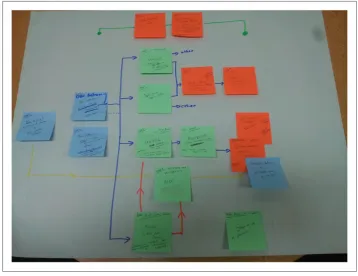
This visual representation was then adapted as new
information was gathered about the detail of thedata
journeyswe uncovered.
Our initial mappings allowed us to identify a number of potential data journeys to explore, and after making initial enquiries regarding access to research sites, we decided to focus on the journeys of data produced at our local weather station (Sheffield Weston Park) and data produced by amateur weather observers and citi-zen scientists. We then followed these data on their journeys from sites of production on into processing by the UK’s Met Office, and on into re-use in climate science and financial markets. We also explored the intersecting journeys of data generated by amateur observers and citizen scientists. As well as identifying key informants through desk research, snowball sam-pling techniques were also adopted once we were in the field. In total, primary data were gathered in relation to eight sites of data practice: Sheffield’s Weston Park weather station, Met Office headquarters in Exeter, the Climatic Research Unit at the University of East Anglia, the Inter-governmental Panel on Climate Change (IPCC), archives that store historical weather observations, the Old Weather citizen science project, amateur weather observers in distributed locations, and a firm that supplies weather data to the weather deriva-tives market. At each of these sites, primary data were generated including, as appropriate to each site,
in-depth interviews incorporating an oral history
component with data practitioners and other relevant individuals, field observations involving reflective field notes and photography, digital ethnography of selected forums and Twitter hashtags and documentary analysis of policies, legislation and other relevant sources. Through adopting an element of oral history interview-ing in our conversations with participants, we were able to draw upon their memories of the development of the infrastructure in order to construct an evolutionary and
dynamic picture of the life of data which emphasises
key moments in the development of data journeys and practices.
The primary data we generated were used to illumin-ate the journey of data through and between each site, the specific data practices that people were engaged in at each site, the socio-cultural values that framed and were used to justify participants’ data practices, and the varying material conditions and institutional contexts of these practices, including an analysis of the public policies and legislation that shaped the movement of data between sites. We also aimed to uncover tensions and changes in the socio-cultural constructs that prac-titioners were bringing to their data work at different sites, and explore how these constructs are interrelated with the broader socio-material context.
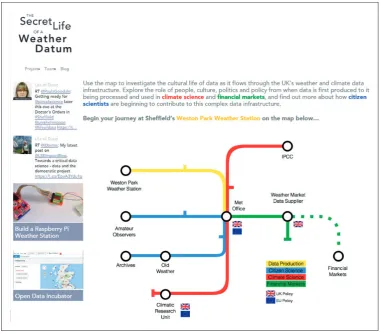
[image:5.595.124.483.68.344.2]Our initial findings have been published on a public facing website – http://lifeofdata.org.uk – that was developed as part of the project. The interactive website draws upon a tube map metaphor in order to represent
visually the journey of data as they move between the different sites of data practice that we explored. Each of these sites is represented by a ‘clickable’ station on the tube map, and within each station the user is invited to explore the different data practices, cultures, and public policy frameworks that contribute to the production of digital data, and their movement between, and use across, different sites. Where permissions from research participants were, granted original research data including audio interviews and photographic images are embedded into the website to bring the story to life. The dynamic nature of the infrastructures we explored is also manifest in the design of the website through our efforts to represent participants’ memories of particular moments during the evolution of data prac tices over time (see Figure 2).
Data journeys: Insights and reflections
Through adopting thedata journeysmethodology in our
empirical work, we have developed further our under-standing of the ways in which evolving socio-cultural values and material factors cohere over time to create
the socio-material conditions that frame activities ofdata
production, processing and distribution, and resultantly influence the form and use of data and their movement across infrastructures. This section will discuss three key conceptual observations we made through our empirical work about: (1) the socio-material constitution of digital data objects, (2) different forms of socio-material ‘fric-tion’ (Edwards, 2010) experienced by data as they move (or not) across space and time between different sites and (3) the mutability of digital data as a material property which contributes to driving the movement of data between different sites. The intention of this section is to present some key conceptual findings. Empirical find-ings can be explored further at: http://lifeofdata.org.uk, and more detailed empirical analyses will be published in further papers.
The socio-material constitution
of digital data objects
[image:6.595.101.483.374.708.2]Our analysis demonstrated the ways in which the prac-tices of those who produce meteorological data are bound up in complex systems of meaning that crystalise
in thematerial formandpropertiesof data (Dourish and Mazmanian, 2011). Even at the micro level of a digital datum – for example, the two data points recording
a temperature of 18.5C on 24 June 2014 mentioned in
the opening vignette – we observed how inter-related socio-cultural values, practices and material conditions of production, evolving over time, came to take on sub-stance at a particular moment in the form of two single data points.
The Weston Park weather station was founded and first began recording data in the 1880s in response to a fatal outbreak of diarrhoea in the city. It was suspected that the cause of the outbreak was related to weather temperature, but doctors needed data so they could view the problem through an informational lens, and ultimately predict future outbreaks and improve the public health of the city. The local Corporation, under pressure from the Department of Health, asked the museum curator Elijah Howarth to build and run a weather station. He decided to locate it at Weston Park, which was conveniently next to his place of work. The weather station has been active since this time and has produced one of the longest and most complete climate datasets on record.
Since the 1880s, responsibility for the station has passed down through generations of curators. The museum curator who currently looks after the station told us stories about how these individuals – barring a short period of variability in standards during the early years of the station – took great pride in looking after the station and the data it has generated (both digital and paper records), contributing to the durability and persistence of the climate dataset over the years. Data generated by the station are produced to international climate data standards. Prior to automation this was not an easy task, and over the years curators have been found at the station on Christmas day in order to reset instruments to ensure accurate data generation. The curator perceived the station as part of the local fabric of Sheffield and remembered how local people came to its rescue – fundraising 3000 in a ‘matter of weeks’ – when an expensive piece of equipment was stolen from the roof of the museum.
Over the years, the physical infrastructure of the sta-tion has survived other threats. It came unscathed through a bombing raid on the museum in World War Two – during which the curator braved high winds on the roof of the museum to capture hourly wind readings for the military. More recently, the sta-tion has been threatened by funding cuts to museums in the wake of the economic crisis, which have led to staff-ing cuts. In order to adapt to some of these pressures and ensure the continuity of the weather station, the previous curator allowed the national Met Office to add its own weather observation instruments to the
weather station compound in 2010. This new equip-ment generates data alongside the museum equipequip-ment. It feeds its data in real time to the Met Office via the WMO Global Telecommunication System and is part of the national synoptic network. As the curator describes, this adaption in the physical infrastructure, whilst likely necessary to ensure the continued presence of a weather station at Weston Park, means the Met Office no longer depends on the climate data generated by the museum equipment. This development has resulted in a reduction in power for the local museum in its relationship with the national Met Office, and the emergence of a tension between the value system of the curator who looks after the weather station and per-ceives it and its data as part of the cultural heritage of Sheffield, and the more technocratic values of the dis-tant national Met Office that emphasise efficiency, speed and volume of data.
In discussing his work and the history of the station, the curator expressed strong values of public service, civic duty, resilience, pride in his contribution, and responsibility to his forbearers, local community and data users. It was clear that the historical mix of cul-tural values, practices and material conditions of pro-duction outlined above inform and frame the values and practices of the current curator. We observed how, enabled and empowered by this history, the activ-ity of the curator to protect, maintain and run the museum weather station and look after the Met Office equipment in the context of current socio-material con-ditions resulted in (1) the production of these two spe-cific data points at that particular moment in time, influencing their accuracy, timing, unit of measurement
and so on, (2) the specificmaterial formsin which the
data points were represented, for example, as digital objects stored in a CSV file, Access database, Twitter and Met Office databases such as the NWP system and
MetDB synoptic database and (3) thematerial
proper-tiesof the data points, for example, their mobility,
per-sistence, durability and spatiality. In the form and properties of these data, we can observe how historic-ally constituted values, practices and material
condi-tions continue to have meaning and take on
substance in the world.
found accusations of misconduct ‘patently false’ (House of Commons, 2010) – climate scientists accepted the sceptics’ demand for full transparency of the underlying weather station data feeding into the CRUTEM datasets. However, this means that some data series cannot be included in the latest version, CRUTEM4, because of the socio-material conditions of their production – that is, for a variety of economic, socio-cultural and political reasons, their source coun-try prohibit the data being made publicly available. These struggles around the publication of underlying station data have therefore crystallised in the specific form that the CRUTEM4 dataset takes, and gained substance as a result of the practical activity of climate scientists’ decision making and negotiating around which specific data series can, and cannot, be incorpo-rated into the global dataset.
Friction in data movement
Through examining the journey of data between differ-ent sites, we were able to iddiffer-entify factors that enable and restrict the movement of data across infrastruc-tures, and observe sites of potential movement, blocked movement and lack of movement (Sheller, 2011: 6). It was evident that whilst data are often mobile between sites, they do not necessarily move smoothly or easily from one place to another – they experience ‘friction’ (Edwards, 2010) as a result of the complex socio-material contexts they exist within.
Most obviously, we can observe the diverse forms and levels of friction experienced by data as they move along different types of path through space and time from historical ships into the International Comprehensive Ocean Data Set (ICOADS). The jour-ney begins with the slow movement of handwritten data points inscribed in the log books of Royal Navy ships. The data in these log books spent time slowly traversing the oceans, before being removed from ships and deposited in archives around the world where they were boxed up and left untouched for years in varying states of decay. We can then observe the ‘friction’ reduce as climate scientists began to recognise the
potential for data movement, and acquired pockets of funding to ‘recover and rescue’ data from the log books. The log books were extracted from the archives and transported to facilities where they were digitised, before digital copies were transmitted via the internet into the living rooms of citizen scientists working on the Old Weather project. These volunteers transcribed the digital copies of these handwritten data points via a ‘cloud’ platform, through which they were written to a server, before being captured by climate scientists and integrated into the ICOADS. Nevertheless, despite this clear reduction in ‘friction’ enabled by developments in
both the physical and social dimensions of the infra-structure, significant amounts of data remain locked away in archives: their paths into the ICOADS
data-base blocked primarily by the material conditions of
production – namely a lack of public funding for ‘unsexy’ data recovery projects.
We can also observe how policy makers, commercial actors and civil society campaigners have recognised
blockages topotential data movements between public bodies such as the Met Office and third parties such as commercial re-users of meteorological data. In some
cases, efforts to overcome these blockages have led to
new policies and legislation, for example, Open Data policies and Re-use of Public Sector Information regu-lations. However, whilst Open Data policies that allow anybody to access and freely re-use data apply to some data, for example, some data produced by the Met Office, Open Data policies are not the norm across the infrastructure.
The weather observation data produced by
Museums Sheffield at Weston Park, for instance, was shared readily with the Met Office, as well as with stu-dents and researchers at the local universities. The cur-ator was also responsible for fostering a rich local data ecology in which weather station updates were shared with the public on Twitter and in the local newspaper. However, whilst strongly in favour of the idea that these data belonged to the public, the curator was wary about Open Data policies given that the sustain-ability of the weather station was dependent upon the small-scale commercialisation of the weather data it produced; a factor that seemed unlikely to change soon given the financial challenges posed by recent cuts to public funding for museums. These material conditions that shape the production of the museum’s meteorological data have a significant impact upon the curator’s understanding and practices regarding open-ing data generated by the museum equipment, high-lighting how ‘friction’ in the movement of data can reflect, and be shaped by, power dynamics at play in the wider context. In this case, the curator’s efforts to keep the museum weather station going in the face of significant reductions in public spending, and a reduc-tion in the importance of the museum’s data since the Met Office installed its own equipment at the site, is dependent upon creating and maintaining some data ‘friction’.
obliged to generate revenue through the commercial exploitation of the goods and services it produces, although in the case of the Met Office revenue comes primarily from the services it is contracted to provide to the UK government and public sector. These material
conditions of Met Office data production and
processing mean that, similar to the curator at Weston Park, there has been some resistance to Open Data policies that are perceived to risk the financial stability of the organisation during an era of deep public sector restructuring. Despite these issues, some meteorological data have been opened. However, even when there is the will to make high volumes of fre-quently updated, highly detailed data available for others to re-use, material barriers exist to making that happen in practice, for example, as a result of datasets being updated four or more times a day, and models getting bigger and more detailed, the volume of data being processed is significant and growing. The sheer volume of data therefore presents a material challenge when the Met Office wants to make data available to third parties.
Overall, our findings demonstrate that where data do and do not end up on their journey from production through to re-use is influenced by a range of inter-related socio-material factors, including: the material conditions of their production and efforts to sustain physical infrastructures and institutions given this con-text; the material form and properties of data such as their size and speed; the relative power and influence of different actors who desire to shape the movement of data; and the socio-cultural values framing beliefs and practices around the role of publicly funded infrastruc-ture, data sharing and valued forms of data re-use. Illuminating the causes behind these shifting patterns of ‘friction’ as data move, or not, between sites of data practice has the potential to provide a fascinating insight into the power dynamics that are shaping emer-gent material conditions of production.
Data objects as mutable mobiles
Observations of what happens to digital data when they do move indicate that ‘mutability’ is an important
material property of data (Dourish and Mazmanian,
2011). Digital data, as objects that embody
Manovich’s (2001) five principles of numerical repre-sentation, modularity, automation, variability and transcoding, are easily manipulable and hence mutable. Similar to other forms of digital documentation (Borgman, 2010) and new media (Manovich, 2001), digital data are not ‘fixed once and for all, but some-thing that can exist in a myriad of forms and copies’ (Manovich, 2001: 36). As Law and Mol (2001) argue, this mutability refers not only to the shape of the object
itself but also extends to variation in what it means for
the object ‘towork’ (pp. 5–6) at different sites.
The mutability of objects as they move through Euclidean space, for example, between two sites located in different geographical locations, has been explored within the field of ANT and, more broadly, STS. The
data journeys approach, which emphasises the move-ment of data between different sites, allowed us to unpack the mutability of data within and across infra-structures. It allowed us to question, as data move through space and time: does the socio-material context force them to hold their original shape, or are they adapted based on the needs of different sites? We observed that digital data are a form of ‘mutable mobile’ (Law and Mol, 2001) – as they move between sites, practitioners remix, repurpose, and adapt them in different ways for different ends. Similar to de Laet and Mol’s (2000) ‘Zimbabwean bush pump’, both the data and the socio-cultural values and relations that crystal-lise within them mutate as practitioners process data across diverse sites of practice. This high level of mut-ability also contributes directly to their usefulness for the different practitioner groups who work with and shape them and can therefore be recognised as a key material factor driving the movement of data between different organisations and projects.
accuracy is more important than speed, than for data being fed into the weather derivatives industry and forecasting where immediacy is vital. Further, whilst the mutability of digital data is always technically pre-sent, social factors intersect to restrict this mutability at particular points. When a particular version of a data-set is used in a weather derivatives trade, for example, data become immutable – they will not undergo any further alterations, as this would impact upon the val-idity of the contract. Similarly, when a new version of a
climate dataset is published, for example,
CRUTEM4.4.0.0 (Jones et al., 2012), data points are made temporarily immutable. However, unlike in the case of the weather derivatives contract, they may change again at a future point when the next version of the dataset is published. In many cases, these prac-tices of cleaning and homogenisation of data that take place at different sites are undertaken in order to gen-erate datasets that are accurate and complete enough for the purposes to which they are to be put, whether that be climate research or financial market trades.
Our research only touched on a few examples of data mutability across a small number of sites. However, the reproducibility and reconfigurability of digital data allows these mutations to happen simultaneously, at scale, and largely independently of one another, factors which contribute substantially to the complexity and scale of data in existence. Their mutable nature enables digital data to be re-used, re-purposed, and put to work for different purposes in different places and contexts, factors which contribute to driving the movement of data between different sites across infrastructures. Whilst the value systems of some of these different sites of data practice may conflict, for example, those of Weston Park and the data supplier to the financial markets, the data as ‘mutable mobiles’ connect these different human actors in complex, often invisible, rela-tions that together form a key component of emergent socio-material conditions.
Conclusions
As it becomes increasingly clear that emergent ‘Big Data’ practices across a variety of domains are con-tributing to the re-constitution of socio-spatial rela-tions, it is crucial that methodologies are developed and research conducted that help to illuminate the concrete ways in which ‘Big Data’ are constituted through complex socio-material practices, and how they contribute to the ongoing reconstruction of
socio-spatial relations. The data journeysmethodology
aims to contribute to this endeavour, shifting the gaze of critical ‘Big Data’ research from that of an external onlooker to one in which the researcher becomes embedded alongside data as they journey through
‘Big Data’ infrastructures from sites of production through to diverse sites of re-use; and from an empha-sis on the ‘bigness’ of ‘Big Data’ to a focus on the specific ways in which the small and local make up ‘Big Data’ infrastructures. Through identifying par-ticular moments in the socio-material constitution of data objects and flows as meteorological data move
between different sites of practice, the data journeys
methodology allowed us to begin to capture some of the ways in which diverse social worlds are becoming increasingly interconnected and interdependent as they contribute to, and are impacted by, emergent practices of data production, distribution and use.
We identified the importance of historically consti-tuted socio-cultural values in shaping practices of data production. The dedication and pride taken in the production of data at Sheffield Weston Park over the years contributes directly to their scientific and economic value at other sites including the Met Office, climate science and financial markets, as well as to the data and the weather station being valued as an important part of the cultural heritage of Sheffield. We also identified how the material properties of digi-tal data – for example, their volume, mutability and durability – impact on how data move between differ-ent sites. Increasing volumes of quality data may con-tribute to their desirability for potential re-users, but can also pose challenges for how best to distribute data between sites. Their mutability – the ways in which they can be cleaned, homogenised, and other-wise re-configured, linked and aggregated with other data – increases the re-usability of data, and therefore contributes to generating demand and driving the movement of data between sites. Through drawing attention to the broader power dynamics influencing the evolution of these practices – particularly material conditions of production such as a lack of public investment and funding for data recovery projects and sites such as Weston Park, as well as broader questions in the UK about the structure and govern-ance of public institutions such as the Met Office in the context of a deep restructuring of the state – the approach also shed light on the ways in which data practices and journeys are deeply politicised. We observed that different actors were working to influ-ence the distribution of data between sites for a range of political and economic ends from the restructuring of public institutions, to the protection of local infra-structure and cultural heritage in this context, to efforts to deepen the financialisation of climate uncer-tainty through pushing to open data used by the
wea-ther derivatives industry. Overall, the data journeys
data across space and time, the ways in which socio-cultural values and material factors come together to frame and give justification for these practices, and how together these contribute to the production of emergent socio-material conditions.
Acknowledgements
We would like to thank the three anonymous reviewers for their suggestions for improvements to the article, which con-tributed significantly to its development.
Declaration of conflicting interests
The author(s) declared no potential conflicts of interest with respect to the research, authorship, and/or publication of this article.
Funding
This work was supported by the Arts and Humanities Research Council AH/L009978/1.
References
Beer D and Burrows R (2013) Popular culture, digital arch-ives and the new social life of data. Theory, Culture & Society30(4): 47–71.
Bieler A and Morton AD (2001) The Gordian Knot of agency—structure in international relations: A neo-Gramscian perspective.European Journal of International Relations7(1): 5–35.
Bieler A and Morton AD (2008) The deficits of discourse in IPE: Turning base metal into gold? International Studies Quarterly52: 103–128.
Borgman C (2010)Scholarship in a Digital Age. Cambridge, MA: MIT Press.
Borgman C (2015) Big Data, Little Data, No Data. Cambridge, MA: MIT Press.
Bowker G (1994) Information mythology: The world of/as information. In: Bud-Frierman L (ed.) Information Acumen: The Understanding and Use of Knowledge in Modern Business. London: Routledge, pp. 231–247. Bowker G (2008) Memory Practices in the Sciences.
Cambridge, MA: MIT Press.
Bowker G and Star S (2000)Sorting Things Out: Classification and Its Consequences. Cambridge, MA: MIT Press. Bowker G, Baker K, Millerand F, et al. (2010) Toward
infor-mation infrastructure studies: Ways of knowing in a net-worked environment. In: Hunsinger J, Klastrup L and Allen M (eds) International Handbook of Internet Research. Dordrecht: Springer, pp. 97–117.
boyd D and Crawford K (2012) Critical questions for Big Data. Information, Communication & Society 15(5): 662–679.
Braman S (2006)Change of State: Information, Policy, and Power. Cambridge, MA: MIT Press.
Buckland MK (1991) Information as thing. Journal of the American Society for Information Science42(5): 351–360. Dalton J and Thatcher J (2014) What does a critical data
studies look like, and why do we care? Seven points for
a critical approach to ‘‘Big Data’’.Society and Space Open Site. Available at: http://societyandspace.com/material/ commentaries/craig-dalton-and-jim-thatcher-what-does-a- critical-data-studies-look-like-and-why-do-we-care-seven-points-for-a-critical-approach-to-big-data (accessed 11 June 2016).
De Laet M and Mol A (2000) The Zimbabwe bush pump mechanics of a fluid technology. Social Studies of Science30(2): 225–263.
Dourish P and Mazmanian M (2011) Media as material: Information representations as material foundations for organizational practice. In: Working paper for the third international symposium on process organizational studies, Corfu, Greece, June 2011. Available at: http://www.douri. sh/publications/2011/materiality-process.pdf (accessed 11 June 2016).
Edwards P (2010) A Vast Machine: Computer Models, Climate Data, and the Politics of Global Warming. Cambridge, MA: MIT Press.
Edwards P, Jackson SJ, Chalmers MK, et al. (2013)Knowledge Infrastructures: Intellectual Frameworks and Research Challenges. Ann Arbor: Deep Blue. Available at: http://pne. people.si.umich.edu/PDF/Edwards_etal_2013_Knowledge_ Infrastructures.pdf (accessed 30 June 2016).
Gitelman L and Jackson V (2013) Introduction. In: Gitelman L (ed.)Raw Data Is an Oxymoron. Cambridge, MA: MIT Press, pp. 1–14.
Harvey D (1991)The Condition of Postmodernity: An Enquiry into the Origins of Cultural Change. Oxford: Blackwell. Hogan M (2015) Data flows and water woes: The Utah Data
Center.Big Data and Society2(2): 1–12.
House of Commons (2010) The Disclosure of Climate Data from the Climatic Research Unit at the University of East Anglia. London: The Stationery Office Limited. Available at: http://www.publications.parliament.uk/pa/ cm200910/cmselect/cmsctech/387/387i.pdf (accessed 11 June 2016).
Jensen HE (1950) Editorial note. In: Becker H (1952)Through Values to Social Interpretation. Durham, NC: Duke University Press, cited in Kitchin R (2014) The Data Revolution. London: Sage.
Jones, P. D., Lister, D. H., Osborn, T. J., Harpham, C., Salmon, M., & Morice, C. P. (2012) Hemispheric and large-scale land-surface air temperature variations: An extensive revision and an update to 2010. Journal of Geophysical Research: Atmospheres. 117, D05127, pp. 1– 29.
Kennedy H and Moss G (2015) Known or knowing publics? Social media data mining and the question of public agency.Big Data and Society2(2): 1–11.
Kitchin R (2014a) Big Data, new epistemologies and para-digm shifts.Big Data and Society1(1): 1–12.
Kitchin R (2014b)The Data Revolution. London: Sage. Law J and Mol A (2001) Situating technoscience: An inquiry
into spatialities.Environment and Planning D: Society and Space19(5): 609–621.
Leonelli S (2013) Global data for local science: Assessing the scale of data infrastructures in biological and biomedical research.BioSocieties8(4): 449–465.
Mackenzie A (2005) The performativity of code: Software and cultures of circulation. Theory, Culture & Society 22(1): 71–92.
McNally, R., Mackenzie, A., Hui, Al, Tomomitsu, J. (2012) Understanding the ‘Intensive’ in ‘Data Intensive Research’: Data Flows in next generation sequencing and environmental networked sensors. International Journal of Digital Curation7(1): 81–94.
Manovich L (2001)The Language of New Media. Cambridge, MA: MIT Press.
Massey D (1994)Space, Place and Gender. Minneapolis, MN: University of Minnesota Press.
Orlikowski WJ (2007) Sociomaterial practices: Exploring tech-nology at work.Organization Studies28(9): 1435–1448. Rowley J (2007) The wisdom hierarchy: Representations of
the DIKW hierarchy.Journal of Information Science33(2): 163–180.
Ruppert, E., Harvey, P., Lury, C., Mackenzie, A., McNally, R., Baker, S. A., Kallianos, Y. & Lewis, C. (2015) Socialising Big Data: From concept to practice. Available at: http://www.cresc.ac.uk/medialibrary/workingpapers/ wp138.pdf (accessed 30 June 2016).
Ruppert E, et al. (2015) Socialising Big Data: From concept to practice. In:CRESC working paper no. 138(February). Available at: http://www.cresc.ac.uk/medialibrary/work ingpapers/wp138.pdf (accessed 11 June 2016).
Sands, A., Borgman, C. L., Wynholds, L., & Traweek, S. (2012) Follow the data: How astronomers use and reuse data.Proceedings of the American Society for Information Science and Technology49(1): 1–3.
Sheller M (2011) Mobility. Sociopedia. Available at: www. sagepub.net/isa/resources/pdf/mobility.pdf (accessed 11 June 2016).
Sheller M and Urry J (2006) The new mobilities paradigm. Environment and Planning A38(2): 207–226.
Star SL (1999) The ethnography of infrastructure.American Behavioral Scientist43(3): 377–391.
van der Vlist FN (2016) Accounting for the social: Investigating commensuration and Big Data practices at Facebook.Big Data and Society3(1): 1–16.
Vis F (2013) A critical reflection on Big Data: Considering APIs, researchers and tools as data makers.First Monday 18(10). Available at: http://firstmonday.org/ojs/index.php/ fm/article/view/4878/3755 (accessed 11 June 2016). Williams R (1958) Culture is ordinary. In: Szeman I and
Kaposky T (eds) Cultural Theory: An Anthology. London: John Wiley and Sons, pp. 53–59.
Williamson B (2015) Educating the smart city: Schooling smart citizens through computational urbanism. Big Data and Society2(2): 1–13.