This is a repository copy of Online retail returns management: Integration within an
omni-channel distribution context.
White Rose Research Online URL for this paper:
http://eprints.whiterose.ac.uk/93474/
Version: Accepted Version
Article:
Bernon, M., Cullen, J. and Gorst, J. (2016) Online retail returns management: Integration
within an omni-channel distribution context. International Journal of Physical Distribution &
Logistics Management, 46 (6/7). pp. 584-605. ISSN 0960-0035
https://doi.org/10.1108/IJPDLM-01-2015-0010
[email protected] https://eprints.whiterose.ac.uk/ Reuse
Unless indicated otherwise, fulltext items are protected by copyright with all rights reserved. The copyright exception in section 29 of the Copyright, Designs and Patents Act 1988 allows the making of a single copy solely for the purpose of non-commercial research or private study within the limits of fair dealing. The publisher or other rights-holder may allow further reproduction and re-use of this version - refer to the White Rose Research Online record for this item. Where records identify the publisher as the copyright holder, users can verify any specific terms of use on the publisher’s website.
Takedown
If you consider content in White Rose Research Online to be in breach of UK law, please notify us by
Online retail returns management: Integration within an omni-channel distribution context
Purpose
With the rapid growth of consumer sales being fulfilled through omni-channel retailing, this paper explores the subsequent impact on the levels of consumer retail returns experienced through online sales and the emergent returns management strategies being affected by retailers in relation to network configuration and returns management processes.
Design/methodology/approach
We use a mixed methods approach from an interpretive perspective. It is appropriate to describe our approach in terms of convergent design, since we have collected both qualitative and quantitative data.
Findings
Return rates for online retailing can be double those for stores, while return levels for
‘considered purchases’ remain similar. Our findings suggest that omni-channel returns management has yet to fully mature and we find challenges for network design and returns processes in offering a seamless solution.
Research implications
For practitioners we identify a number of challenges and offer insights to improve performance in returns management process, while for academic colleagues we propose a number of avenues for further research both in the qualitative and quantitative fields.
Originality/value
While a significant body of extant literature exists, in researching the generalized retail returns management process this paper make a contribution by addressing the emergent managerial implications of omni-channel retail returns.
Introduction
A necessary aspect of retailing is the acceptance of customer product returns and the processing of product returns has become a critical activity for organizations (Guide et al., 2006). While online retailing is not a new phenomenon, the increasing convergence of store and online retailing has led to the recent emergence of the omni-channel concept offering customers a seamless shopping experience across all retail formats. This seamless approach presents new challenges for product returns management as they move towards integrating returns, processes, information systems, inventories and performance measurement systems that have been typically operated as discrete entities within a multi-channel proposition. Whereas a substantive body of knowledge exists in the extant literature advancing our understanding of store based returns management, there is an absence of discussion concerning the effects of omni-channel retailing on returns management practice. The importance of managing returns within an omni-channel environment is increasing as sales originating online have been rapidly growing over the past decade, as consumers become more self-assured in utilizing electronic devices, (laptops, tablets and mobile phones) to both research and purchase products online. In 2013, it accounted for 13.5 percent of all goods sold in the UK (Centre for Retail Research, 2014) while the growth in online retailing in the UK grew by 15.3 percent in 2013 (MinteI, 2014). Coupled with this growth is a change in the way consumers make their purchasing decisions. Factors including the ease at which customers are able to return items have an influence over the retailers they buy from (JDA & Centiro, 2015) and there are an increasing variety of return channel options, including, retail store, drop point, parcel carrier and postal service.
Further, customers that buy online like to try the product before making their final decision. In a recent survey of consumers, 22 percent of shoppers bought more than one size or colour of the same fashion item (JDA & Centiro report 2015). This has implications for the volume of products being returned, returns physical network design and return logistics processes.
A number of papers have previously offered conceptual frameworks for the management of return logistics, which broadly identify two key management themes: network optimisation (Alumur et al., 2012; Gomes Salema et al., 2007; Min et al., 2006; Niknejad and Petrovic, 2014; Srivastava, 2008) whereas others have sought to define the management processes involved (Bernon et al., 2011; Genchev et al., 2011; Mollenkopf et al., 2007; Rogers et al., 2002; Stock and Mulki, 2009). While these studies provide a generalized view of product returns management, there is little discourse in the academic literature that explores the rapid emergence of omni-channel retailing and the effects specifically pertaining to product return rates at the product category level. Further, the unique operational characteristics for omni-channel returns management is yet to be fully explored and it is these gaps in our knowledge that this paper attempts to bridge. Specifically, we initially make a contribution to the literature by reporting comparative levels of returns originating from both online and store based sales for a range of different product categories. Further, the paper contributes through presenting a conceptual framework for returns management that furthers our understanding for returns management practice within an omni-channel context.
and Davis (2012) encouraging more mixed methods research in the area of supply chain management.
Literature Review and research questions (RQs)
Initially, the review extant literature examines the growing importance of omni-channel retailing and the implications for the product return rates. It continues by reviewing research into product returns management in two key areas: return logistics network design and returns management processes and practices. The literature is analyzed leading to the research questions and the development of a theoretical framework.
The growing importance of omni-channel retailing
Omni-channel retailing is a seamless approach to retailing that offers a single and unified shopping experience across all retail channel formats. Accenture (2013) defines omni-channel as a synchronized operating model in which all of the company’s channels are aligned and present a single face to the customer, along with one consistent way of doing business. Further, Verhoef et al., (2015) discusses the optimisation of performance across the numerous available channels and customer touchpoints recognising the imperative for effective operations and processes. Within this context, a key element is the capability to offer a unified and seamless customer returns management process.
While estimates for online spending vary depending upon the criteria used and the range of products and services included, the UK can be seen as a leading market in terms of growth and percentage sales. Table 1 illustrates that the UK has the highest percentage of online sales compared with the US and a range of European markets (Centre for Retail Research, 2014) while up to 23 percent of spending in the UK over the festive period was now being made via mobile devices (The Telegraph, 2014). In a recent forecast for eCommerce sales Worldwide between 2013-2018 (www.emarketer.com, 2014) the UK was ranked 3rd behind China and the USA. This suggests that the UK is a good market to study as it is one of the most mature. Moreover, the UK retail sector offers some of the most liberal customer returns policies (for example, John Lewis, a UK mass merchandiser, offers a 90 day no quibble guarantee) further necessitating effective returns management.
Country 2014 2015
estimated
UK 13.5 15.2
Germany 10.0 11.6
Sweden 7.6 7.8
European Average 7.2 8.4
France 6.9 8.0
Netherlands 7.1 7.4
Spain 3.0 3.5
Poland 2.8 3.3
Italy 2.1 2.5
[image:4.595.165.433.488.660.2]USA 11.0 12.7
Table 1: Percentage of online sales by country 2014 & 2015: Adapted from Centre for Retail Research (2014)
retailer priorities, in a recent survey of 25 UK retail leaders, omni-channel was voted as number one (Retail Week, 2015).
Effects of omni-channel retailing on product returns
Estimates of product return rates vary from 20 percent (Daugherty et al., 2001) up to around 35 percent in some sectors (Trebilcock, 2002). The total value of products being returned has been calculated at £5.75bn within UK retail sector (Bernon and Cullen, 2007) while Blanchard (2007) states that product returns cost retailers and manufacturers in the USA $100bn each year. While this information provides an insight into traditional retail environments, there is little understanding of the effects on return rates within an omni-channel context. This is important because within the pre-purchase stage of the consumer decision process (CDP) (Blackwell et al., 2006), in remote purchase environments, the purchase decision is more likely to be framed as two separate decisions: consumers' decisions to order and, upon receipt, their decisions to keep or return the item (Wood, 2001). In multi-channel retailing contexts, (where retailers operate retail stores and online operations as separate entities), consumers purchasing via online channels, lack first-hand experience of products which makes product selection more risky (Wood, 2001). Within an omni-channel environment, where there is no distinction between channels, consumers have an opportunity to search product information both online and through visiting stores in order evaluate the alternatives and gain higher product familiarity prior to the purchase decision. We therefore anticipate a moderating effect over multi-channel retailing, due to the increased opportunity to gain enhanced insight of product characteristics prior to purchase. Conversely, however, customers can gain additional confidence in their purchasing decisions in the knowledge that they have a wider range of return options and, therefore, likely to increase the propensity of returns. Finally, we suggest that these factors will have a differential effect dependant on the types of products being purchased, for example, considered purchases of electronic products versus high fashion products, where consumers are more likely to revisit alternatives after having made their initial choices (Gu et al., 2013). While a limited number of papers have attempted to provide aggregate figures for overall returns levels (Stock et al., 2002), they do not reflect the recent phenomenon of omni-channel retailing nor do they provide insights of the specific returns levels from customer orders within an omni-channel context. Further, to our knowledge, there is little understanding of product returns rates for a range of different product categories, which leads to our first research question:
RQ 1: What is the effect of omni-channel retailing on product return rates at the product category level?
Retail returns network design
A body of literature exists in defining the components and optimising methods for traditional retail returns networks. According to Bernon et al., (2011), retail return networks comprise four main management aspects: facility location, information technology, green supply chain management and outsourcing. Effective physical logistics return networks can optimize transportation, reduce inventory, order processing and warehousing costs related to returns (Amini et al., 2005). A number of authors also have presented conceptual models to support decision making in the location and capacity of facilities (Fleischmann et al., 1997; Fleischmann et al., 2001; Srivastava and Srivastava, 2006). Authors have also contributed to our knowledge by developing quantitative models for network location design (Gomes Salema et al., 2007; Kara et al., 2007; Lieckens and Vandaele, 2007). Blackburn et al.,
considered by Fernández and Kekäle (2005) and the rate of product innovation impact on the IT requirements for supporting repair operations.
While previous work has explored returns network design from a number of dimensions, little commentary exists pertaining to the network implications within an omni-channel context, specifically the emerging routes by which customers can return products. Our contention is that retailers will differ in their distribution network configuration contingent upon their existing network design and the need to offer an easy and seamless returns process to customers. The interest of this paper is in exploring the environmental factors and emerging organizational network structures leading to effective omni-channel returns management performance.
A further dimension explored by researchers are the benefits associated with outsourcing of returns operations to third party logistics service providers (3PL) to realise efficiencies, economies of scale, and returns management knowledge (Krumwiede and Sheu, 2002; Min and Ko, 2008; Sarkis et al., 2004) and access to capabilities, such as, specialist IT (Richey
et al., 2005). While these benefits remain for omni-channel retailing, there is little discourse examining what new developments and benefits exist. As retailers’ networks for omni-channel returns are emerging we also anticipate developments utilizing third party organizations for omni-channel returns to provide new and novel network solutions.
This leads to our second research question:
RQ 2: What are the emergent physical network challenges and innovations for omni-channel retail returns?
Product return processes
A further dimension of returns management is the management processes involved and a number of authors have identified different stages, but for the most part common themes pervade. Rogers et al., (2002 p1) suggested they comprise the “activities associated with returns, reverse logistics, gatekeeping, and avoidance across key members of the supply chain. The correct implementation of this process enables management not only to manage the reverse product flow efficiently, but to identify opportunities to reduce unwanted returns and to control reusable assets such as containers”. Stock and Mulki (2009 p41) found that product return process activities “can be grouped into four stages: receiving, processing, sortation and disposition”. The six process stages identified by Bernon et al., (2011) i.e. customer return request, return logistics, processing and sortation, inventory control, repair and refurbishment and final disposition were important processes for minimizing logistics costs and improving the re-sale revenue of products. All these works view the returns process as a linear and singular phenomenon, which does not take account of the implications for managing returns within an omni-channel concept where customers have multiple ways in which a product return can be instigated.
The literature suggests that return processes play an important role in the effectiveness of managing returns inventory levels, operational costs and product recovery values. The literature further suggests that innovations by retailers in returns practice can lead to improved performance through various mechanisms, including, increased speed, information systems capability and information flows. We therefore expect to find, that the differential operational characteristics for omni-channel retailing will create new challenges and necessitate process innovations. This leads to our third and final research question:
RQ 3: What are the emergent process challenges and innovations that have emerged for omni-channel retail returns?
[image:7.595.83.505.443.576.2]From our synthesis of the literature, we present, in figure 1, a generic conceptual framework for product returns. The framework illustrates the key constructs of the returns management process and the scope of our research questions. The framework presents a stepwise process which comprises of two elements, namely; customer order and delivery fulfilment which is the focus of research question 1 and product return network and processing being the focus of research questions 2 and 3. The customer order and delivery fulfilment element is comprised of three components; a customer order (either online or store based); customers obtain products via multiple channels (for example, home delivery) and the customer decision to return a product where customers initiate returns and select their chosen return route option (for example, return to store) and receive a credit or exchange. The product return network and processing element is comprised of return logistics, return warehousing and processing and disposition of products. These pertain to the return management processes encompassing return logistics and warehousing, through to processing, testing and grading and eventually products either being returned to stock or dispositioned through a secondary channel. Based on our empirical results, the framework is further enriched in the findings section.
Figure 1: Conceptual framework for retail product returns Method
qualitative and quantitative research design (Golicic and Davis, 2012), we are coming at this from an interpretive perspective whilst recognizing the potential of hypothesis testing at a later date.
Harrison (2013) provides a framework for understanding mixed method designs. He identifies five different types: Exploratory, Explanatory, Embedded, Convergent and Hybrid designs. In the context of our particular research project, it is appropriate to describe our approach in terms of convergent design since we collected both qualitative and quantitative data. We have analyzed both data strands separately, but then merged the data in order to allow an analysis incorporating both qualitative and quantitative empirical data. The whole analysis exercise was focussed on combining the two data collection methods in order to provide a richer picture of what was happening in practice. This is in line with Golicic and
Davis’s (2012) framework for undertaking robust mixed methods research in supply chain
management, as our data is analyzed and interpreted in a single report of results.
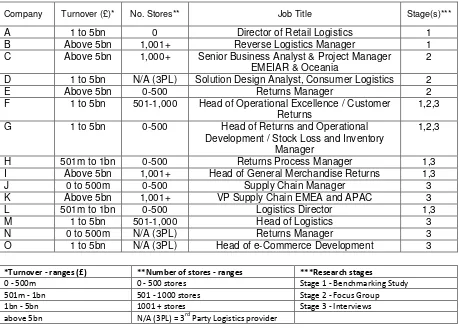
Data were collected between November 2013 and December 2014. Due to reasons of commercial confidentiality the companies have been anonymized. 15 companies comprising 12 retailers and 3 specialist returns management 3PL organisations were engaged with the research. Retailers selected were well known UK brands with a significant market presence and stocked the range of products under investigation. In terms of the turnover of retailers: 4 were in excess of £10bn; 5 between £1bn and £10bn, 2 between £501m and £1bn and 1 less than £500m (Please see table 2).
Company Turnover (£)* No. Stores** Job Title Stage(s)***
A 1 to 5bn 0 Director of Retail Logistics 1
B Above 5bn 1,001+ Reverse Logistics Manager 1 C Above 5bn 1,000+ Senior Business Analyst & Project Manager
EMEIAR & Oceania
2
D 1 to 5bn N/A (3PL) Solution Design Analyst, Consumer Logistics 2
E Above 5bn 0-500 Returns Manager 2
F 1 to 5bn 501-1,000 Head of Operational Excellence / Customer Returns
1,2,3
G 1 to 5bn 0-500 Head of Returns and Operational Development / Stock Loss and Inventory
Manager
1,2,3
H 501m to 1bn 0-500 Returns Process Manager 1,3 I Above 5bn 1,001+ Head of General Merchandise Returns 1,3
J 0 to 500m 0-500 Supply Chain Manager 3
K Above 5bn 1,001+ VP Supply Chain EMEA and APAC 3
L 501m to 1bn 0-500 Logistics Director 1,3
M 1 to 5bn 501-1,000 Head of Logistics 3
N 0 to 500m N/A (3PL) Returns Manager 3
O 1 to 5bn N/A (3PL) Head of e-Commerce Development 3
*Turnover - ranges (£) **Number of stores - ranges ***Research stages
[image:8.595.68.527.361.689.2]0 - 500m 0 - 500 stores Stage 1 - Benchmarking Study 501m - 1bn 501 - 1000 stores Stage 2 - Focus Group 1bn - 5bn 1001 + stores Stage 3 - Interviews above 5bn N/A (3PL) = 3rd Party Logistics provider
Table 2: Company and interviewee data
The research methodology followed a mixed methods approach in three distinct stages, with
Stage 1 - Quantitative data collection of returns rates: to quantitatively measure the levels of product returns experienced from store-based and online based returns. As organizations report their operational performance in differing ways, a benchmarking meeting was held to share and discuss how returns management was recorded in each company so as to align the data collection approach. Three categories of products were identified that retailers agreed they could report on, namely: Clothing, Electrical / Technical and Home. Seven retailers took part in providing returns data.
A data collection protocol using an Excel spreadsheet was subsequently devised, piloted and then emailed to the companies to complete. Piloting consisted of sending the data collection protocol to the companies prior to completion to ensure there was no ambiguity and the companies had the relevant data. As we had agreed the way the data would be collected during the benchmarking workshop and the data requirements were straight forward, no changes were required. The data were analyzed using simple mean, min/max and range calculations in Excel. The results were emailed back to the companies for final validation of the results.
Stage 2 – Exploratory qualitative research forum: To explore the thematic issues relating to the management of omni-channel retail returns, a one day research workshop event was held with 4 retailers and 2 3pl organizations. A broad research agenda was used to guide the discussion. Three academics from three different institutions were involved in guiding the discussion, note taking and capturing themes on A1 flipcharts.
Stage 3 - Exploratory qualitative empirical work: Data collection was undertaken with 10 organizations through semi-structured interviews, site visits and direct observation, and analysis of secondary sources (e.g., company websites, company documentation, company presentation media (PowerPoint) and external publically available data including, newspaper articles and practitioner documents. The semi-structured interview protocol was informed by the literature review and the empirical data collected in Stages 1 and 2 of the research. The protocol contained 4 central themes, namely: customer return policies and the impact on the returns management process within omni-channel returns; the implications for product return rates within an omni-channel context; the implications for returns network design within an omni-channel context and the development of processes, routines and scripts involved with managing omni-channel product returns. The central themes were further divided into sub themes designed to explore the phenomenon in a consistent way. This protocol was sent to all interviewees prior to the interview, so that they were familiar with the themes under investigation. The protocol was piloted for clarity and meaning prior to use, to increase reliability with academics at the author institutions.
To perform the data analysis, within and cross-case analyses were performed. To conduct
this, the researchers’ notes were written up in Word files immediately after the interviews to
avoid any loss of information. Analysis of the data was conducted through the research team reviewing the Word files looking for common themes for classification purposes. The results were collected and refined to converge into a final set of classifications.
Finally, following a convergent design perspective for mixed methods research, the data collected by both quantitative and qualitative means was analyzed together in order to refine the conceptual framework presented at the end of the literature review (Figure 1). The final conceptual framework is presented as Figure 2.
Findings
Figure 2: Updated conceptual framework for retail product returns
The effect of online retailing on product return levels
In an attempt to provide a seamless shopping experience, we found retailers offered similar returns policies for both online and store retailing. Notably however, the duration of the return period varied significantly from between 14 days to 90 days. As retailers offered similar policies for both channels we can see the effect that online sales has for return rates. The results are shown in Table 3 for the average, highest, lowest and range return rates for the categories of Clothing, Electrical / Technical and Home for 52 weeks.
RETAIL STORE
Average Range Highest Lowest
Clothing 10.9 14.1 19.0 4.9
Electrical / Tech 8.7 7.3 13.3 5.9
Home 5.5 9.4 11.0 1.5
ONLINE
Average Range Highest Lowest
Clothing 20.0 30.1 38.2 8.1
Electrical / Tech 8.0 3.9 10.3 6.4
Home 8.5 7.7 12.7 5.0
Table 3: Average percentage return rates as a proportion of sales by category by channel (52 weeks)
[image:10.595.142.457.477.639.2]choose the correct product by comparing features, technical specifications and pricing, etc. Second, in omni-channel retailing, customers of considered purchases often take the opportunity to both seek out product data online, while also visiting stores to view products before the final purchase decision is made online.
The range in the product returns rates reported show significant differences. Although we were unable to fully understand the differences, some possible explanations were provided. Two of our retailers offered outdoor and casual wear ranges that were not as ‘fit critical’ as
for fashion clothing and customers were more accepting of allowances in size. Further, one of the retailers charged customers for returns, as it was perceived to reduce multiple purchases of the same product. Finally, it was noted that retailers with an older customer demographic felt that their customers were less likely to return products than younger, more fashion conscious, customers.
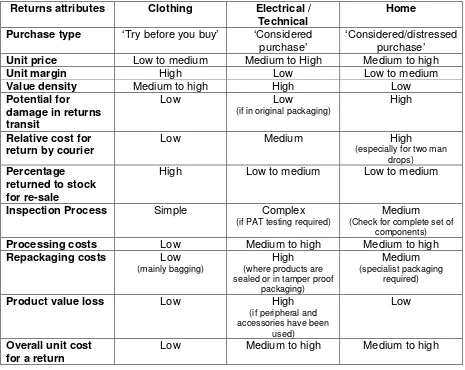
Interestingly, in our discussions, we found a degree of acceptability for the high returns levels for apparel. As shown in Table 4, owing to a ‘try before you buy’ value proposition, Clothing suffered from significantly higher levels of returns, however, when the full range of return activities are considered, the complexity of processing and the opportunity for margin erosion from testing, lost packaging and accessories, logistics costs and damage can be less punitive than for the other two categories.
Returns attributes Clothing Electrical / Technical
Home
Purchase type ‘Try before you buy’ ‘Considered purchase’ ‘
Considered/distressed purchase’
Unit price Low to medium Medium to High Medium to high
Unit margin High Low Low to medium
Value density Medium to high High Low
Potential for damage in returns transit
Low Low
(if in original packaging)
High
Relative cost for return by courier
Low Medium High
(especially for two man drops)
Percentage returned to stock for re-sale
High Low to medium Low to medium
Inspection Process Simple Complex
(if PAT testing required)
Medium (Check for complete set of
components)
Processing costs Low Medium to high Medium to high
Repackaging costs Low
(mainly bagging)
High (where products are sealed or in tamper proof
packaging)
Medium (specialist packaging
required)
Product value loss Low High
(if peripheral and accessories have been
used)
Low
Overall unit cost for a return
[image:11.595.66.531.336.706.2]Low Medium to high Medium to high
Network design considerations
According to our findings, two new management aspects are relevant when considering physical network design for omni-channel returns: Strategies relating to customer accessibility to return entry points and increasing complexity leading to issues of poor integration across the returns channels.
Customer accessibility to return entry points
A number of respondents stated that a key component of a successful omni-channel returns network was the ease with which customers could return products and the number of return points available to them to minimize distance travel times. The predominant fulfilment
channel for online sales was found to be ‘click and collect’ and ‘return to store’ was also the
preferred return option for customers. From our study, retailers adopted different strategies contingent upon their existing network capabilities. A number of our respondents had more than a 1000 stores nationwide and, therefore, could offer an effective in-store returns capability to customers that was within easy reach of them. As one retailer stated:
“We are 20 minutes from 90% of the population and customers can drop returns back to us the same day”.
Conversely, where retailers had a relatively limited coverage of stores, we found that they were seeking to partner to extend their reach. Three distinct strategies were observed: allow customers to return products to different branded retail operations but owned by the same retail group: utilize the capability of a specialist third party store-based parcel service: use the Post Office service.
One retailer, whilst having a significant turnover, has a relatively small number of outlets (less than 50 nationwide). To extend their coverage they were able to offer a returns facility to customers through their sister retail group, who operate over 300 grocery retail outlets. However, while increasing their coverage, this was not a simple solution as noted:
“A lot of click and collect is in (sister group), we get a far larger coverage by using them but customer expectation is no different for returns, but (sister group) is on a completely different IT system….creates back of store management issues for them….the physical distribution handling characteristics of general merchandize and grocery product are very different”.
A number of the retailers in our survey were utilizing specialist third party store-based parcel service, CollectPlus. CollectPlus manage a store network comprising over 5,500 newsagents, convenience stores, supermarkets and gas stations nationwide, which allows online customers to collect and return products seven days a week from ‘early til late, seven days a week’ (CollectPlus, 2014). CollectPlus have developed systems and processes to support their network to accept products and to arrange for them to be returned to retailers through the CollectPlus network for a fee charged to the retailers. While this was attractive to some retailers, others voiced concern that ultimately this may be sending their customers to competitor stores. Some retailers were operating a hybrid strategy utilizing a range of options. One retailer comprised over 3000 stores nationwide but, also accepted returns via the post office and were considering utilizing the capability of a specialist third party store-based parcel service to offer the widest choice to customers.
Increasing complexity and lack of integration
From our data we suggest that managing omni-channel returns networks increases returns channel complexity and requires high levels of integration. Examples where we found evidence of poor integration are provided through three case illustrations below:
For home deliveries, all of our retailer’s utilized specialist parcel carriers; one respondent cited that they use four main parcel carriers. Two of them only perform fulfilment operations and not returns. In this instance, a product return requiring an exchange may have three van deliveries to complete the transaction: one to drop off the original product, one to pick up the return and a separate delivery for the replacement product. This neither represents a seamless experience for the customer or for the returns logistics function.
b) Inventory re-balancing
Where product returns through stores leads to inventory located at the wrong place, retailers need to re-balance their inventory. One retailer quoted an instance where they had over 100k items across their store network that needed to be recalled to the DC for processing. As the existing network was not designed to accommodate this, they had to create a temporary warehouse operation and have a two-stage cross dock operation to consolidate the returns coming back from stores into pallet loads to be returned to stock. Also the product had to be moved from cages onto pallets to be put away in the warehouse.
c) Separate return channel processes
As a recent initiative, one retailer had launched an eBay store to launch a range of 800 sku’s with a plan to increase this to 3000. While the majority of store and online product returns were administered via their store network, eBay originated sales could not be processed through the same channel necessitating a completely separate returns process where product was returned to the distribution centre.
Process considerations
From our participants we found two unique process challenges when dealing with omni-channel returns; Processing speed and Process integration.
Processing speed
Speed has two elements, firstly, a facet of customer shopping experience in terms of the speed at which a customer receives a credit for their returned purchase: secondly, the speed at which returned products can either be returned to A grade for resale or directed to the most appropriate disposition route. Where customers return products to stores, the return is handled immediately and the customer will receive a credit at that point. However, customers returning products via the postal service do not receive a credit until the product
has been received at the retailer’s returns operations and it has been processed and cleared
for credit. Although a number of our interviewees were able to undertake their returns processing operations within 24 to 48 hours, it could be the case that if a customer places the product in the post late on Thursday, it may not be processed until the product arrives at the return centre on the following Monday. From the customer’s perspective, it may appear that the returns process is six days long.
A key aspect for retailers was the shortening product life cycles and the speed at which returned products were processed back in to a saleable position. A number of them were measuring their performance with the intention of shortening the time taken. Although we did not gather data from all the companies involved in the research, it appeared that good performance was considered to be 48 hours from receipt at the processing centre to being back in to stock although one retailer stated that they routinely processed returns within 24 hours.
Process integration
There was strong consensus amongst respondents that process integration for managing omni-channel returns was underdeveloped. As one respondent summed up succinctly:
Evidence of poor integration in return processes are provided through the following case illustrations:
Return to store processes
The highest occurring return route for online sales was found to be ‘back to store’. For this type of return we found retailers operated one of three possible different returns management processes:
1) Process the return, give a credit to the customer at the store and retain grade A stock in the store
2) Give a credit to the customer in store and return the product to a Returns DC for processing
3) Give the customer a receipt for the return in store and return the product to a Returns DC for processing and customer credit
Several integration issues surfaced within these policies. Firstly, where retailers adopted option 1, they had the advantage of having procedures, processes and systems capability to fully manage the return in store. As stated by one respondent:
“We don't really distinguish between channel of purchase and returns….good product (returned to stores) which is resalable will go into store stock - about 60%...it’s the Colleagues in store making the decision about whether a product is good enough to return to good stock. No great technical training, it is more about a judgement call of staff”.
On the surface, this would appear to be an effective outcome as the customer receives a credit immediately and grade A stock can be returned to store stock and made available for resale. However, as recorded by a number of the retailers, this process leads to stock imbalances where stores take back excessive product returns which they are unable to re-sell. A further unintended consequence is that stores may end up with a negative sales trading position. This was reported to lead to frustration by stores as they feel penalized of online product returns, as explained by one respondent:
“Customers aren't worried about how they return it, whereas internally to (retailer) it is more of an issue as one areas returns can make another look worse because of online returns through stores and our P&L silo's….some departments start the week with a negative figure on their P&L”.
Integration issues were also recorded where retailers operated option 2 or 3 by returning all returns back to the returns processing operations. In some cases, the process was fairly rudimentary, as explained by one respondent:
“When online products are returned by customers to store, the store simply bags them up and returns them to the DC for processing”.
The benefit to stores is they do not have the complication of managing returns beyond providing a credit and a returns slip. Further, processing returns in a central point is more efficient. However, the downside is the potential for additional logistics costs especially where product is returned to store at a later date. Moreover, it can be the case that sales can be lost through non availability of stock at stores.
Click and collect processes
“Uncollected ‘click and collect’ is an issue, as it drives a large volume of perfect product in the wrong location. This isn't necessarily viewed as a return, but it has to go through a returns process. The uncollected products are fully returned through the returns centre; they aren't opened by store and sold off in store”.
Product exchange processes
Online returns can comprise of more than a product return and often include an exchange. One example was provided by a major mass merchandiser with the associated integration issues:
“….two thirds of customers actually want a replacement rather than simply a credit….the difficulties of managing replacements and returns at the same time requires a system to handle a return item and at the same time to pick up another hence a timed delivery at store. Currently, the (Retailer) system would re-order a replacement product but at store level they would only see this as a collect item. If the customer did not come back with the original item it could be the case that the store staff would not know to take the product back. Further, it could also be the case that the customer may be refunded for the product they return and take away another product as the store staff just see it as a product to be picked up”.
Attachment rate processes
Attachment rates refer to customers purchasing additional merchandise when entering a store to pick up a ‘click and collect’ item. While normally associated as a positive effect as it creates an up-lift in sales, we found that a number of retailers’ check-out systems were not able to process the additional item as the ‘click and collect’ order was on a separate system. In this case, store staff would have to cancel the original order and then put both items through the till as a new sale.
Returns processes through the postal system
Due to a lack of integration between the postal system and retailers, when products were returned by post there was no visibility and customers could not be assured of where in the system their returned product was. As stated by one respondent:
“……this is a big challenge for online returns sent through the post. It is very difficult for us to see what is going on while the parcel is in the postal system. We have just introduced a texting system which lets customers know when the product has been received by us. It’s also an issue for us…we are interested to know what is coming back and when it will arrive”.
This has implications for customer service where customers are contacting store staff either in store or by phone and they are unable to satisfactorily advise customers when they would receive their money.
Discussion
The empirical results presented in our findings provide a rich picture of product returns management practice within the omni-channel concept. The paper continues with discussing our findings in relation to the literature.
In answering RQ1, we provide deeper granulation and understanding of product return rates within an omni-channel context. As might have been anticipated, we found that Clothing and Home return rates were higher for online originated sales than for those originating from store sales. For these product ranges we would support the view that liberal returns policies
both channels. Hence, our research would suggest that the situation is more complex than previously reported and indeed, a well executed omni-channel strategy may even lead to reduced return rates overall. This could especially be the case for ‘considered purchases’
where sufficient product information across a range of omni-channel platforms (including stores) is available to customers. In so doing, they have deeper experiential information pre-transaction leading to better informed decisions.
Further, in regard to product return rates, we partly agree with Guide et al., (2006 p1200) that “cost efficient logistics processes may be desirable for collection and disposal of products when the return rates are low and profit margins are comfortable” within the context of electrical and electronic commercial returns. However, this narrow focus fails to consider other product categories and channel characteristics within the omni-channel concept. We suggest that, where product margins are high, as for apparel, and sales are online, then high returns levels may also be acceptable or indeed a necessary factor in giving confidence to consumers for them to buy online as “return policies are a signal to the customer of convenience and an assurance of quality” (Skinner et al., 2008, p533). It was apparent from our discussions that the value proposition, relative margin and ease of processing returns played a part in retailer's minds in determining normative return levels. Hence, the returns levels of 30 percent that we find may be considered acceptable if they lead to an increase in overall profitability (Petersen and Kumar, 2010).
Returns avoidance and moderating effects
A significant amount of returns management literature discusses ‘avoidance’ techniques, which are tactical measures designed to reduce return rates (Bernon et al., 2011; Lambert, 2004; Mollenkopf, 2007; Rogers, 2002). In our exploration of return rates we found a range
‘moderating effects’ that have an impact of the return rates experienced within an omni-channel context. These effects inform the discourse on returns avoidance and provide further insights to customer return behaviour. The moderating effects we identified included:
•Try before you buy’ shopping behaviour
• Considered purchases in Electrical and technology category
•‘Non critical fit’ in apparel category • Returns charging
• Customer demographic
• Product cost profile & margin erosion
•Ease at which to recover at ‘A’ grade
Although beyond the scope of this research, we argue that by understanding a number of these effects, retailers might improve their avoidance techniques. With consideration of the
‘Try before you buy’ moderating effect where customers order multiple variants of the same product, retailers could track, through their ordering systems, those customers who routinely abuse the system and put in place processes that restrict these practices.
In respect of RQ2 and network design, it was evident that the ease with which customers could return products was a key challenge within the omni-channel concept. We found retailers adopted various strategies dependent upon the reach of their existing networks. The extant literature on reverse logistics network design has generally focussed on quantitative models optimising operational costs, particularly in relation to re-manufacturing, repairing, re-fabricating and recycling (Fleischmann, 2000; Xiaoyan, 2012). More recently, authors have considered network design for the collection of product returns in an
entry points and the capability retailers have to develop their own solutions or engage with specialist service providers, (for example, ConnectPlus), will become a point of differentiation.
In RQ3 we sought to understand the process implications of product returns management in relation to the omni-channel concept and identified the elements of speed and integration. While a number of authors have sought to show the importance of the speed of processing returns with regard to asset decay values (Blackburn et al., 2004; Guide et al., 2006) we add to this discourse with two additional dimensions. Firstly, a customer service dimension and the speed at which customers receive a credit from a returned product and secondly, the frequency that products are returned back to be processed.
A contention of our work is that omni-channel retailing is a nascent concept which lacks the levels of process integration found in many other forward supply chains. SCI literature to-date has primarily focussed on on three key areas: first, conceptualizing what SCI actually means (Fawcett and Magnan, 2002); second, understanding the relationship between internal (e.g. cross-functional) and external process integration (Flynn et al., 2010; Gimenez and Ventura, 2005; Koufteros et al., 2007); and third, identification of barriers to and enabling practices of SCI (Akkermans, et al., 1999; Bowersox et al., 2003; Frohlich and Westbrook, 2001). We support the view that, “for the most part, the literature on integration has focussed on the forward supply chain” (Fawcett and Magnan, 2002, p. 339) and is yet to fully mature within the returns management process. However, as evidenced in our case examples, we suggest that the emergence of the omni-channel concept merely compounds this fact and raises potential new dimensions in SCI research. We found barriers to SCI both in internal cross functional processes and inter-organizational practices that affect customer service and operational performance. We found the degree of process integration within each of the retailers varied considerably, however, a number of common themes in relation to integration barriers were observed, including; return networks, return management processes, stock management, performance measurement systems and information systems capability. In line with Bernon et al., (2011) our empirical results show that one of the key cost drivers of retail reverse logistics is poor integration between the various interfaces that exist between internal actors. Whereas they found examples of poor internal coordination between Marketing, Procurement and Logistics functions, our study showed a lack of integration between the return channels. This supports the claims of Andel (1997) and Bernon et al., (2011) that poor integration drives significant costs in retail returns processes. It is also in line with forward supply chain process literature, claiming that supply chain integration is generally a beneficial initiative (Flynn et al., 2010).
Conclusions and suggestions for further research
There has been relatively little discourse in the literature that considers the rapid emergence of omni-channel retailing and the implications for product returns management. Specifically, the managerial implications of this development and the impact on the levels of product returns have been under researched. In our paper, we sought to extend our knowledge by providing evidence of the effects on return rates, physical network design and managerial processes. We contribute to the literature via a rich empirical study of omni-channel practices in the UK Retail sector. The collection of data took place at a time when the researched organizations were engaged in the rapid development of different retail formats, in order to provide customers with a targeted seamless experience.
other. Further, these managers received a written report of the key findings illustrating their relative performance. The insights gained from the dimensions of network design and process management can be used by practitioners to revise their strategies for both online and retail based returns. This ongoing engagement with practitioners in the research process also enhanced the richness of our contribution to the academic literature.
For the wider practitioner audience, understanding these dimensions will also allow managers involved in operating returns networks to take a more holistic approach to improving customer service, through the ease at which customers can return products, while at the same time reducing the overall financial burdens associated with the returns management process. Moreover, it may help in defining how to better integrate the returns management process for both types of returns channels leading towards a more omni-channel response for returns.
We suggest that our results are generalizable to those retailers with similar product ranges within our survey and located in geographies where multi-channel and omni-channel retailing are maturing (in particular, the European and North America markets). However, we concede that there are limiting factors, for example, the UK has very liberal returns policies that may not be found in other geographies. Moreover, whilst we accept that interpretive approaches suffer from a lack of generalization, we would argue that we were seeking analytical generalization rather than statistical generalization (Yin, 2003). As with other studies of an exploratory nature, the findings are limited by the research design and the size of the sample. Although care was taken to select companies which had significant market share in their respective retail sector and an online retail presence, statistical inferences cannot be made.
Our research is exploratory and further research is required to develop and test hypotheses drawn from our refined conceptual framework. Specifically, further work is needed to understand the moderating effects that influence the level of product return rates experienced pertaining to omni-channel retailing. Further, the emergence of new returns channels brings questions for the optimal network design that offer high accessibility to customers at optimal return logistics cost. Finally, our research suggests an increase in the complexity of the returns management process in relation to omni-channel retailing and additional work is required to further our understanding of supply chain integration (SCI) within this context.
References
Accenture, (2013), “The New Omni-Channel Approach to Serving Customers: Strategy Implications for Communications Service Providers”, Accenture report.
Akkermans, H., Bogerd, P. and Voss, B. (1999), “Virtuous and vicious cycles on the road
towards international supply chain management”, International Journal of Operations and Production Management, Vol. 19 Nos 5/6, pp. 565-581.
Alumur, S.A., Nickel, S., Saidanha-Da-Gama, F. and Verter, V. (2012), “Multi-period reverse logistics network design”, European Journal of Operational Research, Vol. 220, No. 1, p. 67. Amini, M.M., Retzlaff-Roberts, D. and Bienstock, C.C. (2005), "Designing a reverse logistics operation for short cycle time repair services", International Journal of Production Economics, Vol. 96, No. 3, pp. 367-380.
Andel, T. (1997), “Reverse logistics: a second chance to profit: whether through
Bell, D.R., Gallino, S. and Moreno, A. (2014), “How to Win in an Omni-channel World”, MIT Sloan Management Review, Vol. 56, No. 1. pp. 45-53.
Bernon, M. and Cullen, J. (2007), "An integrated approach to managing reverse logistics",
International Journal of Logistics: Research & Applications, Vol. 10, No. 1, pp. 41-56.
Bernon, M., Rossi, S. and Cullen, J. (2011) “Retail reverse logistics: a call and grounding
framework for research”, International Journal of Physical Distribution and Logistics Management, Vol. 41, pp. 484-510.
Bernon, M., Upperton, J., Bastl, M. and Cullen, J. (2013), “An exploration of supply chain
integration in the retail product returns process”, International Journal of Physical Distribution and Logistics Management, Vol. 43, No. 7, pp. 586-608.
Blackburn, J.D., Guide Jr, V.D.R., Souza, G.C. and Van Wassenhove, L. N. (2004), "Reverse supply chains for commercial returns", California Management Review, Vol. 46, No. 2, pp. 6-22.
Blackwell, R.D., Miniard, P.W. and Engel, J.F. (2006), “Consumer behaviour”, Thomson/South-Western, 10th edition
Blanchard, D. (2007), “supply chains also work in reverse”, Industry Week/IW, Vol.256 No.5,
pp.48-9.
Bowersox, D.J., Closs, D.J. and Stank, T.P. (2003), “How to master cross-enterprise
collaboration”, Supply Chain Management Review, July-August, pp. 18-27.
Centre for Retail Research, (2014), “Online Retailing: Britain, Europe, US and Canada 2015”, available at: www.retailresearch.org/onlineretailing.php (accessed 14 December 2014).
CollectPlus (2014) “About us”, available at: www.collectplus.co.uk/about-us (accessed 12 November 2014).
Cullen, J., Tsamenyi, M., Bernon, M. and Gorst, J.K. (2013), “Reverse Logistics in the UK Retail Sector: A case study of the role of management accounting in driving organisational
change”, Management Accounting Research, Vol. 24, No. 3, pp. 212-227.
Daugherty, P.J., Autry, C.W. and Ellinger, A.E., (2001). Reverse logistics: the relationship between resource commitment and programme performance, Journal of Business Logistics, Vol. 22, No. 1, pp. 107–123.
Daugherty, P.J., Richey, G.R., Genchev, S.E. and Chen, H. (2005), “Reverse logistics: superior performance through focused resource commitments to information technology”,
Transportation Research Part E Vol. 41, pp. 77–92.
eMarketer.com, (2014). “Retail Sales Worldwide Will Top $22 Trillion This Year” available at:
http://www.emarketer.com/Article/Retail-Sales-Worldwide-Will-Top-22-Trillion-This-Year/1011765, (accessed 2 June 2015)
Fawcett, S.E. and Magnan, G.M. (2002), “The rhetoric and reality of supply chain
Fernández, I. and Kekäle, T. (2005), "The influence of modularity and industry clockspeed on reverse logistics strategy: Implications for the purchasing function", Journal of Purchasing & Supply Management, Vol. 11, No. 4, pp. 193-205.
Fleischmann, M., Beullens, P., Bloemhof-Ruwaard, J. M. and Van Wassenhove, L. N. (2001), “The impact of product recovery on logistics network design”. Production and Operations Management, Vol. 10, No. 2, pp. 156-173.
Fleischmann, M., Krikke, H.R., Dekker, R. and Flapper, S.D.P. (2000), “A characterization of
logistics networks for product recovery”, Omega, Vol. 28 No. 16, pp. 653-66.
Fleischmann, M., Bloemhof-Ruwaard, J. M., Dekker, R., van der Laan, E.; van Nunen, J A E E. and Van Wassenhove, L. N. (1997), "Quantitative models for reverse logistics: A review",
European Journal of Operational Research, Vol. 103, No. 1, pp. 1-17.
Flynn, B.B., Huo, B. and Zhao, X. (2010), “The impact of supply chain integration on performance: a contingency and configuration approach”, Journal of Operations Management, Vol. 28, pp. 58-71.
Frohlich, M.T. and Westbrook, R. (2001), “Arcs of integration: an international study of
supply chain strategies”, Journal of Operations Management, Vol. 19 No. 2, pp. 185-200. Genchev, S.E., Richey, R.G. and Gabler, C.B. (2011), "Evaluating reverse logistics programs: a suggested process formalization", International Journal of Logistics Management, Vol. 22, No. 2, pp. 242-263.
Gimenez, C. and Ventura, E. (2005), “Logistics production, logistics marketing and external
integration: their impact on performance”, International Journal of Operations and Production Management, Vol. 25 No. 1, pp. 20-38.
Golicic, S.L. and Davis, D.F. (2012), “Implementing mixed methods research in supply chain management”, International Journal of Physical Distribution and Logistics Management, Vol. 42, No. 8/9, pp. 726-741.
Gomes Salema, M., Barbosa-Povoa, A. and Novais, A. (2007), “An optimization model for the design of a capacitated multi-product reverse logistics network with uncertainty”,
European Journal of Operational Research, Vol. 179, No. 3, pp. 1063-1077.
Gu, Y., Botti, S. and Faro, D. (2013), ‘Turning the page: The impact of choice closure on satisfaction’, Journal of Consumer Research, Vol. 40, No. 2,, pp. 268–283.
Guide Jr, V.D.R., Souza, G.C., Van Wassenhove, L.N. and Blackburn, J.D. (2006), “Time Value of Commercial Product Returns”,Management Science, Vol. 52, No. 8, pp. 1200-1214.
Harrison III, R.L. (2013) “Using mixed methods designs in the Journal of Business Research”, Journal of Business Research, Vol. 66, pp. 2153-2162.
Koufteros, X.A., Cheng, T.C.E. and Lai, K.H. (2007), “Black-box and grey-box supplier integration in product development: antecedents, consequences and the moderating role of
firm size”, Journal of Operations Management, Vol. 25 No. 4, pp. 847-870.
Krumwiede, D. and Sheu, C. (2002), “A model for reverse logistics entry by third-party
providers”, Omega, Vol. 30, No. 5, p. 325.
Lambert, D.M. (2004), Supply Chain Management: Processes, Partnership, Performance, Supply Chain Management Institute, Sarasota, FL.
Lieckens, K. and Vandaele, N. (2007), "Reverse logistics network design with stochastic lead times", Computers & Operations Research, Vol. 34, No. 2, pp. 395-416.
Min, H. and Ko, H. (2008), "The dynamic design of a reverse logistics network from the perspective of third-party logistics service providers", International Journal of Production Economics, Vol. 113, No. 1, pp. 176-192.
Min, H., Hyun, J.K. and Ko, C.S. (2006), “A genetic algorithm approach to developing the multi-echelon reverse logistics network for product returns”, Omega, Vol. 34, No. 1, pp. 56-69.
MinteI, (2014), “Online Grocery Retailing: Executive Summary”, Mintel UK Report.
Modell, S. (2010) “Bridging the paradigm divide in management accounting research: The role of mixed methods approaches”, Management Accounting Research, Vol. 21, pp. 124-129.
Mollenkopf, D., Russo, I. and Frankel, R. (2007), “The returns management process in supply chain strategy”,International Journal of Physical Distribution & Logistics Management, Vol. 37, No.7, pp. 568-592.
Niknejad, A. and Petrovic, D. (2014), “Optimisation of integrated reverse logistics networks with different product recovery routes”,European Journal of Operational Research, Vol. 238, No.1, pp. 143 – 158.
Petersen, J.A. and Kumar, V. (2010), “Can Product Returns Make You Money?” MIT Sloan Management Review, Vol. 51, No.3, pp. 85-89.
Retail Week Reports, (2015). “Retail 2015: Definitive intelligence on the state of the industry, from leaders in UK retail”, Retail Week, UK.
Retail Week, (2013), “Retailers to invest £5bn in omni channel in next five years”, available at:
http://www.retail-week.com/multichannel/online-retail/retailers-to-invest-5bn-in-omnichannel-in-next-five-years/5049362.article (accessed 2 June 2015)
Richey, R.G., Chen, H., Genchev, S.E. and Daugherty, P.J. (2005), "Developing effective reverse logistics programs", Industrial Marketing Management, Vol. 34, No. 8, pp. 830-840. Rogers, D.S., Lambert, D.M., Croxton, K.L. and Garcia-Dastugue, S.J. (2002), "The returns management process", International Journal of Logistics Management, Vol. 13, No. 2, pp. 1-18.
Skinner, L.R., Bryant, P.T. and Richey, R.G. (2008), “Examining the impact of reverse logistics disposition strategies”, International Journal of Physical Distribution & Logistics Management, Vol. 38, No. 7, pp. 518-539.
Srivastava, S.K. (2008), “Network design for reverse logistics”. Omega, Vol. 36, No. 4, p. 535.
Srivastava, S.K. and Srivastava, R.K. (2006), “Managing product returns for reverse logistics”,International Journal of Physical Distribution & Logistics Management, Vol. 36, No. 7, pp. 524-546.
Stock, J.R. and Mulki, J.P. (2009), "Product returns processing: an examination of practices of manufacturers, wholesalers/distributors, and retailers", Journal of Business Logistics, Vol. 30, No. 1, pp. 33-62.
Stock, J., Speh, T. and Shear, H. (2002), “Many happy (product) returns”,Harvard business review, Vol. 80, No. 7, pp. 16-17.
The Telegraph (2014) “Omnichannel retail trends are setting the shopping style”, Available
at: http://www.telegraph.co.uk/sponsored/technology/4g-mobile/connected-retail/11297081/omnichannel-retail-trends.html (accessed 2 June 2015)
Trebilcock, B., (2002). “The seven deadly sins of reverse logistics”, Logistics Management (2002), 41(6), pp. 31-34.
Verhoef, P.C., Kannan, P.K. and Inman, J.J., (2015). “From Multi-Channel Retailing to
Omni-Channel Retailing”, Journal of Retailing, Vol. 91 No. 2, pp. 174-181.
Wood, S.L. (2001), "Remote purchase environments: The influence of return policy leniency on two-stage decision processes", Journal of Marketing Research, Vol. 38, No. 2, pp. 157-169.
Xiaoyan, Q., Han, Y., Qinli, D. and Stokes, P., (2012). Reverse logistics network design model based on e-commerce, International Journal of Organizational Analysis, Vol. 20, No. 2, pp. 251-261.