This is a repository copy of Quango reform: The next steps?.
White Rose Research Online URL for this paper:
http://eprints.whiterose.ac.uk/90222/
Version: Accepted Version
Article:
Dommett, K. and MacCarthaigh, M. (2016) Quango reform: The next steps? Public Money
and Management, 36 (4). pp. 249-256. ISSN 0954-0962
https://doi.org/10.1080/09540962.2016.1162588
[email protected] https://eprints.whiterose.ac.uk/ Reuse
Unless indicated otherwise, fulltext items are protected by copyright with all rights reserved. The copyright exception in section 29 of the Copyright, Designs and Patents Act 1988 allows the making of a single copy solely for the purpose of non-commercial research or private study within the limits of fair dealing. The publisher or other rights-holder may allow further reproduction and re-use of this version - refer to the White Rose Research Online record for this item. Where records identify the publisher as the copyright holder, users can verify any specific terms of use on the publisher’s website.
Takedown
If you consider content in White Rose Research Online to be in breach of UK law, please notify us by
1 5889 words
Quango reform: The next steps?
The Coalition Government elected in 2010 in the UK pursued a programme of quango reform focused on reducing the number and expenditure of arm s length bodies increasing transparency improving accountability and maximising efficiency and effectiveness. In this article we revisit
Flinders and Skelchers article Shrinking the quango state: five challenges in reforming
quangos to assess progress to date and consider future challenges. Drawing insights from the UK
programme of quango reform , as well as similar developments in Ireland, we identify five new challenges for governments regulating managing reconciling co-ordinating and reflecting
Dr Katharine Dommett and Dr Muiris MacCarthaigh
Department of Politics, School of Politics, International Studies and Philosophy
Elmfield, 25 University Square
Northumberland Road, Queen's University
Sheffield, Belfast
S10 2TU B BT7 1PB
[email protected] [email protected]
Bibliographical Information
Katharine Dommett is Lecturer in the Public Understanding of Politics at the University of Sheffield.
Muiris MacCarthaigh is Lecturer in Politics and Public Administration at Queen s University Belfast.
Key Words: Quango; Reform; Ireland; UK; Government
Introduction
Ahead of the 2010 general election significant attention was directed to the issue of quango reform in the UK a term that refers to bodies or agencies which sit at arm s-length from government and either provide public services, arbitrate or advise the government.1 Parties from across the political spectrum proposed a radical agenda for reform that would variously shrink the size of the state, reduce budgets, increase efficiency, improve accountability and enhance transparency. The ambition of and consensus for change in this area was clear. Five years on from 2010 it appears that the coalition government have had significant success in inducing reform (Cabinet Office, 2014; Dommett, Flinders, Skelcher and Tonkiss, 2014). The number of public bodies has fallen, financial savings have been made and new measures for transparency and accountability have been introduced. And unlike the 2010 campaign, quango culls did not feature prominently in the 2015 election campaign debates.
1 The term quango is utilized here interchangeably with public body and agency while there is much
2
On this measure it appears that the government has been successful in translating its ambition into practice, but the process has been far from smooth with Minister for the Cabinet Office, Francis Maude arguing i t wasn t easy it was prosaic, painstaking work but together we saw it though Maude In 2012 Matthew Flinders and Chris Skelcher picked up on these challenges in this journal, identifying five limitations to the coalition s agenda citing difficulties in mapping assessing reconfiguring saving and accounting (Flinders and Skelcher 2012). In this article we revisit the issue of quango reform to explore the progress that has been made, to map the barriers to reform and to consider issues for the future (within and beyond the UK). Through this process we identify five new challenges captured by the terms regulating
managing reconciling co-ordinating and reflecting
Such inquiry is vital because, as Flinders and Skelcher pointed out, quangos remain an indispensible part of the state 2012, p.327). Even the coalition government, who were committed to reducing the number and expenditure of public bodies, have created new organisations including the Office for Budget Responsibility, the National Crime Agency and, perhaps most notably, NHS England which in 2014 received £95,873,000,000 in funding from the UK Government. Quangos are therefore here to stay and will require ongoing reform and improvement. This point has been made by Francis Maude who asserted that o ften the lot of the reformer is to be asked by people when it s going to end but it will never end
From his perspective, the Government:
should always be re-examining how we deliver services because it s always possible to find new and better ways of doing things. All organisations are either getting better or they re getting worse There s no such thing as an organisation in a steady state if you think it s in a steady state it s getting worse (Maude, 2014).
It is unclear, however, what issues future reform should address. In considering this question this article examines the UK quango reform agenda, and draws insights from the Irish case where a parallel programme of agency reform has emerged since 2008. Using comparative examples and information from semi-structured interviews with civil servants in London and Dublin, we explore progress to date and, based on these examples, identify five challenges that politicians pursuing quango reform in the UK and elsewhere need to consider.
Success since 2010?
3
(Cabinet Office, 2014b) new triennial reviews were introduced to review bodies function and governance (Dommett, 2014), and the sponsorship of these bodies was overhauled (Flinders and Tonkiss, 2014). This approach accorded with the rationale that reforms were not about structures but about services, and accordingly focused on increasing efficiency and effectiveness in government (For a more detailed account of the reform programme see: Dommett and Flinders, 2014a; Dommett, Flinders, Skelcher and Tonkiss, 2014).
Five years on from the 2010 general election the success of the reform agenda has been attested in the most recent Public Bodies report published in November 2014 an annual account of the size of the public bodies landscape (which looks exclusively at one category of quango, Non-Departmental Public Bodies (NDPBs). This report gathers data on UK-wide quangos, as opposed to those within devolved administrations, and hence does not consider bodies which solely relate to Scotland, Wales and Northern Ireland. In this report the Cabinet Office has highlighted a reduction in the number of public bodies by over 285, with more than 185 abolished, and over 165 bodies merged into fewer than 70. As of December 2014 over 95% of planned abolitions and mergers have been completed, progress the National Audit Office had described as good and as evidence of significant rationalisation of the public bodies landscape Cabinet Office 2014a, p.4). Financially the reform of public bodies is also reported to be on track to exceed £2.6 billion in cumulative spending reductions by the end of March 2015 (Cabinet Office, 2014a, p.4) with reductions of £2 billion already achieved between 2010 and March 2014. In addition the government has claimed increases in transparency, asserting that 90% or more of NDPBs now make more information such as annual reports, biographies of board members and details of how to make complaints and freedom of information requests publically available on their websites (Cabinet Office, 2014a, p.4). Accountability is also reported to have been improved by moves to bring the functions of over bodies closer to democratically elected representatives (Ibid).
On these measures the reform agenda appears to have been a significant success. And yet from the outset commentators have outlined the limitations of these reforms. An initial assessment made in 2012 by Flinders and Skelcher highlighted five reasons for caution in interpreting the public bodies reform agenda, which are worth recounting. First, at the level of mapping, Flinders and Skelcher emphasized that whilst ambitious in its focus on NDPBs, the coalition government s reform agenda had neglected significant numbers of other quangos. Executive Agencies and other off stage bodies (which possess the characteristics of quangos but are not formally classified as such due to quirks of history) were not considered and hence the scope of reform was limited raising questions about the extent to which it would produce fundamental change. Second, the 2012 article showed there was inconsistency in assessing the quango state with departments adopting different approaches in the application and definition of the three tests provided by the Cabinet Office as the basis for assessing quangos future. For this reason it was argued that the 2010 reform agenda did not appear to be rectifying inconsistencies but rather added new ambiguities to the quango landscape. In addition, Flinders and Skelcher highlighted questions concerning the form of change.
4
argued that the government had failed to grasp the cost of reform, raising questions about the validity of the claim to achieve £2.6 billion in savings by 2015 (Flinders and Skelcher, 2012, p.332). Finally, the 2012 article raised questions about accounting, probing the extent to which reform would produce the desired improvements in accountability. The authors examined the impact of drawing functions closer to ministers, discussing how transparency and accountability can actually be undermined by such measures by reducing opportunities for external scrutiny. In this initial assessment these challenges led Flinders and Skelcher to argue that developments in shrinking the quango state since May are certainly much more than a barbeque but that they are less than the bonfire hoped for by some 2012, p.335).
As time has passed it has become clear that Flinders and Skelcher analysis accurately captured the challenges of effecting reform. Whilst significant progress has been made, concerns about the size, scope and capacity of the quango state remain. Indeed Flinders and Skelcher themselves, in an updated analysis of reforms, have argued that whilst progress has been made the reforms were limited because at the level of metagovernance [the Coalition] refused to adopt a more strategic approach and focused instead on just one layer or species of arm s -length body without any clear rationale for a why similar measures weren t similarly appropriate for other layers or b how the centripetal logic of the public bodies reform programme can be reconciled with the centrifugal logic of reforms in other sectors (most notably but not exclusively in the health sector Dommett Flinders Skelcher and Tonkiss 2014, p.141). Elsewhere the Public Administration Select Committee (2014) has levelled similar criticisms, asserting that:
that arm s-length Government is confused and opaque. Organisational forms and names are inconsistent. Most public bodies answer to Ministers but some are directly accountable to Parliament. There is no agreement on how many types of body exist. There are overlaps and blurring between categories. Accountability arrangements and reforms so far have been ad hoc (Public Administration Select Committee, 2014, p.3).
The Institute for Government has voiced similar concerns arguing that whilst there have been some positive steps the fundamental problems evident in the quango landscape in 2010 have not been resolved )n their analysis there are at least different types of ALB a situation that leads to confusion about roles and responsibilities between organisations and creates variation in the relationships between departments and the ALBs that they sponsor that varies considerably in quality (2015, p.1). On this evidence it appears that, notwithstanding the reform successes to date, the problems cited by Flinders and Skelcher continue to be relevant.
Quango reforms in Ireland
5
in respect of State agencies and a detailed review of existing agencies to identify opportunities to amalgamate, rationalize and make greater use of shared services p40).
In the wake of the Global Financial Crisis and suddenly faced with an enormous budgetary deficit, quango rationalisation became a financial rather than administrative modernisation issue. The then Fianna Fáil-led government announced plans in an emergency budget in late 2008 to reduce the number of State bodies and agencies by forty-one, and to streamline certain other functions Lenihan . As per the UK, deciding on what to include in the Irish agency population proved problematic (MacCarthaigh, 2012a). However, adopting a broad definition of agencies (to include, for example, commercial state-owned enterprises), a longitudinal database of Irish agencies estimated a peak of almost 360 agencies was reached in 2008, meaning the initial reduction target was approximately 12% of the agency population. An initial rash of agency terminations and departmental absorptions in 2008 and 2009 also largely small advisory bodies with minimum budgetary spend resulted in only 15 of the 41 bodies closing, and with political energies focused in the state s economic survival by early 2011 the pace of reform had slowed considerably (MacCarthaigh, 2014a).
Renewed impetus was given to the quango cull by a new coalition government that took office in Ireland in March 2011 with a strong mandate for reform. In a Public Service Reform Plan published in November the Minister with responsibility for the new Department of Public Expenditure and Reform (DPER) announced that it was proceeding with the rationalisation of 48 Bodies by the end of 2012 [and nominating] another 46 Bodies for critical review by the end of June DPER, 2011, p.52). The plan attested that the government would further rationalise the number of State Agencies and Departmental bodies to streamline service delivery increase democratic accountability and secure million in enhanced service efficiencies and value-for-money DPER p Additional measures including sunset clauses when new bodies are created, annual reviews of the continuing business case for all significant state bodies, and a requirement for robust service level agreements between departments and state bodies were also introduced (DPER, 2011, Appendix II, p.2). These plans were pursued in accordance with a desire to make the agency sector a more efficient and responsive sector in delivering on their service objectives in the coming years DPER, 2014a). Despite this new energy for rationalizations, by late 2012 a review by the Department noted that progress was much slower than expected and only a third of the agencies due for abolition that year would be gone by year-end.
6
Figure 1: Public Organisations in Ireland (including Ministerial Departments) 1922-2014
Source: Hardiman et al. 2015, www.isad.ie
In addition it is clear that whilst pursuing reform the government s efforts to induce change have been frustrated. Having set a target of million in financial savings, the government report identified actual annual savings of over million to date a shortfall attributed to the simple fact a feature of the private sector too that some mergers have upfront costs or at least require time to fully extract efficiencies DPER b p Many terminated Irish agencies also had small budgets. This indicates that similar questions about savings and reconfiguration are evident in the Irish case, as are concerns over accountability and mapping.
Barriers to reform
The challenges experienced in the UK, aligned with those of the Irish case, make it interesting to consider the nature of the barriers encountered by government officials, and bring two variables to the fore: legislative process and capacity.
Legislative Process
The first challenge concerns the process of effecting reform. As mentioned above, the vast majority of initial reforms pursued in the UK and Ireland were of small advisory or sub-national bodies that can be reformed by ministerial order or through the passage of (usually) simplistic legislative changes. These changes bring about a swift reduction in the number of bodies and are far easier to achieve than change to more legislatively complex organisations, making change of this form attractive to governments
The process of bringing about reform can therefore be frustrated by bodies legislative foundation. Governments are often required to unpick multiple pieces of legislation in order to close quangos, a process that is resource and time intensive. In the UK intended reforms to the Forestry Commission were frustrated by the legislative complexity of reforming a body that had foundations in numerous pieces of legislation dating back to 1919 (Interview No. 1). Whilst in )reland one departmental employee reflected that there is a big structural barrier to reform as
7
the effort which needs to be expended is huge (Interview No. 2). In some cases, this has led to efforts to starve agencies of staffing and budget resources aiming to facilitate closure through stealth rather than direct action. These structural requirements are seen to have frustrated the process of bringing about change in both countries.
In addition, bodies legislative foundation raised a second difficulty concerning scrutiny. Both the UK and Irish governments experienced barriers to reform through central oversight procedures. To pursue reform in the UK the Government passed the Public Bodies Act 2011, a piece of enabling legislation under which Orders for specific reforms could be tabled. Orders were subject to an enhanced affirmative procedure that permitted up to 60 days for further consideration of a proposal. For the vast majority of orders laid under the Act limited delays occurred, however, in certain instances changes were substantially delayed by the Parliamentary process, with the Secondary Legislation Scrutiny Committee raising concerns over, amongst other factors, the robustness of the Government's case for individual orders (2011, p.3). The impact of such scrutiny was particularly apparent in the case of the Administrative Justice and Tribunals Council (AJTC). The order for the abolition of this body was first laid on December 2012 but, following numerous critical reports from both Houses of Parliament, the AJTC was not formally abolished until August 19th 2013 (Skelcher, 2015). In Ireland, many of the more substantial Irish agency mergers and absorptions (and particularly those involving organisations with full statutory autonomy) were only realised by means of bespoke pieces of legislation which were developed seriatum. The development and parliamentary progress of the legislation added further to delays, hindering departmental efforts to effect reform.
Capacity
In addition to the problems derived from process these cases also show challenges arising from a lack of capacity to implement decisions. In both the UK and Irish cases reforms have proceeded at a time of austerity, being implemented alongside wider programmes of civil service reform and retrenchment. In the UK context there are indications that this has limited the capacity of departments to implement new processes (for example in relation to triennial reviews (Dommett, 2014)) as resources and staff capacity have been lacking (Interview No. 3; No, 4). The pressure of fiscal retrenchment is also keenly apparent in the Irish case where departmental budgets have been cut by as much as 40% in some cases, and DPER has relied on already hard-pressed Departments to engage in difficult agency termination strategies for which they had little resource. This has placed pressure on departments and has limited their capacity to implement change. In part these challenges derive from a freeze on recruitment within departments from 2008, but in the main they stem from a reduction in the number of staff within departments and agencies. In one high profile department the number of staff was reduced from around 800 to 525 and yet new responsibilities were added meaning that departmental capacity to pursue change was stretched. In practice this has created difficulties implementing and enforcing the new requirements outlined by DPER a point recognized by DPER officials who reported you can issue all the guidance you want but there is no point if it isn t implemented fully (Interview No.5).
8
charged with other major responsibilities. The lack of central capacity limited the ability of the Irish Government to oversee reform to ensure that progress was made and that new practices were implemented in a uniform manner. In relation to guidance for setting up new bodies, for example, despite a clear pledge to implement sunset clauses made by central government, officials have not been able to enforce the implementation of this practice in departments, resulting in lack of uniformity in the application of this ideal.
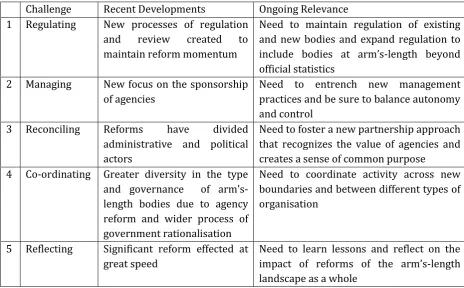
These indicators suggest that bringing about change is by no means simple and that efforts to reform quangos are likely to be frustrated by the complexities of the political system. Against this backdrop it is interesting to consider the form ongoing change in this area may take and the new challenges that are likely to be encountered. We argue that while substantial reform progress has been made which address the five challenges Flinders and Skelcher suggested for a programme of rationalisation aimed at reducing the number and cost of quangos, the future evolution of quango reform should be informed by a new set of priority challenges. We explore each of these under the headings regulating managing reconciling co-ordinating and
reflecting (see Table 1, below).
Five Future Challenges for Quango Reform:
Regulating
The terra incognita of the quango landscape identified by Flinders and Skelcher in their 2012 article and also evident in Ireland pre-reform (MacCarthaigh, 2012b) has been (partially) tackled by the process of mapping that occurred in both countries and steps have been taken in both contexts to control agency establishment and monitor performance. In the UK and in Ireland departments need to present a robust business case when proposing to establish new agencies (DPER, 2014b; Cabinet Office, 2012), a requirement that has limited the number of new bodies created. In addition both countries have established processes for more regular periodic review with the implementation of Triennial Reviews in the UK and more routine performance/service-level agreements between agencies and their parent departments in Ireland.
Such developments indicate fundamental change that is likely to have positive long-term implications for the regulation of agency numbers and functions. However, there are notable limitations to the current approach adopted in the UK that have wider relevance for countries conducting quango reform. Whilst NDPBs are now subject to greater regulation, there are a raft of new bodies such as mutuals and charities that deliver functions previously performed by public bodies but are not subject to the above regulatory processes. This indicates room for potential inconsistency in regulating the arm s-length state as new models of service delivery are introduced. It also poses challenges in terms of resource, with interviewees expressing doubt as to whether departments are sufficiently resourced to support the ministers in decision making even before the latest round of departmental cuts )nterview No. 6).
Managing
9
2014; Flinders and Tonkiss, 2015). This goes some way in resolving the tension between parent departments and agencies identified by the Institute of Government (2012). Yet, to ensure the efficient and effective management of agencies such practices will need to be embraced by departments and deployed in a manner that balances central control and agency autonomy to ensure that agencies are able to carry out their statutory duties.
Reconciling
The rhetoric of bonfires culls and quangocide has not served agencies or their departments well. The portrayal of agencies as unnecessary or undesirable appendages to an otherwise rational central administration undermines the role and extension of state capacity they offer. In a similar vein, the plea for uniformity in how quangos are governed and held to account across government fails to appreciate that there are benefits to diversity and flexibility in agency governance.
The global financial crisis has resulted in tensions between political executives and administrative systems as the former have sought to reduce the cost and size of the latter, with considerable changes to the public service bargain Lodge and (ood, 2011). In pursuing further agency reform, a process of reconciliation between political and administrative actors is required that re-establishes a sense of common purpose and recognizes the vital role of agencies in delivering public services. This approach appears to be emerging in the UK where the notion of a partnership (Maude, 2014) between agencies, departments and central government is seen to be key to future reform, but it is an approach that has wider relevance beyond this immediate context.
Co-ordinating
The process of administrative landscape clearing that formed part of the justification for agency rationalisation strategies post 2008 has resulted in a smaller but more diverse range of public service organisations. In many cases, hybrid and multi-functional organisations now exist arising from mergers of previously separate entities under the aegis of different departments. As part of cost reduction strategies, there has also been an increase in the use of stand-alone
shared service centres which perform back-office and corporate processing functions previously performed by multiple agencies simultaneously (Elston, 2014; MacCarthaigh 2014b,).
Traditional co-ordination challenges such as those between CEOs, boards, sponsoring departments and Ministers remain. In the post-rationalisation environment, however, new co-ordination challenges have emerged:
- Between agencies, parent departments and shared service centres
- Between departments who share responsibility for hybrid or multi-functional agencies In some respects, therefore, the process of agency rationalisation has led to a more complex environment, with increased number of actors and veto points. Ensuring coordination across these actors will therefore be necessary as part of any future reform agenda.
10
[image:11.595.66.531.298.586.2]Finally, the considerable energy and resource that has been committed to the agency rationalisation process over the last number of years deserves reflection. Engaging in what has effectively been a stock-take of agencies has yielded important information about the scope and form of state activities, and how savings could be made with minimal impact to services. The process of stretching public organisations to achieve more with less and to engage in mergers or termination has also demonstrated considerable capacity to adapt to changed political and economic circumstances. While senior managers in agencies might have learned much about managing organisations in turbulent times, there is scope for central government to capture learning from the system-wide overhaul that has occurred. As such future reform needs to be underpinned by a process of reflection that allows lessons to be learnt from previous processes of reform. This reflection should be conducted outside the heat and political short-sightedness surrounding general election campaigns, and feed into training and development resources to mitigate the effects of staff turnover and consequent loss of institutional memory.
Table 1: Five new challenges for quango reform
Challenge Recent Developments Ongoing Relevance 1 Regulating New processes of regulation
and review created to maintain reform momentum
Need to maintain regulation of existing and new bodies and expand regulation to include bodies at arm s-length beyond official statistics
2 Managing New focus on the sponsorship of agencies
Need to entrench new management practices and be sure to balance autonomy and control
3 Reconciling Reforms have divided administrative and political actors
Need to foster a new partnership approach that recognizes the value of agencies and creates a sense of common purpose
4 Co-ordinating Greater diversity in the type and governance of arm s -length bodies due to agency reform and wider process of government rationalisation
Need to coordinate activity across new boundaries and between different types of organisation
5 Reflecting Significant reform effected at great speed
Need to learn lessons and reflect on the impact of reforms of the arm s-length landscape as a whole
Conclusions
11
In considering the future of quango reform it therefore appears that numerous challenges will be encountered and will have to be overcome. Building on Flinders and Skelcher s analysis we suggest five such challenges best captured by the headings regulating managing reconciling
co-ordinating and reflecting that should inform future reform of the quango state.
Looking beyond the UK it is clear that these challenges have relevance for other non-Whitehall administrative systems. Post-crisis governments around the world are faced with financial constraints that continue to inspire programmes of reform and rationalisation, and yet politicians possess limited political capital with which to launch high profile programmes of reform such as that evident in the UK in 2010. Such states need to develop new mechanisms that embed principles of reform within government departments and agencies. We propose that processes of regulating, managing, reconciling, co-ordinating and reflecting can assist governments seeking to effect ongoing change. For this reason governments around the world can draw insight from the UK and Irish cases in designing and implementing future programmes of quango reform.
References
Cabinet Office. (2012), The Approval Process for the Creation of Non Departmental Public Bodies (London: Stationary Office).
Cabinet Office. (2014a), Public Bodies 2014 Overview (London: Cabinet Office).
Cabinet Office. (2014b), Public Bodies 2014 Data (London: Cabinet Office).
Cabinet Office. (2014c), Public Bodies Reform Strategy (www.gov.uk).
Cabinet Office. (2014d), Review of the Administrative Classification of Public Bodies within the United Kingdom (www.gov.uk).
Cabinet Office. (2014), Sponsorship Specialism Competency Framework(www.gov.uk).
Department of Public Expenditure and Reform. (2011), Public Service Reform Plan (Dublin: Department of Public Expenditure and Reform).
Department of Public Expenditure and Reform. (2014a), Public Service Reform Plan 2014-16 (Dublin: Department of Public Expenditure and Reform).
Department of Public Expenditure and Reform. (2014b), A Report on the Implementation of the Agency Rationalisation Programme (Dublin: Department of Public Expenditure and Reform).
Dommett, K. (2014), Triennial Reviews and Public Body Reform in the UK, Shrinking the State Website (www.shrinkingthestate.org.uk).
12
Dommett, K. and Flinders, M. (2014b), The Centre Strikes Back: Meta-governance, Delegation and the Core Executive in the United Kingdom, 2010-2014. Public Administration, 93, 1, pp.1-16.
Dommett, K., Flinders, M., Skelcher., C. and Tonkiss, K. (2014), Did they Read Before Burning The Coalition and Quangos.The Political Quarterly, 85, 2, pp.133 142.
Elston, T. (2014), Shared corporate services in the public sector: a critical review. Paper presented in the panel, Public Service Delivery in the Transforming State, convened by the Public Policy and Administration specialist group at the 64th annual conference of the Political Studies Association, (Manchester, UK).
Flinders, M., K, Dommett. and Tonkiss, K. (2014), Bonfires and Barbeques: Coalition Governance and the Politics of Quango Reform. Contemporary British History, 28, 1, pp.56-80.
Flinders, M and Skelcher, C. (2011), Shrinking the Quango State: Five Challenges in Reforming Quangos. Public Money & Management, 32, 5, pp.327-34.
Flinders, M. and Tonkiss, K. (forthcoming), From poor parenting to micro-management: coalition governance and the sponsorship of arm s length bodies in the United Kingdom -2013. International Review of Administrative Sciences.
Hardiman, N. MacCarthaigh, M. and Scott, C. (2015), The Irish State Administration Database (http://www.isad.ie).
Institute for Government. (2012), It Takes Two (London: Institute for Government).
Institute for Government. (2015), Out of the Ashes Priorities for Reforming Arm s-length Government in the UK (London: Institute for Government).
Interview No. 1 (2012), Forestry Commission (London: 14 November).
Interview No. 2 (2014), Department of Justice and Law Reform (Dublin: 11 November).
Interview No. 3 (2013), Home Office (London: 19 April).
Interview No.4 (2013), Department for Business, Innovation and Skills (London: 19 April).
Interview No. 5 (2014), Department of Public Expenditure and Reform (Dublin: 12 November).
Interview No. 6 (2012), Museums, Libraries and Archives Council (London: 7 November).
Lenihan, B. (2008), Budget Speech, (14 October) (www.budget.gov.ie).
Lodge, M. and Hood, C. (2011), Into an age of multiple austerities?: Public Management and Public Service Bargains Across OECD Countries. Governance, 25, 1,
pp.
79-101.13
MacCarthaigh, M. (2012b), From Agencification to De-Agencification: The Changing
Bureaucratic Model in O Malley E and MacCarthaigh M eds.) Governing Ireland: From Cabinet Government to Delegated Governance (Dublin: Institute of Public Administration), pp.128-51.
MacCarthaigh. M. (2014a), Agency termination in Ireland: Culls and bonfires, or life after death? Public Administration, 92, 4, pp.1017-37.
MacCarthaigh, M. (2014b), Shared Services in Ireland in Laegreid, P.; Sarapuu, K; Rykkja, L and T. Randma-Liiv (eds.) Organising for Coordination in the Public Sector: Practices and Lessons from 12 countries (Basingstoke: Palgrave), pp.54-65.
Maude, F. (2014), Public Bodies Summit Speech, (10 November) (www.gov.uk).
National Audit Office. (2012), Reorganising Central Government Bodies (London: HMSO).
Secondary Legislation Scrutiny Committee. (2011), Special Report : Public Bodies Act 2011: Two Years On (London: The Stationery Office).