allocation under dynamic workload on many-core systems
.
White Rose Research Online URL for this paper:
http://eprints.whiterose.ac.uk/103290/
Version: Accepted Version
Proceedings Paper:
Dziurzanski, Piotr orcid.org/0000-0001-9542-652X, Singh, Amit Kumar and Indrusiak,
Leandro Soares orcid.org/0000-0002-9938-2920 (2016) Feedback-based admission
control for hard real-time task allocation under dynamic workload on many-core systems.
In: Architecture of Computing Systems -- ARCS 2016:29th International Conference,
Nuremberg, Germany, April 4-7, 2016, Proceedings. 29th International Conference on
Architecture of Computing Systems, ARCS 2016, 04-07 Apr 2016 Lecture Notes in
Computer Science (including subseries Lecture Notes in Artificial Intelligence and Lecture
Notes in Bioinformatics) . Springer-Verlag , pp. 157-169.
https://doi.org/10.1007/978-3-319-30695-7_12
[email protected] https://eprints.whiterose.ac.uk/ Reuse
Items deposited in White Rose Research Online are protected by copyright, with all rights reserved unless indicated otherwise. They may be downloaded and/or printed for private study, or other acts as permitted by national copyright laws. The publisher or other rights holders may allow further reproduction and re-use of the full text version. This is indicated by the licence information on the White Rose Research Online record for the item.
Takedown
If you consider content in White Rose Research Online to be in breach of UK law, please notify us by
Real-Time Task Allocation under Dynamic
Workload on Many-core Systems
Piotr Dziurzanski, Amit Kumar Singh, and Leandro Soares Indrusiak
Department of Computer Science, University of York, Deramore Lane, Heslington, York, YO10 5GH, UK.
{Piotr.Dziurzanski, Amit.Singh, Leandro.Indrusiak}@york.ac.uk
Abstract. In hard real-time systems, a computationally expensive sche-dulability analysis has to be performed for every task. Fulfilling this re-quirement is particularly tough when system workload and service capac-ity are not available a priori and thus the analysis has to be conducted at runtime. This paper presents an approach for applying control-theory-based admission control to predict the task schedulability so that the exact schedulability analysis is performed only to the tasks with positive prediction results. In case of a careful fine-tuning of parameters, the pro-posed approach can be successfully applied even to many-core embedded systems with hard real-time constraints and other time-critical systems. The provided experimental results demonstrate that, on average, only 62% of the schedulability tests have to be performed in comparison with the traditional, open-loop approach. The proposed approach is partic-ularly beneficial for heavier workloads, where the number of executed tasks is almost unchanged in comparison with the traditional open-loop approach. By our approach, only 32% of exact schedulability tests have to be conducted. Moreover, for the analysed industrial workloads with de-pendent jobs, the proposed technique admitted and executed 11% more tasks while not violating any timing constraints.
1
Introduction
The vast majority of existing research into hard real-time scheduling on many-core systems assumes workloads to be known in advance, so that traditional scheduling analysis can be applied to check statically whether a particular taskset is schedulable on a given platform [5]. The hard real-time scheduling is desired in several time critical systems such as automotive and aerospace domains [8]. Under dynamic workloads, admitting and executing all hard real-time (HRT) tasks belonging to a taskset can jeopardise system timeliness so that some task deadlines may be violated. The decision of a task admittance is made by an
the negative impact of the task rejection (for example, to execute the task outside the considered platform).
Dynamic workloads do not necessarily follow simple periodic or sporadic task models and it is rather difficult to find a many-core system scheduling analy-sis that relies on more sophisticated models [5, 11]. Computationally-intensive workloads not following these basic models are more often analysed in High Per-formance Computing (HPC) domain, for example in [4]. The HPC community experience with these tasksets could help introducing novel workload models to many-core system schedulability analysis [5]. In HPC systems, tasks alloca-tion and scheduling heuristics based on feedback control proved to be valuable for dynamic workloads [12], improving platform utilisation while meeting tim-ing constraints. Despite a number of successful implementations in HPC, these heuristics are not exploited for many-core embedded platforms with hard real-time constraints.
The Roadmap on Control of Real-Time Computing Systems [1], one of the results of the EU/IST Network of Excellence ARTIST2 program, states clearly that feedback scheduling is not suitable for applications with hard real-time con-straints, since feedback acts on errors. However, further research [13, 14] shows that although the number of deadline misses must not be used as an observed value (since any positive error value would violate the hard real-time constraints), observing other system’s parameters, such as dynamic slack, created when tasks are executed earlier than their worst-case execution time (WCET), or core util-isation, could help in allocating and scheduling tasks in a real-time system.
Contribution:In order to address aforementioned issues, we present a novel task resource allocation process, which is comprised of the resource allocation
andtask scheduling. Theresource allocation process is executed on a particular core. Its role is to send the processes to be executed to other processing cores, putting them into the task queue of a particular core. Task scheduling is carried out locally on each core and selects the actual process to run on the core. The proposed approach adopts control-theory based techniques to perform runtime admission control and load balancing to cope with dynamic workloads having hard real-time constraints. It is worth stressing that, to the best of our knowl-edge, no control theory based allocation and scheduling method aiming at hard real-time systems has been proposed to operate in an embedded system with dynamic workloads.
This paper is structured as follows. Section 2 describes related work. The as-sumptions of the considered application and platform models are enumerated in Section 3. In Section 4, the proposed runtime admission control and load balanc-ing approach dedicated to dynamic workloads are described. Section 5 presents the experimental results to demonstrate the performance of the proposed scheme under different workload conditions. Section 6 summarizes the paper.
2
Related Work
detailed model description in Section 3) only when the system can allocate a necessary resource budget to meet its timing requirements and guarantee that no access of a job being executed to its allocated resources is denied or blocked by any other jobs [1]. Providing such kind of guarantee facilitates to fulfill the re-quirements of time critical systems, e.g. avionic and automotive systems, where timing constraints must be satisfied [8].
Usually hard real-time scheduling requires a priori knowledge of the worst-case execution time (WCET) of each task to guarantee the schedulability of the whole system [5]. However, according to a number of experimental results [7], the difference between WCET and observed execution time (ET) can be rather substantial. Consequently, underutilization of resources can often be observed during hard real-time system run-time. The emerging dynamic slack can be used for various purposes, including energy conservation by means of dynamic voltage and frequency scaling (DVFS) or switching off the unused cores with clock or power gating and slack reclamation protocols [13, 14].
In [6], a response time analysis (RTA) has been used to check the schedu-lability of real-time tasksets. This ensures meeting all hard deadlines despite assigning various execution frequencies to all real-time tasks to minimise energy consumption. In the approach proposed in this paper, RTA is also performed, but it is executed far less frequently due to the fast schedulability estimation based on controllers and thus its total execution time is shorter.
Some researchers highlight the role of a real-time manager (RTM) in schedul-ing hard real-time systems. In [10], it is described that after receivschedul-ing a new allocation request, an RTM checks the resource availability using a simple pre-dictor. Then the manager periodically monitors the progress of all running tasks and allocates more resources to the tasks with endangered deadlines. However, it is rather difficult to guarantee hard real-time requirements when no proper schedulability test is applied.
From the literature survey it follows that applying feedback-based controllers in hard real-time systems has been limited to determine the appropriate fre-quency benefiting from DVFS. According to the authors’ knowledge, the feed-back controller has not been yet used by an RTM to perform task allocation under dynamic workload on many-core systems.
ii) Exact schedulability
analysis
iii) Allocation to a core guaranteeing the timing constraints i) Approximate
schedulability analysis
iv) Execution before the task
deadline task l
failed failed
passed passed
[image:4.595.158.464.546.609.2]v) Rejection of task l
Task queue Admission controller
Monitor Core_1
Core_2
Core_n
...
slack
slack_setpoint
PID Controllers
[image:5.595.167.444.122.203.2]Y DSE
Fig. 2.Proposed many-core system architecture
3
System Model
In Figure 1, the consecutive stages of a task life cycle in the proposed system are presented. The taskτl is released at an arbitrary instant. Then an approximate
schedulability analysis is performed, which can return either fail or pass. If the approximate test is passed, the exact schedulability, characterised with a rela-tively high computational complexity [5], is performed. If this test is also passed, the task is assigned to the appropriate core, selected during the schedulability tests, where it is executed before its deadline.
3.1 Application Model
A taskset Γ is comprised of an arbitrary number of tasks, Γ ={τ1, τ2, τ3, . . .} with hard real-time constraints. Thej-th job of taskτi is denoted withτi,j. If a
task is comprised of only one job, these terms are used interchangeably in this paper. In case of tasks with job dependencies it is assumed that all jobs of a task are submitted at the same time, thus it is possible to identify the critical path at the instant of the task release, which can be viewed as a realistic assumption in assorted applications, e.g. industrial use cases [3]. Periodic or sporadic tasks can be modelled with an infinite series of jobs. Since the taskset is not known in advance, the tasks can be released at any instant.
3.2 Platform Model
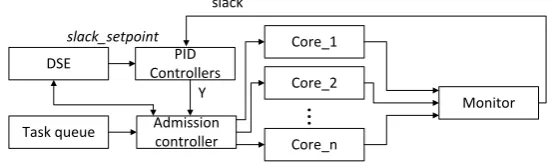
The general architecture employed in our work is depicted in Figure 2. The system is comprised of n processing cores, whose dynamic slacks (slack vector whose length|slack|=n) are observed constantly by the Monitor block.
In the PID Controllers block, one discrete-time PID controller for each core is invoked everydttime. Since small sampling intervals emulate continuous time algorithms more accurately [9], the PID controllers have been decided to be activated every clock tick.
The controllers use dynamic slacks of the corresponding cores as the observed values.
The Admission controller block receives a vector of PID controllers’ outputs, Y = [y1(t), . . . , yn(t)], from the PID Controllers block. Based on its elements’
If this analysis predicts that the workload is schedulable, an (ii) exact schedu-lability analysis is performed by the Design Space Exploration (DSE) block. If at the second stage the result of the task schedulability analysis is negative, the task is rejected. Otherwise it is(iii) allocated to a core where the execution be-fore the deadline is guaranteed based on the schedulability analysis performed in block DSE.
3.3 Problem Formulation
Given an application and platform models, the problem is to quickly identify tasks whose hard timing constraints would be violated by the processing cores and then to reject such tasks without performing costly exact schedulability analysis. The number of rejected tasks should be reasonably close to the number of tasks rejected in a corresponding open-loop system, i.e. the system without the early rejection prediction. Meeting the deadlines for all admitted tasks shall be guaranteed.
4
Performing Runtime Admission Control and Load
Balancing to Cope with Dynamic Workloads
t
p,k
cp,k si,j Cp
Ip,k ri,j Fp,k
t
p,k
cp,k
si,j Cp
Ip,k ri,j Fp,k
t
p,k
Ip,k cp,k
[image:6.595.142.450.379.431.2]Fp,kri,j si,j=0 Cp
Fig. 3.Illustration of taskτi,j slack in three cases from equation (1)
In dynamic workloads, admitting and executing all hard real-time (HRT) tasks belonging to a taskset can jeopardise system timeliness. The role of the admission control is to detect the potential deadline violation of a released task, τl, and to reject it in such a case. In doing so, the resource working time is not
wasted for the task that would probably violate its deadline and early signaling of the rejection could be used for minimizing its negative impact.
The j-th job of task τi, τi,j, is released at ri,j, with the deadline di,j and
the relative deadline Di,j = di,j−ri,j. The slack for τi,j executed on core πa,
where τp,k was the immediate previous job executed by this core, is computed
as follows:
si,j=
(C
p−cp,k ifri,j≤Ip,k+cp,k,
Fp,k−ri,jifIp,k+cp,k ≤ri,j< Fp,k,
0 ifri,j≥Fp,k,
(1)
whereri,j is release time of τi,j,Ip,k - initiation time ofτp,k (also known as the
starting time of job execution),cp,k andCp - computation time and worst-case
similar slack calculation approach is employed in [14]. The three possible slack cases (Equation (1)) are illustrated in Figure 3 (left, centre, right, respectively). In these figures the solid rectangle illustrates execution time (ET) ofτp,k, whereas
the striped rectangle shows the difference between WCET and ET of this task. The normalised value of slack of currently executed job τi,j on core πa is
computed as follows:
slacka =
Di,j−si,j
Di,j
. (2)
This value is returned by a monitor and compared by a PID controller with setpoint slack setpoint. An error ea(t) = slacka−slack setpoint is computed
for coreπa, as schematically shown in Figure 2. Then thea-th output of the PID
Controllers block, reflecting the past and previous dynamic slack values in core πa, is computed with formula
ya(t) =KPea(t) +KI IW
X
i=0
ea(t−i) +KD
ea(t)−ea(t−1)
dt , (3)
where KP, KI and KD are positive constant components of the proportional,
integral and derivative terms of a PID controller, and IW is a selected length of the integral time window. Their values are usually determined using one of the well-known control theory methods, such as root locus technique, Ziegler-Nichols tuning method or many others, to obtain the desired control response and preserve the stability. In our research, we have applied Approximate M-constrained Integral Gain Optimisation (AMIGO), as it enables a reasonable compromise between load disturbance rejection and robustness [2].
The value ofslack setpoint is bounded between values:min slack setpoint and max slack setpoint, which should be chosen appropriately during simula-tion of a particular system. Similarly, the initial value of slack setpoint can influence (slightly, according to our experiments) the final results. In this pa-per, it is initialised with the average between its minimal and maximal allowed values to converge quickly with any value from the whole spectrum of possible controller responses.
The slacks of the tasks executed by a particular processing core accumulate as long as the release times of each task are lower than the worst-time completion time of the previous task, which correspond to the first two cases in equation (1) and are illustrated in Figure 3 (left and centre). It means that the slacks of subsequent tasks executed on a given core can be used as a controller input value. However, previous values of dynamic slack are of no importance when the core becomes idle, i.e. the core finishes execution of a task and there are no more tasks in the queue to be processed, which corresponds to the third case in equation (1) illustrated in Figure 3 (right). To reflect this situation, the current value of slack setpoint is provided as an errorea(t), to enhance the task assignment to
Algorithm 1: Pseudo-code of Admission controller involving DSE algo-rithm
inputs :Taskτl∈Γ (from Task queue)
Vector of errors Y[1..n] (from PID Controller) Controller invocation perioddt
slack setpointdecrease perioddt1,dt1> dt
outputs :Coreπa∈Πexecutingτlor job rejection Value ofslack setpoint
constants:min slack setpoint- minimal allowed value ofslack setpoint max slack setpoint- maximal allowed value ofslack setpoint slack setpoint add- value to be added toslack setpoint slack setpoint sub- value to be subtracted fromslack setpoint 1 whiletruedo
2 whiletask queue is not emptydo 3 fetchτl;
4 forallYa>0do
5 iftasksetΓa∪τlis schedulablethen
6 assignτltoπa;
7 break;
8 end
9 ifτlnot assignedthen
10 rejectτl;
11 if∃Ya: Ya>0∧slack setpoint < max slack setpointthen
12 increaseslack setpointbyslack setpoint add;
13 end
14 end
15 end
16 end
17 waitdt;
18 end
19 whiletruedo
20 ifslack setpoint > min slack setpointthen 21 decreaseslack setpointbyslack setpoint sub;
22 end
23 waitdt1;
24 end
The PID Controllers block output value Y = [y1(t), . . . , yn(t)] is provided as
an input to the Admission controller block, where it is used to perform a task admittance decision. If all PID Controllers’ outputs (errors)ya(t), a∈ {1, . . . , n}
are negative, the task τl fetched from the Task queue is rejected. Otherwise,
a further analysis is conducted by the Design Space Exploration (DSE) block to perform exact schedulability analysis. The available resources are checked according to any exact schedulability test (e.g. from [5]), which is performed for each core with task τl added to its taskset as long as a schedulable assignment
is not found. If no resource is found that guarantees the task execution before its deadline, it is rejected.
The pseudo-code of the control strategy is presented in Algorithm 1. This algorithm is comprised of two parts, described respectively by lines 1-18 and 19-24, which are executed concurrently. The first part consists of the following steps.
– Step 1. Invocation (lines 1, 17).
The block functionality is executed in an infinite loop (line 1), activated every time intervaldt(line 17).
– Step 2. Task fetching and schedulability analysis (lines 2-8).
which are treated as an early estimation of schedulability (line 4). If such value is found in an a-th output, an exact schedulability test checks the schedulability of the tasksetΓa of the corresponding coreπa extended with
taskτlusing any exact schedulability test (line 5), e.g. from [5]. If the analysis
proves that the taskset is schedulable,τlis assigned toπa(line 6). Otherwise,
the next core with the corresponding positive output value is looked for.
– Step 3. Task rejection and setpoint increase (lines 9-15).
If all cores have been browsed and none of them can admitτldue to either a
negative controller output value or the exact schedulability test failure, the taskτl is rejected (line 10). In this case, if there exists at least one positive
value in the PID Controllers’ output vector, theslack setpoint is increased by constantslack setpoint addprovided that it is lower than constantmax -slack setpoint (lines 11-12) to improve the schedulability estimation in fu-ture.
The second part consists of two steps.
– Step 1. Invocation (lines 19, 23).
The block functionality is executed in an infinite loop (line 19), activated every time intervaldt1,dt1> dt(line 23).
– Step 2. Setpoint decrease (lines 20-21).
The value ofslack setpointis decreased by constantslack setpoint sub (pro-vided that it is higher than constantmin slack setpoint), which encourages a higher number of tasks to be admitted in future.
5
Experimental Results
In order to check the efficiency of the proposed feedback-based admission control and real-time task allocation process, a Transaction-Level Modelling (TLM) sim-ulation model has been developed in SystemC language. Firstly, the controller components KP, KI andKD have to be tuned by analysing the corresponding
open-loop system response to a bursty workload. Then two series of experiments have been performed. Firstly, workloads of various weight have been tested to observe the system behaviour under different conditions and to find the most beneficial operating region. Then industrial workloads with dependent jobs have been used to determine the applicability of the proposed approach in real-life scenarios. The details of these experiments are described below.
0 100 200 300 400 500 600 700
W1 W2 W3 W4 W5 W6 W7 W8
#
T
as
ks
Workloads open-loop closed-loop
0 200 400 600 800 1000 1200
W1 W2 W3 W4 W5 W6 W7 W8
#
S
ch
edu
la
bi
lity
te
sts
[image:10.595.135.473.118.221.2]Workloads
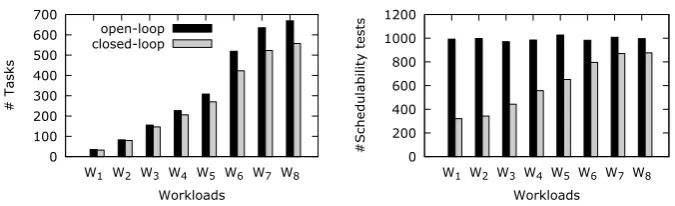
Fig. 4. Total number of tasks executed before their deadlines (left) and number of the exact schedulability test executions (right) in baseline open-loop and proposed closed-loop systems for the random workloads simulation scenario with workload sets W1, . . . ,W8including 1000 tasks each
slack setpoint sub= 0.05, the first part of the proposed algorithm (Algorithm 1) is executed five times more often than the second one.
To check the system response to tasksets of various levels of load, eight sets, W1, . . . ,W8, of 10 random workloads each have been generated. Each workload is comprised of 100 tasks, including a random number (between 1 and 20) of independent jobs. The execution time of every job is selected randomly between 1 and 99µs. All jobs of a task are released at the same instant, and the release time of the subsequent task is selected randomly betweenri+range min·Ci andri+
range max·Ci, whereCiis the total worst-case execution time of the current task
τireleased atri, andrange min, range max∈(0,1),range min < range max.
The following parameters for pairs (range min, range max) have been selected for workloads: W1 - (0.001,0.01), W2 - (0.0025,0.025), W3 - (0.005,0.05), W4 -(0.0075,0.075), W5- (0.01,0.1), W6-(0.02,0.2), W7- (0.03,0.3), W8- (0.04,0.4) to cover a wide spectrum of workload heaviness.
workload sets W1 and W2, the schedulability tests are executed about 65% less frequently in the closed-loop system.
This experiment has been conducted for the number of processing cores rang-ing from 1 to 9. The number of executed tasks grows almost linearly with the number of cores in both configurations and the slopes of their linear regression approximations (both with correlation coefficients higher than 0.99) are almost equal. This implies that both configurations are scalable in a similar way and the difference between the number of executing tasks in open-loop and closed-loop systems is rather unvarying. The number of schedulability test executions is al-most constant in the open-loop system regardless the number of cores. However, for the closed-loop configuration, it changes in a way relatively well approximated with a power regression model (power regression result:y= 1476.29x−0.30, resid-ual sum of squaresrss= 14216.21, wherexis the number of cores andy - the number of schedulability test executions). Since the growing number of process-ing cores corresponds to less computation on each of them, the conclusion is similar as in the (range min, range max) variation case: the higher the load for the cores, the more beneficial is applying of the proposed scheme.
To analyse industrial workloads, 90 workloads have been generated whose dependency patterns are based on the grid workload of an engineering design department of a large aircraft manufacturer, as described in [3]. These workloads include 100 tasks of 827 to 962 jobs in total. The job execution time varies from 1ms to 99ms. Since the original workloads have no deadlines provided explicitly, relative deadline of each task has been set to its WCET increased by a certain constant (100ms).
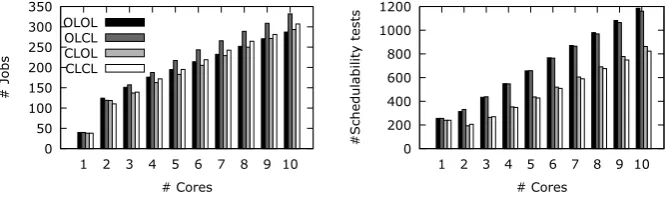
In these workloads all jobs of any task are submitted at the same time, thus it is possible at the first stage to identify the critical path of each task and admit the task if there exists a core that is capable of executing the jobs belonging to the critical path before their deadlines. At the second stage, the remaining jobs of the task can be assigned to other cores so that the deadline of the critical path is not violated. The outputs from PID controllers can be used for choosing the core for the critical path jobs (during the first stage) or the cores for the remaining jobs (during the second stage). Four configurations can be then applied. We abbreviate them with four letter acronyms, where the two first letters denote whether the core selection for critical path tasks is done without (open loop -OL) or with (closed loop - CL) PID controllers and similarly the two remaining letters inform if the core selection for tasks outside the critical path is performed without (OL) or with (CL) PID controllers. For example, in configuration OLOL no PID controller is used and thus this configuration is treated as a baseline (only exact schedulability tests are used to select a core for a job execution).
Figure 5 (left) shows the number of jobs executed before their deadlines. The cores are scanned in a lexicographical order as long as the first one capable of executing the job satisfying its timing constraints is not found, whereas in the closed-loop configurations the tasks are checked with regards to the decreasing value of the corresponding controller outputs. Notice that the number of cores is related to the processing cores only (Core 1, ..., Core n in Fig. 2); the remaining functional blocks (e.g. Admission controller) are realised in additional cores.
0 50 100 150 200 250 300 350
1 2 3 4 5 6 7 8 9 10
#
J
obs
# Cores OLOL
OLCL CLOL CLCL
0 200 400 600 800 1000 1200
1 2 3 4 5 6 7 8 9 10
#
S
ch
edu
la
bi
lity
te
sts
[image:12.595.139.472.122.221.2]# Cores
Fig. 5. Number of executed jobs (left) and number of schedulability test executions (right) for systems configured in four different ways for the industrial workloads simu-lation scenario
best results. Its superiority in comparison with CLCL stems from the fact that an over-pessimistic rejection of critical path jobs leads to fast rejection of the whole task. Thus the cost of a false negative estimation is rather high. Wrong estimation at the second stage usually results in choosing an idler core. The OLCL configuration admits 11% more jobs than OLOL, whereas CLCL is only slightly (about 1.5%) better than the baseline OLOL.
The main reason for introducing the control-theory based admittance is, how-ever, decreasing the number of costly exact schedulability testing. The number of the exact test executions is presented in Figure 5 (right). Not surprisingly, the wider the usage of controller outputs, the lower is the cost of schedulability testing. The difference between OLOL and OLCL is almost unnoticeable, but the configurations with control-theory-aided selection of a core for the critical path jobs leads to significant, over 30% reduction.
From the results it follows that two configurations OLCL and CLCL dominate the others: the former in terms of number of executed jobs, the latter in terms of number of schedulability tests. Depending upon which goal is more important, one of them is advised to be selected. Interestingly, only in case of low number of processing cores, the baseline OLOL approach is slightly better than the remaining ones. For larger systems, applying PID controllers for task admissions seems to be quite beneficial.
6
Conclusions and Future Work
for computing jobs belonging to the critical path. In future, we plan to consider heterogeneous many-core system and extend the proposed approach for mixed criticality workloads.
7
Acknowledgments
The research leading to these results has received funding from the European Union’s Seventh Framework Programme (FP7/2007-2013) under grant agree-ment no. 611411.
References
1. Arzen, K.E., Robertsson, A., Henriksson, D., Johansson, M., Hjalmarsson, H., Johansson, K.H.: Conclusions of the ARTIST2 roadmap on control of computing systems. SIGBED Rev., Volume 3, Issue 3, 11–20 (2006)
2. Astrom, K., Hagglund, T.: Revisiting the Ziegler-Nichols step response method for PID control. Journal of Process Control, Volume 14, 635–650 (2004)
3. Burkimsher, A., Bate, I., Indrusiak, L.S.: A characterisation of the workload on an engineering design grid. In: Proceedings of the High Performance Computing Symposium (HPC ’14). Society for Computer Simulation International, Article 8 (2014)
4. Cheveresan, R., Ramsay, M., Feucht, C., Sharapov, I.: Characteristics of workloads used in high performance and technical computing. In: Proceedings of the 21st Annual International Conference on Supercomputing (ICS’07), pp. 73–82 (2007) 5. Davis, R.I., Burns, A.: A survey of hard real-time scheduling for multiprocessor
systems. ACM Comput. Surv., Volume 43, Issue 4, Article 35 (2011)
6. Djosic, S., Jevtic, M.: Dynamic voltage scaling for real-time systems under fault tol-erance constraints. In: 28th International Conference on Microelectronics (MIEL), pp. 375–378 (2012)
7. Engblom, J., Ermedahl, A., Sjodin, M., Gustafsson, J., Hansson, H.: Worst-case execution-time analysis for em-bedded real-time systems, International Journal on Software Tools for Technology Transfer. Volume 4, Issue 4, 437-455 (2003) 8. Giannopoulou, G., Stoimenov, N., Huang, P., Thiele, L.: Scheduling of
mixed-criticality applications on resource-sharing multicore systems. In: International Conference on Embedded Software (EMSOFT’13), pp. 1–15 (2013)
9. Janert, P.K.: Feedback Control for Computer Systems, OReilly Media (2013) 10. Kumar, A., Mesman, B., Theelen, B., Corporaal, H., Yajun, H.: Resource
Manager for Non-preemptive Heterogeneous Multiprocessor System-on-chip. In: IEEE/ACM/IFIP Workshop on Embedded Systems for Real Time Multimedia (ESTMED ’06), pp. 33-38 (2006)
11. Kiasari, A.E., Jantsch, A., Lu, Z.: Mathematical formalisms for performance eval-uation of networks-on-chip. ACM Comput. Surv., Volume 45, Issue 3, Article 38 (2013)
12. Lu, C., Stankovic, J.A., Son, S.H., Tao, G.: Feedback control real-time scheduling: Framework, modeling, and algorithms. Real-Time Systems, Volume 23, Issue 1/2, 85–126 (2002)
13. Tavana, M.K., Salehi, M., Ejlali, A.: Feedback-Based Energy Management in a Standby-Sparing Scheme for Hard Real-Time Systems. In: 32nd IEEE Real-Time Systems Symposium (RTSS’11), pp. 349–356 (2011)