
This is a repository copy of Optimized Basis Sets for the Environment in the Domain-Specific Basis Set Approach of the Incremental Scheme.
White Rose Research Online URL for this paper: http://eprints.whiterose.ac.uk/97102/
Version: Accepted Version
Article:
Anacker, T., Hill, J. orcid.org/0000-0002-6457-5837 and Friedrich, J. (2016) Optimized Basis Sets for the Environment in the Domain-Specific Basis Set Approach of the Incremental Scheme. Journal of Physical Chemistry A, 120 (15). pp. 2443-2458. ISSN 1089-5639
https://doi.org/10.1021/acs.jpca.6b01097
[email protected] https://eprints.whiterose.ac.uk/ Reuse
Unless indicated otherwise, fulltext items are protected by copyright with all rights reserved. The copyright exception in section 29 of the Copyright, Designs and Patents Act 1988 allows the making of a single copy solely for the purpose of non-commercial research or private study within the limits of fair dealing. The publisher or other rights-holder may allow further reproduction and re-use of this version - refer to the White Rose Research Online record for this item. Where records identify the publisher as the copyright holder, users can verify any specific terms of use on the publisher’s website.
Takedown
If you consider content in White Rose Research Online to be in breach of UK law, please notify us by
Optimized Basis Sets for the Environment in
the Domain-Specific Basis Set Approach of
the Incremental Scheme
Tony Anacker,
†J. Grant Hill,
‡and Joachim Friedrich
∗,††Department of Theoretical Chemistry, Chemnitz University of Technology, Straße der
Nationen 62, D-09111 Chemnitz, Germany
‡Department of Chemistry, University of Sheffield, Sheffield S3 7HF, UK
E-mail: [email protected]
Abstract
Minimal basis sets, denoted DSBSenv, have been developed based on the segmented
basis sets of Ahlrichs and co-workers for use as environmental basis set for the
domain-specific basis set incremental scheme with the aim of decreasing the CPU requirements
of the incremental scheme. The use of this minimal basis within explicitly correlated
(F12) methods has been enabled by the optimization of matching auxiliary basis sets
for use in density fitting of two-electron integrals and the resolution-of-the-identity.
The accuracy of these auxiliary sets has been validated by calculations on a test set
containing small- to medium-sized molecules. The errors due to density fitting are about
two to four orders of magnitude smaller than the basis set incompleteness error of the
DSBSenv orbital basis sets. Additional reductions in computational cost are tested
with the reduced DSBSenv basis sets, where the highest angular momentum functions
of the DSBSenv auxiliary basis sets have been removed. The optimized and reduced
basis sets are used in the framework of the domain-specific basis set of the incremental
scheme to decrease the computation time without significant loss of accuracy. The
computation times and accuracy of the previously used environmental basis and that
optimized in this work is validated with a test set of medium- to large-sized systems.
The optimized and reduced DSBSenv basis sets decrease the CPU-time by about 15.4 %
and 19.4 % compared to the old environmental basis and retains the accuracy in the
absolute energy with a standard deviation of 0.99 and 1.06 kJ/mol, respectively.
Introduction
The application of highly accurate wave function based methods to large systems is a
chal-lenging research field in the last few years. A primary goal is to have an alternative method
to density functional theory, which is systematically improvable and can be applied for
even larger systems. Coupled-cluster with single, double and perturbative triple excitations
[CCSD(T)] with an appropriate basis set is currently the “gold standard” of quantum
frequently used to make CCSD(T) applicable. The first deals with the slow convergence
of the coupled-cluster energies with respect to the one-particle basis set. To overcome this
drawback complete basis set extrapolations,5–7 interference-corrected coupled-cluster8–11 or
explicitly correlated methods6,12–19 are frequently used strategies. The convergence with
re-spect to the complete basis set (CBS) limit is improved and therefore smaller basis sets can
be used to achieve accurate energies with affordable computational cost.
Another strategy to reduce the computational effort is to introduce local approximations
in the wave function with the goal of reducing the scaling with system size. With the
fun-damental work of Pulay and Sæbø20–24 many groups have developed local methods
includ-ing Werner’s local coupled-cluster methods,17,18,25–33 Neese’s pair natural orbitals (PNOs)
coupled-cluster34–44 and Yang’s orbital specific virtuals (OSVs) coupled-cluster.33,45–47 The
incremental scheme proposed by Stoll48–55 is another local method and is frequently used
by Dolg,56–60 Friedrich61–66 and Paulus.54,67–72 A fully automated implementation of this
scheme for MP2 and CCSD(T) and the corresponding explicitly correlated methods were
developed by Friedrich73–80 and Dolg.56,57 The incremental scheme very efficiently delivers
highly accurate energies81,82 and properties66,83,84 for closed- and open-shell systems.85,86
In this work, the computational speed performance of the automated incremental scheme of
Friedrich shall be improved. The main approximation for improving the computation times
is the application of the domain-specific basis set. With this approach the virtual space of
a domain is reduced in order to save computational time and is discussed in detail below.
In previous work, the SV orbital basis set (OBS) of Ahlrichs87 was used in conjunction with
the SVP auxiliary basis sets (ABS)88 in both the density fitting of two electron integrals
in density-fitted MP2 (DF-MP2) and as the complementary basis for explicitly correlated
methods (F12) within the complementary auxiliary basis set (CABS)89 approach to the
resolution-of-identity (RI) approximation of many electron integrals. This combination was
used as an ad hoc guess to describe the environment of a domain in the domain-specific
ABS to improve the computational speed performance of the incremental scheme. Another
main goal is to achieve negligible loss of accuracy in using the newly developed basis sets.
The DSBSenv basis sets are optimized for the first three periods of the periodic table and
these basis sets are then used in the incremental scheme with the domain-specific basis set.
Moreover, the reduced DSBSenv basis sets remove the highest angular momentum functions
in the ABS to further improve computational speed performance. We compare the old
envi-ronmental SV/SVP basis sets with the newly optimized and reduced DSBSenv sets in respect
to the computation times of the incremental scheme as well as the accuracy in the absolute
correlation energy and relative energies.
Incremental Scheme
For an incremental calculation of the correlation energy, the system is divided into one-site
domains consisting of disjoint sets of localized occupied orbitals.61,62 The correlation energy
of the total system is computed through a truncated many-body expansion, summing the
correlation energy of these one-site domains and energy corrections for pairs, triples, etc. of
these domains that approximately account for the non-additivity of the correlation energy.
The incremental expansion of the correlation energy reads:50,61
Ecorr =
X
X X∈P(D)∧|X|≤n
∆εX (1)
where P(D) is the power set of the set of domains D. The restriction to the cardinality of
the sets Xtruncates the incremental series at the desired order n and the increment ∆εX is
defined as
∆εX =εX− X Y Y∈P(X)∧|Y|<|X|
εX is the correlation energy of the domain X. Each domain is a set of localized occupied
orbitals (LMOs), grouped using METIS graph partitioning90 on the basis of charge-center
distance criteria, and a subsequent pairwise refinement.79
The Domain-Specific Basis Set Approximation
To further improve the computational speed performance of the incremental scheme, for each
incremental domain calculation the virtual space is reduced by using a domain-specific basis
set, where the high quality basis set is used only at the atoms close to the charge centers of
the domain and a small basis set is used at the remaining atoms.63,73,76,91
In this approach, we construct the domains from Boys-localized molecular orbitals obtained
from a SCF calculation on the whole molecule in a small basis, which we are free to choose
(we use the SV and the DSBSenv OBS developed in this work). The incremental correlation
energy of a domain is computed after a Hartree-Fock (HF) calculation in the composed
domain-specific basis set, and a unique mapping of the localized molecular orbitals in the
domain-specific basis set to the small basis calculation. The computational time for the
additional HF calculation is negligible compared to the CCSD(T) calculation for the domain.
The environment of a domain is included in an incremental calculation to avoid artificial
errors in the wave function. The reduction of the virtual space using a small environmental
basis introduces errors in the incremental correlation energies, but we can effectively correct
this using the incremental MP2 error. With the newly optimized DSBSenv basis sets, we
use a minimal basis for the environment and want to investigate the influence of a larger
virtual space reduction on the accuracy and computation time of the incremental scheme.
In addition to improving computational speed performance, smaller environmental basis sets
MP2 Error Correction
The domain-specific basis set approach introduces an error in the CCSD(T)(F12*)14,15,92
energy. The leading contributions to these errors can be subtracted using the relatively
cheap MP2 method, computed in the target basis
Ecorrinc(CCSD(T)(F12*)|MP2-F12)
= Ecorrinc(CCSD(T)(F12*))− Ecorrinc (MP2-F12)−Ecorr(MP2-F12)
(3)
The MP2 error correction allows us to truncate the incremental expansion at second order
for water clusters and at third order for organic systems, for both open-shell and closed-shell
systems.79,80,82,93
Basis Set Development
In the following, we present the development of the DSBSenv OBS and ABS basis sets for
the atoms of the first three periods of the periodic table, i.e. period 1 (H and He), period 2
(Li–Ne) and period 3 (Na–Ar).
The DSBSenv Orbital Basis Sets
The DSBSenv OBS was constructed by recontracting the def-SV basis set primitives of
Ahlrichs and co-workers87,94 to form a minimal basis with a segmented contraction scheme.
For this purpose, we used the atomic orbital (AO) coefficients from symmetry adapted
HF calculations on atomic ground-states carried out using the MCSCF program in
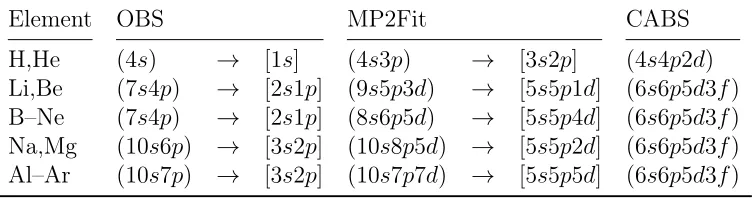
MOL-PRO.95,96 For the H and He atoms, the 4s functions are contracted to 1s function, for the
atoms Li–Ne7s4pto2s1p, and for the atoms Na–Ar10s7pto3s2p. The final composition of
the basis sets are shown in Table 1, along with the composition of the matched auxiliary basis
sets. The DSBSenv basis sets (including ABSs) can be found in the Supporting Information
Table 1: Composition of the DSBSenv orbital and the auxiliary MP2Fit and CABS basis sets for the elements H–Ar.
Element OBS MP2Fit CABS
H,He (4s) → [1s] (4s3p) → [3s2p] (4s4p2d)
Li,Be (7s4p) → [2s1p] (9s5p3d) → [5s5p1d] (6s6p5d3f)
B–Ne (7s4p) → [2s1p] (8s6p5d) → [5s5p4d] (6s6p5d3f)
Na,Mg (10s6p) → [3s2p] (10s8p5d) → [5s5p2d] (6s6p5d3f)
Al–Ar (10s7p) → [3s2p] (10s7p7d) → [5s5p5d] (6s6p5d3f)
The DSBSenv/MP2Fit Auxiliary Basis Sets
Auxiliary basis sets for use in density fitting of two-electron integrals (suffixed MP2Fit)
matched to the DSBSenv basis have been optimized using a methodology based on that
of Hättig and Weigend et al.88,97 The functional δ
DF is minimized for neutral ground-state
atoms using the analytical ABS gradients provided by thericc2 module88,97–99 of
TURBO-MOLE:100
δDF =
1 4
X
aibj
(hab||ijiDF− hab||iji)2
ǫa−ǫi+ǫb−ǫj
(4)
where the antisymmetrized two electron integrals are defined as hab||iji= (ai|bj)−(aj|bi).
The integrals are in chemists notation, with i, j denoting occupied orbitals, a, b virtual
or-bitals and ǫx the HF orbital energies. Full details of the optimization can be found in the SI,
but briefly the ABS uses the exponents of the def-SV(P)/MP2Fit ABS88,97 primitives with
a reoptimization of the contraction coefficients to produce a new, smaller contraction pattern.
The accuracy of the optimized MP2Fit auxiliary basis sets has been investigated at the
molecular level with a test set of 104 small- to medium-sized systems derived from Kritikou’s
extension of Weigend’s test set.101,102 The noble gas atoms have been removed from the
test set as the minimal basis means they have no virtual orbitals to allow a correlation
linear combination of AOs (LCAO). The statistics of the∆DF error, defined as the absolute
error in the MP2 correlation energy, for the test set are shown in Table 2, along with an
estimate of the conventional MP2/DSBSenv BSIE. The latter is assessed by using
MP2-F12/cc-pVQZ-F12 correlation energies as a simple estimate of the complete basis set limit.
These F12 calculations used the (R)MP2-F12 method103,104 with the 3C(FIX) Ansatz,105 a
geminal Slater exponent of 1.0 and correlation consistent basis sets optimized specifically
for use with F12 methods.106,107 It can be seen from Table 2 that the density fitting error is
three to four orders of magnitude smaller than the conventional BSIE, indicating that the
errors introduced in the density fitting are negligible. As it is envisaged that the DSBSenv
basis will be used in explicitly correlated calculations, Table 2 also contains an estimate
of the MP2-F12/DSBSenv BSIE, and it is evident that the BSIE is reduced by a factor of
roughly 2–5 through the use of explicit correlation. A comparison of the MP2-F12 BSIE
and ∆DF shows that the density fitting error is roughly three orders of magnitude smaller
than this measure of BSIE and hence the MP2Fit ABS developed in this work should also
be appropriate for density fitting in the explicitly correlated context.
Table 2: DSBSenv frozen-core correlation energy errors (µEh, per correlated
electron) relative to the MP2-F12/cc-pVQZ-F12 energy for the test set of 101 molecules. ∆DF evaluates the MP2 density fitting error using the optimized MP2Fit ABS and ∆RI gives the MP2-F12 error of the optimized OptRI ABS relative to the large even-tempered sets.
Error Type µ σ MAX
BSIE (MP2) 27309.75 8619.67 40179.23
BSIE (MP2-F12) 6041.94 2725.67 25659.05
∆DF (MP2Fit) 7.08 9.35 50.28
∆RI (OptRI) 14.24 14.57 60.57
The DSBSenv/OptRI Complementary Auxiliary Basis Sets
RMP2-F12103,104calculations with the diagonal 3C(D)Ansatz and a geminal slater exponent
For this purpose, either the Broyden-Fletcher-Goldfarb-Shanno (BFGS)108 or Nelder-Mead
simplex algorithm109 were used. The optimizations were performed with a locally modified
version of MOLPRO and use the diagonal elements of the intermediate V and B matrices,
which appear in F12 theory.103 The resulting ABSs follow the OptRI design philosophy of
Peterson and co-workers, with the exponents optimized by minimizing the objective function
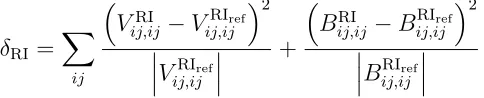
δRI,110 where the superscript ref indicates a large, almost complete, RI basis.
δRI=
X
ij
VRI
ij,ij −V
RIref ij,ij 2 V RIref ij,ij + BRI
ij,ij−B
RIref ij,ij 2 B RIref ij,ij (5)
δRI has units of energy and is always positive. The value ∆RI is also introduced to indicate
the energetic error due to using an incomplete ABS in the RI.
∆RI=
EcorrOptRI−Ecorrref
(6)
Large even-tempered basis sets of Hill107,111 were used as reference RI ABS. These
uncon-tracted sets have 21s18p14d12f10g8h6i functions for H and He, 28s26p22d22f20g18h15i
functions for Li–Ne, and 29s27p23d20f18g17h15i functions for Na–Ar. Additionally the
aug-cc-pV5Z/MP2Fit112 and cc-pV5Z/JKFit101,113 ABS were used in the density fitting of
the two-electron integrals, and the Fock and exchange matrices. Additional optimization
[image:10.612.186.428.227.276.2]details are included in the SI.
Table 3: RI errors in the frozen-core correlation energy (per correlated electron, relative to a large even-tempered reference set) at the MP2-F12 level for the atoms H–Ar. ∆RI illustrates the error in the absolute energy.
∆RI [µEh] δRI [nEh]
Element µ σ MAX µ σ MAX
H2, He 1.67 1.92 3.03 0.33 0.03 0.35
Li–Ne 9.64 7.87 20.58 1.77 2.24 7.17
Na–Ar 9.55 8.99 22.03 6.16 4.15 10.69
The statistics of theδRIand∆RI atomic errors are shown in Table 3, where it can be seen
that the average energetic error per correlated electron is less then 10 µEh. The period two
and three elements have the same composition for the OptRI basis and therefore, the small
increase in the statistical errors in the optimization criteriaδRI are not entirely surprising. It
is noted in passing that the DSBSenv/OptRI ABSs are almost equivalent in size to
cc-pVDZ-F12/OptRI (the latter have fewer spd functions, but require higher angular momentum
g-type functions). This is presumably due to the unified OBS and ABS needing to span a
specific space in order to accurately reproduce the RI integrals, and in the present case the
relatively large CABS compensates for the minimal nature of the OBS. The optimized OptRI
ABS are also analyzed in terms of molecular error using the same test set as above for density
fitting errors, with results displayed in Table 2. The error related to using the OptRI ABSs
is once again insignificant compared to the MP2-F12 BSIE, as it is two to three orders of
magnitude smaller. The reader is reminded at this stage that the main goal of this basis set
development is to provide an efficient environmental basis set for the domain-specific basis
set approach in order to increase the computational speed performance of the incremental
scheme.
The reduced DSBSenv Auxiliary Basis Sets
The domain-specific basis set approach is the most important approximation within our
incremental scheme to decrease the computation time and enable local correlation with
large basis sets. Therefore, the use of minimal basis sets for the environment is preferable,
but one has to take account of the errors introduced. The reduction of the virtual space
using the DSBSenv OBS introduces a larger error than the density fitting. The DSBSenv
minimal OBS is used for the environment of a domain, which is an insufficient description
of the environment with regard to the large target basis used for the main part of a domain.
This unbalanced basis leads to HF orbitals different to those of the target basis. Thus,
different HF orbital spaces for every domain calculation.63 We can assess this error with
the incremental MP2 error, as shown in previous studies.79 It is expected that the density
fitting in the environment has a negligible error compared to the use of a minimal basis (see
Tab. 7). Therefore, we try to improve the computational speed performance of the
domain-specific basis incremental scheme by removing the highest angular momentum functions from
the MP2Fit and OptRI ABSs matched to the DSBSenv basis set. All other exponents and
contraction coefficients remain fixed at their optimized values. These ABSs are referred to
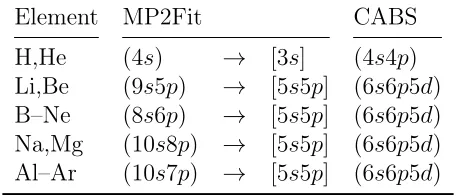
as rDSBSenv, which are used in conjunction with the DSBSenv OBS. The compositions of
[image:12.612.192.420.347.445.2]the MP2Fit and OptRI rDSBSenv ABSs are shown in Table 4.
Table 4: Composition of the auxiliary reduced DSBSenv (rDSBSenv) MP2Fit and CABS basis sets for the elements H–Ar. The rDSBSenv ABSs use the DSBSenv OBSs.
Element MP2Fit CABS
H,He (4s) → [3s] (4s4p)
Li,Be (9s5p) → [5s5p] (6s6p5d)
B–Ne (8s6p) → [5s5p] (6s6p5d)
Na,Mg (10s8p) → [5s5p] (6s6p5d)
Al–Ar (10s7p) → [5s5p] (6s6p5d)
Application in the Incremental Scheme
The TURBOMOLE 6.6 program package100 was used for all reference and incremental
cal-culations to investigate the computation time and accuracy of the above optimized
DSB-Senv basis sets. For the density-fitted explicitly correlated calculations MP2-F12114 and
CCSD(T)(F12*),14,15,92 the optimized cc-pVDZ-F12 basis sets106,107 were used. All
calcula-tions used the frozen core approximation. Therefore, the 1s electrons of the Be–Al atoms,
and the1s2s2p electrons of the Si–Ar atoms are excluded from the correlation treatment.
Third-order incremental F12 [i3F12], CCSD(T)(F12*) [i3CC(F12*)] and
our fully automated implementation.73–80 For the small basis in the domain-specific basis
approach,91we employed either the SV basis and the SV(P) auxiliary basis sets or the newly
optimized DSBSenv basis sets for all atoms. The distance threshold used to specify the
atoms belonging to a domain wastmain= 3.0a0, as recommended in previous work.80,93 The
calculations employed an order-dependent distance thresholdtdist(i), set using the truncation
parameter f = 30a0 as recommended previously.79
tdist(i) =
f
(i−1)2 (7)
All incremental computations were performed on a cluster of 71 nodes connected by
stan-dard gigabit Ethernet. Each node is equipped with an Intel Xeon E3-1270 3.4 GHz Quad-core
CPU, 8 GB RAM, and a single hard disk of 1 TB.
For the following investigations a test set was optimized which contains all elements of
the first, second and third periods of the periodic table. The structures were optimized
with the BP86/def2-TZVP88,94 method or were taken from the literature.79,115 The noble
gas structures were optimized with a dispersion correction116 (BP86-D3/def2-TZVPP). The
test set contains 37 systems and is divided into two subsets. Subset I consists of neutral and
ionic cluster structures (10 systems), for which the incremental scheme has an outstanding
accuracy with the old environmental basis sets. For the noble gas structures, i.e. He10, Ne10, and Ar14, we chose every atom as a domain. Subset II exists of diverse covalent bound systems (27 systems) with aromatic π systems as critical tests for the incremental scheme.
Additionally, the test set can be divided into a subset containing only elements from periods
one and two (period 2 subset) and a subset containing elements from periods one, two and
I, period 2 II, period 3 II, period 3
II, period 2 II, period 2 II, period 2
II, period 2 II, period 2 II, period 2
II, period 2 II, period 2 II, period 3
II, period 2 II, period 2 II, period 3
II, period 3 II, period 3 II, period 3
II, period 3 II, period 3 II, period 3
I, period 3 I, period 2 II, period 3
I, period 2 I, period 2 II, period 3
II, period 3 I, period 3 II, period 2
II, period 3 I, period 2 I, period 3
[image:15.612.100.513.76.635.2]I, period 2
Computation Time
For all incremental calculations, the thresholds given above are used. The reference
calcula-tions were done on one of the above mentioned nodes. Only the calculacalcula-tions for the (HF)12
and Ar14structures needed to be done on a larger node with 12 cores and 64 GB RAM. All
in-cremental calculations were done with one core for the inin-cremental server and 10 clients with
4 cores to carry out the calculations. This ensures a comparable communication between the
server and the clients. The advantage of our incremental scheme is the high parallelization
of the clients. The clients can use the parallelization of the TURBOMOLE suite to increase
the speed performance and additionally one can use as many clients as calculations needed
to be done to decrease the wall-time, i.e. the wall-time is as long as the longest incremental
calculation. In this work, we concentrate on the better comparable CPU-time, which delivers
us the real time savings in the incremental calculations.
In the framework of the domain-specific basis set, the small environmental basis set is used
for an automatic generation of the one-site domains. The orbitals of the domain in the
domain-specific basis set are identified with the charge centers of the localized molecular
orbitals (LMOs). For this purpose, we use the Boys localization in combination with our
template localization for a unique mapping.91 The second orthogonal transformation is
nec-essary, since the Boys localization has more than one maximum, e.g. for aromaticπ systems.
Due to the re-contraction of the basis functions of the new DSBSenv OBS, the LMOs can
be different to the ones of the SV OBS, which can lead to a different number of one-site
domains as well as different one-site domains. In a few cases, i.e. the 4-methyl-pyrazol
and 5-methyl-imidazol, the DSBSenv OBS led to more domains than the SV OBS using the
default parameters. In such cases, we defined the domains to be equal by hand, in order to
retain a one to one comparability.
The test set contains structures with different atoms and spatial distribution. This
in-troduces many parameters which makes a systematically analysis very difficult.
Table 5: CPU-times for the third-order incremental MP2-F12 corrected CCSD(T)(F12*) energies. The structures with the lowest (CH2−−CHCOCl) and the highest (HSiEt3) time savings, and the largest structure ((HF)12) of the test set are listed as well as the number of domains (#dom). The percentage time savings reflect the time savings using the DSBSenv or rDSBSenv basis sets in-stead of the SV basis sets. In the last line the arithmetic mean µ of the time savings for the whole test set are added. In general, the time savings increase with the system size.
CPU-time [h] time savings [%] #dom. ref. SV DSBSenv rDSBSenv DSBSenv rDSBSenv
CH2−−CHCOCl 4 1.1 2.3 2.2 2.2 2.5 2.1 HSiEt3 6 27.7 67.0 41.2 46.6 38.5 30.5 (HF)12 12 537.3a 93.4 58.4 44.6 37.0 52.2
mean savings 15.4 19.4
a
The canonical reference calculation was performed on a node with 12 cores and 64 GB RAM, since it was not computable on the other nodes.
smaller DSBSenv basis sets are used instead of the old SV/SV(P) basis sets in Table 5. The
CH2−−CHCOCl structure is partitioned into 4 domains for the incremental correlation treat-ment. For such small-sized molecules, we do not expect large time savings (2.5 or 2.1 %).
Also the smaller rDSBSenv ABSs have nearly no influence on the computation time. The
difference of 0.4 % is due to the implementation of the incremental scheme. There are
dif-ferent procedures which needs to fulfill convergence criteria, e.g. the template localization.
The template localization has no parallel implementation and is done for every domain
cal-culation. This can lead to different number of cycles until a given threshold is reached. The
HSiEt3 structure is divided into 6 domains and has the largest percentage time savings with 38.5 % for the full calculation. As discussed before, we used the incremental scheme with the
default parameters as black box method. In this case, the screening of small increments with
the order-dependent distance threshold79 neglects more incremental calculations for the old
SV environmental basis sets than the new DSBSenv ones, but the latter still has a much
better speed performance. Without screening of small increments, the HSiEt3 structure is
calculated six first-order, 15 second-order and 20 third-order incremental domains. Using
sets, respectively. It should be mentioned that the third-order domains have the highest
computational demand, as they are merged from the first-order domains. This illustrates
that a straightforward discussion of the computation time improvement is quite difficult,
since we do not want to make further assumptions for the incremental scheme. The (HF)12 structure has the largest correlation energy of the test set. The screening of small increments
neglects the same calculations for both environmental OBS. In this case we save 35 h and
48.8 h CPU-time for the DSBSenv and rDSBSenv basis sets, respectively. Moreover, the
canonical calculation needed to be done on a larger node with 12 cores and 64 GB RAM.
The larger amount of memory should make the calculation additionally much faster.
Com-paring the CPU-times, we can see that both incremental calculations are much faster than
the reference calculation on nodes with less memory. In summary, the newly optimized
DS-BSenv OBSs and ABSs as well as the rDSDS-BSenv ABSs improve the speed performance in
all test cases without significant loss of accuracy (see discussion below). The He10 system is
the only exception, but due to the fast canonical CCSD(T)(F12*)/cc-pVDZ-F12 calculation
(264 seconds CPU-time), the application of the incremental scheme to this system is not
required using the cc-pVDZ-F12 basis. The application will be more interesting for basis
sets with higher ζ level, i.e. cc-pVXZ-F12 with X = T, Q. For the investigated test set,
we save an average of 15.4 % or 19.4 % of the incremental calculation time when using the
DSBSenv or rDSBSenv basis sets instead of the SV OBSs combined with SVP ABSs.
The analysis focuses on the computation time using the cc-pVDZ-F12 basis set as target
basis. We expect the time savings for this basis to be very small, since the canonical
im-plementation is quite fast. Nevertheless, to obtain energies close to the CCSD(T) CBS
limit, one has to use the cc-pVTZ-F12 or cc-pVQZ-F12 basis sets in combination with the
CCSD(T)(F12*) method. These calculations are much more time consuming and not
fea-sible for large systems. We use the Na(H2O) +
6 structure to illustrate the increasing
CPU-and wall-times for the CCSD(T)(F12*) method using the cc-pVDZ-F12 CPU-and cc-pVTZ-F12
Table 6: Computation times for the Na(H2O)6+ structure with different methods using the cc-pVDZ-F12 and cc-pVTZ-F12 basis sets. The use of the optimized and reduced DSBSenv basis sets improve the speed performance of the incre-mental scheme with respect to the SV basis sets. Using the increincre-mental scheme for calculations with larger basis sets (higher ζ level in the correlation consistent basis sets), the speed performance increases for the new DSBSenv basis sets and the calculations are much faster than the canonical ones.
cc-pVDZ-F12 cc-pVTZ-F12
Method CPU-time wall-time #proc CPU-time wall-time #proc
RHF 0.1 h 0.5 min 12 0.8 h 0.1 h 12
DF-MP2-F12 4 h 19.9 min 12 37.2 h 3.1 h 12
DF-CCSD(T)(F12*) 46.6 h 233.2 min 12 404.1 h 33.7 h 12 i3CC(F12*)|MP2/SV 10.1 h 18.4 min 41 37.4 h 0.6 h 161 i3CC(F12*)|MP2/DSBSenv 9.7 h 16.4 min 41 31.6 h 0.5 h 161 i3CC(F12*)|MP2/rDSBSenv 7.6 h 13.8 min 41 28.9 h 0.5 h 161
For the Na(H2O) +
6 structure, the CPU-time increase from 46.6 h to 404.1 h (about a
factor of 9) for the CCSD(T)(F12*) method, when the cc-pVTZ-F12 basis is used instead of
cc-pVDZ-F12 (see Table 6). In contrast to this, the CPU-time of the incremental methods
increase about a factor of 3 to 4. This illustrates that the incremental scheme makes the
CCSD(T)(F12*) method applicable to larger basis sets and achieve a higher computational
speed performance. Additionally, the new environmental DSBSenv basis sets lead to a
larger decrease of the CPU-times in the cc-pVTZ-F12 basis. Moreover, using the reduced
rDSBSenv ABSs saves 3 h of CPU-time compared to the optimized ones. The incremental
calculations using the cc-pVTZ-F12 as target basis were carried out on 41 nodes (1 for the
server and 40 for the clients), so that every domain calculation is performed in parallel. This
massive parallelization of the calculations reduces the wall-time from 33.7 h for the canonical
calculation to 28 min using the reduced DSBSenv basis sets.
Evaluation of the Accuracy in the Absolute Energy
In the following section the influence of the DSBSenv basis sets as environmental basis in
the framework of the domain-specific basis set is analyzed within the errors in the absolute
Table 7: Errors in the absolute correlation energy [kJ/mol] for the third-order incremental MP2-F12 [i3MP2-F12], CCSD(T)(F12*) [i3CC(F12*)] and MP2-F12 corrected CCSD(T)(F12*) [i3CC(F12*)|MP2] methods for the test set.
subset I
SV DSBSenv reduced DSBSenv
system i3MP2-F12 i3CC(F12*) i3CC(F12*)|MP2 i3MP2-F12 i3CC(F12*) i3CC(F12*)|MP2 i3MP2-F12 i3CC(F12*) i3CC(F12*)|MP2
Al(H2O)63+ -0.82 -1.51 -0.69 -1.93 -4.01 -2.08 -1.61 -3.69 -2.08
(Ar)14 -0.16 -3.15 -2.98 -0.17 -1.10 -0.93 -0.22 0.15 0.37
Be(H2O)
2+
6 0.25 0.20 -0.05 0.52 0.34 -0.18 0.52 0.34 -0.18
(H2O)6 0.01 -0.02 -0.03 -0.05 -0.05 0.01 -0.05 -0.05 0.01
(He)10 0.02 0.02 0.00 0.02 0.02 0.00 0.01 0.02 0.00
(HF)12 0.20 -0.06 -0.26 -0.17 -0.44 -0.27 -0.14 -0.41 -0.27
Li(H2O)
+
6 0.26 0.27 0.01 0.27 0.34 0.06 0.28 0.34 0.07
Mg(NH3)
2+
6 -0.85 -1.51 -0.66 -1.72 -2.37 -0.65 -1.54 -2.20 -0.66
Na(H2O)
+
6 0.19 0.35 0.16 0.21 0.42 0.20 0.22 0.43 0.21
(Ne)10 -0.02 -0.04 -0.02 -0.02 -0.04 -0.02 -0.02 -0.04 -0.02
µ -0.09 -0.54 -0.45 -0.30 -0.69 -0.38 -0.26 -0.51 -0.26
σ 0.41 1.14 0.94 0.83 1.44 0.69 0.73 1.35 0.70
MAX 0.85 3.15 2.98 1.93 4.01 2.08 1.61 3.69 2.08
subset II
SV DSBSenv reduced DSBSenv
system i3MP2-F12 i3CC(F12*) i3CC(F12*)|MP2 i3MP2-F12 i3CC(F12*) i3CC(F12*)|MP2 i3MP2-F12 i3CC(F12*) i3CC(F12*)|MP2
4-methyl−pyrazol -0.17 -1.27 -1.10 -6.53 -7.45 -0.91 -6.08 -7.15 -1.07
5-methyl−imidazol 0.74 0.70 -0.04 1.37 1.36 -0.02 1.40 1.37 -0.03
B3H6N3 -0.01 -0.06 -0.04 -0.42 -0.43 -0.01 -0.42 -0.43 -0.01
B3O3H3 0.04 0.02 -0.02 -0.92 -1.21 -0.29 -0.89 -1.19 -0.30
BOEt3 -0.58 -1.20 -0.62 -2.13 -2.87 -0.73 -2.12 -2.86 -0.73
C2H5COOH 0.01 -0.05 -0.05 0.57 0.36 -0.21 0.59 0.37 -0.21
C3H4S2COOH -0.81 -1.62 -0.81 -7.72 -9.33 -1.60 -7.70 -9.32 -1.63
C3H7SH -0.25 -1.13 -0.87 -0.01 -0.79 -0.77 -0.01 -0.78 -0.77
C4H9SO2H -3.00 -4.19 -1.19 -5.30 -6.00 -0.70 -5.22 -5.94 -0.72
C4H9SO3H -1.28 -2.02 -0.74 -2.28 -3.20 -0.92 -2.21 -3.13 -0.92
CH2CHCOCl 0.34 0.15 -0.19 1.02 0.53 -0.49 1.02 0.53 -0.49
CH2CHCOOH 0.18 0.09 -0.09 0.70 0.43 -0.28 0.70 0.43 -0.28
CH3−C−−−C−C4H9 -0.66 -0.82 -0.16 -2.04 -2.54 -0.50 -2.03 -2.53 -0.50
CH3−CH−−CH−C4H9 -0.17 -0.41 -0.24 -2.00 -2.29 -0.29 -2.00 -2.29 -0.29
ClEtPO3H2 0.45 -0.05 -0.50 0.20 -0.36 -0.56 0.23 -0.33 -0.56
ClSiEt3 -1.37 -1.42 -0.04 -2.33 -2.56 -0.24 -2.31 -2.55 -0.24
(Me3Si)2O -0.38 -0.73 -0.35 -0.58 -1.00 -0.42 -0.57 -0.99 -0.42
C7H16 -0.01 -0.07 -0.06 -1.68 -2.31 -0.63 -1.67 -2.31 -0.64
HSiEt3 -0.84 -0.92 -0.08 -0.14 -0.67 -0.54 -0.13 -0.67 -0.54
norbornan -1.80 -1.15 0.65 -4.44 -4.02 0.42 -4.42 -4.02 0.40
OPMe(OMe)2 0.05 -0.02 -0.06 4.12 4.50 0.38 4.14 4.52 0.38
PhCCl3 -0.68 0.21 0.89 2.01 -0.15 -2.16 2.33 0.03 -2.29
PhCOCl -1.01 -2.74 -1.73 -3.28 -6.69 -3.42 -3.18 -6.63 -3.45
PhNCS 1.10 0.06 -1.04 -3.09 -6.04 -2.95 -2.75 -5.82 -3.07
PhNHCl 0.29 0.80 0.51 -0.81 -4.28 -3.47 0.19 -3.64 -3.84
PhSO2F -0.41 0.01 0.41 2.51 0.40 -2.11 3.05 0.76 -2.29
Si2Cl6 -0.70 -1.27 -0.57 -2.65 -4.22 -1.57 -2.59 -4.14 -1.55
µ -0.40 -0.71 -0.30 -1.33 -2.25 -0.93 -1.21 -2.17 -0.97
σ 0.83 1.09 0.59 2.70 3.06 1.06 2.71 3.03 1.12
MAX 3.00 4.19 1.73 7.72 9.33 3.47 7.70 9.32 3.84
The incremental errors in the absolute energy are listed in Table 7 for the whole test
set. It is expected that the use of the DSBSenv basis sets as environmental basis in the
domain-specific basis set introduce larger errors in the i3MP2-F12 and i3CC(F12*) energies.
For the cluster subset (subset I) the error only increase slightly, as the standard deviation
of the i3MP2-F12 method increase from 0.41 to 0.83 or 0.73 kJ/mol changing the SV/SVP
basis sets with the DSBSenv or rDSBSenv basis sets. In the same manner, the i3CC(F12*)
method has a small increase in error. The MP2-F12 error correction leads to an improvement
of all errors and statistical values. Although the statistical errors of the i3MP2-F12 and
i3CC(F12*) methods are increased using the optimized and reduced DSBSenv basis sets, the
i3CC(F12*)|MP2 method has nearly the same accuracy within the absolute energy for the
three environmental basis sets. Thus, the small DSBSenv basis sets decrease the computation
time of the incremental scheme without significant loss of accuracy for cluster structures and
the reduced DSBSenv ABS have a negligible influence on the accuracy.
For subset II the change of the ad hoc environmental basis to the DSBSenv basis sets
also increases the errors of the i3MP2-F12 and i3CC(F12*) methods. The influence of the
environmental basis for organic systems, especially aromatic π systems can be seen, e.g. for
the PhNCS system where the error of the i3CC(F12*) method is increased from 0.06 to
-6.04 kJ/mol. The MP2-F12 correction is important to assess the local error and achieve
chemical accuracy for such systems.
Figure 2 shows the normal distributions of the old SV and the new DSBSenv
environ-mental basis sets for the full test set. Comparing the i3MP2-F12 normal distributions, the
error increases by about a magnitude of 1.6 kJ/mol in the standard deviation when using
the smaller DSBSenv basis sets. Also the arithmetic mean errors µ shift slightly from the
origin. It can be concluded that the smaller DSBSenv basis introduces a larger error in the
incremental correlation energies, but in combination with the MP2-F12 correction the loss
of accuracy is negligible compared to the old environmental basis. Moreover, the removal of
−10 −5 0 5 10 0
0.1 0.2 0.3 0.4 0.5 0.6 0.7
Deviation [kJ/mol] G ( x ) i3MP2-F12 i3CC(F12*) i3CC(F12*)|MP2 µ σ
i3MP2-F12 -0.32 0.75
i3CC(F12*) -0.66 1.09
i3CC(F12*)|MP2 -0.34 0.69
(a) SV
−10 −5 0 5 10
0 0.1 0.2 0.3 0.4 0.5 0.6 0.7
Deviation [kJ/mol] G ( x ) i3MP2-F12 i3CC(F12*)
i3CC(F12*)|MP2
i3MP2-F12/R i3CC(F12*)/R
i3CC(F12*)|MP2/R
µ σ
i3MP2-F12 -1.05 2.37
i3CC(F12*) -1.83 2.79
i3CC(F12*)|MP2 -0.78 0.99
i3MP2-F12/R -0.95 2.37
i3CC(F12*)/R -1.72 2.77
i3CC(F12*)|MP2/R -0.77 1.06
[image:22.612.132.478.87.568.2](b) DSBSenv & rDSBSenv (R)
while increasing speed performance. In Figure 2b, the normal distributions of the reduced
DSBSenv and DSBSenv basis sets are almost identical. For i3CC(F12*)|MP2 method, the
difference in the statistical errors are well below 1 kcal/mol.
The diversity of the test set shows that the environmental DSBSenv basis sets work well
for all different types of structures. The statistical errors are analyzed within the sub groups
and the elements contained in the structures. Therefore, the normal distributions of the error
in the absolute correlation energy for the subsets are illustrated in Figure 3. The statistical
errors of the DSBSenv and the reduced DSBSenv are nearly the same. This illustrates that
the reduction of the ABSs used for the environment of a domain introduces only a small
error compared to the use of a minimal OBS. For all environmental basis sets, the standard
deviations for the period 2 and period 3 subsets are nearly the same. The accuracy for
organic systems (subset II) decreased when using the DSBSenv basis sets. For the cluster
subset (subset I), the standard deviation of the DSBSenv improves about 0.3 kJ/mol with
respect to the old SV environmental basis sets.
It is also important to compare the local error due to the domain-specific basis set incremental
scheme with the intrinsic error of the method used. Therefore, the statistical errors of the
incremental correlation energies for the CCSD(T)(F12*)/cc-pVDZ-F12 method are given in
kJ/mol per correlated electron for the full test set and the subsets in Table 8.
Comparing the statistical errors of the subsets in Table 8, we see that for all environmental
basis sets, the statistical errors are smaller for subset II than subset I and for the period 2
subset than the period 3 subset. Thus, the DSBSenv minimal basis sets for the environment
of a domain have the same behavior as the SV basis sets for different types of systems.
Also we can see that for the cluster subset (subset I) and the period 2 subset, the new
environmental DSBSenv basis sets have nearly the same standard deviations as the old SV
basis sets, and differ only by 0.05 kJ/mol per correlated electron. For the subset II and
the period 3 subset, the DSBSenv basis sets have larger standard deviations. A possible
−4 −3 −2 −1 0 1 2 3 4 0
0.5 1 1.5
Deviation [kJ/mol] G ( x ) I II period 2 period 3 µ σ
I 0.45 0.94
II -0.30 0.59
period 2 -0.12 0.35
period 3 -0.53 0.85
(a) SV
−4 −3 −2 −1 0 1 2 3 4
0 0.5 1 1.5
Deviation [kJ/mol] G ( x ) I II period 2 period 3 I/R II/R period 2/R period 3/R µ σ
I -0.38 0.69
II -0.93 1.06
period 2 -0.23 0.33
period 3 -1.25 1.13
I/R -0.26 0.70
II/R -0.97 1.12
period 2/R -0.24 0.35
period 3/R -1.23 1.25
[image:24.612.137.477.88.572.2](b) DSBSenv & rDSBSenv (R)
Table 8: Incremental errors in the absolute correlation energy of the MP2-F12 corrected CCSD(T)(F12*) [i3CC(F12*)|MP2] method [kJ/mol per correlated electron] to the canonical CCSD(T)(F12*)/cc-pVDZ-F12 energies using differ-ent basis sets for the environmdiffer-ent of the domain-specific basis. The errors are analyzed concerning their subsets and atom types of the structures. The intrin-sic error of the CCSD(T)(F12*)/cc-pVDZ-F12 method to the CCSD(T)/CBS limit is 0.130 kJ/mol per correlated electron.14,15,117,118
SV DSBSenv reduced DSBSenv
Test Set µ σ MAX µ σ MAX µ σ MAX
subset I -0.006 0.009 0.027 -0.007 0.014 0.043 -0.006 0.014 0.043 subset II -0.008 0.014 0.038 -0.021 0.023 0.083 -0.022 0.025 0.091
period 2 subset -0.003 0.010 0.034 -0.006 0.009 0.029 -0.006 0.009 0.033 period 3 subset -0.011 0.015 0.038 -0.027 0.025 0.083 -0.027 0.027 0.091
full test set -0.007 0.013 0.038 -0.017 0.022 0.083 -0.017 0.023 0.091
methods, the union of OBS and corresponding CABS is built for the calculation. The
optimized DSBSenv/OptRI ABS have the same number of functions for period two and
three elements. This leads to slightly larger RI errors (δRI) for the period three elements
(see Table 3). All statistical errors due to the local approximations of the incremental
scheme are smaller than the BSIE of the CCSD(T)(F12*)/cc-pVDZ-F12 method. A standard
deviation of 0.130 kJ/mol per correlated electron relative to the CCSD(T)/CBS energies was
found for this method.14,15,117,118 In summary, the smaller environmental DSBSenv basis
sets introduce a negligible error to the canonical correlation energy and these errors are only
slightly different to the old environmental SV basis sets, which were used as starting guess for
the application of the domain-specific basis set approach.91 The local error is much smaller
than the BSIE of the CCSD(T)(F12*)/cc-pVDZ-F12 method for both environmental basis
sets.
Evaluation of the Accuracy in the Relative Energies
In previous work, the incremental scheme shows high accuracy in relative energies, resulting
environmental basis sets has been tested. The reactions are divided into two sets, one set
contains structures from the subset I and the second set contains only structures of subset
II. The reactions of subset I are:
Al3++ 6H2O Al(H2O)63+ (8)
Be2++ 6H2O Be(H2O)62+ (9)
Li++ 6H2O Li(H2O)6+ (10)
Na++ 6H2O Na(H2O)6+ (11)
6H2O (H2O)6 (12)
12HF (HF)12 (13)
Mg2++ 6NH3 Mg(NH3)62+ (14)
10He (He)10 (15)
10Ne (Ne)10 (16)
14Ar (Ar)14 (17)
The set of reactions that contain structures of subset II is:
B(OH)3 + 3EtOH B(OEt)3+ 3H2O (18)
3 B2H6+ 6NH3 2B3H6N3+ 12H2 (19)
HSiEt3+ Cl2 ClSiEt3+ HCl (20)
H2C−−CHCOOH + PhCCl3 H2C−−CHCOCl + PhCOCl + HCl (21)
H3C−C−−−C−C4H9+ H2 H3C−CH−−CH−C4H9 (22)
H3C−CH−−CH−C4H9+ H2 C7H16 (23)
The reaction energies for the canonical CCSD(T)(F12*)/cc-pVDZ-F12 method are presented
in Table 9, along with the errors in the i3CC(F12*)|MP2 reaction energies using the SV,
DSBSenv and reduced DSBSenv basis sets as environmental basis in the framework of the
domain-specific basis set. In general, all environmental basis sets have small errors and all
errors are within chemical accuracy of 1 kcal/mol relative to the reference energies. The
largest deviations are in reaction (8) with the Al(H2O) 3+
6 system and reaction 17 containing
the (Ar)14 system. The standard deviations are 0.95, 0.64 and 0.63 kJ/mol for the SV,
optimized and reduced DSBSenv basis sets, respectively. For this test set of reactions, the
statistical errors in the reaction energies are nearly the same for all of the environmental basis
sets, and both the optimized DSBSenv and reduced DSBSenv basis sets slightly improve
the accuracy in addition to the efficiency. Furthermore, the incremental error is negligible
compared to the intrinsic error for CCSD(T)(F12*)/cc-pVDZ-F12 reaction energies.
Further investigations of the errors have been performed by analyzing the subsets of the
reactions. The first subset I (containing ionic and neutral cluster structures) is where the
incremental scheme is expected to perform with an outstanding accuracy as documented
in previous work.80,81 The second subset contains organic systems, especially aromatic π
systems, which are a challenging task for the incremental scheme. Figure 4 illustrates the
error of the i3CC(F12*)|MP2 reaction energies relative to the canonical calculations on
the CCSD(T)(F12*)/cc-pVDZ-F12 level. It can be seen that the optimized and reduced
DSBSenv basis sets have a slightly better accuracy, since the standard deviations for the two
subsets and the full set of reactions are smaller than those of the SV basis sets.
Local Treatment for Large Systems
Within the old environmental basis it was possible to calculate the incremental CCSD(T)
correlation energy for the Al(H2O) 3+
25 system at a quintuple-ζ quality.81 The acronym
−4 −3 −2 −1 0 1 2 3 4 0
0.2 0.4 0.6 0.8
Deviation [kJ/mol] G ( x ) I II full µ σ
I -0.44 0.94
II -0.46 1.04
full -0.45 0.95
(a) SV
−4 −3 −2 −1 0 1 2 3 4
0 0.2 0.4 0.6 0.8
Deviation [kJ/mol] G ( x ) I II full I/R II/R full/R µ σ
I -0.37 0.69
II -0.31 0.60
full -0.35 0.64
I/R -0.24 0.70
II/R -0.30 0.57
full/R -0.26 0.63
[image:28.612.136.479.91.582.2](b) DSBSenv & rDSBSenv (R)
Figure 4: Normal distributions of the errors in the reaction energies [kJ/mol] using the
incre-mental MP2-F12 corrected CCSD(T)(F12*) [i3CC(F12*)|MP2] method with two different
Table 9: Reaction energies of all test reactions using the canonical CCSD(T)(F12*)/cc-pVDZ-F12 method (∆Eref) [kJ/mol] and the incremental
errors of the MP2-F12 corrected CCSD(T)(F12*) [i3CC(F12*)|MP2] method with the SV (∆∆ESV
inc), the DSBSenv (∆∆EincDSBSenv) and the reduced DSBSenv
(∆∆ErDSBSenv
inc ) basis as environmental basis in the framework of the
domain-specific basis set.
Reaction ∆Eref ∆∆EincSV ∆∆EincDSBSenv ∆∆EincrDSBSenv
Eq. (8) -2938.04 -0.69 -2.08 -2.08
Eq. (9) -1870.95 -0.05 -0.18 -0.18
Eq. (10) -560.32 0.01 0.06 0.07
Eq. (11) -173.89 -0.03 0.01 0.01
Eq. (12) -435.90 0.16 0.20 0.21
Eq. (13) -404.97 -0.11 -0.12 -0.12
Eq. (14) -1437.18 -0.66 -0.65 -0.66
Eq. (15) -0.46 0.00 0.00 0.00
Eq. (16) -2.57 -0.02 -0.02 -0.02
Eq. (17) -53.35 -2.98 -0.93 0.37
Eq. (18) -16.63 -0.62 -0.73 -0.73
Eq. (19) -652.82 -0.09 -0.02 -0.02
Eq. (20) -296.45 0.03 0.30 0.30
Eq. (21) -28.61 -2.73 -1.47 -1.37
Eq. (22) -187.13 -0.25 0.04 0.04
Eq. (23) -148.68 0.35 -0.17 -0.17
Eq. (24) -335.81 0.10 -0.13 -0.13
µ -0.45 -0.35 -0.26
σ 0.95 0.64 0.63
MAX 2.98 2.08 2.08
for O (X=D,T,Q,5). The incremental scheme enabled the 4–5 complete basis set
extrapo-lation [CBS(45)] on CCSD(T) level using the extrapoextrapo-lation of Helgaker for the correextrapo-lation
energy.2,5 For this large system, we want to illustrate the increased computational speed
performance and the accuracy with the system size using the reduced DSBSenv basis sets.
The second-order incremental scheme with the MP2 corrected CCSD(T) [i2CC|MP2] method
as well as the domain based local pair natural orbital CCSD(T) of Neese including the T0
approximation which is default in ORCA119 [DLPNO-CCSD(T
the interaction energy with respect to
Al3++ 25H2O Al(H2O)253+ (25)
Using DLPNO-CCSD(T), it is required to set tight thresholds for the PNOs describing
non-covalent interactions. Therefore, both the normalPNO and tightPNO thresholds were
used.119Table 10 details the correlation contribution to the interaction energy. On the above
mentioned hardware, it was not possible to calculate the DLPNO-CCSD(T0) correlation
energy with higher level than triple-ζ quality. The correlation energy with the
DLPNO-CCSD(T0)/aCVTZ’ method and normalPNO and tightPNO thresholds could be computed
[image:30.612.81.528.455.580.2]on a node with 64 GB RAM and a RAID with 4 times 1 TB disks for a fast data transfer.
Table 10: Correlation contribution to the interaction energies [kJ/mol] for the Al(H2O)253+ system using different post-HF methods. The domain based local pair natural orbital CCSD(T) [DLPNO-CCSD(T0)] with normal (normalPNO)
and tight (tightPNO) thresholds, the second-order incremental MP2 corrected CCSD(T) [i2CC|MP2] and density fitted MP2 [DF-MP2], the site-site functional counterpoise correction120 on MP2 level [DF-MP2+SSFC], and explicitly
corre-lated MP2 [MP2-F12] methods were used. The CBS(45) extrapocorre-lated energies for the DF-MP2 and i2CC|MP2 methods are added as benchmark.
DLPNO-CCSD(T0) i2CC|MP2 DF-MP2 MP2-F12 Basis normalPNO tightPNO SV rDSBSenv +SSFC
aCVDZ’ -451.4 -475.6 -506.1 -504.2 -518.8 -357.4 cc-pVDZ-F12 -532.6 aCVTZ’ -476.3 -497.6 -532.0 -529.7 -534.3 -447.9 cc-pVTZ-F12 -518.1 aCVQZ’ - - -531.8 -530.2 -532.8 -488.8
aCV5Z’ - - -528.9 -526.6 -530.2
-CBS(23) -486.8 -506.9 -543.0 -540.5 -540.8 -486.0 CBS(34) - - -531.6 -530.5 -531.8 -518.7
CBS(45) - - -525.8 -522.9 -527.4
-The i2CC|MP2 energies with the two different environmental basis sets differ by around
2 kJ/mol for both the aCVDZ’ and aCVTZ’ basis, indicating that the reduced DSBSenv
basis sets introduce practically negligible errors. The use of the new environmental basis
sets reduces the CPU-time for the aCVDZ’ calculation by 66% (from 417.4 to 140.4 h), and
incremen-tal scheme recovers significantly more correlation energy than DLPNO-CCSD(T0) for this
system. Furthermore, with a CPU-time of 13.4 days, the incremental scheme with the
re-duced DSBSenv basis sets is faster than tightPNO DLPNO-CCSD(T0) (19.4 days) for the
aCVTZ’ basis. Reducing the DLPNO-CCSD(T0) thresholds to normalPNO settings results
in a CPU-time of 2.3 days, but this introduces an additional error of around 20 kJ/mol,
con-sistent with the recommendation of only using tightPNO settings for such a system.119 Due
to the inherent parallelization of the incremental scheme (using 1 processor for the server and
100 as clients) the wall-time for the aCVTZ’ calculation is only 5.8 h, rising to just 3.3 days
for the large aCV5Z’ calculation.
Conclusions
In this work DSBSenv minimal basis sets and matching auxiliary basis sets have been
de-veloped for H–Ar for use as the environmental basis in the framework of the domain-specific
basis set approach of the incremental scheme. These basis sets increase the computational
speed performance of the incremental scheme and achieve a comparable accuracy to the
pre-vious ad hoc choice of environmental basis. Using the DSBSenv/MP2Fit ABS, the density
fitting for the evaluation of the two-electron integrals are three to four orders of magnitude
smaller than the BSIE of the DSBSenv OBS. Also the CABS approach to the RI with the
DSBSenv/OptRI ABS introduces errors about two to three orders of magnitude smaller than
the BSIE.
In combination with the domain-specific basis set approach, the environmental DSBSenv
basis sets save 2.5–38.5 % CPU-time compared to the old def-SV OBS combined with the
def-SV(P) ABS. Exchanging the environmental SV with the DSBSenv OBS, the standard
deviation for the incremental MP2-F12 corrected CCSD(T)(F12*) method of the error in
the absolute correlation energy increase slightly from 0.69 to 0.99 kJ/mol. Moreover, the
deviation decreases from 0.95 to 0.64 kJ/mol. To further decrease the computation time, the
highest angular momentum functions are removed from every DSBSenv ABS. This reduced
DSBSenv leads to significantly lower CPU-times for the test set, saving 19.4 % compared
to the old environmental basis, with standard deviations of the error in the absolute and
reaction energies of 1.06 and 0.63 kJ/mol, respectively. These values are close to those of the
fully-optimized DSBSenv basis sets, thus it is recommended to use the reduced DSBSenv as
environmental basis for the domain-specific basis incremental scheme.
The use of the reduced DSBSenv basis sets in the second-order domaspecific basis
in-cremental scheme reduces the CPU-time for the Al(H2O) 3+
25 system from 17.4 to 5.8 days
in the aCVDZ’ basis and from 36.0 to 13.4 days in the aCVTZ’ basis. For this system,
the incremental scheme is more accurate and faster than the tightPNO DLPNO-CCSD(T0)
method using basis sets with higher level than doubleζ quality.
Acknowledgement
JF, JGH and TA thank the DAAD for financial support and facilitating the collaboration,
D. P. Tew for the modifications to the ricc2 module and Marcel John for providing the
noble gas structures.
Supporting Information Available
The geometries of the investigated structures and their energies, further details of the ABS
optimizations and all basis sets (in TURBOMOLE format) are contained in the Supporting
Information. This material is available free of charge via the Internet at http://pubs.
References
(1) Raghavachari, K.; Trucks, G. W.; Pople, J. A.; Head-Gordon, M. A 5th-order
per-turbation comparison of electron correlation theories. Chem. Phys. Lett. 1989, 157,
479–483.
(2) Helgaker, T.; Jørgensen, P.; Olsen, J. Molecular Electronic-Structure Theory; Wiley,
Chichester, 2000.
(3) Ramabhadran, R. O.; Raghavachari, K. Extrapolation to the Gold-Standard in
Quan-tum Chemistry: Computationally Efficient and Accurate CCSD(T) Energies for Large
Molecules Using an Automated Thermochemical Hierarchy.J. Chem. Theory Comput.
2013, 9, 3986–3994.
(4) Rezac, J.; Hobza, P. Describing Noncovalent Interactions beyond the Common
Ap-proximations: How Accurate Is the "Gold Standard," CCSD(T) at the Complete Basis
Set Limit? J. Chem. Theory Comput. 2013, 9, 2151–2155.
(5) Halkier, A.; Helgaker, T.; Jørgensen, P.; Klopper, W.; Koch, H.; Olsen, J.;
Wil-son, A. K. Basis-set convergence in correlated calculations on Ne, N-2, and H2O.
Chem. Phys. Lett. 1998, 286, 243–252.
(6) Liakos, D. G.; Izsák, R.; Valeev, E. F.; Neese, F. What is the most efficient way to
reach the canonical MP2 basis set limit? Mol. Phys.2013,111, 2653–2662.
(7) Heßelmann, A.; Korona, T. Intermolecular symmetry-adapted perturbation theory
study of large organic complexes. J. Chem. Phys. 2014, 141, 094107.
(8) Vogiatzis, K. D.; Klopper, W. Accurate non-covalent interactions with basis-set
cor-rections from interference-corrected perturbation theory: comparison with the S22B
(9) Vogiatzis, K. D.; Haunschild, R.; Klopper, W. Accurate atomization energies from
combining coupled-cluster computations with interference-corrected explicitly
corre-lated second-order perturbation theory. Theo. Chem. Acc.2014, 133, 1446.
(10) Ahnen, S.; Hehn, A.-S.; Vogiatzis, K. D.; Trachsel, M. A.; Leutwyler, S.; Klopper, W.
Accurate computations of the structures and binding energies of the imidazolebenzene
and pyrrolebenzene complexes. Chem. Phys.2014, 441, 17–22.
(11) Vogiatzis, K. D.; Klopper, W.; Friedrich, J. Non-covalent Interactions of CO2 with
Functional Groups of Metal-Organic Frameworks from a CCSD(T) Scheme Applicable
to Large Systems. J. Chem. Theory Comput. 2015, 11, 1574–1584.
(12) Klopper, W.; Samson, C. C. M. Explicitly correlated second-order Moller-Plesset
methods with auxiliary basis sets. J. Chem. Phys. 2002,116, 6397–6410.
(13) Klopper, W.; Bachorz, R. A.; Hättig, C.; Tew, D. P. Accurate computational
thermo-chemistry from explicitly correlated coupled-cluster theory. Theor. Chem. Acc.2010,
126, 289–304.
(14) Tew, D. P.; Klopper, W.; Neiss, C.; Hättig, C. Quintuple-zeta quality coupled-cluster
correlation energies with triple-zeta basis sets. Phys. Chem. Chem. Phys. 2007, 9,
1921–1930.
(15) Tew, D. P.; Klopper, W.; Neiss, C.; Hättig, C. Comment on Quintuple-zeta quality
coupled-cluster correlation energies with triple-zeta basis sets by D. P. Tew, W.
Klop-per, C. Neiss and C. Hättig, Phys. Chem. Chem. Phys., 2007, 9, 1921 [erratum].Phys.
Chem. Chem. Phys. 2008, 10, 6325–6327.
(16) Tew, D. P.; Klopper, W.; Hättig, C. Diagonal orbital-invariant explicitly-correlated
(17) Adler, T. B.; Knizia, G.; Werner, H.-J. A simple and efficient CCSD(T)-F12
approxi-mation.J. Chem. Phys. 2007,127, 221106.
(18) Knizia, G.; Adler, T. B.; Werner, H.-J. Simplified CCSD(T)-F12 methods: Theory
and benchmarks. J. Chem. Phys. 2009, 130, 054104.
(19) Feller, D.; Peterson, K. A.; Hill, J. G. On the effectiveness of CCSD(T) complete basis
set extrapolations for atomization energies. J. Chem. Phys. 2011,135, 044102.
(20) Pulay, P. Localizability of Dynamic Electron Correlation. Chem. Phys. Lett. 1983,
100, 151–154.
(21) Sæbø, S.; Pulay, P. Local Configuration-interaction - An Efficient Approach For Larger
Molecules.Chem. Phys. Lett. 1985, 113, 13–18.
(22) Pulay, P.; Sæbø, S. Orbital-invariant Formulation and 2nd-order Gradient Evaluation
In Moller-plesset Perturbation-theory.Theor. Chim. Acta 1986, 69, 357–368.
(23) Sæbø, S.; Pulay, P. 4th-order Moller-plessett Perturbation-theory In the Local
Corre-lation Treatment .1. Method. J. Chem. Phys. 1987, 86, 914–922.
(24) Sæbø, S.; Pulay, P. Local Treatment of Electron Correlation.Annu. Rev. Phys. Chem.
1993, 44, 213–236.
(25) Hampel, C.; Werner, H.-J. Local treatment of electron correlation in coupled cluster
theory.J. Chem. Phys. 1996, 104, 6286–6297.
(26) Mata, R. A.; Werner, H.-J.; Schütz, M. Correlation regions within a localized molecular
orbital approach. J. Chem. Phys. 2008, 128, 144106.
(27) Adler, T. B.; Werner, H.-J. Local explicitly correlated coupled-cluster methods:
Effi-cient removal of the basis set incompleteness and domain errors.J. Chem. Phys.2009,
(28) Adler, T. B.; Werner, H.-J. An explicitly correlated local coupled cluster method for
calculations of large molecules close to the basis set limit. J. Chem. Phys.2011,135,
144117.
(29) Werner, H.-J.; Schütz, M. An efficient local coupled cluster method for accurate
ther-mochemistry of large systems. J. Chem. Phys. 2011, 135, 144116.
(30) Krause, C.; Werner, H. J. Comparison of explicitly correlated local coupled-cluster
methods with various choices of virtual orbitals.Phys. Chem. Chem. Phys.2012,14,
7591–7604.
(31) Schütz, M.; Hetzer, G.; Werner, H.-J. Low-order scaling local electron correlation
methods. I. Linear scaling local MP2. J. Chem. Phys. 1999,111, 5691–5705.
(32) Schütz, M. Low-order scaling local electron correlation methods. III. Linear scaling
local perturbative triples correction (T). J. Chem. Phys. 2000, 113, 9986–10001.
(33) Schütz, M.; Yang, J.; Chan, G. K. L.; Manby, F. R.; Werner, H. J. The orbital-specific
virtual local triples correction: OSV-L(T).J. Chem. Phys. 2013,138, 054109.
(34) Neese, F.; Wennmohs, F.; Hansen, A. Efficient and accurate local approximations
to coupled-electron pair approaches: An attempt to revive the pair natural orbital
method. J. Chem. Phys. 2009, 130, 114108.
(35) Neese, F.; Hansen, A.; Liakos, D. G. Efficient and accurate approximations to the local
coupled cluster singles doubles method using a truncated pair natural orbital basis.J.
Chem. Phys.2009, 131, 064103.
(36) Liakos, D. G.; Hansen, A.; Neese, F. Weak Molecular Interactions Studied with Parallel
Implementations of the Local Pair Natural Orbital Coupled Pair and Coupled Cluster
(37) Hansen, A.; Liakos, D. G.; Neese, F. Efficient and accurate local single reference
correlation methods for high-spin open-shell molecules using pair natural orbitals. J.
Chem. Phys.2011, 135, 214102.
(38) Huntington, L. M. J.; Hansen, A.; Neese, F.; Nooijen, M. Accurate thermochemistry
from a parameterized coupled-cluster singles and doubles model and a local pair
nat-ural orbital based implementation for applications to larger systems. J. Chem. Phys.
2012, 136, 064101.
(39) Riplinger, C.; Neese, F. An efficient and near linear scaling pair natural orbital based
local coupled cluster method. J. Chem. Phys. 2013,138, 034106.
(40) Riplinger, C.; Sandhoefer, B.; Hansen, A.; Neese, F. Natural triple excitations in local
coupled cluster calculations with pair natural orbitals. J. Chem. Phys. 2013, 139,
134101.
(41) Tew, D. P.; Helmich, B.; Hättig, C. Local explicitly correlated second-order
Moller-Plesset perturbation theory with pair natural orbitals. J. Chem. Phys. 2011, 135,
074107.
(42) Hättig, C.; Tew, D. P.; Helmich, B. Local explicitly correlated second- and third-order
Moller-Plesset perturbation theory with pair natural orbitals. J. Chem. Phys. 2012,
136, 204105.
(43) Tew, D. P.; Hättig, C. Pair natural orbitals in explicitly correlated second-order
moller-plesset theory. Int. J. Quant. Chem. 2013,113, 224–229.
(44) Schmitz, G.; Hättig, C.; Tew, D. P. Explicitly correlated PNO-MP2 and PNO-CCSD
and their application to the S66 set and large molecular systems.Phys. Chem. Chem.
(45) Yang, J.; Kurashige, Y.; Manby, F. R.; Chan, G. K. L. Tensor factorizations of local
second-order Moller-Plesset theory. J. Chem. Phys. 2011, 134, 044123.
(46) Yang, J.; Chan, G. K. L.; Manby, F. R.; Schütz, M.; Werner, H. J. The
orbital-specific-virtual local coupled cluster singles and doubles method. J. Chem. Phys. 2012, 136,
144105.
(47) Kurashige, Y.; Yang, J.; Chan, G. K. L.; Manby, F. R. Optimization of orbital-specific
virtuals in local Moller-Plesset perturbation theory.J. Chem. Phys.2012,136, 124106.
(48) Stoll, H. Correlation-energy of Diamond. Phys. Rev. B 1992, 46, 6700–6704.
(49) Stoll, H. On the Correlation-energy of Graphite.J. Chem. Phys.1992,97, 8449–8454.
(50) Stoll, H. The Correlation-energy of Crystalline Silicon.Chem. Phys. Lett. 1992, 191,
548–552.
(51) Stoll, H.; Paulus, B.; Fulde, P. On the accuracy of correlation-energy expansions in
terms of local increments.J. Chem. Phys. 2005, 123, 144108.
(52) Stoll, H. Can incremental expansions cope with high-order coupled-cluster
contribu-tions? Mol. Phys. 2010, 108, 243–248.
(53) Mata, R. A.; Stoll, H. An incremental correlation approach to excited state energies
based on natural transition/localized orbitals.J. Chem. Phys. 2011, 134, 034122.
(54) Müller, C.; Usvyat, D.; Stoll, H. Local correlation methods for solids: Comparison of
incremental and periodic correlation calculations for the argon fcc crystal. Phys. Rev.
B 2011, 83, 245136.
(55) de Lara-Castells, M. P.; Stoll, H.; Civalleri, B.; Causà, M.; Voloshina, E.;
Mitrushchenkov, A. O.; Pi, M. Communication: A combined periodic density
time-resolved dynamics of 4He nanodroplets on surfaces: 4He/graphene. J. Chem.
Phys. 2014, 141, 151102.
(56) Zhang, J.; Dolg, M. Third-Order Incremental Dual-Basis Set Zero-Buffer Approach:
An Accurate and Efficient Way To Obtain CCSD and CCSD(T) Energies. J. Chem.
Theory Comput. 2013, 9, 2992–3003.
(57) Zhang, J.; Dolg, M. Approaching the complete basis set limit of CCSD(T) for large
sys-tems by the third-order incremental dual-basis set zero-buffer F12 method. J. Chem.
Phys. 2014, 140, 044114.
(58) Zhang, J.; Heinz, N.; Dolg, M. Understanding Lanthanoid(III) Hydration Structure
and Kinetics by Insights from Energies and Wave functions. Inorg. Chem. 2014, 53,
7700–7708.
(59) Zhang, J.; Dolg, M. Dispersion Interaction Stabilizes Sterically Hindered Double
Fullerenes. Chem. Eur. J.2014,20, 13909–13912.
(60) Heinz, N.; Zhang, J.; Dolg, M. Actinoid(III) Hydration-First Principle Gibbs Energies
of Hydration Using High Level Correlation Methods.J. Chem. Theory Comput.2014,
10, 5593–5598.
(61) Friedrich, J.; Hanrath, M.; Dolg, M. Fully automated implementation of the
incre-mental scheme: Application to CCSD energies for hydrocarbons and transition metal
compounds. J. Chem. Phys. 2007, 126, 154110.
(62) Friedrich, J.; Hanrath, M.; Dolg, M. Error analysis of incremental electron correlation
calculations and applications to clusters and potential energy surfaces. Chem. Phys.
2007, 338, 33–43.
set incremental approach for correlation energies: Applications to hydrocarbons and
a glycine oligomer.J. Chem. Phys. 2008, 129, 244105.
(64) Friedrich, J.; Hanrath, M.; Dolg, M. Evaluation of incremental correlation energies
for open-shell systems: Application to the intermediates of the 4-exo cyclization,
Ar-duengo carbenes and an anionic water cluster.J. Phys. Chem. A2008,112, 8762–8766.
(65) Friedrich, J.; Hanrath, M.; Dolg, M. Using symmetry in the framework of the
incre-mental scheme: Molecular applications. Chem. Phys.2008, 346, 266–274.
(66) Friedrich, J.; Coriani, S.; Helgaker, T.; Dolg, M. Implementation of the incremental
scheme for one-electron first-order properties in coupled-cluster theory.J. Chem. Phys.
2009, 131, 154102.
(67) Paulus, B.; Rosciszewski, K.; Stoll, H.; Birkenheuer, U. Ab initio incremental
cor-relation treatment with non-orthogonal localized orbitals. Phys. Chem. Chem. Phys.
2003, 5, 5523–5529.
(68) Paulus, B. The method of increments - a wavefunction-based ab initio correlation
method for solids.Phys. Rep. 2006, 428, 1–52.
(69) Müller, C.; Paulus, B. Wavefunction-based electron correlation methods for solids.
Phys. Chem. Chem. Phys. 2012, 14, 7605–7614.
(70) Voloshina, E.; Paulus, B. First Multireference Correlation Treatment of Bulk Metals.
J. Chem. Theory Comput.2014,10, 1698–1706.
(71) Steenbergen, K. G.; Gaston, N.; Müller, C.; Paulus, B. Method of increments for the
halogen molecular crystals: Cl, Br, and I.J. Chem. Phys. 2014, 141, 124707.
(72) Hammerschmidt, L.; Maschio, L.; Müller, C.; Paulus, B. Electron Correlation at the
MgF2(110) Surface: A Comparison of Incremental and Local Correlation Methods.J.



![Table 7: Errors in the absolute correlation energy [kJ/mol] for the third-order incremental MP2-F12 [i3MP2-F12], CCSD(T)(F12*) [i3CC(F12*)] and MP2-F12 corrected CCSD(T)(F12*) [i3CC(F12*)|MP2] methods forthe test set.](https://thumb-us.123doks.com/thumbv2/123dok_us/7807380.171415/20.792.111.683.139.528/table-errors-absolute-correlation-incremental-corrected-methods-forthe.webp)
![Figure 2: Normal distributions of the incremental error in the correlation energy [kJ/mol] forthe test set](https://thumb-us.123doks.com/thumbv2/123dok_us/7807380.171415/22.612.132.478.87.568/figure-normal-distributions-incremental-error-correlation-energy-forthe.webp)
![Figure 3: Normal distributions of the errors in the absolute energies [kJ/mol] using the in-cremental MP2-F12 corrected CCSD(T)(F12*) [i3CC(F12*)|MP2] method with the differentsmall environmental basis sets, SV (a), DSBSenv and reduced DSBSenv (b)](https://thumb-us.123doks.com/thumbv2/123dok_us/7807380.171415/24.612.137.477.88.572/distributions-absolute-energies-cremental-corrected-dierentsmall-environmental-dsbsenv.webp)
![Table 8: Incremental errors in the absolute correlation energy of the MP2-F12corrected CCSD(T)(F12*) [i3CC(F12*)|MP2] method [kJ/mol per correlatedelectron] to the canonical CCSD(T)(F12*)/cc-pVDZ-F12 energies using differ-ent basis sets for the environment](https://thumb-us.123doks.com/thumbv2/123dok_us/7807380.171415/25.612.93.516.183.303/incremental-absolute-correlation-corrected-correlatedelectron-canonical-energies-environment.webp)
