ISSN 0252-8266
Γο
I I
eurostat
EUROSTATISTIK
Daten zur Konjunkturanalyse
EUROSTATISTICS
Data for short-term economic analysis
EUROSTATISTIQUES
Données pour l'analyse de la conjoncture
Monatlich D Monthly D Mensuel
eurosta
OFICINA ESTADÍSTICA DE LAS COMUNIDADES EUROPEAS
DE EUROPÆISKE FÆLLESSKABERS STATISTISKE KONTOR
STATISTISCHES AMT DER EUROPÄISCHEN GEMEINSCHAFTEN
ΣΤΑΤΙΣΤΙΚΗ ΥΠΗΡΕΣΙΑ ΤΩΝ
ΕΥΡΩΠΑΪΚΩΝ ΚΟΙΝΟΤΗΤΩΝ
STATISTICAL OFFICE OF THE EUROPEAN COMMUNITIES
OFFICE STATISTIQUE DES
COMMUNAUTÉS EUROPÉENNES
ISTITUTO STATISTICO DELLE COMUNITÀ EUROPEE
BUREAU VOOR DE STATISTIEK DER EUROPESE GEMEENSCHAPPEN
SERVIÇO DE ESTATÍSTICA DAS COMUNIDADES EUROPEIAS
L2920 Luxembourg Tél. 43011 Télex : Comeur Lu 3423
B1049 Bruxelles, bâtiment Berlaymont, rue de la Loi 200 (bureau de liaison) Tél. 2351111
Las publicaciones de Eurostat están clasificadas por temas y por series. La clasificación se encuentra al
final de la obra. Para mayor información sobre las publicaciones, rogamos se pongan en contacto con
Eurostat.
Para los pedidos, diríjanse a las oficinas de venta cuyas direcciones figuran en la página interior de la
contracubierta.
Eurostats publikationer er klassificeret efter emne og serie. En oversigt herover findes bag i hæftet.
Yderligere oplysninger om publikationerne kan fås ved henvendelse til Eurostat.
Bestilling kan afgives til de salgssteder, der er anført på omslagets side 3.
Die Veröffentlichungen von Eurostat sind nach Themenkreisen und Reihen gegliedert. Die Gliederung ¡st
hinten in jedem Band aufgeführt. Genauere Auskünfte über die Veröffentlichungen erteilt Eurostat.
Ihre Bestellungen richten Sie bitte an die Verkaufsbüros, deren Anschriften jeweils auf der dritten
Umschlagseite der Veröffentlichungen zu finden sind.
Οι
εκδόσεις της Eurostat ταξινομούνται κατά θέμα και κατά σειρά. Η ακριβής ταξινόμηση αναφέρεται στο
τέλος κάθε έκδοσης. Για λεπτομερέστερες πληροφορίες σχετικά με τις εκδόσεις, μπορείτε να απευθύνεσθε
στην Eurostat.
Για τις παραγγελίες μπορείτε να απευθύνεσθε στα γραφεία πώλησης, των οποίων οι διευθύνσεις αναγράφονται
στη σελίδα 3 του εξωφύλλου.
Eurostat's publications are classified according to themes and series. This classification is indicated at the
end of the publication. For more detailed information on publications, contact Eurostat.
Orders are obtainable from the sales offices mentioned on the inside back cover.
Les publications de l'Eurostat sont
classées par thème et par série. Cette classification est précisée à la fin
de l'ouvrage. Pour des informations plus détaillées sur les publications, contactez l'Eurostat.
Pour les commandes, adressez-vous aux bureaux de vente dont les adresses sont indiquées à la page 3
de la couverture.
Le pubblicazioni dell'Eurostat sono classificate per tema e per serie. Tale classificazione è precisata alla
fine dell'opera. Per informazioni più dettagliate sulle pubblicazioni rivolgersi all'Eurostat.
Per eventuali ordinazioni rivolgersi a uno degli uffici di vendita i cui indirizzi figurano nella 3a pagina
della copertina.
De publikaties van Eurostat zijn ingedeeld naar onderwerp en serie. Deze indeling is achter ¡n het boek
opgenomen. Voor nadere informatie over de publikaties kunt u zich wenden tot Eurostat.
EUROSTATISTIK
Daten zur Konjunkturanalyse
EUROSTATISTICS
Data for short-term economic analysis
EUROSTATISTIQUES
Données pour l'analyse de la conjuncture
ACHTUNG: Analyse und Kommentar auf S. 7
ATTENTION: Analysis and commentary on p. 11
Luxembourg: Office des publications officielles des Communautés européennes, 1990
Kat./cat.: CA-BJ-90-004-3A-C
© EGKS-EWG-EAG, Brüssel — Luxemburg, 1990
Nachdruck — ausgenommen zu kommerziellen Zwecken — mit Quellenangabe gestattet.
© ECSC-EEC-EAEC, Brussels — Luxembourg, 1990
Reproduction is authorized, except for commercial purposes, provided the source is acknowledged.
© CECA-CEE-CEEA, Bruxelles — Luxembourg, 1990
EUROSTATISTICS
ON DISKETTE
The Statistical Office of the
European Communities in
collaboration with the
company DSI, is offering all
the historical data and the
monthly updating of
Eurostatistics on floppy disks,
so you can consult these data
on your personal computer.
L'Office statistiques des
Communautés européennes,
avec la compagnie DSI, offre
sur disquettes toutes les
données historiques et les
mises à jour mensuelles'
d'Eurostatistiques, que vous
pouvez consulter sur votre
ordinateur personnel.
Das Statistische Amt der
Europäischen Gemeinschaften
in Zusammenarbeit mit der
Firma DSI bietet Ihnen alle
historischen Daten sowie
deren monatliche
Aktualisierung auf Diskette
an, so daß Sie dieselben
jederzeit auf Ihrem PC
abrufen können.
Bureau d'information :
Division A3
Office statistique des Communautés européennes
Bâtiment Jean Monnet
L-2920 Luxembourg
Name/Nom
Vorwort
E
Mit der monatlich erscheinenden Veröffentlichung ,,Eurostatistik" - Daten zur
Konjunk-turanalyse werden innerhalb kürzester Frist die neuesten statistischen Daten über die
Europäische Gemeinschaft als Ganzes (EUR 12), über jedes Mitgliedsland sowie über
die Vereinigten Staaten und Japan bekanntgegeben.
„Eurostatistik" enthält nicht die Gesamtheit des bei Eurostat verfügbaren statistischen
Materials, sondern eine Auswahl der relevantesten Reihen über die konjunkturelle
Ent-wicklung.
Die Reihen werden jeweils für die letzten 15 Monate, die letzten fünf Quartale und die
letzten vier Jahre veröffentlicht, um eine kurz- oder mittelfristige Analyse -
gegebenen-falls mit überarbeiteten Zahlen - zu ermöglichen.
Schnelligkeit und Pünktlichkeit sind die wichtigsten Vorzüge dieser Veröffentlichung.
Aus diesem Grunde wurde sie im Umfang bewußt klein gehalten und enthält keine
Anmerkungen zur Methodik, die im übrigen in den spezialisierten Veröffentlichungen
von Eurostat zu finden sind.
„Eurostatistik" besteht aus vier Teilen:
- Die Rubrik „kurz notiert" gibt die wichtigsten Ereignisse und Entwicklungen der
jüngsten Zeit im wirtschaftlichen, finanziellen und sozialen Bereich wieder.
- Im Schaubilderteil werden die wichtigsten Reihen über die wirtschaftliche
Entwick-lung in der Gemeinschaft, den Mitgliedstaaten, den Vereinigten Staaten und Japan
veranschaulicht.
- Im Konjunkturdatenteil werden die Daten, die von Eurostat auf der Grundlage
gemeinsamer Kriterien harmonisiert wurden, für sämtliche Mitgliedstaaten
darge-stellt und mit den Daten der Vereinigten Staaten und Japans verglichen.
- Der Ländertabellenteil schließlich gibt für jedes Land auf je einer Seite die
wirt-schaftliche Entwicklung auf der Grundlage einer Anzahl von Indikatoren wieder, die
übrigens immer im Konjunkturdatenteil veröffentlicht werden.
Die in „Eurostatistik" veröffentlichten Daten stammen aus dem „ICG"-Bereich der
On-Iine-Datenbank „Cronos" von Eurostat.
Wer Zugang zu Cronos besitzt, kann jederzeit die Tabellen dieser Veröffentlichung
abfragen, wobei die Daten täglich auf den neuesten Stand gebracht werden. Hinweise
zur „on-line"-Benutzung finden sich auf S.
111.
Weitere Informationen über „Eurostatistik" können bei folgender Stelle angefordert
werden:
Eurostat - Direktion A
L-2920
LUXEMBURG
Telephon: (352) 4301-2046
4301-2038
1
Inhaltsverzeichnis
Zeichen und Abkürzungen
„KURZ NOTIERT"
SCHAUBILDER
KONJUNKTURDATEN
1. Volkswirtschaftliche Gesamtrechnungen
2. Beschäftigung
3. Arbeitslosigkeit
4. Industrielle Produktion
5. Meinungsumfrage in der Industrie
6. Industrieerzeugnisse
7. Einzelhandel
8. Landwirtschaftliche Erzeugnisse
9. Außenhandel
10. Verbraucherpreise
11.
Landwirtschaftliche Erzeugerpreise
. . .
12. Löhne und Gehälter
13. Finanzstatistiken
14. Zahlungsbilanz
LÄNDERTABELLEN
Titel (vollständiges Verzeichnis)
1. BR Deutschland
2. France
3. Italia
4. Nederland
5. Belgique/België
6. Luxembourg
7. United Kingdom
8. Ireland
9. Danmark
10. España
11. Hellas
12. Portugal
13. United States of America
14. Japan
Seite
7
17
37 41 44 47 54 ÕS 62 65 65 S5 39
5:
9*
95
93
99
100
101
102
103
104
105
106
107
'03
109
110
111
112
%
%,
14/10
%.T12/T0
%.T/T12
%,SALDO
1985 =100
EUR
10
= 100
EUR 12= 100
MIO
MRD
Τ
TR0EE
GWH
M3
Β
DK D
GR
E
F
IRL
I
L
NL
Ρ
UK
USA
JAP
USD
ECU
SZR
EG
Eurostat
EUR 10
EUR 12
ƒ
UEBL/BLEU
ACP
ESVG
NACE
SITC
Weniger als die Hälfte der verwendeten
Einheit
Prozent
Prozentualer Zuwachs eines Vierteljahres
gegenüber dem entsprechenden Vierteljahr
des Vorjahres
Prozentualer Zuwachs eines Monats
gegenüber dem entsprechenden Monat
des Vorjahres
Saldo zwischen den positiven Antworten
(Zunahme, Verbesserung der Situation) und
den negativen Antworten (Abnahme,
Verschlechterung der Situation) der
Konjunkturbefragung bei den
Unternehmern in der Gemeinschaft,
saisonbereinigt (Ländertabellen)
Basisjahr
} Prozentuale Angaben im Verhältnis zur
| Gemeinschaft der 10 oder 12 ( = 100)
Million
Milliarde
Metrische Tonne
Tonne Rohöleinheiten
Gigawattstunde = 106kWh
Kubikmeter
Belgique/België
Danmark
BR Deutschland
Ελλάδα/Griechenland
España
France
Ireland
Italia
Luxembourg
Nederland
Portugal
United Kingdom
United States of America
Japan
US-Dollar
Europäische Währungseinheit
Sonderziehungsrechte
Europäische Gemeinschaftjen]
Statistisches Amt der Europäischen
Gemeinschaften
Gesamtheit der Mitgliedsländer der
Europäischen Gemeinschaften vor bzw.
nach dem Beitritt Spaniens und Portugals
Belgisch-luxemburgische Wirtschaftsunion
Länder Afrikas, der Karibik und des Pazifiks
— Abkommen von Lomé
Europäisches System Volkswirtschaftlicher
Gesamtrechnungen
Allgemeine Systematik der
Wirtschaftszweige in den Europäischen
Gemeinschaften
KURZ NOTIERT
1. ARBEITSLOSIGKEIT: Weiterhin Stabilität In der
Gemein-schaft
Saisonbereinigt und nach Ausschaltung des Einflusses der unterschiedlichen nationalen Erhebungsmethoden wird die Arbeitslosenquote in der Definition des Internationalen Arbeltsamts (ILO) für die Gemeinschaft Im Februar 1990 auf 8,6 % der zivilen Erwerbsper-sonen geschätzt. Sie liegt damit auf gleicher Höhe wie im Vormonat.
In den drei letzten Jahren Ist die Arbeitslosenquote der Gemeinschaft insgesamt jedes Jahr um 0,7 % gefallen, von 10,6 % im Februar 1987, über 9,9 % in 1988, 9,2 % In 1989 auf nunmehr 8,6 %. Das bedeutet einen Rückgang der Arbeitslosigkeit um 20 % in 36 Mona-ten.
Der in allen Mitgliedstaaten mit Ausnahme von Italien und Dänemark festzustellende Rückgang begann 1985 In der BR Deutschland, Spanien, Irland und Luxemburg; 1986 setzte er Im Vereinigten Königreich sowie In Portugal ein und schließlich 1987 auch in Frankreich, Belgien und den Niederlanden.
2. PREISE: Erneut spürbarer Anstieg für die Gemeinschaft im
Februar ( + 0,5%)
Der Index der Verbraucherpreise für die Gemeinschaft insgesamt ist im Februar um 0,5 % angestiegen; er Hegt somit auf gleicher Höhe wie im Monat Januar.
Dieser spürbare Anstieg ist hauptsächlich auf wesentliche Erhöhungen in folgenden Ländern zurückzuführen: Bundesrepublik Deutschland 0,4 %, Niederlande 0,4 %, Spanien 0,6 %, Vereinigtes Königreich 0,6 %, Italien 0,8 % und ein besonders starker Anstieg von 2,3 % In Portugal.
Die Entwicklungen in den anderen EG-Ländern waren moderat bis schwach: Belgien 0,2 %, Dänemark 0,2 %, Frankreich 0,2 %, Griechenland 0,1 % und Luxemburg 0,1 %. Der vierteljährliche Index von Mitte Februar für Irland ist zur Zeit noch nicht verfügbar. Die jährliche Inflationsrate für die Gemeinschaft beträgt im Februar 5,2 % und bewegt sich somit seit einem Jahr auf dem gleichen Niveau zwischen 5,0 % und 5,5 %.
Die Inflationsraten der letzten zwölf Monate (Februar 1990/Februar 1989) für die EG-Mitgliedstaaten zeigen weiterhin große Unterschiede:
Niederlande 2,1 % BR Deutschland 2,7 % Dänemark 3,2 % 3,4 % 3.4 % 3,8 % 4,6 %* 6,0 % 7,3 % 7.5 % 13,1 % 16,5 % Frankreich
Luxemburg Irland Italien Spanien Ver. Königreich Portugal Griechenland
Nov. 89/Nov. 88
Während der zwei ersten Monate des Jahres 1990 kannten die Vereinigten Staaten ebenfalls einen starken Preisanstieg: + 1 % im Januar und + 0,5 % im Februar; dies Heß die Inflation für die letzten zwölf Monate auf 5,3 % klettern.
Die entsprechenden Inflationsraten für einige Nicht-EG-Lander sind die folgenden: Japan 3.6 %. Schweiz 4,9 %, Österreich 3,1 %, Norwegen 4.3 %. Schweden 8,6 %, Finnland 6.9 % und Kanada 5.4 %.
3. BIP: auch im dritten Quartal Verlangsamung des
Wirtschafts-wachstums
Das dritte Quartal 1989 war für die Wirtschaft der Gemeinschaft durch eine ziemlich bescheidene Wachstumsrate des BIP ( + 0,3 %) gekennzeichnet. Die mit dem impliziten Deflator des BIP gemessene Inflationsrate lag nämlich im Verlauf des dritten Quartals bei 0,8 %. und über das Jahr gesehen war die Verlangsamung noch deutlicher ( + 4,3 % gegenüber 4.8 % im zweiten Quartal). Der Rückgang der Inflation, zusammen mit einem gewissen Anstieg des privaten wie auch öffentlichen Verbrauchs (bzw. 0,7 % und 0,6 % im Laufe des dritten Quartals) könnte die Basis für einen wirtschaftlichen Aufschwung sein. In der Tat, obwohl endgültige Daten für das vierte Quartal noch nicht vorliegen, scheinen erste Ergebnisse aus den Mitgliedstaaten die Hypothese eines Anstiegs des BIP und der Investitionen, nach zwei rückläufigen Quartalen für letztere, zu bestätigen.
Was die einzelnen Mitgliedstaaten angeht, so ist die Situation wie folgt:
- in der Bundesrepublik Deutschland, für die Zahlen für das vierte Quartal zur Verfügung stehen: erneutes Wirtschaftswachstum (BIP + 0.9 %), Verlangsamung der Inflation sowohl auf Quartals- als auch auf Jahresbasis ( + 0,3 % bzw. + 2,0 %), bemerkens-werte Zunahme der Investitionen ( + 4,6 %);
in Frankreich: erste Ergebnisse für das vierte Quartal zeigen: positive Entwicklung des BIP ( + 1,1 %), Anstieg der Investitionen ( + 1.6%), Verlangsamung sowohl des privaten als auch des öffentlichen Verbrauchs (bzw. + 0,4 %, + 0,9 %).
- in Italien: deutliche Entwicklung des BIP ( + 0,8 %), Rückgang der Inflation sowohl auf Quartals- als auch auf Jahresbasis ( + 1,0 % bzw. 5,6 %):
im Vereinigten Königreich: leichte Verlangsamung beim BIP ( + 0,5 %), merkliche Verringerung der Inflation sowohl auf Quartals- als auch auf Jahresbasis ( + 1,0% bzw.
4. INDUSTRIELLE PRODUKTION:
4.1. Weiterhin Wachstum dank der Erzeugung von
Investitions-gütern
Der Index für die Gemeinschaft (EUR 12) wird für den Monat Januar derzeit auf 114,2 geschätzt; dies entspricht einer jährlichen Steigerung von etwa 2,7 %.
Nach Saisonbereinigung beträgt der Index für Januar 114,8.
Für die letzten drei Monate, für die Daten vorliegen, beträgt die Steigerung des Index für EUR 12 gegenüber dem Vorjahr 3,0 %.
Aufgegliedert nach Verwendungszwecken sind für die Gemeinschaft EUR 12 in den letzten Monaten, für die Daten vorliegen, folgende Veränderungen gegenüber dem Vorjahr festzustellen:
+ 1,5 % bei Grundstoffen und Produktionsgütern, + 3,5 % bei Verbrauchsgütern,
+ 5,9 % bei Investitionsgütern.
4.2. Anhaltendes Wachstum der industriellen Produktion der
Gemeinschaft im Jahre 1989, gegen Jahresende in weniger
raschem Tempo
Der Index der industriellen Produktion (EUR 12) des Jahres 1989 könnte sich für die gesamte Industrie um rund 3,7 % erhöht haben. Die seit 1983 verzeichneten aufeinander-folgenden Anstiege beliefen sich auf: + 1,0 %, + 2,1 %, + 3,3 %, + 2,3 %. 2,1 % und 4,3 %. Der Anstieg der Produktion von Investitionsgütern dürfte rund 6,3 % betragen und damit nahe bei den höchsten Zuwachsraten der letzten 20 Jahre liegen: 7,4 % im Jahre 1973 und 7,0 % im Jahre 1988.
In den USA wird sich der Anstieg der industriellen Produktion voraussichtlich auf rund 3,2 % (1988: 5,7 %) und In Japan auf rund 6,0 % (1988: 9,3 %) belaufen. In beiden Ländern haben sich die Zuwachsraten im Verlauf des Jahres 1989 gleichmäßig verringert, in den USA von 5,0 % auf 2,0 % und in Japan von 8,0 % auf 4,0 %.
Für die Gesamtheit der Industrie dürften die zwischen 1988 und 1989 verzeichneten Zunahmen im Vereinigten Königreich bei 0,8 %, in Dänemark bei 2,4 %, in Griechenland bei 2,0 % und in Belgien nahe bei 2,7 % Hegen. Sieben Mitgliedstaaten dürften Anstiege zwischen 3,5 und 5,5 % zu verzeichnen haben: Italien 3,7 %, Frankreich 3,9 %, Portugal 4,0 %, Niederlande 4,8 %, Spanien 5,0 % und Bundesrepublik Deutschland 5,1 %. In Luxemburg dürfte der Anstieg nahe bei 8,0 %, in Irland nahe bei 11,5 % liegen.
5. ZAHLUNGSBILANZ
5.1. GESAMTTENDENZEN: Zahlen für das Jahr 1989: nach
mehreren Jahren mit einem Bilanzüberschuß nähert sich
die Leistungsbilanz der Gemeinschaft dem Gleichgewicht;
das Leistungsbilanzdefizit der USA und der Überschuß
Japans sind rückläufig
Nach vorläufigen Schätzungen wies die Leistungsbilanz der Gemeinschaft für das Jahr 1989 einen Überschuß von rund 2 Milliarden ECU gegenüber 13,6 Milliarden ECU im Jahre 1988 aus. Dieser Rückgang war zum größten Teil der Handelsbilanz zuzuschreiben, die sich um
12,2 Milliarden ECU verschlechterte.
In den USA fiel das Leistungsbilanzdefizit 1989 im Vergleich zum Vorjahr niedriger aus: 96,1 Milliarden ECU (105,9 Milliarden Dollar) gegenüber 107,1 Milliarden ECU (126,5 Mil-liarden Dollar) im Jahre 1988. Verbesserungen waren sowohl bei der Handelsbilanz als auch bei der Bilanz der Dienstleistungen und Übertragungen zu verzeichnen.
Unterdessen hat sich auch in Japan der Leistungsbilsanzüberschuß gegenüber 1988 verringert: 51,6 Milliarden ECU (7 837 Milliarden Yen) gegenüber 67,4 Milliarden ECU (10 214 Milliarden Yen) im Jahre 1988.
5.2. EINZELNE MITGLIEDSTAATEN: Zahlen für das Jahr 1989:
Zunehmende Abweichungen zwischen den
Leistungsbilan-zen - Erhöhung des Leistungsbilanzüberschusses in
Deutschland und den Niederlanden bei gleichzeitiger
Ver-größerung der Defizite Spaniens und des Vereinigten
Königreichs
Der Leistungsbilanzüberschuß Deutschlands erhöhte sich 1989 um 6,8 Milliarden ECU, wobei der größte Teil dieses Anstiegs (5 Milliarden) auf die Verringerung des Defizits der Dienstleistungs- und Übertragungsbilanz zurückzuführen war. Die Leistungsbilanzdefizite Spaniens und des Vereinigten Königreichs lagen 1989 wesentlich höher als im Vorjahr (um 6,3 bzw. 9,6 Milliarden ECU), wenngleich die Zahlen des vierten Quartals für diese Länder eine gewisse Verbesserung erkennen lassen. Auch das Handelsbilanzdefizit Frankreichs stieg (um 2,1 Milliarden ECU), wurde jedoch durch eine Erhöhung des Überschusses der Dienstleistungs- und Übertragungsbilanz weitgehend ausgeglichen, so daß sich die Leistungsbilanz gegenüber dem Vorjahr nur geringfügig änderte. Unterdessen konnten Dänemark und die Niederlande Verbesserungen Ihrer Leistungsbilanzen verzeichnen.
6. AUSSENHANDEL
Das US-Handelsbilanzdefizit für Dezember 1989 (5,8 Milliarden ECU) war wesentlich geringer als im gleichen Monat des Jahres 1988 (10,2 Milliarden ECU). Die Ausfuhren erhöhten sich gegenüber dem gleichen Monat des Jahres 1988 um 13,9 %, während die Einfuhren um 3,2 % zurückgingen. Diese Werte liegen erheblich unter dem durchschnittli-chen Wachstum während der ersten elf Monate des Jahres 1989, als die Ausfuhren um 23,4 % und die Einfuhren um 17 % zunahmen.
Japans Handelsbilanzüberschuß hat sich im September gegenüber dem entsprechenden Monat 1988 beträchtlich verringert (5,3 Milliarden ECU gegenüber 8,2 Milliarden ECU im Dezember 1988).
Die Ausfuhren gingen gegenüber dem Vorjahr um 4,6 % zurück, die Einfuhren stiegen hingegen um 13,6 % an. Die wesentlichen Faktoren für die starke Zunahme des Wertes der Einfuhren waren die höheren Rohölpreise und die Schwächung des Yen gegenüber dem Dollar.
6.2. EINZELNE MITGLIEDSTAATEN: Ergebnisse für Dezember
1989. Anzeichen für eine Verringerung der Abweichungen
zwischen den Handelsbilanzen der Mitgliedstaaten
Die Abweichungen zwischen den Handelsbilanzen der einzelnen Mitgliedstaaten haben sich im Dezember 1989 etwas verringert. Der deutsche Handelsbilanzüberschuß ging gegenüber dem Vorjahr um 1,5 Milliarden ECU zurück, im Gegensatz zu den ersten elf Monaten des Jahres 1989, als ein Anstieg um 4,7 Milliarden ECU verbucht werden konnte. Bei den übrigen ÜberschuBländern waren keine größeren Veränderungen der Handelsbilanzen zu verzeichnen. Andererseits gab es in jüngster Zeit Anzeichen für eine Erholung in den wichtigsten Ländern mit einem Handelsbilanzdefizit. So verringerte sich das Defizit des Vereinigten Königreichs gegenüber Dezember 1988 erheblich um 1,1 Milliarden ECU, womit sich der im November beobachtete Trend fortsetzte. Auch die Defizite Frankreichs und Italiens gingen leicht zurück, um 0,6 bzw. 0,4 Milliarden ECU gegenüber dem entsprechen-den Vorjahresmonat (im Zeitraum Januar-November 1989 hatten sich die Defizite dieser Länder um 2,7 bzw. 3,7 Milliarden ECU gegenüber dem entsprechenden Zeitraum 1988 erhöht). Das spanische Handelsbilanzdefizit lag mehr oder weniger auf der gleichen Höhe wie im Dezember des vergangenen Jahres, nachdem die Bilanz während der ersten elf Monate des Jahres 1989 gegenüber dem gleichen Elfmonatszeitraum 1988 eine Verschlech-terung um rund 8 Milliarden ECU ausgewiesen hatte.7. WECHSELKURSE - ECU in stärkerer Verfassung als die
Mehrzahl der EG-Währungen
Mit Ausnahme von drei Währungen waren für alle Währungen der Zwölfergemeinschaft im Februar Kursverluste gegenüber dem ECU zu verzeichnen, die allerdings im Durchschnitt lediglich 0,3 % betrugen. Die stärksten Verluste erfuhren die griechische Drachme (1,3 %) und, innerhalb der am Wechselkursmechanismus teilnehmenden Währungen, die D-Mark (0,4 %). Leichte Kursanstiege ergaben sich für das Pfund Sterling, die Lira und die dänische Krone.
Der Dollarkurs entwickelte sich weniger uneinheitlich als in den Vormonaten und ging gegenüber allen Währungen mit Ausnahme des Yen zurück. Die stärkste Wertminderung erfuhr der Dollar gegenüber dem Pfund Sterling (2,7%), der Lira (1,4%) und der dänischen Krone (1,4 %).
In den ersten zwei Märzwochen allerdings gewann der Dollar etwas an Boden, vor allem gegenüber dem unter Druck geratenen Pfund Sterling. Gegenüber dem Yen, der seit Jahresbeginn einen Wertverlust von beinahe 6,5 % erlitten hat, konnte sich der Dollar weiter festigen. Um dem Kapitalabfluß aus Japan entgegenzuwirken hob die japanische Zentralbank am 20. März Ihren Diskontsatz um 1 % auf 5,25 % an. Damit ist der Diskontsatz jetzt mehr als doppelt so h x h wie im April 1989, als er bei 2,5 % stand. Neben der japanischen Währung ist auch der japanische Aktienmarkt in einer deutlich schwachen Verfassung: Der Nikkei-Index ist seit Jahresbeginn um mehr als 20 % gefallen, allein am 19. März ging er um 4,15 % zurück, was für die Tokioter Börse den drittgrößten Kurssturz in ihrer Geschichte bedeutete.
Der ECU konnte sich Anfang März gegenüber dem Dollar besser behaupten und am 19. März entsprach sein Dollarkurs im wesentlichen dem Februardurchschnitt. Die D-Mark gewann nach Bekanntgabe der Wahlergebnisse in der Deutschen Demokratischen Republik am 18. März gegenüber dem Dollar wieder an Boden und konnte auch gegenüber anderen EG-Währungen, insbesondere dem Pfund Sterling, Wertgewinne verbuchen.
8. GELDVOLUMEN - M2-Zuwachs in Frankreich rückläufig
Vorläufige Daten lassen für Frankreich Im Januar eine M2-Zuwachsrate von 3,4 % und damit ein Anhalten des rückläufigen Geldmengenwachstums erkennen. Die M3-Zuwachsra-te der Bundesrepublik Deutschland betrug 1989 5,5 % und lag damit Innerhalb des Zielkorridors für 1990 (4 % bis 6 %). Spanien dagegen muß seine Geldmenge erheblich verringern, wenn die Zuwachsrate der liquiden Aktiva Im Besitz von Nlchtbanken In etwa die von der spanischen Zentralbank angestrebten 8 % erreichen soll.Das relativ starke M3-Wachstum In Griechenland setzt sich fort, ohne daß ein echtes Anzeichen für einen Rückgang der Zuwachsrate erkennbar wäre. Ebenso Ist auch beim M2-Wachstum in Italien kein klarer Trend festzustellen.
9. ZINSSÄTZE - Weiterer starker Anstieg der Renditen
Im Februar war In allen beobachteten Ländern, für die entsprechende Daten vorliegen, ein Anstieg der Renditen von Staatsanleihen zu verzeichnen, der in einigen Fällen sehr ausgeprägt war; so stiegen die Renditen in Luxemburg beispielsweise um 0,9 % und In Frankreich um 0 , 7 % . Sie liegen damit derzeit um durchschnittlich 1,5 Prozentpunkte höher als vor zwölf Monaten.Für die Bundesrepublik Deutschland liegen bisher noch keine offiziellen Daten vor, doch kam es offensichtlich auch dort zu einem deutlichen Anstieg der Renditen von Staatsanlei-hen auf etwa 8,7 %; vor zwölf Monaten lagen sie bei 6,5 %.
Die Entwicklung der realen (inflationsbereinigten) Renditen von Staatsanleihen wird aus der nachstehenden Tabelle ersichtlich:
Reale langfristige Zinssätze (Monatsdurchschnitt)
Belgien Dänemark BR Deutschland Spanien Frankreich Italien Luxemburg Niederlande VK
Vereinigte Staaten Japan
* vorläufige Werte.
Dem beschriebenen allgemeinen Anstieg der nominalen Anleiherenditen entsprach im Februar in fast allen Ländern auch ein Anstieg der realen Renditen. Eine Ausnahme bildet hier lediglich Spanien, wo die realen Renditen durch das Zusammentreffen von nahezu unveränderten nominalen Renditen und steigender Inflation leicht zurückgingen. Betrachtet man die Gemeinschaftsländer, für die Daten für Februar vorliegen, so waren die höchsten realen Renditen in Dänemark zu verzeichnen (8,6 %), wo hohe nominale Anleiherenditen mit einer relativ geringen Inflation einhergehen, während Luxemburg die niedrigste reale Rendite (5,6 %) aufwies. Die Daten für Januar und Februar zusammen genommen lassen jedoch annehmen, daß die realen langfristigen Zinssätze Im VK welter deutlich unter denen der übrigen Gemeinschaftsländer liegen, wobei gleichzeitig darauf hinzuweisen ist, daß die kurzfristigen realen Zinssätze des VK zu den höchsten In der Gemeinschaft gehören.
12/89
6,1
6,0
4,6
7,6
6,2
6,0
4,5
6,6
2,3
3,4
3,3
01/90
6,6
7,4
5,2
7,7
6,7
6,2
4,5
6,4
2,6
3,2
3,5
02/90
7,3
8,6'
6,0
7,3
7,4*
5,6
6,9
3,5*
10. WÄHRUNGSRESERVEN - Zufluß in Griechenland und
I t a l i e nZu den stärksten Veränderungen bei den amtlichen Währungsreserven kam es im Januar in Griechenland und Italien (Anstieg um 14 % bzw. 2 %) sowie in Irland und Japan (Verringerung um 12 % bzw. 4 %). In all diesen Ländern sind die Veränderungen der jeweSgen Reservenposition auf Veränderungen des Volumens der Währungsreserven und nicht auf bloße Wechselkursschwankungen zurückzuführen.
Foreword
Eurostatistics - data for short-term economic analysis - is a monthly publication aimed
at providing, as rapidly as possible, the latest statistical data on the European
Com-munity as a whole (EUR 12), each Member State, the United States and Japan.
Eurostatistics does not present all the statistics held by Eurostat, but a selection of the
most relevant series on the economic situation.
The series are published for the last 15 months, the last five quarters and the last four
years, thus permitting short- or medium-term analysis with figures that may have been
revised where necessary.
Speed of publication and punctuality are the main features of this publication; that is
why it is deliberately streamlined and does not contain any methodological notes, which
are given in Eurostat's specialized publications.
Eurostatistics comprises four sections:
- The 'In brief' section outlines the main recent events and trends in the economic,
financial and social fields.
- The 'Graphs' section illustrates the most significant economic series for the
Com-munity, its Member States, the United States and Japan.
- The 'Short-term trends' section presents data harmonized by Eurostat on the basis
of common criteria for the Member States as a whole, with comparisons with the
USA and Japan.
- Lastly, the 'Tables by country' section shows on one page the trends in the
econo-mic situation in each country on the basis of a number of indicators, which are not
always published in the 'Short-term trends' section.
The data published in Eurostatistics are taken from the ICG domain of Eurostat's
on-line data bank, Cronos.
By linking up to Cronos it is possible to obtain daily the tables presented in this
publica-tion, containing data updated daily. The method of consultation can be found on p. 111
of this publication.
Further information about Eurostatistics can be obtained from the following address:
Eurostat - Directorate A
L-2920 Luxembourg
Tel.:(352)4301-2046
4301-2038
Contents
Symbols and abbreviations
Page
'IN BRIEF'
11
GRAPHICS
17
SHORTTERM TRENDS
1. National accounts
37
2. Employment
41
3. Unemployment
44
4. Industrial production
47
5. Opinions in industry
54
6. industrial products
58
7. Retail sales
62
8. Agricultural products
63
9. External trade
65
10. Consumer prices
86
11. Producer prices of agricultural products . . .
89
12. Wages and salaries
90
13. Financial statistics
91
14. Balance of payments
95
TABLES BY COUNTRY
Titles (complete list)
98
1. BR Deutschland
99
2. France
100
3. Italia
101
4. Nederland
102
5. Belgique/Belgïe
103
6. Luxembourg
104
7. United Kingdom
105
8. Ireland
loe
9. Danmark
107
10. España
108
11. Hellas
109
12. Portugal
110
13. United States of America
111
14. Japan
H 2
0
0%.
T4/T0
%,T12/T0
%,T/T12
%, BALANCE
1985 =100
EUR 10=100
EUR 12= 100
MIO
MRD
Τ
TOE
GWH
M3
Β
DK
D
GR
E
F
IRL
I
L
NL
Ρ
UK
USA
JAP
USD
ECU
SDR
EC
Eurostat
EUR 10 I
EUR 12 I
UEBL/BLEU
ACP
ESA
NACE
SITC
Data less than half the unit used
Percent
Percentage increase on the corresponding
quarter of the previous year
Percentage increase on the corresponding
month of the previous year
Balance between positive replies (increase,
improvement in the situation) and negative
replies (reduction, worsening of the
situation) in the shorttermtrends inquiry
conducted among heads of enterprises in
the Community
Seasonally adjusted (Tables by country)
Reference year
Data for countries expressed as a
percentage of the Community of 10 or 12
( = 100)
Million
Thousand million
Tonne
Tonne of oil equivalent
Gigawatthour(= 10
6kWh)
Cubic metre
Belgique/België
Danmark
BR Deutschland
Ελλάδα/Greece
España
France
Ireland
Italia
Luxembourg
Nederland
Portugal
United Kingdom
United States
Japan
US dollar
European currency unit
Special Drawing Right
European Communities
Statistical Office of the European
Communities
Total of the member countries of the EC
before and after the accession of Spain and
Portugal
Belgo-Luxembourg Economic Union
African, Caribbean and Pacific countries of
the Lomé Convention
European System of Integrated Economic
Accounts
General Industrial Classification of
Economic Activities within the European
Communities
IN BRIEF
1. UNEMPLOYMENT: Stable rate for the Community
After compensating for differences In national recording methods, the seasonally adjusted unemployment rate In the European Community, according to the International Labour Office (ILO) definition, is estimated to have been 8.6% in February 1990, the same level as the previous month.
Over the last three years the unemployment rate In the Community as a whole has fallen by a constant 0.7% per year, from 10.6% in February 1987 to 9.9% in 1988, 9.2% in 1989 an finally to 8.6% In February 1990. Unemployment has thus fallen by about 20% during the last 36 months.
A downward trend In unemployment has been recorded in all Member States with the exception of Italy and Denmark, starting In 1985 in the FR of Germany, Spain, Ireland and Luxembourg, In 1986 In the United Kingdom and Portugal, and in 1987 in France, Belgium and the Netherlands.
2. PRICES: Another significant Increase for the Community in
February (+0.5%)
The CPI for the Community as a whole went up by 0.5% In February, the same rate as reported in January.
This significant rise was mainly due to substantial rises in the following countries: Germany 0.4%, Netherlands 0.4%, Spain 0.6%, United Kingdom 0.6%, Italy 0.8% and to the larger rise of 2.3% In Portugal.
Increases in the other EC countries were weak or moderate: Belgium 0.2%, Denmark 0.2%, France 0.2%, Greece 0.1% and Luxembourg 0 . 1 % .
The quarterly index for mid-February for Ireland is not yet available.
The year-on-year inflation rates for the Community was 5.2% in February; it thus remains at the stable level between 5.0% and 5.5% which can be observed over the past year. The annual inflation rates (February 1990/February 1989) for the EC countries still show large differences:
Netherlands 2 . 1 % Germany 2.7% Denmark 3.2% Belgium 3.4% France 3.4% Luxembourg 3.8% Ireland 4.6%* Italy 6.0% Spain 7.3% United Kingdom 7.5% Portugal 13.1% Greece 16.5%
' Nov. '89/Nov.'88.
The United States also recorded marked increases during the first two months of 1990: 1.0% in January and 0.5% In February, which pushed up inflation over 12 months to 5.3%.
The corresponding rates for some other non-EC countries: Japan 3.6%, Switzerland 4.9%, Austria 3.1%, Norway 4.3%, Sweden 8.9%, Finland 6.9% and Canada 5.4%.
3. GDP: Continuation of the slowdown of economic growth
during the third quarter
During the third quarter of 1989 the economy of the Community was characterized by a GDP growth rate of merely +0.3%. As a consequence, inflation, as a measure implicitly deflated by the GDP, was down to +0.8% during the third quarter; expressed as an annual rate the slowdown was, however, even more evident ( + 4.3% against a second quarter figure of +4.8%). This fall in inflation, coupled with certain upturn in consumption, both private and public (respectively +0.7% and +0.6% for the third quarter) may constitute the base for sound economic growth. In fact, while the definitive figures for the fourth quarter are not yet available, initial results from Member States seem to confirm the hypothesis of a return to growth for the GDP and investments after two quarters of diminishing returns. Concerning individual Member States:
In Germany: fourth quarter figures show an upturn in GDP (+0.9%) and slowing of inflation expressed both quarterly (+0.3%) and annually (+2.0%). There was a remarkable increase in investments (+4.6%).
In France: initial fourth quarter figures concerning the market side of the economy show positive growth for the GDP ( + 1.1%); acceleration in investments ( + 1.6%) and slowing of private (+0.4%) and public consumption ( + 0.9%).
In Italy: increasing GDP ( + 0.8%); lowering of inflation, both expressed quarterly ( + 1.0%) and annually (+5.6%).
In the United Kingdom: slight slowing of the GDP (+0.5%); significant reduction of inflation at both quarterly (+1.0%) and annual (+6.1%) rates.
In the United States, initial fourth quarter estimates point to slight slowing of the GDP growth (+0.1%); while the quarterly (+0.9%) rate of inflation was slightly higher and the annual (+3.9%) rate was marginally down. Within the GDP composite figure, there was a slight fall in investments (-0.4%) accompanied by stagnation of private consumption and a small rise in public consumption (+0.4%).
The third quarter for Japan saw a strong growth of the GDP ( + 2.9%) accompanied by a strong lessening of the rate of inflation, both annually (+1.4%) and quarterly (+0.1%). Within the GDP an important acceleration could be seen in private consumption ( + 2.0%) and Investments (+4.7%), whereas the evolution of public consumption remained weaker (+0.3%).
4.2. Sustained growth in industrial production in the
Commu-nity in 1989 but a lesser rate at the end of the year
The Industrial production index (EUR 12) for 1989 is expected to be up around 3.7% for industry as a whole. There have been the following successive increases since 1983: + 1.0%, + 2 . 1 % , +3.3%, +2.3%, + 2 . 1 % and +4.3%. The increase in the production of capital goods will be around 6.3%, close to the highest rates for 20 years: 7.4% in 1973 and 7.0% in 1988.In the USA the Increase in industrial production will be in the region of 3.2% (5.7% in 1988) and in Japan 6.0% (after 9.3% in 1988). In these two countries the rate of increase had diminished steadily over the year 1989 from 5.0% to 2.0% in the USA and 8.0% to 4.0% in Japan.
For industry as a whole increases between 1988 and 1989 of 0.8% for the United Kingdom, 1.9% for Denmark and 2.3% for Greece are expected, compared with around 2.7% for Belgium. Figures of between 3.5% and 5.5% were attained in seven Member States: Italy (3.7%), France (3.9%), Portugal (4.0%), Netherlands (4.8%), Spain (5.0%) and the FR of Germany (5.1%). Increases were close to 8.0% in Luxembourg and 11.5% In Italy.
5. BALANCE OF PAYMENTS
5.1. GLOBAL TRENDS: Figures for the year 1989: Community's
current account balance approaching equilibrium after
several years in surplus; US current deficit and Japanese
surplus fall
Provisional estimates of the Community's current account balance for the year 1989 indicate a surplus of around 2 billion ecus compared with 13.6 billion in 1988. Most of this drop occurred on the trade balance which fell by 12.2 billion ecus.
In the USA, the current account deficit for 1989 was down on the previous year: 96.1 billion ecus (USD 105.9 billion) compared with 107.1 billion ecus (USD 126.5 billion) in 1988. Improvements were recorded on both the trade and invisible balances.
Meanwhile in Japan, the current account surplus was also lower than in 1988: 51.6 billion ecus (7 837 billion yen) as against 67.4 billion ecus (10 214 billion yen) in 1988.
5.2. INDIVIDUAL MEMBER STATES: Figures for the year 1989:
increasing divergence between current account balances
- growth of current account surpluses of Germany and
Netherlands accompanied by rise in deficits of Spain and
UK
Germany's current account surplus increased by 6.8 billion ecus in 1989, the major part (5 billion) being due to a reduction of its deficit on invisibles. The current account deficits of Spain and UK were substantially higher in 1989 than the previous year (up by 6.3 and 9.6 billion ecus respectively), although fourth quarter figures for these countries showed some improvement. France's trade deficit also rase (up 2.1 billion ecus) but was largely counterbalanced by an Increase in its invisibles surplus, leaving the current balance little changed on the year before. Meanwhile, Denmark and the Netherlands registered improvements on their current balances.
6. EXTERNALTRADE
6.1. GLOBAL TRENDS: Results for December 1989. EC trade
balance: Small trade surplus
Important decrease of the US trade deficit and noticeable
decline of the Japanese trade surplus
The Community's extra-trade balance in December 1989 was 2.3 billion ecus, slightly higher than last year's December surplus of 1.7 billion ecus. This is the first monthly improvement after eleven months of consistent deterioration of the trade balance. Over this period the extra-trade deficit increased by roughly 12 billion ecus (from 26.3 billion ecus for January-November 1988 to 38.4 billion ecus for January-November 1989). December exports reached 35.4 billion ecus (up 5.3% compared with December 1988) while imports reached 37.8 billion ecus (up 5% compared with December 1988). The year-on-year trade growth in December was much slower than that for the preceding eleven months of 1989 (exports up 13.9% and imports up 16.9%).
The US trade deficit for December 1989 (5.8 billion ecus) was considerably lower than the same month in 1988 (10.2 billion ecus). Exports were 13.9% up on the same month in 1988 while imports were down 3.2%. These rates are much lower than the average growth during the first 11 months of 1989, when exports rose by 23.4% and imports by 17%. Japan's December trade surplus contracted significantly compared with the corresponding month of 1988 (5.3 billion ecus against 8.2 billion ecus in December 1988).
Exports were down 4.6% on a year-on-year basis while imports rose by 13.6%. The main factors for the strong rise of the import values were the higher crude oil prices, and the weakening of the yen against the dollar.
6.2. INDIVIDUAL MEMBER STATES: Results for December
1989
a
7. EXCHANGE RATES: Ecu stronger against most EC
curren-cies
All but three of the EUR 12 currencies weakened against the ecu during February, although ba an average of only 0.3% however. The greatest depreciation was of the Greek drachma (1.3%), and of an ERM currencies was of the German mark (0.4%). The three currencies which appreciated slightly were sterling, the lire and the Danish krone.
There was less variation than has been seen in recent months of dollar exchange rates, with the dollar weaker against all currencies except the yen. Its greatest depreciation was against sterling (2.7%). the lira (1.4%) and the Danish krone (1.4%).
However, in the first two weeks of March the dollar was slightly stranger, particularly against sterling, which was coming under attack. The dollar continued to gain ground against the yen, which has depreciated almost 6.5% since the start of the year. In an attempt to stem the outflow of capital from Japan, the Bank of Japan increased its discount rate by 1 % to 5.25% on 20 March. This means that it has more than doubled since April 1989, when it stood at 2.5%. In addition to the weak currency, the Japanese equity market is also very weak: the Nikkei index has fallen over 20% since the start of 1990, including a one-day fall of 4.15% on 19 March, the third largest fall in the history of the Tokyo Stock Exchange.
The ecu was rather more stable against the dollar in early March, its value on 19 March hardly differing from the February average. The German mark regained ground against the dollar however after the results of the East German elections on 18 March were announced, and also appreciated against other EC currencies, in particular against sterling.
8. MONEY SUPPLY: Decreasing trend in M2 growth in France
On the basis of provisional data, the growth rate of M2 in France was 3.4% in January, which continues its general downward trend. Germany's M3 growth rate was 5.5% for 1989, within its target range for 1990 of 4-6%. Spain, on the other hand, has to achieve a significant monetary squeeze if it is to bring the growth rate of ALP (liquid assets in the hands of the public) to around the Banco de Espana's new target of a 8% growth rate. M3 growth in Greece continues to be fairly high, with no real sign of a decrease in the trend growth rate. There is equally little clear sign of a trend in the growth of M2 in Italy.9. INTEREST RATES: Another sharp increase in yields
There was an increase in government bond yields in February in all countries surveyed for which data are available. In some cases this increase was very sharp; yields In Luxembourg, for example, rose by 0.9% and in France by 0.7%. Yields are now on average over 1.5 percentage points higher than they were 12 months ago.There are as yet no official data for Germany, but it appears that there too there was a significant increase in government bond yields in February and in the early part of March, to around 8.7%; 12 months ago they stood around 6.5%.
12/89
6.1
6.0
4.6
7.6
6.2
6.0
4.5
6.6
2.3
3.4
3.3
01/90
6.6
7.4
5.2
7.7
6.7
6.2
4.5
6.4
2.6
3.2
3.5
02/90
7.3
8.6*
6.0
7.3
7.4*
5.6
6.9
3.5*
Real (Inflation adjusted) government bond yields are given in the table below:
Real long term interest rates (monthly averages)
Belgium Denmark Germany Spain France Italy Luxembourg Netherlands UK United States Japan
NB: An asterisk indicates provisional data.
The general increase in nominal government bond yields, discussed above, was mirrored ba increases in real yields in February in all countries except Spain, where yields fell slightly as a result of almost constant nominal yields coincident with rising inflation. Of the countries for which February data are available, the highest real yield In the Community occurs in Denmark (8.6%), where high nominal bond yields are combined with relatively low inflation, and the lowest in Luxembourg (5.6%), although on the basis of data for January and February, real long term rates in the UK are likely to continue to be significantly lower than in the rest of the Community, although it should be noted that short term real rates in the UK are amongst the highest in the Community.
10. RESERVES: Inflows in Greece and Italy
The largest changes in the levels of official reserves in January were experienced by Greece, Italy (inflows of 14% and 2% respectively), Ireland and Japan (outflows of 12% and 4%). For all these countries, the changes in their reserve positions are caused by underlying changes in their volume ol reserves, not merely by changes in exchange rates. In Ireland, January's outflow more than reversed the inflow which occurred in December, and indeed Ireland's official reserves are over 5% lower than in November, and over 30% tower than in January 1989.
Avant-propos
E
«Eurostatistiques - Données pour l'analyse de la conjoncture» est une publication
men-suelle qui a comme but de fournir dans les meilleurs délais les données statistiques les
plus récentes pour la Communauté européenne en tant qu'ensemble (EUR 12), pour les
pays membres ainsi que pour leurs principaux partenaires extracommunautaires
(États-Unis d'Amérique et Japon).
«Eurostatistiques» ne publie pas d'une manière exhaustive toutes les statistiques
dis-ponibles auprès de l'Eurostat, mais les plus importantes parmi celles-ci.
Afin de permettre des analyses diverses et, si nécessaire, à plus long terme, sont
publiées généralement des données annuelles sur une période de quatre ans, des
don-nées trimestrielles pour les cinq derniers trimestres et des dondon-nées mensuelles pour
les quinze derniers mois disponibles.
Cette publication se veut rapide et facilement maniable. Pour cette raison, elle ne
com-porte pas de notes méthodologiques, disponibles d'ailleurs dans les publications
spé-cialisées de l'Eurostat.
«Eurostatistiques» contient quatre types d'informations, actualisés mensuellement:
- la rubrique «en bref» commente les principaux événements et tendances résultant
des évaluations récentes;
- la partie «Graphiques» illustre les séries économiques les plus importantes pour la
Communauté, les États membres, les États-Unis et le Japon;
- la partie «Données conjoncturelles» présente des données harmonisées par
l'Euro-stat sur la base des critères communs, pour l'ensemble des États membres et avec
des comparaisons avec les États-Unis et le Japon;
- la partie «Tableaux par pays» présente enfin en une page l'évolution de la situation
économique dans chaque pays sur base d'un certain nombre d'indicateurs qui ne
sont d'ailleurs pas toujours publiés dans la partie «Données conjoncturelles».
Les données publiées dans «Eurostatistiques» proviennent du domaine «ICG» de la
base de données Cronos.
En se connectant à Cronos, il est possible de suivre la mise à jour des tableaux de
cette publication journellement en consultant les données en temps réel. Le mode de
consultation «on line» se trouve à la page 111 de cette publication.
De plus amples informations concernant «Eurostatistiques» peuvent être obtenues à
l'adresse suivante:
Eurostat - Direction A
L-2920 Luxembourg
Tél.: (352) 4301-2046
4301-2038
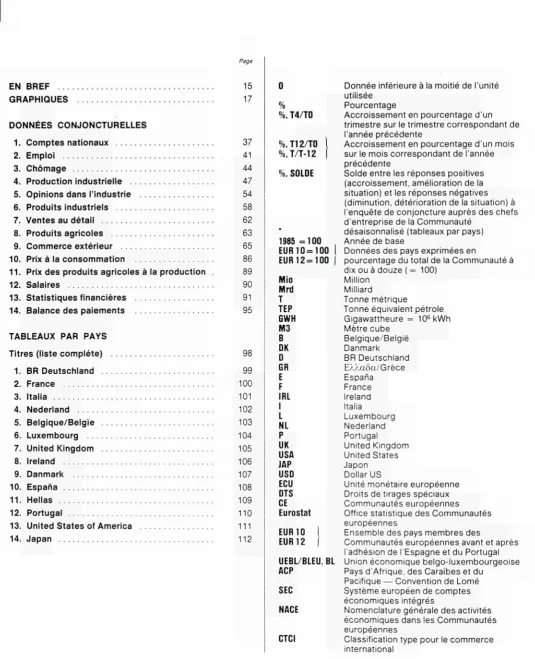
Table des matières
Signes et abréviations
EN BREF
GRAPHIQUES
DONNÉES CONJONCTURELLES
1. Comptes nationaux
2. Emploi
3. Chômage
4. Production industrielle
5. Opinions dans l'industrie
6. Produits industriels
7. Ventes au détail
8. Produits agricoles
9. Commerce extérieur
10. Prix à la consommation
11. Prix des produits agricoles à la production
12. Salaires
13. Statistiques financières
14. Balance des paiements
TABLEAUX PAR PAYS
Titres (liste complète)
1. BR Deutschland
2. France
3. Italia
4. Nederland
5. Belgique/Belgíe
6. Luxembourg
7. United Kingdom
8. Ireland
9. Danmark
10. España
11.
Hellas
12. Portugal
13. United States of America
14. Japan
Page
15
17
37
41
44
47
54
58
62
63
65
86
89
90
91
95
98
99
100
101
102
103
104
105
106
107
108
109
110
111
112
o0
%, T4/T0
%,T12/T0
%.T/T12
%.SOLDE
1985=100
,
EUR 10 = 100
EUR 12 = 100 J
Mio
Mrd
Τ
TEP
GWH
M3
Β
DK
D
GR
E
F
IRL
I
L
NL
Ρ
UK
USA
JAP
USD
ECU
DTS
CE
Eurostat
EUR 10
I
EUR 12
|
UEBL BLEU. BL
ACP
SEC
NACE
Donnée inférieure à la moitié de l'unité
utilisée
Pourcentage
Accroissement en pourcentage d'un
trimestre sur le trimestre correspondant de
l'année précédente
Accroissement en pourcentage d'un mois
sur le mois correspondant de l'année
précédente
Solde entre les réponses positives
(accroissement, amélioration de la
situation) et les réponses négatives
(diminution, détérioration de la situation) à
l'enquête de conjoncture auprès des chefs
d'entreprise de la Communauté
désaisonnalisé (tableaux par pays)
Année de base
Données des pays exprimées en
pourcentage du total de la Communauté à
dix ou à douze ( = 100)
Million
Milliard
Tonne métrique
Tonne équivalent pétrole
Gigawattheure = 10
6kWh
Mètre cube
Belgique/België
Danmark
BR Deutschland
Ελλαδα/Grèce
España
France
Ireland
Italia
Luxembourg
Nederland
Portugal
United Kingdom
United States
Japon
Dollar US
Unité monétaire européenne
Droits de tirages spéciaux
Communautés européennes
Office statistique des Communautés
européennes
Ensemble des pays membres des
Communautés européennes avant et après
l'adhésion de l'Espagne et du Portugal
Union économique belgoluxembourgeoise
Pays d'Afrique, des Caraïbes et du
Pacifique — Convention de Lomé
Système européen de comptes
économiques intégrés
[image:16.595.41.577.120.780.2]EN BREF
1. CHOMAGE: Stabilité dans la Communauté
Après correction des variations saisonnières et des différences entre les méthodes nationales de recensement du chbmage, le taux de chômage dans la Communauté européenne est estimé, selon la définition du Bureau international du Travail (BIT), à 8,6 % en février 1990, au même niveau que le mois précèdent.
Au cours des trois dernières années, le taux de chômage dans l'ensemble de la Communauté a régulièrement baissé de 0,7 % par an, passant de 10,6 % en février 1987 à 9,9 % en 1988, puis à 9,2 % en 1989 pour arriver à 8,6 % en février 1990. Le chômage a ainsi baissé d'environ 20 % en 36 mois.
La tendance è la baisse, générale dans tous les Etats membres à l'exception de l'Italie et du Danemark, est apparue dès 1985 en R. F. d'Allemagne, en Espagne, en Irlande et au Luxembourg, en 1986 au Royaume-Uni et au Portugal, en 1987 en France, en Belgique et aux Pays-Bas.
2. PRIX: Nouvelle hausse sensible pour la Communauté en
février ( + 0,5%)
L'IPC pour l'ensemble de la Communauté s'esl accru de 0,5 % en février, le même taux que celui observé en janvier.
Cette hausse sensible est principalement due à des accroissements substantiels dans les pays suivants: R. F. d'Allemagne 0,4 %, Pays-Bas 0,4 %, Espagne 0,6 %, Royaume-Uni 0,6 %. Italie 0,8 %, et à une très forte hausse de 2,3 % au Portugal.
Les progressions dans tous les autres pays de la CE étaient modérées ou faibles: Belgique 0,2 %, Danemark 0,2 %, France 0,2 %, Grèce 0,1 % et Luxembourg 0,1 %. L'indice trimestriel de mi-février pour l'Irlande n'est pas encore disponible.
Les taux d'inflation sur 12 mois (février 1990/fèvrier 1989) pour les pays de la CE continuent à montrer de grandes divergences:
Pays-Bas 2,1 % RF d'Allemagne 2,7 % Danemark 3,2 % Belgique 3,4 % France 3,4 % Luxembourg 3,8 % Irlande 4,6 %* Italie 6,0 % Espagne 7,3 % Royaume-Uni 7,5 % Portugal 13,1 % Grèce 16,5 %
• Nov. 89/Nov. 88
Les Etats-Unis ont également connu des hausses sensibles pendant les deux premiers mois de 1990: + 1 % en janvier et + 0.5 % en février; ceci a poussé l'inflation sur 12 mois à 5,3%.
Les Taux correspondants pour quelques autres pays hors Communauté: Japon 3,6 %, Suisse 4,9 %. Autriche 3,1 %, Norvège 4,3 %, Suède 8,6 %, Finlande 6,9 % et Canada 5,4%.
3. BIP: poursuite du ralentissement de la croissance
écono-mique au cours du troisième trimestre
Le troisième trimestre 1989 a été caractérisé, pour l'économie communautaire dans son ensemble, par le deuxième ralentissement consécutif de la croissance du PIB ( + 0,3 %). De ce fait, l'inflation, mesurée par le dèflateur implicite du PIB, a baissé jusqu'à + 0,8 % au cours du troisième trimestre, tandis que, en rythme annuel, le ralentissement a été encore plus évident ( + 4,3 % contre + 4,8 % au deuxième trimestre). La baisse de l'inflation, jointe à une certaine reprise de la consommation, tant privée que publique (respectivement + 0,7 % et + 0,6 % au cours du troisième trimestre), pourrait constituer la base d'une reprise de la croissance économique à un rythme soutenu. En effet, bien que les données définitives pour le quatrième trimestre ne soient pas encore disponibles, les premiers résultats provenant des Etats membres semblent confirmer l'hypothèse d'une reprise de la croissance du PIB et des investissements, après deux trimestres de fléchissement pour ces derniers.
En ce qui concerne les différents pays membres on observe la situation suivante: - en R. F. d'Allemagne, dont on dispose des chiffres pour le quatrième trimestre: reprise
de la croissance économique (PIB + 0,9 %), ralentissement de l'inflation, tant trimestrielle qu'annuelle ( + 0,3 %, + 2,0 % respectivement), remarquable reprise des investissements ( + 4,6 %).
- en France, les premiers résultats pour le quatrième trimestre concernant la partie marchande de l'économie indiquent: évolution positive du PIB ( + 1,1 %), progression des investissements ( + 1 , 6 %). ralentissement de la consommation tant privée que publique ( + 0,4 %, + 0,9 % respectivement).
- en Italie: sensible évolution du PIB ( + 0,8 %), baisse de l'inflation tant trimestrielle qu'annuelle ( + 1,0 %, + 5,6 % respectivement).
- au Royaume-Uni: léger ralentissement du PIB ( + 0,5 %), sensible réduction de l'Inflation tant trimestrielle qu'annuelle ( + 1,0 %, + 6,1 % respectivement). Aux Etats-Unis, les premières estimations pour le quatrième trimestre indiquent un sensible ralentissement du PIB ( + 0,1 %), accompagné d'une légère reprise de l'inflation trimes-trielle ( + 0,9 %), tandis que, en rythme annuel, on observe une réduction ( + 3,9 %). Parnii les composantes du PIB, on constate un léger fléchissement des investissements ( - 0,4 %). accompagné d'une stagnation de la consommation privée et d'une légère reprise de la consommation publique ( + 0,4 %).
Pour les trois derniers mois connus, la croissance en un an de l'Indice d'ensemble EUR 12 est de 3,0 %.
Selon la destination des biens, on constate pour la Communauté EUR 12 pour les trois derniers mois connus une variation en un an de:
+ 1,5 % pour les biens intermédiaires, +3,5 % pour les biens de consommation +5,9 % pour les biens d'investissement.
4.2. Croissance soutenue de la production industrielle de la
Communauté en 1989 mais rythme moins rapide en fin
d'année
L'indice de la production industrielle (EUR 12) de l'année 1989 pourrait être en hausse d'environ 3,7 % pour l'ensemble de l'industrie. Les hausses successives depuis 1983 ont été respectivement les suivantes: + 1,0 %, + 2,1 %, + 3,3 %, + 2,3 %, 2,1 % et + 4,3 %. La hausse de production des biens d'investissement sera de l'ordre de 6,3 %, ce qui est voisin des plus forts taux constatés depuis 20 ans: 7,4 % en 1973 et 7,0 % en 1988.
Aux USA la hausse de la production industrielle serait voisine de 3,2 % (5,7 % en 1988) et au Japon de 6,0 % (après 9,3 % en 1988). Dans ces deux pays, les rythmes de hausse ont diminué régulièrement au cours de l'année 1989 de 5,0 % à 2,0 % pour les USA et de 8,0 % è 4,0 % pour le Japon.
Pour l'ensemble de l'industrie les hausses en 1988 et seraient au Royaume-Uni de 0,8 %, au Danemark de 1,9 % et en Grèce de 2,3 %. La hausse serait voisine de 2,7 % en Belgique. Sept Etats membres connaîtraient des hausses comprises entre 3,5 % et 5,5 %: Italie (3,7 %), France (3,9 %), Portugal (4,0 %), Pays-Bas (4,8 %), Espagne (5,0 %) et FR d'Allemagne (5,1 %). Les hausses seraient voisines de 8,0 % au Luxembourg et de 11,5 % en Irlande.
5. BALANCE DES PAIEMENTS
5.1. TENDANCES GLOBALES: Résultats 1989
Balance des opérations courantes de la Communauté
pra-tiquement en équilibre après plusieurs années d'excédent;
déficit courant des États-Unis et excédent du Japon en
baisse
D'après des estimations encore provisoires, la balance des opérations courantes de la Communauté pour 1989 enregistre un excèdent d'environ 2 milliards d'ècus contre 13,6 milliards en 1988. Cette baisse s'explique essentiellement par la diminution de 12,2 milliards d'ècus de la balance commerciale.
Aux Etats-Unis, le déficit des opérations courantes pour 1989 s'est légèrement atténué par rapport à l'année précédente: 96,1 milliards d'ècus (105 milliards de dollars) contre 107,1 milliards d'ècus (126,5 milliards de dollars) en 1988. Cette amélioration est imputable à la fois à la balance commerciale et à la balance des opérations invisibles.
Au Japon, l'excèdent de la balance des opérations courantes est également en baisse par rapport à l'année précédente: 51,6 milliards d'ècus (7837 milliards de yens) contre 76,4 milliards d'ècus (10214 milliards de yens) en 1988.
5.2. LA SITUATION DANS LES ETATS MEMBRES: Résultats
1989
Divergences accrues entre les balances des opérations
courantes: croissance des excédents courants de
l'Alle-magne et des Pays-Bas, aggravation des déficits de
l'Espagne et du Royaume-Uni
L'excèdent de la balance des opérations courantes de l'Allemagne s'est accru de 6,8 milliards d'ècus en 1989 en raison essentiellement de la baisse du déficit de la balance des invisibles ( - 5 milliards). Les déficits courants de l'Espagne et du Royaume-Uni ont été sensiblement plus élevés en 1989 que l'année précédente (respectivement + 6,3 et + 9,6 milliards d'ècus), bien que les chiffres disponibles pour le quatrième trimestre laissent entrevoir une légère amélioration dans ces deux pays. Le déficit commercial de la France s'est lui aussi creusé ( + 2,1 milliards d'ècus); l'augmentation de l'excédent de la balance des invisibles a toutefois permis de compenser largement cette détérioration, de sorte que la balance française des opérations courantes se situe pratiquement au même niveau qu'un an auparavant. Dans le même temps, les balances des opérations courantes du Danemark et des Pays-Bas sont améliorées.
6. COMMERCE EXTERIEUR
6.1. TENDANCES MONDIALES: Résultats de décembre 1989
Léger excédent de la balance commerciale de la
Commu-nauté, importante diminution du déficit commercial
améri-cain et réduction sensible de l'excédent commercial
japonais
a
6.2. LA SITUATION DANS LES ETATS MEMBRES: Résultats de
décembre 1989
Indices d'une atténuation des divergences entre les
balances commerciales des Etats membres
En décembre 1989, les écarts entre les balances commerciales des différents Etats membres se sont quelque peu atténués. L'excédent de la république fédérale d'Allemagne s'est réduit de 1,5 milliards d'ècus alors qu'il avait progressé de 4,7 milliards d'ècus au des onze premiers mois de l'année. Pour les autres Etats membres à balance commerciale excédentaire, aucun changement significatif n'est à signaler. Par contre, certains indices laissent entrevoir un redressement de la situation des pays dont les déficits sont les plus élevés. C'est ainsi que dans le prolongement de la tendance déjà observée en novembre, le déficit du Royaume-Uni a enregistré en décembre une réduction importante de 1,1 milliards d'ècus par rapport au mois correspondant de 1988. Les déficits de la France et de l'Italie se sont également légèrement réduits: respectivement - 0,6 et - 0,4 milliards d'ècus par rapport à décembre 1988 (entre janvier et novembre 1989, les déficits respectifs de deux pays avaient augmenté de 2,7 et 3,7 milliards d'ècus par rapport à la période correspon-dante de 1988). Le déficit commercial de l'Espagne est virtuellement identique à celui enregistré au mois de décembre 1988; au cours des onze premiers mois de 1989, il s'est détérioré de quelque 8 milliards d'ècus par rapport è la période correspondante de l'année précédente.
7. TAUX DE CHANGE: L'écu se renforce contre la plupart des
monnaies CE
Toutes les monnaies EUR 12 sauf trois ont faibli contre l'écu au cours du mois de février, bien qu'en moyenne, dans une proportion de seulement 0,3 %. La drachme grecque a subi la plus forte dépréciation (1,3 %), et à l'intérieur du SME le DM (0,4 %). Les trois monnaies qui se sont légèrement appréciées étaient le Sterling, la lire et la couronne danoise.
Peu de variation au cours des derniers mois sur les taux de change du dollar, affaibli contre toutes les monnaies sauf le yen. Ses plus fortes dépréciations: contre Sterling (2,7 %), contre lire (1,4 %) et contre couronne danoise (1,4 %).
Cependant, au cours des deux premières semaines de mars, le dollar s'est légèrement raffermi en particulier contre le Sterfing qui a été attaqué. Le dollar a continué de gagner du terrain contre le yen qui s'est déprécié de près de 6,5 % depuis le début de l'année. Dans une tentative pour endiguer les sorbes de capitaux du Japon, la Banque du Japon a relevé son taux d'escompte d'un point è 5,25 % le 20 mars. Ce qui signifie que ce taux d'escompte a plus que doublé depuis avril 89. lorsqu'il était à 2,5 %. Non seulement la monnaie est faible, mais le marché boursier japonais est aussi ébranlé: l'Indice Nikkei a perdu 20 % depuis le début de l'année 1990, y compris une chute de 4,15 % en un jour le 19 mars, la plus forte baisse de l'histoire de la bourse de Tokyo.
L'écu était un peu plus stable contre le dollar au début de mars, sa valeur le 19 mars différant peu de la moyenne de février. Le DM a regagné du terrain contre le dollar, mais après l'annonce des résultats des élections de la RDA le 18 mars, il s'est aussi apprécié contre d'autres monnaies CE, en particulier contre le sterling.
8. MASSE MONETAIRE Ralentissement de la croissance M2 en
France
Sur la base des données provisoires, le taux de croissance de M2 en France était de 3,4 % en janvier, ce qui veut dire que sa tendance générale à la baisse continue. Le taux de croissance de M3 en Allemagne a été de 5,6 % pour 1989, conforme aux objectifs fixes pour 1990 de 4 - 6 %. D'autre part, l'Espagne doit effectuer des restrictions monétaires importantes pour amener le taux de croissance des ALP (liquidités è disposition du public) aux environs d'un taux de croissance de 8 %. le nouvel objectif fixé par la banque d'Espagne.
La croissance de M3 en Grèce continue de se développer fortement, sans présenter aucun signe réel de faiblesse dans la tendance à la hausse. Peu de changements aussi dans la tendance à la croissance de M2 en Italie.
9. TAUX D'INTERET: Nouveau bond en avant des rendements.
En février, dans tous les pays étudiés pour lesquels des données sont disponibles, les rendements des obligations d'Etat ont progressé. Dans certains cas, cette hausse est très forte; elle est par exemple de 0,9 % au Luxembourg et de 0,7 % en France. Maintenant, les rendements sont en moyenne de plus de 1,5 point de pourcentage au-dessus des chiffres d'il y douze mois.Aucune donnée officielle n'est actuellement disponible pour l'Allemagne, mais il semble que dans ce pays aussi la hausse ait été significative sur les rendements des obligations d'Etat en février et dans la première quinzaine de mars, atteignant environ 8,7 %; douze mois plus tôt, ils étalent aux alentours de 6,5 %.
Les rendements réels (corrigés de l'Inflation) des obligations d'Etat sont indiqués dans le tableau suivant:
Taux d'intérêt réels longs (moyennes mensuelles)
Belgique
Danemark
R.F.A. Espagne France Italie Luxembourg Pays-Bas Royaume-Uni Etats-Unis Japon* Données provisoires.
La hausse générale des rendements nominaux des obligations d'Etats analysée plus haut a été le reflet des hausses des taux réels en février dans tous les pays sauf l'Espagne, où les rendements ont légèrement baissé dans la mesure où les rendements nominaux constants sont confrontés à la reprise de l'Inflation. Parmi les pays dont on dispose des données pour février, le rendement réel le plus élevé dans la Communauté s'observe au Danemark (8,5 S ) , où des rendements nominaux élevés pour les obligations sont liés à une inflation relativement faible, et le plus faible au Luxembourg (5,6 %), bien que sur la base des données de janvier et février, les taux réels longs au R. U. sont probablement toujours nettement inférieurs à ceux du reste de la Communauté. A noter toutefois que les taux réels courts au R. U. sont parmi les élevés de la Communauté.
10. RESERVES: Rentrées en Grèce et en Italie
Les plus fortes variations des niveaux de réserves sur l'étranger en janvier ont été observées en Grèce, Italie (rentrées de 14 % et 2 % respectivement), Irlande et Japon (sorties de 12 % et 4 %). Pour tous ces pays, les variations de leurs positions réserves sont dues à des variations de volume, et non purement à des variations de taux de change.
En Irlande, les sorties de janvier ont plus qu'annulé les rentrées de décembre, et effectivement, les réserves officielles d'Irlande sont de plus de 5 % Inférieures à celles de novembre et de plus de 30 % Inférieures à celles de janvier 1989.
Au Japon aussi on observe des sorties presque constantes de réserves en même temps que la banque du Japon intervient sur les marchés des changes étrangers pour soutenir le yen. En janvier, tes réserves de ce pays étaient de plus de 22 % inférieures è ce qu'elles étaient douze mois auparavant.
12/89 6,1 6,0 4,6 7,6 6,2 6,0 4,5 6,6 2,3 3,4 3,3
1/90 6,6 7,4 5,2 7,7 6,7 6,2 4,5 6,4 2,6 3,2 3,5
2/90 7,3 8,6* 6,0 7,3 7,4*
5,6 6,9
SCHAUBILDER
1987
ΠΝΓΑΠΙ- LOGARITHMISCHÏ SKAL*
1988
1989
1990
SDO-LOGARTTHUIC SCALE ECHELLE SQD-LOGARrraMI(lUI
20
18
Ifi 14
12
10
8
6
—
-=—
l—
'—
- —
ι I
REGISTR. AKBEITSLOSIGKEIT
11AE