This is a repository copy of Metakaolin-Based Geopolymers for Nuclear Waste
Encapsulation.
White Rose Research Online URL for this paper:
http://eprints.whiterose.ac.uk/135508/
Version: Accepted Version
Proceedings Paper:
Geddes, DA, Ke, X, Bernal, SA et al. (2 more authors) (2017) Metakaolin-Based
Geopolymers for Nuclear Waste Encapsulation. In: Martirena, F, Favier, A and Scrivener,
K, (eds.) Calcined Clays for Sustainable Concrete. RILEM Bookseries, vol 16. 2nd
International Conference on Calcined Clays for Sustainable Concrete, 05-07 Dec 2017,
Havana, Cuba. Springer , pp. 183-188. ISBN 978-94-024-1206-2
https://doi.org/10.1007/978-94-024-1207-9_29
© 2018, RILEM. This is a post-peer-review, pre-copyedit version of an article published in
Calcined Clays for Sustainable Concrete. The final authenticated version is available
online at: https://doi.org/10.1007/978-94-024-1207-9_29. Uploaded in accordance with the
publisher's self-archiving policy
[email protected] https://eprints.whiterose.ac.uk/ Reuse
Items deposited in White Rose Research Online are protected by copyright, with all rights reserved unless indicated otherwise. They may be downloaded and/or printed for private study, or other acts as permitted by national copyright laws. The publisher or other rights holders may allow further reproduction and re-use of the full text version. This is indicated by the licence information on the White Rose Research Online record for the item.
Takedown
If you consider content in White Rose Research Online to be in breach of UK law, please notify us by
Metakaolin-based geopolymers for nuclear waste
encapsulation
D. A. Geddes1, X. Ke1, S. A. Bernal1, M. Hayes2 and J. L. Provis1
1 Immobilisation Science Laboratory, Department of Materials Science and Engineering, Sir Robert Hadfield
Building, University of Sheffield, Sheffield, UK, S1 3JD
2 National Nuclear Laboratory, Chadwick House, Warrington Road, Warrington, WA3 6AE
Abstract
The UK nuclear industry has a significant and challenging stockpile of nuclear wastes, and geopolymers produced from activation of the calcined clay metakaolin offer a valuable alternative to Portland cement-based systems. The characteristics of different formulations of metakaolin-based geopolymers, reacted with sodium and potassium silicate, are therefore of interest. As preliminary steps, the compressive strength and rheology of some metakaolin geopolymer grouts have been studied. This work showed that a potassium silicate-based geopolymer binder, with a sufficiently high water content can be produced to be highly workable. These grouts have a shear stress of approximately 80 Pa at a shear rate of 110 s-1 and can achieve compressive strengths of up to 40 MPa after 7 days of curing. This study is to be expanded in future and compared to the results produced from further analysis performed on the chemical structure of the geopolymer, as well as the overall physical characteristics achieved, to support the immobilisation, incorporation and retention of metal and oil based nuclear wastes.
1. Introduction
Since the introduction of nuclear power to the UK in the 1950s, the question of how to safely handle the potentially harmful radioactive waste produced has always been posed. The UK nuclear industry continues to develop and produce new ideas and concepts for dealing with the diverse waste streams that are produced in operational and decommissioning phases of the lifecycle of a nuclear power plant, as well as the complex legacy wastes resulting from experimental and historical operations. The UK has three basic classifications of nuclear waste: High-level waste (HLW), Intermediate-level waste (ILW) and Low-level Waste (LLW). ILW is by far the most diverse and problematic of these waste types; it is defined as waste that does not generate significant heat but emits radioactivity greater than 4 GBq per tonne of alpha activity or 12 GBq per tonne of beta/gamma activity. This waste can be generated from many sources across the operational lifecycle of a nuclear reactor. This includes, but is not limited to, plant maintenance and decommissioning, fuel cladding, effluents from plant operation, and sludges formed from liquid effluents and corrosive metallic elements [1]. Geopolymers based on calcined clays, produced through the reaction of the calcined clay powder with an alkali source, could be ideal for the encapsulation and immobilisation of ILW due to the possibility of tailorable chemistry, such as alkalinity and corrosion resistance, and physical properties, such as the refined pore structure and adaptable viscosity in the fresh state [2].
The gel chemistry of metakaolin (MK) is based on a highly disordered, highly cross-linked structure containing high levels of Si and Al, and low levels of Ca. This leads to the formation of a (Na,K)2O-Al2O3
-SiO2-H2O (or in abbreviated notation (Na,K)-A-S-H) gel, where Na and/or K are alkali cations supplied
An (Na,K)-A-S-H gel is formed of Al- and Si-centred tetrahedra, bridged by oxygen [3], with the alkali cations present in a charge balancing role associated with the Al-centred tetrahedra. The initial setting of a geopolymer takes a few hours, and a relatively strong microstructure takes around 1-7 days to form depending on the precursor characteristics and curing temperature [4]. As the reaction advances over longer time periods, the structure begins to rearrange, and allows the formation of zeolites [5]. The formation of zeolites generates host sites in the crystal structure that are ideal hosts for some of the metal cations present within nuclear waste.
The International Atomic Energy Agency (IAEA) has examined the use of clays for the encapsulation of ILW: natural clays, including kaolinite, were used to encapsulate Cs contaminated liquid waste streams [6], with moderate success. However, after many years of intermittent research in the use of calcined clay-based geopolymers in the nuclear industry, Kuenzel et al. [7-10] and Frizon et al. [11-13] have produced useful data that has generated much interest within the nuclear sector.
Kuenzel et al. demonstrated some initial success for the encapsulation of Cs/Sr [7] and Al [9], and studied how composition can affect the shrinkage and cracking characteristics of geopolymers [10]. Their work has shown that the metallic Al present in some ILW streams has the potential to be encapsulated in MK-based geopolymers [9]. Cs can also be bound tightly to the aluminosilicate phase replacing Na, while Sr has a limited degree of uptake; beyond 0.4 mol of Sr per mol of Al in the geopolymer, the Sr was observed to precipitate out [7].
Frizon et al. have also moved towards the solidification/stabilisation of oil-based waste streams in geopolymers. This work was carried out by producing an emulsion of oil and sodium silicate, mixing this with the MK and allowing to set. This produced very limited oil leaching and a retention of the mechanical properties at up to 20 vol.% oil fraction [12]. Oil is incompatible with Portland cement, and so if a valid alternative arose this could provide the answer to many problems, not just within the nuclear sector. Work from the same group also focused on Mg-Zr waste streams, showing that a sodium silicate activated MK-geopolymer with appropriate fluoride corrosion inhibitors can reduce the release of hydrogen as a product of Mg metal corrosion [13].
The brief summary, presented above shows that the use of MK-based geopolymers to encapsulate materials of specific interest to the nuclear sector is viable. This report demonstrates that the work that has been undertaken can be used and advanced to promote the use of geopolymers within the nuclear industry. A discussion will be provided showing how the results from the literature can be used in conjunction with new results to provide key formulations for immobilisation of problematic nuclear waste streams in clay-based geopolymers.
2. Experimental Programme
Flash-calcined MK (Argeco, France), with a particle size (d50) of 25 and a SiO2/Al2O3 of 5.1 (elevated
due to the presence of quartz in the pre-calcined kaolin), was used to produce geopolymers using sodium or potassium silicate solutions (provided by PQ Silicates) blended with reagent grade MOH (M = Na or K; Sigma Aldrich UK). The activating solutions were designed with SiO2/M2O molar ratios of
0.5, 1 and 1.5, and H2O/M2O molar ratios of 11 and 13. The geopolymers were produced with
Al2O3/M2O = 1, by high shear mixing of the MK and activating solution, at 20 °C.
3. Results and Discussion
This section will describe some characteristics that must be understood, to determine the suitability of geopolymers for the solidification and stabilisation of waste from the nuclear industry.
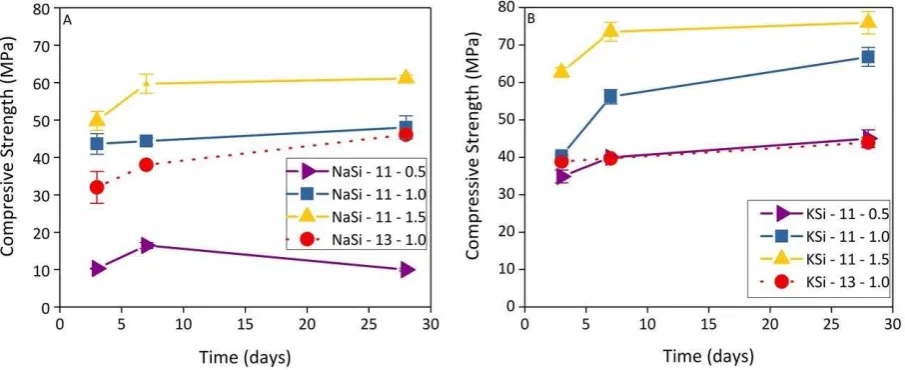
The compressive strengths of sodium and potassium silicate activated MK geopolymers are shown in Figure 1a and Figure 1b, respectively. These strength curves show that binders where the activator contains more silica, up to an SiO2/(Na,K)2O molar ratio of 1.5, tend to have greater compressive
strengths. The low compressive strength determined for the sodium silicate formulation, H2O/Na2O =
11 and SiO2/Na2O = 0.5, is believed to be due to the formation of sodium metasilicate crystals within
the activating solution before or during shear mixing. This has been described by Provis et al. [14], where low modulus sodium silicate solutions, SiO2/Na2O crystallised and solidified during storage.
This formulation has therefore been removed from further studies. A compressive strength of 75 MPa was reached after 28 days for the lowest alkalinity potassium-based system, H2O/K2O = 11 and
SiO2/K2O = 1.5. When the H2O/(Na,K)2O ratio is increased to 13, the compressive strength is
[image:4.595.73.526.319.504.2]approximately 40 MPa for both formulations. This is well within the acceptable range for nuclear waste immobilisation.
Figure 1 - Compression strength curves showing a comparison between sodium silicate (A) and potassium silicate (B) activated geopolymers. The legends show the activator, H2O/(Na,K)2O molar ratio and activator SiO2/(Na,K)2O ratio for each formulation. The curves for H2O/(Na,K)2O ratios of 11 and 13 are shown with solid
and dotted lines, respectively. Error bars show the standard deviation among triplicate samples.
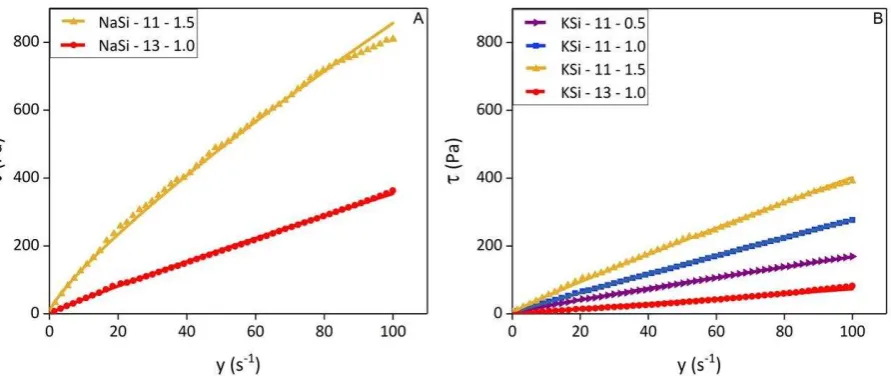
The next step in explaining this geopolymer system is to perform rheological analysis on the different grouts produced. These grouts are described by the Herschel-Bulkley (H-B) Model, which states that
materials are related to the shear rate ( ) by a power law, Equation 1. This is different from Portland cement based systems that often follow the Bingham model (constant plastic viscosity once the yield stress is overcome) [15].
(1)
The viscosity data and the calculated theoretical H-B curve are given in Figure 2a and Figure 2b for sodium and potassium silicate activated solutions, respectively. The rheology curve for the grout with SiO2/Na2O = 1.0 and H2O/Na2O = 11 was unable to be obtained as the paste formed was too stiff to be
Figure 2 - Flow curves for the alkali-activated MK grouts. The sodium and potassium activated systems are given in A and B, respectively, and the solid lines represent the H-B model fits to each data set.
All the grouts produced appear to show some degree of shear thinning in this shear rate range (H-B parameter n < 1), which can be of use in and beyond the nuclear industry. The potassium-activated systems show a lower viscosity than the sodium-activated systems, and particularly when the water content of the grout is increased to H2O/K2O = 13, low to negligible yield stress and highly fluid
behaviour is observed. This is therefore the ideal formulation to examine further, both chemically and structurally, to determine its ability to encapsulate nuclear waste streams whilst complying with the relevant UK guidelines for waste management and disposal.
4. Conclusions and Future Work
It has been demonstrated that the production of MK-based geopolymers using sodium and potassium silicate activation can yield desirable material characteristics for the encapsulation of nuclear waste streams: sufficient strength and high flowability. A moderate activator SiO2/(Na,K)2O ratio of 1.5 gives
the highest overall compressive strength at low water content, but the viscosity of the sodium silicate-activated composition at the studied water content is too high to give the high fluidity needed for nuclear wasteform grouts. Two effective ways of reducing the viscosity were to use an increased water ratio, H2O/M2O = 13, or to replace sodium silicate with a potassium silicate activator. A combination
of these parameters yielded high fluidity whilst keeping a compressive strength of 40 MPa. This is a good formulation on which to base further studies of the key physical and chemical characteristics of geopolymers for nuclear waste immobilisation, to allow ideal formulations for different problematic waste streams to be validated.
5. Acknowledgements
The PhD project of D. Geddes is funded by the UK Nuclear Decommissioning Authority with input from the National Nuclear Laboratory. This research was performed in part at the MIDAS Facility, at the University of Sheffield, which was established with the support of the Department of Energy and Climate Change. The authors gratefully acknowledge the donation of alkali silicates by PQ Silicates.
6. References
[2] Provis, J.L. and J.S. van Deventer, Alkali Activated Materials. (2014) Dordrecht: Springer/RILEM.
[3] Li, C., H. Sun, and L. Li, A review: The comparison between alkali-activated slag (Si + Ca) and metakaolin (Si + Al) cements. Cem. Concr. Res. 40 (2010) 1341-1349.
DOI: 10.1016/j.cemconres.2010.03.020.
[4] Walkley, B., et al., Phase evolution of Na2O-Al2O3-SiO2-H2O gels in synthetic aluminosilicate binders. DTr 45 (2016) 5521-5535.
DOI: 10.1039/C5DT04878H.
[5] Duxson, P., et al., Geopolymer technology: the current state of the art. J. Mater. Sci. 42 (2007) 2917-2933.
DOI: 10.1007/s10853-006-0637-z.
[6] Barney, G.S., Immobilization of aqueous radioactive cesium wastes by conversion to aluminosilicate minerals. (1975) Atlantic Richfield Hanford Co.pp.
[7] Kuenzel, C., et al., Encapsulation of Cs/Sr contaminated clinoptilolite in geopolymers produced from metakaolin. J. Nucl. Mater. 466 (2015) 94-99.
DOI: 10.1016/j.jnucmat.2015.07.034.
[8] Kuenzel, C., et al., Influence of metakaolin characteristics on the mechanical properties of geopolymers. Appl. Clay Sci. 83 84 (2013) 308-314.
DOI: 10.1016/j.clay.2013.08.023.
[9] Kuenzel, C., et al., Encapsulation of aluminium in geopolymers produced from metakaolin. J. Nucl. Mater. 447 (2014) 208-214.
DOI: 10.1016/j.jnucmat.2014.01.015.
[10] K C A T D S C M B Geopolymers. J. Am. Ceram. Soc. 95 (2012) 3270-3277.
DOI: 10.1111/j.1551-2916.2012.05380.x.
[11] Berger, S., F. Frizon, and C. Joussot-Dubien, Formulation of caesium based and caesium containing geopolymers. Adv. Appl. Ceram. 108 (2009) 412-417.
DOI: 10.1179/174367609X422072.
[12] Cantarel, V., et al., Solidification/stabilisation of liquid oil waste in metakaolin-based geopolymer. J. Nucl. Mater. 464 (2015) 16-19.
DOI: 10.1016/j.jnucmat.2015.04.036.
[13] Rooses, A., et al., Encapsulation of Mg Zr alloy in metakaolin-based geopolymer. Appl. Clay Sci. 73 (2013) 86-92.
DOI: Encapsulation of Mg Zr alloy in metakaolin-based geopolymer.
[14] Provis, J.L., et al., Stabilization of Low-Modulus Sodium Silicate Solutions by Alkali Substitution. Ind. Eng. Chem. Res. 51 (2012) 2483-2486.
DOI: 10.1021/ie202143j.