C o n tr o lle r R e fin e m e n t w ith
A p p lic a tio n to a S u gar C a n e
C r u sh in g M ill
Ari G. Partanen
May 1995
A thesis submitted for the degree of Doctor of Philosophy
of the Australian National University
Department of Systems Engineering
Research School of Information Sciences and Engineering
Declaration
These doctoral studies were conducted with supervision from Professor Robert R. Bit- mead of the Australian National University.
The work presented in this thesis is the result of original research carried out by myself, in collaboration with others, whilst enrolled in the Department of Systems Engineering as a candidate for the degree of Doctor of Philosophy. This work has not been submitted for any other degree or award in any other university or educational institution.
A significant proportion of the research performed for this thesis has been published, or has been submitted to conferences and journals as listed below.
J o u r n a l P a p e r s
[J1] Partanen, A.G., R.D.Peirce and R.R.Bitmead (1994). Crushing Mill Control for Sugar Cane - a Robust, Nonadaptive LQG/LTR Strategy. Control Engineering Practice, Vol. 2, No. 1, pp. 3-16.
[J2] Partanen, A.G., and R.R.Bitmead. (1995). The Application of an Iterative Identifi cation and Controller Design to a Sugar Cane Crushing Mill. Accepted for publication in Automatica.
[J3] Partanen, A.G. (1995). Advanced Control for a Sugar Cane Crushing Mill. Submitted to the IEAust for publication.
C o n fe r e n c e P a p e r s
[Cl] Partanen, A.G., R.D.Peirce and R.R.Bitmead. (1993). Crushing Mill Control for Sugar Cane - a Robust, Nonadaptive Strategy, Preprints, 12th IFAC World Congress, Sydney, Australia, Vol. 4. pp. 407-410.
[C2] Partanen, A.G., and R.R.Bitmead. (1993). Excitation versus control issues in closed loop identification of plant models for a sugar cane crushing mill, Preprints, 12th IFAC
World Congress, Sydney, Australia, Vol. 9, pp. 49-52.
[C3] Partanen, A.G., and R.R.Bitmead. (1993). Two Stage Iterative Identification / Controller Design and Direct Experimental Controller Refinement, Proc. 32nd IEEE
Conference on Decision and Control, San Antonio, USA, pp. 2833-2838.
Modelling: Prejudices in Action, Preprints 10th IFAC Symposium on System Identifi cation, Copenhagen, Denmark, Vol. 1, pp. 181-186.
[C5] Partanen, A.G., Z.Zang, R.R.Bitmead, and M.Gevers. (1994). Experimental Re stricted Complexity Controller Design, Preprints 10th IFAC Symposium on System Identification, Copenhagen, Denmark, Vol. 2, pp. 177-182.
[C6] Partanen, A.G. (1995). Advanced Control for a Sugar Cane Crushing Mill. Submitted to the IEAust CONTROL 95 conference, Melbourne, Australia, October, 1995.
The work described in this thesis has been carried out in collaboration with a number of people. They are: R.R.Bitmead, S.Crisafulli, M.Gevers, C.R.Johnson Jr, R.D.Peirce, P.M.J.Van den Hof, and Z.Zang. However, the majority of the work is my own.
A c k n o w le d g e m e n ts
Despite having taken automatic control subjects during my undergraduate degree, my interest in feedback control systems was first aroused during my employment as an Elec trical Engineer with Mount Isa Mines (MIM) Ltd. During this time, I was fortunate to work with Florido Bizzozero on numerous electrical engineering projects, including feed back control systems on the gigawatt thyristor converter drives th at control the mine hoists at the Isa and Hilton mines. I became inspired by Florido’s methodical manner. This led me gradually to heighten my own powers of observation and intellectual analysis and thereby to become successful at resolving many engineering problems, including those addressed in this dissertation. I am extremely grateful to Florido for the example he set when performing engineering tasks.
Following my escapades on mine hoists with MIM, I moved onto the control of sugar cane crushing mills at C S R Ltd’s, Victoria Mill, Ingham. My current supervisor Professor Bob Bitmead was, at the time, and still is engaged as a process control control consultant to C S R Ltd. During my employment as process control engineer with C S R Ltd, Bob and I s tru c k u p a v ery effective w o rk in g re la tio n s h ip w h ich c o n tin u e s to th is day. I w ould sincerely like to thank Bob for his patience and input on m atters technical and non technical.
Although, I left CSR Ltd to undertake a PhD, their sugar cane crushing process con tinued to dominate my research endeavours. I am indebted to the support I have received from CSR Ltd engineers, Rob Peirce, Matthew Ingegneri and Ted Seldon, of the Com puter Services Department (CSD). In particular, I would like to make special mention of Rob Peirce’s efforts in organising my many visits to tropical North Queenland during the 1993 and 1994 crushing season. The efforts of CSR Ltd Victoria Mill plant engineers, instrument fitters, and crushing station operators, too numerous to name individually, is gratefully acknowledged.
The research and development work conducted during 1994 on this project was in part funded by the A.C.Waters Scholarship for young engineers administered by the Institution of Engineers, Australia. The author acknowledges this funding with gratitude and pride. This funding provided the me with an opportunity for international collaboration on the theoretical issues associated my PhD research. This collaboration was undertaken with
Professor Michel Gevers, Universite Catholique de Louvain, Louvain-la-Neuve, Belgium,
and Professor Paul Van den Hof, Delft University of Technology, Delft, The Netherlands.
The efforts of bo th Michel and Paul are warmly acknowledged.
The funding provided by the activities of the Cooperative Research Centre for Robust
and Adaptive Systems by the A ustralian Government under the Cooperative Research
Centres Program towards my PhD is also acknowledged.
During my tim e as a PhD student I have been fortunate to collaborate w ith many
acknowledgeable people in th e field of System Identification and Control theory. These
people are Bob Bitm ead, Frankie de Bruyne, Raymond de Callafon, Allan Connolly, Sam
Crisafulli, Michel Gevers, Rick Johnson, Wee Sit Lee, Paul Van den Hof, and Zhuquan
Zang. I sincerely th an k them for their efforts. Thanks also go to my advisors Brian
Anderson and Iven Mareels.
T he interactions of a technical or social n ature w ith fellow students and staff at the
D epartm ent of Systems Engineering, A ustralian National University, during my stay here
from O ctober 1992 - May 1995, have contributed to a rewarding sojourn. I particularly
wish to thank Sam and Lisa Crisafulli for their friendship. Special thanks go to my office-
m ates A nton Madievski, Jeremy M atson, and Wee Sun Lee.
I would like to th an k members of my family, both in A ustralia and Finland for their
m oral support. In particular, the love, support, understanding, and encouragement th a t
I have received from my fiancee, Jill Harris, has been a significant positive factor in all
aspects of my life. For this support I am especially grateful to Jill.
Finally, I wish dedicate this thesis to my parents, P entti and Elvi. Both have abundance
of th e Finnish sisu, th a t is guts, determ ination, perseverance, and tenacity, at levels which
cannot be depleted even in th e most difficult of situations. I have been lucky enough to
inherit an ample portion of th eir sisu genes.
A b s tr a c t
This thesis covers a broad range of theoretical and practical issues related to the ap
plication of controller refinement m ethods to the sugar cane crushing process w ith the
ultim ate aim of improving the extraction performance of this process.
Controller refinement relates to the adjustm ent of existing feedback controller param e
ters in an attem p t to enhance closed loop process performance. The refinement of existing
feedback controllers is the intent of fledgling iterative identification and control design
schemes. The available iterative design methodologies are supported by and extend the
m ature fields of System Identification and Robust Control Design. The particular iter
ative design methodology which features in this thesis is the so-called Zangscheme. It
consists of a model adjustm ent step followed by a controller enhancement step. In the
model adjustm ent step, direct prediction error m ethods are used to perform closed loop
identification, and in the controller enhancement step, a frequency weighted LQG control
design is undertaken.
The profitability of a raw sugar factory is determ ined by the extraction performance
of crushing units (mills) which make up a multi-stage milling train. In order to cope
w ith the variations in the physical attrib utes of the incoming sugar cane and still achieve
reasonable extraction at a prespecified throughput rate, feedback control of the sugar cane
crushing process is essential. The extraction performance of this process is closely related
to the torque exerted by the milling rollers. For the purposes of defining an appropriate
control strategy, high extraction is equivalent to minimising torque deviations about a high
torque set-point. In order to m aintain throughput, at possibly the expense of extraction,
the existing PID controllers operate w ith conservative process variable set-points. The
need for tighter torque control of the sugar cane crushing process to ameloriate extraction
m otivates the application of controller refinement.
The sugar cane crushing process is a difficult-to-control process since an accurate dy
nam ical model of the process and the disturbances acting upon it do not exist. Fortu
nately, approxim ate models which adequately describe the crushing process dynamics for
the purpose of controller design can be identified. The difficulty in obtaining such models is
com pounded by the requirem ent th a t for safety and production reasons, the identification
also h in dered by th e occurrence and e x te n t of th e variations to th e sta tistic a l pro perties of
th e process d istu rb an c e . C urren tly , it is not possible to predict these variations. D espite
th e vagaries associated w ith th e crushing process, iterativ e identification and control de
signs schem es like th e Zangschem e can be cajoled into delivering controllers which enhance
closed loop process perform ance.
Successful ap p licatio n of th e Zangschem e iterativ e identification and control design
m ethodology to th e sugar cane crushing process required an u n d erstan d in g of how th e
th eo re tic al asp ects of th e ite rativ e design are affected by process specific im plem entation
issues. In acquiring th is u n d e rsta n d in g , n o t only was th eory of closed loop identification,
frequency w eighted LQ G controller design, and iterativ e design, extended, b u t also a
b e tte r com prehension of th e crushing process behaviour was developed. In extending
th e th eo re tic al issues, em phasis was placed on exam ining th e role of o peration al and
e x p erim en tal closed loop in p u t-o u tp u t d a ta in th e controller design process.
For m any in d u stria l process, th e sugar cane crushing process included, in p u t-o u tp u t
process d a ta is readily available. W ith th e Zangschem e iterativ e design, operation al d a ta
is n o t only em ployed to evaluate th e perform ance of th e cu rren t controller, it is also used to
u p d a te th is controller. T herefore th e ap p lication of controller refinem ent to th e sugar cane
crush in g process can be viewed as a logical extension of ro b u st control ideas to accom odate
a po steriori p erfo rm an ce inform ation.
Contents
D e c la r a tio n i
A c k n o w le d g e m e n ts iii
A b str a c t v
1 In tr o d u c tio n 1
1.1 Thesis Motivation ... 1
1.2 Research P h ilo so p h y ... 2
1.3 Synopsis of the T h e s i s ... 3
1.4 Summary of Original C ontributions... 5
1.5 Significance of the R e s e a rc h ... 7
2 C o n tr o ller R efin em en t 9 2.1 Chapter Motivation ... 9
2.2 Theoretical A ssum ptions... 10
2.3 System F ram ew o rk ... 13
2.4 Performance Enhancem ent... 15
2.5 Robust Adaptive C o n t r o l ... 16
2.6 Uncertainty S e t s ... 18
2.7 Probing and Caution in Stochastic Adaptive C o n tro l... 20
2.8 Iterative D esig n ... 22
2.9 Chapter Conclusion ... 31
3 C lo sed L oop Id en tifica tio n 32 3.1 Chapter Motivation ... 32
. 32
3.2 Informative Experiments and Indirect Identification
3.3 Direct Prediction Error M eth o d ...35
3.4 Two-stage Indirect M e t h o d ... 41
3.5 Dual Y oula-param etrization...43
3.6 Normalised Coprime Factor Id e n tific a tio n ... 49
3.7 Chapter Conclusion ... 50
4 Ite r a tiv e Id e n tific a tio n an d C on trol D e sig n 52 4.1 Chapter Motivation ... 52
4.2 The Z a n g sch e m e ...52
4.2.1 Control D e s ig n ... 53
4.2.2 Id e n tific a tio n ... 55
4.2.3 Iterative D esign... 61
4.3 Delft Iterative Design ... 62
4.3.1 Controller D esign... 62
4.3.2 Model Id e n tific a tio n ... ; . . 64
4.3.3 Iterative D esign... 65
4.4 Internal Model Control (IMC) Iterative D e s ig n ... 66
4.4.1 Control D e s ig n ... 66
4.4.2 Id e n tific a tio n ... 69
4.4.3 Iterative D esign... 70
4.5 Other Iterative A p p ro a c h e s ... 71
4.6 Chapter Conclusion ...73
5 Su gar C an e C ru sh in g P r o b le m 74 5.1 Chapter Motivation ...74
5.2 The Sugar Cane Crushing P r o c e s s ...75
5.2.1 Process Description ... 75
5.2.2 Process V ariables... 75
5.2.3 Process Objective ... 78
5.2.4 PID versus Multi-variable C o n t r o l ... 79 80 5.2.5 Process Disturbances . . .
5.3 Controller Design Considerations
viii
81
5.3.1 Candidate Control Strategies .
5.3.2 Robust versus Adaptive Control ... 83
5.3.3 LQG C o n tr o l... 83
5.3.4 Iterative Identification and Control D esign...85
5.3.5 Process Model Identification ...87
5.3.6 Controller M aintainability...88
5.3.7 Controller Implementation P la tf o r m ... 89
5.4 LQG Control S o lu tio n ... 90
5.4.1 Process M o d e l ... 91
5.4.2 Model A g g re g ra tio n ... 92
5.4.3 The LQG/LTR Torque C o n tr o lle r ... 93
5.5 Implementation I s s u e s ... 95
5.5.1 Data Integrity ...96
5.5.2 Controller Im plem entation... 98
5.6 Chapter Conclusion ...102
6 C losed Loop Identification o f Sugar Cane Crushing P rocess M odels 103 6.1 Chapter Motivation ...103
6.2 The Need for Excitation during Closed Loop Identification... 104
6.2.1 Open Loop Id e n tific a tio n ... 104
6.2.2 Closed Loop Identification with Excitation ... 106
6.3 Design of Closed Loop Identification Experim ents... 106
6.3.1 Plant and Disturbance C h aracteristics...106
6.3.2 Excitation Signal D esign... 107
6.3.3 Data Filter D e s ig n ... 110
6.3.4 D ata Sequence Selection... 112
6.3.5 Model Structure S electio n ... 113
6.3.6 Model A sse ssm e n t...114
6.4 Experimental R esu lts...115
6.4.1 The Need For Excitation ... 115
6.4.2 Direct versus Two-stage Indirect M e t h o d ... 118
6.5 Chapter Conclusion ...125
7 T h e R e v ise d Z an g sch em e 127
7.1 Chapter Motivation ... 127
7.2 The Original Z a n g sch e m e ... 128
7.3 Decoupled Zangscheme V a r ia n t...131
7.4 Direct Zangscheme Variant ... 134
7.5 Simulation E x a m p l e ... 135
7.6 Cautious Controller Enhancement ...138
7.7 The Revised Zangscheme ... 140
7.8 Frequency Weighted Controller D e sig n ...140
7.9 Simulation E x a m p l e ... 148
7.10 Chapter C on clu sio n s...148
8 A p p lic a tio n o f th e R e v ise d Z an g sch em e Ite r a tiv e D esig n to th e Sugar C an e C ru sh in g M ill 150 8.1 Chapter Motivation ...150
8.2 Seasonal and Regional Factors affecting Process P e rfo rm a n c e ... 152
8.3 Application R esu lts...153
8.3.1 Height R e g u la tio n ... 153
8.3.2 Torque R e g u la tio n ... 155
8.3.3 Energy S a v in g s...165
8.4 Technology T r a n s f e r ...165
8.5 Chapter C o n clu sio n s...167
9 C o n c lu sio n s a n d F u rth er R esea rch 169 9.1 Summary of C ontributions... 169
9.2 Further R e s e a rc h ... 172
9.2.1 System Identification and Control D e s ig n ...173
9.2.2 Sugar Cane Crushing P ro c e s s ... 174
9.3 Conclusion ...174
9.4 C o d a ... 175
A p p e n d ix A - C lo sed L oop Id en tifica tio n M u lti-v a ria b le Form ula 176
A p p e n d ix C - F req u en cy W eig h ted LQG C o n troller D esig n for a Sugar C ane
C ru sh in g M ill 180
A p p e n d ix D - A n A lte r n a tiv e P r o o f o f T h eo rem 7.1 186
A p p e n d ix E - M ill S e ttin g s an d R o ller D ia m e te r s 190
A p p e n d ix F - LQG C o n tro ller P a ra m e ters 195
A p p e n d ix G - P ID C o n tro ller G a in s 204
B ib lio g ra p h y 206
List o f T ables
6.1 Delay Magnitudes for Height and Torque Models. Direct Method vs.
Two-stage Indirect M ethod... 123
8.1 Turbine Steam Usage - LQG vs. P I D ...165
G .l A2 Mill Height and Torque PID Controller Gains... 204
G.2 A3 Mill Height and Torque PID Controller Gains... 205
G.3 A4 Mill Height and Torque PID Controller Gains... 205
L ist o f F ig u r e s
2.1 Achieved closed loop system... 14
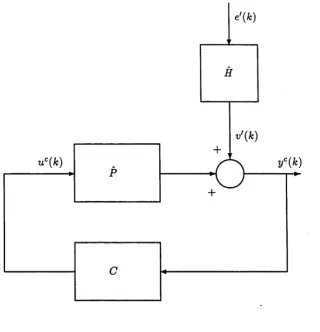
2.2 Designed closed loop system...25
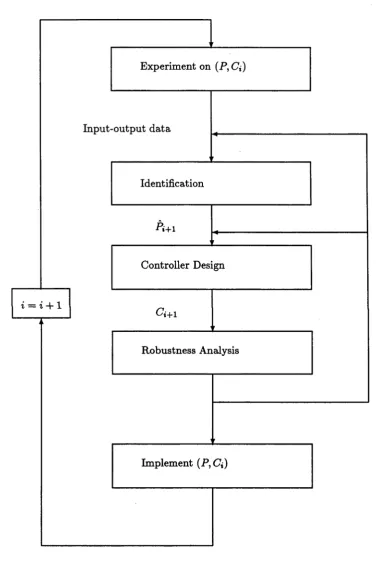
2.3 Iterative scheme of identification and control design... 30
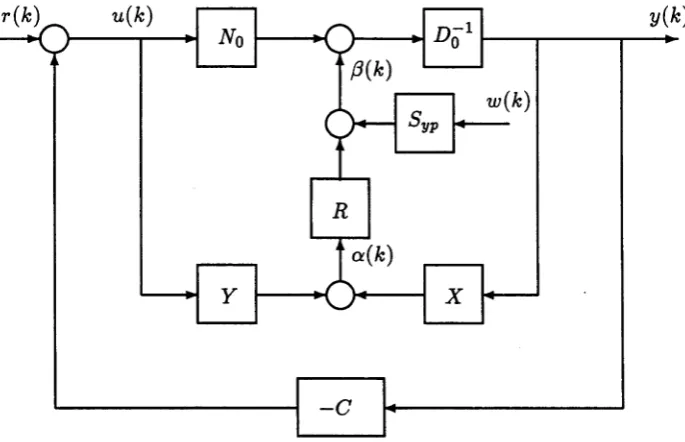
3.1 Dual-Youla parametrization of the achieved closed loop system...46
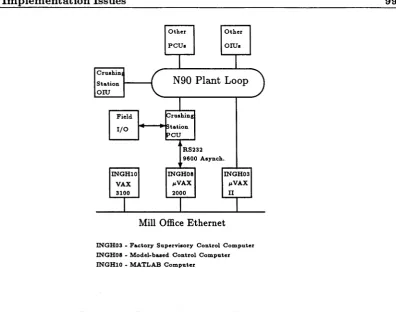
5.1 Diagram of sugar mill operation... 76
5.2 Normalised Extraction versus Mill Number for various torque set-points. . . 77
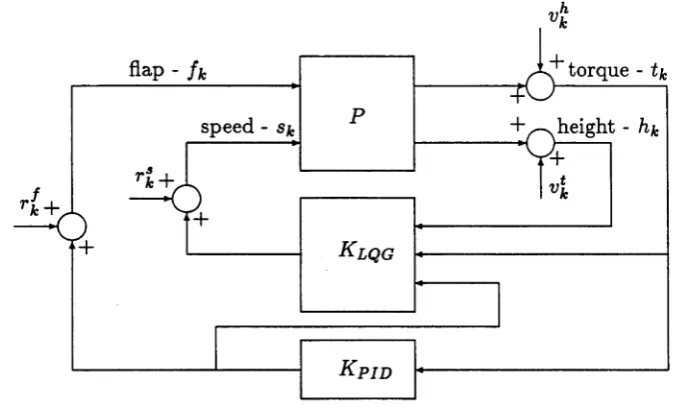
5.3 Feedback Control System for the Sugar Cane Crushing Mill... 90
5.4 Factory Computing Environment... 99
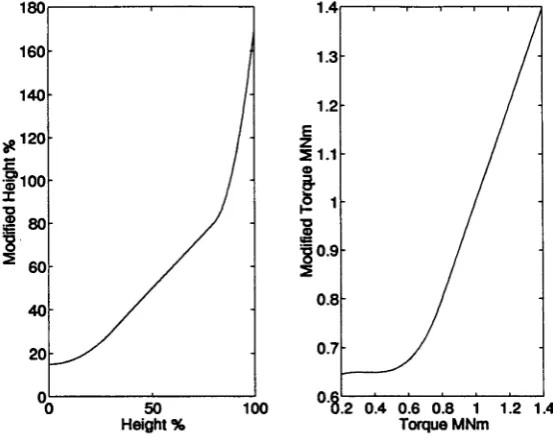
5.5 Nonlinear gain functions for the crushing process LQG controllers...100
6.1 Identification of Plant Models in Closed Loop with E x c ita tio n ...108
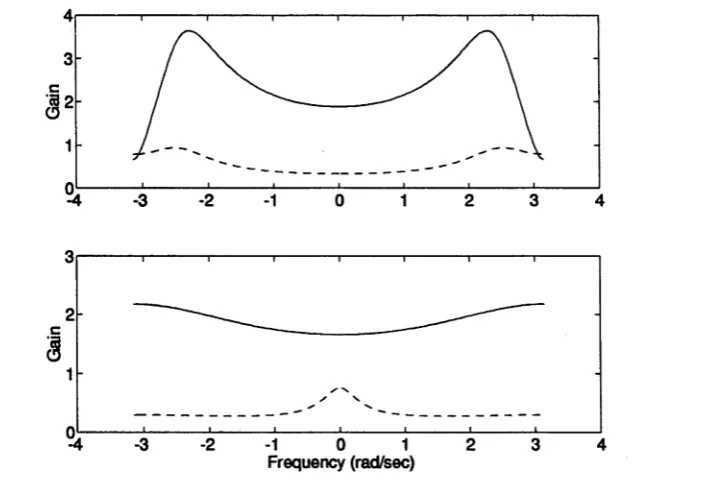
6.2 Frequency response of A2 mill height models identified in closed loop from non-excited (top) and excited (bottom) data. Speed to height transfer function model (solid line), flap to height transfer function model (dashed line)... 117
6.3 Frequency response of A2 mill torque models identified in closed loop from non-excited (top) and excited (bottom) data. Speed to torque transfer function model (solid line), flap to torque transfer function model (dashed line)...117
6.4 Step responses of the height model identified using the direct (left) and the two-stage indirect (right) methods of closed loop identification... 119
6.5 Frequency responses of the height model identified using the direct (left) and two-stage indirect (right) methods of closed loop identification... 119
6.6 Step responses of the torque model identified using the direct (left) and two-stage indirect (right) methods of closed loop identification...120 6.7 Frequency responses of the torque model identified using the direct (left)
and the two-stage indirect (right) methods of closed loop identification. . . . 120 6.8 LQG torque controllers’ speed response to steps in the input and distur
bance variables. Controller, C2 (dashed line), designed using models identi
fied via direct prediction error method. Controller, C2 (solid line), designed
using models identified using the two-stage indirect closed loop identifica tion m ethod... ... 121
7.1 Bode plots of the true plant, P , true disturbance, H, initial plant model, Pq, and the identified plant Pi for the iterative designs with model adjustment. 137 7.2 Achieved Performance J ach of the enhanced controllers for various iterative
designs... 137 7.3 Designed closed loop system featuring model estimates, (P , H )...142 7.4 Bode plot of the Transfer Function, T(z), relating the white noise process,
e\b, to the predicted difference signal, v%cfl, associated with the achieved closed loop system...149
8.1 PID versus LQG chute height control - A3 Mill... 154 8.2 Step Response of Height Controllers using model-based LQG design (solid
line) and direct LQG controller design (dashed line)... 154 8.3 A2 mill torque regulation - PID versus LQG with Co during the 1993 crush
ing season. The torque set-point is 1.0 MNm... 156 8.4 A2 mill LQG torque and chute height control performance with C\ during
the 1993 crushing season. The torque set-point is 1.0 MNm... 158 8.5 A2 mill LQG torque and chute height performance with C2 during the 1993
crushing season. The torque set-point is 1.0 MNm and the chute height set-point is 40%...158 8.6 A comparison of A2 mill LQG controller step responses. Co dotted line, C\
dashed line, C2 solid line... 159
8.7 A comparison of A2 mill LQG controller frequency responses. Co dotted line, Ci dashed line, C2 solid line... 159
8.8 A2 mill LQG torque and chute height performance with C2 during the 1994
crushing season. The torque set-point is 1.0 MNm... 162
8.9 A3 mill LQG torque and chute height performance with C\ during the 1994 crushing season. The torque set-point is 1.05 MNm...163
8.10 A4 mill LQG torque and chute height performance with C2 during the 1994 crushing season. The torque set-point is 0.9 MNm...163
8.11 A2 mill turbine power under PID and LQG control... 166
8.12 A3 mill turbine power under PID and LQG control... 166
D . l The designed closed loop system for the system (P, H) with input-output signals, and the Kalman Predictor innovations, v£ea...188
E . l A2 Mill Settings and Roller Diameters - 1994 Crushing Season...190
E.2 A2 Mill Settings and Roller Diameters - 1993 Crushing Season...191
E.3 A2 Mill Settings and Roller Diameters - 1991 Crushing Season... 191
E.4 A3 Mill Settings and Roller Diameters - 1994 Crushing Season... 192
E.5 A3 Mill Settings and Roller Diameters - 1993 Crushing Season... 192
E.6 A3 Mill Settings and Roller Diameters - 1991 Crushing Season... 193
E.7 A4 Mill Settings and Roller Diameters - 1994 Crushing Season... 193
E.8 A4 Mill Settings and Roller Diameters - 1993 Crushing Season... 194
E.9 A4 Mill Settings and Roller Diameters - 1991 Crushing Season... 194
C h a p te r 1
In tro d u ctio n
1 .1
T h e s is M o t iv a t io n
The theoretical discourse presented in this thesis is aimed at the refinement of existing feedback control systems. The theoretical research issues examined have been motivated by the need to improve the performance of an extraction process in an Australian raw sugar production factory. In the author’s opinion, with Research and Development (R&D) undertaken in a tax-payer funded university engineering department, the relevance of any theoretical endeavour would be incomplete without direct applicability to some industrial system.
Maximum sucrose extraction is one of the key objectives in maximising the profit of a raw sugar factory. The majority of sugar produced in Australia is sold on the world market and, as such, sugar prices are subject to the vagaries of cyclical price variations. In order to compete with those sugar producing countries which have low unit labour costs, sugar producers in developed countries like Australia (which have high unit labour costs) are heavily reliant on the benefits of advanced technology for their continued profitability. The extraction of sugar-bearing juice trapped inside the cellular structure of the sugar cane plant is usually attem pted with a milling train consisting of multiple crushing units. The primary objective of the crushing process is to maximise extraction at a reasonable throughput rate. Improved feedback control of the crushing process has been identified as an indirect mechanism by which to achieve higher extraction and a consequent improve ment in the profitability of Australian raw sugar factory operations. Hence, the motivation for considering controller refinement in this thesis.
2 I n t r o d u c tio n
The refinem ent of existing feedback controllers is the intent of fledgling iterative iden
tification and control designs. The available iterative schemes are supported by a solid
theoretical framework associated w ith the m ature fields of System Identification and Ro
bust Control Design. As such, engineering insights provided in this thesis, which were
critical to the development of a feedback control solution for the sugar cane crushing pro
cess, are sufficiently generic to have implications for potential application of these m ethods
to other industrial processes.
The rem ainder of this brief introductory chapter includes a short discussion of research
philosophy, a thesis overview, a listing of the original research contributions, and a state
m ent of thesis significance.
1 .2
R e s e a r c h P h ilo s o p h y
The following definition epitomises the spirit in which the research described in this thesis
was undertaken.
The task of research, and of the researcher, is to uncover what is hidden, to
make transparent what is opaque and to reveal links, and meanings, where one
might least suspect them.
Susan George
The Debt Boomerang (1992), pp. 172.
The contribution of this engineering thesis is to make transparent w hat is opaque about
certain theoretical aspects of iterative identification and control design with the view of
successfully im plem enting this advanced technology in the A ustralian sugar industry. It is
hoped th a t th e insights provided are useful to the process control practitioner in realising
successful advanced control1 solutions using currently available design techniques.
It is th e endeavour of the author to present the m aterial in a m anner which is accessible
not only to academic researchers b u t also to engineers practicing process control who do
not, necessarily, possess postgraduate qualifications. To w hat degree this mission has been
accomplished will, ultim ately, be determ ined by the individual readers.
1 .3 S y n o p s is o f t h e T h e s is 3
1 .3
S y n o p s is o f th e T h e s is
Although, this thesis presents theoretical insights which have led to the gradual develop ment of a multi-variable control solution for the sugar cane crushing process, the theory is sufficiently general so that it also applies to other multi-variable processes which can be adequately characterised by linear time-invariant finite-dimensional systems. The sub jects dealt with include control design, identification, iterative design, and application to
an industrial process. The problem statements and literature reviews are covered in the early chapters.
C h a p te r 2: C o n tro ller R e fin e m e n t
Closed loop performance can be assessed using a posteriori operational and/or experimen tal information. If the performance does not meet design specifications then controller refinement becomes necessary. A posteriori information plays an important role in de termining the manner in which the model identification and control design should be conducted in order to produce a controller which improves closed loop performance. A philosophical introduction to controller refinement is provided before controller refinement via successive model identification and control design is motivated. Thesis assumptions
are also detailed and justified.
C h a p te r 3: C lo sed L oop Id e n tific a tio n
Closed loop identification is an important component of iterative identification and control design. Direct and indirect methods of closed loop identification are investigated, with emphasis on their control-relevant nature and the design of experimental conditions.
C h a p te r 4: I te r a tiv e Id e n tific a tio n a n d C o n tro l D e sig n
Iterative identification and control design schemes enable progressive controller refinement. An overview of the currently available iterative identification and control designs is given. In particular, the so-called Zangscheme iterative design, the design methodology chosen for refining feedback controllers of the sugar cane crushing process, is introduced.
C h a p te r 5: S u g a r C a n e C r u sh in g P r o b le m
4 I n tr o d u c tio n
Zangscheme iterative identification and control design. Successful application of this tech nique has necessitated the resolution of a number of fundamental research issues. These research issues are stated in the chapter conclusion section of Chapter 5, since they are addressed in the subsequent two chapters.2
C h a p te r 6: C lo sed L o o p Id e n tific a tio n o f Su gar C a n e C ru sh in g P r o c e ss M o d e ls
The sugar cane crushing process effectively contains integrators. Therefore, stable opera tion of this production process for lengthy periods at reasonable throughput rates can only be achieved with feedback control. Consequently, identification of process models must be performed using closed loop input-output data. Successful application of the closed loop identification theory from Chapter 3 necessitates the selection of appropriate identification design variables. By taking into account a priori knowledge of the crushing process, the issue of appropriate design variable selection can be resolved.
C h a p te r 7: T h e R e v is e d Z a n g sch em e
The Zangscheme, an iterative identification and control design, uses weighted Least Squares identification and weighted LQG control design. Variant design procedures of the original Zangscheme are presented. The Zangscheme is extended to include cautious controller enhancement by making the frequency weightings for the controller design user scalable. A combination of both variants and cautious controller enhancement gives rise to a revised version of the original Zangscheme. The chapter finishes with a theoretical analysis which provides a better understanding of the manner in which frequency weightings used during the controller design affect the resultant closed loop performance.
C h a p te r 8: A p p lic a tio n o f R e v is e d Z a n g sch em e Ite r a tiv e D e sig n to th e S u gar C a n e C r u sh in g M ill
The sugar cane crushing process has provided a rich proving ground for understanding the capabilities and the shortcomings of the modelling and control techniques considered. These techniques make heavy use of operational and experimental data to derive en hanced controllers. Comprehending the manner in which process characteristics influence the iterative design is the essential ingredient for the development of successful control
1.4 S u m m a ry o f O rigin al C o n trib u tio n s 5
strategies. Various controller implementation issues related to the industrial environment were resolved prior to conducting online controller trails.
C h a p te r 9: C o n c lu sio n s and F u rth er R esea rch
The thesis finishes with a conclusion chapter in which the major results are summarised, and avenues for possible areas for future research are stated.
1.4
S u m m ary o f O riginal C on trib u tion s
During the course of research and development for this doctoral dissertation, a number of original contributions have been made. These are the subject of journal and conference papers, as previously indicated. A brief description of the original work is listed below.
• C losed Loop Identification C riterion [Section 3.3]: The criterion for closed loop identification using direct prediction error methods is derived. The criterion is not entirely new, it has been stated in a less revealing form by Gunnarsson (1988) and in an incorrect form by Bitmead et al (1990). It also appears in Gevers (1993). Nevertheless, the criterion is fundamental and is used to promote a better under standing of the design issues surrounding closed loop identification. This is in itself a valid research endeavour, recall the definition of research from Section 1.2.
• S election o f C losed Loop Identification D esign Variables [Chapter 6]: The selection of identification design variables is of great importance to the final outcome of the modelling process. To facilitate closed loop identification, an excitation signal needs to be added at the plant input. For the sugar cane crushing process, a thought experiment based upon a priori knowledge of process behaviour and closed loop identification theory systematically reveals the appropriate excitation signal to be injected during the identification experiment. Other identification design variables can be selected in a similar manner. A priori process knowledge also plays an important role in formulating model assessment checks.
6 I n t r o d u c t i o n
second variant is a direct controller design algorithm , therefore a process model
identification is no longer required at every iteration.
• C a u tio u s C o n tr o ller E n h a n c em en t [C hapter 7]: Unlike other iterative design schemes, th e original Zangscheme proceeds with not-so-cautious controller enhance
m ent using frequency weighted LQG controller design. Caution can be built into
the design criterion by scaling the effect of the frequency weightings.
• T h e R e v is e d Z a n g sch em e [C hapter 7]: A revised Zangscheme iterative design is proposed. By using a com bination of the two Zangscheme variants, the revised
Zangscheme features occasional model adjustm ent. It also features cautious control
ler enhancem ent through scalable frequency weightings. The revised Zangscheme is
a practical iterative design methodology which has been successfully implemented
on th e sugar cane crushing process.
• “In n o v a tio n s ” sig n a ls in F req u en cy W eig h ted LQG C on troller D e sig n [C h ap ter 7]: A theoretical analysis of a closed loop system with an unknown plant and disturbance under the control of an LQG controller perm its, for analysis, the
isolation of a pseudo-innovations signal called the predicted difference. The predicted
difference signal is the difference between the measured closed loop o u tp ut and the
o u tp u t of th e K alm an predictor component of the LQG feedback controller. If the
unknown plant and disturbance correspond exactly w ith the plant and disturbance
models used for th e LQG controller design, the predicted difference signal would be
w hite and equivalent to the Kalm an predictor innovations process. However, given
th a t th e feedback controllers are usually designed using approxim ate estimates of
the unknow n plant and disturbance, the associated predicted difference signal will
not be w hite. Nevertheless, by examining the whiteness of this predicted difference
signal th e suitability of a particular control design methodology or innovation can
be in terp retted . In this instance, it is the suitability of the Zangscheme frequency
weighted LQG controller design which is under consideration.
• F o r m u la tio n o f LQ G C o n tro l O b je c tiv e s for th e Su gar C ane C ru sh in g P r o c e s s [C h ap ter 5]: For the first time, model-based control was considered and successfully im plem ented for the sugar cane crushing control problem. A disturbance
1 .5 S ig n ific a n c e o f th e R e s e a r c h 7
give the user the ability to m anipulate sensibly the m athem atical control design pro
cedure in accordance with the demands of the process, a 'priori process knowledge
featured in the selection of design variables. The first control criterion considered
was based on accepted milling theory. The second control criterion evolved after
it was found the controller designs using the first criterion did not secure the ex
pected extraction improvements. Excogitation of the second criterion went against
the traditionally-held view of sugar cane milling, and was therefore justified through
careful process observation based upon open-loop step response tests, thought ex
perim ents, and process modelling. This exercise in itself contributed to a b etter
understanding of process behaviour. LQG controllers which resulted in the minimi
sation of the second control criterion, given acceptable process models and appro
priate design param eters, were found to be capable of delivering extraction benefits.
However, to improve extraction performance, significantly, it became evident th a t
resort to controller refinement techniques like the Zangscheme iterative design was
necessary.
• A p p lic a tio n o f th e R e v ise d Z an gsch em e to th e Sugar C ane C ru sh in g M ill [C h ap ter 8]: Given a good understanding of the process, successful application of Zangscheme iterative identification and control design to the sugar cane crushing
process was only achieved after adequately accommodating many practical issues in
the theoretical development of a control refinement solution. These practical issues
were a m otivating force behind the development of th e revised Zangscheme. Results
from this application are valuable for setting a future research agenda.
1 .5
S ig n ific a n c e o f t h e R e s e a r c h
The research contained in this tom e deals w ith a broad range of theoretical and practical
problem s concerned w ith the use of experim entation, d a ta analysis, identification, and
control design in the engineering of control solutions. It treats a collection of im p o rtan t
problem s related to controller performance assessment and controller enhancem ent using
operational data. This represent a logical extension of robust control design ideas to
accom m odate a posteriori performance inform ation and makes a strong liasion between
8 In tro d u ctio n
robust control design and robust controller design or enhancement based on process d ata
and identified models.
The entire tableau is not yet complete, especially from a theoretical perspective. How
ever, many of the design issues have been exposed and empirical solutions have been found
for the sugar mill application. This is a very active and exciting area of current research.
Some of the many open problems are highlighted in the final chapter. The future devel
opment of theory, techniques, and tools3 to facilitate the application of these m ethods
should, hopefully, make advanced control more accessible to the practitioners. Ultimately,
the practitioners will have the final judgem ent regarding this m atter.
C h ap ter 2
C o n tr o lle r R e fin e m e n t
2.1
C h ap ter M o tiv a tio n
Many industrial processes are often beset by marked variations in the grade of the incoming feedstock. This variability is of a stochastic nature and results in a large deviation of the process output from its desired set-point value. Poor process regulation usually has an adverse effect on the process objective. Improved rejection of the feedstock disturbance upon the process outputs can improve process performance and result in the recuperation of otherwise lost factory revenue.
Traditional PID (Proportional-Integral-Derivative) control covers the needs of many industrial processes (Nozaka, 1993). Multi-variable model-based controllers can be used to meet the demands of those processes where, either, PID control is not applicable, or where performance enhancement is sought. Performance enhancement may be required due to tighter process specifications, or simply due to poor performance with existing well-tuned PID controller. The use of advanced control techniques is not without considerable effort, often justified by economic benefits based upon anticipated performance enhancement (Richalet, 1993). In order for the material presented in this thesis to be of practical use, it is assumed th at for a given process, the financial benefits have been quantified and th at the anticipated returns justify the use of advanced control designs. It should be noted th a t quantifying the financial benefits is not a trivial exercise, often requiring long and expensive experiments.
Many industrial processes already operate under some form of feedback control, e.g. PID. Often economic and safety considerations dictate the presence of feedback controllers.
10 C o n tr o lle r R e fin e m e n t
Therefore, it is natural to consider control design techniques which seek to refine the existing feedback controller(s) to enhance closed loop performance.
Traditional robust control techniques use models and model uncertainty assumptions. Readily available a posteriori closed loop process data from normal operation and experi ments is not normally used by traditional robust control design methods to refine existing closed loop controller. The use of this a posteriori information to effect model adjustment and controller refinement to improve closed loop performance is emphasised heavily in this dissertation.
2 .2
T h e o r e t ic a l A s s u m p t io n s
Prior to exploring controller refinement, general assumptions which apply to the theoretical material advanced in this thesis, are now stated. Also, the relevance of the assumptions is justified. The first assumption is related to the nature of the closed loop signals. The second assumption applies to the process and disturbance transfer function descriptions.
The controller problem being considered in this thesis, disturbance rejection, treats the regulation of a process in the face of stochastic process disturbances. In some instances, the disturbance may also include a deterministic component, e.g. steps, pulses, ramps, sinusoids. In addition, the possibility exists for deterministic signals to be added to the plant an d /o r controller input. The technical machinery for model-based multi-variable controller design draws heavily upon the theory of stochastic processes (Doob, 1953), where the distinction between deterministic and stochastic signals can be de-emphasized if a quasi-stationarity assumption is used (Ljung, 1987).
D efin ition 2.2.1 (Ljung, 1987). A stochastic process, s(k), is quasi-stationary provided,
E s ( k ) = m 3(k), |m3(fc)| < C Vfc, (2.1)
Es(k)s(r) = R s(k, r) |i?3(fc,r)| < C Vfc, (2.2)
N
Jim TtX R,(k,k- r ) = Vt, (2.3)
N- ° ° te l
The integer time index parameter k belongs to the index set, K , i.e. k £ K, k ,K G Z .
E is the expectation operator with respect to the stochastic components of s(k). N is the
2 .2 T h e o r e t ic a l A s s u m p t io n s 11
A ss u m p tio n 2.2.1 All external signals are quasi-stationary.
R e m a rk 2.2.1 The integer nature of the index set implies th at discrete time stochastic processes and consequently discrete time controller designs are under consideration in this thesis. Today, at least in the western world, most industrial processes are have been automated through the use of digital computer technology. For industrial processes with relatively slow dynamics like the sugar cane crushing process, the acquistion of process data on modern Distributed Control Systems (DCS) can be achieved at a necessary sampling rate of 4-10 times the process rise time (Äström and Wittenmark, 1990). As the sampling rate is sufficiently fast, yet not too fast, and as the controller will be implemented on a digital computer, continuous time controller designs need not be considered.
R e m a rk 2.2.2 Bounds on the mean and auto-covariance in equations (2.1) and (2.2), respectively, imply th at the stochastic process, s(fc), is well-behaved. In a practical appli cation stochastic processeses are always bounded.
R e m a rk 2.2.3 The third condition (2.3) implies th at the covariance of a stochastic pro cess can be determined from a single sufficiently long realisation. This is im portant, since the theoretical material for the design of a feedback controller often involves signal spectra. The power spectrum, 4>3, of a stochastic process, {s(fc)}, is the Fourier transform of its covariance function, R 9, i.e.
. T — OO
^
E
(2.4)T = — OO
In practice, equations (2.3) and (2.4) provide a mechanism to compute an estimate of the covariance, and hence the signal spectrum, of a stochastic process from a finite length batch of signal data (Oppenheim and Schafer, 1975).
R e m a r k 2.2.4 The restriction to quasi-stationary stochastic process implies th at the theoretical methods considered will not apply to nonstationary processes.
12 C o n tr o lle r R e fin e m e n t
A s s u m p tio n 2 .2 .2 The idealised plant, P , and the idealised disturbance, H , can be ex
actly represented by linear time-invariant finite dimensional (LTIFD) difference equations.
However, the exact knowledge of the number and magnitude of the coefficients in these
equations need not be known precisely.
R e m a r k 2.2.5 For many complex industrial processes, linearity assumptions allow a im
m ediate and feasible controller design, albeit th a t the im plem ented controller is, at best,
a crude approxim ation to an otherwise, often, unobtainable and unconstructible optimal
controller.
R e m a r k 2.2.6 A time-invariance assum ption is often added, despite the fact th a t the
process an d /o r the disturbance m aybe time-varying. Difficulty in accurately characterising
b o th the determ inistic and stochastic n ature of the tim e-variation for complex industrial
processes has to some degree inhibited the use of time-varying controller design methods.
R e m a r k 2 .2 .7 Controller im plem entation on the available factory computing environ
m ent necessitates a restricted dimensional design.
R e m a r k 2 .2 .8 In keeping w ith th e notation used in the literature, the system, (P ,H),
and its model, (P , H), shall be abbreviated to P and P , respectively, where this does not
bring confusion. In general, th e terminology s y s te m will refer to the plant and disturbance
pair, (P, H), whilst s y s te m m o d e l e s tim a te s refers to estim ated plant and disturbance
model pair, (P , H).
A pproxim ate system model estim ates can be obtained by
:-• physical modelling, where models are formulated using physical or chemical laws of
nature.
• black-box modelling, where param etric models are fitted using only d ata collected
during a model identification experim ent on the process.
• grey-box modelling, where models are constructed using a combination of the above
m ethods.
In this thesis, models used are, unless otherwise indicated, identified using black-box
modelling techniques known as System Identification (Ljung, 1987). The focus is to use
a priori process knowledge and posteriori d ata to m anipulate black box modelling in a
2 .3 S y s t e m F r a m ew o r k 13
2 .3
S y s t e m F r a m e w o r k
The framework adopted in this thesis for considering linear tim e-invariant systems is th a t
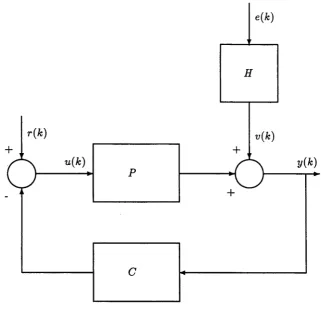
of Ljung (1987). Figure 2.1 shows the closed loop configuration under consideration in
this thesis. The in pu t-output relationships of the idealised LTIFD system of Figure 2.1
can be described as follows.
The o u tp u t, y{k), of the idealised plant, P , is given by
<5: y(k) = P( z ) u( k) + v(k), (2.5)
where the plant input u{k) is a quasi-stationary process with spectrum , <Fu(o;). P{z)
is a strictly proper rational transfer function. The argum ent, z, in P( z) denotes the z-
transform complex variable, while z in P(z)u(fc) denotes the shift operator, i.e. z nu ( k) =
u( k + n), z ~ nu{k) = u(k — n). The idealised disturbance, v(k), which acts upon the
process o u tp u t, y(k), is a quasi-stationary stochastic process described by,
v(k) = H{ z ) e{ k), (2.6)
where e( k) is a sequence of independent random variables w ith zero mean values, covari
ances, <7e, and bounded fourth moments. H{z) is a proper rational stable transfer function
of the form,
H( z) Cd(z)
Dd(zy
(2.7)The polynom ial D d( z) has all its zeros inside the unit circle. The polynomial C d( z) has
zeros either inside or on the unit circle. Both polynomials are assumed to be monic. The
spectrum of v ( k) is given by
$ t , ( w ) = <Te|P ( e JU') |2, - 7 T < U < 7T, (2.8)
where u> is the radian frequency. The plant input, u(fc), is determ ined by the control law
u(k) = r(k ) - C ( z ) y ( k), (2.9)
where C ( z) is a LTIFD transfer function description of the feedback controller, and r(k)
14 C o n tr o lle r R e fin e m e n t
Figure 2.1: Achieved closed loop system.
• an excitation signal injected only during an identification experiment, or
• a reference signal for the controller to track.
R em ark 2.3.1 The bounded fourth moment assumption on e(k) allows the interchange of expectation and summation operators, necessary to derive computable formulae for the covariance and cross-covariance functions, Ryy( r) and RyU( r), respectively (Äström and W ittenmark, 1990).
R em ark 2.3.2 In general, in this dissertation the signal, r(fc), is an excitation signal as opposed to a reference signal, since disturbance rejection controller designs are under review.
[image:30.549.95.417.99.410.2]2 .4 P e r fo r m a n c e E n h a n c e m e n t 1 5
in the disturbance cannot be identified from second order statistics. Hence, the cost-free restriction th at C d in (2.7) has its zeros on or inside the unit circle.
R em ark 2.3.4 Equation (2.5) suggests that only a single, perhaps multi-variable, dis turbance, v(k), enters additively at the process output. It is assumed th at process dis turbances or noise entering at, either, the process input or within the process, have been lumped into the output disturbance, v(k), (Ljung, 1987).
2.4
P erform an ce E nh an cem en t
The rapid development of computer controlled factory automation systems has resulted in a proliferation of process variable data exploitable for analysis. In particular, time domain input-output data associated with feedback control systems is readily available. An im portant aspect of advanced control for process industries concerns the financially justified use of time domain data to enhance the process performance through better feedback control systems design.
The refinement of a feedback controller relates to the adjustment of existing controller parameters in order to achieve improved closed loop performance. The subject of controller refinement considered in this thesis is formalised by the following definition.
D efin ition 2.4.1 C ontroller R efinem ent. Controller refinement refers to the iterative
process of the gradual enhancement of closed loop performance for an unknown, yet fixed,
system, such that
j ach( p , c x+1) < r ch(p,c,),
(2.10)where the integer i refers to iteration index and J ach is a criterion used to evaluate the
closed loop performance achieved with the indicated controller. The lowest achievable closed
loop performance is bounded below by the optimal performance, J ach(P ,C opt(P)), where
C 0?1 is the optimal admissible controller designed given exact knowledge of the system.
R em ark 2.4.1 The performance criterion selected resolves the controller design method. Criterion selection is influenced by a combination of considerations related to
16 C o n tr o lle r R e fin e m e n t
tolerances (Cheng et al, 1993). Regulation of the temperature profile of steel slabs leaving the reheat furnace plays an important role in determining the metallurgical properties of the final product. Therefore selected control performance criterion must be congruent with the overall process objective.
• the control design expertise of the user. Although some academic researchers may sit uncomfortably with this unscientific notion, and in some extreme cases even refuse to accept th at it does exist, it is nevertheless is a fact of life th at the user’s level of comfort dictates the application of certain design techniques over others. Performance criterion selection based on this pragmatic insight can be justified by the availability of user software specific to a particular design method, and end-user requirements regarding delivery time of a control solution.
R em ark 2.4.2 Controller refinement is initiated when the controller performance on the true system is recognised as not meeting the design specifications. Controller refinement can be considered as the supervised retuning of an existing feedback controller. Similarly, with commercial PID single-loop controller products th at incorporate auto-tuning, the user recognises the need for controller retuning and then initiates and supervises the automatic refinement of an online controller (Äström et al, 1993).
2 .5
R o b u s t A d a p t iv e C o n tr o l
The following heuristic arguments for placing controller refinement into robust adaptive control context were used by Lee, (1994), and Schrama (1992a).
2 .5 R o b u s t A d a p tiv e C o n tr o l 17
A ssu m p tio n 2.5.1 It assumed that the existing feedback controller can classified as a
robust controller in the sense of Zames and Wang (1992).
R em ark 2.5.1 Practically all controllers are designed on the basis of some a priori knowl edge and therefore, in the sense of Zames and Wang (1992), can be considered to be robust.
If the closed loop performance of an initial robust controller meets design specifications, an adaptive design is not required. However, if the design specifications are not meet, resort to an adaptive design is warranted. With traditional adaptive control (Äström and W ittenm ark, 1989, Gupta, 1986, Goodwin and Sin, 1984), the adjustment of the existing controller parameters occurs continually as new data is logged, in other words on-line. W ith controller refinement as considered in this volume, a batch of recently collected closed loop input-output data is used to make off-line adjustments to the existing controller. Only after the adjustments are completed is the enhanced controller ready for feedback control. Since off-line controller refinement also uses a posteriori data it can also be considered to be an adaptive control design method.
By definition, controller refinement would not be necessary if the current robust con troller achieved closed loop performance specifications. Therefore, controller refinement
includes both a robust and adaptive agenda and the associated technical issues are those of robust adaptive control. This is confirmed in Schrama and Bosgra (1993), Lee et al (1993a), who combine adaptation and robust control through an iterative identification and control design for controller refinement.
W ith controller refinement for uncertain systems, the design of an enhanced controller according to a particular design criterion depends upon the current closed loop system, system estimates, a model uncertainty description, and certain design variables available for user manipulation.
D efinition 2.5.1 C ontroller D esign. The design of an enhanced feedback controller
for the unknown system, P , is the search for a controller, Ci+i, in some class, C, which minimises a design criterion, J de9, for a specific system model estimate, P{+\, i.e.
Ci+i = arg min J de9{Pi+i, C,A,+i, xi,*+l)> (2.11)
C GC
where
18 C o n tr o lle r R e fin e m e n t
A refers to a linear time-invariant (LTI) stable plant perturbation, x i to a set of con
trol design variables, and X2 to a set of design variables which influences the modelling
outcome.
R e m a r k 2 .5 .2 Definition 2.5.1 concedes th a t the model-based controller design is depen
dent upon a previous model identification step. T h at is, the modelling and control design
processes are iterative in n ature (Schrama, 1992b, Skelton, 1988). The emergent field of
iterative identification and control design schemes presents systematic and theoretically
justified procedures to achieve performance enhancement (Van den Hof and Schrama,
1994, Gevers, 1993).
R e m a r k 2 .5 .3 The inclusion of design variable sets allows the user to influence the out
come of a m athem atical design procedure. Therefore, the issue of design variable selection
is of great im portance. In this thesis, aspects of design variable selection for both the
model identification and controller design are examined.
R e m a r k 2 .5 .4 The unconstrained m inim isation given in Definition 2.5.1 does not guar
antee perform ance enhancem ent. U nfortunately, constraining the minimisation subject
to,
J ach( P ,C i+1) < J ack(P,Ci),
leads to a m athem atically intractable problem since the system, P, is unknown.
R e m a r k 2 .5 .5 In a stan dard “certainty equivalance” LQG controller design, the plant
p ertu rb atio n , A , is zero, whereas w ith Hqo control designs A is typically non-zero. There
fore, in the case of a control design an estim ate of the plant pertubation, which defines
an uncertainty set associated w ith a particular plant model, is required.
2.6
U n c e r ta in ty S ets
U ncertainty sets define a bound on the m ism atch between the plant and its nominal model.
K osut (1995) considers uncertainty sets as a collection of unfalsified models. T h at is, all
possible m em ber plant models w ithin the uncertainty set can, in some sense, adequately
reflect the dynam ical behaviour captured by a given input-output d ata set. W ith robust
control design m ethods, the stru ctu re and size of the dynamical perturbation is used to
2 .6 U n c e r t a in t y S e ts 19
D e fin itio n 2.6.1 (Van den Hof and Schrama, 1994) An uncertainty set, V& (P,b), re stricted in size by a scalar metric, b, induced by the nominal plant model, P, and an
uncertainty structure, A , is defined as
V&(P,b) = { P ’ s.t. |/>*(eJ“ ) - P(eiw)\g(Pw)~l < b]- tt< w < tt, (2.13)
where g is some real-valued weighting function.
R e m a rk 2.6.1 Definition 2.6.1 is a general definition for unstructured uncertainties, that is, an uncertainty about which no information is available except for an upper bound on the magnitude of its frequency response. Structured uncertainties are also possible (Green and Limebeer, 1995, Doyle et al, 1992, Maciejowski, 1989, Morari and Zafiriou, 1989). However, for many complex industrial processes it is difficult to characterise reliably the unstructured uncertainty estimates, let alone the more specific structured uncertainty estimates.
R e m a rk 2.6.2 Typically, available robust control designs incorporate disturbance model uncertainty by specifying an a priori norm bound on the disturbance signal, rather than probabilistic models of the disturbance process and the associated disturbance model mismatch (Mäkilä et al, 1994). Bounded disturbance signals are used in set membership identification (Milanese and Vicino, 1991, Norton, 1987, Fogel and Huang, 1982)
R e m a rk 2.6.3 Given an uncertainty set, V&(P,b), the robust control design problem is to construct a controller, C (P ,Va(P, b)), which achieves certain specifications for all plant models in the uncertainty set. This is the philosophy of a worst-case design.
R e m a r k 2.6.4 Worst-case bounds on the uncertainty set can be estimated from finite length closed loop input-output data sequences (Hakvoort, 1994, Hakvoort and Van den Hof, 1994, de Vries, 1994, Kosut et al, 1992, Kosut, 1988). Similar approaches limited to open-loop data include those of Goodwin et al, 1992, Wahlberg and Ljung, 1992.
20 C o n tr o lle r R e fin e m e n t
used in any robust control design. To the author at least, it is unclear whether algorithms developed for the purposes of model uncertainty estimation include a validation proce dure. For example, does there exist a simple sensibility check for validating the order of magnitude of the estimated bound. In the early 1990s, the lack of model uncertainty estimation algorithms, and just as importantly, reliable software to implement these algo rithms, mitigated against the use of robust control design methods which required model uncertainty estimation for the sugar cane crushing problem. Nevertheless, the concept of uncertainty set is fundamental to understanding controller design for unknown systems.
The ultim ate aim of controller refinement is high performance control. In order to design a feedback controller which achieves high closed loop performance for an uncertain system, the size and structure of the uncertainty set needs to be limited (Van den Hof and Schrama, 1994). This observation asserts th a t with a robust control design the achievable closed loop performance is a reflection of the uncertainty set size and hence confidence in the model estimates. In order to gain performance improvement, controller refinement requires an investigative agenda to reduce the size of the uncertainty set associated with a particular plant model. Such an agenda is the realm of a stochastic adaptive control philosophy known as d u a l c o n tro l (Fel’dbaum, 1965, W ittenmark, 1975).
2.7
P ro b in g and C a u tio n in S to ch a stic A d a p tiv e C ontrol
The concept of dual control was introduced by Fel’dbaum (1960-61) for systems for which the parameters are not known precisely. Fel’dbaum recognised that control signals should not only seek to direct the process, but should also probe with the view to obtaining information. Hence, the control signal is said to possess a reciprocal or dual nature.
D efinition 2.7.1 (Äström and Wittenmark, 1989). Dual control is the property of an
optimal controller which achieves the correct balance between maintaining small control
signals and parameter estimation errors for a given performance criterion.