This is a repository copy of The Effects of Learning Orientation and Marketing Programme Planning on Export Performance: Paradoxical Moderating Role of Psychic Distance. White Rose Research Online URL for this paper:
http://eprints.whiterose.ac.uk/143298/ Version: Accepted Version
Article:
Assadinia, S, Kadile, V orcid.org/0000-0001-9266-3861, Gölgeci, I et al. (1 more author) (2019) The Effects of Learning Orientation and Marketing Programme Planning on Export Performance: Paradoxical Moderating Role of Psychic Distance. International Small Business Journal, 37 (5). pp. 423-449. ISSN 0266-2426
https://doi.org/10.1177/0266242619831914
© The Author(s) 2019. Assadinia, S, Kadile, V , Gölgeci, I et al. (1 more author) (Accepted: 2019) The Effects of Learning Orientation and Marketing Programme Planning on Export Performance: The Paradoxical Moderating Role of Psychic Distance. International Small Business Journal. ISSN 0266-2426 Reprinted by permission of SAGE Publications.
[email protected] https://eprints.whiterose.ac.uk/
Reuse
Items deposited in White Rose Research Online are protected by copyright, with all rights reserved unless indicated otherwise. They may be downloaded and/or printed for private study, or other acts as permitted by national copyright laws. The publisher or other rights holders may allow further reproduction and re-use of the full text version. This is indicated by the licence information on the White Rose Research Online record for the item.
Takedown
If you consider content in White Rose Research Online to be in breach of UK law, please notify us by
The Effects of Learning Orientation and Marketing Programme Planning on Export Performance: The Paradoxical Moderating Role of Psychic Distance
Shahin Assadinia1, Vita Kadile2, Ismail Gölgeci3, Nathaniel Boso4
1Dr, Lecturer in Marketing, Norwich Business School, University of East Anglia, Norwich Research Park, Norwich, Norfolk, NR4 7TJ, UK. E-mail: [email protected]
2Dr, Lecturer, Leeds University Business School, University of Leeds, Leeds, United Kingdom.
E-mail: [email protected]
3Dr, Associate Professor, School of Business and Social Sciences, Department of Business
Development and Technology, Aarhus University, Birk Centerpark, Herning, 7400, Denmark. E-Mail: [email protected]
4Prof., Associate Professor, Marketing and Corporate Strategy, Kwame Nkrumah University of
Science & Technology, Kumasi, Ghana. E-Mail: [email protected]
Abstract
Despite extensive research on the effect of organisational learning processes on firm performance, how and when a propensity to learn drives export performance of small and medium-sized enterprises (SMEs) remains unclear. Using multiple-informant and time-lagged primary data from 242 SMEs in a sub-Saharan African market, this study examines the roles of marketing programme planning and host country psychic distance in linking export learning orientation to export performance. Findings from the study show that increases in both export learning orientation and marketing programme planning are associated with increases in export performance. Additionally, the study finds that while increases in psychic distance weaken the effect of export learning orientation on export performance, it strengthens the effect of marketing programme planning on export performance. These findings draw attention to the idea that cognitive distance between home and host country markets may play a paradoxical role in explaining when organisational learning activities may help or hurt exporting SMEs.
Keywords
Introduction
Exporting activity is of great importance to firms as it helps enhance firms’ market position and survival (Morgan et al., 2012; Leonidou et al., 2010). In particular, small and medium-sized enterprises (SMEs) in developing economies can leverage exporting as a springboard to transcend the limits of their home markets and utilise foreign market opportunities (Tasavori et al., 2018; Boso et al., 2016). Nonetheless, given the increasing competitiveness of the international marketplace, understanding the key determinants of export performance is of great concern for both managers and policy makers (Morgan et al., 2004). This effort to understand export performance drivers has enabled exporting research to examine export market knowledge resource bases that enable exporting firms to use internal routines and processes to build learning capabilities to drive export performance (Morgan et al., 2012; Chabowski et al., 2018).
of how exporting firms in developing countries may benefit from the deployment of export learning orientations and marketing capabilities (Ellis et al., 2011; Boso et al., 2017).
In particular, the knowledge on the mediating mechanisms that translate emerging market SMEs’ learning orientation into export performance outcomes and on boundary conditions that shape
the nature of these linkages, remains underdeveloped. Nonetheless, as a strategic disposition, export learning requires specific activity-based mechanisms to convey its influence on export performance. Likewise, the linkage between emerging market SMEs’ export learning orientation and export
performance is unlikely to be universal and immune to external contingencies, given the potential variations in cultural values and business paradigms across home and foreign markets (Child et al., 2002). In a world where businesses and, in particular, SMEs from developing economies, face unprecedented levels of complexity and volatility that create export learning challenges and subdue seemingly clear-cut solutions (Cavusgil and Cavusgil, 2012; Matanda et al., 2016), understanding how and when SMEs convert their learning orientation into export performance is imperative.
This study contributes to SMEs research in three ways. First, we respond to on-going calls for additional research on SME internationalisation from developing markets (Chabowski et al., 2018; Boso et al., 2018a) and the mechanisms through which export learning drives export performance (Theodosiou and Katsikea, 2013). We draw insights from resource-based theory to conceptualise export learning as a firm resource that can influence export market performance when channelled through marketing programme planning. We contend that the ability to learn about the nuances, opportunities, and challenges in export markets is a primary and fundamental activity for SMEs, as it enables exporting firms to develop knowledge about opportunities and risks in targeted export markets, as well as design and formulate marketing programme strategies to exploit new export market opportunities (Morgan et al., 2012).
Greater perceived psychic distance may weaken the economic benefits that firms obtain from export learning (Brock et al., 2011; Taylor and Jack, 2013), as it impairs information flows between a firm and its export market in terms of accuracy of information on export market needs and demands (Evans et al., 2000). Paradoxically, a greater perceived psychic distance may prompt firms to formally plan for their export marketing programmes to boost performance. This study argues, therefore, that a greater understanding of the interplay between export marketing programme planning and perceived psychic distance may help to explain how and when export learning influences export performance.
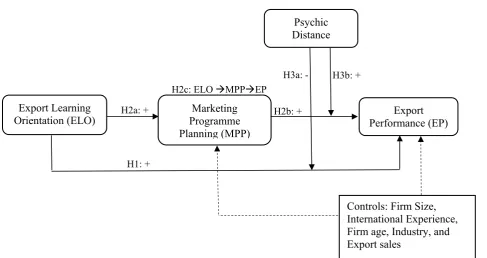
Third, research on export learning, marketing programme planning, and psychic distance has been based on data from Western industrialised economy firms with limited evidence coming from firms in less developed economies (Child et al., 2002; Naldi and Davidsson, 2014; Villar et al., 2014). We extend prior studies further by testing our conceptual model (see Figure 1) in a less studied sub-Saharan African context: exporting SMEs in Nigeria. Accordingly, our study helps uncover new insights from an exotic context to explain how developing economy SMEs deploy marketing programme planning to channel export market learning activities to export performance, amid varying levels of psychic distance across different export markets.
[Insert Figure 1]
Theoretical background and hypotheses development
Learning orientation
Learning orientation refers to the mind-set and propensity of a firm to create and use knowledge for the purposes of strategy development (Sinkula et al., 1997; Calantone et al., 2002). Learning orientation influences where learning occurs and the nature of what is learned. It defines how firms obtain, share and
utilise knowledge (Real et al., 2014). Four commonly accepted elements of learning orientation include a commitment to learning, shared vision, open-mindedness, and intra-organisational knowledge sharing (Calantone et al., 2002; Sinkula et al., 1997). It is, therefore, reflected in the intrinsic motivation to seek, question, and absorb new information. It plays a pivotal role in shaping market information processing (Baker and Sinkula, 1999). Learning orientation, therefore, affects a firm’s propensity to value learning as a strategic resource (Baker and Sinkula, 1999), and supports a continuous re-examination of the organisational practices and norms that guide marketing activities (Sinkula et al., 1997). Thus, it constitutes the foundational resource for market information utilisation (Calantone et al., 2002).
Given its strategic importance, the extent to which learning orientation influences organisational performance has been subject to extensive scrutiny by management and marketing researchers (Baker and Sinkula, 1999; Real et al., 2014; Wang, 2008; Calantone et al., 2002). A firm with strong learning orientation is not merely a depository of knowledge but also a knowledge processor, as it shapes firms’ likelihood of promoting generative learning as an enduring primary competence (Baker and Sinkula, 1999). Firms’ commitment to learning and receptivity to new, external information are fundamental to performance (Wang, 2008). Firms that have enhanced learning orientation are more eager to question long-held assumptions about their central business philosophies, and thus are more likely to adapt to external demands that are seen as a keystone of long-term performance (Baker and Sinkula, 1999).
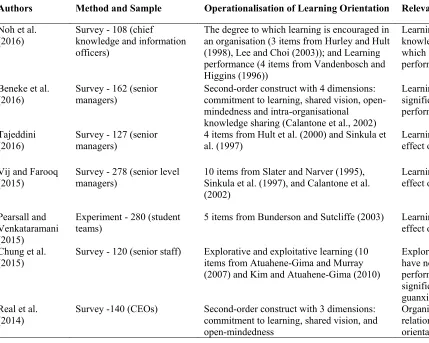
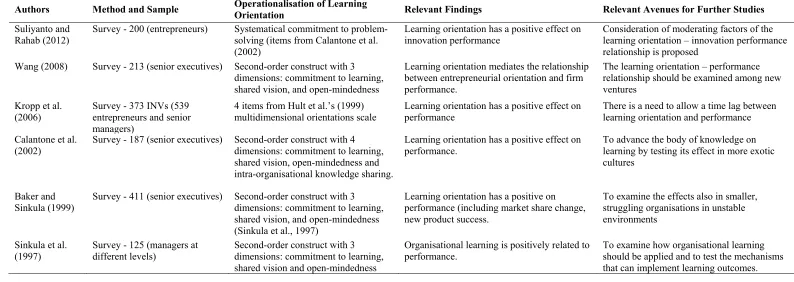
Extant research on the link between learning orientation and performance suggests that the relationship is more complex than previously assumed (Kropp et al., 2006). Importantly, empirical findings on the relationship remain inconclusive (see Table 1). Specifically, while some prior studies show that a firm’s proclivity to learn is positively associated with performance (Real et al., 2014; Wang, 2008), others
this equivocality of the learning orientation – performance relationship, some researchers have called for additional research on the relationship. For example, Real et al. (2014) suggest that the extent to which learning orientation influences performance is conditional upon it being channelled through organisational routines and processes. Similarly, Calantone et al. (2002) propose additional research to examine organisational mechanisms that may connect learning orientation to organisational performance (see also Sinkula et al., 1997).
Additionally, researchers have also called for further research to understand the conditions under which learning orientation is more or less beneficial to firms (Suliyanto and Rahab, 2012). Calantone et al. (2002), in particular, take a national cultural perspective to argue that knowledge on learning orientation may be enhanced under conditions of varying cultural settings beyond the often researched industrialised markets in North America and Western Europe. Along this line, Baker and Sinkula (1999) suggest that the learning orientation - performance relationship should be examined in market environments that are traditionally noted for instability and turbulence. Furthermore, the complexity of the learning orientation – performance relationship is exacerbated when it is considered in an international business context. This contextual complexity has the potential to convolute findings and hinder the applicability of research implications.
[Insert Table 1]
Thus, in following the suggestion by Katsikeas et al. (2016), this study focuses on a specific form of export-related learning orientation and a specific export performance outcome. Similarly, learning orientation is a dispositional (or attitudinal) concept (Sinkula et al., 1997; Calantone et al., 2002), and its actual influence on performance outcomes, without accounting for the intervening role of relevant behavioural activities, may limit knowledge development. To this end, we concentrate on a specific marketing behavioural activity (i.e., marketing programme planning) to probe into how this activity helps firms convert export learning orientation into export performance.
Export learning orientation is a specific form of organisational learning that concentrates on learning about opportunities and challenges in a firm’s export environment, as well as the internal processes needed to
succeed in export activities. Because foreign markets are more unfamiliar and complex than home markets (Sousa and Bradley, 2006; Evans and Mavondo, 2002), learning about the realities of export markets becomes ever more necessary for creating value and realising export marketing strategies. Firms that maintain learning orientation are more likely to stay alert to external information sources, cognisant of fluid export market demand, and acquire the necessary knowledge to create value (Wang, 2008). In line with the resource-based view of learning orientation (Schilling, 2002), export learning enables organisational knowledge management activities and intra-organisational knowledge sharing (Calantone et al., 2002) to decode and disseminate intricate export market intelligence. Accordingly, as a potentially influential force in firms’ international marketing strategies (Baker and Sinkula, 1999; Morgan et al., 2012), export learning
orientation can underlie export market learning activities and internalisation of export market knowledge thereby paving the way for increased export performance. Accordingly, we propose that:
Hypothesis 1: Export learning orientation is positively related to export performance
inextricably intertwined with market learning through reciprocal and dynamic processes and could be an essential mediating process linking export learning orientation to export performance.
On the one hand, learning orientation can influence a firm’s ability to create and use market
knowledge (Real et al., 2014), implying that export learning orientation is instrumental to the enactment of marketing plans to serve export market needs. In particular, export learning orientation can stimulate export marketing strategy development by providing rich information on export market demands and trends (Conant and White, 1999). We therefore argue that export learning orientation can be a significant driving force behind the design and implementation of marketing programme plans for export markets. On the other hand, despite increasing turbulence and uncertainty in the global business environment (Putnam et al., 2016; Cavusgil and Cavusgil, 2012), marketing planning remains an essential element in the smooth execution of business operations. In particular, marketing programme planning can help firms set realistic goals, gauge their competences, and execute marketing activities in foreign markets (Conant and White, 1999).
Planning becomes especially relevant for complex business operations with ambiguous inputs and outputs (Alpkan et al., 2007; Oliva and Watson, 2011). A well-prepared strategic marketing plan may alleviate internal and external uncertainties by clearly defining a firm’s marketing strengths and weaknesses with respect to marketing plans compared to export market competitors’ plans (Alpkan et al., 2007). Therefore, strategic planning approaches has been suggested as critical factors in business performance (Lysonski and Pecotich, 1992), although there exists an alternative line of research that suggests rigid marketing planning processes could damage performance in dynamic environments (Slotegraaf and Dickson, 2004). Drawing on this line of research, we argue that market programme planning can, at an overall level, serve as an enabler of the performance of firms’ export operations.
Marketing programme planning is a key process that turns organisational learning propensity into increased export performance by enabling firms to convert their learning values and orientations into actionable marketing plans (Cavusgil and Cavusgil, 2012). Thus, we argue that:
Hypothesis 2: (A) Export learning orientation is positively related to marketing programme planning,
(B) marketing programme planning is positively related to export performance; and therefore (C)
marketing programme planning mediates the relationship between export learning orientation and export
performance
The paradoxical role of psychic distance
Beyond the processes through which export learning orientation influences export performance, the effect may also be dependent upon export market environment conditions within which learning activities are executed. One central concept often used to understand a firm’s export market environment condition is psychic distance (Sousa and Bradley, 2006; O'Grady and Lane, 1996). It refers to the psychological distance between a firm’s home and foreign markets with regard to cultural and business practice
differences (Evans and Mavondo, 2002). Psychic distance is a consequence of a number of inter-related factors, of which perception is a major element (Evans and Mavondo, 2002). These factors curb information flow between home and host country operations, including culture, language, business practices, political and legal systems, education, economic development, marketing infrastructure, and industry structure (Evans et al., 2000). Such a portfolio of differences between home and host markets can impose ambiguous and multidimensional influences on firms’ international business activities (O'Grady
and Lane, 1996).
psychic distance focuses on perceptual variations in economic, language, cultural, educational, and business practices between a firm’s home and host market environments (Dow and Karunaratna, 2006).
Psychic distance, therefore, comprehensively captures managers’ overall perception of the host market vis-à-vis home market business environment conditions (Sousa and Lages, 2011). Thus, while some degree of similarities may be expected, psychic distance is a more comprehensive concept than institutional distance, and is more relevant to this study in that it raises an important question about how managerial perceptions of variation in home and host market practices shapes the effectiveness of strategic decisions.
As the focus of organisations is the management of known and knowable parameters (Carson et al., 2006), psychic distance challenges management practice in a fundamental way by introducing unknown parameters into the equation, stemming from the complexity and unfamiliarity of operating in foreign markets (Sousa and Bradley, 2006). As firms venture into export markets, the inputs and outputs of their managerial decision making and activities become blurred, and the influence of psychic distance on performance can be either positive or negative (Evans et al., 2000; Stöttinger and Schlegelmilch, 1998). Such a challenge can put managers in a cognitively difficult position and undermine firm functioning. However, as the influence of psychic distance on firm functioning is likely to be relative to that of competitors in foreign markets, firms that can handle psychic distance better in relative terms can be in an advantageous position. Such dynamics around this construct highlight the paradoxical role of psychic distance (O'Grady and Lane, 1996; Zaheer and Hernandez, 2011; Evans and Mavondo, 2002).
al., 2016) and its linkages with issues such as innovation (Jay, 2013) and learning (Ho and Wang, 2015). Paradox has also recently found applications in marketing, particularly with respect to inter-organisational competition (Mattsson and Tidström, 2015) as well as in small business management (Ortega-Argilés et al., 2009; Volery et al., 2015). The application of paradox theory has helped to disentangle complex phenomena like psychic distance and grasp their nature and influences in a more realistic way (Putnam et al., 2016).
Within the context of exporting, paradox often arises from the competing demands of institutional environments (Smith and Tracey, 2016). It often invokes inevitable yet rewarding challenges for organising: difficult to face and manage but rewarding once it is embraced and dexterously navigated. Psychic distance is mostly determined by cultural distance and the individual values of the managers (Sousa and Bradley, 2006). Hence, the paradox of psychic distance mainly stems from the complex interplay between the external determinants of distance such as geography and culture, and managerial perception. On the one hand, psychic distance is a daunting challenge when operating in murky waters due to information and learning related obstacles. On the other hand, it may present unexpected opportunities potentially stemming from unanticipated events and the failure of competitors to handle the challenges it presents. The mixture of objective external forces and one’s perception of these forces, makes the influence
of physics distance less predictable and paradoxical (Evans and Mavondo, 2002). Thus, the psychic distance paradox, which denotes a dual or dilemmatic influence of psychic distance on a firm’s orientations and marketing strategy outcomes, represents a significant managerial conundrum that requires additional scholarly attention. This study, therefore, focuses on exposing the paradoxical moderating role of psychic distance in the relationships between export learning orientation, marketing programme planning, and export performance.
performance is likely to be shaped by a variety of perceptual contingent factors. One such perceptual factor is perceived psychic distance (Stöttinger and Schlegelmilch, 1998; Johnston et al., 2012).
Psychic distance is often understood in terms of perceived barriers to learning about foreign markets (Evans and Mavondo, 2002). Hence, as psychic distance increases, export marketing activities often face several difficulties, partly due to a lack of a shared frame of reference and understanding about perceived differences between home and host market actors (Johnston et al., 2012). For example, differences in perception may emerge between home country and respective host country trading partners concerning the benefit of learning philosophies. Thus, psychic distance can create learning bottlenecks and inhibit the realisation of a tendency for learning about foreign markets and its potential influence on the effectiveness of export activities (Evans and Mavondo, 2002). Additionally, exporting firms can find it cognitively difficult to comprehend unfamiliar and perceptually distant market needs and challenges. For example, a greater perceived socio-cultural distance can impede managers’ ability to understand the sociocultural implications of serving in a host market. Under such circumstances, firms may find it daunting to translate their export learning into increased performance. Therefore, we argue that increases in psychic distance can weaken the export performance benefits of export learning orientation.
Hypothesis 3A: The relationship between export learning orientation and export performance is
weakened when perceived psychic distance increases in magnitude.
We propose that systematic and cognisant marketing programme planning and execution can help firms tease out subtle advantages of psychic distance and supplant its negative effects. Exporters who design and implement export marketing programme plans often have a clear sense of key competencies in the export market environment (Conant and White, 1999). The negative role of psychic distance can thus turn positive once the distance is bridged by juxtaposing the firm’s marketing competences against the
export market environment and properly configuring and efficiently implementing export marketing strategies (Morgan et al., 2012). Firms that realise their marketing planning programme in export markets with high psychic distance can pave the way for greater export performance when they play to their strengths and turn market challenges into an asset through conscientious marketing planning activities (Lysonski and Pecotich, 1992).
When linked with export learning orientation, market programme planning can unlock opportunities hidden in the obscurity of distant markets. As planning is often a pivotal tool in handling unfamiliarity in new contexts (Lysonski and Pecotich, 1992), marketing programme planning helps firms evaluate uncertainties and potential unknown possibilities in export markets. Thus, we posit that the effect of marketing programme planning on export performance is strengthened when perceived psychic distance increases because, in such circumstances, firms may have planned for their foreign markets with high psychic distance by collecting and analysing intelligence on those markets. Such that, as marketing programmes become well planned through stronger orientation to export learning, and as perceived psychic distance increases, there is a greater likelihood that firms will transcend perceived market uncertainties and utilise opportunities, leading to boost performance in export markets. Accordingly, we propose that:
Hypothesis 3B: The indirect effect of export learning orientation, via marketing programme planning,
on export performance is strengthened when perceived psychic distance increases in magnitude.
Research Method
We tested our hypotheses among exporting firms in a sub-Saharan African economy - Nigeria. Two main reasons informed the choice of Nigeria for our empirical setting. First, Nigeria has emerged as one of the two largest economies in sub-Saharan Africa with a projected gross domestic product (GDP) of US$1.12 trillion at purchasing power parity rates, and the most populous with an estimated 190 million population in 2016 (CIA World Factbook, 2018). As a result, Nigeria has become a significant player in global business activities. Second, Nigeria operates an open market economy that has led to an increased presence of privately-owned SMEs with significant exporting operations. The fast growth of the key non-oil sectors (e.g., agro-processing and information and communication technology) in Nigeria has generated significant interest in the exporting firms operating in this country (Ibeh et al., 2012).
The study involved a multi-industry survey of exporting firms. Prior to the main survey launch, we pre-tested the survey instrument among several academics with research expertise in international business and export marketing, to evaluate face validity and the appropriateness of the scales used in the survey. The Nigerian business directory was subsequently used as a sampling frame. This directory provides information on firms’ managerial profile and contact details. We randomly selected 1,000 exporting companies that met our selection criteria. Considering the inaccuracy and scarcity that may be associated with databases from developing economies (Khavul et al., 2010), the firms were contacted by telephone to (1) evaluate their eligibility for the study, (2) verify their contact details, (3) find key informants. Overall, 790 firms agreed to participate in the study. Given the unreliable postal system in Nigeria, we followed literature recommendations (e.g., Acquaah, 2012) to use a face-to-face survey instrument administration procedure. Accordingly, we hired a local research consultancy firm with highly trained and experienced field researchers to administer the survey instruments under the supervision of an experienced export marketing researcher associated with this study.
the 790 firms were contacted for information on the firms’ export learning, marketing programme
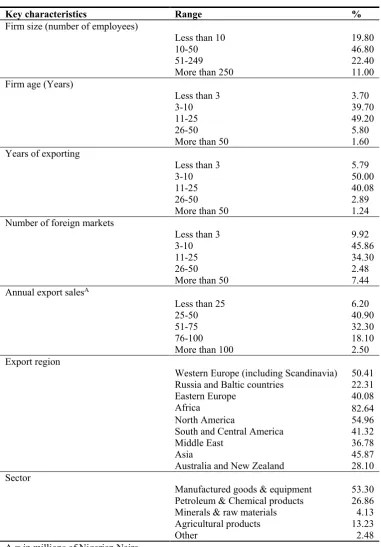
planning and perceived psychic distance. A total of 261 responses was obtained. We eliminated 19 responses as a result of extensive missing data (see Morgan et al., 2012) leaving 242 valid responses, representing a 31% response rate. In study two (i.e., one year after study one), we contacted the finance managers (i.e., finance officers and/or chief accountants) of the 242 firms to obtain the export performance data. Our use of multiple informants and multiple time points helped rule out potential common methods bias concerns and minimise single informant bias in the study. In sum, the study relies on data from two sources (i.e., data from export managers on the independent, mediator and moderator variables and data from finance directors on the dependent variable). Sample characteristics of the participant firms are summarised in Table 2.
[Insert Table 2]
Measures
Export performance was measured by an adapted version of the export performance measure
developed by Morgan et al. (2004) and used by Hult et al. (2008). The scale contains five items that capture senior finance directors’ satisfaction (in time two) with export cash flow, export sales growth,
export profitability, return on assets, and profit margin growth from export operations. We validated these perceptual measures with objective measures (e.g., export sales growth and export sales volume). The correlation between the objective and perceptual performance measures was very high (r =.91, p < .01). Export learning orientation was operationalised by borrowing items from more culturally based measures from Baker and Sinkula (1999) and Gnizy et al. (2014). Marketing programme planning was measured with a scale from Conant and White (1999). The scale captured
In all cases, we used seven-point scale items to capture the perceptual measures. Seven-point scale items are often deemed appropriate for measuring attitudes, beliefs, and opinions due their capacity to increase item reliability (DeVellis, 2011; Allen and Seaman, 2007). In particular, seven-point scale items allow respondents to more precisely describe their beliefs and lessen restriction of ranges (Tobacyk, 2004), and thus, allows for longer tails and more skewness than a five-point interval (De Winter and Dodou, 2010).
We controlled for two variables that previous research shows can affect export performance: firm size, measured by number of employees (logarithm transformed); and international experience,
measured by number of years the firms have been exporting (logarithm transformed).
Bias Assessment
change the significance level of any correlation coefficient, which suggests method bias does not pose a problem in this study.
Analyses and Results
Measurement Model Estimation
We examined construct validity using confirmatory factor analysis (CFA) implemented in EQS (6.3) statistical package. We used the maximum likelihood estimation method. The measurement model results indicate a good fitting model: ( 2221 = 587.59, p<.001; NFI = .93, NNFI = .95; CFI =
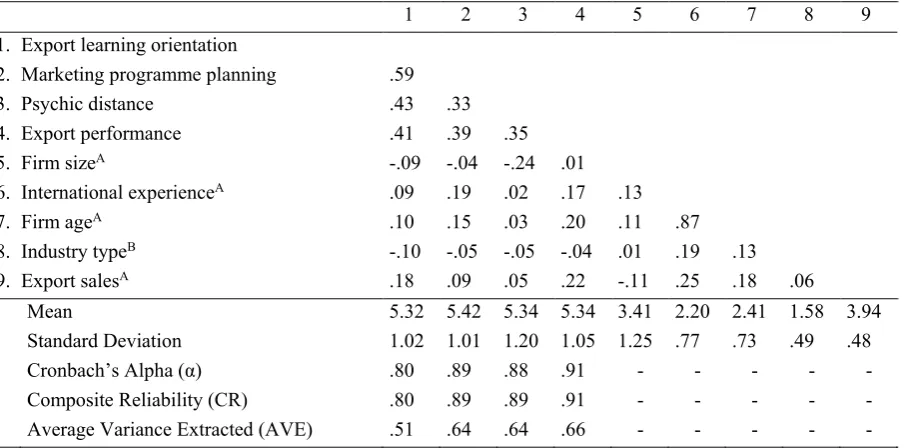
.96; RMSEA = 0.08) with large and significant loadings (t ≥ 9.60) (see Table 3). Moreover, for all constructs, the average variance extracted (AVE) estimates and composite reliability (CR) were above the recommended thresholds of 0.5 and 0.7, respectively, which indicates convergent validity (Bagozzi and Yi, 2012). We followed Voorhees et al.’s (2016) recommendations to examine discriminant validity. First, we employed the AVE-shared variance comparison (Fornell and Larcker, 1981), and found that the AVE values for all constructs were higher than corresponding shared variances. Second, in line with Anderson and Gerbing (1988), we performed chi-square difference tests, and the results indicated significant chi-square differences between the constrained and unconstrained models ( 2(1) ≥3.84, p < 0.05), indicating the presence of discriminant validity. Table 4 presents the descriptive statistics, inter-construct correlations and validity measures for the variables included in the analysis.
[Insert Table 3 and Table 4]
Structural Model Estimation
and as such, relationships between various variables may look more complex than traditional multivariate analysis techniques (such as ANOVA multiple regression and logistic regression) can help to estimate (Tabachnick and Fidell, 2007). Second, SEM incorporates both observed and unobserved (i.e., latent) variables, while traditional methods are only based on observed measurements. Moreover, it provides researchers with the ability to estimate and account for measurement error in their data (Hair et al., 2017). Third, it is a well-tested and verified methodology for testing interval indirect effect relationships (Bagozzi and Yi, 2012). However, despite its benefits, we acknowledge that the use of SEM may also pose some challenges. One key challenge is the requirement for a relatively large sample size of subject-parameter ratio of 10:1 (Hair et al., 2017). Some simulation studies have suggested that a minimum of 200 sample size may be required to achieve satisfactory results (Yung and Bentler, 1994), which can be difficult to achieve in behavioural research.
In line with established procedures for testing moderated relationships, a multiplicative approach to SEM was adopted (Ping, 1995). The constructs that were used for multiplicative interactive analyses were mean centred to minimise any multicollinearity problem. We employed Ping’s (1995) equations to estimate the loading and error variances of the interaction terms. We followed Mackinnon et al.’s (2002) recommendation to test the mediation model hierarchically (Lu
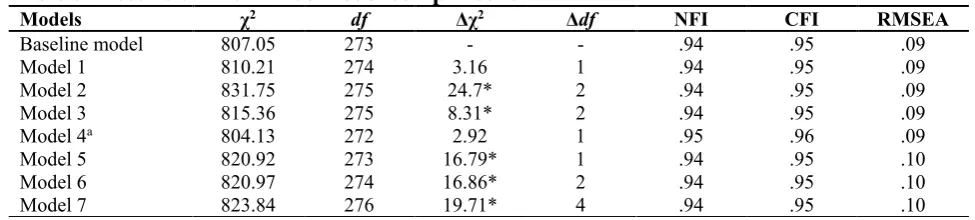
et al., 2009; Boso et al., 2018b). First, we examined the full mediation model (baseline model) which does not have a path from independent variable (i.e., export learning orientation) to the dependent variable (i.e., export performance). The baseline model provides an acceptable model fit: ( 2
(273) =
807.05, p < .001; NFI = .94, NNFI = .95, CFI = .95, RMSEA = .09).
Hypothesis 2 was constrained to zero: export learning orientation to marketing programme planning. A significant increase in chi-square was noted, thus providing support for the baseline model. In Model 3, the moderation paths were set to zero. A significant change in the chi-square difference suggests that the moderation paths are important.
Additionally, in Model 4 we compared the baseline model to a partial mediation model. In this case, one additional path was added to the baseline model: the direct path from export learning orientation (ELO) to export performance (EP). The result shows that the partial mediation model produces an acceptable model fit: ( 2(272) = 804.13, p < .001; NFI = .95, NNFI = .96, CFI = .96,
RMSEA = .09). However, no significant chi-square difference was obtained: the p-value for the 2
of 2.92 with one degree of freedom was not significant at 5% significance level. Although there is no statistically significant difference between the partial and the baseline full mediation models, we rely on the partial mediation for additional evaluation because it produces a smaller chi-square and a better fit to the data.
Consistent with the recommendations of Preacher and Hayes (2004; 2008), we conducted an additional mediation analysis with a bootstrap method in PROCESS to test the mediation effect relationship. The result confirms the mediating role of marketing programme planning in the relationship between export learning orientations and export performance ( = .15, 95%, LLCI= .03, ULCI= .27), demonstrating a similar pattern as those in the structural equation modelling.
We then tested three additional models to rule out alternative explanations. First, one could argue that there is no causal relationship between export learning orientation (a firm resource) and marketing programme planning (a firm capability), since capabilities are simply high order resources that contribute to export performance. To exclude this argument, we tested Model 5 (direct effect model) in which export learning orientation and marketing programme planning were directly linked to export performance. The chi-square difference test revealed that the partial mediation model was superior to the direct effect model ( 2 = 16.79, df =1, p < .05). Second, we ruled out the alternative
performance. To remove this argument, we tested a non-mediation model in which the path from marketing programme planning to export performance was constrained to zero. The result of the chi-square difference test indicates that marketing programme planning is a non-trivial variable in the model ( 2 = 16.86, df =2, p < .05). Finally, in Model 7, we excluded a potential reverse causality
argument on the basis of a competing argument that marketing programme planning may cause firms to build their resource base to drive export performance. To counter this contention, we modelled marketing programme planning as an antecedent variable impacting on export learning orientation, and with export learning orientation directly linked to export performance. The overall fit indices show that this alternative model is significantly worse than our proposed conceptual model. Given these results, the partial mediation model best fit the data, and we rely on Model 4 in Table 6 to interpret our hypotheses. Table 6 presents the results of the standardised parameter estimates of the structural model. Overall, the model explains 37% of the total variance in export performance and 44% in marketing programme planning.
[Insert Table 6]
The study argues in H1 that export learning orientation relates positively to export performance. The study finds only marginal support for this hypothesis at 10% significant level ( = .18; t = 1.76; p < 0.10). In H2, the study argues that marketing programme planning mediates the relationship between export learning orientation and export performance. The results show that export learning orientation is positively associated with marketing programme planning ( = .63; t = 6.70; p < .01), and the relationship between marketing programme planning and export performance is significant at 5% level ( = .18; t = 2.00; p < .05), providing support for Hypothesis 2. Thus, we find empirical evidence to support our argument that marketing programme planning is the channel through which export learning orientation drives export performance.
marketing programme planning on export performance is strengthened when the degree of perceived psychic distance is high. We find somewhat interesting and mixed results. Specifically, in support of H3a, at higher levels of psychic distance, the positive direct effect of export learning orientation on export performance is weakened, suggesting that the positive effect of export learning orientation on export performance is stronger when psychic distance takes on lower values ( = -.14; t = -2.40; p < .05). With respect to H3b, findings show that when marketing programme planning takes on higher values and perceived psychic distance increases in magnitude, there is a significant positive effect of marketing programme planning on export performance ( = .22; t = 3.73; p < .01), which upholds our argument in H3b.
[Insert Table 6]
Additional Analyses
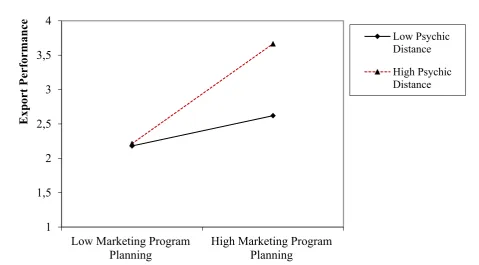
Following Aiken and West (1991), we plotted the relationships between export learning orientation and marketing programme planning and export performance under differing levels of perceived psychic distance. Specifically, we assessed the effects of export learning orientation and marketing programme planning on export performance under high (one standard deviation above the mean values) versus low (one standard deviation below the mean values) of psychic distance. In Figure 2, we show that values below the mean value of psychic distance are associated with a stronger positive relationship between export learning orientation and export performance. Figure 3 demonstrates that when psychic distance takes on higher values above the mean, there is a corresponding stronger relationship between marketing programme planning and export performance.
[Insert Figure 2 and Figure 3]
Controlling for endogeneity
and influence of psychic distance on the marketing programme planning and export performance relationship1. In line with prior small business research (Booltink and Saka-Helmhout, 2018; McCann
and Vroom, 2015; Scarlata et al., 2016), we employ the instrumental variables (IVs) approach, which involves a two-stage least squares (2SLS) regression, to mitigate endogeneity-related concerns (Bascle, 2008; Wooldridge, 2002). In the first stage, the endogenous variable is regressed on the chosen instruments, which are used as predictors, and the regression residual is saved in lieu of that variable. This procedure requires using instruments that are not correlated with the dependent variable, but are correlated with the independent (in our case – moderator), endogenous variable to be instrumented, thus ensuring the relevance and strength of the chosen instruments.
We treated international experience, the number of international export markets, organisation structure complexity, and export market intelligence dissemination as IVs, since each of these variables is expected to significantly affect psychic distance (the endogenous variable), but is not linked to export performance or marketing programme planning (Bascle, 2008). Based on Stock et al. (2002), the strength of the IVs can be measured by the F statistic, which should reach 10 for strong instruments. In our case, the F statistic from the first-stage regression of 2SLS used to instrument psychic distance showed a value of F = 9.689, p < 0.01. This indicates that the variables selected in our study served as relevant and strong instruments.
In the second stage, the residual saved from the first regression is used as an estimate of the psychic distance construct and is regressed together with the optimal model variables on firm performance (Wooldridge, 2002). Having implemented the second stage, the patterns of effects in the results obtained were identical to those presented in the analyses and results section of this study. Consequently, any presence of endogeneity in the psychic distance construct relationship with marketing programme planning and export performance is not distorting the key findings.
endogeneity-Finally, one may argue that there may be differences in the relationships tested among high and low performers in our sample. To rule out this argument, we ran a multi-group model to test the relationships across high and low performing firms in our sample. We compared a constrained model (i.e., by imposing an equality constraint on the hypothesised structural paths) to an unconstrained model (i.e., by allowing all parameter estimates to vary between the two groups), and found that while the unconstrained model yielded 2544 = 1296.008, p=.001, the constrained model yields
546
2 = 1297.676, p=.001. The insignificant chi-square difference between the two models ( 2 =
1.688, df =2, p > .05) indicates that there is no significant difference between the two groups of
firms.
Discussion and implications
orientation and export performance. Thus, in taking a resource-based theoretical argument, findings imply that export learning orientation knowledge-based firm resources should be used to develop exporting related marketing programme plans to drive performance in export markets. This can be done by using the knowledge generated from export markets to feed into the design, formulation, and implementation of marketing programmes. For exporting SMEs such as those studied in this study, a defined and well-designed marketing programmes driven by accumulated export knowledge can help newly internationalising firms turn their export learning proclivity into an enhanced export performance (Alpkan et al., 2007; Conant and White, 1999).
Our findings add to the growing number of studies investigating the importance of psychic distance in exporting and internationalisation in general (Johnston et al., 2012; Morgan et al., 2012). We have sought to broaden the understanding of the psychic distance paradox (Evans and Mavondo, 2002; O'Grady and Lane, 1996; Zaheer and Hernandez, 2011) and its implications for small and medium-sized exporting firms and their performance. We find that psychic distance negatively moderates the link between export learning orientation and export performance. However, conversely to our expectations and in favour of the existing paradoxical evidence, its conditioning effect becomes positive on the relationship between marketing programme planning and export performance. In this light, our results strongly emphasise that high export learning orientation alone is not enough to improve export performance. It might even become damaging for a firm exporting to psychically distant countries, potentially owing to efforts put primarily to acquire knowledge but not to adapt internal planning and operations responsible for smooth internationalisation.
contribute a lot more time and resources to design especially sturdy and effective marketing programmes. Based on the above, we add to the psychic distance and internationalisation literature within exporting context (Evans et al., 2000; Sousa and Bradley, 2006) by expanding our understanding of how such complex markets with high psychic distance can be not only barriers to export performance but also facilitators for the successful planning and implementation of marketing programmes boosting export performance.
The value of this article also extends to practitioners. Managers of small to medium-sized internationalising firms, particularly those who are involved in exporting activities, can benefit from the identification of factors found to influence export performance. Exporting companies utilise their acquired knowledge to increase the likelihood of improving their performance; however, our findings suggest that learning alone, as proactive as it may be, is not a sufficient component for the international success of a firm. Moreover, the effect of export learning orientation on export performance becomes negative under the conditions of high psychic distance of foreign markets. Nonetheless, export learning orientation is found to make a significant contribution to export performance through marketing programme planning. Thus, the potential influence of marketing programme planning identified in this research can serve in the form of developing a tactical planning tool, guiding a firm’s decisions regarding export strategy and its implementation, as well as internationalisation overall. By being made aware of the crucial importance of a clear, defined, and realistic marketing programme, managers will be better prepared to recognise and adapt to internal and external influences of foreign markets.
programmes should take place in tandem with export learning activities, with the latter informing and guiding the former.
Limitations and future research
As with any study, our results should be interpreted considering some limitations. First, we must point out that certain bias may be present, since all the measures in this study are of a perceptual nature. At the same time, since the study relies on cross-sectional data, the causal attribution of relationships is relatively weak. Hence, future research could add greater rigour to our results by adopting a longitudinal approach in the study of the relationships.
Second, we conducted the study within the context of one country. However, there are good theoretical reasons to believe that firms in other emerging markets may experience similar dynamics. Nonetheless, even though Nigeria undoubtedly represents an emerging market and we expect that our findings will hold for other markets of a similar kind, the focus on a single country context may limit the generalisability of the results to some degree. Thus, a useful extension would be to conduct this study in South East Asian countries (e.g., China and India), Eastern European countries (e.g., Poland and the Baltics) and South American countries (e.g., Brazil, Chile, and Peru).
Conclusions
References
Acquaah M. (2012) Social networking relationships, firm-specific managerial experience and firm performance in a transition economy: A comparative analysis of family owned and nonfamily firms. Strategic Management Journal 33: 1215-1228.
Aiken LS and West SG. (1991) Multiple regression: Testing and interpreting interactions, Newbury Park, CA: Sage.
Allen IE and Seaman CA. (2007) Likert scales and data analyses. Quality progress 40: 64-65. Alpkan L, Yilmaz C and Kaya N. (2007) Market orientation and planning flexibility in SMEs
performance implications and an empirical investigation. International Small Business Journal 25: 152-172.
Anderson JC and Gerbing DW. (1988) Structural equation modeling in practice: A review and recommended two-step approach. Psychological bulletin 103: 411-423.
Atuahene-Gima K and Murray JY. (2007) Exploratory and exploitative learning in new product development: A social capital perspective on new technology ventures in China. Journal of International Marketing 15: 1-29.
Bagozzi RP and Yi Y. (2012) Specification, evaluation, and interpretation of structural equation models. Journal of the Academy of Marketing Science 40: 8-34.
Baker WE and Sinkula JM. (1999) The synergistic effect of market orientation and learning orientation on organizational performance. Journal of the Academy of Marketing Science 27: 411-427.
Bascle G. (2008) Controlling for endogeneity with instrumental variables in strategic management research. Strategic Organization 6: 285-327.
Beneke J, Beneke J, Blampied S, et al. (2016) The impact of market orientation and learning orientation on organisational performance: A study of small to medium-sized enterprises in Cape Town, South Africa. Journal of Research in Marketing and Entrepreneurship 18: 90-108.
Booltink LW and Saka-Helmhout A. (2018) The effects of r&d intensity and internationalization on the performance of non-high-tech SMEs. International Small Business Journal 36: 81-103. Boso N, Adeleye I, Ibeh K, et al. (2018a) The internationalization of African firms: Opportunities,
challenges, and risks. Thunderbird International Business Review.
Boso N, Adeola O, Danso A, et al. (2017) The effect of export marketing capabilities on export performance: Moderating role of dysfunctional competition. Industrial Marketing Management.
Boso N, Annan J, Adeleye I, et al. (2018b) Examining the paths from export strategic orientations to export performance: The mediating role of export resource transformation capability. Thunderbird International Business Review 60: 207-230.
Boso N, Oghazi P, Cadogan JW, et al. (2016) Entrepreneurial and market-oriented activities, financial capital, environment turbulence, and export performance in an emerging economy. Journal of Small Business Strategy 26: 1-24.
Brock JK-U, Johnson JE and Zhou JY. (2011) Does distance matter for internationally-oriented small firms? Industrial Marketing Management 40: 384-394.
Bunderson JS and Sutcliffe KM. (2003) Management team learning orientation and business unit performance. Journal of Applied Psychology 88: 552.
Cadogan JW, Boso N, Story VM, et al. (2016) Export strategic orientation–performance relationship: Examination of its enabling and disenabling boundary conditions. Journal of Business Research 69: 5046-5052.
Calantone RJ, Cavusgil ST and Zhao Y. (2002) Learning orientation, firm innovation capability, and firm performance. Industrial Marketing Management 31: 515-524.
Cavusgil ST and Cavusgil E. (2012) Reflections on international marketing: Destructive regeneration and multinational firms. Journal of the Academy of Marketing Science 40: 202-217.
Chabowski B, Kekec P, Morgan NA, et al. (2018) An assessment of the exporting literature: Using theory and data to identify future research directions. Journal of International Marketing 26: 118-143.
Charoensukmongkol P. (2016) Cultural intelligence and export performance of small and medium enterprises in Thailand: Mediating roles of organizational capabilities. International Small Business Journal 34: 105-122.
Child J, Ng SH and Wong C. (2002) Psychic distance and internationalization: Evidence from Hong Kong firms. International Studies of Management & Organization 32: 36-56.
Chung HF, Yang Z and Huang P-H. (2015) How does organizational learning matter in strategic business performance? The contingency role of guanxi networking. Journal of Business Research 68: 1216-1224.
CIA. (2018) The world factbook. Available at: https://www.cia.gov/library/publications/the-world-factbook/geos/ni.html.
Conant JS and White JC. (1999) Marketing programme planning, process benefits, and store performance: An initial study among small retail firms. Journal of Retailing 75: 525-541. De Winter JC and Dodou D. (2010) Five-point Likert items: T test versus Mann-Whitney-Wilcoxon.
Practical Assessment, Research & Evaluation 15: 2.
Devellis RF. (2011) Scale development: Theory and applications: Sage Publications, Incorporated. Dow D and Karunaratna A. (2006) Developing a multidimensional instrument to measure psychic
distance stimuli. Journal of International Business Studies 37: 578-602.
Ellis PD, Davies H and Wong AH-K. (2011) Export intensity and marketing in transition economies: Evidence from China. Industrial Marketing Management 40: 593-602.
Evans J and Mavondo FT. (2002) Psychic distance and organizational performance: An empirical examination of international retailing operations. Journal of International Business Studies 33: 515-532.
Evans J, Treadgold A and Mavondo F. (2000) Explaining export development through psychic distance. International Marketing Review 17: 164-169.
Fornell C and Larcker DF. (1981) Evaluating structural equation models with unobservable variables and measurement error. Journal of Marketing Research 18: 39-50.
Gaur AS and Lu JW. (2007) Ownership strategies and survival of foreign subsidiaries: Impacts of institutional distance and experience. Journal of Management 33: 84-110.
Gnizy I, Cadogan JW, Oliveira JS, et al. (2017) The empirical link between export dispersion and export performance: A contingency-based approach. International Business Review 26: 239-249.
Gnizy I, E. Baker W and Grinstein A. (2014) Proactive learning culture: A dynamic capability and key success factor for SMEs entering foreign markets. International Marketing Review 31: 477-505.
Hair JF, Hult GTM, Ringle CM, et al. (2017) Mirror, mirror on the wall: A comparative evaluation of composite-based structural equation modeling methods. Journal of the Academy of Marketing Science 45: 616-632.
Hakala H. (2011) Strategic orientations in management literature: Three approaches to understanding the interaction between market, technology, entrepreneurial and learning orientations. International Journal of Management Reviews 13: 199-217.
Ho MH-W and Wang F. (2015) Unpacking knowledge transfer and learning paradoxes in international strategic alliances: Contextual differences matter. International Business Review 24: 287–297.
Hult GTM, Ketchen DJ, Griffith DA, et al. (2008) An assessment of the measurement of performance in international business research. Journal of International Business Studies 39: 1064-1080. Hurley RF and Hult GTM. (1998) Innovation, market orientation, and organizational learning: An
Håkanson L and Ambos B. (2010) The antecedents of psychic distance. Journal of International Management 16: 195-210.
Ibeh K, Wilson J and Chizema A. (2012) The internationalization of African firms 1995–2011: Review and implications. Thunderbird International Business Review 54: 411-427.
Jay J. (2013) Navigating paradox as a mechanism of change and innovation in hybrid organizations. Academy of Management Journal 56: 137-159.
Johnston WJ, Khalil S, Jain M, et al. (2012) Determinants of joint action in international channels of distribution: The moderating role of psychic distance. Journal of International Marketing 20: 34-49.
Katsikeas CS, Morgan NA, Leonidou LC, et al. (2016) Assessing performance outcomes in marketing. Journal of Marketing 80: 1-20.
Khavul S, Pérez-Nordtvedt L and Wood E. (2010) Organizational entrainment and international new ventures from emerging markets. Journal of Business Venturing 25: 104-119.
Kim N and Atuahene Gima K. (2010) Using exploratory and exploitative market learning for new product development. Journal of Product Innovation Management 27: 519-536.
Kropp F, Lindsay NJ and Shoham A. (2006) Entrepreneurial, market, and learning orientations and international entrepreneurial business venture performance in south African firms. International Marketing Review 23: 504-523.
Kuivalainen O, Sundqvist S and Servais P. (2007) Firms’ degree of born-globalness, international entrepreneurial orientation and export performance. Journal of World Business 42: 253-267. Lado AA, Boyd NG, Wright P, et al. (2006) Paradox and theorizing within the resource-based view.
Academy of Management Review 31: 115-131.
Lee H and Choi B. (2003) Knowledge management enablers, processes, and organizational performance: An integrative view and empirical examination. Journal of Management Information Systems 20: 179-228.
Leonard D. (1992) Core capabilities and core rigidities: A paradox in managing new product development. Strategic Management Journal 13: 111-125.
Leonidou LC, Katsikeas CS and Coudounaris DN. (2010) Five decades of business research into exporting: A bibliographic analysis. Journal of International Management 16: 78-91.
Lu Y, Zhou L, Bruton G, et al. (2009) Capabilities as a mediator linking resources and the international performance of entrepreneurial firms in an emerging economy. Journal of International Business Studies 41: 419-436.
Lysonski S and Pecotich A. (1992) Strategic marketing planning, environmental uncertainty and performance. International Journal of Research in Marketing 9: 247-255.
Mackinnon DP, Lockwood CM, Hoffman JM, et al. (2002) A comparison of methods to test mediation and other intervening variable effects. Psychological methods 7: 83-104.
Malhotra NK, Kim SS and Patil A. (2006) Common method variance in is research: A comparison of alternative approaches and a reanalysis of past research. Management Science 52: 1865-1883.
Matanda MJ, Ndubisi NO and Jie F. (2016) Effects of relational capabilities and power asymmetry on innovativeness and flexibility of Sub-Sahara Africa small exporting firms. Journal of Small Business Management 54: 118-138.
Mattsson L-G and Tidström A. (2015) Applying the principles of yin–yang to market dynamics: On the duality of cooperation and competition. Marketing Theory 15: 347-364.
Mccann BT and Vroom G. (2015) Opportunity evaluation and changing beliefs during the nascent entrepreneurial process. International Small Business Journal 33: 612-637.
Morgan NA, Feng H and Whitler KA. (2018) Marketing capabilities in international marketing. Journal of International Marketing 26: 61-95.
Morgan NA, Katsikeas CS and Vorhies DW. (2012) Export marketing strategy implementation, export marketing capabilities, and export venture performance. Journal of the Academy of Marketing Science 40: 271–289.
Murray JY, Gao GY and Kotabe M. (2011) Market orientation and performance of export ventures: The process through marketing capabilities and competitive advantages. Journal of the Academy of Marketing Science 39: 252-269.
Naldi L and Davidsson P. (2014) Entrepreneurial growth: The role of international knowledge acquisition as moderated by firm age. Journal of Business Venturing 29: 687-703.
Noh M, Kim H and Jang H. (2016) Learning performance and business performance of knowledge management organizations: The moderating effect of technological capability. Information Development 32: 637-654.
O'grady S and Lane HW. (1996) The psychic distance paradox. Journal of International Business Studies 27: 309-333.
Oliva R and Watson N. (2011) Cross-functional alignment in supply chain planning: A case study of sales and operations planning. Journal of Operations Management 29: 434-448.
Ortega-Argilés R, Vivarelli M and Voigt P. (2009) R&d in SMEs: A paradox? Small Business Economics 33: 3-11.
Pearsall MJ and Venkataramani V. (2015) Overcoming asymmetric goals in teams: The interactive roles of team learning orientation and team identification. Journal of Applied Psychology 100: 735.
Ping RA. (1995) A parsimonious estimating technique for interaction and quadratic latent variables. Journal of Marketing Research 32: 336-347.
Podsakoff PM, Mackenzie SB and Podsakoff NP. (2012) Sources of method bias in social science research and recommendations on how to control it. Annual review of psychology 63: 539-569.
Preacher KJ and Hayes AF. (2004) SPSS and SAS procedures for estimating indirect effects in simple mediation models. Behavior Research Methods 36: 717-731.
Preacher KJ and Hayes AF. (2008) Asymptotic and resampling strategies for assessing and comparing indirect effects in multiple mediator models. Behavior Research Methods 40: 879-891. Putnam LL, Fairhurst GT and Banghart S. (2016) Contradictions, dialectics, and paradoxes in
organizations: A constitutive approach. The Academy of Management Annals 10: 65-171. Rauch A, Wiklund J, Lumpkin GT, et al. (2009) Entrepreneurial orientation and business
performance: An assessment of past research and suggestions for the future. Entrepreneurship Theory and Practice 33: 761-787.
Real JC, Roldán JL and Leal A. (2014) From entrepreneurial orientation and learning orientation to business performance: Analysing the mediating role of organizational learning and the moderating effects of organizational size. British Journal of Management 25: 186-208. Scarlata M, Zacharakis A and Walske J. (2016) The effect of founder experience on the performance
of philanthropic venture capital firms. International Small Business Journal 34: 618-636. Schad J, Lewis MW, Raisch S, et al. (2016) Paradox research in management science: Looking back
to move forward. The Academy of Management Annals 10: 5-64.
Schilling MA. (2002) Technology success and failure in winner-take-all markets: The impact of learning orientation, timing, and network externalities. Academy of Management Journal 45: 387-398.
Sinkula JM, Baker WE and Noordewier T. (1997) A framework for market-based organizational learning: Linking values, knowledge, and behavior. Journal of the Academy of Marketing Science 25: 305-318.
Skarmeas D, Lisboa A and Saridakis C. (2016) Export performance as a function of market learning capabilities and intrapreneurship: Sem and fsQCA findings. Journal of Business Research 69: 5342-5347.
Slotegraaf RJ and Dickson PR. (2004) The paradox of a marketing planning capability. Journal of the Academy of Marketing Science 32: 371-385.
Smith WK and Lewis MW. (2011) Toward a theory of paradox: A dynamic equilibrium model of organizing. Academy of Management Review 36: 381-403.
Smith WK and Tracey P. (2016) Institutional complexity and paradox theory: Complementarities of competing demands. Strategic Organization 14: 455-466.
Sousa CM and Bradley F. (2006) Cultural distance and psychic distance: Two peas in a pod? Journal of International Marketing 14: 49-70.
Sousa CM and Lages LF. (2011) The pd scale: A measure of psychic distance and its impact on international marketing strategy. International Marketing Review 28: 201-222.
Stock JH, Wright JH and Yogo M. (2002) A survey of weak instruments and weak identification in generalized method of moments. Journal of Business & Economic Statistics 20: 518-529. Stöttinger B and Schlegelmilch BB. (1998) Explaining export development through psychic distance:
Enlightening or elusive? International Marketing Review 15: 357-372.
Suliyanto S and Rahab R. (2012) The role of market orientation and learning orientation in improving innovativeness and performance of small and medium enterprises. Asian Social Science 8: 134.
Tabachnick BG and Fidell LS. (2007) Using multivariate statistics: Allyn & Bacon/Pearson Education.
Tajeddini K. (2016) Analyzing the influence of learning orientation and innovativeness on performance of public organizations: The case of Iran. Journal of Management Development 35: 134-153.
Tasavori M, Zaefarian R and Eng T-Y. (2018) Internal social capital and international firm performance in emerging market family firms: The mediating role of participative governance. International Small Business Journal: 1-24.
Taylor M and Jack R. (2013) Understanding the pace, scale and pattern of firm internationalization: An extension of the ‘born global’ concept. International Small Business Journal 31: 701-721. Theodosiou M and Katsikea E. (2013) The export information system: An empirical investigation of
its antecedents and performance outcomes. Journal of International Marketing 21: 72-94. Tobacyk JJ. (2004) A revised paranormal belief scale. International Journal of Transpersonal Studies
23: 11.
Tse CH, Yu L and Zhu J. (2017) A multimediation model of learning by exporting: Analysis of export-induced productivity gains. Journal of Management 43: 2118-2146.
Vandenbosch B and Higgins C. (1996) Information acquisition and mental models: An investigation into the relationship between behaviour and learning. Information Systems Research 7: 198-214.
Vij S and Farooq R. (2015) The relationship between learning orientation and business performance: Do smaller firms gain more from learning orientation? IUP Journal of Knowledge Management 13: 7.
Villar C, Alegre J and Pla-Barber J. (2014) Exploring the role of knowledge management practices on exports: A dynamic capabilities view. International Business Review 23: 38-44.
Volery T, Mueller S and Von Siemens B. (2015) Entrepreneur ambidexterity: A study of entrepreneur behaviours and competencies in growth-oriented small and medium-sized enterprises. International Small Business Journal 33: 109-129.
Voorhees CM, Brady MK, Calantone R, et al. (2016) Discriminant validity testing in marketing: An analysis, causes for concern, and proposed remedies. Journal of the Academy of Marketing Science 44: 119-134.
Wang CL. (2008) Entrepreneurial orientation, learning orientation, and firm performance. Entrepreneurship Theory and Practice 32: 635-657.
Yung YF and Bentler PM. (1994) Bootstrap corrected ADF test statistics in covariance structure analysis. British Journal of Mathematical and Statistical Psychology 47: 63-84.
Zaefarian G, Kadile V, Henneberg SC, et al. (2017) Endogeneity bias in marketing research: Problem, causes and remedies. Industrial Marketing Management 65: 39-46.
Zaheer A and Hernandez E. (2011) The geographic scope of the MNC and its alliance portfolio: Resolving the paradox of distance. Global Strategy Journal 1: 109-126.
Zhang X, Ma X and Wang Y. (2012) Entrepreneurial orientation, social capital, and the internationalization of SMEs: Evidence from China. Thunderbird International Business Review 54: 195-210.
Figure 1: Theoretical Framework
H2a: +
Export Learning Orientation (ELO)
Marketing Programme Planning (MPP)
Export Performance (EP) Psychic
Distance
Controls: Firm Size, International Experience, Firm age, Industry, and Export sales
H3a: - H3b: +
H2b: +
H1: +
Figure 2: Surface Plot of the Moderating Effect of Psychic Distance on Export Learning Orientation-Export Performance Relationship
Figure 3: Surface Plot of the Moderating Effect of Psychic Distance on Marketing Programme Planning-Export Performance Relationship
1 1,5 2 2,5 3 3,5 4
Low Export Learning Orientation
High Export Learning Orientation
Exp
or
t P
er
for
man
ce Low Psychic
Distance High Psychic Distance
1 1,5 2 2,5 3 3,5 4
Low Marketing Program Planning
High Marketing Program Planning
Exp
or
t P
er
for
man
ce
Low Psychic Distance
[image:36.595.58.538.441.706.2]