arXiv:quant-ph/0006106 v2 28 Jun 2000
Entanglement, Information and Multiparticle Quantum Operations
Anthony Chefles
Department of Physical Sciences, University of Hertfordshire Hatfield AL10 9AB, Herts, UK
email: [email protected]
Claire R. Gilson
Department of Mathematics, University of Glasgow, Glasgow G12 8QQ, UK
Stephen M. Barnett
Department of Physics and Applied Physics, University of Strathclyde Glasgow G4 0NG, UK
Collective operations on a network of spatially-separated quantum systems can be carried out using local quantum (LQ) operations, classical communication (CC) and shared entanglement (SE). Such operations can also be used to com-municate classical information and establish entanglement be-tween distant parties. We show how these facts lead to mea-sures of the inseparability of quantum operations, and ar-gue that a maximally-inseparable operation on 2 qubits is the SWAP operation. The generalisation of our argument toN
qubit operations leads to the conclusion that permutation op-erations are maximally-inseparable. For evenN, we find the minimum SE and CC resources which are sufficient to perform an arbitrary collective operation. These minimum resources are 2(N−1) ebits and 4(N−1) bits, and these limits can be attained using a simple teleportation-based protocol. We also obtain lower bounds on the minimum resources for the odd case. For allN≥4, we show that the SE/CC resources required to perform an arbitrary operation are strictly greater than those that any operation can establish/communicate.
PACS numbers: 03.67.-a, 03.67.Hk
I. INTRODUCTION
Many of the novel information-theoretic properties of quantum systems are attributable to the existence of en-tanglement. Entanglement is responsible for the non-local correlations which can exist between spatially sep-arated quantum systems, as is revealed by the violation of Bell’s inequality [1]. It also lies at the heart of sev-eral intriguing applications of quantum information, such as quantum teleportation [2], quantum computational speed-ups [3,4] and certain quantum cryptographic pro-tocols [5].
The central position of entanglement in quantum in-formation theory, and its usefulness in applications, has led to considerable efforts being devoted to finding a suit-able measure of how much entanglement a quantum sys-tem contains. This problem has been solved completely for bipartite pure states [6], and the accepted measure
is the subsystem von Neumann entropy, conventionally taken to the base 2, so that a maximally-entangled state of a pair of two-level quantum systems, orqubits[7], pos-sesses one unit of entanglement. This fundamental unit is known as anebit.
The production of entanglement requires the trans-mission of quantum information between systems. Con-versely, the transmission of quantum information be-tween systems can be used to establish entanglement between them. Perhaps the most perfect expression of this duality is the fact that there are two equivalent def-initions of the quantum capacity of a communications channel [8]. According to one definition [9], it is the asymptotic maximum amount of quantum information that can be transmitted per use of the channel, mea-sured in qubits. In the other [10], it is the asymptotic maximum number of ebits of entanglement that can be established between the sending and receiving stations, again per use of the channel. An important consequence of this equivalence is the fact that no entanglement can be created without the transmission of quantum informa-tion. That is, no entanglement can be created when only local quantum operations are allowed, and only classical information can be transmitted.
Collective quantum operations involving multiple quantum systems can create entanglement and be used to communicate classical information. Conversely, the use of entanglement shared by spatially-separated labo-ratories, in addition to facilities enabling classical com-munication and arbitrary local quantum operations, per-mit these laboratories to carry out collective operations upon a network of separated quantum systems. The abil-ity to do this will have interesting implications for many potential applications of quantum information, such as distributed quantum computing, network quantum com-munication and the production of novel multiparticle en-tangled states.
com-munication resources required to carry out an arbitrary collective operation uponN qubits, and also the amount of classical information that such an operation can be used to send. An intriguing issue highlighted by these considerations is that of how we might quantify the ‘in-separability’ of a quantum operation, rather than that of a quantum state. As we shall see, this inseparability has both classical and quantum aspects.
In section II, we examine the use of entanglement and classical communication to carry out arbitrary collective operations upon a pair of qubits. A simple protocol for achieving this, which uses quantum teleportation, is proposed. Two classical and two quantum measures of the inseparability of a quantum operation arise naturally from these considerations. The quantum measures are analogous to the entanglement of formation [12] and dis-tillation [13] of quantum states. These are respectively the minimum amount of entanglement required to per-form the operation, and the maximum amount of entan-glement that the operation can establish. The classical measures of inseparability are respectively the minimum amount of classical information required to perform the operation, and the maximum amount of classical infor-mation that the operation can be used to communicate. The relationship between these measures leads to the conclusion that a maximally-inseparable quantum oper-ation is the SWAP operoper-ation, or any other which can be obtained from it by local unitary transformations.
The remainder of this paper is concerned with collec-tive operations uponN qubits. The particular issues we address are: how much bipartite entanglement can an op-eration be used to establish and how much information can it be used to communicate? Also, how much bipar-tite entanglement and classical information are needed to perform an arbitrary operation?
In section III, we develop a graph-theoretic frame-work for the representation of bipartite entanglement and communication networks for N laboratories. Using this framework, we generalise to the case of N qubits our teleportation protocol. We show that this protocol is optimal in the class of protocols which operate by state teleportation. We also generalise our discussion of quan-tifying the inseparability of quantum operations to the N-particle case. As far as the ‘distillation’ measures are concerned, which quantifies the ability of a quantum op-eration to establish entanglement and communicate clas-sical information, we find that permutation operations are maximally-inseparable. These operations can estab-lish the largest amount of entanglement, and be used to communicate the largest amount of classical information. In section IV, we are concerned with minimising the entanglement and communication resources required to perform an arbitrary quantum operation uponN qubits. There are two distinct scenarios to consider here. On the one hand, we may wish to determine the minimum re-sources required to carry our an arbitrary operation just once. We refer to this as the ‘one-shot’ scenario. On the other hand, it may be the case that the N laboratories
share a very large amount of entanglement, and are able to communicate large amounts of classical information. They may wish to use these resources with maximum ef-ficiency to carry out an arbitrary operation many times. The limit as both the resources and the number of rep-etitions of the operation tends to infinity is known as theasymptoticlimit. In this scenario, the asymptotically minimum resources are the minimum entanglement and classical communication that must be used, on average, per run of the operation.
We find that in terms of both entanglement and com-munication, our teleportation protocol is optimal, in both the one-shot and asymptotic scenarios, for evenN. We obtain lower bounds on the minimum resources for the odd case. We show that, for allN≥4, the classical com-munication and entanglement resources required to carry out an arbitrary operation are strictly greater than the amount of entanglement that can be established, and the amount of classical information that can be sent, by any particular operation. We also show that if the manipula-tion of these resources obeys the same efficiency restric-tions as those found in entanglement swapping [14] and indirect communication, then the teleportation protocol is optimal for allN≥12, and for allN≥4 for entanglement resources, in the one shot case if only integer resources are allowed.
II. OPERATIONS INVOLVING TWO QUBITS
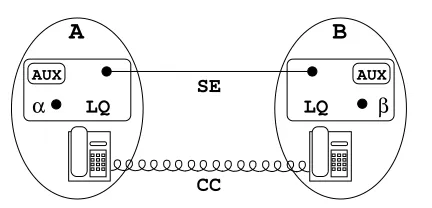
We consider first the simple case of just two qubits. Suppose that two parties, by convention Alice and Bob, occupy laboratoriesAandB which contain qubitsαand β respectively. The Hilbert spaces of these systems are denoted byHα andHβ, so that the Hilbert space of the collective systemαβis the tensor product spaceHα⊗Hβ. In addition to these systems, Alice and Bob also possess auxiliary local quantum systems, shared entanglement and a two-way classical communication channel. This setup is illustrated in figure (1). Using these resources, Alice and Bob can perform any collective operation by carrying out the following four steps:
Step 1: Alice teleports the state ofαto Bob in labora-toryB. This costs 1 ebit of entanglement and 2 classical bits fromAtoB.
Step 2: Bob, possibly making use of his auxiliary sys-tems, carries out the operation locally upon the com-pound system.
Step 3: Bob teleports the final state of Alice’s qubit back to her. This costs 1 ebit of entanglement and 2 classical bits fromB toA.
at the end of his LQ operation. This step applies only to (generalised) measurements, in which case it would be information about the result.
Thus, the total CCSE resources required to perform an arbitrary collective operation on αβ using teleporta-tion, such that Alice and Bob share the same classical information at the end, are
2 ebits + 2 bits(A→B) + 2 bits(B→A) +CS(B→A).
(2.1)
AUX AUX
α β
A
B
LQ
SE
CC
[image:3.612.72.288.192.296.2]LQ
FIG. 1. Illustration of the experimental setup considered in section 2. LaboratoriesAandBcontain respective qubits
αandβ. Their aim is to perform an arbitrary collective op-eration on these system using shared entanglement (SE) and a two-way classical communication (CC) channel. They are also able to perform arbitrary local quantum (LQ) operations, possibly involving local auxiliary quantum systems and their respective parts of the entangled systems.
The supplementary information CS(B→A) is that which is conveyed by Bob to Alice in step 4. This additional information will be created when the opera-tion, represented by a completely-positive, linear, trace-preserving map L, is selective. The most general kind of operation which gives rise to non-zero supplementary information is a generalised measurement. A generalised measurement with M outcomes is described by M pos-itive, Hermitian operators Er, where r = 1, . . ., M and
P
rEr = 1. These operators form a positive, operator-valued measure (POVM) [15] and each of them corre-sponds to a distinct outcome. If the initial state ofαβ is described by the density operatorρ, then the probability pr of obtaining outcomer is given by TrρEr. The sup-plementary information generated at Bob’s laboratory is given by the Shannon entropy of this distribution
CS =−
M
X
r=1
prlog2pr. (2.2)
This quantity can take on any non-negative real value. Clearly, it is zero when the operation is non-selective. If, however, we consider an operation described by the POVM
Er= 1
M, (2.3)
where Bob records the outcome, then the supplementary information is equal to log2M, which diverges asM→∞. For this operation, one cannot decrease the supplemen-tary information using any information that Alice may have about the initial stateρ, since the probability dis-tribution is uniform regardless of what the initial state is.
For selective operations, the transmission of this sup-plementary information will have epistemological signif-icance for Alice which may be important in some appli-cations. She may, for example, wish to carry out some local operation upon her subsystem, depending on the supplementary information she receives from Bob. For the remainder of this paper however, we shall not be concerned withCS, and when we speak of the classical information required to complete a quantum operation, we will mean that which is needed to carry it out non-selectively. In this paper, we shall be concerned largely with unitary operations anyway, which are non-selective. Returning to the teleportation protocol, it may be the case that the CC and SE resources required to perform aparticularoperation,L, are less than those required to performanyoperation, by this method. Let us denote by CR(L:A→B),CR(L:B→A) andER(L) the number of classical bits transmitted in each direction and number of ebits of entanglement required to carry outL. These may be regarded respectively as classical and quantum measures of how nonlocal the operation is, andER(L) is therefore somewhat analogous to the entanglement of formation of quantum states [12].
Alternative classical and quantum measures of insepa-rability arise naturally if we consider the fact that collec-tive operations on quantum systems can be used to trans-mit classical information and establish entanglement be-tween distant locations. Let us define the quantities CC(L : A→B), CC(L : B→A) and EC(L), respectively the maximum number of classical bits that the opera-tion can be used to communicate in each direcopera-tion, and the maximum number of ebits of entanglement that it can create betweenA andB. EC(L) is correspondingly analogous to the entanglement of distillation of quantum states [13]. We must have
CC(L:A→B)≤CR(L:A→B), (2.4) CC(L:B→A)≤CR(L:B→A), (2.5) EC(L)≤ER(L). (2.6)
equivalent to the impossibility of superluminal commu-nication.
As a consequence of the teleportation protocol, the minimum CCSE resources required to perform any par-ticular operation will not exceed 2 ebits of entanglement and 2 classical bits each way. The most nonlocal quan-tum operations with regard to the resource measuresER andCR are those for which the minimum values of these quantities are both equal to 2. Inequalities (2.4)-(2.6) im-ply that the maximum values of theEC and CC cannot exceed 2. Any operation which saturates the limits of 2 on the latter measures must also then saturate inequali-ties (2.4-2.6), and can be termed a maximally-inseparable operation.
One such operation is the SWAP operation. This is a unitary operationUS which, for any state|ψαi∈Hα and any state|ψβi∈Hβ, acts as follows:
US|ψαi⊗|ψβi=|ψβi⊗|ψαi, (2.7)
[image:4.612.366.511.213.397.2] [image:4.612.105.247.354.527.2]that is, it exchanges the states ofαandβ. The ability of SWAP to create 2 ebits of entanglement and transmit 2 classical bits each way is easily demonstrated. We shall now do this, with reference to figures (2) and (3). The remarkable properties of the SWAP operation are also described by Collinset al[18] and Eisertet al [16].
|B >α |B >β
|B >β |B >α
A B
A B
SWAP
FIG. 2. Illustration of how the SWAP operation can be used to communicate two classical bits each way between Al-ice and Bob.
In figure (2), Alice and Bob initially share 2 ebits of entanglement in the form of Bell states [19]. Using su-perdense quantum coding [20], Alice and Bob can each manipulate one of their particles, those represented by hollow circles, to produce any of the 4 Bell states that they wish. The final shared Bell states are |Bαi and
|Bβi. The SWAP operation is them performed on the states of the hollow qubits, resulting in each party be-ing in possession of the entire Bell state which the other party created. Each then performs a Bell measurement, which has 4 possible outcomes and thus reveals 2 bits of
information, showing how SWAP can transmit 2 classical bits each way.
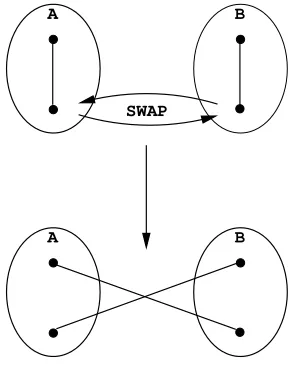
Figure (3) shows how SWAP can be used to establish 2 ebits of entanglement between Alice and Bob. Each party initially possesses 1 local ebit of entanglement. If the SWAP operation is used to interchange the states of one particle from each entangled pair, the result is that Alice and Bob share 2 ebits of entanglement.
Notice that the SWAP operation cannot be used to cre-ate 2 ebits of entanglement, and communiccre-ate 2 classical bits each way, simultaneously. In fact, looking at figures (3) and (4), we can see that one of these processes is essentially the time-reverse of the other.
A B
A B
SWAP
FIG. 3. Illustration of how the SWAP operation can be used to establish 2 ebits of entanglement betweenAandB.
A broader class of maximally-inseparable operations on 2 qubits can be obtained by considering those which are equivalent to SWAP up to a bilateral local unitary op-eration. Specifically, any unitary operationT of the form T= (Uα2⊗Uβ2)US(Uα1⊗Uβ1) must require the same en-tanglement and communication resources asUS. Here, Uαi andUβi are local unitary operations onαandβ
re-spectively. The reason for this is simple: it is possible to convert this operation into the SWAP operation by just local-unitary transformations, that is, without any additional entanglement or classical communication re-sources. This follows from the simple observation that US = (U†
α2⊗U
†
β2)T(U
†
α1⊗U
†
β1).
III. MULTIPARTICLE SYSTEMS, GRAPHICAL REPRESENTATIONS AND TELEPORTATION.
qubit, and we label these qj. We are interested in the CCSE resources required to perform an arbitrary collec-tive quantum operation involving allN qubits.
Each laboratory shares a certain number of ebits of entanglement with every other laboratory. In this paper, we shall, except where indicated, take all entanglement to be in pure, bipartite form. TheN laboratories are also linked by classical communication channels, so that each can communicate a certain number of classical bits to the others. Each laboratory also possesses auxiliary quantum systems allowing arbitrary local quantum operations to be performed.
The CCSE resources available to the network of labo-ratories are conveniently represented using the concepts of graph theory [21]. Recall that a graph G = (V, E) is a set V of vertices connected by edges comprising a set E. If the edges have a sense of direction indicat-ing an asymmetrical relationship between the vertices it connects, the graph is said to be a directed graph, or a digraph. If there is no preferred direction, the graph is undirected.
These resources can be represented by distinct en-tanglement and communication graphs. Both graphs are comprised of N vertices, each of which represents one of the laboratories Aj. The resource entanglement graph GE represents the amount of bipartite entangle-ment shared between each pair of laboratories. Specif-ically, we write both the jth laboratory and its corre-sponding vertex as Aj. The weight of the edge joining vertices Ai and Aj is equal to the number of ebits of entanglement shared by these laboratories. The graph is characterised completely by theN×N resource entangle-ment matrixER. The elementERij of this matrix is equal to the number of ebits of entanglement shared byAi and Aj. The diagonal elements of this matrix are zero.
Clearly, ER is symmetric and the graph GE is undi-rected. These observations follow from the fact that en-tanglement is a shared, rather than a directed resource.
As an example, a resource entanglement graph for N = 4 is depicted in figure (4). This corresponds to the following resource entanglement matrix:
ER=
0 3 2 6 3 0 1 0 2 1 0 0 6 0 0 0
. (3.1)
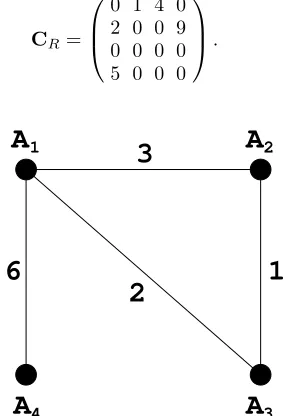
Likewise, we can define a resource communication graphGC. This represents the number of classical bits that the laboratories can communicate directly to each other. By directly, we mean that it is not relayed by a set of intermediate laboratories from origin to destina-tion. The weight of the edge running from Ai and Aj represents the number of classical bits thatAi can com-municate directly toAj. These weights are the elements of a correspondingly defined resource communication ma-trixCR. Theij element of this matrix,CRij, is equal to the number of classical bits thatAican communicate di-rectly to Aj. The diagonal elements of this matrix are
also zero. CRis not necessarily symmetric and the graph GC is directed, which follows from the fact that com-munication operations have a natural sense of direction from sender to receiver. An example of a resource com-munication graph forN = 4 is given in figure (5), which corresponds to the resource communication matrix
CR=
0 1 4 0 2 0 0 9 0 0 0 0 5 0 0 0
. (3.2)
A
1A
2A
3A
43
1
6
2
FIG. 4. Example of an entanglement graph GE with
N= 4. This corresponds to the resource entanglement matrix
ER in Eq. (3.1).
The fact that each pair of vertices may be joined by more than one edge means thatGCis, strictly speaking, a multigraph, indeed a multidigraph since these edges are directed. We do not, however, wish to unduly proliferate terminology, so we shall simply use the term graph.
A
3A
2A
11
2
5
9
4
A
4FIG. 5. Example of a communication graph GC with
N = 4. This corresponds to the resource communication matrixCR in Eq. (3.2).
[image:5.612.367.519.133.341.2]from vertexAi to Aj in the graphGC, then Ai cannot communicate any classical information directly toAj.
Two quantities which will be of particular interest to us are the total shared entanglement and the total number of classical bits that can be communicated. Respectively, these are
ER= 1 2
X
ij
ERij, (3.3)
CR=X ij
CRij. (3.4)
The factor of 1/2 in Eq. (3.3) occurs as a consequence of the shared nature of entanglement, which implies that the entanglement shared between each pair of laboratories is counted twice in the summation.
Having established the framework within which we will work, let us now see how such resources can be used to perform an arbitrary collective quantum operation upon theNqubitsqj. The teleportation-based procedure for 2 qubits described in the preceding section admits a natural generalisation to the case of N qubits, which we now describe.
We consider the situation in which all laboratories share entanglement and have the resources for two-way classical communication with one particular laboratory. Let this laboratory beA1. It follows that the other labo-ratories can teleport the states of their qubits toA1. The operation can then be carried out atA1 as an LQ oper-ation. The final states of the other qubits can then be teleported back to their original laboratories, completing the procedure.
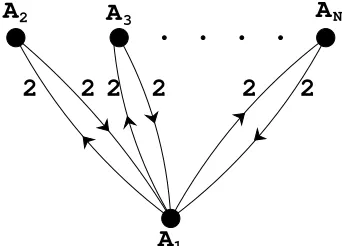
This multiparticle protocol generalises the first 3 steps of the 2-qubit protocol described in the preceding section. It requires each of the laboratories A2, . . ., AN to share 2 ebits of entanglement with A1 and for 2 bits of clas-sical information to be communicated each way between each of them andA1. The elements of the corresponding resource entanglement and communication matrices are
ERij=CRij = 2|δi1−δ1j|. (3.5)
The corresponding graphs GE and GC are depicted in figures (6) and (7). The total resource entanglement and communication are
ER=CR
2 = 2(N−1). (3.6)
The graph GE representing the entanglement resources required by the teleportation protocol is said to be atree. Generally speaking, a tree is an connected, acyclic graph, that is, one where every pair of vertices is connected by at least one path, and where there are no closed paths.
Any quantum operation onNqubits can be performed using this method and thus, at least for the topology of entanglement and communication in our protocol, the values ofERandCR in Eq. (3.6) are sufficient.
A
1A
2A
3A
N [image:6.612.353.524.316.439.2]2
2
2
FIG. 6. Resource entanglement graph for the teleportation protocol.
Much of the remainder of this paper will be concerned with the issue of whether or not this protocol is optimal: that is, whether or not there exists a procedure for car-rying out any quantum operation onN qubits which less resources than this protocol. Prior to doing so, it is of interest to determine whether or not this protocol is the most efficient among those that operate by teleportation of the states of the qubits concerned.
A
1A
2A
3A
N2
2
2
2
2
2
FIG. 7. Resource communication graph for the teleporta-tion protocol.
We haveN laboratoriesAi, each of which possesses a corresponding qubitqi. If we wish the N laboratories to be able to carry out any collective operation upon the qi by teleporting single qubits, then, as we now show, at least 2(N−1) such teleportations must take place.
To see why, suppose that the first teleportation is from A1 to A2. A2 now has information aboutA1. Secondly another labAr teleports a state toA3. If they are com-pletely different labs from the first pairs of laboratories thenA3 can hold information only about one other lab, Ar. If, however, r = 2, then A3 can hold information about 3 qubits,q1,q2 andq3.
events required so that each of the first N−1 labs can get information from labAN. This gives a total of a least 2(N−1) communications in all which costs 2(N−1) ebits. We saw in the preceding section that the total resource entanglement for an arbitrary operation upon two parti-cles can be recovered if the operation in question is uni-tarily equivalent to SWAP. Also, for such an operation, the required classical communication facilities required to complete an arbitrary operation can be fully used to communicate useful information. An important question is, does there exist an operation, or class of operations which fulfills this role in the generalN-particle case?
Let us denote the maximum total entanglement that can be established, and the maximum number of classical bits that can be sent by any operation byEC andCC re-spectively. To address this issue, it is helpful to partition the entire network of N qubits into a single qubit and a compound system comprised of the remaining N−1 qubits. How much entanglement can be established be-tween the location of the isolated qubit and the rest of the network? Also, how much classical information can be transmitted in both directions between the location of this qubit and the remainder?
In the teleportation protocol, a special status was given to laboratoryA1. However, this choice was arbitrary, and clearly this role could have been assumed by any labo-ratory. It follows that any collective quantum operation uponN qubits can be carried out with each laboratory sharing no more than 2 ebits of entanglement, and able to exchange no more than 2 classical bits each way, with the rest of the network. The reasoning which led us to inequalities (2.4-2.6) then implies that no operation can be used to establish more than 2 ebits of pure bipartite entanglement, or be used to exchange more than 2 classi-cal bits each way, between any particular laboratory and the rest of the network.
The maximum total entanglement that can be estab-lished is then obtained by multiplication of 2 ebits by the number of laboratories and then dividing by 2, since entanglement is shared, giving
EC≤N. (3.7)
The maximum number of classical bits that any collective operation can be used to communicate is obtained by multiplying the maximum amount of information that one laboratory can communicate, namely 2 bits, by N, the number of laboratories, giving
CC≤2N. (3.8)
These bounds are tight, that is, they can be accessed by a specific class of quantum operations, the permutation operations.
A unitary permutation operator uponN qubits is de-scribed by
UP|ψ1i⊗. . .⊗|ψNi=|ψP(1)i⊗. . .⊗|ψP(N)i, (3.9)
where P(i) represents a permutation of the index i∈[1, N]. Here, we consider only permutation operations which satisfyP(i)6=i∀i∈[1, N].
[image:7.612.327.555.100.211.2]00 00 00 11 11 11 0 0 1 1 0 0 1 1 0 0 1 1 00 00 00 11 11 1100 00 11 11 00 00 11 11 0 0 1 1 00 00 11 11 00 00 00 11 11 11 00 00 11 11 00 00 11 11 0 0 1 1 0 0 0 1 1 1 0 0 0 1 1 1 0 1 0 0 1 1 0 1 A1 A2 A3 A4 A5 A6 A1 A2 A3 A4 A5 A6 00 00 00 11 11 11 00 00 00 11 11 11 00 00 11 11 00 00 11 11 0 0 1 1 0 0 1 1 00 00 11 11 0 0 1 1 00 00 00 11 11 11 0 0 0 1 1 1 00 00 00 11 11 11 00 00 11 11
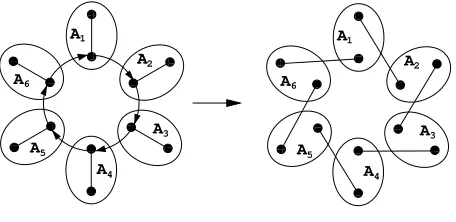
FIG. 8. Illustration of the production of N ebits of entan-glement by the permutation operation. Here, N = 6 and the permutation takes{1,2,3,4,5,6}to{6,1,2,3,4,5}. One qubit of each initial local ebit is transferred to the successive laboratory, resulting in the finalN shared ebits.
To see thatN ebits of entanglement can be established using a permutation operation, suppose thatAicontains one local ebit, in the form of, for example, some standard Bell state. We shall denote this state by|Bi,ii. The first and second indices denote the laboratories which possess the first and second qubits respectively. Suppose now that the second qubits’ states are permuted according to Eq. (3.9). This transforms|Bi,iiinto|Bi,P(i)i. Following this permutation, laboratories Ai and AP(i) share the Bell state|Bi,P(i)i. There areN laboratories, and soN shared ebits of entanglement in the form of Bell states have been established. This procedure is illustrated in figure (8).
To see that a permutation operation can be used to communicate 2N classical bits, suppose that AP−1(i)
shares the Bell state |Bi,P−1(i)
i with Ai. Locally, us-ing superdense codus-ing,AP−1(i)can manipulate the state
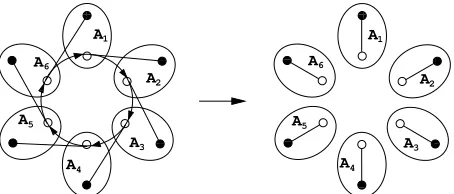
of the second qubit in this Bell state so that it becomes any of the four possible Bell states. Figure (9) illustrates this scenario, where each second qubit is represented by a hollow circle. We may therefore write the state follow-ing this local manipulation as|Bi,Pµ(i)−1(i)i, where the in-tegerµ(i)∈[1, . . .,4]. The permutation operation is then carried out on the set of locally-manipulated qubits, re-sulting inAi being in possession of the state|Bµ(i)i,i i. By performing a Bell measurement,Ai can read the two bits of information sent byAP−1(i), and in total 2Nbits have
A4 A5 A3 A2 A1 A6 00 00 11 11 00 00 11 11 0 0 0 1 1 1 00 11 00 00 11 11 0 0 1 1 A1 A2 A3 A4 A5 A6 0 0 1 1 00 00 11 11 00 00 11 11 00 00 11 11 00 00 11 11 00 00 11 11 00 00 11 11 0 0 1 1 0 0 0 1 1 1
FIG. 9. Illustration of how permutation operations can be used to communicate 2N classical bits, using the same cyclic permutation as in figure (8). Each laboratory initially shares 1 ebit with its successor, which it then manipulates into one of the 4 Bell states. The manipulated qubits are represented by hollow circles. The permutation operation is then used to localise each of these ebits in the successive laboratories. Individual local Bell measurements are performed upon these, each of which reveals two classical bits, or 2N bits in total.
As is the case with the SWAP operation for 2 qubits, the number of ebits thatUP can establish is also the min-imum amount of entanglement required to carry out this operation. The same is true of the classical communica-tion resources involved. Suppose thatAi shares one ebit of entanglement withAP(i)and can communicate 2 clas-sical bits to this location. Then the permutation opera-tion can be carried out using these resources to teleport the state of qubitqifromAitoAP(i). Permutation oper-ations, including the SWAP operation, make maximally efficient use of the resources required to carry them out. As is also the case with the SWAP operation, any oper-ation which is equivalent toUP up to anN-partite local unitary transformation, that is, any unitary operationT of the form
T = ON i=1U 2 i UP ON j=1U 1 j , (3.10)
where U1
i, Uj2 are arbitrary local unitary operations on qubitsqi andqj, is also maximally-inseparable. This is a consequence of the fact thatUP can be obtained fromT by the local unitary operation
UP = ON i=1U 2† i T ON j=1U 1† j . (3.11)
Comparing (3.7) and (3.8) with (3.6), we see that the total amount of entanglement that can be established, and the total amount of classical information that can be sent is strictly less than that required to carry out an arbitrary operation using the teleportation protocol, with the exception of the case N = 2. We have not, however, established the optimality of the teleportation protocol. We examine this issue in the following section.
IV. RESOURCES REQUIRED TO PERFORM ARBITRARY MULTIPARTICLE OPERATIONS
A. Graph Symmetrisation
The teleportation-based method for performing an ar-bitrary collective quantum operation upon N spatially separated qubits requiresER= 2(N−1) ebits of entan-glement andCR= 4(N−1) classical bits. An obviously important question is: are these figures optimal, in the sense that no less entanglement and communication will suffice?
Unlike the case of N = 2, for general N we cannot answer this question by making use of the fact that the resource entanglement and communication required by the teleportation protocol can respectively be recovered and used to communicate messages, as can be done with the SWAP operation. ForN >2, the values of ER and CRfor the teleportation protocol, given by Eq. (3.6), are strictly greater than the upper bounds onEC andCC in (3.7) and (3.8). Another approach must be taken to re-solve this issue. In this section, we show that, for even N, the resource entanglement and communication re-quired to perform an arbitrary quantum operation upon N qubits using the teleportation protocol are indeed the minimum possible values. We describe a novel proof tech-nique, which we termgraph symmetrisation, to establish this fact. The same method is then used to find lower bounds on the minimum values ofERandCRfor oddN. We find that, forN≥4, these lower bounds are strictly greater than the upper bounds on EC and CC in Eqs. (3.7) and (3.8).
The problem we will investigate is the following. A network of laboratoriesAipossesses shared bipartite en-tanglement, described by the graph GE, and facilities enabling limited classical communication between them, described by a graphGC. If these graphs describe suf-ficient resources to enable any collective operation to be performed upon their respective resident qubitsqj, then what lower bounds must the corresponding values ofER andCR satisfy?
We commence by making the following observation: if the graphs GE(V) and GC(V) describe sufficient re-sources, then so does any other pair of graphs obtained from them by a permutation of the vertices. Note that we have written the dependence of the graphs on the vertex set explicitly here. This makes sense intuitively. Never-theless, here we provide a short proof. Let G′
E(V) and G′
C(V) be the entanglement and communication graphs obtained from GE(V) and GC(V) by a permutationP of the vertex set. We may write G′
E(V) = GE(P[V]) and G′
C(V) = GC(P[V]), where P[V] is the permuta-tion. The reversibility of permutation operations implies thatGE(V) =G′
from Lby applying the same permutation to the vertex set, that is,L′(V) =L(P[V]), andL(V) =L′(P−1[V]).
If there exists an operation L′(V) which cannot be
performed using the resources described by the graphs G′
E(V) andG′C(V), then by reversing the permutationP, it follows thatL(V) cannot be carried out usingGE(V) andGC(V), in contradiction with our premise. Thus, if the resources described by the graphsGE(V) andGC(V) can be used to carry out any quantum operation, then so do those described byGE(P[V]) andGC(P[V]) for any permutationP of the vertex setV.
Let us now consider the graphs ˜GE and ˜GC, defined by
˜
GE= X P[V]
GE(V), (4.1)
˜
GC= X P[V]
GC(V). (4.2)
These graphs are constructed by summing over all of the graphs obtained fromGEandGCby permuting the ver-tices. By summing, we mean summing the entanglement and communication represented by the weights of the edges. The resource entanglement and communication matrices for these graphs are easily obtained. Their ele-ments are
˜
ERij= X P[V]
ERP(i),P(j), (4.3)
˜
CRij= X P[V]
CRP(i),P(j). (4.4)
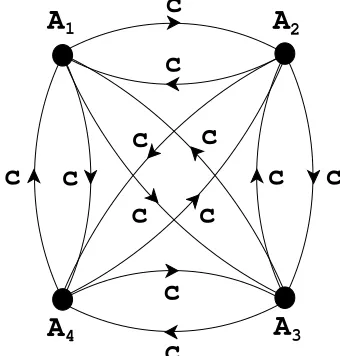
These graphs are regular and complete. A complete graph is one where each pair of vertices is joined by an edge. In the case of the graph ˜GC, this means that each pair of vertices is connected by an edge in each direction. A regular graph is one where all edges have the same weight. In a network represented by these graphs, all pairs of laboratories share the same amount of entangle-ment, and can communicate the same amount of classical information, in both directions.
For the purposes of illustration, the graphs ˜GE and ˜
GC are shown in figures (10) and (11) corresponding to the particular graphsGE andGC in figures (4) and (5). The regularity and completeness properties are easily proven, and follow immediately from the fact that the graphs ˜GCand ˜GE, being defined as sums over all vertex permutations, are clearly themselves permutation invari-ant.
The total resource entanglement and communication for these graphs, ˜ER and ˜CR, are easily evaluated in terms of the corresponding resources represented by the original graphsGE and GC. Take the case of ˜ER: there are N! permutations of the vertex set, so ˜GE describes N! times as much entanglement asGE, that is
˜
ER=N!ER. (4.5)
Similarly,
˜
CR=N!CR. (4.6)
A
1A
2A
3A
4e
e
e
e
[image:9.612.361.512.68.258.2]e
e
FIG. 10. Symmetrised resource entanglement graph ˜GE
corresponding to the graphGE in figure (4). Here, e, which
is given by eq. (4.7), is equal to 24.
A
2A
3A
1A
4c
c
c
c
c
c
c
c
c
c
c
c
FIG. 11. Symmetrised resource communication graph ˜GC
corresponding to the graphGC in figure (5). Here,c, which
is given by Eq. (4.8), is equal to 42.
All edges in each of these graphs have the same weight, and it will be convenient to label these two weights. For
˜
GE and ˜GC, we denote these edge weights simply by e andcrespectively. These are
e= 2(N−2)!ER, (4.7) c= (N−2)!CR, (4.8)
which follows from Eqs. (4.5) and (4.6), and also from the fact that the graphs ˜GEand ˜GChaveN(N−1)/2 and N(N −1) edges respectively. For the graphs in figures (10) and (11), we find thate= 24 andc= 42.
[image:9.612.353.523.319.497.2]and ˜GCcan be used to perform any operationN! times. By this, we mean the following: suppose thatAicontains N! qubits. We can then define N! sets of qubits, where each contains one qubit from each laboratory. It will be possible to perform the same operation separately upon every one of these sets.
In the next two subsections, we will use the formal-ism developed here, together with inequalities (2.4-2.6) to establish lower bounds on the values ofeandc. These lead to lower bounds onER and CR through Eqs. (4.7) and (4.8). We shall treat the cases of even and odd N
separately, since, for even N, it is possible to use this technique to solve for the minimum values ofERandCR which are sufficient to carry out any operation. These are those required to implement the teleportation proto-col described in section III.
B. Necessary and Sufficient Resources for Even N
Using the formalism we have set up, we can obtain the minimum values ofER andCR exactly whenN is even. The network ofN laboratories is assumed to possess suf-ficient resources, described by the graphs ˜GE and ˜GC, to enable any operation to be carried out N! times. Here, we consider one particular operation, which we will refer to as the pairwise-SWAP (PS) operation. This operation has the effect of swapping the state of a qubit atAj with that of one at Aj+1, for all oddj. If we write the two-particle SWAP operation exchanging the states of qubits atAjandAj+1 asUSj+1,j, then the PS operation may be written as
UP S=USN,N−1⊗USN−2,N−3⊗. . .⊗US2,1. (4.9)
This operation is illustrated in figure (12).
[image:10.612.354.526.238.527.2]SWAP
SWAP
A
A
A
A
3 4 1 2FIG. 12. Depiction of the pairwise-SWAP (PS) operation forN= 4.
The PS operation is a permutation operation which leaves no vertex invariant, and so it can be used to
es-tablishN ebits of entanglement and to communicate 2N classical bits. Performing this operation N! times can then be used to create N!N ebits of entanglement and to send 2N!N bits of classical information. From the as-sumption that the graphs ˜GEand ˜GCrepresent sufficient resources to carry out theN!-fold PS operation, we can deduce the minimum values of e and c, and using Eqs. (4.7) and (4.8), those ofER andCR, required to do so.
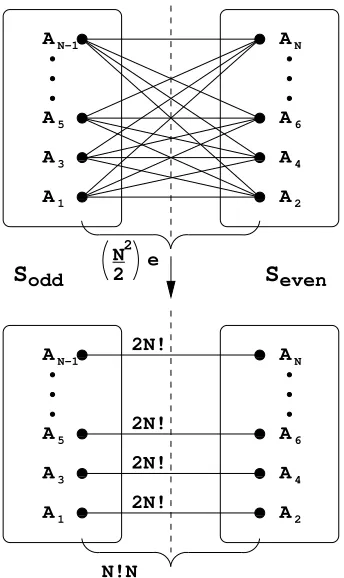
To determine the minimum value of e, we will make use of the fact that entanglement cannot increase under LQCC operations. Consider the situation depicted in figure (13). We partition the entire network into two sets. One contains the even laboratoriesA2, A4, . . ., AN, and the other contains the odd ones A1, A3, . . ., AN−1.
We shall refer to these sets asSeven andSodd.
odd
S
S
evenA1 A2
A4 A6 AN AN-1 A3 A5
A1 A2
A4 A6 AN AN-1 A3 A5 e _ N 2 2 0 0 1 1 0 0 1 1 0 0 1 1 0 0 1 1 0 0 1 1 0 0 1 1 0 0 1 1 0 0 1 1 00 00 11 11 00 00 11 11 00 00 11 11 00 00 11 11 00 00 11 11 00 00 11 11 0 0 1 1 0 0 1 1 0 0 1 1 0 0 1 1 0 0 1 1 0 0 1 1 0 0 1 1 0 0 1 1 00 00 11 11 00 00 11 11 00 00 11 11 00 00 11 11 00 00 11 11 00 00 11 11 2N! 2N! 2N! 2N! N!N
FIG. 13. Use of the resource entanglement graph ˜GE to
carry out theN!-fold pairwise-SWAP operation. Initially, the entanglement resources are distributed according to the graph
˜
GE. We have divided theN laboratories into even and odd
setsSevenandSodd. For the sake of clarity, we have not
indi-cated the internal entanglement of these sets. Each laboratory inSoddshareseebits of entanglement with each laboratory in
Seven. These sets are separated by an imaginary partition,
in-dicated by the broken line. Initially, these sets share (N/2)2e
[image:10.612.69.274.441.627.2]The total entanglement initially shared by these sets can be calculated in a straightforward manner. Each of the N/2 laboratories in Sodd shares e ebits with each laboratory in Seven, that is, N e/2 ebits with Seven in total. Adding up the N/2 such contributions from the laboratories in Sodd gives (N/2)2e ebits initially shared bySeven andSodd. The final entanglement they share is N!N ebits. The total entanglement thatSeven andSodd share cannot increase, giving the inequality
N
2
2
e≥N!N. (4.10)
Making use of Eq. (4.7), we find that
ER≥2(N−1). (4.11)
This lower bound on the total resource entanglement is precisely the amount which is required by the teleporta-tion protocol. Thus, for evenN, the teleportation proto-col is optimal with regard to the required total resource entanglement.
This bound has been derived on the basis of the fact that, in a multiparticle system, the (bipartite) entangle-ment shared by two exhaustive subsets cannot increase under LQCC operations. Although the entanglement ini-tially shared by each pair of laboratories is in pure, bipar-tite form, the transformation shown in figure (13) may, at some point, manipulate the resource entanglement into, possibly mixed, multiparticle entanglement. Our argu-ment still holds under these circumstances. If the final entanglement is in multiparticle form, then in order to carry out the N!-fold PS operation, Aj and Aj+1 will have to be able todistill 2N! ebits of pure, bipartite en-tanglement. The total distillable entanglement between SevenandSodd cannot increase, which leads to inequality (4.10) and thus the teleportation bound in (4.11).
The nonincreasing of entanglement under LQCC oper-ations is an asymptotic result. It follows that the telepor-tation protocol is asymptotically optimal for evenN. By asymptotic [22], we mean that, given a very large number of sets of separated qubits, where the same, arbitrary op-eration is to be carried out on each set, the teleportation protocol uses the minimumaverageentanglement that is required per run of the operation.
In practical situations, it is often the resources required to carry out an operation successfully just once that will be of interest. For general information processing tasks, the resources required in the ‘one-shot’ scenario are at least equal to the resources required asymptotically. For the problem we have considered here, when N is even, the entanglement resources required in both scenarios are equal. This is because the teleportation protocol, which requires 2(N −1) ebits, can be used to carry out any collective operation onN qubits once.
The proof that theN laboratories must also be able to send 4(N−1) classical bits proceeds similarly. The graph
˜
GC is assumed to represent sufficient CC resources to
perform any operationN! times. If this operation is the PS operation, then it should then be able to communicate 2N!N bits. Given this, and the fact that each laboratory can communicatec classical bits to each other one, we can determine the minimum value ofc, from which we can infer the minimum ofCRthrough Eq. (4.8).
Again, we partition the vertex set intoSevenandSodd. According to inequalities (2.4-2.5), the total amount of resource communication between the setsSeven andSodd cannot be less than the amount of classical information that theN!-fold PS operation can be used to communi-cate between these two sets.
According to ˜GC, each of theN/2 laboratories inSeven can communicate c classical bits to each one in Sodd. From this, we find that the maximum amount of classical information that can be sent in either direction between Seven toSodd odd is (N/2)2c bits.
The N!-fold PS operation can be used to send N!N bits in either direction Seven to Sodd. Inequalities (2.4-2.5) imply that
N
2
2
c≥N!N. (4.12)
Making use of Eq. (4.8), we obtain
CR≥4(N−1), (4.13)
which is the amount of resource communication required to implement the teleportation protocol. We have thus shown that, in terms of the total resource entanglement and communication, the teleportation protocol in section III is maximally efficient.
C. Necessary Resources for Odd N
Let us now examine the case of odd N. We have been unable to find a specific operation which proves that the minimum resources required to carry out any operation on an odd number of qubits are those employed by the teleportation protocol. However, using the graph sym-metrisation technique, it is still possible to obtain lower bounds on these minimum resources. As before, we as-sume that the graphs ˜GE and ˜GC represent sufficient resources to perform any operationN! times. The spe-cific operation we shall consider here is the PS operation upon the firstN−3 qubits, and a separate, cyclic permu-tation of the remaining three. ForN = 3, there is only this latter part of the operation. We shall refer to this as the PS+CP operation, and it is illustrated in figure (14). The PS+CP operation is again a permutation opera-tion which leaves no vertex invariant. It follows that it can be used to establishN ebits of entanglement and to communicate 2N classical bits.
on the resources required to carry out the PS+CP oper-ation. Again, we divide theN laboratories into two sets, Seven andSodd.
[image:12.612.354.524.53.384.2]A5 A A6 7 SWAP SWAP A A A A 3 4 1 2
FIG. 14. Depiction of the PS+CP operation forN = 7
Our aim, as before, is to obtain lower bounds on the minimum values of c and e from the assumption that
˜
GEand ˜GC represent sufficient resources to perform this particular operationN! times.
We begin by deriving a lower bound on the minimum sufficient resource entanglementER. In figure (15), the total initial entanglement betweenSeven andSodd is de-picted, as is the amount of entanglement that can be established by theN!-fold PS+CP operation. As before, these sets are divided by an imaginary partition, and the total entanglement across this partition cannot increase. Initially, each of the (N −1)/2 laboratories in Seven shareseebits with each of the (N+ 1)/2 laboratories in Sodd. The total amount of entanglement initially shared bySeven andSodd is then (N2−1)e/4 ebits. There are two contributions to the amount of entanglement that can be created by the N!-fold PS+CP operation. One is that created by the PS part of the operation on the qubits in the first N −3 laboratories. This can create N!(N−3) ebits. The second contribution comes from the cyclic permutation on the remaining three laboratories. This gives an additional 2N! ebits. Inequality (2.6) then implies
N2−1 4
e≥N!(N−1). (4.14)
Making use of Eq. (4.8), we obtain a corresponding lower bound onER:
ER≥2
N N+ 1
(N−1), (4.15)
that is, the teleportation bound multiplied by a factor ofN/(N+ 1). The argument given for evenN that this bound cannot be improved upon by converting the initial bipartite resource entanglement into multiparticle entan-glement also applies here.
A2 A4 A6 A 0 0 0 1 1 1 0 0 1 1 0 0 1 1 0 0 1 1 00 00 11 11 00 00 11 11 00 00 11 11N-1 A1 A3 A5 0 0 1 1 0 0 1 1 0 0 0 1 1 1 0 0 1 1 00 00 11 11 00 00 11 11 00 00 11 11 0011
00 00 11 11 A AN-2 N A2 A4 A6 A 0 0 1 1 0 0 0 1 1 1 0 0 1 1 0 0 1 1 00 00 11 11 00 00 11 11 00 00 11 11N-1 N2 ____-1 4 e A1 A3 A5 0 0 0 1 1 1 0 0 1 1 0 0 1 1 0 0 1 1 00 00 11 11 00 00 11 11 00 00 11 11 0011
00 00 11 11 A AN-2 N 2N! 2N! 2N! N!N N! N!
FIG. 15. Use of the resource entanglement graph ˜GE to
carry out theN!-fold PS+CP operation. The initial entan-glement resources are distributed according to the graph ˜GE.
Here, prior to carrying out the operation, the setsSeven and
Sodd share (N2 −1)e/4 ebits of entanglement. The N!-fold
PS+CP operation can establish N!N ebits between them. The total entanglement shared by these sets cannot increase, and the requirement thatemust be large enough to carry out theN!-fold PS+CP operation leads to inequalities (4.14) and (4.15).
Let us now obtain a lower bound on the minimum re-source communicationCR. As with the even case, we will make use of the fact that the amount of classical informa-tion that the PS+CP operainforma-tion can be used to communi-cate, in either direction betweenSeven and Sodd, cannot exceed the amount of resource communication in this di-rection that must be consumed in order to implement the N!-fold PS+CP operation.
[image:12.612.63.291.101.207.2]As with entanglement, the PS and CP parts of theN !-fold PS+CP operation make distinct contributions to the amount of information that this operation can be used to send fromSeven toSodd. For a single implementation of PS+CP, the PS part can communicate (N−3) bits from Seven to Sodd, while the CP part can be used to send 2 bits. Thus, the total amount of classical information that theN!-fold PS+CP operation can be used to send in either direction across the partition isN!(N−1) bits. The impossibility of this exceeding the resource com-munication in either direction across the partition implies that
N2−1
4
c≥N!(N−1). (4.16)
and, making use of Eq. (4.8), we obtain the correspond-ing bound forCR:
CR≥4
N N+ 1
(N−1), (4.17)
which, like the entanglement bound in (4.15), is the tele-portation bound multiplied byN/(N+ 1).
Like the bounds in (4.11) and (4.13) for the even case, the lower bounds we have obtained here for the minimum resource entanglement and communication for oddNare asymptotic results. However, the fact that the bounds (4.15) and (4.17) are not integers suggests that if the available resources are at these bounds, they may not be very useful in the one-shot case, where it is more desirable to be able to transmit whole bits of classical information, and to manipulate whole ebits of entanglement. With this in mind, let us return to the bound onER in (4.15) and consider the inequality
2N(N−1)
N + 1 = 2(N−1)−2 + 4
N+ 1≥2(N−1)−2 (4.18)
where the equality is attained only in the limit asN→∞. If we are to round this bound up to the next integer, we obtain 2(N −1)−1. Thus, the minimum number of integer ebits able to carry out an arbitrary operation on an odd number of qubits, in the one-shot case, is bounded from below by one ebit less than the teleportation bound. By a similar calculation, one can show, using the bound in (4.17), that in the one-shot case, if classical informa-tion is to be transmitted in integer amounts, then the minimum number of bits needed to carry out an arbi-trary operation on an odd number of qubits is bounded from below by 3 bits less than the teleportation bound. For N = 3,5, a stronger bound of 2 bits less than re-source communication for the teleportation protocol is obtained.
With these observations in mind, the case of N = 3 appears to be particularly significant. For this case, in the one-shot scenario, we see that at least 3 ebits and
6 classical bits are required. However, we know that a permutation of 3 qubits can create 3 ebits or be used to send 6 classical bits. This implies that these bounds must also hold asymptotically.
It is important to compare the bounds in (4.15) and (4.17), which hold rigorously in both the one-shot and asymptotic scenarios, with the maximum amount of entanglement that can be created, and the maximum amount of classical information that can be sent, by anN qubit operation. With this in mind, we note the following inequality, which holds for allN≥3:
2
N N+ 1
(N−1)≥N. (4.19)
The equality is obtained only whenN = 3. This implies that, for allN≥4, the resources required to carry out an arbitrary operation exceed those that can be recovered, either by re-establishing consumed entanglement, or us-ing the resource communication which was consumed to implement the operation to send useful messages.
As we saw in section II, this is not the case forN = 2, which can be seen from the properties of the SWAP op-eration. The remaining case, that ofN = 3, is presently unsolved.
D. Transfer of Expendable Resources
In our derivation of the lower bounds on the mini-mum resource entanglement and communication needed to carry out any multiqubit operation, we used specific operations where certain pairs of laboratories needed to be able to establish large amounts of entanglement or communicate large amounts of classical information: more than is represented by the corresponding edges in the graphs ˜GE and ˜GC. Thus, to carry out either the N!-fold PS or PS+CP operation, the resources from the other edges in these graphs must somehow be ‘trans-ferred’ to the edges which must gain resources.
We can formalise this notion in the following way: con-sider a multiqubit operationL onN qubits. IfLis car-ried out N! times, then depending on the initial condi-tions, there may be some pairs of laboratories which will end up sharing more that e ebits of entanglement, or exchanging more than c classical bits in either, or per-haps both directions. Let is define the target entangle-ment and communication graphs GT
E and GTC. These will represent either the number of ebits shared by each pair of laboratories or the number of classical bits com-municated, following the N!-fold implementation of L. These graphs can be characterised by the target entan-glement and communication matrices ET = {ETij} and
CT ={CTij}, in the same way as for the resource graphs. For ˜GEandGT
E, we will define a pair of complementary subsets of the edge set, SE+ and SE−, in the following
The setSE− contains all edges for whichETij≤e. These sets contain the edges which respectively gain, and do not gain entanglement.
Similarly, for the classical communication graphs ˜GC andGT
C, we will define the subsetsSC+ and SC− of the
edge set. SC+contains the edges, represented byordered
pairs [i, j], for whichCTij > c, andSC− contains all edges
[i, j] for whichCTij≤c.
Here, we shall be particularly interested in the edges which gain resources. In fact, the resources contained in the other edges, contained in the setsSE−andSC−, will
be considered expendable. The total expendable entan-glement and communication are given by
EE= 1 2
X
(i,j)∈SE−
˜
EijR, (4.20)
CE= X
[i,j]∈SC−
˜
CRij. (4.21)
The question we would like to answer is: how much of the expendable entanglement or communication can be transferred to the setSE+orSC+? We have been unable to obtain the general solution to this problem, although the analysis of the PS operation suggests intuitively ap-pealing upper bounds.
For the N!-fold PS operation, the values of EE and CE are easily calculated, where the sets SE+ and SC+ contain the edges linking laboratories whose qubits are to be swapped. We find that
EE= 1 2(N
2−2N)e, (4.22)
CE= (N2−2N)c. (4.23)
If each pair of swapped qubits generates 2 ebits of entan-glement, then as we know, theN!-fold PS operation can by used to create N!N ebits. The total amount of en-tanglement which has beenaddedto the setSE+ is then N!N−(N e/2) ebits. From inequality (4.10), we see that
N!N−N e
2 ≤ EE
2 (4.24)
that is, at most half of the expendable entanglement can be added to the edges inSE+. Whether or not this bound holds in general for allN, and when the initial resource entanglement is not described by a regular, complete graph, is currently unknown. However, we can prove that it holds in general for N = 3. Consider 3 laboratories, A1. . .A3. Let their initial and final entanglement be de-scribed by the resource and target entanglement graphs GEandGT
E, characterised by the corresponding matrices
ER andET. The difference between the initial and final entanglement between each pair of laboratories can be represented by the matrix∆=ET −ER.
The fact that the total amount of entanglement shared by one laboratory and the other pair cannot increase im-plies that the sum of the elements in each row or col-umn of ∆ cannot exceed zero. This also implies that
the entanglement between at most one pair of laborato-ries can increase. Let this pair of laboratolaborato-ries beA1and A2. Summing up the elements of ∆ in rows 1 and 2, together with the nonincreasing property of the column sums, gives ∆12≤|∆13+ ∆23|/2. The numerator on the right hand side is the total amount of entanglement lost. We see that the entanglement transferred to the edge (1,2) cannot exceed half of this loss.
This kind of entanglement loss was originally discov-ered in association with entanglement swapping [14]. It would be useful to know whether or not it is an unavoid-able feature of all operations which transfer entangle-ment, and for an arbitrary number of spatially separated systems. Any proof, or disproof, of this conjecture must take into account the possibility that the initial bipartite resource entanglement is converted into multiparticle en-tangled states. Some progress has recently been made towards developing a theory of conversion between bipar-tite and multiparticle entangled states [23]. The study of certain particular situations has indicated that these con-versions are typically lossy. Consequently, we do not be-lieve that multiparticle entangled states will enable more efficient entanglement transfer.
Returning to the N!-fold PS operation, we will show how a similar result relating the expendable communi-cation to the communicommuni-cation that can be added to the edges in SC+ can be obtained. The N!-fold PS opera-tion can by used to send 2N!N bits. The total amount of communication which has beenadded to the set SC+ is then 2N!N−N cbits. From inequality (4.12), we see that
N!N−N c
2 ≤ CE
2 (4.25)
that is, at most half of the expendable communication can be added to the edges inSC+.
This restriction holds in general if the expendable com-munication is used to transmit informationindirectly be-tween pairs of laboratories. By ‘indirectly’, we mean the following. the weight of an edge in a resource commu-nication graph is equal to the number of bits that one party can transmit along a channel to some other party, without passing through some intermediate laboratory. Clearly, the sender can transmit more information to the receiver if he sends some information via some interme-diate laboratories. By indirect communication, we mean this relaying procedure.
Thus, if the sender wishes to send κ bits indirectly, he will use up at leastκbits of resource communication sending this information to the intermediate parties, who will in turn use up at least a furtherκ bits of resource communication relaying it to the receiver. So, theκbits actually communicated from sender to receiver cannot exceed the lower bound of 2κbits depleted from the re-source communication.
consequences for oddN and the PS+CP operation. We will show that this leads to tighter bounds than (4.15) and (4.17) on the amount of resource entanglement and communication needed to carry out an arbitrary opera-tion on an odd number of qubits.
Let us return to the N!-fold PS+CP operation. Be-ginning with entanglement, the amount of entanglement transferred to the edges in SE+ has two contributions. The entanglement transferred by the PS part of the op-eration is easily calculated to be (N−3)(2N!−e)/2 ebits. The amount transferred by the CP part is 3(N!−e) ebits. The expendable entanglement is that initially rep-resented by all other edges in the graph ˜GE, and is found to be
EE=
N2 2 −N−
3 2
e. (4.26)
The assumption that at most half of the expendable en-tanglement can be transferred to the edges inSE+ leads to the inequality
N!N≤e
N−3
2 + 3
+EE
2 . (4.27)
From the relationship betweeneand the initial resource entanglementER, expressed in Eq. (4.7), we find
ER≥2(N−1)
1 + 3/N2. (4.28)
E R, C R/2
N
1 2 3 4 5 6 7 8 9 10
[image:15.612.52.294.349.558.2]0 2 4 6 8 10 12 14 16 18
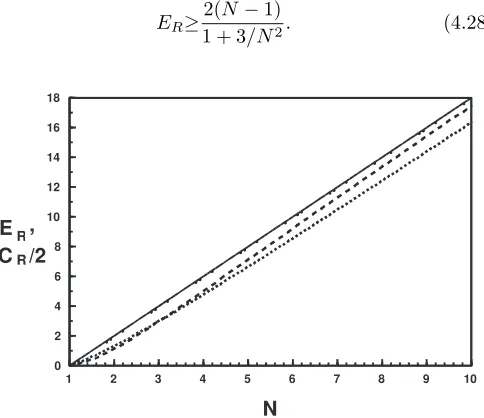
FIG. 16. Lower bounds on the resource entanglement and communication versus the number of qubits. The solid line corresponds to the teleportation bound in (4.11) and (4.13). The dotted line indicates the bounds in (4.15) and (4.17) for the PS+CP operation which hold rigorously for odd N. The dashed line corresponds to the bounds in (4.28) and (4.29), for the PS+CP operation and odd N if at most half of the expendable resources can be transferred.
Similar reasoning can be applied to the required mini-mum classical communication. If at most half of the ex-pendable communication is transferable, then the min-imum number of classical bits required to perform the PS+CP operation with oddN is bounded by
CR≥4(N−1)
1 + 3/N2. (4.29)
Assuming that inequalities (4.28) and (4.29) hold, let us deduce the minimum integer resources for the one shot case, as we did in the previous subsection. To this end, we note the inequality
2(N−1)
1 + 3/N2≥2(N−1)−1, (4.30)
for N≥3, with the equality only being attained when N = 3. From this inequality, we see that for all N≥4, the minimum integer resource entanglement is equal to that required to implement the teleportation protocol. By a similar calculation, one can show that for allN >3, the minimum integer resource communication is at least equal to one bit short of the teleportation bound, and that for allN≥12, it is the teleportation bound.
Figure (16) illustrates the main asymptotic bounds we have considered in this paper: the teleportation bound, the bound derived from the PS+CP operation derived in the previous subsection and the bound derived from the PS+CP operation based on the assumption that only half of the expendable resources are transferable.
To summarise this subsection, we have worked on the assumption that at most half of the expendable resources can be transferred. The analysis of the PS operation sup-ports this conjecture that it is true for allN. If it indeed is true in general, then in the one-shot case, the tele-portation protocol is optimal with regard to the resource entanglement for all oddN6=3, and also in terms of the resource communication for all oddN≥13, if only integer resources are permitted.
V. DISCUSSION.
In this paper, we have examined the properties of collective quantum operations performed upon spatially separated quantum systems. We have considered a net-work ofN spatially separated laboratories, each of which contains one qubit. The network is equipped with facili-ties for classical communication and local quantum oper-ations, and each pair of laboratories also shares bipartite pure entanglement.
This scenario we have considered helps to emphasise the fact that the final state of each system will depend upon the initial states of the others. The evolution thus requires information to be exchanged between the sys-tems. In classical physics, this is simply classical infor-mation. If the systems are quantum mechanical, then the exchange of quantum information is necessary.
the transmission of classical information and existence of entanglement shared between the sending and receiv-ing stations. In the case of N = 2, one particular class of operations, namely those equivalent, up to bipartite local unitary transformations, to the SWAP operation, permits either the minimum classical communication or entanglement resources required to perform any opera-tion to be ‘recovered’ for other tasks. These operaopera-tions may be regarded as the most inseparable operations for N = 2.
ForN >2, the situation is more interesting. ForN≥4, no operation can establish the entanglement or be used to communicate the information necessary to perform any operation. Whether or not this is also the case forN= 3 is currently unknown. For allN we have determined the maximum total amount of entanglement that can be es-tablished, and the maximum total number of classical bits that can be communicated, by any operation. Per-mutation operations attain these limits, which are also the minimum resources required to carry out these spe-cific operations.
We have also examined the problem of finding the min-imum resources required to perform an arbitrary opera-tion. The scenario we considered was one where each pair of laboratories shares a certain amount of entanglement, and can communicate a certain number of classical bits to each other. The problem we addressed was: what are the minimum values of the total entanglement and com-munication required to carry out an a priori unknown operation, that is, unknown prior to the entanglement and communication resources being set up?
For evenN, we have found these minimum resources exactly, and these can be used to perform an arbitrary op-eration using teleportation. We arrived at these bounds using a technique we refer to as graph symmetrisation. We have shown that the teleportation protocol is optimal for evenN. Whether or not it is also optimal for odd N
is an important outstanding problem. We have shown, in the even case, that the optimality of the teleportation protocol can be reinterpreted as coming from a restric-tion on the extent to which expendable resources can be transferred from one pair of laboratories to another. In particular, for any amount of resources transferred, at least as much are irrevocably lost. The assumption that this restriction always holds leads to tighter bounds on the resources required to carry out an arbitrary operation on an odd number of qubits. These bounds imply that if, in the one shot scenario, resources can only be consumed in integer amounts, then the teleportation protocol is op-timal, for all N >3 for entanglement and for allN≥12 for communication also. One clear conclusion from our work is that the case of N = 3 is of particular interest, since many of our results which apply to all otherN6=2 have not been established for this case. It could be that graph-theoretic techniques are not suitable for analysing the 3 qubit case, and that other tools must be employed.
ACKNOWLEDGEMENTS.
We would like to thank Sandu Popescu, Noah Linden, Osamu Hirota and Masahide Sasaki for interesting dis-cussions. We also wish to thank John Vaccaro for help with some of the figures. Part of this work was carried out at the Japanese Ministry of Posts and Telecommu-nications CommuTelecommu-nications Research Laboratory, Tokyo, and we would like to thank Masayuki Izutsu for his hospi-tality. This work was funded by the UK Engineering and Physical Sciences Research Council, and by the British Council.
[1] J. S. Bell, Speakable and Unspeakable in Quantum Mechanics: Collected Papers on Quantum Philosophy
(Cambridge 1987).
[2] C. H. Bennett, G. Brassard, C. Crepeau, R. Josza, A. Peres and W. K. Wootters, Phys. Rev. Lett. 70, 1895 (1993).
[3] P. W. Shor, SIAM Journal on Computing26(5), 1484 (1997).
[4] L. K. Grover,Phys. Rev. Lett79, 325 (1997). [5] A. K. Ekert,Phys. Rev. Lett.67, 661 (1991).
[6] S. Popescu and D. Rohrlich, Phys. Rev. A 56, 3319 (1997).
[7] B. Schumacher,Phys. Rev. A51, 2738 (1995).
[8] H. Barnum, E. Knill and M. A. Nielsen, ‘On Quantum Fidelities and Channel Capacities’, LANL e-print quant-ph/9809010.
[9] S. Lloyd,Phys. Rev. A56, 1613 (1997). [10] B. Schumacher,Phys. Rev. A54, 2614 (1996).
[11] A. Chefles, C. R. Gilson and S. M. Barnett, ‘Entangle-ment and Collective Quantum Operations’, LANL eprint quant-ph/0003062,Phys. Lett. A, in press.
[12] W. K. Wootters,Phys. Rev. Lett.802245 (1998). [13] C. H. Bennett, G. Brassard, S. Popescu, B. Schumacher,
J. A. Smolin and W. K. Wootters, Phys. Rev. Lett.76
722 (1996).
[14] M. Zukowski, A. Zeilinger, M. A. Horne and A. K. Ekert,
Phys. Rev. Lett.714287 (1993).
[15] K. Kraus, States, Effects and Operations: Fundamen-tal Notions of Quantum Theory, (Springer-Verlag, Berlin Heidelberg, 1983).
[16] J. Eisert, K. Jacobs, P. Papadopoulos and M. B. Plenio, ‘Optimal Local Implementation of Non-Local Quantum Gates’, LANL eprint quant-ph/0005101.
[17] M. Horodecki and R. Horodecki,Phys. Lett. A244, 473 (1998).
[18] D. Collins, N. Linden and S. Popescu, ‘The Non-Local Content of Quantum Operations’, LANL eprint quant-ph/0005102.
[19] A. Chefles and S. M. Barnett,Phys. Lett. A232(1997) 4.
(1992).
[21] See any introductory text for a fuller discussion, e.g. R. Gould,Graph Theory, (Benjamin/Cummings 1988). [22] C. H. Bennett, H. J. Bernstein, S. Popescu and B.
Schu-macher,Phys. Rev. A532046 (1996).