This is a repository copy of Accelerating scholarly communication : the transformative role
of preprints.
White Rose Research Online URL for this paper:
http://eprints.whiterose.ac.uk/151295/
Version: Published Version
Monograph:
Chiarelli, A., Johnson, R., Richens, E. et al. (1 more author) (2019) Accelerating scholarly
communication : the transformative role of preprints. Report. Knowledge Exchange ,
London.
https://doi.org/10.5281/ZENODO.3357727
[email protected] https://eprints.whiterose.ac.uk/ Reuse
This article is distributed under the terms of the Creative Commons Attribution (CC BY) licence. This licence allows you to distribute, remix, tweak, and build upon the work, even commercially, as long as you credit the authors for the original work. More information and the full terms of the licence here:
https://creativecommons.org/licenses/
Takedown
If you consider content in White Rose Research Online to be in breach of UK law, please notify us by
Accelerating scholarly
communication
The transformative role of preprints
Acknowledgements
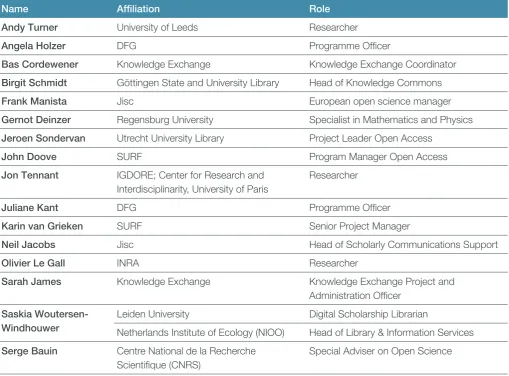
This study was underpinned by the work of the KE Task and Finish Group on preprints, led by Karin van Grieken (SURF), Juliane Kant (DFG) and Serge Bauin (CNRS), and including a range of other engaged members:
` Andy Turner (University of Leeds)
` Angela Holzer (DFG)
` Bas Cordewener (Knowledge Exchange)
` Birgit Schmidt (Göttingen State and University Library)
` Frank Manista (Jisc)
` Gernot Deinzer (Regensburg University)
` Jeroen Sondervan (Utrecht University Library)
` John Doove (SURF)
` Jon Tennant (IGDORE; Center for Research and Interdisciplinarity, University of Paris)
` Neil Jacobs (Jisc)
` Olivier Le Gall (INRA)
` Sarah James (Knowledge Exchange)
` Saskia Woutersen-Windhouwer (Leiden University/Netherlands Institute of Ecology (NIOO))enmark)
Our thanks also go to the 38 international
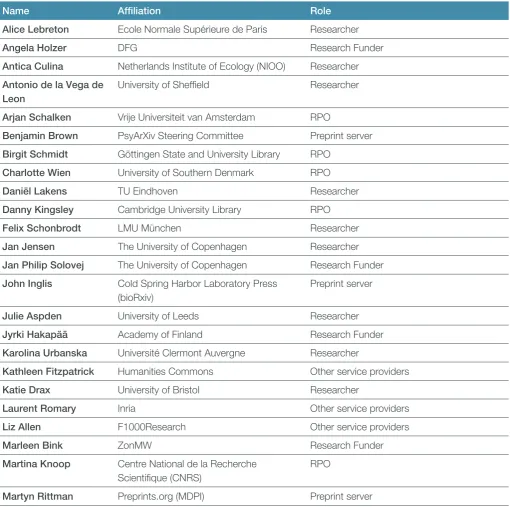
stakeholders who agreed to be interviewed as part of this project and provided their views on preprints and the open sharing of research. A full list of project contributors is available in Appendix A.
© Knowledge Exchange 2019
Title: Accelerating scholarly communication: The transformative role of preprints
Authored by: Andrea Chiarelli, Rob Johnson, Emma Richens (Research Consulting), Stephen
Pinield (University of Shefield)
Email: [email protected]
DOI: 10.5281/zenodo.3357727
3
Accelerating scholarly communicationExecutive summary
Introduction
Background and rationale
The traditional academic publishing process is widely recognised as time-consuming for authors and reviewers and, in many cases, is slow to disseminate new knowledge. Over the past few years, the sharing of preprints, or versions of research outputs, ahead (or even instead) of formal publication has become more widespread in a number of academic disciplines. This study aims to advance Knowledge Exchange’s (KE) previous work in the area of preprints, which consists of a 2018 review on this evolving landscape
(knowledge-exchange.info/event/preprints).
Objectives
The overall objective of this study was to explore the place of preprints in the research lifecycle from the points of view of researchers, research performing organisations, research funding organisations and preprint servers/ service providers. Our investigation covered:
` Core beneits and usage in the case of researchers,
including incentives and disincentives
` Attitudes of research performing organisations (RPOs) and research funders
` Values, strategies and aims of service providers
Methodology
This study was based on a comprehensive literature review and a set of 38 interviews that were transcribed and qualitatively coded for the purposes of thematic analysis. We mainly focused on research areas where preprint posting is growing (e.g. biology, chemistry and psychology, which were the focus of our interviews) but also considered disciplines where preprint posting is common (e.g. physics, mathematics, computer science, economics) or relatively less widespread (e.g. humanities).
The second wave of preprint servers
Preprints have become increasingly popular
Explosive growth has characterised the preprints
landscape over the last few years. The irst wave of
preprint servers started with the high energy physics and economics communities in the 1990s, but, since 2010, the movement has been growing in popularity in other disciplines. Increasingly available and standardised technical solutions have enabled the launch of a range of disciplinary preprint servers focusing on the broad and early dissemination of research.
Preprints can support open scholarship
Preprints can support open scholarship by enabling free online access and potentially increasing the pace of research. They have a potentially transformative role in the scholarly communication landscape. Nevertheless,
there remains signiicant uncertainty as to whether
recent growth in interest in and take up of preprints services will be sustained, and how broadly preprints will be adopted across disciplinary communities.
The researcher’s perspective
Disciplinary communities treat preprints differently We found that ambiguity on the deinition of a preprint is
present across all disciplines and stakeholder groups: this means that any discussion of preprints is inherently complex and must be sensitive to context. The most common interpretations are that a preprint is either:
` A version of a paper ready to be submitted; or
` An early version of a paper shared to receive feedback before submission
However, a number of other views arose in this study. For example, the idea that preprints might be research outputs that are not intended as papers for peer review or that might not make it to the published stage (e.g. null results) was advanced.
4
Accelerating scholarly communication Executive summaryEarly and fast dissemination is a key motive for preprints posting
Early and fast dissemination appears to be the main motive behind preprint posting. In addition, increased opportunities for feedback seem to be highly valued, even though comments are not often added directly on preprint servers. Advantages for early career researchers are also often mentioned, as preprints can be added to CVs to increase the chances of being hired or promoted.
The lack of peer review and the fear of rejection by journals are barriers to uptake
Interviewees reported that their main concern when it comes to reading and reusing preprints is the fact that they haven’t been peer-reviewed. This means that,
potentially, incorrect indings could be shared broadly or
reported on by the media. However, there is also an expectation that researchers and journalists will behave ethically and professionally, which should minimise the risk of the above.
Rejection by academic journals is another barrier to uptake, as some researchers fear that depositing a preprint might lead to editors not accepting their submissions on
the grounds of the ‘Ingelinger rule’. This, however,
appears to be only a perceived barrier, as many publishers now explicitly accept preprint posting.
A wide range of preprint servers are available today In the course of this project, we identiied over 60
platforms that can be used to store, share and, in some cases, comment on preprints. Today, the availability of a
server that is it for the purpose of any given researcher
is almost guaranteed. It should be noted that preprint servers are often started from the bottom up and maintained by disciplinary communities, which indicates that they are likely to address any technical requirements
or customs existing in a research ield.
Twitter has been playing a key enabling role
Researchers and preprint servers often rely on Twitter for preprint discovery and sharing purposes. Researchers can follow Twitter bots posting preprints as set up by individual preprint servers but also share their own preprints. Twitter is, in practice, how many researchers
appear to encounter preprints for the irst time and is one
of the key pathways for making and receiving comments.
Mapping the preprints landscape
A wide range of stakeholders are involved in and affected by preprints
The preprints landscape is currently characterised by some degree of fragmentation, which suggests that
future developments are likely to beneit from closer
collaboration between the stakeholder groups involved. These include researchers, research performing organisations, research funders, service providers and
publishers. We note that, at present, there is signiicant
experimentation in terms of approaches and technologies, and that the extent to which stakeholders are
collaborating is unclear in some cases.
Different practical approaches to preprint servers are being taken
A range of technical solutions are available to implement preprint servers in practice, including the popular Open Science Framework and digital repository solutions (e.g.
EPrints, igshare, DSpace, Invenio, Drupal); ad-hoc and
5
Accelerating scholarly communicationExecutive summary
Preprints are poorly integrated into publication
worklows
Current technologies seem largely suitable to support the uptake of preprints. For instance, digital object
identiiers or permalinks can be assigned to preprints,
withdrawals are possible on preprint servers and open licensing options are offered. However, versioning features are not used by many authors and the automatic tracking
of a manuscript through the publication process is dificult.
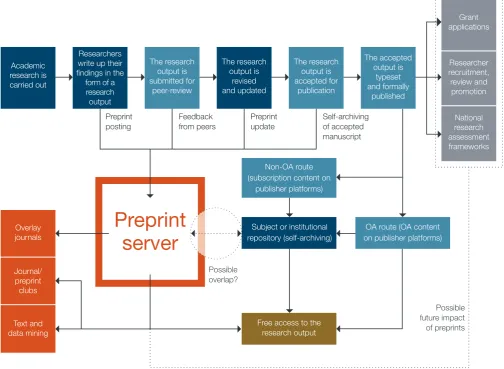
In most cases, preprint posting is disconnected from
traditional publication worklows: this means that
researchers would typically post a preprint independently ahead of publication and then add new versions after making revisions.
‘Information overlap’ and digital preservation are growing concerns
In some cases, preprints are posted as the author’s accepted manuscript on both a preprint server and an online repository (e.g. an institutional repository). We call this phenomenon ‘information overlap’ and raise the challenge of covering the costs of technical infrastructure in cases where this duplicates efforts that are already otherwise funded. Currently, there is a lack of consistency in terms of approaches to the long-term preservation of preprints, and this is not seen as a priority due to limited budgets and the quick pace of change within the preprints landscape. However, long-term preservation is recognised as a growing concern that should be addressed in the future, including in terms of what preprints should or should not be within the scope of digital preservation activities.
Are preprints riding the hype wave?
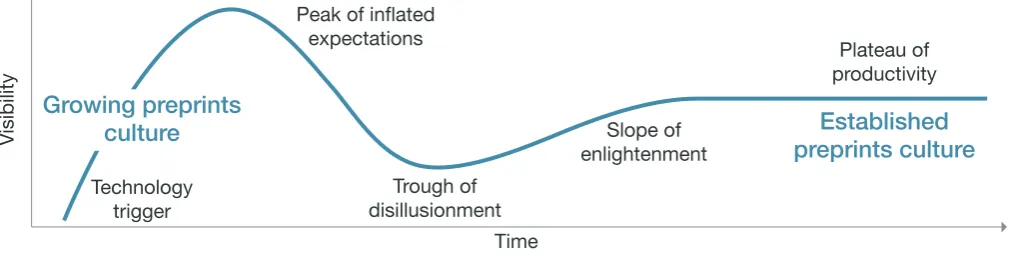
Preprints and preprint servers have been growing in popularity very quickly over the past few years. Based on a hype cycle interpretation, the visibility of preprints can be expected to decrease from the current “peak of
inlated expectations”, and we note that some players in
this landscape might merge or disappear in time. After a
“trough of disillusionment”, preprints and preprint servers
might once again grow in visibility and reach the level of
mainstream adoption that is currently seen in the communities served by arXiv and RePEc (physics, mathematics, computer science, economics, among others).
The future of preprints
It is not clear who will take the lead in preprint posting
We investigated the question of whether preprint posting will evolve as a researcher- or publisher-centric phenomenon. The answer is not clear at present, but we note that researchers are mostly responsible for posting preprints today. A shift to a publisher-centric model could potentially improve the tracking of preprints throughout and after publication, but there are growing concerns of market consolidation in the scholarly communication landscape. Clearly, the choice between a researcher- or publisher-centric approach will affect funding, too: in the former case, grants or pooled funds would likely form the bulk of funding for preprint servers, while in the latter these could be supported by publishers,
provided they perceive suficient potential for a return on
the investment required.
Do traditional journals need to evolve?
In a shifting landscape that could be transformed by the increased use of preprints, the role of and costs
attached to traditional academic journals is liable to be questioned. Furthermore, overlay journals reviewing and sharing content posted to preprint servers are already being used in some disciplinary communities, and this could also affect the extent to which traditional journals might have to reframe their value proposition.
Licensing options should be carefully considered
6
Accelerating scholarly communication Executive summaryPreprints can support fairer research(er) evaluation
A growing number of research funders are starting to acknowledge and accept preprints as suitable for inclusion in grant applications, and we recognise the role that preprints can have in researcher evaluation. There is an increasing push to focus on individual outputs rather than on publication venues such as high-impact journals.
Preprint servers should aim to address perceived pain points
Preprint servers today are being started by enthusiastic proponents of open scholarship but may not always meet a perceived need in their research communities. The increasing focus on open scholarship in the research landscape is certainly contributing to some extent of behavioural change, but preprint servers might have to focus more on addressing researchers’ pain points if they are to lead to lasting change.
Conclusions
Three future scenarios in preprint posting
We see three possible scenarios for the future of preprints:
` Scenario 1 – Turn of the tide: the second wave of preprint servers fades, and preprints remain a major component of scholarly communication only in the
ields where they are already irmly established, e.g.
those served by arXiv and RePEC
` Scenario 2– Variable adoption: preprints grow in
some additional ields such as those within the
scope of ChemRxiv and bioRxiv, but not all
` Scenario 3 – Preprints by default: preprints grow
in all ields (at different paces) and are accepted by
the research community at large
7
Accelerating scholarly communicationExecutive summary
Five areas should be considered to ensure a sustainable future for preprints
This study led to the identiication of ive areas that
require further investigation:
1. Responsibilities and business models
2. Involvement of commercial players vs community ownership
3. Evidence on the advantages and disadvantages of preprint posting
4. Pathways to awareness raising
5. Approaches to training and support
We note that active engagement is needed to build a sustainable future for this growing scholarly
communication practice: the higher the level of stakeholder coordination, the more positive any outcomes will be for the research community.
Five take-away messages
Early and fast dissemination,
increased opportunities for feedback and openness are seen as the main
beneits of preprints.
The main concerns over preprints are the lack of quality assurance, media potentially reporting inaccurate research and journals rejecting articles if a preprint has been posted.
Twitter has been playing a key enabling role in the current second wave of preprints and preprint servers. It also appears to be the main way researchers are exposed to
preprints in the irst place.
It is not clear who will be responsible for posting preprints in the long-term – researchers or publishers? This will partly be affected by the availability of sustainable business models.
Traditional academic journals might have to reframe their value proposition
should preprints grow signiicantly in
8
Accelerating scholarly communication ContentsContents
Executive summary
3
Introduction 3
The second wave of preprint servers
3
The researcher’s perspective
3
Mapping the preprints landscape
4
The future of preprints
5
Conclusions 6
Five take-away messages
7
1. Introduction
10
Background and rationale
10
Objectives 10
Methodology 11
Structure of the report
11
Limitations 11
2. The second wave of preprint servers
12
Recent growth
12
A brief history of preprints
13
Preprints and open scholarship
14
3. The researcher’s perspective
16
The challenge of deining preprints
16
Beneits for the research community
17
Early adopters and sceptics
19
Posting preprints in practice
21
The enabling role of Twitter
21
4. Mapping the preprints landscape
23
Key stakeholders
23
Technology and operations
24
Size and trends in the preprints landscape
25
Infrastructural challenges
26
Information overload and information overlap
26
9
Accelerating scholarly communicationContents
5. The future of preprints
30
Taking the lead in preprint posting
30
Cultural resistance
31
The evolving roles of academic journals, preprint servers and overlay services
31
Licensing and preprints
32
Preprints, responsible metrics and evaluation
34
Addressing perceived pain points
35
Supporting the preprints movement
35
6. Conclusions
37
Summary and conclusions: Three future scenarios
37
Making progress
40
7. References
42
Knowledge Exchange study outputs
42
Other references
42
Appendix A – Acknowledgements and participants
48
Appendix B – Interview questions
51
10
Accelerating scholarly communication 1. IntroductionBackground and rationale
This study arose from the need to better understand the preprints landscape. Preprints are versions of research papers, typically prior to peer review and publication in a journal. The practice of sharing these research outputs online has increased rapidly in popularity over the past few years, partly in response to the slow pace of
traditional academic worklows, from article submission
to publication.1 Knowledge Exchange (KE) has been
working on the topic of preprints since 20182 and
commissioned this study to investigate the current state and broader implications of this evolving area.
This work started in September 2018 and led to the development of:
` A slide deck summarising initial indings3
` A publication under open peer-review available on F1000Research4
` The present report
Objectives
The overall objective of this study was to explore the place of preprints in the current research lifecycle from the points of view of researchers, research performing organisations, research funding organisations and preprint servers/service providers. Particularly, we set out to investigate:
` Core beneits and usage in the case of researchers,
including incentives and disincentives
` Attitudes of research performing organisations (RPOs) and research funders
` Values, strategies and aims of service providers
1. Introduction
Knowledge Exchange, a group of national organisations from six European
countries, commissioned and co-designed this study as part of their work on
digital infrastructures to enable open scholarship. This report investigates the
preprints landscape: it highlights current thinking in this dynamic area and
makes recommendations for future work.
Footnotes
1 AMS Secretary. (2018). Backlog of Mathematics Research Journals.
ams.org/journals/notices/201810/rnoti-p1289.pdf 2 Tennant, J., Bauin, S., James, S., & Kant, J. (2018). The
evolving preprint landscape: Introductory report for the Knowledge Exchange working group on preprints.
https://doi.org/10.31222/osf.io/796tu
3 Chiarelli, A., Johnson, R., Pinield, S., & Richens, E. (2019).
Practices, drivers and impediments in the use of preprints (Phase 1 report).
https://repository.jisc.ac.uk/7381/1/Practices,_drivers_and_ impediments_in_the_use_of_preprints_(Phase_1_report).pdf 4 Chiarelli, A., Johnson, R., Pinield, S., & Richens, E. (2019).
Preprints and Scholarly Communication: Adoption, Practices, Drivers and Barriers.
11
Accelerating scholarly communication1. Introduction
The present report builds on our initial indings shared in
slide form and aims to highlight key messages and
areas for future work for all stakeholders identiied as
having a role in the preprint landscape.
Methodology
This study was carried out by reviewing relevant literature on the topic of preprints and by interviewing a range of 38 international stakeholders in the preprints landscape. Interviews were recorded, transcribed and qualitatively coded for the purposes of analysis and reporting. Quotes in this report are included using an intelligent verbatim approach to transcription (i.e. any
illers and repetitions in the text have been removed for
improved legibility).
Our research focused on disciplines where the use of preprints is increasing quickly: these included biology, chemistry and psychology, with the corresponding preprint servers bioRxiv, ChemRxiv and PsyArXiv. We did, however, broaden the scope of our analysis for the purposes of this report, including other preprint servers and service providers. This study used Innovation Diffusion Theory5 as an evaluation framework.
Structure of the report
This report includes both indings from a literature
review (LR) and original empirical research (OER). After this introduction, it is structured as follows:
` The second wave of preprint servers (LR)
` The researcher’s perspective (OER)
` Mapping the preprints landscape (LR)
` The future of preprints (OER)
` Conclusions (OER)
In some parts, literature indings and original research
might be presented side-by-side, but the above split describes the main focus of each section.
We note that researchers are the only stakeholder group to whom we have dedicated an entire section. This is because preprint posting will likely struggle to play a role in scholarly communication unless it is closely aligned with researchers’ motivations to share, read and cite scholarly content.
Limitations
Study participants were gathered via convenience sampling, that is, we interviewed stakeholders who were both available and willing to participate. Moreover, interviews were limited to individuals based in Europe and North America. Therefore, it may not be appropriate
to generalise the indings of this study, and outlying results
may be over-represented. Furthermore, we note that:
` We chose not to interview traditional academic publishers, as the publishing community is already discussing preprints in a structured way, for example via the Committee on Publication Ethics (COPE).6
Their role and importance, however, are clearly acknowledged and discussed throughout the report
` Our analysis is underpinned by qualitative coding, and we note that this relies on analytical judgement and interpretation
Footnotes
5 Rogers, E. M. (2003). Diffusion of innovations.
https://books.google.co.uk/books?id=9U1K5LjUOwEC&redir_ esc=y
6 COPE. (2018). COPE Discussion Document – Preprints. https://publicationethics.org/iles/u7140/COPE_Preprints_
12
Accelerating scholarly communication 2. The second wave of preprint serversRecent growth
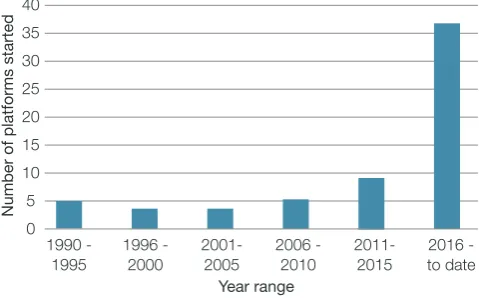
The growth of preprint servers over the last few years has been nothing short of explosive. Figure 1 (p.13)builds on previous work to map the preprints landscape7 and
shows that preprint servers started appearing in the 1990s (see Appendix C, p.54). The movement slowed down to some extent between the late 1990s and 2010 but has seen a resurgence over the last ten years and
particularly the last ive.
Preprint servers have been created to share preprints, that is, versions of research outputs typically prior to peer review and publication.2 As outlined in section 3 (p.16), deining preprints is not simple, as disciplinary communities and norms play a signiicant role in determining what a
preprint is and what it is worth to researchers; however,
for the purposes of this overview, the above deinition will sufice.
In terms of preprints making it to peer-reviewed form, we note that as many as 59% of preprints posted to
ChemRxiv (chemistry) and 67% of those posted to
bioRxiv (biology) are eventually peer-reviewed and published formally;8 in the case of preprints posted to
bioRxiv, recent research shows that “the majority of published preprints appeared in a journal less than six
months after being posted”.9 In the communities served
by arXiv, the number of preprints making it to peer-reviewed form has been estimated at over 90%,10 which
suggests that there is further potential for growth in other disciplines. However, numbers of preprints remain relatively low when compared with traditional academic
publishing. For example, in the ield of biology, the
number of preprints posted in 2019 relative to new publications in PubMed stands at just 2.3%.11
2. The second wave of preprint servers
Preprint servers have been available since the early 1990s for the physics,
mathematics and economics communities but have started growing more
widely only over the past few years. Preprints originated in online form as a
practical solution to the issue of sharing and reading hardcopy research prior
to formal publication. Preprints form part of the open scholarship landscape
and exist in parallel to traditional journal articles – the key difference is that
preprints may not be submitted for peer-review.
Footnotes
2 Tennant, J., Bauin, S., James, S., & Kant, J. (2018). The evolving preprint landscape: Introductory report for the Knowledge Exchange working group on preprints.
https://doi.org/10.31222/osf.io/796tu
7 Rittman, M. (2017). Research Preprints – Preprint servers.
https://researchpreprints.com/preprintlist
8 Nguyen, T.M. (2019). Chemistry preprints pick up steam.
https://cen.acs.org/acs-news/publishing/Chemistry-preprints-pick-steam/97/i3
9 Abdill, R.J. & Blekhman, R. (2019). Meta-Research: Tracking the popularity and outcomes of all bioRxiv preprints.
https://doi.org/10.7554/eLife.45133
10 Gentil-Beccot, A., Mele, S. & Brooks, T. (2009). Citing and Reading Behaviours in High-Energy Physics. How a
Community Stopped Worrying about Journals and Learned to Love Repositories.
https://doi.org/10.1007/s11192-009-0111-1 11 Penfold, N. (2019). Twitter (29 May 2019).
13
Accelerating scholarly communication2. The second wave of preprint servers
A brief history of preprints
Some disciplinary communities started seeking the open sharing of pre-refereed research long before the advent of today’s digital tools and the open scholarship movement.
` The high energy physics (HEP) community started sharing hardcopy literature prior to publication by
post in the 1960s, once the process to duplicate
articles had become economic12
` The same applied to the economics community, which was sharing working papers – the designation for pre-refereed work in economics – in the 1950s
` The US National Institutes for Health launched the
Information Exchange Groups (IEG) in the 1960s,
aiming to share any biology “preprint, comment,
discussion” by post13
Early preprint sharing took place via personal correspondence but the role of physical repositories (e.g. libraries) became more important in time. One of
the irst issues that sharing hardcopy preprints led to
was information overload.11 The increasing number of hardcopy preprints was making research more dificult,
as sifting through thousands of articles was impractical for any individual researcher (we note that similar issues would likely have applied to peer-reviewed hardcopy work, too).
Digital systems to manage bibliographic records were an
initial ix to the unmanageable number of preprints available.
However, it wasn’t until the advent of digital typesetting systems such as TeX (https://en.wikipedia.org/wiki/ TeX) that things really changed. Digital typesetting systems allowed authors to write research articles in electronic form using plain text, to be rendered directly on the reader’s device. The next roadblock the preprints movement hit was that mailboxes were getting full too quickly, even though plain text articles were small in
terms of their ile size.
Footnotes
12 O'Connell, H. (2000). Physicists Thriving with Paperless Publishing.
https://arxiv.org/abs/physics/0007040v2
13 Cobb, M. (2017). The prehistory of biology preprints: A forgotten experiment from the 1960s.
[image:14.595.43.283.298.447.2]https://doi.org/10.1371/journal.pbio.2003995
Figure 1 – Growth of platforms allowing the
sharing of preprints in time
Note: Figure 1 was created based on information available online and only includes currently active platforms that could be identiied within the timeframe and scope of this project. While the information is considered to be correct at the date of publication, we cannot guarantee its accuracy.
40 35 30 25 20 15 10 5 0
Number of platforms started
Year range 1990
-1995
1996 -2000
2001-2005
2006 -2010
2011-2015
14
Accelerating scholarly communication 2. The second wave of preprint serversThe physics and economics communities developed different yet complementary solutions to share electronic preprints:
` In 1991, physicist Paul Ginsparg created a central repository at Los Alamos National Laboratory, from which preprints could be obtained directly. The creation of this repository marked the birth of e-prints – electronic preprints – as opposed to their hardcopy versions. In 2001, Ginsparg moved to Cornell University: this year marked the change of the name of the above central repository to today’s arXiv14
` In 1993, the Working Papers in Economics project (WoPEc) was started to enable electronic dissemination of economics working papers. WoPEc grew into “an
interconnected network of over 60 archives holding over
13,000 downloadable papers and over 50,000
descriptions of ofline papers from close to 1,000 series,
as well as data about over 4,000 academic Economics
departments and research institutes”. This is now called
Research Papers in Economics, or RePEc15
Looking back at these disciplinary communities, it is easy to see that the desire to exchange research openly and prior to formal publication (a process often spanning several months)16 was the key motivation behind the
creation of preprint servers. Since preprint sharing originated in hardcopy form, digital tools offered a chance to rationalise, simplify and broaden access to a system that was (to some extent) already in place. Today’s preprint servers (see Section 4, p.23) appear to be following a similar policy. However, while the desire for sharing work in preprint form has been historically high in the physics and economics communities, this may not be the case for all disciplines.
Preprints and open scholarship
The irst preprint servers were created to facilitate the
open sharing of research prior to formal publication. However, the idea of openness today is immediately associated with the concepts of open scholarship and open access. While a detailed analysis of the topic is beyond the scope of this report, we highlight the following aspects of the relationship between preprints and open scholarship:
` Preprints can support open scholarship by enabling free online access and potentially increasing the pace of research10, 17
` While the above beneits with respect to open
scholarship are recognised, preprints are typically
shared in pre-refereed form (in the irst place) and
this might affect the extent to which researchers are willing to consider and use them as they would traditional publications18
Footnotes
10 Gentil-Beccot, A., Mele, S. & Brooks, T. (2009). Citing and Reading Behaviours in High-Energy Physics. How a
Community Stopped Worrying about Journals and Learned to Love Repositories.
https://doi.org/10.1007/s11192-009-0111-1
14 Butler, D. (2001). Los Alamos loses physics archive as preprint pioneer heads east.
https://doi.org/10.1038%2F35083708
15 Karlsson, S. & Krichel, T. (1999). RePEc and S-WoPEc: Internet access to electronic preprints in Economics.
http://openlib.org/home/krichel/papers/lindi.html
16 Huisman, J. & Smits, J. (2017). Duration and quality of the peer review process: the author’s perspective.
https://doi.org/10.1007/s11192-017-2310-5
17 Fraser, N., Momeni, F., Mayr, P. & Peters, I. (2019). The effect of bioRxiv preprints on citations and altmetrics.
https://doi.org/10.1101/673665
18 Neylon, C., Pattinson, D., Bilder, G. & Lin J. (2017). On the origin of nonequivalent states: How we can talk about preprints.
15
Accelerating scholarly communication2. The second wave of preprint servers
Furthermore, the Berlin Declaration on Open Access to Knowledge in the Sciences and Humanities, although dated, recognises the role of the internet as an emerging medium for knowledge dissemination and
that this will “signiicantly modify the nature of scientiic
publishing as well as the existing system of quality
assurance”.19 This reinforces the view that preprints and
preprint servers can play a transformative role in
scholarly communication worklows.
The debate on the transition to open access has
increased in intensity signiicantly in the last year,
following the announcement of 'Plan S' by a group of European Funders (September 2018). This initiative
stipulates that scientiic publications that result from
research funded by public grants must be published in compliant Open Access journals or platforms, including repositories. The implications of Plan S (which is rapidly evolving) have been widely discussed and debated, but we note here that the implementation guidance states that the “early sharing of research results through
preprints is […] strongly encouraged”.20 Preprint
posting, however, is not seen as meeting the proposed open access requirements, which apply to peer
reviewed scholarly articles. This, to some extent, further
conirms the distinction made in the bullets above.
The co-founders of bioRxiv and the Editor in Chief of eLife have jointly proposed ‘Plan U’,21 which
recommends preprint posting should be a funder requirement to achieve free access to research. Plan U is based on the expectation that most preprints would subsequently be peer reviewed and puts much of the
technical burden on preprint servers, such as permanence of deposition (e.g. articles can be withdrawn but a record would remain), indexable and standardised metadata, linking with relevant publishing infrastructure and long-term preservation.
Other approaches combining open scholarship, open access and the use of preprints have been
hypothesised. As an example, Green has recently proposed a transformation of scholarly publishing
involving preprints: in this scenario, articles would irst
be posted as preprints and invited to peer review only if
they are attracting suficient attention. Therefore, peer
review and publication would only be carried out in select cases.22 This ties back to the idea that the
internet could reshape scholarly communication and systems of quality assurance advanced in the Berlin Declaration on Open Access.
“The preprint agenda is a reaction against the very expensive Gold open access that is required by some funders. It may appeal to those who lack the funding for Gold open access.”
Researcher
Footnotes
19 Max Planck Society. (2003). Berlin Declaration on Open Access to Knowledge in the Sciences and Humanities.
https://openaccess.mpg.de/Berlin-Declaration 20 cOAlition S. (2019). Principles and Implementation.
coalition-s.org/principles-and-implementation
21 Sever, R., Eisein, M. & Inglis, J. (2019). Plan U: Universal access to scientiic and medical research via funder preprint mandates.
planu.org
22 Green, T. (2019). Is open access affordable? Why current models do not work and why we need internet-era transformation of scholarly communications.
16
Accelerating scholarly communication 3. The researcher’s perspectiveThe challenge of deining preprints
Recent work on the future of scholarly communication shows that a mix of researchers and funders are keen to see new output formats and feedback loops, increased transparency and reproducibility, more pathways to research impact and, importantly, faster research.23 At
least in principle, what is broadly understood to be a
preprint would it the bill. However, our research shows
that there is no agreement across research communities on precisely what a preprint is:
` Most see a preprint as a version of a paper ready to be submitted or as an early draft uploaded online
(“posted”, in preprint jargon) to receive comments
from the community
` Some see preprints as research outputs that haven’t been completed as papers for peer review (e.g. work
that is not meant for formal publication in the irst
place) or that might not make it to the published stage (e.g. null results)
` A minority see preprints as the author’s accepted manuscript (AAM) posted on a preprint server, possibly to comply with national/funder policies or for personal preference, but not yet formatted into the version of record (VoR) published by the journal
The irst of these three deinitions is likely the most
canonical view of preprints with respect to traditional
publishing worklows.24 However, we note that different
disciplinary communities have slightly different
interpretations of the term “preprint” and that a uniied
view may not be possible (nor is it clear at this stage whether this would be desirable).25
The standing of preprints, i.e. their value or reputation,
is also deined by disciplinary communities. This means that, in addition to the dificulty of understanding what a
preprint is in different disciplines, the weight it will carry for them will also vary in practice. For example, preprints are highly regarded by the communities served by arXiv (e.g. physics, mathematics and computer science), while they are considered mostly as works in progress by those using SSRN (e.g. social sciences and humanities, which constitute the bulk of the content on this platform).24
3. The researcher’s perspective
Deining a “preprint” is a challenge, as disciplinary communities assign different
values to research outputs in preprint form. Furthermore, the research community
is split between early adopters, who see many advantages in preprint posting,
and sceptics, who struggle to see beneits and highlight concerns such as the
lack of peer review. The role of Twitter is important, as researchers are often
exposed to preprints via social media and discover new ones by following
peers and the accounts of prominent preprint severs.
Footnotes
23 Elsevier, Ipsos MORI. (2019). Research futures: Drivers and scenarios for the next decade.
elsevier.com/connect/elsevier-research-futures-report 24 Neylon, C., Pattinson, D., Bilder, G. & Lin J. (2017). On the origin
of nonequivalent states: How we can talk about preprints.
https://doi.org/10.12688/f1000research.11408.1
25 European Commission. (2019). Future of Scholarly Publishing and Scholarly Communication.
17
Accelerating scholarly communication3. The researcher’s perspective
The standing of preprints can also be discussed with respect to national assessment exercises, but we note that this is an evolving area and should be considered in the broader context of research evaluation and metrics. As an example, the UK’s 2021 Research Excellence Framework does consider preprints as valid research outputs but not as equivalent to articles.26 On the other
hand, the OA policy used by the Excellence in Research for Australia programme clearly states that any versions of articles that have not been refereed (including preprints) are not acceptable.27
Finally, we note the importance of distinguishing preprints from preprint servers. The former term describes a type of research output, which could be in hardcopy or electronic, early-stage or ready for submission. On the other hand, preprint servers are the technical infrastructure underpinning the use of preprints in electronic form. This indicates that preprints could exist even without dedicated preprint servers. For example, the community could use generalist
repositories (e.g. Zenodo, igshare, Open Science
Framework) or platforms such as ResearchGate to deposit pre-refereed research. Today’s research, including the present report, tends to deal with both preprints and dedicated preprint servers, but we note that this close relationship might not be the case forever.
Beneits for the research community
Our research showed that the key perceived beneits of
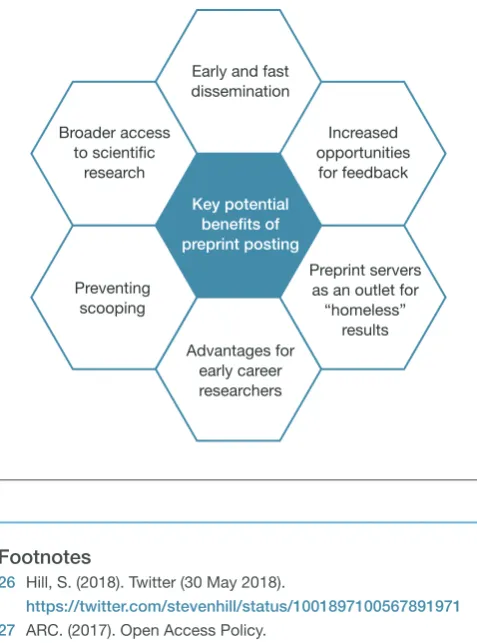
preprint posting for researchers are early and fast dissemination and increased opportunities for feedback (Figure 2). Broader access to scientiic research is also signiicant and related to the above, as preprints are
normally expected to be openly accessible online.
“The term “preprint” itself includes the idea that you’re building it towards something. That it’s only the preprint and then something will come later from it.”
Research funder
Footnotes
26 Hill, S. (2018). Twitter (30 May 2018).
https://twitter.com/stevenhill/status/1001897100567891971 27 ARC. (2017). Open Access Policy.
[image:18.595.313.552.405.727.2]arc.gov.au/policies-strategies/policy/arc-open-access-policy-version-20171
Figure 2 – Potential beneits arising from
preprint posting
Early and fast dissemination
Increased opportunities
for feedback
Preprint servers as an outlet for “homeless”
results Broader access
to scientific research
Preventing scooping
Key potential benefits of preprint posting
18
Accelerating scholarly communication 3. The researcher’s perspectiveSome of the broadly advertised beneits of preprint
posting are sometimes perceived by researchers as
potential risks, and inding the right balance is key.28 Our
interviewees highlighted the following:
` The idea that preprints prevent scooping by establishing priority is shared by many, but some researchers are concerned about the opposite, i.e. research being scooped because it has been made
available early on in a potentially uninished form
` The possible advantages for early career researchers of quickly building up a track record of publication through preprints appear to be broadly supported by our interviews and the literature. However, the extent to which these advantages will materialise largely depends on whether research funders and RPOs value preprints in practice
` Some have advanced the idea of using preprint
servers as outlets for “homeless” results, i.e. outputs
that currently do not have dedicated publication venues (e.g. null results https://en.wikipedia.org/ wiki/Null_result). Using preprint servers for this purpose might raise some concerns in terms of their scope and role in scholarly communication, i.e. what are preprint servers really for? There doesn’t seem to be agreement on this, and there is a risk of creating
ambiguity in terms of worklows, DOI creation, indexing, and licensing if so-called “homeless” research is
shared in parallel with regular articles in preprint form
It is currently dificult to quantify the advantages of preprint posting in ields where the preprints culture is just
growing, and these remain largely anecdotal. While most advantages are broadly mentioned in the international literature4,10,29,30 and by those aware of preprints as a
phenomenon, evidence is scarce. We note however that, in the case of economics and RePEc, when a working paper and a journal version are both available, “the working paper is downloaded many times more than the
article”.31 This could have implications in terms of
researcher evaluation, as the preprint server may include important metrics to complement those attached to the journal version, but also means that academic journals might have to think about their value proposition in light of the success of preprints in some disciplines.
“The primary purpose of preprints is to communicate scientiic knowledge as early as possible to as wide an audience as possible.”
Researcher
Footnotes
4 Chiarelli, A., Johnson, R., Pinield, S., & Richens, E. (2019).
Preprints and Scholarly Communication: Adoption, Practices, Drivers and Barriers.
https://doi.org/10.12688/f1000research.19619.1
10 Gentil-Beccot, A., Mele, S. & Brooks, T. (2009). Citing and Reading Behaviours in High-Energy Physics. How a Community Stopped Worrying about Journals and Learned to Love Repositories.
https://doi.org/10.1007/s11192-009-0111-1 28 Sarabipour, S., Debat, H.J., Emmott, E., Burgess, S.,
Schwessinger, B. & Hensel, Z. (2018). On the value of preprints: an early career researcher perspective.
https://doi.org/10.7287/peerj.preprints.27400v1 29 Bourne, P.E., Polka, J.K., Vale, R.D. & Kiley R. (2017). Ten
simple rules to consider regarding preprint submission.
https://doi.org/10.1371/journal.pcbi.1005473
30 Alliance nationale de recherche pour l'environnement. (2017). Preprints are a valid form of scientiic communication.
allenvi.fr/actualites/2017/preprints-communication-scientiique-recevable
31 Zimmerman, C. (2019). 5000 working paper series on RePEc: working papers are still central to economics.
19
Accelerating scholarly communication3. The researcher’s perspective
The rationale for preprint posting may be clear in a
minority of research ields. However, in most others, the
various stakeholders involved would need a nudge to
take up a new practice and it it within their already busy
schedules. The extent of cultural change that would be required is noted in the literature.32 The need for a
‘carrot’ element in the preprints equation mostly refers to researchers as the primary writers of research outputs. However, funders (who may have to assess preprints), RPOs (who might need to provide support), publishers (who would need to take a position on whether they accept the practice) and more will need to
contribute to ensure preprints ind their place in the
scholarly communication landscape.
Early adopters and sceptics
Our interviews highlighted the presence of two distinct attitudes towards the practice of posting preprints:
` Some researchers are supporters of preprint posting and tend to be early adopters and follow emerging community trends. They are committed to open scholarship and embrace new practices believing
that their beneits (Figure 2, p.17) will materialise
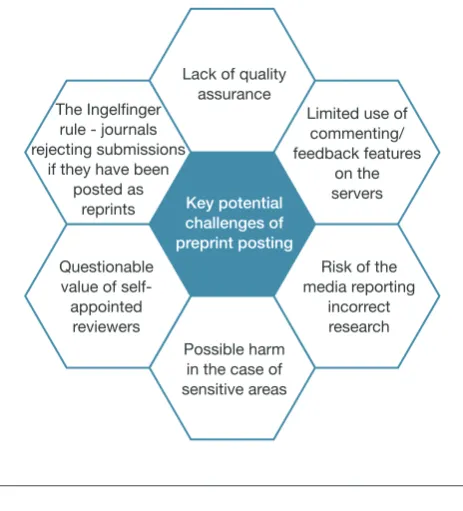
` Others are more sceptical and feel that preprints might be just ‘yet another job’. In their view, the challenges of posting preprints (Figure 3) outweigh
the beneits
Naturally, every innovation will see some contrast between early adopters and sceptics. We have discussed the
beneits perceived by the supporters of preprints in the
previous section, so we will now focus on the point of view
of sceptics. Similarly to the case of the beneits listed above, which tend to be dificult to evidence, sceptics
often express hypothetical objections.
“I don’t have a lot of examples [of the beneits of preprints] here, but certainly, you know, I hear anecdotes.”
Researcher
Footnotes
32 Weingart, P. & Taubert, N. (2017). The Future of Scholarly Publishing: Open Access and the Economics of Digitisation.
[image:20.595.316.548.402.658.2]http://doi.org/10.5281/zenodo.1003185
Figure 3 – Potential challenges arising from
preprint posting.
Lack of quality assurance
Limited use of commenting/ feedback features
on the servers
Risk of the media reporting
incorrect research The Ingelfinger
rule - journals rejecting submissions
if they have been posted as
reprints
Questionable value of self-appointed
reviewers
Key potential challenges of preprint posting
20
Accelerating scholarly communication 3. The researcher’s perspectiveWe note that many challenges mentioned by study participants and in the literature with respect to preprints and preprint servers would not materialise unless authors or media reporters engaged in unprofessional behaviours:
` The fact that preprints are unrefereed may be an issue. However, if they are treated as pre-review outputs and critically assessed by readers and re-users, no particular issues should arise. In addition, since reputation plays an important role in academia, the likelihood of authors risking posting poor or
falsiied results may reasonably assumed to be low
` Media may pick up research in preprint form and report on it. However, the consensus is that the onus is on journalists and researchers to behave responsibly and professionally, acting where appropriate to
corroborate the indings of a preprint before this is
shared via mass media or to report it with caveats33
` Harm in sensitive areas, for instance, those related to human health or protected animal species, is not likely to materialise if researchers behave ethically
and in line with professional standards in their ields.
Preprint servers dealing with these topics, such as medRxiv, include screening processes to ensure that research with a potentially harmful impact is not posted34
The possibility of rejection by academic journals when a preprint has been posted appears to be one of the root causes of scepticism. We note that the above-mentioned
Information Exchange Groups (IEG) started in the 1960s
by the NIH fell due to pressures from journals and learned societies: these “considered the organised
circulation of preprints in both biology and physics to be
a threat to their inancial interests and to their perceived status as guardians of scientiic integrity”.13
Although the scholarly communication landscape has since changed, we highlight that scholarly publishers and learned societies do retain the ability to affect norms and behaviours in disciplinary communities. For instance, the
so-called “Ingelinger rule”,35 which arose in 1969 and
after the fall of the IEG, stipulates that a journal would not
publish indings already shared elsewhere. This concept
is widely understood by researchers today, but fears that it might apply widely to preprints may not be in line with reality: article rejection on the basis that a preprint has been posted seems unlikely, as a range of journals now have policies compatible with preprint posting (https:// en.wikipedia.org/wiki/List_of_academic_journals_by_ preprint_policy).36 In particular, we note that Elsevier,
Springer Nature and Wiley, which together published
over 30% of the global article output in 2016,37 currently
accept preprint posting prior to submission to their
journals. Furthermore, in some ields, the sharing of
preprints is already accepted broadly: in palaeontology,
“I don’t think people in my ield would just post off stuff that’s…terrible…because you’re still being judged on what’s going up there.”
Researcher
Footnotes
13 O'Connell, H. (2000). Physicists Thriving with Paperless Publishing.
https://arxiv.org/abs/physics/0007040v2
33 Tennant, J., Gatto, L. & Logan, C. (2018). Preprints help journalism, not hinder it.
http://doi.org/10.1038/d41586-018-06055-3 34 medRxiv. (2019). Coming soon: medRxiv.
https://connect.medrxiv.org
35 Altman, L.K. (1996). The Ingelinger rule, embargoes, and
journal peer review - part 1.
https://doi.org/10.1016/S0140-6736(96)91016-8
36 Teixeira da Silva, J.A. & Dobránszki, J. (2019). Preprint policies among 14 academic publishers.
https://doi.org/10.1016/j.acalib.2019.02.009
37 Eficiency and Standards for Article Charges – ESAC. (n.d.).
Market watch.
21
Accelerating scholarly communication3. The researcher’s perspective
for example, this is the case for around 60% of journals.38
A possible way to address uncertainty around journal policies is the use of sources such as SHERPA RoMEO (http://sherpa.ac.uk/romeo/index.php) or the recently-created Transpose database ( https://transpose-publishing.github.io/#/about): an international
collaboration, the website lists a large number of journals and includes information on their policies, including with respect to preprints.
The academic literature also mentions some additional issues that weren’t discussed in our interviews due to our focus on certain preprint servers and on the pre-review stage. For example, authors who have published on F1000Research (an open access publishing platform) have reported that open peer review of preprints on the platform could lead to poorer-quality reviews lacking criticism.39,40
The opposite has also been argued as well – that introducing transparency in peer review ensures reviewers produce higher quality reports. The literature does mention that reviewers might be unwilling to get involved in the
irst place or to be too critical if their comments are going
to be published publicly,41 but the reduced amount of criticism could also relect the above-mentioned fact that
researchers tend to submit preprints of a high standard when they know these will be immediately visible online.
The underlying theme when it comes to challenges in the preprints landscape is trust. The possible challenges and risks noted in this report could, in time, be overcome under the assumption that authors, media and the other stakeholders in this area work professionally and ethically.
Posting preprints in practice
In the course of this project, we sought to develop an overview of existing preprint servers (see section 4, p.23 and Appendix C, p.54 for details). We identiied over 60 platforms that can be used to store and share
preprints, though a handful are online repositories with a wider scope that also accept preprint posting (e.g.
Zenodo, igshare, Open Science Framework).
Thanks to the fast development of new preprint servers over the last ten years, the availability of a server that is
it for the purpose of any given researcher is almost
guaranteed. Preprint servers ranging from physics to humanities, medicine to agriculture, geosciences to mind and contemplative practices are now available, as well as generalist repositories and servers with a national/geographic/language focus. While the sheer variety risks creating confusion in some cases, we note that the vast majority of these new preprint servers have been started from the bottom up and are being
maintained by tight disciplinary communities.
The enabling role of Twitter
A surprising inding of this study was that Twitter plays
an enormous role in supporting the uptake of preprints. Many participants mentioned that Twitter is the way
they were irst exposed to preprints. Typical experiences
included a peer sharing a preprint or a member of an interviewee’s network commenting on one.
Footnotes
37 Eficiency and Standards for Article Charges – ESAC. (n.d.). Market watch.
https://esac-initiative.org/about/apcmarket
38 Tennant, J. & Lomax, D. (2019). An overview of Open Access publishing in palaeontology.
https://doi.org/10.26879/968
39 For more information on open peer review, see: Johnson, R., Watkinson, A. & Mabe, M. (2018). The STM Report. An overview of scientiic and scholarly publishing.
stm-assoc.org/2018_10_04_STM_Report_2018.pdf 40 Kirkham, J. & Moher, D. (2018). Who and why do researchers
opt to publish in post-publication peer review platforms? - indings from a review and survey of F1000Research.
https://doi.org/10.12688/f1000research.15436.1
41 Cosgrove, A. & Cheifet, B. (2018). Transparent peer review trial: the results.
22
Accelerating scholarly communication 3. The researcher’s perspectiveTwitter is widely known as a social network, and its use by academics for professional purposes, though still limited, is growing.42 An open and publicly available
medium by nature, Twitter is increasingly being used by
scientiic communities to:
` Follow Twitter bots posting preprints as set up by individual preprint servers
` Share their own preprints
` Discuss preprints via comments (“replies”, in Twitter
jargon)
` Contact publishers of high-impact journals if a
preprint has received signiicant attention
The point on making and receiving comments is particularly
signiicant. This is possible on some preprint servers and
comments can be made either on a full preprint or on
speciic portions of text (depending on technological
solutions). However, when readers comment on preprints via social media they make their feedback less discoverable and, thus, not as accessible to all interested parties. In some cases, altmetrics algorithms might be able to track discussions on Twitter, but this is often possible only if the preprint’s DOI continues to be mentioned.
Over the course of this study, which started in September 2018, the follower counts on Twitter of preprint servers under observation (bioRxiv, ChemRxiv and PsyArXiv) increased by between a few hundred and a few thousand individuals/organisations. This supports our claim for the importance of Twitter in enabling the development of preprint servers and signals continued
interest from these disciplinary communities. However, we note that the follower counts of preprint servers accounts remain relatively low in social media terms – bioRxiv is the most popular Twitter account among the three with almost 34k followers, followed by ChemRxiv and PsyArXiv with 7.5k and 4.7k, respectively.
Finally, we note that the EarthArXiv preprint server was launched via a targeted social media campaign that led to a rapid development of the platform:43 this shows yet
another way Twitter can be leveraged to promote preprint posting.
Nevertheless, it is important to note that use of Twitter is limited in many parts of the world, most notably China where it is currently blocked. Within an academic context, there is also evidence that social scientists and computer and information scientists are
over-represented on Twitter, whereas mathematical, life, and physical scientists are under-represented.44
Preprint servers and their authors will therefore need to make greater use of other communication and
discovery channels in the future if they are to assume a central position in the scholarly discourse. These may include, among other solutions, the setup of custom alerts, a function already implemented by arXiv.
Footnotes
42 Mohammadi, E., Thelwall, M., Kwasny, M. & Holmes, K.L. (2018). Academic information on Twitter: A user survey.
https://doi.org/10.1371/journal.pone.0197265
43 Narock, T. W., Goldstein, E., Jackson, C. A., Bubeck, A., Enright, A., Farquharson, J. I., … Ampuero, J. (2018). Earth Science is Ready for Preprints: The First Year of EarthArXiv.
https://doi.org/10.1029/2019EO121347
44 Ke Q., Ahn Y-Y., Sugimoto CR (2017). A systematic identiication
and analysis of scientists on Twitter. PLoS ONE 12(4): e0175368.
https://doi.org/10.1371/journal.pone.0175368
“I would say that the momentum behind [name of the preprint server] owes a great deal to Twitter, and to Facebook, a bit less so.”
23
Accelerating scholarly communication4. Mapping the preprints landscape
Key stakeholders
This study started by considering researchers, RPOs, research funders and service providers. As discussed in our Methodology section, we did not interview academic
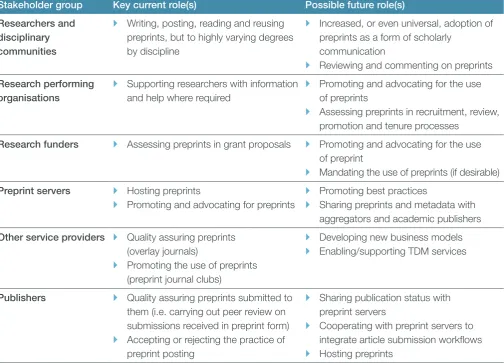
publishers, but they are here discussed to relect their signiicant role in scholarly communication (Table 1, p.29).
The preprints landscape is evolving fast and, in some cases, in a fragmented manner:
` New preprint servers are being regularly started up
` There is signiicant experimentation in terms of
approaches and technologies
` Little collaboration is in place between existing players
While these are not issues per se, we highlight that
broader acceptability of preprint posting could beneit
from a reduction in the current extent of variability and uncertainty in the landscape.
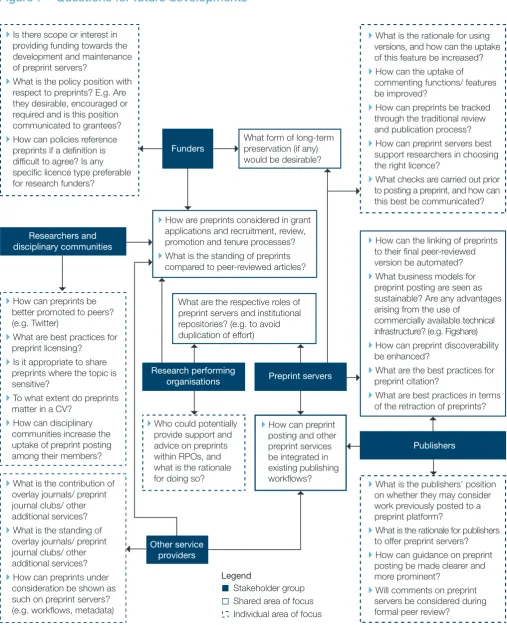
A possible way forward is cooperation between the stakeholders listed in Figure 4 (p.24) and Table 1
(p.29), but this will depend on whether this is seen as desirable by all. Most likely, some extent of coordination across scholarly communication stakeholders will be
needed in the future, as lasting cultural change is
signiicantly easier to achieve when mandates,
expectations, practices and infrastructure are aligned. As a starting point, we note that important sector stakeholders have taken notice of the preprints movement.19, 20, 22
The fact that inluential players such as Crossref (https://github.com/CrossRef/rest-api-doc), Europe PMC (https://europepmc.org/downloads/preprints)
and Google Scholar (https://scholar.google.com/ intl/en/scholar/publishers.html) are now formally
recognising preprints is a signiicant step towards
recognising the inclusion of preprints in mainstream
academic worklows. However, more efforts are required
to ensure the stakeholder groups involved have a shared understanding and some agreement on what comes next in this fast-moving area.
4. Mapping the preprints landscape
The recent growth of preprint servers means that the landscape now includes
over 60 solutions for a range of disciplines, languages and countries. Many
stakeholders are involved when it comes to preprints, such as researchers
as both authors and readers, research performing organisations, funders,
publishers, service providers and more. The technology underpinning preprints
is widely available, but some infrastructural challenges exist. The ‘hype’ in
areas where the preprints culture is currently growing might be temporary,
but it appears likely that at least some of the existing servers are here to stay.
Footnotes
19 cOAlition S. (2019). Principles and Implementation.
coalition-s.org/principles-and-implementation
20 Sever, R., Eisein, M. & Inglis, J. (2019). Plan U: Universal access to scientiic and medical research via funder preprint mandates.
planu.org
22 Elsevier, Ipsos MORI. (2019). Research futures: Drivers and scenarios for the next decade.
24
Accelerating scholarly communication 4. Mapping the preprints landscapePublisher owned/ managed platform
Standalone platform
Author posting
SSRN Preprints.org
Proprietary technology
arXiv
bioRxiv ChemRxiv Preprint servers
based on OSF
Third-party technology
bioRxiv/PLOS F1000Research
Publisher posting
Technology and operations
We identiied 60+ platforms allowing the sharing of
preprints and highlight different approaches to technical implementation:
` 25 preprint servers in our sample are based on the Open Science Framework, which is open source and gaining popularity
` 18 servers employ proprietary/ad-hoc solutions (note that this has no impact on the openness of the preprints they host)
` Six are based on the EPrints digital repository solution
` Other solutions, used by three or fewer preprint servers,
include igshare, DSpace, Invenio, F1000 and Drupal
The choice between the above options by the preprint server mainly has consequences in terms of user
experience and web design: these considerations apply to readers accessing preprints (website interface) and to
authors sharing them (posting worklows). Furthermore, some commercial solutions may be in a better inancial
position to invest in developing the relationships and interfaces needed to maximise content discoverability.
The choice of technology is somewhat related to the way platforms operate in practice and what kind of control their owners or managers wish to exert. Figure 4
shows that either authors or publishers are typically responsible for sharing pre-refereed content, and that the platforms that enable this can be either standalone or owned/managed by publishers.
Footnotes
45 Narock, T. & Goldstein, E.B. (2019). Quantifying the Growth of Preprint Services Hosted by the Center for Open Science.
https://doi.org/10.3390/publications7020044
25
Accelerating scholarly communication4. Mapping the preprints landscape
One of the main differences between author and publisher posting is that publishers would tend to post pre-refereed content as part of a holistic publishing process. However, publishers do not necessarily need their own
platforms to include preprints within their worklows: for
example, PLOS has partnered with bioRxiv to achieve
this, effectively creating a publisher-triggered worklow
that uses a standalone community resource.
Finally, we note that the use of proprietary technology allows the highest level of control and customisation to preprint server managers and publishers such as F1000. With solutions developed in-house, any
functionality could, at least potentially, be implemented. This comes with the need to employ staff to carry out web development and technical maintenance, however. The use of third-party solutions reduces the technical burden on the preprint server’s administration, but, for example, in the case of ChemRxiv means that the cost of a commercial solution must be covered.
Size and trends in the preprints landscape
The number of preprints hosted by a single server can
vary signiicantly: our research shows igures ranging
between ~20 preprints in Medieval Studies and the over 1.5 million hosted on arXiv. This comparison highlights the impact of disciplinary culture on the posting of preprints: some disciplines are just starting to experiment, while the physics, mathematics and computer science communities lead the way. However, the size of disciplinary communities and the average pace of
research in different areas will also affect these igures.
Another factor to keep in mind when looking at preprint
counts is that researchers in some areas (chiely the
humanities) may value monographs more than they do articles. Therefore, the extent to which preprints (meant as pre-publication versions of articles) will matter to them might be limited. The idea of sharing preprint versions of monographs has emerged more recently,46, 47 but neither
the literature nor our interviews suggest any consensus is emerging on the way forward. We note, however, that
the very irst experiments with electronic book publishing,
although unrelated to preprints and closer to open/free access, date as far back as 1971, when Project Gutenberg was started.48
Finally, we highlight the global reach of preprints. There are some preprint servers with a geographic focus, for instance, for Africa, China, India and Indonesia,49 or with
a language focus, for instance, Arabic or French. At present, it is not possible to forecast with any certainty whether this approach will co-exist alongside the use of preprint servers by disciplinary communities, and what the respective merits of each model might be. However, studies of OA publishing practices indicate that authors’
disciplinary afiliations tend to carry greater weight than
national loyalties or their country of residence.50
Footnotes
46 Geltner, G & Willinsky, J. (2018). Preprint to Monograph: A Path to Travely By. guygeltner.net/blog/652018preprint-to-monograph-a-path-to-travel-by
47 Springer Nature, Pyne, R., Emery, C., Lucraft, M. & Pinck, A.S. (2019). The future of open access books: Findings from a global survey of academic book authors.
https://doi.org/10.6084/m9.igshare.8166599.v1
48 Moore, S. (2019). Revisiting ‘the 1990s debutante’: scholar-led publishing and the pre-history of the open access movement.
http://dx.doi.org/10.17613/gty2-w177
49 Mallapaty, S. (2019). Indian scientists launch preprint repository to boost research quality.
http://doi.org/10.1038/d41586-019-01082-0
50 Eger, T., and Scheufen, M. (2018). The Economics of Open Access: On the Future of Academic Publishing.