THE ECONOMIC BACKGROUND
The International Environment
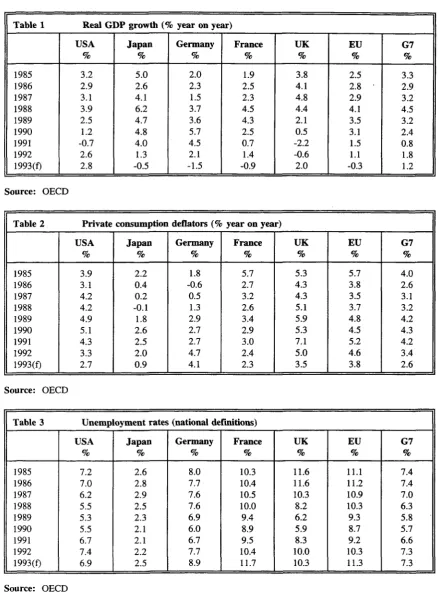
The International environment has a much more positive outlook for Scotland in the first quarter 1994, after remaining extremely uncertain over the past couple of years. The UK, US and Canadian recessions had pushed annualized G7 growth down to 0.8% in 1992, but this improved to 1.8% in 1993 as the US and Canada began the long road to a sustained recovery. With the recession in the European Union and the unending saga of Japanese attempts to revive demand, G7 growth subsided in 1993 to 1.2%. The OECD has estimated that the economy of the European Union contracted by 0.3% in 1993 and Figures 1 & 2 show the extent of this contraction in Europe, comparing it with the rest of the G7.
Inflationary pressures have receded in most industrialised countries, except for a small risk in the USA. More accurately, the risk to countries is not from inflation but, especially in the case of Japan, from deflation. Labour markets in all of the industrialised nations are suffering from a high level of slack or overmanning. European unemployment rose to an average level of 9.5% in 1992 and is expected to have risen to around 11.0% by the end of
1993 as Spanish unemployment rocketed to 24% of the labour force.
The United States of America
In the United States, the economy has benefitted from nearly five years without a major hike in interest rates. Since late 1991 real interest rates have effectively been at zero or below. Gross Domestic
Product rose effortlessly after the Democrat victory in the 1992 elections but faltered in the first quarter
1993 as consumers recoiled from the threat of tax rises. Since then growth has accelerated and reached 7.5% year-on-year in the last quarter 1993.
One feature of this recovery phase, as we have regularly highlighted, is the near absence of strong employment growth. And fears of a jobless recovery have been heightened by the new method of calculating the rate of unemployment whose introduction will raise the rate by about 0.7% points to around 7.5%. In defence, Laura Tyson - the US trade secretary - has insisted that strong output growth accompanied by a healthy productivity trend could still help to provide new jobs in the USA1.
Despite low inflationary pressures, financial markets have become increasingly worried about its resurgence. So, in early February, Mr Alan Greenspan ordered the raising of the Federal Funds rate by one quarter of one percent. It was hoped that this would achieve two ends, one, to reduce the likelihood of a rise in inflationary expectations since monetary policy has been very loose since late 1991, and two, to stimulate investment growth which has been, and still is, the foundation of recovery. At the time of going to press it would seem as if the markets have taken the historical - negative - view that a rise in short term interest rates is a signal of incipient inflation and not
-as w-as intended and advised in this c-ase - an attempt to signal the Fed's determination not to accommodate any increase in inflationary expectations. Gilt prices have been falling since the announcement and yields on long dated stock have risen above 6.5% for the first time in many quarters. This might not be a huge problem since the estimated increase in investment over 1993 was 10%. Confidence appears to be high and the recovery seems well established.
over the next three fiscal years (over the last three years spending on the military has risen by 45%) may yet produce a rise in the budget.
Japan
Japan is still floating without a rudder, or some would say a plan. Previous attempts to get things moving by fiscal injection foundered and heightened the tension between Japan and the United States caused by the Trade Surplus. The Protectionist voices from Washington were not satisfied that the Japanese authorities were trying hard enough to revive demand and the two countries' leaders met in Washington to discuss possible means by which the huge surplus can be reduced. The US wanted a numerical reduction but the Japanese were insisting that, not only was the treat of protection against the ethos of the Uruguay settlement, they were trying hard to open up their domestic market to greater competition from abroad. Nothing was agreed and uncorroborated roomers of a US plot to talk up the Yen led to a further appreciation. Why the USA would do this given that a stronger Yen would probably keep Japan in recession for even longer is counter-intuitive. After all, the corporate and household sectors have suffered extremely badly from their over indulgences in the late 1980s and further lashings from the USA would not be very clever.
At the time of going to press the continuance of deflationary pressure is only too apparent. With consumer price inflation currently running at 1% and producer prices a shade under 3% there is still some way to go before real balances are high enough to stimulate spending and restart the economy. Recently, manufacturers have stopped running down their levels of stocks, an indication that there is little chance of recovery soon and the level of business investment has fallen. Business and Consumer confidence are very weak, the latter at an historical low point.
The Japanese labour market is also an important - if relatively invisible - indicator of how badly the economic downswing has affected the decision making process. The historically low levels of unemployment in Japan (1-2.5% of the labour force) have been endlessly cited as proof that their's is the superior mode of production. But closer inspection of trends in 1992 and 1993 shows that all is not well. In one instance there has been an partial abandonment of the Job-for-Life ethic and a consequent rise in the number of workers taking early retirement. Also, the levels of overtime and recruitment have begun to decline as the full force of a near slump takes hold.
Count this along with a huge discouraged worker effect and surplus manning of around an estimated 750,000 workers and the casual observer quickly comes to the conclusion that an official rate of unemployment of 2.8% is probably an under-estimate of between 4-7%. A recent report in The Economist magazine has indicated that, once adjustments for labour hoarding are accounted for the effective, rate of unemployment in Japan is probably equal or even higher than in the USA.
The response to the no growth syndrome has not been through interest rates, as would have been the case in 'Western' economies. The policy weapon has been fiscal policy2 and in February the government announced a Y15,250bn spending and tax cut plan -which is to be financed by bond sales rather than indirect tax rises. With a hint of deja vu we feel that this will finally pull the Japanese economy out of recession provided the Yen is not allowed to go too near to Y100 to the dollar - where many Japanese manufacturers would be making a clear loss. The previous two supplementary budgets failed to stimulate activity because the authorities were bound to match increased spending with an increase in taxation. But this time around, things are different and the issuance of government debt - for the first time in five years - should get things moving since long rates are unlikely to rise given the fiscal surplus brought about by many years of financial prudency. Had the Japanese gone on a wild tax cutting spree in the 1980s even this option would not have been available. Reliance on monetary policy and a subsequently even higher trade surplus would have been the probable result.
Western Europe
In Western Europe conditions are easing as the Bundesbank has continued cut lending rates. Inflation continues to subside. This has had the effect of returning the former narrowly banded currencies of
the ERM to within 2.25% of the Deutschmark. The cuts in German rates have also allowed yields on pan-European government bonds to fall at the long end and improve the potential for an upward revision to investment intentions in the near future - an important policy objective given that most investment in the Federal Republic is long-term.
The effects of the German recession - which seems to have ended around the middle of the third quarter 1993 - had been mitigated to some extent by the buoyancy of net exports. But now, in the first quarter 1994, there is the likelihood that we will see a pick up in domestic demand and further falls in interest rates cumulating to around 1-1.5% percentages points over 1994. This would leave German short real interest rates at 2% by the end of the year.
The European labour market, for many years the object of lament, is now estimated by the OECD to have 17million unemployed workers, over half the 30million unemployed in the OECD. In response the European Commission produced a white paper entitled Growth, Competitiveness and Employment in an attempt to stimulate debate on how wage/non-wage costs could be reduced and jobs created. As we know, the blame for the very high level of unemployment in the Union is directed - primarily by the UK government - at excessive regulation and relatively higher hiring and firing costs than those found in the USA. In popular economics jargon this excessive bureaucracy is known as Eurosclerosis.
The European Commission's white paper proposes a micro-macro approach. On the micro side, the emphasis is placed on enhancing the employer's ability to respond quickly to an upturn in demand by increasing employment. The paper is sympathetic to the economically right-of-centre view that the state must roll back those barriers which impede employers from employing workers with lower productivity levels. This, obviously, means the abandonment of minimum wage legislation and further legislative curbs on union activity. On the macro side the paper also recognises that there is a need for co-operation between governments, employers and unions - along the lines which have successfully been employed in Ireland - to hold down wages and channel investment into training and R&D so that in the future companies from Europe can compete with their Asian counterparts who still maintain a cost advantage. As the Asian economies mature, and form unions to protect workers from low wage exploitation, a successful move to cooperate on training and investment policy by me European nations will put them in a good position to compete effectively in the
next century3.
Whether this will be successful we will have to wait and see. If the white paper is implemented and the reforms are effective then we should see employment growth along side a steady rate of inflation, rather than the contemporary phenomenon of choosing lower inflation for high unemployment and wastage of resources. But, it should be remembered that in the USA greater flexibility has brought with it greater social problems and a wider disparity in earnings since the last century. Therefore some compromise must be found between moving from high unemployment to high levels of social disenfranchisement.
The United Kingdom
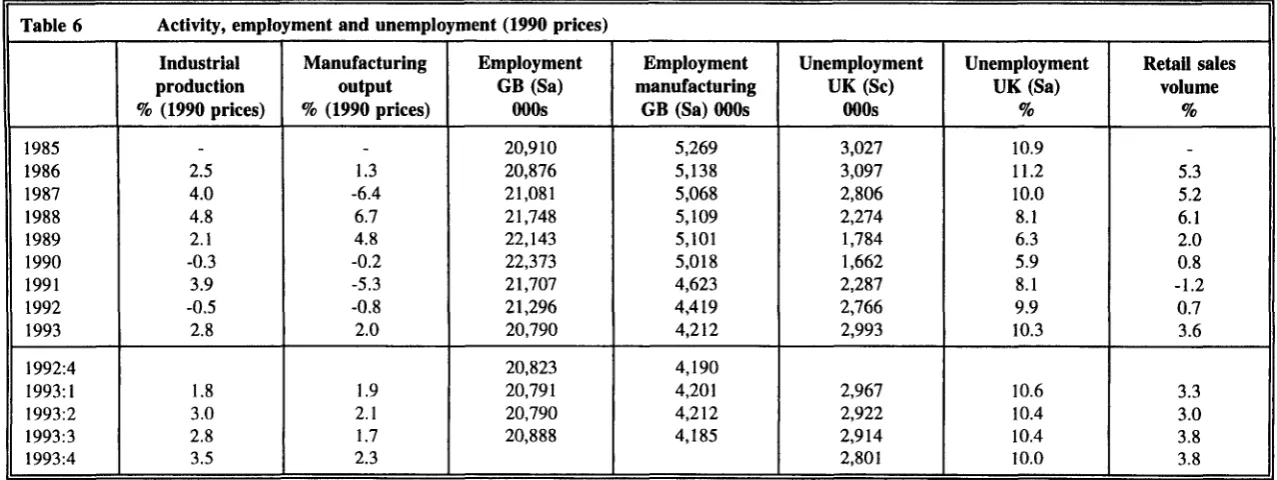
The continuing recovery is less rapid and more uncertain than in the immediate aftermath of previous recessions. During the quarter 1993, 'real' GDP rose by 0.8% to a level 2.6% higher than a year earlier and this left the year-on-year increase at 2%. But caution is recommended. While the recovery has now been under-way for seven quarters, GDP in the fourth quarter still stood 0.5% below the last cyclical peak in me second quarter 1990.
Both production and service sectors are expanding. Growm in the former outpaced the service sector growth in the final quarter of last year. But, the recovery has been more evident in the service sector and by the fourth quarter, service sector output stood 1% above the previous cyclical peak. Production output was more than 1.7% below die previous peak.
1 51
10-1 «•
i l o
-
-5-/
iaa
| —
Elements of UK Demand
19B7 1B» 1MB 1SBD 1901 19B2 - Can. Exp. aPPCT Owl. Hip. —±— GDP
*£
i «
1
Industrial and Manufacturing output
19M 1SV 1SM 1M9 101
demand for UK exports the recovery would have been even slower and more narrowly based.
Consumers's expenditure rose by over 3 percent in the year to the fourth quarter. Retail sales continued their improvement into January of this year having risen for six consecutive months. The savings ratio fell throughout 1993 - net wealth rose despite a flat housing market as equity prices increased sharply -and the dem-and for consumer credit picked up considerably. In addition, the unexpected falls in recorded unemployment will also have served to reduce the need for high levels of saving and increased the willingness to take on new debt.
Money, Prices and Retail Sales
*i
i *~
i
*
*
2-
0-19
c
^ ^-—~\ / \ '" x / , \ ' \
/" \ \ ^ \
/ \ ^ \ \ /
/ .H \ V /
L_ — — - " " " \ \ / ' *
^———^-/ ''
~~-* /
^•'
m iap ion iaiB iooo IOBI 1102 i m M) KFlu-D^i SMdSriMVgli^ |
Corporate expenditures were relatively flat during 1993. Manufacturing investment exhibited no real growth, and there were significant contractions in distribution and business services. But, recent survey evidence suggests that manufacturers are anticipating increases in investment in plant and machinery in early 1994 and we would expect such intentions to harden considerably during the year. De-stocking, which has been largely concentrated in manufacturing, also appears to be coming to an end. Throughout the year, stock levels should gradually rise and make a contribution to overall growth.
Net Trade is contributing positively to growth. The deficit on visible trade fell during 1993 compared with 1992, although on a trend basis the deficit appears to have been flattening in recent months. Nevertheless, the deficit in 1993 is likely to be around £2 billion below the deficit in 1992, reflecting improvements in Britain's competitiveness with the rest of the EC. As reported in previous issues of the
Commentary, intra-EC trade data remain problematic
and the new system of data collection appears to be under recording European trade flows. Britain's trade outside the EC has risen since sterling's exit from the ERM although the volume of exports and imports has broadly risen pari passus. Both the visible balance and the current balance are likely to deteriorate during 1994 with rising domestic demand attracting more imports as, in particular, investment picks up and stockbuilding occurs, and as some domestic production is switched from exports to home use.
Inflation was more subdued in 1993 than had been predicted at the beginning of the year. In the fourth quarter, the underlying annual rate was 2.7% compared with forecasts of between 3% and 5%. Low world inflation, affecting commodity and raw material prices, a stronger pound sterling than expected and
the low level of pay and earnings increases are the principal reasons why forecasters were confounded.
Earnings, Costs and Productivity
•
0-I
i.
2-
0-^ 0-^ 0-^ 0-^ V
^——rc^~~^ ^ \
^-^' ^ \
— -~^ / N \
/ \ \
\X
\\ \
1880 1917 1888 1M0 1880 1881 1882 1883 & « M « i B n * 9 UtWapOMa VKdodM* |
The rate of growth of average earnings appears to have stabilised at 3% in the final quarter 1993, after over three years of almost continuous decline. However, wage inflation in manufacturing remains almost 2% higher than in services. The rate of growth of labour productivity, which peaked in the first quarter 1993, continues to fall - both in the whole economy and in manufacturing. The result is that manufacturing unit labour costs, which declined throughout 1992 and to the second quarter 1993, have started to rise again. Whole economy unit labour costs are also increasing, though it must be stressed only at a relatively moderate rate.
During 1994, however, we should expect to see a rise in the underlying rate for three reasons. One, the 1993 reductions in mortgage interest payments and the effects of the move from the Poll Tax to the Council tax will drop out of the calculations. Secondly, 1993 saw various budget measures which are inflationary -the introduction of VAT on fuel and -the increases in excise duties. Thirdly, other factors will appear such as the delayed effects of Sterling's exit from the ERM, increasing unit wage costs and a restoration of retailing margins following the recent bout of price wars in the high street. All three will increase the annual rate of underlying inflation. Nevertheless, the rate should remain within the Government's 4% ceiling during 1994, although the final outcome will be dependent on moderation in wage and salary demands during the coming pay rounds, something which can by no means be guaranteed.
UK unemployment peaked in January 1993, but the subsequent recovery in the labour market has been rather fitful. Although unemployment fell consistently in the last quarter of 1993, in January 1994 there was a small increase in both the male and female counts and an accompanying decline in the number of job vacancies. The rather weak improvement in the
unemployment position is also reflected in the total employment figures which show that whilst UK employment rose in the second and third quarters of
1993, it was still at a lower level than at the same time in the previous year. Employment continues to fall in manufacturing, although the third quarter 1993 showed a reasonably large increase in service employment.
World Trade
The Uruguay Round of Trade talks has finally been concluded. The longest round of trade talks in Gatt's history not least because of its ambitious agenda -holds out the prospect of increasing world trade over the next 10 years by between USS213bn and US$274bn. These estimates are somewhat on the cautious side since they do not incorporate likely benefits from increased trade in services, strengthened trading rules and regulations, and a more competitive and integrated global economy.
The European Union the world's largest exporter -not surprisingly will be one of the principal beneficiaries of this accord. Greater market access for its goods and services will further boost its already formidable export levels.
The removal of tariffs altogether in the G7 countries, and their reduction in other Gatt countries should lift the spirits of the Scotch whisky industry. The industry's exports is expected to rise as result of these tariff removal/reductions, but may still be inhibited in some overseas markets by non-tariff restrictions.
Scottish farmers, on the other hand, may find their farm incomes falling in the short-term ; but this short-term income decline should be credited more to CAP reform than the farm trade settlement of the Gatt accord. In the long -run, increased productivity and output may allow farmers to reap the benefits of the Gatt agreement and compensate them for the reductions in their artificially high support prices.
Commodity Prices
The overall level of commodity prices has remained fairly stable in the recent past because of two counteracting effects. Oil production has been overdone and the Brent price recently fell below $14pb. Conversely, the price of non-agricultural commodities, particularly timber, rose by over 12% in the fourth quarter - reflecting conditions in die United States.
Over the fourth quarter 1994 food prices only rose by 4.1% and metals prices fell by over 6%. Prices should be stable in the near future as new production techniques are less commodity and energy intensive and the price of food is unlikely to rise in line with incomes.
The International Outlook
Now that 1992 and 1993 are over, the generally accepted forecast is one in which inflation remains low - die result of die successful conclusion to the Uruguay Round and the impending rise in oil production - and unemployment settles down at a higher level, given steady inflation, than at the end of me 1980s. The United States is making concerted efforts to tackle its deficit problem and the countries of the European Union are coming out of recession.
The outlook for die coming months, and for 1994, is one of lower interest rates and inflation in all countries except the USA where its is becoming increasingly likely diat the FED will move to increase interest rates again. The next rise, given die increasing frequency of data showing resurgent inflation, will probably be in the region of one half to three quarters of one percent since the original seems to have come too late and in too small a package. The result has
been market chaos tiiroughout early March and bond traders have moved out of US bonds by the drove. The unfortunate result has been a rise in long yields and a probable slowdown in capital investment. An upward movement widiin the next quarter will bring witii it a depreciation of the pound-dollar exchange rate and a boost to Scodand's export companies, in particular office machinery, chemicals and textiles. Whisky manufacturers will benefit from higher profits since their products are invoiced in dollars and die depreciation will raise die dollar price of tiieir products.
Since most of Scotland's trade goes to Western Europe, what should we be expecting? Exporters should not be particularly worried by the 20% rise in M3 in January - it is unlikely to push up interest rates and send die EU economy back into recession. The explosion was a statistical abberation, caused by special factors, and we should see a continuance of the downward trend in die repo rate for the rest of tiiis year. This will stimulate die demand for imports in Scodand's two biggest markets - France and Germany - and improve Scottish growdi in 1994. This will be a very important event for Scotland given tiiat it is 24% more dependent on exports than die United Kingdom economy.
The UK outlook
Growdi will continue to improve during 1994. Year-on-year growtii in 1994 is expected to be around 2.5%, which is the "average" of die Treasury's January survey of 35 independent forecasters. These forecasts are confined to a fairly narrow range of 1.5% to just above 3%.
Growdi will be boosted in 1994 as corporate expenditures rise. Company spending on investment and stocks will increase. Recent evidence from me CBI Industrial Trends Survey suggests that capacity utilisation is now above its long-term trend. This in part represents die scrapping of excess capacity as well as die outcome of faster output growdi. In addition, die lagged effect of relaxation of monetary policy since 1992, combined witii lower dian anticipated inflation, is reducing die cost of capital. For tiiese reasons, coupled witii improved corporate profit performance last year which allowed a restructuring of corporate balance sheets and a lowering of debt-equity ratios, we expect a considerable boost to investment diroughout 1994. Reduced user-capital costs and improved liquidity will also make it easier for companies to rebuild tiieir stock-output ratios which, given expectations of further demand growtii, should see an end to
de-stocking and an accumulation of stocks. However, given improved stock-control techniques and the introduction of 'just-in-time' production systems, the stock-output ratio is unlikely to be rebuilt to the levels attained in the recovery from earlier recessions and so the contribution of stockbuilding to growth will be relatively smaller.
The outcome for consumption during 1994 might, at first sight, appear to be more problematic in view of the fiscal tightening introduced in the 1993 Budgets.
The February Report from the National Institute of Economic and Social Research (NIESR) indicates that as a result of die measures, the Government's net revenue has been increased by £12.8 billion in 1994 and by considerably higher sums in 1995 and 1996. This fiscal tightening is estimated to amount to 1.9% of GDP in 1994/5, 2.4% of GDP in 1995/6 and 2.8% of GDP in 1996/7, and can be compared with the tightening introduced in the infamous 1981 Budget of 1.4%. As the NIESR point out, the prospective impact on personal sector spending of these changes will depend on the extent to which consumers allow future tax and expenditure changes to affect current spending plans.
In simulations where spending is allowed to be influenced both by the past alone and by future expectations, die NIESR find tiiat the overall negative effect on consumption and GDP is about the same but witii forward looking behaviour the negative impact is more substantial in earlier years. So, they estimate that, in comparison with what otherwise would have occurred, consumption will be 1% lower (GDP -0.5%) in 1994 with forward looking behaviour, compared widi a drop of 0.5% (GDP -0.,3%) where expectations are assumed to be solely backward-looking. These estimates assume mat me Budget changes have no effect on interest rates and exchange rates, which becomes less tenable in the longer term. Given that me impact on consumption of the earlier relaxation of monetary policy has still to fully feed through to consumption and into view of the subsequent lowering of base rate in two stages to 5.25 %, which became possible as result of fiscal tightening, the effect of the Budget changes are likely to have only a small negative effect on consumption during the current year.
The same can not be said for 1995 and 1996, although it is to be hoped that rising consumer confidence, an increased potential for equity withdrawal as the housing market picks up and a strong equities market will ensure that the growth of consumers' expenditure continues. But consumer
spending and growth will be appreciably lower in 1995 to 1998 because of the Budget measures; unless interest rates or the exchange fall further than presently anticipated. Indeed, we are more likely to see interest rates taking an upward rather than a downward path as the World and UK economies expand and as inflationary expectations increase.
Notes:
2.
See - The Financial Times, February 16th 1994
As the OECD have recently pointed out, the Japanese economy is the only G7 country in a position to reflate using fiscal policy. The cyclically adjusted deficit is in surplus in Japan, compared with a very large numerical deficit in the USA and a European wide failure to meet the Maastrict budgetary requirement of a 3% of GDP deficit.
See the OECD Economic Outlook -December 1993
See - Head to Head publishing
Table 1 1985 1986 1987 1988 1989 1990 1991 1992 1993(f)
Real GDP growth (% year on year)
USA % 3.2 2.9 3.1 3.9 2.5 1.2 -0.7 2.6 2.8 Japan % 5.0 2.6 4.1 6.2 4.7 4.8 4.0 1.3 -0.5 Germany % 2.0 2.3 1.5 3.7 3.6 5.7 4.5 2.1 -1.5 France % 1.9 2.5 2.3 4.5 4.3 2.5 0.7 1.4 -0.9 UK % 3.8 4.1 4.8 4.4 2.1 0.5 -2.2 -0.6 2.0 EU % 2.5 2.8 • 2.9 4.1 3.5 3.1 1.5 1.1 -0.3 G7 % 3.3 2.9 3.2 4.5 3.2 2.4 0.8 1.8 1.2 Source: OECD Table 2 1985 1986 1987 1988 1989 1990 1991 1992 1993(f) Private USA % 3.9 3.1 4.2 4.2 4.9 5.1 4.3 3.3 2.7 consumption Japan % 2.2 0.4 0.2 -0.1 1.8 2.6 2.5 2.0 0.9 deflators (% Germany % 1.8 -0.6 0.5 1.3 2.9 2.7 2.7 4.7 4.1
year on year)
France % 5.7 2.7 3.2 2.6 3.4 2.9 3.0 2.4 2.3 UK % 5.3 4.3 4.3 5.1 5.9 5.3 7.1 5.0 3.5 EU % 5.7 3.8 3.5 3.7 4.8 4.5 5.2 4.6 3.8 G7 % 4.0 2.6 3.1 3.2 4.2 4.3 4.2 3.4 2.6 Source: OECD Table 3 1985 1986 1987 1988 1989 1990 1991 1992 1993(f)
Unemployment rates (national definitions)
Table 4 UK demand and output (1990 prices)
1986 1987 1988 1989 1990 1991 1992 1993
1992:4 1993:1 1993:2 1993:3 1993:4
GDP % (average)
4.0 4.6 5.0 2.2 0.6 -2.3 -0.5 2.0
1.3 1.9 2.0 2.5
Consumers' expenditure %
6.8 5.3 7.5 3.2 0.6 -2.2 -0.1 2.5
2.1 2.0 2.7 3.2
Investment GDFCF %
2.4 10.2 13.5 5.5 -3.4 -9.8 -1.6 0.4
0.9 -0.7
1.5 -0.3
Govern consump
1.6 1.0 0.7 1.4 2.5 2.5 0.7 -0.
-1. -1. 0.8 0.8
Table 5 Money and prices (1990 prices)
1985 1986 1987 1988 1989 1990 1991 1992 1993
1992:4 1993:1 1993:2 1993:3 1993:4
MO %
4.5 4.2 4.5 7.3 5.4 5.0 2.5 2.2 5.1
4.7 4.5 5.3 5.8
RPIX
3.0 3.0 3.4 4.1 5.3 7.0 7.7 4.6 3.0
2.8 3.0 3.4 2.8
Average earnings - whole
economy % 8.3 7.0 7.7 8.7
9.1 9.8
8.0 6.1 3.5
4.3 3.7 3.1 3.1
Average earnings manufacturing
% 9.0 7.8 7.9 8.5 8.7 9.4 8.2 6.6 4.7
5.1 4.8 3.6 4.0
Unit wage costs whole economy
%
5.3 4.5 4.4 6.8 9.5
9.9
7.0 4.2 0.0 (q2)
2.8 0.3 0.0
1.1
Unit wage cos manufacturin
%
5.7 4.0 2.4 2.6 4.3 7.3 6.9 1.6 -1.9
Table 6
1985 1986 1987 1988 1989 1990 1991 1992 1993
1992:4 1993:1 1993:2 1993:3 1993:4
Activity, employment and unemployment (1990 prices) Industrial
production % (1990 prices)
-2.5 4.0 4.8 2.1
-0.3
3.9
-0.5
2.8
1.8 3.0 2.8 3.5
Manufacturing output % (1990 prices)
-1.3
-6.4
6.7 4.8
-0.2 -5.3 -0.8
2.0
1.9 2.1 1.7 2.3
Employment GB (Sa)
000s
20,910 20,876 21,081 21,748 22,143 22,373 21,707 21,296 20,790
20,823 20,791 20,790 20,888
Employment manufacturing
GB (Sa) 000s
5,269 5,138 5,068 5,109 5,101 5,018 4,623 4,419 4,212
4,190 4,201 4,212 4,185
Unemploy UK (S 000s
3,027 3,097 2,806 2,274 1,784 1,662 2,287 2,766 2,993
2,967 2,922 2,914 2,801