Rochester Institute of Technology
RIT Scholar Works
Theses Thesis/Dissertation Collections
1998
Applying continuous improvement through
process management in a restaurant environent
Thomas Wappman
Follow this and additional works at:http://scholarworks.rit.edu/theses
This Thesis is brought to you for free and open access by the Thesis/Dissertation Collections at RIT Scholar Works. It has been accepted for inclusion in Theses by an authorized administrator of RIT Scholar Works. For more information, please [email protected].
Recommended Citation
APPLYINGCONTINUOUS IMPROVEMENT THROUGH PROCESS MANAGEMENTINA RESTAURANT ENVIRONMENT
by
ThomasJ. Wappman
Athesissubmittedtothe
Faculty, ofthe SchoolofFood, Hotel,andTravelManagement
at
RochesterInstituteofTechnology
inpartialfulfilmentoftherequirements
forthedegreeofMasterofScience
ROCHESTER INSTITIITE OF TECHNOLOGY
School of Food, Hotel and Travel Management Department of Graduate Studies
M.S. Hospitality-Tourism Management Presentation of ThesislProject Findin2s
Narne:
---
Thomas J. Wappman Date:4-5-98 SS#:-Title of Research: Applying Continuous Improvement Through Process
Management in a Restaurant Environment
Specific Recommendations: (Use other sideif necessary.)
(1) Dr. Richard Marecki
Thesis Committee: (Chairperson)
(2) Prof. Warren Sacklgr
OR (3) Dr. Franc'is Domoy
Faculty Advisor: Dr. Richard Marecki
Number of Credits Approved: __4 _
IJ11hj
S,iff'
_
~
at Committee Chairperson's SignatureS-5r~'
at Department Chairperson's Signature
Note: This form will not be signed bythe Department Chairperson until all corrections, as suggested in the specific recommendations (above) are completed.
ROCHESTER INSTITUTE OF TECHNOLOGY
School of Food, Hotel and Travel Management Department of Graduate Studies
M.S. Hospitality-Tourism Management
Statement Grantin2 or Denying Permission to Reproduce Thesis/Project
The author of a thesis or project should complete one of the following statements and include this statement as the page following the title page.
Applying Continuous Improvement Through Process Management
Title of thesis/project: _
in a Restaurant Environment
Thomas J. Wappman ~ . .
I, , hereby~deny) penmssIOn to the
Wallace Memorial Library of R.I.T., to reproduce the document titled above in
whole or part. Any reproduction will not be for commercial use or profit.
OR
I, , prefer to be contacted each time a
request for reproduction is made. I can be reached at the following address:
/ft.y~J?ff 7 >
ABSTRACT
Thepurpose ofthis studyisto investigate howcontinuous improvement methods can be
applied inarestaurantenvironmentthroughprocess management. Increasedcompetition
in the service marketplace, and more knowledgeable customers has forced many
organizationsto focus onbusiness re-engineering. Therefore,the abilityto develop new
systems aimed at the
customers'
needs has become imperative. This assessment will
focus on the service deliverytimein four areas ofa student-operated restaurant utilizing
process management techniques. The fourprocesses that the researchers measured are:
1) promptness of
greeting-seating the customer, 2) beverage service, 3) entree service,
and 4) check-payout. The datacollectedin thisstudycanbe applied for future means of
improvement at Henry's Restaurant on the Rochester Institute of Technology campus.
Furthermore, the utilization ofthe instruments in this study will prepare future service
managers with experience in Statistical Process Control (SPC) methods, which are
ACKNOWLEDGEMENTS
Iwouldliketo thankDr. Richard Mareckifor hisexpertise and guidancethroughout this
project.
Iwould also liketo thankmyparentsCarlandSharon Wappmanfortheloveand support
thattheyhave giventome overtheyears. Thankyoufor everythingthatyouhavedone
forme mom anddad. I loveyoubothverymuch.
To mybrotherRoband sisterLinda,thankyouforyourfriendship,support, and
knowledgethatyouhavegivento me overtheyears.
Tracey,thankyouforbeingsuch a greatfriend,Iloveyou.
TABLE OF CONTENTS
Abstract ii
Acknowledgments iii
ListofTables vi
ListofFigures vii
Chapter I. Introduction andStatementofStudy 1
Introduction 1
Problem Statement 2
Hypothesis 3
DefinitionofTerms 3
ScopeandLimitations 4
Chapter II. ReviewoftheLiterature 6
Customer Focus 6
ProcessImprovement 10
Total Involvement 18
QualityLessonsfrom Baldrige Award Winners 21
Chapter IE. Methodology 25
SettingofStudy 25
StudySample 25
Research Instruments Used 25
PeriodofData Collection 26
Procedures 26
Chapter IV. Analysis ofData 35
Data Collection 35
Control Charts 35
Findings 35
Chapter V. Conclusions andRecommendations 41
Conclusions 41
Recommendations 41
LIST OF TABLES
Table 1 - GroupsofPeopleInvolved intheOperationandImprovement ofProcesses... 12
Table 2- Phases
ofProcessManagement 14
Table3-ProcessManagement in Perspective 17
TABLE OF FIGURES
Figure 1
-CustomerGreeted byHost/Hostess 28
Figure 2
-Beverage Order TakenandDelivered 30
Figure 3-EntreeOrder TakenandDelivered 32
Figure 4
-PresentationofCheckandPayment 34
Figure 5
-Greet-SeatResponse Time 37
Figure 6
-Beverage Response Time 38
Figure 7
-Entree Response Time 39
Figure 8
-Check-PayoutResponse Time 40
Figure 9
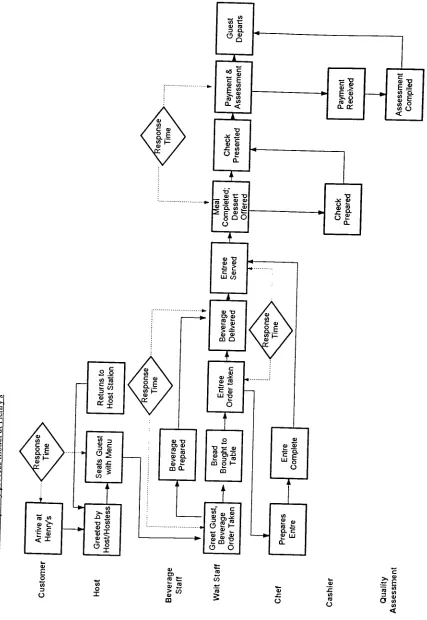
-Process ModelatHenry's 44
CHAPTER I
Introduction and Statement ofStudy
Introduction
The 1990s have experienced a myriad ofchanges in the service industry. The
futurein thisfield is expandingrapidly, anditisestimatedthat90% of all workers willbe
involved in some aspect of service by the turn of the century. The growth is evident;
from new businesses entering the marketplace to technological advances to better serve
thecustomer. Over thepastfifteenyears, more and more players have become involved
in the delivery of some aspect of service. Food service has experienced the largest
growthduringthis timeperiod.
In the seventies, Burger King and McDonald's were the lone fast-food giants.
However, the nineties have seen the evolution of bagel shops, such as Bruegger's and
Manhattan BageL Theemergence of newfast-foodrestaurants, like BostonMarket,Taco
Bell, and Wendy's has also crowded the marketplace. Furthermore, specialized
restaurants have become popular destinations for families. These include the Olive
Garden, MacaroniGrill, DonPablo's, andthenumerous steakhouses (Outback, Lonestar,
andBugaboo Creek). The growth seems unlimited whenitcomes to restaurants, because
more and more individuals are dining out on a more consistent basis. A problem that
arises is, How are all of these establishments going to survive? The solution today is
through a commitment to continuous improvement practices through process
management.
Continuous improvementinvolvesthree majorprinciples. First,
customers' needs
must be attended to at alltimes. The customer has become the major player in today's
competitive marketplace, because they are necessary for continued success. Customers
arenow directingcompaniesonhowtodelivertheir services. Oneexamplethatcomes to
mind is the new system implemented by the Mobil Oil Corporation. At Mobil service
stations around the country, patrons are now able to use a device on their key-ring to
activate thegas pump. This enables customersto pay-at-the-pump without having to go
inside to pay an attendant. Technological advances have given the customer more
options, and those businesses that are committed to improving their service delivery
processhave abetterchance of surviving.
Processimprovement isthe second aspectofcontinuous improvement. Itsgoal is
to produce a desirable output to meet the customer's requirement. By devising new
methods, andredesigning old ones, businessesarein aposition wherethey must improve systems to stay competitive. Companiesmustconstantly investigate,and devise the best
methodtoproduce aqualityoutput.
Finally, totalinvolvement is the last aspect involved incontinuous improvement. This approach must consist of strong active leadership within senior management.
Further, the talents of all employees in an organization must be utilized. This is
accomplished byempoweringemployees andutilizingteams to betterservethecustomer.
It has become increasingly important for all facets of an organization to commit to
producing qualityoutputs (services).
MystudywillfocusonHenry'sRestaurant, locatedontheRochester Instituteof
Technology campus. Through continuous improvement efforts, the restaurant is
attemptingto becomeastate-of-the-artfood laboratory. Technological advances, such as
strategically placed cameras and electronic comment cards have been implemented at
Henry's. These processes are aimed at providing quality service on a consistent basis.
The new cameras are used to time the wait staff, while the electronic comment cards
provide feedbackonthequality offood, and promptness ofservice. Mystudy willfocus
on whether or not these improved processes have improved customer satisfaction at
Henry's.
Problem Statement
delivery. There is a need to ttain tomorrow's managers in utilizing statistical process
control (SPC) tools, with an eye toward continuous improvement. This is accomplished by focusing on three principles; customer focus, process management, and total involvement. Processtransformationhas become anecessity forthosebusinesses thatare
committed to producing a quality product year-after-year. The utilization of process management has emerged as the way to continue to improve the method of service
delivery. This is accomplished by focusing on the
customers'
needs, because they are
theintegral factor for success. Ifbusinessesfail to incorporateprocess management into
their company, theyare at risk ofexperiencing lostrevenue and/or business. The ability
to possess a systemthat is beneficial to the external, as well as the internal customer is important for continued success. This study will investigate how process management
wasimplemented atHenry's Restaurantandtheresultsthatwere attained.
Hypothesis
The implementationof process management atHenry's Restaurant hasresulted in
betterservicequality forthepatrons.
Null Hypothesis
Process management has had little or no effect onthe quality ofservice delivery
atHenry's Restaurant.
Definition ofTerms
ContinuousImprovement- the
constantdeploymentofresources aimed atdevisingnew processesthatwillincreasethequalityof an outputforthecustomer
External Customer the people (person) who receives the desired output from a
Henry's Restaurant a student-run restaurant located on the fourth floorofthe George
Eastman Buildingon theRochester InstituteofTechnologycampus
Process Management the method used to acquire, define, execute, and improve best
practicesof an organization with customerfocus asthemain objective
QS-1000
-ahand-held electronicmarketing deviceusedtomeasure customer satisfaction
Total Quality Management- a management concept where thecustomer's needs arethe
drivingforce,and continuous improvementis alwaysinvestigated
Ultrak 24/40 Hour Continuous Recorder - device
usedto monitor time of wait staffto
performcertain servicefunctions intherestaurant
Scope and Limitations
The scope of this study is to examine how continuous improvement can be
applied through process management in a restaurant environment. This study utilized
statistical process control tools to improve service quality at Henry's Restaurant.
Students and faculty focused on the front-of-the-house operations in a restaurant. The
four areas studied were; greeting of customers, beverage service, entree service, and
checkpresentation-payment.
The limitation ofthis study is that it was conducted over a six-week time period
every Tuesday and Thursday during the Fall Academic Quarter. Therefore, the data
gathered reflects alimited sample. Iftherestaurant was open morethan two days aweek,
then alarger assessment could have been complied. Furthermore, theanalysis primarily
focused on the "front house" operations at Henry's. Therefore, the wait staff and
host/hostess were the only workers timed on a daily basis. This meant that the kitchen
CHAPTER II
Review ofthe Literature
Customer Focus
Society:Increased Expectations of Service
The modern quality era emerged in 1980, with the introduction of a book by
Philip Crosbyentitled Quality is Free. Crosbyinvestigated methods onhowto improve
adequate quality care for customers. Inthe years following, a number of similar books
were published that focused on service excellence for the benefit of the customer. However, many organizations were reluctant to listen to the desires of the consumer.
Today, it is imperative that senior managementknowswho their customers are and what
they exactly expect. The customer has become an active participant in determining
service deliveryprocesses. A customer is constantly looking for ways to make theirlife
easierfor themselves, andin turn, aregetting harderto please. 'Today'scustomer-driven
culture demands that all systems and processes in a company be oriented to the
customer's convenience and
success"
(Hyden, 1991). Technological advances and
conveniencehave become thebestfriend'sofconsumers. Therefore, businesses arenow
forced to develop new methods that are aimed at the customer's wants and/or needs or
they will suffer. Hence, individual customers are now driving the global economy,
instead of specific markets and products.
Throughoutthe eighties, manycorporationsthought that they wereimplementing
breakthrough deliveryprocesses, but in many instancestheir systemswere not
customer-friendly. Business leaders arejust starting torealize thatcustomer-focused processes are
vital to their success. Customer focus has become the most important factor to being
successfulin thecompetitive marketplace. The companies that are experiencing success
today, arethe ones who constantlyinvestigate waysto satisfythe external, aswellas the internal customer on a consistent basis. According to Albrecht, the cardinal rule of
theabilitytoidentifyandrespond to areaswhere customersbelievechange isneeded will
prosper (Brown, 1995). Ithas been almosttwentyyears since thequality revolution, but the idea of customer focus is now extremely important due to changing needs and
increased competition in the marketplace. An unsatisfied customer is difficult to win
back, thatiswhycustomer focusmust bethenumber onepriorityofall service providers.
The Need for Customer Focus
The detainment ofcustomers isakeyingredientto success in theservice industry
today. Only a handful ofcorporations have been successful in attending to customer's
needs on aconsistentbasis. Oneexample isthecatalog giant,L.L. Bean. Bean describes
what a customer meansto hiscompany:
Acustomer isthe mostimportantperson ever, acustomer is notdependent onus,
we are dependent on them; they are not an interruption ofwork, butthe purpose ofit. We aredoing themafavor bygiving us theopportunity to serve them. A
customer brings us his/her wants, it is our job to handle them (Tenner and
DeToro, 1992,p.51).
A badexperience at ahotelor restaurant will makecustomers hesitatefora return
visit in the future. "The key to gaining a long-term competitive advantage is to
continuallymeet
customers'
expectations inwaysthattheyrecognize as adding value. It is necessary to know who your customers are, and what they
expect"
(Tenner and
DeToro, 1992, p.51). Therefore, the abilityto focus on thecustomer is thefirst ofthree stepsfor qualitymanagement.
Since the introduction of the quality revolution twenty years ago, many organizations have experienced lost revenue because of a reluctance to listen to the
customer. Hyden explains that success today is achieved by making the customer successful (1991). If the customer knows that they are appreciated, they in turn will
return in the future. Cross lists five stages of bonding to deepen customer loyalty;
awareness, identity, relationship, community, and advocacy (1992). These stages assist
management in learning who their customers are and how they can continue to service
them in the future. The Strategic Planning Institute states, "organizations that focus on
quality ofcustomer care keep their customers up to 50% longer, have 20-40% lower
marketingcosts, and experience 7-17% better net
returns"
(Zemke, 1997). Theproblem
is that only a handful of organizations have been successful in mastering customer
service techniques. Club Med has been a successful operation for many years, because
they focus on the information that they receive from their customers to improve the
product and services that they offer (Whiteley, 1997). Therefore, all companies are
attemptingtopatternthemethods ofClub Med fortheirowncustomer-oriented systems.
The concept of customer care is a problem in many corporations, but more and
more are starting to realize how important the customer has become. The Forum
Corporation surveyed six hundred executives and asked them, what are your
organizations most important strategic needs? An astounding 86% answered quality of customer care (Whiteley, 1994). However, the process of improving customer
satisfactioninvolves manychangesina company'sphilosophy and practices. Companies
that are able to satisfytheir customers consistently must have acomplete understanding
oftheirclient, thecompetition ofthe marketplace, and an abilityto identifyandrespond
to areas that need change (Brown, 1995). This is the reason only a handful of
corporationshave beensuccessful.
Customer-QualityPractices
Every company has a unique method of attending to customer's needs. The
ability to make the consumer happy and successful is a challenge that is not always attainable. However, a pizzeria in Minnesota has taken customer care to the next level.
manyas nine visits to a specific tableduring a meal. This is accomplished by assigning
small sections ofthe restaurant to each server. In turn, this allows the staff to spend
plentyoftime taking care oftheir guests. Further, the owner states, "we are attuned to
our customers; from vegetarians to babies to grandparents"
(Walkup, 1995). This
example illusttates how important the customer has become in today's competitive
marketplace.
Quality customer service is also evident at the Motorola Corporation. The
company uses a five-step method for recovery from a bad experience with a customer.
Thesesteps are asfollows:
1. Apology
-acknowledgmentof error
2. Urgent Reinstatement
-efforttorestorebalance
3. Empathy
-expressingcompassion
4. Symbolic Atonement
-agestureto showformistake
5. Follow-up
-closureforthe incident
The above practice has enabled Motorola to become a leader in the electronics
industry. The ability to turn a bad experience into a pleasant one takes a lot of
commitment, andMotorolahasestablished a methodtodo so.
The Internal Customer's ImpactonService
It hasalso been determinedthatemployees areextremely importantto companies
that hope to become more customer-oriented. Employees who enjoy theirjobs and feel
valued and appreciated by their employer will, in turn, display a positive and helpful
attitude toward customers (Barrett, 1994). The front-line employee has become an
important asset for companies to find out what
customers'
desire. They are the people
who interact with the external customer on a daily basis. Southwest Airlines actively
solicits advice from their front-line employees because of their close interaction with
passengers. Employees are actively involved in developing new programs to improve
day-to-day operations,and Southwest listens carefullyto their internal customer because
they know the passengers best (Barrett, 1994). It would be absurd if management was
reluctant to receive input from the employees, because a person behind a desk has very little knowledge of what the customer desires compared to a front-line employee.
Employeesoften have valuable inputthatcan be ofbenefit when improvementis needed inthequalityof acompany'sproduct(Weiss, 1997).
However, customer focused attitudes must be initiated by executives who wish
that their employees treat customers fairly. Hyden lists four steps to begin a
customer-oriented atmosphere. First, executives must add value to their products. Innovation,
continuousimprovement, andcontinually asking customerswhatthey need arenecessary to stayahead ofthe competition. Second, customer-friendly systems mustbe developed
at all levels ofthe organization. Hyden explains that simple service tests can be run to
ensurethat the systems are functioningproperly. Theyinclude making phone calls from the outside into the company, performing surveys of customers, and examining if
customer's interests are being met. Third, employees must be involved in contributing
ideas and solutions to the company. It has been determined that great business leaders
createenvironmentsthatallowsemployeesto providetheirinput andparticipationtoward
customer service.
Process Improvement
Work Processes
Process improvement is the second key principle for total quality management.
Every time that we receive a good or service, there is some type of process involved. There is a process in place when you order a hamburger from a fast food restaurant, or
when one checks into a hotel. "All products and services are produced and delivered throughworkorbusiness
processes"
(Tenner and DeToro, 1992, p.98). Tennerdefines a
process as the sequential integration of people, materials, methods, and machines to
produce value-added outputsforcustomers (1992). Further, Born assertsthat a processis
the sequence of steps which transforms information from an initial state (input) into a
final state (output) (1994). The concept ofprocess transformation is a key issue facing businesses in the nineties, due to increased competition and customer expectations.
Today'sindustryleadersareconstantlyimprovingtheir workprocessesto betterservethe
customer. Four groupsof people areinvolved intheoperation and improvementprocess:
1. Customers
-thepeople whoreceivetheoutput
2. Work Group - thepeople who workintheprocess toproduce anddelivertheoutput
3. Supplier
-thepeople who provide inputto theworkprocess
4. Owner the person responsible for the operation of the process and for its
improvement
(See Table 1onnext page)
ImprovementStrategies - Process Management
Organizations are constructed in order to reach certain objectives. Therefore,
constant improvement is needed in order to maintain a quality operation and satisfied
customers. There are two types of improvement that can be adapted; incremental or
breakthrough. Incremental improvements are usually low-cost modifications in a
companyinvolving workprocedures and process steps. Onthe other hand, breakthrough (reengineering) improvements are major changes to the work process through
technological advances and innovation (Melan, 1995). These methods can be
accomplishedthroughtheimplementationof process management.
Melan states, thatprocess management achieves fourobjectives. First, itreduces
costsfora company. Second,it improves thequalityoftheoutputthatisbeingproduced.
Third, it increases the productivity of the output. Finally, it provides a basis for total
quality improvement throughout an organization (1995). LBMS, Inc. supports this by stating, process management yields a 350% improvement in developer productivity, a
90% reduction indefects, and a$5 returnfor every dollar invested (1996). These results
TABLE 1
GroupsofPeople Involved in theOperationand ImprovementofProcesses
Group Involved Henry's
Customers PatronsofHenry's
Work Group Kitchen Staff
Supplier Wait Staff
Owner Warren Sacklerand Students
Tenner,A R &DeToro, I. J. (1992). TotalQualityManagement: ThreeStepsto ContinuousImprovement. MenloPark,CA: Addison-Wesley PublishingCompany.
[image:22.566.95.494.222.349.2]illustrate howprocessmanagementcandrasticallyturnarounda company.
However, implementing process management is not accomplished overnight.
There are three phases involved in the six basic steps of improving a process. Melan
classifies the three phases as initialization, definition, and control (1995). This is
represented in Table 2onthefollowingpage. Further, Pall(1987)lists thesixingredients
essentialforprocess management as:
1. Ownership
2. Planning
3. Control
4. Measurement
5. Improvement
6. Optimization
Ownership is the first integral aspect of process management. It involves the
assigning ofresponsibility for the design and improvementoftheprocess. Theowner of
a process is usuallya manager, becausetheyareusuallyaccountable for theperformance
and resources of the process (Melan, 1995). For all process improvement initiatives,
ownership must be clearly established in order to achieve success. Effective process
cannotbeachieved without anindividualorgroupthatownsthe totalprocess.
Planning is the second ingredient for successful process management, and
includes the beginning and the end ofthe process. According to Melan, every process
must possess an input and an output boundary (1995). Inputs precede the first activity
that occurs, while outputs follow the last activity in the process. Further, the planning
stage examinesthe interrelationships thatbetween the major components ofthe process.
Theseincludetheinteractionthatoccurs betweencustomers, producers, andsuppliers.
The third step is control. This stage assures that effective measures are being
takenin thedevised process. Palldescribes it as, making sureall outputs are predictable
and consistent with the
customers'
expectations. It is a regulating method, because a
TABLE2
PhasesofProcess Management
AssignOwnership
Phase 1: Initialization
Phase 2: Definition
Phase 3: Control
Delineate Boundaries
DefineProcess
Establish Control
Points
Implement
Measurements
Perform Feedback
and Control
Source:Melan,Eugene (1995). Process
Management:MethodsforImprovingProducts andServices,
MCGRaw-Hill,Inc.: NewYork.
[image:24.566.133.413.67.581.2]process with no control points willlack feedback (Melan, 1995).
Measurementis the fourth necessity, because it manages the improving process.
Throughmeasurement, itcan bedetermined ifor ifnot
customers'
expectations are being
met with the output delivered. According to Melan, there are three primary types of
measurements; measures of conformance (defects, errors) measures of response time
(cycle time), and measuresof repetition (numberof re-dos).
Further, process data can be presented in a number of ways. They include;
histograms, bar charts, Pareto charts, trend or run charts, pie charts, and control charts.
At the Zytec Corporation (a Baldrige Award Winning Company), employees use the
following criteria to determine what statistical process control tool is to be used for a
particular situation(Hodgetts, 1994):
In answeringthisquestion... UsethisSPCtool
Whatgoes onintheactivity? How chart
Whatarethebigproblems? Paretochart
What arethecauses? Cause/effect Diagram
What does pastdatashow? Histogram
Whatarethecause/effect? Scatterplot
What do currentdatashow? Controlcharts
Improvement is the fifth element of success process management. Continuous
improvement is essential in order for a desired process to reach its full potential. As
stated earlier, improvement can be incremental (little or no capital investment) to
breakthrough (new technological advances and changes to an organization). Ownership
participation is essential, because they are the ones who possess the resources for
improvement.
The final step is optimization, which involves implementing the process. Melan
lists eight steps that enables process improvement to become a reality using process
management(1995). Theyare:
Selecta process
Establisha processteam
Trainthe team
Develop animprovementsttategy
Applythesixstepsofprocessmanagement Presentresultsandrecommendations
Implementimprovement
Monitortheimprovedprocess
Process Management in Today's Marketplace
More and more organizations are using process management to attain company
goals. It has become the central tool of modern quality management (Anttila, 1997).
Further,process managementfocusesonthecustomer, and methodsto betterserve them.
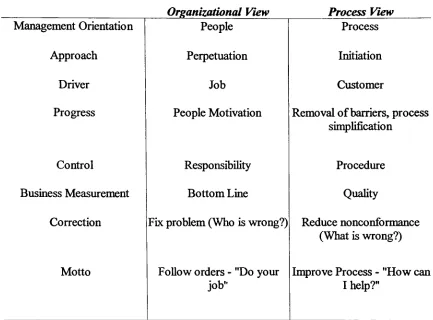
(SeeTable 3on next page)
This management style (process management) provides customer focus for
routine work. Adopting customer focus eliminates the interface between operations and projectmanagement. Ratherthandefining workinterms ofresponsibilities and systems, businesses are responsiveto the
customers'
requirements, and the processes which must be undertakento deliver products which meetthem(Turner, Peymai, and Stewart, 1995,
p.48).
Xerox is one company that has been extremely successful in utilizing process
management effectively. The Xerox Leadership through Quality strategy is based on
three elements; quality principles, management actions and behaviors, and quality tools
(Tennerand DeToro, 1992). Theseprincipals have enabledXerox to become a leader in
thecopierbusiness, andincreasetheir worldwide marketshare. Processmanagement can
beeffective only ifthewhole organizationis willing to commit to quality. This leads to
TABLE3
ProcessManagementinPerspective
Organizational View Process View
Management Orientation People Process
Approach Perpetuation Initiation
Driver Job Customer
Progress PeopleMotivation Removalofbarriers,process
simplification
Control Responsibility Procedure
BusinessMeasurement BottomLine Quality
Correction Fixproblem(Who iswrong?) Reducenonconformance (Whatiswrong?)
Motto Followorders- "Do your
job"
ImproveProcess- "How can
Ihelp?"
Source:Pall, Gabriel(1987). QualityProcessManagement, Prentice-Hall,Inc:
EnglewoodCliffs,NewJersey.
[image:27.566.67.500.120.440.2]Total Involvement
All organizations that engage in total quality management must have all of its
employees involved. Each department should have supporting functions in order to
ensure the desired output meets certain quality specifications. Total involvement is
necessaryto ensurecustomer focusand process improvement inan organization. This is
supportedbyDavid Kearns,thenPresidentofXerox, who statedin 1983:
Xerox isclearly ina period oftransition. Weare no longerthecompany weonce
were, and we are not yet the company that we must be. If we are to successfully
complete this transition and continue our record of success, every individual in the
corporation will have to work toward our common goals (Tenner & DeToro, 1992,
p.259).
Leadership/Management
Senior management possesses theability to make improvements that willlead to
continual successin an organization. Everydecision that impacts an organization starts
at the top. Business leaders are responsible to their customers, employees, and
stockholders to achieve successful results. Therefore, continuous improvement is a
challenge that all leaders must address, because their actions and decisions result in
success orfailureof a company. As J.WillardMarriot, Sr. once stated,"Successis never
final"
(Albrecht, 1988). Thisexemplifiesthe commitmentthathis companyhas takenin
regardto improvingservice quality.
Furthermoremanagement mustbeawarethat therightworkprocesses are inplace
for an organizationto succeed. Too oftenmanagers become fixatedonaprocess, and try
sohardto makeitmore efficient(Morano, 1994). Thisiswhere continuousimprovement
mustbe implemented. Ifa processis notworkingeffectively, leadership mustinvestigate
methods to improve service quality for the internal and external customers. Tenner and
DeToro state, that leaders must look at the following six questions before altering a processforcontinuousimprovement(1992). Theyareasfollows:
1. What is ourpurpose?(mission)
2. Whatdo wewantto become?(vision)
3. What do webelieve in?(values)
4. Whatguidancewillbeprovidedto employees oftheorganization?(policy)
5. What are the accomplishments that will fulfill our mission and attain our
vision?(goals)
6. How do we movetowardour vision and accomplish our goals?(methodology)
These questions are extremely important for those managers who seek to move
their business in an upward fashion. Leadership is an integral part of total quality
management, and ifthereis a lack ofdirection at thetop of an organization, then status
quo will prevail Senior management must possess a commitment to continuous
improvement, andtotalqualityprinciples. Albrecht asserts,thechief executive and other
senior managers must preach, teach, and reinforce the gospel of service quality (1988).
Management must create the conditions to make service excellence attainable and
worthwhile. If an executive is obsessed withquality improvement, employees at lower
levels ofthe organization will recognize how important it is. The following methods have beenused by senior management to improveprocesses fortheir employees, and in
thelongrun; thecustomer.
Empowering theWork Force
An employee who is empowered to solve problems when they arise is an
extremely important benefit to a company. Empowering involves passing on authority
and responsibility to the employee. Many organizations believe that a commitment to
continuous improvement by all members is necessary if their businesses are to remain
competitive (Wellins, Byham, and Wilson, 1991). Therefore, empowerment has proved
beneficial because employees are no longer waiting for a manager to make a final
decision on an issue. Employees are more active in determining the outcome of certain
business transactions. At Solectron, the employees are given the authority to stop the
production line at any time if they feel it is necessary (Hodgetts, 1994) Morano
continues, "empowerment is becoming a necessary condition in firms to be able to
compete in furiouslycompetitive global
markets"
(1994). Xerox and AT&T have also
been extremelysuccessfulin empowering employees.
Further, restaurants have now empowered servers to correct any problems that
may arise during a meal. Many now have the powerto offer complimentary meals ifa
guestis notcompletelysatisfied withhis/her diningexperience (Walkup, 1995). Theage
of empowermenthas seentheelimination ofthehierarchical business structure. In turn,
theemergenceofhorizontalcompanieshas becomecommonplace.
UtilizationofTeams
Another aspect of empowerment isthrough the formation ofteams. The concept
ofteams wasbroughtto theUnitedStates in the late 1970sbyWayne Rieker in an effort
to achieve quality improvement (Melan, 1993). Today, many leading corporations are
relying on self-directed work teams to accomplish organizational goals. Jerry Junkins,
theCEOofTexas Instruments states, "Nomatter yourbusiness, those teamsarethewave
ofthe future (Dumaine, 1990, p.52). So what is a team? A team is a small group of
individualswithcomplimentaryskillscommittedto aspecificgoal.
A survey asked senior managers the major reasons they were moving towards
self-directed work teams; the primary reason was to improve quality (Wellins, Byham,
and Wilson, 1991). Theresults attributed to teams can be found at such leading service
providers as, Federal Express, General Electric, Motorola, and AT&T. At Federal
Express, service errors (including such things as lost packages) were cut by 13%
(Dumaine, 1990). A team has been known to obtain better results than a collection of
individualsoperating inconfinedjobs.
Teamsaremore flexiblethanlargerorganizationalgroupingsbecause theycanbe
morequicklyassembled, deployed, refocused,and disbanded, usually in waysthat
enhance ratherthandisruptmorepermanent structures andprocesses. Teamsare
moreproductivethan groupsthathave no clear performance objectivesbecause
their members are committedto delivertangibleperformance results. Teams and
performanceare an unbeatable combination(Katzenbach & Smith, 1993,p.15).
There have been several phenomena on why teams perform so well. First, they
bring together complimentary skills and experiences, which exceed those of any
individual. Second, teams establish communications that support real-problem solving.
Third, they enhance the economic and administrative aspects of work. Finally, teams
have more fun because workers feel more relaxed and comfortable with one another
(Katzenbach and Smith, 1993). Finally, Wellins et al believe self-directed work teams
are established for the following reasons; they improve quality and service, provide
greater flexibility, reduce operating costs, and attract and retain the best people (1991).
Empoweredteams haveemerged as awayto get moreproductivity fromtheworkforce.
Quality Lessons from Baldrige Award Winners
The Malcom Baldrige Quality Award was created in 1987 in hope ofimproving
the overall competitiveness of United
States'
industries. The award is open to three
categories; manufacturing, services, and smallbusinesses. This honor is thehighest level
of national recognition for performance excellence that an American company can
receive. Richard Hodgetts performed an analysis of past winners and presents eight
lessonsthatare universalamong Baldrigewinnersforsuccess (1994).
Lesson 1: Formulatea Vision ofQuality
guidetodevelop aplan. Thisisevidentbythefollowing twoexamples:
Cadillac: The mission of the Cadillac Motor Car Company is to engineer,
produce, and market theworld's finest automobiles known foruncompromised levels of
distinctiveness,comfort, convenience, and refinedperformance.
Motorola: Dedication to quality is awayoflife at ourcompany, so much sothat
it goes far beyond rhetorical slogans. Our ongoing program ofcontinued improvement
reaches out for change, refinement, and even revolution in our pursuit of quality
excellence. Motorolawill pursue goals aimed attheachievement ofqualityexcellence.
Lesson 2: InvolveTopManagementfromtheStart
Thecompanies thatarecontinuously competing for theMalcom Baldrige Quality
Award hasits topmanagement involved in the totalqualityeffort. Senior managers bear
the ultimate responsibility for the success of organizations, and through their positions
havetheauthorityto setdirectionand allocate resources(Tennerand DeToro, 1992).
Lesson 3: FocusonCustomer Needs
As stated earlier in the section on customer focus, theneed for customer focus is
extremely importantto beasuccessfulorganization, becausethecustomer is king!
Lesson 4:Develop thePlanningandImplementation Processes
Award winning firms in the study did extensive planning for total quality by
determining the objectives to be attained and then devising a plan of action to be
implemented. This is accomplished by making sure that all of the departments in the
organization caneffectively attainqualityobjectives. At FederalExpress, twelve service
quality indicatorsmeasure qualityperformance. These indicators aretracked for overall
performance onadaily basis toensure quality.
Lesson5: Train Employeesto UseStatisticalProcessControl Tools
This step involves teaching the methods to the personnel and then allowing
employees to apply it in the workplace. At the Zytec Corporation, criticalquestions are
answeredusing thefollowing methods:
Lesson 6: Empower Employees
Baldrige organizations spend a great deal oftime encouraging their personnel to
become more involved in getting tasks accomplished. For example, the Ritz-Carlton
allowsemployees to spendupto $2,000to alleviatea problemfortheirguests.
Lesson 7: RecognizeandReward Employees
Recognition and awards are presented in a myriad of ways. Theycan range form
financial awards, vacation trips, a day off, aparking space, or a plaque. The ability to
recognize employees is beneficial because it makes the internal customer feel as ifthey
arehavinganimpactonthe success ofthecompany. Thecompanies intheanalysis each
hadunique recognition systems, buttheyalso shared thefollowing characteristicsintheir
effortsto acknowledge employees:
1. Recognition isalways positive and rewards success
2. Recognition is offered openly, and is publicized throughout the company or
department
3. Recognitioniscarefullytailored to needs ofthepeople
4. Rewardsare givenpromptly
5. Thereisarelationship betweentheachievementandtherewardisclearlyunderstood
Lesson 8: Make Continuous ImprovementanOngoingChallenge
All ofthe firms analyzed had a desire for continuous improvement. Two ofthe
most populartoolsutilized byBaldrigeAwardwinners werebenchmarking and six sigma
which aimed atimprovingtheirsystem ofdelivery.
The above lessons are beneficial to those companies that are serious about
continuous improvement. At Henry's, a number ofthese ideas were implemented in
ordertore-organizetheprocessesofservicedelivery.
CHAPTER III
Methodology
SettingofStudy
The study was conducted over twelve days in Henry's Restaurant, which is
locatedon thefourth floorofthe George Eastman Building onthe Rochester Instituteof
Technology. Henry's is a student-operated restaurant that is open to the public seven
weeks during eachacademic quarter. During the 1997 Fall Academic Quarter, the hours
of operation were 11:30a.m to 1:30p.m.
StudySample
The population used for this study included the lunch patrons at Henry's
Restaurant (the external customers), as well as the staff of Henry's (the internal
customers). Typically, the customers of Henry's are form both on and off campus.
Reservations are requested, due to the limited number of seats, but walk-ins are also
welcome.
ResearchInstruments Used
There were two instruments utilized to conduct this investigation. The Ultra
24/40 Hour Continuous Recorder KR5440 was used to time the wait staff in service
delivery. Also, theUltra 8 Camera System Model KZ0824A tapedeach member ofthe
Henry's staffat alltimes. Thesecameras were strategicallyplaced in the dining area of
the restaurant and the kitchen. The response times were calculated in the following
areas; promptness of greeting, beverage delivery, entree delivery, and check
presentation.
PeriodofDataCollection
The data was collected by Rochester Institute of Technology graduate students during the 1997 FallAcademicQuarter. Thisperiod started onSeptember25, and ended
onNovember 5, 1997. Therestaurant was open every Tuesday and Thursday for lunch
from1 1:30 am until 1:30 pm.
Procedures
This study was doneto analyzethe effects of a quality improvement processin a
restaurant environment. During the Fall Academic Quarter, students and faculty were
introducedto SPC conceptsinregardsto "frontofthe house" operations of a restaurant. A process flow chart was developed to illustrate how service was to be delivered at Henry's. Further, sub-processflowcharts weredevised to show who was responsible for
eachactivity ofthe service deliveryprocess. These sub processes were dividedinto four
categories; 1)greeting-seating ofcustomers,2)beverage service, 3) entree service, and4)
check pay-out.
Melan'
s six steps for improving products and services through process
management were implementedfor each sub process. A descriptionof each sub process
anditscorresponding flowchart are represented onthefollowingpages.
PromptnessofGreeting
The promptness of the greeting was performed by the host/hostess on duty.
Therefore, they possessed the ownership of the process. It was the role of the
host/hostess to seat the guests when they arrived, which meant that there were no other
boundaries with other co-workers. The process for
greeting-seating guests was as
follows. First, the customer arrives at the front door of Henry's and is greeted by the
host/hostess. Next, the customer is asked if they have reservations or if they are just
walking-in for lunch. If there are reservations, they are checked on the master list of
reservations forthe day. Menus are then counted out forthe number ofguests, and the
host/hostess seats the customers at a table. After this is completed, the host/hostess
returns to the greeting station to await future guests. There are two control points
present in this process. The first involves checking to see ifthere are reservations, and
the second is the response time from the
guests'
arrival until the actual seating. The
measurements are determined through the use of the Ultrak video camera and timing
device. Finally,feedback isprovidedthrough thecustomer assessment. (Figure1)
FIGURE 1
Customer Greeted by
Host/Hostess
Customer Arriveat Henry's
Host
Greetedby
Host/Hostess
Seats Guest
withMenu
Return to Host
Station
Counts Out
Menus
Tables
become
available
Asked towait and given approximate
timeof wait
BeverageDelivery
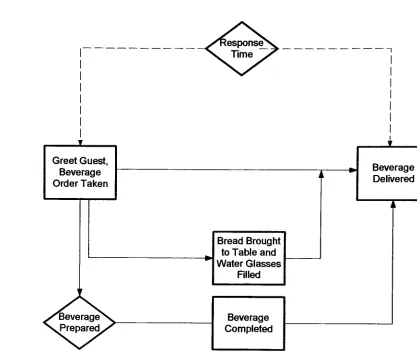
Ownership wasdivided intothreeareas fortheservice ofthebeverage. The
threeownerswerethewaitstaff, the bussers,and thebeverage staff. Eachownerhad a
specific boundary involved inthedeliveryofthebeveragetothecustomers. The guests
were greetedbythewaitstaff, andtheirbeverageorder wastaken.Thebeveragestaff
thenwas inchargeofpreparingthebeverage, whilethebuspersondeliveredthebreadto
the table. Also,thewait staffreturnsto take theentreeorderformtheguests. Whenthe
beverage orderiscompletedbythebeverage staff,itisdeliveredbythewaitstaff.
Therefore, theprocess startswiththegreeting andtaking ofthebeverage orderbythe
wait staff. Next, breadisdeliveredwhile thebeverageisprepared, and the entree order
istakenanddeliveredto thekitchenforpreparation. Finally, thebeverage is served. The
twocontrol points werethepreparation ofthebeverage andtheresponsetime fromthe
time thebeveragewas ordered untilthe timeit wasdelivered. Themeasurements were
determined through theuse oftheUltrakvideo camera andtimingdevice, while
feedbackwasgatheredfromthequalityassessment. (Figure2)
FIGURE 2
Beverage Order Taken and
Delivered
tesponsej
Time
Waitstaff
Busperson
Beverage
Staff
1r i
GreetGuest,
Beverage Order Taken
Beverage
Delivered
n *
M
Bread Brought
toTableand
Water Glasses Filled
'T
>^BeverageV
^Prepared,/' Beverage
Completed
Entree Delivery
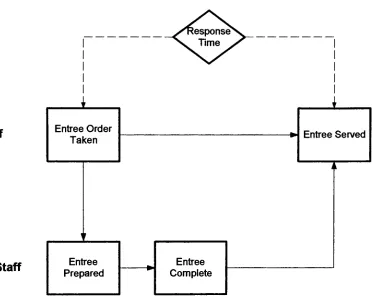
The ownership ofthis process belonged to the wait staff and the kitchen staff.
The boundaries were as follows; the entree order is taken by the wait staff and is
delivered to the kitchen for preparation by the kitchen staff. During this time, the
beverage is delivered by the wait staff. After the entree orders are completed, they are
delivered bythe wait staff. The process thenis as follows: the entree order is taken and
delivered to the kitchen to be prepared. Drinks are brought to the table and when the
entree(s) is complete, it is served. The two control points of this process is the
preparation oftheentree(s) and theresponse time fromthe ordering oftheentree until it
isserved. The measurements aredeterminedthrough the use oftheUltrakvideo camera
andtimingdevice, while feedback isprovidedbythequalityassessment. (Figure 3)
FIGURE 3
Entree Order Takenand
Delivered
^/^ResponseS^
^>^
TimeWait Staff
KitchenStaff
1 i\
Entree Order
Taken Entree Served
i '
it
Entree Entree
Complete
Prepared
Presentation ofCheckand Payment
The wait staff, cashier, and quality assessment team possess ownership ofthis
sub process. The boundaries are as follows; the check is prepared by the cashier, who
gives it to the wait staff for delivery. Next, payment is given to the wait staff who
delivers itto thecashier. Afterpayment isreceived,thequalityassessment teamdelivers
the electric commentcard forcompletion bythe guests. The process is very simple; the
meal is completed, the check is prepared, payment is made, and the assessment is
completed. The two control points used were the preparation ofthe check by the wait
staffand theresponse time from thecompletion ofthe meal untilthepresentation ofthe
check. Measurements were determined through theuse ofthe Ultrakvideo camera and
timing device. Finally,feedbackwas received fromthequalityassessment completedby
i
theguests. (Figure4)
(0 u M-E c >. O 3 +3 D-(0 c (0 LU 0 w c (0 Q. Q 4-* ^ ^ , , _ A 0) 3 o it
TJ *-
+-^
<
it
T5
o c a> ^^
O
Q.
iL
/
t>\--- _ x ^ <u x
x co ir y
\ o /
o/
T3
"O ?^
^ (0
-S 8 9 ^ 1'
S E o O ^ ^ ^ ' (0 ?J CO "
5 o o
CHAPTER IV
AnalysisofData
Data Collection
The goal ofthiscontinuous improvementproject was toimprovethe processes of
servicedelivery. Datawas collectedin a realtime and fora period oftwelve days (every
Tuesday and Thursday) the restaurant was open. The tabulated data was entered into
Microsoft Excel spreadsheet for tabulation. Then the tabulated data used Minitabs
(vl1.2) toproduce control chartsthatrepresented x-bar and range oftheinformation.
ControlCharts
Processcontrol chartsare usedtospecifytheupperandlower boundsofa sample.
Within theselimits liesthemean oftheaveragesfor thedatasample over a specific time
period. The upper control limit (UCL) is the highest boundary on the chart, while the
lower control limit (LCL) is the lowest boundary of the chart. Data is plotted within
these boundaries, and it enables researchers to find the mean and range of the samples
over the time ofthe research (Hayes, 1997). Control charts were used in this study to
illustrate themean and range ofthedatacollectedin Henry's forthefourareas of service
delivery.
Findings
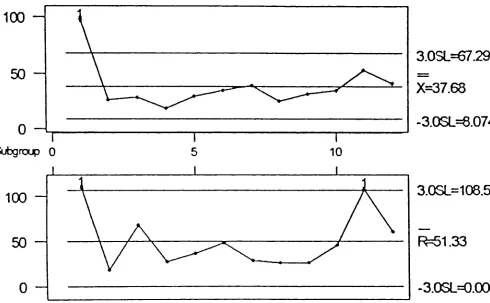
Figure 5 represents the x-bar and range forthe greeting-seatingprocess. In this
analysis, the mean time for this process was 37.68 seconds, with a range of 51.33
seconds. The mean and range of times gathered for day one were not very accurate.
Since thiswas the opening ofdayoftherestaurant, the staffmay have been uncertain of
their roles. Further, they were getting acquainted withthe SPC tools. The nextten days
ofoperation represent anincrease in service time. The analysis also showedthat groups
with six people or more took longerto seat than those with two orthree in a party. The
increased time to seat larger groups can be attributed to the staff being unprepared or
unfamiliar withseatingbiggroupsfor lunch(Marecki, 1998).
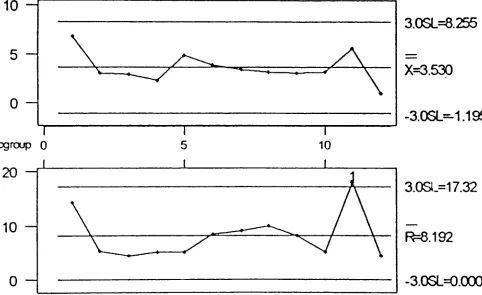
Figure 6 shows the x-bar and range for thebeverage service process. The mean
forthisprocess was 3.5 minutes,with a range of about 8minutes. Therangedatawas in
control over theperiod ofdata collection,except on the 11th daywhen therewas a large
number of groups with six or more guests. Onthisday, therange was out of control.
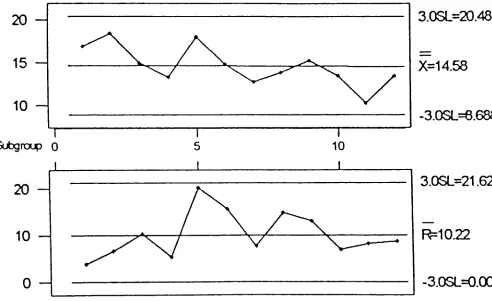
Figure 7 representsthe x-bar and rangefortheentree service process. The mean
time for the order to be taken and delivered was 14.58 minutes, while the range was
10.22 minutes. All of the data lie within the upper and lower control limits, which
indicatethat theprocess remainedincontrol duringthedurationofthe analysis(Marecki,
1998). Entree responsetimes were in control for theday withlarge groups, because the
kitchen staff was aware that they were coming in for this day. This was one occurance
wherethebackofthehousewasmoreadequatelypreparedthan the frontofthehouse.
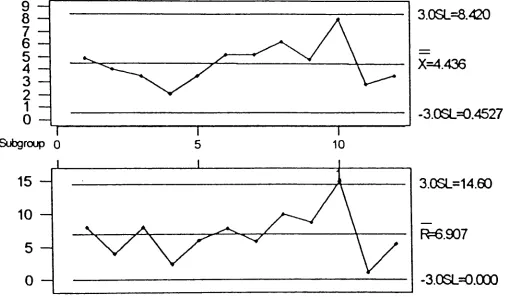
Figure 8represents the x-bar and range forthecheck-payout process. The mean
time from check presentation until change and receipt was4.43 minutes. The range for
this process was6.9 minutes. Almostall ofthedatawas within the control limits, which
means that theprocess was in control forthe durationofthe study (Marecki, 1998). On
day 10 thecashier was using the computersystem forthe first time, whichincreased the
meantimeforthisday.
FIGURE 5
Greet-Seat Response Time
Greet-Seat Time
(Sec.)
c 03
0J CD C CO
100
-50
-0 -L
Subgroup 0
100
H
50
-o
-10
3.0SL=67.29
X=37.68
-3.0SL=8.074
3.0SL=108.5
R=51.33
-3.0SL=0.000
[image:47.566.62.552.228.531.2]FIGURE 6
BeverageResponse Time
Beverage Response Time
(Min.)
10
5
-o
-Subgroup 0
20^"
10
-o
-10
3.0SL=8.255
X=3.530
-3.0SL=M.195
3.0SL=17.32
R=8.192
-3.0SL=0.000
[image:48.566.65.547.262.557.2]FIGURE 7
Entree Response Time
Entree Response Time
(Min.)
<D en
20
-15
-10
T
Subgroup 0 10
3.0SL=20.48
X=14.58
-3.0SL=8.688
3.0SL=21.62
[image:49.566.59.551.252.553.2]FIGURE 8
Check-PayoutResponse Time
Check-Payout
Response Time
(Min.)
9
-8
-7 -6
-5 H
4 -3
H
2
-1
0
r
Subgroup 0
15
-10
-5
-0
-_\
T
5
^7
10
3.0SL=8.420
X=4.436
-3.0SLO.4527
3.0SL=14.60
R=6.907
-3.0SL=0.000
[image:50.566.33.544.245.542.2]CHAPTER V
Conclusion and Recommendations
Conclusion
This studywas performedto improve servicequality in a restaurant environment.
Food service organizations are faced with strong competition and increased customer
demands today. It has become imperative thatcontinuous improvement is usedin order
to provide aquality product on a consistentbasis. Through the useof statistical process
control tools, Henry's implemented a program that has made it a state-of-the-art food
institution. Further, it has enabled future food service managers to learn how to
implement a continuous improvement process. This study was important because it
empowered the students to develop processes and then analyze what occurred in each
one.
The SPC tools will benefit each student who had an opportunity to be a part of
this program. However, this is not a one- time program.
"Quality improvement must
becomepart oftheculture ofan
organization"
(Marecki, 1998). This study was thefirst
step inthe turnaround ofHenry's Restaurant utilizingprocessimprovement.
Recommendations
Future studies may investigate the data that was compiled by the quality
assessmentteam. This datawas gatheredfromtheelectriccomment cardsthattheguests
filled-outaftertheirmeals were completed. Ibelievethatifthisis done, thenacomplete
analysis can be performed to see if process management has an effect on customer
satisfaction.
FIGURE 9 to U) c <u ro Q. 0> Q c"8 HI > h o> >.o <0 oi Q-(T I a>"D ao> o> > o> 01 mQ c o E Q > 3 C col
o co
U) Ct 3 oi CO T u a> t-c < U) </> A 01 TI </) 0) 01I i f) o X a>-a O) 0) 0) Q. > 0) CO Q. i c aj <u-SC c tu -o O o
TJIt o> (j
m o
\-If?
o> jK oi [image:52.566.75.502.60.680.2]BIBLIOGRAPHY
Albrecht,KarL (1988). AtAmerica'ssevice. New York: Warner Books.
Anttila, Juhani (1998). Process management. On-line reference:
www.finnevo.com.
Barett, Colleen. (1994, March). Service begins at home. Sales and Marketing
Management. 131T 27-28.
Born, Gary. (1994). Process management to quality improvement: The wayto
design, documentandre-engineerbusinesssystems. New York: JohnWiley& Sons.
Brown, Stanley. (1995, July). You can get satisfaction: Progressive companies
take time to listento theircustomers. SalesandMarketingManagement, 147, 106-107.
Cross, Richard H. (1992, October). The five degrees of customer bonding.
DirectMarketing, 55, 33-35.
Hayes, B.E. (1997). Measuring Customer Satisfaction. (2nd Ed.), Milwaukee,
WI: ASQCQualityPress.
Hodgetts, Richard M. (1994, July-August).
Quality lessons from America's
Baldrigewinners. BusinessHorizons,37,43-51.
Hyden,Howard E. (1991,April 1). Outside-incustomerfocus: it maybetheonly
wayto surviveinthe 1990s. IndustryWeek,240,34.
Katzenbach, J. R. & Smith, D. K. (1993). The wisdom ofteams. New York:
Harper Business.
LBMS,Inc. (1997,May 19). Processmanagement andbestpractices.
On-linereference: www.lbms.com.
Marecki, Richard. (1998). Managing service quality through process
improvement: using spctoolsina restaurant environment. Praxis(1) (inprocess).
McDougall, Duncan. (1995, August 7). Knowthy customer. The Wall Street
Journal,p.A12.
Melan, Eugene. (1993). Process management: Methods for improvingproducts
andservice. New York: McGraw-Hill.
BIBLIOGRAPHY
Melan, Eugene. (1995). Process management: A systems approach to total
quality. Portland: ProductivityPress.
Morano,Richard. (1994). Thefive fatal flawsof managers: Howto avoidthe five
worst managementpractices. EastRockaway,NY: Cummings &HathawayPublishers.
Pall, Gabriel A. (1987). Quality process management. Englewood Cliffs, NJ:
Prentice-HalL Inc.
Tenner, A. R. &DeToro, I. J. (1992). Total qualitymanagement: Three stepsto
continuousimprovement. MenloPark,CA:
Addison-Wesley PublishingCo.
Turner, J. R., Peymai, R., & Stewart, K (1995, Autumn). Processmanagement:
the versatile approach to achieving quality in project based organizations. Journal of
General Management, 21, 47-62.
Walkup, Carolyn. (1995, October 9). Sidney'spropels growththroughcustomer
focus. Nation's Restaurant News. 29. 38-40.
Weiss, W.H. (1997, July). Promoting quality through training and employee
performance. Supervision, 58, 3-6.
Wellins, R. S., Byham, W. C, & Wilson, J. M. (1991). Empowered teams:
creating self-directed work groups that improve quality, productivity, and participation.
San Francisco:Josey-Bass, Inc.
Whiteley, Richard (1994, June). Are you driven to action? Sales & Marketing
Management, 135. 31-33.
Zemke, Ron. (1997, March). The service revolution: who won? Management
Review. 86. 10-16.