Theses Thesis/Dissertation Collections
5-1-2007
Rub, fold, and abrasion resistance testing of digitally
printed documents
Nicholas DiSantis
Follow this and additional works at:http://scholarworks.rit.edu/theses
This Thesis is brought to you for free and open access by the Thesis/Dissertation Collections at RIT Scholar Works. It has been accepted for inclusion in Theses by an authorized administrator of RIT Scholar Works. For more information, please [email protected].
Recommended Citation
Rub, Fold, and Abrasion Resistance Testing of Digitally Printed Documents
by Nicholas E. DiSantis
A Thesis submitted in partial fulfillment of the requirements for the degree of Master of Science
in the School of Print Media
in the College of Imaging Arts and Sciences of the Rochester Institute of Technology
May 2007
School of Print Media Rochester Institute of Technology
Rochester, New York
Certificate of Approval
Rub, Fold, and Abrasion Resistance Testing of Digitally Printed Documents
This is to certify that the Master’s Thesis of
Nicholas E. DiSantis
has been approved by the Thesis Committee as satisfactory for the thesis requirement for the Master of Science degree
at the convocation of
May 26, 2007
Thesis Committee:
________________________________________
Primary Thesis Advisor
________________________________________
Secondary Thesis Advisor
________________________________________
Graduate Thesis Coordinator
________________________________________
Graduate Program Coordinator
________________________________________
Copyright © 2007 Nicholas E. DiSantis
Rub, Fold, and Abrasion Resistance Testing of Digitally Printed Documents
I, Nicholas E. DiSantis, hereby grant permission to the Wallace Memorial Library of R.I.T. to reproduce my thesis in whole or in part. Any reproduction will not be for commercial use or profit.
In loving memory of Nicholas Myron DiSantis
Founder of Quality Printing Company
Acknowledgements
I would like to thank my mother, Judith, and my father, John DiSantis, for their
love and support throughout my academic career. These two individuals have provided
me with the tools necessary to get as far as I have come today. I would also like to thank
my Thesis Committee for giving me the necessary feedback and support that allowed for
the completion of this research and creation of this document. Lastly, I thank my sister,
Table of Contents
Table of Contents ... vii
List of Tables... ix
Abstract ... xi
Chapter 1 Introduction ...1
Background ...1
The Problem ...2
Significance ...3
Reasons for Interest in the Study ...5
Chapter 2 Literature Review ...7
Introduction ...7
Life Cycle Terminology and Focus ...9
Stress Induction on Print ... 10
Processes in the Printing Stage ... 12
Processes in the Finishing Stage ... 15
Processes in the Mail Preparation and Mailing Stage ... 16
Processes in the Fulfillment Stage ... 18
Processes in the Distribution Stage ... 20
Processes in the Usage Stage ... 22
Processes in the Recycling Stage ... 24
Summary and Conclusion ... 26
Chapter 3 Research Questions... 28
Chapter 4 Project Methodology ... 29
Overview ... 29
Chapter 5 Results ... 37
Introduction ... 37
Taber Abrasion Test Results ... 43
Sutherland Rub Test Results ... 48
Chapter 6 Summary and Conclusions ... 55
Recommendations for Further Research ... 58
Bibliography ... 60
Appendix A Assessment of Digital Printing Permanence Issues Actual Survey and Results ... 66
Appendix B Testing Procedures Performed... 69
Taber Abraser Testing Procedure ... 70
Sutherland Rub Tester Testing Procedure ... 71
Fold Testing Procedure ... 72
Appendix C Actual Test Targets Run for Testing ... 74
List of Tables
Table 1. Areas of printing that digital technology is taking over ...5
Table 2. Stress types, testing, and instruments... 12
Table 3. Stresses induced on a print in the finishing stage of the life cycle ... 16
Table 4. Processes in the mail preparation and mailing, fulfillment, and distribution stages... 21
Table 5. Processes in the user stage ... 23
Table 6. Materials used to print the test targets... 29
Table 7. Testing summaries ... 33
Table 8. Settings for the GretagMacbeth SpectroEye ... 41
Table 9. Response to question #1 ... 67
Table 10. Response to question #2 ... 67
Table 11. Response to question #3 ... 68
Table 12. Response to question #4 ... 68
Table 13. Taber Abrasion test data ... 77
List of Figures
Figure 1. Actual results from the wetting technique used to determine machine and cross
machine direction... 32
Figure 2. Original samples with machine direction noted ... 40
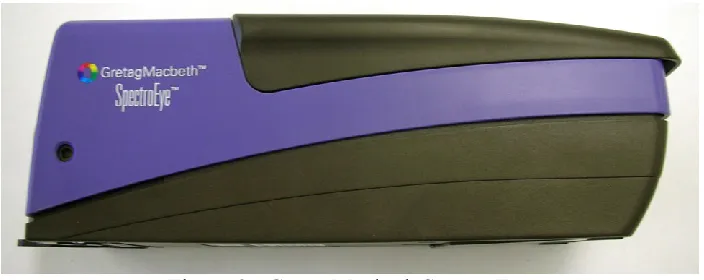
Figure 3. GretagMabeth SpectroEye ... 41
Figure 4. Actual density reading on the GretagMacbeth SpectroEye before an abrasion test ... 42
Figure 5. Taber Abraser testing instrument ... 43
Figure 6. Commercial Digital Press B sample run on the Taber Abraser ... 44
Figure 7. Taber Abrasion test: average change in density per press ... 45
Figure 8. Taber Abrasion test: average change in Delta E per press ... 46
Figure 9. Taber Abrasion test: average change in the Abrasion Resistance Index ... 47
Figure 10. Sutherland Rub Tester ... 48
Figure 11. Sutherland Rub Tester in action with a sample from Press C ... 49
Figure 12. Sutherland Rub Test: average change in density per press ... 50
Figure 13. Sutherland Rub Test: average change in ∆E per press ... 51
Figure 14. Sutherland Rub Test: average of the abrasion resistance index per press ... 51
Figure 15. Folding instrument complete with angled steel board and 2kg weight ... 52
Abstract
The life cycle of commercially printed digital documents (in particular, marketing
and promotional items, direct mailers, business communications, and on-demand color
books) was examined to find stress points where potential permanence problems could
exist. The stress and life cycle overview covers the stages of processes in printing and
finishing, mailing preparation and fulfillment, distribution, usage, and recycling. Stress
points found in the different stages of the life cycle, whether physical or chemical,
include (but are not limited to) scratching, rubbing, cracking, solvent exposure, light
exposure, moisture exposure, heat exposure, and air contamination exposure.
Tests for abrasion resistance, folding resistance, solvent resistance, light-fastness,
water-fastness, thermostability, and gas/ozone fastness were researched. Based on a
survey given to randomly selected printers, printing press vendors, and print buyers, the
tests for abrasion resistance, folding resistance, and rub resistance were selected. Using
offset lithography as a benchmark, three commercial digital presses as well as high-speed
ink jet technology were included in this testing.
Using a combination of solid circular test targets and the “Three Musicians” test
target (an image for visual comparisons), the Taber Abraser testing method, the
Sutherland Rub testing method, and a folding procedure outlined in ASTM document
F 1351 were used to examine and to compare the five presses in this study (three
commercial digital presses, one offset lithographic press, and one high-speed ink jet
press). After testing was performed, visual ranking, changes in density, Delta E, and the
Testing results showed that the high-speed ink jet held up the best in each test
performed during this research; however, the image quality of the high-speed ink jet press
was less than the image quality of any other press in this study. The second best
performer in the testing was the offset lithographic press. The test performance of these
particular presses, as compared with the commercial digital presses, was attributed to the
different drying methods in each of the different printing technologies. In the ink jet and
lithographic presses, the evaporation, absorption, and oxidation drying methods seemed
to hold up better to the testing performed than the drying method of toner-based
technology. With oxidation and evaporation, the image (i.e., the ink) actually becomes a
part of the paper after drying, whereas, in toner technology, the image (i.e., the toner) is
fused to the paper and actually sits on top of it. Within the digital printing industry,
coatings have been put in place to alleviate some of these problems, but they have not
been tested here. This research shows that offset lithography is the dominant technology
Chapter 1
Introduction
Background
Digital printing is increasingly used today across a wide range of products. Some
digital prints are used for marketing, others for books, and still others for lasting
keepsakes. Regardless of the intended use, every printed product has a life cycle, and the
product is expected to meet or exceed that life cycle. However, based on personal
experience and comments from professionals involved in digital printing, some printed
products cannot live up to the customer’s expectations. This leads users to consider the
limitations of digital printing in terms of permanence.
As defined by Delmar’s Dictionary of Digital Printing and Publishing (1997),
permanence is described with relevance to a paper’s (i.e., substrate) ability to resist
change in its characteristics and properties over a length of time (Romano). In this
research, permanence also includes the printed image’s ability to resist changes in
characteristics and properties over a period of time. The definition of permanence is
highly dependent upon the type and purpose of the printed product that one is rating. For
example, the Declaration of Independence is an important document archived in
Washington, D.C. This document has very different permanence expectations than that
of a daily newspaper, which needs to last a mere fraction of the time; thus, the definition
defined in terms of the appearance of a final printed product, specifically resistance to
light exposure, density changes, scratching/abrasion, humidity, water exposure,
smearing/rubbing, and chemical exposure (i.e., ozone) (Johnson, 2003).
Independent researchers, educational facilities, manufacturers, vendors, and
distributors today are doing much research in the permanence field; however, these
researchers have focused more on permanence issues of desktop printing technology
(Johnson, 2003). Much less research on the commercial segment of the industry has been
conducted.
This document examines the life cycle of marketing and promotional documents,
direct mailers, transactional and business documents, and on-demand color books. Its
goal is to point out stress points in the life cycle by performing tests to see how certain
printing technologies hold up against these stress points.
The Problem
Although Henry Wilhelm, president of Wilhelm Imaging Research, Inc., has
conducted much independent research testing permanence of desktop ink jet systems,
similar testing in the digital commercial sector is lacking. Press manufacturers and
vendors most likely do their own testing, and the Rochester Institute of Technology (RIT)
Printing Applications Laboratory has also been approached to conduct testing, yet little
research relating to this topic has been published to this researcher’s knowledge. In
addition, permanence seems to be an issue in the printing industry, regardless of the
With the growing popularity of print on demand, variable data, short-run printing,
etc., the commercial digital printing sector is in need of permanence performance
measures. Based upon an examination of the digital product life cycle and results from
specific testing, this research will benefit RIT, as well as printers, print buyers, and
vendors in the following ways:
Printers and print buyers can assimilate the strengths and limitations of current
commercial digital printing with their production needs.
Printers and print buyers can determine what stresses digital products can
withstand before the print run begins, rather than after the print run, when it is
too late.
Printing press manufacturers can identify some areas where their products
need improvement.
Significance
Raymond Prince of North American Printing Leadership (NAPL) states that rub
resistance during the mailing process is of particular concern to many of his current
clients (personal communication, 2006). In this research, rub resistance, abrasion
resistance, and other categories of stresses that occur during the mailing stages of the
product’s life cycle are being tested.
Another significant fact is that the markets for direct mailing, variable data,
growing daily. Direct mailing accounted for over $29 billion, or 11%, of the United
States advertising expenditures in 1998 (The Status and Future of Direct Mail, 1999). In
2005, this expenditure increased to $70 billion. With over $70 billion worth of print
being mailed, and digital technology gaining market share exponentially, permanence is a
major problem. It is a problem that must be dealt with quickly if digital printing is to
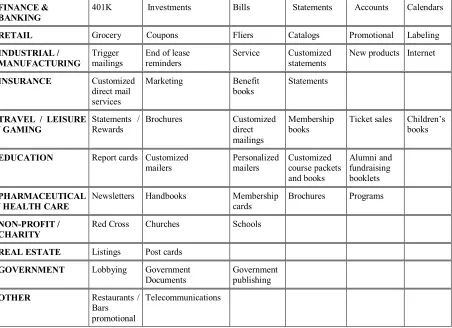
continue to capture market share (2005 Tech Forecast, 2005). Table 1 identifies by sector
Table 1. Areas of printing that digital technology is taking over (Source: Graphic Arts Marketing Information Service 2004)
FINANCE & BANKING
401K Investments Bills Statements Accounts Calendars
RETAIL Grocery Coupons Fliers Catalogs Promotional Labeling
INDUSTRIAL / MANUFACTURING
Trigger
mailings End of lease reminders Service Customized statements New products Internet
INSURANCE Customized direct mail services
Marketing Benefit
books Statements
TRAVEL / LEISURE / GAMING
Statements / Rewards
Brochures Customized direct mailings
Membership books
Ticket sales Children’s books
EDUCATION Report cards Customized
mailers Personalized mailers Customized course packets and books
Alumni and fundraising booklets
PHARMACEUTICAL / HEALTH CARE
Newsletters Handbooks Membership cards
Brochures Programs
NON-PROFIT /
CHARITY Red Cross Churches Schools
REAL ESTATE Listings Post cards
GOVERNMENT Lobbying Government Documents
Government publishing
OTHER Restaurants / Bars promotional
Telecommunications
Reasons for Interest in the Study
Having worked and become certified as a commercial digital press operator
before attending RIT, this researcher was drawn by a personal issue to the study of
permanence in digital printing. Being involved in a family-owned printing business that
has invested in a commercial digital press, this researcher has become aware of the many
problems that digital prints have throughout the finishing, distribution, and mailing
other stresses throughout the products’ life cycle. The press manufacturers do not offer
many solutions to fix the problem, so this researcher has become interested in finding out
how to deal with the problems.
A review of the literature has revealed only a few published resources relating to
permanence of commercial digital documents. Problems have been found, not only in the
lack of permanence research, but also in the post-printing stage of commercial digital
product life cycles. Of particular concern are the problems with digital prints during the
mailing process. Some printing cannot withstand the mailing process, which is costing
the industry in reprinting costs and dissatisfied customers.
It is up to the press manufacturers to remedy problems with their technology and
to offer solutions to problems that are identified in this research. Based on carefully
chosen testing to mimic real-world stresses induced on prints, assessments and
comparisons are made that can be used to predict the performance of certain documents
printed by specific presses, according to their end-use requirements.
Chapter 2
Literature Review
Introduction
With technology expanding at an incredible rate, printing has gone through many
changes, the most recent phase being the digital revolution. Digital technology has
brought with it more automation and better efficiency, and has made many earlier
processes close to obsolete (Cost, 2005). Despite all of these exciting attributes that the
digital era brings to the printing industry, it has also created new permanence issues. As
defined earlier by Delmar’s Dictionary of Digital Printing and Publishing, permanence is
described with relevance to a paper’s ability to resist change in its characteristics and
properties over a length of time (Romano, 1997). For the purpose of this research,
permanence is anything that alters the appearance of a final printed product, specifically
resistance to light exposure, density changes, scratching, humidity, water exposure,
smearing, and chemical exposure.
Permanence in digital printing has as much to do with the printing process as with
the ink and substrates used. The issue of permanence begins with the printing process,
yet many other variables come into play when one takes into consideration finishing
product that is used for a mailing will require different properties than those of another
kind of product, such as a map.
The main objective of this study focuses on the life cycle of digital prints and the
stress points in each stage of the life cycle that may pose problems in the performance
and/or permanence of the digital piece. These stresses, including the chemical and
physical stresses, will be discussed from the printing and finishing stages of the product
life cycle all the way through the recycling stage.
This study is also limited to the following four categories of digital documents:
marketing and promotional pieces, direct mailers, transactional and business documents,
and on-demand color books. These four categories have been selected because they have
been identified by printing industry leaders as being a major part of the future of digital
color print (Frey, 2006). According to Andrew Paparozzi, of NAPL (2005), “Demand
for color, design, and customization is growing as clients recognize the power of timely,
visually compelling, personalized printing” (n.p.). The documents in this study all stem
from this statement by Paparozzi in the NAPL State of the Industry Survey. This belief
of the exponential growth expected of digital printing is further discussed by Davis
(2005):
Life Cycle Terminology and Focus
According to Frey (2006), life cycle theory:
…is described as a framework for describing a system in constant change. The change is described as the development that these systems undergo throughout the stages of its life cycle. A stage will therefore require processes that are adjusted to the development of that particular stage. Even though life cycle theory has its origin in biology, it has spread into less organic sectors such as the software industry, the managerial field, electrical engineering, environmental research, and architecture and construction. Due to the diversification of these scientific and industrial areas, divergent life cycle terminologies have been created (n.p).
Secondary research on life cycle theory revealed only findings outlining the
transformation from electronic forms to print or microfilms; nothing was found outlining
the life cycle of documents within the four categories discussed in this research.
Therefore, working backwards, here we define a life cycle that works for this research
and apply a similar source to each stage of the life cycle. One life cycle theory that
proved promising and fitting relates to the industrial sector, as stated by Järvenpää
(2004):
The industrial cluster is working with very complex entities, which are associated with huge amounts of knowledge. The life cycle theory provides a mental framework for this environment. It claims the different stages of a product or service require different operations performed. The approach emphasizes the complexity of issues and provides an opportunity to define what is important in each stage of the development (p. 6).
Similarly, this research has been confined to the life cycle of digitally printed
documents between the printing phase and recycling phase of a document’s life cycle.
These stages are the printing, finishing, distribution, usage, and recycling stages. This
physical or chemical, are introduced to the product. However, since we have a set of four
different categories of documents being researched here (all of which may differ in
production in some way), an overview of certain processes and the stages in its life cycle
is provided (Frey, 2006).
Stress Induction on Print
There are many variables among the characteristics of the document types
examined in this study, as well as the methods for printing them. For this reason,
whether we are using ink jet, dry, or liquid toner, the type of substrate and the
formulation of colorants play a role in the type of stress induced on the prints.
Toner-based technologies are more susceptible to certain stresses than ink jet technology, and
vice versa. Differences are also seen in stresses between dry and liquid toner
technologies (Frey, 2006).
Efforts to improve permanence in ink jet technology have been focused on the
following six fields: light-fastness, humidity-fastness, thermostability, solvent-fastness,
water-fastness, and gas-fastness. Although ink jet does not seem to have many problems
with abrasion, the preceding fields still remain problematic. This problem requires
changes in not only the ink, but also the substrates that we are printing on (Kitamura,
2003).
Discussing toner technology, Sastri and Sankaran (2003) state, “Print evenness,
toner adhesion, and good optical quality is essential…The output should be free of
Adhesion properties in toner technology are quite important and are dependent upon the
following factors: the substrate, the toner type, and the fusing system. Pigments in toner
do not show affinity towards the surface of a particular substrate and, therefore, render
the resin in the toner the underlying factor in the adhesion process between the toner and
substrate. Sipi (2003) describes this problem further:
There are a few main theories for explaining the principles of adhesion on polymeric materials, but they have not been directly structured for toner adhesion. The general theories entail both mechanical and chemical adhesion. When paper is the receiving layer, both types of adhesion are involved (p. 145).
This adhesion problem with toner technology can wreak havoc on a print run in
the post press operations and/or in the distribution process. Mailing can also be
particularly harmful to toner-based digital prints. The equipment used by the United
States Postal Service (USPS) to sort mail uses spinning wheels that can abrade the
surfaces of the print. The heat generated by these wheels can reach and exceed “…[the]
glass transition temperature (Tg) of the resin used, which can cause contamination with
pigmented toner resin on the next coming papers” (Deprez, 2003, p. 487).
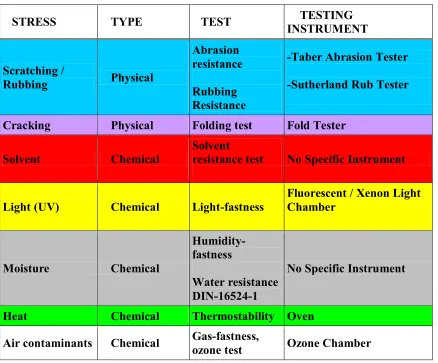
Keeping the preceding factors in mind and bringing in other permanence
problems with printing, this researcher has developed Table 2 which shows specific test
types that this research will focus on, the specific tests that can be done, and the testing
Table 2. Stress types, testing, and instruments (Source: Frey, 2006)
STRESS TYPE TEST INSTRUMENT TESTING
Scratching /
Rubbing Physical
Abrasion resistance
Rubbing Resistance
-Taber Abrasion Tester
-Sutherland Rub Tester
Cracking Physical Folding test Fold Tester
Solvent Chemical
Solvent
resistance test No Specific Instrument
Light (UV) Chemical Light-fastness
Fluorescent / Xenon Light Chamber
Moisture Chemical
Humidity-fastness
Water resistance DIN-16524-1
No Specific Instrument
Heat Chemical Thermostability Oven
Air contaminants Chemical Gas-fastness, ozone test Ozone Chamber
Processes in the Printing Stage
Electrophotography
Many of the printing presses used in digital printing use electrophotography,
which is much different than conventional printing technologies. This process, combined
with digital imaging systems that the presses are equipped with, has provided a niche for
cost-effective, short-run, high-quality printing. Unlike conventional offset printing
substrate, data can now be sent directly to the press from a computer and from the
computer file; it can then be printed within minutes with little set-up time. Digital press
technology is quite different than that of traditional offset; yet it has become strikingly
similar to offset in quality (Digital Offset Introduction, n.d.). With electrophotography,
as stated before, the ink sits atop the paper and does not sink into the actual substrate, as
other printing processes are designed to do (Fischer, 2005). All three commercial digital
presses studied here share this attribute. While this process yields bright and vibrant
colors, it also exacerbates the permanence problem because the ink is not actually part of
the paper; it is merely fused to it. The finished product from a digital press is susceptible
to scratching and can be altered by finishing techniques or other elements, such as
mailing, ultraviolet exposure, chemical exposure, and humidity (Krasne, 2002).
Electrophotographic printing is a big business and accounts for approximately
12% of the total paper purchased in 2003. The commercial digital presses in this study
all use some form of electrophotography to print. This process uses electricity and
positive and negative charges to attract and to repel inks and toner to an image. The
image is first exposed to a photoconductive drum or belt using lasers and/or rotating
mirrors. Once the image is exposed to the drum, an image area is created which is
negatively charged. The drum is then exposed to positively charged toner particles,
which cling only to the negatively charged image area on the drum. The image area now
contains the toner, which remains positively charged on the drum and is carried around
until it contacts the substrate, which also has a minimal charge, allowing the toner to
dry or liquid; once on the substrate, the toners pass through rollers, which, depending on
the press and the process, fix the toner to the substrate, using either hot- or cold-setting
methods. The end result is the toner (thermoplastic powder or liquid) dries immediately
atop the substrate and is ready for finishing or for its particular end use (The Effect of
New Printing, 2003).
Ink Jet Technology
Ink jet technology differs from electrophotography, in that the ink does not sit
atop the paper; it is absorbed much like it is in offset printing. The ink used in ink jet
printers applies ink directly to the substrate in small drops from ink-dispensing nozzles.
Because the ink is applied directly from the nozzles to the substrate, the type of paper
used is extremely important (Kipphan, 2001).
Instead of being fused, as in electrophotographic technology, ink jet technology
uses a combination of evaporation and absorption to print, with water- and solvent-based
inks (Kipphan, 2001). In effect, the major difference between toner-based digital printing
and ink jet printing is the absorption. Toner does not absorb into the substrate, as the inks
do in ink jet printing. Therefore, abrasion and adhesion permanence is not much of an
issue when it comes to ink jet. On the other hand, toner-based digital printing has many
Processes in the Finishing Stage
Electrophotographic digital printing, as previously stated, has many problems
with abrasion and adhesion. The finishing process that prints are put through, post-press,
introduce many of these types of stresses on digital print.
Processes in the finishing stage include folding, stitching, binding, cutting, and
die cutting. As Kipphan (2001) explains:
Folding is the sharp-edged bending of paper webs or sheets under pressure at a prepared or unprepared bending point along a straight line according to specified dimensions and folding layouts (p. 796)…[Stitching is] a for-fit jointing method. With wire-stitching binding, wire staples are pushed through sheets of a block and closed on the underside (p. 839).
Wire comb binding can be split into three different sections: wire-o bound,
plastic bound, or spiral bound. In all three cases, a metal or plastic wire is inserted into
holes drilled into the sample, and the sample is bound. Perfect binding can be split into
two sections: notch binding/tape binding, and flexo-stable binding. Kipphan (2001)
describes them both:
Notch binding: This process (also referred to as perforating binding) occurs in two stages. Firstly the back edge is perforated in the folder using a special punch knife, so that the grooves can be filled with adhesive. Gluing the spine and back stripping of the block takes place in the perfect binder. The spine routing station is put out of action.
Flexo-stable binding: Flexo-stable binding describes the aim of obtaining maximum perfect binding strength. Here the back edges in the area of the head and foot trim are not routed off. This requires an additional control of the routing unit in the perfect binder. To reinforce the opening hinge and to counter-balance the spine, a felt strip is glued in the area routed off. The join is covered with a backing strip. (p. 832)
Die cutting can be compared to the use of a cookie cutter to punch out large
much larger scale for printing. Lastly, Kipphan (2001) describes this process for cutting
and trimming: “blocks for hard covers and brochures are cut on one, three, or four sides
to the final format, whereby the closed fold edges on the head, foot, and front side of the
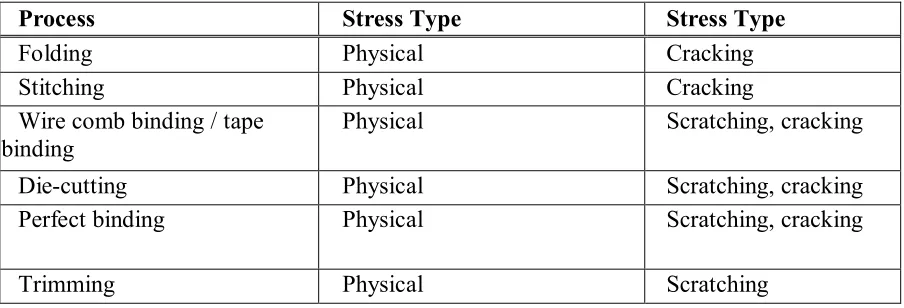
block are eliminated, if this is intended for the product” (p. 842). Each of these processes
[image:29.612.99.551.287.441.2]exerts stress on the printed product, as seen in Table 3.
Table 3. Stresses induced on a print in the finishing stage of the life cycle (Source: Frey, 2006)
Process Stress Type Stress Type
Folding Physical Cracking
Stitching Physical Cracking
Wire comb binding / tape binding
Physical Scratching, cracking
Die-cutting Physical Scratching, cracking
Perfect binding Physical Scratching, cracking
Trimming Physical Scratching
Processes in the Mail Preparation and Mailing Stage
The mailing process is particularly grueling for all printed pieces, but particularly
for digitally printed pieces. Direct mailers created with toner-based, digital printing
typically experience more damage than do direct mailers created by any other printing
technology. According to C. Clint Bolte (2005), reporting on the PIA/GATF Tech Alert
2005 Conference, “It seems that the various USPS (United States Postal Service)
high-speed sorting equipment scrape, scuff, scratch, and rub the digital toners leaving streaks,
(p. 4). Bolte also indicated that press vendors have provided coatings to try to combat
this problem, and although it has helped, it has definitely not eliminated the problem.
Companies dealing with direct mailings are usually not concerned with light and
ultraviolet radiation fading the prints. Normally, direct mailings are not archived and are
more of a marketing tool than anything else; hence, the shelf life of these documents is
not very long. However, image quality and the overall look of the final document when it
reaches the end user are important in this thriving field of printing. Therefore, humidity,
water exposure, temperature, smearing, handling procedures, and scratching are all areas
of permanence that a printer needs to be aware of when printing bulk mailers (Bolte,
2005).
Humidity and water exposure can also negatively affect printing. They not only
affect the substrate, but distort the inked image on the substrate, as well. This is a much
bigger problem during the summer in Northern climates and in the South where humidity
and temperature are regularly high. High humidity, coupled with high temperatures, will
curl paper and speed up the chemical decomposition of the printed piece. In colder
regions, humidity in the winter is of little concern; however, water exposure in all
climates is a major concern, especially for bulk mailers. Mail may travel long distances
and cover a wide array of climates in a short period of time. It can be exposed to rain,
snow, or other weather-related phenomenon. Bulk mailers must be able to withstand this
exposure and still look presentable when they reach the end user (Johnson, 2003).
PIA/GATF has teamed up with the USPS, printing press vendors, printers, and
problems the industry is having with digital mailers. Their primary objective is to see
how the different treatments of ultraviolet coatings, aqueous coatings, or varnishes affect
the performance and permanence of the digitally printed piece throughout the mailing
process. They soon realized that this would not be the core of their research (Bolte,
2005).
The USPS states that their sorting equipment was primarily designed to handle
standard-sized envelopes. The majority of digital mailings are not standard-sized
envelopes and are, in fact, quite the opposite with savvy designers getting more and more
creative every day. A 2005 mailing study revealed that less than one-third of the mailers
arrived at the destination and more than one-quarter were damaged. This leaves much
work to be done, as this problem is a high priority for interested parties. Since more and
more mail is printed digitally, this problem needs to be addressed and solved
immediately. As of June 21, 2006, the final results of the PIA/GATF joint study have not
been released (Bolte, 2005).
Processes in the Fulfillment Stage
Mailing and fulfillment are usually tied together because sometimes fulfillment
can include mailing. Whatever the case, fulfillment is viewed as a value-added service,
which more and more printing companies today claim to be involved in. According to
Twyla Cummings’ Industry Trends in Fulfillment, Finishing and Distribution (2004),
fulfillment is defined as “the storing and distribution of products directly to end users,
states what fulfillment is all about: the customer. As competition in the printing industry
increases, this simple definition continues to mean much more (Cummings and Chhita,
2004).
Fulfillment services have grown from simple operations to multifaceted,
real-time, Internet-based programs that customers can work and monitor directly. These
interfaces can monitor and allow the customer to interact with storage, management, and
distribution concerns of their products at the click of a button. Print buyers want a
“one-stop shop for it all,” and fulfillment houses are supplying just that (Cummings and
Chhita, 2004).
According to Cummings and Chhita, the three types of fulfillment are literature
fulfillment, product fulfillment, and Internet fulfillment or e-fulfillment. They state:
[Literature fulfillment is the]…physical distribution of company information such as brochures, point-of-purchase (POP) displays, and product catalogs. Typically, the customers request the assistance of the printer in designing, printing the informational document, product finishing, warehousing, and ultimately distribution to individuals and businesses.
[Product fulfillment is the]…distribution of goods such as magazines, CDs, audiotapes, free samples, and premiums to retail outlets, subscribers or consumers. Typically, for example, the printer would assemble kits containing printed postcards, booklets, and other promotional items and then ship them directly to the customers.
Fulfillment incorporates many stages in a product’s life cycle; therefore, it is a
significant area to study. Internet fulfillment obviously has no bearing on the product
life-cycle stresses because there is no printed product; however, literature and product
fulfillment cover a wide array of stresses. These two categories carry with them the
stresses induced by printing, finishing, and distribution (Cummings and Chhita, 2004),
which are covered in the next section.
Processes in the Distribution Stage
Distribution normally takes place after finishing, when a printed product is sent
directly to the customer, end user, distributor, warehouse, or database (Kipphan, 2001).
For printing companies or third parties handling distribution, the following factors are of
utmost concern: costs, handling procedures, storage, and safety. Because of these
factors, distribution is a key part of the digital print life cycle; in most cases, it is the final
stage before the printed product reaches the end user. A vital shift in distribution trends
has occurred in the past few years, addressing the concerns of the distributors.
Historically, printing companies followed a print-and-distribute business model. This
involved physically printing the product in one location, then delivering it directly to
where it needed to go. A distribute-and-print business model has become increasingly
popular. This model is derived from electronically distributing the files to be printed at a
location closer to the original destination of the product, which dramatically reduces the
stresses that are invoked by the distribution process and is a breakthrough in
Both the traditional and technologically advanced methods of distribution burden
the print with stresses. The distribute-and-print model minimizes as much of the stresses
as possible; however, stresses still include scratching, cracking, moisture, heat, and air
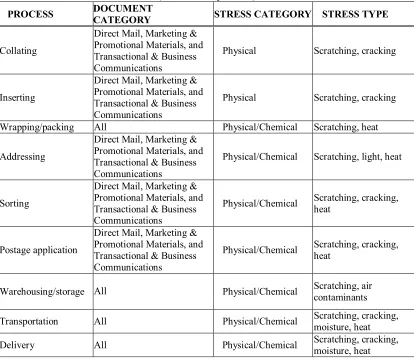
contaminants. These stresses, as well as the stresses from mail preparation and mailing,
[image:34.612.117.531.282.644.2]fulfillment, and distribution are outlined more specifically in Table 4.
Table 4. Processes in the mail preparation and mailing, fulfillment, and distribution stages
(Source: Frey, 2006)
PROCESS DOCUMENT CATEGORY STRESS CATEGORY STRESS TYPE
Collating
Direct Mail, Marketing & Promotional Materials, and Transactional & Business Communications
Physical Scratching, cracking
Inserting
Direct Mail, Marketing & Promotional Materials, and Transactional & Business Communications
Physical Scratching, cracking
Wrapping/packing All Physical/Chemical Scratching, heat
Addressing
Direct Mail, Marketing & Promotional Materials, and Transactional & Business Communications
Physical/Chemical Scratching, light, heat
Sorting
Direct Mail, Marketing & Promotional Materials, and Transactional & Business Communications
Physical/Chemical Scratching, cracking, heat
Postage application
Direct Mail, Marketing & Promotional Materials, and Transactional & Business Communications
Physical/Chemical Scratching, cracking, heat
Warehousing/storage All Physical/Chemical Scratching, air contaminants
Transportation All Physical/Chemical Scratching, cracking, moisture, heat
Processes in the Usage Stage
Although it is difficult to find literature on the user stages of the product life cycle
in digital printing, the users are unique to the product. Permanence issues, quality, and
archivability are, as mentioned previously, product dependent. Therefore, permanence
can, in some cases, have many different meanings and interpretations (Johnson, 2003).
As discussed earlier, the principal categories of documents focused on in this
study include: marketing and promotional materials, direct mail, transactional and
business communications, and on-demand color books. These are all vastly different
products, with different life expectancies, and with different user expectations of these
life expectancies.
Normally, marketing and promotional materials do not have a long shelf life.
They are, however, expected to be very presentable when they get to the end user.
Because of their short shelf life, they do not need to excel in the archiving field, but must
last long enough to survive the printing process, finishing process, and distribution
process—all while maintaining a superior quality. With digitally printed products, this
superior quality can be tough to sustain, more so than with products printed using other
printing technologies.
Direct mail holds the same qualities as do the marketing and promotional
materials. They do not have a long shelf life, but are expected to survive the grueling
stages of printing, finishing, and distribution stages, and still look great when they reach
On the other hand, transactional and business documents follow a different suit.
These documents usually hold some legal or contractual qualities; therefore, they are
expected to last. These types of documents are commonly filed and kept for years. This
means that this type of printing must be able to withstand all the aforementioned
processes, yet also retain some archiving ability.
Lastly, on-demand color books do not hold as much value as the transactional and
business documents; however, user expectations are the same. Books are meant to be
read and are sometimes abused, but also they are often viewed as lasting keepsakes.
These printed materials go though the harshest of conditions throughout their life cycle.
They must deal with the printing, finishing, and distribution stages, as well as continuous
use and prolonged exposure to the elements. This may be the only type of printed
product discussed in this research that is exposed to every type of stress mentioned.
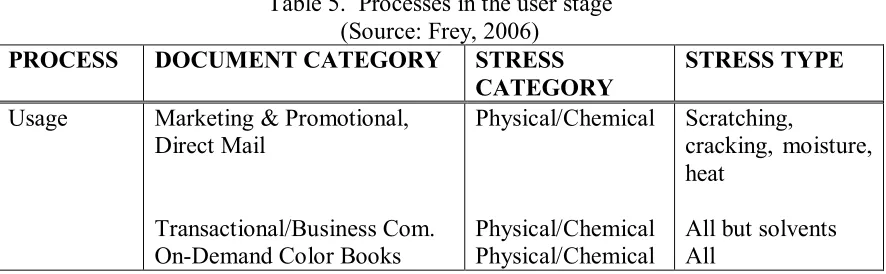
[image:36.612.104.547.468.605.2]Table 5 outlines the stresses in the user stage of the life cycle.
Table 5. Processes in the user stage (Source: Frey, 2006)
PROCESS DOCUMENT CATEGORY STRESS
CATEGORY STRESS TYPE
Usage Marketing & Promotional,
Direct Mail
Transactional/Business Com. On-Demand Color Books
Physical/Chemical
Physical/Chemical Physical/Chemical
Scratching,
cracking, moisture, heat
Processes in the Recycling Stage
The last stage in a digitally printed product’s life cycle is recycling, i.e., the
breaking down of ink and paper to be reused. This seemingly simple process, one that
has been going on for years, has seen some complications in the digital era.
Conventionally, the recycling process begins in the flotation stage, where the
de-inking of printing occurs. To improve and to aid in the ink release process, chemicals
(such as caustic soda, sodium silicate, hydrogen peroxide, and soap) are introduced in the
pulping stage, making slurry (Carre, Magnin, and Ayala, n.d.). In this process, the slurry
of paper is subjected to rising air bubbles, which carry the ink particles from the paper to
the top of the slurry. Once the ink particles have risen, due to the hydrophobic properties
of the ink, they can easily be targeted and removed. However, most non-impact printing
processes are difficult to process in this way. According to Bolanca, Agic, and Bauer
(n.d.), non-impact printing inks,
…unlike conventional printing inks, [toners] contain synthetic binders based on polyester or polymers of styrene with acrylates, methacrylates, or butadiene. The toners contain 90-95% resin, 3-5% colorant, 1-3% charge control agents and other technical additives (p. 2).
These binders make it difficult to complete the recycling process. During the first
stage of the process, the toner tends to break up into very large particles, unlike
conventional printing inks, some of which are too large to be removed in the processes
(Bolanca, Agic, and Bauer, n.d.).
Other recycling techniques include screening, cleaning, washing, and dispersion.
fine web. This process is primarily used to remove large contaminants from the pulp.
Washing is similar to screening, in that it removes unwanted contaminants through a
screen with the addition of water. However, this process is seldom used, unless there is a
need to remove mineral fillers for certain products, such as paper. Cleaning can be used
to remove large or small contaminants in somewhat of a washing machine approach. As
Carre, Magnin, and Ayala (n.d.) describe,
Cleaning is based on particle separation in a centrifugal flow field. A swirling motion is created by the tangential inlet flow. The vortex motion creates centrifugal forces which causes the particles heavier than the stock to migrate to the outside of the cleaner, while the lightweight particles migrate toward the vortex core(p. 2).
Finally, dispersion is used to reduce residual contaminants. With the addition of
heat, this process is used to rid the old product of adhesives, varnishes, toners, or coatings
that may have been left over from previous recycling processes (Carre, Magnin, and
Ayala, n.d.).
Areas that seem to be particularly problematic with recycling processes include
use of ultraviolet inks, liquid toner, hot-melt ink jet prints, home and office ink jet prints
using water-based pigment inks, and ultraviolet coatings. These specific printing types
create problems in recycled paper with speck contamination, sticky deposits, low
brightness, and pronounced color shade (Carre, Magnin, and Ayala, n.d.).
For the recycling process to be economical and able to create quality recycled
papers, the toners must be almost completely removed from the pulp. With digital
printing taking more and more of the market share away from traditional offset
indicated that the recycled paper produced from digital prints is just as good as that
produced from offset prints. The recycled papers showed a
…deterioration of properties such as burst strength, tensile strength, stretching and double fold…[however the] use of recycled fibers leads to an improvement in properties such as stiffness, tear resistance, porosity, opacity, and light scattering coefficient, because of the loss of swelling ability and fiber bending (Bolanca, Agic, and Bauer, n.d., p. 70).
Work still needs to be done on how to recycle digitally printed products more
efficiently because they have the ability to produce equal quality recycled papers as
offset; however, we do not currently have the technology to recycle it as well.
Summary and Conclusion
This chapter has reviewed literature outlining the life cycle of digitally printed
marketing and promotional materials, transactional and business communications, direct
mail, and on-demand color books. Focusing on the stresses involved in each stage of the
life cycles, the goal of this research is to identify areas in digital print production and
distribution that require more attention and research. No formal document was found
outlining the full life cycle of digitally printed products, so the secondary research was
observed through life cycle theory, based on the concepts of Järvenpää.
Digital printing is projected to be the fastest growing service over the next two
years. As such, it is imperative that time and money be spent researching the subject.
On-demand and variable data printing, only available on truly digital presses without a
fixed image carrier, have proven to be valuable for consumers, provide opportunities for
It is for this reason that this research examines the life cycle of digital printing: to
discuss the strengths and weaknesses in this new era of print. In this research, the life
cycle has been examined in the stages between the printing processes and recycling,
namely, the stages of printing and finishing, mailing and fulfillment, distribution, usage,
and recycling.
Each stress has been examined in every stage of the life cycle where it was found
in the printing and finishing stages. No stress was involved in the actual printing;
however, physical scratching and cracking occurred during finishing. During the mailing
and fulfillment stages, scratching, cracking, heat, light, and air contaminants were seen as
stresses induced on the printing. Similarly, scratching, cracking, heat, and moisture were
seen as stress problems in the distribution stage. In the user stage, the printing was
subjected to every type of stress found in Table 2. Lastly, the products were turned back
into pulp in the recycling stage to produce recycled papers, where stresses were deemed
irrelevant.
There is no secondary literature that this researcher could find on print life cycles,
performance measures, or performance predictions of digitally printed materials using a
full life cycle approach. With one-to-one marketing, variable data, and print-on-demand
becoming so popular, this research is necessary for all professionals in all of the segments
of the printing industry. If the expanding projections of digital printing hold true, these
Chapter 3
Research Questions
The primary objectives of this research are summarized in the following research
questions:
1. What different types of stresses are associated with digitally printed products
throughout their life cycle?
2. What are the concerns of a sample of printers, print buyers, and vendors with
regard to digital print permanence?
3. How do the specific technologies (toner-based digital, lithographic, and ink jet
digital) compare to each other with respect to abrasion resistance, rub resistance,
Chapter 4
Project Methodology
Overview
The testing for this research involved Miami Systems in Cincinnati, Ohio; the
Center for Integrated Manufacturing Studies (CIMS) facility at the Rochester Institute of
Technology (RIT); the Printing Applications Laboratory (PAL) at RIT; the Print/Postal
Hub at RIT; and the Imaging Products Laboratory (IPL) at RIT. Samples were printed on
the three commercial digital presses, a high-speed ink jet press, and an offset lithographic
[image:42.612.104.545.446.559.2]press (Table 6).
Table 6. Materials used to print the test targets
PRESS TECHNOLOGY STOCK WEIGHT SPECIFICS
Ink Jet High Speed Ink Jet (HSIJ) 50# Weyerhauser HSIJ treated, uncoated Offset Litho Lithographic 50# Finch uncoated
Digital A Electrophotography 80# Xerox Color Xpressions Text Digital B Electrophotography 70# UPM High Definition uncoated Digital C Electrophotography 70# UPM High Definition uncoated
Testing capabilities in the IPL include ozone, folding, light-fastness with xenon
light, water-fastness, rub testing, and abrasion testing. Research actually performed for
The commercial digital presses involved in this research and testing are all
sheet-fed. Digital press samples are compared with the high-speed ink jet press, as well as the
offset lithographic press, which is used as the industry benchmark.
Primary research stemming from the missing pieces in the literature review had the following objectives:
1. Interviews to identify what problems printing companies, vendors, and
consumers are facing in terms of permanence. This, in effect, covers the life cycle from an industry perspective. (Interview questions and full responses are located in Appendix A.)
2. Define testing (based on existing testing models) that can be done to help
predict the performance (i.e., folding, abrasion, water-fastness, light-fastness,
pollutants, etc.) of digitally printed materials.
Perform testing on printed samples with test targets. Test targets are provided
by the IPL and have been modified by the researcher to fit the testing models.
A circular, solid test target was retrieved from IPL and from this, five targets
are made one each of cyan, magenta, yellow, process black, and solid black.
Also, the “Three Musicians” test target was used for visual comparisons of
testing. (Appendix C shows the actual test targets printed in a scaled-down
3. Conclusions will be reached, assessing performance measures created for digital printing technologies and their particular use with certain products. The end product will include comparisons between three main commercial digital presses, high-speed ink jet, and offset lithography with regard to the specific testing performed.
Testing Methodology
Particular attention has been paid to the stresses involved in each step of the
digital product life cycle, thus far, to determine problem areas. Standardized tests were
selected in an attempt to simulate these stresses. The tests were performed in a controlled
environment that allowed for comparisons to be made with a relative degree of
confidence. The tests chosen are some of the best methods, to this researcher’s
knowledge, to simulate the stresses induced on a commercial digital print and, therefore,
this research can be used as a guide for information on permanence of commercial digital
printing only.
The standards documents that were chosen are from both the International
Organization for Standardization (ISO) and the American Society for Testing and
Materials (ASTM). It is important to note that many companies outside of the educational
realm of research provide testing, some of which could apply to this research; however,
the testing facilities at RIT proved to be sufficient for completion of this researcher’s
goals.
Note that before any of the targets are cut to suit specific testing requirements, the
standard test method for machine direction of paper and paperboard. Within this
standard, the wetting technique was used, where each sheet is cut into a perfect square
and dropped into a pan of water. After the sample was dropped into the water, it was
quickly removed and observed to see in which direction the sample curled. Along the
base of the curl (i.e., in the valley) was the machine direction. If along the whole base of
the valley was the machine direction, the opposite was documented, the cross machine
direction (“Standard Test Method,” 1997/2002). This must be noted in certain testing
methodologies, so it was deemed appropriate to derive first. Figure 1 shows the actual
[image:45.612.178.472.339.555.2]samples cut and tested to determine machine direction and cross machine direction.
Figure 1. Actual results from the wetting technique used to determine machine and cross machine direction
The following are detailed descriptions of testing, the instruments (if any) used,
and the standard procedures of the tests as put forth by ISO or ASTM. Of these tests, the
certain tests was based upon preliminary interviews with printers, print buyers, and print
press vendors to decide which tests are the most important to the industry. (The results of
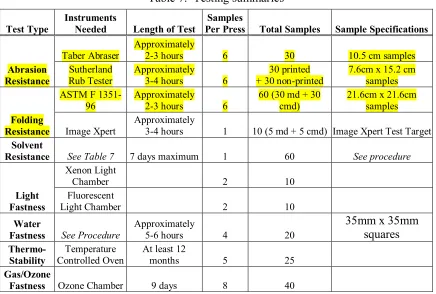
this survey can be seen in Appendix A.) Table 7 is a summary of test types researched,
instruments needed, length of tests, samples necessary, and specifications. After
interviewing a sample of printers, press vendors, and print buyers, it was concluded to
test for folding and abrasion resistance. (See Chapter 5 for a description of the
[image:46.612.108.544.320.614.2]interviews.)
Table 7. Testing summaries
Test Type Instruments Needed Length of Test Per Press Samples Total Samples Sample Specifications
Abrasion Resistance
Taber Abraser Approximately 2-3 hours 6 30 10.5 cm samples Sutherland
Rub Tester
Approximately 3-4 hours 6
30 printed + 30 non-printed
7.6cm x 15.2 cm samples
Folding Resistance
ASTM F
1351-96 Approximately 2-3 hours 6 60 (30 md + 30 cmd) 21.6cm x 21.6cm samples
Image Xpert Approximately 3-4 hours 1 10 (5 md + 5 cmd) Image Xpert Test Target Solvent
Resistance See Table 7 7 days maximum 1 60 See procedure
Light Fastness
Xenon Light
Chamber 2 10
Fluorescent
Light Chamber 2 10
Water
Fastness See Procedure Approximately 5-6 hours 4 20
35mm x 35mm squares
Thermo-
Stability Controlled Oven Temperature At least 12 months 5 25
Gas/Ozone
Abrasion Resistance
Typical abrasion resistance was tested by two methods approved by the ASTM
standards organization. The Taber Abraser method was outlined similarly to the research
being conducted at RIT by ASTM F 1478-95. The other method outlined in this report
uses the Sutherland Rub Tester and is outlined by ASTM D 5264-98.
Taber Method. ASTM F 1478 is the standard test method for determining the
abrasion resistance of prints from copiers and printers using, specifically, the Taber
Abraser. This test is used specifically to measure, record, and observe how much of an
image is abraded from the surface of the samples. The Taber Abraser has rough wheels
which grind and rub the surface of the print during the test. Circular, solid test targets are
used in this testing for ease of using the machine and measuring results. (The circular
test targets can be seen in Appendix C and include cyan, magenta, yellow, process black,
and solid black inks.) The targets were cut to approximately 10.5 centimeters in
diameter. This measurement does not have to be exact. Also, a small hole must be
punched out of the center of the sample to accommodate the testing instrument’s
mounting procedure. This hole only needs to be as large as a standard 3-hole punch. The
“Three Musician” test target may be cut in the same manner as the circular solid targets
and tested to be used strictly as a visual comparison, using an image. ASTM has a
specific test target to be used in their standard testing method; however, the targets used
in this research allow for the same measurements to be taken.
Results of this test simulate some of the stresses that a printed piece is subject to
automated sorting and handling machines, shipping environments, etc.). (The full testing
procedure appears in Appendix B.)
Sutherland Rub Tester. ASTM D 5264 is the standard method for testing the
abrasion resistance of prints using, specifically, the Sutherland Rub Tester. This test can
be used, just as the Taber Abraser, to simulate stresses imposed on a printed product
through mailing, distribution, or fulfillment services. This method can simulate stresses
from abrasion/rubbing from another substrate or from handling on its own, while the
Taber Abraser uses strictly abrasive wheels. The samples for the testing used the same
circular targets and the “Three Musician” test target as did the Taber Abraser testing.
The Sutherland Rub Tester does not require the printed samples to be cut to any specific
size. However, blank stock must be cut to approximately 7.6 centimeters by 15.2
centimeters to be mounted on the Sutherland Rub Tester.
This testing was done at IPL, under laboratory conditions that were recorded at
the time of testing. Many different factors affect a typical product in the distribution
stage of its life cycle; those factors are not taken into account here (i.e., temperature,
humidity, precipitation, etc.). As with any testing, this procedure has its limitations.
(The full testing procedure is located in Appendix B.)
Folding Resistance
Folding resistance can be tested using ASTM F 1351-96. This document
articulates the standard practice for determining the effect that hard creasing paper has on
is a “paper folded 180 degrees (back to back, face to face, long grain, short grain) with a
uniform force applied to the fold” (Standard Practice for Determination, 1970/1996,
p. 12). This standard was originally developed for business imaging systems (i.e.,
copiers, fax machines, printers, typewriters, etc.). Therefore, it has not been developed
with commercial digital presses, offset lithography, or even ink jet in mind. With this
caveat in mind, this researcher will perform the tests as per ASTM F 1351-96 and report
this fact as a possible source of error. ISO 18908 is also a standard for fold testing, but
the ASTM standard was deemed sufficient for this research.
The ASTM F 1351 document describes a simplistic instrument to be used in
testing for folding/hard creasing resistance of digital prints. This test was performed in
the IPL on the RIT campus where the specific testing instrument resides. (The testing
Chapter 5
Results
Introduction
To decide which tests were to be performed in this research, a survey consisting
of four questions was conducted with printers, print buyers, and printing press vendors
who were randomly selected by this researcher. The four questions asked of the
respondents were as follows:
1. How would you compare digital printing to the offset lithography with regards
to permanence issues and problems?
2. Do you see any problems with digitally printed products compared to any
other printing you are involved with?
3. Do you find any permanence problems in the finishing stages or mailing
process of digitally printed products that are of particular concern?
4. Rank from 1-7 (1 being the highest and 7 being the lowest) the following
permanence tests which results you deem most necessary: abrasion, folding
endurance, solvent resistance, light-fastness, water-fastness, thermostability,
From the interviews conducted with printers in the Northeast, marketers and
advertisers, and digital printing press vendors, it was quite clear that their largest
concerns were cracking of toner in commercial digital printing. The average secondary
concern was abrasion resistance; hence, the testing actually done in this document covers
folding and abrasion resistance. It is interesting to note, however, that printers had issues
with the products that they had to finish and distribute. They seemed to choose abrasion,
cracking, and water exposure as concerns which are in line with the same stresses
induced to print in their finishing and distribution processes. On the other hand, the
primary concern of print press vendors was folding. One would think that press vendors’
and printers’ goals and concerns would be aligned, but in this case, they are not.
Similarly, print buyers (marketers and advertisers) could not offer a ranking, as they did
not know the process well enough. There was a real disconnect between the printers,
press vendors, and print buyers when in actuality, they should all be working towards the
same goals. (Actual results from the survey can be found in Appendix A.)
Because of the disconnect between printers, print buyers, and press vendors, the
idea of developing a sample kit containing original samples and samples after testing
came up. When interviewing, a visual sample would be quite helpful when asking
questions about permanence issues; the visual sample may be able to get people in the
printing industry looking at the issues in the same way or at least able to respond to the
questions. This sample kit is put forward as an area for further research.
Results from the Taber Abrasion Test, Sutherland Rub Test, and folding test were
least resistant to the stress or stresses put forth by the test and 5 being the most resistant
to the stress or stresses put forth by the test) was done. Testing results were also based on
objective evaluation, including density changes, Delta E (∆E), and an abrasion resistance
index introduced in ASTM F 1478. In the evaluation of the data and calculations, the
lower the density change, the better; the lower the ∆E (distance between two colors), the
better; and the higher the abrasion resistance index, the better.
Before the testing was performed, samples that are not to be tested are laid out
with the machine direction noted for the sake of visual referencing back to the original
samples after the testing. Certain testing standards require the notation of grain direction
during the testing. Also, samples to be used in the testing are cut and shaped, as noted in
the procedures section, in preparation for use with the testing instruments. Original,