Devolution
Briefings
Is Devolution Good for the Scottish Economy?
A Framework for Analysis
+Briefing No. 26, March 2005
Key points
• There are no obvious methods for a systematic examination of devolution’s impact on the economy, so this breifing sets out a framework for understanding devolution’s economic impact rather than quantifying that impact
• Among the potential positive impacts are:
o a more efficient distribution of competences between UK and devolved levels o better satisfaction of Scottish policy preferences, via new patterns of public
expenditure and better information
o more effective policy implementation
• Among the potential negative impacts are:
o the costs of building and running the devolved institutions o loss of UK-wide economies of scale in policy-making o greater capacity for lobbying by sectional interests
o the economic impacts of the Barnett formula and fiscal autonomy o greater inter-regional policy spillovers
• Overall, the impact of devolution on the Scottish economy is likely to be complex, subtle and difficult to measure – not least because the institutional arrangements were not fashioned with due consideration to their economic impacts
Introduction
This briefing sets out a framework for addressing the question: Is devolution good for the Scottish economy? We are currently implementing the approach and shall report the results in due course.
We begin with two observations.
decentralised delivery of policies to improve productivity the effect is of considerable interest.
• Devolution being “good for the Scottish economy” is not necessarily the same thing as being “good for the Scottish people”. If, for example, Scotland
wanted to become “greener”, this could imply a desire for slower growth than in the rest of the UK.
We set out below the aggregate effects and the specific mechanisms through which devolution might be expected to impact on the economy.
The Scottish Economy before and after devolution
It seems reasonable to begin by examining the Scottish economy pre- and
post-devolution in an attempt to identify any measurable change in economic performance. However, nothing definitive comes from this exercise. Such (time-series based) analyses that seek to establish the impact of policy changes are well-established, but have well-known limitations:
• It is difficult to control fully for all influences other than devolution, and this could lead to incorrect attribution to devolution of effects that are in fact due to other disturbances that have impacted on the Scottish economy
• We have only had six years of experience post-devolution, and so very few observations with which to compare the situation prior to devolution • We might expect that at least some devolution effects would take time to
become established, for example, re-allocation of public expenditures may be seriously constrained by contracts
• Devolution in Scotland is a very significant political change. But is it such a big change in terms of the economy? Small changes are difficult to detect
More subtle qualitative changes which do not register on aggregate statistics, such as a more appropriate allocation of public expenditure, cannot be identified in this way.
An overview of the arguments concerning the economic impact of devolution
Devolution in Scotland has involved a shift from a region with significant
administrative decentralisation and ministerial influence in cabinet to one with its own devolved government. The economic influence of devolution therefore really focuses on the benefits of democratically-informed formulation, implementation and
monitoring of policies, as against polices determined centrally but often delivered in a decentralised manner.
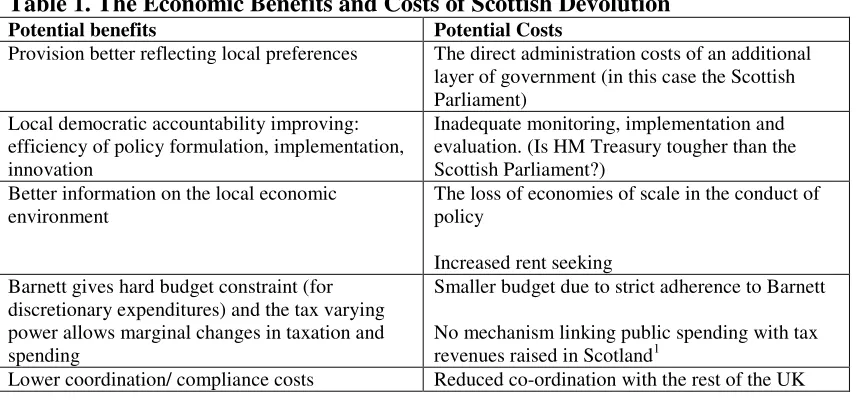
Table 1. The Economic Benefits and Costs of Scottish Devolution
Potential benefits Potential Costs
Provision better reflecting local preferences The direct administration costs of an additional layer of government (in this case the Scottish Parliament)
Local democratic accountability improving: efficiency of policy formulation, implementation, innovation
Inadequate monitoring, implementation and evaluation. (Is HM Treasury tougher than the Scottish Parliament?)
Better information on the local economic environment
The loss of economies of scale in the conduct of policy
Increased rent seeking Barnett gives hard budget constraint (for
discretionary expenditures) and the tax varying power allows marginal changes in taxation and spending
Smaller budget due to strict adherence to Barnett
No mechanism linking public spending with tax revenues raised in Scotland1
Lower coordination/ compliance costs Reduced co-ordination with the rest of the UK
Economic benefits of Scottish devolution
a) Does the Scottish-UK system at least allow potential efficiency gains from devolution?
The key issue is whether the allocation of powers among the different levels of government in the UK is at least potentially efficient, by avoiding the most obvious spillover effects or loss of economies of scale.
b) Is there any direct evidence of better satisfaction of the Scottish people’s preferences under devolution?
The direct approach to this issue involves asking people what they think of the Scottish Parliament. The Scottish Social Survey provides us with observations on a range of attitudes to the Parliament, and so we can investigate the extent to which there appears dissatisfaction with the existing settlement.
c) Is there any indirect evidence of better satisfaction of Scottish preferences post devolution?
The Scottish Parliament acting in a distinctive fashion from Westminster is indicative of change. Of course, the existence of distinctiveness, or apparent policy divergence, is not necessarily evidence of innovation, or a reflection of the preferences of the Scottish people.
The general allocation of the Scottish Budget. A major element of the Scottish
Parliament’s power is its discretion over the budget allocated to it through the Barnett formula. It is natural therefore to explore changes in the allocation of public
order to identify any distinctive element and the revealed preferences of the Executive.
Other evidence of distinctiveness. Not all policies have a major and immediate impact on government expenditures. Perhaps the two most widely publicised sources of policy difference between Scotland and Westminster are those on student fees, which are set to increase with proposed top-up fees and on the provision of free personal care for the elderly, but other differences exist. The impacts of these policies, even on public expenditures, are not yet apparent, and so a full evaluation (on outcomes rather than projections) is in any case not yet feasible.
Economic development policies. The key issue is not distinctiveness per se, rather whether these have become more differentiated post devolution. One indicator of priorities here is the share of expenditure allocated to such activities in Scotland, and how this has changed since devolution.
Of course, policy formulation and implementation is about much more than can be captured in simple measures of expenditure, and wider analyses of at least the style and form of Scottish economic development policies are needed. However what we are ultimately interested in is the results of implementing economic development policies and this requires effective implementation (see 5 below).
d) Innovation in policy
It is clear that distinctiveness in policy formulation or implementation is a necessary, but not a sufficient condition for the presence of innovation. The basic idea is that there is now a greater incentive to be innovative. Also, there is the idea of the “laboratory”, with Scotland playing the lead role in respect of its greater degree of devolution. Inevitably, judgements on the innovative nature of policies are to a degree subjective.
Economic costs of Scottish Devolution
a) Direct costs of the Scottish Parliament
While the traditional literature on fiscal federalism tends to be optimistic about the economic benefits of decentralisation in terms of efficiency enhancement, it has little to say about the costs of their generation. Yet we know that the establishment of the Scottish Parliament has incurred substantial capital costs (in terms of the building itself and supporting infrastructure) and recurrent costs in terms of MSPs and supporting administration.
b) Lower total budget
If the Barnett formula’s convergence effect is more rigorously adhered to as a consequence of devolution this would imply a loss.
The basic idea is simple: if there are in principle UK-wide economies of scale in the policy process or in the provision of devolved public services then devolution
generates additional costs, even for the provision of an equivalent service. This can be examined by looking at patterns of civil service employment change in Scotland and the UK to look for any distinctive post-devolution developments.
d) Rent seeking behaviour
The establishment of the Scottish Parliament creates a number of new agents with influence over policy, most obviously MSPs, but that also in turn has undoubtedly stimulated a host of lobbying organisations and other interest groups. A potential problem arises from an efficiency perspective if these agents act in a way as to further their own positions, if the latter are not entirely consistent with the wishes of the Scottish electorate: such activity is unproductive and imposes an efficiency cost.
e) Adequacy of monitoring and evaluation of policies
One issue is whether the Scottish Parliament is as adept at monitoring and evaluation policies as is the UK Treasury. There are a number of considerations here:
• Should the Treasury’s “Green Book” on the impact of economic development initiatives still be implemented in Scotland or should we have a “Tartan Book” • Devolved policies in Scotland are not subject to Public Service Agreements as
are policies in England– is the regime in England tougher?
• Scottish targets for efficiency gains in the provision of public services are less ambitious than those elsewhere
f) Effectiveness of policy implementation?
One issue is the potential tendency to ‘balkanisation’ within a more insular civil service. But civil servants may feel more motivated when answerable to political masters sensitive to perceptions of policy ineffectiveness.
g) The Barnett formula
The Barnett formula is effectively a means of allocating lump sum transfers to devolved authorities. it presents a number of problems:
• It breaks the link between successful growth policies and tax revenues, so moderates incentive for economic growth.
• Rigorous adherence has an adverse impact on devolved territories2 • But Barnett does, in principle, offer a hard budget constraint
There already exists a degree of fiscal autonomy: the “tartan tax”. • The potential effects of the tax are that:3
2
o a balanced-budget rise in taxes would stimulate demand.
o but would bring adverse supply effects through migration and wage
bargaining.
o The net effect - and the role of the Parliament – is unclear.
• Such considerations would be even more important under greater tax autonomy
h) Reduced coordination of policies in the UK
The issues here are the efficiency costs experienced as a consequence of a lack of coordination of regional development policies at the centre. Key concerns are the scale and direction of interregional spillovers – where initiatives benefiting one region may have an adverse effect on another - and the inefficiencies that are generated if these are ignored by the devolved authorities. Some provisions have been made to co-ordinate policies through Concordats, but these are thought to have played a relatively limited role.
Does devolution in Scotland really stimulate growth?
The UK Government believes devolution/decentralisation stimulates growth. However, international evidence on a link between a decentralised government and economic growth is limited and ambiguous. For Scotland, the asymmetric nature of devolution within the UK might reduce the incentive for innovative, but risky, policy. Also any rural bias to its economic development policies might lower the growth rate. Further, there are arguments that the degree of fiscal autonomy available to the Parliament is too low to encourage growth. The dynamic arguments and empirical evidence need to be evaluated.
Conclusions
The impact of devolution on the Scottish economy is likely to be complex, subtle and difficult to measure. However, even though the devolution decision was not made on economic grounds, and is unlikely to be reversed as a result of poor economic
performance, this does not reduce the value of further economic evaluation. The Scottish people are broadly content with the present constitutional arrangement: there is little evidence of a growing desire either to turn back the clock or to press on for independence. However, it is important for the institutional arrangements to be fashioned with due consideration to their economic impacts, particularly on efficiency: small improvements in Scottish growth will have important, and increasing, impacts over time.
This Devolution Briefing was written by Brian K Ashcroft and J Kim Swales of the Fraser of Allander Institute and Department of Economics, University of Strathclyde and Centre for Public Policy for Regions (CPPR), and Peter G McGregor of the Department of Economics, University of Strathclyde and CPPR. The authors
gratefully acknowledge the financial support of the ESRC (grant L219252102) under the Devolution and Constitutional Change Programme. We are grateful to the Programme Director, Charlie Jeffery, for posing the question in the title of this Briefing, but he bears no responsibility for our attempts to provide an answer. We are also grateful to John Curtice for providing us with a number of his forthcoming articles and to Fraser Jamieson for able research assistance. CPPR is a SHEFC-funded joint research institute of the Universities of Glasgow and Strathclyde.
The Devolution and Constitutional Change Programme was set up by ESRC in 2000 to explore the series of devolution reforms which have established new political institutions in Scotland, Wales, Northern Ireland, London and the other English regions since 1997. It has commissioned 35 projects around the UK to carry out top-class academic research and to contribute to the policy debates surrounding devolution.
For more information see the Programme website at www.devolution.ac.uk or contact the Programme Director, Professor Charlie Jeffery at ESRC Devolution Programme, School of Social and Political Studies, Adam Ferguson Building, George Square, University of Edinburgh. Tel 0131 650 8489, Fax 0131 650 6546, Email