RESEARCH NOTE
Detection of
Ehrlichia ruminantium
infection in cattle in Cameroon
Seraphine N. Esemu
1,2, Roland N. Ndip
1,2,3and Lucy M. Ndip
1,2,4*Abstract
Objectives: Ehrlichia ruminantium infection (heartwater) is a major constraint that impacts negatively on the cat-tle industry development in sub-Saharan Africa and so far, litcat-tle is known of the presence of heartwater in catcat-tle in Cameroon. This study sought to investigate the prevalence of E. ruminantium infection in cattle in Cameroon and to determine the predictors of infection.
Results: A species-specific semi-nested pCS20 polymerase chain reaction was used to screen the buffy coats from 182 cattle (comprising 82 cattle that received intensive tick control regimen and 100 cattle on strategic tick control) from two study sites in Cameroon for E. ruminantium DNA in a cross-sectional study. E. ruminantium infection was confirmed in 12 (6.6%) of the 182 cattle comprising 11 that received intensive tick control and one on strategic tick control. Of the 12 cattle detected, 11 were apparently healthy and one was clinically diagnosed of heartwater. All DNA sequences of pCS20 amplicons were identical to each other (a representative sequence deposited in GenBank under accession number JQ039939). These findings which have veterinary and epidemiological significance, suggest the need for further investigation to determine the extent and role of heartwater in cattle in Cameroon.
Keywords: Ehrlichia ruminantium, Heartwater, Cattle, Polymerase chain reaction, Cameroon
© The Author(s) 2018. This article is distributed under the terms of the Creative Commons Attribution 4.0 International License (http://creat iveco mmons .org/licen ses/by/4.0/), which permits unrestricted use, distribution, and reproduction in any medium, provided you give appropriate credit to the original author(s) and the source, provide a link to the Creative Commons license, and indicate if changes were made. The Creative Commons Public Domain Dedication waiver (http://creat iveco mmons .org/ publi cdoma in/zero/1.0/) applies to the data made available in this article, unless otherwise stated.
Introduction
Ehrlichia ruminantium (ER) is an obligate intracellular, Gram negative, pleomorphic, tick-transmitted bacte-rial pathogen recognized as an agricultural biothreat [1,
2]. ER infection causes heartwater, a disease of domestic ruminants and one of the most economically important tick-borne diseases in Africa [3]. In West Africa, heart-water is a major constraint that delays the improvement of the ruminant livestock industry thereby compromising food and nutritional security [4, 5].
In Cameroon, heartwater is one of the major disease problems that delay the cattle industry [6, 7]. Since ER is an obligate intracellular bacterium, its detection requires specific equipment. Hence, most of the reports of the presence of heartwater in Cameroon have been based on the microscopic examination of Giemsa stained brain impression smears of grey matter from deceased cattle
[7] or the presence of the heartwater vector, Amblyomma variegatum tick [7–11]. Other studies have employed serological methods to demonstrate antibodies against ER proteins in small ruminants [11] while ER signatures have been detected in A. variegatum ticks using a DNA-based assay [8]. To date, there is no confirmed evidence of ER infection in live cattle in Cameroon. This study sought to fill this knowledge gap and reinforce the exist-ing reports on the presence of ER in Cameroon by per-forming DNA-based analysis on live cattle blood as well as determining predictors of infection.
To date, the pCS20 assay is regarded as the most sensi-tive and reliable test to use for ER detection in cattle and ticks [12, 13]. Even in situations of low parasite levels, the nested pCS20 PCR has been successfully used [14]. Using pCS20 nested PCR, ER infection rates increased from 1.7 to 36% [15]. In this study, we applied a semi- nested pCS20 PCR to determine the prevalence of ER infec-tion in cattle in Cameroon as well as the predictors of infection.
Open Access
*Correspondence: [email protected]
1 Laboratory for Emerging Infectious Diseases, University of Buea, P. O.
Box 63, Buea, Cameroon
Main text
Study design, study sites and cattle population
A cross-sectional survey was carried out between Febru-ary and April 2010. This study involved sampling cattle from two ranches implementing different tick control strategies and management systems. The study sites, Société de Développement et d’Exploitation des Pro-ductions Animales (SODEPA) Dumbo ranch (SDR) and upper farms ranch (UFR) have been described previously [8]. Written authorizations were obtained from the ranch managers before samples were taken. A total of 182 cattle (82 cattle from SDR and 100 from UFR) were sampled. Data on age, sex, breed, tick infestation levels and tick control strategies were recorded in order to evaluate the predictors of infection.
Clinical samples and DNA extraction
Whole blood (2–4 mL) was drawn from each cattle by venipuncture into EDTA coated vacutainer tubes. The buffy coat was harvested from each blood sample after centrifuging the whole blood at 2000×g for 15 min and stored at − 20 °C until used. DNA was extracted from 100 µl of each buffy coat using the DNeasy Tissue Kit (Qiagen, Chatsworth, CA, USA) following the manufac-turer’s protocol without modification.
Semi‑nested pCS20 PCR amplification and DNA sequencing
To eliminate the risk of contamination that is inherent in nested PCR, the setting up of PCR reactions mixture, addition of DNA templates and PCR amplification were performed in physically separated areas in the labora-tory. Three primers, AB128 (5′-ACT AGT AGA AAT TGC ACA ATC TAT -3′), AB129 (5′-TGA TAA CTT GGT GCG GGA AAT CCT T-3′) and ITM130 (5′-TCA ATT GCT TAA TGA AGC ACT AAC TCAC-3′), were used to amplify open reading frame (ORF) 2 of the pCS20 region of ER DNA [14]. AB128 was used as internal forward primer, ITM130 as external forward primer and AB129 as inter-nal and exterinter-nal reverse primer. PCR amplification was carried out as described previously [8]. Ultrapure water (Sigma–Aldrich, Gillingham, UK) was used as negative control and ER CMR Buea 20 (GenBank accession num-ber JQ039914) DNA as positive control. DNA amplifica-tion was confirmed by separating the PCR amplicons on 1.5% (w/v) high-resolution agarose gel (Fisher Biotech, Australia) stained with SYBR safe DNA gel stain (Invitro-gen, USA). The gel was viewed under ultraviolet light and photographed in a gel documentation system (Alliance 4.7 Chemi and Fluo, Uvitec, Cambridge).
DNA sequencing was performed in both directions for maximum data accuracy. All amplified PCR prod-ucts were sequenced with the same PCR primers (Inqaba
Biotec, South Africa). The BLAST program (National Centre for Biotechnology Information, Bethesda, MD) was used to compare pCS20 sequences to determine spe-cies and genotype.
Statistics
Data were considered statistically significant if p < 0.05. Chi square goodness-of-fit test was used to compare the prevalence of ER in the two study sites, evaluate the hypothesis that tick infestation levels differed between the two tick control strategies and sex.
Results
Characteristics of the cattle population
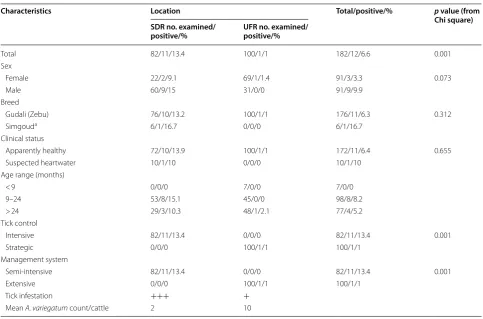
A total of 182 cattle from two study sites were included in the study (Table 1). The total number of males and females were equal (n = 91). A few of the cattle (n = 10) from SDR were clinically diagnosed of heartwater. Clinical signs observed were loss of appetite, high fever (> 40 °C), incoordination and coughing.
All cattle from UFR (n = 100) had heavy tick infesta-tion, with a mean of 10 adult A. variegatum ticks per cattle while cattle from SDR (n = 82) had sparse tick infestation, with a mean of two adult A. variegatum ticks per cattle. SDR was implementing an intensive tick con-trol strategy by dipping all cattle in a dip solution (2% Cypermethrine—ERADIK® or Alpha Cypermithrine— ALPHADIP®) after every 2 weeks during the dry season and once every week during the rainy season. This tick control strategy was implemented throughout the sample collection period. UFR was implementing a strategic tick control method (periodically treating cattle with a para-siticide by hand spraying) and throughout the sample col-lection period (February to April 2010), no tick control was done. The management (grazing) system for cattle in UFR was extensive (free ranging cattle). The manage-ment system for cattle in SDR was semi-intensive, hence the cattle grazed freely within the rangeland which is enclosed within a fixed perimeter. Five (2.7%) of the cattle were less than 1 year old. The mean age of the cattle was 3.7 years (range 9 months–15 years).
Prevalence of ER DNA and predictors of infection
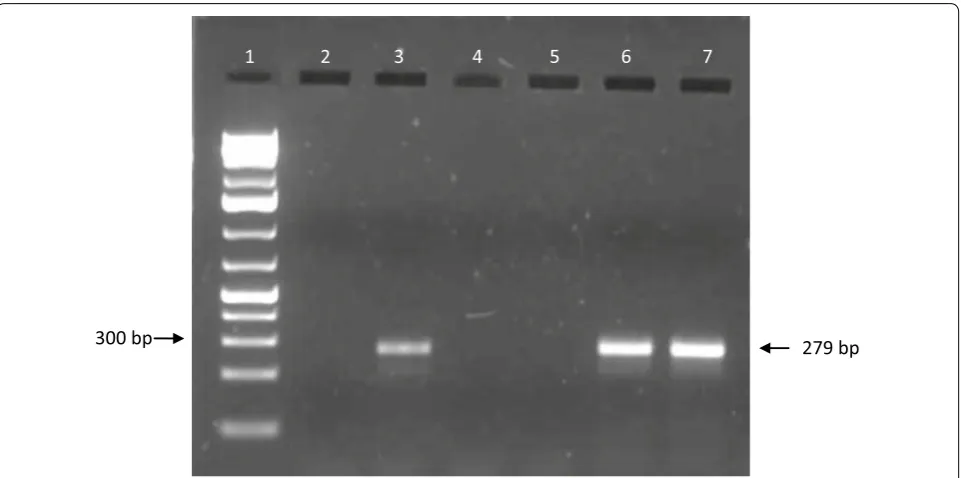
As expected, DNA amplification produced amplicons of 279 bp (Fig. 1).
The overall prevalence of ER infection in the cattle was 12 (6.6%) of the 182 cattle. Of the 82 cattle from SDR, 11 (13.4%) were positive for ER DNA while one (1.0%) of the 100 cattle from UFR was positive and this difference was statistically significant (χ2= 11.275, p = 0.001, df = 1).
p > 0.05, df = 1) between prevalence of ER infection in the male and female cattle.
Of the 176 Gudali, 11 (6.3%) were positive for ER infection while one (16.7%) of the six Simgoud was also positive (Table 1). The majority (n = 10, 90.9%) of the 11 Gudali cattle positive for ER DNA came from SDR and 1 (9.1%) from UFR.
Seven (3.8%) of the 182 cattle were less than 9 months old, 98 (53.8%) were within the age range of 9–24 months while 77 (42.3%) were older than 24 months. Eight (66.7%) of the 12 cattle positive for ER DNA were within the age range of 9–24 months while the remaining 4 (33.3%) were older than 24 months. Of the 172 appar-ently healthy cattle, 11 (6.4%) were positive and 1 (10%) of the 10 cattle clinically diagnosed of heartwater was positive (Table 1).
Cattle that received intensive tick control and main-tained under a semi-intensive management system (n = 82, 45.1%) had a higher prevalence (13.4%) of infec-tion. Cattle that received strategic tick control and grazed extensively (n = 100, 54.9%), had a very low prevalence
(1%) of infection with ER. Tick control strategy as well as cattle management system are important predictors of ER infection in this study (χ2= 11,275, p = 0.001, df = 1).
Processing of PCR amplicons sequences
The sequences of the 12 PCR amplicons were 100% iden-tical to each other, 100% ideniden-tical to the partial sequence of the pCS20 regions of ER strains CH26 (KX373603) and Hb32 (MG544305) and 99% identical to ER strains Gardel (AY236061), Ball3 (AY236059) and Welgevonden (AY236058). A representative sequence, ER CMR Dumbo 48, was deposited in GenBank under accession number JQ039939.
Discussion
Heartwater is one of the World Organization for Animal Health’s notifiable diseases [4] because of its economic impact on rural livelihoods in Africa. Our study is the first definitive report of ER infection in live cattle follow-ing natural exposure to ER in Cameroon. We confirmed ER infection in 6.6% (12/182) of the cattle. Eleven (91.7%)
Table 1 Epidemiological data and prevalence of E. ruminantium infection in cattle included in the study
+++, heavy tick infestation; +, sparse tick infestation; (%), prevalence
SDR SODEPA Dumbo ranch, UFR upper farms ranch, ANAPRI Associazione Nazionale Allevatori Pezzata Rossa Italiana, UNIUD Università di Udine, Italiana, MINEPIA
Ministere de L’Elevage, des Peches et des Industries Animales (MINEPIA), Cameroon
a Trade name of SODEPA for a synthetic breed of cattle which SODEPA has obtained in partnership with ANAPRI/UNIUD and MINEPIA
Characteristics Location Total/positive/% p value (from
Chi square) SDR no. examined/
positive/% UFR no. examined/positive/%
Total 82/11/13.4 100/1/1 182/12/6.6 0.001
Sex
Female 22/2/9.1 69/1/1.4 91/3/3.3 0.073
Male 60/9/15 31/0/0 91/9/9.9
Breed
Gudali (Zebu) 76/10/13.2 100/1/1 176/11/6.3 0.312
Simgouda 6/1/16.7 0/0/0 6/1/16.7
Clinical status
Apparently healthy 72/10/13.9 100/1/1 172/11/6.4 0.655
Suspected heartwater 10/1/10 0/0/0 10/1/10
Age range (months)
< 9 0/0/0 7/0/0 7/0/0
9–24 53/8/15.1 45/0/0 98/8/8.2
> 24 29/3/10.3 48/1/2.1 77/4/5.2
Tick control
Intensive 82/11/13.4 0/0/0 82/11/13.4 0.001
Strategic 0/0/0 100/1/1 100/1/1
Management system
Semi-intensive 82/11/13.4 0/0/0 82/11/13.4 0.001
Extensive 0/0/0 100/1/1 100/1/1
Tick infestation +++ +
[image:3.595.56.540.98.417.2]of the 12 positive cattle were apparently healthy. Previous studies have reported ER in peripheral blood of clinically healthy animals in heartwater endemic areas [16, 17]. Elsewhere, 16 (13.3%) samples positive for ER infection were recorded by pCS20 PCR from blood of 120 cattle that showed no symptoms of heartwater or any other dis-ease [17]. The observation of ER infection in healthy cat-tle may be an indication of endemic stability or infection by a non pathogenic variant of ER [18].
The difference in ER prevalence in SDR (11/82, 13.4%) and UFR (1/100, 1%) was statistically significant. This difference could be due to the cattle management sys-tem and tick control strategy. Although the cattle in SDR grazed within a fixed perimeter, SDR hosts refuge cattle from other areas fleeing their various locations as a result of acute reduction of pasture and/or drinking water dur-ing the months of January to April (dry season). The practice of moving livestock from one grazing ground to another may increase their exposure to animal diseases [19]. The type of management system may be a key vari-able that enhances cattle infection with tick-borne patho-gens like ER as this has been reported to determine the host-vector contact time and transmission dynamics [20].
Cattle from UFR had a mean of 10 adult A. variegatum ticks per cattle, while those from SDR had a mean of two A. variegatum ticks per cattle. Based on this tick infesta-tion rate and the tick control strategies, one would expect a higher ER infection rate in UFR. Interestingly, a very low prevalence of one per cent (n = 100) was observed
from UFR. This difference was not statistically significant and the reason for this observation is not clear.
The majority (96.7%) of the cattle studied were Gudali and only six (3.3%) were Simgoud. Simgoud is a synthetic breed of cattle which SODEPA has obtained in partner-ship with ANAPRI/UNIUD and MINEPIA. The large representation (96.7%) of Gudali in this study is probably due to the popularity of this breed in Cameroon. Gudali make up 65% of total cattle population in Cameroon [6].
Calves between 0 and 9 months have been shown to have a dominant immune response (acquired and innate) to Anaplasma and Ehrlichia infections and this may be the reason why all the calves in this study were appar-ently healthy. Adult cattle also benefit from acquired immunity following natural exposure to ER [20]. There was no statistical significance (χ2= 0.77, p > 0.05, df = 1)
in the prevalence of ER among cattle of different age groups. Although great diversity has been reported in the MAP1 gene among ER strains circulating in Cameroon [21], all the ER strains detected in this study were identi-cal to each other in the pCS20 region.
Conclusions
An ER prevalence of 3.4% was reported in this study with majority of the positive cattle being apparently healthy. Tick control strategy and cattle management system were significantly associated with ER infection. These results suggest the need for further investigation to determine 300 bp
1 2 3 4 5 6 7
279 bp
[image:4.595.59.540.87.326.2]the extent and role of heartwater in the cattle population in Cameroon.
Limitations
The results from this study cannot be generalized to rep-resent ER prevalence in cattle in Cameroon. This study needs to be expanded to other areas and to other rumi-nant populations.
Abbreviations
ER: Ehrlichia ruminantium; DNA: deoxyribonucleic acid; PCR: polymerase chian reaction; SODEPA: Société de Développement et d’Exploitation des Produc-tions Animales; SDR: SODEPA Dumbo ranch; UFR: upper farms ranch.
Authors’ contributions
SNE performed the experiments and drafted the manuscript. RNN and LMN designed and supervised the experiments. All authors read and approved the final manuscript.
Author details
1 Laboratory for Emerging Infectious Diseases, University of Buea, P. O. Box 63,
Buea, Cameroon. 2 Department of Microbiology and Parasitology,
Univer-sity of Buea, P. O. Box 63, Buea, Cameroon. 3 Department of Biochemistry
and Microbiology, Microbial Pathogenicity and Molecular Epidemiology Research Group, Faculty of Science and Agriculture, University of Fort Hare, Alice, South Africa. 4 Center for Tropical Diseases, University of Texas Medical
Branch, Galveston, USA.
Acknowledgements
We are grateful to the Microbial pathogenicity and Molecular Epidemiology Research Group, University of Fort Hare, Alice, South Africa for material support to conduct this study. We acknowledge the assistance of the Director General of SODEPA in sample transportation from SDR to the Laboratory for Emerging Infectious Diseases, University of Buea. We thank SDR staff and Aghoug Cletus for assistance in sample collection.
Competing interests
The authors declare that they have no competing interests.
Availability of data and materials
Additional data generated from this study could be obtained on request from the corresponding author. One representative sequence, ER CMR Dumbo 48, was deposited in GenBank under accession number JQ039939.
Consent for publication Not applicable.
Ethics approval and consent to participate
Authorization to carry out this study on cattle was obtained from the South West Regional Delegation of Livestock, Fisheries and Animal Industries (Ref No. 8/GA/MINEPIA/DREPIA/SW/BU10) and from SODEPA (Ref 046/2010/SODEPA/ DG).
Funding None.
Publisher’s Note
Springer Nature remains neutral with regard to jurisdictional claims in pub-lished maps and institutional affiliations.
Received: 26 April 2018 Accepted: 4 June 2018
References
1. Esemu SN, Ndip LM, Ndip RN. Ehrlichia species, probable emerging human pathogens in sub-Saharan Africa: environmental exacerbation. Rev Environ Health. 2011;26(4):269–79.
2. McBride JW. Ehrlichia. In: Barrett ADT, Stanberry L, editors. Vaccines for biodefense and emerging and neglected diseases. London: Academic Press; 2009. p. 919–37.
3. Provost A, Bezuidenhout JD. The historical background and global impor-tance of heartwater. Onderstepoot J Vet Res. 1987;54:165–9.
4. Allsopp BA. Heartwater-Ehrlichia ruminantium infection. Rev Sci Tech. 2015;34(2):557–68.
5. Faburay B, Jongejan F, Taoufik A, Ceesay A, Geysen D. Genetic diversity of
Ehrlichia ruminantium in Amblyomma variegatum ticks and small rumi-nants in the Gambia determined by restriction fragment profile analysis. Vet Microbiol. 2008;126:189–99.
6. Pamo ET. Country pasture/forage resource profiles. Cameroon: FAO; 2008. p. 76.
7. Ndi C, Bayemi PH, Nfi AN, Ekue FN. Preliminary observations on ticks and tickborne diseases in the North West province of Cameroon II. Bovine Heartwater. Rev Elev Med Vet Pays Trop. 1998;51(1):25–8.
8. Esemu SN, Besong WO, Ndip RN, Ndip LM. Prevalence of Ehrlichia ruminantium in adult Amblyomma variegatum collected from cattle in Cameroon. Exp Appl Acarol. 2013;59:377–87.
9. Ndip LM, Fokam EB, Bouyer DH, Ndip RN, Titanji VPK, Walker DW, et al. Detection of Rickettsia africae in patients and ticks along the Coastal Region of Cameroon. Am J Trop Med Hyg. 2004;71(3):363–6. 10. Stachurski F. Invasion of West African cattle by the tick Amblyomma
variegatum. Med Vet Entomol. 2000;14:391–9.
11. Awa DN. Serological survey of heartwater relative to the distribution of the vector Amblyomma variegatum and other tick species in North Cameroon. Vet Parasitol. 1997;68:165–73.
12. Cangi N, Pinarello V, Bournez L, Lefrançois T, Albina E, Neves L, et al. Efficient high-throughput molecular method to detect Ehrlichia ruminan-tium in ticks. Parasit Vectors. 2017;10:566.
13. Biguezoton A, Noel V, Adehan S, Adakal H, Dayo G-K, Zoungrana S, et al.
Ehrlichia ruminantium infects Rhipicephalus microplus in West Africa. Parasit Vectors. 2016;9:354.
14. Faburay B, Geysen D, Munstermann S, Ceesay A, Bell-Sakyi L, Jongejan F. Longitudinal monitoring of Ehrlichia ruminantium infection in Gam-bian lambs and kids by pCS20 PCR and MAP1-B ELIZA. BMC Infect Dis. 2007;7:85–103.
15. Martinez D, Vachiery N, Stachurski F, Kandassamy Y, Raliniaina M, Aprelon R, et al. Nested PCR for detection and genotyping of Ehrli-chia ruminantium, Use in genetic diversity analysis. Ann NY Acad Sci. 2004;1026:106–13.
16. Nakao R, Stromdahl EY, Magona JW, Faburay B, Namangala B, Malele I, et al. Development of loop-mediated isothermal amplification (LAMP) assays for rapid detection of Ehrlichia ruminantium. BMC Microbiol. 2010;10(296):2171–80.
17. Steyn HC, Pretorius A, McCrindle CM, Steinmann CML, Van Kleef M. A quantitative real-time PCR assay for Ehrlichia ruminantium using pCS20. Vet Microbiol. 2008;131:258–65.
18. Allsopp MT, Van Strijp MF, Faber E, Josemans AI, Allsopp BA. Ehrlichia rumi-nantium variants which do not cause heartwater found in South Africa. Vet Microbiol. 2007;120:158–66.
19. Macpherson CNL. The effect of transhumance on the epidemiology of animal diseases. Prev Vet Med. 1995;25:213–24.
20. Muhanguzi D, Ikwap K, Picozzi K, Waiswa C. Molecular characteriza-tion of Anaplasma and Ehrlichia species in different cattle breeds and age groups in Mbarara District (Western Uganda). Int J Anim Vet Adv. 2010;2(3):76–88.
21. Esemu SN, Ndip RN, Ndip LM. Genetic diversity of Ehrlichia ruminantium