R E S E A R C H A R T I C L E
Open Access
Economic evaluation studies in the field of
HIV/AIDS: bibliometric analysis on research
development and scopes (GAP
RESEARCH
)
Bach Xuan Tran
1,2*, Long Hoang Nguyen
3, Hugo C. Turner
4, Son Nghiem
5, Giang Thu Vu
6, Cuong Tat Nguyen
7,
Carl A. Latkin
2, Cyrus S. H. Ho
8and Roger C. M. Ho
3,9,10Abstract
Background:The rapid decrease in international funding for HIV/AIDS has been challenging for many nations to effectively mobilize and allocate their limited resources for HIV/AIDS programs. Economic evaluations can help inform decisions and strategic planning. This study aims to examine the trends and patterns in economic evaluation studies in the field of HIV/AIDS and determine their research landscapes.
Methods:Using the Web of Science databases, we synthesized the number of papers and citations on HIV/AIDS and economic evaluation from 1990 to 2017. Collaborations between authors and countries, networks of keywords and research topics were visualized using frequency of co-occurrence and Jaccards’similarity index. A Latent Dirichlet Allocation (LDA) analysis to categorize papers into different topics/themes.
Results:A total of 372 economic evaluation papers were selected, including 351 cost-effectiveness analyses (CEA), 11 cost-utility analyses (CUA), 12 cost-benefit analyses (CBA). The growth of publications, their citations and usages have increased remarkably over the years. Major research topics in economic evaluation studies consisted of antiretroviral therapy (ART) initiation and treatment; drug use prevention interventions and prevention of mother-to-child transmission interventions. Moreover, lack of contextualized evidence was found in specific settings with high burden HIV epidemics, as well as emerging most-at-risk populations such as trans-genders or migrants. Conclusion:This study highlights the knowledge and geographical discrepancies in HIV/AIDS economic evaluation literature. Future research directions are also informed for advancing economic evaluation in HIV/AIDS research.
Keywords:HIV/AIDS, Health economics, Economic evaluation, Bibliometric, Content analysis
Background
Global efforts to put an end of the HIV/AIDS epidemic in 2030 require extraordinary amounts of investments in both international and national levels [1]. The latest global statistics in 2019 reported that in 2018, more than 37.9 million people are currently living with HIV/AIDS, and 770 thousand people died due to AIDS-related dis-eases [2]. African countries continue to have the highest number of people living with HIV (PLWH) with 27.8 million, following Asian and the Pacific region with 5.9
million [2]. It has been estimated that from 2000 to 2015, worldwide expenditures on HIV/AIDS totaled US$ 562.6 billion, of which national expenditure accounted for 57.6% [1]. The Joint United Nations Programme on HIV/AIDS (UNAIDS) estimates that by 2020, total re-sources needed for HIV/AIDS responses in low and middle-income countries (LMICs) will be a sum of US$ 26.2 billion, which is US$ 4.9 billion higher than the investment in 2017 (US$ 21.3 billion) [3]. Filling this financial resource gap in these countries becomes a significant challenge as they are shifting to self-sustain financing HIV/AIDS programs due to a rapid decrease of foreign aids [3–5]. With limited available resources, selecting optimal allocation strategies are vital to achiev-ing the highest benefits with the lowest costs, or in other
© The Author(s). 2019Open AccessThis article is distributed under the terms of the Creative Commons Attribution 4.0 International License (http://creativecommons.org/licenses/by/4.0/), which permits unrestricted use, distribution, and reproduction in any medium, provided you give appropriate credit to the original author(s) and the source, provide a link to the Creative Commons license, and indicate if changes were made. The Creative Commons Public Domain Dedication waiver (http://creativecommons.org/publicdomain/zero/1.0/) applies to the data made available in this article, unless otherwise stated.
* Correspondence:[email protected] 1
Department of Health Economics, Institute for Preventive Medicine and Public Health, Hanoi Medical University, Hanoi, Vietnam
2Bloomberg School of Public Health, Johns Hopkins University, Baltimore,
MD, USA
words, focus on the right population, in the right place, and at the right time [6–8].
Economic evaluations can support this decision-making process by systematically quantifying and comparing the costs and outcomes of different interventions or health pro-grams. Economic evaluation has been defined as“the com-parative analysis of alternative courses of action in terms of both their costs and consequences”[9]. There are three pri-mary forms of economic evaluation: cost-effectiveness ana-lysis (CEA), cost-benefit anaana-lysis (CBA) and cost-utility analysis (CUA) [9]. They are distinguished by the measure of outcomes. The first form measures natural units of effects (e.g., new HIV infection averted or prevented), while the second form evaluates the outcomes in monetary terms, and the third form assesses the effectiveness in terms of Disability-adjusted life years (DALYs) or Quality-adjusted life years (QALYs) [9–11]. In the literature, economic evaluation is proposed as a powerful tool to assist in prioritization and scarce resources allocation [8,12,13]. In the field of HIV/AIDS, the number of economic evaluation studies significantly increase in recent years with a wide range of topics from prevention (e.g., behavior risk reduction, HIV testing and screening, pre-prophylaxis exposure, or prevention of mother-to-child HIV trans-mission) [8, 14–18] to treatment and care (e.g., ART alone, ART with other medications, or adherence sup-port) [19–22]. The rapid development of economic evaluation studies in this field requires a further assess-ment to understand the knowledge gap and propose future research directions.
Importantly, one question that should be raised is about the applicability and transferability of the economic evalu-ation studies from one setting to others, considering both technical and contextualization aspects. Ramos et al. indi-cated that scientific production on HIV was dominated by the United States of America (USA) and Western Europe (accounted for 83% of total publications in 2003), while lit-tle empirical evidence was available in the most severe HIV-affected regions such as Sub-Sahara Africa or South East Asia [23]. This finding was also confirmed by other narrative and systematic reviews on economic evaluation in HIV/AIDS [7,8,17,24–26]. A prior analysis in some low-and middle-income countries (LMICs) found that human capacity was a major limiting attributed to the unmet need of health economic evidence for decision-making process [27]. Indeed, countries with lower human capacity may be beneficial if they can adapt and apply the economic evalu-ation evidence created from neighboring nevalu-ations in the same region, or with the similar socioeconomic, health sys-tem, and decision-making processes [28,29]. Thus, examin-ing collaboration networks among countries is helpful on the transferability of economic evaluation evidence and the enhancement of the countries’capacities to build economic evaluation programs in the field of HIV/AIDS.
Bibliometric analysis is a useful tool to explore the research gaps and collaboration networks in a particular research field [30,31]. This method informs objective data about scientific publications in both quantity and quality perspectives [32]. Bibliometric studies show the develop-ment of scientific publications over time, including the number of publications; the emergence of new scientific terms and journals; topics, subject areas and contents of research; and the impact of research via citations and co-citations. Moreover, this approach enables scholars to understand the collaboration patterns by identifying the geographic distribution and co-authorships among institutions and countries [30, 31]. Analyzing these characteristics would help to figure out the current state and further agenda for economic evaluation in HIV/AIDS research, which can be eventually used to advance these research areas.
Previously, several papers attempted to provide the health economic research patterns in HIV/AIDS. For ex-ample, Youle et al. searched five databased and extracted 79 economic studies (including cost analysis and eco-nomic evaluations) published from 1985 to 1998 [33]. Other two studies were conducted by Beck et al. to re-view publications about cost of HIV/AIDS treatment and care [34,35]. However, to date, little is known about the patterns of research development and scopes in scientific publications, as well as collaborations in eco-nomic evaluation studies of HIV/AIDS interventions and programs. This study aims to examine the trends and patterns in economic evaluation studies in the field of HIV/AIDS and determine their research landscapes.
Methods
Search strategy
– First, we combined the following terms to extract publications about HIV/AIDS using option“Topic”: HIV; human-immunodeficiency-virus; AIDS; Acquired-Immune-Deficiency-Syndrome
– Second, used search term:“cost-effectiveness”,“cost effectiveness”,“cost-benefit”,“cost benefit”,“cost utility”or“cost-utility”in the Title or Abstract to extract publications about economic evaluation.
– Final, we screened the titles and abstracts of these publications according to eligible and exclusion criteria in order to extract only those meeting our inclusion criteria.
Data extraction
Publication data were downloaded from the WoS com-prising all necessary information about authors’ names, title of papers, journal names, keywords, institutional affiliations, the frequency of citation, subject category, usage (number of downloads) and abstracts. All data were collected and synthesized using Microsoft Excel to check for errors before further analysis. Standardized procedures were developed and performed by two re-searchers to check for any discrepancies in author names and affiliations, then make necessary changes to make
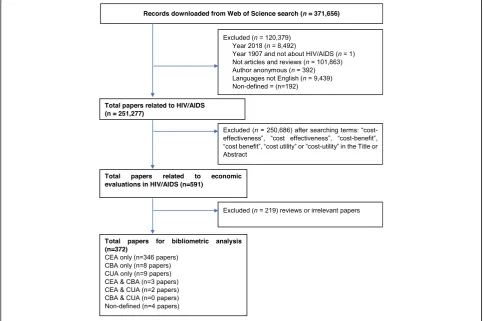
the search results consistent. Disagreements between the two researchers were resolved by discussing with a senior researcher. After having correct data, we screened the ti-tles and abstracts, and excluded publications which were: 1) not original articles and reviews; 2) not published in English; 3) not about HIV/AIDS. Figure1 shows the re-sults of the searching process. The final dataset was trans-ferred to a data file to be further analyzed using STATA version 14.0 (STATACorp., Texas, the USA).
Data analysis
We described some fundamental characteristics of publi-cations, which consisted of years of publication, the num-ber of papers per country/per year, total citations up to 2017, mean citation rate per year, total usage in the last 6 months/5 years, and mean use rate the last 6 months/5 years. We used Circos platform to draw network graphs to figure the collaboration networks among countries using co-authorships data [27]. This tool was originally used to figure the variations of genome [27]. We used the VOSviewer (version 1.6.8, Center for Science and Tech-nology, Leiden University, the Netherlands) to illustrated networks of co-occurrence keywords. By using STATA version 14, we conducted a Latent Dirichlet Allocation
[image:3.595.56.540.397.718.2](LDA) analysis to categorize papers into different topics/ themes [36–40]. Two researchers reviewed all titles and abstracts of papers in each topic/theme and identify the content of the ten topics. Disagreements were resolved by involving opinions from a senior researcher. Jaccard’s similarity index was used to determine research topics or terms that most frequently co-occur with each other.
Results
Figure 1 reveals the searching and selection processes. Among 250,270 papers about HIV/AIDS, 372 papers are about economic evaluations in HIV/AIDS.
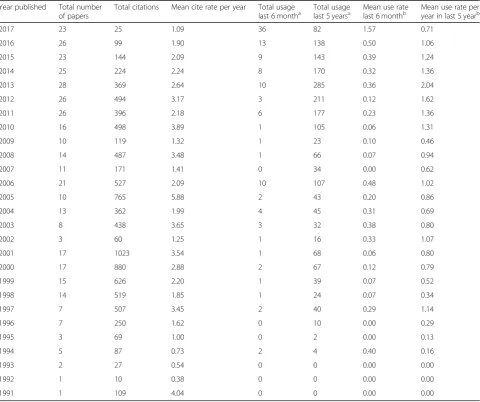
Table1outlines some basic characteristics of the selected publications. Overall, the number of articles studying eco-nomic or finance perspective in the field of HIV/AIDS, as well as the total citations and mean cite rate per year in-creased significantly from period 1991–1997 to 1998–2001
albeit a decrease in the period 2002–2005. Notably, the total usage (total number of downloads) and the mean use rate in the last 5 years of papers published in 2013 were the highest compared with other years.
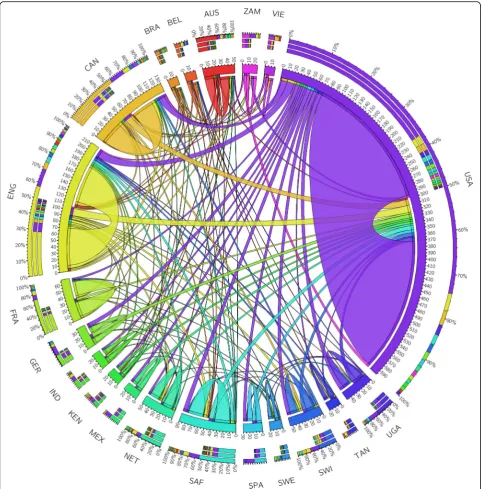
[image:4.595.58.539.314.716.2]Figure2reveals the collaboration networks between the top 20 contributing countries. Overall, 46 countries con-tributed to at least one article in the final dataset with 372 papers, of which the United States of America (USA) and England had the highest number of publications (306 and 118 papers, respectively), following by Canada (66 papers), South Africa (45 papers), and France (35 papers). In top 10 countries with the highest number of publications, only South Africa and Uganda had hyperendemic and general-ized HIV/AIDS epidemic, respectively, while others had concentrated (such as the USA or England) or low-level epidemic (such as France). Meanwhile, among the top 20 country, only South Africa, Uganda, Zambia, Kenya and
Table 1General characteristics of publications
Year published Total number of papers
Total citations Mean cite rate per year Total usage
last 6 montha Total usagelast 5 yearsa Mean use ratelast 6 monthb Mean use rate peryear in last 5 yearb
2017 23 25 1.09 36 82 1.57 0.71 2016 26 99 1.90 13 138 0.50 1.06 2015 23 144 2.09 9 143 0.39 1.24 2014 25 224 2.24 8 170 0.32 1.36 2013 28 369 2.64 10 285 0.36 2.04 2012 26 494 3.17 3 211 0.12 1.62 2011 26 396 2.18 6 177 0.23 1.36 2010 16 498 3.89 1 105 0.06 1.31 2009 10 119 1.32 1 23 0.10 0.46 2008 14 487 3.48 1 66 0.07 0.94 2007 11 171 1.41 0 34 0.00 0.62 2006 21 527 2.09 10 107 0.48 1.02 2005 10 765 5.88 2 43 0.20 0.86 2004 13 362 1.99 4 45 0.31 0.69 2003 8 438 3.65 3 32 0.38 0.80 2002 3 60 1.25 1 16 0.33 1.07 2001 17 1023 3.54 1 68 0.06 0.80 2000 17 880 2.88 2 67 0.12 0.79 1999 15 626 2.20 1 39 0.07 0.52 1998 14 519 1.85 1 24 0.07 0.34 1997 7 507 3.45 2 40 0.29 1.14 1996 7 250 1.62 0 10 0.00 0.29
1995 3 69 1.00 0 2 0.00 0.13
1994 5 87 0.73 2 4 0.40 0.16
1993 2 27 0.54 0 0 0.00 0.00
1992 1 10 0.38 0 0 0.00 0.00
1991 1 109 4.04 0 0 0.00 0.00
a
Total usage: Total number of downloads
b
Tanzania had hyperendemic or generalized epidemic. England and the USA had the highest volume of collabo-rations with 27 and 22 countries, respectively. These were followed by Canada (13 countries), South Africa (11 coun-tries) and Australia (11 councoun-tries).
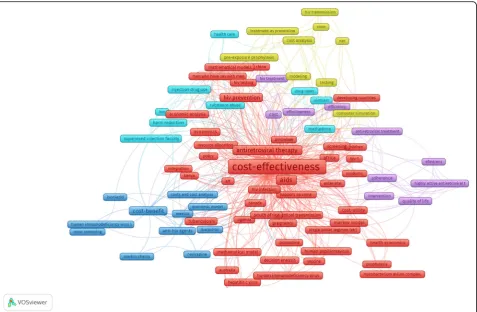
To illustrate the scopes of studies and development of research landscapes, we performed abstracts and keywords analysis. Figure3reveals five major clusters from 121 most
[image:5.595.57.541.87.577.2]especially in men who have sex with men; 3) the blue clus-ter referred to the economic evaluation studies on injection drug use; 4) the navy blue cluster referred to topics of cost-benefit studies, focusing on HIV screening and treatment; 5) the purple cluster covered the interventions to improve adherence and quality of life in HIV patients.
Table2lists the top 10 research topics as well as the 20 most frequent keywords in each topic that emerged from the LDA for contents of titles/abstracts. The top three topics with highest number of publications were 1) Eco-nomic evaluations for ART interventions; 2) EcoEco-nomic evaluations for Drug use prevention interventions (such as harm reduction or methadone maintenance treatment); and 3) Economic evaluation for Prevention of mother-to-child transmission interventions.
Figure 4 showed the trend of research topics in the whole period. The first paper published in 1990 is belonged to Topic 1, following by a publication in 1992 about Topic 3. Since then, Topic 1 and Topic 2 were still paid the highest attention. However, in the last 3 years, publications in the Topic 9 “Pre and post-exposure prophylaxis interventions”, following by Topic 1, Topic 2 and Topic 5, have been raised significantly compared to other topics.
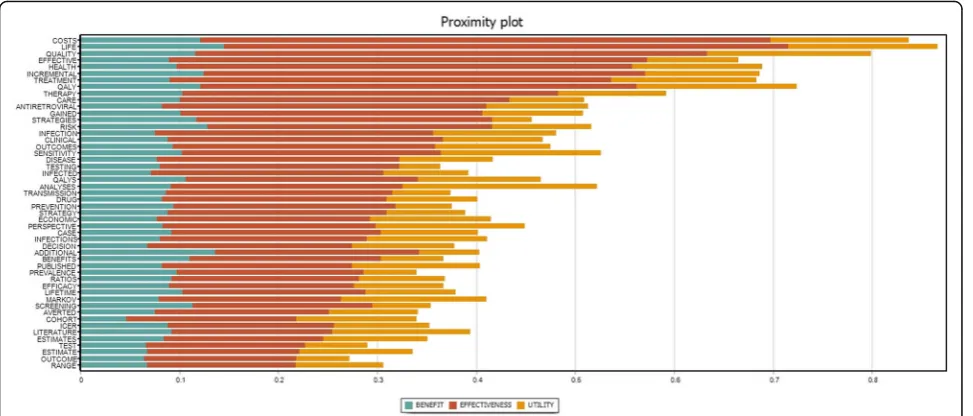
Figure 5 describes the most frequent terms co-occurring with“cost-effectiveness analysis”(CEA),“cost-utility analysis” (CUA), “cost-benefit analysis” (CBA) terms in the content analysis of all abstracts. CBA has been identified that fre-quently co-occurred with strategies for risk reduction and screening and testing services. This method was more likely to be treated as an additional method along with CEA as the terms “life,” “quality,” “QALYs” were frequently presented. The Markov model seems to be a more common method in CBA compared to the Decision Tree. Meanwhile, in terms of CEA, HIV treatment and care were perhaps the most common topic, following by risk reduction strategies (espe-cially drug use), and HIV screening and testing. QALY gained was the most common outcome, followed by infec-tious cases averted. Decision Tree and Markov Model were the two most common methods with similar shares in total publications.
Similar to CEA, treatment was the most common topic in CUA, following by risk reduction and care service. The Markov model was more frequently co-occurring with CUA compared to the Decision tree. Published papers and cohort studies were more likely to be the most common sources of data for all three forms of economic evaluation.
[image:6.595.61.539.87.399.2]Table 2Ten research topics emerged classified by LDA for titles and abstracts’contents
No Topic Most frequent terms N Percent 1 ART intervention cost-effectiveness; antiretroviral; therapy; patients; analysis, clinical;
effectiveness; treatment; objective; infection, highly; regimens; study; HIV-infected; combination, trial; active; HAART; HIV-1; adults
45 13.2%
2 Drug use prevention intervention cost-effectiveness; treatment; methadone; maintenance; injection, users; health; programs; study; intervention, supervised; drugs; prevention; reduction; background, opioid; analysis; substance; abuse; injecting
41 12.0%
3 Prevention of mother-to-child transmission intervention
cost-effectiveness; transmission; Africa; objective; model; south; women; prevent; methods; effectiveness; sub-Saharan; mother-to-child; prevention; strategies; analysis; design; reduce; health; interventions; estimate
37 10.8%
4 Cancer screening and testing intervention in HIV/AIDS patients
Human; virus; immunodeficiency; cost-effectiveness; screening; Hepatitis; testing; blood; infection; study; compared; antibody; cancer; background; tests;
cervical; donations; purpose; papillomavirus; determine
36 10.5%
5 ART intervention in resource-limited settings
antiretroviral; therapy; cost-effectiveness; settings; background, treatment; monitoring; health; Africa; resource-limited, clinical; sub-Saharan; guidelines; viral; resistance, world; different; first-line; organization; countries
35 10.2%
6 HIV counseling and testing intervention testing; screening; cost-effectiveness; united; states, analysis; objective; voluntary; counseling; design, effectiveness; disease; routine; impact; evaluate, infection; patients; expanded; benefits; objectives
33 9.6%
7 Condom distribution intervention cost-effectiveness; analysis; transmitted; workers; sexually, infections; female; background; south; condom, program; impact; Africa; cost-benefit; cost-utility, India; health; evidence; diseases; intervention
32 9.4%
8 HIV-related respiratory diseases treatment and prevention
Effectiveness; tuberculosis; background; HIV-infected; patients; strategies; infection; efficacy; diagnosis; mortality; Individuals; rapid; diagnostic; study; persons; early; preventive; infected; isoniazid; Uganda
28 8.2%
9 Pre and post-exposure prophylaxis interventions
cost-effectiveness; prophylaxis; economic; impact; evaluation, prevention; sexual; background; pre-exposure; intervention, program; potential; objective; post-exposure; exposure, Zambia; couples; following; service; methods
28 8.2%
10 HIV/AIDS vaccination intervention costs; prevention; HIV/aids; cost-effectiveness; effectiveness, interventions; disease; economic; treatment; estimates, study; comparing; important; medical; policy; using; healthcare; integrated; incremental; vaccine
27 7.9%
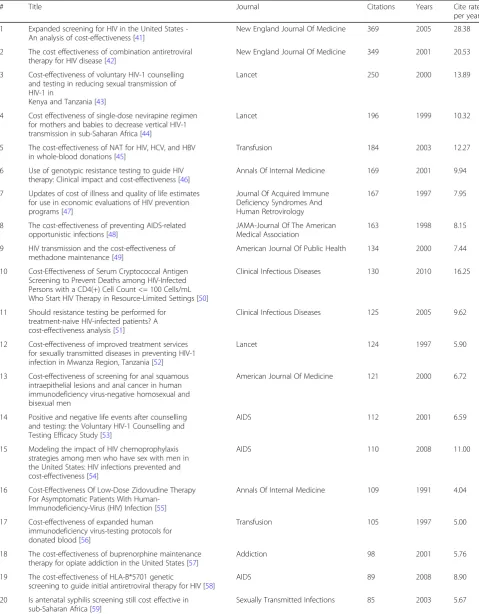
[image:7.595.54.541.146.713.2]Top 20 most cited papers on economic evaluation in HIV populations are presented in Table3. These studies primarily focused on medications for HIV treatment and care, behavior risk reduction (drug use), and HIV/Cancer screening and testing. Moreover, some studies concentrated on evaluating interventions to address co-infections such as Hepatitis C, Tuberculosis and other sexually transmitted in-fections and opportunistic inin-fections. Other studies focused on different sub-populations such as breastfeeding women and men who have sex with men.
Discussion
This study mapped the trends and patterns of economic evaluation publications in the field of HIV/AIDS, and hence it enriches the previous bibliometric studies regard-ing health economics in HIV/AIDS research [33–35]. Our study captured the growth of these publications as well as their usage in the last 5 years, suggesting the critical role of this topic in HIV/AIDS research. We also observed the overwhelming majority of CEA compared to CUA and CBA; and the predominance of the USA in performing economic evaluation studies in HIV/AIDS. Moreover, we applied an advanced method to understand thoroughly the content of keywords and abstracts, indicating the de-velopment of research domains as well as landscapes in this field and exploring the research gaps. The findings would be used to recommend further directions in order to advance this research area.
By analyzing the contents of abstracts, we could identify the most common economic evaluation research topics in the field of HIV/AIDS. Economic evaluation had been ap-plied in various topics, including prevention (such as harm
reduction, condom use or pre and post-exposure prophy-laxis); HIV-related clinical services (testing and counselling services; ART, or vaccine); or co-infections (tuberculosis, hepatitis C, or HPV). Nonetheless, these results also imply some research gaps that have not been fully investigated. For instance, little economic evaluation evidence was found for transgender or migrant people, who are at very high risk of HIV infection [60,61]. Also, there was a lack of economic evaluation evidence in structural interventions such as policy experiments or integrated/decentralized HIV-related service models, especially for stigmatized populations such as men who have sex with men [8,62]. As infecting HIV requires lifelong treatment, evaluations in effectiveness and cost-effectiveness of interventions reducing the burden of aging and non-communicable diseases in HIV patients are also necessary [63–65]. Furthermore, our results showed a lack of economic evaluation evidence on the intervention using theory-driven eHealth approach, which is increasingly per-formed to prevent HIV risk behaviors, promote HIV testing and support HIV treatment [66,67]. Last, but not least, the studies on the affordability were lacking. Policymakers with short-term constrained resources may not be able to invest in the high-cost interventions despite their superior health benefits [68]. Therefore, information about the affordability, feasibility and acceptability of the interventions should be incorporated into the economic evaluation studies. This in-formation will support policymakers optimally allocating the available resource.
[image:8.595.57.544.88.296.2]Table 3Top 20 most cited papers among economic evaluation publications
# Title Journal Citations Years Cite rate per year 1 Expanded screening for HIV in the United States
-An analysis of cost-effectiveness [41]
New England Journal Of Medicine 369 2005 28.38 2 The cost effectiveness of combination antiretroviral
therapy for HIV disease [42]
New England Journal Of Medicine 349 2001 20.53 3 Cost-effectiveness of voluntary HIV-1 counselling
and testing in reducing sexual transmission of HIV-1 in
Kenya and Tanzania [43]
Lancet 250 2000 13.89
4 Cost effectiveness of single-dose nevirapine regimen for mothers and babies to decrease vertical HIV-1 transmission in sub-Saharan Africa [44]
Lancet 196 1999 10.32
5 The cost-effectiveness of NAT for HIV, HCV, and HBV in whole-blood donations [45]
Transfusion 184 2003 12.27 6 Use of genotypic resistance testing to guide HIV
therapy: Clinical impact and cost-effectiveness [46]
Annals Of Internal Medicine 169 2001 9.94 7 Updates of cost of illness and quality of life estimates
for use in economic evaluations of HIV prevention programs [47]
Journal Of Acquired Immune Deficiency Syndromes And Human Retrovirology
167 1997 7.95
8 The cost-effectiveness of preventing AIDS-related opportunistic infections [48]
JAMA-Journal Of The American Medical Association
163 1998 8.15 9 HIV transmission and the cost-effectiveness of
methadone maintenance [49]
American Journal Of Public Health 134 2000 7.44 10 Cost-Effectiveness of Serum Cryptococcal Antigen
Screening to Prevent Deaths among HIV-Infected Persons with a CD4(+) Cell Count <= 100 Cells/mL Who Start HIV Therapy in Resource-Limited Settings [50]
Clinical Infectious Diseases 130 2010 16.25
11 Should resistance testing be performed for treatment-naive HIV-infected patients? A cost-effectiveness analysis [51]
Clinical Infectious Diseases 125 2005 9.62
12 Cost-effectiveness of improved treatment services for sexually transmitted diseases in preventing HIV-1 infection in Mwanza Region, Tanzania [52]
Lancet 124 1997 5.90
13 Cost-effectiveness of screening for anal squamous intraepithelial lesions and anal cancer in human immunodeficiency virus-negative homosexual and bisexual men
American Journal Of Medicine 121 2000 6.72
14 Positive and negative life events after counselling and testing: the Voluntary HIV-1 Counselling and Testing Efficacy Study [53]
AIDS 112 2001 6.59
15 Modeling the impact of HIV chemoprophylaxis strategies among men who have sex with men in the United States: HIV infections prevented and cost-effectiveness [54]
AIDS 110 2008 11.00
16 Cost-Effectiveness Of Low-Dose Zidovudine Therapy For Asymptomatic Patients With
Human-Immunodeficiency-Virus (HIV) Infection [55]
Annals Of Internal Medicine 109 1991 4.04
17 Cost-effectiveness of expanded human immunodeficiency virus-testing protocols for donated blood [56]
Transfusion 105 1997 5.00
18 The cost-effectiveness of buprenorphine maintenance therapy for opiate addiction in the United States [57]
Addiction 98 2001 5.76 19 The cost-effectiveness of HLA-B*5701 genetic
screening to guide initial antiretroviral therapy for HIV [58]
AIDS 89 2008 8.90 20 Is antenatal syphilis screening still cost effective in
sub-Saharan Africa [59]
research [70]. CEA uses disease-specific clinical, biomed-ical indicators or non-compound measures of survival as outcomes, for example, cost per infection averted/pre-vented or cost per life year saved; hence, contextualized features are not fully reflected [12]. Meanwhile, CUA is the gold standard for economic evaluation, since it uses utility-based units as outcomes (such as cost per QALYs gained or DALYs averted), which enables the compari-son of various type of interventions and disease condi-tions. A previous review indicated that QALYs were more popular in high income countries, while low and low-middle income countries mostly used DALYs averted [71]. A key benefit of the utility-based units CUA uses is that they consider both the patients’quality of life/health and the effects of interventions on mortal-ity, which are more important than purely clinical out-comes often used in CEA. However, in practice, many studies in the field of HIV/AIDS reported both clinical outcomes and QALYs/DALYs outcomes; and they used the term “cost-effectiveness analysis” instead of “ cost-utility analysis” [7, 8, 17, 24–26]. In CBA it is necessary to quantify the monetary value of the outcomes of health-care interventions. This is complex and some consider it to be unethical to place a monetary value on human life. These disadvantages hinder the use of CBA and CEA/ CUA studies have become the dominant method.
Our findings also revealed a discrepancy in the geo-graphical distribution of economic evaluation studies. The current results illustrate a high fragmentation of economic evaluation studies, which were mostly per-formed by authors in a few countries such as the USA (concentrated epidemic), England (concentrated epidemic), Canada (concentrated epidemic) and South Africa (Hyper-endemic). Among top 20 countries as study settings having the highest number of economic evaluation publications, only five countries had severe HIV epidemic including South Africa (hyperendemic), Uganda (generalized), Kenya (generalized), Tanzania (generalized), and Zambia (general-ized). Indeed, the application of economic evaluation stud-ies for HIV responses highly depends on socioeconomic, epidemiological and health system characteristics in each nation. Jacobsen et al. argued that most of the economic evaluation models examining HIV/AIDS interventions were heterogeneous due to variations of methodologies and set-tings [68]. Insufficient local cost and effectiveness data were one of the major reasons that obstructed the utilization of economic evaluation research in policy-making process, leading to incorrect decisions in selecting priorities [72]. This lost benefit might even be greater in LMICs than that in high-income countries [69]. The Second Panel on Cost-effectiveness in Health and Medicine in 2016 suggested that interventions’impacts on both health and non-health out-comes (such as work productivity, education, or environ-ment) should be measured to reflect fully the societal
perspectives of interventions in specific settings [73]. There-fore, increasing the presence of contextualized data and strategies are vital to promoting the quality and applicability of economic evaluation studies in HIV/AIDS research.
The partnership network analysis in our study shows clearly that countries in similar geographical regions tended to collaborate in performing economic evaluation research. This result implies that building strong regional and sub-regional partnership networks between leading countries and other countries in similar regions or with similar con-texts may be beneficial. For example, countries such as South Africa, India, China, Brazil and the United Kingdom could play a center role in bringing together available re-sources from other countries in the same regions to con-duct multi-country economic evaluation studies. Such a regional initiative could substantially increase the quality of evidence as well as the research capacity of each country members in the network. Previous bibliometric analyses had agreements in the critically important role of inter-national and local collaboration networks in enhancing re-search capacity and evidence transfer [29,74].
Our study contains several limitations. First, our searching process restricted in using only the WoS albeit its advantages compared to other databases. The limited databases might restrict our ability to cover all possible health economic and economic evaluation studies in HIV/AIDS field. The misuse of keyword such as CEA in-stead of CUA could result in the underestimation in the volume of publications for each economic evaluation form. Second, we only included peer-reviewed publica-tions in the English language; therefore, potential grey documents reporting health economic studies and eco-nomic evaluation were not considered. Furthermore, we could only analyze abstracts and keywords instead of full-text of publications, which might not capture the main themes of selected publications. Fourth, our ana-lysis was not able to examine the transferability of each research, which referred to the application of economic evaluation evidence in one country to another country. Further research should evaluate the transferability and applicability of economic evaluation in the decision-making process in each country.
Conclusion
In conclusion, this study highlighted the methodological and geographical discrepancies in health economic and economic evaluations in the field of HIV/AIDS. Developing regional collaboration networks and performing studies that incorporate affordability, feasibility and acceptability of the interventions would potentially improve the research capacity and study quality in economic evaluation research.
Abbreviations
LDA: Latent Dirichlet Allocation; LMICs: Low- and middle-income countries; PLWH: People living with HIV; QALY: Quality-adjusted life years; STIs: Sexually Transmitted Infections; UNAIDS: Joint United Nations Programme on HIV/ AIDS; USA: United States of America; WoS: Web of Science
Acknowledgements Not applicable
Authors’contributions
BXT, LHN, HCT, SN, GTV, CTN, CAL, CSHH, RCMH conceived of the study, and participated in its design and implementation and wrote the manuscript. BXT, LHN analyzed the data. All authors read and approved the final manuscript.
Funding
This study did not receive any funding.
Availability of data and materials
The datasets supporting the conclusions of this article are included within the article and its additional file.
Ethics approval and consent to participate Not applicable
Consent for publication Not applicable
Competing interests
The authors declare that they have no competing interests. Bach Tran is a member of the editorial board of BMC Health Services Research. HCT is supported by the Wellcome Trust [089276/B/09/7].
Author details
1Department of Health Economics, Institute for Preventive Medicine and
Public Health, Hanoi Medical University, Hanoi, Vietnam.2Bloomberg School
of Public Health, Johns Hopkins University, Baltimore, MD, USA.3Center of
Excellence in Behavioral Medicine, Nguyen Tat Thanh University, Ho Chi Minh City 70000, Vietnam.4Oxford University Clinical Research Unit, Ho Chi
Minh City 70000, Vietnam.5Centre for Applied Health Economics, Griffith
University, Brisbane, Australia.6Center of Excellence in Evidence-based
Medicine, Nguyen Tat Thanh University, Ho Chi Minh City 70000, Vietnam.
7Institute for Global Health Innovations, Duy Tan University, Da Nang,
Vietnam.8Department of Psychological Medicine, National University
Hospital, Singapore, Singapore.9Department of Psychological Medicine,
Yong Loo Lin School of Medicine, National University of Singapore, Singapore 119228, Singapore.10Biomedical Global Institute of Healthcare
Research & Technology (BIGHEART), National University of Singapore, Singapore 117599, Singapore.
Received: 12 April 2019 Accepted: 7 October 2019
References
1. Dieleman JL, Haakenstad A, Micah A, Moses M, Abbafati C, Acharya P, Adhikari TB, Adou AK, Ahmad Kiadaliri A, Alam K, et al. Spending on health and HIV/AIDS: domestic health spending and development assistance in 188 countries, 1995–2015. Lancet. 2018;391(10132):1799–829. 2. Global HIV & AIDS statistics—2019 fact sheet.https://www.unaids.org/en/
resources/fact-sheet. Accessed 3 Sept 2019.
3. Snapshot - HIV investment.http://www.unaids.org/sites/default/files/media_ asset/HIV_investments_Snapshot_en.pdf. Accessed 3 Sept 2019.
4. Schwartländer B, Stover J, Hallett T, Atun R, Avila C, Gouws E, Bartos M, Ghys PD, Opuni M, Barr D, et al. Towards an improved investment approach for an effective response to HIV/AIDS. Lancet. 2011;377(9782):2031–41. 5. Olakunde BO, Ndukwe CD. Improved domestic funding enhances the
sustainability of HIV/AIDS response in Nigeria. Ann Glob Health. 2015; 81(5):684–8.
6. Resources and Financing.http://www.unaids.org/en/topic/resources. Accessed 3 Sept 2019.
7. Holtgrave DR, Qualls NL, Graham JD. Economic evaluation of HIV prevention programs. Annu Rev Public Health. 1996;17:467–88.
8. Galarraga O, Colchero MA, Wamai RG, Bertozzi SM. HIV prevention cost-effectiveness: a systematic review. BMC Public Health. 2009;9(Suppl 1):S5. 9. Drummond MF, Aguiar-Ibanez R, Nixon J. Economic evaluation. Singap Med
J. 2006;47(6):456–61 quiz 462.
10. Blumenschein K, Johannesson M. Economic evaluation in healthcare. A brief history and future directions. PharmacoEconomics. 1996;10(2):114–22. 11. Drummond M, Jonsson B, Rutten F. The role of economic evaluation in the
pricing and reimbursement of medicines. Health Policy. 1997;40(3):199–215. 12. Rudmik L, Drummond M. Health economic evaluation: important principles
and methodology. Laryngoscope. 2013;123(6):1341–7.
13. Tarride JE, Blackhouse G, Bischof M, McCarron EC, Lim M, Ferrusi IL, Xie F, Goeree R. Approaches for economic evaluations of health care technologies. J Am Coll Radiol. 2009;6(5):307–16.
14. Cambiano V, Miners A, Dunn D, McCormack S, Ong KJ, Gill ON, Nardone A, Desai M, Field N, Hart G, et al. Cost-effectiveness of pre-exposure prophylaxis for HIV prevention in men who have sex with men in the UK: a modelling study and health economic evaluation. Lancet Infect Dis. 2018; 18(1):85–94.
15. Pinkerton SD, Holtgrave DR, Jemmott JB 3rd. Economic evaluation of HIV risk reduction intervention in African-American male adolescents. J Acquir Immune Defic Syndr. 2000;25(2):164–72.
16. Huang YL, Lasry A, Hutchinson AB, Sansom SL. A systematic review on cost effectiveness of HIV prevention interventions in the United States. Appl Health Econ Health Policy. 2015;13(2):149–56.
17. Dibosa-Osadolor O, Roberts T. Economic evaluation, human immunodeficiency virus infection and screening: a review and critical appraisal of economic studies. Int J Technol Assess Health Care. 2010;26(3):301–8.
18. Werayingyong P, Phanuphak N, Chokephaibulkit K, Tantivess S, Kullert N, Tosanguan K, Butchon R, Voramongkol N, Boonsuk S, Pilasant S, et al. Economic evaluation of 3-drug antiretroviral regimens for the prevention of mother-to-child HIV transmission in Thailand. Asia Pac J Public Health. 2015; 27(2):Np866–76.
19. Tse WF, Yang W, Huang W. A narrative review of cost-effectiveness analysis of people living with HIV treated with HAART: from interventions to outcomes. Clinicoecon Outcomes Res. 2015;7:431–9.
20. Colombo GL, Di Matteo S, Antinori A, Medaglia M, Murachelli S, Rizzardini G. Economic evaluation of initial antiretroviral therapy for HIV-infected patients: an update of Italian guidelines. Clinicoecon Outcomes Res. 2013;5:489–96. 21. Merito M, Bonaccorsi A, Pammolli F, Riccaboni M, Baio G, Arici C, Monforte
AD, Pezzotti P, Corsini D, Tramarin A, et al. Economic evaluation of HIV treatments: the I.CO.N.A. cohort study. Health Policy. 2005;74(3):304–13. 22. Patel AR, Kessler J, Braithwaite RS, Nucifora KA, Thirumurthy H, Zhou Q, Lester RT, Marra CA. Economic evaluation of mobile phone text message interventions to improve adherence to HIV therapy in Kenya. Medicine (Baltimore). 2017;96(7):e6078.
23. Ramos JM, Gutierrez F, Padilla S, Masia M, Martin-Hidalgo A. Geography of medical publications. An overview of HIV/AIDS research in 2003. AIDS. 2005;19(2):219–20.
24. Ruger JP, Lazar CM. Economic evaluation of drug abuse treatment and HIV prevention programs in pregnant women: a systematic review. Addict Behav. 2012;37(1):1–10.
25. Nosyk B, Krebs E, Eyawo O, Min JE, Barrios R, Montaner JS. Cost-effectiveness analysis along the continuum of HIV care: how can we optimize the effect of HIV treatment as prevention programs? Curr HIV/ AIDS Rep. 2014;11(4):468–78.
26. Mauskopf J, Annemans L, Hill AM, Smets E. A review of economic evaluations of darunavir boosted by low-dose ritonavir in treatment-experienced persons living with HIV infection. PharmacoEconomics. 2010; 28(Suppl 1):1–16.
27. Li R, Hernandez-Villafuerte K, Towse A, Vlad I, Chalkidou K. Mapping priority setting in health in 17 countries across Asia, Latin America, and sub-Saharan Africa. Health Syst Reform. 2016;2(1):71–83.
28. Jenniskens F, Tiendrebeogo G, Coolen A, Blok L, Kouanda S, Sataru F, Ralisimalala A, Mwapasa V, Kiyombo M, Plummer D. How countries cope with competing demands and expectations: perspectives of different stakeholders on priority setting and resource allocation for health in the era of HIV and AIDS. BMC Public Health. 2012;12:1071.
29. Hernandez-Villafuerte K, Li R, Hofman KJ. Bibliometric trends of health economic evaluation in sub-Saharan Africa. Glob Health. 2016;12(1):50. 30. Ellegaard O, Wallin JA. The bibliometric analysis of scholarly production:
31. Durieux V, Gevenois PA. Bibliometric indicators: quality measurements of scientific publication. Radiology. 2010;255(2):342–51.
32. Rosas SR, Kagan JM, Schouten JT, Slack PA, Trochim WM. Evaluating research and impact: a bibliometric analysis of research by the NIH/NIAID HIV/AIDS clinical trials networks. PLoS One. 2011;6(3):e17428.
33. Youle M, Trueman P, Simpson KJP. Health economics in HIV disease. Pharmacoeconomics. 1999;15(1):1–12.
34. Beck EJ, Miners AH, Tolley KJP. The cost of HIV treatment and care. Pharmacoeconomics. 2001;19(1):13–39.
35. Beck EJ, Harling G, Gerbase S, DeLay P. The cost of treatment and care for people living with HIV infection: implications of published studies, 1999– 2008. Curr Opin HIV AIDS. 2010;5(3):215–24.
36. Massey CN, Feig EH, Duque-Serrano L, Wexler D, Moskowitz JT, Huffman JC. Well-being interventions for individuals with diabetes: a systematic review. Diabetes Res Clin Pract. 2019;147:118–33.
37. Valle D, Albuquerque P, Zhao Q, Barberan A, Fletcher RJ Jr. Extending the latent Dirichlet allocation model to presence/absence data: a case study on north American breeding birds and biogeographical shifts expected from climate change. Glob Chang Biol. 2018;24(11):5560–72.
38. Chen C, Zare A, Trinh HN, Omotara GO, Cobb JT, Lagaunne TA. Partial membership latent Dirichlet allocation for soft image segmentation. IEEE Trans Image Process. 2017;26(12):5590–602.
39. Lu HM, Wei CP, Hsiao FY. Modeling healthcare data using multiple-channel latent Dirichlet allocation. J Biomed Inform. 2016;60:210–23.
40. Gross A, Murthy D. Modeling virtual organizations with latent
Dirichlet allocation: a case for natural language processing. Neural Netw. 2014; 58:38–49.
41. Paltiel AD, Weinstein MC, Kimmel AD, Seage GR 3rd, Losina E, Zhang H, Freedberg KA, Walensky RP. Expanded screening for HIV in the United States--an analysis of cost-effectiveness. N Engl J Med. 2005;352(6):586–95. 42. Freedberg KA, Losina E, Weinstein MC, Paltiel AD, Cohen CJ, Seage GR,
Craven DE, Zhang H, Kimmel AD, Goldie SJ. The cost effectiveness of combination antiretroviral therapy for HIV disease. N Engl J Med. 2001; 344(11):824–31.
43. Sweat M, Gregorich S, Sangiwa G, Furlonge C, Balmer D, Kamenga C, Grinstead O, Coates T. Cost-effectiveness of voluntary HIV-1 counselling and testing in reducing sexual transmission of HIV-1 in Kenya and Tanzania. Lancet. 2000;356(9224):113–21.
44. Marseille E, Kahn JG, Mmiro F, Guay L, Musoke P, Fowler MG, Jackson JB. Cost effectiveness of single-dose nevirapine regimen for mothers and babies to decrease vertical HIV-1 transmission in sub-Saharan Africa. Lancet. 1999;354(9181):803–9.
45. Jackson BR, Busch MP, Stramer SL, AuBuchon JP. The cost-effectiveness of NAT for HIV, HCV, and HBV in whole-blood donations. Transfusion. 2003; 43(6):721–9.
46. Weinstein MC, Goldie SJ, Losina E, Cohen CJ, Baxter JD, Zhang H, Kimmel AD, Freedberg KA. Use of genotypic resistance testing to guide hiv therapy: clinical impact and cost-effectiveness. Ann Intern Med. 2001;134(6):440–50. 47. Holtgrave DR, Pinkerton SD. Updates of cost of illness and quality of life
estimates for use in economic evaluations of HIV prevention programs. J Acquir Immune Defic Syndr Hum Retrovirol. 1997;16(1):54–62.
48. Freedberg KA, Scharfstein JA, Seage GR 3rd, Losina E, Weinstein MC, Craven DE, Paltiel AD. The cost-effectiveness of preventing AIDS-related
opportunistic infections. Jama. 1998;279(2):130–6.
49. Zaric GS, Barnett PG, Brandeau ML. HIV transmission and the cost-effectiveness of methadone maintenance. Am J Public Health. 2000; 90(7):1100–11.
50. Meya DB, Manabe YC, Castelnuovo B, Cook BA, Elbireer AM, Kambugu A, Kamya MR, Bohjanen PR, Boulware DR. Cost-effectiveness of serum cryptococcal antigen screening to prevent deaths among HIV-infected persons with a CD4+ cell count < or = 100 cells/microL who start HIV therapy in resource-limited settings. Clin Infect Dis. 2010;51(4):448–55. 51. Sax PE, Islam R, Walensky RP, Losina E, Weinstein MC, Goldie SJ, Sadownik SN,
Freedberg KA. Should resistance testing be performed for treatment-naive HIV-infected patients? A cost-effectiveness analysis. Clin Infect Dis. 2005;41(9):1316–23. 52. Gilson L, Mkanje R, Grosskurth H, Mosha F, Picard J, Gavyole A, Todd J,
Mayaud P, Swai R, Fransen L, et al. Cost-effectiveness of improved treatment services for sexually transmitted diseases in preventing HIV-1 infection in Mwanza Region, Tanzania. Lancet. 1997;350(9094):1805–9.
53. Goldie SJ, Kuntz KM, Weinstein MC, Freedberg KA, Palefsky JM. Cost-effectiveness of screening for anal squamous intraepithelial lesions and anal
cancer in human immunodeficiency virus-negative homosexual and bisexual men. Am J Med. 2000;108(8):634–41.
54. Grinstead OA, Gregorich SE, Choi KH, Coates T. Positive and negative life events after counselling and testing: the voluntary HIV-1 counselling and testing efficacy study. AIDS. 2001;15(8):1045–52.
55. Desai K, Sansom SL, Ackers ML, Stewart SR, Hall HI, Hu DJ, Sanders R, Scotton CR, Soorapanth S, Boily MC, et al. Modeling the impact of HIV chemoprophylaxis strategies among men who have sex with men in the United States: HIV infections prevented and cost-effectiveness. AIDS. 2008;22(14):1829–39. 56. Schulman KA, Lynn LA, Glick HA, Eisenberg JM. Cost effectiveness of low-dose
zidovudine therapy for asymptomatic patients with human immunodeficiency virus (HIV) infection. Ann Intern Med. 1991;114(9):798–802.
57. Barnett PG, Zaric GS, Brandeau ML. The cost-effectiveness of buprenorphine maintenance therapy for opiate addiction in the United States. Addiction. 2001;96(9):1267–78.
58. Schackman BR, Scott CA, Walensky RP, Losina E, Freedberg KA, Sax PE. The cost-effectiveness of HLA-B*5701 genetic screening to guide initial antiretroviral therapy for HIV. AIDS. 2008;22(15):2025–33.
59. Terris-Prestholt F, Watson-Jones D, Mugeye K, Kumaranayake L, Ndeki L, Weiss H, Changalucha J, Todd J, Lisekie F, Gumodoka B, et al. Is antenatal syphilis screening still cost effective in sub-Saharan Africa. Sex Transm Infect. 2003;79(5):375–81.
60. Baral SD, Poteat T, Strömdahl S, Wirtz AL, Guadamuz TE, Beyrer C. Worldwide burden of HIV in transgender women: a systematic review and meta-analysis. Lancet Infect Dis. 2013;13(3):214–22.
61. Coffee M, Lurie MN, Garnett GP. Modelling the impact of migration on the HIV epidemic in South Africa. AIDS. 2007;21(3):343–50.
62. Iskarpatyoti BS, Lebov J, Hart L, Thomas J, Mandal M. Evaluations of structural interventions for HIV prevention: a review of approaches and methods. AIDS Behav. 2018;22(4):1253–64.
63. Kemp CG, Weiner BJ, Sherr KH, Kupfer LE, Cherutich PK, Wilson D, Geng EH, Wasserheit JN. Implementation science for integration of HIV and non-communicable disease services in sub-Saharan Africa: a systematic review. AIDS. 2018;32:S93–S105.
64. Patel P, Rose CE, Collins PY, Nuche-Berenguer B, Sahasrabuddhe VV, Peprah E, Vorkoper S, Pastakia SD, Rausch D, Levitt NS. Noncommunicable diseases among HIV-infected persons in low-income and middle-income countries: a systematic review and meta-analysis. AIDS. 2018;32(Suppl 1):S5–s20. 65. Brent RJ, Brennan M, Karpiak SE. Economic evaluations of HIV prevention in
rich countries and the need to focus on the aging of the HIV-positive population. Curr Opin HIV AIDS. 2010;5(3):255–60.
66. Henny KD, Wilkes AL, McDonald CM, Denson DJ, Neumann MS. A rapid review of eHealth interventions addressing the continuum of HIV care (2007-2017). AIDS Behav. 2018;22(1):43–63.
67. Kemp CG, Velloza J. Implementation of eHealth interventions across the HIV care cascade: a review of recent research. Curr HIV/AIDS Rep. 2018; 15(6):403–13.
68. Jacobsen MM, Walensky RP. Modeling and cost-effectiveness in HIV prevention. Curr HIV/AIDS Rep. 2016;13(1):64–75.
69. Pitt C, Goodman C, Hanson K. Economic evaluation in global perspective: a bibliometric analysis of the recent literature. Health Econ. 2016;25(Suppl 1):9–28.
70. Wendy JU. Paediatric health economic evaluations: a world view. World Health Popul. 2006;8(4):89–101.
71. Neumann PJ, Anderson JE, Panzer AD, Pope EF, D'Cruz BN, Kim DD, Cohen JT. Comparing the cost-per-QALYs gained and cost-per-DALYs averted literatures. Gates Open Res. 2018;2:5.
72. Taleski SJ, Ahmed K, Whiteside A. The relationship between economic evaluations and HIV and AIDS treatment policies. Curr Opin HIV AIDS. 2010;5(3):204–9. 73. Neumann PJ, Kim DD, Trikalinos TA, Sculpher MJ, Salomon JA, Prosser
LA, Owens DK, Meltzer DO, Kuntz KM, Krahn M, et al. Future directions for cost-effectiveness analyses in health and medicine. Med Decis Mak. 2018;38(7):767–77.
74. McIntyre D, Wayling S. Strengthening health-economics capability in Africa: summary and outcomes of a regional consultation of experts and policy-makers. Geneva: World Health Organization/Special Programme for Research & Training in Tropical Diseases; 2008.
Publisher’s Note