arXiv:1510.08036v4 [math.CO] 18 Jul 2016
Pattern avoidance in forests of binary shrubs
David Bevan
1Derek Levin
2∗Peter Nugent
2†Jay Pantone
3Lara Pudwell
4Manda Riehl
2‡ML Tlachac
2§1 Dept. of Mathematics and Statistics, Open Univ., UK
2 Dept. of Mathematics, Univ. of Wisconsin – Eau Claire, USA 3
Dept. of Mathematics, Dartmouth College, USA
4 Dept. of Mathematics and Statistics, Valparaiso Univ., USA
received 31st
Oct. 2015,revised 8th
June 2016, accepted 4th
July 2016.
We investigate pattern avoidance in permutations satisfying some additional restrictions. These are naturally considered in terms of avoiding patterns in linear extensions of certain forest-like partially ordered sets, which we call binary shrub forests. In this context, we enumerate forests avoiding patterns of length three. In four of the five non-equivalent cases, we present explicit enumerations by exhibiting bijections with certain lattice paths bounded above by the line y = ℓx, for some ℓ ∈ Q+, one of these being the celebrated Duchon’s club paths withℓ= 2/3. In the remaining case, we use the machinery of analytic combinatorics to determine the minimal polynomial of its generating function, and deduce its growth rate.
Keywords: permutation patterns, linear extensions
1
Introduction
In this paper, we extend pattern avoidance to a previously unexamined combinatorial structure. Let Sn be the set of permutations of length n. First, given permutationsπ = π1π2· · ·πn ∈ Sn
andρ=ρ1ρ2· · ·ρm∈ Smwe say that π contains ρas a (classical) pattern if there exist 1≤i1<
i2<· · ·< im≤nsuch thatπia < πib if and only ifρa< ρb. In this case we say thatπi1πi2· · ·πim
is order-isomorphic to ρ (denoted πi1πi2· · ·πim ∼ ρ) and that πi1πi2· · ·πim reduces to ρ. If π
does not containρ, thenπ is said toavoidρ. This definition of pattern avoidance in permutations appears in many differing applications ranging from the analysis of sorting algorithms to algebraic
∗Student Blugold Commitment Differential Tuition funds through the University of Wisconsin-Eau Claire
Summer Research Experiences for Undergraduates
†Student Blugold Commitment Differential Tuition funds through the University of Wisconsin-Eau Claire
Summer Research Experiences for Undergraduates
‡University of Wisconsin - Eau Claire Office of Research and Sponsored Programs
§Student Blugold Commitment Differential Tuition funds through the University of Wisconsin-Eau Claire
Summer Research Experiences for Undergraduates
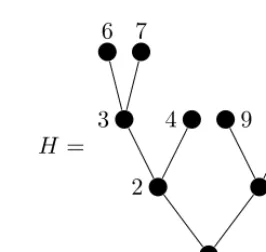
H =
1 5
8 9
2 4 3
[image:2.595.202.335.107.233.2]7 6
Fig. 1: A binary heap on 9 vertices
geometry, and has generated a number of enumeration and classification questions that are of interest in their own right.
Motivated by work with trees [4, 9, 14] and comb posets [17], Levin, Pudwell, Riehl and Sandberg [10] considered pattern avoidance in heaps. In particular a complete k-ary tree is a tree where each node has k or fewer children, all levels except possibly the last are completely full (i.e. leveli containski−1 vertices), and the last level has all of its nodes to the left side (i.e. for any two vertices in the penultimate level, if the right vertex has a positive outdegree, then the outdegree of the left vertex is k, and no more than one vertex in the penultimate level has outdegree not equal to 0 or k).
Ak-ary heapis a completek-ary tree labeled with{1, . . . , n}such that every child has a larger label than its parent. We draw trees (respectively heaps) with the root at the bottom of the figure. An example of a 2-ary (i.e. binary) heap on 9 vertices is shown in Figure 1. Let Hk n
denote the set of k-ary n-vertex heaps. The heap in Figure 1 is a member of H2
9. Given a heap
H, we associate a permutationπH with it by recording the vertex labels as they are encountered
in a breadth-first search. For example, if H is the heap in Figure 1, thenπH = 125349867. We
say that heapH contains (respectively avoids)ρas a pattern ifπH contains (respectively avoids) ρas a classical pattern, using the definition above. LetHk
n(P) be the set of members ofHnk that
avoid all patterns in the listP. While the heap in Figure 1 contains 123, 132, 213, 312, and 321, it is a member of H2
9(231). In [10], the authors determined Hkn(ρ)
for ρ ∈ (S3\ {321}), and
Hnk(P)
when|P| ≥2 and P ⊆ S3.
In this paper we extend their pattern avoidance in a new direction by considering forests of heaps. Aheap forest is an ordered collection of heaps. Given a forestF of heapsH1, H2, . . . , Hn,
we label all vertices in F with distinct integers from {1, . . . ,|F|}(where|F|=|H1|+· · ·+|Hn|),
and then associate the permutation πF = πH1πH2· · ·πHn. In other words, we concatenate the
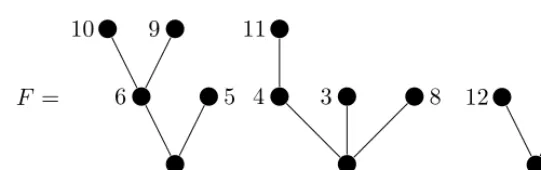
associated permutations for each heap to obtain the permutation associated to the forest. Given the forest in Figure 2,πF = 165(10)92438(11)7(12)(13). As before, we say that forestF avoids
pattern ρ if πF avoids ρ. Note, from our example, that forests can be composed of heaps with
varying numbers of vertices or even heaps that arek-ary for different values of k.
F =
1 5 6
9 10
2
8 3
4 11
[image:3.595.136.407.110.195.2]7 13 12
Fig. 2: A 13-node binary heap forest
F =
10 11 12
1 9 2
3 8 4
5 6 7
Fig. 3: A binary shrub forest with 12 vertices
so a binary shrub forest has 3n vertices where n is the number of heaps in the forest, while similarly in ak-ary shrub forest we have (k+ 1)n vertices.
Let Fk
n be the set of all k-ary shrub forests of n heaps. In Figure 3, we see a member F of
F2
4 where πF = (10)(12)(11)129348576. Let Fnk(P) be the set of members of Fnk that avoid all
patterns in list P and
Sn2(P) =
π∈ S3n |π=πf for some f ∈ Fn2(P) .
Equivalently,
Sn2(P) ={π ∈ S3n(P)|π3i+1< π3i+2 andπ3i+1 < π3i+3 for all 0≤i < n}.
Our main goal is to determine Sn2(P)
whereP ⊆ S3. In the rest of this paper, we determine
Sn2(ρ)
exactly for eachρ 6= 321. A list of sequences and corresponding reference numbers from the On-Line Encyclopedia of Integer Sequences [13] is given in Table 1. This includes results forS2
n(P) where P contains more than one pattern of
length 3. Details of the enumerations when |P|>1 are omitted from this paper due to length, but can be found as an ancillary file attached to this arXiv submission at
http://arxiv.org/src/1510.08036/anc/MultiplePatterns.pdf.
In the next section, we look at each of the sets avoiding a single pattern of length 3. For five of the patterns, we enumerate the set by establishing a bijection with a family of lattice paths from (0,0) to (m, ℓm) for someℓ∈Q+, bounded above by the line y =ℓx. In four cases, these lattice paths consist of unit east and north steps. S2
n(123) is shown to be equinumerous to such
paths withℓ= 2 (Theorem 2.4), and more generallyFk
n(123) is equinumerous to such paths with ℓ = k (Theorem 2.3). S2
n(132) is in bijection with these paths with ℓ= 3. Indeed, we prove a
more general result concerningk-ary forests, thatFk
n(132) is equinumerous to these lattice paths
withℓ=k+ 1 (Theorem 2.6). In the case ofS2
case of paths bounded above by y = 23x, the so-called “Duchon’s club model” (Theorem 2.15), and more generally we outline how Fk
n(231) is equinumerous to such paths bounded above by
y= k
k+1x.
We prove thatS2
n(213) andSn2(312) are equinumerous (Theorem 2.12) and establish a bijection
with lattice paths having east, north and northeast steps, bounded by y = 3x (Theorem 2.11). Finally, we investigate S2
n(321). We are unable to enumerate this set explicitly. However, using
functional equations, we are able to generate nearly a thousand terms of its enumeration sequence, prove that its generating function is algebraic and determine its minimal polynomial and growth rate (Theorem 2.18). We conclude in Section 3 with some questions.
P Sn2(P)
n≥1 OEIS Result
∅ 2,80,13440,5913600, . . . A210277
123 1,3,12,55,273, . . . A001764 Theorem 2.4
132 1,4,22,140,969, . . . A002293 Corollary 2.8
213
2,14,134,1482,17818, . . . A144097 Theorem 2.13 312
231 2,23,377,7229,151491, . . . A060941 Theorem 2.15 321 2,37,866,23285,679606, . . . A257995 Theorem 2.16 132,213
1,2,4,8,16, . . . A000079
132,312
132,321 1,4,10,19,31, . . . A005448 213,231
2,8,32,128,512, . . . A004171
231,312 213,312
2,2,2,2,2, . . . A007395
213,231,312 213,312,321 213,231,312,321
213,321 2,6,13,23,36, . . . A143689 231,321 2,12,72,432,2592, . . . A167747 312,321 2,10,50,250,1250, . . . A020699 132,213,321 1,2,3,4,5, . . . A000027 213,231,321 2,4,6,8,10, . . . A005843 231,312,321 2,6,18,54,162, . . . A025192
Tab. 1: Sn2(P)
whereP ⊆ S3
2
Avoiding a pattern of length
3
Proposition 2.1 (Fuss [8]). The number of lattice paths with unit East and North steps from
(0,0)to (m, ℓm) remaining weakly under the line y=ℓx is given by
1
ℓm+ 1
(ℓ+ 1)m m
.
2.1
Avoiding 123
We enumerate forests avoiding 123 by exhibiting a bijection with lattice paths bounded above by
y =kx. We begin by establishing the fact that the labels of a 123-avoiding forest are uniquely determined by their root labels.
Lemma 2.2. For any F ∈ Fk
n(123) with k ≥ 2 and n ≥ 0, the roots of the forest of F have
decreasing labels as do the leaves.
Proof: Consider πF and suppose to the contrary thatπiandπj are root labels wherei < j and
πi< πj. Thenπiπjπk ∼123 whereπk is a descendant ofπj. Similarly ifπi andπj are leaf labels
where i < j andπi< πj, thenπkπiπj ∼123 whereπk is the parent ofπi.
Therefore if we know only the root labels of a labeled forest avoiding 123, the labels for the entire forest are uniquely determined. Note however, this is not the same as saying that any labeling of roots corresponds with a forest that avoids 123.
We are now in a position to enumerateFk
n(123) and consequently Sn2(123).
Theorem 2.3. For k≥2 and n≥0,
Fnk(123) =
1
kn+ 1
(k+ 1)n n
.
Proof: We will show that Fk
n(123) is in bijection with NE lattice paths from (0,0) to (n, kn)
weakly below the liney =kx. The result then follows by Proposition 2.1 withℓ=k.
A 123-avoiding forest of k-ary shrubs is uniquely determined by its roots. Therefore, we must choose a set ofn root labels, 1 =r1< r2<· · ·< rn such that there are at least kunused labels
larger thanrn, at least 2kunused labels larger thanrn−1, and in general at leastk(n−i+1) unused labels larger than ri for 1≤ i≤n. Then the roots of the forest have labelsrn, rn−1, . . . , r2, r1, the leaves use the remaining labels in decreasing order, and each tree has leaves with larger labels than the roots.
Similarly, in a NE lattice path from (0,0) to (n, kn) weakly below the line y = kx, we must choose n steps to be East steps. To stay below the line y = kx, the ith east step must have
k(n−i+ 1) north steps after it (1≤i≤n).
Thus, 123-avoiding k-ary shrub forests are in bijection with NE lattice paths below the line
y = kx in the following way: given F ∈ Fk
n(123), let ri = π(k+1)(i−1)+1 for 1 ≤ i ≤ n be the roots of the forest corresponding toπF. Now construct a NE-lattice path of nEast steps andkn
North steps so that thejth step is an East step if and only ifj∈ {r1, . . . , rn}. This map is easily
invertible. Given a NE-lattice path belowy =kx, letr1 <· · ·< rn be the positions of the East
steps. Then use r1, . . . , rn in decreasing order as the labels of the roots for a forest, and place
the unused labels in decreasing order on the roots.
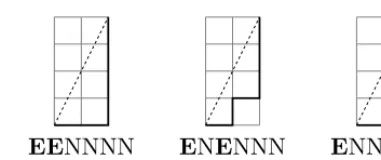
EENNNN 265143
ENENNN 365142
[image:6.595.178.369.109.189.2]ENNENN 465132
Fig. 4: S22(123) and corresponding lattice paths
Corollary 2.4. Sn2(123) =
1 2n+ 1
3n
n
.
The 3 members ofS2
2(123) and their corresponding NE lattice paths are shown in Figure 4.
2.2
Avoiding 132
We enumerate forests avoiding 132 by giving a bijection with lattice paths bounded above by
y= 3x. Indeed, we establish a stronger result, applicable to all k-ary shrub forests, exhibiting a bijection between Fk
n(132) and lattice paths bounded in the wedge below y= (k+ 1)x.
As with forests avoiding 123, we start by establishing that the labels of a 132-avoiding forest are also determined by their root labels.
Lemma 2.5. The labels of a 132-avoiding k-ary shrub forest are uniquely determined by their root labels.
Proof: Define S to be the ordered set of currently unused labels in a forest of t heaps with
v =k+ 1 vertices each, and imagine we are assigning labels from left to right on heaps, and in breadth-first order on each heap. Initially,S ={1,2, . . . , vt}. The labels in each heap are clearly larger than the label of their root, and in each heap are increasing (in order to avoid 132). In fact, not only are they larger, they are the smallest possible unused labels. In other words, the leaves of each root are labelled, from left to right, by the k smallest unused labels greater than the root. If not, the next largest label y would be used later (on its right) and would create a
xzy∼132 pattern where z is a leaf of (the root)xbut noty. Thus we only need know the label of the roots in order to deduce the entire labeling of a 132-avoiding k-ary shrub forest of heaps. Furthermore, knowing the first root and the longest decreasing subsequence of roots is sufficient since if the roots arer1, r2, . . . , rt and we haveri< ri+1 <· · ·< rj−1 > rj thenri> rj in order
to avoid 132.
Again, Lemma 2.5 is not equivalent to saying that any labeling of roots corresponds with a forest that avoids 132.
It turns out that we can use the structure of 132-avoiding forests to describe not onlyS2
n(132),
but more generallyFk n(132).
Theorem 2.6.
Fnk(132) =
1 (k+ 1)n+ 1
(k+ 2)n n
Proof: We provide a bijection from Fk
n(132) to the set P of paths under the line y = (k+ 1)x
from (0,0) to (n,(k+ 1)n) using North (0,1) and East (1,0) steps. The result then follows by Proposition 2.1 with ℓ=k+ 1.
Define φ:P → Fk
n(132) as follows. Givenp∈P, let 0 =w1≤w2≤ · · · ≤wn be the heights of
the East steps inp. Letw′ := (w
n+ 1)(wn−1+ 1)· · ·(w1+ 1). Label the first rootw1′. For each subsequent root, if w′
i 6=w′i−1, then label root i with wi′. If w′i =wi′−1, leave root i unlabeled. Now, by Lemma 2.5 label the remaining forest vertices from left to right (and in breadth-first order on each heap), at each point using the smallest unused label larger than the most recent root. We claim this forest avoids 132. Suppose there were a 132 pattern not involving a root where ℓ plays the role of 1. Since ℓ’s root is smaller than ℓ, there is another copy of 132 using
ℓ’s root. Now, by construction, all entries larger than a given root and after the root appear in increasing order, so this forest is 132-avoiding.
Next we describe φ−1:Fk
n(132)→P, beginning with a 132-avoiding forest. We create a string y, withy1being the root of the first heap. We add an element to the string yfor each rootri. If
the permutation has been only increasing sinceri−1, set yi =yi−1. If the permutation has had a descent (which could only occur between the last leaf of the tree with root ri−1 and the root
ri), set yi=ri. We then create a stringy′ by subtracting 1 from each element ofy. Finally we
reverse the string to obtain y′r, which is our string displaying heights of the East steps in our
path, which we claim lies below the liney= (k+ 1)x. Notice that a path lies belowy= (k+ 1)x
if and only ify′r
i ≤(i−1)(k+ 1) fori≥1. By construction,y1=r1≤n−ksincer1haskleaves
larger than itself. In general, ifr∗
i = min(r1, . . . , ri), thenr∗i ≤n−((i−1) +ki) =n+ 1−(k+ 1)i
since there are i−1 other roots and ki leaves larger than ri as labels on the first i shrubs.
Since yi = ri∗, we have that yi ≤ n+ 1−(k+ 1)i for all i, and thus y′i ≤ n−(k+ 1)i for
all i. Let t = kn+1 be the number of trees in our shrub forest. Our bound on y′
i implies that
y′r
t+1−i≤n−(k+ 1)(t+ 1−i) =t(k+ 1)−(k+ 1)(t+ 1−i) = (i−1)(k+ 1), as desired.
This proof gives two easy corollaries. The first demonstrates that although we considered shrubs here, in special cases (such as avoiding 132) we can characterize the shrub condition more simply in terms of a permutation composed of a string of equal-length subpermutations. The second is our result restricted to binary shrubs.
Corollary 2.7. Let σ be a permutation composed of a concatenation of m increasing sequences of length n. The number of suchσ ∈ Snm(132)is given by
1
nm+ 1
(n+ 1)m m
.
Also, Sn2(132)
is a special case of Theorem 2.6.
Corollary 2.8.
Sn2(132) =
Fn2(132) =
1 3n+ 1
4n
n
.
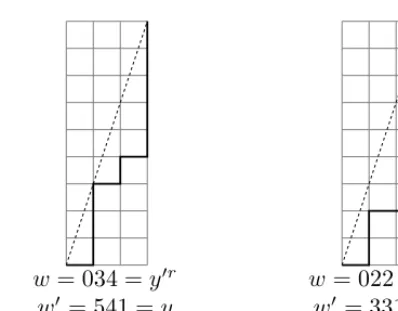
Figure 5 shows two examples of lattice paths below y = 3x that correspond to members of
S2(132).
2.3
Avoiding 213 or 312
The only pair of permutationsρ1, ρ2∈ S3for which S2(ρ1)
=
S2(ρ2)
w= 034 =y′r w= 022 =y′r w′= 541 = y w′= 331 =y
[image:8.595.171.370.107.262.2]π=567489123 π=345678129
Fig. 5: Two lattice paths and the permutations corresponding to the 132-avoiding binary shrubs
To enumerate these sets, we make use of a variant of the result of Fuss we used above, in which diagonal, as well as horizontal and vertical, steps are permitted.
Proposition 2.9 (Schr¨oder [15, Theorem 2.9]). The number of lattice paths with steps (0,1), (1,0)and (1,1), from (0,0)to (m, ℓm), remaining weakly below the line y=ℓx is given by
1
ℓm+ 1
m
X
v=0
ℓm+ 1
m−v
ℓm+v
v
.
We also require the following ‘folklore’ bijection between two families of lattice paths. This proposition follows directly from the invertibility of the affine map of the Euclidean plane implied in its statement.
Proposition 2.10 (Banderier and Wallner [2, Proposition 2.1]). Lattice paths with step set S,
from (0,0)to (m, ℓm) remaining weakly below y=ℓx are in bijection with lattice paths with step
set {(x+y, ℓx−y) : (x, y)∈S}, from(0,0) to ((ℓ+ 1)m,0)remaining weakly above the x-axis.
We enumerate forests avoiding 213 by exhibiting a bijection with a family of lattice paths which, by Proposition 2.10, are known to be equinumerous to paths bounded above byy= 3x. Theorem 2.11.
Sn2(213)
= an where an is the number of lattice paths from (0,0) to (4n,0)
with unit steps (1,3), (2,2), and (1,−1)staying weakly above the x-axis.
Proof: First we give a correspondence from lattice paths to 213-avoiding permutations.
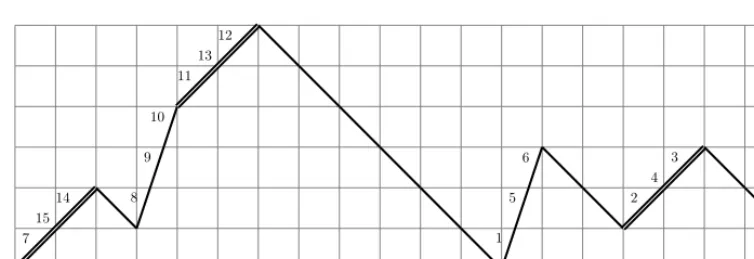
subpath to the right ofsand the remaining (larger) unused labels to the subpath to the left ofs, and repeat this construction recursively. In the case that a subpath has no up-segments, it must consist of a single midpoint of a (2,2)-step and so it receives the only unused label reserved for the subpath. Now, read the labels from left to right to obtain a permutationπ.
Notice thatπcan be the labels of a binary shrub forest since the three labels on each increasing (1,3) step or (2,2) step correspond to the labels of a heap. By construction, the labels on a (1,3) step form a 123 pattern while the labels on a (2,2) step form a 132 pattern. Further, π avoids 213 since for each digiti, all labels larger than and left ofiare greater than all labels larger than and right of i.
Next, we show how to reverse this correspondence, by giving a map from 213-avoiding permu-tations to lattice paths. Start with a binary shrub forest f. Considerf one heap at a time. A heap with an increasing pair of leaves corresponds to a (1,3) step and a heap with a decreasing pair of leaves corresponds to a (2,2) step. The (1,3) and (2,2) steps can be separated by (1,−1) steps. To determine the placement of the (1,−1) steps, we look at the roots of the heaps.
Take π and mark any digit that is the first digit of a pair of leaves with decreasing labels. Now, for each root, count the number of unmarked digits (roots and unmarked leaves) before the root and larger than the root. This is the number of (1,−1) steps that immediately precede the increasing step corresponding to that heap. Mark the digits that were just used and repeat. Finally, end the path by adding (1,−1) steps to return to thex-axis.
As an example, consider the path in Figure 6. Here, (2,2) steps are shown with doubled lines to make them clearly distinct from (1,3) steps. For the map from π to the path, the heaps 7 15 14, 11 13 12, and 2 4 3 have decreasing leaves, so each of them correspond to a (2,2) step. The heaps 8 9 10 and 1 5 6 have increasing leaves, so each of them correspond to a (1,3) step. The increasing steps in the path alternate between (2,2) steps and (1,3) steps. Now, we mark the digits 15, 13, and 4 in π. For the root 8, we see that 14 is unmarked and prior to 8, so we put one (1,−1) step between the first two upsteps and mark 14. For the root 11, we see no numbers larger than 11 and prior to 11 that have not yet been used, so we put zero (1,−1) steps between the second and third upsteps. For the root 1, we see 12, 11, 10, 9, 8, and 7 larger than 1 and prior to 1 that have not yet been used, so we put six (1,−1) steps between the third and fourth upsteps and mark 12, 11, 10, 9, 8, and 7. For the root 2, we see 5 and 6 larger than 2 and prior to 2 that have not yet been used, so we put two (1,−1) steps between the fourth and fifth upsteps and mark 5 and 6. Finally, we must take three (1,−1) steps at the end of the path to return to thex-axis.
We now show that 213-avoiding forests are equinumerous to those avoiding 312.
Theorem 2.12. Sn2(213) =
Sn2(312) .
Proof: Consider a forest avoiding 213 as it is built from left to right. According to our corre-spondence a (2,2) upstep indicates that the next heap forms a 132 pattern while a (1,3) upstep indicates that the next heap in the forest forms a 123 pattern. The (1,−1) steps between the upsteps indicate the labels of the next in the following way:
7 14 15
8 9
10 11
12 13
1 5
6
2 3 4
[image:10.595.84.461.106.235.2]π =7 15 14 8 9 10 11 13 12 1 5 6 2 4 3
Fig. 6: A lattice path and its corresponding 213-avoiding permutation
be consecutive. In particular, the labels on the new heap may be i+ 1, i+ 2, i+ 3 for 0≤i≤ℓ
(and all labels larger than i on the original forest are incremented by 3). Letd be the number of downsteps immediately after the (1,3) upstep corresponding to the last 123 pattern; then
ℓ−d=i indicates the labels on the next heap to be appended arei+ 1,i+ 2, andi+ 3. Similarly, suppose that the firstkupsteps in our path encode a forest with labels{1,2, . . . ,3k}
where the last heap forms a 132 pattern with labels ℓ−2, ℓ−1, ℓ. We wish to append a single new heap to this forest. In order for the shrub forest to avoid 213, all labels on the new heap must be consecutive. In particular, the labels on the new heap may be i+ 1, i+ 2, i+ 3 for 0 ≤ i ≤ ℓ−1 (and all labels larger than i on the original forest are incremented by 3). Let d
be the number of downsteps immediately after the (2,2) upstep corresponding to the last 132 pattern; thenℓ−d−1 =iindicates the labels on the next heap to be appended arei+ 1,i+ 2, andi+ 3.
In general, when we append a new 123 heap to the end of a 213-avoiding forest, we increase the number of sets of labels we can use on the next heap by 3, and when we append a new 132 heap to the end of a 213-avoiding forest, we increase the number of sets of labels we can use on the next heap by 2. The numberkof (1,−1) downsteps tells us to use the (k+ 1)st highest possible value for the root of the next appended heap.
We can construct 312-avoiding forests in a similar way, encoding 123 heaps with (1,3) steps and 132 heaps with (2,2) steps.
Suppose that the first k upsteps in our path encode a forest with labels {1,2, . . . ,3k} where the last heap forms a 123 pattern with labelsℓ−2, ℓ−1, ℓ. We wish to append a single new heap to this forest. In order for the shrub forest to avoid 312, all labels that are used on leaves of the new heap must be larger than all existing labels, but the root can appear lower. In particular, the labels on the new heap may bei,3k+ 2,3k+ 3 for 1≤i≤3k+ 1 (and ifi≤3k thenimay not be the larger digit in an inversion in the original forest on {1,2, . . . ,3k}). Then, all labels larger thani−1 on the original forest are incremented by 1 to obtain the new forest. Letdbe the number of downsteps immediately after the (1,3) upstep corresponding to the last 123 pattern; thenℓ−d=iindicates the labels on the next heap to be appended are i, 3k+ 2, and 3k+ 3.
Similarly, suppose that the firstkupsteps in our path encode a forest with labels{1,2, . . . ,3k}
leaves of the new heap must be larger than all existing labels, and the root can appear lower. In particular, the labels on the new heap may be i,3k+ 2,3k+ 3 for 1≤i≤3k+ 1 (and ifi≤3k
then i may not be the larger digit in an inversion in the original forest on {1,2, . . . ,3k}, so we knowi6= 3kin this case).
As before, when we append a new 123 heap to the end of a 312-avoiding forest, we increase the number of sets of labels we can use on the next heap by 3 (sincei∈ {3k−1,3k,3k+ 1} are new), and when we append a new 132 heap to the end of a 312-avoiding forest, we increase the number of sets of labels we can use on the next heap by 2 (since i∈ {3k−1,3k+ 1} are new). The numberkof (1,−1) downsteps tells us to use the (k+ 1)st highest possible value for the root of the next appended heap.
Since both 213 and 312-avoiding forests are in bijection with the same set of lattice paths using (1,3), (2,2), and (1,−1) steps, the two sets of forests are equinumerous.
For example, the path in Figure 6 corresponds to the 213-avoiding forest 7 15 14 8 9 10 11 13 12 1 5 6 2 4 3. Earlier, we built this forest by labeling up-segments in the path, but we can also follow the argument of Theorem 2.12 for an alternate construction. The first upstep is a (2,2) step, so we begin with the forest 1 3 2. Next, we haved= 1 downsteps, so i=ℓ−d−1 = 3−1−1 = 1. Our next tree has labels 2, 3, and 4, and since the next upstep is a (1,3) step, we have 1 6 5 2 3 4. Next, we haved= 0 downsteps, so i=ℓ−d= 4−0 = 4. Our next tree has labels 5, 6, and 7, and since the next upstep is a (2,2) step, we have 1 9 8 2 3 4 5 7 6. Next, we haved= 6 downsteps, soi=ℓ−d−1 = 7−6−1 = 0. Our next tree has labels 1, 2, and 3, and since the next upstep is a (1,3) step, we have 4 12 11 5 6 7 8 10 9 1 2 3. Next, we have d= 2 downsteps, so i= ℓ−d = 3−2 = 1. Our next tree has labels 2, 3, and 4, and since the next upstep is a (2,2) step, we have 7 15 14 8 9 10 11 13 12 1 5 6 2 4 3.
Similarly, we can construct a 312-avoiding forest from the same path working from left to right. The first upstep is a (2,2) step, so we begin with the forest 1 3 2. Next, we haved= 1 downsteps, and the possible values of the next root are 1, 2, or 4. We choose the 2nd highest value. Our next tree has labels 2, 5, and 6, and since the next upstep is a (1,3) step, we have 1 4 3 2 5 6. Next, we haved= 0 downsteps, and the possible values of the next root are 1, 2, 5, 6, or 7. We choose the highest value. Our next tree has labels 7, 8, and 9, and since the next upstep is a (2,2) step, we have 1 4 3 2 5 6 7 9 8. Next, we have d= 6 downsteps, and the possible values of the next root are 1, 2, 5, 6, 7, 8, or 10. We choose the 7th highest value. Our next tree has labels 1, 11, and 12, and since the next upstep is a (1,3) step, we have 2 5 4 3 6 7 8 10 9 1 11 12. Next, we haved= 2 downsteps, and the possible values of the next root are 1, 11, 12, or 13. We choose the 3rd highest value. Our next tree has labels 11, 14, and 15, and since the next upstep is a (2,2) step, we have 2 5 4 3 6 7 8 10 9 1 12 13 11 15 14.
By combining our results, we can enumerate forests avoiding either 213 or 312.
Theorem 2.13. Sn2(213) =
Sn2(312) =
1 3m+ 1
m
X
v=0
3m+ 1
m−v
3m+v v
.
Proof: The result follows directly from Theorems 2.12 and 2.11, and Propositions 2.10 and 2.9 withℓ= 3.
213 is in bijection with lattice paths using the steps (1,−1), (1,4) (corresponding to 1234), red (2,3) (corresponding to 1243), red (3,2) (corresponding to 1342), blue (2,3) (corresponding to 1423), and blue (3,2) (corresponding to 1432). Notice that since we wish to use (2,3) labels and (3,2) labels for different kinds of heaps, we need colored labels.
For example, the path (red (3,2)) (1,−1) (blue (2,3)) (1,−1) (1,−1) (1,4) (1,−1)6corresponds to 1(11)(12)(10) 2978 3456.
In general, k-ary shrub forests avoiding either 213 or 312 are in bijection with lattice paths using (1,−1) steps and k+11 2kk
steps of the form (j, k−j+ 2) going from (0,0) to ((k+ 2)n,0) and staying weakly above the x-axis. To find the step corresponding to a particulark-ary shrub permutationπletibe the value of the smallest number that plays the role of a 2 in a 21-pattern, or i = k+ 2 if π is the identity. Then the corresponding step is (k+ 2−(i−1), i−1). This makes sense since if i is the smallest number that plays the role of 2 in a 21 pattern, then all digits greater than or equal toimust be larger than labels in new 213-avoiding shrubs appended to the end of the forest. Withi−1 smaller digits, there areisets of consecutive values that can be used on the labels of a newly appended shrub. Using an upstep that takesi−1 vertical units allowsichoices for how many (1,−1) steps may come after it.
2.4
Avoiding 231
To enumerate S2
n(231), we make use of the following celebrated result of Duchon concerning
lattice paths bounded byy= 2 3x.
Proposition 2.14(Duchon [5, Theorem 11]). The number of lattice paths of length5n from the origin to the line y= 23x with unit East and North steps that stay weakly below the line is given by
n
X
i=0 1 5n+i+ 1
5n+ 1
n−i
5n+ 2i i
.
This sequence was investigated further by Banderier and Flajolet [1] under a slightly different formulation, whose equivalence follows from Proposition 2.10. This alternative perspective is known as “Duchon’s club model”: People arrive at a club by pairs and leave in threesomes. What is the number of possible scenarios from the club opening until it closes?
We enumerate forests avoiding 231 by exhibiting a bijection with Duchon’s club paths.
Theorem 2.15. The equalitySn2(231) =
n
X
i=0 1 5n+i+ 1
5n+ 1
n−i
5n+ 2i i
holds.
Proof: Let An be the set of 231-avoiding permutations realizable on a binary shrub forest
containing n heaps. Let Bn be the set of lattice paths with 3n East (1,0) and 2n North (0,1)
steps that stay at or below the liney= 2x
3 .
To prove the theorem, we give a mapφ:Bn→ An; then we prove that it is indeed a bijection by
showing that it is injective, well-defined, and surjective. The result then follows by the application of Proposition 2.14.
To explain φrigorously, we must first introduce some notation. Given b∈ Bn, we partitionb
into blocks of the form EkN with k≥0. Since there are 2n Ns (and bends in N), there are 2n
To determineφ(b), we first construct a permutation with vertical bars between certain pairs of adjacent digits. Given such a permutation a, write a=A1|A2| · · · |Aℓ. Also, given a
subpermu-tation Ai|Ai+1| · · · |Ai+j, let Ai−Ai+j be the permutation formed by erasing all bars between
these blocks. Finally, given a string of digitsa, write ai+ for the string formed by incrementing all digits greater than or equal to iby 1.
We are now ready to describe φ. Let b∈ Bn have blocksB1, . . . , B2n.
1. Let i= 2n, and leta= 1.
2. (a) If blockBi=N then leta= 1|(a)1+.
(b) If blockBi=EkN where k≥1, then determinem= max(Ak) + 1. Let a=m(A1−Ak|Ak+1| · · · |Aℓ)m+.
3. If iis even, then let a= 1|(a)1+. 4. Decrement iby 1.
If i= 1 then we are done. Returnφ(b) =A1−Aℓ.
If i >1, then return to step 2.
Recall that a value in a permutation is a left-to-right maximum if it is larger than all the values to its left. Notice that by construction, at the end of each step, the vertical bars appear immediately before each left-to-right maximum ofa(except the first one). We add a bar in steps 2a and 3 when we introduce an ascent at the beginning ofabya= 1|(a)1+(and thus a create new left-to-right maximum). We erase bars in step 2b when we create a new left-to-right maximum that supersedes the left-to-right maxima from a previous step. It follows that while we do not use B1 to encode additional digits of A, the number of E’s in B1 is the number of left-to-right maxima of a at the end of the algorithm describing the map φ. In general, notice that since max(Ak) = max(A1−Ak) = m−1, a=A1| · · · |Ak−1|(m−1)A′k|(m′)A′k+1| · · · where A′i is Ai
with its first entry deleted, and m′> m−1.
It is clear thatφis injective; consider the rightmost block where two paths differ and thus two different digits will be appended to the beginning ofa, resulting in different outputs. It remains to show that φis well-defined and surjective.
To show thatφis well-defined, we must show that when we read a blockB =EkN withk≥0 in
step 2 (including both cases 2a and 2b),a=A1|A2| · · · |Aℓ withℓ≥k. Letb′=B2n−j+1· · ·B2n,
the rightmost j blocks of b. We claim that the number of bars in aafter we have readj blocks of bis given by
nN(b′)−nE(b′) +
nN(b′) + 1
2
=j−nE(b′) +
j+ 1
2
,
where nE(W) (resp. nN(W)) is the number ofE (resp. N) steps in wordW. We begin with no
bars. Every N block creates one more bar in step 2a. Every occurrence of an EkN block with k≥1 (step 2b) creates a descent and reduces the number of bars by k−1. After every second block (i.e. j+1
2
It is immediate from the fact that b ∈ Bn lies below the line y = 23x that for all b = b′′b′ ∈
Bn we have (3n−nE(b′),2n−nN(b′)) ∈ {(x, y)|x, y∈Nand 2x≥3y} so 2(3n−nE(b′)) ≥
3(2n−nN(b′)) ⇐⇒ nE(b′) ≤ 3/2nN(b′). Now let b′ = B2n−j+1· · ·B2n as above, let b∗ = B2n−jB2n−j+1· · ·B2n, and supposeB2n−j =EkN. We must showk≤ℓ. k=nE(b∗)−nE(b′)≤
3
2nN(b∗)−nE(b′) = 32(j+ 1)−nE(b′) ≤ (j+ 1)−nE(b′) + j+12 , as desired. Therefore, step 2
above is always possible.
Now, we check that φ(b) ∈ S2
n(231). First, a is indeed a permutation at each step in the
algorithm forφ. We begin with a= 1. Each time we use step 2 or step 3 to prepend a new digit, all larger digits are incremented by 1 soaalways consists of a string of consecutive non-repeating digits. Next,φ(b) has length 3nsince we begin with 1 digit and obtain (2n−1) new digits from step 2 andnnew digits from step 3. Finally,φ(b) avoids 231 since the digit inserted into the first position ofamust play the role of 2 in the 231 pattern. It is impossible for this digit to play the role of 2 in steps 2a and 3 since the first digit is the smallest. In case 2b, the permutation has all digits smaller than m appearing before all digits larger than m. Therefore, φ :Bn → An is
well-defined.
Finally, to show that φ is surjective, we show that every a ∈ An has a path b ∈ Bn that is
mapped to it. Givena, we can certainly reverse the encoding of ascents and descents prescribed by φ. To be rigorous, given a∈ An, we build the corresponding pathb in the following way:
1. Let bbe the empty path and leti= 3n−1.
2. (a) If i= 3z+ 1 for some integerz, then bremains unchanged. (This is the inverse of step 3 above.)
(b) If i6= 3z+ 1 for some integerz andai < ai+1 then b=N b. (This is the inverse of step 2a above.)
(c) If i6= 3z+ 1 for some integerz andai> ai+1, then b=EkN bwhere kis the number of left-to-right maxima ofai+1· · ·a3n that are less thanai.
(This is the inverse of step 2b above).
3. Decrement i.
If i= 1, thenφ−1(a) =E3n−nE(b)N b.
If i >1 then return to step 2.
To showφis surjective, we must verify that any pathbformed in this way stays below the line
y= 23x. Suppose we havea∈ An such thatφ−1(a)∈ B/ n. Consider the first blockBℓ−1=EkN (reading from right to left) where the corresponding path goes above the line y = 2
3x, but
Bℓ· · ·B2n is below the line. We havenE(Bℓ· · ·B2n)≤ 32nN(Bℓ· · ·B2n) but nE(Bℓ−1· · ·B2n)>
3
2nN(Bℓ−1· · ·B2n), or equivalently,nE(Bℓ· · ·B2n) +k > 32(nN(Bℓ· · ·B2n) + 1). Since b comes
from the map φ−1, we know that
k≤1 +nN(Bℓ· · ·B2n)−nE(Bℓ· · ·B2n) +
nN(Bℓ· · ·B2n) + 1
2
.
Therefore,
nE(Bℓ· · ·B2n) +k≤1 +nN(Bℓ· · ·B2n) +
nN(Bℓ· · ·B2n) + 1
2
But by assumption nE(Bℓ· · ·B2n) +k > 23(nN(Bℓ· · ·B2n) + 1),so
3
2nN(Bℓ· · ·B2n) + 3
2 <1 +nN(Bℓ· · ·B2n) +
nN(Bℓ· · ·B2n) + 1
2
.
Simplifying,
1
2nN(Bℓ· · ·B2n) + 1 2 <
nN(Bℓ· · ·B2n) + 1
2
.
If nN(Bℓ· · ·B2n) is even, then nN(Bℓ· · ·B2n) = 2z for some integer z, so z+12 <
2z+1 2
= z, which is a contradiction. On the other hand, ifnN(Bℓ· · ·B2n) is odd, thennN(Bℓ· · ·B2n) = 2z+1
for some integer z, so z+ 1 < 2z+2 2
= z+ 1, which is also a contradiction. Therefore, any permutation inAn does indeed correspond to a path below the line y= 23x.
For example, consider b = EEN EN EEEEEEN N EN N EN EN. We have n = 4. Here
B1 = EEN, B2 = EN, B3 = EEEEEEN, B4 = N, B5 = EN, B6 = N, B7 = EN, and
B8=EN.
• We begin withi= 8 anda= 1.
• Since B8=EN andk= 1, we see thatm= max(1) + 1 = 2, so we havea= 21 by step 2b. Since i= 8 is even, a= 1|32 by step 3.
Decrement ito 7 and return to step 2.
Since B7=EN andk= 1, we see that m= max(1) + 1 = 2, so we havea= 21|43 by step 2b.
Decrement ito 6 and return to step 2. Since B6=N,a= 1|32|54 by step 2a. Since i= 6 is even, a= 1|2|43|65 by step 3. Decrement ito 5 and return to step 2.
Since B5=EN andk= 1, we see thatm= max(1) + 1 = 2, so we have a= 21|3|54|76 by step 2b.
Decrement ito 4 and return to step 2. Since B4=N,a= 1|32|4|65|87 by step 2a. Since i= 4 is even, a= 1|2|43|5|76|98 by step 3. Decrement ito 3 and return to step 2.
Since B3 = EEEEEEN and k = 6, we see that m = max(98) + 1 = 10, so we have
a= (10)124357698 by step 2b.
Decrement ito 2 and return to step 2.
Since B2 = EN and k = 1, we see that m = max((10)124357698) + 1 = 11, so we have
a= (11)(10)124357698 by step 2b.
• Decrement ito 1. Sincei= 1, we are done.
φ(EEN EN EEEEEEN N EN N EN EN) = 1(12)(11)2354687(10)9∈ S2
4(231).
Notice that Theorem 2.15 generalizes as follows: Fk
n(231) is equinumerous with paths with
unit East and North steps from (0,0) to ((k+ 1)n, kn) bounded above by y = k
k+1x. Given a path bounded byy= k
k+1x, we build the permutation for a 231-avoidingk-ary shrub forest from right to left. EachEiN block encodes information about a leaf of the forest, and after every set
of kleaves we add a new right-to-left minimum as a root.
2.5
Avoiding 321
In contrast to the situation with other patterns of length 3, we are unable to present an explicit expression for the enumeration of forests avoiding 321. Nor do we exhibit a bijection with a family of lattice walks (though it is possible that such a bijection exists). However, using the techniques of analytic combinatorics, we are able to determine the generating function for this set, and its growth rate.
2.5.1
Deriving a functional equation
We begin by deriving a functional equation for a bivariate generating function, making use of a catalytic variable.
Recall that an inversion is an occurrence of 21 in a permutation. Given a permutation π, let its last inversion foot be the lower point of the rightmost inversion of π (if there is one), and let the statistic lif(π) count the number of entries of π with value greater than that of its last inversion foot. In other words, if|π|=nandπ(i) is the rightmost entry that is not a left-to-right maximum, then lif(π) = n−π(i). If π is an increasing permutation (i.e.,π = 12· · ·n), then we set lif(π) =n.
Theorem 2.16. Let H(x, u) be the bivariate generating function for 321-avoiding binary shrub forests, where the coefficient of xnuk is the number of forests consisting of n shrubs whose
un-derlying permutation σ (of length 3n) satisfies lif(σ) =k. Then, H(x, u) satisfies the functional equation
H(x, u) = 1 + xu 1−u
u2(1−3u+ 2u2−u3)
(1−u)2 H(x, u) +
1−3u+ 3u2−u3+u4
(1−u)2 H(x,1)
+2−2u−u 2
1−u ∂H
∂u(x,1) +
1 2
∂2H
∂u2(x,1)
!
.
Proof: Consider S2
n(321). These are permutations avoiding 321 of length 3n such that each of
then blocks of three consecutive values is an occurrence of either a 123 or a 132. Let us consider how a permutation in S2
n(321) may be extended by adding three points to its
right in such a way that the resulting permutation is also a member of S2
n(321). First of all,
Suppose lif(σ) = k. Adding a new maximum entry to σ in the rightmost position does not alter the last inversion foot. In this case, the lif statistic of the resulting permutation is k+ 1. On the other hand, if a new point is added in any other valid location it results in a permutation whose lif statistic is at least 1 but is not greater than k, as 321 avoidance implies that the new point must have value greater than that of the previous last inversion foot.
Define the following four transition rules for the lif statistic:
A: k→ {1, . . . , k},
B: k→ {1, . . . , k+ 1},
C: k→ {k+ 1}, D: k→ {1, k+ 1}.
We now verify that the only valid ways to extend a permutation inS2
n(321) (i.e., the only ways
to add a 123 or 132 to the right without creating a 321) are either A then B then B, or else C then CthenD.
To see this, first observe that if we wish to add a 123 or 132 pattern to the right of σ using values{|σ|+ 1,|σ|+ 2,|σ|+ 3}, then adding the first two entries (12 if adding a 123, 13 if adding a 132) corresponds to applying C twice. Appending the rightmost entry effects the transition
k→ {k+ 1} if a 123 is created and effects the transitionk→ {1} if a 132 is created. Therefore, if the 123 or 132 pattern is added entirely above the maximum entry ofσ, the ruleCthenCthen Dcaptures all possible transitions for the lif statistic.
Suppose next that the first two entries in the pattern to be appended toσ are added below the maximum entry ofσ. This corresponds to applying ruleAtwice. Moreover, we are now forbidden from creating a 132 pattern, as the maximum ofσ together with the 32 would be a 321 pattern. The only option is to create a 123 pattern, and the placement of the last entry corresponds to ruleB.
If on the other hand the first entry to be added lies below the maximum of σ but the second entry lies above (corresponding to applying ruleAand then ruleC), either a 123 or a 132 pattern can be created and the insertion of the last entry corresponds to rule B. This case (A then C thenB), together with the previous case (AthenAthenB) combine to give the transition ruleA thenB thenB.
Each of these transition rules can be represented as a linear operator acting on the generating functions, as follows (see [7, Exercises III.22, p.199 and V.20, p.365]):
ΩA
uk
=u+u2+. . .+uk= u
1−u(1−u
k) Ω
A
f(u)
= 1−uu f(1)−f(u) ΩB
uk
=u+u2+. . .+uk+1= u
1−u(1−u
k+1) Ω B
f(u)
= 1−uu f(1)−uf(u) ΩC
uk
=uk+1 ΩC
f(u)
=uf(u) ΩD
uk
=u+uk+1 ΩD
f(u)
=u f(1) +f(u) Thus H(x, u) satisfies the functional equation
H(x, u) = 1 + xΩB ΩB
ΩA
H(x, u)
+ΩD ΩC
ΩC
H(x, u)
where the initial 1 corresponds to the empty shrub forest. Observing by arithmetic of formal power series that if
f(u) = H(x,1)−H(x, u)
1−u , then f(1) = ∂H
∂u(x,1),
a computer algebra system can easily simplify the resulting expression to give the functional equation in the statement of the theorem.
The most efficient way to generate coefficients of H(x, u), and hence of H(x,1), is to iterate the transition rules. Greater performance is achieved by combining the valid sequences of three steps into one rule,
ABB+CCD: k → n1(k+22 ),2( k+2
2 )−1,3( k+1
2 ),4( k
2), . . . , k6,(k+ 1)3, k+ 2, k+ 3
o ,
the right hand side being a multiset in which multiplicities are represented by exponents. Using Mathematica [16], we were able to calculate 993 values in the enumeration sequence for binary shrub forests avoiding 321. The first ten terms (including the empty forest) are:
1,2,37,866,23285,679606,20931998,669688835,22040134327,741386199872.
See A257995 in [13] for more.
A Maple program was then used to find a possible polynomial equation satisfied by the gener-ating function. The first 250 terms sufficed to suggest thatH(x,1) was a root of the polynomial given in the statement of Theorem 2.18 below, and hence is algebraic.
2.5.2
Confirming algebraicity
To prove that H(x, u), and hence H(x,1), is algebraic, we make use of a general result of Bousquet-M´elou and Jehanne [3]. To state their theorem, we first need to introduce some nota-tion. Suppose
F(x, u) = f0(x) + f1(x)u + f2(x)u2 + . . .
is a bivariate formal power series. We define a sequence of operators∆,∆2,∆3, . . ., that discard the low order terms, as follows:
∆i
F(x, u)
= fi(x) + fi+ 1(x)u + fi+ 2(x)u2 + . . . .
Theorem 2.17 (Bousquet-M´elou and Jehanne [3], Theorem 3). If P and Q are polynomials, then the functional equation
F(x, u) = P(u) + xQ F(x, u),∆
F(x, u)
,∆2
F(x, u)
, . . . ,∆k
F(x, u)
, x, u
has a unique solution for F(x, u) that is a formal power series in x whose coefficients are poly-nomials in u. Moreover, this solution is algebraic.
The functional equation in Theorem 2.16 is not in the appropriate form to apply Theorem 2.17 directly. Setting G(x, u) =H(x, u+ 1), we have
∂H
∂u(x,1) =
∂G
∂u(x,0) and
∂2H
∂u2(x,1) =
∂2G
Upon making these substitutions, the functional equation stated in Theorem 2.16 becomes
G(x, u) = 1 +x(1 +u)
u
1 + 4u+ 6u2+ 5u3+ 3u4+u5
u2 G(x, u)
−1 + 4u+ 6u
2+ 3u3+u4
u2 G(x,0)−
1 + 4u+u2
u
∂G
∂u(x,0)−
1 2
∂2G
∂u2(x,0)
.
In addition, the definition of the ∆operator implies that
∂kG
∂uk(x,0) =k!(∆
k
[G(x, u)]−u∆k+1[G(x, u)]),
fork≥0. Hence, the functional equation forGcan be transformed into the form in Theorem 2.17 by making this substitution fork= 0,1,2, clearing denominators, and rearranging. ThusG(x, u) is algebraic, and hence so areH(x, u) andH(x,1) and its derivatives.
2.5.3
Solving the functional equation
We would like to solve our functional equation to get an explicit expression forH(x,1). Unfortu-nately, this is not possible. However, it is possible to determine the minimal polynomial of which
H(x,1) is a root.
Theorem 2.18. The generating function H0(x) =H(x,1)for 321-avoiding binary shrub forests is a root of the polynomial
(4x2+ 4x+ 1) − (x4−24x3+ 8x2−54x+ 1)H0(x)2
+ (15x4+ 24x3−71x2−54x)H0(x)4 + (18x5−215x4+ 2x3−360x2)H0(x)6
+ (3x6−228x5−213x4+ 162x3+ 729x2)H0(x)8 − (138x6−354x5−1053x4)H0(x)10
− (36x7−751x6−486x5)H0(x)12 − (3x8−420x7−54x6)H0(x)14 + 123x8H0(x)16 + 18x9H0(x)18 + x10H0(x)20.
Consequently, the growth rate of321-avoiding binary shrub forests is approximately 39.88873, the greatest real root of the quartic polynomial
729x4−28674x3−15505x2−25758x+ 621.
Given a suitable functional equation, Bousquet-M´elou and Jehanne [3] present a way of setting up a system of polynomial equations that can then be solved to yield a polynomial having a root that is the desired generating function. They suggest that the “laziest approach” is to feed this system of equations to a Gr¨obner basis package and let it work. Unfortunately, as they comment, “this lazy approach often fails, because the computation tends to take forever”. This has also been our experience. Submission of the appropriate equations to Singular, a computer algebra system optimized for working with polynomials, yielded no output after a week of processing.
Proof Proof of Theorem 2.18:
To start with, since our functional equation is linear in H(x, u), it can be expressed in the form
K(x, u)H(x, u) = P(H0(x), H1(x), H2(x), x, u),
where bothK andP are polynomials that we omit for brevity andHi(x) =
∂iH
∂ui(x,1).
Thus, we can use the kernel method to eliminate both H(x, u) andu. Observe that the kernel
K(x, u) = 0 if and only if P(H0(x), H1(x), H2(x), x, u) = 0. We want to eliminate u from this pair of equations.
To do so, we calculate theresultantofKandP. The resultant of two polynomials is a monomial multiple of a polynomial in their coefficients which has the property that it is equal to zero if and only if the polynomials have a common root. The resultant is given by the determinant of a matrix (known as the Sylvester matrix) whose entries are coefficients of the polynomials.
Let R be the resultant of K andP with respect to u. Then we have
R(H0(x), H1(x), H2(x), x) ≡ 32x5R1(H0(x), H1(x), H2(x), x) = 0, where R1 is a large polynomial that cannot be factored.
To eliminate H1(x) and H2(x), the discriminant of P can be used. The discriminant of a polynomial is a polynomial function of its coefficients which has the property that it is equal to zero if and only if the original polynomial has a multiple root. For example, it is well known that the discriminant of the quadraticax2+bx+c with respect tox isb2−4ac.(i)
We now apply this approach twice. We do not give the polynomials involved explicitly, as they would cover many pages. Firstly, taking the discriminant of R1 with respect to H1(x) yields a new equation
S(H0(x), H2(x), x) ≡ S1(x)2S2(H0(x), H2(x), x)2 = 0,
where S1 is a polynomial only inx, andS2 cannot be factored further.
Then, taking the discriminant of S2(H0(x), H2(x), x) with respect toH2(x) yields
T(H0(x), x) ≡ T1(x)2T2(H0(x), x)2T3(H0(x), x)6 = 0.
where T1, T2 and T3 are polynomials. Thus both T2 and T3 are possibilities for the minimal polynomial of H(x,1) =H0(x).
We rule out the first choice by observing that T2(1,0) is nonzero, whereasT3(1,0) = 0 as is required from considering the constant term of the series expansion of H0(x). T3 is, in fact, the polynomial presented in the statement of the theorem, which is the same as the minimal polynomial that we were able to guess based on the first 250 terms of the enumeration sequence. The growth rate of the 321-avoiding binary shrub forests is then determined from the minimal polynomial by taking its discriminant with respect to H0(x). The growth rate is given by the reciprocal of one of the positive real roots of the discriminant (see [7, Note VII.36, p.504]). As the growth rate must be at least 1, the positive real root whose reciprocal gives the growth rate must be at most 1. This leaves only one candidate, which is the greatest real root of the quartic polynomial in the statement of the theorem.
(i)Resultants and discriminants are closely related, the discriminant ofPwith respect toxbeing, up to a monomial
3
Summary
Throughout this paper we have studied forests of binary shrubs that avoid any permutation pattern of length 3. This adds a new restriction to the classical pattern avoidance problem by requiring the digitsπ3i+1π3i+2π3i+3 to form a 123 or a 132 pattern for all i.
Remarkably, forests avoiding a single patternρ∈ {123,132,213,231,312}are in bijection with lattice paths in a wedge. It would be interesting to explore whether this phenomenon is more widespread. Are other similar pattern-avoiding structures equinumerous to such lattice paths? If so, is it possible to develop a more general theory to explain this?
In contrast to the other patterns, the enumeration of forests avoiding 321 required us to use the machinery of analytic combinatorics. However, perhaps, in this case too, there is a connection to lattice paths that remains to be uncovered.
One natural generalization also merits further investigation. In Theorem 2.6 and the discussion after Theorems 2.13 and 2.15, we generalized our results to the case ofk-ary shrubs rather than binary shrubs. More of our results could be generalized in this way or to forests of tree structures other than shrubs.
Acknowledgments
We grateful to the University of Wisconsin - Eau Claire (UWEC) Department of Mathematics and Office of Research and Sponsored Programs for supporting work done by four of the coau-thors at UWEC during the 2014-2015 academic year. The aucoau-thors also thank Alex Burstein for organizing the Special Session on Patterns in Permutations and Words at the spring 2015 East-ern Sectional Meeting of the American Mathematical Society at Georgetown University, which allowed collaboration on a then-open case in this manuscript.
References
[1] C. Banderier and P. Flajolet, Basic analytic combinatorics of directed lattice paths.Theoret. Comput. Sci. 281(1–2)(2002), 37–80.
[2] C. Banderier and M. Wallner, Lattice paths of slope 2/5. In Proceedings of the Twelfth Workshop on Analytic Algorithmics and Combinatorics (ANALCO), SIAM (2015), chapter 9, 105–113.
[3] M. Bousquet-M´elou and A. Jehanne, Polynomial equations with one catalytic variable, al-gebraic series and map enumeration. J. Combin. Theory Ser. B.96.5(2006), 623–672.
[4] M. Dairyko, L. Pudwell, S. Tyner, and C. Wynn, Non-contiguous pattern avoidance in binary trees.Electronic J. Combin. 19.3(2012), P22.
[5] P. Duchon, On the enumeration and generation of generalized Dyck words. Discrete Math. 225:1–3(2000), 121–135.
[7] P. Flajolet and R. Sedgewick, Analytic Combinatorics. Cambridge University Press, Cam-bridge, 2009.
[8] N. Fuss, Solutio quaestionis, quot modis polygonum n laterum in polygonam laterum, per diagonales resolvi queat. Nova Acta Academiae Scientiarum Imperialis Petropolitanae IX (1791), 243–251.
[9] N. Gabriel, K. Peske, L. Pudwell, and S. Tay, Pattern avoidance in ternary trees.J. Integer Sequences 15 (2012), 12.1.5.
[10] D. Levin, L. Pudwell, M. Riehl, and A. Sandberg. Pattern avoidance in k-ary heaps. Aus-tralasian J. Combin.64 (2016), 120–139.
[11] N. A. Loehr, Bijective combinatorics. CRC Press, Boca Raton, 2011.
[12] Maplesoft.Maple. Version 18.01. www.maplesoft.com, 2014.
[13] The On-Line Encyclopedia of Integer Sequences. Published electronically at http://oeis. org.
[14] E. S. Rowland. Pattern avoidance in binary trees. J. Combin. Theory Ser. A 117 (2010), 741–758.
[15] J. Schr¨oder, Generalized Schr¨oder numbers and the rotation principle. J. Integer Seq. 10 (2007), Article 07.7.7.
[16] Wolfram Research, Inc. Mathematica. Version 10.0. www.wolfram.com/mathematica, 2014.