The Fourth International Conference on Design Creativity (4th ICDC) Atlanta, GA, November 2nd-4th, 2016
DESIGN IDEATION THROUGH IMPROVISED
COMEDY PROCESSES
G. Hatcher
1, W. Ion
1, R. Maclachlan
1, A. Wodehouse
1, B. Simpson
2and
M. Sheridan
31
Design Manufacture and Engineering Management, University of
Strathclyde, Glasgow, UK
2
Strategy and Organisation, University of Strathclyde, Glasgow, UK
3English, University of Strathclyde, Glasgow, UK
Abstract:
We argue that the processes of creating successful comedy are comparable to the
processes of designing an innovative product. Our research explores how constructs of humor may
be applied to the early phase of engineering design, when divergent thinking is assumed to be most
valuable. During a series of exploratory workshops, the principles and processes of creating
improvised comedy presented an opportunity to reinvigorate the design process, and overcome
some of the common barriers to effective group brainstorming. This paper discusses the link
between improvised comedy and design creativity, and the early development of a new
improvisation-based approach to design ideation.
Keywords: humor, design process, ideation, improvisation
1. Introduction
Philosophers and scientists have long proposed that there is a link between humor and creativity, from the effects of humor appreciation on an individual’s creative abilities to the inherent creativity of humorists and their cognitive processes (Humke & Schaefer, 1996; Koestler, 1964). A humor-enhanced environment has been found to reduce stress and improve problem-solving abilities (Isen, Daubman, & Nowicki, 1987; Ziv, 1976). As well as the effects of humor appreciation, links have also been made between creativity and the humor creation process. In a commentary on design creativity, Gero (1996) likens the creative design process to the incongruity theory of humor- both jokes and products are successful when they are unexpected yet understandable. Analogies can be made between the engineering design process and various humor creation processes, as outlined by Hatcher et al. (2015).
process, and will present findings from initial workshops trialing a new improvisation-based approach to design ideation. Finally the paper will outline our plans for further development and validation of the method.
2. Literature
2.1 Group idea generation
Brainstorming is one of the most widely adopted approaches to ideation in a variety of disciplines, including product and engineering design. The key brainstorming rules recommended for design sessions still largely follow Osborn’s (1953) original method as, for example, outlined in the Delft Design Guide (van Boeijen, Daalhuizen, Zijlstra, & van der Schoor, 2013): 1. Criticism is postponed, 2. Freewheeling is welcome, 3. Combination and improvement of ideas are sought, and 4. Quantity is wanted.
Due to its popularity and subsequent entry into everyday language, the term ‘brainstorming’ is often used to describe any meeting that involves the generation of ideas, regardless of whether the correct rules and procedures are followed (Rickards, 1999). In practice, design teams will often fail to follow the brainstorming rules effectively (Matthews, 2009) and studies have found individual idea generation to be more effective than brainstorming groups in terms of both productivity and quality of ideas (Mullen, Johnson, & Salas, 1991). Some of the common creativity barriers associated with brainstorming are outlined in Table 1. However, many prefer the social dynamics of a group brainstorm, and perceive their performances in group idea generation to be better than working individually (Diehl & Stroebe, 1991). Despite criticism, brainstorming has not been completely dismissed. In a study of fluency in both brainstorming groups and individual ideation, Isaken and Gaulen (2005) found groups with appropriate facilitation to be most effective, suggesting the real issue lies in the correct use of the brainstorming method.
Table 1: Common barriers to creativity in group brainstorming
Brainstorming barrier Detail
Social loafing When one or more team members lowers their effort due to reduced personal responsibility. It can occur when individuals working within a group view their contribution as dispensable and are tempted to ‘free ride’ on the effort of others. Fear of judgement /
self-censorship
Despite the ‘no criticism’ rule, participants still fear judgement of their ideas, and will self-censor as a result (Isaksen & Gaulin, 2005).
Premature rejection of ideas
Although ideas may not be explicitly criticised, wilder ideas are not given the chance to be built upon and developed into workable solutions. Cognitive inertia /
idea fixation
A desire for cohesion means that the group struggles to break from a collective line of thinking (Isaksen & Gaulin, 2005).
Production blocking Participants must take turns to speak, and therefore cannot always express ideas at the moment they occur (Nijstad & Stroebe, 2006). While waiting their turn,
participants forget ideas or self-censor (Diehl & Stroebe, 1991).
2.2 Improvisation
of ‘no criticism’. It also mirrors ‘build on ideas’, except in improv building is compulsory, reinforcing the importance of listening and teamwork. The Upright Citizens Brigade, a successful improv theatre and training centre, goes further by placing particular emphasis on the importance of ‘finding the game’ and ‘heightening’ to create humorous improvised scenes. The ‘game’ of a scene is the unusual idea that makes the scene funny. Players should initially use Yes And to build up a ‘base reality’ for the scene (the who, what and where) and aim to find the game as quickly as possible. From that point, the focus moves to heightening that unusual idea, i.e. exploring it in more detail for the remainder of the scene (Besser et al., 2013). If funny ideas are analogous with creative product ideas (Gero, 1996; Giora et al., 2004), then the unusual thing in an improv scene could be analogous with an unusual or creative idea expressed during an ideation session. The humour in improv does not come from an ability to tell witty jokes- instead players should focus on being spontaneous, following the rules and allowing incongruous and surprising ideas to emerge. Therefore, our improv-based method is not about training designers to be comedic, it is about providing them with a process that enables them to be spontaneous and generate more surprising ideas.
2.3 Improvisation and design
Improvised comedy’s emphasis on spontaneous idea generation, building on ideas and teamwork has been identified as having the potential to reinvigorate the early phase of the design process. A small number of previous studies have explored the use of improv training to enhance design creativity.
Recognizing the parallels between brainstorming and improvisation, Gerber (2009) used theatrical improvisation exercises to reinforce the brainstorming rules. Kudrowitz and Wallace (2010) conducted a workshop in which participants carried out a brainstorming exercise before and after a series of shortform improv games, resulting in a 37% increase in idea output. They suggest that improvisation games can help designers become more prolific and less inhibited in their idea generation habits. Ludovice et al. (2013) discuss the use of shortform improv games as creative stimuli for solving technical design problems. They adapted the Sweeney approach to innovation (Sweeney, 2004) by including an additional convergent step that involves generating workable solutions from initial ‘infeasible’ ideas.
These studies provide some interesting insights into the linkages between improv and design ideation, in particular the use of improvisation activities as a creative stimulus before generating design solutions. However, they do not go as far as importing improv processes directly into new methods that could change the way designers generate ideas. Our research contributes to this body of work by looking beyond designers participating in improv and instead focusing on how the process may be utilized effectively.
3. Exploratory workshops
The topic of ‘humor’ covers a wide range of theories, processes and media, and therefore our research began by exploring how these could be used or adapted. These ideas included using humor as a creative stimulus as well as applying various humor creation techniques to design ideation. The early phases of the research, as outlined in this paper, involved a series of exploratory workshops conducted with groups of undergraduate and postgraduate product design students. These workshops helped to identify the most promising avenues to explore, and refine the chosen approach for further testing and validation.
3.1 Initial exploratory workshops- Phase 1
Following each workshop, participants were asked to provide verbal feedback in a semi-structured focus group format. This qualitative feedback provided an indication of which methods were likely to be perceived as useful for design ideation, and which methods would most likely be received positively by design engineers. Based on this feedback, combined with observations on the quantity and quality of ideas generated, improv-based ideation was identified as having the most potential for further development. Participants who trialed the improv-based ideation agreed that the approach is particularly suited to the early phase of idea generation. Some commented on the benefits of being put on the spot and ‘forced to think’. The approach helped participants feel less self-conscious about stating wild ideas, because of the relaxed atmosphere, the lack of criticism and because ‘everyone was in the same boat’. One group appreciated how the method allowed each member equal time to speak and express ideas, even if a participant was normally quiet or reserved during brainstorming. Some participants stated that they struggled to relax at first, and felt nervous about the prospect of being exposed. They also found the method difficult to grasp at first, in particular making the transition from base reality to heightening, but once they understood the process it became more enjoyable and relaxed. They agreed that the method could become even more effective with practice. The details of the method are presented in Section 3.2.
3.2 Further exploratory workshops- Phase 2
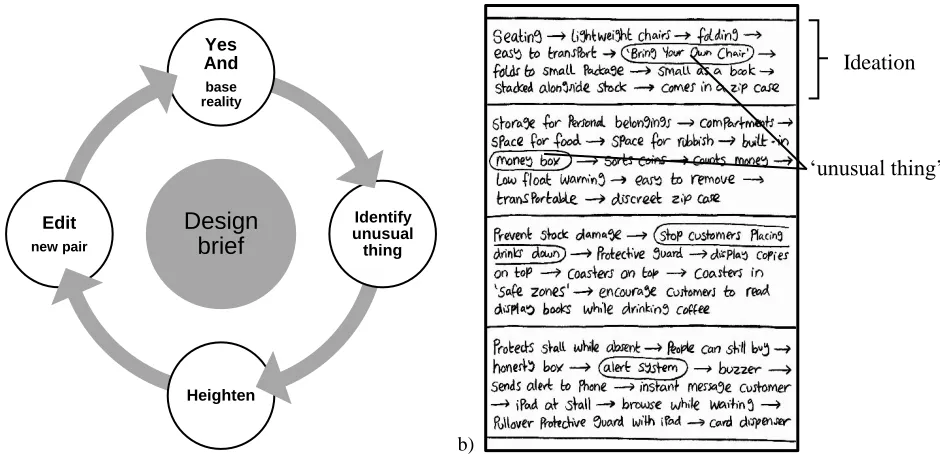
Once a promising approach to humor-based design ideation had been identified, a second phase of exploratory work was carried out to explore the approach further. A workshop was conducted in a classroom setting with a group of 37 undergraduate product design students, divided into teams of 4-6 participants. The workshop was conducted during a timetabled industrial design class, focused on emotion and form, and the students used the workshops to generate ideas for their class project - a loudspeaker product. The improv-based approach to design ideation that was trialed and developed has drawn primarily from the Upright Citizens Brigade approach to improvised comedy. This model was chosen because it has been developed specifically to create humor (as opposed to dramatic performances), with an emphasis on creating a ‘base reality’ then ‘finding the game’ (Besser et al., 2013). The initial steps carried out during these workshops are outlined in Figure 1 a).
1. A reading of the design brief / problem statement acts as an ‘opening’, much like a group game or monologue in an improv performance.
2. Designers work in pairs, using Yes And to create a ‘base reality’ for the new concept- the basic building blocks that create an image of the solution- its function, behaviour and/or structure, much like the who, what and where of an improv scene. Meanwhile, the rest of the design team listen and observe, and one team member takes notes, as illustrated in Figure 1b).
3. At any time, any team member can indicate that they have identified ‘the unusual thing’. In improv, the unusual thing is the idea that makes the scene funny; in design ideation, it is the idea that makes the concept creative i.e. novel and surprising. In an improv performance, players will naturally find the game and seamlessly begin to heighten. Ideally, with training and practice, designers could achieve a similar level of intuition, however for the purposes of these early workshops it was deemed necessary that the unusual thing was explicitly identified. As soon as the unusual thing has been identified, the improvising pair should immediately turn to heightening that particular idea- exploring it further through the same process as before.
a) b)
Figure 1: a) Improv-based ideation method followed in exploratory workshops and b) example note-taking format
[image:5.612.80.550.70.297.2]Feedback and observations from Phase 1 suggested that the improv-based ideation method requires time and practice to be fully realized. The large classroom setting of the Phase 2 workshop enabled an exploration of the use of improvised comedy training to help designers understand the principles of ‘Yes And’ and heightening, before applying them to design ideation. Prior to trialing the method, participants received an hour of basic improvisation training, delivered by professional improvisers. Following the training, the participants were guided through the improv-based ideation method before being asked to spend 20 minutes independently using the method to generate ideas. During the same workshop session, participants also trialed a ‘laughter-enhanced brainstorming’ method, a facilitated Laughter Yoga (simulated laughter) session as a stimulus prior to classic brainstorming. This method was trialed to explore whether stripping away the procedural elements of humor creation may address the issue of subjectivity in jokes and comedy. Upon completion of the workshop, participants were asked to complete a short feedback survey. 30 participants returned the survey. They rated the usefulness of each workshop activity on a scale of 1 (not useful) to 5 (very useful) and also rated how enjoyable they found each activity on a scale of 1 (not enjoyable) to 5 (very enjoyable). The average ratings for each workshop activity are presented in Table 2. These results align with researcher observations on participant body language, energy and level of engagement. Qualitative observations made regarding the outputs of the workshop (the ideas recorded by each team) show that improv-based ideation generally resulted in a more productive and task-focused ideation session when compared to classic brainstorming. However, audio recordings suggest that many teams struggled to follow the rules without a dedicated facilitator, in particular identifying the unusual thing and heightening (step 3 outlined above). This would suggest that further training and/or facilitation was required before participants would be able to fully utilize the method.
Table 2: Phase 2 workshop average participant ratings
Workshop Activity Laughter Yoga Brainstorming Improv Training Improv Ideation
Usefulness 2.8 3.4 4 4
Enjoyment 3.1 3.2 4.2 3.8
Design
brief
Yes And
base reality
Identify unusual thing
Heighten
Edit
new pair
Ideation
One week following the workshop, a group of four participants volunteered to take part in a short focus group to elaborate on the findings from the feedback survey. Feedback was generally positive, with participants agreeing that the method helped them to focus and ‘suspend disbelief’. It encouraged wild ideas, with one participant stating that they felt less self-conscious about expressing ‘silly’ ideas. The participants believed that the improvisation training helped foster this open and relaxed environment, and that having professional improvisers involved made the session more exciting. In contrast to improv, participants felt stimulated during the laughter-enhanced brainstorming, but through anxiety rather than enjoyment, further validating improv as a more engaging humor-based approach.
The findings from the first two phases of the investigation highlighted several possible avenues for improvement and refinement to the improv-based method, which will be discussed in the following section.
4. Discussion
A series of workshops explored a variety of ways in which humor constructs may be applied to the engineering design process. The outcomes of the workshops combined with observations and participant feedback helped identify and develop an approach with the potential to enhance design creativity. An approach inspired by improvised comedy was selected for further development. This section will discuss in more detail how such an approach may enhance design creativity and alleviate some of the barriers and challenges often associated with group brainstorming (Table 3). We then discuss how the method will be developed further in preparation for testing in industry.
Table 3: Potential to alleviate brainstorming barriers
Brainstorming barrier Improv ideation advantage
Social loafing Design improv involves continuous turn-taking, and therefore each participant is provided a platform to share their ideas equally.
Fear of judgement / self-censorship
The relaxed and ‘game-like’ atmosphere means that participants feel less self-conscious about expressing wild ideas. Similarly, the time-pressure to build on ideas encourages participants to state ideas without self-censorship and generate
exaggerated, absurd and incongruous ideas to be built upon. Premature rejection
of ideas
Building on ideas is compulsory, meaning that no idea is ever fully rejected, and continues to inform the emergent process.
Cognitive inertia / idea fixation
The fast-paced nature and ‘editing’ rule prevents design fixation, as the slate is regularly wiped clean and a new ideation begins.
Although it requires some training and practice, the highly structured format of an improv-based technique makes it arguably more teachable, learnable, and practicable than brainstorming rules. Therefore there is a tentative sense that designers and organizations could develop their proficiency in ideation in much the same way that an improv comedian hones their artform.
Considering group energy and engagement, further development will explore the use of movement during the ideation session. Although all the groups that trialed the method were seated, two of the alternative improv-based methods trialed in Phase 1 were conducted standing up, and participants reported feeling more task-focused and energized as a result. A study by Knight and Baer (2014) suggests that a non-sedentary environment can enhance information elaboration in problem-solving groups.
The overall aim of this research is to explore how humor constructs may be applied to complex engineering problems, however these early exploratory workshops were conducted primarily with design briefs that focused on user requirements, experience, form, materials and aspects of engineering management. Therefore the method was not always used to address the technical issues of a design specifically. Further work is required to establish whether the method can usefully be applied in such cases, and with participants who hold deep and extensive domain knowledge.
Whilst the exploratory workshops have provided useful insights into the use of improvised comedy principles to enhance design creativity, there is a number of limitations which must be taken into consideration. First of all, participant groups came from different backgrounds, were working on highly varied design briefs, and the methods trialed varied in structure, making direct comparisons between the outputs of the workshops difficult. The classroom nature of the Phase 2 workshop could also be considered a limitation. Researchers were facilitating up to four teams at a time, which proved challenging as participants attempted to understand and adapt to a new way of thinking. Observations from the idea sheets and audio recordings suggest that some teams would have benefitted from more guidance while learning the method. Another limitation was time. Following practice runs, teams were allocated 20 minutes to independently use the method to generate ideas. Although it is often recommended that an ideation session be limited to no more than 30 minutes, a longer session with more one-to-one facilitation may have helped participants grasp the new method and more fully experience its benefits and challenges.
This limitation raises another challenge to implementing improv-based ideation, or any new approach - the period of practice time and/or training required to familiarize team members with the method. In addition to the hour-long comedy improvisation activities, Phase 2 workshop participants carried out around 30 mins of tutoring and ‘practice runs’ before being asked to independently use the method. Participants rated the improvised comedy training highly for both usefulness and enjoyment, and additional feedback from the focus group suggested that the input from professional comedians added value to the workshop. However, there was no notable difference in the ease of understanding between Phase 2 and Phase 1 participants, who were also guided through the process with tutoring and practice runs but did not receive improvisation training. Furthermore, a reliance on an improvised comedy training session with specialist facilitators could pose significant barriers to the uptake of such a method in industry. Improvised comedy is a highly skilled artform which cannot be mastered in such a short training session. Further work will focus on how facilitation can help participants develop the skills necessary to carry out the design method specifically.
6. Conclusion
will be developed and the refined method will then be tested and validated with design practitioners to determine the effect of improv-based ideation on creativity in the engineering design process.
Acknowledgement
This work was supported by the Engineering and Physical Sciences Research Council (EPSRC) grant number EP/N00597X/1. The research data associated with this paper will be available from the University of Strathclyde KnowledgeBase at: http://dx.doi.org/10.15129/7a8c5e1e-988b-4f32-ba9a-0ad8c01c0dc6, from May 2017 onwards, after the cessation of an embargo period.
References
Besser, M., Roberts, I., & Walsh, M. (2013). The Upright Citizens Brigade Comedy Improvisation Manual. New York: Comedy Council of Nicea LLC.
Diehl, M., & Stroebe, W. (1991). Productivity loss in idea-generating groups: Tracking down the blocking effect. Journal of personality and social psychology, 61(3), 392.
Fotis, M. (2014). Long Form Improvisation and American Comedy: The Harold: Palgrave Macmillan.
Gerber, E. (2009). Using improvisation to enhance the effectiveness of brainstorming. Paper presented at the Proceedings of the SIGCHI Conference on Human Factors in Computing Systems.
Gero, J. S. (1996). Creativity, emergence and evolution in design. Knowledge-Based Systems, 9(7), 435-448. Giora, R., Fein, O., Kronrod, A., Elnatan, I., Shuval, N., & Zur, A. (2004). Weapons of mass distraction: Optimal innovation and pleasure ratings. Metaphor and Symbol, 19(2), 115-141.
Halpern, C., Close, D., & Johnson, K. (1994). Truth in comedy: The manual of improvisation: Meriwether Publishing. Hatcher, G., Ion, W., Wodehouse, A., Maclachlan, R., Simpson, B., & Sheridan, M. (2015). Humour Processes for Creative Engineering Design.
Humke, C., & Schaefer, C. E. (1996). Sense of humor and creativity. Perceptual and Motor Skills, 82(2), 544-546. Isaksen, S. G., & Gaulin, J. P. (2005). A reexamination of brainstorming research: Implications for research and practice. Gifted Child Quarterly, 49(4), 315-329.
Isen, A. M., Daubman, K. A., & Nowicki, G. P. (1987). Positive affect facilitates creative problem solving. Journal of personality and social psychology, 52(6), 1122.
Johnstone, K. (2012). Impro: Improvisation and the theatre: Routledge.
Knight, A. P., & Baer, M. (2014). Get Up, Stand Up The Effects of a Non-Sedentary Workspace on Information Elaboration and Group Performance. Social Psychological and Personality Science, 1948550614538463.
Koestler, A. (1964). The act of creation. London: Hutchinson & Co Ltd.
Kudrowitz, B., & Wallace, D. (2010). Improvisational Comedy and Product Design Ideation: Making Non-Obvious Connections between Seemingly Unrelated Things. Paper presented at the Proceedings of the International Conference on Design and Emotion. Chicago.
Ludovice, P., Lefton, L., & Catrambone, R. (2013). Humorous Improvisation Tailored for Technical Innovation. ASEE Southeast Section Conference.
Matthews, B. (2009). Intersections of brainstorming rules and social order. CoDesign, 5(1), 65-76.
Mullen, B., Johnson, C., & Salas, E. (1991). Productivity loss in brainstorming groups: A meta-analytic integration. Basic and applied social psychology, 12(1), 3-23.
Nijstad, B. A., & Stroebe, W. (2006). How the group affects the mind: A cognitive model of idea generation in groups. Personality and social psychology review, 10(3), 186-213.
Osborn, A. F. (1953). Applied imagination, principles and procedures of creative thinking. New York: Charles Scribner's Sons.
Rickards, T. (1999). Brainstorming revisited: a question of context. International journal of management reviews, 1(1), 91-110.