Rochester Institute of Technology
RIT Scholar Works
Theses Thesis/Dissertation Collections
1-28-2013
A Multi-temporal fusion-based approach for land
cover mapping in support of nuclear incident
response
Shagan SahFollow this and additional works at:http://scholarworks.rit.edu/theses
This Thesis is brought to you for free and open access by the Thesis/Dissertation Collections at RIT Scholar Works. It has been accepted for inclusion in Theses by an authorized administrator of RIT Scholar Works. For more information, please [email protected].
Recommended Citation
A MULTI-TEMPORAL FUSION-BASED APPROACH FOR LAND COVER
MAPPING IN SUPPORT OF NUCLEAR INCIDENT RESPONSE
by
Shagan Sah
Bachelor of Engineering,
Pune University, 2009
A thesis submitted in partial fulfillment of the requirements for the degree of Master of Science in the Chester F. Carlson Center for Imaging Science
of the College of Science Rochester Institute of Technology
January 28, 2013
Signature of the Author
Accepted by
CHESTER F. CARLSON CENTER FOR IMAGING SCIENCE
COLLEGE OF SCIENCE
ROCHESTER INSTITUTE OF TECHNOLOGY
ROCHESTER, NEW YORK
CERTIFICATE OF APPROVAL
M.S. DEGREE THESIS
The M.S. Degree Thesis of Shagan Sah has been examined and approved by the thesis committee as satisfactory for the
thesis requirement for the M. S. degree in Imaging Science
Dr. Jan van Aardt, Thesis Advisor
Dr. David Messinger, Committee
Dr. Anthony Vodacek, Committee
Dr. Peter Bajorski, Committee
THESIS RELEASE PERMISSION
CHESTER F. CARLSON CENTER FOR IMAGING SCIENCE
ROCHESTER INSTITUTE OF TECHNOLOGY
Title of Thesis:
A Multi-temporal Fusion-based Approach for Land Cover Mapping in Support of Nuclear Incident Response
I, Shagan Sah, hereby grant permission to the Rochester Institute of Technology to reproduce my print thesis or dissertation in whole or in part. Any reproduction will not be for commercial use or profit.
ABSTRACT
An increasingly important application of remote sensing is to provide decision
support during emergency response and disaster management efforts. Land cover maps
constitute one such useful application product during disaster events; if generated rapidly
after any disaster, such map products can contribute to the efficacy of the response effort.
In light of recent nuclear incidents, e.g., after the earthquake/tsunami in Japan (2011), our
research focuses on constructing rapid and accurate land cover maps of the impacted area
in case of an accidental nuclear release. The methodology involves integration of results
from two different approaches, namely coarse spatial resolution multi-temporal and fine
spatial resolution imagery, to increase classification accuracy. Although advanced
methods have been developed for classification using high spatial or temporal resolution
imagery, only a limited amount of work has been done on fusion of these two remote
sensing approaches.
The presented methodology thus involves integration of classification results from
two different remote sensing modalities in order to improve classification accuracy. The
data used included RapidEye and MODIS scenes over the Nine Mile Point Nuclear
Power Station in Oswego (New York, USA). The first step in the process was the
construction of land cover maps from freely available, high temporal resolution, low
spatial resolution MODIS imagery using a time-series approach. We used the variability
in the temporal signatures among different land cover classes for classification. The time
series-specific features were defined by various physical properties of a pixel, such as
variation in vegetation cover and water content over time. The pixels were classified into
Mahalanobis distance metrics. On the other hand, a high spatial resolution commercial
satellite, such as RapidEye, can be tasked to capture images over the affected area in the
case of a nuclear event. This imagery served as a second source of data to augment
results from the time series approach. The classifications from the two approaches were
integrated using an a posteriori probability-based fusion approach. This was done by
establishing a relationship between the classes, obtained after classification of the two
data sources. Despite the coarse spatial resolution of MODIS pixels, acceptable
accuracies were obtained using time series features. The overall accuracies using the
fusion-based approach were in the neighborhood of 80%, when compared with GIS data
sets from New York State. This fusion thus contributed to classification accuracy
refinement, with a few additional advantages, such as correction for cloud cover and
providing for an approach that is robust against point-in-time seasonal anomalies, due to
the inclusion of multi-temporal data.
We concluded that this approach is capable of generating land cover maps of
acceptable accuracy and rapid turnaround, which in turn can yield reliable estimates of
crop acreage of a region. The final algorithm is part of an automated software tool, which
can be used by emergency response personnel to generate a nuclear ingestion pathway
Acknowledgements
I would like to thank all the professors, staff, and all my fellow students at the
Imaging Science department at RIT, for the wonderful experience and knowledge I have
received throughout the program. I am deeply indebted to Dr. Jan van Aardt, my teacher
and advisor, for providing his valuable time and guidance throughout the research
process and writing of this thesis. His constant encouragement and support towards
experimenting with new ideas really had me going. I am greatly honored to have worked
under him.
I would like to thank the members of my advisory committee, Dr. David
Messinger, Dr. Anthony Vodacek, and Dr. Peter Bajorski, for providing their knowledge
and expertise throughout this project. I would also like to thank Mr. Don Mckeown for
his help during the initial phase of this research. My gratitude goes out to Cindy Schultz,
for her encouragement and support during my time with the DIRS group. This thesis
would not have been possible without help and support of all the people around me, who
were always kind and willing to give their time and valuable assistance towards the
completion of this thesis. Finally, my sincere thanks goes to the Chester F. Carson Center
for Imaging Science at RIT and the National Science Foundation for providing financial
support in the development of this thesis.
My deepest gratitude goes to my family for their support throughout this graduate
Table of Contents
Chapter 1 Introduction ...1
1.1. Multispectral Classification ... 6
1.2. Temporal Classification ... 9
1.3. Fusion-based Classification ... 15
1.4. Hypothesis and Objectives ... 19
Chapter 2 Methodology ...20
2.1. Study Area ... 22
2.2. Imagery Specifications ... 24
2.3. Data Preprocessing ... 24
2.4. Time Series Classification ... 26
2.4.1 Time Series Feature Metric Extraction ... 35
2.4.2 Classification Metrics ... 37
2.5. High Spatial Resolution Classification (RapidEye) ... 39
2.6. The Fusion Method ... 40
2.7. Error Analysis ... 41
Chapter 3 Results and Discussion ...43
3.1. Time Series Classification ... 43
3.3. Fusion Results... 57
Chapter 4 Conclusion ...63
Bibliography ...67
Appendix A - Algorithms ...74
A.1 RapidEye data processing ... 74
A.2 Time-series processing ... 79
List of Figures
FIGURE 1.1AN EXAMPLE OF A NUCLEAR INGESTION PATHWAY FROM THE NINE MILE POINT NUCLEAR
POWER PLANT,OSWEGO,NY, WHICH SHOWS THE AREA EFFECTED BY A HYPOTHETICAL NUCLEAR
FALLOUT. ... 3
FIGURE 1.2LAND USE MAP FROM USGS AROUND THE NINE MILE POINT NUCLEAR POWER PLANT.IN THE
RADIUS OF 10 KM AROUND THE PLANT, THERE ARE APPROXIMATELY 3600 HECTARES OF
AGRICULTURAL LANDS. ...10
FIGURE 1.3FLOWCHART FOR THE FIRST FUSION STRATEGY, WHICH COMBINES LAYERS OF IMAGES OF
VARYING RESOLUTION AND THEN CLASSIFIES THEM (CHEN AND STOW,2003). ...17
FIGURE 1.4FLOWCHART FOR THE SECOND STRATEGY ON COMBINATION OF VARIOUS SPATIAL RESOLUTIONS
(CHEN AND STOW,2003).THIS IS A BOTTOM-UP APPROACH WHERE PIXELS ARE ASSIGNED TO THE
CLASS WITH HIGHEST POSTERIORI PROBABILITY AT EACH RESOLUTION. ...17
FIGURE 1.5FLOWCHART FOR THE THIRD STRATEGY FROM (CHEN AND STOW,2003), WHICH INVOLVES A TOP
-DOWN APPROACH FOR FUSION OF CLASSIFICATION MAPS. ...18
FIGURE 2.1.BLOCK DIAGRAM OF THE ENTIRE ALGORITHM WORKFLOW, BASED ON COARSE RESOLUTION (CR)
MULTI-TEMPORAL MODIS AND HIGH SPATIAL RESOLUTION (HR)RAPIDEYE IMAGERY. ...21
FIGURE 2.2STUDY AREA -OSWEGO COUNTY,NEW YORK,USA, SHOWING THE RAPIDEYE IMAGE GRIDS. ...23
FIGURE 2.3REPRESENTATION OF A "TEMPORAL STACK" OF MODIS IMAGERY, WHERE THE TEMPORAL
DIMENSION FOR A PIXEL AT A SPECIFIC WAVELENGTH OR INDEX IS REPRESENTED IN THE THIRD
DIMENSION. ...29
FIGURE 2.4AN EXAMPLE OF A MODIS“HYPER-TEMPORAL” RED REFLECTANCE CURVE (SHOWN FOR THE
PIXEL INDICATED ON THE LEFT RGB IMAGE).THE THIRD DIMENSION OR THE BAND NUMBER
REPRESENTS A TIME PERIOD OF FIVE YEARS WITH A 16-DAY RESOLUTION. ...29
FIGURE 2.5AN EXAMPLE OF A RAPIDEYE SCENE MARKED WITH MODIS PIXEL SIZE BLOCKS.MIXTURE OF
DIFFERENT LAND CLASSES CAN BE OBSERVED IN MODIS PIXELS. ...30
FIGURE 2.6SMOOTHED NORMALIZED DIFFERENCE VEGETATION INDEX (NDVI) TEMPORAL PROFILES FOR
FIGURE 2.7SMOOTHED ENHANCED VEGETATION INDEX (EVI) TEMPORAL PROFILES FOR THE FOUR CLASSES.
...33
FIGURE 2.8SMOOTHED SOIL ADJUSTED VEGETATION INDEX (SAVI) TEMPORAL PROFILES FOR THE FOUR
CLASSES. ...34
FIGURE 2.9SMOOTHED MODIFIED SOIL ADJUSTED VEGETATION INDEX -2(MSAVI-2) TEMPORAL PROFILES
FOR THE FOUR CLASSES...34
FIGURE 2.10EVI TIME SERIES CURVES FOR FOUR LAND COVER CLASSES AFTER SAVITZKY-GOLAY
SMOOTHING.A NUMBER OF DISTINCT FEATURES WERE OBSERVED, E.G., PEAK-TO-PEAK VALUES FOR
THE FOREST CLASS WAS HIGH, WHILE URBAN AND VEGETATION CLASSES HAVE REDUCED VALUES AT
TROUGHS, WHICH WAS ATTRIBUTED TO BARE SOIL EXPOSURE IN WINTER. ...36
FIGURE 3.1AN EVI TIME SERIES FOR A TYPICAL VEGETATION COVER PIXEL, BEFORE AND AFTER THE
SAVITZKY-GOLAY SMOOTHING, TO FILTER HIGH FREQUENCY SPIKES. ...44
FIGURE 3.2ILLUSTRATION OF MODIS OUTPUT SCALE.(A)AN EXAMPLE MODIS(250 M) CLASS MAP FOR
FOUR CLASSES DERIVED USING MAHALANOBIS DISTANCE CLASSIFICATION;(B) A HIGH RESOLUTION
RGB IMAGE (5 M) FROM RAPIDEYE OVER THE SAME AREA FOR COMPARISON. ...48
FIGURE 3.3RAPIDEYE SAMPLE SHOWING CLOUD COVERED LAND AREAS (LEFT) AND RESULTS FROM THE
CLOUD MASKING ALGORITHM, BASED ON A RED BAND THRESHOLD (RIGHT). ...51
FIGURE 3.4EXAMPLE OF SPECTRAL BEHAVIOR SIMILARITY BETWEEN THE FOREST AND AGRICULTURE CLASS
FOR RAPIDEYE BANDS. ...52
FIGURE 3.5A SAMPLE RAPIDEYE SCENE AND CORRESPONDING CLASS MAP, BASED ON THE EUCLIDEAN
DISTANCE CLASSIFICATION. ...53
FIGURE 3.6A SAMPLE RAPIDEYE SCENE AND CORRESPONDING CLASS MAP, BASED ON THE MAHALANOBIS
DISTANCE CLASSIFICATION. ...54
FIGURE 3.7ARAPIDEYE CLASSIFICATION MAP THAT DEMONSTRATES THE DISADVANTAGES OF USING A
SINGLE-DATE IMAGE FOR CLASSIFICATION...56
FIGURE 3.8SPECTRAL REFLECTANCE COMPARISON FOR URBAN CLASS WITH A CROP SITE AT INITIAL GROWTH
FIGURE 3.9CLASS MAPS FOR,(A) COARSE SPATIAL RESOLUTION (CR) TIME-SERIES,(B) HIGH SPATIAL
RESOLUTION (HR) MULTI-SPECTRAL, AND (C) FUSION-BASED CLASSIFICATION, USING THE
MAHALANOBIS DISTANCE AS METRIC FOR CLASSIFICATION. ...60
FIGURE 3.10AN ILLUSTRATION OF CLASSIFICATION RESULTS AT 5M SPATIAL RESOLUTION:(A)RAPIDEYE
(5M)RGB IMAGE OF AN AREA WITH CLOUD COVER,(B)RAPIDEYE LAND COVER CLASSIFICATION USING
THE EUCLIDEAN DISTANCE, AND (C) THE CLASSIFICATION RESULT AFTER FUSION OF CLASS MAPS FROM
List of Tables
TABLE 1.1FEW EXAMPLES OF VARIOUS MULTISPECTRAL IMAGE CLASSIFICATION METHODS FROM THE
LITERATURE. ... 7
TABLE 2.1DATA SPECIFICATIONS FOR THE MODIS AND RAPIDEYE IMAGERY. ...24
TABLE 2.2DESCRIPTION OF THE FINAL FOUR LAND COVER TYPES USED IN THE CLASSIFICATION ALGORITHM.
...32
TABLE 2.3TIME SERIES FEATURE METRICS COMPUTED USING THE TEMPORAL PROFILES. ...35
TABLE 3.1A LIST OF THE SUBSET TEMPORAL FEATURE METRICS, AS IDENTIFIED VIA THE STEPWISE
DISCRIMINANT ANALYSIS. ...45
TABLE 3.2CONFUSION MATRIX, OVERALL ACCURACY AND KAPPA STATISTICS FOR TIME SERIES MODIS
CLASSIFICATION USING MAHALANOBIS DISTANCE AS THE CLASSIFICATION METRIC. ...47
TABLE 3.3CONFUSION MATRIX FOR RAPIDEYE HIGH SPATIAL RESOLUTION CLASSIFICATION USING THE
EUCLIDEAN DISTANCE METRIC. ...53
TABLE 3.4CONFUSION MATRIX FOR THE RAPIDEYE HIGH SPATIAL RESOLUTION CLASSIFICATION USING THE
MAHALANOBIS DISTANCE METRIC. ...54
TABLE 3.5CONFUSION MATRIX FOR FUSION-BASED CLASSIFICATION USING THE EUCLIDEAN DISTANCE
METRIC. ...57
TABLE 3.6CONFUSION MATRIX FOR THE FUSION-BASED CLASSIFICATION USING THE MAHALANOBIS
DISTANCE METRIC. ...58
TABLE 3.7CLASSIFICATION ACCURACIES AND KAPPA VALUES FOR THE COARSE SPATIAL RESOLUTION TIME
SERIES, HIGH SPATIAL RESOLUTION MULTI-SPECTRAL, AND FUSION-BASED METHODS.EUCLIDEAN
Chapter 1
Introduction
Remote sensing data providers, scientists, algorithm specialists, and disaster
response agencies often collaborate to develop effective ways to prevent and respond to a
variety of disaster scenarios and provide associated relief measures. Remote sensing and
geographic information systems (GIS) are among many tools available today for disaster
management efforts, which contribute to making many disaster response efforts more
efficient. For example, remote sensing can be used to rapidly generate land cover maps
for assisting emergency response personnel with resource deployment decisions and
impact assessments. But, despite the presence of numerous satellites with varying spatial,
temporal, spectral, and radiometric resolutions, none of them have been solely designed
for the purpose of observing disasters or natural hazards (Nirupama, 2002).
In light of recent disaster events at the Fukushima nuclear power facility in Japan,
caused by the earthquake and associated tsunami of 2011, there has been an increased
awareness of the problem of managing a major radiological release on the part of
emergency response agencies. The accurate mapping of the “ingestion exposure
pathway”, which refers to the area affected by the deposition of radionuclides on crops,
other vegetation (such as pasture and animal feed), bodies of surface water, and ground
surfaces, is among the most critical issues. In other words, a nuclear ingestion pathway or
simply a nuclear plume, is the area surrounding a nuclear facility site (usually with a
radius of approximately 15-20 km) that has been subjected to radioactive exposure (for
resource usage and food ingestion by humans (New York State Radiological Emergency
Planning, 2010). Emergency managers need up-to-date inventories of crops, vegetation,
open water, and drainage features in an affected area to determine the impact of a release.
Information on the acreage, type, and geographic distribution of the affected areas will
drive decision-making relative to the response; this information also provides a
quantitative basis for economic impact assessment.
Remotely sensed imagery, based on aircraft- or satellite-based sensors with
sufficient spatial and spectral resolution, can potentially be used to accurately map and
discriminate crop/ground cover types, open water bodies, and impervious surfaces
(runoff) (Vinciková et al., 2010). This land cover classification is an important remote
sensing or geospatial product and is typically derived based on spatial, spectral, or
temporal characteristics of individual or grouped pixels (Lu and Weng, 2007). The
resultant accurate and timely produced land cover maps can provide essential information
during and after a regional, national, or a global scale disaster. In this study, we focus on
deriving accurate land cover maps to identify the impacted area in the case of an
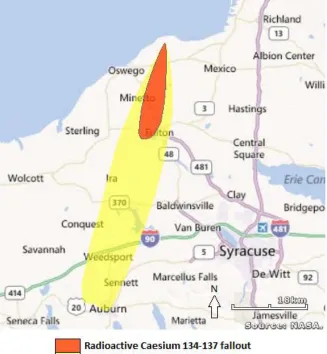
Figure 1.1 An example of a nuclear ingestion pathway from the Nine Mile Point Nuclear Power Plant, Oswego, NY, which shows the area effected by a hypothetical nuclear fallout.
Remote sensing of the ingestion exposure pathway requires imaging a large area
in a timely fashion. The Federal Emergency Management Agency (FEMA), in their
Ingestion Pathway Exercise (2000), reported that an affected area may be tens of
thousands to several hundred thousand hectares. A typical airborne mapping system (one
aircraft and sensor) can cover approximately 200-250 km2 per day (weather permitting)
[image:16.612.144.471.72.426.2]can be launched at virtually anytime, weather permitting; however, aircraft operations do
need to be mobilized for an event, which may require a day or more of planning and
deployment from wherever the system is based and as stated before, is limited in terms of
aerial coverage. Another significant challenge for aircraft data acquisition is that an
ongoing radiological incident may preclude the safe operation of manned air assets,
especially near the reactor site or for any extended period of time.
High spatial resolution commercial satellites have the potential to rapidly cover
large areas. For example, a satellite can cover hundreds of square kilometers in a single
pass as can be observed from specification of various satellite sensors (Satellite Imaging
Corporation). Satellites are also not restricted by hazards in the affected area. In the case
of a catastrophe, with an increasing number of available high spatial resolution satellites
such as Quickbird, IKONOS, RapidEye, etc., any number of satellites could be tasked to
acquire images of the affected area. Most high spatial resolution imaging satellites are in
a state of continuous readiness and can be tasked within minutes or hours (Gillespie et
al., 2007). However, there are potential limitations due to orbital geometry and weather.
For example, it may be several days before a satellite’s ground track passes over a
particular location or the ground track may not be well aligned with the plume area. High
clouds that would not impact airborne operations, on the other hand, would render
satellite imaging ineffective and result in another waiting period before the next pass.
In addition, land cover classification based on a single image is potentially less
accurate and more challenging to derive, given the occurrence of poor weather
conditions, e.g., cloud cover, or the spatial and spectral limitations of the sensor (Robin et
this research involves the fusion of classification results from two satellite image sources
- a single date, high spatial resolution, multi-spectral image and coarse spatial resolution,
high temporal resolution, freely available imagery over the same area. We used a
RapidEye image for the high spatial resolution multi-spectral classification; the presence
of the red edge band in the RapidEye band set has made this sensor a useful resource for
vegetation-related applications. For example, Tapsall et al. (2010), Kim et al. (2011), and
Sousa et al. (2012) have analyzed the use of RapidEye images for a variety of natural
resource applications. Details of the RapidEye satellite constellation are listed in the
methods section.
Several studies also have been conducted in the past to assess the appropriate
spatial resolution for classification, most notably the work by Atkinson and Curran
(1997). Other authors also found that the best classification results can be achieved for a
specific land cover class by using a particular combination of resolution and algorithm;
however, it is hard to achieve the best results for all classes using just a single
combination of a resolution and an algorithm (Marceau et al., 1994; Ponzoni et al.,
2002). It thus stands to reason that the strategy of integrating class maps at two different
resolutions can be regarded as a necessary component in the process of land cover
mapping. This is underscored by a large number of fusion-based image classification
methods that exist in the literature, all of which use the combination of several sources of
information with the basic aim of augmenting and increasing the reliability of
classification results. The final objective of this research was to augment the
coarse spatial resolution time series imagery. Note: In order to facilitate discussion, the
term “resolution” will be assumed to imply “spatial resolution” from this point forward.
In the following subsections, we will discuss various classification methods from
the literature. For our application, multispectral, time-series, and fusion-based
classification methods are reviewed.
1.1.
Multispectral Classification
Radiance from the Earth’s surface is measured by a variety of satellite sensors and
typically converted to approximate surface reflectance measurements, which in turn are
used to extract information for specific surface targets, i.e., towards application of the
acquired imagery to a specific problem. Image classification and segmentation into land
cover, material, or object classes, are among the most important applications of remote
sensing. Classification of any form of data can be broadly categorized into supervised and
unsupervised approaches. In unsupervised methods, an algorithm is developed to group
pixels with similar characteristics, while supervised approaches rely on a user to identify
a sample of pixels of each class/cover type and use various signal processing algorithms
to assign pixels from the image to class with the highest membership probability (Schott,
2007).
There are a number of algorithms that target the analysis of multispectral data.
The traditional methods for image classification algorithms include K-means and
can easily be applied through widely available image processing or statistical software
packages (Xie et al., 2008). Artificial neural networks and fuzzy logic approaches for
image classification and vegetation applications are also abundant in the literature, but
often lack transparency (Zhang and Foody, 1998; Filipi and Jensen, 2006). Our goal was
not to evaluate different classification approaches, but rather to focus on a novel
multi-temporal, multi-resolution approach based on established classification algorithms. A few
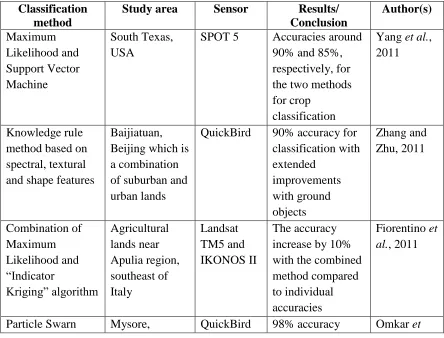
examples of classification algorithms based on multispectral data are listed in Table 1.1. The reader therefore is referred to the in-depth review of various classification methods
[image:20.612.84.528.380.718.2]by Lu and Weng (2007).
Table 1.1 Few examples of various multispectral image classification methods from the literature.
Classification method
Study area Sensor Results/ Conclusion Author(s) Maximum Likelihood and Support Vector Machine South Texas, USA
SPOT 5 Accuracies around 90% and 85%, respectively, for the two methods for crop
classification
Yang et al., 2011
Knowledge rule method based on spectral, textural and shape features
Baijiatuan, Beijing which is a combination of suburban and urban lands
QuickBird 90% accuracy for classification with extended improvements with ground objects Zhang and Zhu, 2011 Combination of Maximum Likelihood and “Indicator Kriging” algorithm Agricultural lands near Apulia region, southeast of Italy Landsat TM5 and IKONOS II The accuracy increase by 10% with the combined method compared to individual accuracies
Fiorentino et al., 2011
Classification method
Study area Sensor Results/ Conclusion Author(s) Optimization and Ant-Miner algorithm Karnataka, India
when the swarn intelligence used the relation between various input data
al., 2007
Spectral Angle Mapper Clarion, Pennsylvania, US Landsat TM5 Overall accuracy of 93% and the method does not require the data to be normally distributed Sohn and Rebello, 2002 Artificial Neural Network South west Florida Landsat TM 5 Overall accuracy of 78 %, but it depends on the number of hidden units Dixon and Candade, 2008 Object-based classification Phoenix, Arizona
QuickBird Better results than the classical per-pixel classifier, with accuracies of 90%
Myint et al., 2011
We used two different classification techniques, based on spectral and temporal
properties of different pixels, at various stages throughout the algorithm. The first was the
minimum distance or the Euclidean distance classification, which calculates the spectral
distance between the measurement vector for the candidate pixel and the mean vector for
each class or signature. The candidate pixel is assigned to the class with the shortest
distance. The main drawback with the minimum distance method is its inability to
consider class variability/co-linearity. The second method was the Mahalanobis distance
method, which is based on the correlation between the variables. It uses the mean and
from the local class mean. The advantage with Mahalanobis distance method is the
inclusion of class variability using the covariance matrix (Schott, 2007).
The next section reviews relevant published articles on various methods, all of
which use temporal information as input to the classification.
1.2.
Temporal Classification
The second step in the multi-temporal, multi-resolution algorithm involved
construction of a coarse-scale land cover map from freely available, high temporal
resolution data using a time-series approach. Given the fact that most of the landmass
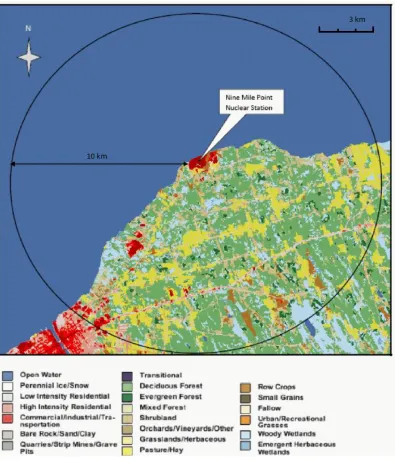
worldwide is covered by vegetation (in particular consider our study area in Figure 1.2), the application of phenological differences through time series analysis of imagery could
yield accurate land cover map (Knight et al., 2006). Such an approach is further
facilitated by improved satellite revisit times (temporal resolution); multi-temporal data
are now available which help to characterize objects based on their dynamic properties, in
Figure 1.2 Land use map from USGS around the Nine Mile Point Nuclear Power Plant. In the radius of 10 km around the plant, there are approximately 3600 hectares of agricultural lands.
Recent studies on land cover classification increasingly have used multi-temporal
remotely sensed data sets, e.g., Boles et al. (2004) achieved accuracies around 70% using
east Asia. They also reported maximum misclassifications among the woody vegetation,
grasslands, sparse vegetation and croplands classes. In another study, Sakamoto et al.
(2005), determined different phenological stages of vegetation growth in terms of time in
days, using maximum, minimum and inflection points from time profiles and obtained
offset errors of approximately 10 days. An important conclusion was the presence of
errors in phenological stages due to mixed pixels effects. Zhang et al. (2008) used a
decision tree analysis on the time-series of MODIS images over North China Plain and
reported a 75% accuracy. Most of these studies have commonly described the vegetation
dynamics based on phenological variations over time. Researchers have exploited typical
satellite vegetation indices, such as Normalized Difference Vegetation Index (NDVI) and
Enhanced Vegetation Index (EVI), which are directly correlated with the green biomass,
and are frequently used for studying land cover dynamics. In this study, time profiles
from a number of spectral bands, along with derived vegetation indices, were used as
temporal input data. Keeping all the requirements and constraints in view, the Moderate
Resolution Imaging Spectro-radiometer (MODIS) time-series data were used for
generating land cover maps at a coarse resolution. We therefore will discuss the methods
and results of some more common methods where MODIS time series imagery was used
for various forms for land cover classification.
The use of temporal signatures of different classes as features for classification is
a common approach while working with time profiles. For example, Gupta and Rajan
(2010), used MODIS data over the Dharwad District in Karnataka, India, and applied
dynamic time warping as a distance measure to form a curve matching scheme; the
classes, namely forest, crop, and water. Similarly, class separability among specific crop
types was investigated using the Jeffries-Matusita distance statistic, using MODIS EVI
and NDVI data over Kansas State in USA (Wardlow et al., 2007). They concluded that
NDVI and EVI exhibited a high correlation when used to describe vegetation cover.
Another very common approach while working with temporal profiles, is the decision
tree method. This was successfully applied by Zhang et al. (2008), by basing the decision
nodes on the values of phenological features derived through time, but their approach was
also dependent on other physical features, such as land surface temperature and surface
slope. The work by Jönsson and Eklundh (2004) also deserves special mention – these
authors developed a widely popular user algorithm and interface dubbed “TIMESAT”.
The interface assists the user in describing the land dynamics by viewing the
phenological variation of MODIS EVI time-series throughout the course of a year.
Finally, among the more mathematically complicated methods, the back-propagation and
fuzzy neural network approach, used for multi-temporal image classification, increased
classification accuracies by 10-15%, when compared with conventional multi-temporal
methods (Kushardono et al., 1995). However, most of these studies produce land cover
maps at a lower resolution that lack definition of high spatial resolution features.
In many of the previous studies, data in the form of vegetation indices from other
satellites were also used for temporal analysis of land cover. For example, ISODATA
classification using data from the SPOT sensor resulted in a maximum accuracy of 80%,
while validating the results using a Landsat-derived land cover data (Boles et al., 2004).
Similarly, Lhermitte et al. (2008) have applied hierarchical segmentation on the fast
sensor to describe the spatio-temporal features to analyze actual vegetation. They
concluded that more multi-scale studies are crucial to get a better relationship between
time-series data and the ecosystem they represent. This approach was also successfully
demonstrated by Wen et al. (2010), who used MODIS EVI time-series over grasslands in
Tibet, and obtained accuracies of approximately 68%. Kandrika and Roy (2008), on the
other hand, evaluated the temporal spectral responses using the IRS-P6 (Resourcesat)
dataset over eastern parts of India to classify land cover. The authors implemented a
decision tree approach and obtained accuracies of 87%. Likewise, numerous other studies
are present in the literature, all of which have used different sensor datasets in a temporal
approach to achieve land cover maps. However, the majority of past studies have
preferred approaches based on MODIS data for time-series analysis, because of a variety
of reasons, e.g., improved atmospheric and cloud screening, consistent data availability,
low cost (free), high temporal resolution (8-day and 16-day) and above all, the vast range
of spectral and data products (Carrão et al., 2008). It should also be noted that most of the
work involving time series data is focused on vegetation applications. Another very
important application of time-series data is change detection, e.g., through filtering the
MODIS NDVI time-series data, to obtain a 89% accuracy in change detection of new
settlements in South Africa (Kleynhans et al., 2011). Lunetta et al. (2006), also
evaluating vegetation spectral time series, achieved change detection accuracies of 88%
while comparing discrete Fourier transformed time-series of MODIS NDVI data over
Albemarle-Pamlico Estuary System in North Carolina. However, the question of which
The issue of data redundancy when working with time series revolves around the
large number of data channels or bands, with the majority of bands containing
superfluous information (Chandola et al., 2010). This could in turn affect the
performance of the classifier, due the Hughes phenomenon (Hsieh and Landgrebe, 1998).
For practical reasons, the computational cost also increases with an increase in the feature
space dimension. Thus, data reduction constitutes an important step when working with
high dimensional time-series data (Carrão et al., 2008). As demonstrated successfully by
Zhang et al. (2008) and Sakamoto et al. (2005), we used temporal attributes extracted
from the time series as features for classification. Feature space data reduction relied on
stepwise discriminant analysis, which has been widely used in the remote sensing
community, e.g., for spectral band selection in hyperspectral images (Hochberg and
Atkinson, 2000; Karimi et al., 2005; van Aardt and Rogers, 2008) or with other forms of
datasets like feature reduction with light detection and ranging (lidar) (van Aardt et al.,
2011). It should also be noted that the selection of a suitable classification method is
application dependent, while also varying with testing and training data and the number
of classes.
The third step in our algorithm was fusion of classification results from a single
multispectral high resolution image and time-series coarse resolution image. The next
1.3.
Fusion-based Classification
Multi-sensor image fusion is among the fundamental tools of image processing
and has gained more traction in land cover classification, mainly because of numerous
limitations (spatial, spectral, or temporal) associated with individual satellite sensors. One
of our objectives for this study was to increase land cover classification accuracy through
image fusion, in contrast to single modality classification approaches. There are a variety
of existing algorithms that focus on fusion of classification information from sensors with
different spatial resolutions. The Bayesian approach for multi-scale land classification
remains popular among fusion studies. For example, Robin et al. (2005) obtained
accuracies >90%, when combining Bayesian theory with a linear mixture model.
However, their approach was limited to images with resolution ratios of 15 and the
method was only demonstrated using simulated images. In another Bayesian theory based
approach, Storvik et al. (2005) used a reference resolution from the SPOT-5 sensor over
downtown Paris to obtain an overall probability of correct classification of 88%. Kumar
et al. (2011), in an enhancement to the Bayesian method, proposed a new technique
which contrasts the most widely used Bayesian classifiers, by not assuming equal prior
probabilities for all classes. Their method increased the land cover classification
accuracies by 6% and 9% with IRS LISS-III MS and IKONOS data, respectively.
However, the method increased the computational requirements and was not suitable for
near-real time applications.
Apart from a Bayesian approach, another notable effort was developed in the
resolution image to generate a classification map at the higher resolution. The authors
used data from the Landsat 5 and MODIS sensors for purposes of training and validation,
respectively. In other studies, neural networks were applied for classification of
multisource datasets. Examples include Bruzzone et al. (1999), who applied Landsat 5
and Synthetic Aperture Radar data into a single layer neural network and obtained errors
<5%, and Liu et al. (2001), who used an Adaptive Resonance Theory neural network on
MODIS and Landsat TM, and predicted 80% of each classes within the 10% error bound.
Yet another context-dependent method, in this case using a two-dimensional Hidden
Markov Model for multi-resolution classification, was successfully demonstrated by Li et
al. (2000). The biggest challenge in all of these multi-resolution approaches was the
multi-to-single date spatial correspondence between low and high spatial resolution data.
A collection of various image fusion methods has been compiled by Laporterie and
Flouzat (2003). A probability-based approach to fusion therefore was chosen, based on
these past results.
Three probability-based strategies for multi-resolution classification were
developed by Chen and Stow (2003). The first method is a simple process, which
involves selection of features at all the resolution levels and applying the classification
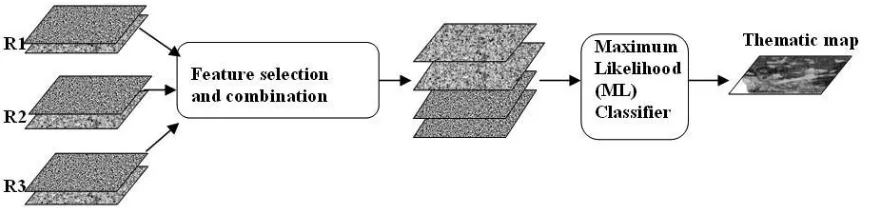
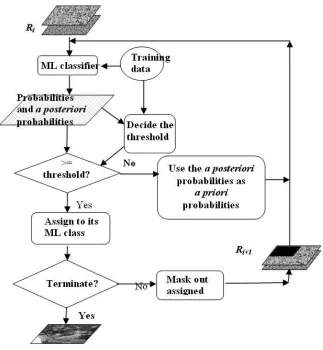
scheme to obtain the class maps (Figure 1.3). The second is a simple, but very effective bottom-up technique for integration of image classification maps at multiple spatial
resolutions. This technique compares the a posteriori probabilities at different spatial
resolutions, after which the class with highest probability is assigned those pixels that
conformed to the probability conditions (Figure 1.4). The third method is a top-down
used when necessary (Figure 1.5). The computation cost in the first method is very high, while with the third method, class decisions may be made in the absence of fine
resolution information (Chen and Stow, 2003). In this study we therefore applied an
approach similar to the second method, in order to combine the coarse spatial resolution
temporal and high spatial resolution instantaneous imagery sets for classification
[image:30.612.92.527.264.372.2]purposes.
Figure 1.3 Flowchart for the first fusion strategy, which combines layers of images of varying resolution and then classifies them (Chen and Stow, 2003).
Figure 1.4 Flowchart for the second strategy on combination of various spatial resolutions (Chen and Stow, 2003). This is a bottom-up approach where pixels are assigned to the class with highest posteriori
[image:30.612.97.521.476.596.2]1.4.
Hypothesis and Objectives
The in-depth literature review and associated outcomes from past studies have led
to the development of the main hypothesis that land cover classification results can be
improved in terms of overall and class-level accuracy through the fusion of coarse
resolution time-series imagery and a high resolution multi-spectral image. This study
has the associated three main objectives:
1) Assess the utility of coarse spatial resolution multi-temporal MODIS satellite
imagery for accurate land cover classification;
2) Evaluate the classification efficacy of a fusion-based approach by integrating the
classification maps from the multi-temporal analysis and a single date, high
spatial resolution multispectral image classification; and
3) Determine if land cover information products, to mainly map agriculture lands in
Chapter 2
Methodology
This chapter describes the methodology used throughout the complete algorithm
workflow, from time series classification to fusion of coarse spatial resolution time series
outputs and high spatial resolution imagery classification. Firstly, we summarize the
study area and list the data specification for the MODIS and RapidEye imagery used. The
process starts by performing pre-processing on images from both remote sensing
modalities. This is followed by the time series feature extraction and classification of the
coarse spatial resolution MODIS images. Next, the high resolution multispectral single
date RapidEye image is classified. Finally, a probability-based fusion is performed using
the classification results from the two disparate modality methods, in order to generate
land cover maps at high spatial resolution, while retaining the spatial, spectral, or
temporal benefits from both the image sources in the final classification results. An error
analysis is performed on the final classification results using the 2010 Cropland Data
Layer Product from the U.S. Department of Agriculture and National Agricultural
2.1.
Study Area
Data from the MODIS Terra sensor were used for time-series analysis. The
MODIS 250m Level-3 product (MOD13Q1) is comprised of the vegetation indices-
NDVI and EVI, along with spectral bands for blue, red, near-infrared, and mid-wave
infrared wavelengths (see Table 2.1). All the images are composited at 16-day intervals. The spectral and vegetation indices products were constructed from atmospherically
corrected bi-directional surface reflectance. Time series of all the images were generated
for five years, from July of 2005 to July of 2010, with each year contributing 23 images.
In addition to this, two mosaicked high spatial resolution RapidEye images (5m),
acquired in July of 2010, were used as a second source of data for the fusion approach.
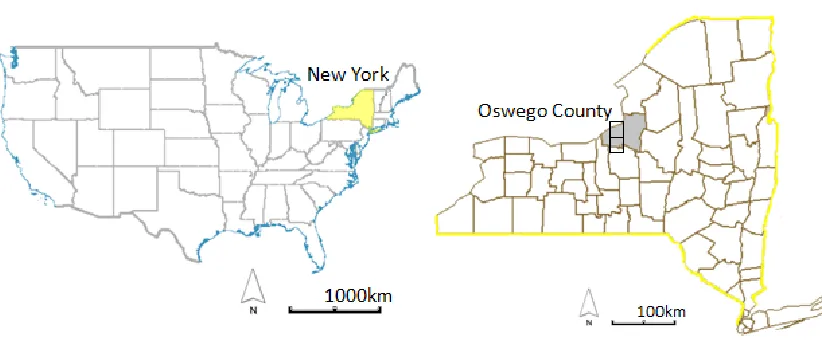
The MODIS and RapidEye images covered the area surrounding the Nine Mile
Point Nuclear Power Plant in Oswego, NY. This region is diverse in terms of the number
of crop types that are present. According to the Cropland Data Layer Product from the
U.S. Department of Agriculture and National Agricultural Statistics Service, generated in
2010, the study area boasts 58 crop types. In addition, there are vast land areas of
woodlands, wetlands, shrub lands, and barren lands; moreover, a section of Lake Ontario
was also a part of the image used. In terms of crops types, the acreage was dominated by
Hay, Corn, Pasture grass, Soybeans and Fallow or Idle croplands. The images also
covered large portions of urban areas with the towns of Oswego, Fulton, and northern
parts of Syracuse. Validation of classification results was performed using the 2010
specific crop types, at a spatial resolution of 30m (USDA-NASS, Cropland Data Layer
Product, 2010). For validation purposes, this was re-sampled to the same spatial
[image:36.612.95.506.191.361.2]resolutions as the MODIS and RapidEye datasets.
2.2.
Imagery Specifications
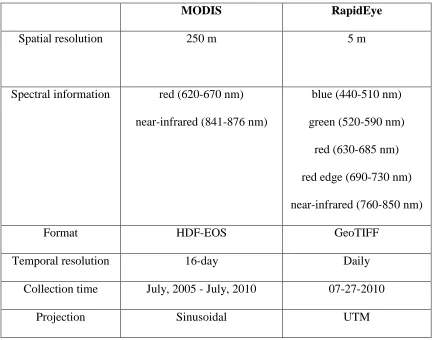
Table 2.1 lists the specifications for the MODIS and RapidEye images.
Table 2.1 Data specifications for the MODIS and RapidEye imagery.
MODIS RapidEye
Spatial resolution 250 m 5 m
Spectral information red (620-670 nm)
near-infrared (841-876 nm)
blue (440-510 nm)
green (520-590 nm)
red (630-685 nm)
red edge (690-730 nm)
near-infrared (760-850 nm)
Format HDF-EOS GeoTIFF
Temporal resolution 16-day Daily
Collection time July, 2005 - July, 2010 07-27-2010
Projection Sinusoidal UTM
2.3.
Data Preprocessing
Preprocessing constituted a critical step before any useful information could be
extracted from the images. This processing was performed on both image sources,
MODIS data were originally obtained in the sinusoidal projection and therefore required
a re-projection step into the UTM projection to ensure proper alignment with the
RapidEye images. The re-projected data were spatially subset to the same extent as the
RapidEye image, but the edges of the images were extended by a one-sided linear
dimension of the minimum mapping unit (MMU). The MMU is the size of the smallest
feature that can be distinguished at any particular spatial resolution. Improper definition
of the MMU could lead to biased or underestimation of land cover classes (Saura, 2002).
A MMU of 50 hectares was used, given the MODIS spatial resolution of 250m, in order
to avoid any erroneous classifications at the edges (Herald, 2009). The image data were
also converted from the HDF-EOS format to the GeoTIFF format, which is a more
widely accepted image format among software suites. The MODIS Reprojection Tool
(MRTWeb 2.0) was used for re-projection, subsetting, and conversion of the dataset. The
MRTWeb is an open source tool for the MODIS data processing and analysis.
On the other hand, RapidEye data were converted from digital numbers to
top-of-atmosphere reflectance values (see equation 2.1) (Naughton et al., 2011). The Digital
Number (DN) of a pixel was converted into radiance by multiplying each DN by the
radiometric scale factor.
(2.1)
where, i is the number of the spectral bands, REF is the reflectance value, RAD is the
units, EAI is the Exo-atmospheric irradiance, and SolarZenith is the solar zenith angle in
degrees (=900 – sun elevation). For RapidEye the EAI values for the 5 bands are 1997.8
W/m2μm (blue), 1863.5 W/m2μm (green), 1560.4 W/m2μm (red), 1395.0 W/m2μm (red
edge), and 1124.4 W/m2μm (near-infrared).
In addition to the above conversion, cloud detection was performed on the
RapidEye imagery with an obvious expectation of improvement in classification
accuracies. This was done using a band threshold analysis on the red spectrum. The cloud
pixels were detected by comparing the DN values with a threshold value for the red band
(Naughton et al., 2011). The threshold value, as estimated using trial and error method,
was 17,500 units in digital numbers. The threshold method had numerous disadvantages,
such as inability to detect haze, or “darker” or “small” clouds; moreover, bright features
such as snow, ice or desert sand may be incorrectly classified as clouds. Despite these
limitations, the cloud detection results were visually accurate and this method was used
for its simplicity and low computational requirements. It is obvious that, should this
processing workflow be adopted in future, the user would need to perform an interactive
cloud removal via this or a similar procedure.
2.4.
Time Series Classification
The MODIS time series images were used for obtaining classification maps at a
coarser spatial resolution, but higher temporal resolution (approximately bi-weekly). Four
the MODIS imagery. The pre-processing steps were performed to obtain corrected
reflectance images, i.e., atmospherically corrected bi-directional surface reflectance that
have been masked for water, clouds, heavy aerosols, and cloud shadows, which were
used directly after processing with MRTWeb.
Apart from the spectral bands, vegetation indices were also extracted to enhance
the accuracy (broader class inclusion) and utility (defining vegetation classes) of the
classification. The normalized vegetation index (NDVI) is the most commonly used
vegetation index, used to represent photosynthetic activity or “greenness” in any form of
vegetation. However, it has limitations such as being sensitive to within-pixel soil surface
exposure and loss of sensitivity in presence of high cover or dense canopies (Huete et al.,
2002). Other indices, such as the enhanced vegetation index (EVI) and Soil Adjusted
Vegetation Index (SAVI) were evaluated in order to overcome these limitations. EVI
addresses the drawbacks of NDVI and also provides some additional advantages, such as
correcting for canopy background signals, reducing the influence of atmospheric
conditions on vegetation index values, and increasing the spectral sensitivity in areas with
high biomass density. SAVI and Modified Soil Adjusted Vegetation Index 2 (MSAVI2),
on the other hand, address the issues that NDVI has with areas with low vegetative cover
and with sub-pixel exposed soil surfaces (Terrill, 1994). The entire set of vegetation
indices therefore presents a variety of metrics and provides an extensive range of spectral
information, while performing well for nearly all types of vegetation cover (Huete et al.,
(2.2)
(2.3)
(2.4)
(2.5)
where, NIR is the near-infrared spectral reflectance, RED is the red spectral reflectance,
BLUE is the blue spectral reflectance, L is the canopy background adjustment (L=1), and
C1 and C2 are coefficients of the aerosol resistance term that uses the 500nm blue band of
MODIS (Huete et al., 1999).
The list of spectral bands and vegetation indices, used as input for time-series
classification, included blue, red, near-infrared, and mid-infrared reflectances, as well as
NDVI, EVI, SAVI, and MSAVI2 as indices. Each of the spectral bands and vegetation
index data were organized in the form of a stack (Figure 2.3), where each 250m x 250m pixel from this stack would represent the temporal profile of that pixel. This temporal
stack is analogous to a hyperspectral image, where the third dimension represents “time",
Figure 2.3 Representation of a "temporal stack" of MODIS imagery, where the temporal dimension for a pixel at a specific wavelength or index is represented in the third dimension.
Figure 2.4 An example of a MODIS “hyper-temporal” red reflectance curve (shown for the pixel indicated on the left RGB image). The third dimension or the band number represents a time period of five years with
a 16-day resolution.
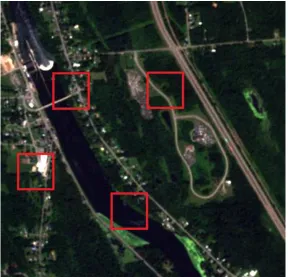
Another important observation with MODIS is the large size of the ground sample
distance, where a typical pixel contains a mixture of different land cover types; an
[image:42.612.95.521.371.545.2]involves fusion of such pixels with considerably smaller size pixels, e.g., the resolution
ratio between MODIS and RapidEye images is 50. This spatial complexity often is
exacerbated by spectral challenges, e.g., mixed pixels, different scattering properties of
[image:43.612.164.452.221.498.2]sub-pixel materials, etc.
Figure 2.5 An example of a RapidEye scene marked with MODIS pixel size blocks. Mixture of different land classes can be observed in MODIS pixels.
When working with time series data, the default corrections performed on the
MODIS products are often not sufficient. This is because of atmospheric and seasonal
variations over time, which cannot be corrected for with individual images. Such an
present in the temporal curves (curves shown in the results section Figure 3.1). Savitzky-Golay smoothing (Jönsson and Eklundh, 2004) therefore was applied to filter the
temporal curves for these signal spikes. This filter approximates the function within a
moving window by a polynomial of higher degree. All data values are replaced by a
linear combination of nearby values in a window. The filter can be expressed
mathematically as equation 2.6.
(2.6)
where, Ii, i=1, 2, … represent the data values and c = 1 / (2n+1) are the weights for a
moving average filter, in the simplest case. The data value, Ii, is replaced by the average
of the values in the window. In order to avoid losing any critical time series features from
the curves, the temporal resolution of the window size was kept to less than two months
in temporal units. Smoothened temporal curves were obtained after the filtering, which
were used as inputs to the next steps in the processing chain (smoothing results presented
in the results chapter). The data were now ready for classification analysis.
The basic assumption, as required by any classification based on time-series data,
was that different land cover types exhibit unique temporal signatures over time. For the
purpose of distinguishing the maximum number of classes, seven categories - forest,
agriculture, urban, barren, water, wetlands, and shrub lands - were formed (Anderson et
al., 1976). However, it was observed that wetlands, along with shrub lands, exhibited a
behavior very similar to the agricultural lands, whereas the time profiles of barren lands
resembled either urban or agricultural pixels. After a thorough inspection of temporal
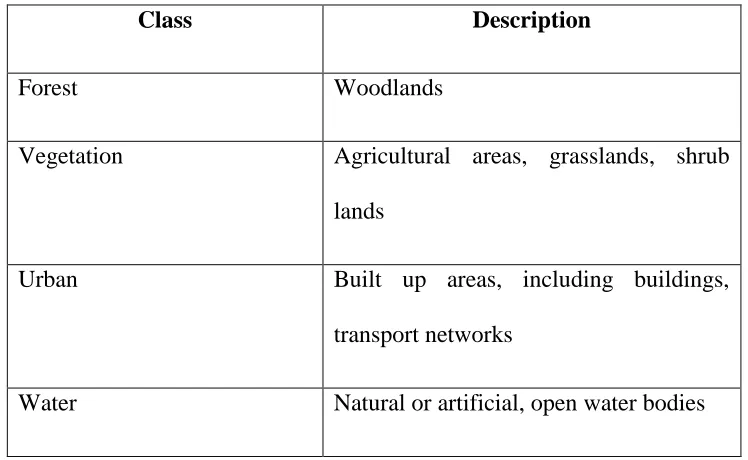
coarse resolution MODIS data (Table 2.2). The temporal profiles for these four land-cover types for all the different vegetation indices can be seen in Figure 2.6 - Figure 2.9. It should be noted that though these curves were generated using manually selected pure pixels;
however, a certain level of impurity, due to mixture of classes within these pixels, should
be expected in the case of most pixels, especially those with a low spatial resolution. For
[image:45.612.119.493.302.532.2]example, the urban category pixels had areas with trees and other vegetation cover.
Table 2.2 Description of the final four land cover types used in the classification algorithm.
Class Description
Forest Woodlands
Vegetation Agricultural areas, grasslands, shrub
lands
Urban Built up areas, including buildings,
transport networks
Figure 2.6 Smoothed Normalized Difference Vegetation Index (NDVI) temporal profiles for the four classes.
[image:46.612.131.488.350.532.2]Figure 2.8 Smoothed Soil Adjusted Vegetation Index (SAVI) temporal profiles for the four classes.
2.4.1 Time Series Feature Metric Extraction
Six features were calculated using the temporal curves for each spectral band and
vegetation index to characterize the phenological differences among the classes (Table 2.3); these features subsequently were used as inputs to the classification. Distinct profiles
for the classes hinted at typical, class-specific attributes that could be exploited, while
these features also were quantified. For example, some of these observations with EVI
profiles (Figure 2.10) were that (a) forested lands have higher crest or “summer peak” values than other vegetation types, ascribed to the denser canopy cover, (b) vegetation
and urban cover have lower trough or “winter dip” values, as opposed to agriculture and
forested lands which typically do not exhibit exposed bare soil and snow during winter,
and (c) EVI values for water were more distinct (flatter) and fluctuated closer to zero.
Similar conclusions were drawn from other temporal profiles. These observations,
supported by the conclusions from Zhang et al. (2008), assisted in the derivation of a
[image:48.612.133.481.563.701.2]credible set of time-series pixel-based features or metrics for land cover classification.
Table 2.3 Time series feature metrics computed using the temporal profiles.
Feature name Definition
Mean Mean time-series value
Max Maximum time-series value (at crests)
Feature name Definition
Peak-to-peak Difference of the maximum and minimum
values
Winter cycle Approximated by the length between the
negative to positive inflection points
(during troughs) in time-series
Summer cycle Approximated by the length between the
positive to negative inflection points
[image:49.612.108.511.379.593.2](during crests) in time-series
Figure 2.10 EVI time series curves for four land cover classes after Savitzky-Golay smoothing. A number of distinct features were observed, e.g., peak-to-peak values for the forest class was high, while urban and
The temporal stacks were comprised of 23 images per year for five years, which
results in a total of 115 images for each feature. The six time-series metrics were
computed for all eight spectral bands and vegetation indices, thus resulting in a total of 48
features. The time-series-based feature calculation effectively reduced the data
dimensionality, i.e., the number of bands for each spectral band and vegetation index,
from 115 to just six. Still, the reduced data set is expected to have some redundancy,
mainly due to the similarity in temporal behavior of different spectral bands and
vegetation indices. Therefore, as a second iteration of data mining, namely stepwise
discriminant analysis, was used to reduce these 48 metrics to approximately ten, a
number which conforms to other classification studies that are based on high dimensional
data (van Aardt et al., 2001). Stepwise discriminant analysis reduces the data set to those
variables that maximize between statistical group variability while minimizing within
group variability, for a given α-level. This was done using the “PROC STEPDISC”
function from SAS 9.3. The significance level (α-level) for assessing which variables
were useful for class separation was kept at 0.01 or 1%.
2.4.2 Classification Metrics
Two distance metrics were used as measures for classification – the Euclidean and
Mahalanobis distances. The Euclidean distance (D) between two points in the spectral
(2.7)
where, x is the coordinate of any unknown pixel and m is the mean vector of a class in the
spectral space. Whereas, the Mahalanobis distance (d) is defined as
(2.8)
where, x is any unknown pixel in space, m is the mean vector for each class, and S is the
covariance matrix for the same class. More detailed descriptions for these measures can
be found in Schott (2007). A library comprised of pure pixels for each land cover type,
was used as training and validation data. These data accounted for approximately 1% of
the total pixels in the image, and were deemed sufficient (Gupta and Rajan, 2010).
Certain conclusions by Congalton (1991) were used for selecting the training and testing
samples. A minimum number of 100 samples for each category was collected, since the
study area has a large number of vegetation types. For both the coarse and high spatial
resolution approaches, the training data were comprised of spatially diverse regions with
sample clusters not greater than 10 pixels in size.
Using the distance metrics, probability maps were generated for all the pixels as
members of any of the four classes. The probability maps were converted to a posteriori
probabilities of class membership, which could be assessed as probability densities for
the classes (Chen and Stow, 2003). The classification map was converted into a
posteriori probabilities using the equation
where, P( is the probability for a pixel k as a member of class i, is the a priori
probability of membership of class i, and n is the total number of classes. The classes
were assumed to have equal a priori probabilities during this calculation.
2.5.
High Spatial Resolution Classification (RapidEye)
The next step in the process was the classification of a single date, multispectral,
high spatial resolution image, which theoretically should be acquired closely following a
disaster event. Although there is a significant difference in the spatial resolution between
MODIS and RapidEye imagery, the classification methodology for the high spatial
resolution image was kept similar to the coarse resolution MODIS imagery. The
cloud-masked reflectance image was classified using the Euclidean and the Mahalanobis
distance metrics. The training and validation data sets were prepared using the ENVI
Region of Interest (ROI) tool. The classification then were converted into class
probability maps and further transformed into a posteriori probabilities. Unlike the coarse
spatial resolution MODIS imagery, the multispectral image had the potential to
distinguish grass from crop cover. However, since the results from this approach were to
be fused with the coarse resolution results, such classes were merged into similar
2.6.
The Fusion Method
The final and most crucial step in the workflow was the fusion of the class
probability maps from high spatial and coarse spatial, but high temporal resolution
images. A bottom-up strategy was used for the integration of classification results. In this
method, a comparison of the a posteriori probabilities was performed for all four classes
at each high spatial resolution pixel. The coarse spatial resolution probability maps were
sampled to higher resolution for ease of comparison. An added advantage with this
re-sampling was generation of the final classification results at higher spatial resolution. The
probabilities can be regarded as a measure of confidence with which the classification has
assigned a pixel to a given class.
The sum of class probabilities for each pixel should equal 1.0, once the
classification maps are transformed into probabilities. At both the spatial resolutions, the
higher probability and the corresponding classes were recorded for each pixel.
represents the maximum a posteriori probability of a pixel k belonging to class i at
resolution level l. is derived from all resolutions, and k is assigned to the class
with the highest a posteriori probability. Thus, k would belong to class c if, and only if,
(2.10)
where, i = 1, 2, 3, …, m possible classes, l = 4m, 8m,…, possible resolutions. In
accordance with our implementation, the pixels were assigned to the class with the higher
2.7.
Error Analysis
Error analysis was performed to validate the classification scheme. The final land
cover maps were compared to the test/validation dataset generated from the 30m spatial
resolution USDA Cropland Data Layer Product (USDA-NASS, Cropland Data Layer
Product, 2010). This dataset has 58 agricultural and six non-agricultural classes, which
were combined in order to obtain the same four exhaustive classes used in the
classification. For the validation of the coarse resolution class maps, the validation
dataset was re-sampled from 30m to 250m, whereas fusion results were re-sampled from
5m to 30m for comparison. For both of these resolutions, re-sampling was performed
using the nearest neighbor technique (Schott, 2007).
In addition to re-sampling, the improper registration between the class maps and
the validation dataset presented another challenge while comparing the fusion class maps.
There was clearly an impact of re-sampling on validation, particularly across the 50 times
change in spatial resolution. A pixel-to-pixel comparison would be a simple, but a
restrictive way for evaluating the class maps. An alternative scheme was established to
take into account a spatial generalization. Since the class maps being tested consisted of
information from both the low, as well as high spatial resolution data, errors attributable
to mis-registration or inability to confidently photo-interpret a sample unit would be
large. Therefore, a definition of agreement was developed between the class map and the
ground truth maps. A sample pixel was compared with the most common class within a
generalization can be achieved and mis-registration errors up to one pixel in any direction
Chapter 3
Results and Discussion
The results presented in this section cover classification using (i) coarse spatial
resolution time-series MODIS imagery, (ii) high resolution multi-spectral RapidEye
imagery, and (iii) the high-temporal high-spatial resolution fusion-based approach.
3.1.
Time Series Classification
Pre-processing - time profile smoothing
An example of Savitzky-Golay filtering results for EVI time-profile is shown in
Figure 3.1. It can be observed that the basic time series contour was preserved, while a relatively minimal loss of time series features occurred after smoothing the curves. The
smoothened temporal curves, obtained after filtering, were used to derive input features
for the subsequent classification steps. This was based on the conclusion that the
temporal trends were conserved, even though fine resolution temporal features may be
lost during this pre-processing step. These high frequency features arguably could
introduce noise during the classification steps, given that such fine temporal occurrences
are often due to intra-annual anomalies. The sharp decrease of the time-series curves in
the fall and sharp increase in the spring can be attributed to snowmelt and snow
Figure 3.1 An EVI time series for a typical vegetation cover pixel, before and after the Savitzky-Golay smoothing, to filter high frequency spikes