Rochester Institute of Technology
RIT Scholar Works
Theses
Thesis/Dissertation Collections
11-6-2012
Stirrings: Interactive tableware
Lorianne Resch
Follow this and additional works at:
http://scholarworks.rit.edu/theses
This Thesis is brought to you for free and open access by the Thesis/Dissertation Collections at RIT Scholar Works. It has been accepted for inclusion in Theses by an authorized administrator of RIT Scholar Works. For more information, please [email protected].
Recommended Citation
Rochester Institute of Technology
A thesis submitted to the Faculty of the
College of Imaging Arts and Sciences
In candidacy for the degree of
Master of Fine Arts in Industrial Design
Stirrings: Interactive tableware
by Lorianne Resch
Advisors
Chief Advisor: Stan Rickel, Assistant Professor, Industrial Design, RIT.
Associate Advisor: Dr. Jennifer Lukomski, Associate Professor, School Psychology, RIT.
Abstract
The goal of this thesis project was to create an object or set of objects that would serve as an
interaction point to foster reciprocal learning and perceptual exchange between children and
adults. The underlying investigation dealt with the notion that the child’s point of view can be
quite insightful, but it is often forgotten or overlooked and replaced by a more ‘reasonable’ and
rational perspective as we age. The project’s final form serves not only as a whimsical, functional
Stirrings: Interactive Tableware
Lorianne Resch
Contents
Introduction...1
Initial Questions...2
Observations and Background Research...2
Regarding Ritual and Tradition / A time and a place / Temporal Considerations...7
Research Summary...10
Influences...12-14 Eureka Moment!...14
Distraction section: ///INTERMISSION/// get up, stretch!...16
Settling on Final Forms and Materials...16
Production of Final Forms. Methods, Materials, and Processes...23
Process and Final Images...26-34 Hindsight...35
References...38-39
Appendix A: Early Concepts...40-41
Appendix B: Distractions...42-44
Introduction
While with age comes wisdom, at times it is helpful to view the world through a child’s eyes.
As I ruminated upon this idea, I found myself wondering: amidst the constant struggle to turn
children into adults, do we overlook some of the important lessons childhood has to offer?
More importantly, are there things to be learned (or re-learned) from children? Are there ways of
thinking that are forgotten or replaced with age that might actually serve us well, even once we
are all grown up?
This thesis was an investigation into the wisdom inherent in the naive, the wisdom to be
glimpsed by becoming more mindful of the workings of the “untrained” or “in-training” mind of
the child. It constitutes an attempt to dismantle existing notions of who learns from whom, when,
why, and how the learning happens, and to synthesize the resulting information into a physically
mutable product that helps the users identify with an alternate point of view. To that end, the
over arching goal of this project was to design a product that would serve as an interaction point
for a reciprocal exchange of perception between children and adults.
My goal was not to create something that would allow for kids to ‘teach’ any specific skill to
adults, or, conversely, for adults to learn a skill from children. Instead, the aim was to develop a
product that would engage people of all ages. The product needed to be something that would
not only encourage a time for cooperative interactive learning play for the child, but that would
also challenge ‘adult’ perceptions of the world, and remind adults of the merits of the child-like
point of view. The hope was that the product would effectively encourage an adult to be more
mindful of the value of seeing the world in a somewhat naive, playful, less serious light. It should
positively affect the adult’s everyday experience, perhaps by reminding him or her to think more
openly about ways to view and resolve problems on a personal as well as interpersonal level.
The product should also have a positive impact on the child’s development by encouraging more
The final solution is a set of dishes that function both as building blocks and as a language of
anthropomorphic forms. The dishes encourage young and old alike to communicate in a playful
manner, fostering conversation and idea exchange and enhancing quality time for all involved.
Initial Questions:
My earliest research was fueled by three seemingly simple questions:
What can adults learn from children?
What is unique about a child’s understanding of the world?
How and where is this kind of learning already occurring?
Having established that the goal was to design a product that would encourage adult-child
perceptual exchange, I began by attempting to find existing products, literature, and data that
related directly to adults learning from children. After a fairly thorough search of the internet,
journals, and a variety of retail outlets, I determined that there was fairly little information on
the exact topic, and that products specifically and purposely fitting the criteria outlined above
were virtually nonexistent. Therefore, I decided to approach the topic peripherally, by looking for
information on separate but related aspects of the thesis.
Observations and Background Research:
Three main areas of background research included: traditional developmental and school
psychology, documentation of child/adult interaction, and studies on adult learning. The first
phase of my research was largely observational, and involved making note of adults and children
interacting in everyday situations. I was most interested in times when the child (in the 3-5 year
adult noticeably changed his or her course of action in playful response to the child’s actions,
as opposed to forcing social norms of adult behavior on the child. My study was fairly limited;
this was not a large scale scientific experiment with controls, merely a period of heightened
awareness of small everyday occurrences. The observations that I made were generally in
keeping with expected behaviors. In public places, for example, grocery stores or the book
store, adults were largely concerned with making sure that the child was behaving: generally
discouraging silliness, dawdling, running, being too loud, etc. In contrast, there was more
possibility of the adult allowing or encouraging the child to lead the play or interaction while
at home, or in other places socially designated as places for kids such as museums, parks, and
playgrounds.
Understandably, adults enforce appropriate behaviors for a location or situation, structures that
children may not yet understand or care much about. It is more common to see adults actively
playing with children when they are at home and in a “family time” setting on a trip to the
beach, than while shopping with the child in the grocery store. While this makes perfect rational
sense, and not ALL times can be “playtime,” it was my goal to find other social times that may
push the boundary between traditional and non-traditional adult –child interaction time.
Next, I began looking at media and products that are being marketed to children, especially
those that are “educational” including but not limited to PBS programming like Mr. Rodgers and
Sesame Street, children’s books, and educational toys. My hope was that looking subjectively
at the delivery systems through which we expect children to learn might shed some light on
what and how we are aiming to teach children. I was also interested in the connotations of the
delivery systems themselves.
The television program examples seemed to be in keeping, content-wise, with what I remember
seeing as a child in the 1980s, though there are a far greater number of choices of shows now. In
terms of content, rudimentary building blocks of language and counting are still at the forefront
taken to approach all sorts of social and cultural issues in age-appropriate and thoughtful ways.
That being said, while there are several other “good” PBS-style children’s programs out there,
there are just as many or more that are troublesome; for instance, the marketing of all things
princess to little girls.
Something that struck me as being odd/notable was the approach to imagination in some
instances. Mr. Rogers, for example, tells the kids that “(…tomorrow) I’ll have more ideas for you.”
The statement struck me as slightly ironic, as it seemed to imply that the child should look to the
adult for lessons on how to imagine, though I suppose it would be helpful for a child to learn
the meaning of the word “imagine,” and to understand the difference between something that is
“imaginary” and something that is “real.” Those lines can be quite blurry.
In looking at toys and even some books there certainly is a trend towards adult-free play.
There are more blinking, talking, music-making, solitary play “interactive” toys out there than
you can shake a stick at. Many of these items, designed by companies like Leap Frog, V-Tech,
Fisher-Price, and many others really do have great educational value. Some have little to none.
Furthermore, as a relatively new parent, I can say that at times, having a child sit quietly in a
corner pushing a button that makes lights and music come on is truly and absolutely invaluable.
That being said, there is just as much, or possibly more play value in 3 crayons, a few sheets of
paper, and the box from a dishwasher, the difference being that those toys, while simple and
inexpensive, become the most magical when my son and I play with them together.
In order to better understand the way that western culture goes about interacting with and
educating children, I also did fairly extensive reading in the field of developmental psychology.
I will not go into great detail here, but just outline a few main points from two famous theorists,
Jean Piaget and Lev Vygotsky, whose work influenced this project in the most direct way.
Jean Piaget’s picture of developmental psychology is among the most studied and built upon
aren’t any real shortcuts in learning. The child cannot skip steps. All learning is linear, and new
concept ‘B’ can not be internalized if the child has not yet mastered preceding concept ‘A.’ In
short, a child first begins with a belief (or schema) that the child holds about the world. The
child may “assimilate” new information into a particular belief set (schema.) “Accommodation”
occurs when a child challenges and subsequently changes a schema as he or she uncovers new
information about the world. An example:
Schema: the furry thing with four legs and a tail is a cat.
Assimilation: cats have pointy ears and say “meow.”
Accommodation: That furry thing with four legs and pointy ears makes a barking noise. Eureka!
Not all furry things are cats!
Piaget’s work ascribes general ages to each of the developmental stages. For instance, the
Preoperational Stage occurs between the ages of 2 and 7, and is the prime time for language
development, pretend play, and symbolic play. It occurs before the Concrete Operational Stage
(ages 7-11) during which logical, fact driven thought reigns supreme.1,2 Piaget’s breakdown of
developmental stages helped me determine a general age range for my youth audience by giving
me a good idea of childrens’ abilities at various ages. However, the work of Vygotsky was of
more consequence to this project overall, as it deals with how a child learns as an interactive
member of society.
One Vygotskyian idea that had bearing on the course of this project is the “zone of proximal
development.” When a child is in the process of learning something, but she cannot quite do
it on her own, an adult or more skillful peer may step in to offer guidance and help the child
achieve the task. The learning that happens in collaboration with a more skilled partner is said
to occur in the child’s zone of proximal development. Being given just enough help to ensure
1 Piaget, J. “Piaget’s Theory.” In Handbook of Child Psychology, 4th edition, Vol. 1., edited by Paul Mussen. (New York: Wiley, 1983)
success, the learner may more quickly internalize the new concept. 3
Vygotsky (...) was concerned with the development of knowledge and skills for using culturally developed tools to mediate mental functioning. His focus was therefore on the ways in which more advanced members of a culture pass on to less mature members culturally acceptable practices and tools of which language is most important. Vygotsky’s model of social interaction, therefore, was one in which the emphasis is on the development of shared understanding and meaning. (Tudge, Rogoff 1999, 40-41)
In contrast to the work of Piaget, Lev Vygotsky viewed a child’s development as inextricably
linked to social interaction, and his emphasis on language as an important tool for passing on
culture was, in turn, important to this thesis.4
Ultimately, trying to identify what is unique about the child’s point of view led me back to the
concept of learning the “language” of the world. Much of the brilliance of children rests in
the things that they do not know; things that they are still open to learning about. There is an
excitement about learning, as well as a willingness to be wrong and OK with it, that is lost as we
learn about the physical, social, and cultural limitations of our environment. Children are still
trying out “the rules,” seeing what works and what doesn’t in a given situation.
I also spent a fair amount of time reading about adult learning. Much of this, however, referred
to various teaching strategies that work well with adult students, such as self guided learning
techniques, etc. While interesting, very little of the adult learning data was applicable to this
project, as it dealt with the wrong type of learning. The information that came closest to being
useful was from Jack Mezirow and Associates’ Fostering Critical Reflection in Adulthood.
...becoming critically aware of our own presuppositions involves challenging our
established and habitual patterns of expectation, the meaning perspectives with which
3 Learning Theories, “Social Development Theory (Vygotsky),” http://www.learning-theories.com/ vygotskys-social-learning-theory.html (accessed June 1, 2012).
we have made sense out of our encounters with the world, others, and ourselves. ...As
we encounter new meaning perspectives that help us account for disturbing anomalies
in the way we understand our reality, personal as well as scientific paradigm shifts can
redirect the way we engage the world. ...By far the most significant learning experiences
in adulthood involve critical self-reflection -- reassessing the way we have posed
problems and reassessing our own orientation to perceiving, knowing, believing, feeling,
and acting. (Mezirow, 1990,12-13)
The affirmation by an authority on the topic that critical reflection was of utmost importance to
adult learning reaffirmed my thesis; I wanted to create a product that would challenge the adult
by bending traditional meanings, and creating a situation in which he or she would be wise to
look to juvenile play structures for direction. As in childhood, an adult would be confronted with
a product for which ‘the rules’ are not immediately clear.
Regarding Ritual and Tradition / A Time and a Place / Temporal Considerations.
Ask the Children: What America’s Children Really Think About Working Parents, by Ellen
Galinsky, provided useful insight and solid statistical information regarding children’s perceptions
of the roles of their parents and caregivers, and the ways and degrees to which interaction with
the adults in their lives impacted their self-perceived social and emotional development and
functioning. The research also shed light on places where adults were likely to misinterpret or
underestimate the child’s view of various situations. For example, parents tended to feel guilty
about not spending more time with their children. Adults also tended to underestimate the child’s
ability to pick up on their feelings.5
Reflecting on these findings, I attempted to find research regarding the converse, looking at
whether it is in some way detrimental to adults to spend large amounts of time without children.
5 Ellen Galinsky, Ask the Children: What America’s Children Really Think About Working Parents
While this may seem extreme (the notion of documenting a control group of people in a
child-free society), it seemed worth at least looking for in beginning this project. I did not find any
significant data on the subject.
One of the most helpful aspects of the information in Ask the Children involved looking at
specific activities that adults and children were doing together. Fairly early on, I thought it
prudent to try and ground whatever the product was that was loosely taking shape in some sort
of pre-existing tradition or ritual, so that the audience might be more likely to adopt and use the
product. Although I was also hoping to inspire new traditions and rituals, I began to think about
times and places that are or were already historically significant and pervasive in the daily lives
of an average family, while also keeping in mind that there is really no such thing as ‘average’
anymore.
Data on activities and the implied places and the times of day that they occur offered useful
starting points in developing a product to fit my thesis criteria. While many of the times and
general object categories seem quite commonplace and obvious, it was nevertheless useful to
find scientific data to back up my assumptions.
Some of the categories highlighted in the book that interested me included bedtime, mealtimes,
exercising/outdoor play time, and hobby or craft time (Also mentioned in the study were
homework help time and TV/passive activity time, but they did not seem to apply). Thinking
about these activities and where they generally occur helped me to envision a variety of
scenarios that could serve as pre-existing backdrops for the kind of interactive product that I was
hoping to create.
Bedtime involves a variety of activities that provide a place for adult-child interaction. In addition
to the obvious, traditional bedtime story, there are plenty of other activities that generally occur
as a child gets ready for bed (brushing teeth, washing face, being tucked in, picking out the
repetition.
Mealtime was the other temporal consideration that I made as I began conceptualizing. Eating
and preparing meals together as a family has become particularly rare in this day and age.
Sitting down to a meal together used to be quite common, but has been increasingly replaced by
rushed, on the go, or separate meals. The pace of life has quickened to an alarming speed, and
perhaps a product that encourages families to reclaim mealtime would be appropriate.
So, to review and break down:
Mealtimes: meal preparation, eating, and cleaning up.
Objects involved: Pots, pans, bowls, utensils, dishes, flatware, table linens,
sponges, dish towels etc.
Bedtime: (including personal care): bathing, brushing teeth, story time.
Objects involved: towels, bath toys, soap bottles, toothbrush, comb, blanket, bed,
night light, books, stuffed animals, etc.
Outdoor/recreational time: gardening, exercising in the form of sports/game play, other
outdoor hobbies.
Objects involved: shovels, spades, clippers, rakes, window boxes, all types of
sporting equipment, playground equipment, tools, camping gear, etc.
I began to explore the basic object categories and products that are used in these activities as a
place to start thinking about how to actually solve my design problem. A few very early ideas are
shown in Appendix A. As I began sketching out ideas, I realized that I would need to narrow the
field quite a bit. I also decided that I’d overlooked an important factor-I wanted the product to be
fun for the users! It needed to have a significant dose of play value, whatever it was going to be.
Motivational Processes was an extremely interesting resource on a variety of levels. The most
applicable detail from the resource was the idea that an object or toy that induces a bit of anxiety
in the user (in other words, an object that presents a problem), and that has more than one
solution will remain the most novel for the longest. Furthermore, in the case of toys, the toy that
remains novel the longest is the toy that most endears itself to the user.6 So, I wanted to create
an object with possibilities, one that would challenge the user and provide multiple levels of use
and play that could be incorporated into the users’ everyday activities.
Research Summary:
In summarizing my research, I found that there were a number of emergent topics and key ideas
that I wanted the final product to address in some way. First, I wanted the product to somehow
inspire a symbiotic interaction between users. At the time I was toying with the idea of making it
impossible to use the product without a (preferably) child and adult team. Eventually, I decided
that forcing two-person use was unnecessary, and that it was more important that the product
inherently challenge the users’ usual perception of right and wrong in some way.
As I was set on coming up with a product for an adult and a child to use together, a balance in
the scale of the object(s) and their accessibility to both groups on an ergonomic level was not to
be overlooked. Also, I wanted the product to inspire play, and probably to be able to transform/
mutate in some way.
The idea of perception was also going to be important, and prompted investigations into
products connected with common traditions and ritualistic tendencies among families and
cultures. While the final product was largely going to be intended for a western audience, I
looked into the traditions of a variety of cultures, looking for those that differed from our own
in ways that may help me to formalize a product. One favorite was the Japanese technique,
called kintsugi, of repairing broken ceramics with gold lacquer.7 This concept interested me on
a variety of levels. First, there was an emphasis placed on repairing as opposed to replacing
broken items. Second, the repaired cracks serve as a record and reminder of events. The wear
and tear on the object increases sentimental value and turns a simple piece of tableware into a
vessel for memories. In addition, repairing the object with such a precious material adds to the
beauty and perceived value of the piece, a commitment to investing in taking care of what one
already has instead of replacing the item with every bump and bruise. An interesting parallel can
be noted in the reverence that Eastern cultures afford the elderly members of their communities.
Furthermore, the repairs were appreciated as adding rather than detracting from the beauty of the
object. So, two more key ideas to be included were “containment” as a vessel for memories, and
preciousness or fragility, and the implications of valuable objects.
Summarization of key points of interest learned from first round of research:
Key words and some traits to try to include in the final product:
symbiotic scale perception play fragility/preciousness tradition/ritual balance containment mutable
7 Blake Gopnik, “‘Golden Seams: The Japanese Art of Mending Ceramics’ at Freer”
This lead to a new set of questions:
Where are the Adult/child roles most likely to overlap?
What determines rituality/tradition, preciousness?
>holding value
-material (ie: fine porcelain, gold, etc.)
-historical/treasured because of connection to other people
(ex: civil war relic, family heirloom)
-metaphorical/implied meaning (semantic/cultural)
-repeated use of everyday favorites (ex: pair of jeans,
favorite stuffed toy
- wear and tear = record of memories
How does the product encourage adult involvement? Is it by choice, is it implied,
or is it absolutely necessary somehow?
Eventually, I decided that the most appropriate object categories, or the ones that seemed to
offer the greatest number of possibilities while still fulfilling all of my original criteria regarding
mutability, novelty, play, communication and tradition/ritual, would involve looking at dishes,
building blocks, and children’s narrative toys such as puppets. I looked for existing products
in each of these categories that seemed to have a playful flavor similar to that which I would
be aiming for with my product. HABA Toys had a wonderful set of dishes (meant to be used
exclusively by children), and they were about the closest thing that I found to dishes that you can
build with:
I was also intrigued by various block sets, both for their unending possibilities and their narrative
quality, as well in some cases for their connection points:
I also explored ceramic design, and was influenced by the work of Constantine Boym and
Hella Jongerius, Eva Zeisel, and Sasha Wardell. I also investigated products designed by Alessi,
Massimo Vignelli, Tonfisk, Umbra, and others, and looked at historical forms as well. A few
examples:
Haba ‘Sticky Bricks’ Building Blocks.
Boym Partners ‘Salvation Series’. c.2002
‘Zen’ Building Blocks.
Eureka moment!
It would do me no good to deny that I love making things with clay. I wanted to make dishes
from the start, but it wasn’t until quite a ways into my research and experimentation that I
formulated a solid reason WHY that was an appropriate track to be on, or how dishes constituted
a good solution to my thesis problem statement. While I am sure that I could have come up with
a product solution that involved bedtime or outdoor play, mealtime is ubiquitous social “family”
Tonfisk ‘Warm’ Tea Set. Eva Zeisel ‘Century’ Collection.
c.1952.
Alessi ‘Anna G’ bottle opener. Sasha Wardell ‘Space Bowls’.
time, and it is social time that has dwindled in Western society. Mealtime is (or was once) rife
with ritual and tradition: setting the table, passing plates, and talking about the day. Special
foods are served and eaten at certain times of the year, special plates and serving dishes are used
for special occasions. I wanted to design a product that could challenge an adult’s notion of
tradition in some way, and that would bring enjoyable conversation and storytelling back to the
family table. So, I next began thinking about how people (and things) communicate.
In order for any exchange of information, perceptual or otherwise, to take place, one must
consider language and communication. Beyond spoken and written language, other sensory
experiences can communicate a great deal, and have the capacity to take on language-like
qualities without representing particular story lines or specific words. Abstractions in music and
art can communicate and are the most pervasive examples, but a scent can trigger vivid memory
of a place or time, and can also effectively tell a story.
At least a little bit of the novelty in the thinking of children seems to come from their lack of
mastery as communicators on a variety of levels. Because they are still learning both literal
language and the more subtle customs and norms of their environment, they are free of many
limitations that begin to fence us in as adults. While there are obvious trade-offs to both
childhood and adulthood respectively, and while I am not at all suggesting that adults should
throw all rules and social norms out the window in favor of complete anarchy, it is notable that
many of the small linguistic misunderstandings, naïve conceptualizations and straightforward
emotional responses of children can lead to creative solutions to problems and insightful
commentary on everyday situations that adults have begun to take for granted.
It became clear that one solution to my design problem would be to create an object language
that would place both adult and child participants on a level playing field. This object language
needed to fulfill a variety of roles in order to hold meaning as storytelling elements. The goal
was to create otherwise “inert” objects, whose traditional memes describe only the functional
“fork” in that it can carry liquid) into objects that imply characters, places, and other worlds.
The final dish forms use approximate bilateral symmetry. This helps the cup and bowl to read as
anthropomorphic forms (creatures). Once small-scale objects are given person-like features, they
take on creature-like qualities, which, in turn, encourage pretend play, not just in the child, but
in the adult as well. The other objects in the set are geared more towards signifying places (plate/
bowl) and other objects or tools with which the character may interact.
Distraction section: ///INTERMISSION/// get up, stretch etc.
Approximately 3/4 of the way through the concept formalization stage, I took a major detour
in terms of final form and format. I was working on creating “objects with possibilities,” and
while I eventually made my way back to dishes as a final product, two or three other noteworthy
concepts grew out of the exploration. Appendix Bcontains brief descriptions and images of those
experiments that, while they may or may not have had direct influence on my final product,
accounted for a large chunk of time and energy, and constitute the beginnings of interesting
alternate solutions that may provide useful starting points for future exploration. I explored a
variety of potential product-based solutions, each with definite possibilities of fulfilling my thesis
goal of encouraging adult-child interaction and perceptual exchange on some level. While this
foray into alternate solutions was time consuming, and, in the end, circular, it was indeed a
necessary part of my process, if only as validation that I was choosing the most logical solution
that I possibly could at the time. Still, in many ways it was akin to trying on 200 pairs of shoes
only to finally purchase the very first pair tried on.
Settling on Final Forms and Materials:
Thus, at long last I settled on creating a set of dishes that could serve not only as traditional
dishes, and puppets. I wanted the dishes to be able to be seen as loosely representational of
both characters and environments (the “noun” parts of the story line), and for the end user to be
enticed to add in the actions and ideas of the characters without implicitly directing who or what
the characters had to represent. In other words, I wanted the child to be able to envision the
cup as a princess one day, and to be able to have the same cup represent a completely different
character or object the next. What was the princess one day might be a spaceship, a cave, or the
sun the next.
In order to lend “characterability” to the pieces, I decided that it was important that each piece
imply basic facial features or anthropomorphic gestures in some way, such that they have a
capacity for signifying at least a rudimentary range of emotions. This was a bit of a challenge,
as, unlike literal puppets, there would be no moving mouths, and they would not be blatantly
figurative either, as they still needed to function as dishes. Emotional mutability had to be
accomplished simply by allowing the player to manipulate the viewing angle of each object.
From one angle or side, the cup should look happy, from another, sad, and so on. I conducted
a mini-experiment in which I asked fellow designers to portray happy, sad, angry and confused
with no more than 2 dots and two lines, and some simple, emoticon-like images were the result:
Another question to be answered was of what pieces should the set of dishes be comprised. I
your day” conversation at the dinner table each night, and for their use to slowly become a
family tradition. Therefore, I settled on the set being made up of cup, plate, and bowl for a
start. This gave me small (cup), medium (bowl), and large (plate) basic footprints to start with,
which automatically set up an implied sense of scale within the set. I explored a variety of
forms and possible form interactions for each of these pieces, ranging from very organic to more
architectonic. While the clean lines and block-like abilities of some of the more basic shapes
was somewhat appealing on a formal level, more organic (or at least softened) forms were more
practical in the “dishes” functioning of the set; Washing a square bowl with interior corners
tends to be less than ideal.
In tandem to this decision making process came the question of how the objects would be able
to interact with one another physically. This became one of the biggest challenges in developing
the dishes. I looked at a variety of building sets and blocks, and various other types of closures
and attachments for inspiration. At one point, I toyed with the idea of using silicone pieces with
holes that corresponded to various button-like knobs on the dishes as attachment pieces and
Many attachment possibilities either required extra parts as connectors or relied on gravity or
snap fit connections. I also considered magnets, but decided that they would be difficult to
embed into dishes in an elegant fashion, and a mechanical connection seemed a more honest
solution than the relative magic of magnets anyway. I wanted to the attachment points to be
integral to the design of the dishes, for them to add something to the character that I was trying
to impart. Eventually, I determined that the attachment points would be a combination of loose
tension-fit pegs and barrels (kind of like LEGOs, but more organic), balancing (like traditional
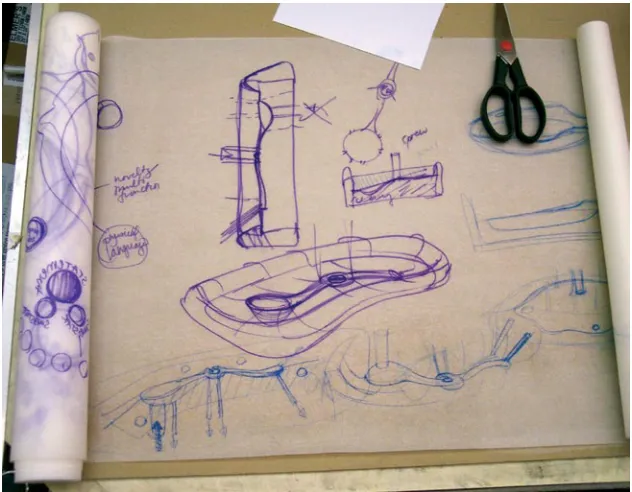
Much of the early design work was sketched out on paper and tried out loosely in 3 dimensions
with Sculpey. All along, I was working in ceramic, experimenting with forms and textures as
well, and the precursor to the cup and bowl were made in porcelain. Here are some early
Production of Final Forms. Methods, Materials, and Processes:
Originally, I was working from the idea that making the dish forms out of actual ceramic or
porcelain would serve to force adults to use the dishes with children. Porcelain dishes would
lend instant preciousness/worth to the objects, and would create situations where adults would
have to re-evaluate material worth. I wanted to maybe incorporate some element of “it’s OK if
they break.” Porcelain dishes that were getting close to final forms and aesthetic:
After much experimentation in stoneware and porcelain, and a rather stubborn insistence on
making the final dishes of pretty, precious porcelain, I came to grips with the fact that it was
just not going to be practical for a variety of reasons. First, porcelain is difficult to control, as
is evidenced by the fact that even high-volume commercial companies often have outlets and
discount stores to which they sell their seconds. I would have been relying on one-off slip casting
had I made the dishes of porcelain, and while the results could have been beautiful, consistency
is not conducive to creating the peg/hole/slot system that I was planning on, which was going to
require at least reasonable tolerances.
The other possible material choice was plastic, so I began researching Smooth-On products. I
found that with (quite a bit) of experimentation, I should be able to make reusable rubber molds
and cast multiples of my pieces reasonably well. Furthermore, plastic dishes would be much less
intimidating to stack, and therefore a more child/family-friendly option.
Still, there were several downsides to using the plastic. One of the main ones was the fact that
they would not be food-safe, and that I would therefore be investing quite a bit of time and
money into what would ultimately be little more than appearance models. At the time, there was
one Urethane resin approved for dry food only, but it cost quite a bit more, and I wouldn’t even
be able to put soup in my bowl when I was done. Also, I still really wanted the dishes to have
the look and feel of porcelain with glazed interiors, so that part of the play and communication
could be controlled by which side of the dish you were viewing. Achieving this look was no
small feat. The opaque white resin came in either a very yellowy off-white, or an extremely
chalky bright white. I wanted a warm white somewhere in-between. I eventually found that a
one to one ratio of off white to white produced the color I was looking for. The “glazing” bit was
even trickier. I tinted a second clear plastic, and quite literally glazed the interior of the cup and
bowl, which was a very time consuming process because each piece had to remain in motion
for close to an hour while the plastic was curing. Otherwise I would have had a pool of colored
plastic sitting in the bottom of the bowl. In addition, the colored plastic had to be mixed and
applied just as the white layer was finishing curing in order for the two layers to adhere to one
another. In the case of the bowl, which was a male/female mold, there both the internal and
external surfaces of the piece touching the mold. They therefore had slimy mold release on them,
this meant gently washing the inside of the almost cured bowls before applying the “glaze” layer
of plastic. For the sake of brevity, I will just outline the production method used for the cup here,
as it involved the most problem solving and was both the most interesting and the most difficult
Cup process:
The cup was sort of the anchor piece of the set. The reason for this was two-fold. First, relating
back to object scale, the cup was the piece that was going to be the most relatable as being the
main character in any sort of story construct due to its size in relation to the bowl and plate.
Second, much of my original 3D experimentation was done in ceramic. The throwing and
altering of cups (and some bowls) was much more time-effective than attempting to throw plates,
which is more challenging and uses more raw material. As I worked on the cup the longest, I
had the best idea of what I wanted it to look like, and it turned out that the cup was going to
work best as an enclosed and asymmetrical form. Therefore, the resulting mold was going to be
complex no matter how I sliced it, especially because I was using plastic. When using ceramic
slip, the slip is poured into a hollow plaster mold. The plaster sucks the water out of the slip and
hardens to form a leathery wall from the outside in. Excess liquid slip is poured out once desired
wall thickness is achieved. Urethane plastic poured into a hollow rubber mold would not exhibit
this phenomenon. It would cure as a solid mass. Therefore, creating a hollow urethane part
with urethane was going to require either a male/female mold, blow molding (an industrialized
process which was beyond the scope of the project, or rotational molding (constant 360 degree
turning of the whole mold that distributes the plastic evenly in a film on the inside of the mold
as the plastic cures. I guess a third possibility would have been to pour a solid piece and then
hollow the cup out after it cured, but that would have been a waste of material. Also, I found that
if I wanted a secondary pour of plastic (the glaze layer) to stick to the primary pour (white layer,)
the white needed to be just barely cured.
My solution to this problem was essentially a hand roto-molding technique. I made a two-part
hollow mold in a hamster ball so that I could easily turn the mold for the 40 minutes. There
was a clay plug in what would be the top of the cup. First, with the mold open, I used an eye
dropper to fill the ‘feet’ of the cup and let them cure part way. Next, I closed the 2 halves of the
hamster ball, and put in a measured amount of urethane. Then I plugged the hole in the top of
minutes, I removed the clay plug, popped the plastic skin covering the top of the cup, and used
an eyedropper to put the second colored glaze layer of into the mold. I then put in a new clay
plug, and began rolling the ball around on the floor for another 40-45 minutes. Most of the cups
were imperfect in some way using this method, as there were multiple variables with the method
and no way to really monitor the progress inside of the mold. Also, as the trials progressed the
results generally deteriorated. I am still not sure whether this was due to two part plastic resin
being open and exposed to air for more time or some other factor relating to the deterioration of
something about the mold itself- or maybe buildup of mold release. In many ways, though, the
imperfect cups had that much more character.
Images of the cup process:
The part and the mold.
Finished Cups:
Open mold and part, first cup out of the mold, testing the fit.
Spoon Process:
Figuring out how to construct the spoon mold.
Preparing to pour the first half of the mold. Mold and part.
Hindsight.
Now several years removed from deciding on the finalized form of Stirrings, both successes and
shortcomings of the project have coalesced in my mind. In order to give a clear and reflective
overall assessment, it seems as though it will be most efficient for me to critique several aspects
of the project separately before attempting to make an over arching proclamation of success or
failure.
First, while my original thesis statement regarding “reciprocal perceptual exchange between
adults and children,” and original question: (“what can adults learn from the way that children
view the world?”) served as a means to an end (a starting place), I am not sure that my final
solution truly addressed a strict interpretation of statement or question. If I were to attempt to
extrapolate a new thesis statement/question from my final product it might actually speak of
creating a playful object language that can be manipulated by two or more persons. The goal
might actually have been “to create an object language that pushes the boundaries of traditional
communication forms and encourages playful dialog between users.’”
Regarding my approach and process: I was a bit slow in starting to make actual prototypes-
overly self conscious about miss-stepping. I would have made better progress faster if I had been
able to take myself less seriously. On the plus side, I did take the time and fully explore a variety
of avenues before coming to rest on a final solution. I was open to letting the process guide my
solution, even though it kind of ended up right where it began.
Regarding final forms and material choices: The final forms are better than ‘OK’ but not perfect
by any means. Even though they were the “final” product for the purpose of my master’s
exploration, I feel as though the forms, materials and overall finish are more of a draft from both
an aesthetic perspective as well as a functional one. In some ways the pieces (the cup especially)
were overworked. I believe this is in part a result of attempting to render in plastic forms that
hand, and in part due to limitations of the mold-making materials. The combination of these
factors with a somewhat limited time and budget resulted in forms that were less elegant than
they could have been. They lack both the fluidity of one off ceramic pieces as well as the
precision that one would expect to find in a mass-produced object. The spoon is probably the
most “honest” of the objects produced. It was made kind of as an afterthought, at the last minute
and out of a single piece of foam. There was no refinement of form, and no tweaking or redoing.
While it is still far from perfect functionally, there is at least a freshness to the spoon that was lost
a bit in the other pieces.
So, while I am relatively pleased with the dishes as a final product in general, and do feel that
they are a valid response to my original question regarding adult-child interaction and perceptual
exchange, I think that the there is very little other than playful form/color that makes the dishes
objects that require (or even strongly imply) that they be used by or with children. In retrospect,
there is mild irony in my goal of creating a product that could fulfill similar play criteria to
a cardboard box, the main difference being that a cardboard box only works if the adult in
question is already in the mood to crawl around on the floor, where the product I wanted to
develop needed to be more of an everyday fixture, one that crossed over between a “mere toy”
and an object that could have the potential to integrate into a family’s daily routine in a beautiful
and meaningful way.
I’ve gotten a fairly positive response to the dishes from the adult design community; a poster
of the dishes was displayed at the MACEF Home Show in Milan as an entry in a competition
through designboom, the actual dishes were part of a gallery night show at a Design Within
Reach Store in Milwaukee, and they were also on display in London during Design Week.
Overall, I suppose that the validity of the starting point is much less in question than the quality
of the journey and the usefulness of the final destination. I wonder sincerely whether changing
the original thesis statement would have changed the final product at all. In many respects, I
Completing this project has, as I suspect it is partially intended to, left me with more questions
than answers, many new avenues, side streets, and Other Roadside Attractions (to employ the
References
Ballinger, Raymond A. Design With Paper in Art and Graphic Design. New York: Van Nostrand Reinhold, 1982.
Berg, Cynthia A. and Robert J. Sternberg, editors. Intellectual Development. USA: Cambridge University Press, 1992.
Beukers, Arriaan and Ed van Hinte. Flying Lightness: The Inevitable Renaissance of Minimum Energy Structures. Rotterdam: 010 Pub., 2005.
Bolton, Andrew. The Supermodern Wardrobe. London: V&A Publications; New York, N.Y.: distributed by Harry N. Abrams, 2002.
Braddock, Sarah, and Marie O’Mahony. Techno Textiles: Revolutionary Fabrics for Fashion and Design. London: Thames and Hudson, 1998.
Chatani, Masahiro. Ondori Pop-Up Origamic Architecture. New York, N.Y.: Distributed in the U.S. by Kodanska International/USA, 1984.
Davis, Merideth, Peter Hawley, Bernard McMullan, and Gertrude Spilka. Design as a Catalyst for Learning. Alexandria, Virginia: Association for Supervision and Curriculum Development, 1997
Drew, Phillip. Frei Otto: Form and Structure. London: Crosby Lockwood Staples, 1976.
Galinsky, Ellen. Ask The Children: What America’s Children Really Think About Working Parents. New York: William Morrow, 1997.
Gopnik, Blake. “’Golden Seams: The Japanese Art of Mending Creamics’ at Freer.”
Washington Post, Tuesday, March 3, 2009, http://www.washingtonpost.com/wp-dyn/ content/article/2009/03/02/AR2009030202723.html (accessed June 1, 2012).
Gorlitz, Dietmar and Joachim F. Wohlwill, editors. Curiosity, Imagination, and Play: On the Development of Spontaneous Cognitive and Motivational Processes. Hillsdale, New Jersey: Lawrence Erlbaum Associates, Inc., 1987.
Jean, Georges. Writing: The Story of Alphabets and Scripts. Translated by Jenny Oates. New York: Harry N. Abrams Incorporated, 1992.
Kenny, John B. Ceramic Design. Drawings by Carla Kenny. Philadelphia, Chilton Books, 1963.
Learning Theories. “Social Development Theory (Vygotsky).” http://www.learning- theories.com/ vygotskys-social-learning-theory.html (accessed June 1, 2012). McLeod, Saul. “Jean Piaget.” Simply Psychology. http://www.simplypsychology.org/piaget.html (accessed June 2, 2012).
Mezirow, Jack, and Associates. Fostering Critical Reflection in Adulthood: A Guide to
Transformative and Emancipatory Learning. San Francisco, California: Jossey-Bass, Inc., Publishers & Oxford, England: Jossey-Bass Limited, 1990.
MindWing Concepts Blog. http://www.mindwingconcepts.com (accessed October 29, 2010).
Nigrosh, Leon I. Form and Idea in Ceramic Design. Worcester, Mass.: Davis Publications, 1986.
Piaget, J. “Piaget’s Theory.” In Handbook of Child Psychology, 4th edition, Vol. 1., edited by Paul Mussen. New York: Wiley, 1983.
Ostermann, Matthias. The Ceramic Surface. Philadelphia: University of Pennsylvania Press, 2002.
Reilly, Mary, ed. Play as Exploratory Learning. USA: Sage Publications, Inc., 1974.
Rogers, Mary. Mary Rogers on Pottery and Porcelain, 2nd ed. Sherborne, Dorset, England: Alphabet and Image, 1984.
Rogoff, Barbara. Apprenticeship in Thinking: Cognitive Development in Social Context. New York: Oxford University Press, 1990.
Sandeman, Alison. Working With Porcelain., edited by Murray Fieldhouse. New York: Watson-Guptill Publications, 1979.
Sikes, Toni Fountain. The Best of New Ceramic Art: Featuring the Winners of the Monarch National Ceramic Competition. Madison, WI: Hand Books: Cincinnati, OH: U.S. distribution, North Light Books, 1997.
Sweet, Fay. Scandimodern. London: Mitchell Beazley, 2003.
Tudge, Jonathan and Barbara Rogoff. “Peer Influences on Cognitive Development: Piagetian and Vygotskian perspectives.” In Lev Vygotsky: Critical Assessments, Volume 3, edited by Charles Fernyhough and Peter Lloyd, Chapter 41. New York: Routeledge, 1999.
Willcox, Donald J. New Design in Ceramics. New York: Van Nostrand Reinhold Co., 1970.
Appendix A: Early Concepts
A Storytelling bench for seeing eye to eye. An early take on a set of dishes.
Appendix A Continued:
Both of these concepts were about the connection of memory and scent. Two takes on essentially the same concept; each involved a bedtime ritual in wich warmed stones would melt through scented wax. Holes left by the stones in the wax would be a physical reminder of the experience, and over time, the scent
Appendix B: Distractions
Alternate explorations into storytelling and ‘objects with possibilities.’3-d, trans-formable fabric structures that turn into enviornments, puppet theatres,