1 | P a g e
A comparative study on the design of an environmentally friendly
RoPax ferry using CFD
Herman Peder Kavli, Elif Oguz*, Tahsin Tezdogan
Department of Naval Architecture, Ocean and Marine Engineering, Henry Dyer Building, University of Strathclyde, 100 Montrose Street, Glasgow, G4 0LZ, UK
* Corresponding author; e-mail: [email protected], phone: +44(0)1415484047
ABSTRACT
RoPax ferries are designed for maximum efficiency, enabling smooth loading and unloading of cars, cargo and passengers. When optimising successful RoPax design, a compromise is always made between a light and compact hull geometry with diminished power requirement whilst providing substantial car and passenger capacities.
In response to recent computational developments, Computational Fluid Dynamics (CFD) is a widely-used design tool amongst naval architects owing to its more accurate results compared to conventional potential flow theory based techniques. By combining CFD tools with Computer Aided Design (CAD) software, it is possible to obtain useful results at an early stage of a typical ship design process.
The key objective of this paper is to design an environmentally friendly RoPax ferry utilising CAD and CFD tools. This aim was achieved by developing a new RoPax design with a new green power plant configuration releasing less greenhouse gas (GHG) emissions to the atmosphere. The performance of the green power plant was assessed through making a comparison to other power plant options. It is clearly shown in the paper that the hybrid LNG turbine is the most environmentally-friendly power option amongst the two other power plants investigated in this piece of research. Keywords: RoPax Ferry, GHG emissions, hybrid power plant, ship design, CFD
1.
Introduction
2 | P a g e companies and engine manufacturers to follow certain guidelines, in order to limit the SOx and NOx
emissions. The limitations on NOx emissions, commonly referred to as Tier III criteria, became
effective as of 1st January 2016, and apply to ships operating in the Emissions Control Areas (ECAs)
of North America and United States Caribbean Sea, particularly to engines installed after 1st January
2016 with a power output greater than 129 kW. Similarly, the SOx regulations became effective as of
1st January 2015 (IMO, 2014).
DNV GL is also pushing the marine industry in an environmentally friendly direction, by actively taking part in research projects by providing both funding and human resources. DNV GL published a report in 2015 where they stated that “the future is hybrid”, and promoted the usage of batteries as a viable solution to reduce emissions from the marine industry. The report concluded with a 14% reduction in fuel consumption when using hybrid configurations (DNV GL, 2015a).
The Danish/German based ferry operator Scandlines AG is a company that currently owns the largest fleet of hybrid ferries in the world. The fleet of 5 ferries, operating on shorter voyages (1-3 hours), have proven to reduce CO2 emissions by 15% (Hand, 2015).
Using cleaner fuel, such as LNG, as an alternative to diesel has become more common during the last decade. According to the DNV GL’s report (2015b), there are currently around 150 LNG fuelled ships either in operation or on order worldwide. With DNV GL as a project partner, MS Helgoland was built in 2015. The 83 m long ferry was fitted with LNG engines which reduced CO2 emissions by 20%,
NOx emissions by 90% and SOx emissions by 95%, as well as eliminating particulate matter emissions
(DNV GL, 2015b).
The possibility of using alternatives to the traditional diesel engines for power production has also been a topic of increasing interest. GTT, CMA and its subsidiary CMA Ships and DNV GL (2015), jointly studied the technical design and economic feasibility for an electric-driven 20,000 TEU ULCV container ship to utilise an LNG-fuelled combined cycle gas and steam turbine (COGAS) power plant. The study concluded with LNG fuelled COGAS power generation as the most efficient and economical way of converting fuel into mechanical power or electricity, as they can achieve overall efficiencies and power to weight ratios far beyond traditional diesel engines.
3 | P a g e With this in mind, this study presents a new design of an environmentally friendly RoPax ferry by combining CAD and CFD software packages. This aim was achieved through creating a new ferry design with a selection of green power plant configurations to propel the ferry. Fully nonlinear unsteady Reynolds-Averaged Navier Stokes (RANS) simulations were carried out to obtain the ship resistance versus speed curve of the vessel to predict the ferry’s power requirements and hence fuel consumption and emissions for a range of forward speeds. Using the results obtained from CFD, three different power plant configurations for the ferry were investigated and the emissions for each individual power plant installation were predicted based on a predetermined operational scenario. To the best of our knowledge, no specific study exists which aims to investigate the possible benefits for a RoPax ferry to utilise a combination of two of the most environmentally friendly power configurations – a hybrid version of LNG fuelled COGAS power generation system. This study therefore may be useful to understand the operational emissions of the above power generation system by comparing its emissions to those from other power plant configurations installed on the same ferry. In addition, during our literature review (given in sub-section 2.1), it was seen that although significant previous research has investigated the motions, resistance and added resistance of a ship using CFD, no specific study exists which aims to directly estimate the GHG emissions of the vessel due to its operation using a CFD-based RANS technique.
1.1 A typical ship design process
The design process adopted in this study, aiming towards obtaining a vessel with reduced emissions, is depicted in Figure 1. The goal of the design process is to reduce the operational emissions by designing a ship that is compact and can carry many vehicles and passengers relative to its size.
Figure 1 Reduced emissions by hull optimisation
The key to obtain lower operational emissions by design optimisation is to optimise the internal arrangement of the ship in such a way that the ship becomes lighter and more compact. It is important that the ship maintains its cargo capacity during this process, which in this case is passengers and vehicles. This in turn causes a reduction in total resistance and hence less power requirements and therefore lower emissions.
CAD and CFD software packages are important design tools implemented in this part of the study. The CAD software will be used to design a ship geometry that will then be imported into the CFD software which will be used to measure the resistance characteristics of the vessel against speed. This will then enable determination of the power vs speed curve of the vessel in question.
Optimise internal arrangement
Lighter and compact ship
Smaller underwater part
of the hull
Decreased resistance
Smaller power
4 | P a g e On the basis of the CAD model, a general arrangement (GA) drawing specifying the passenger and vehicle capacity will be developed. A comparison of similar vessels in terms of capacity and power requirements will be used as a basis to measure the performance of the new ship geometry developed in this paper.
1.2 Green power plant selection
The goal of the power plant selection is to reduce the emissions of the ship. This means that the power plant needs to be efficient and yield relatively small emissions per kWh power output. It is worth noting that the power plant needs to be able to fulfil the IMO MARPOL Annex VI emission criteria (IMO, 2014).
The power plant selection is of great importance in order to reduce the overall emissions from the ship. Whereas the ship geometry determines how much power is required to propel the vessel, the power plant selection determines the level of emissions per power unit used. This paper will focus on new power plant technology and the use of alternative types of fuel in order to formulate a power plant configuration that is purposely designed for reduced emissions.
The power vs speed curve obtained from the CFD analyses will be the basis of the power plant selection. Multiple power plants will be compared to each other in order to make a validated selection, and emission calculations will be the main factor for the final power plant selection.
This paper is organised as follows. Section 2 gives a brief literature review on emissions and CFD studies on hull optimisation. Afterwards, the main dimensions of the ship and the properties of the other comparison cases are given. Following this, the numerical setup of the CFD model is presented. Then, all of the results from this work are discussed in detail. Finally, a brief summary of the main results from this work are provided in Section 5 and suggestions are made for future study.
2.
Background
RoPax ferries are a combination of RoRo ferries and passenger ferries. RoRo ferries are built for transporting vehicles that can “roll on and roll off” whereas passenger ferries are built for transporting passengers. As a RoPax ferry is a combination of the two, they are designed to transport both vehicles and passengers. According to ShipPax, RoPax ferries transported more than 1.3 billion passengers and 217.5 million vehicles on 5.9 million global crossings in 2004 (Zagkas and Pratikakis, 2012).
2.1 Literature survey
5 | P a g e to assess hydrodynamic performance at the early design stage enabling any necessary corrective action to be taken before the ship is actually built. Tezdogan et al. (2015) reviewed the latest CFD applications in the marine industry in the literature review section of their article.
There are many CFD studies on ship hull optimisation. To cite an example from the published literature, Percievel et al. (2001) carried out a study in order to optimise a hull form for minimum calm-water resistance using a CFD method. Campana et al. (2006) used CFD analysis to optimise the bow shape of a ship hull. Besnard et al. (2007) carried out a study on hull shape optimisation of a fast ship using CFD and structural analysis. Around the same time, Vyselaar et al. (2007) investigated the effect of parabolic bulbs on ship resistance. They applied the parabolisation technique to a high-speed NPL trimaran. In their study they used a Rankine source panel method to obtain the wave-making resistance and a RANS solver together with an Integral Boundary Layer solver to predict the viscous drag of the trimaran. Their numerical results supported by experimental studies showed that the trimaran hull with appended parabolic side bulbs reduced the total resistance by up to 6%. Following this, He et al. (2011) adopted metamodeling to a multidisciplinary design optimisation process of a ship hull from resistance, seakeeping and manoeuvring standpoints. In their ship hull optimisation process they used the FLUENT software as a RANS solver to predict the resistance of a vessel. They developed an automated process to run the CFD simulations in a relatively short time. Later, Guo et al. (2013) investigated the resistance and wave pattern of the KVLCC2 ship by conducting a series of numerical and experimental studies. They used the ISIS-CFD tool, developed by EMN, to solve the RANS equations. In their study, they focused on resistance distribution along the ship hull which was divided into three segments. They also performed a verification study and compared their CFD results to those from experiments they conducted at MARINTEK.
6 | P a g e reduction of cost and energy consumption. The study also clearly indicated that the best design candidate produced a weakened hub vortex presenting additional benefits for this retrofitting technology. Around a similar time, a research group from the University of Strathclyde, Glasgow as reported in Demirel et al. (2017), proposed a fully nonlinear CFD-based unsteady RANS method to model the roughness effects of marine coatings and biofouling on the resistance of a full-scale ship hull. Their approach can be regarded as an alternative method to the traditional similarity law scaling procedure, which uses the flat plate approach. Their analyses stated that, due to heavy slime fouling the increase in the effective power of the full-scale KCS model could be up to 38% at the ship design speed (24 knots).
CFD simulations have also been used to study different engineering options for more fuel-efficient ships. For example, Hochkirch and Bertram (2010) summarised technical levers to save fuel and reduce emissions from ships. In addition, Kilpinen (2010) developed an accurate and complete CFD-based marine diesel engine modelling to predict NO emissions from a diesel engine. More recently, Ammar and Farag (2016) numerically studied the combustion and emission characteristics of syngas fuel in marine gas turbines. They performed their analyses using the ANSYS FLUENT software under various operational conditions. They also compared the CO2, CO and NO emissions from syngas and
natural gas fuel combustion.
Today, Heavy Fuel Oil (HFO) remains the most popular fuelling option for ship propulsion, harnessing its potential in diesel engines due to their high thermal efficiency. However, diesel engines are not the optimal solution considering the emissions they expel, a factor subject to exceeding scrutiny, and one which forms the basis for the diversification of marine fuelling current underway. These factors have led the shipping industry to question whether this present mode of ship propulsion is sustainable, where increases to both operating costs and emission volumes have forced the industry to look for ways to innovate, implement and improve current propulsion methods, in order to benefit the environment.
There are various power plant configurations that can be utilised, depending on the requirements of the ship. The following sections will introduce the different configurations that have been considered in this study.
2.2 Conventional propulsion configurations
7 | P a g e
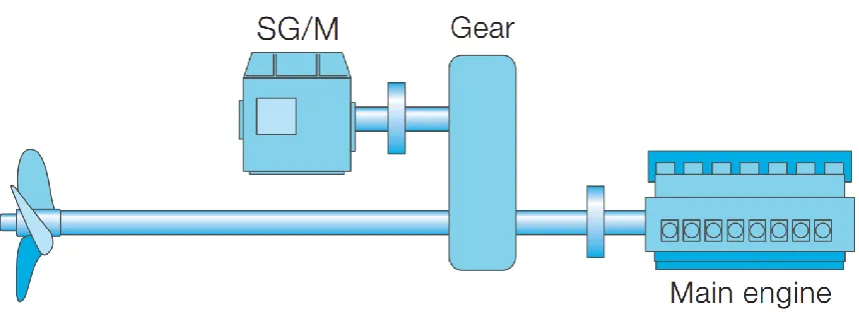
Figure 2 Conventional propulsion system (ABB, 2014)
Conventional propulsion configurations, as illustrated in Figure 2, generally use one or more large main engines that are connected directly to the aft propellers via a gearbox. The on-board electricity usage is produced by a shaft generator (SG) or auxiliary generators. The configuration has a good efficiency when operating at service load, as the main engine runs on optimal revolutions per minute (rpm) and brake specific fuel consumption (BSFC) within these circumstances. However, it is when the vessel approaches the port that this configuration displays its weaknesses. The sailing speed is obtained by adjusting the rpm of the main engine. As a consequence of the rpm adjustment, the engine operates outside of its optimal rpm and BSFC region, which results in increased emissions when the vessel is in the port. The smaller auxiliary generators that may be used while in the port are generally less efficient than bigger engines, which contributes to poor performance in terms of emissions while the vessel is in the port.
Another drawback of this configuration is the mechanical connection (shaft) between the main engine and the propellers, which takes up a large space. A single engine failure in this configuration can cause partial or full power shutdown.
2.3 Electric propulsion configurations
8 | P a g e
Figure 3 General configuration of diesel-electric propulsion plant (MAN Diesel, n.d.)
Table 1 Legend summary of Figure 3 (MAN Diesel, n.d.)
Item Contents
1 Gensets: Diesel engines + alternators 2 Main switchboards
3 Supply transformer (optional) 4 Frequency converters
5 Electric propulsion motors 6 Gearboxes (optional) 7 Propellers
Rather than having a few large main engines, this configuration includes more, but smaller, main engines that are directly connected to a generator, commonly referred to as gensets. The type and number of main engines is determined depending on the design criteria of the ship. The focus in this study will be on diesel engines and liquefied natural gas (LNG) fuelled turbines to be used as main engines.
[image:8.595.174.423.430.543.2]9 | P a g e Table 1. It is not relevant to this study to delve deeper into the technical details of all the components involved, but it is important to understand the overall functionality of the configuration.
The switchboard is the heart of the configuration, as every on-board electric unit is connected to it. The switchboard also acts like the brain of the configuration, signalling the gensets to start or stop depending on how much power is needed at a given time. This means that the configuration regulates the sailing speed by adjusting the number of simultaneously running gensets rather than adjusting the rpm of the engines. This allows the gensets to operate at their optimal rpm and BSFC most of the time. Because the gensets and propulsion units are connected via electrical wires, they can be installed almost everywhere in the ship, allowing a more flexible design. The configuration is also a lot more reliable, as the power output will not be extensively affected by the failure of a main engine.
Because there are more components involved, the overall efficiency may be lower than for the conventional configurations. Typical losses in a diesel-electric propulsion plant are shown in Figure 4.
Figure 4 Efficiencies in diesel-electric plants (MAN Diesel, n.d.)
2.4 Hybrid configurations
Hybrid configurations utilise the same components as the electric propulsion configurations, but batteries are also added to the circuit. The batteries are charged by the gensets in order to store energy that can be used to cover short periods of time when extra large or small amounts of power are required.
This configuration also allows the ship to operate solely on electricity for short periods, which can be very beneficial in terms of emissions, especially when the ship is operating in or near the port.
2.5 Emission of Greenhouse Gases (GHG)
A report by the IMO shows that the international shipping industry emitted 2.2%, 30% and 9% of the global CO2, NOx and SOx emissions, respectively, in 2012 (IMO, 2014). In order to control gaseous
10 | P a g e several international and national regulatory bodies such as the IMO, European Maritime Safety Agency (EMSA) and Environmental Protection Authority (EPA) have suggested a number of regulations to restrict the non-greenhouse gaseous emissions including NOx and SOx as well as the
greenhouse gaseous emissions, particularly CO2,as reported in IMO (2014), EMSA (2015) and EPA
(2010).
Since the container ship sector has relatively large ships sailing at comparatively high speeds which causes high fuel consumption, most of the current efforts to decrease CO2 emissions from global
shipping are focused on container ships. Corbett et al. (2009) introduced slower operational speeds in practice referred to as ‘slow steaming’, which has been shown to significantly reduce fuel consumption and emissions. Later, Lindstad and Sandaas (2016) carried out a study for an offshore support vessel to investigate potential emission and fuel consumption reductions through the introduction of hybrid technologies by taking advantage of their climate mitigation potential. They used four different fuel and engine technologies each with a standard combustion engine and with a hybrid arrangement that included standard combustion engines with batteries in their study. Their results showed that hybrid technologies reduce both fuel consumption and emissions and that the climate impact of the emission reduction is much larger than the fuel reduction alone.
As this work’s focus is to design a RoPax ferry with a particularly green power plant, the emissions of greenhouse gases need to be analysed and calculated. There are many different GHG emitted during the combustion of fuel and in order to get accurate calculations of the emission of these, analyses from the actual exhaust is needed. As these analyses are difficult to get hold of, this study has focused on a few of the most important GHG, such as CO2, NOx, SOx, particulate matter (PM) and hydrocarbons.
2.5.1 CO
2emissions
CO2 emissions arise as the fuel is combusted, and the CO2 emissions are a direct function of the fuel
consumption. The amount of CO2 produced is dependent on what kind of fuel is used in the
combustion process.
Considering global differences in population, economy, land-use and agriculture, a large number of scenarios were developed and modelled by the IMO for the UN IPCC (United Nations Intergovernmental Panel on Climate Change) in order to determine the expected changes in CO2
emissions from shipping from 2007 to 2050 (IMO, 2009).
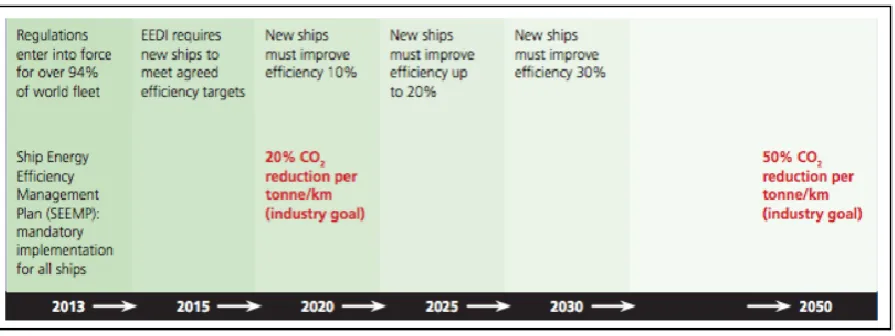
As reported in Pike et al. (2011), the IMO has intended to improve the shipping sectors’ carbon footprint by introducing the Energy Efficiency Design Index (EEDI), the Energy Efficiency Operational Indicator (EEOI) and Ship Energy Efficiency Management Plan (SEEMP). These measures are in force to facilitate the reduction of CO2 emissions, as well as the energy efficiency and
11 | P a g e (2015). The EEDI was made mandatory for new ships and its standards will be tightened every 5 years from 2015 to 2030 as detailed in Figure 5.
Figure 5 EEDI: MARPOL Annex VI, CO2 Limits (IMO, 2012, ICS, 2014).
2.5.2 NO
xemissions
NOx is the general term for the different types of gases that comprise a mix of nitrogen and oxygen.
Two of the most common gases that occur from this mix are nitric oxide (NO) and nitrogen dioxide (NO2). The amount of NOx produced is dependent on the engine, but can be mechanically limited by
the usage of external equipment on the engine, such as selective catalytic reduction units (SRC). NOx emission limits were set by the IMO for diesel engines against the engine maximum operating
speed (n [rpm]) as jointly shown in Table 2 and Figure 6. It should be mentioned that Tier III level can only be applied in emission control areas (ECAs) whilst Tier I and Tier II are in force globally.
[image:11.595.149.445.492.694.2]12 | P a g e
Table 2 MARPOL Annex VI NOx Emission Limits (IMO, 2014)
Tier Date
NOx Limit, g/kWh n < 130 130 ≤ n < 2000 n ≥ 2000
Tier I 2000 17.0 45 · n-0.2 9.80
Tier II 2011 14.4 44. n-0.23 7.70
Tier III 2016 3.4 9 · n-0.2 1.96
2.5.3 SO
xemissions
SOx is the generic term used for different kinds of oxides of sulfur that occur during the combustion
process. The amount of emissions of this pollutant is highly dependent on the fuel type used. The emission of SOx can therefore be limited by selecting a fuel with lower amounts of sulfur in it, but can
also be limited by installing external equipment that cleans the exhaust from the engines, such as scrubbers (American Berau of Shipping, 2015).
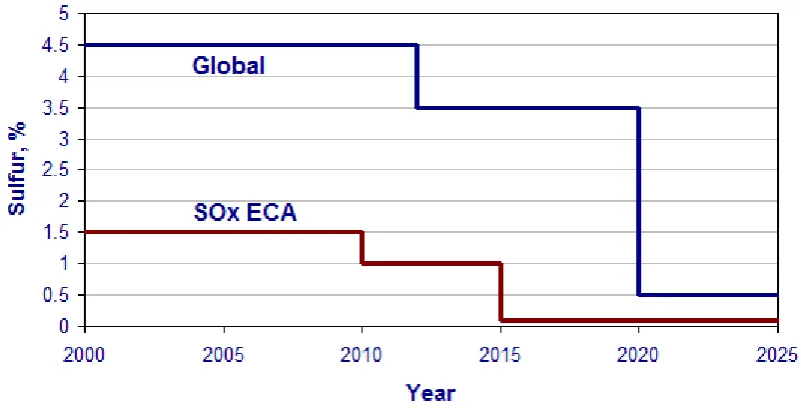
In order to reduce the global SOx emissions from the marine industry, the IMO has set limitations on
sulfur content in the fuel in the MARPOL Annex VI standards (see Figure 7).
Figure 7 Fuel sulfur limits according to MARPOL Annex VI (IMO, 2014)
2.5.4 Particulate matter (PM) emissions
PM emissions are a mix of solid and liquid particles that are emitted with the exhaust. The magnitude of PM emissions is a function of the fuel consumption and the sulfur content in the fuel. In the same way as SOx, PM emissions can be limited by using fuels with a low sulfur content. Depending on the
size of the particles, PM can also, in some extend, be limited by the use of external equipment to clean the exhaust, such as scrubbers (American Berau of Shipping, 2015).
[image:12.595.74.475.367.573.2]13 | P a g e
2.5.5 Hydrocarbon emissions
Hydrocarbon (HC) emission occurs when unburned or partly burned (slip) fuel is released with the exhaust and into the atmosphere. This study will focus on one specific type of hydrocarbon, namely methane (CH4). Preventing methane slip can be challenging, but some scrubbers can limit the
emissions. Selecting other type of engines which burn the methane more efficiently, such as turbines, can also limit the HC emissions.
3.
Numerical set-up
Up to this section, this paper has provided a background to this study and has given an introduction to the work. The following section will present details of the numerical model of the RoPax ferry and will discuss the CFD simulations used in this study.
3.1
Hull Modelling
Although most of the RANS resistance simulations were performed in the model scale, Hochkirch and Mallol (2013) reported that model scale flows and full-scale flows can be different due to scale effects. They indicated that these discrepancies stem from different boundary layers, flow separation, and wave breaking. In their paper, Hochkirch and Mallol (2013) showed the importance of modelling at the full-scale using a large number of examples. For this reason, in this study a full-scale ship geometry was modelled using the Maxsurf Modeller CAD tool. The main design parameters of the hull are shown in Table 3.
Table 3 The main particulars of the ferry
Item Value
Overall length (LOA) 150 m
Length of waterline (LWL) 150 m
Beam at waterline (BWL) 24 m
Design draft (T) 5.5 m
Depth (D) 7.5 m
Block coefficient (CB) 0.643
Longitudinal Centre of Gravity (LCG) (from aft peak) 77 m
Vertical Centre of Gravity (VCG) 3.5 m
Moment of inertia (Kxx /B) 0.4
Moment of inertia (Kyy /LWL, Kzz /LWL) 0.25
14 | P a g e
Figure 8 Isometric view of the model obtained from Maxsurf
Figure 9 Side view of the model obtained from Maxsurf
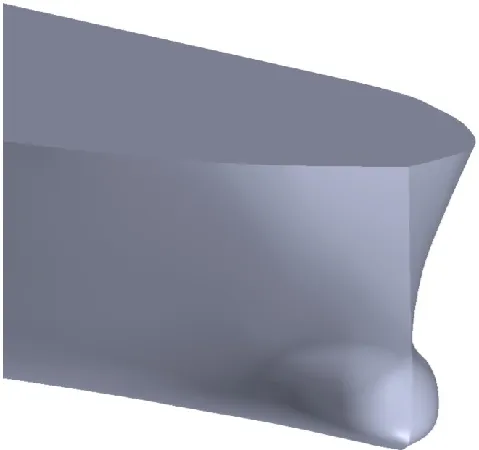
3.1.1 Wave piercing bow
[image:14.595.177.417.496.721.2]As shown in Figure 10, the bow was designed with a wave piercing bow which aims to reduce the wave resistance by piercing through the waves, rather than pushing them away. It was also designed to be vertical, with a relatively small flare angle that reduces the amount of reserve buoyancy at the bow. The lack of reserve buoyancy prevents the vessel from reacting with trim motions when penetrating the waves.
15 | P a g e
3.1.2 Flat stern
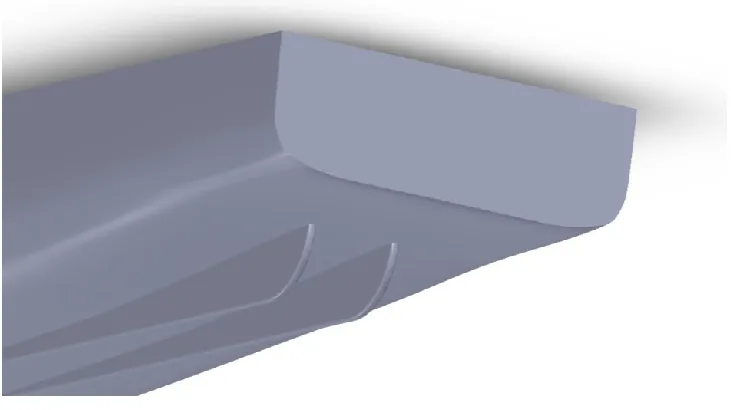
[image:15.595.115.481.167.372.2]The stern was modelled to be flat as given in Figure 11. This was due to the relatively small draft of 5.5 metres, which leaves little space for the aft propellers. It was therefore considered that three propellers were needed in order to obtain enough power for propulsion.
Figure 11 The Flat stern
3.2 CFD modelling
In this study, an unsteady RANS approach is applied using the commercial CFD software Star-CCM+ version 11.0.2, which was developed by CD-Adapco (2016). Additionally, the supercomputer facilities at the University of Strathclyde have been utilised to allow much faster and more complex simulations. CFD simulations were performed at five different speeds (5, 18, 20, 22 and 24 knots). It is also worth mentioning that in order to simulate realistic ship behaviour, the model was also set free to trim and sink utilising a Dynamic Fluid Body Interaction (DFBI) model.
3.2.1 Physics modelling
The turbulence model selected in this study was a standard k-ε model, which has been extensively used for industrial applications (CD-Adapco, 2016). Also, Querard et al. (2008) note that the k-ε model is quite economical in terms of CPU time, compared to, for example, the SST turbulence model, which increases the required CPU time by nearly 25%. The k-ε turbulence model has also been used in many other studies performed in the same area, such as Kim and Lee (2011), Enger et al. (2010) and Tezdogan et al. (2015, 2016).
3.2.2 Choice of the time-step
16 | P a g e
U t
CFL
x
(1)
The Courant number is typically calculated for each cell and should be less than or equal to 1 for numerical stability.
Often, in implicit unsteady simulations, the time step is determined by the flow properties, rather than the Courant number. According to the International Towing Tank Conference (ITTC)’s related guideline, the time-step for resistance simulations in calm water is formulated as Δt=0.005 ~ 0.01L/U, where L is the length of the ship model and U is the ship speed (ITTC, 2011). In this work the time-step was selected to be Δt=0.0075 L/U.
The maximum number of inner iterations per time-step was set to 10. This number was considered to be enough for the purpose of this study, as the computational time increases rapidly when increasing the maximum number of inner iterations. It is also worth noting that a first-order temporal scheme was applied to discretise the unsteady term in the Navier-Stokes equations. The stopping criteria of the simulations was set to be 500 physical seconds, and visual convergence lasting more than 30 physical seconds.
3.2.3 Computational domain
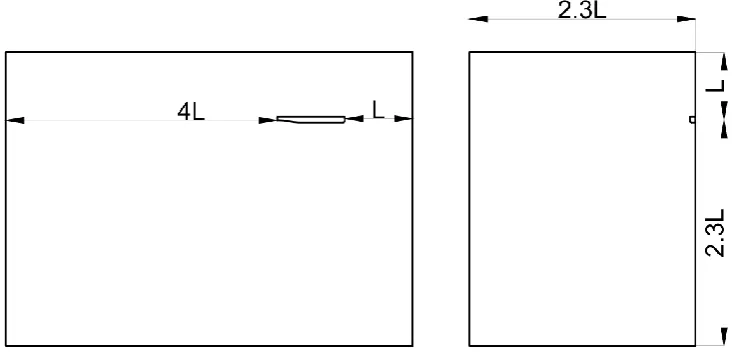
[image:16.595.90.507.561.641.2]In all CFD work, the initial and boundary conditions must be selected carefully in order to obtain accurate results within reasonable computational time. For resistance simulations ITTC (2011) recommends that the inlet boundary should be positioned 1-2LBP away from the hull whilst the outlet should be located 3-5LBP downstream in order to prevent any wave reflection from the walls. The dimensions used in this study were selected based on the ITTC’s recommendations as well as other pieces of previous work summarised in Table 4. The locations of the boundaries applied in this work’s CFD modelling are depicted in Figure 12.
Table 4 The locations of the boundaries in similar previous studies (Tezdogan et al., 2015)
Reference
Directions
Upstream Downstream Up Bottom Transverse
17 | P a g e
Figure 12 Computational domain dimensions (L: length between perpendiculars)
3.2.4 Boundary conditions
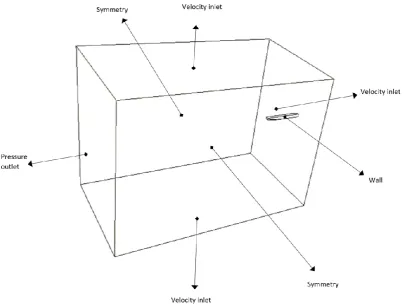
In order to obtain accurate and realistic results, it is important that the boundary conditions are set correctly. A general view of the computation domain with the RoPax model and the notations of selected boundary conditions are depicted in Figure 13. In order to reduce computational demand, a symmetry plane was applied at the centreline of the hull, meaning only half of the hull is presented in the analysis. Figure 13 describes that a velocity inlet boundary condition was set in the upstream direction. A pressure outlet boundary was modelled behind the ship as it prevents backflow from occurring and keeps static pressure constant at the outlet. The top and bottom boundaries were both set as velocity inlets. Two sides of the domain have a symmetry boundary condition. These stated boundary conditions were selected because they were reported to give the quickest solutions for similar work performed using the Star-CCM+ software (CD-Adapco, 2016). As clearly explained in Tezdogan et al. (2015), the employment of the velocity inlet boundary condition at the top and bottom prevents the fluid from sticking to the walls. It should be noted that the top, bottom and side boundaries could have been modelled as a slip-wall boundary condition.
18 | P a g e
Figure 13 Domain boundary conditions
3.2.5 Mesh generation
19 | P a g e
Figure 14 A cross section of the computational mesh around the vessel
Figure 15 A view of the surface mesh on the ship hull with skegs
4.
Results and discussion
The design of the RoPax ferry features nine decks, with a total of 306 cabins and a passenger capacity of 1400 divided over three accommodation decks. The total length of the vehicle lanes is 1950 m (lane meters), divided over three vehicle decks. There are three different cabin modules – single cabin, couples cabin and family cabin.
[image:19.595.73.524.382.454.2]20 | P a g e
4.1 Verification study
The CFD work’s verification study was undertaken to estimate the discretisation errors due to grid-size and time-step resolutions for the resistance simulation at 24 knots. It is expected that the numerical uncertainties for the other cases are of the same order.
Xing and Stern (2010) state that the Richardson extrapolation (RE) method (1911) is the basis for existing quantitative numerical error/uncertainty estimates for time-step convergence and grid-spacing. With this method, the error is expanded in a power series, with integer powers of grid-spacing or time-step taken as a finite sum. Commonly, only the first term of the series will be retained, assuming that the solutions lie in the asymptotic range. This practice generates a so-called grid-triplet study. Roache’s (1998) grid convergence index (GCI) is useful for estimating uncertainties arising from grid-spacing and time-step errors. Roache’s GCI is recommended for use by both the American Society of Mechanical Engineers (ASME) (Celik et al., 2008) and the American Institute of Aeronautics and Astronautics (AIAA) (Cosner et al., 2006).
For predicting iterative errors, the procedure derived by Roy and Blottner (2001) was employed. The results obtained from these calculations suggest that the iterative errors for both force coefficients are equal to almost zero.
Grid-spacing and time-step convergence studies were carried out following the GCI method described in Celik et al. (2008). The convergence studies were performed with triple solutions using systematically refined grid-spacing or time-steps. For example, the grid convergence study was conducted using three calculations in which the grid size was systematically coarsened in all directions whilst keeping all other input parameters (such as time-step) constant. The mesh convergence analysis was carried out with the smallest time-step, whereas the time-step convergence analysis was carried out with the finest grid size.
To assess the convergence condition, the convergence ratio (Rk) is used, as given by:
21
32
k k
k
R
(2)
where εk21=φk2-φk1 and εk32=φk3-φk2 are the differences between medium-fine and coarse-medium
solutions, and φk1, φk2 and φk3 correspond to the solutions with fine, medium and coarse input
parameters, respectively. The subscript k refers to the kth input parameter (i.e. grid-size or time-step)
(Stern et al., 2006).
Four typical convergence conditions may be seen: (i) monotonic convergence (0<Rk<1), (ii)
oscillatory convergence (Rk<0; |Rk|<1), (iii) monotonic divergence (Rk>1), and (iv) oscillatory
divergence (Rk<0; |Rk|>1). For diverging conditions (iii) and (iv), neither error nor uncertainty can be
21 | P a g e predict the error and order-of-accuracy (pk) for the selected kth input parameter. For a constant
refinement ratio (rk), pk can be calculated by:
32 21
ln( / ) ln( ) k k k k p r
(3)
The extrapolated values can be calculated from Celik et al. (2008).
21
1 2
( p ) / ( p 1)
ext rk rk
(4)The approximate relative error and extrapolated relative error can then be calculated using Equations 5 and 6, respectively (Celik et al., 2008):
21 1 2
1
a
e
(5) 12 21 1 12 ext ext exte
(6)Finally, the fine-grid convergence index is predicted by:
21 21 1.25 1 a fine p k e GCI r (7)
22 | P a g e
Table 5. The final cell numbers for each mesh configuration as a result of the mesh convergence study
Mesh Configuration Total cell number
Fine 4,753,289
Medium 2,988,720
Coarse 1,740,213
The verification parameters of the resistance for the grid spacing and time-step convergence studies are presented in Table 6.
Table 6. Grid and time-step convergence studies for ship hull resistance
Grid convergence Time-step convergence
Total hull resistance (RH)
(with monotonic convergence)
Total hull resistance (RH)
(with monotonic convergence)
r √2 √2
φ1 1628.5 kN 1628.5 kN
φ2 1563.8 kN 1549.4 kN
φ3 1446.1 kN 1415.3 kN
R 0.550 0.589
p 1.727 1.523
φext21 1707.5 kN 1742.26 kN
ea21 3.97% 4.86%
eext21 4.63% 6.53%
GCIfine21 6.06% 8.73%
As can be seen from Table 6, the resistance results tend to decrease monotonically as the grid or time-step resolutions are systematically lessened. The levels of uncertainty were deemed to be sufficient for this study. The numerical uncertainties in the finest-grid solution for grid and time-step convergence tests are predicted as 6.06% and 8.73%, respectively. It can be interpreted that a smaller time-step resolution should be applied to obtain a smaller uncertainty level.
4.2 Ship comparison and internal arrangement optimisation analysis
[image:22.595.146.450.227.415.2]23 | P a g e
Table 7 Ship main design parameter comparison. Sources: MS Mega Express Four - Corsica Ferries, MS Calais Seaways - DFDS Seaways and MS Stena Saga - Stena Line.
Name LOA (m) B (m) T (m) Passenger capacity Lane meters (m)
MS Mega Express Four 173.50 24.00 6.41 1400 1850
MS Calais Seaways 165.00 26.00 6.30 1100 1784
MS Stena Saga 165.50 28.40 6.80 2000 1800
This study’s ferry 150.00 24.00 5.50 1400 1950
Relative difference (%) -10.71 -8.16 -15.43 -6.67 7.66
The comparison shows that the vessel has successfully been designed to be smaller and more compact in terms of length, breadth and draft. The comparison also shows that the internal arrangement of the vessel has been designed with a high capacity in terms of lane meters, but the capacity of passengers is, however, lower than the average of the ships in the comparison.
4.3 CFD results
The following sub-section will outline the CFD results achieved.
4.3.1 Ship resistance
The resistance characteristics of the ferry in calm water (RH) were estimated at various speeds using
CFD. The resistance values were calculated by taking the average of the drag values over the last 30 seconds of a time history record. These figures are obtained under an idealised trial condition which refers to a clean hull and which neglects waves and winds. However in normal service conditions the power required to propel the vessel in a certain speed is higher than the one predicted in the trial conditions. This increase is commonly referred to as ‘sea margin’ or ‘powering margin’. ITTC (2005) defines the powering margin as “the margin which should be added to the estimation of the speed-power relationship for a newly built ship in ideal weather conditions to allow for the operation of the ship in realistic conditions”. Powering margins take into calculation environmental effects (such as wind and waves) and the effects of ageing and fouling as well as hull roughness. As stated in ITTC (2005) a typical value for a powering margin can be taken to be 15-25% of the total hull resistance in calm water.
In this study the powering margin was taken to be 22% as per the ITTC’s suggestion. However, in our CFD simulations the hull was modelled without bow thrusters and propellers, so an additional factor must be added to account for their resistance. As suggested by Huber (2016) a margin of 2% per bow thruster and propeller was added to the powering margin which increased the powering margin from 22% to 26%. This means that the total hull resistance values obtained from the CFD simulations were increased by 26% to account for the real operational and environmental conditions.
The resistance characteristics of the ferry obtained under idealised trial conditions (RH) and real
operational conditions (RT) are given in Table 8. Figure 16 shows the total ship resistance under
24 | P a g e completed for 15, 18, 20, 22 and 24 knots, so the values between 15 knots and 0 knots were simply extrapolated.
Table 8 The resistance characteristics of the ferry in question obtained for trial and sea conditions for different speeds
Ship speed (kn)
Ship resistance in calm water (obtained from CFD) (RH) (kN)
Total ship resistance in operational sea conditions (RT) (kN)
15 472.74 595.665
18 708.15 892.269
20 903.05 1137.843
22 1200.35 1512.441
[image:24.595.148.425.179.454.2]24 1628.5 2051.910
Figure 16 The total resistance (RT) values over a range of ship forward speeds
4.3.2 Pressure distribution
Visualising the pressure distribution around the ship’s hull is an important tool for naval architects to identify the areas where high pressure and therefore high stress is expected to occur. Such areas are often prone to cracking or collapsing and therefore must be supported with structural members. As can be seen from the pressure distribution around the ship’s hull in Figures 17 and 18, the bow and skegs experience the highest pressure values, though these pressure values are smaller than the yield strength of marine hull steel.
0 500 1000 1500 2000 2500
0 2 4 6 8 10 12 14 15 18 20 22 24
RT
[kN]
V [knot]
25 | P a g e
[image:25.595.88.507.302.481.2]Figure 17 Pressure distribution on the ship’s hull at 24 knots (a view from the bow)
Figure 18 Pressure distribution on the vessel surface at 24 knots (a view from the stern)
4.3.3 Wave pattern
26 | P a g e
[image:26.595.96.504.448.731.2]Figure 19 Calculated wave pattern behind the vessel at 15 knots
Figure 20 Calculated wave pattern behind the vessel at 20 knots
27 | P a g e
Figure 22 Illustration of the Kelvin Wake generated by the ship
4.3.4 Trim and sinkage
The ship was, as previously mentioned, free to sink and trim during all the simulations. This allows the model to translate along the z-axis, and rotate about the y-axis freely. Table 9 lists the trim and sinkage values obtained from CFD measured at the ship’s centre of gravity (CoG) for different speeds. A negative sinkage value indicates the vessel sits larger in the water. As can be seen from the table, the sinkage values increase with increasing speed, as expected.
Table 9 Comparison of trim and sinkage values measured at the ship’s CoG in CFD
Ship speed (kn) Trim (°) Sinkage (m)
15 0.059 -0.141
18 0.077 -0.214
20 0.083 -0.282
22 0.059 -0.359
24 0.014 -0.427
4.3.5 Free surface
[image:27.595.197.398.557.631.2]28 | P a g e
Figure 23 Free surface representation on the vessel surface (at 24 kn)
Figure 23 displays how the free surface was represented in Star-CCM+ by demonstrating the volume fraction of the water profile on the vessel surface. In the figure, for example, a value of 0.5 for the volume fraction of water means that a computational cell is filled with 50% water and 50% air.
Figure 24 Free water at the bow (at 24 kn) Figure 25 Wave run-up around the bow (at 24 kn)
Having a closer look at the free surface around the bow as shown in Figures 24 and 25, it is evident to see the small amount of green water on the deck. This is mainly due to the fact that the ship geometry has a small flare angle which causes a green water on deck incident at high speeds. This figure implies that the bow area should be better designed to minimise, if not prevent, green water loads.
4.4 Power requirements
Since the total hull resistance of the ferry has been obtained in sub-section 4.3.1, the brake power of the main engine to propel the ship in a specific constant speed taking into account efficiency parameters will be calculated in this sub-section.
The procedure from MAN (2011) is employed to obtain the power parameters of the ship in question. Before giving our findings, it would be fitting to give the formulae used in the power calculations, as taken from Chapter 2 of the paper given by MAN (2011):
Effective power:
P
E
R xV
H (8a)Thrust power: E T
H P
[image:28.595.69.529.304.427.2]29 | P a g e Delivered power: T
D
B P
P
(8c)Brake power: D B
S
P
P
(8d)in which V denotes ship speed and ηH, ηB and ηS refer to hull efficiency, propeller efficiency and shaft
efficiency, respectively. It is of importance to recall that the propeller efficiency working behind the ship is calculated as the product of open water propeller efficiency ηO and the relative rotative
efficiency ηR.
Efficiencies are commonly calculated using empirical formulation or data provided by manufacturers. Naval architecture text book such as ‘Principles of Naval Architecture’ series published by the Society of Naval Architects and Marine Engineers (SNAME) (Lewis, 1988) are also among the most cited references to find approximated values for efficiencies.
In order to calculate the brake power of the main engine for the ferry, the open water propeller efficiency (ηO) was taken to be 0.7 as provided by the propeller manufacturer (Huber, 2016). The other
efficiencies were taken to be as follow: ηR=0.985, ηS=0.988 and ηH=0.922 (MAN, 2011 and Lewis,
1988).
[image:29.595.96.475.466.666.2]Using the expressions given in Equation 8 with the efficiencies provided above, the brake powers of the main engine for this work’s vessel are calculated for various ship speeds, as graphed in Figure 26.
Figure 26 The brake power of the main engine installed in the ferry against different ship speeds
4.5 Power plant investigation
The power plant suggestions are made using the power requirements of the vessel as calculated in Section 4.4. Three different power plant configurations were investigated in this study, each of which
0 10000 20000 30000 40000 50000
0 2 4 6 8 10 12 14 15 18 20 22 24
PB
[kW
]
30 | P a g e will be outlined in the following sub-sections. Due to a sharp increase in the brake power of the vessel after 20 knots, the power plan arrangements will be made to meet a maximum speed of circa 20 knots.
4.5.1 Power plant configuration 1: Hybrid diesel
This configuration is based on the derivation of hybrid propulsion configurations in sub-section 2.4. As the engine room of the ferry was designed with a low roof height, the engines must be short in height to fit in the room. The straight two-stroke engines are known to be quite tall, so a four-stroke V-engine was selected for this reason.
For this purpose, the GE 16V250 diesel engine is suitable, which has a maximum continuous rating (MCR) of 4650 kW (General Electric Marine, 2013). This engine is currently the only engine that is able to fulfil the IMO Tier III NOx criteria without the usage of external equipment to clean the exhaust gas. The proposed power plant consists of four of the mentioned engines, resulting in a total MCR power output of 18600 kW. It is predicted that the ship needs 800 kW for on-board usage, and for charging the batteries, which leaves 17800 kW to the propulsion plant. When taking the efficiency components shown in Figure 4 into account, the total power delivered to the propellers at MCR rises to 16180 kW, which corresponds to a ship speed of 19.5 knots according to Figure 26.
It is assumed that the ferry requires 500 kW per hour for on-board usage when it is docked in the port for unloading and loading passengers and vehicles. Based on our prior experience, 1.5 hours for the loading and unloading process is sufficient for our ferry. It is also assumed that the vessel uses 1000 kWh when entering, and 1000 kWh when exiting, the port. Given the fact that batteries exhibit longer lifespans when operated from an almost fully charged, rather than fully charged state, it is proposed that a battery pack of 4000 kWh is enough for the ferry to be able to enter the port, unload, load and exit the port running solely on electricity.
4.5.2 Power plant configuration 2: Hybrid LNG turbine
This configuration is based on the same concept as above. The only difference is that the diesel engines are replaced with LNG fuelled turbines. Two of the Siemens SGT-300 turbines are selected, which have a MCR power output of 9200 kW each, giving a total power output of 18400 kW (Igoe et al., 2011).
31 | P a g e exhaust from the gas turbine to boil fluid into steam, which drives the steam turbine. Siemens’ combined cycle test results suggest that for our case the extra cycle increases the power output by around 30%, without increasing the fuel consumption (Welch, 2016). The extra cycle therefore increases the total MCR power output to (18400 kWx1.3=) 23920 kW which corresponds to a speed of 21.3 knots (Figure 26).
It is worth mentioning that the same battery pack as described in the last paragraph of sub-section 4.5.1 was proposed for this configuration as well.
4.5.3 Power plant configuration 3: Conventional propulsion configuration
The third power plant investigated in this study was a reference configuration that is commonly installed in RoPax ferries, as described in sub-section 2.2. In order obtain calculations that are representative for RoPax ferries in general, there will not be selected any specific engine for this configuration, but general values in terms of BSFC and emissions will be used for the later emission calculations.
The MCR value used for this configuration was set to be similar to the former suggestions, 18400 kW. As this configuration does not have a battery pack, much of the produced power goes to the propellers rather than charging batteries. This results in a slightly higher forward speed of 19.7 knots (according to Figure 26). Additional auxiliary/port generators are required, in order to produce electricity for on-board usage when the ship is docked at the port.
It is worth emphasising that the cargo capacity in terms of lane meters would decrease when using this configuration. The reason for this is the mechanical connection (shaft) going from the main engines to the propellers, which requires a lot of space and consequently interferes with the lower car deck.
4.6 Emission calculations
This sub-section will outline the fundamental emission calculations pertaining to the vessel in question. The emissions were predicted for the pollutants described in sub-section 2.5 for each power plant configuration discussed in the previous sub-section.
The calculations were performed based on a scenario where the ferry is in service on a 300 nautical mile route, for 340 days over a year. The sailing speeds for all the three configurations were specified in sub-section 4.5. It is assumed in the calculations that the ferry spends 1.5 hours in the port between arrival and departure for unloading/loading. All details required for the emission calculations are given in the appendix.
32 | P a g e The first step to predict the GHG emissions from a ship is to calculate the fuel consumption of the vessel for a given route. Fuel consumption is calculated based on the BSFC value for the ship’s main engine(s). Each engine has its own BSFC, which represents the mass of fuel consumed per power unit produced ([𝑔𝑓𝑢𝑒𝑙
𝑘𝑊ℎ]). In this study, the BSFC values were obtained from the engine manufacturers. The fuel consumption for a specific route is calculated by multiplying the BSFC value by the power output and the number of hours the engine is operating at this power level. In our case, the engine power, the number of running hours for an engine and the service speeds are taken for each plant configuration from the results presented in the previous sub-section.
NOx emissions were calculated in the same way as fuel consumption, as each engine has a specific
emission rate of NOx per kWh produced. These values were also obtained from the engine
manufacturers.
Similar to NOx emissions, the CH4 emissions are calculated as a specific rate of CH4 emissions per
kWh produced. These values are dependent on the engine type, and were obtained from previous work by Welch and Kavli (2013).
SOxemissions are proportional with the fuel consumption and the content of sulfur in the fuel. The
SOx emissions can be translated into a specific emission rate per tonne of fuel consumed as follows
(Kristiansen, 2012):
𝑘𝑔 𝑆𝑂𝑥 𝑒𝑚𝑖𝑠𝑠𝑖𝑜𝑛𝑠 𝑝𝑒𝑟 𝑡𝑜𝑛𝑛𝑒 𝑓𝑢𝑒𝑙 𝑜𝑖𝑙 𝑐𝑜𝑛𝑠𝑢𝑚𝑒𝑑 = 21 ∗ 𝑆 [𝑘𝑔𝑠𝑢𝑙𝑝ℎ𝑢𝑟
𝑡𝑜𝑛𝑛𝑒𝑓𝑢𝑒𝑙] (9)
where S is the percentage of sulfur in the fuel.
PM was calculated as a specific emission rate per power unit produced, as follows (Kristiansen, 2012):
𝑃𝑀 𝑒𝑚𝑖𝑠𝑠𝑖𝑜𝑛𝑠 𝑖𝑛 𝑔
𝑘𝑊ℎ= 0.26 + 0.081 ∗ 𝑆 + 0.103 ∗ 𝑆
2 [𝑔𝑃𝑀
𝑘𝑊ℎ] (10)
The percentage of sulfur was taken to be 0.1% in the calculations, according to the MARPOL Annex VI criteria (IMO, 2014), as shown in Figure 7. As LNG does not contain sulfur, the configuration that utilises LNG as fuel has zero SOx and PM emissions.
[image:32.595.95.507.663.771.2]Table 10 lists the calculated annual emissions based on the scenario and methods described above. Table 10 Summary of the fuel consumption and emission calculations for each power plant configuration
Configuration Hybrid
Diesel Hybrid LNG turbine Reference power plant
Annual fuel consumption (tonnes) 17512.62 19438.54 18267.42 Annual CO2 emissions (tonnes) 56145.45 53455.98 58565.33
Annual NOx emissions (tonnes) 204.31 45.82 1115.07
Annual SOx emissions (tonnes) 36.76 0 38.52
Annual PM emissions (tonnes) 26.18 0 56.56
33 | P a g e Table 10 shows that the hybrid LNG turbine configuration (power plant configuration 2) has significantly lower overall emissions, particularly CH4 emissions, when compared to the other two
configurations. The effect of reduced CH4 emissions is highlighted when taking the global warming
potential (GWP) of CH4 into account. According to the Intergovernmental Panel on Climate Change
(IPCC), CH4 has a GWP of 25, meaning that the global warming effects of 1 tonne of CH4 emissions
are the equivalent of 25 tonnes of CO2 (Intergovernmental Panel on Climate Change, 2007). To
demonstrate the effects of reduced CH4 emissions, the combined GWP from CO2 and CH4 is
[image:33.595.78.517.251.292.2]summarised in Table 11.
Table 11 Annual combined GWP
Configuration Hybrid Diesel Hybrid LNG
turbine Reference power plant
Annual combined GWP (tonnes) 86 250.7 53 742.34 87 277.23
Tables 10 and 11 jointly show that the emissions from the hybrid diesel configuration are closer to the reference power plant compared to the hybrid LNG turbine. As can be understood from Tables 10 and 11, if the second power plant configuration (hybrid LNG turbine) is implemented to the ferry in question, the emissions from the ship will be the lowest compared to the other two alternatives. Safety issues should also be carefully considered with the use of LNG as fuel. In addition, the usage of LNG as fuel is quite a new phenomenon, and bunkering opportunities are not well established yet. Initial investment costs associated with this new technology should also be investigated thoroughly.
The effects of using batteries become apparent when looking at the emissions while the vessel is in the port for unloading and loading. Whereas the hybrid configurations utilise their batteries to operate solely on electricity and have zero emissions while in the port, the reference power plant uses its engines to produce power. Table 12 shows the annual emissions from the reference power plant configuration while the ship is in the port for unloading/loading.
Table 12 Annual emissions of the reference power plant while the ship is in the port for unloading/loading
Configuration Reference Power Plant
Annual CO2 emissions [tonnes] 239.81
Annual NOx emissions [kg] 3 842.0
Annual SOx emissions [kg] 157.08
Annual PM emissions [kg] 91.50 Annual CH4 emissions [kg] 4 080.0
Annual combined GWP [tonnes] 341.81
5.
Concluding remarks and future work
34 | P a g e also demonstrated the place of CFD in the prediction of emissions from a vessel under operational conditions.
The ship design developed in this study has been compared with similar vessels that currently are in service. Even though a direct comparison between the study object and other similar ships are not conclusive, the comparison shows that the ship has been successfully designed to be more compact than the other vessels, as it is smaller in size but can carry the same amount of cargo.
The ship geometry with two skegs attached was modelled using a piece of CAD software and then imported into a CFD-based commercial software package (Star-CCM+) to predict the hull resistance in calm water conditions and to measure the Kelvin Wake behind the vessel. Before obtaining the main results, a verification study was performed for 24 knots employing the methodology proposed by Celik et al. (2008). The numerical uncertainties in the finest-grid solution for grid and time-step convergence studies were predicted to be 6.06% and 8.73%, respectively. Following this, the hull resistance of the vessel was obtained for the trial conditions for various speeds using CFD. Later the total resistance of the vessel for the real operational conditions was calculated with the inclusion of the powering margin. This was followed by the determination of the power requirements of the vessel by accounting for the operational efficiencies. Based on the obtained power figures, three different power plant configurations have been suggested with a view to reveal the potential benefits of a green power plant arrangement.
The emission calculations for the suggested power plant configurations successfully indicated that there can be significant reductions of emissions by optimising the power plant. When comparing the suggested power plants to a commonly used reference power plant, the calculations reveal a significant overall reduction in emissions, and 100% reduction when the ship is in the port. The analyses clearly showed that the hybrid LNG turbine configuration, by far, provides the least GHG emissions compared to the other two power plant configurations. The reasons behind this can be attributed to the use of clean LNG fuel and the efficiency improvement of employing an extra cycle to the turbines. The results have also shown the importance of the hybrid system in decreasing the GHG emissions. Investigation into the performance of the hybrid engine is required in order to find the most optimised usage such that the system is producing the minimum emission. For this purpose, the study should be extended to investigate different engine usages, such as 50% diesel engine + 50% battery, only battery, only diesel engine, 70% diesel engine + 30% battery. This study should also be extended to optimise the operational modes of the hybrid power system, as this will also have a notable reduction on ship emissions.
36 | P a g e
A
CKNOWLEDGEMENTS
37 | P a g e
R
EFERENCES
American Bureau of Shipping (ABS) (2015). SO
xScrubber Ready Vessels. Houston.
Retrieved
from
http://ww2.eagle.org/content/dam/eagle/rules-and-guides/current/design_and_analysis/219_soxscrubberreadyvessels/SOx_Scrubber_Rea
dy_Guide_e.pdf
Ammar, N.R, Farag, A.I. (2016). CFD modelling of syngas combustion and emissions for
marine gas turbine applications. Polish Maritime Research, 23(3), 39-49. DOI:
10.1515/pomr-2016-0030
ASEA Brown Boveri (ABB) (2014). Shaft generator drive for marine. Retrieved from
https://library.e.abb.com/public/439229cbf491151c48257d150041783d/17163_Shaft_
generator_drive_for_marine_EN_3AUA0000165329_RevA_lowres.pdf
Besnard, E., Schmitz, A., Hefazi, H., Shinde, R., (2007). Constructive Neural Networks and
Their Application to Ship Multidisciplinary Design Optimisation. Journal of Ship
Research, 51, 297-312.
Campana, E., Peri, D., Tahara, Y., Stern, F. (2006). Shape optimisation in ship
hydrodynamics using computational fluid dynamics. Computer Methods in Applied
Mechanics and Engineering, 196, 634-651. DOI: 10.1016/j.cma.2006.06.003
CD-Adapco (2016). User guide STAR-CCM+ Version 11.0.2.
Celik, I.B., Ghia, U., Roache, P.J., Freitas, C.J. (2008). Procedure for estimation and reporting
of uncertainty due to discretization in CFD applications. Journal of Fluids
Engineering-Transactions of the ASME, 130(7), 078001.
Choi, J., Yoon, S.B. (2009). Numerical simulations using momentum source wave-maker
applied to RANS equation model. Coastal Engineering, 56(10), 1043-1060. DOI:
10.1016/j.coastaleng.2009.06.009.
Corbett, J.J., Wang, H., Winebrake, J.J. (2009). The effectiveness and costs of speed
reductions on emissions from international shipping. Transportation Research Part D,
14, 593-598. DOI: 10.1016/j.trd.2009.08.005
Cosner, R.R., Oberkampf, W.L., Rumsey, C.L., Rahaim, C.P., Shih, T.I-P. (2006). AIAA
Committee on standards for computational fluid dynamics: Status and plans. In:
Proceedings of 44th Aerospace Sciences Meeting and Exhibit, Reno, Nevada.
Demirel, Y.K., Turan, O., Incecik, A. (2017). Predicting the effect of biofouling on ship
resistance using CFD. Applied Ocean Research, 62, 100-118. DOI:
10.1016/j.apor.2016.12.003.
DNV GL. (2015a). In focus - the future is hybrid - a guide to use batteries in shipping.
Hamburg,
Germany.
Retrieved
from
http://www.dnvgl-source.com/assets/documents/src/in_focus_the_future_is_hybrid.pdf
DNV GL. (2015b). In focus - LNG as ship fuel. Hamburg, Germany. Retrieved from
https://www.dnvgl.com/Images/DNV%20GL_LNG%20Report%202015_tcm8-24903.pdf
38 | P a g e
Environmental Protection Authority (EPA) (2010). Control of Emissions from New Marine
Compression-Ignition Engines at or Above 30 Litres per 409 Cylinder; Final Rule.
Federal Register/Rules and Regulations. 75(83), 30 April 2010.
European Maritime Safety Agency (EMSA) (2015). EMSA Consolidated Annual Activity
Report.
Retrieved
from
www.emsa.europa.eu/emsa-documents/latest/download/4180/2746/23.html
General Electric Marine. (2013). GE Marine’s non-SCR diesel technology requires no
after-treatment.
Retrieved
from
http://media.getransportation.com/sites/default/files/L250V250%20EPAT4i%20IMOT
III%20Engine%20Factsheet.pdf
GTT, CMA CGM, DNV GL (2015)