Rochester Institute of Technology
RIT Scholar Works
Theses Thesis/Dissertation Collections
2-11-2011
Time and space
Doroteia JohnsonFollow this and additional works at:http://scholarworks.rit.edu/theses
This Thesis is brought to you for free and open access by the Thesis/Dissertation Collections at RIT Scholar Works. It has been accepted for inclusion in Theses by an authorized administrator of RIT Scholar Works. For more information, please [email protected].
Recommended Citation
Time and Space
Doroteia Dimtcheva Johnson
MFA, School for American Crafts
Rochester Institute of Technology
Committee Approvals
_______________________
Date: _______________Leonard Urso – Chief Advisor
_____________________________ Date: _______________
Juan Carlos Caballero-Perez – Associate Advisor
_____________________________ Date: _______________
Clarence Sheffield, Jr. – Associate Advisor
_____________________________ Date: _______________
Don Arday – SAC Interim Chair
I, Doroteia Dimtcheva Johnson, hereby deny permission to the Wallace Memorial Library
of R.I.T. to reproduce my thesis in whole or in part. Please refer any party wishing access
to this thesis to me directly at [email protected].
Abstract
Aesthetic moments created by the interaction of human beings everyday become more exciting
and valuable when a simple shape takes the viewer to another place, time, or state of mind. I am
interested in engaging simplified shapes in order to generate a heightened experience of
movement and an acute sense of belonging within time and space.
Through the use of tungsten inner gas (TIG) welding, I translated geometric forms of steel into
sculptures. The eye follows lines that evoke a sense of balance in motion and boundaries.
Investigation of geometric lines as a mapping element reflects memories and relationships that I
have experienced within my past and present. Important sources for my work include: incisions
of fully developed painted pottery, geometric ornaments found in the oldest manuscript book
from the First Bulgarian Kingdom (680-1018), the reflection of the sun off surfaces in the early
morning, or the feeling of the land around us which suggest the linear qualities of continuous
balance between human beings and experience. The reflective and textural aspects of the surface
of my work are applied to provide a mirror and collect relationships within the surrounding
environment that repeat continuously around the forms. Color choices are based on memories
associated with personal relationships throughout my life and they are used to intensify an area
of interest. I believe that structural boundaries that are expressive in visual harmony create a
relationship and a dialog between the viewer, object, and maker.
Introduction
We live in a world defined by geometric progression. Wherever we turn, we engage with
geometrical forms, on both a small and large scale. Furthermore, in our culture, geometry is
often revealed through science, which has helped to uncover the mysteries of the universe. The
physical evidence of geometry projects itself in architecture. These architectural forms that
utilize the truss system are so commonplace that they have become virtually invisible to us.
My thesis started with the thought of creating a dialogue between interior and exterior
experience, by using the geometric elements that surround us every day. Drawing inspiration
from a wide range of sources – the Greek philosopher Protagoras who has stated in the 6th
century, BC; “Man is the measure of all things that he is and that he is not.”, the artists of the
Russian Avant-garde, who posed a threat to tradition by breaking the classical rules of
composition, to Stephen Hawking’s great documents “The Cambridge Lectures”, where “space
doesn’t have any boundary”, I sought to explore these basic elements of contemporary
architectural construction, by projecting geometric structures that expand in different motion,
and at the same time, to explore the hierarchical relationship between forms that creates a
balance in motion. Moreover, my work is grounded on the basic tension between stasis and
motion, the linear (two-dimensional surface) and the spatial (three-dimensional).
Throughout my graduate studies, I have struggled to define my thesis body of work. Coming
from a cultural background where the artwork has stayed a constant throughout the centuries,
of sculpting geometric linear boundaries that are inspired and reflect a balance in human
orientation and space. It has seemed to me for some time that my childhood in Eastern Europe
has helped to shape my character during graduate school and it has been reflected in my work.
When I was a child, among other things, I was introduced to the Bulgarian flag and its color
symbolism (white stands for freedom, green for nature, and red for the blood of the heroes). The
first white-green-red striped flag was made by S. Paraskevov and presented to Russian-Bulgarian
troops (during the war against Turkey) in the Romanian town of Braila in 1877. Furthermore, the
flag was first adopted after the Russo-Turkish War (1877-1878), where Bulgaria gained
independence. Those colors and thoughts are echoed in my art and life. I grew up in a country
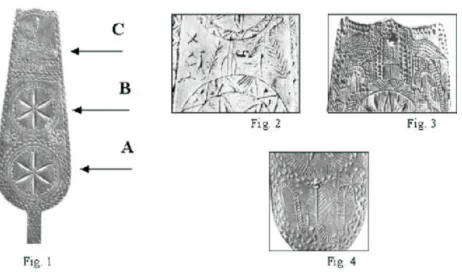
rich in history and tradition (fig. 1). Art, poetry, and music have been integral to different stages
in Bulgarian history.1From an early age, I developed a strong affection for geometrical shapes
that were part of my culture and also exemplified by the orthography of my native language. Art
was introduced to me through the fully developed style of painted pottery that emerged in the
late 5th millennium B.C. from earlier traditions based on repetitive geometrical motifs executed
as incisions filled with white paste (fig. 2). During the Old Iron Age, geometrical art continued to
exist on Bulgarian land, and the main objects that were produced were cult axes, amulets, and
bronze ornaments on horse trappings (fig. 3). As Bulgarian, I was able to examine the art in
different centuries, and this has strongly influenced my work and life. Eager to continue
developing my skills and knowledge in artistic culture, I became especially interested in work
1
Bousfield, Jonathan and Dan Richardson. The Rough Guide to Bulgaria. New York: Penguin Books. 2002.
created by Bulgarians from elements they had brought during the long migration from their
original homeland in the Volga region to the Danube. It was the art of geometric ornaments in
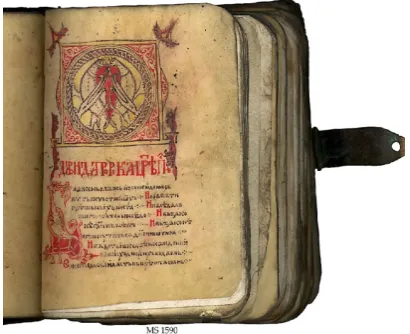
the oldest manuscript book from the First Bulgarian Kingdom (7th and 8th centuries), that I found
most compelling (fig. 4). The Glagolitic script, with its round character, necessitated the
invention of a new style of writing and system of decoration (fig. 5). The earliest Glagolitic
manuscript displayed simple ornaments of round initial letters, symmetrically composed without
lavished floral ornamentation and developing more the system of intertwined vine design, while
Byzantine manuscripts emphasized more the floral elements and palm leaves. Bulgarian
manuscripts used simplified initial letters, while the Byzantine used more colorful ones. Finally,
Bulgarian scribes used capital uncial letters while Byzantine scribes used small uncial letters.
Organic and geometric motifs emerged from the miniatures and yet both showed intricate details
and plays on positive and negative space in their design. After falling almost entirely under
Ottoman rule in the end of the 14th century, Bulgaria ceased to exist as an independent entity and
remained part of the Ottoman Empire for nearly five centuries until 1878. Following the rise of
Bulgarian nationalism and cultural revival in 18th and 19th century as part of a region-wide trend,
an autonomous Bulgarian Church was established in 1870, the Bulgarian Exarchate, which was
the result of a decade-long struggle with the Ottoman and Greek authorities and later paved the
way to the Bulgarian independence. The Russo-Turkish War of 1877-1878 led to the re-
establishment of a Bulgarian state as a constitutional monarchy in 1878.2 The Bulgarian National
2
Revival also stimulated the arts in the 19th century. Dobri Chintulov (1822-1886) wrote the first
poetry in modern Bulgarian in the 1840s. Translation of Western European and Russian literature
accelerated, providing new influences that broke centuries of rigid formalism. Painting and
architecture also broke from the prescribed forms of Byzantine church art to express secular and
folk themes. Bulgarian woodcarving and craft played a vital role in Bulgaria, assuming the forms
that survive today. Growing up in the 20th century in one of the major centers of art – Sofia, I
realized how Bulgarian art became preoccupied with the expression of the national identity. The
20th century also witnessed the emergence of radical avant-garde trends. After the mid-forties,
the art was untrammeled by normative Party academicism, characteristics of all totalitarian
national states. The most important development while I was a young adult was the emergence of
alternative non-communist art, which helped me, among the young generation of artists, to
reinstall individual expression. Attending Rochester Institute of Technology, I desired to pursue
a thesis topic that would reflect relationships I have experienced within the time and space of my
past and present. I discovered that aesthetic moments created by everyday interactions between
human beings become more exciting and valuable when a simple shape takes the viewer to
another place, time, or state of mind. Using the shapes inspired from geometrical motifs found in
the painted pottery, I further developed boundaries that are inspired by a balance between human
beings and experience. I believe that structural boundaries that are expressive in visual harmony
create a relationship and dialog between the viewer, object, and maker.
Influences and Inspirations
Geometric purity, because of its formal composition, and the fact that buildings are constructed
by taking simple geometric forms, such as cubes, spheres, cones, and so on, and combining them
into ensembles, has stimulated my artwork all along. I have always been fascinated by the formal
similarities of our architectures to each other, and to the Russian movement on the other side.
The same phenomenon as in architecture has occurred in painting and sculpture. The intersecting
“cones and pillars” of Frank Stella along with other Minimalist artists, who created objects
which often blurred the boundaries between painting and sculpture, characterized by unitary,
geometric forms and industrial materials, and the trapezoidal earth lines of Michael Heizer (fig.
6), and other such artists who were well aware of Russian Constructivism come to mind.
After I became aware of the formal relevance of movements in art and architecture, I
researched the movement that was familiar to where I grew up. It was the Russian avant-garde
with its dynamic, modern form, the art with “its luxuriance, its large comprehension” – or in
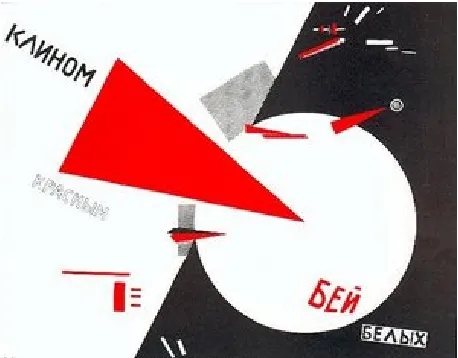
other words, “formal culture with its infinity of aspects”.3 Pure forms were now used to produce
“impure”, geometric compositions (figs. 7-9). Impurity, or deviation, from the structural order is
regarded as opposing or rather, threatening, the former values of harmony, unity and stability.
The quality of harmony, unity and stability arise from the geometry of purity, and formal
composition. The combining of such pure geometrical forms follow compositional rules which
3
do not allow one form to conflict with another. The overall harmony is maintained. But with
Deconstructivism, according to Mark Wigley, form is no longer pure. Deconstruction is not the
taking apart of constructions; instead it is challenging the values of harmony, unity and stability.
It proposes a new view of structure where the flaws are structural. What appealed to me was the
radical freedom of form and the open manifestation to complexity in creating a construction
rather than strict attention to functional concerns. Furthermore, I wanted to acquire some
knowledge of the developing process of the many different structural compositions and their
aesthetic qualities. The Russian avant-garde exposed me to my interest in the construction of
three- dimensional works, such as in the icon painter, and sculptor Vladimir Tatlin (1885 –
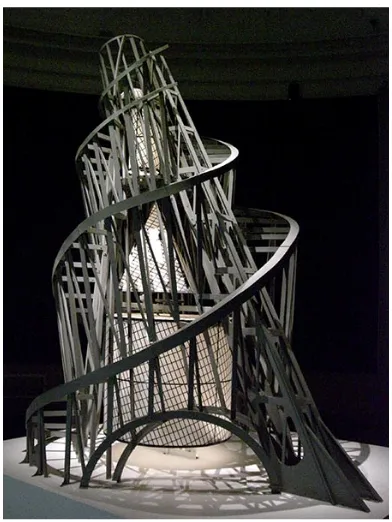
1953). Tatlin achieved fame as an architect, designing a monument, in which pure geometric
forms become trapped in a twisted frame, also known as Tatlin’s Tower or The Monument of the
Third International (figs. 10-11). Extending his artistic vision into all domains, he conceived
corner sculptures, by placing simple forms to produce an unstable, restless geometry, created by
a nest of competing and conflicting forms, in order to question the traditional idea of painting.
Tatlin opened up a new concept of three-dimensional construction in space, sparked off by his
own response to the constructions he had seen in Picasso’s studio in Paris.4 Researching those
counter-reliefs made of wood, iron, steel, and glass, wherein the material shapes the form, rather
than vice versa, I have become more and more interested in the nesting of forms within one
another.
4
Detailed discussion of the Tatlin-Picasso exchange are presented in Anatolii Strigalev, “O
Alongside Tatlin, I became influenced by other constructivists such us Pevsner, Katarzyna
Kobro, El Lissitzky, Karl Ioganson, and many others, and intrigued by one of the most famous
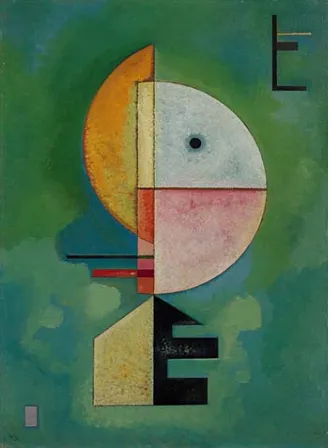
20th century artists, painters, printmakers, and art theorists – Wasily Kandinsky (1866 – 1944),
who is credited with painting the first modern abstract works. Exploring the idea that space had
an inherent geometry, he organized many of his works geometrically (figs. 12-13). The
reconciliation of abstract subject and concrete object is certainly of great import to many of us
since the divorce of mind and body and even the more so to those religious personalists whose
symbol is the fish and whose heaven is beyond the lines, colors and forms of earth, where
disembodied persons are somehow maintained forever if not resurrected intact, on a perfect
plane. We may or may not sympathize with Wasily Kandinsky’s prejudice of 1935: “I see no
essential difference between a line one calls “abstract” and a fish…. The capacities of the fish are
necessary extras for the fish itself and for the kitchen, but not for painting. And so, not being
necessary, they are superfluous. That is why I like the line better than the fish – at least in my
painting.”5 In 1918, The Institute of Artistic Culture had delegated the creation of a teaching
program to Kandinsky. That program, published in 1920, was his pet theory based on
theosophical assumptions, of a new, profound relation between artists and society. Abstract
artists had, in his humble opinion, a loftier vision than others, and the purest means of
communicating it, composed in such a way to produce ecstasy in the mass audience. As for
non-objective art, he disagreed with Malevich, and said that once the natural bonds are severed, the
resulting, so-called art is merely decorative, like a rug or necktie.
5
Most influential to my artistic mind was Kandinsky’s psychology of expression and perception.
In addition, his ultimate objective was the elaboration of a science of art (nauka na iskusstvoto).
He defines the “fundamental elements” (osnovny elementy) as “those elements without which the
given art form would be unthinkable,” and furthermore, Kandinsky’s primary interest was in
following the particular effects that the fundamental elements of each art have upon viewers.
Kandinsky talks about inner necessity as the principle of the art and the foundation of the forms
and colors’ harmony.6Moreover, he defines it as the principle of the efficient contact of the form
with the human soul. In addition, Kandinsky analyzed, in his writings, the geometrical elements
which compose every painting, namely the point and the line, as well as the physical support and
the material surface on which the artist draws or paints and which he called the basic plane. He
didn’t analyze them on an objective, exterior point of view, but on the point of view of their
inner effect on the living subjectivity of the observer who looks at them and lets them act on his
sensibility. Kandinsky was aspired to develop a vocabulary that would point toward universals.
He saw art as a medium of the mystical and, to him, “Colour is the keyboard, the eyes are the
hammers, the soul is the piano with many strings. The artist is the hand which plays, touching
one key or another, to cause vibrations in the soul”. His best known book, Concerning the
Spiritual in Art, (originally published in 1911 as Über das Geistige in der Kunst), illustrates his
efforts to present his art in terms of spiritual science.7 Kandinsky’s allegiance to universalism,
and his attraction to mysticism, theosophy, and other occult systems was evident in his
6
Kandinsky, Vasily. Complete Writtings on Art, 2 vols.,ed. Kenneth Lindsay and Peter Vergo, Vol.I. Boston: G. K. Hall, 1982.
7
An overview of Kandinsky’s interest in the spiritual is presented by Sixten Ringbom in
publications, and compositionally. Grouping a few objects together, he would abstract from
them a logical structure of lines and particles of color. Then he would analyze this structure in
terms of the pictorial means—point, line, surface, space and so on. As a painter, Kandinsky saw
himself as a prophetic figure, whose mission was to translate the most profound human emotions
into universally comprehensible symbols and visual sensations. He saw music as the most
transcendent form of non-objective art, and strove to produce similarly object-free, spiritually
rich paintings.
Studying the Russian Constructivism helped me to bring my thoughts together and explore
them in an exciting and original manner. Based on the three elements of space, time and distance
of constructivist aesthetics I was able to place simplifying shapes fusing into each other, and to
create a balanced experience. In addition, I began to treat the space in my work as geometry with
extended characteristics. Advancing space itself as “concrete” material, I began orchestrating this
material without filling it; declaring volume with recourse to neither mass nor weight; and
dissolving the customary distinction between the exterior and interior of form.
About the same time of my graduate studies I was exposed to a great document, in which I
found some similarities with Kandinsky’s psychology. It was an essay by the French artist Henri
Matisse – “Notes of a Painter” (1908), where the harmony and balance in his work are
determined by the color and the lines. His goal was an art of expression, composition and color.
Combining all of these elements together, his paintings became self-explanatory to the viewer.
Looking at Matisse’s philosophy I realized that I needed to challenge myself through trial and
specifically, their strengths and limitations.
Mathematicians and scientists throughout history have discovered shapes, forms, and
relationships, some of which can be expressed visually. Furthermore, comparing the visual ideas
of artists and mathematicians has allowed one point of view to encounter another. Indeed, one of
the objectives of my inquiry has become more and more the need to help the viewer discover the
geometric dimension of the world around us. This experience requires a certain appreciation of
spatial relations and geometrical intuition. However, that it hopefully will inspire one to an
appreciation of the higher geometric dimensions.
It is fascinating that the regularities and connections once discovered by mathematics retain
their validity. More fascinating still is the fact of how they have impacted us. Furthermore, the
Greek philosopher Protagoras already stated clearly in the 6th century, BC; “Man is the measure
of all things that he is and that he is not.”8 Man became both the measure and the measurer of all
things. One of my most essential artistic influences was a symbol of a confidence created by
Leonardo da Vinci (1452-1519) in his image of a nude man with outstretched arms
circumscribing both a square and a circle (Vitruvian Man) from 1501 (fig. 14). This image
exemplifies the blend of art and science, and moreover provides constant concern about
proportions. More intriguing to me still is the idea of material existence symbolized by the
8
square and spiritual existence by the circle, in order to draw a relationship between these two
aspects of human existence. In addition, the founder of modern science the Italian, Galileo
Galilei (1564-1642), has introduced the language of mathematics and the figures of geometry as
the language and the symbols of the universe. Thus, in the essay, Sidereus Nuncius, from 1610,
he writes:
Natural philosophy is written in the great book that lies eternally spread before our eyes – I mean the universe. But we cannot
understand it before we learn the language and learn to understand the symbols in which it is written. The book is written in the
mathematical language, and the symbols are triangles, circles, and other geometrical figures, without whose help it is impossible to comprehend a single word, and without which we wander through a dark labyrinth in vain.9
Indeed, the circle as being connected to the sky and cosmos was a symbol of Dionysus. The
square symbolizes the natural way in which humans relate to the physical world. This is why
there are four directions, four seasons, and four elements. It is why the room I am sitting in has
four sides while I write my thesis paper and read it on my square screen. The square was a
symbol of the human aspect. However, the content and the form have to be harmonized so that
they become one. It is important to encourage both – the appearance and meaning. Then this
piece will be completed. Looking at Leonardo’s “Vitruvian Man” I have become more and more
intrigued by the symbolic meaning of geometric shapes, and moreover, I began to use the
symbols in my work as information, recorded on them. I hoped to be able to transform some of
9
these symbols into more artistically meaningful forms. I hoped that in using this approach, rather
than mainly researching other artists, my work would be more closely linked to the human
experience and space around us.
Since I was working on the structure of coordinates, I directed my research primarily toward
physics. The accuracy in astronomical measurements used extensively by Copernicus, Tycho
Brahe, and Johannes Kepler has become profoundly influential to my work.
Nicholas Copernicus (1473-1543) was born in Torun, Poland. In Italy he studied canon law
and medicine, but he also developed his interest in astronomy. Copernicus introduced a radical
solution to the age-old mystery of the planets, achieving revolution for the space of science. He
was concerned with the fundamental structure of the world in which we live, with quantity, and
with the close match between prediction and observation, not with truth and falsehood.
Furthermore, he showed that adequate planetary tables could indeed be calculated from
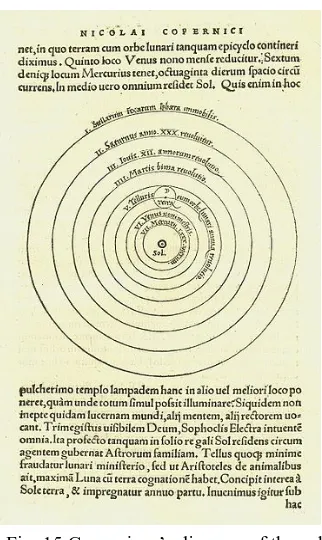
geometrical models with the Sun at the center. The publication in 1543 of Copernicus’s De
revolutionibus developed geometrical models that reproduced the observed motion, indeed
planted the seeds of revolution – for how could the stable Earth not only spin, but hurtle through
space (fig. 15). In this time of transformation, crucial roles were played by four men: Tycho
Brahe of Denmark, who made accuracy and completeness his first priority; Johannes Kepler, a
German mathematician, who transformed astronomy from applied geometry into a branch of
dynamical physics; Galileo Galilei, who used a telescope to reveal hidden truths and developed a
infinite universe and was credited with analytic geometry with its x and y axes. Most of all I
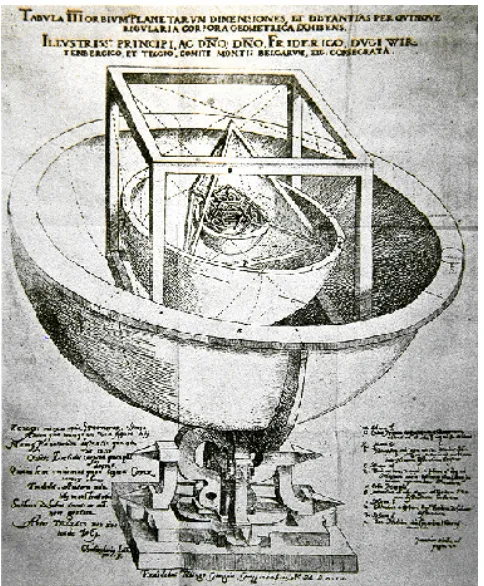
became intrigued with the characteristically unique nested shapes of long Cosmographic Mystery
(1596), a diagram from Kepler in which he reveals the geometrical relationship underlying the
mystery of the creation and the order of the universe (figs. 16-17). Six spheres correspond to six
planets, Saturn, Jupiter, Mars, Earth, Venus, and Mercury, which in that order are separated by
one of the five regular solids. Of course, Kepler had no knowledge of the three outer planets,
Uranus, Neptune, and Pluto, discovered in 1781, 1846, and 1930, respectively.10
10
Time and Space
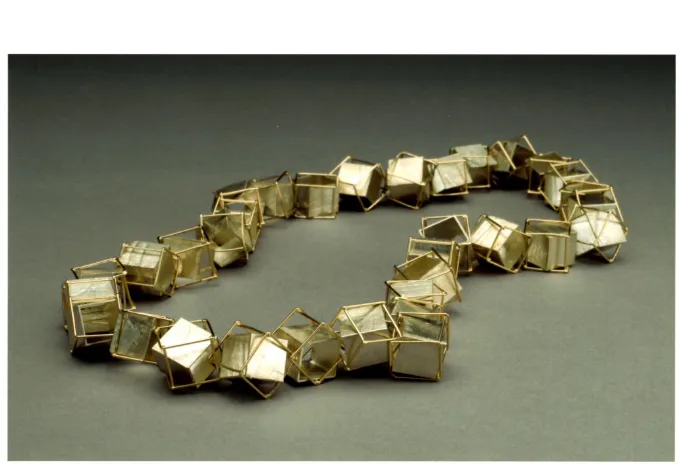
The idea of a nest of shapes alternating with regular solids became a turning point in my design
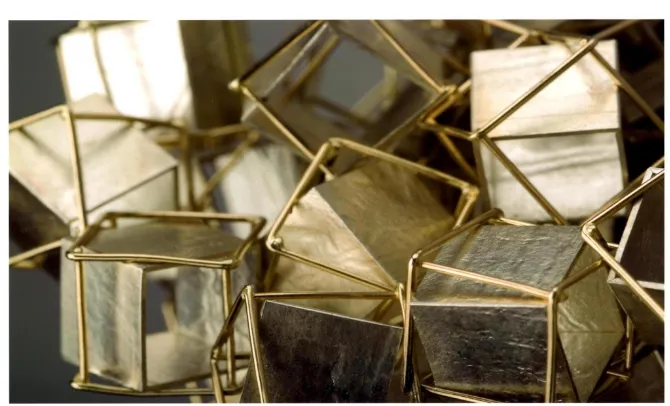
concept. Closely related to Kepler’s model of the universe, “Boundaries” (figs. 18-19)
incorporates a conjunction of linear and quadratic equations: The former unifies individual units,
the latter (cubic wire connection in between) serves to organize all the elements into a gradual
whole. In this piece I employed the techniques of scoring and bending fine silver and 14k gold,
which creates the symbol of an expression of the two dimensions that constitute a surface.
Basically a square is defined as land, field, ground, or the element earth; indeed, it is the natural
way that humans relate to the physical world. Each one of the former elements maintains 4
carved sides that incorporate maps, such patterns that one only can see from above (figs. 20-21).
Compressing these different patterns into the flat surface of fine silver, I attempted to find a
sense of belonging within time, space and history. The geometric progression organizing the
individual elements suggests through linear means a perspective recession into space. Built on 33
solid squares and 33 highly polished wire structures, with its repetitiveness, it creates a new
image of space-time coordinates. Repetition was an important part of my piece; moreover, by
interpreting mapping as a system of rendering space I was able to reflect the repetitiveness of the
human cycle in time and space. Displaying the piece in the gallery was as important as the
creating process. If art is concerned with mirroring the world, then I hoped to turn it into a
reflective surface that literally does image the environment: its mirrored platform and high polish
structures on the other hand, allow me to reveal the space around it as part of the composition. A
scale in terms of “time” rather than “space” took place. The mirror itself is not subject to
duration, because it is an on-going abstraction that is always available and timeless. The
reflections, on the other hand, are fleeting instances that evade measure.
By repeating my basic elements, I insured that the unique impressions of individuals will not
become the meaning of the work. If one investigates the piece as a whole, reflectiveness
becomes abstract. I structured some of my thesis so that it incorporates both realistic and abstract
reflections – elements from the surrounding environment as well as the piece’s ability to mirror
itself. It was my intent to provide a range of visual experiences that ultimately become a
philosophic proposition concerning the nature of vision. Furthermore, I expanded the idea of
reflection by mirrored images themselves being mirrored.
My next piece, Sphere (figs. 22-23), was a turning point in my work. Prior to this sculpture,
most of my work was on a much smaller scale and tended almost exclusively to be functionally
orientated. These functional structures can also be viewed as wearable sculptural pieces.
Engaging them in a physical relationship to the body, only contributed to the total pattern of
elevating experience of movement and time. With my next piece, I broke away from my normal
patterns and went on a journey of constructing my art forms in a more monumental scale. I felt
that working on large sculptural forms would help me to define not only the changing
relationship between mass and space, but also to reveal negative space as shaped boundaries.
When I was making this sculpture I was thinking of the mapping that refers to the planet Earth.
The circular format of the flattened-out earth’s hemisphere was used by me in the first stage of
development of this piece. However, following only my own rules for measuring distance and
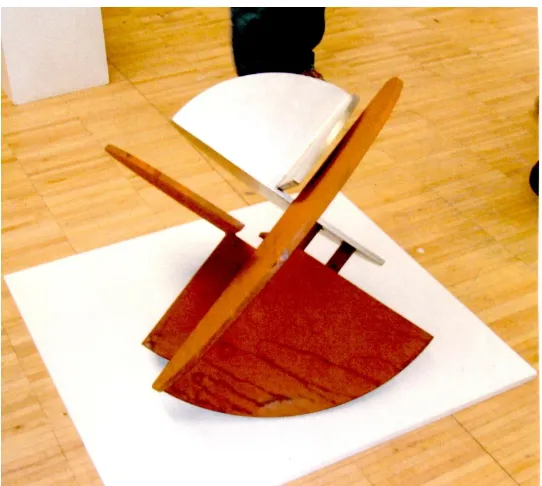
the middle under a 90-degree angle, and shaping it into three-dimensional format. Moreover, I
continued playing with this shape and came to the solution of dividing one of the symmetrical
halves in half, bending it 90-degrees, only opposite the direction of the former. In the end I was
satisfied with the final outcome by creating a mode, which contained a simple breaking of the
circle (fig. 24). This cleavage of a pure shape gained all its force by challenging the very values
of harmony, unity, and stability, and proposed instead a different view of structure. However, I
wanted to play with the scale of the different components, but still allow the viewer to identify
the origin of the design. Indeed, I decided to combine repetitively the mode I created above into
a piece that reproduces the circular shape all over again. I frequently relied on mathematical
proportions, in order to calculate the right size of the latter modes, so they can fit within the
orbits of the former. Repetitiveness was used once again to construct the piece as a whole, not
the basic mode of a distorted circle to become the meaning of the work. The more carefully I
look, the more unclear it becomes where the perfect form ends and its imperfection begins.
Once all the elements of the “Sphere” had been assembled from ½” thick steel plate, I focused
on perception. The human mind often finds it easier to handle one thing at a time. This holds true
for the artist who conceives a sculpture or painting, as well as the critic or theorist who describes
it. Furthermore, in this sculpture the use of negative space between the modes is so limited that it
helps the viewer to perceive the sculpture as a solid. Having shape on its own, negative space
contributes to the total pattern of this work of art.
After creating the “Sphere”, I switched back to a more familiar area, and worked in a more
how the geometric shapes physically joined together became more important. Thinking of large
scale constructions and how the different pieces are all joined together left me with many
possibilities to consider. “Time and Space”, however, came into existence by chance. A
specially hollow fabricated steel partial circle had originally been intended for a much larger
work that had proved unsatisfactory. I started working with scaled-down circular steel pieces –
cutting, joining, and soldering them into sculptural jewelry forms that had, at the end, little to do
with the original intent they were designed to be used for. Recognizing the role of chance, I also
realized could be a benefit to my work. Moreover, taking that risk can just develop an expression
inspired by my actions at that time. Indeed, I proceeded with the remaining half of the circle
which is held in reserve for the extension made from 14k yellow gold. Retaining strong contrasts
between each other, the extended surface of the circle with its bright color reminds me of the
reflection of the sun off surfaces in the early morning, and the main steel shape holds memories
of the afternoons, as the sunlight softens, and the surface of the land becomes rust covered (fig.
26). As in my other work, the materials composing “Time and Space” consist of stainless steel,
sterling silver, 14k yellow gold, patina, diamonds and they aim to provide meaning. In the early
80’s I was fascinated by the idea of the feeling of the land around us. I was told stories how in
prehistoric times when Bulgarian hunters traveled, they ran across the land by following the
shadows of the clouds. The colors changed constantly. Between seven and eight o’clock in the
morning the shadows are heavy and purple, the reflection of the sun off surfaces bright, giving a
high contrast to form. At midday the land is flattened by the haze of heat and sun. In the
afternoon, as the sunlight softens, the whole land becomes rust covered. Once you are used to the
the help of different color metals and their endless surface opportunities, I was able to mirror
these thoughts into my piece and create a circle holding strong contrasts, that suggested an acute
sense of temporality; a chronometric experience of movement and time, that pervades one’s
experience not in a specific place, but elevating and sharpening the viewer’s perception through
locomotion. Furthermore, reflecting the point of origin, I joined these two materials together in
an inner/outer dialectic and the use of stones helped me define the gravity of our environment.
Communicating the ideas about nature, land, history, time and human relationships, I engaged
the physicality of the body in this piece, by making its function wearable.
In our system the vertical direction defines the horizontal plane as the only one for which the
vertical serves as an axis of symmetry. It is the one plane on which one can move freely in any
direction without the sensation of climbing or descending. Therefore, no direction along the
ground plane is spatially distinguished. Christian Norberg-Schulz has written that “the horizontal
directions represent man’s concrete world of action.In a certain sense, all horizontal directions
are equal and form a plane of infinite extension. The simplest model of man’s existential space
is, therefore, a horizontal plane pierced by a vertical axis.”11 Frank Lloyd Wright pointed to
motorized transportation as having opened to Americans the unlimited freedom of the horizontal
plane.12 It follows from the asymmetry of space that being is experienced essentially as
verticality due to our upright stance. Furthermore, to come into existence means to detach
oneself from the earth, be it by the organic growth of plants or the upward thrust of mountains, or
11
Norberg-Schulz, Christian. Existence, space, and architecture. New York, Praeger, 1971. 12
by their human equivalent, building. In daily visual experience, a thing or creature shows up by
rising above the ground, and a vertical axis is a particularly characteristic and aspect of its shape.
The work of art as a horizontal format is more of an extension of the viewer’s space. A vertically
oriented object becomes an abstract anthropomorphic other and this is the orientation I most
frequently chose for my next pieces.
Sculpture, however, is the art form that best defines the changing relationship between mass
and space. Continuing in that direction, I began using large steel, trapezoids, triangles, circles,
and parallelograms, and gradually converted the shapes into a three-dimensional sculpture named
later “Within the Sphere” (fig. 27). The result is a complex dialogue between the basic forms
clashing in ways that create a range of relationships: at times there is no conflict, as one form
passes over or under another; sometimes one form is simply embedded within another; other
times one form eats into another; and often both forms are disturbed and a new form is produced
(figs. 28-29). Furthermore, this project became a complex exchange between solid and
transparency, emphasizing for viewers the invisible quality of geometry that is space. Creating
this piece I was inspired by Aristotle, who defined space as what is bounded by the interfaces
between physical objects and the open areas around them:
“Space and time also belong to this class of quantities.
parts have a common boundary.” 13
Furthermore, in “Within the Sphere” neighboring objects share their borders peacefully and their
contour serves both at once. Working on the final installation of the piece proved to be as
difficult as important. I enjoyed projecting the combined trapezoid and triangle structure in a
way which ascends diagonally through the composition. Playing with gravity, I finalized a
structure that leans over precariously, in tension with the basic rhythm of the horizontal floor
plane.
From using limited negative space as a contribution to the total pattern of my work, I went on
a journey of shaping negative space as geometry with extended characteristics. From creating
solids on a large scale, I traveled through a complex exchange between negative and positive, to
defying negative space as shaped boundaries.
My final work “Bounding Space” came into existence by using linear perspective as the
traditional means of conceiving space (figs. 30-34). The ½” thick steel rod became an outlet
through which I could convey my insights. The use of wire and its ability to define negative
space, and its basic nature of flexibility, held great attraction for me. Also the wire appealed to
me, with its graceful lines and transparent implications. I liked the support that wires gave to the
structure – the fact that a single wire looks fragile, but at the same time was made strong by
13
tension. Furthermore, the lines created by the wire can disappear from view in the right
condition, moreover, they open the question of what it is you are looking at. By interpreting
mapping as a system of drawing space and a way of rendering it two-dimensionally, I
incorporated maps into my sculpture, and the steel rods actualize perspective schemata in
three-dimensional terms (fig. 35). Furthermore, I was able not only to draw into space like sketching
on a paper; in fact I was shaping the space itself.
Conclusion
I have reached the end of my graduate studies; for now, my journey through the world of
geometry at RIT is over. In creating my thesis work, I have grown as an artist, both in the forms
and the imagery of my pieces. I have always liked the idea of being on the edge: whether the
work is functional or not, sculpture or jewelry, a model or completed piece. I tried to leave room
for interpretation about the origin of my thesis work. It drew its inspiration not so much from any
one source, as from a combination of sources: geometric elements found on fully developed
painted pottery from the late 5th millennium B.C. and bronze ornaments on horse trappings from
the Old Iron Age, as well as elements taken from my visual memories of the reflection of the sun
in early mornings and shadows of butterflies reflected in the water. It was my hope to be able to
create work that would allow the viewers to identify some of the imagery in the pieces as part of
aesthetic moments they have experienced within the time and space of their past and present.
Drawing attention to the psychological and social relationships between people in daily
interaction, my work seeks to connect with the viewer’s experience and perhaps helps them to
leap from their world to my work and back. Of course, a person defines the nature of his own
being largely by his place in a network of personal relations and more generally on the social
conventions of the particular cultural setting. Furthermore, my work reflects its distinct
references from the basic forms and figures of which the environment is composed, but is
presented in such a way that one is unsure as to its exact origins. The opportunity I had to work
on this thesis makes me want to believe I have uncovered some of the walls we have constructed
Fig. 1 Map of Bulgaria.
[image:27.612.75.246.308.397.2]
Fig. 2 Painted pottery that emerged in the late 5th millennium B.C.
[image:27.612.76.307.515.654.2]Fig. 4 Psalms. Church Slavonic, Bulgaria
[image:28.612.266.526.414.598.2]
Fig. 5 Bulgarian Glagolitic Fig. 6 Rift is one of several “earth sculptures” by Michael Heizer
Fig. 7 Kandinsky, Black and Violet, Painting, 1923
Fig. 8 Lissitzky, Proun G7,
1923
[image:29.612.73.302.479.658.2]
[image:30.612.73.268.109.373.2]
Fig. 10 Tatlin,The Monument of the Third International,
[image:30.612.72.268.435.696.2]Fig. 12 Kandinsky
Fig. 13 Kandinsky, Upward, 1929
[image:31.612.74.240.405.629.2]
Fig. 14 Leonardo da Vinci, The Vitruvian Man, 1492
[image:32.612.69.230.415.685.2]Fig. 16 Kepler’s model of the universe, 1597.
Fig. 17 A diagram from Kepler’s Cosmographic Mystery, 1596.
[image:33.612.73.315.353.646.2][image:34.612.88.427.110.324.2]
Fig. 18 Boundaries. Ring.
[image:34.612.89.429.392.624.2]
Fig. 20 Detail.
[image:35.612.88.423.448.651.2]Fig. 22 Sphere.
Fig. 23 Sphere. Different view.
[image:36.612.73.344.419.662.2]Fig. 25 Time and Space.
[image:38.612.74.323.462.683.2]
Fig. 28 Prototype.
Fig. 30
[image:41.612.71.401.370.576.2]Fig.32
Fig. 33
[image:42.612.73.427.71.283.2]Bibliography
Arnheim, Rudolf. The Dynamics of Architectural Form. Based on The 1975 Mary Duke Biddle Lectures at The Cooper Union. University of California Press 1977.
Gough, Maria. The Artist as Producer. Russian Constructivism in Revolution. University of California Press.
Hansen, Vagn Lundsgaard. Geometry in Nature. Mathematical Institute, The Technical University of Denmark, Lyngby, Copenhagen.