City, University of London Institutional Repository
Citation
:
Miceli, G., Scopelliti, I., Raimondo, M. A. and Donato, C. (2014). Breaking Through Complexity. Visual and Conceptual Dimensions in Logo Evaluation. Psychology & Marketing, 31(10), pp. 886-899. doi: 10.1002/mar.20741This is the accepted version of the paper.
This version of the publication may differ from the final published
version.
Permanent repository link:
http://openaccess.city.ac.uk/4267/Link to published version
:
http://dx.doi.org/10.1002/mar.20741Copyright and reuse:
City Research Online aims to make research
outputs of City, University of London available to a wider audience.
Copyright and Moral Rights remain with the author(s) and/or copyright
holders. URLs from City Research Online may be freely distributed and
linked to.
Running head: Visual and Conceptual Dimensions in Logo Evaluation across Exposures
BREAKING THROUGH COMPLEXITY:
VISUAL AND CONCEPTUAL DIMENSIONS IN LOGO EVALUATION ACROSS EXPOSURES
Gaetano “Nino” Miceli*
Università della Calabria, Campus di Arcavacata,
Department of Business Administration and Law, Cubo 3C, Via P. Bucci, 87036 Rende (CS), Italy;
Phone: +39 0984 492162; Fax: +39 0984 492277; e-mail: [email protected]
Irene Scopelliti
City University London, Cass Business School 106 Bunhill Row, EC1Y 8TZ London (UK);
Phone: +44 (0) 20 7040 5209; Fax: +44 (0) 20 7040 8328; email: [email protected]
Maria Antonietta Raimondo
Università della Calabria, Campus di Arcavacata,
Department of Business Administration and Law, Cubo 3C, Via P. Bucci, 87036 Rende (CS), Italy;
Phone: +39 0984 492248; Fax: +39 0984 492277; e-mail: [email protected]
Carmela Donato
Marketing Department, Duisenberg Building
Faculty of Economics and Business – University of Groningen, Nettelbosje 2, 9747 AE Groningen, The Netherlands
Phone: +31 50 363 7065; e-mail: [email protected]
To be cited as: Miceli G., Scopelliti I., Raimondo M.A. & Donato C. (2014) “Breaking Through Complexity. Visual and Conceptual Dimensions in Logo Evaluation, Psychology and Marketing, 31(10), 886-899.
Acknowledgements
BREAKING THROUGH COMPLEXITY:
VISUAL AND CONCEPTUAL DIMENSIONS IN LOGO EVALUATION ACROSS
EXPOSURES
Abstract
This research investigates the effects of visual and conceptual complexity on brand logo evaluations at single and multiple exposures. Building upon the theoretical distinction between visual and conceptual constructs and on a processing fluency account it is proposed that the effects of visual complexity and conceptual complexity on attitude toward the logo change across exposures following opposite patterns, and are driven by the mechanisms of
perceptual fluency and conceptual fluency, respectively. The results of a hybrid experimental study suggest that the initially positive effect of visual complexity on attitude toward the logo becomes negative with multiple exposures, whereas the initially negative effect of conceptual complexity on attitude toward the logo becomes positive as exposures increase. The findings contribute to research on consumer reactions to the visual elements of brands, and offer guidelines to brand managers and logo designers for leveraging on visual and conceptual complexity, as well as the number of exposures, in order to raise the attractiveness of logos.
INTRODUCTION
A logo is the set of graphic design elements associated with a brand and represents a
fundamental tool of the brand communication strategy (Keller, 1998). Logos are often the
most visible and prominent parts of brands and influence consumer attitude toward the brand
“at first sight” (Henderson & Cote, 1998) as well as after repeated exposure (Janiszewski &
Meyvis, 2001). Ultimately, logos have an impact on brand equity via their effects on brand
awareness and image (Shimp, 2010).
Visual complexity, i.e. the variety of visual information featured by a logo (Berlyne,
1970), and conceptual complexity, i.e. the ability of a logo to evoke multiple meanings but
not a consensually held one (Perussia, 1988), are two distinct properties of logos. Take as
examples the following three logos:
a) b)
!
c)One may easily recognize that both logos ‘a’ and ‘b’ evoke unambiguously the concept of
‘sun’ (low conceptual complexity) but have higher and lower degrees of visual complexity,
respectively. In other words, a consensually held meaning can be evoked independent of
whether the stimulus is visually elaborate or simple. At the same time, both logos ‘b’ and ‘c’
are visually simple, but while the former is immediately related to a sun, the latter is
susceptible to several interpretations (a wheel, slices of a cake, a pinwheel, a sun – high
conceptual complexity). In other words, comparable levels of visual complexity may yield to
either a consensually held meaning or multiple meanings.
Previous studies have analyzed different dimensions of complexity in a single-exposure
the effect of complexity on logo evaluation and on how such effect may change across
exposures. Despite these relevant findings, previous research offers only a partial view of
how both visual and conceptual dimensions of complexity influence attitude toward the logo
in a single/multiple-exposure context, and, more importantly, it has neglected the
mechanisms mediating the effects of complexity on attitude. Although Janiszewski and
Meyvis (2001) have proposed processing fluency as the mechanism driving conceptual
complexity effects, they have not empirically tested the mediating role of fluency in their
studies.
The above-mentioned gaps are particularly relevant when considering that logos have a
ubiquitous presence in the communication campaigns of any company (Henderson & Cote,
1998), and are systematically shown to new and established customers by means of mass as
well as social media. Additionally, in comparison with other visual stimuli, logos have
specific features (small scale dimension, reduced use of colors to favor replicability,
meaning-based associations) that call for further research using true logos to test predictions
on complexity effects on logo evaluation.
This research investigates the effects of visual and conceptual complexity on brand logo
evaluations at single and multiple exposures. Specifically, building upon the theoretical
distinction between visual and conceptual constructs (e.g., Blaxton, 1989; Tulving &
Schacter, 1990) and on a processing fluency account (Reber, Schwarz, & Winkielman, 2004)
hypotheses on the interactions of visual and conceptual complexity with the number of
exposures are formulated. Based on the present conceptual analysis, it is proposed that the
effects of the two dimensions of complexity change across exposures and follow opposite
complexity on attitude toward the logo are driven by the mechanisms of perceptual fluency
and conceptual fluency, respectively.
The results of a hybrid experimental study suggest that the initially positive effect of
visual complexity on attitude toward the logo becomes negative with multiple exposures,
whereas the initially negative effect of conceptual complexity on attitude toward the logo
becomes positive as exposures increase. The findings contribute to research on consumer
reactions to the visual elements of brands (Keller & Lehmann, 2006; Labreque, Patrick, &
Milne, 2013), and offer guidelines to brand managers and logo designers for leveraging on
visual and conceptual complexity, as well as the number of exposures, in order to raise the
attractiveness of logos.
BREAKING THROUGH COMPLEXITY IN LOGO EVALUATION
Logos have both a visual structure and a meaning structure (Garner, 1974). The visual
structure is represented by the informational properties of the logo, which can be defined
independently of any user-organism. The meaning structure is the set of meanings associated
with the logo. Accordingly, the level of complexity that characterizes a logo can refer to
either its visual structure or its meaning structure.
Following theories on aesthetics and perception (Berlyne, 1970; Kosslyn, 1975; Palmer,
1999), in this research visual complexity (hereafter: VC) of a logo is defined as the variety of
the information featured by the visual structure of the logo. According to this definition, the
structure of a visually complex logo is characterized by heterogeneous visual elements that
span multiple perceptual dimensions. Following theories on semiotics and stimulus codability
evoking multiple meanings. According to this definition, a conceptually complex logo is one
susceptible to several interpretations and that shows high degrees of polysemy.
Because they are used in multiple media and are crucial depositaries for brand
associations, logos have specific features compared to other visual marketing stimuli (Park &
Rabolt, 2009; Maxian, Bradley, Wise, & Toulouse, 2013). On the one hand, they have often
small dimensions and therefore a finite surface that should fit in disparate communication
media (e.g., business cards, packages, ads, social networks and web sites). As such, from a
graphical perspective, logos are designed to be adaptable to different communication
contexts, often with low variety in colors (Labreque, Patrick, & Milne, 2013). As a
consequence, logos seldom reach very high levels of heterogeneity and detail in terms of
visual elements (Henderson & Cote, 1998). On the other hand, despite the small dimensions,
logos have a relevant potential in terms of meanings that can be associated to their perceptual
features (Bennett, 1995). Accordingly, one may expect to observe a sizeable range of
variation in terms of CC across logos.
Some empirical studies (Henderson & Cote, 1998; van der Lans et al., 2009) suggest that
VC and CC are distinct constructs. Specifically, they show that visual elaborateness, a factor
combining VC, depth, and activeness of design, has no effect, or a significant but close to
zero effect, on the ability of logos to elicit a familiar or shared meaning, a property inversely
related to CC. More generally, different streams of research have demonstrated that
perceptual and conceptual constructs involve distinct domains and processes of human
cognition. First, performance on tasks that require the processing of meaning appears to be
systematically dissociated from performance on tasks that rely more on the analysis of
physical features (Blaxton, 1989). Second, research on implicit memory (e.g., Cabeza & Ohta,
semantic priming act separately and independently.
In addition, processing of visual information and of meanings associated with that
information seems to require different resources in terms of effort and time. On the one hand,
there is evidence that individuals are able to get the gist of a scene within less than 100
milliseconds (Oliva, 2005), and to perceive other specific visual elements within a few more
eye-movements (Pieters & Wedel, 2008), since the memory representation of the perceptual
aspects of a stimulus operates at a pre-semantic level and does not require conscious
processing (Lee, 2002). On the other hand, the elaboration of meaning may require the
retrieval of knowledge associations from memory, and the categorization and semantic
interpretation of the stimulus (Hamann, 1990). Consequently, a meaning-based representation
of a stimulus cannot be formed without the intervention of conscious elaboration, which
requires more time and opportunities to process the stimulus (Lee, 2002). Overall, previous
studies suggest that i) VC and CC are theoretically distinct constructs, ii) their elaboration
follows different routes, and iii) they may be differently sensitive to the number of exposures.
Previous research suggests that stimulus complexity influences evaluations, and that such
effect changes depending on the number of exposures to the stimulus. Berlyne (1970) found
that complexity – intended as a general concept – positively influences viewers’ pleasure in
response to an object up to an optimal level. At first, increasing complexity boosts pleasure
because of arousal and the stimulus learning potential. Further increases in complexity,
however, dampen pleasure because they produce uncertainty of interpretation and reduce the
ability to elaborate the stimulus. The central idea of this theory is expressed by an inverted
U-shaped relationship between complexity and pleasure.
Focusing on the visual dimension of complexity, Henderson and Cote (1998) found a
logo, whereas Henderson, Cote, Leong, and Schmitt (2003), and more recently Van der Lans
et al. (2009) have conducted large-scale surveys and found that logo elaborateness has a
generally positive effect on attitude toward the logo. Focusing on the conceptual dimension
of logo complexity, Janiszewski and Meyvis (2001) manipulate the congruity between verbal
and pictorial elements of logos in a series of experiments. Their results generally suggest that
mono-meaning logos (i.e., logos in which verbal and pictorial elements both convey the same
meaning) are initially preferred to multi-meaning logos (i.e., logos in which verbal and
pictorial elements convey different meanings), whereas as the number of exposures increases
multi-meaning logos are relatively preferred to the mono-meaning logos.
Despite these relevant contributions, existing research on logo complexity has not
considered the effects of both dimensions of complexity and has not observed how these
effects change within a single/multiple exposure design. Another important area that needs
further clarification concerns the mechanisms driving complexity effects on logo evaluations.
In fact, while some authors have suggested that processing fluency may drive the effect of
complexity (Janiszewski & Meyvis, 2001; Reber, Schwarz, & Winkielman, 2004), little
empirical evidence is available on the potential mediating role of fluency in the
complexity-to-attitude relation taking into account single and repeated exposure.
Complexity and processing fluency
Processing fluency refers to the ease of elaboration of a stimulus, which generates pleasant
metacognitive feelings in the beholder, and is affected by stimulus features (e.g., symmetry,
complexity – Reber et al., 2004) and/or by repeated exposure (Zajonc, 1968). According to
fluency theory (Higgins, 1998; Clore et al., 2001), people attribute the pleasantness of the
reactions emerge in the course of processing the stimulus, they are not a function of the
stimulus cognitive elaboration, but rather metacognitions about how easy it is to elaborate the
stimulus (Schwarz & Clore, 1990). As a consequence, the experience of processing fluency
makes stimulus evaluations improve (Winkielman & Cacioppo, 2001; Winkielman, Schwarz,
Fazendeiro, & Reber, 2003).
When considering a single exposure, processing fluency is triggered by specific stimulus
characteristics (Reber et al., 2004), which facilitate the elaboration of the stimulus. For
example, changes in stimulus surface affect the amount of processing fluency (Jacoby &
Dallas, 1981). Also, symmetry is supposed to generate processing fluency because
symmetrical patterns can be elaborated more efficiently than nonsymmetrical patterns (Reber
et al., 2004). With multiple exposures, instead, processing fluency can be triggered by the
interplay of stimulus characteristics and repeated exposures (Reber et al., 2004). Indeed,
previous research has related the mere exposure effect (Zajonc, 1968; Stafford & Grimes,
2012) to processing fluency, as individuals tend to elaborate familiar stimuli, that have been
seen repeatedly, more smoothly.
Two forms of processing fluency have been acknowledged: perceptual fluency and
conceptual fluency. Perceptual fluency occurs when exposure to a stimulus creates a
feature-based representation of that stimulus that facilitates its elaboration (Bornstein & D’Agostino,
1992; Jacoby, Kelley, & Dywan, 1989). Indeed, perceptual fluency concerns metacognitions
that trigger interest and attention in the observer, thus facilitating the elaboration of the visual
features of the stimulus. Conceptual fluency occurs when exposure to a stimulus creates a
meaning-based representation of that stimulus that facilitates its interpretation (Shapiro,
1999; Whittlesea, 1993). In fact, conceptual fluency regards metacognitions related to
This research proposes that the two dimensions of complexity are related to the two
aforementioned forms of processing fluency. On the one hand, VC, which concerns the visual
structure of a stimulus, affects the smoothness with which perceptual information is attended
and decoded. Accordingly, it is claimed that the effect of VC on attitude toward the logo is
driven by perceptual fluency. On the other hand, CC, by influencing the number of potential
meanings associated with a stimulus, affects the ease of interpreting the meaning of that
stimulus. In this research, the effect of CC on attitude toward the logo is thought to be driven
by conceptual fluency.
There are reasons to believe that the relation between VC and perceptual fluency and that
between CC and conceptual fluency may change across exposures. Previous research has
related the mere exposure effect(Zajonc, 1968) to changes in perceptual fluency due to
multiple exposures to the same stimulus (Bornstein & D’Agostino, 1994), especially for
those stimuli characterized by few (compared to many) perceptual dimensions (Janiszewski
& Meyvis, 2001). Repeated exposure may also affect the relation between CC and conceptual
fluency by providing more time and opportunities to decode and to interpret visual stimuli
even when they carry multiple meanings (Hamann, 1990; Lee, 2002).
The effect of visual complexity on attitude toward the logo across exposures
This research proposes that the effect of VC on logo evaluations across exposures is
related to the generation of perceptual fluency. Considering a single exposure context,
high-VC logos, featuring heterogeneous visual elements (e.g., curves, lines, patterns), are more
likely to stimulate interest and attention than low-VC logos, thus facilitating stimulus
encoding. Differently, low-VC logos are characterized by homogenous perceptual elements,
activate positive metacognitions related to perceptual fluency, which, in turn, should
determine an increase in attitude toward the logo. Accordingly, it is expected that, at a single
exposure, the effect of VC on attitude toward the logo is positive. Although some authors
have advocated a reverse-U shaped effect of VC on stimulus evaluations (Berlyne, 1974;
Henderson & Cote, 1998), one may consider that the typical logos, having relatively small
scale dimension, do not reach extreme levels of VC. Therefore, even for high-VC logos, the
effect on attitude should not decline and keeps being monotonically positive. This prediction
is consistent with the results of an extensive cross-national survey (van der Lans et al., 2009)
that reported a robust positive effect of logo elaborateness (a factor including VC) on affect
toward logos exposed once.
The effect of VC on attitude toward the logo may change with increasing exposures. Since
perceptual information is elaborated quickly (Quinlan, 2003), the attention-grabbing and
interest potential of VC can be exhausted with initial exposure. However, in addition to
stimulus properties, repeated exposure per se may determine the experience of perceptual
fluency. Based on the mere exposure effect(Zajonc, 1968), previous research has proposed
that repeated exposure generates a pleasant sensation deriving from the encoding of an
apparently familiar stimulus. Janiszewski and Meyvis (2001) argue that repetition-based
fluency is more common for stimuli with structures based on a single perceptual dimension
compared to stimuli that are complex along multiple perceptual dimensions. If this conjecture
is correct, one should observe an increase in perceptual fluency for low-VC logos, which
benefit from the mere exposure effect also because their simpler structure facilitates the
retrieval of the feature-based representation in memory of the stimulus. The experience of
repetition-based perceptual fluency for high-VC logos is less likely to take place, because
elements. Therefore, with multiple exposures the effect of VC on attitude toward the logo
becomes negative, with low-VC logos receiving higher evaluations than high-VC logos.
Overall, it is expected that the effect of VC on attitude toward the logo changes with
increased exposures, and that such change is driven by changes in perceptual fluency.
Formally:
H1: The number of exposures moderates the effect of VC on attitude toward the logo.
Specifically, at a single exposure, the effect of VC on attitude toward the logo is positive,
whereas, with multiple exposures, the effect of VC on attitude toward the logo is
negative.
The effect of conceptual complexity on attitude toward the logo across exposures
This research proposes that the effect of CC on attitude toward the logo across exposures
is driven by conceptual fluency. At a single exposure, conceptual fluency mainly depends on
stimulus codability (Perussia, 1988), that is, the property of a stimulus to evoke an easily
interpretable meaning (i.e., low CC). With multiple exposures, however, conceptual fluency
can be influenced also by the incremental opportunities to interpret even lowly codable
stimuli (i.e., high CC – Hamann, 1990).
Studies on codability(Perussia, 1988) suggest that, at a single exposure, highly codable
stimuli are perceived and interpreted more easily than stimuli that are low in codability
(Schulz & Lovelace, 1964; Smith & Egeth, 1966; Rodewald & Bosma, 1972; Lachman,
1973). Such prediction is consistent with a conceptual fluency account, which suggests that
when the meaning of a stimulus is easy to access and to understand (i.e., low in CC –
Schwarz & Clore, 1990) the stimulus tends to receive more favorable evaluations because the
liking. Studies on codability and conceptual fluency, therefore, seem to suggest that at initial
exposures high levels of CC may result in less favorable evaluations, because the meaning
structure of the stimulus is not immediately codable, preventing the experience of conceptual
fluency (Hamann, 1990; Lee, 2002). On the contrary, low levels of CC make the meaning
structure of a logo accessible, facilitating the process of interpretation and thus benefiting
from conceptual fluency-based metacognitions that improve attitude toward the logo.
Accordingly, it is expected that, at a single exposure, the effect of CC on attitude toward the
logo is negative.
A higher number of exposures provides more resources for the conscious elaboration of
high-CC logos and increases the opportunity to elaborate the meaning of even a conceptually
complex stimulus (Hamann, 1990), thus amplifying the likelihood of experiencing conceptual
fluency that will, in turn, enhance stimulus liking. In contrast, the meaning of a low-CC logo
is often codable even after a single exposure. Further opportunities to elaborate the stimulus
provided by additional exposures are unlikely to enhance conceptual fluency, and the already
clear meaning of the logo may become boring and fail to reinforce logo evaluations. As a
consequence, the effect of CC on attitude toward the logo becomes positive as exposures
increase. Overall, it is expected that the effect of CC on attitude toward the logo changes with
multiple exposures, and that such change is driven by changes in conceptual fluency.
Formally:
H2: The number of exposures moderates the effect of CC on attitude toward the logo.
Specifically, at a single exposure, the effect of CC on attitude toward the logo is
negative, whereas, with multiple exposures, the effect of CC on attitude toward the logo
A HYBRID EXPERIMENTAL STUDY
In order to test the hypotheses, a hybrid experimental study was conducted on a large set
of logos. The number of exposures was manipulated in three levels (1 vs. 4 vs. 9 exposures)
adopting a procedure based on an ostensibly unrelated task that will be discussed in detail
later. For each logo, scores of VC, CC, control variables, and attitude toward the logo were
collected from different groups of respondents. Using different data sources allowed to
prevent common method bias (Podsakoff, MacKenzie, Lee, & Podsakoff, 2003) and to ensure
correct estimation of relevant effects. Measures of perceptual and conceptual fluency were
also collected in order to test for the underlying mechanisms driving the hypothesized effects.
Stimuli, participants and procedure
A multi-stage procedure was adopted to collect the data. The first stage used a procedure
similar to that described by Henderson and Cote (1998) and selected 140 black-and-white,
unfamiliar logos, partly from Henderson and Cote’s sample, and partly through a random
extraction from the Yellow Pages of a major metropolitan directory from a region outside that
of data collection. Two professional graphic designers and two marketing and advertising
experts were provided with definitions of VC, as well as of other visual dimensions that
potentially affect fluency included in the study as control variables (Reber et al., 2004).
Specifically, the four experts rated (using 7-point scales) the 140 logos on VC,
proportionality, symmetry, parallelism, redundancy, and roundness1. The experts were
1 Proportionality is the extent to which a visual stimulus follows the “golden section,” that is, a ratio between the
instructed to take their time to give accurate evaluations, and to rate all of the 140 logos by
focusing on one specific dimension at a time. This approach reduces bias due to fatigue and
boredom, and favors comparability across logos. Reliability analyses showed an adequate
level of agreement among the four experts. Cronbach alphas were computed for each
dimension and allowed to create average scores of VC (α = .83), proportionality (α = .82),
symmetry (α = .89), parallelism (α = .76), redundancy (α = .89), and roundness (α = .91) for
each logo.
The second stage adopted the following procedure. First, a random set of 100 target logos
was extracted from those used in the first stage. The remaining 40 logos were used as decoy
stimuli in the manipulation of exposures. Second, to control for any potential confound
related to the assignment of logos to specific exposure conditions, 300 potential conditions
(100 target logos × 3 exposure conditions) were created.
Five hundred and five participants (56.2% female; Mage = 33.48, SDage = 12.38) were
recruited to complete the study from Amazon Mechanical Turk (AMT). Previous studies
demonstrate the validity and many benefits of running virtual experiments with AMT
workers (e.g., Horton, Rand, & Zeckhauser, 2011; Paolacci, Chandler, & Ipeirotis, 2010;
Mason & Suri, 2012; Paolacci & Chandler, 2014). Based on AMT’s prescreening feature,
participation in the study was allowed only to AMT workers with an approval rate higher
than 95%, aged 18 years or older, and located in the United States. Workers were paid $ .50
for their participation in the study. This compensation is comparable to or higher than other
payments on AMT (e.g., Berinsky, Huber, & Lenz, 2012; Wu, 2013).
In the first part of the study, participants were randomly assigned to one target
logo/exposure condition and were exposed to nine screenshots, each showing six logos
contained the target logo, which appeared one, four, or nine times across the nine screenshots,
depending on the exposure condition. For each screenshot, participants were asked to identify
and to select the pair of identical (decoy) logos as quickly as possible. This task allowed to
expose participants to the target logo the intended number of times, albeit surreptitiously.
Figure 1 shows a sample screenshot of the experimental task.
Figure 1 about here
Subsequently, participants were asked to list up to ten meanings they associate with the
target logo. A research assistant who was not aware of the research objectives counted the
valid meanings aggregating redundant words (Mmeanings = 3.62, SDmeanings = 2.76). This
variable was used as a measure of CC, as logos inspiring multiple meanings are supposed to
be less codable and more conceptually complex2. Participants then evaluated the target logo
on a 7-point scale (1 = do not like at all, 7 = like a lot), answered a set of fluency measures,
and typed in their gender and age. Perceptual fluency was measured by two 7-point items
(“To what extent do you find this logo interesting?”: 1 = not at all, 7 = a lot; and “This logo
features graphical elements that attract your attention”: 1 = completely disagree, 7 =
completely agree – Labroo, Dhar, & Schwarz, 2008). Conceptual fluency was measured by
two 7-point items (“To what extent this logo is easy to interpret?”, and “To what extent this
logo conveys a clear meaning?”: 1 = not at all, 7 = a lot) developed by the authors based on
the construct definition (Whittlesea, 1993). Finally, participants were asked to guess the real
2 As suggested by an anonymous referee, it was important to rule out the possibility that the three exposure
purpose of the study. None of the participants mentioned that the target logos were shown in
the first task, making the occurrence of a demand effect unlikely.
To control for the potential confounding effects of logo valence two judges assigned a
score of plus one (positive meaning), zero (neutral meaning), or minus one (negative
meaning) to each meaning associated with the target logos. Upon verifying that the two
judges showed a good level of agreement (Cohen’s kappa = .76), a valence score was
computed for each target logo by summating individual meaning scores. Valence was used in
the subsequent analyses as a control variable.
Summarizing, two different samples provided data on attitude toward the logo (dependent
variable), VC and CC (independent variables), proportionality, symmetry, parallelism,
redundancy, roundness, and valence (control variables). Additionally, the number of
exposures was manipulated in three levels (1 vs. 4 vs. 9). The authors also computed average
scores of perceptual fluency (α = .89) and of conceptual fluency (α = .84) to investigate the
mechanisms driving the effects of VC and CC across exposures. Table 1 shows descriptive
statistics and correlations.
Table 1 about here
Results
Multiple regression analyses were first conducted on the whole sample. Considering that
each target logo was evaluated by multiple respondents, heteroskedasticity-consistent
standard errors were computed to derive correct statistical conclusions. In all the estimated
linear models, VIFs were lower than 2.33, suggesting that multicollinearity does not affect
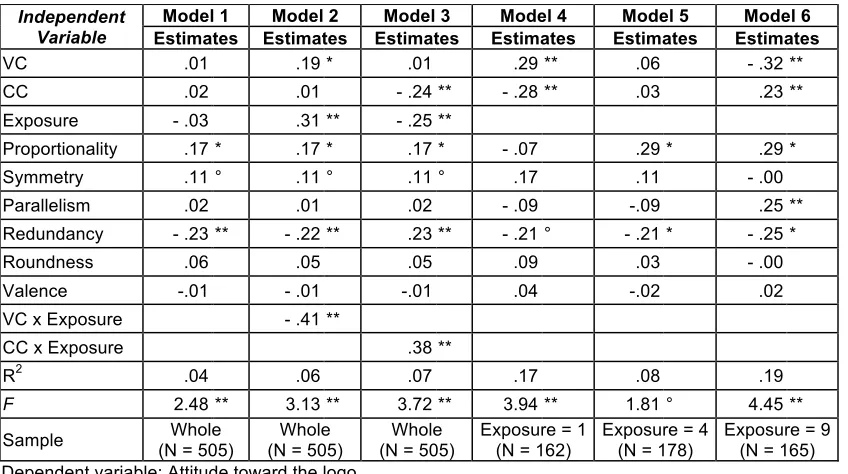
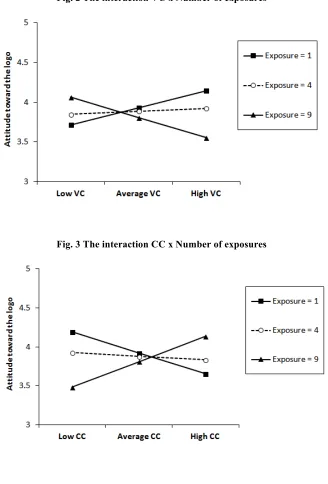
therefore all the levels of exposures. However, the interactions of VC (βVC_exposure = - .41, p <
.01) and CC (βCC_exposure = .38, p < .01) with exposures on attitude toward the logo were
significant. This evidence suggests that indeed the effects of VC and CC change across
exposures. Among control variables, proportionality has a positive effect and redundancy has
a negative effect on attitude toward the logo, whereas the positive effect of symmetry is only
marginally significant. The other control variables do not show significant effects.
Then, separate regression analyses for the three exposure conditions show that the effect
of VC is positive at one exposure (βVC_1exp = .29, p < .01), non-significant at four exposures
(βVC_4exp = .06, ns), and negative at nine exposures (βVC_9exp = - .32, p < .01). Also, the effect
of CC is negative at one exposure (βCC_1exp = - .28, p < .01), non-significant at four exposures
(βCC_4exp = .03, ns), and positive at nine exposures (βVC_9exp = .23, p < .01). Table 2
synthesizes results of regression analyses, which support H1 and H23. The two interaction
effects are graphically shown in figures 2 and 3. Considering control variables, one may
notice a consistently negative effect of redundancy on attitude toward the logo across
exposure, whereas the effect of proportionality seems to increase with multiple exposures.
Table 2 about here
Figures 2 and 3 about here
Mediation analysis
Following Zhao, Lynch, and Chen (2010), mediation tests based on bootstrap causal
analysis (with 1,000 re-samples) were conducted. Since significant effects of VC and CC at
one and nine exposures were observed, mediation analysis focused on these two sub-samples.
First, the effect of VC on attitude toward the logo across exposures via perceptual fluency
was analyzed, and conceptual fluency was considered as a rival mediator. At one exposure,
VC positively influences perceptual fluency (b = .25, p < .01). The effect of VC on
conceptual fluency is positive and marginally significant (b = .16, p < .10). The effects of
perceptual fluency (b = .49, p < .01) and conceptual fluency (b = .14, p < .05) on attitude
toward the logo are both positive and significant, while the direct effect of VC on attitude
toward the logo is not significant (b = .04, ns). The bootstrap 95% confidence interval for the
indirect effect VC à perceptual fluency à attitude toward the logo does not include zero (.03, .22). The bootstrap 95% confidence interval for the indirect effect VC à conceptual fluency à attitude toward the logo shows a lower bound close to zero (.00, .07) casting doubts about the significance of such indirect effect. As a robustness check, a test of the null
hypothesis of equality between the two indirect effects demonstrated that the indirect effect
via perceptual fluency is significantly stronger than the indirect effect via conceptual fluency
(IEvia PF = .14 IEvia CF = .03, χ2(1) = 4.75, p < .05). Therefore, it is possible to conclude that the
effect of VC on attitude toward the logo at one exposure is fully mediated by perceptual
fluency and conceptual fluency, but the mediating role of perceptual fluency is certainly more
prominent.
At nine exposures, VC negatively influences perceptual fluency (b = - .20, p < .05). The
effect of VC on conceptual fluency is not significant (b = - .07, ns). The effects of perceptual
fluency (b = .48, p < .01) and conceptual fluency (b = .16, p < .01) on attitude toward the
logo are both positive and significant, while the direct effect of VC on attitude toward the
logo is not significant (b = - .07, ns). The bootstrap 95% confidence interval for the indirect
.02). The bootstrap 95% confidence interval for the indirect effect VC à conceptual fluency
à attitude toward the logo does include zero (- .05, .02). Therefore, it is possible to conclude that the effect of VC on attitude toward the logo at nine exposure is fully mediated only by
perceptual fluency.
Then, the effect of CC on attitude toward the logo across exposures via conceptual fluency
was analyzed, and perceptual fluency was considered as a rival mediator. At one exposure,
CC negatively influences conceptual fluency (b = - .12, p < .05). The effect of CC on
perceptual fluency is negative and marginally significant (b = - .10, p < .10). The effects of
perceptual fluency (b = .49, p < .01) and conceptual fluency (b = .13, p < .05) on attitude
toward the logo are both positive and significant, while the direct effect of CC on attitude
toward the logo is negative and significant (b = - .08, p < .05). The bootstrap 95% confidence
interval for the indirect effect CC à conceptual fluency à attitude toward the logo does not include zero (- .04, - .01). The bootstrap 95% confidence interval for the indirect effect CC à
perceptual fluency à attitude toward the logo does include zero (- .10, .01). Therefore, the effect of CC on attitude toward the logo at one exposure is partially mediated only by
conceptual fluency.
At nine exposures, CC positively influences conceptual fluency (b = .17, p < .01). The
effect of CC on perceptual fluency is positive and marginally significant (b = .08, p < .10).
The effects of perceptual fluency (b = .49, p < .01) and conceptual fluency (b = .14, p < .05)
on attitude toward the logo are both positive and significant, while the direct effect of CC on
attitude toward the logo is not significant (b = .05, ns). The bootstrap 95% confidence
interval for the indirect effect CC à conceptual fluency à attitude toward the logo does not include zero (.01, .06). The bootstrap 95% confidence interval for the indirect effect CC à
effect of CC on attitude toward the logo at one exposure is fully mediated only by conceptual
fluency. Overall, consistent with the proposed conceptual analysis, the effect of VC on
attitude toward the logo is mediated by perceptual fluency, whereas the effect of CC on
attitude toward the logo is mediated by conceptual fluency.
GENERAL DISCUSSION
In their detailed review of studies on processing fluency and aesthetic pleasure, Reber et
al. (2004) suggest that complexity may sometimes be preferred because it facilitates the
understanding of a visual stimulus (Martindale, Moore, & Borkum, 1990), and that
“simplicity per se does not necessarily imply ease of processing (p. 376).” In order to account
for this evidence, previous research on aesthetics and consumer behavior (e.g., Berlyne,
1970; Janiszewski & Meyvis, 2001) has recognized that the effect of complexity on
evaluations of visual stimuli may be explained by considering both its perceptual and
conceptual aspects as potential drivers of consumer reactions. This paper proposes and tests a
conceptual model to examine how visual and conceptual dimensions of complexity may
affect brand logo evaluations at different levels of exposures. The remainder of this section
discusses implications of this research for theory and management of brand logos, as well as
limitations of the study and directions for future research.
Implications for brand logo theory
Following the direction of a research stream exploring the relation between perceptual and
conceptual constructs, as well as the related types of processing (Lee & Labroo, 2004; Labroo
elements by showing that the effects of VC and CC on consumer attitude depend on the
number of exposures and follow opposite patterns. While previous studies have analyzed
different dimensions of complexity at a single exposure or specific forms of complexity with
multiple exposures, this research shows that it is important to take into account both
dimensions of complexity in single/multiple exposure studies. Indeed, breaking through
complexity appears crucial as the effects of the two dimensions are different across
exposures, and ignoring (or not controlling for) the two-faceted nature of complexity may
lead to biased conclusions. Particularly, treating complexity as a general concept may prevent
to separate perceptual and meaning-based sources of complexity effects, whereas focusing on
a specific dimension of complexity without controlling for the other one may lead to biased
inference on the extent to which stimuli vary non-randomly over the uncontrolled dimension
of complexity.
Results also show that the effect of VC on logo evaluations is driven by perceptual
fluency. Differently, the effect of CC on logo evaluations is driven by conceptual fluency. As
a matter of fact, this study is a first attempt to analyze how the relationship between exposure
and evaluations of visual stimuli is mediated by changes in both perceptual and conceptual
fluency. While previous research offers insights on the interaction between perceptual and
conceptual fluency at a single exposure (Lee & Labroo, 2004), this study sheds light on how
the two forms of fluency behave across exposures.
This research relates to previous studies on complexity reporting that the elaborateness of
logos, an underlying dimension gathering measures of VC, depth, and activity, has a slightly
inverted U-shaped relationship (Henderson & Cote, 1998), or a positive relationship
(Henderson et al., 2003; van der Lans et al., 2009) with consumers’ affective responses.
presented conceptual analysis and findings expand the framework of these studies by
showing how the effect of VC on attitude changes across exposures, and how such an effect
differs from that of CC.
This research also relates to the framework proposed by Janiszewski and Meyvis (2001),
but follows different theoretical and methodological directions. First, Janiszewski and Meyvis
(2001) define CC in terms of congruity between brand pictorial and brand name. Therefore,
logos are defined as mono- vs. multiple-meanings depending on the congruity vs. incongruity
between pictorial and name of the brand. Instead, this study isolates the analysis of pictorial
from that of brand name, and defines logos as conceptually simple vs. complex depending on
their ability to evoke a consensually held meaning vs. multiple meanings, irrespective of
brand names. These different conceptualizations of CC may call for different predictions on
their effects on consumer responses. Second, Janiszewski and Meyvis (2001) assess the effect
of congruity between brand pictorial and name on consumer preference for
multiple-meanings over mono-meaning logos at different levels of exposure. However, it is more
realistic to assume that individuals form attitudes toward logos than make choices between
pairs of logos. Accordingly, this research focused on attitude, rather than on choice, as the
dependent variable. Interestingly, although the dependent variable and the definition of logo
complexity are different, the findings are generally in line with the results of Janiszewski and
Meyvis’ (2001) Study 2, as mono-meaning logos are initially preferred to multi-meaning
logos, while as the number of exposures increases multi-meaning logos become relatively
preferred. On the one hand, this convergence of findings suggests that, as exposures increase,
the positive effect of CC on evaluations of visual stimuli is robust to different
operationalizations. On the other hand, the present findings are different from those of their
versa for higher number of exposures. This could be due to the fact that in their Study 2,
compared to Study 1, Janiszewski and Meyvis (2001) increased the intervals between
exposures. Although the massed exposures used in Study 1 are less comparable with the
manipulation of exposures used in the present study, the distributed exposures used in Study
2 are more consistent with the comparison between one-exposure and nine-exposure
conditions in the present study.
Implications for brand management
From a managerial perspective, this research offers insights for logo design and brand
management to maximize the favorability of consumer attitude toward brand logos. The
proposed conceptual model examines three actionable variables – VC, CC, and the number of
exposures. When creating a new logo or updating visual identity through changes in brand
elements (Muller, Kocher, & Crettaz, 2013), brand managers and designers can control, to a
large extent, the levels of VC and CC of their logos. The number of exposures to logos can be
managed by companies in several contexts, such as that of paid advertising campaigns, in
which companies try to reach a target number of exposures. The present findings mainly
apply to these cases. In particular, managers and designers can use the results of this research
to determine the ideal 1) levels of logo VC and CC, given the intended number of exposures,
and 2) number of exposures to logos, given fixed levels of logo VC and CC.
Considering the relationship between the number of exposures and the promotional budget
(Henderson & Cote, 1998), some companies need to leverage on logo complexity given a
fixed level of exposure that they can afford. In the attempt to translate the experimental
setting in the real world, it is possible to consider the high and low levels of the manipulation
largely-exposed (9/9 exposure) logos, respectively. In turn, one can assume that slightly-largely-exposed
logos and largely-exposed logos are related to limited and larger promotional budgets,
respectively. In these scenarios, companies may try to maximize their return on
communication in terms of attitude favorability by leveraging on logo VC and CC.
Companies that rely on small budgets for the promotion of their brand logo may need to
maximize the return of their effort within a small number of exposures. Based on the present
findings, it is possible to recommend that these companies design logos with high levels of
VC and low levels of CC.For example Skyscanner, a web search engine for travel services,
has recently changed its old logo, characterized by low-VC and high-CC, with a new logo
featuring higher VC and lower CC.
This logo modification seems to be consistent with the present findings and
recommendations. Although the new logo is more visually complex, it could create a more
pleasing sensation in the beholder as its meaning is easily interpretable even without
extensive exposure. This goal is also pursued in the specific versions of the logo used for
related businesses, as shown in the following logos belonging to the same company. Skyscanner old logo Skyscanner
The Conservation International Foundation is a nonprofit environmental organization with
headquarters in Virginia, which can rely on lower levels of exposure than other, more famous
nonprofit organizations (e.g., Greenpeace, WWF). The Foundation has recently changed its
logo:
While the old logo – which features high VC and low CC – would have performed better
with limited exposure, the new logo – which shows a significant shift towards low VC and
high CC – requires more exposures to produce more favorable consumer attitude. According
to the findings, this strategy may jeopardize attitude toward the logo, unless the Foundation
managers are not planning to expand the logo exposure through promotional investments. Conservation International Foundation old logo Conservation International Foundation new logo Skyscanner
Companies that rely on larger budgets can reach a higher number of exposures for their
logos. For these companies, lower levels of VC and higher levels of CC are recommendable.
For example, the replacement of the U.K. Conservative Party’s torch (i.e., a high-VC/low-CC
logo) with a new logo in 2006, characterized by lower VC and higher CC (it could be
interpreted as a tree, a cloud, a doodle) seems to be an appropriate logo re-design strategy
given a large promotional budget.
Similarly, Caribou Coffee, the second largest U.S.A. coffee and espresso retailer, seems to
have chosen an appropriate logo re-design strategy if supported by a large promotional
budget. The old logo was characterized by high-VC and low-CC, while the new logo has
lower levels of VC and, at the same time, higher levels of CC. In the new logo, the reindeer
is, in fact, much more stylized and susceptible to multiple interpretations.
Interestingly, low-VC and high-CC logos appear to be also more suitable from a brand
extension perspective (Broniarczyk & Alba, 1994). Visually simple and conceptually UK Conservative Party
old logo
UK Conservative Party new logo Caribou Coffee
old logo
category. Perceptually simpler and conceptually complex logos may therefore meet the level
of abstraction required for brands that are extended across product categories and are related
to more general brand personality dimensions (Aaker, 1997) rather than to more concrete
product features. Accordingly, these logos can benefit from exposures cumulated across
different product categories.
There are situations, however, in which companies may have difficulty in changing the
complexity of their logos. For instance, short-run constraints and trademark concerns may
preclude modifications to logo complexity aimed at obtaining favorable reactions in specific
exposure conditions. In such cases, our results may help to define the ideal level of exposure
to be sought given fixed levels of VC and CC featured by the logo. Logos featuring high
levels of VC and low levels of CC benefit the most from slight exposure, whereas, logos
featuring low levels of VC and high levels of CC benefit the most from higher levels of
exposure. Since a certain promotional budget can be invested either on increasing the reach
(i.e., the number of individuals exposed to the brand) or the frequency (i.e., the number of
exposures per individual; Kotler & Keller, 2010) of a message, this research proposes that
companies with high-VC and low-CC logos should aim at enlarging the scope of their
promotional effort by increasing the reach. For example, consider the following
high-VC/low-CC logo used by a take-away pizza chain from San Francisco: Pick a Pizza
Based on the present findings, and assuming a fixed promotional budget, the company
owning this logo should rather leverage on reach by expanding the scope of the campaign and
media impact, keeping exposure to lower levels.
Instead, companies with low-VC and high-CC logos should invest in increasing the
number of exposures by raising the frequency rather than the reach of their messages.
Less perceptually complex, more abstract logos, such as Almirall’s (a Spanish
pharmaceutical company),
would indeed require a higher number of exposures to obtain more favorable evaluations.
Accordingly, Almirall’s promotional budget should be devoted more to increase the
frequency or their messages rather than the reach.
As previously mentioned, the present findings apply more readily to cases in which
companies can control the number of exposures to the logo. In other contexts, companies
have limited control over the number of exposures as consumers are incidentally exposed to
logos featured on packages, products, guerrilla marketing, and other informal media (e.g.,
McQuarrie & Mick, 2003). Although the present guidelines are less applicable in these
contexts, companies may still have some degree of control on the level of exposure to their
logos by managing brand logo prominence (Han, Nunes, & Drèze, 2010). This concept refers
to the extent to which brand signs are visible on products and other marketing stimuli. By
increasing visibility, logo prominence enhances the likelihood that consumers are exposed to
that logo. Consequently, based on the reported findings one may speculate that high-VC and Almirall
low-CC logos – which are favored by lower levels of exposure – may benefit from reduced
prominence, whereas low-VC and high-CC logos – which are favored by higher levels of
exposure – may benefit from increased prominence. Consistent with this idea, French fashion
company Hermes uses a high-VC and low-CC logo, which is often reported onto products in
small scale dimension, thus featuring low prominence and maintaining low levels of
incidental or informal exposure.
Instead, Nike, which employs a low-VC/high-CC logo, tends to leverage strongly on brand
prominence by marking their merchandise with loud signs, thus increasing informal
exposures to their logos.
Limitations and directions for future research
This research has some limitations that may provide opportunities for future research.
First, the proposed analysis focuses on black-and-white, picture-only stimuli, and therefore
does not take into account colors, name, and brand identity. Although such focus may be a
limit to the external validity of results because the experimental stimuli are less realistic, it
allowed to control for the visual clutter of the images (i.e., the level of detail in color,
luminance, and edges, see Rosenholtz, Li, & Nakano, 2007), granting greater internal
validity. Future research may want to extend the present framework by including additional
visual elements. Second, the analysis focuses on complexity but excludes from the conceptual Hermes
However, several dimensions that previous research has related to fluency-based effects
(proportionality, symmetry, parallelism, redundancy, and roundness) were measured and
controlled for. Having assessed the effects of visual and conceptual complexity by controlling
for these dimensions allows to interpret the results confidently. Finally, this paper presents
results of a single study. Despite such limitation, the conducted hybrid experimental study
employs a large sample and was designed to ensure adequate manipulations of exposures and
measurement of focal independent variables (considering 300 potential conditions). Also, the
collection of data from multiple sources should prevent common method bias, thus offering
further confidence in the stability of results.
Although disciplines such as aesthetics and semiotics have provided relevant directions on
basic aspects of the relations between signs and related meanings (e.g., Berlyne, 1970; Mick,
1986), there is still a need for further exploration of how these elements act as determinants
of individuals’ responses across exposures. This research contributes to the debate on these
issues and proposes insights on the idea of “simplicity in complexity” discussed in the
aesthetics literature (Dickie, 1997; Gombrich, 1984). That is, stimuli that feature complex
themes presented in an accessible way may receive favorable evaluations. Managing both
visual and conceptual complexity and taking into account the number of exposures to a logo
may allow companies to concretely embody simplicity in complexity in a brand logo, in order
Reference List
Aaker, J. L. (1997). Dimensions of brand personality. Journal of Marketing Research, 34(3)
347-356.
Bennett, P.D. (1995). Dictionary of Marketing Terms. Lincolnwood, IL: NTC Business
Books.
Berinsky, A. J., Huber, G. A., & Lenz, G. S. (2012). Evaluating online labor markets for
experimental research: Amazon.com’s Mechanical Turk. Political Analysis, 20, 351–
368.
Berlyne, D.E. (1970). Novelty, complexity and hedonic value. Perception and
Psychophysics, 8, 279-286 (November).
Berlyne, D. E. (1974). Studies in the new experimental aesthetics: Steps toward an objective
psychology of aesthetic appreciation. Washington D.C.: Hemisphere Publishing
Corporation.
Blaxton, T.A. (1989). Investigating dissociations among memory recognition memory:
Applications to dementia and amnesia. Journal of Experimental Psychology. Learning,
Memory, and Cognition, 15(4), 657-668.
Bornstein, R.F., & D’Agostino, P.R. (1992). Stimulus recognition and the mere exposure
effect. Journal of Personality and Social Psychology, 63(4), 545-552.
Bornstein, R. F., & D'Agostino, P. R. (1994). The attribution and discounting of perceptual
fluency: Preliminary tests of a perceptual fluency/attributional model of the mere
exposure effect. Social Cognition, 12(2), 103-128.
Broniarczyk, S.M., & Alba, J.W. (1994). The importance of the brand in brand extension.
Butterfield, G.B., & Butterfield, E.C. (1977). Lexical codability and age. Journal of Verbal
Learning and Verbal Behavior, 16, 113-118 (February).
Cabeza, R. & Ohta, N. (1993). Dissociating conceptual priming, perceptual priming, and
explicit memory. European Journal of Cognitive Psychology, 5, 35-53 (March).
Clore, G.L., Wyer, R.S., Dienes, B., Gasper, K., Gohm, C., & Isbell, L. (2001). Affective
Feelings as Feedback: Some Cognitive Consequences. In Handbook of Social Cognition:
A User's Guidebook, L. L. Martin and G. L. Clore, eds., Mahwah, NJ: Erlbaum.
Dickie, G. (1997). Introduction to aesthetics. Oxford, England: Oxford University Press.
Garner, W.R. (1974). The processing of information and structure. New York: Lawrence
Erlbaum Associates.
Gombrich, E.H. (1984). A sense of order (2nd ed.). London: Phaidon.
Hamann, S.B. (1990). Level of processing effects in conceptually driven implicit tasks.
Journal of Experimental Psychology: Learning, Memory, and Cognition, 16, 970-977
(November).
Han, Y. J., Nunes, J. C., & Drèze, X. (2010). Signaling status with luxury goods: the role of
brand prominence. Journal of Marketing, 74(4), 15-30.
Henderson, P.W., & Cote, J.A. (1998). Guidelines for selecting or modifying logos. Journal
of Marketing, 62(2), 14-30.
Henderson, P.W., Cote, J.A., Leong S.M., & Schmitt B. (2003). Building Strong Brands in
Asia: Selecting the Visual Components of Image to Maximize Brand Strength.
International Journal of Research in Marketing, 20, 297–313.
Higgins, E.T. (1998). The Aboutness Principle: A Pervasive Influence on Human Inference.
Horton, J. J., Rand, D. G., & Zeckhauser, R. J. (2011). The online laboratory: Conducting
experiments in a real labor market. Experimental Economics, 14, 399–425.
Jacoby, L.L., & Dallas, M. (1981). On the Relationship Between Autobiographical and
Perceptual Learning. Journal of Experimental Psychology: General, 110, 306-40
Jacoby, L.L., Kelley C.M., & Dywan J. (1989). Memory Attribution. In Varieties of memory
and consciousness: Essays in honour of Endel Tulving, ed. H. L. Roediger and F. I. M.
Craik, Hillsdale, NJ: Lawrence Erlbaum Associates, 391-422.
Janiszewski, C., & Meyvis, T. (2001). Effects of brand logo complexity, repetition, and
spacing on processing fluency and judgment. Journal of Consumer Research, 28(1),
18-32.
Keller, K. L. (1998). Strategic brand management. Upper Saddle River: Prentice Hall.
Keller, K.L., & Lehmann, D.R. (2006). Brands and branding: Research findings and future
priorities. Marketing Science, 25(6), 740-759.
Kosslyn, S. (1975). Information representation in visual images. Cognitive Psychology, 7,
341-370.
Kotler, P., & Keller, K. L. (2010). Marketing Management, 14th edition, Upper Saddle River:
Prentice Hall.
Labrecque, L. I., Patrick, V. M., & Milne, G. R. (2013). The marketers’ prismatic palette: A
review of color research and future directions. Psychology & Marketing, 30(2), 187-202.
Labroo, A.A., Dhar, R., & Schwarz, N. (2008). Of frog wines and frowning watches:
Semantic priming, perceptual fluency, and brand evaluation. Journal of Consumer
Research, 34, 819-831 (April).
Lachman, R. (1973). Uncertainty effects on time to access the internal lexicon. Journal of
Lachman, R., Shaffer, J.P., & Hennrikus, D. (1974). Language and cognition: Effects of
stimulus codability name-word frequency and age of acquisition on lexical reaction time.
Journal of Verbal Learning and Verbal Behavior, 13, 613-625 (December).
Lee, A.Y. (2002). Effects of implicit memory on memory-based versus stimulus-based brand
choice. Journal of Marketing Research, 39, 440-454 (November).
Lee, A.Y., & Labroo, A.A. (2004). The effect of conceptual and perceptual fluency on brand
evaluation. Journal of Marketing Research, 41, 151-165.
Martindale, C., Moore, K., & Borkum, J. (1990). Aesthetic preference: Anomalous findings
for Berlyne’s psychobiological theory. American Journal of Psychology, 103, 53-80.
Mason, W., & Suri, S. (2012). Conducting behavioral research on Amazon’s Mechanical
Turk. Behavior Research Methods, 44, 1–23.
Maxian, W., Bradley, S. D., Wise, W., & Toulouse, E. N. (2013). Brand Love is in the Heart:
Physiological Responding to Advertised Brands. Psychology & Marketing, 30(6),
469-478.
McQuarrie, E. F., & Mick, D. G. (2003). Visual and verbal rhetorical figures under directed
processing versus incidental exposure to advertising. Journal of Consumer Research,
29(4), 579-587.
Mick, D.G. (1986). Consumer research and semiotics: Exploring the morphology of signs,
symbols, and significance. Journal of Consumer Research, 13, 196-213 (September).
Muller, B., Kocher, B. & Crettaz, A. (2013). The effects of visual rejuvenation through brand
logos. Journal of Business Research, 66(1), 82-88.
Oliva, A. (2005). Gist of the scene. In L. Itti, G.Rees, and J.K. Tsotsos (Eds.), Neurobiology
Palmer, S.E. (1999). Vision science: Photons to phenomenology. Cambridge, MA: A
Bradford Book.
Paolacci, G., & Chandler, J. (2014). Inside the Turk: Understanding Mechanical Turk as a
Participant Pool. Current Directions in Psychological Science, 23: 184-188.
Paolacci, G., Chandler, J., & Ipeirotis, P. G. (2010). Running experiments on Amazon
Mechanical Turk. Judgment and Decision Making, 5, 411–419.
Park, H. J., & Rabolt, N. J. (2009). Cultural value, consumption value, and global brand
image: A cross-‐national study. Psychology & Marketing, 26(8), 714-735.
Perussia, F. (1988). Semiotic frame: A method for the experimental analysis of images.
Psychological Reports, 63, 524-526.
Pieters, R., & Wedel, M. (2008). Informativeness of eye movements for visual marketing. Six
cornerstones. In Wedel, M. and Pieters, R. (Eds.), Visual marketing. From attention to
action (pp. 43-71). New York, NY: Lawrence Erlbaum Associates.
Podsakoff, P.M., MacKenzie, S.B., Lee, J.Y., & Podsakoff N.P. (2003). Common method
biases in behavioral research: A critical review of the literature and recommended
remedies. Journal of Applied Psychology, 88(5): 879-903.
Quinlan, P.T. (2003). Visual feature integration theory: Past, present and future.
Psychological Bulletin, 129, 643-673.
Reber, R., Schwarz, N., & Winkielman, P. (2004). Processing fluency and aesthetic pleasure:
Is beauty in the perceiver’s processing experience? Personality and Social Psychology
Review, 8(4), 364-382.
Rodewald, H.K., & Bosma, L.F. (1972). Information transmission in brief exposures as a
Rosenholtz, R., Li, Y., & Nakano, L. (2007). Measuring visual clutter. Journal of Vision,
7(2), 1-22.
Schulz, R.W., & Lovelace, E.A. (1964). Meaningfulness and the associative phase of
paired-associate learning: A methodological consideration. Psychonomic Science, 1, 37-38.
Schwarz, N., & Clore, G.L. (1990). Feelings and phenomenal experiences. In E. T. Higgins &
A. Kruglanski (Eds.), Social psychology: Handbook of basic principles (pp. 433-465).
New York: Guilford.
Shapiro, S. (1999). When an Ad’s Influence is beyond our Conscious Control: Perceptual and
Conceptual Fluency Effects Caused by Incidental Exposure. Journal of Consumer
Research, 26 (June), 16-36.
Shimp, T.E. (2010). Advertising promotion and other aspects of integrated marketing
communications, 8th Edition. Mason, OH: South-Western Cengage Learning.
Smith, E.E., & Egeth, H. (1966). Effects of association value on perceptual search. Journal of
Experimental Psychology, 71, 687-690.
Stafford, T., & Grimes, A. (2012). Memory Enhances the Mere Exposure Effect. Psychology
& Marketing, 29(12), 995-1003.
Tulving, E., & Schacter, D.L. (1990). Priming and human memory systems. Science, 247,
301-306.
Van der Lans, R., Cote, J. A., Cole, C. A., Leong, S. M., Smidts, A., Henderson, P. W.,
Bluemelhuber, C., Bottomley, P. A., Doyle, J. R., Fedorikhin, A., Moorthy, J.,
Ramaseshan, B., & Schmitt, B.H. (2009). Cross-national logo evaluation analysis: An
individual-level approach, Marketing Science, 28(5), 968-985.
Whittlesea, B.W.A. (1993). Illusions of Familiarity. Journal of Experimental Psychology:
Winkielman, P. & Cacioppo J.T. (2001). Mind at Ease Puts a Smile on the Face:
Psychophysiological Evidence That Processing Facilitation Elicits Positive Affect.
Journal of Personality and Social Psychology, 81(6), 989-1000.
Winkielman, P., Schwarz, N., Fazendeiro, T. & Reber, R. (2003). The Hedonic Marking of
Processing Fluency: Implications for Evaluative Judgment, in The Psychology of
Evaluation: Affective Processes in Cognition and Emotion, edit by Musch, J. and Klauer,
K.C., Mahwah, NJ: Erlbaum, 189-217.
Wu, P. F. (2013). In Search of Negativity Bias: An Empirical Study of Perceived Helpfulness
of Online Reviews. Psychology & Marketing, 30(11), 971-984.
Zajonc, R.B. (1968). Attitudinal effects of mere exposure. Journal of Personality and Social
Psychology Monograph Supplement, 9, 1-27.
Zhao, Xinshu, Jr. John G. Lynch, & Qimei Chen (2010). Reconsidering Baron and Kenny:
Myths and Truths About Mediation Analysis. Journal of Consumer Research, 37(2),
TABLES
Table 1 Descriptive statistics and correlations
Mean SD 1 2 3 4 5 6 7 8 9 10 11 12 1. Attitudea 3.88 1.44 1.00
2. VCa 3.74 1.44 .01 1.00 3. CCb 3.62 2.76 .03 .08 1.00 4. Exposurec 4.67 3.26 -.03 .02 .02 1.00 5. Proportionalitya 3.41 1.55 .09* .01 .06 -.02 1.00 6. Symmetrya 4.08 1.65 .08 -.26** .00 -.05 .60** 1.00 7. Parallelisma 2.71 1.24 .03 .50** .06 -.01 .12** -.04 1.00 8. Redundancya 3.01 1.14 -.07 -.06 .00 -.04 .61** .49** .04 1.00 9. Roundnessa 3.34 1.12 .01 .12** .03 .00 -.20** -.31** .06 -.09 1.00 10. Valenced 5.74 14.52 .07 .22** .08 .01 .15** .15** .06 -.12** .04 1.00 11. Perceptual Fluencya 3.93 1.71 .68** .08 .02 .02 .09* .07 .08 -.07 -.03 .05 1.00 12. Conceptual Fluencya 2.95 1.51 .39** .00 .08 .08 .10* .14** .06 .00 .11* .15** .37** 1.00 * p < .05, ** p < .01; a 7-point scale, b count measure of associated meanings, c experimental conditions (1, 4, and 9 exposures), d index formed aggregating valence scores (-1, 0, +1) to associated meanings (min = - 23, max = 38)
Table 2 Results of regression analyses
Independent Variable
Model 1 Model 2 Model 3 Model 4 Model 5 Model 6 Estimates Estimates Estimates Estimates Estimates Estimates
VC .01 .19 * .01 .29 ** .06 - .32 ** CC .02 .01 - .24 ** - .28 ** .03 .23 ** Exposure - .03 .31 ** - .25 ** Proportionality .17 * .17 * .17 * - .07 .29 * .29 * Symmetry .11 ° .11 ° .11 ° .17 .11 - .00 Parallelism .02 .01 .02 - .09 -.09 .25 ** Redundancy - .23 ** - .22 ** .23 ** - .21 ° - .21 * - .25 * Roundness .06 .05 .05 .09 .03 - .00 Valence -.01 - .01 -.01 .04 -.02 .02 VC x Exposure - .41 **
CC x Exposure .38 **
R2 .04 .06 .07 .17 .08 .19
F 2.48 ** 3.13 ** 3.72 ** 3.94 ** 1.81 ° 4.45 **
Sample (N = 505) Whole (N = 505) Whole (N = 505) Whole Exposure = 1 (N = 162) Exposure = 4 (N = 178) Exposure = 9 (N = 165) Dependent variable: Attitude toward the logo
[image:40.595.88.512.419.656.2]FIGURES
Fig. 2 The interaction VC x Number of exposures