City, University of London Institutional Repository
Citation
:
McNaughton, N. and Corr, P. J. (2014). Approach, avoidance, and their conflict:
the problem of anchoring. Frontiers in Systems Neuroscience, 8, p. 124. doi:
10.3389/fnsys.2014.00124
This is the published version of the paper.
This version of the publication may differ from the final published
version.
Permanent repository link:
http://openaccess.city.ac.uk/5141/
Link to published version
:
http://dx.doi.org/10.3389/fnsys.2014.00124
Copyright and reuse:
City Research Online aims to make research
outputs of City, University of London available to a wider audience.
Copyright and Moral Rights remain with the author(s) and/or copyright
holders. URLs from City Research Online may be freely distributed and
linked to.
City Research Online:
http://openaccess.city.ac.uk/
[email protected]
Approach, avoidance, and their conflict: the problem of
anchoring
Neil McNaughton1* and Philip J. Corr2
1Department of Psychology and Brain Health Research Centre, University of Otago, Dunedin, New Zealand 2
Department of Psychology, City University London, London, UK *Correspondence: [email protected]
Edited by:
Daniela Laricchiuta, IRCCS Santa Lucia Foundation, Italy
Reviewed by:
Luke D. Smillie, The University of Melbourne, Australia
Keywords: approach, avoidance, conflict, personality, biomarkers, anchoring
To understand the neurobiology of indi-vidual differences in approach and avoid-ance behavior, we must anchor constructs at the behavioral level to the long-term global sensitivities of the neural systems that give rise to the observed stable pat-terns of behavior. We will argue that this requires not only appropriate data at both the neural and behavioral levels but also appropriate account to be taken of inter-actions at the intervening level of the conceptual nervous system (Hebb, 1949; Gray, 1975). In particular, in accounting for approach and avoidance behavior we must include consideration of the distinc-tion between valuadistinc-tion and motivadistinc-tion (Corr and McNaughton, 2012), of inter-actions between the approach system and the avoidance system (Gray and Smith, 1969), and of their interaction with a dis-tinct additional system that is activated by approach-avoidance conflict (Gray, 1977; summarized inCorr, 2013).
But first we need to ask why would we expect there to be traits linked to global approach and avoidance systems? Simple animals (with little or no brain) can pro-duce approach and avoidance behavior (toward benefits and ultimately reproduc-tion; and away from dangers and ulti-mately failure to reproduce) via multiple independent rules of thumb (Krebs et al., 1983). But we can expect more com-plex brains to have largely integrated these simple elements into systems more gen-erally dedicated to approach or avoid-ance “because this is how [a few] genes can build a complex system that will produce appropriate but flexible behav-ior to increase fitness. . . . Rather than
just pre-programmed movements such as tropisms and taxes, . . . if the genes are effi-ciently to control behavior . . . they must specify the goals for action” (Rolls, 2000, pp. 183, 190). Together with the evolution of general approach and avoidance systems that are not tied to any specific motivat-ing stimulus (reinforcer), we would expect evolution of the long-term adaptive con-trol of their overall sensitivity to adequate inputs. Such stable sensitivity would be the neurobiological basis of approach and avoidance personality traits.
Determining the appropriate neurobi-ological measure for the sensitivity of a highly evolved approach or avoidance sys-tem is not simple. These syssys-tems have hierarchically organized neural levels with processing ranging from “quick and dirty” to “slow and sophisticated” for both perception (LeDoux, 1994) and action (Graeff, 1994, 2010). Sensitivity to input determines which level of the system is activated and so sensitivity cannot reside in any one of the modules within the sys-tem (McNaughton and Corr, 2004). The source of any sensitivity must, therefore, be identified independently—in essence requiring at least a preliminary surface level description of traits.
Existing theories of personality pro-vide a number of competing surface level, lexically-derived, systems with trait mea-sures that relate to approach and avoid-ance either indirectly via constructs such as Extraversion and Neuroticism (Eysenck, 1957) or directly via constructs such as Harm Avoidance (Cloninger et al., 1993). Each system is stable, with links to mental disorder (Strelau and Zawadzki,
McNaughton and Corr Anchoring approach and avoidance sensitivity
The plethora of competing trait scales can to some extent be encompassed by just five major trait dimensions that include both normal people and those with psy-chiatric disorders (Markon et al., 2005; Revelle et al., 2011; Krueger et al., 2012). However, the traits of the competing sys-tems have complex relations to these five large scale dimensions and it is open to question whether there are five funda-mental dimensions or whether these are complex facets riding on two or even just one major dimension of personality (Markon et al., 2005; DeYoung et al., 2007; Rushton and Irwing, 2009). These large scale dimensions have “facets” that poten-tially represent the true underlying sources of personality; and different “approaches differ substantially in the number and nature of the facets they propose, indicat-ing that further conceptual and empirical work is needed to achieve a consen-sual specification of the Big Five factors at lower levels of abstraction. [Further], given that the Big Five were derived ini-tially from analyses of the personality lex-icon, one might wonder whether they merely represent linguistic artifacts” (John et al., 2008, p 141). With no “bottom up” neural anchor to definitely locate the correct rotation of any true biological trait/facet axis, there is no unequivocal way to unify the various systems currently in use.
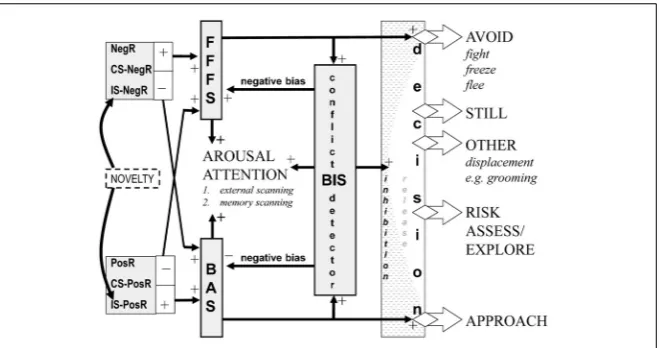
[image:3.595.221.551.60.234.2]A related problem, on which we focus below, is that the bulk of personality research has required statistical indepen-dence (orthogonality) of the extracted factors. To do otherwise would greatly increase the already large number of alter-native trait solutions for any particular item space. However, as we will see, there is good reason to see surface level behavior as being determined interactively even if the biological control of the underlying sen-sitivities is independent. Likewise, even if the control of factors is neurally indepen-dent, when one, e.g., neuroticism, is a risk factor for another, e.g., anxiety (Andrews et al., 1990), then they will become statis-tically linked in the population as a result. The solution for approach/avoidance traits is to anchor their factor spaces to measures derived from existing neural state theory. Figure 1 is derived from one particular detailed neuropsycho-logical theory (Gray and Smith, 1969;
FIGURE 1 | Overall relation of approach (BAS), avoidance (FFFS=fight, freeze, flee), and conflict (BIS=behavioral inhibition) systems—an updated model.The inputs to the system are classified in terms of the delivery (+) or omission (−) of primary positive reinforcers (PosR) or primary negative reinforcers (NegR) or conditional stimuli (CS) or innate stimuli (IS) that predict such primary events. The BIS is activated when it detects approach-avoidance conflict—suppressing prepotent responses and eliciting risk assessment and displacement behaviors. The systems interact in a variety of ways to generate behavior, see text. The shaded areas are all points at which traits appear to operate. Figure and legend modified fromGray and McNaughton (2000)andCorr
and McNaughton (2012).
Gray, 1982; Gray and McNaughton, 2000; McNaughton and Corr, 2004; Corr and McNaughton, 2012) but its system level description captures issues that must be taken into account by any approach/avoidance account of personal-ity. Adequate stimuli (reinforcers) must first be valued and, importantly, nega-tive stimuli (e.g., losses) have a higher exchange rate that positive ones (e.g., gains); that is, people usually show loss aversion (Kahneman and Tversky, 1979).
Any specific positive or negative rein-forcer can produce approach or avoidance depending on its contingency (presenta-tion or omission) with responding. For any given reinforcer, the motivational sen-sitivity of approach activation is differ-ent from avoidance activation; and these are separate from the distinct valuation sensitivities of gain to loss (Hall et al., 2011). The strength of response output for any given level of approach activation also depends on distance from the goal (not shown inFigure 1) and does so to a lesser extent than does avoidance (Miller, 1944). Even with independent trait sensitiv-ities, state approach output depends on the level of avoidance activation, and vice versa: their activations sum to gen-erate arousal, while subtracting to deter-mine choice—giving rise to phenomena
such as behavioral contrast and peak shift (Gray and Smith, 1969). As a result, when approach and avoidance are strongly and equally activated, arousal is high but the probability of both approach and avoid-ance is low; in addition, the approach-avoidance conflict is detected by a third system (with its own trait sensitivity) that is unlike either pure approach or pure avoidance (withdrawal) in being affected by anxiolytic drugs (Gray, 1977). Both approach and avoidance are then inhib-ited and replaced by behaviors such as risk assessment (Gray and McNaughton, 2000) and displacement (Hinde, 1998), while arousal and negative bias (risk aversion) are increased. With this plethora of inter-actions, it will be difficult to extract true approach and avoidance traits from the surface structure of behavior—especially if orthogonal factors such as gain and approach have been conflated in a sin-gle construct such as reward (Corr and McNaughton, 2012).
traits within the conventional factor spaces and determine non-orthogonalities. Paradoxically, we are closest to achiev-ing this with the most embedded neural construct: sensitivity to conflict. The argu-ment for the use of primarily neural rather than questionnaire measures of approach and avoidance sensitivities has been made in detail previously—coupled with arguments for combining bottom up neural analysis with top down behav-ioral analysis (Smillie, 2008a,b; DeYoung, 2010). Here, we would emphasize, in addi-tion, that the choice of neural measures should be strongly theoretically based and behaviorally and or pharmacologi-cally validated in relation to the theory. Otherwise a plethora of questionnaires becomes a plethora of putative neural measures.
The conflict system is defined by the action of anxiolytic drugs (Gray, 1977) acting on receptors for endogenous com-pounds (Guidotti et al., 1978; Polc, 1995) that could mediate the system’s trait sen-sitivity. Anxiolytic action is specifically linked to hippocampal rhythmicity in rodents (Woodnorth and McNaughton, 2002; McNaughton et al., 2006, 2007) and this has led to development of a human scalp EEG homolog (McNaughton et al., 2013) that provides a biomarker for con-flict sensitivity in humans. This biomarker appears to be linked to the shared vari-ance in neuroticism and trait anxiety much more than either of their unique variances (Neo et al., 2011).
In summary, we believe that approach and avoidance systems have evolved in such a way that global control of sen-sitivities to gain, loss, approach, avoid-ance and conflict can underlie human personality traits (Corr and McNaughton, 2012). While each of these long-term sen-sitivities is likely to be controlled inde-pendently, under normal ecological cir-cumstances short-term behavioral output will be the result of complex interac-tions between them (Figure 1). However, the combination of appropriate neural measures with designs that dissect these interactions should provide the means to anchor trait measures in the data spaces that personality research has already shown have long term stability and impor-tant behavioral, and particularly psychi-atric, consequences. Critically, the factor
analysis of lexically-derived variables at the surface level of description cannot be assumed to reflect the deeper construct processes that are giving rise to surface descriptions; and no adjustment of the basic factor analysis method can avoid the problem created when there is no neural anchor to ensure inclusion of correct items and unique rotational solution after initial factoring.
REFERENCES
Andrews, G., Stewart, G., Morris-Yates, A., Holt, P., and Henderson, S. (1990). Evidence for a general neurotic syndrome.Br. J. Psychiatry157, 6–12. doi: 10.1192/bjp.157.1.6
Carver, C. S., and White, T. L. (1994). Behavioral inhibition, behavioral activation, and affective responses to impending reward and punishment: the BIS/BAS scales. J. Pers. Soc. Psychol. 67, 319–333. doi: 10.1037/0022-3514.67.2.319 Cloninger, C. R., Svrakic, D. M., and Przybecky, T. R.
(1993). A psychobiological model of temperament and character.Arch. Gen. Psychiatry50, 975–990. doi: 10.1001/archpsyc.1993.01820240059008 Corr, P. J. (2013). Approach and avoidance behavior:
multiple systems and their interactions.Emot. Rev.
5, 286–291. doi: 10.1177/1754073913477507 Corr, P. J., and McNaughton, N. (2008).
“Reinforcement sensitivity theory and person-ality,” inThe Reinforcement Sensitivity Theory of Personality, ed P. J. Corr (Cambridge: Cambridge University Press), 155–187.
Corr, P. J., and McNaughton, N. (2012). Neuroscience and approach/avoidance personality traits: a two stage (valuation-motivation) approach.
Neurosci. Biobehav. Rev. 36, 2339–2354. doi:
10.1016/j.neubiorev.2012.09.013
DeYoung, C. G. (2006). Higher-order factors of the Big Five in a multi-informant sample. J. Pers.
Soc. Psychol. 91, 1138–1151. doi:
10.1037/0022-3514.91.6.1138
DeYoung, C. G. (2010). Personality neuroscience and the biology of traits. Soc. Pers. Psychol.
Compass4, 1165–1180. doi: 10.1111/j.1751-9004.
2010.00327.x
DeYoung, C. G., Hirsh, J. B., Shane, M. S., Papademetris, X., Rajeevan, N., and Gray, J. R. (2010). Testing predictions from personal-ity neuroscience.Psychol. Sci. 21, 820–828. doi: 10.1177/0956797610370159
DeYoung, C. G., Quilty, L. C., and Peterson, J. B. (2007). Between facets and domains: ten aspects of the big five.J. Pers. Soc. Psychol.93, 880–896. doi: 10.1037/0022-3514.93.5.880
Elliot, A. J., and Thrash, T. M. (2010). Approach and avoidance temperament as basic dimensions of personality.J. Pers.78, 865–906. doi: 10.1111/j. 1467-6494.2010.00636.x
Eysenck, H. J. (1957).The Dynamics of Anxiety and Hysteria.New York, NY: Preger.
Gardini, S., Cloninger, C. R., and Venneri, A. (2009). Individual differences in personality traits reflect structural variance in specific brain regions.Brain Res. Bull.79, 265–270. doi: 10.1016/j.brainresbull.2009.03.005
Gomez, R., Woodworth, R., Waugh, M., and Corr, P. J. (2012). Attention-deficit/hyperactivity dis-order symptoms in an adult sample: associa-tions with Cloninger’s temperament and character dimensions.Pers. Individ. Dif.52, 290–294. doi: 10.1016/j.paid.2011.10.015
Graeff, F. G. (1994). Neuroanatomy and neuro-transmitter regulation of defensive behaviors and related emotions in mammals.Braz. J. Med. Biol. Res.27, 811–829.
Graeff, F. G. (2010). “Human fear and anxiety,” in
Encyclopedia of Behavioral Neuroscience, eds G. F. Koob, M. Le Moal, and R. F. Thompson (Oxford: Academic Press), 70–75.
Gray, J. A. (1970). The psychophysiological basis of introversion- extraversion. Behav. Res. Ther. 8, 249–266. doi: 10.1016/0005-7967(70)90069-0 Gray, J. A. (1975).Elements of a Two-Process Theory of
Learning.London: Academic Press.
Gray, J. A. (1977). “Drug effects on fear and frustra-tion: Possible limbic site of action of minor tran-quilizers,” in Handbook of Psychopharmacology, Vol. 8:Drugs, Neurotransmitters and Behaviour, eds L. L. Iversen, S. D. Iversen, and S. H. Snyder (New York, NY: Plenum Press), 433–529.
Gray, J. A. (1982).The Neuropsychology of Anxiety: An Enquiry in to the Functions of the
Septo-Hippocampal System. Oxford: Oxford University
Press.
Gray, J. A., and McNaughton, N. (2000). The Neuropsychology of Anxiety: An Enquiry into the Functions of the Septo-Hippocampal System, 2nd Edn. Oxford: Oxford University Press.
Gray, J. A., and Smith, P. T. (1969). “An arousal-decision model for partial reinforcement and dis-crimination learning,” inAnimal Discrimination
Learning, eds R. Gilbert, and N. S. Sutherland
(London: Academic Press), 243–272.
Guidotti, A., Toffano, G., and Costa, E. (1978). An endogenous protein modulates the affinity of GABA and benzodiazepine receptors in rat brain.
Nature275, 553–555. doi: 10.1038/275553a0
Hall, P. J., Chong, W., McNaughton, N., and Corr, P. J. (2011). A economic perspective on the rein-forcement sensitivity theory of personality.Pers. Individ. Dif.51, 242–247. doi: 10.1016/j.paid.2010. 06.023
Hebb, D. O. (1949).The Organization of Behavior: A
Neuropsychological Theory. New York, NY:
Wiley-Interscience.
Hinde, R. A. (1998).Animal Behaviour.New York, NY: McGraw-Hill.
John, O. P., Naumann, L. P., and Soto, C. J. (2008). “Paradigm shift to the integrative Big Five trait taxonomy: history: measurement, and conceptual issues,” inHandbook of Personality: Theory and Research, eds O. P. John, R. W. Robins, and L. A. Pervin (New York, NY: Guilford Press), 114–158. Kahneman, D., and Tversky, A. (1979). Prospect
theory: an analysis of decision under risk.
Econometrica 47, 263–291. doi: 10.2307/
1914185
Krebs, J. R., Stephens, D. W., and Sutherland, W. J. (1983). “Perspectives in optimal foraging,” in
Perspectives in Ornithology, eds G. A. Clark and A. H. Brush (Cambridge: Cambridge University Press), 165–221.
McNaughton and Corr Anchoring approach and avoidance sensitivity
a maladaptive personality trait model and inven-tory for DSM-5.Psychol. Med.42, 1879–1890. doi: 10.1017/S0033291711002674
LeDoux, J. E. (1994). Emotion, memory and the brain. Sci. Am. 270, 50–59. doi: 10.1038/ scientificamerican0694-50
Lykken, D. T. (1971). Multiple factor analysis and personality research.J. Res. Pers.5, 161–170. Markon, K. E., Krueger, R. F., and Watson, D. (2005).
Delineating the structure of normal and abnormal personality: an integrative hierarchical approach.
J. Pers. Soc. Psychol.88, 139–157. doi: 10.1037/ 0022-3514.88.1.139
McNaughton, N., and Corr, P. J. (2004). A two-dimensional neuropsychology of defense: fear/anxiety and defensive distance. Neurosci.
Biobehav. Rev. 28, 285–305. doi: 10.1016/j.
neubiorev.2004.03.005
McNaughton, N., Kocsis, B., and Hajós, M. (2007). Elicited hippocampal theta rhythm: a screen for anxiolytic and pro-cognitive drugs through changes in hippocampal function? Behav.
Pharmacol. 18, 329–346. doi: 10.1097/FBP.
0b013e3282ee82e3
McNaughton, N., Ruan, M., and Woodnorth, M. A. (2006). Restoring theta-like rhythmicity in rats restores initial learning in the Morris water maze.
Hippocampus16, 1102–1110. doi: 10.1002/hipo.
20235
McNaughton, N., Swart, C., Neo, P. S. H., Bates, V., and Glue, P. (2013). Anti-anxiety drugs reduce conflict-specific “theta” - a possible human anxiety-specific biomarker.J. Affect. Disord.148, 104–111. doi: 10.1016/j.jad.2012.11.057 Miller, N. E. (1944). “Experimental studies of
con-flict,” inPersonality and the Behavioural Disorders, ed J. M. Hunt (New York, NY: Ronald Press), 431–465.
Mullins-Sweatt, S. N., and Lengel, G. J. (2012). Clinical utility of the five-factor model of per-sonality disorder. J. Pers. 80, 1615–1639. doi: 10.1111/j.1467-6494.2012.00774.x
Neo, P., Thurlow, J. K., and McNaughton, N. (2011). Stopping, goal-conflict, trait anxiety and frontal rhythmic power in the stop-signal task.
Cogn. Affect. Behav. Neurosci.11, 485–493. doi:
10.3758/s13415-011-0046-x
Polc, P. (1995). Involvement of endogenous benzodi-azepine receptor ligands in brain disorders: ther-apeutic potential for benzodiazepine antagonists.
Med. Hypotheses44, 439–446. doi:
10.1016/0306-9877(95)90504-9
Revelle, W., Wilt, J., and Condon, D. (2011). “Individual differences and differential psychol-ogy: a brief history and prospect,” inHandbook of Individual Differences, eds T. Chamorro- Premuzic, A. Furnham, and S. Von Stumm (Oxford: Wiley-Blackwell), 3–38.
Rolls, E. T. (2000). Précis of the brain and emo-tion. Behav. Brain Sci. 23, 177–191. doi: 10.1017/S0140525X00002429
Rushton, J. P., and Irwing, P. (2009). A gen-eral factor of personality in 16 sets of the big five, the Guilford-Zimmerman temperament sur-vey, the California psychology inventory, and the temperament and character inventory.Pers. Individ. Dif.47, 558–564. doi: 10.1016/j.paid.2009. 05.009
Smillie, L. D. (2008a). The conceptualisation, mea-surement and scope of reinforcement sensitivity in the context of a neuroscience of personality.Eur. J. Pers.22, 411–425. doi: 10.1002/per.687
Smillie, L. D. (2008b). What is reinforcement sen-sitivity? Neuroscience paradigms for approach-avoidance process theories of personality.Eur. J. Pers.22, 359–384. doi: 10.1002/per.674
Strelau, J., and Zawadzki, B. (2011). Fearfulness and anxiety in research on temperament: temperamental traits are related to anxiety disorders. Pers. Individ. Dif. 50, 907–915. doi: 10.1016/j.paid.2010.07.008
Trull, T. J. (2012). The Five-Factor model of per-sonality disorder and DSM-5. J. Pers. 80, 1697–1720. doi: 10.1111/j.1467-6494.2012. 00771.x
Woodnorth, M. A., and McNaughton, N. (2002). Similar effects of medial supramammillary or systemic injection of chlordiazepoxide on both theta frequency and fixed-interval responding.
Cogn. Affect. Behav. Neurosci. 2, 76–83. doi:
10.3758/CABN.2.1.76
Conflict of Interest Statement:The authors declare that the research was conducted in the absence of any commercial or financial relationships that could be construed as a potential conflict of interest.
Received: 03 April 2014; accepted: 16 June 2014; published online: 03 July 2014.
Citation: McNaughton N and Corr PJ (2014) Approach, avoidance, and their conflict: the problem of anchor-ing. Front. Syst. Neurosci.8:124. doi: 10.3389/fnsys. 2014.00124
This article was submitted to the journal Frontiers in Systems Neuroscience.