Three dimensions of maturity required to achieve future state, technology enabled manufacturing supply chains
Michael Ward*1, S. T. Halliday2, Olga Uflewska3, T.C. Wong3
1. Advanced Forming Research Centre, University of Strathclyde, Renfrew, PA4 9LJ, UK
2. Rolls-Royce plc, PO Box 31, Derby DE24 8BJ, England, UK
3. Design, Manufacture and Engineering Management, University of Strathclyde, Glasgow, UK
The particular challenges associated with supply chain application of emerging manufacturing
technologies are increasingly recognised in industry, academia and government. The problem is often
described in terms of Technology Readiness Levels (TRLs), with the particular challenge relating to
the stages between proof of concept and initial adoption in the factory environment. In the UK the
government has established the High Value Manufacturing Catapult, a network of manufacturing
innovation centres brought together with the objective of addressing the so called ‘valley of death’
between traditional academic research and industrial needs across a broad spectrum of manufacturing
process technology. This is achieved through demonstrating manufacturing technology at full scale,
in factory representative environments in terms of equipment, process control and operation. This
provision helps to address the key gap of full scale pre-production capability demonstration and can
be seen to de-risk investment in new manufacturing technology. This paper argues that addressing
this particular gap is entirely necessary but not sufficient to drive exploitation of the full potential that
is available from the latest manufacturing technologies. A three dimensional maturity based
framework is proposed which, in addition to considerations of technology demonstration, also allows
the position of the target product application in its product lifecycle, and the readiness of the supply
chain to receive the technology to be taken into account as success factors in the potential for
industrialisation. Case study examples, both current and historical, are used to illustrate the need for
such an approach in achieving future technology enabled supply chains. In combination this analysis
introduces the basis of a more complete ‘long valley of death’ description which articulates the needs
projects in order to maximise overall pace and achieve a level of agility of delivery which is
consistent with future views on digitalisation of manufacture.
Keywords: Technology readiness level, manufacturing readiness level, supply chain, technology
management, valley of death, maturity
1. INTRODUCTION
Product developers face a continual dilemma in specifying the componentry which drives the
performance of their products between exploitation of latest technology and minimisation of supply
chain risk. The drive to exploit latest technology is brought about by the need to achieve the best
available design and manufacturing solutions to provide the most competitive products. Use of
unknown or unproven technologies however carries risk both that the technology itself might not
work, and that mature supply chains might not be established quickly enough to support demand and
meet quality requirements. Likewise component manufacturers face a related dilemma between
investment to meet apparent future product needs, and continued focus on running their operations to
support the demand of today’s customers and products.
The use of readiness based approaches to the de-risk technology reliant, complex product
development is well understood and demonstrated. In general, readiness approaches are appealing to
product developers on the basis that they provide a clear development route and means of assessing
status in addressing future needs. They are most attractive in situations where the pace of introduction
is sufficiently long term as to allow systematic technology planning, and where there is a need of at
least a preparedness to develop technology as part of a committed product introduction programme.
Hence they have been most widely applied to aerospace and defence applications. When used
appropriately they can also aid component manufacturers in demonstrating a route to increased
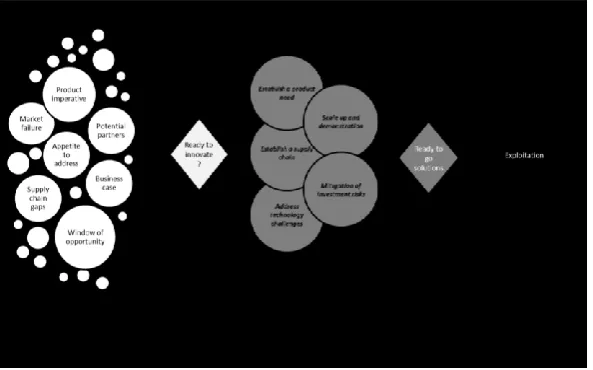
efficiency through the utilisation of new methods. The typical scenario is as outlined in Figure 1
which illustrates how multiple technology options might initially by down-selected into a relative few
for which a business case and proof of concept can be implemented in a suitable timeframe. This
help mitigate the risks of an unsuccessful or incomplete implementation. In these cases the so called
‘valley of death’ [1] or ‘missing middle’ as proposed by [2] both coincide with TRLs 4-6 and relate
to scale-up of the technology from laboratory to industrial scale.
The applicability of the approach is much less clear, and the results therefore often far less effective,
in addressing the more difficult scenario illustrated in Figure 2 which is triggered by a market failure
of some kind. In this case it is argued that a ‘Long Valley of Death’ exists, which extends to stages
prior to TRL/MCRL4 based on the need to address the primarily non-technological issues of supply
chain partnership development, product alignment and the general appetite for change while technical
propositions are being created in parallel. While these areas have been considered to some extent by
earlier work which describes holistic and integrated approaches to readiness beyond TRL and MRL /
MCRL, it will be argued here that there is a case for a ‘Foundation for Innovation’ approach which
provides the basis of an assessment of the maturity of the underlying combined capability of a
technology provider, target application, and associated supply chain as a precursor to large scale
investment. Having a foundation for innovation would mean that the long term strategy which
bridges the long valley of death is understood and largely in place.
Technology Readiness Levels (TRLs) first originated from NASA, and they were described as a
“measurement system that aims to assess the maturity level of a particular technology” [3] or as “a
discipline-independent, programmatic figure of merit (FOM) to allow more effective assessment of,
and communication regarding the maturity of new technologies [4]. Technology Readiness Levels
(TRLs) which originated from NASA [3] and Manufacturing Readiness Levels (MRLs) which
developed by the US Department of Defence [5] are used extensively to articulate the ‘valley of
death’ [1] between traditional university research and industrial implementation. The valley of death
reference is meant to indicate a position in the technology implementation landscape where a
disproportionate level of failure occurs. Both scales take their starting point from the NASA
developed nine point TRL scale which describes technology maturation from the observation and
reporting of basic principles (TRL1) to a fully operationally proven system (TRL9). In the case of the
implementation (MRL10) has been added to reflect the need for a level of continuous improvement to
achieve sustainment of the capability. Sustainment of capability is a major ongoing challenge in the
case of manufacturing technologies on the basis that “factories have to adapt to ever new challenges,
trends and paradigms in manufacturing to stay competitive”[6]. In this sense “sustainability in
manufacturing means the targets and approach for measurement to meet the high level goals within a
manufacturing company” [7]. The theme of sustainability in the context of mature manufacturing
[image:4.595.148.449.252.447.2]technology manifests itself in several different forms through the approach described here.
Figure 1. The established ‘valley of death’ scenario
[image:4.595.151.448.500.685.2]The readiness level concept has been extended to manufacturing processes in the form of
Manufacturing Readiness Levels (MRLs), as originally defined by the US DoD and subsequently
developed within the automotive sector [8] and elsewhere. In parallel Rolls-Royce developed its own
system of Manufacturing Capability Readiness Levels (MCRLs) [9]. The addition of the word
‘capability’ is important in the MCRL system and was included on the basis that the effective delivery
of manufacturing innovation depends on much more than just technology maturity. Operational,
commercial, organisational, and integration issues also need to be addressed and are of equal
importance. MRL based approaches also recognise these issues, and consequently both MRL and
MCRL methods could be classified as somewhat holistic readiness methodologies. In the interests of
consistency between manufacturing and technology readiness, the nine point Manufacturing
Capability Readiness Level (MCRL) scale derived directly from TRLs [5] will be used as the primary
measure of manufacturing maturity in this paper.
Several other more holistic views of both TRL and MCRL have been developed in recent years.
Mankins [10] built on the TRL scale to develop a more general approach to risk and readiness
assessment. In this work Mankins recognised that R&D management needs to address threefold goals
of improving performance parameters of new technology, driving maturation, and reducing risks
relating to the eventual uptake of the technology. In developing a more complete view of technology
risk mitigation he proposed the need for additional parameters relating to ‘R&D degree of difficulty’
(R&D3) and ’Technology need value’ (TNV), where five point scales are defined in each case. This
much more complete view provides the basis to position TRLs within an overall R&D management
context rather than is a simple maturity indicator. In defining Innovation Readiness Levels (IRLs)
aimed primarily at incremental innovation Tao et el. [11] proposed a six point scale for product
innovation. Most significantly Tao pays significant attention to a ‘Chasm’ phase which is deemed to
exist when a technology first enters the market, and proposes market, organisational, partnership and
risk factors which need to be considered at each of the six stages along with technology. Hicks et al.
[12] developed a more general form of TRL focused product development through the definition of
Product Readiness Levels (PRLs) which include consideration of marketing, manufacturing and ‘Other
Functions’. Islam [13] attempted to combine thinking on IRLs with the established MRL scale to
develop a five point Innovative Manufacturing Readiness Level (IMRL) scale which is proposed as
particularly applicable to nano-manufacturing. Wang et al. [2] dealt with concurrent engineering and
maturation via development of xRLs (Accelerated Readiness Levels) which bring together a combined
or meta view of the total product readiness through combined consideration of separate MRL, TRL
maturity status along with Business case Readiness Level (BcRL) and Ecosystem Readiness Levels
(ERL) scales. All of these combined approaches have significant merit and effectively address
Mankin’s [10] risk management question with different emphasis. They all however deal primarily
with providing a total approach to maximising the likelihood of success of a project that is assumed to
be committed or demanded for an end user. It is fair to say that the readiness assessment has a crucial
role “within the systems engineering decision making process” - Tetlay & John, 2009 [14]. They are
less effective in dealing with the uncertain starting point seen in cases of market failure or technology
push, where the need to take action is clear, at least to some degree, but where the existence
pre-requisites for success is difficult to assess.
2. CASE FOR ACTION
All of these combined approaches described above have significant merit and effectively address
Mankin’s [10] risk management question with different emphasis. They all however deal primarily
with providing a total approach to maximising the likelihood of success of a project that is assumed to
be committed or demanded for an end user. They are less effective in dealing with market failures
where the need to take some specific action is clear, at least to some degree, but where the existence
of capabilities and plans is insufficient to guarantee success. Equally they are not well suited to
dealing with the provision of base technology capability which might be needed to serve a number of
end use applications.
A consideration of the distinction between the terms ‘readiness’ and ‘maturity’, as outlined by Tetlay
“Readiness refers to time. Specifically it means ready for operations at the present time”
(Nuclear Decommissioning Authority [15]), or
“Readiness, in the situation of a software environment (yet equally true for hardware), to be a
measure of the suitability of a product for use within a larger system “in a particular context”,
i.e., with respect to specific requirements. Depending on its application, a product deemed to
be mature may possess different degrees of readiness” (Seablom & Lemmerman [16]).
On the other hand, maturity is defined as follows:
“Maturity is therefore regarded as a part of readiness (...), the system must first be fully ‘mature’
before it can be ‘ready’ for use” (Tetlay & John [14])
“Maturity is the verification within an iterative process of the system development lifecycle and
occurs before (…) readiness” (ibid.)
Hence, both concepts seem to be context-specific and so the technology would have to be validated
according to the requirements that were given at the beginning of the process, in order to check how
ready the technology is at a given time. The idea of a separate maturity view, as part of a mechanism
for assessing for addressing situations where foundational technology is being placed ‘on the shelf’, or
where a market failure is being addressed seems to be inherently appealing in supporting a slightly
different range of usage scenarios. It is however considered to be essential to distinguish three
separate but essential ingredients of maturity which can be thought of as complementary success
factors for manufacturing technology insertion.
2.1.The technology maturity dimension
In the case of technology, and manufacturing technology in particular it is only meaningful to state
that a technology is 'at' a particular state of readiness if that level is being applied to a specific
technology application project, or there have been sufficient developments across a spectrum of
applications such that it can be taken as the underlying maturity level for future projects. The fact that
somebody somewhere has achieved a high level of maturity for similar technology under different
does not provide direct confidence in terms of maturity that can be replicated. It is likewise tempting
to apply readiness terminology to situations where no new technology is being developed.
Manufacturing R&D facilities are often quite rightly employed to explore the resolution of production
problems in mature manufacturing operations. This is perhaps one of the most effective ways of
achieving economic and societal impact from them in the short to medium term timescale. There is
however little value in applying readiness terminology in these situations on the basis that
This implies a need to estimate the readiness of an operationally mature process, which is a
philosophical exercise
The application of readiness terminology distracts attention from that fact that other
techniques and measures are far more appropriate and effective in directing operational
improvement
It provides a confused and unmanageable situation where technology insertion projects are
measured and monitored based on the same expectations as continuous improvement,
problem resolution, or attempts at achieving effective control of an embedded process.
Application of readiness can therefore be problematic and is only really appropriate to apply readiness
terminology to situations of new technology insertion within committed, time bound programmes
with a clear end application. Having said this, there remains a need for a maturity based assessment
which can be used within the general context of the journey to generic capability in a particular field,
and within an individual research network. This need is based on the many benefits to be had in
articulating the gap between current state and aspirational target for capability within a field of
technology. Such a measure needs to be able to articulate generic capability, and the ability to
demonstrate highly competent execution of work in this area, as opposed to excellence in the
performance of a single implementation project. The concept of underlying maturity is important on
the basis of key problems with this view:
Implementations of the technology can be somewhat specific to the application, either as a
industry. The effect of which would be that the technology requires an additional level of
proving on other generic applications
The technology demonstration may have involved an end user or other collaborating body
acting as an integrator, combining the workpackage under consideration with others to
provide demonstrable technology. Without access to the steps taken by the integrator, the
ability to repeat the implementation may well be limited
The technology may rely on intellectual property (either in the form of patented technology,
or in the form of trade secrets or know how) owned by a third party, without which the
technology cannot be readily exploited
The scope for read-across from other applications is limited by differences in validation needs
2.2.The supply chain dimension
The supply chain, in the context of the following discussion is ‘the network of organisations that are
involved, through upstream and downstream linkages, in the different processes and activities that
produce value in the form of products and services in the hands of the ultimate consumer’ [17]. Here
we are focused on manufacturing and manufacturing technologies, and in this sense we can be clear
that supply chain activities involve the transformation of natural resources, raw materials, and
components into a finished product that is delivered to the end customer [18].
Understanding whether preconditions are in place to address the Long Valley of Death requires a
mechanism which can articulate the underlying maturity of supply chain, manufacturing technology
and product maturity. Step change manufacturing technologies, or even adoption of global state of
the art manufacturing technology to address the market failure of historic investment in technology,
requires a capable, committed and sustainable supply chain which is scaled to reflect the total
anticipated production requirement. This is perhaps the single most important success factor for large
scale manufacturing technology insertion projects. Manufacturing Technology insertion projects
which are sponsored by a receiving organisation who plan to implement the new technology within
their own domestic facilities require competent technical execution. Supply Chain Management
coordinating the entire materials process, and also requires joint relationships with suppliers across
multiple tiers” [19]. SCM is a concept, “whose primary objective is to integrate and manage the
sourcing, flow, and control of materials using a total systems perspective across multiple functions
and multiple tiers of suppliers.” Manufacturing technology projects, especially those which aim to
insert technology which is missing from current supply chains needs to be consider in the context of
SCM. Projects have a high chance of success however, assuming viable technology and a suitable
level of organisational buy-in. Those who wish to push technology which addresses a market failure
have a much more difficult job, and results in some alignment to Mankin’s [10] degree of difficulty.
If it is assumed that some level of technology push activity needs to be prompted as a market
intervention, then there is a need to understand the maturity of the target supply chain to receive any
developed technology, as without such an understanding of maturity.
Recent developments in the digital manufacturing (Industrie 4.0) landscape relating to cyber physical
systems, the internet of things and other related concepts will undoubtedly transform manufacturing
supply chains in the years and decades to come. The exact nature of this change is yet to be
understood and is inherently difficult to predict as it looks likely to emerge from the use of new
business models which are enabled by technology rather than from the technology itself. This is
clearly a vital consideration in the development of any mechanism or framework relating to
manufacturing technology and supply chain development at the current point in time. The most
predicable manifestation of this developing picture is that frameworks, structures and delivery
mechanisms will need to be flexible and ready to quickly respond to emerging needs. This is an
important driver of the need for reliable foundational capabilities which can operate as a platform for
much more rapid readiness programmes in response to specific and rapidly emerging customer need.
2.3.The Product Dimension
New product introductions, especially the introduction of highly innovative products often provide the
best opportunity to catalyse the introduction of new manufacturing technology. It might well be
argued that there is no particular need to include a product maturity dimension in and maturity
point however is that the purpose of a maturity framework is not for use as a comprehensive
numerical assessment tool, but as an approach for determining whether the pre requisites are in place
to justify strategic efforts in addressing a manufacturing supply chain market failure. The maturity of
the target product application(s) is clearly a key factor in making this determination and, unlike the
first two proposed dimensions, it is not necessarily the case that the highest possible score is most
conducive to successful uptake of technology.
3. ANALYSIS
The need to consider maturity based on multiple dimensions is appealing as a mechanism which can
allow clarity of understanding not simply whether there is a gap to full technology implementation,
but also to pinpoint its specific nature. In this preliminary work the three dimensions introduced
above will be demonstrated by consideration of case studies, which demonstrate why the three
dimensions represent necessary success factors for implementation. The work described here should
however be seen as a preliminary study which is yet to demonstrate that the three dimensions are
sufficient to fully articulate maturity in all circumstances.
3.1.Case Study 1 – Advanced Forming Research Centre – foundational capability planning
The University of Strathclyde’s Advanced Forming Research Centre (AFRC), has been operational for
seven years during which time industrial, academic and government partners have worked together to
establish a world leading research facility for the shaping of materials. The centre works closely with
major industrial companies, and since 2011 it has been a part of the UK High Value Manufacturing
(HVM) Catapult. The “interdisciplinary focus and combination of education with applied research have
created a new model for performing science” [20] . The centre operates a membership model, whereby
major industrial companies pay a significant annual subscription in return for collectively directing the
Core Research Programme (CRP) which is entirely collaborative in nature. The collaborative nature of
this approach [21] means that the CRP is typically aimed at developing underlying capability at a
consortium level, with a view to exploitation and more rapid deployment through additional work.
While the subsequent application work (typically company and application specific) can be advanced
the underlying capability level. The reason for this difficulty is inherent in the fact that capability is
being developed for potential use by multiple end-users on multiple applications [16]. In this case
readiness becomes a rather contentious issue with the obvious question ready for what exactly?
Essentially the time-bound nature of readiness [15], becomes a major source of ambiguity. Different
options are available, including the potential to simple assign the readiness based on the first customer
application, or to position some kind of representative or typical readiness position. These options are
in fact rather meaningless and can be seen to be misleading in providing a level of specific positioning
without a particular target and associated specific requirements. Far more preferable and informative
in this context is the concept of a more generalised description of foundational technology maturity.
Such a maturity description provides the potential to be somewhat distinct from any specific end
application, and therefore could be defined on the basis of the viability of exploitation by a broad
customer base [14].
Figure 3(a) provides a basic technology based maturity measurement. It uses a five point scale, to chart
the path between having no capability in a particular area of technology and what is termed to be an
advanced technology. The use of a five point scale has been selected in the interests of distinctness
from MCRL, and influenced to some extent by Mankins [10] R&D3 and TNV concepts. Assessment
against the scale is based on the use of elements (shown as the columns of Figure 3(a)) which provide
a level of granularity to the maturity definition, and which could be re-defined based on specific
situations. The elements have been selected based on experience within the AFRC and its partner
organisations relating the typical technology related barriers to full implementation of new
manufacturing methods. The elements relating to people / skills, equipment and process control are
deemed to be core aspects of foundational technical capability. The Sustainability element relates to
the long-term robustness of the provided capability and the ability to support application on an ongoing
basis. This is deemed foundational to technology in research networks and is of key importance on the
based on their national strategic nature and their reliance on public funding mechanisms. The
demonstration element is needed to provide a pragmatic assessment of whether the technology has been
The applicability of this approach to a research provider rather than to an end user of technology
becomes apparent by considering the nature of the five point scale. Here there is no inherent need to
progress to the ultimate level 5 position for all technologies provided within the centre, especially in
situations where the underlying need is simply to service other more core technologies available
internally or through other organisations. In the case of the AFRC, certain metrology technologies
could be easily seen as fitting into this category – i.e. where there is a need to establish credible
technology offering to support the customer base directly, but where there is not necessarily a need to
become world or even nationally leading. In other cases of core strategic technology, where there is a
direct and unique alignment to the mission of the centre, the target end point would absolutely be level
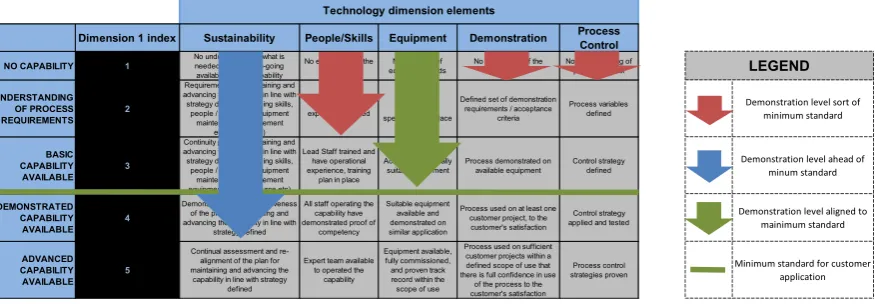
5. Figure 3(b) outlines the basic mode of use of the approach in assessing the gap between a target level
on the scale, and the actual achieved position for each of the elements of dimension 1. In the case
shown a specific action plan would be drawn-up against the People, Demonstration and Process Control
elements of capability so that the level 3 position could be achieved. This initial use of the technology
dimension against a single area of technology in addressing specific gaps in maturity and approach is
therefore an obvious mode of use. It is very consistent with typical usage of readiness approaches, but
the focus on underlining generic applicability to potentially service a range of customers or end
applications provides is differentiating.
(a) Dimension 1: Underlying Manufacturing Technology Capability
Dimension 1 index Sustainability People/Skills Equipment Demonstration Process
Control
NO CAPABILITY 1
No understanding of what is needed to ensure on-going availability of the capability
No experience of the process
No definition of equipment needs
No experience of the capability
No understanding of process control
UNDERSTANDING OF PROCESS REQUIREMENTS
2
Requirements for maintaining and advancing the capability in line with strategy defined (including skills, people / continuity, equipment
maintenance, replacement equipment, etc)
Required skills / expertise identified
Definition of specification in place
Defined set of demonstration requirements / acceptance
criteria Process variables defined BASIC CAPABILITY AVAILABLE 3
Continuity plan for maintaining and advancing the capability in line with strategy defined (including skills, people / continuity, equipment
maintenance, replacement equipment, funding source etc)
Lead Staff trained and have operational experience, training
plan in place
Access to potentially suitable equipment
Process demonstrated on available equipment Control strategy defined DEMONSTRATED CAPABILITY AVAILABLE 4
Demonstration of the effectiveness of the plan for maintaining and advancing the capability in line with
strategy defined
All staff operating the capability have demonstrated proof of
competency
Suitable equipment available and demonstrated on similar application
Process used on at least one customer project, to the customer's satisfaction
Control strategy applied and tested
ADVANCED CAPABILITY AVAILABLE
5
Continual assessment and re-alignment of the plan for maintaining and advancing the
capability in line with strategy defined
Expert team available to operated the
capability
Equipment available, fully commissioned, and proven track record within the scope of use
Process used on sufficient customer projects within a defined scope of use that there is full confidence in use
of the process to the customer's satisfaction
(b) Applying Dimension 1 – understanding of the gap to a credible technology offering
Figure 3. Technology Maturity – Dimension 1
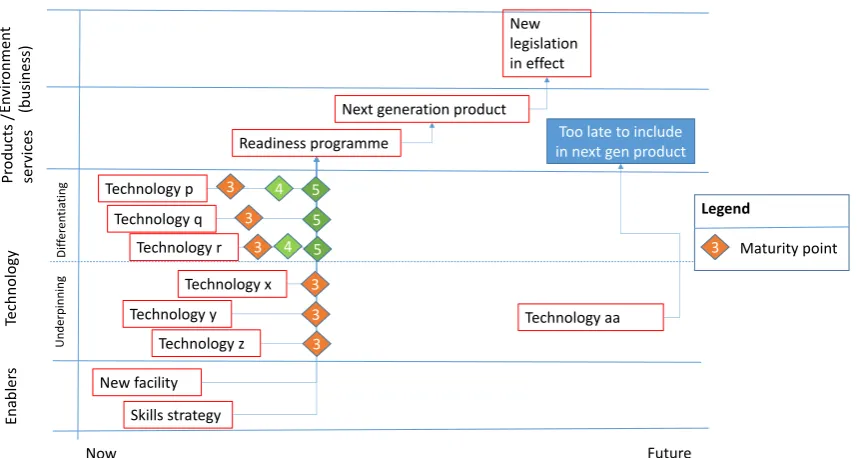
Figure 4 illustrates the more strategic use of the technology dimension in technology planning. Figure
4(a) shows a typical roadmap framework derived from the approach of Phaal et al. [22]. In this case
the technology layer is divided into ‘underpinning’ and ‘differentiating’ layers. In these cases it is
clear to see that the expectation is that differentiating technologies are expected to be driven to an
advanced sate of maturity in the research centre before readiness approaches are applied within a
product programme. Underpinning technologies, potentially less core to making the product offering
stand out in the market, are driven only to level 3, where a credible offering is in place at the research
centre. The exact breakdown of target setting is a matter of risk management and will depend on the
nature of the end application market, local decision making and the attitudes of immediate customers
of the technology. The point is that a clear and consistent of underlying technology maturity can be
seen to provide insight into the timings of research capability and infrastructure ahead of readiness
programmes in support of next generation products. Having understood the timing and priority of
individual technology developments, the maturity measure can be further used in technology
planning, as shown in Figure 4(b). Here it can be seen that at a detailed technology planning level
specific actions (or the lack of them can be used to develop technologies towards target end points –
even though the target point may vary based on the nature of the technology within the strategic
context, and based on opportunity.
Dimension 1 index Sustainability People/Skills Equipment Demonstration Process
Control
NO CAPABILITY 1 No understanding of what is needed to ensure on-going availability of the capability
No experience of the process
No definition of equipment needs
No experience of the capability
No understanding of process control
UNDERSTANDING OF PROCESS REQUIREMENTS
2
Requirements for maintaining and advancing the capability in line with strategy defined (including skills,
people / continuity, equipment maintenance, replacement
equipment, etc)
Required skills / expertise identified
Definition of equipment specification in place
Defined set of demonstration requirements / acceptance
criteria Process variables defined BASIC CAPABILITY AVAILABLE 3
Continuity plan for maintaining and advancing the capability in line with strategy defined (including skills,
people / continuity, equipment maintenance, replacement equipment, funding source etc)
Lead Staff trained and have operational experience, training
plan in place
Access to potentially suitable equipment
Process demonstrated on available equipment Control strategy defined DEMONSTRATED CAPABILITY AVAILABLE 4
Demonstration of the effectiveness of the plan for maintaining and advancing the capability in line with
strategy defined
All staff operating the capability have demonstrated proof of
competency
Suitable equipment available and demonstrated on similar application
Process used on at least one customer project, to the customer's satisfaction
Control strategy applied and tested
ADVANCED CAPABILITY AVAILABLE
5
Continual assessment and re-alignment of the plan for maintaining and advancing the
capability in line with strategy defined
Expert team available to operated the
capability
Equipment available, fully commissioned, and proven track record within the scope of use
Process used on sufficient customer projects within a defined scope of use that there is full confidence in use
of the process to the customer's satisfaction
Process control strategies proven Technology dimension elements
Minimum standard for customer application Demonstration level sort of
minimum standard Demonstration level ahead of
minum standard Demonstration level aligned to
mainimum standard
(a) Application within a typical roadmapping framework
[image:15.595.78.507.68.297.2](b) Application within a in technology planning
Figure 4. Technology Maturity – Use of dimension 1 in technology roadmapping
3.2.Case Study 2 – UK Automotive metals supply chain
Despite some recent resurgence in UK (Original Equipment Manufacturer) OEM performance
especially in the automotive sector, the adverse long term trend in overall market share for the metals
supply chain looks likely to continue, irrespective of acceleration of technology development. For
En vir onme n t (busine ss ) P rodu ct s / se rvices Technology Enab ler s Now Future New legislation in effect
Next generation product
Technology x Technology y Technology z New facility Skills strategy Technology aa
Too late to include in next gen product
Un d erp inn ing Dif fer en tia tin
g Technology p
Technology q Technology r 3 3 3 3 3 3 4 5 4 5 5 Readiness programme Legend Maturity point 3
Maturity Indicators Maturity Indicators Maturity Indicators Maturity Indicators Maturity Indicators Maturity Indicators
Core technology area 1
1
Some simple approaches to shape
definition 2 Some simple customer case studies suppported by modelling 3 Potential implementation of published approach 4 AFRC approach developed and tested
4 5 UK technology leadership
Core technology area 2
1
Some simple approaches to shape
definition 2 Some simple customer case studies suppported by modelling 3 Potential implementation of software vendor approach 4 AFRC approach developed and tested
4 5 UK technology
leadership Core technology area 3 2 Definition exclusively provided by customers, General CAD capability (software + people)
3 Some examples of in-house tooling definition 3
Parts using AFRC developed geometry 4 Multiple customer case studies 5 Multiple customer case studies
5 Global leading ofeering
Core technology area 4
2
Use of modelling to evaluate customer
tolling
2
Use of modelling to evaluate customer tooling 2 Collaborative programmes needed 2 Collaborative programmes needed 2 Collaborative programmes needed 3 Ability to support customer cases studies and internal R&D Support technology area A 2 Some guidance provided to customers
on alternative materias 2 Some guidance provided to customers on alternative materias 2 Assessment of an alternative MoM 3 Materials and process route list, supported by material properties 4 Capability underpinned with materials selector database 3 Die materials selector database Support Technology area B
1 No activity 1 No activity 1 No activity 2
Initial tooling definition based
on inserts
3 Initial customer case studies 3
Ability to support customer cases studies and internal R&D Support Technology area C
1 Manual shape improvement 1 Manual shape improvement 1 Manual shape improvement 2
Initial die definitions (preforms) based
on optimised shape
3 Initial customer case studies 3
Ability to support customer cases studies and internal R&D
TE
CH
N
OL
OG
Y
THE
ME
example in the period from 1994-2009 the UK fabricated metal products and for basic metal processes
activities fell by 10% and 38% respectively in terms of real value added, this despite an overall
growth of more than 50% in aircraft, automotive, rail and motorcycle value add in the same period
[23]. While the industry [24] and government previously identified a £3 billion opportunity to
increase UK Tier 1-supply chain value, realising this opportunity has been proved to be a major
challenge. Perceptions among OEMs and major Tier 1 suppliers of competitive and technological
capability among UK suppliers is believed to be a primary reason for this. The low levels of
year-on-year investment in research, development and innovation compared with other industrial nations
supports this view. There is an urgent need to take action in this area on the basis of some important
and time bound drivers:
Major OEMs in a number of sectors, notably automotive are developing next generation products
based on major changes in propulsion and transmission systems required to achieve future
environmental standards [25], [26]. The effect of this is that established supply chains are being
re-evaluated and new ones developed in support of new product launches [27].
Overseas initiated movements such as Industry 4.0 are being established at a scale and pace that
could provide large barriers to entry for companies and national industries who have not delivered
innovation at the same pace [ibid.]
From a more positive perspective the UK manufacturing R&D network has successfully
completed a phase of growth with the establishment and early success of the High Value
Manufacturing Catapult including the AFRC [ibid.]
Despite the many difficulties that surround innovation in the UK metals industry, The Automotive
Council have identified that realistic opportunity exists to increase local sourcing (Tier 2s, Tier 3s) to
the UK Tier-1 community by at least £2 billion annually that is additional to the £3 billion Tier 1
opportunity already identified [ibid.].
All of this illustrates that consideration of the maturity of the supply chain in its capacity to receive
new manufacturing technologies, and respond to the demands and opportunities presented by new
addressing national industry needs [27], [28]. It typifies the Long Valley of Death at a total supply
chain level through a current market failure. In this situation the critical success factor has little to do
with the readiness of technology to meet a particular product need, or even the underlying maturity of
that technology in supporting a broad potential customer base, it is about the fundamental existence
(or viability) of a supply chain which can address the needs of the market [29]. Digitalisation of
manufacturing and the creation of new and more globalised supply chain service models may well be
seen to mitigate national security of supply issues in situations of this type, but do not in themselves
obviate the need for physical supply, at least at a global level. Essentially resolution of market failure
of this type requires intervention on a number of fronts, none of which have much chance of success
without the basic conditions being in place to establish a physical supply chain [27].
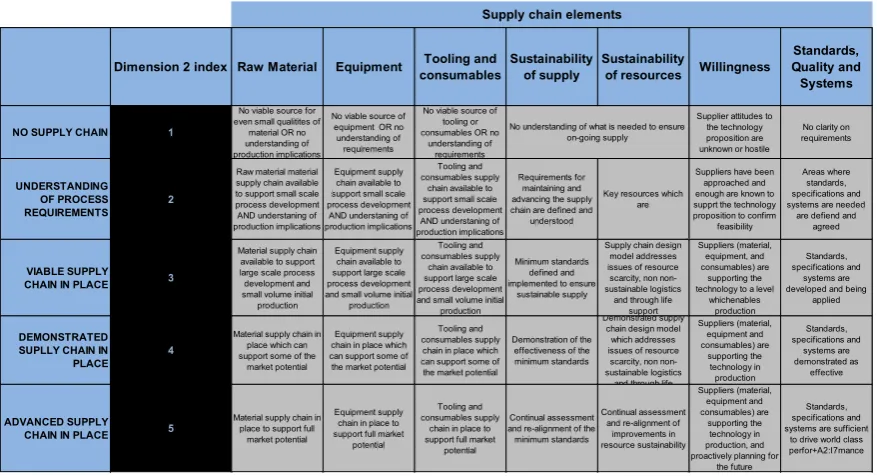
Figure 5 outlines a basic framework of supply chain maturity. As with the technology dimension
(Figure 4) its most obvious mode of use is in plotting the current state of maturity versus each of the
elements of maturity to understand and quantify the gap to achievement of a viable supply chain
position. As with the Technology dimension the elements have been developed based on practical
experience of the barriers to implementation of manufacturing technology which relate to supply
chain. The elements relating to raw material, equipment and consumables are deemed to be core
physical elements of the supply chain which need to be understood. The Quality Standards element in
this case relates to the standards that need to be developed and achieved in order to embed technology
in a potentially regulated environment. Sustainability is addressed both from the perspective of
robustness of the developing supply chain, and in terms of the use of scare resources. For many
process technologies which impact product integrity this aspect of supply chain definition is a vital
and often overlooked step. Perhaps the most important success factor in any supply chain
implementation is whether or not leaders in target supply chain organisations are keen to change their
business model through insertion of the technology under question. This is an obvious consideration
but, based on a level of experience is often overlooked.
Supply chains, especially in established sectors like the UK metals supply chain for the automotive
as well as national markets. This makes action planning difficult. While it is potentially viable
determine gaps in supply chain maturity and use the maturity framework to define the case for
corporate or government level intervention at a theoretical level, making a real change requires
decision making and a level of focused effort. A pragmatic approach can however be readily offered
through the maturity framework concept. Essentially it is feasible to assess whether supply chain
challenges are addressable – in which case there is a case to be made in addressing a grand challenge,
or non-addressable in which there is a need to accept a genuine long term market failure. Figure 6
illustrates this approach and concept through two different scenarios, one of which is difficult to
address based on issues of systematic under investment and lack of access to natural resources, and
one of which subject to a lack of standards and appetite to invest based on limited engagement. Only
the specifics of the different situations provide the real view about which scenario can be deemed to
be addressable, but it is clear that in each of the two situations there are different issues which need to
be addressed. The second situation outlined in Figure 6(b) requires procedural and engagement action
which could conceivably be addressed as part of a major call to action on either a corporate end-user
[image:18.595.72.511.463.701.2]or a government basis.
Figure 5. Supply Chain Maturity – Dimension 2
Dimension 2 index Raw Material Equipment consumablesTooling and Sustainability of supply Sustainability of resources Willingness
Standards, Quality and Systems
NO SUPPLY CHAIN 1
No viable source for even small qualitites of
material OR no understanding of production implications
No viable source of equipment OR no understanding of requirements
No viable source of tooling or consumables OR no
understanding of requirements
Supplier attitudes to the technology proposition are unknown or hostile
No clarity on requirements
UNDERSTANDING OF PROCESS REQUIREMENTS
2
Raw material material supply chain available to support small scale process development AND understaning of production implications
Equipment supply chain available to support small scale process development
AND understaning of production implications
Tooling and consumables supply
chain available to support small scale process development
AND understaning of production implications
Requirements for maintaining and advancing the supply chain are defined and
understood
Key resources which are
Suppliers have been approached and enough are known to supprt the technology proposition to confirm
feasibility
Areas where standards, specifications and systems are needed
are defiend and agreed
VIABLE SUPPLY
CHAIN IN PLACE 3
Material supply chain available to support large scale process development and small volume initial production
Equipment supply chain available to support large scale process development and small volume initial
production
Tooling and consumables supply
chain available to support large scale process development and small volume initial
production
Minimum standards defined and implemented to ensure
sustainable supply
Supply chain design model addresses issues of resource
scarcity, non non-sustainable logistics
and through life support
Suppliers (material, equipment, and consumables) are
supporting the technology to a level
whichenables production
Standards, specifications and
systems are developed and being
applied
DEMONSTRATED SUPLLY CHAIN IN PLACE
4
Material supply chain in place which can support some of the
market potential
Equipment supply chain in place which can support some of the market potential
Tooling and consumables supply chain in place which can support some of the market potential
Demonstration of the effectiveness of the minimum standards
Demonstrated supply chain design model which addresses issues of resource
scarcity, non non-sustainable logistics
and through life
Suppliers (material, equipment and consumables) are supporting the technology in production Standards, specifications and systems are demonstrated as effective ADVANCED SUPPLY
CHAIN IN PLACE 5
Material supply chain in place to support full
market potential
Equipment supply chain in place to support full market
potential
Tooling and consumables supply
chain in place to support full market
potential
Continual assessment and re-alignment of the minimum standards
Continual assessment and re-alignment of
improvements in resource sustainability Suppliers (material, equipment and consumables) are supporting the technology in production, and proactively planning for
the future
Standards, specifications and systems are sufficient
to drive world class perfor+A2:I7mance
Supply chain elements
(a) Failing supply chain – major systemic
and infrastructural gaps
(b)Failing supply chain – regulatory and supplier
engagement gaps
Figure 6. Use of Dimension 2 in distinguishing between addressable and non-addressable supply
chain gaps
3.3.Case Study 3 – Super Plastic Forming
Superplasticity is a phenomenon of certain metallic alloys, whose fine grain structure allows very
large plastic elongations to be achieved under controlled conditions of temperature and strain rate
[30]. Superplastic forming (SPF) exploits this phenomenon to allow large scale deformation of sheet
metal components in a single operation, typically through the use of gas pressure. SPF is an important
technique for some high cost aerospace applications and specialist automotive components, but is
energy intensive and typically requires expensive equipment and tooling. For these reasons it is often
considered a niche technology. Most significantly in the current context, many of the product
applications of SPF are somewhat mature, and arguably reaching the end of their product lifecycle.
This means that all of the early stage barriers to end product application of the technology have been
addressed for these established markets. Many future applications are however subject to competition
from other techniques which allow the design and manufacture of stiff, lightweight, geometrically
complex structures such as composites and additive manufacture [31]. Without consideration of the
how SPF positions itself on future generations of product in the light of competition, it will have a
limited long term future.
This illustrates the importance of end-product maturity in any consideration of a successful route to Dimension 2 index Raw Material Equipment consumablesTooling and Sustainability of supply Sustainability of resources Willingness
Standards, Quality and Systems
NO SUPPLY CHAIN 1
No viable source for even small qualitites of material OR no understanding of production implications
No viable source of equipment OR no understanding of requirements
No viable source of tooling or consumables OR no
understanding of requirements
Supplier attitudes to the technology proposition are unknown or hostile
No clarity on requirements
UNDERSTANDING OF PROCESS REQUIREMENTS
2
Raw material material supply chain available to support small scale process development AND understaning of production implications
Equipment supply chain available to support small scale process development AND understaning of production implications
Tooling and consumables supply
chain available to support small scale process development AND understaning of production implications
Requirements for maintaining and advancing the supply chain are defined and understood
Key resources which are
Suppliers have been approached and enough are known to supprt the technology proposition to confirm feasibility
Areas where standards, specifications and systems are needed are defiend and
agreed
VIABLE SUPPLY CHAIN IN PLACE 3
Material supply chain available to support large scale process development and small volume initial production
Equipment supply chain available to support large scale process development and small volume initial production
Tooling and consumables supply
chain available to support large scale process development and small volume initial production
Minimum standards defined and implemented to ensure
sustainable supply Supply chain design
model addresses issues of resource scarcity, non non-sustainable logistics and through life
support Suppliers (material,
equipment, and consumables) are supporting the technology to a level
whichenables production
Standards, specifications and
systems are developed and being
applied
DEMONSTRATED SUPLLY CHAIN IN
PLACE 4
Material supply chain in place which can support some of the
market potential Equipment supply chain in place which can support some of the market potential
Tooling and consumables supply chain in place which can support some of the market potential
Demonstration of the effectiveness of the minimum standards
Demonstrated supply chain design model which addresses issues of resource scarcity, non non-sustainable logistics and through life
Suppliers (material, equipment and consumables) are supporting the technology in production Standards, specifications and systems are demonstrated as effective ADVANCED SUPPLY CHAIN IN PLACE 5
Material supply chain in place to support full market potential
Equipment supply chain in place to support full market potential
Tooling and consumables supply
chain in place to support full market potential
Continual assessment and re-alignment of the minimum standards
Continual assessment and re-alignment of improvements in resource sustainability Suppliers (material, equipment and consumables) are supporting the technology in production, and proactively planning for
the future Standards, specifications and systems are sufficient
to drive world class performance Supply chain elements
No understanding of what is needed to ensure on-going supply
Dimension 2 index Raw Material Equipment consumablesTooling and Sustainability of supply Sustainability of resources Willingness Standards, Quality and Systems
NO SUPPLY CHAIN 1
No viable source for even small qualitites of material OR no understanding of production implications
No viable source of equipment OR no understanding of requirements
No viable source of tooling or consumables OR no
understanding of requirements
Supplier attitudes to the technology proposition are unknown or hostile
No clarity on requirements
UNDERSTANDING OF PROCESS REQUIREMENTS
2
Raw material material supply chain available to support small scale process development AND understaning of production implications
Equipment supply chain available to support small scale process development AND understaning of production implications
Tooling and consumables supply
chain available to support small scale process development AND understaning of production implications
Requirements for maintaining and advancing the supply chain are defined and understood
Key resources which are
Suppliers have been approached and enough are known to supprt the technology proposition to confirm feasibility
Areas where standards, specifications and systems are needed are defiend and
agreed
VIABLE SUPPLY CHAIN IN PLACE 3
Material supply chain available to support large scale process development and small volume initial production
Equipment supply chain available to support large scale process development and small volume initial production
Tooling and consumables supply
chain available to support large scale process development and small volume initial production
Minimum standards defined and implemented to ensure
sustainable supply Supply chain design
model addresses issues of resource scarcity, non non-sustainable logistics and through life
support Suppliers (material,
equipment, and consumables) are supporting the technology to a level
whichenables production
Standards, specifications and
systems are developed and being
applied
DEMONSTRATED SUPLLY CHAIN IN PLACE
4
Material supply chain in place which can support some of the
market potential Equipment supply chain in place which can support some of the market potential
Tooling and consumables supply chain in place which can support some of the market potential
Demonstration of the effectiveness of the minimum standards
Demonstrated supply chain design model which addresses issues of resource scarcity, non non-sustainable logistics and through life
support Suppliers (material, equipment and consumables) are supporting the technology in production Standards, specifications and systems are demonstrated as effective ADVANCED SUPPLY CHAIN IN PLACE 5
Material supply chain in place to support full market potential
Equipment supply chain in place to support full market potential
Tooling and consumables supply
chain in place to support full market
potential Continual assessment and re-alignment of the minimum standards
Continual assessment and re-alignment of improvements in resource sustainability Suppliers (material, equipment and consumables) are supporting the technology in production, and proactively planning for
the future Standards, specifications and systems are sufficient
to drive world class performance Supply chain elements
market for a manufacturing technology [32]. Manufacturing technologies as a fundamental
mechanism for achieving product and component characteristics [33], [34], are inherently always a
step away from the end use, and must therefore be considered to be subservient to the underlying
maturity of the end application. Typical approaches to technology and manufacturingreadiness
assume an ongoing upward trajectory, with additional development and application driving increased
readiness[14]. The approach is not well suited to situations where the end application changes or
ceases to exist. On this basis, as the need for a dimension of maturity relating product maturity is
considered, it becomes clear that need is different than in the cases two dimensions already
considered. For both technology and supply chain maturity there is an underlying assumption that
increased levels of assessed maturity are inherently a good thing. In the case of product maturity this
is not necessarily the case, as the benefit of targeting a technological solution to a product at the end
of its lifecycle seems to be inherently less than applying the same benefit during the early to mid-stage
of product maturity. That said, targeting manufacturing technology towards purely emerging product
needs could be seen as a rather risky strategy unless it was part of some form pf portfolio planning.
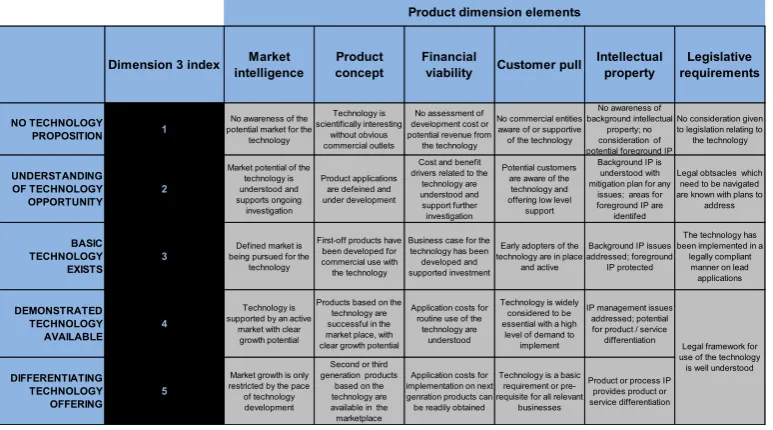
Figure 7 shows a maturity structure on the same basis as Dimensions 1 and 2 but applied to product
maturity. Again the elements have been developed based on practical experience of the barriers to
implementation of manufacturing technology which relate to product in this case. Here the elements
relating to market intelligence, product concept and financial viability are deemed to be the basic
elements of a business case for development. The Intellectual Property and Legislative issues easy to
overlook, especially when the detailed combination of process as applied to product are considered.
Perhaps the most important success factor in the case of product is the extent and nature of Customer
Pull. The Customer Pull elements is perhaps the central driver behind inclusion of the Product
Figure 7. Supply Chain Maturity – Dimension 3
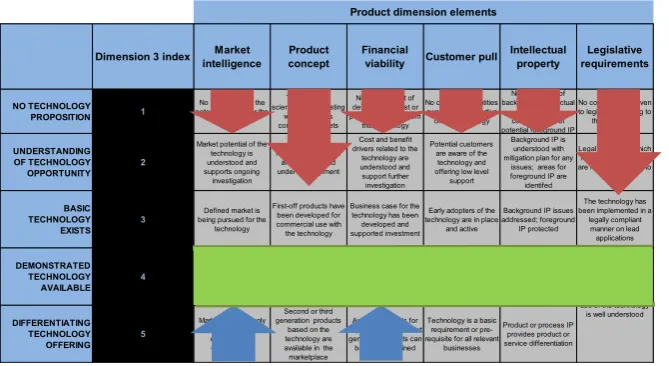
Returning specifically to SPF, the problem can be readily identified. The technology is well
understood including its costs of implementation and use. The product application of the technology
meets level 5 expectations. This knowledge is sufficient to firmly position the processing technology
in its established niche. The problem is that it is competition with technologies, in this composite
materials, threatens the existence of the niche, and certainly threatens the conditions which drive
onward innovation. Without a level of forward innovation the technology development need to drive
future market growth cannot be achieved. There is a need in this situation to drive alternative product
applications as the mechanism to move the technology forward. Alternative uses of the technology,
for example as a means of cost effective prototype or low volume production forces an alternative set
of considerations provide this possibility but represent technology push rather than market pull. The
technology challenge here would relate to establishing flexible tooling concepts which are cost
effective at low volume. The use of the product maturity dimension on helping to articulate this
combined challenge is illustrated in Figure 8.
Dimension 3 index intelligenceMarket Product concept Financial viability Customer pull Intellectual property requirementsLegislative
NO TECHNOLOGY
PROPOSITION 1
No awareness of the potential market for the
technology
Technology is scientifically interesting
without obvious commercial outlets
No assessment of development cost or potential revenue from the technology
No commercial entities aware of or supportive of the technology
No awareness of background intellectual
property; no consideration of potential foreground IP
No consideration given to legislation relating to the technology
UNDERSTANDING OF TECHNOLOGY OPPORTUNITY
2
Market potential of the technology is understood and supports ongoing investigation
Product applications are defeined and under development
Cost and benefit drivers related to the
technology are understood and support further investigation
Potential customers are aware of the
technology and offering low level
support
Background IP is understood with mitigation plan for any
issues; areas for foreground IP are
identifed
Legal obtsacles which need to be navigated are known with plans to
address
BASIC TECHNOLOGY EXISTS
3 being pursued for the Defined market is technology
First-off products have been developed for commercial use with the technology
Business case for the technology has been developed and supported investment
Early adopters of the technology are in place
and active
Background IP issues addressed; foreground
IP protected
The technology has been implemented in a
legally compliant manner on lead applications DEMONSTRATED TECHNOLOGY AVAILABLE 4 Technology is supported by an active
market with clear growth potential
Products based on the technology are successful in the market place, with clear growth potential
Application costs for routine use of the
technology are understood
Technology is widely considered to be essential with a high
level of demand to implement
IP management issues addressed; potential for product / service differentiation
DIFFERENTIATING TECHNOLOGY OFFERING
5
Market growth is only restricted by the pace of technology development
Second or third generation products
based on the technology are available in the marketplace
Application costs for implementation on next genration products can be readily obtained
Technology is a basic requirement or pre-requisite for all relevant
businesses
Product or process IP provides product or service differentiation
Legal framework for use of the technology
is well understood
Figure 8. SPF product maturity challenges
So in this case the proposition is about taking an already mature, and arguably sunset technology, and
repositioning it as a flexible, and adaptable process. Clearly in this situation there are threats for other
competing technology, most notably digitisation of manufacturing generally as well as specific
manufacturing techniques including composite material and additive manufacture. In this case it
becomes essential to consider the availability of suitable end product applications as a critical success
factor in any specific aspect of technology development, and crate the case for developing the
technology further (assuming this is genuinely believed to be a valid approach with a future). In this
case the product dimension of the maturity framework makes this issue of target product maturity
very clear, and also signposts the potential importance of a revised version of the process as a
prototyping method. The approach also assists those involved in the strategic development of this
very sophisticated and capable technique to recognise the need to address the technology gaps that
currently make widespread application early stage product development problematic. In particular it
helps clarify the route to achieving the basic building blocks required for new applications, which
may require development of some of the underpinning aspects of flexible processing on established
products in order to help make the case for the future uses. Finally it identifies the challenge of
aligning this technology potential to the next generation of products to support their development. Dimension 3 index intelligenceMarket conceptProduct Financial viability Customer pull Intellectual property requirementsLegislative
NO TECHNOLOGY PROPOSITION 1
No awareness of the potential market for the
technology
Technology is scientifically interesting
without obvious commercial outlets
No assessment of development cost or potential revenue from the technology
No commercial entities aware of or supportive of the technology
No awareness of background intellectual
property; no consideration of potential foreground IP
No consideration given to legislation relating to the technology
UNDERSTANDING OF TECHNOLOGY OPPORTUNITY
2
Market potential of the technology is understood and supports ongoing
investigation
Product applications are defeined and under development
Cost and benefit drivers related to the
technology are understood and support further investigation
Potential customers are aware of the
technology and offering low level support
Background IP is understood with mitigation plan for any
issues; areas for foreground IP are identifed
Legal obtsacles which need to be navigated are known with plans to
address
BASIC TECHNOLOGY EXISTS
3 being pursued for the Defined market is technology
First-off products have been developed for commercial use with the technology
Business case for the technology has been developed and supported investment
Early adopters of the technology are in place
and active
Background IP issues addressed; foreground IP protected
The technology has been implemented in a
legally compliant manner on lead applications DEMONSTRATED TECHNOLOGY AVAILABLE 4 Technology is supported by an active
market with clear growth potential
Products based on the technology are successful in the market place, with clear growth potential
Application costs for routine use of the
technology are understood
Technology is widely considered to be essential with a high
level of demand to implement
IP management issues addressed; potential for product / service differentiation
DIFFERENTIATING TECHNOLOGY OFFERING
5
Market growth is only restricted by the pace of technology development
Second or third generation products
based on the technology are available in the marketplace
Application costs for implementation on next genration products can be readily obtained
Technology is a basic requirement or pre-requisite for all relevant
businesses
Product or process IP provides product or service differentiation Product dimension elements
Legal framework for use of the technology is well understood
LEGEND
Demonstration level sort of minimum standard (use in
prototyping) Demonstration level ahead of minimum standard (traditional aerospace part manufacture) Demonstration level aligned to