City, University of London Institutional Repository
Citation
:
Cuthbertson, K., Hayley, S., Motson, N. & Nitzsche, D. (2016). What Does Rebalancing Really Achieve?. International Journal of Finance & Economics, 21(3), pp. 224-240. doi: 10.1002/ijfe.1545This is the accepted version of the paper.
This version of the publication may differ from the final published
version.
Permanent repository link:
http://openaccess.city.ac.uk/13733/Link to published version
:
http://dx.doi.org/10.1002/ijfe.1545Copyright and reuse:
City Research Online aims to make research
outputs of City, University of London available to a wider audience.
Copyright and Moral Rights remain with the author(s) and/or copyright
holders. URLs from City Research Online may be freely distributed and
linked to.
City Research Online: http://openaccess.city.ac.uk/ [email protected]
What Does Rebalancing Really Achieve?
Keith Cuthbertson* (Cass Business School) Simon Hayley (Cass Business School)
Nick Motson (Cass Business School) Dirk Nitzsche (Cass Business School)
This version – 4th February 2016
Abstract
There is now a substantial literature on the effects of rebalancing on portfolio performance. However, this literature contains frequent misattribution between ‘rebalancing returns’ which are specific to the act of rebalancing, and ‘diversification returns’ which can be earned by both rebalanced and unrebalanced strategies. Confusion on this issue can encourage investors to follow strategies which involve insufficient diversification and excessive transactions costs. This paper identifies the misleading claims that are made for rebalanced strategies and demonstrates theoretically and by simulation that the apparent advantages of rebalanced strategies over infinite horizons give an inaccurate impression of their performance over finite horizons.
Keywords: rebalancing, diversification returns, excess growth, volatility pumping.
JEL Classification: G10, G11
What Does Rebalancing Really Achieve?
1. Introduction
Rebalancing is a vital part of many investment strategies. Passive strategies usually involve
choosing portfolio weights according to some predetermined rule and a key practical element of
such strategies is the frequency and hence cost of rebalancing. Only if portfolio weights are allowed
to evolve over time according to the relative returns on the component assets (a buy and hold
strategy, B&H) will there be no rebalancing. Other passive strategies require at least periodic
rebalancing, and in the extreme some passive strategies assume continuous rebalancing to keep
asset weights constant (an assumption that is often required to produce tractable closed form
results). Rebalancing is so widespread that a good understanding of its effects is vital.
The well-established literature on optimal growth considers portfolio weights chosen to
maximise the expected geometric growth rate of the portfolio value, consistent with maximising
the expected logarithm of final wealth (Kelly 1956, Luenberger 1997, Thorpe 2010, Platen and
Rendek 2010). Rebalancing is a vital part of these strategies. Another strand of the literature
considers arbitrary fixed weight portfolios which are compared with a B&H strategy (e.g. Fernholz
and Shay 1982, Booth and Fama 1992, Luenberger 1997, Mulvey et al. 2007, Qian 2012,
Willenbrock, 2012). A key result from this part of the literature is that a rebalanced portfolio of
independently and identically distributed (IID) assets has a higher expected portfolio growth rate
pumping” is a strategy which seeks to boost this effect by deliberately choosing high volatility
assets and rebalancing each period to fixed weights.
In this paper we focus on the choice between constant portfolio weight rebalanced strategies
and the corresponding B&H strategies. We examine under what circumstances and for what
reasons one strategy outperforms the other. The purpose of this paper is to correct misleading
claims that are widely made about the benefits of rebalancing.
It is widely noted that even when there is no predictable time structure to asset returns
rebalanced portfolios generate “excess growth” (defined in this literature as expected geometric
portfolio growth which is greater than the average geometric growth of the underlying assets). We
demonstrate mathematically that unrebalanced portfolios also generate “excess growth”, and that
growth rates of unrebalanced and rebalanced portfolios only diverge to the extent that drift in
portfolio weights gradually leaves the unrebalanced portfolio less well diversified.
Confusion on this issue appears to have arisen in part because of the difficulty in making
meaningful comparisons between rebalanced and unrebalanced portfolios, since even when the
portfolios are initially identical the composition of the unrebalanced portfolio tends to shift over
time. We derive like-for-like comparisons between rebalanced and unrebalanced portfolios and
demonstrate analytically that in the absence of mean reversion in relative asset prices the greater
expected growth of rebalanced strategies is entirely explained by their lower portfolio volatilities
rather than – as is claimed – being due to the rebalancing trades themselves being profitable. We
are very misleading indicators of performance over the finite horizons that are likely to be of
interest to investors.
This has important implications for investors. The misleading claims that are made for
rebalancing encourage investors to increase the scale of their rebalancing trades by holding volatile
assets and rebalancing frequently. More efficient portfolios can be constructed simply by
diversifying effectively. Investors might rationally prefer rebalancing strategies where they
anticipate mean reversion in relative asset prices, but this is very different from the claims in the
theoretical literature that rebalancing directly boosts returns even in the absence of any such time
structure in returns.
The rest of the paper is organised as follows. Section 2 reviews the theoretical and empirical
literature on rebalancing. Section 3 shows, using analytic and simulation approaches, that under
standard assumptions the expected growth rate of a portfolio of risky assets (either rebalanced or
B&H) is entirely explained by diversification, with no additional “rebalancing return”. Section 4
examines the impact of rebalancing in the widely-cited case of a portfolio consisting of one risky
2. Literature Review
Rebalancing is important in a wide range of situations. It is inherent in any portfolio weighting
strategy other than capitalisation-weighting and plays a part in the debate over fundamental and
alternative forms of equity indexing (Arnott, Hsu and Moore 2005, Kaplan 2008, Hsu et al. 2011)
and universal portfolios (Cover 1991). Rebalancing also has a significant impact on the growth
rates of portfolios of commodity futures (Gorton and Rouwenhorst 2006a and 2006b, Erb and
Harvey 2006).
In the theoretical literature Cheng and Deets (1971) compare the performance of B&H and
rebalancing strategies assuming that risky asset prices follow random walks and are IID except for
their different mean returns i. The B&H strategy and the rebalancing strategy give the same
expected terminal wealth when the mean returns of all risky assets are equal. However, if at least
one pair of assets has different mean returns μi ≠μj then an initially equally weighted B&H strategy
always gives a higher expected terminal wealth than the corresponding rebalancing strategy
(intuitively, a B&H portfolio is likely over time to give increasing weight to the assets with higher
μi). This relative superiority of B&H in terms of expected wealth is found to be larger the greater
the dispersion of thei, the longer the investment horizon and the more frequently the rebalanced
portfolio is returned to equal weights.
A specific situation which is widely analysed (e.g. Fernholz and Shay 1982, Perold and
Sharpe 1988, Luenberger 1997, and Gabay and Herlemont 2007) is a portfolio which is rebalanced
remainder is invested in a risky asset which follows the lognormal diffusion process
exp( ( ))
t
S gtW t where g 2/ 2 and ( )W t is a Wiener process. Hence, if g0 the
long term growth rate of this risky asset approaches zero as t→∞. However, the terminal wealth
of the rebalanced portfolio is:
reb ( ) g t*
t t
V S e where g* (1 ) 2 / 2 (1)
The term g*is referred to as the “excess growth rate” of the portfolio (in excess of the
weighted average of the growth rates of the component assets, which in this case is zero). The
expected portfolio excess growth rate is positive for 0
1, is maximized for
1/ 2 andincreases with volatility . The corresponding B&H portfolio has the same initial weights, but
does not rebalance. This has terminal wealth:
& (1 )
B H
t t
V S (2)
Using (1) and (2), for the risk-free plus single risky asset portfolio we have:
2 &
1
ln (1 ) ln
2 1 reb t t B H t t V S t V S
(3)
Thus the log of relative wealth for the two strategies is stochastic, but depends positively
on the time horizon and the volatility of the risky asset (hence the term “volatility pumping” given
to the rebalancing strategy). Dempster, Evstigneev and Schenk-Hoppe (2007) use a more general
portfolio of N risky assets also generates excess growth. They too note that if individual assets have
zero long-run growth, then this rebalancing strategy seems to provide “something for nothing”.
One distinctive feature of this literature is the use of the expected geometric portfolio
growth rate (or the corresponding discrete time geometric mean return, GM) as the performance
metric instead of more conventional metrics such as the arithmetic mean return (AM), Sharpe ratio,
Fama-French 4-factor alpha, expected utility or certainty equivalent return.1 Our objective in this
paper is to clear up the confusion which is apparent in the literature over the effects of rebalancing
on some of these metrics.
Rebalancing clearly has important implications for portfolio risk2, but our key interest in
this paper is in the claims that are made for the growth rates and terminal wealth achieved by
rebalanced portfolios (either in expectation or asymptotically as t→∞). In particular, we examine
the claims originally made in Fernholz and Shay (1982) and endorsed by an increasing number of
1 Using the geometric growth rate or GM as a performance metric raises a number of questions (see, for
example, Elton and Gruber 1974, Brennan and Schwartz 1985). For example, maximising the GM will maximise the welfare of an investor whose utility is a logarithmic function of terminal wealth. It is less clear that it is an appropriate target for investors with other utility functions. This topic has previously been the subject of a long and rancorous debate, which we do not wish to revisit here. For our purposes it is sufficient to note that investors are encouraged to choose rebalanced strategies on the basis of their expected growth rates or GM returns. This paper seeks to clarify how these apparently attractive returns come about. 2 Perold and Sharpe (1988) note that a constant-weight rebalanced strategy which buys more risky assets
subsequent papers (e.g. Luenberger 1997, Mulvey et al. 2007, Stein et al. 2009, Qian 2012,
Willenbrock 2012, Bouchey et al. 2012, Hallerbach 2014), that even when returns have no
predictable time structure (for example when asset prices evolve following geometric Brownian
motion), rebalanced portfolios must be expected to outperform because they generate “rebalancing
returns” which are entirely absent in unrebalanced portfolios.
In parallel to this theoretical literature, a large body of empirical research has investigated
the effects of rebalancing. This is testament to the practical importance of this issue to investors.
One sizeable strand of the empirical literature seeks to identify the optimal rebalancing frequency
or no-trade interval around desired portfolio weights (e.g. Buetow et al. 2002, Masters 2003, Smith
and Desormeau 2006, McLellan et al 2009), but it arrives at no clear consensus. Many studies
attempt to assess the effects of rebalancing on a simple two asset equity/bond portfolio. The results
have varied, depending on the different performance metrics used, different markets and time
horizons considered, the frequency of rebalancing and the extent to which transactions costs are
taken into account. Some studies find that a rebalancing strategy outperforms a B&H strategy
(Arnott and Lovell 1993, Tsai 2001, Donohue and Yip 2003, Harjoto and Jones 2006, Tokat and
Wicas 2007, Bolognesi et al. 2013), whilst Jaconetti, Kinniry and Zilbering (2010) find the reverse.
Plaxco and Arnott (2002) conclude that a B&H strategy “may appear to outperform in a strongly
trending market”, but that rebalancing outperforms on a risk-adjusted basis.
Dichtl, Drobetz and Wambach (2012) note that most empirical studies consider at most a
statistical significance to their findings. Instead, they use a block bootstrap approach, finding that
rebalancing boosts returns “only marginally” and not consistently.
By contrast, Plyakha et al. (2012) construct portfolios by randomly sampling 100 stocks
from within the S&P500 index and find that rebalanced equally-weighted portfolios outperform in
terms of mean return and four factor alpha as well as risk-adjusted measures. They attribute this to
the fact that rebalancing is “a contrarian strategy that exploits reversal in stock prices”, consistent
with earlier evidence of such reversals (eg. Jegadeesh 1990, and Jegadeesh and Titman, 1993 and
2002). However, the finding that rebalancing strategies may outperform because of such empirical
regularities is very different from the claim made in the theoretical literature that rebalancing
strategies automatically outperform even when asset returns follow a geometric Brownian motion,
and hence have no identifiable time structure. In this paper we address the theoretical claims made
in favour of rebalancing, and demonstrate that they are very misleading.
3. Rebalancing Multiple Asset Portfolios
In this section we first define the terms “volatility drag”, “diversification returns” and “rebalancing
returns”, as used in this literature. Second we demonstrate analytically that the concept of
“rebalancing returns” is misleading since unrebalanced portfolios also generate such returns.
Finally, we show using simulations that the expected growth of a rebalanced or unrebalanced
portfolio is entirely explained by portfolio volatility and there is no additional effect from
As discussed above, a number of theoretical papers which use expected growth rates as their
performance metric claim that rebalanced strategies outperform corresponding unrebalanced
strategies. Use of the expected growth rate means that we must take account of “volatility drag”.
This effect will be familiar to many investors, and can be understood directly from the standard
relationship between the arithmetic and geometric mean returns:3
2 ] [ ] [
2
E AM GM
E (4)
This tells us that, all else equal, an asset or portfolio will generate a lower expected GM if
it has a higher volatility. This is because the expected GM is a concave function of terminal wealth.
If we compare two strategies with identical expected terminal wealth, the one with the more
dispersed distribution of wealth outturns will generate a lower E[GM] because this concave
relationship effectively penalizes both exceptionally high and exceptionally low terminal wealth
outturns (by contrast, terminal wealth is a linear function of the AM). Figure 1 illustrates this
volatility drag. The same volatility drag effect is seen for the continuous time geometric growth
3Fama and Booth (1992) derive this relationship using a Taylor expansion for the expected continuously
compounded return E[log(1+r)] around E[r]. This derivation makes no assumption about the nature of the asset or portfolio which generates these returns (except that the distribution of returns is differentiable with finite derivatives), yet it is an accurate approximation when compounding over small time periods for which
E[r] is also small. The precise expression derived by Fama and Booth is E GM E AM [GM],
rate, which is a similarly concave function.4 We demonstrate this when we examine continuous
time applications in the next section.
[Figure 1]
Volatility drag is inherent in the relationship between periodic returns and terminal wealth
and, as Equation 4 shows, is merely a function of the volatility of returns. Volatility drag thus
affects both rebalanced and unrebalanced portfolios, although rebalancing may indirectly affect
expected portfolio growth to the extent that it keeps the portfolio better diversified, with lower
variance. Another entirely different effect is that portfolio rebalancing could boost expected
terminal wealth if the rebalancing trades themselves tend to be profitable. A fixed weight
rebalancing strategy sells some of each asset that outperformed in the most recent period and buys
assets that underperformed, so it will profit if these relative price movements tend to reverse in
future as a result of negative autocorrelation in relative asset returns.
These two effects are entirely distinct: One is an increase in the expected growth rate as a
result of the reduction in portfolio volatility (but, as Chambers and Zdanowicz 2014 show, this
does not affect expected terminal wealth), the other is an increase in expected terminal wealth
which occurs only if there is (a) rebalancing, and (b) negative autocorrelation in relative asset
returns. We argue below that proponents of rebalancing strategies tend to confuse these two effects
4 GM=(W
T/W0)1/T–1 in discrete time (where WT= Terminal wealth, W0= Initial wealth). The equivalent
continuous time growth rate is 1/
by claiming that rebalancing generates excess growth because of “rebalancing returns” which are
entirely absent from unrebalanced portfolios, but which are not dependent on any time structure in
asset returns.
Equation (4) holds for any asset or portfolio. We can apply it to a diversified portfolio p
and also to a portfolio containing a single asset i. Subtracting one of the resulting equations from
the other gives us:5
) ] [ ( ) ] [ ( ] [ ] [ 2 2 1 2 2
1 p i i
p i
p EGM E AM E AM
GM
E
(5)For simplicity we assume all asset returns are IID and not autocorrelated6. Without this
assumption, assets with larger expected returns are likely over time to comprise a larger proportion
of an unrebalanced portfolio, raising E[AM] of the portfolio as a whole, as shown by Cheng and
Deets (1971). By removing this effect, our assumption of IID asset returns not only simplifies the
analysis, it is also generous to rebalanced portfolios. We show below that even with this
assumption, unrebalanced portfolios give expected geometric returns equal to those of rebalanced
portfolios with equal levels of volatility. Without it, unrebalanced portfolios would tend to
outperform.
5 Applying equation (2) to a portfolio p gives us E[GM
p]≈E[AMp]-σp2/2. A similar equation relates the
expected return and variance (σi2) of a single asset i: E[GMi]≈E[AMi]-σi2/2
6Other studies such as Fernholz and Shay (1982) and Luenberger (2013) similarly assume that all assets
By definition, the expected portfolio AM is the weighted average of the expected AM of
its component assets. With E[AM] assumed equal for every asset E[AMp]=E[AMi] regardless of
the composition of the portfolio (we assume zero leverage, so portfolio weights always sum to
unity). This gives us:
) (
] [ ]
[ 2 2
2
1 i p
i p EGM
GM
E
(6)Booth and Fama (1992) define the “diversification return” as the degree to which the
expected GM of a portfolio is greater than the weighted average of the expected GMs of its
component assets. Our assumption of IID asset returns means that every asset has an identical
E[GM] so the weighted average of these component returns is the same for any unleveraged
portfolio of these assets. Equation 6 thus represents the diversification return of shifting from a
single asset to a portfolio of similar assets. It also tells us that this diversification return is entirely
due to the associated reduction in portfolio volatility (volatility drag).
The "rebalancing return" is portrayed as resulting from a very different process. Fernholz
and Shay (1982) claim that even when asset returns follow a geometric Brownian motion an
equally-weighted portfolio of IID assets generates “excess growth” (an expected growth rate which
is greater than the weighted average growth of its component assets) and so will tend to outperform
the corresponding unrebalanced portfolio, which they claim has the same expected growth rate as
its component assets (i.e. zero excess growth). They explain this higher growth as resulting from
endorsed by subsequent papers (e.g. Qian, 2012, Luenberger, 1997, Bouchey et al., 2012,
Willenbrock, 2012, Stein et al. 2012) and in the practitioner literature.
We can assess this claim directly and with complete generality by taking an unrebalanced
portfolio Pu and modelling it as two portfolios which are initially of equal value. These
sub-portfolios have growth paths described by the random variables x and y:
0.5 + 0.5 (7)
Using the Taylor expansion:
1
2 2 4
1
2 2 4 8
⟹ 1 (9)
If x and y are always identical (so that the portfolio in effect consists of only one asset) then
/2, so the portfolio grows at a rate which is close to the average growth rate of
its component parts, with no excess growth.7 If instead Pu can be divided into two non-identical
7 For clarity the analysis above expanded only to the quadratic terms, but the excess growth clearly remains positive if
we add the third and fourth power terms of the expansion. Adding the extra terms to equation (5) gives us the following (for simplicity we omit the t subscripts):
1
2 2 4 12 48
1
2 2 4 12 48
1 2 12 2 16 2 241 2 18 3
48
6 384 1
sub-portfolios then the term is unambiguously positive. Thus any diversified portfolio
has “excess growth” even if it is not rebalanced.8 This directly contradicts the explicit claims made
by proponents of rebalancing strategies. Labelling these as “rebalancing returns” is extremely
misleading – they are better regarded as the result of reduced portfolio volatility, since they clearly
arise for any diversified portfolio.
This gives us all the terms up to the fourth power in the Taylor expansion of exp plus additional terms which
represent "excess growth" by which growth in the portfolio exceeds the average (equally weighted in this case) of the growth rates of its components. If our portfolio consists of a single asset then x and y will be identical and, by inspection, the excess growth terms will all be equal to zero. If instead the portfolio is diversified then x and y are non-identical and these excess growth terms are:
1 8
3 48
6 384
1 384
1
64 4 2
1 6
This excess growth is clearly always positive for x≠y. We cannot rule out the possibility that over long horizons higher order terms will become significant, but at least for modest investment horizons (where x and y are well below 1) these can be safely ignored. Thus, contrary to what proponents of rebalancing explicitly claim, diversification unambiguously raises the expected growth rate of an unrebalanced portfolio.
8The growth rate g
u of a B&H portfolio over a horizon T can be expressed in terms of the growth rates gi of
its component assets as the following, since the terminal portfolio value is simply the sum of the terminal values of the component assets: 1 ∑ 1 where wi are the initial portfolio weights of the assets. However,
this complex non-linear relationship does not in general imply the simpler relationship ∑ that is
Simulation
We can also demonstrate the relationship between expected portfolio growth and portfolio
volatility using simulation. Such numerical techniques have been little used in this literature since
without rebalancing, portfolio asset weights tend to vary over time making it difficult to derive
like-for-like comparisons between rebalanced and unrebalanced strategies.
We show below that expected portfolio growth for both rebalanced and unrebalanced
portfolios is entirely explained by portfolio volatility and there is no additional contribution to
expected growth from rebalancing. Even when asset returns are IID and have no time structure
there are two effects which might be thought to cause E[GM] of rebalanced and unrebalanced
portfolios to differ. First, unrebalanced portfolios which are initially equally weighted are likely to
become less diversified over time, leading to higher portfolio volatility and hence a lower E[GM].
Second, it is widely claimed that there is an additional effect on E[GM] which is directly due to the
act of rebalancing – a claim that we reject.
We consider returns that are IID and not autocorrelated so E[AM] is the same for both
strategies. To simulate rebalanced and unrebalanced strategies with a wide range of different
portfolio variances we use two approaches. We first consider portfolios containing N risky assets
which we vary from N=2 to 100. For each value of N we simulate (i) an equally-weighted 1/N
portfolio with rebalancing each month and (ii) an unrebalanced portfolio with initial weights 1/N,
but with the weights then evolving in line with relative asset returns (i.e. B&H). Monthly asset
standard deviation 20% per annum for each asset. For each portfolio we conduct 10,000
simulations, each over a horizon of 100 years.
The results are shown in Figure 2. Panel A shows that the variances of rebalanced and
unrebalanced portfolios fall as N rises. However for each level of N the unrebalanced portfolios
have higher average variances. Asset returns are all assumed identically distributed, so an equally
weighted rebalanced portfolio gives the minimum portfolio variance. Without rebalancing, the
weights on each asset tend to diverge over time, leaving the portfolio less effectively diversified.
The expected AM return remains constant for every portfolio (since the portfolio is unleveraged
and all assets have identical expected AMs), but the geometric mean returns of these portfolios
increase as their variances decrease, consistent with E[GM] ≈ E[AM] - σ2/2.
Panel B presents the same results, but with the average variance for each set of simulations
plotted against the corresponding expected GM. The results for the rebalanced and unrebalanced
portfolios now coincide. This shows that rebalancing affects the expected GM only to the extent
that it affects the portfolio variance, and hence generates different levels of volatility drag. By
contrast, if rebalancing generated returns by “buying low and selling high” as proponents suggest,
we should expect different GMs for these portfolios even after correcting for their different
variances.
Next we examine the relationship between the expected GM and portfolio variance for
portfolios of two risky assets with a range of different initial asset weights (Figure 3). Panel A
shows that a fixed 50:50 weighting is the minimum variance portfolio, with unrebalanced portfolios
seeing higher variances as the portfolio weights subsequently drift over time. However in the
unrebalanced portfolios, if the initial portfolio weights are highly unequal (with one asset
accounting for 86% or more of the portfolio), then the drift in these portfolio weights reduces
average portfolio variance because it can result in the weights becoming substantially more equal
over time.
Panel B plots the same results in terms of mean realised variance versus mean GM return
for each set of simulations. The results coincide for rebalanced and unrebalanced portfolios just as
they did for our earlier simulations. Furthermore, these results and those in Figure 2 all describe
the same linear relationship (E[GM] ≈ E[AM] - σ2/2), confirming that rebalancing only affects the
average GM to the extent that it affects the average portfolio variance.9Thus the different expected
growth rates of the rebalanced and unrebalanced portfolios can be entirely explained by the
resulting portfolio volatilities and there are no additional “rebalancing returns”. For robustness we
9 Annex 1 shows that even though the portfolio variance shifts over time for an unrebalanced portfolio,
repeated the simulations using asset returns drawn from uniform and t distributions. These show
the same result: That portfolios with the same variance generated the same expected GM regardless
of whether they are rebalanced.
[Figure 3 around here]
Fernholz and Shay (1982) state that a fixed weights portfolio “buys on a downtick and sells
on an uptick”, and Luenberger (1997) agrees that it will automatically “buy low and sell high”.
These authors claim that these effects boost profits even if asset returns follow a geometric
Brownian motion, but Dempster et al. (2009) rightly note that any such profits are conditional on
presumed negative autocorrelation of returns. Rebalancing will by construction sell some of an
asset after a period in which it outperformed the rest of the portfolio, but this sale is only profitable
if it takes place before a period (of whatever duration) of relative underperformance. It is worth
noting that if there were such negative autocorrelation then rebalancing would increase the
expected AM as well as the expected GM, but none of the proponents of rebalancing that we cite
above claim such an increase in E[AM].
Similarly, Willenbrock (2011) argues that “the underlying source of the diversification
return is the rebalancing”, and Qian (2012) states that a “diversified portfolio, if left alone and not
rebalanced, does not provide diversification return”. These statements are incorrect. Rebalancing
can be used to keep the portfolio at its minimum-variance weights and hence maximize the
return will be zero in unrebalanced portfolios. Equation (9) and our simulations both clearly show
that unrebalanced portfolios achieve higher expected GMs than their component assets as long as
they retain some element of diversification. This is confirmed in Annex 2 where we derive
expressions for the excess growth of unrebalanced portfolios.
Rebalancing will be profitable in markets which tend to mean-revert, and loss-making in
markets which tend to show momentum (as assets which have underperformed in the past ─ and
so are bought by the rebalancing strategy ─ tend to continue underperforming in the future, and
vice versa). A large empirical literature has sought to establish the extent to which asset returns in
various markets tend to show such predictable autoregressive properties. Adding significantly to
this huge empirical literature is beyond the scope of the present paper. Instead our objective is to
address the misleading claims that are made in the theoretical literature where there is assumed to
be no such autoregression. This is important because these misleading claims are likely to
encourage investors to pursue strategies which are inappropriate for the markets concerned.
4. Portfolios of One Risky Asset and One Risk-Free Asset
The previous section showed that even unrebalanced portfolios generate “rebalancing returns”
(defined in this literature as expected growth rates that are greater than the weighted average of the
expected growth rates of the component assets). We demonstrated this algebraically in complete
generality, and by simulation for portfolios of assets with returns that are assumed IID (the
section we return to a portfolio consisting of a risk-free deposit and a single risky asset with
variance σa2. This example is important, since it is widely used in the academic and practitioner
literature and because the misleading conclusions drawn from it encourage investors to hold
volatile assets so as to maximise the scale of the rebalancing trades.
In this section we show analytically that rebalanced and unrebalanced portfolios initially
have equal expected growth rates. Second, using simulations, we show that the relative
outperformance claimed for rebalancing over infinite investment horizons does not apply over
finite horizons. Indeed, we show that expected portfolio final wealth for an unrebalanced portfolio
is greater than for a rebalanced portfolio, so on this performance criterion an unrebalanced portfolio
is superior.
The risk free and the risky asset are generally assumed to have identical expected growth
rates (e.g. Fernholz and Shay, 1982, and Mulvey et al., 2007) and for simplicity we follow
Dempster et al. (2007) and Qian (2012) in also normalising these rates to zero.10 Under these
assumptions the expected growth rate of a rebalanced portfolio which is 50% risky asset and 50%
risk-free is shown to be σa2/8. Thus two assets which each have zero expected growth combine to
10 Without this normalisation, the AM and GM figures in Table 1 would all be increased by the risk-free
give positive expected growth in a rebalanced portfolio. This excess growth is interpreted as
resulting directly from the rebalancing trades. As Fernholz and Shay (1982) put it:
“...a balanced cash-stock portfolio will buy on a downtick and sell on an uptick. The act of
rebalancing the portfolio is like an infinitesimal version of buying at the lows and selling at
the highs. The continuous sequence of fluctuations in the price of the stock produces a
constant accrual of revenues to the portfolio.”
However, the authors explicitly assume a geometric Brownian motion in which the risky
asset has an expected growth rate of zero, so after the price has diverged from its original value,
the expected geometric return on any shares bought or sold at this new price is zero. This applies
in every period, so any rebalancing trade shifts wealth from one asset into another which is as likely
to outperform as underperform the asset it replaces. This shift will raise the expected portfolio
growth rate if it improves diversification and so reduces volatility drag, but the language used by
proponents of rebalancing strategies suggests that a very different effect is at work.
An alternative interpretation is suggested by deriving the size of this increase in expected
growth without using any dynamic expressions, but instead merely using the standard
arithmetic/geometric mean relationship (E[GM] ≈ E[AM] - σ2/2). As discussed above, this
relationship captures the effects of portfolio diversification (volatility drag) on portfolio growth.
This equation is of general applicability, and makes no presumption about rebalancing − it applies
to the returns of both rebalanced and unrebalanced portfolios, and indeed to all positive numbers.
have zero GM and zero variance). The risky asset is assumed to have variance σa2, but zero expected
growth rate, so this equation tells us that it must have a positive expected AM of σa2/2 (see Table
1). This positive arithmetic mean is generally not made explicit in discussions of this strategy, thus
helping to maintain the impression that the expected geometric mean return on the 50:50 portfolio
is caused by the rebalancing trades buying low and selling high.
Table 1: Expected AM and GM returns derived using E[GM]≈E[AM] - σ2/2
E[AM] Variance E[GM]
Risky asset σa2/2 σa2 0
Risk-free asset 0 0 0
50:50 fixed
weight portfolio σa2/4 σa2/4 σa2/8
The 50:50 portfolio has an expected AM equal to half that of the risky asset, but only one
quarter of the variance. Thus it must have an expected growth rate of σa2/8. Fernholz and Shay
(1982) derive this result using stochastic calculus to model the dynamics of the portfolio, but it
follows directly from the standard AM:GM relationship which applies for all assets and portfolios,
regardless of whether they are rebalanced. This shows that a positive arithmetic mean return on the
risky asset is vital if we are to see positive expected portfolio growth. For the 100% risky asset
portfolio this positive expected AM is perfectly offset by volatility drag, leaving E[GM]=0. By
contrast, the 50/50 portfolio has an expected AM which is half as large, but it suffers only one
rebalanced portfolio can thus be explained entirely by the reduced volatility drag, rather than being
evidence of the buy-low/sell-high effects which are claimed.
The fact that risky asset returns are assumed to follow a geometric Brownian motion
suggests that volatility drag is the more appealing of these two explanations. Nevertheless,
observational equivalence is still a potential problem here since the results in Table 1 require the
asset weights to be constant at 50%, which requires rebalancing. To prove that there are no such
buy low/sell high effects we need to consider explicitly the extent to which unrebalanced portfolios
generate similar gains.
In practice if there is no rebalancing then the proportion πof the portfolio which is held in
this single risky asset is likely to vary from one period to the next. E[AM] in any period varies in
direct proportion to π, whilst the variance of the portfolio varies with π2. Thus the expected GM in
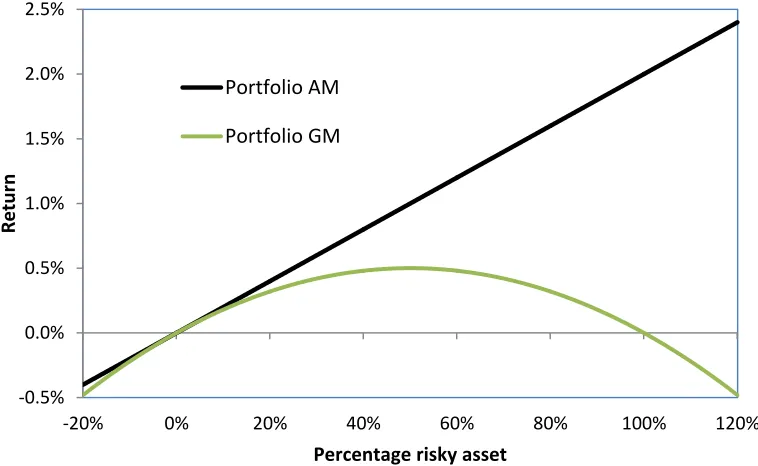
any period has a quadratic relationship11 with π, with the maximum expected GM at π = 0.5 as
shown in Figure 4.
11 E[GM] = E[AM] – σ
p2/2 = πσa2/2 - π2σa2/2= π(1-π) σa2/2. This result is derived by Qian (2012) and, in continuous time form, by Fernholz and Shay (1982). If there is only a single risky asset, with an expected GM equal to the risk-free rate, then the 50:50 fixed weight portfolio will indeed be the most attractive option for an investor who wishes to maximise the expected portfolio GM. But in practice there are likely to be alternative risky assets which are less than perfectly correlated. This allows clearly superior strategies to be constructed. If, for example, two or more assets have the same expected AM and variance then an unleveraged portfolio of them (however weighted) will have the same expected AM, but a lower variance,
and thus a higher expected GM. Combining this multi-asset portfolio with a fixed π% of cash will (for any
[Figure 4 around here]
Rebalancing is required to maximise E[GM] by keeping the portfolio composition at 50/50.
If π falls to zero then the portfolio is composed entirely of risk-free asset, with zero GM. If π rises
to 1 then the portfolio consists entirely of the risky asset and volatility drag will completely offset
the positive E[AM], leaving E[GM] zero. However, for short time horizons the proportion of the
risky asset in the portfolio should not be expected to diverge substantially from its initial 50%, so
the expected GM for an unrebalanced portfolio will be only slightly below that for the rebalanced
portfolio. Annex 2 demonstrates that this results also holds in continuous time, with an
unrebalanced portfolio which is initially 50% cash generating expected growth of approximately
, compared to for the equivalent rebalanced portfolio. Thus expected growth for the
unrebalanced portfolio is not the zero that is claimed. For short time horizons the term will be
negligible, showing that the rebalanced and unrebalanced portfolios initially have near-identical
expected growth. This gradual divergence of expected growth rates for these two portfolios is
inconsistent with the claim that one always generates rebalancing returns and the other never does.
By contrast, it is entirely consistent with the different growth rates being due to the gradual increase
in volatility (and hence volatility drag) as the unrebalanced portfolio’s composition gradually drifts
away from its initial equal weights.
If instead of following geometric Brownian motion the risky asset tends to revert to
a B&H strategy. This can be illustrated using the simplest possible example of two consecutive
periods of duration t over which the risky asset price evolves according to a geometric binomial
distribution, either rising or falling by a factor σ√t. The portfolio is initially equally-weighted, with
0.5 in the risky asset and 0.5 in the (zero return) risk-free asset. If the risky asset rises in the first
period, then the portfolio has 0.5(1+σ√t) in the risky and 0.5 in the risk-free asset. The rebalancing
trade then sells half of the first period gains on the risky asset (an amount 0.25σ√t) in order to return
to equal weights. If the risky asset price falls in the second period (by σ√t) then this trade generates
a profit of σ2t/4 over the two periods, and this is the amount by which the rebalanced portfolio
outperforms the unrebalanced portfolio (which simply returns to its starting value). The rebalancing
strategy makes an identical profit if the risky asset falls in the first period and then rebounds in the
second. Conversely, the rebalanced portfolio would underperform if the risky asset either rises in
both periods (in which case the rebalancing trade sold some of this asset at the end of the first
period before it continued to outperform in the second) or falls in both periods (so the rebalancing
trade buys more risky asset at the end of period 1 before its price falls in the second). Thus over
this two period horizon a rebalancing strategy generates greater terminal wealth than the B&H
strategy at a rate of σ2/8 per period, but this is strictly contingent on the assumption that the risky
asset price reverts to exactly its starting value at the end of the horizon.
The same result can be derived if we initially assume that the price of the risky asset follows
a standard geometric Brownian motion: . Without loss of generality we
risky asset has zero expected growth rate, implying that μ=σ2/2 and . A portfolio P r
which is constantly rebalanced to keep 50% in the risky asset and 50% in the risk-free asset will
always have half the upward drift rate and half the standard deviation of the risky asset itself
(μ=σ2/4 and standard deviation σ/2), giving us .
Fernholz and Shay (1982) note that whenever the unrebalanced portfolio returns to its initial
weights (i.e. W(t)=0, implying St=S0), the rebalanced portfolio will have outperformed by a factor
(since whilst the unrebalanced portfolio 0.5 0.5 will merely have returned
to its initial value of 1). Thus the rebalanced portfolio has ‘excess growth’ of σ2/8 per period
compared to the zero growth rate of each of its component assets, but again this is contingent on
the assumption that the risky asset returns at the end of the horizon to exactly its starting value.
One reason for the apparent confusion in the literature may be that this equally weighted
risky/risk-free asset portfolio generates two very different forms of return which happen to be of
equal magnitude. First, we have the extra terminal wealth generated by the rebalancing trades if
the risky asset reverts to its starting value. Second, as we saw above, we have the diversification
return which means that the rebalanced portfolio generates an expected growth rate of σ2/8 whereas
each component asset has a growth rate of zero.12 These two effects have the same magnitude, but
they use different metrics. The first is an increase in terminal wealth (a move along the horizontal
12 The assumption that μ=σ2/2 means that the risky asset has zero growth as the volatility drag perfectly
offsets the positive drift μ, but the equally-weighted portfolio has half the drift (μ/2=σ2/4) and only one
axis in Figure 1) whilst the second is an increase in the growth rate (the vertical axis). Moreover
the first is contingent on the risky asset price reverting to its starting value, whilst the second is not.
Fernholz/Shay (1982) is still very widely cited in support of rebalancing strategies. It
supports its claim that such strategies benefit from “buying on downticks and selling on upticks”
by noting, as above, that every time that the B&H portfolio returns to equal proportions the
corresponding rebalanced portfolio will have outperformed, and also noting that as t→∞ “this will
occur infinitely often with probability one”. This statement is formally correct, and appears to
imply that every rebalancing trade must eventually end up generating a profit, but this is far from
true over the finite horizons that are likely to be of interest to investors. Figure 5 shows that for
typical parameter values it takes several millennia for the probability that the rebalanced portfolio
outperforms the unrebalanced portfolio to get anywhere close to unity. Over horizons of up to 100
years Pr outperforms Pu in less than 70% of our 100,000 simulations.13
[Figure 5 around here]
Furthermore, even though the proportion of paths which at some point return to St=S0 tends
to 1, each period the subset of paths which have not yet returned to S0 will on average have diverged
further from S0 than in the previous period, so that a rebalancing trade made when it first diverged
13 Gabay and Herlemont (2007) derive a closed form solution for the single risky asset case which shows
from S0 will on average be recording ever-larger losses.14 It is only by taking both these subsets
into account that we can make meaningful statements about the expected return on the rebalanced
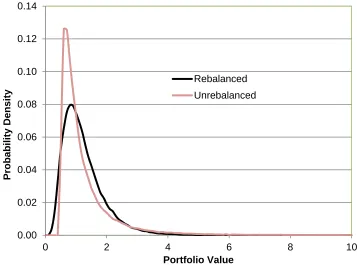
portfolio. Figure 6 shows that the unrebalanced portfolio Pu outperforms at both tails of the
distribution. Rebalancing trades are profitable on average on paths where St tends to mean revert,
leaving only small positive or negative cumulative returns. Conversely, when St makes large
cumulative moves in either direction (i.e. tends instead to trend) then Pr underperforms Pu.
[Figure 6 around here]
The right tail of the distribution thus shows Pu generating more extreme outturns than Pr.
Over time this tail represents a smaller and smaller probability space, but the average size of (Pu -
Pr) in these cases keeps increasing. It is straightforward to demonstrate that the expected terminal
wealth is in fact greater for the unrebalanced portfolio than the rebalanced.15 This
14 Similarly, we have the standard result that the expected length of time required for a geometric Brownian
motion with zero expected growth rate (μ=σ2/2) to converge to any arbitrarily distant level is infinite. The time to convergence for many paths may be very short, and the proportion of paths which reach this level inevitably rises over time, but the remaining paths that have not yet converged will on average have moved in the opposite direction.
15 As above, the underlying asset where W(t)~N(0,1). The upward skew of this lognormal
distribution gives E . Thus 0.5 0.5 0.5 0.5 . As above, the
rebalanced portfolio , where and hence . By inspection, the
extended, but ever-less-likely right tail explains why E[Pu]>E[Pr] even though the probability that
Pr>Pu tends to 1 as time passes. It also tells us that over finite investment horizons it is very
misleading to ignore this right tail by assuming (as Fernholz and Shay (1982) explicitly does) that
Pr always outperforms Pu. This is a property that is only true for infinite investment horizons.
5. Conclusion
A sizeable theoretical literature has now developed concerning the effects of rebalancing. Within
this literature it is widely claimed that rebalancing strategies automatically generate rebalancing
returns by “buying low and selling high” even when asset returns show no predictable time
structure. This paper demonstrates instead that the difference between the expected growth rates of
rebalanced and unrebalanced portfolios of IID assets is entirely explained by portfolio
diversification (volatility drag), with no evidence of any additional rebalancing returns. This paper
also shows that the arguments used by key proponents of rebalancing strategies based on infinite
horizons are not applicable over finite investor lifetimes.
We also demonstrate that all diversified portfolios generate expected growth rates greater
than the average growth of their component assets (the definition of “excess growth” used in this
literature). This contradicts the claims made by proponents of rebalancing strategies that such
excess growth is the direct result of the process of rebalancing, and so is entirely absent from
unrebalanced portfolios. By contrast, we show that unrebalanced portfolios initially generate the
same expected growth as the corresponding rebalanced portfolios and these growth rates only
The misleading arguments that are widespread in the literature have important implications,
since they lead to a misinterpretation of the benefits of rebalancing. Specifically, they encourage
investors to hold portfolios which are concentrated in volatile assets so as to increase the scale of
the resulting rebalancing trades (e.g. “The pumping effect is obviously most dramatic when the
original variance is high. After being convinced of this, you will likely begin to enjoy volatility,
seeking it out for your investment rather than shunning it” Luenberger, 1997). Frequent
rebalancing is likely to be costly due to transaction and market impact costs. Furthermore, the
desire to maximise these transactions may push investors into sub-optimal asset allocations.
Investors would be better advised to seek to minimize volatility drag by diversifying effectively
and to rebalance no more than is necessary to keep their portfolio compositions adequately close
References
Arnott, R. D., Hsu, J., and Moore, P. (2005) “Fundamental indexation”, Financial Analysts Journal, 61(2), 83-99.
Arnott, R. D., and Lovell, R. D. (1993) “Rebalancing: Why? When? How often?”, Journal of Investing, 2(1), 5-10.
Bolognesi, Enrica, Giuseppe Torluccio, and Andrea Zuccheri (2013) "A comparison between capitalization-weighted and equally weighted indexes in the European equity market", Journal of
Asset Management, 14(1), 14-26.
Booth, David and Fama, Eugene (1992) "Diversification returns and asset contributions", Financial Analysts Journal, 48, 26-32.
Bouchey, P, Nemtchinov, V, Paulsen, A and Stein, D.M. (2012) “Volatility harvesting: Why does diversifying and rebalancing create portfolio growth?”, Journal of Wealth Management, 15(2), 26-35.
Brennan, M.J. and Eduardo S. Schwartz (1985) “On the geometric mean index: A note”, Journal
of Financial and Quantitative Analysis, 20(1),119-122.
Buetow Jr, G. W., Sellers, R., Trotter, D., Hunt, E., and Whipple Jr, W. A. (2002) “The benefits of rebalancing”. Journal of Portfolio Management, 28(2), 23-32.
Chambers, D. R., and Zdanowicz, J. S. (2014) “The limitations of diversification return”, Journal
of Portfolio Management, 40(4), 65-76.
Cheng, Pao L., and M. King Deets (1971) "Portfolio returns and the random walk theory", Journal of Finance , 26(1), 11-30.
Cover, Thomas M. (1991) “Universal portfolios”, Mathematical Finance, 1(1),1-29.
de La Grandville, Olivier (1998) “The long-term expected rate of return: setting it right”, Financial
Analysts Journal, 54(6), pp. 75-80.
Dempster, Michael AH, Igor V. Evstigneev, and Klaus R. Schenk-Hoppé (2007) "Volatility-induced financial growth", Quantitative Finance, 7(2), 151-160.
Dichtl, Hubert, Wolfgang Drobetz, and Martin Wambach (2012). "Testing rebalancing strategies for stock-bond portfolios: Where is the value added of rebalancing?", Midwest Finance Association Annual Meeting.
Donohue, C., and Yip, K. (2003) “Optimal portfolio rebalancing with transaction costs”, The
Journal of Portfolio Management, 29(4), 49-63.
Elton, Edwin J. and Martin T. Gruber (1974) “On the optimality of some multiperiod portfolio selection criteria”, The Journal of Business, 47(2), 231-243.
Erb, Claude B., and Campbell R. Harvey (2006). "The strategic and tactical value of commodity futures", Financial Analysts Journal, 62(2), 69-97.
Fernholz, E. Robert and Cary Maguire (2007) “The statistics of statistical arbitrage”, Financial Analysts Journal, 63(5), 46-52.
Fernholz, Robert, and Brian Shay. (1982) "Stochastic portfolio theory and stock market equilibrium", Journal of Finance, 37, 615-624.
Gabay, Daniel, and Daniel Herlemont (2007) "Benchmarking and rebalancing", Working paper. Gorton, Gary, and K. Geert Rouwenhorst (2006a) “Facts and fantasies about commodity futures”, No. W10595. National Bureau of Economic Research.
Gorton, G., and Rouwenhorst, K. (2006b) “A note on Erb and Harvey 2005”, Yale School of Management, No. amz2595.
Granger, N. M., Greenig, D., Harvey, C. R., Rattray, S., and Zou, D. (2014) “Rebalancing risk”. Available at SSRN 2488552.
Hallerbach, Winfried G. (2014) "Disentangling rebalancing return." Journal of Asset Management 15(5), 301-316.
Harjoto, M. A., and Jones, F. J. (2006) “Rebalancing strategy for stocks and bonds asset allocation”, The Journal of Wealth Management, 9(1), 37-44.
Hsu, J. C., Chow, T. M., Kalesnik, V., and Little, B. (2011) “A survey of alternative equity index strategies”, Financial Analysts Journal, 67(5).
Kaplan, P. D. (2008) “Why fundamental indexation might - or might not – work”, Financial
Analysts Journal, 64(1), 32-39.
Kelly, Jr., J. R. (1956) “A new interpretation of the information rate”, Bell System Technical
Journal 35, 917-926.
MacBeth, James D. 1995 “What's the long-term expected return to your portfolio?” Financial
Analysts Journal, September/October, 51(5), 6-8.
Masters, S. J. (2003) “Rebalancing” Journal of Portfolio Management, 29(3), 52-57.
McLellan, R. I., Kinlaw, W., and Abouzaid, E. (2009). “Equity turbulence, fixed income illiquidity, and portfolio reallocation: The case for synthetic rebalancing” Trading, 2, 18-27.
Mulvey, J. M and W. Kim (2009), “Constantly rebalanced portfolio – is mean reversion necessary?” Encyclopedia of Quantitative Finance, John Wiley and Sons, U.K.,
Mulvey, J. M., Ural, C., and Zhang, Z. (2007). “Improving performance for long-term investors: wide diversification, leverage, and overlay strategies”, Quantitative Finance, 7(2), 175-187.
Perold, A. F and Sharpe, W. F. (1988) "Dynamic strategies for asset allocation", Financial Analysts Journal ,44(1), 16-27.
Platen, E. and Rendek, R. (2010). “Simulation of diversified portfolios in a continuous financial market, SSRN, Working Paper, University of Technology, Sydney, August 18th
Plaxco, L. M., and Arnott, R. D. (2002) “Rebalancing a global policy benchmark”, Journal of
Portfolio Management, 28(2), 9-22.
Plyakha, Yuliya, Raman Uppal, and Grigory Vilkov (2012) "Why does an equal-weighted portfolio outperform value-and price-weighted portfolios." Preprint available at http://dx. doi. org/10.2139/ssrn 1787045.
Qian, Edward (2012) “Diversification return and leveraged portfolios”, Journal of Portfolio
Management Summer, 38(4), 14-25.
Smith, David M. and Desormeau, William H. (2006) “Optimal rebalancing frequency for stock-bond portfolios”, Journal of Financial Planning, 19 (November), 52-63.
Stein, D. M., Nemtchinov, V., and Pittman, S. (2009). “Diversifying and rebalancing emerging market countries”, Journal of Wealth Management, 11(4), 79-88.
Thorp, E. O. (2010) “Understanding the Kelly criterion”. In L. C. MacLean, E. O. Thorp, and W. T. Ziemba (Eds.), The kelly capital growth investment criterion: Theory and practice. World Scientic Press, Singapore.
Tsai, Cindy Sin-Yi. (2001) “Rebalancing diversified portfolios of various risk profiles”, Journal of
Financial Planning, 14(10), 104-110.
Annex 1
Fama and Booth (1992) show that the continuously compounded holding period return is well
approximated by the expected return expressed in continuously compounded terms minus a fraction
of the variance of the simple returns.
2 2]) [ 1 ( 2 E[r]) log(1 r) + log(1 E r E
(A1)
This equation holds in each period, so we can sum each side over periods 1 to T:
T 1 t 2 2 T 1 t t T 1 t t ]) [ 1 ( 2 ]) E[r + log(1 ) r + log(1 E t t r E (A2)Rearranging and dividing through by T:
T 1 t 2 2 T 1 t t T 1 t t ]) [ 1 ( 2 T 1 ]) E[r + log(1 T 1 ] ) r + (1 [log E T 1 t t r E (A3)
T 1 t 2 t 2T 1 ] E[rt (A4)
If each period is short then E[rt] will be small and the continuously-compounded GM and AM
above will be close to their more commonly-used discretely compounded equivalents. Thus we end
up with a form of the standard relationship E[GM] ≈ E[AM] - σ2/2 which applies even if the
distribution of rt varies over time: the expected GM over the whole multi-period horizon is
approximately equal to the average expected return over these periods minus half of the average
variance. The linear relationships shown in Figures 2 and 3 confirm that this relationship holds for
Annex2:ExpectedGrowthRatesOfRebalancedandUnrebalancedPortfolios
(a)SingleRiskyAsset
The risky asset S follows ⇒ where μ=σ2/2, S0≡1. To keep the
notation simple we suppress the t subscripts in the following.
The rebalanced portfolioPr follows ⇒
Thus generating expected growth rate: log (A5)
For the unrebalanced portfolio Pu=0.5+0.5St=0.5+0.5
⇒ log(Pu)=log( 0.5 + 0.5e ) (A6)
A Taylor expansion of the exponent up to terms in σ4W(t)4 gives:
log P log 1 σW t (A7)
A Taylor expansion of the log up to terms in σ4W(t)4 gives:
log
(A8)
We cannot rule out the possibility that over long horizons higher order terms will become significant, but for modest investment horizons (where w(t) is small) these can be safely ignored. Substituting in standard assumptions for the cumulative Wiener term in geometric Brownian motion E[W(t)]≡E[W(t)3]≡0, E[W(t)2]=t, E[W(t)4] =3t2:
Hence the expected growth rate is E log . For small horizons the term will be
negligible, so the expected growth of Pu is identical to that of Pr. This is inconsistent with the key claim
made by proponents of rebalancing that Pr generates expected excess growth at a constant rate of
σ2/8 per period, whilst Pu has no rebalancing returns and hence zero excess growth (implying zero
total growth in this case since both the risky and risk‐free asset are assumed to have expected growth rates of zero). By contrast, the gradual decline of the expected growth rate of Pu is entirely consistent
with our contention that this decline is due to increased volatility drag as the composition of the portfolio drifts away from the optimal 50:50 mix.
(b)PortfolioOfNRiskyAssets
Each asset is assumed to follow a geometric Brownian motion , implying
where the initial value of S0 is normalized to 1. A rebalanced portfolioPr gives equal
weight to each of n such assets, so the growth rate of Pr is the weighted average of the growth rates of
the component assets (we again suppress the t subscripts in the following; summations are over the
n component assets):
∑ ∑ ∑ (A10)
These assets are assumed IID. The dWi are standard N(0,1) normal variates and are independent, so
ΣdWi~N(0,n) and the portfolio growth rate is distributed N(μi, σi2/n). We can express this in terms of
another standard N(0,1) variate dW:
⇒ ∑
√ (A11)
Thus application of Ito’s lemma gives a result for Pr which is similar to S, and simply reflects the lower
standard deviation ⁄√ of the rebalanced portfolio (and hence the reduced volatility drag).
⇒ log (A13)
The unrebalanced portfolio ∑ ∑
However, these assets are assumed IID:
⇒ ∑ (A14)
log log ∑ (A15)
Taylor expansion of the exponent up to the fourth power gives:
log log ∑ 1 (A16)
Taylor expansion of the log term to the fourth power gives:
log
(A17)
Note that for this standard Weiner process E[Wi(t)]≡E[Wi3(t)]≡0. Hence E[off‐diagonal terms]=0 so,
for example, E[(ΣWi(t))2]= E[ΣWi2(t)]=nt:
E log E E
Noting that E[Wi4(t)]=3t2 for this standard Wiener process and simplifying:
E log
(A19)
⇒ E log 1 (A20)
For small t the term is negligible, so the unrebalanced and rebalanced portfolios have the same
expected growth rate: E log E log . Thereafter the term becomes
significant so E log E log . An intuitive interpretation is that Puand Pr initially have equal
growth rates since they start with identical composition. Thereafter the arithmetic mean of the two portfolios remains identical (since the underlying assets are assumed IID), but Pu becomes less well
diversified over time, so it suffers from increasing volatility drag. But the claim that Pu never shows
FIGURE 1
Illustration of Volatility Drag
This chart shows how volatility in terminal wealth results in a lower expected growth
rate, in accordance with equation (4). A zero-volatility terminal wealth outturn of A
generates a growth rate B, but although two equally likely outturns equidistant (in
terms of terminal wealth) above and below A would generate the same expected
terminal wealth, they would generate lower expected growth C because the concavity
of the log function effectively penalises both exceptionally high and exceptionally low
outturns.
‐2.5 ‐2 ‐1.5 ‐1 ‐0.5 0 0.5 1 1.5
0.1 0.5 0.9 1.3 1.7 2.1 2.5 2.9
log(Terminal
Wealth)
Terminal Wealth
B
C
FIGURE 2
Rebalanced and unrebalanced portfolios – varying number of assets
These charts show the average annualized GM and variance of rebalanced and unrebalanced portfolios comprising different numbers (from 2 to 100) of component assets. The unrebalanced portfolios start with equal weights in the chosen number of assets, but these weights are then allowed to evolve in line with relative asset returns. For the rebalanced portfolio the weights are returned to equality at the end of each period. Asset returns are assumed normal, IID and not autocorrelated, with annualized arithmetic mean 10% and variance 4%. Each path is calculated over 100 years for 10,000 simulated paths.
Panel A Panel B
8.4% 8.6% 8.8% 9.0% 9.2% 9.4% 9.6% 9.8% 10.0%
0% 1% 2% 3%
GM Re tu rn Variance
Unrebalanced portfolio
Rebalanced portfolio
0% 1% 2% 3% 8.4% 8.6% 8.8% 9.0% 9.2% 9.4% 9.6% 9.8% 10.0%
2 12 22 32 42 52 62 72 82 92
Variance GM re tu rn
Number of assets in portfolio
Rebalanced portfolio GM (LHS)
Unrebalanced portfolio GM (LHS)
Unrebalanced portfolio variance (RHS)
FIGURE 3
Rebalanced and Unrebalanced Portfolios – Varying Initial Portfolio Weights
These charts show the average annualized GM and variance of portfolios comprising two assets. The unrebalanced portfolios initially start with the weight shown for asset A, but the weights are then allowed to evolve in line with relative asset returns. For the rebalanced portfolio the weight of asset A is returned at the end of each period to its initial value. Initial portfolio weights are given 101 different values (from 0% to 100% asset A) for both rebalanced and unrebalanced portfolios − a total of 202 variants. Asset returns are assumed normal, IID and not autocorrelated, with annualized arithmetic mean 10% and variance 4%. Each path is calculated over 100 years for 10,000 simulated paths.
Panel A Panel B
0% 1% 2% 3% 4% 8.0% 8.2% 8.4% 8.6% 8.8% 9.0% 9.2%
0% 20% 40% 60% 80% 100%
Va ri an ce GM ret u rn
Weight in asset A
Unrebalanced portfolio variance (RHS)
Rebalanced portfolio variance (RHS)
Unrebalanced portfolio GM (LHS)
Rebalanced portfolio GM (LHS)
8.0% 8.2% 8.4% 8.6% 8.8% 9.0% 9.2%
2% 3% 4%
FIGURE 4
Volatility Pumping – Single Risky Asset
This chart shows the arithmetic and geometric means of a portfolio comprising a risk-free asset (zero AM return and zero variance) and a risky asset (expected AM return 2%, and variance 4%) which is rebalanced to keep the proportion invested in the risky asset fixed at the indicated percentage.
‐0.5% 0.0% 0.5% 1.0% 1.5% 2.0% 2.5%
‐20% 0% 20% 40% 60% 80% 100% 120%
Return
Percentage risky asset
Portfolio AM